#oneaday Day 742: Being a Treatise on the Nature of Friendship in the Digital Age

20120131-010259.jpg

Today was a good day, because I took the relatively rare opportunity to take a friendship with an "Internet Friend" to the next level — real friendship. Speaking face to face. Being able to see each other, and having to actually speak words instead of typing things.

My erstwhile Internet Friend Holly and I had been conversing online for some time after a chance encounter — as I recall, it was a Twitter follow and a question on Tumblr that has long since been lost among pictures of cats and pushed Formspring answers. Regardless of exactly how it happened, we got chatting, and we did that Internet Friends thing of talking a whole bunch, going quiet for days, weeks, months at a time, and then picking up where we left off without too much difficulty. A familiar story to many of you reading this, I'm sure.

As it happens, Holly used to live where I now live (not literally in the same house, that would be super-weird). As such, she decided to come on down to visit her friends who are still in the area now she's elsewhere in the country. And we decided that it might be fun to meet each other and hang out.

Now, anyone who's ever broached the subject of a real-life meetup with an Internet Friend, whatever the motives for doing so might be, will doubtless be aware of that feeling of unease and anxiety that comes as the date for your meeting approaches. (Or perhaps it's just me. For the sake of this entry, however, I am going to assume you know what I'm talking about.) Will your friendship successfully carry over into the real world? Will you be able to make the same jokes you do on Twitter/Facebook/Tumblr/text message/however you've been conversing previously? Will the other person take one look at you, think you're some sort of hideous freak and run screaming out of the door?

Statistically, this is fairly unlikely to happen — in my experience, anyway. Out of all the Internet Friend meetups I have had over the years (and I've had a surprising amount, now that I come to think about it), only one encounter was a failure, and even then, it wasn't completely disastrous — we just didn't click in person for whatever reason. Past successful meetups saw me attending a showjumping event; getting married (though, granted, that didn't end all that well, but that's not the point under scrutiny here); flying to Toronto to play a ton of boardgames, see the sights and get sunstroke at the zoo; flying to Boston for super nerd-convention PAX East; having someone other than my brother and his family to visit when I'm in California (not that I don't enjoy seeing my bro!); and, indeed, my current living situation and relationship with Andie can also be attributed to a successful Internet Friend meetup.

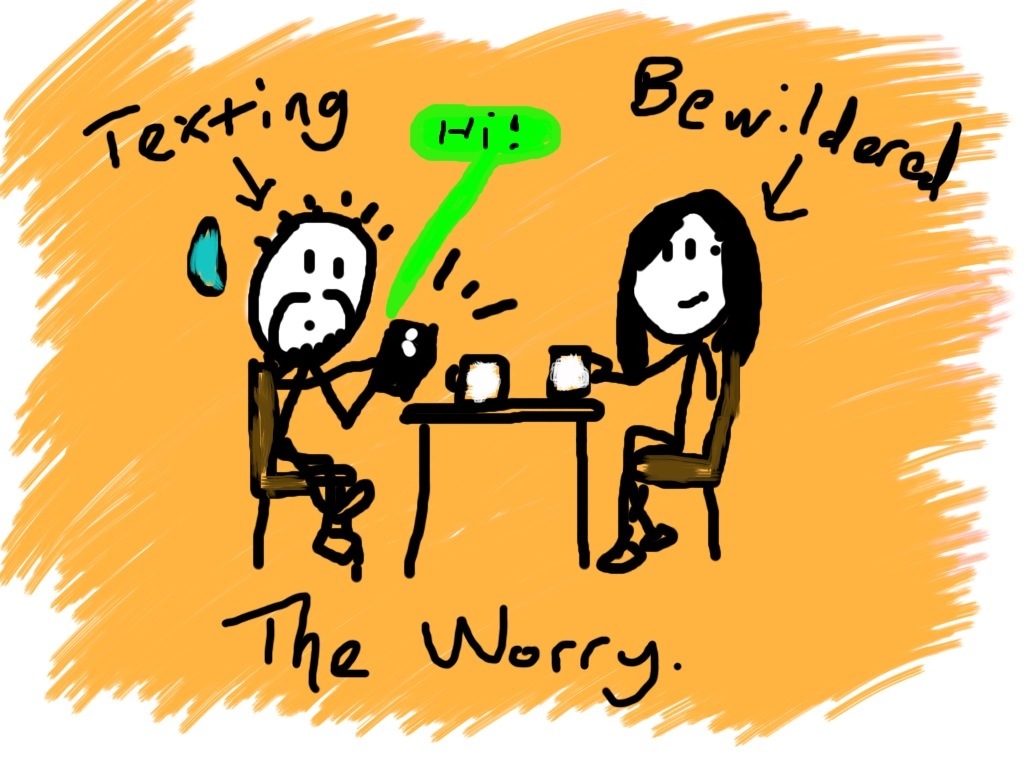
That one failure has haunted me a bit over the years, though. Despite all the other successful encounters, I still think back to that awkwardness I felt when I met Julia for the first time, and how awful I felt on the way home, thinking that all our long, heartfelt emails to one another had turned out to be essentially worthless. As those who know me well (and regular readers) will know, I am not the most confident person in the world, so to feel rejected like that — regardless of whether she had actually rejected me or it was simply my own social ineptitude that had caused the awkwardness — well, it hurt, quite a bit. As such, any time I've had the opportunity to meet up with someone I get on well with from the Internet, I've always been wary. All my insecurities and neuroses about my appearance, my personality and everything else all come out to play, and I find myself wondering if meeting is actually a good idea or not. In short, I worry the situation in the image above is what will happen.

Fact: it usually is a good idea to meet, and the situation in the image above is, mercifully, fairly rare. Look at it this way: you get on well online for a reason. For most people (those who aren't making a specific effort to troll, anyway), their online persona is a pretty true representation of the person they are — often sans any insecurities they have in face to face meetings. And if you get on well when speaking in text, it's pretty likely that you will get on in person, too.

You're doubtless waiting on tenterhooks to know whether or not Holly and I hit it off, then. (Maybe not.)

We did. We managed to easily fill several hours of conversation on a variety of topics, and both left feeling good that we'd done that. We're hopefully going to do it again before she has to depart back to far-off climes (relatively speaking). I'd call that a successful Internet Friend meetup, then, resulting in a real-life friendship. Hurrah!

So there you have it. You can make a Real Friend out of an Internet Friend. But you probably knew that already.
#oneaday Day 708: Stupid O' Clock

It's, once again, stupid o' clock in the morning, but this time The Old Republic isn't to blame. At least, not directly — no, instead, this evening/morning's lateness is due to the long-awaited return of the Squadron of Shame SquadCast.

The Squaddies are some of my most long-standing friends, and people I speak to in some capacity pretty much every day. I'd even go so far as to say that they're probably the best friends I have, despite the fact that we're several thousand miles apart and see each other face to face rarely — and in some cases, we still haven't met in person.

From humble beginnings as a loose community on 1up.com's message boards to a more organised "club" on the site and, eventually, cutting loose into the big wide world by ourselves, we've stuck together through thick and thin, through life's big moments and its little pleasures. And between us, we've built friendships that have endured, remained strong through various adversities, and grown stronger over the years.

This, people, is the power of the social Web. It's not about building a "voice for your brand". It's not about "engaging with your audience". It's not about "leveraging somethingorother". And it's certainly not about "monetization strategies". It's about socalisation, society, people. It's easy to forget that with the amount of information we're voluntarily bombarded with on a daily basis. We willingly subject ourselves to a barrage of stimuli from a diverse array of sources — some of which are real people acting with real honesty; others of which are real people holding up a façade in an attempt to be someone they're not; others still of which are people acting as the voice of a brand, attempting to bring a face to the faceless corporate world.

Events which transpired today showed the potentially disastrous consequences of acting as the voice of a brand, not of an individual. Ocean Market(t)ing [sic] president Paul Christoforo descended into childish insults and poorly-spelled, poorly-articulated attempts to assert his authority and regain his credibility when confronted with an irate customer. The email exchange has, thanks to its posting on Penny Arcade earlier today, gone viral, and Christoforo has become the object of ridicule. It isn't the first time this has happened, and I fear very strongly for Christoforo's future job prospects after this debacle, particularly as so many employers are now taking social media "output" into account when considering applicants for positions. Don't get me wrong, Christoforo was a dick, but is it really fair to potentially jeopardise his whole future over things that clearly happened in the heat of the moment.

Somewhere along the line, I believe we've lost our way with the social Web. We made the critical mistake of letting the marketers and businessmen take charge of something which should bring people together. Rather than situations like that which brought me and the Squaddies to each other, we get popular brands asking facile questions and the eager hordes responding in all-lowercase, thereby indirectly promoting the brand in question. We get people carefully guarding the way the represent themselves online so as to protect their personal brand. We get situations spiralling out of control, such as that seen with Christoforo and his customer earlier today.

It's not all doom and gloom, of course; to imply that the world is going to hell in a handcart purely because of the presence of marketers is foolish. But it would do many people well to, once in a while, remember what the "social" bit of "social media" really means. Does it mean telling the faceless drone behind the The Sims Facebook account that your favourite colour is indeed green? Or does it mean striking up conversation, getting together, finding new people that you want to spend time with?

I'd opt for the latter every time. And now I need to go to bed before I pass out.

#oneaday Day 555: Social Smarts

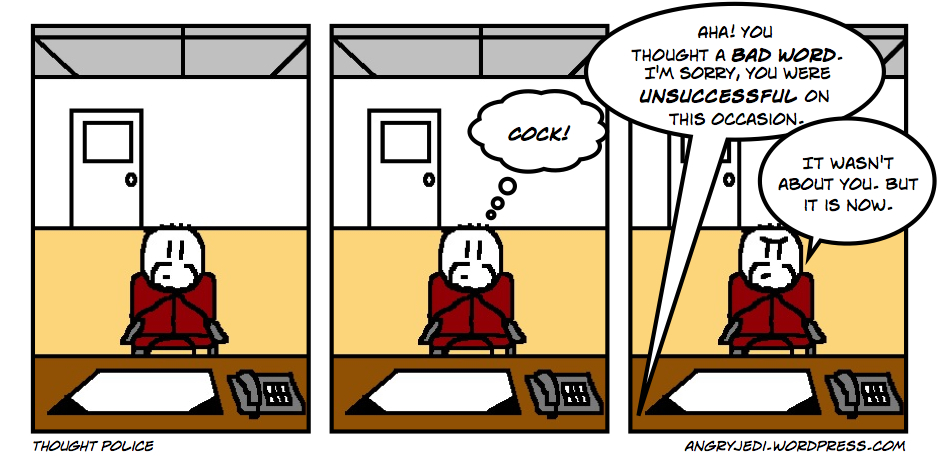
This story in the New York Times tells of a year-old startup company called Social Intelligence, whose remit consists of assembling a dossier of information on job applicants based on their online activity over the past seven years.

Now, you may argue that employers are perfectly within their rights to carry out background checks on prospective employees, and you'd be absolutely right — it's why schools and other positions which place people in positions where they will be dealing with "vulnerable" individuals require a disclosure check to make sure the applicant doesn't have a checkered criminal past. Evidence of professional honours and charitable work also helps make an employer feel that not everything listed on a CV is a fabrication.

The concerning part is what else Social Intelligence looks for — according to the NYT article, "online evidence of racist remarks; references to drugs; sexually explicit photos, text messages or videos; flagrant displays of weapons or bombs and clearly identifiable violent activity." The concerning part is not the type of content that the company is looking for — it's how it might be stumbled across in a typical Internet search. That is, completely lacking in context. I'm not for a moment condoning violent activity, racism or anything else dodgy. But, frankly, everyone makes jokes, and sometimes those jokes are off-colour. Everyone has embarrassing Facebook photos, many of which are not what they seem. And if someone's had a puff of weed of a weekend and had a good giggle about it with their friends, that doesn't make them an inherently bad person, either.

"We are not detectives," said Max Drucker, CEO of the company. "All we assemble is what is publicly available on the Internet today."

Fair enough; but where does it stop? Once employers get the message that it's okay for companies like Social Intelligence to start trawling through your online background, what's to stop them from rejecting you based simply on something you said to your friends, or who you associate with online. This is particularly relevant given the "amusing" practice of friends "facejacking" or "fraping" each other's accounts given the opportunity — perhaps they left their account logged in, perhaps they left their phone on the table to go for a piss. Regardless of how or why it happened, a good-natured facejacking with all its usual excesses could well lead to someone's job prospects being dashed on the rocks — through no fault of the candidate.

Then there's the privacy question. Not necessarily the "what you share" question — that's a different matter entirely, and one which every individual must decide upon: what are you willing to tell people online? No, the privacy question I'm concerned about here is the divide between the personal and the professional. We're all different people at work — we behave in one way when we're on the clock, expected to be that person listed in the Person Specification and deal with customers and clients in the way we're supposed to, but as soon as 5pm rolls around we're off down the pub, swearing like a sailor, giving each other light-hearted ribbings and possibly making fools of ourselves. This latter part of the day doesn't affect our capability to do the job effectively. This latter part of the day is completely irrelevant to an employer — and, given most social networks' focus on the "personal" rather than the "professional", most social networks save the interminably boring LinkedIn are also completely irrelevant to an employer.

As someone who suffered workplace bullying from management partly as a result of some extremely vague negative comments on Twitter (which didn't mention the company in question at all, I hasten to add) — and witnessed several colleagues get fired over a Facebook prank that went awry — I feel particularly strongly about this. The things I said online were vague, not directed at my employer but at my life situation in general, and designed to let my friends who cared about me know how I was feeling — which wasn't great at the time. My professional life had no place intruding on my personal life — my personal life was not affecting my job performance, which had never been better. There were facts and figures and customer satisfaction surveys to prove it. Ironically, all the poor treatment I received at the hands of this shockingly bad management did was make me more likely to badmouth them now that I've left the company. But specifics of that are for another day.

The best analogy I can think of for Social Intelligence's work would be if as part of your job interview you had someone from the company follow you to the pub in the evening, follow you home, watch you go about your daily business, watch you have a shit, shower, shave, and then go through your bins just for good measure. In the days before social networking sites employers didn't do this, so just because there is the possibility for unprecedented invasions of privacy doesn't mean that it should happen.

Sadly, however, in the modern world, a lot of people seem to think that the words can and should are, in fact, interchangeable. And as such we end up with companies such as Social Intelligence rifling through candidates' virtual dirty laundry in an attempt to come up with the one tragic flaw that means Mr Perfect is not, in fact, quite so perfect for this position after all.

To me, the concept of "watch what you say" goes against everything social media — which should, in essence, be the ultimate form of free speech — stands for. But while this sort of thing is going on, you'd better just double-check those privacy settings, and cancel that account on that swinging site you signed up for "just to take a look."

#oneaday Day 533: More Thoughts on Google+

So I've been using the service for a few days now and the fact I've made it a Pinned Tab in Chrome should tell you how much I like it. I think it's got a huge amount of potential, and I sincerely hope that it takes off. I also sincerely hope it doesn't just morph into an identikit Facebook — but hopefully that won't happen, because although Google is gradually spreading itself over all aspects of the web, they haven't (yet) done anything that particularly offends me from a privacy or usability perspective. In fact, every change they've made to their services while I've been a user has been for the better.
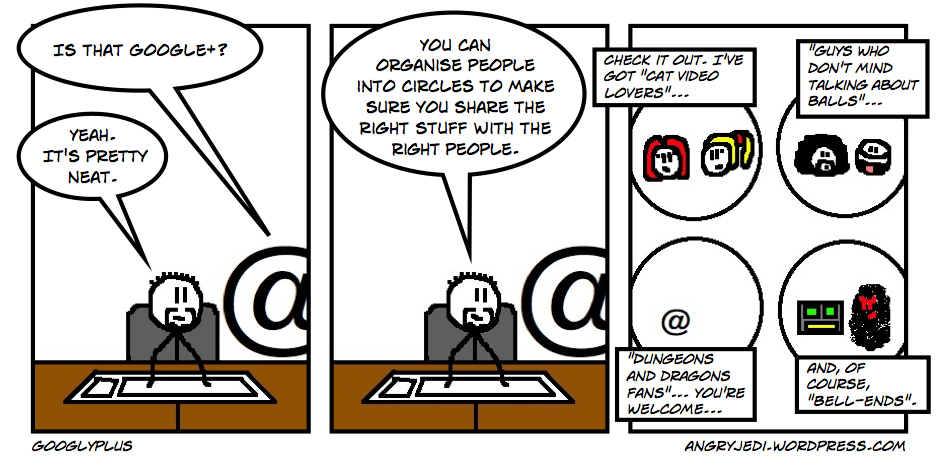
So let's go over some thoughts, tips and tricks in handy bullet-point form, for those of you who are just getting started — or those who have been using it for a while. Or those who tried it once and immediately gave up. Or, well, just anyone interested, really.

  • Circles are made to be used. Use them! Make as many as is practical for you. Don't stick with the Facebook approach of keeping everyone in one Friends list. There will be some crossover between Circles as a natural process, particularly if you and your friends share some common interests, but they're there to be useful. Case in point: today I shared my GamePro articles only with those who are specifically interested in video games (which, as it happens, is most of my friends currently on G+) — once more people get in there, that facility will be a godsend.
  • The photo interface is gorgeous. The photo viewer looks great and has a nice layout, and the way the photos are tiled on the album page is attractive and distinctive. My only quibble is that you can't rename an album — or so I thought. As it happens, since G+ photo albums are actually albums on Picasa, to change an album name all you need to do is go to Picasa's website and change it there. Hopefully Google will add the facility to do this within G+ shortly — because, as I found out tonight, long album titles break the page layout.
  • You can format stuff with special characters, not HTML. Putting *asterisks* either side of a word/phrase/sentence/paragraph makes it bold. Putting _underscores_ either side of something makes it italic. Putting -dashes- either side of something makes it strikethrough. You don't appear to be able to underline things.
  • Buzz is shit. I turned on Google Buzz because it adds a tab to your profile where your Twitter feed, Google Reader shared items and various other goodies can be automatically shared. However, this only appears on your profile and takes literally hours to update, making the auto-import from Twitter in particular utterly useless.
  • No ads is nice. I know it won't last, but using a social network with no ads makes for a lovely, clean experience.
  • Face recognition when tagging photos is a good start, but needs work. It doesn't recognise some faces, and it would be nice if it "learned" faces like iPhoto does. Still, it automatically spotting where faces are is a good start.
  • Resharing should be an option. You can post something then disable reshares and/or comments for it after it's been posted — but that might be too late. You should be able to choose whether or not a post is resharable or commentable before you post it.
  • +1 is a useful bookmarking function. More sites are starting to use it now, and having a tab on your profile for all your +1s is handy. However, as the feature grows, this list is going to become long and cumbersome. It needs to be searchable, taggable or able to be organised into some sort of hierarchy. +1s also need a Share button if you want to post them to your Circles, as currently your +1s around the Web have nothing to do with G+ besides appearing on this tab.
  • The current absence of brand pages is wonderful. Another thing that won't last, as every corporation believes it needs a presence on every major social network. But for now, the fact that G+ remains a truly person-based social network is thoroughly pleasant.
  • Notification bar across all Google apps is great. This means you're always engaged with the service, yet it's not overly intrusive. The fact this is already integrated hopefully means further service integrations in the future — Events auto-syncing with Google Calendar, for example, would be smashing.
  • Things I'm looking forward to: Themes, non-obtrusive extensions, the iOS app, further integration between Google services, the service being open to everyone.
  • Things I'm not looking forward to: Social games, brand pages, ads.

#oneaday Day 528: Thoughts on Google+

You can't say I don't provide you with variety here, dear readers. Just yesterday I was talking about underage boys simulating anal sex in a school library in order to avoid doing work, and today I'm telling you about what may or may not be the next big thing in social networking: Google+, Google Plus, Googlyplus, G+ or whatever the hell you want to call it.
If you haven't got in yet, don't ask me for an invite at the moment as they've switched them off for now. Keep an eye on Twitter or Facebook, though — I'll let you know if I have any more spare.

So, to business. What is Google+? Well, the cynical would say it's a rebranded Facebook, and indeed we've already seen at least one article today bemoaning the fact that Google+ has some features in common with Facebook. I'm not sure why they felt the need to draw attention to this, as the features they show are pretty commonplace in all social networks.

But are those cynics right? Well… yes and no. Google+ does indeed resemble Facebook. You have a news feed, people can comment on posts, people can Like things (or "+1" in this case) and people can share content. The key difference between Google+ and Facebook is how it handles the way you interact with people. There are no "friend requests" on Google+, simply Circles. Circles is an evolution of Facebook's Groups system, in which you can categorise your friends, acquaintances and family members into, well, categories. Then, when you post something on the network, you can choose which individuals or Circles it's visible to — or even make it completely public. This is a nice idea. It allows people to tailor the content they spew out to different social groups without feeling that they need to have a "work" profile and a "professional" profile. So long as, of course, you remember to keep the stories about the hooker you threw up on to your "Drinking Buddies" Circle and don't accidentally copy in your boss.

So the way you deal with people is different. But there's more; the photo interface is simple, elegant and much better than Facebook's slightly clumsy lightbox. While I think that the lightbox was a good addition to Facebook's interface, many disagreed, and the fact it's difficult to view the image and look at the comments at the same time unless you have the highest-resolution screen in the world is not great. Google+ takes a different approach. Not only does the service allow you to upload pictures at considerably higher resolution than the artifacted messes that Facebook's compression creates, but the interface allows for simple inline commenting while still viewing the picture. It's a simple case of putting the comments in a sidebar rather than underneath the picture, and it works beautifully well.

Then there's the fact that the Photos feature on Google+ integrates with Google's Picasa service. Anything you post on Picasa will be available on Google+, and vice-versa. You can even use Picnik to edit the photo, add text and generally arse about with it, save it back to Picasa (even overwriting the original if you don't need it any more) and the modified version will be right there in your feed without you needing to refresh the page. Clever. Since Picnik is a third-party service, though, this isn't integrated quite as well as it could be — an "Edit with Picnik" option when viewing a photo on Google+ would be nice, for example — but it's early days yet. And Google+ allows simple iPhoto-style edits of colours and the like to be applied to pictures without having to leave the page, which is nice, particularly for those who either don't know a lot about photo editing or don't have the software to do anything fancy-pants.

This isn't even getting started on the excellent Sparks feature, where you can subscribe to topics of your choice and be fed a constant stream of relevant articles — which can, of course, then be shared with the Circles of your choice if you see fit.

As you can tell, I'm quite enamoured with the new service and genuinely hope it takes off. My only worry is that it, like Facebook, might try and do too much. Facebook was an excellent service when it felt personal, but now it's as much a home for businesses to engage with their clientèle as a means of communication, it's becoming increasingly irrelevant to people who just want to talk to their friends. Google+'s simple elegance that it has at the moment doesn't have any of that noise — and none of the associated spam from social games and endless "What Length of Pubic Hair Are You?" quizzes, for that matter. I'm sure it won't stay that way, as social game and app developers are already pricking their ears up at the buzz surrounding the service, but I hope it stays that way for at least a little while. There's definitely a market for a clean, clear social network with minimum fuss that offers something a little more than Twitter but a lot less than Facebook. And I think Google+ has the potential to be it if the developers handle it correctly.

#oneaday Day 510: Come Play with Me

Some of you may not be aware that I've been writing regular pieces on up-and-coming social games for Inside Social Games. A number of things have become apparent during my ongoing whistle-stop tour of the social gaming space. Firstly, Facebook games are getting better, and secondly, there's still a lot of work to do.

Here's a few things that, to my mind, would improve the Facebook gaming experience immensely. I'm not a professional analyst, nor have I done extensive research into online usage habits, so I imagine a man with a beard bigger than mine will probably be able to counter each and every one of these arguments, but anyway. This is my opinion — and some games do one or more of these already, so fair play to them, I say.

Stop copying each other.

Imitation may be the sincerest form of flattery, but when you're making a game that is mechanically and aesthetically identical to a competitor's product, you're not giving a potential player a reason to play your game. Differentiate yourself — and not just by making the game in a different setting. Ripping off two distinct but similar titles does not count either, so if you make a city-building game where you can farm crops, think of something better. Little Cave Hero is a good example — while the city-building mechanics are similar to a million other titles out there, there are extra bits, such as your "factory" structures producing crap that either you or a friend have to clean up, user-generated content, and then the meat of the game — puzzle-based mine exploration.

Stop insisting I "share" everything.

The number one complaint people have about Facebook games is when a player spams their wall (and, in worst cases, other people's walls) with bollocks about what they've just "achieved". The reason for this is that in the vast majority of social games, completing any mundane task pops up a huge window inviting you to share your "achievement" with friends. In some more extreme cases, the "Share" button is much more obvious than the "No thanks, kindly piss off" button.

Sure, there's a viral marketing thing at work here — but at least make it optional for people who just want to play the game. Add a Share button, sure, but don't make it quite so in-your-face. Better yet, add the option for players to switch off notifications like this altogether.

Stop insisting I "give you a five star review".

By all means solicit user feedback. But to be perfectly honest, many average Facebook users either aren't that bright, aren't very computer literate or — in some hopeless cases — are neither. As a result, many of them are apparently incapable of doing anything other than what is written in front of them. Invite them to "write an honest review" rather than "give a five star review" and you might get some honest, if badly-spelled, feedback. Invite them to "give a five star review" and you'll get lots of five-star reviews, very often with no feedback whatsoever. This not only makes Facebook's app rating system utterly worthless, it also removes a potential way for players to get their voices heard.

If you want me to Like your page, post something worth following and commenting on.

Screenshots of your game are not interesting — I've played it. I know what it looks like. Attempts to engage with the community are interesting. Take a vote on what new quest you should add next, or what character you'd like to see more of. Let the community play a part in the development of the game.

Stop claiming you're the "first/best/most [something] on Facebook".

If everyone says it — and they do — no-one believes it. If your game's good, word will spread, both via the press and word of mouth. The elusive "core gamer" market isn't going to flock to your Facebook game just because you say it's built for core gamers.

Give my friends something to do.

Yes, being able to look at a friend's town is cool. But it's ultimately pretty meaningless if I can't interact with anything there. Let us do stuff together. Provide some multiplayer content, or rebalance the single player content for people to play together — perhaps even simultaneously! Diablo did this years ago.

My friends aren't going to want to play or add me as a neighbour if there's no real reason to do so.

Don't break the game with your premium items.

By all means monetize your game — you made it, so you deserve to earn something from it. But don't make paid-for items into "win buttons". Also, don't allow people to buy their way out of quest objectives. Allow players who pay to make quicker progress — perhaps increase their experience gain — or customize their character/city/world to a greater degree, but don't undermine the game mechanics.

Offer a subscription.

Someone who plays your game regularly will be quite happy to spend a fiver a month to get access to additional features or make quicker progress. Microtransactions can mount up easily without people noticing — good for business, not great for ethics.

Let me fail.

If I fuck something up, give me a consequence. Life isn't all about happy-happy-joy-joy. Sometimes you get things wrong, in which case I should have some sort of penalty more severe than "wait five minutes and try again". In city-building games, don't let me move my buildings. If I built something in the wrong place or planned my city ineffectively, punish me by making me demolish my hard-earned building and spending the time and money to construct it again.

Make the tutorial optional.

Some Facebook gamers need step-by-step help on how to get started. Others have played games — either Facebook or otherwise — before and already know how it works. Offer the opportunity to skip the tutorial — especially if it's a long and incredibly boring one.

Provide a reference manual.

Perhaps I've forgotten what one of your beautifully-designed but obtuse icons does. Perhaps I can't remember how to do something. Let me look it up.

Let me start again.

Maybe I called my character the wrong thing. Maybe I hate my city and want to build a new one. Let me wipe everything out and start afresh.

Try a different look.

The vector-graphics Farmville look is old hat. Try a different look. This is one of those few instances where it's actually desirable to have something that's a bit more dark and gritty than normal. If your Facebook game is based on an established franchise, do try and make it look like other entries in the same franchise. You don't have to "kiddy it up" for Facebook — grown-ups use Facebook, too.

Ditch game mechanics that don't belong in a particular genre.

A game about completing wordsearches and crosswords has no place for an experience system. Allow players to unlock new challenges via their progress, not via arbitrarily-issued experience points. Similarly, ditch the Energy system, as it often leads to players being stuck halfway through something and then forgetting what they were doing when they come back to it. If you must control how much people play (and monetize the ability to play more) then find a different way that allows players to complete something before they get locked out.

Provide a meaningful mobile experience.

Create, at the very least, an iPhone and Android-compatible web experience. Ideally, you'd create an app for both iPhone and Android that allows players to participate in your game when they're on the go. Don't make a mobile version of your game that has nothing to do with the Facebook version!

Polish your game.

Proofread your text before you release to the public. Spelling mistakes and grammatical errors look unprofessional. Make sure the game works and fix it promptly if it doesn't. Little details like this can make the difference between a popular game and a laughing-stock.

Have some character.

Games are fun! Stop being so po-faced and get a proper writer to inject a bit of wit into your dialogue. If people are made to smile or even laugh by your game — or even be scared or upset by it — then they're more likely to return for further emotional experiences. If the whole thing is very businesslike and dull, despite a cartoonish appearance, then it's not going to hold anyone's interest.

There we go. Some free advice for any of you developing or considering Facebook game development. As I say, I mention all these things with the caveat that I can't develop games as I don't have any programming experience. Many of these games are undoubtedly impressive technical, creative achievements. But for them to be taken more seriously by some parts of the community, changes need to be made — but making those changes will not only please those who feel turned off by Facebook games, it'll also present additional revenue streams for the developers and publishers in question. Everyone's a winner.

#oneaday, Day 22: Make Love, Not Hate

On the Internet, opinions exist in a binary state for many people. There is your opinion (1), and there is everyone else's opinion (0). Sometimes other people's opinions coincide with your own, meaning they can join you in the happy 1 gang, while the 0-toting losers get to stand over there being Wrong.
It's strange, though, really, isn't it? People develop such strong feelings about particular issues, and these opinions spread virally very quickly via all forms of the media. I remember reading about this in A-level Sociology and forget all the names and dates of studies concerned, but since this isn't an essay I'm not going to go and look them up. What I do know is that nowadays, such opinions spread far quicker than they have ever done before thanks to the immediacy of online social interactions, meaning that in some cases people may end up feeling that they should change their opinions on things in order to remain somehow "credible".

'Twas ever thus, of course, with the school bullies always listening to the most badass music out there whilst the flute-playing pansies amongst us voluntarily listened to—or even played—classical music. (Guess which of the two categories I was in, though I didn't play the flute. Flutes are for girls.) One group tended to kick the shit out of the other on a fairly regular basis, and it was usually a pretty one-sided battle.

You shouldn't start actively hating something just because other people say so, though. You should take pride in your tastes, however idiosyncratic or separate from the supposed "norm" they are.

Let's take a few examples of Things I Like That Should Be Embarrassing To Admit But Really Aren't, Honestly, No, Stop Looking At Me Like That And Please Don't Unsubscribe, Think Any Less Of Me Or Be Any Less Likely To Do Nice Things For Me (Like Buy Me Cake, Give Me A Big Wet Snog Or Make Me A Delicious Roast Dinner) Should The Opportunity Come Up.

Okay. I can do this.

(takes deep breath)

I like Robbie Williams. I also enjoy the comedy of Michael McIntyre, the radio show of Chris Moyles, the bubblegum pop music of MIKA and think Ke$ha's album is a work of quirky genius that I believe I have described as "sounding like Kelly Clarkson being forcibly inserted into a NES" on several occasions. I voluntarily bought both Dead or Alive Xtreme games and played them a lot, and not just for the bazongas involved, I enjoyed the dumbass illogical "dating sim" mechanics that were in there too. I follow Katy Perry on Twitter and find her music cheerfully uplifting. And I own two Spice Girls CDs.

Tastes change over time, of course, but who's to say that I'm "wrong" for liking any of those things just because the popular opinion is to hate them and deride those who enjoy them? I'm just as guilty as anyone else, of course; I find myself hating shows such as The X-Factor, Strictly Come Dancing and the like irrationally and automatically. I loathe Call of Duty. I would rather gouge my own eyes out than watch anything involving Piers Morgan (I think we can all agree on that one, surely).

The world would undoubtedly be a nicer place where everyone could feel more confident in themselves if our personal preferences stopped being scrutinised so much, and assumptions made based on those preferences. Take the recent announcement of Final Fantasy XIII-2, for example, a sequel to one of the most controversial Final Fantasy games there has ever been. Not because of the content, but because of the gameplay, which wasn't to everyone's liking. There are people out there who assume that because Final Fantasy XIII wasn't to their taste, XIII-2 is going to be shit as well. Justifications range from "Square have lost their way" (well, perhaps, but can't they pick it up again?) to "it's the same team, of course it's going to be rubbish" (because everyone is always universally good or universally bad?) and it's nonsense. Nonsense I tell you!

Basically, do your blood pressure a bit of good and start concentrating on the things you like a bit more. Tell people how much you like them, by all means. But let's all make a pact to stop making people feel bad about things that you, personally, "hate".

Unless it's terrorism, AIDS or Piers Morgan. You can hate those as much as you like.

#oneaday, Day 327: LOOK AT MY FACE.

There are people out there who are paid frankly obscene amounts of money to develop a company or brand's "social media strategy". This is a position that wouldn't have existed five years ago, yet now it's the new hotness. If you've got anything to do with marketing, social media is where it's at.

These "gurus" have come up with their own set of arbitrary rules about what "works" and what doesn't. Supposedly, following their bible of social media norms helps you to get hits and be more influential online. Perhaps they're true. But some of them strike me as a little odd.

Take the way social media news website Mashable presents itself on Twitter, for example. Actually, first of all look at Mashable itself. Not the most personality-filled site at first glance, is it? Sure, the personalities come out in the writing, but at first glance it looks like just any other tech news site.

So then, take a peep at Mashable's Twitter account. Notice anything odd?

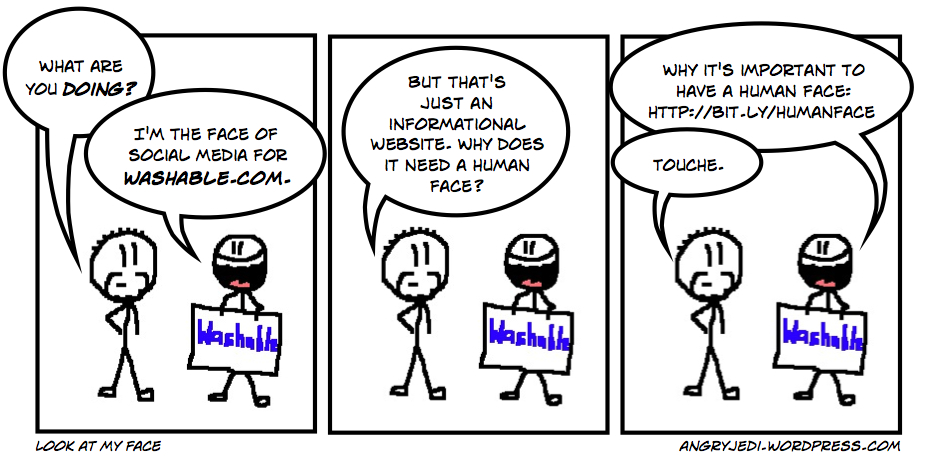
Right. Despite obviously being the official account for Mashable the site, and posting little more than links to their articles with little to no interaction with their millions of followers, they have taken the inexplicable decision to present the site not as a site, but as the face and name of CEO and founder Pete Cashmore. Thus, when something from Mashable comes up in your Twitter timeline, depending on how you've got it set up, it looks like these links are being posted by a person, not by an automated RSS-to-Twitter doobriewotsit. But they're not. Unless there's a very bored intern at Mashable in charge of doing that.

Now, the theory behind this is that putting a human face on a Twitter account makes it inherently more "trustworthy". As anyone who's used Twitter before will know, bots are a pain in the arse and should be killed with fire, but it's usually reasonably obvious that they are bots. There's the odd exception, but for the most part, it's very clear.

So, with that in mind, isn't it actually rather more dishonest to post automated updates from a website pretending to be an individual person? I honestly can't understand the logic behind it. I'm sure some social media guru out there will be able to educate me. But I know that generally speaking, if I'm looking out for an update from a particular website in my Twitter timeline, I'll be looking out for that website's logo, not some bearded guy with a slight sneer.

Unless Pete Cashmore thinks he genuinely is the logo for Mashable, in which case the website should replace its header with a GIANT PICTURE OF HIS FACE. Possibly with a big flashing logo saying "OBEY".

Maybe.