#oneaday Day 814: Death of a publication

I've finally finished my efforts to catalogue all the games-related articles (including roundups, re-reviews, type-in listings and issue disk bonuses) from Page 6/New Atari User. My data sheet has over 2,000 rows in it, though some of those are repeats. Even so, that's a lot of material to work with.
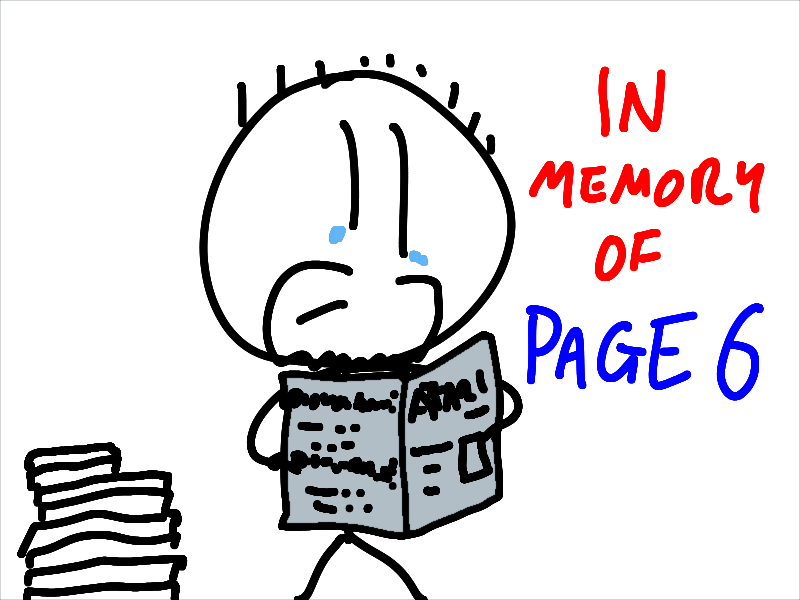
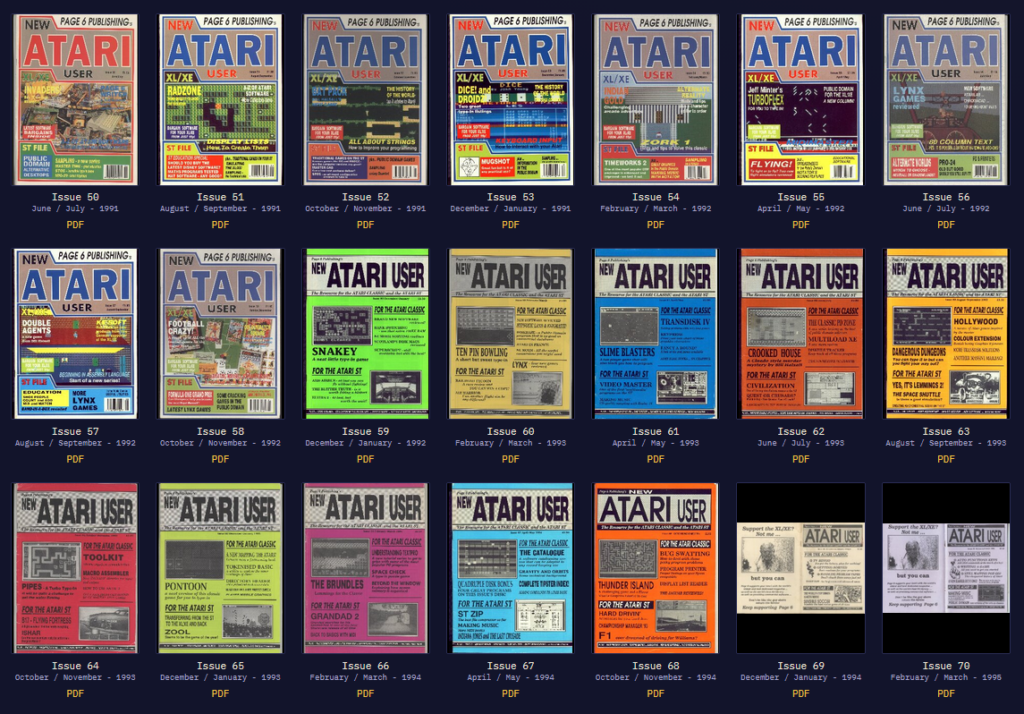
As I found myself reviewing the latter-day issues in the magazine's run, though, I found myself feeling an intense sense of melancholy and almost mourning, I guess. Over the course of the publication's complete run, you can see at a glance when it was doing the best (full-colour covers with specially commissioned artwork or photography to appear prominently and attractively on newsstands) and when things started to go downhill (single-colour covers, the return to a subscription-only model) and when things were nearing the end (a switch to an A5 format, with less and less in the way of commercial releases covered each issue).

Here's a shot from Atarimania, which hosts a full archive of Page 6/New Atari User issues, that shows three stages of this evolution:
I found myself feeling sad all over again while working my way through these issues — because I remember this happening first time around. I remember getting Page 6/New Atari User every month, and in those latter years, feeling like something which had been a fixture in my life for as long as I could remember was ailing and would eventually die. Page 6 started before I was old enough to know what a computer or a magazine was, so it was always present throughout my childhood and adolescence.

Its final issue — in which the editor, Les Ellingham, made an unfortunately unkept promise to readers that there would be six more issues of the magazine before it finally closed for good — is a sad read. Even my Dad, who had been a contributor from midway through the magazine's run up until its very last issue, had given up writing about specifically Atari-related stuff, and was instead posting a regular column about the wonders of the then-nascent (at least in consumer-accessible form) Internet and World Wide Web. My article spreadsheet has just a single game-related entry for that final issue: a public domain version of Tetris for Atari 8-bit.

One of the most remarkable things about Page 6/New Atari User is that it wasn't the Atari ST coverage which lasted until the b(l)itter end. No; the last few issues contained pretty much nothing but Atari 8-bit coverage, which provided the first hints of the fact that the "Atari Classic" scene, as the magazine referred to it at the time, would continue to thrive in the years to come, even in the absence of a major specialist publication.

The ST scene is still alive too, but I can't help but feel like there's a lot more Atari 8-bit enthusiasts out there than Atari ST people. After all, the ST marked the beginning of the shift towards all home computing being PC-based; the ST certainly had its own distinctive, unique features, but it also marked a point where the distinction between purportedly different platforms was less pronounced in various ways. Thus, I suspect what happened, is people who were once ST enthusiasts just sort of… "upgraded" to MS-DOS and then Windows-based PCs and then never looked back. That's certainly what my family did — although I certainly never quite left the Atari machines behind, as they had been so important to me growing up, and continue to be important to me to this day.

Anyway, the thing I think I find most sad about the slow death of Page 6/New Atari User is that it was clearly taking a mental toll on Les. In some of the last few issues, he described how the editor of an American Atari newsletter had found himself succumbing to ill health, at least partly due to the stress of working on his publication, and he indicated that he had no desire to do himself a mischief in the same way — particularly because, in these latter years, he was also trying to support himself with handmade crafts. In one of the last issues, he mentions that he thinks he might have to get a part-time job to continue supporting himself, because between the magazine and his crafts, there was no longer enough money coming in to completely make ends meet.

But all good things have to eventually come to an end, and in the tech space in particular, the rate at which things progress can be absolutely mind-boggling at times. I don't think there's any shame in Page 6/New Atari User's eventual bowing out, even with the regrettably unkept promise from Les' final editorial. To consider that this was a publication which continuously supported both the Atari 8-bit and, once it hit the market, the ST, from 1983 up until 1998 is absolutely mindblowing. Les' refusal to let go until it was absolutely, definitely no longer viable to continue in any way whatsoever is incredibly admirable — as is the commitment of the freelance contributors who kept sending in articles issue after issue, without fail, like my Dad.

So yeah. While reliving the end of something that brought me so much joy as a child has made me a little bit maudlin, I also continue to celebrate everything this publication achieved — and continue to derive joy from it as I grow older, since I am now in possession of the complete run of issues that I grew up with.

It saddens me a bit that when something similar happens these days, in the form of a website going down and no longer being accessible, that there is often no easy way to simply look back fondly over past "issues" in the same way as you can with a magazine. There are many, many online publications that are just gone these days, and while The Internet Archive has done an incredible job of preserving some of them, there are others that we'll just never see again in any form. I know — I've worked on a bunch of them, and now most of my articles are now buried, nigh-unsearchable, in the archives of other sites that ingested the data of the closing publications, often introducing a bunch of errors in the process.

Page 6/New Atari User, though, that will always exist in the form that I knew and loved it. So although I'm sad all over again at the end of such an important publication, I know that I will continue to derive joy — and attain knowledge — from browsing that archive of issues over and over again. One day I might even get around to learning how to program the Atari 8-bits properly beyond simple BASIC. You never know.


Want to read my thoughts on various video games, visual novels and other popular culture things? Stop by MoeGamer.net, my site for all things fun where I am generally a lot more cheerful. And if you fancy watching some vids on classic games, drop by my YouTube channel.

If you want this nonsense in your inbox every day, please feel free to subscribe via email. Your email address won't be used for anything else.

#oneaday Day 575: Independence

There was a good post that went around earlier by the VTuber, journalist and activist Ana Valens, reflecting on her time as part of the games media landscape, and how she was part of the sector's slow decline into almost total irrelevance as SEO-baiting and click-chasing became the norm. I strongly encourage you to give it a read — you can do so by clicking here. Go on, I'll be here when you get back.

One of Ana's points in her piece was that as games media slowly circled the drain, particularly as groups such as Valnet and GAMURS started hoovering up once-respectable brands and then systematically destroying them one by one, a new type of "media" stepped in to take its place. This, of course, is the oft-trumpeted advent of YouTubers and streamers, whom many claim to find more "trustworthy" than the traditional games media in many cases — despite the obnoxious rise of the term "influencer", and the clearly documented use of "influencer marketing" being far more egregious than any sort of "paid reviews" that, in my experience, never actually took place when the traditional games press was at its peak.

But I'm not here to rant about the rise of YouTubers and streamers. They have their place — hell, I do a lot of stuff on YouTube and I've dabbled with streaming — but for me, they've never been an adequate replacement for having a publication that was "yours". Back in the '80s and '90s, this would be your magazine of choice: the one you would dutifully buy a copy of every month, or subscribe to if you could convince your parents to do so. As the new millennium rolled around and this World Wide Web thing became the norm — particularly as high-speed always-on broadband Internet established itself as the rule rather than the exception — print gave way to online, and we had some wonderful websites like 1up.com that were as much community as they were professional publication.

Sites like that still exist to a certain degree — I believe IGN and Gamespot still have a certain amount of social features, and the relaunched Giant Bomb is more community-focused than ever — but no site has ever managed to quite recapture that wonderful time: an age of personalities, of brave new frontiers in writing about video games, of figuring out exactly what the "games media" really was.

YouTubers and streamers don't quite replace that for me. Sure, it's nice to find someone who aligns with your values and tastes — and sometimes challenges them — but it's not quite the same as finding an entire publication, put together by a team of people, that resonates with you for one reason or another. There are YouTubers I watch fairly regularly, but I don't think of them at all in the same way as I do 1up.com in the early aughts, or favourite magazines like ACE, N64 Magazine and Electronic Gaming Monthly from the late '90s.

Part of that is their individuality, but it's also a completely different medium with its own appeal elements — and there's not necessarily the crossover you might expect. I will gladly read a lengthy magazine article about something I am interested in, but present me with someone who has made a multi-hour YouTube video on the subject and I will immediately switch off. People keep recommending Noah Caldwell-Gervais to me, for example, and I'm sure his work is very good, but his video on the Resident Evil series is seven and a half hours long. I am not watching that when I could be spending those seven hours doing literally anything else — including beating multiple Resident Evil games in that timeframe.

I'm the same with streaming. I'm sure there are some streamers I'd enjoy watching, but I just can't be arsed to spend my time doing so. I'm not someone who can easily split my attention between a stream and Something Else, and I genuinely think it's disrespectful to the creators to engage with a creative work like a game while watching a video or listening to a podcast. (I also think the opposite, to be clear; if I'm watching a video or listening to a podcast, the absolute most I will be doing at the same time is a tedious, repetitive task at work, or driving somewhere.) And, given the choice between spending several hours watching someone else stream a game and sitting down to play a game myself, I'm always going to choose playing something myself.

Conversely, give me someone who writes well, is passionate about what they do and who tries to find the fun rather than get bogged down in negativity — all traits I try to follow in my own games writing — and I will follow that person's blog to the ends of the Earth. In fact, this year I'm going to make a specific effort to follow more individual blogs and independent gaming sites, because, for me, those are the nearest alternative to what I was describing earlier: a publication that speaks to you, and which you feel comfortable checking in on regularly.

But how is an individual writer different from a YouTube video essayist or streamer? I guess in some ways they aren't. But for me it's all down to how that person delivers their message. I see a seven and a half hour YouTube video and feel like that's not something I'm ever going to spend time watching, but I see a light novel-length article and will happily read it from start to finish. It's just inherently more digestible to me — I'm not in this to "consume content"; I actually want to read interesting things! And, honestly, fair or not, the first thing I think of when I see a YouTube video of a length that absurd is "content". I see a website with a bunch of interesting-looking headlines and I think "fantastic, something to read".

I don't know how much sense I'm making here, so I'll stop talking in circles. I guess the main point I want anyone who happens to stumble across this to take away from the whole situation is that we should continue to reject the click-hungry corporate interests of publications under demonstrably awful labels like Valnet and GAMURS, and instead focus our time and attention on individual, independent creators that we enjoy the work of, and that we feel represent our tastes and interests well.

I aspire to be that for at least some people, and I know MoeGamer in particular has at least semi-regular readers. So I encourage you: if you find something that particularly resonates with you, be sure to tell the people behind it that you enjoyed it — and share it with your friends who you think might also enjoy it! Word of mouth is still an incredibly powerful thing on our increasingly broken Internet, and as the world continues to collapse all around us, it's going to be these little communities we can build away from corporate interests that will remain important lifelines for many.


Want to read my thoughts on various video games, visual novels and other popular culture things? Stop by MoeGamer.net, my site for all things fun where I am generally a lot more cheerful. And if you fancy watching some vids on classic games, drop by my YouTube channel.

If you want this nonsense in your inbox every day, please feel free to subscribe via email. Your email address won't be used for anything else.