2092: I Can Have a Darkside If You Want Me To

0092_001

I decided that I was going to get over my "rut" with Final Fantasy XIV today and get my mojo back, so I booted it up and decided to try something I hadn't done before: give Dark Knight a go.

Dark Knight is the new tanking class that was added in the Heavensward expansion. So far, I've levelled Paladin (the main "defense tank") to 60 as my main, and I have Warrior (the main "wallopy tank") at 50, so I have a reasonable understanding of it. Dark Knight was a bit of a mystery, though; although I'd read a bit about it, I didn't really have a bead on how it might actually feel to play it.

Turns out it feels like a hell of a lot of fun — far more so than the rather weedy-but-graceful-feeling Paladin, and, for my money, also more so than the cumbersome swings and heavy hits of Warrior.

I've only levelled fro 30-34 so far (you start Dark Knight at 30, unlike pre-expansion classes, which start at 1) so I don't have a huge amount of experience as yet, but I've enjoyed what I've done. The class feels like a good balance between the relatively straightforward, set combos and defense of Paladin and the more intricate combos and damage-buffing of Warrior. There also seems to be a bit more in the way of "stance-dancing", since there are a number of abilities that only work when you have a specific status effect active — or in some cases, if you don't have it active. The skill "Blood Weapon", for example, which increases your attack speed and allows you to drain MP from enemies, will not work if you're in the defensive "Grit" stance, but that's fine, since Blood Weapon is an offensive skill and Grit carries a hefty damage penalty, so the two aren't really compatible.

I like this way of playing; rather than Paladin's approach of sticking with Shield Oath most of the time and giving it a bit of Sword Oath only when you have a hefty aggro lead on the rest of your party, Dark Knight allows you to switch back and forth a lot more freely, giving combat a much more dynamic feel. The rhythm I was getting into by the end of tonight's session saw me doing my basic aggro combo, weaving in the "Low Blow" stunning kick (which is off the global cooldown) and also dropping in the off-GCD "Reprisal" proc to reduce enemy damage after a successful parry. Then, when Blood Weapon was up — it actually has a pretty short cooldown — I'd drop Grit, hit Blood Weapon, unleash as many attacks as I could manage — including DRK's DoT, which, unlike PLD's, isn't part of a combo, so can be applied immediately — before switching back into Grit again once Blood Weapon dropped. The timing of Blood Weapon's cooldown usually meant that I could rotate defensive cooldowns at the same time as throwing up Blood Weapon, too, so I could mitigate at least some of the increased damage I'd be taking by dropping Grit's considerable (20%) reduction in incoming damage.

DRK's AoE aggro move is also a bit more intuitive than PLD's Flash, whose radius I'm still not entirely 100% sure of. Unleash, meanwhile, displays a very clear area of effect when you use it, making it extremely apparent whether your positioning is right or not. It's not quite as satisfying as WAR's cone-area Overpower, being a weird-looking spell with an annoying sound effect rather than a distinctly HULK SMASH-style swing of your axe, but I've also found so far that DRK appears to be able to hold aggro pretty well even with only a couple of Unleashes at the start of the fight — perhaps a side-effect of its increased damage when compared to something like PLD.

I'm digging DRK so far, then, and although it's another tank class like my main, it feels different enough from PLD already that I feel like it's going to be enjoyable to level. And who knows? I might even end up maining it if and when I get it to 60.

2078: Two FFXIV Ideas That Will Never Get Implemented (Probably)


0078_001

I haven't been playing Final Fantasy XIV all that much recently. This is partly down to the fact that I've been really enjoying the other stuff I've been playing, and also due to the fact that the current content is feeling a bit stale and stagnant; Heavensward came out quite a long time ago now, and aside from the introduction of raid dungeon Alexander (which proved to be a little underwhelming after the dramatic insanity of The Binding Coil of Bahamut) there hasn't been much new stuff introduced. Consequently, the grind to get other classes to level 60 — or to gear up my main class, for that matter — isn't feeling all that appealing right now, particularly as there really isn't a huge amount to do at level 60 at the moment: two dungeons, two Extreme boss fights, and Alexander in its Normal and Savage incarnations.

This, along with some of the other stuff I've been playing recently, got me thinking about ways the formula could be shaken up a little — partly to make the grind a bit more bearable, partly to make replays of old content a more attractive option, and partly to address some common complaints of certain aspects of the player base, specifically the lack of challenge in dungeons and the desire to show off your skills a bit more outside of the tippest-toppest highest-level content.

Final Fantasy XIV is heavily based on instanced content such as dungeons and boss fights, so I had an idle thought that the addition of two optional ways of playing this content would make the game interesting: specifically a Time Attack mode, which would reward those who can slice through a dungeon at high speed, and a Score Attack mode, which will encourage "full clears" of dungeons as well as skilful play.

I'm no game designer and I am under no illusions that these ideas would ever be implemented into the game, but I'll share my thinking for each mode, anyway.

Queueing

Added to the existing Duty Finder options — Undersized/Unsynced Party and Minimum Item Level — would be the options for Score Attack and Time Attack. You would only be able to challenge one or the other at a time, but there could potentially be some additional options such as difficulties, whether to run it with level/item level sync or not and so forth. (There could also perhaps be an additional option for a "Story" run, for those who want to enjoy dungeons for the first time as originally intended, which could perhaps make cutscenes unskippable, bosses untargetable until everyone is out of cutscenes and perhaps even force a minimum iLevel sync. Alternatively, not selecting Score or Time Attack could simply assume that the run is for "story" purposes, without the restrictions suggested above.)

Time Attack

There are a few ways this could work. The simplest means would be for the party's clear time to be recorded, starting from when the barrier comes down at the outset of the dungeon and stopping when the dungeon's final boss is defeated. The final time would give the party as a whole a letter grade between, say, D and S — D being the worst, S being the best — and the rewards for the dungeon would be adjusted accordingly based on the grade attained.

Each player's best time is recorded, and this could provide additional incentives: perhaps a small extra reward if you beat your previous best, or leaderboards showing which players/parties/Free Companies/servers have cleared content most efficiently.

A second means of approaching this could be to give the party a fairly strict time limit countdown from when the dungeon starts, with time being extended by reaching checkpoints or defeating particular enemies. This provides the opportunity for failure — something which the game as a whole is lacking a bit, particularly in dungeons, where you can just respawn until the currently implemented and overly generous total time limit expires — as well as the chance to reward efficient play; again, the run should be concluded with some sort of rating system or bonus based on time remaining to encourage speedy runs.

My thinking behind this system is that there are already people who like to rush through dungeons as quickly as possible, and this often leads to conflict with people who aren't as confident or simply prefer to take things slowly. Providing a separate "mode" for those who like to speedrun — as well as incentives for everyone in the party to be on board with speedrunning the dungeon — would, I feel, alleviate at least a certain amount of this tension. Plus trying to beat your best times makes for an inherently satisfying means of rewarding replays of old content.

Score Attack

This would be a little more complex, but the basic principle is the same as outlined above: clear a dungeon, get a grade, adjust the rewards according to how good the grade was.

In this case, the grade would come from the total score the party attains in the dungeon. The score could change via any or all of the following possible events:

  • Dealing damage/overall DPS
  • Defeating an enemy
  • Overkilling an enemy (dealing more damage than necessary to knock its HP to 0)
  • Landing hits in rapid succession (skillchains)
  • Hitting multiple enemies at once with AoE skills
  • Tanks maintaining aggro
  • Losing points for non-tanks taking aggro
  • Clutch healing (i.e. the same circumstances where a well-timed heal increases the Limit gauge)
  • Using limit breaks
  • Finding treasures
  • Defeating bosses quickly

There could then be a number of point bonuses awarded, either at the end of the dungeon or at checkpoints (likely the bosses):

  • Time bonus according to how quickly the section/dungeon was cleared
  • Bonus according to the percentage of all enemies in the section/dungeon defeated (encouraging full clears)
  • Penalties for party KO's or failing to deal with boss mechanics properly
  • Bonuses for achieving specific goals such as overkills, enemies simultaneously defeated and the like

At the conclusion of the dungeon, the party receives a letter grade between D and S, with rewards increasing for better grades.

My thinking behind this mode is that it would force players to play in a slightly different way; it would require cooperation, players playing their job well and being more willing to be thorough about clearing a dungeon. Because well-geared players are less inclined to do full clears of dungeons, the rewards for performing well in Score Attack should provide sufficient incentive for them to play in this mode, since better gear will inevitably allow for the attainment of higher scores.


Someone out there doubtless has a compelling argument as to why both of these are stupid ideas — off the top of my head, perhaps the strongest argument against would be making something so "gamey" fit into the overall lore, though FFXIV isn't above a transparently shoehorned explanation or two here and there. (See: anything PvP; the Crystal Tower weekly quest; anything involving the Wandering Minstrel; the recent seasonal event in which you could meet the developers) To be clear, these are not by any means serious suggestions in the slightest. I do think they'd both be pretty fun, though — and they'd certainly get me pumped up to chase some high scores and best times.

2062: By Request: 100 Reasons You Should Play Metal Gear Solid V

0062_001

Continuing with my exercise from the last few days in which I take "requests" from my Twitter followers, today I follow the suggestion of Josh "Musubi Azeyma" Major, a friend whom I originally met through Final Fantasy XIV. Josh requested that I present a hundred reasons why people should play Metal Gear Solid V, because he's obsessed with it right now and thinks everyone else should be too. So, who am I to argue with that logic?

DISCLAIMER: The only real potential issue with this task is that I haven't actually played Metal Gear Solid V, nor do I own a copy. Since we have, however, established that it is acceptable for professional journalists to comment negatively about things without putting in a substantial amount of time with them — or in some cases, without even playing them at all — it's surely fine for some nobody blogger in the wilds of the Internet (albeit one who used to be a professional games journalist) to speak positively about something he has absolutely no experience with whatsoever. So, without further ado, let's begin.

  1. It's part of the Metal Gear Solid series, which people have heard of.
  2. Hideo Kojima is a cool dude who posts pictures of Eggs Benedict on Twitter and makes jokes about them jiggling like boobs.
  3. Konami fucked Hideo Kojima up the ass pretty royally towards the end of Metal Gear Solid V's development, so while buying a copy and enjoying it may support Konami to a certain degree, it also shows your support for Hideo Kojima's creation.
  4. The graphics are quite pretty.
  5. It's available on Xbox 360, Xbox One, PlayStation 3 and PlayStation 4, so unless you're a weirdo who only has a Wii U in the house, you can almost certainly play it.
  6. Quiet has nice tits.
  7. Quiet is pretty badass.
  8. Appreciating Quiet's feminine wiles pisses off the outrage brigade.
  9. There are guns in this game.
  10. And dogs.
  11. And a horse that you can command to shit whenever you want.
  12. You can attach balloons to bears and send them flying off into the sky.
  13. You can do the same with enemy guards.
  14. There's apparently some sort of story that's pretty good.
  15. Something interesting happens in the medical bay or something, everyone keeps yammering on about it without actually saying what it is because spoilers.
  16. Something about cassette tapes.
  17. METAL GEAR?!
  18. It is, I am assured, open world without being directionless.
  19. It does that thing I like where it presents each mission as its own self-contained "episode", complete with intro and outro credits sequences.
  20. Each mission is apparently pretty tightly focused rather than making use of the open world unnecessarily.
  21. It's not Splinter Cell.
  22. Revolver Ocelot.
  23. Metal Gear is a Japanese series that it's apparently still acceptable to like without people calling you a paedophile.
  24. There are achievements and trophies in the game.
  25. If you're really good at a mission, you get an S-rank and feel all happy.
  26. You can tranquilise people.
  27. You can kill people.
  28. You can sneak up on people.
  29. You can charge in the front door of an enemy base brandishing an assortment of improbable military hardware, then blow everything up with reckless disregard for the "Tactical Espionage" part of the game's subtitle.
  30. Something about tanks.
  31. Anita Sarkeesian's puppetmaster Jonathan McIntosh doesn't like Hideo Kojima for the jokes he makes on Twitter (see #2).
  32. Posting things about Metal Gear Solid online at the time of writing is a sure-fire means of getting those sweet-ass clicks.
  33. There's a Mother Base that you manage or something.
  34. You can get soldiers and dogs and stuff for your base or something.
  35. Some of it's a bit like Peace Walker, which I also haven't played but people seemed to like.
  36. Kojima has dialled back the "I'M MAKING A MOVIE!!" chaos. A bit.
  37. Kiefer Sutherland is like a proper famous actor, innit.
  38. The probably-vain hope that David Hayter will show up at some point in the same, growl "SURPRISE", snap the neck of KieferSnake, forcing you to play the rest of the game as Snake with his proper voice.
  39. Lid from Hyperdevotion Noire was pretty fit.
  40. You can hide in cardboard boxes.
  41. You can play as people who aren't Snake if you so desire.
  42. Including women. SHOCK
  43. But Snake has a robot arm or something, so he's clearly the best.
  44. If you're playing this game, you are contractually obliged to put the word "Punished" in front of your Twitter name, because it makes you at least 20% cooler to do so.
  45. This coolness quotient increases to 30% if you also scrawl an eyepatch on your avatar using Microsoft Paint.
  46. Hurt me more, Snake
  47. There's a sweet-ass limited edition PlayStation 4 to tie in with the game's release, because we all know Metal Gear is a series that belongs on PlayStation.
  48. There's some sort of online feature, I think.
  49. You're banned from soliciting relationships with other people through Metal Gear Solid V's online features, which means you can protect yourself against people who are on the pull through Metal Gear Solid V's online features.
  50. Who does that?
  51. I anticipate it will be less than a week before someone recreates a scene from this using nothing but Super Mario Maker.
  52. Someone already did the microwave tunnel scene from Metal Gear Solid IV.
  53. This game is longer than Ground Zeroes.
  54. It is also a lot longer than previous Metal Gear games.
  55. My friend Josh claims to have spent over a hundred hours on this game so far.
  56. A lot of stuff is optional, so you can probably whizz through it a bit quicker if you want to.
  57. Something about vagina bombs. (I didn't play Ground Zeroes either.)
  58. You like Castlevania, don't you?
  59. There are no navel-gazing codec conversations between Raiden and Rose.
  60. There are, instead, navel-gazing cassette tapes, but you can listen to these while you're attaching helium balloons to bears.
  61. Metal Gear games usually have good villains. (I have absolutely no idea who the villains are in this.)
  62. Ditto boss fights. (Likewise.)
  63. The old games had good music. This one probably maybe does too.
  64. Ditto voice acting.
  65. You can level up Snake or something.
  66. I think you can possibly maybe level up the other soldiers you collect too.
  67. If Quiet's boobylicious outfit bothers you that much, she has numerous other costumes, including being completely covered in blood and Sniper Wolf's somewhat more conservative but still boobylicious outfit.
  68. Apparently there's some explanation for why Quiet dresses the way she does.
  69. Something about photosynthesis.
  70. Or possibly nanomachines. Son.
  71. That big speech at the end of Metal Gear Solid 2 was kind of cool in how eerily prescient it was.
  72. That means that in roughly ten years' time, something in Metal Gear Solid V will probably be looked back on and numerous chins stroked thoughtfully.
  73. This installment uses a Roman numeral instead of the Arabic digit 5, because Roman numerals are, as everyone knows, inherently classier.
  74. The Phantom Pain sounds kind of cool as a subtitle.
  75. Although it's a bit close to The Phantom Menace for my liking.
  76. Although it looks as if Metal Gear Solid V may well be reclaiming the subtitle structure The Phantom [x] from the damage that Star Wars did to it.
  77. George Lucas had nothing to do with this game.
  78. This game does not feature, at any point, in Disney Infinity.
  79. If you play this game, you can talk about it with your friends rather than just nodding and smiling and pretending to know what they're blathering on about.
  80. The Steam version might have trading cards or something, I don't know because the Steam store isn't working for me right now.
  81. The PC port has to be better than that dogshit effort with the last Batman game.
  82. Hey, it's a Metal Gear Solid game that you can actually play on PC without dicking around with emulators!
  83. You should still probably play it on PlayStation, preferably on that sweet-ass limited edition console.
  84. If you buy one of those sweet-ass limited edition consoles from me when I'm working, do me a solid and also buy the extended warranty coverage and preorder some other stuff.
  85. The person who hired me for my part-time seasonal retail job is a huuuuge fan of Metal Gear Solid.
  86. I was hired for said job partly because I included the words "nanomachines, son" under the "Skills" section on my CV.
  87. I'm running out of things to write here.
  88. I'm honestly impressed that I've made it to 88 without much padding.
  89. If you buy a physical copy of the game you can put it on your shelf alongside all the previous Metal Gear Solid games for a cool display of the series over time.
  90. The uneven sizes of the boxes for Metal Gear Solid over the years — CD-sized PSone cases, DVD-sized PS2 cases, slightly-smaller-than-DVD-sized PS3, PS4 and Xbox One cases — makes for an attractively wibbly-wobbly effect on your shelf.
  91. The hardback strategy guide for Metal Gear Solid V is very pretty indeed, and if you can still find a copy anywhere you often get a free poster with it.
  92. The softback one is still pretty meaty and can probably do some damage to an assailant if you have it to hand when you come under attack.
  93. Even if you have no intention of playing Metal Gear Solid V, tossing the disc case out in front of a passing guard will distract them long enough for you to sneak up behind them and snap their neck.
  94. You probably shouldn't do that.
  95. Instead, you can indulge such fantasies in the new video game from Hideo Kojima, Metal Gear Solid V: The Phantom Pain.
  96. There's some sort of kawaii idol girl posters scattered around the place in the game.
  97. Have you considered trying Mad Max as well, which came out the same day? Polygon hated it, which is reason enough to try it.
  98. You should probably also give Until Dawn a go if you have a PlayStation 4, because Sony idiotically released it last week and not at, I don't know, Halloween.
  99. You can probably edit together some entertaining and silly videos using the next-gen consoles' video capture facilities and software such as the PS4's ShareFactory.
  100. If you bugger off and play Metal Gear Solid V, I don't have to keep writing this, and I can get on with playing Super Mario Maker instead.

2057: Assault Android Cactus is Out Later This Month, and Here's Why You Should Buy It

0057_001

First things first: please forgive the Kotaku-style headline, but I started capitalising headlines in this way when I first started posting on this blog and now I can't bring myself to change to AP style without going back and changing all my previous ones. And, since there are well over 2,000 "previous ones", that would take a very long time indeed. So awkwardly capitalised headlines it is for now.

But I digress, and I haven't even started yet, so let's begin again.

Nearly two years ago, my then-managing editor Jaz Rignall pointed me in the direction of an intriguing-looking Early Access game on Steam called Assault Android Cactus. After taking a peek at the pre-alpha build, I began corresponding with Mr Sanatana Mishra from developer Witch Beam Games, and it transpired that the game would be on show at the then-new Eurogamer Expo (now known as EGX). Since I was heading to EGX anyway, I made an appointment to meet with Mishra and have a chat about the game, and in the meantime I familiarised myself a little more with the early build.
cactus3

When I first heard about Assault Android Cactus, I wasn't sure what to think. On paper, it sounds like any number of games that bloat Steam's marketplace daily — it's an arcade-style twin-stick shooter inspired by retro classics — but it quickly became apparent from playing through the limited number of levels in the early build that there was actually something quite special taking shape here. This feeling was further compounded when I eventually made it to the Eurogamer Expo and had a thoroughly enjoyable chat with Mishra about the game and the team's plans for it in the long-term — to cut a long story (which you can read in full here) short, it was apparent that Witch Beam was a small team who were absolutely dedicated to making Cactus the best experience it could possibly be, and to creating a truly authentic Dreamcast-style experience heavily inspired by the masters of Japanese shoot 'em ups like Treasure, Cave and their ilk.

Since I first gave Cactus its glowing write-up on USgamer, I've checked in on the Early Access build numerous times as it's developed, and regularly talked about how much I like it. I've also kept in touch with Mishra and the rest of the team at Witch Beam via Twitter, and it's been a genuine pleasure to witness the passion they've been pouring into their project. It's been a long and slow road to release for the game, but recently the team finally announced that the full, non-Early Access version would be hitting Steam on September 23, 2015, and that the promised console versions would be following early next year.

cactus1

I received an email from Mishra last night containing a beta code for the review build of Assault Android Cactus' full version as a "thank you" for the support I've shown them over the last couple of years. Touched by this thoroughly nice gesture of appreciation, I made a point of downloading the new build this morning and playing it for a good few hours. And it seems my early impressions were very much correct: Assault Android Cactus is something very special indeed, and if it doesn't end up taking its rightful place of honour alongside modern arcade classics like Ikaruga, DoDonPachi, Geometry Wars and their ilk, something is very, very wrong.

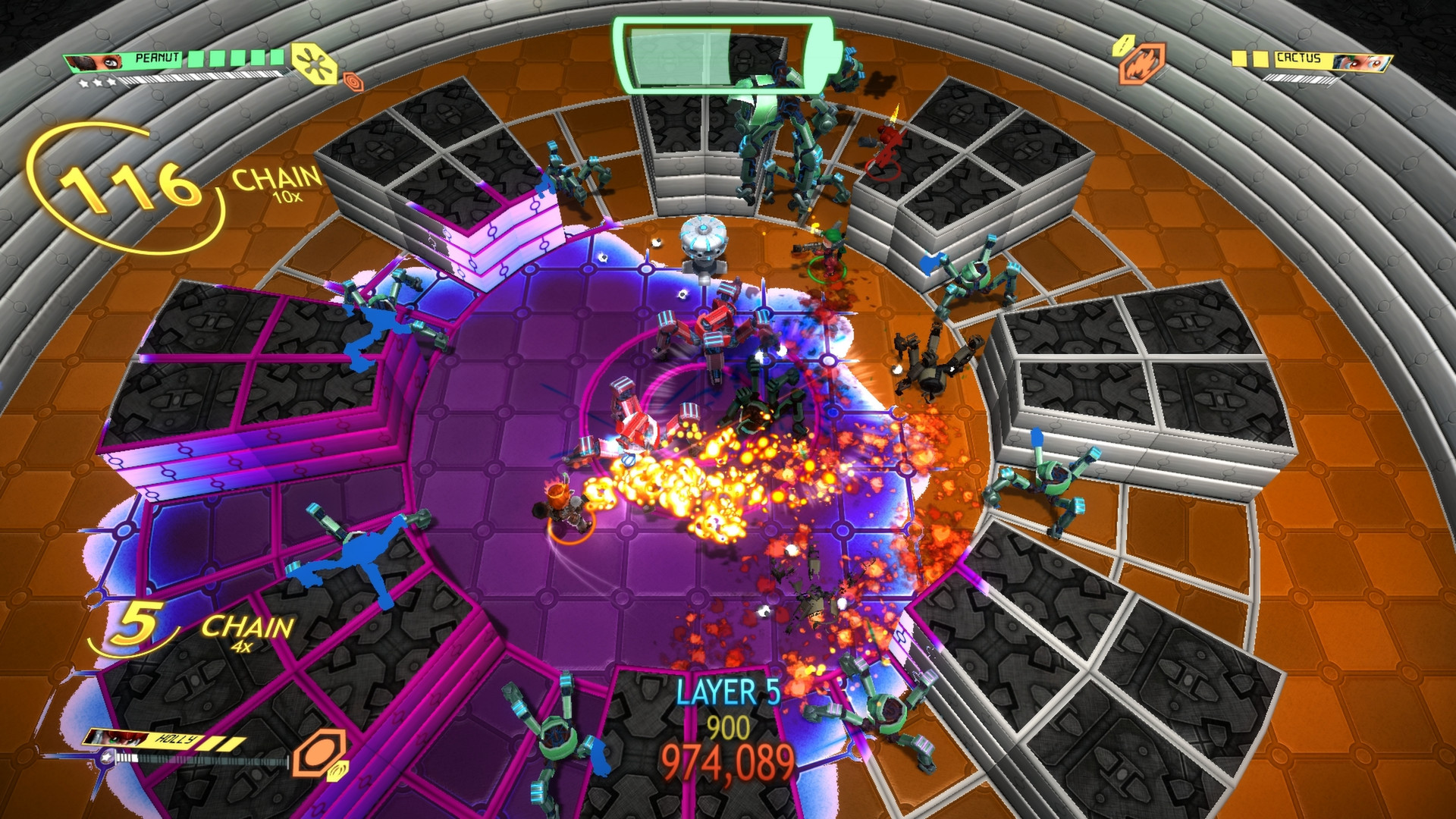
For the unfamiliar, Assault Android Cactus is, as previously mentioned, a twin-stick shooter. There's a few twists on the usual formula, though: the right stick just aims rather than shoots, for one, so you have to actually pull the trigger to fire, while the left trigger swaps between your chosen character's main and secondary weapon. Main weapons have unlimited ammunition; secondary weapons have a cooldown before they can be used again, but tend to be considerably more powerful.

Another major twist on the formula is the fact that there's no lives system, with the challenge factor instead coming from a time limit represented by the characters' declining battery charge. Blowing up a wave of enemies allows you to collect a recharge item, while getting knocked down wastes time and battery charge as well as costing you some points, so avoiding getting hit is a very important part of going for high scores. The battery system proved to be a controversial addition to the game when it was first put in place, but it's now such an integral part of the game structure that it's difficult to imagine Assault Android Cactus without it. It ensures the game strikes a good balance between accessibility for casual players and rewarding skilful play from the people who know what "1CC" stands for.

cactus2

One of the most noteworthy aspects of Cactus' gameplay is its selectable characters, who are gradually unlocked as you progress through the main series of levels. Far from just being different skins, each of the playable android characters handles uniquely, with very different main and secondary weapons allowing you to play in different ways. Title character Cactus is the most straightforward, boasting a simple machine gun and short-range flamethrower combination, while Aubergine is one of the more peculiar offerings due to her main weapon being an independently controlled helicopter drone and her secondary weapon being the ability to summon a quantum singularity and suck everything into it. The way the different characters play is one area where Witch Beam has clearly taken inspiration from classic Japanese shoot 'em ups, since many of these have selectable ships with different weapon setups. There's a huge amount of creativity in the way the characters play, though, and it's a real pleasure to get a handle on how some of the more outlandish characters work. (I still have no idea how to use Aubergine effectively, mind.)

Another interesting aspect is in the level design. Cactus could have easily been a straightforward arena shooter, but instead the levels show a great deal of variety in their structure. While they all have the same goal — destroy all the enemies — some of them take place in a confined space; some of them unfold in an arena that changes shape over time; some of them are in levels that force you to move from one place to another. One particularly memorable one scrolls infinitely in every direction, with checkerboard floor tiles flipping up and down according to which direction you're going; the backdrops are always interesting and exciting to look at as much as the main action is.

Cactus' long-term appeal comes from the same place as other arcade-style shooters: score attack. Completing a level immediately shows you a leaderboard as well as a letter grade, with the elusive "S+" rank being reserved for those who chained all of the enemies in a level into a single combo, didn't die and were generally a bit of a superstar. After attaining an S+ rank, you unlock "Pro Mode", which puts an on-screen indicator on your HUD showing whether or not it's still possible to attain an S+ on the level you're playing; you can also quickly restart a level if you make a mistake along the way somewhere.cactus4

The ranking system has been well thought out. Levels are designed so that you can "learn" them, much like a bullet hell shooter, and attaining the best ranks is dependent on you figuring out these enemy patterns, how to avoid their attacks and how to ensure that you're always on the offensive to keep your combo active. Bosses are similar, unfolding across several learnable phases, with the boss' health bar clearly showing where there's a phase transition so you can ensure you're in an advantageous position ahead of time.

If you're not in the mood for score attack, though, some Sega-inspired "EX options" allow you to play the game in various different ways. You can try the game in first-person, for example, or from a fixed isometric perspective rather than the dynamic camera angles of the regular game — though both of these options disable the leaderboards. There are also several graphical filter options — including an entertaining "JJ Mode", which spooges lens flare and bloom all over the screen for an incredibly colourful experience — as well as options for having AI players alongside you or taking on co-op enemy waves with just a single player.

In short, if you're a fan of arcade-style shooters and you're looking for something entertaining to feed your virtual quarters into, Assault Android Cactus is pretty much an essential purchase. Combine the solid main campaign with other enjoyable modes such as the never-ending Infinity Drive mode and the randomly generated Daily Drive confrontation, and you have a game that will keep you occupied for a very long time indeed — and one that I will quite happily purchase again on PS4 when that version hits early next year.
2055: Adventures at Seal Rock

0055_001I've been playing some of Final Fantasy XIV's player vs player mode recently, and I've been pleasantly surprised how much fun it is.

I've tried PvP in various other MMOs and never really got along with it. I never got far enough through Guild Wars for the PvP to be relevant outside of the single match you're forced to play in the introductory chapter; Star Wars: The Old Republic's PvP was unbalanced garbage; and The Secret World's PvP just seemed too chaotic to be manageable.

The trouble with PvP in a game with RPG mechanics is that it often becomes nothing more than a numbers game rather than a test of skill. In other words, whoever has the best gear will almost definitely win every time. This is particularly apparent in games that make seemingly no effort whatsoever to balance things out for a fair competition, the most egregious example of this I can think of being Blizzard's Diablo II. (To be far, PvP wasn't really the point of that game at all, but the fact it was in there at all in such a gleefully unbalanced state was just baffling.)

One of the nice things about Final Fantasy XIV's PvP is that it puts everyone on a pretty level playing field by syncing gear levels to a relatively low standard — iLevel 80 for level 50 PvP and iLevel 150 for level 60 PvP. This means that even if you haven't spent months farming content for the very best gear, you can still be both competitive and an asset to your team, making PvP as a whole a lot more accessible to a wider bunch of people. Which is good, because it's pretty large-scale, with 72 participants across three teams fighting it out all together in most cases.

Seal Rock is the newest addition to Final Fantasy XIV's PvP lineup. The previous PvP matches on the Carteneau Flats saw you either capturing and defending points from enemy assault, or simply attempting to defeat as many of the enemy teams as possible. The "Seize" mode you play on Seal Rock, meanwhile, is a slightly more involved, dynamic affair that requires coordination and teamwork, challenging your team to activate and hold Allagan Tomeliths that activate at random at various points across the battlefield, with the ultimate goal being to score 800 points before the other teams.

Points are scored by holding onto the Tomeliths; when one is in your team's possession, your Mammets gradually download data from it until it runs dry, at which point new Tomeliths will activate after a short period, and the process continues. The twist is that not all Tomeliths are created equal; there are B-, A- and S-rank varieties, with B-rank Tomeliths being worth the least potential number of points and S-rank Tomeliths being worth the most.

It's not as simple as just charging for the most valuable Tomelith, though. At times, it can be more advantageous to watch the other two teams scrap over an S-rank while you sneak around behind their backs and capture all the other ones for a greater total number of points than the S-rank by itself is worth. Add to that the fact that every time one of your team members is knocked out, your team loses a few points, and you have a mode where confrontation is something you want to avoid as much as you can unless you have a significant numbers advantage, at which point it's enormously satisfying to steamroller members of the enemy team.

What I think I like most about playing PvP is how different it feels from the PvE content. PvE can often feel quite "by rote" after a while, particularly in the more scripted encounters, and while this is satisfying in its own way at times — I've described the more intricate boss fights as being delightfully dance-like — PvP keeps you on your toes, challenging you to respond to new and unexpected situations as they crop up, and no two matches are ever quite alike. This makes it fun and enjoyable even if you're on the losing side, particularly as matches are wrapped up within 20 minutes at the very most, usually less.

I haven't quite figured out what the best strategies are quite yet, but I've been enjoying the experience a great deal so far, and I'm looking forward to battling those scoundrels of the Maelstrom and the Adders again soon.

2050: Three Hours Until Dawn

0050_001I've been really enjoying Until Dawn so far. Not only is it one of the most impressive-looking games I've seen for a very long time — the lighting, character models, animation (particularly facial expressions) and overall cinematography are all gobsmacking — it's also one of the best "interactive movies" I've ever played, outdoing all of David Cage's work in terms of coherence, tension and emotional impact. (And I'm one of the people who actually likes Cage's work!)

I'm really pleased with how well it balances the interactivity of a game with the storytelling of a movie. Choices you make throughout are meaningful, and are often referred to later through conversations or consequences. Plus, even though everyone knows the worst possible thing you can do in a horror movie is "just go and see what that was", the game encourages and rewards exploration with hidden collectible items aplenty, each of which contribute to your clue database and help to unravel the several mysteries at the heart of the narrative.

One of the most interesting things about the game is how your choices affect the characters themselves. Each character has a series of "stats" reflecting things like how honest, brave, romantic and funny they are, and the way you choose to have them behave throughout the game affects these stats, which in turn determines how they behave in certain other situations. Alongside these stats are relationship values that increase and decrease according to your choices throughout the game — again, with consequences at certain junctures according to how much the characters like each other.

20150831233023

The game makes effective use of its multiple characters as a means of presenting the player with different perspectives on the story. Individual characters by themselves might not know exactly what is going on, but by seeing what is happening to each of them, you can start to put the pieces together yourself. Like a visual novel, the game also encourages repeat playthroughs to discover all the collectible clues and piece together what happened, and I can already see a number of obvious branching points based on decisions I've made — with some of the more drastic choices resulting in the (apparent) death of one or more of the characters. (I say "apparent" because the game has pulled the "that person couldn't have survived that… unless…" thing more than once so far — plus it's apparently possible to get through the whole thing with everyone surviving.)

It makes nice use of timed decisions and quick-time events, too. Quick-time events are loathed and detested by an awful lot of people, but I've actually rather liked them since the phrase was coined way back in ShenmueUntil Dawn makes relatively sparing use of them throughout, and they help add a great deal of tension to already nerve-wracking scenes that have made my palms sweaty more than once. Perhaps the best part of the game's use of quick-time events, however, is the fact that the game occasionally requires you to not do anything at all — literally. "DON'T MOVE!" urges the screen, and the game begins tracking your real-life movement through the motion sensors in the controller. It's hyper-sensitive, too, so the slightest movement and you'll be discovered. (You can, of course, cheat the system by resting your controller on something, but it's more fun to grip it tightly in your hands and hold your breath.)

20150831233016

On that note, it's also gratifying that in a number of situations, not making a choice is also a valid choice. I liked this when I saw it in visual novel/interactive anime School Days HQ; I liked it when Telltale used it in some of its games; and I like it very much here. Until Dawn takes School Days' approach on a number of occasions — presenting you with a single (rather than binary) choice on screen and giving you a few seconds to decide whether or not to do it. These choices usually involve choosing whether or not to use violence to solve a situation and have tight timers, so you have to think fast about what the consequences might be — or simply throw caution to the wind and try to deal with whatever happens a bit later.

I have a few more chapters of the game still to go, and the story has thrown up some interesting twists that I sort of half-saw coming but wasn't sure about — I'm generally not all that great at spotting twists ahead of time, I must confess — so I'm intrigued to see where it all ends up, and who, if anyone, is going to walk away from that mountain retreat.

It's been a great experience so far, and I can heartily recommend it to anyone looking for something a bit different from the usual "run and gun" nature of triple-A spectacles.

2047: Until Dawn, Some First Impressions

0047_001I grabbed a copy of new PS4 game Until Dawn today. I haven't been following the development of this game at all, but what little I had heard of it sounded enormously intriguing, so I decided to give it a shot.
For those as yet unfamiliar, Until Dawn is an interactive movie-type game in the vein of David Cage's works Heavy Rain and Beyond: Two Souls in that it's heavily story-based, extremely linear and the decisions you make throughout are extremely important to how the whole thing concludes. Like Cage's work, too, there's absolutely no guarantee that all the cast are going to make it to the end, either.

Unlike Cage's work, however, which draw influences from noir and a few other sources, Until Dawn is very much designed in the mould of '90s-era teen slasher horror films. This type of movie is something of a lost art these days, with modern horror films tending to adopt more of a "horrorporn" approach with lots of gore and sadism, whereas teen slasher films were often witty and incisive as much as they were scary and horrific. (This isn't to say that modern horrorporn films don't have anything to say, of course — quite the contrary — but teen slasher films were very much their own distinct subgenre.)

The game opens with a bunch of teenagers spending a winter retreat up at a cabin in the mountains. Before long, Bad Shit starts happening and two of the party are dead — though their bodies are never found by either the authorities or their friends. The story then jumps forward to a year later, where the same group are revisiting the cabin on the anniversary of the two girls' disappearance, and it's clear that something odd is going on — though the early hours of the game are somewhat slow-paced, with only a few cheesy jump scares to keep you on your toes.

One interesting aspect of Until Dawn is its structure. While largely chronological and episodic in nature — each episode even starts with a "Previously on Until Dawn" recap — the game is punctuated by some interesting fourth wall-breaking sections in which a psychoanalyst appears to be speaking directly to the player. Whether or not this is actually the case remains to be seen, but in the same way that Silent Hill: Shattered Memories made use of the psychoanalysis session as a narrative framing device, so too does Until Dawn use your answers to the frankly rather creepy shrink's questions to subtly tweak and tailor the experience. Often, these changes aren't even commented on, leaving you in the distinctly uneasy position of wondering if you were imagining how you thought you remembered things from before, or if the game is just messing with you.

To say too much more would be to spoil it — and anyway, I'm only up to the third chapter so far — but I'm very, very impressed so far. It's by far the most "next-gen" game I've seen so far with regard to graphical fidelity and particularly facial animation. It's also nice to see other developers experimenting with the interactive movie format as David Cage has done in the past; Cage's work often draws heavy criticism (though I'm very fond of both Heavy Rain and Beyond: Two Souls) but the underlying principles of making meaningful narrative choices and interacting with the on-screen action are sound. I'm very intrigued to see where it all goes, and can confidently already recommend the game to anyone out there with a PS4 who enjoys a strongly narrative-driven experience.

2038: Vacation from Eorzea

0038_001Astute long-term readers will notice that I haven't been talking much about Final Fantasy XIV recently. And the reason for that is simple: I just haven't been playing it that much.
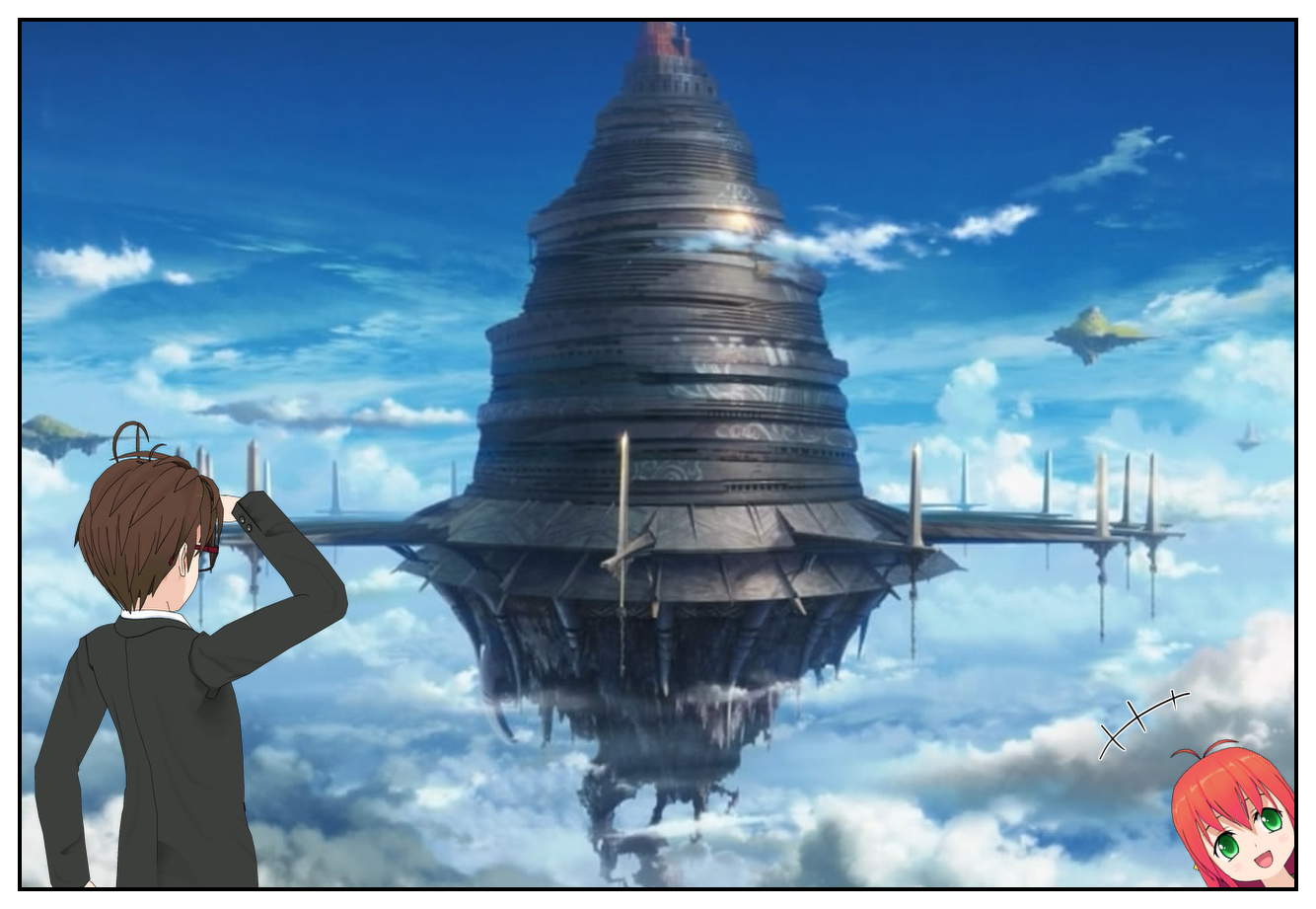
It's not that I've gone off the game per se — I still see myself playing it for many years to come — it's more that I've got out of it what I wanted to get out of it so far. The Heavensward storyline was exciting and dramatic — and, for my money, better than A Realm Reborn's main quest — and the Alexander raid dungeon was an enjoyable challenge, though we're still yet to clear its Savage incarnation.

Trouble is, outside of levelling alternate classes there's not a huge amount to do at level cap right now.

This is the exact situation A Realm Reborn (and, I imagine, most MMOs) found itself in at launch, of course; the difference here, however, is that whereas it took me a good few weeks to make it to 50 in A Realm Reborn — I reached the level cap a while after the more dedicated players in my Free Company — I got through Heavensward pretty quickly. This was deliberate, of course; I binged on the new story content because it was enjoyable and interesting, and also because I wanted to see everything that the expansion pack had to offer. I also wanted to avoid inadvertently being spoiled on the storyline, since Final Fantasy XIV is that rare example of an MMO where the story is actually worth paying attention to and even told pretty well.

Consequently, I got to the "end" a lot more quickly than I did with A Realm Reborn, and consequently I've found myself with a lot more "dead time" with stagnant content. Sure, I could run Alexander over and over again to try and get some more gear sets. Sure, I could level other classes — I probably will do this at some point. Sure, I could run the current two level 60 dungeons over and over to get as many Tomestones of Esoterics as possible to gear up one or more classes.

Trouble is, I simply don't have a lot of motivation to do so right now. And that's sort of fine by me, really; whenever I play an MMO I always find myself in a weird place where I'm really enjoying the experience of playing the game and getting good at it — I maintain that Final Fantasy XIV is one of the few games I genuinely consider myself to actually be pretty good at — but also feeling a strange sense of "guilt" that I'm not playing any of the other million and one games that have been staring at me from my shelves for the last few years. Conversely, I play a game that isn't Final Fantasy XIV and I feel a similar sense of "guilt" that I'm not playing Final Fantasy XIV more. I can't win. Stupid brain.

On balance, though, this "dead time" is actually proving to be rather welcome, as since I have little inclination to log in right now for anything other than my weekly raiding commitments — and the group as a whole is pretty half-hearted about the whole thing at the moment, to be honest — I am having plenty of time to delve into other experiences. I managed to get the Platinum trophy on Omega Quintet. I'm working on the Platinum trophy for Hyperdevotion Noire. I am loving the shit out of Sword Art Online on PS4. And I'm also really enjoying Splatoon, Heroes of the Storm and any number of other games right now.

The trouble with any hobby that has a lot of different elements to it — be it gaming, music, reading, movies or whatever — is finding that perfect balance where you can enjoy all those different elements at different times and not feel like you're neglecting any of them. Right now, even though I know that I don't have much motivation to play Final Fantasy XIV, I still feel like I'm neglecting it because I'm not logging in to talk to my friends. So perhaps I still haven't quite found the right balance there. But eh. I'm not going to worry about it for the moment — a new content patch for the game might rekindle my interest for a while, but in the meantime I'm going to cut right back and enjoy the other experiences I have on the go right now.

2037: I Killed a Volcano

0037_001Another Sword Art Online Re:Hollow Fragment post, I'm afraid, but, well, deal with it; it's good, I'm enjoying it, and I want to talk more about it.
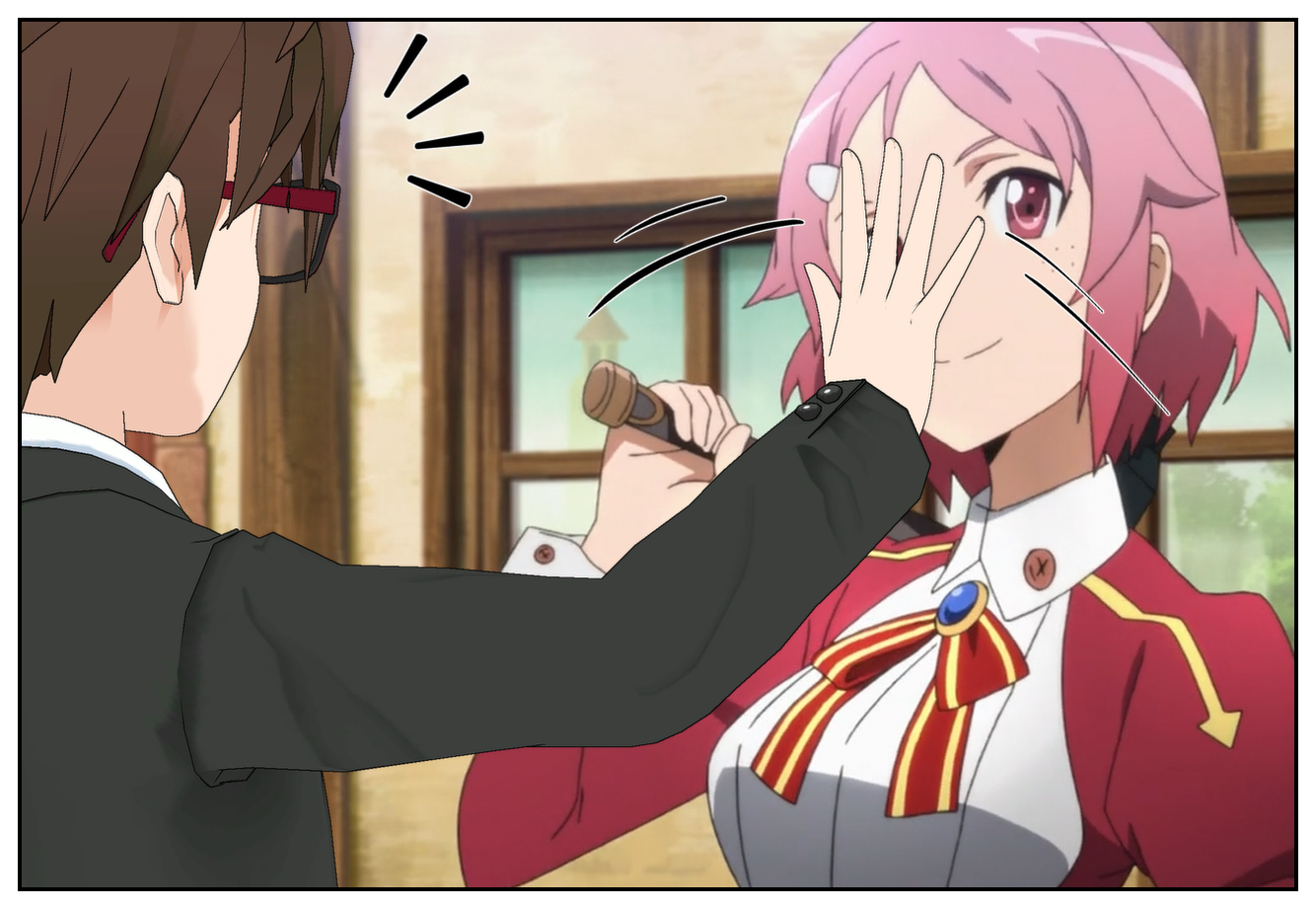
I was describing the game to a friend earlier and the thing that struck me is how utterly different from your typical JRPG it is. It's extremely non-linear at heart — that is to say, there are a number of parallel linear objectives to follow at any given moment, but it's always entirely up to you which one you pursue at any given moment, or even whether you pursue them at all or just decide to grind out a few levels fighting powerful enemies.

So far the "main" quests I've encountered include the ascent of Aincrad, which is the way you "beat" the game; the storyline that unfolds as you unlock access to each part of the Hollow Area; the "Grand Quest" which mysteriously appears on one trip to the Administration Area; and a line of waifu-specific objectives that demand you go into the Hollow Area with a specific companion and complete a particular kind of Hollow Mission, the exact details of which are usually given in fairly vague terms, so you have to figure out exactly which missions will fulfil their criteria for yourself.

In my relatively brief session on the game earlier, I chose to forego the waifu quests I had previously been working on (largely because I couldn't find a Hollow Mission that involved fighting kobolds or goblins to progress Silica's questline) and instead continue with the Grand Quest. This part of the game — which I believe was added in a free update post-release on the original Vita version — involves entering a mysterious new part of the already mysterious Hollow Area, known as the Abandoned Area, and promises the reward of powerful new Sword Skills that you can't get anywhere else.

The Abandoned Area is introduced to you with a beautiful garden, one end of which is dominated by an enormous pair of doors — doors which are, of course, locked. However, since Sword Art Online is well and truly aware that it is a game, it very much follows the rules of a game, and consequently there are two obvious depressions in the door where "something" most certainly fits. And, wouldn't you know it, there are two pathways out of the garden, each of which leads to a different "dungeon" area — one in some fiery caves, another in the mountains. And oh! It just so happens that your map indicates that there's a powerful Area Boss waiting in the furthest reaches of each of these areas. Guess what you have to do to progress the Grand Quest?

It's not just as simple as wandering in and smacking the boss about a bit, though, not least of which because the bosses are challenging encounters with plenty of mechanics to figure out. In order to even get at the boss of the fiery cave area, you need to complete a number of different Hollow Missions that reveal some interesting facts about the local fauna — most notably the explosive bugs that become petrified when they die, and which conveniently explode with sufficient force to knock down walls when triggered by the correct catalyst. Once you've discovered this useful piece of information, you then have to scour the area for other instances of these petrified bugs, blow them up and see if they reveal a convenient pathway through to the boss.

The mountain area is similar in execution, though it is set up in such a way as to prevent you from progressing too far without completing the fiery caves first — you need a key item to melt open a door that is frozen shut. In this area, however, you quickly encounter the Area Boss without too much difficulty, who promptly screeches at you with a noise so terrible you're forced to retreat. The challenge here, then, is to uncover a means of protecting yourself against his powerful sonic attacks. I'm yet to discover exactly what that means is, but it will almost certainly involve a convenient Key Item somewhere, because that's how games work and, as previously noted, Sword Art Online is very much aware that it is a game.

The fiery cave area boss — dramatically known as Gaiard the Volcano — is a great fight that is far more than simple hack and slash. It's a fight where you'll have to pay attention to what moves are coming up — they are telegraphed in various ways — move carefully to avoid them, order your companion around (assuming you brought one with you) and take every opportunity you have to get in your most powerful attacks. It's an intense fight that really doesn't let up for a moment; opportunities to attack are short and easy to miss if you're not paying attention, and you need to keep a close eye on your partner's condition, too; letting them die is as instant a Game Over as if you died yourself. It's extremely satisfying when you finally clear it, however; it took me a good few attempts, but like the very best boss fights, it never felt like I was being smacked around by cheap, unfair moves — I learned something every time and progressed a little further, until eventually I was able to counter almost all his earth-shaking attacks and take full advantage of the openings that were presented throughout the battle.

If you're the sort of person who enjoys setting their own objectives and pursuing things in whatever order they like, then, Sword Art Online Re:Hollow Fragment is something that will very much appeal. Plus I was delighted to see today that it appears to be a top-seller on PSN right now, which means that it's a game that is getting noticed, played, enjoyed and promoted by people who like it. That makes me really happy; while it is far from the most technically proficient game in the world — the upscaled PSP graphics and somewhat inconsistent frame rate will be a culture shock for many — it's a beautifully designed, enormously addictive and extremely playable game that I can see myself spending a very long time with before I move on to something else.

2034: The Hollow Area

0034_001Been playing some more Sword Art Online Re:Hollow Fragment for the past few days, and I'm thoroughly enamoured with it. It's quite unlike any RPG I've played before, though I must say, it does a pretty good job with the whole "simulated MMO" deal, particularly as you can even play it in cooperative multiplayer.

I've mostly been exploring the "Hollow Area" part of the game, which is the vast new section originally added in the Vita version of the game; the original PSP version only covered the last 25 floors of Aincrad up to the final boss on Floor 100. Aincrad is a mostly linear experience; the Hollow Area, meanwhile, though gated by story progression in a few places, is much more non-linear in nature since you can freely move between regions, take on any "Hollow Missions" you choose or simply explore, fight monsters and seek treasure.

Interestingly, this aspect of the game is the one area where Re:Hollow Fragment differs from a real MMO: while the first time you enter a new zone in an MMO you'll probably take some time to explore and map it fully, most MMOs design their areas in such a way as to be easily navigable by large groups of people, and once you've been everywhere, you've been everywhere; no further exploration needed. When it comes to dungeons, any kind of exploration is usually discouraged entirely in favour of a linear sequence of encounters culminating in one or more highly scripted boss fights. There's nothing wrong with this; when it comes to herding a group of players towards their objective together — particularly when they might not be able to communicate with one another due to issues such as the language barrier, console players not having a keyboard to hand or people simply being unwilling to talk — it's best to keep things as simple as possible so no-one gets lost, everyone can have a good time and work their way through efficiently.

Since Re:Hollow Fragment doesn't have to worry about "real" players (for the most part — multiplayer assumes you're already familiar with how the basic game works) it's free to be a bit more interesting with its areas. So we have mazes, networks of caves, perilous clifftops (that you can fall off and die instantly) and dungeons with multiple routes and secret passages, many of which you'll need to pay return visits to at a higher level to get the most out of. It's an absolute pleasure to explore, and all the more rewarding when you come across a powerful monster to fight or a treasure chest containing an awesome treasure item.

The "powerful monster" aspect is worthy of some note. I'd heard a few people compare this game to Monster Hunter when it first came out; I haven't played Monster Hunter myself so can't comment with a huge amount of authority, but it never struck me as a particularly obvious comparison to make. That is, until I started ranking up some of the regions in the Hollow Area and coming across the "NM" (Named Monster) and "HNM" (Hyper Named Monster… I think?) encounters, which pit you against powerful, boss-tier enemies that demand a little more than just hack and slash. Now I kind of Get It… that moment when you think "That thing looks awesome… let's kill it!"

That said, the game isn't particularly hack and slash even with its trash mobs, anyway; it has an interesting combat system based around a combination of carefully timed button presses (Phantasy Star Online-style) and skills with cooldowns a la traditional MMOs. While Kirito starts a fair distance down the Dual Wielding path he's depicted following in the anime, you're free to change to any other weapon type whenever you like, and in fact if you want to farm Skill Points to learn new abilities, you're going to need to do that, since Skill Points are earned most reliably by levelling up weapon proficiencies. What's nice is that each weapon type has its own unique set of skills to learn along with its own unique animations and timings for "Exact Attacks". Branching off each weapon type are support skills, too, ranging from healing and buffing to passive abilities that improve your overall position in battle.

Then there's the Implementation system, which works alongside the skill system. While the skill system is presented as being part of the Sword Art Online game Kirito and his friends are trapped in, the Implementation system is the game's equivalent of turning on Google Labs in GMail; it tasks you with "researching" various things during Hollow Missions (and only during Hollow Missions) and then rewards you with experimental game adjustments — anything from stat buffs to the ability to receive new item drops from NMs and HNMs — and even entire new game systems, such as the Original Sword Skill system, which essentially allows you to record a "macro" of your favourite skills and chain them together at will. The challenges you'll be tasked with completing range from the simple (defeat 20 enemies) to the infuriating and time consuming (land 200 perfectly timed Exact Attacks) but the rewards are very much worth it, and this array of challenges — there are well over a hundred of them in total, I believe — give the game a great deal of variety as it becomes less about simply hacking your way through monsters as quickly as possible, and more about defeating them in specific ways in order to efficiently complete these research objectives.

Perhaps one of the most interesting things about Re:Hollow Fragment is the fact that all this stuff is technically optional. All you have to do to finish the game is climb to floor 100 of Aincrad, beat the last boss and hooray, you win. Any RPG player worth their salt knows that making a beeline straight for the final boss is rarely a good idea, though; sure, you might clear the game quickly, but you'll also miss out on potentially some of its coolest aspects. As such, I'm unsurprised to have found myself well and truly captivated by exploring the Hollow Area, while my progress on Aincrad has stalled after just two floors. The Assault Team don't seem to mind, though, and the game's generous complement of waifus are more than happy to accompany me on my various adventures, so all's well.

I can see myself spending a long time with this game, and I'm actually keen to play some more multiplayer (particularly as two trophies relate to multiplayer sessions — though you can play "solo multiplayer" in a party with your characters from single player) — it's been a very pleasant, enjoyable surprise so far, and I'm looking forward to continuing to explore its hidden depths. And then jumping right into Lost Song when it comes out in a few months!