1016: A Few More Aselia Thoughts

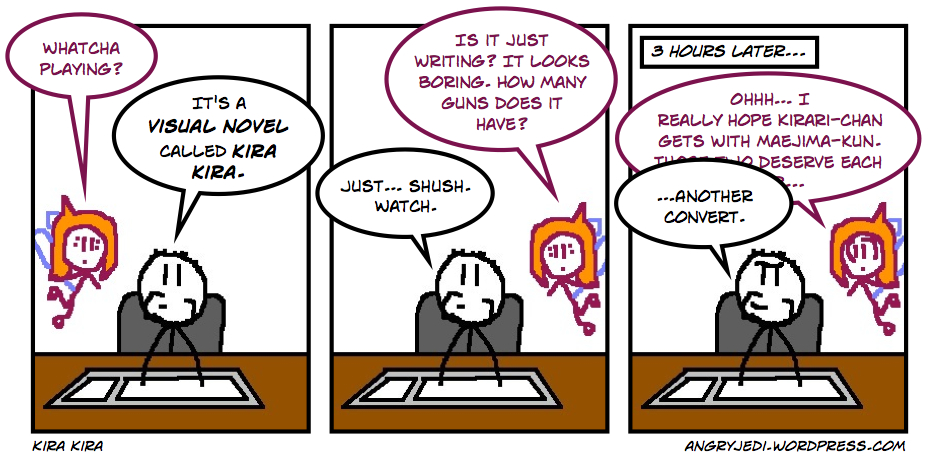
I finished my first playthrough of Aselia the Eternal this evening. Clocking in at about 54 hours, this $30 title is certainly good value for money in terms of its dollars-to-hours ratio.

It's also a very, very good game, though one that will undoubtedly not be to everyone's taste. Simply put, if you enjoy the narrative being the focus of a game rather than its gameplay, you will dig Aselia the Eternal. If you're the sort of person who skips cutscenes even if you haven't seen them before, you will not like Aselia the Eternal.

This is not to say that Aselia the Eternal is as "gameplay-free" as most other visual novels, however — in fact, it plays host to an excellent strategy-RPG component as well as its decision-based visual novel aspect — but you have to be willing and able to deal with the fact that the game will frequently break without warning in mid-"mission" for a considerable amount of plot exposition. I love that the game does this, as it gives a nice feeling of "coherence" to the experience rather than sharply demarcating where "plot" and "game" are. Equally, it will doubtless annoy some others. If it sounds like it might annoy you, you will probably not appreciate Aselia the Eternal.

There are eight endings to the game. I have now seen one of them. After the break, some spoileriffic thoughts on the whole playthrough.

MAHOOSIVE SPOILERS AHEAD, in case that wasn't already clear.

Continue reading "1016: A Few More Aselia Thoughts"

#oneaday Day 971: Y'All Should Probably Play This FTL Thing

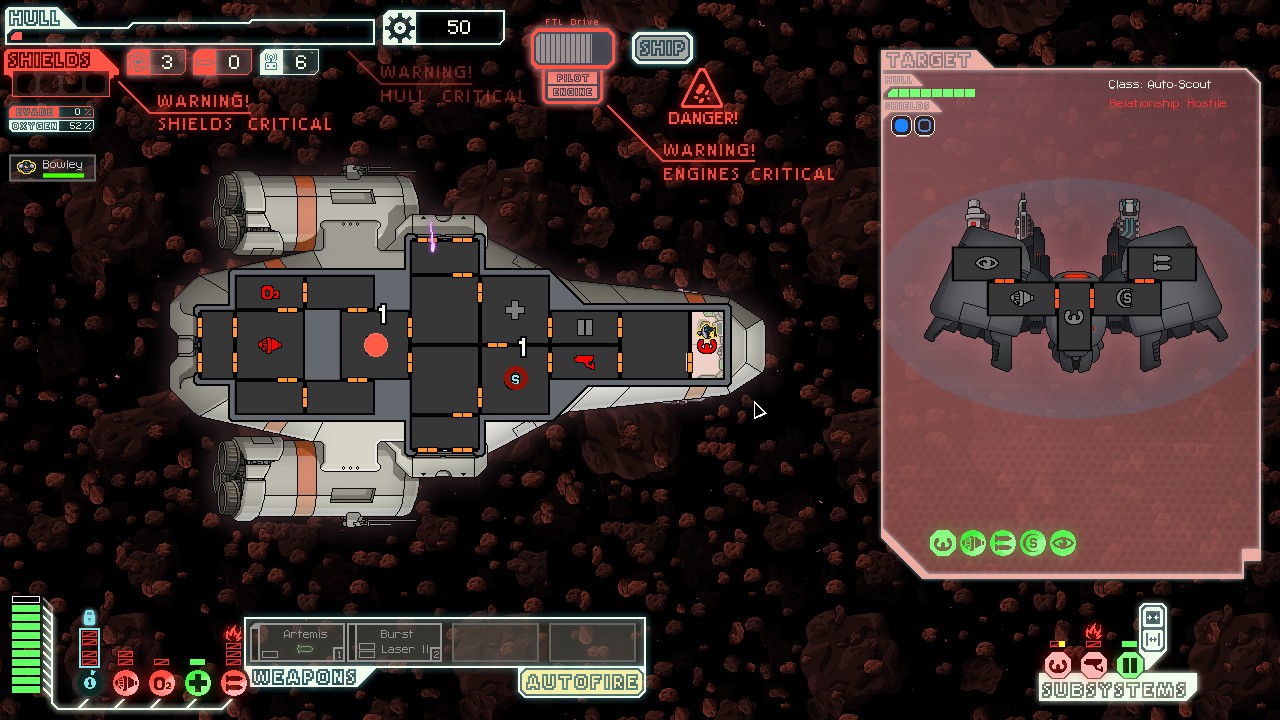
Things weren't going well. The rebel fleet were closing in, and the last jump had put the UNS Scruttocks perilously close to a rather active star that was currently enjoying a period of intense flares. Pete, best pilot in the remnants of the Federation (which wasn't saying much) frantically struggled to power up the Scruttocks' FTL engines as the ship was rocked  by the explosions of the overly-joyful sun.

It turned out that wasn't the only problem, though. A pirate ship, seemingly undeterred by the solar activity, stood staunchly in the path of the Scruttocks, matching its every move and doing its best to ensure that this would be the end of the intrepid crew's journey.

Andie ran from the bridge to her station at the weapons console at the rear of the ship. Lara followed her, splitting off at a rear bulkhead to head for the engine room. The undermanned Scruttocks was going to need every ounce of power she could give them if they were going to get out of this alive.

"Fire! Go for the shields!"

Andie didn't need to be told twice. She diverted power from non-essential systems, powered up the ship's missile launcher and laser cannon and took aim for the pirate ship's shield systems. The first missile sailed harmlessly past, while the first volley of laser fire was absorbed by their assailant's shields; the second struck true, the missile penetrating the shields and knocking out the shield generators, the cannon fire now free to inflict damage directly on to the enemy's hull.

The pirates weren't going down without a fight, though.

"Fire!"

"I am!"

"No, seriously, FIRE! Get out of there!"

Lara came running through the aft section, severe burns over one side of her body. Andie watched in astonishment as her determined crewmate headed for the medical bay. She smelled smoke, and knew that trouble was ahead. But if she could just hang on a little longer…

The air started to become thin; it became harder to breathe. Andie knew that Pete was trying to put the fire out by venting the oxygen out of the affected sections, but it seemed like the ship's oxygen distribution system had been damaged by the fire, as even though the weapons room was firmly enclosed, she was definitely starting to feel light-headed.

Lara came charging back through. "Come on!" she cried. "Help!"

Andie left the weapons controls on automatic and followed her companion through the aft sections of the ship. Sure enough, the fire had gutted the ship's oxygen distribution room, but the damage wasn't so severe it couldn't be repaired. The pair set about their important work, doing their best as the ship was continually rocked by impact after impact.

Finally, through the window they saw the debris of the destroyed pirate ship drifting sliently past. They had done it. The Scruttocks had survived another day, for now — all they had to do was get this oxygen tank back up and running before–

A loud bleep confirmed to the rapidly-weakening Andie and Lara that their efforts to repair the oxygen tanks had been successful. As they heard the air distribution system start up again, they breathed in heavily, gulping down the precious, life-giving air.

"Preparing for jump to lightspeed," came Pete's voice over the comm system. "Ready in 3… 2…"

At that moment, a solar flare erupted. The Scruttocks' hull, weakened from the protracted battle, tore apart like a snail shell beneath a wellington boot. Its crew's last thoughts as they were suddenly cast into the silent vacuum of space?

"Bollocks."

That's a typical day in the life of the crew of FTL: Faster Than Light, a new independently-developed game that officially came out today. In it, players oversee the crew of a starship frantically running from the mysterious "Rebels" as they attempt to deliver important secrets to the remains of the "Federation". Little more context than this is given, and little more is needed, because FTL is a game about the struggle that is the journey rather than its beginning or its conclusion.

The most apt descriptions of FTL would draw comparisons to the board games Space Alert and Battlestar Galactica. Like those games, FTL gives its players a small number of crew members and a sprawling ship in which to deploy them, then continually bombards them with increasingly-unreasonable challenges until they explode, die, asphyxiate or reach one of a variety of other sticky ends. It is possible to "finish" the game by beating a final boss, but for your first few playthroughs at the very least, you'll be dead within half an hour.

FTL strikes a great balance between simple mechanics and depth, and presents its unfolding emergent narrative in a manner that is abstract enough to allow the player to use their imagination, yet explicit enough to make it clear to understand exactly what is going on at any given moment. Players can route power to different parts of their ship, fire weapons on specific systems of enemy ships, move crew members around to man stations, deal with intruders and put out fires, and even faff around with doors. Doors are very important. You might not think that they are, but the moment your remote door control systems get blown out and you're unable to vent your engine section that is currently on fire, you'll come to appreciate the power of being able to sit in the driver's seat and open the back doors without running the risk of asphyxiation.

FTL describes itself as a form of roguelike and there's certainly plenty of resemblance there — a randomly-generated challenge at the start of each new game, permadeath and a wonderful sense of unfolding, unscripted narrative — but it has a unique identity that is all its own. It's not trying to be Star Control or Master of Orion or anything like that, nor is it trying to be Angband in space — it's the personal story of a few brave men, women and slugs who want to make a difference in a turbulent galaxy. Whether they do so, or whether they end up suffocating as they run around panicking at the fact that half the ship is on fire and the pilot is in the process of being eaten by a praying mantis? That's entirely up to the player's skill and/or sense of sadism.

Either way, you should buy FTL because it's fucking great.

#oneaday Day 943: School Days HQ First Impressions

I mentioned a while back that I'd acquired a copy of School Days HQ from JAST USA/JList, but I didn't play it very far due to a few rather nasty bugs that unfortunately made it on to the master CDs. Two rather hastily-deployed patches later and the game now appears to be fully playable without issue, which means I can get stuck into it. I'm now two "episodes" in — I'm not sure how many there are in total — and ready to give some first impressions.

School Days HQ, for the uninitiated, is a remake of a visual novel originally released in 2005 for Windows, PS2 and PSP. It's unusual in the visual novel genre in that instead of static backdrops with characters and text overlaid atop them, it's fully animated. "Fully" might be a slight exaggeration, as the game has something of a tendency to cut to images of the sky or a particularly interesting piece of ceiling whenever something that might have been difficult to animate happens, but for the most part the game looks rather convincingly like an animé series you'd watch on TV and, occasional strange cuts aside, is well-directed, with good use of split-screen and other special effects. In essence, it's an interactive movie rather than a visual novel, but it tends to be lumped in that genre due to its similarities in structure and gameplay. And, of course, the fact it has bonking in it.

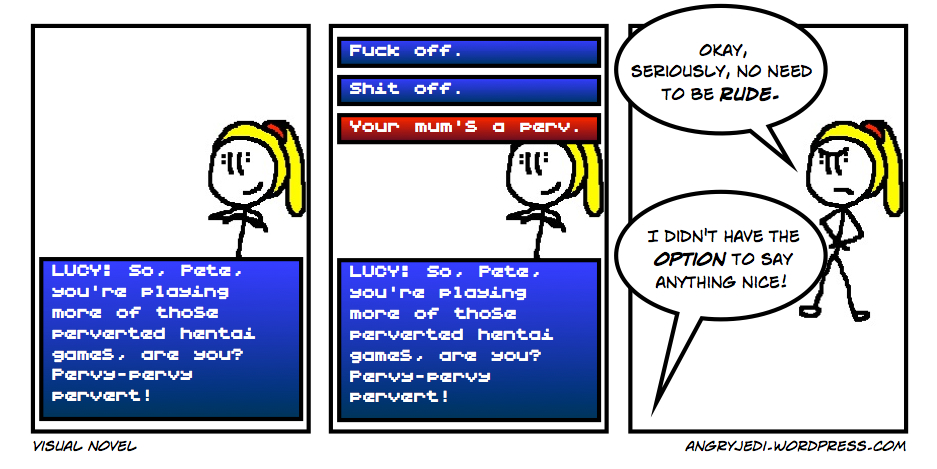
Said gameplay involves a lot of watching and occasionally making decisions that will branch the story off in different directions. You can't afford to sit back and relax in School Days HQ, however, because decision points come without warning and "expire" after a short period of time — effectively making "say nothing" a valid option in most situations. This is an unusual feature for visual novels and for narrative-based games in general — the only other recent examples I can think of are The Walking Dead from Telltale and Heavy Rain, both of which have more in common with the visual novel genre than more "conventional" game styles. (I suppose choosing not to do the Paragon or Renegade actions in Mass Effect might sort of count, too.)

School Days HQ's narrative is all about close personal relationships, a favourite theme of mine. Protagonist Makoto finds himself sitting next to class cutie Sekai when their seats are rearranged, and through a bit of underhanded manipulation on Sekai's part, admits that he has a bit of a crush on the very shy Kotonoha, a girl from another class. Sekai, who firmly establishes herself early on as a complete control freak, makes it her goal to get Makoto and Kotonoha together and succeeds in her machinations.

Both Makoto and Kotonoha are almost painfully awkward together, however — extremely hung up on the conventions of polite Japanese society and not quite sure how to cope with the prospect of a relationship — it takes two dates before they'll call each other by their first names. Sekai, meanwhile, appears to have her own designs on Makoto, but so far in the story has done nothing but help the couple — with a bit of gentle teasing along the way, however. Given that she took her "payment" for getting the two together in the form of a kiss from Makoto and then spent her train journey home crying, however, it's clear that all is not as it seems with Sekai, and I'm expecting a distinctly messy love triangle as the story proceeds — something which has already been rather strongly foreshadowed.

So far I've very much enjoyed what I've seen. The animation and voice acting is decent quality, the subtitles appear to be well-translated and the timed decision points give the player a strong feeling of involvement even though, as usual for the genre, they're relatively infrequent. The characters are interesting, and the plot, while seemingly mundane, certainly has a lot of potential to head off in a bunch of different directions — including, as I understand it, some distinctly fucked-up ones. Which is nice.

As with many visual novels, the game is specifically for adults and features explicit sexual scenes. There haven't been any yet, but given that the game supports bona fide wanking machines for both sexes, it's fair to expect that there will be at least a few on the game's various paths. There's also the usual unnecessary (but seemingly expected) "fanservice" throughout — there were two rather gratuitous shots of shimapan in the first episode alone, though the second episode seemed to restrain itself from further pervertedness — fitting, since it largely revolved around Makoto worrying whether or not him attempting to hold Kotonoha's hand would make her see him as a "pervert".

I'm looking forward to continuing through the story. Its episodic nature means that it can be easily digested in small chunks like a TV series — and I mean this literally, as each episode opens with a short teaser, plays an opening title sequence and ends with a credits crawl. As such, it's an experience that can easily be fit around other things or marathoned all in one go.

Will I get a good or bad ending, though? That remains to be seen. I hope I get a good one. I kind of like these characters.

#oneaday Day 929: PC Gaming: The 'Master Race' For A Reason

I finished Fortune Summoners tonight. (Go play it, it's great.) I am not going to talk about Fortune Summoners, however; I am instead going to talk about something which came to mind while I was playing it.

PC gaming.

There's still a bit of a funny attitude surrounding PC gaming. Some console players and commentators refer disparagingly to those who do the bulk of their game playing on personal computers using phrases such as "the Master Race", and actively refuse to participate in it. The reasons for this are many, but the most commonly-cited ones include the supposed "expense" of getting started and the misconception that some things are just "better" on console.

Let's address both of these points before moving on to the real reason I started writing about this.

Firstly, the cost issue. Yes, depending on what sort of games you want to be playing, there will probably be a higher up-front cost to get a gaming PC. But, realistically, this startup cost is not significantly more than a new console costs upon its first launch. And for that price you're getting something that significantly outstrips current-generation games consoles in terms of performance — and will continue to do so for quite some time.

My current PC cost in the region of £650 to put together and is what I'd describe as "mid-range". It plays most games at 720p (the resolution most Xbox 360 and PS3 games tend to run at — sometimes less) at 60 frames per second or more without breaking a sweat. At 1080p, it can handle most stuff you can throw at it without issue — it's only really demanding stuff like The Witcher 2 and Crysis that will make it struggle a little. In short, stuff looks good on it — significantly and noticeably better than on Xbox 360 and PS3 — and given that the next generation of games consoles are yet to be announced, this system is going to maintain a comfortable lead for a year or two at least. We have no idea how much these new systems are going to cost at this juncture.

Insofar as the console experience is "better", I agree to a certain extent, in that sitting on a couch with a controller in your hand is, for most types of game, much more appealing than hiding in your computer room with the screen a few inches from your face. However, there is a very straightforward way to solve this issue: connect your PC to that big-ass HDTV you have in your living room, and you immediately have the world's best games console that also does all that "multimedia" shit far better than Microsoft's gradually-worsening Xbox interface ever will — just compare the experience of using Netflix on the Web to Netflix on Xbox and you'll see what I mean. Add an Xbox 360 controller and you can play sitting slumped back on the couch just like a console, but you have the added option of playing with mouse and keyboard for when accuracy and/or lots of buttons are required.

Take this approach and you'll be set — you practically won't need a console, except for exclusive games. Multiformat games are generally best on PC — even the worst console port is usually able to take decent advantage of your computer's hardware, allowing you to run it at crazy resolutions and deliciously butter-smooth frame rates. Online communities are generally lively and active. And the vast mod community allows games to maintain their "life" long after console players have moved on to the next big thing.

The thing I really wanted to talk about, though, is diversity. There is no other platform on which you can have such diverse experiences as the PC. iOS certainly has a good go, but as days go on it's abundantly clear that the mobile market is shifting very much in favour of "freemium" social games rather than truly inventive experiences. On the PC, meanwhile, the fact that it is such a free market out there — and easy to develop for (relatively speaking) — means that if you can imagine an experience you want to have, you can probably do so on PC.

Fortune Summoners is a prime example. Fortune Summoners is a Japanese platform RPG that combines elements of Castlevania, Zelda II, Demon's Souls and '90s arcade games to produce something that is endearing, charming and bastard hard. That certainly wouldn't get a retail release on consoles (not that it did on PC, either) but even if it were to be released on a service such as Xbox Live Arcade or PlayStation Network, it wouldn't be an easy title to come across accidentally thanks to the closed nature of both Microsoft and Sony's networks and their rigidly-defined criteria for advertising products. And would it even be released at all? A translation of a 5 year old Japanese game that was the start of a series that never continued? Would that be profitable? Would that be worth promoting? These are the questions that get asked when it comes to console games, whereas the PC marketplace has a lot more small-scale "enthusiast" developers and publishers more than happy to cater to "niche" markets — if not through Steam (which is generally pretty good anyway) then directly to their customers.

And there are plenty of niches catered to. "Grand Strategy" buffs can enjoy titles like Crusader Kings II and Civilization V. "Bullet hell" shooter fans can take on Gundemonium Recollection and those three games that Capcom released on Steam recently that I've forgotten the name of. Adventure game fans can enjoy pretty much the entire history of the genre, from King's Quest I right up to more recent titles like Resonance or Telltale's episodic work. Japanese visual novel enthusiasts can delve into JAST USA's vast library of translated titles, and within that collection there are plenty of dirty and non-dirty titles. Simulation fans can drive anything from a First Great Western train to a garbage truck.

This isn't even getting into the rich back catalogue of gaming that the emulation scene offers. While downloading ROM files for old consoles puts you on shaky ground legally, let's face it — pretty much everyone occasionally has a hankering to play, say, Super Mario World or Blast Corps and thus finds themselves digging around in one of the dark corners of the Internet. While there's a certain magic to playing it on old hardware, that's not always practical. Old hardware breaks down; old cartridges lose their batteries; old CDs get scratched or broken. Through the magic of emulation, your PC is not only a bleeding-edge games console, but it's also an archive of all the console games you owned in your youth, too. And an arcade machine. And a means of playing Web-based games.

So if PC gaming is considered to be "superior" by some, it's certainly not without reason. Nowhere can you get the same diversity of experience that a PC offers. Nowhere else can you finish a game of Civ V and then have a quick rag on Dr. Mario to cool down. Nowhere else is there such an incredibly useful, multi-functional device that is ready and willing to hook up to your TV and serve pretty much all of your entertainment needs — both interactive and non-interactive.

So if you're one of those people who dismisses the PC platform out of hand without even an iota of interest in engaging with it, I'd urge you to reconsider. You'll be surprised how little it is about editing AUTOEXEC.BAT and CONFIG.SYS or slotting cards into slots these days, and how much it is about enjoying some of the finest digital entertainment experiences on the planet.

Join us. Join us.

#oneaday Day 926: Fortune Summons the Brave

Having finished Chantelise the other night I decided to move straight on to the latest of Carpe Fulgur's translated Japanese titles, Fortune Summoners: Secret of the Elemental Stone. Unlike Chantelise and Recettear, Fortune Summoners was not originally developed by EasyGameStation, so I knew it was going to have some significant differences from the previous two games — I was curious to discover exactly what.

Fortune Summoners is a side-scrolling platform-RPG in which you play a prepubescent girl named Arche. Arche has moved to a new town with her family, and her father — an ex-adventurer — has decided to settle down with his wife and daughter, and open an item shop.

Arche is an endearingly ditzy little girl, charmingly naïve in the ways of the world. She's not very bright, she's terrible at arithmetic and she comes to her new magic school woefully unprepared, lacking the one component necessary for her to be able to begin her magical studies — an Elemental Stone. She does, however, have a strong sense of Doing What Is Right, and so decides not to mention the fact that she needs a stone to her family — who are somewhat lacking in funds due to their move and the start of their new life — and seek out one for herself. Thus begins an adventure that sees Arche discovering a great deal about the true power of the Elemental Stones and the origins of magic, accompanied occasionally by two equally prepubescent little girls.

If this all sounds terribly adorable, you'd be absolutely right. Like Carpe Fulgur's previous releases — and despite originating from a different developer — Fortune Summoners is awash with bright colours, squeaky Japanese voices and well-defined characters who all have their own distinctive personalities. Witnessing Arche's endearingly naïve responses to life-threatening situations never gets old, and her interactions with her party members and other characters is always a joy.

But beneath this brightly-coloured, charming exterior beats a heart of pure evil. Like Chantelise, Fortune Summoners isn't afraid to drop-kick the player into a dirty toilet full of acid-tipped spikes and expect them to come out unscathed, undiseased and smelling of roses. This game is hard, and it is the very definition of "don't judge a book by its cover."

Each of Fortune Summoners' three characters has their own unique abilities. Arche specialises in swordplay, while her companions Sana and Stella provide backup with water/ice and fire magic respectively. It's possible for the player to switch between these characters at will, and during the game's dungeons this frequently becomes essential to progress. Sana, being a water mage, is able to breathe underwater using her magic, for example, while Stella is able to burn down obstacles with her command of the fire element. Arche, meanwhile, doesn't have access to magic for the vast majority of the game and thus is the "tank" of the group (and yes, the concept of a little girl being a tank is hilarious), with a higher hitpoint value, better defensive capabilities and an array of fighting moves designed to go toe-to-toe with the various horrible monsters that wander the countryside — and that none of the game's cast seem particularly concerned about. ("Watch out for the slimes on your way home!" says their teacher at the end of a school day. You'd think they'd arrange a bus service or something.)

Each of the game's characters make use of their abilities in a different manner. Arche, for example, can only swing her sword if she has drawn it first, which takes a valuable couple of seconds and thus is best done before combat rather than during. Following this, she can unleash various attacks by using Street Fighter-style direction and button combinations, allowing her to slash, thrust, use combination attacks, roll to evade, cartwheel backwards out of harm's way and leap down on an enemy from above for unblockable damage. There's a level of depth to combat that you don't normally see in 2D-perspective role-playing games — and the game will most certainly punish you if you don't get the hang of it, because wildly flailing at enemies will not get you far.

Sana and Stella, on the other hand, are better at hanging back and unleashing their magic from a distance. Sana has access to an icicle-flinging spell, for example, while Stella is able to create fire walls and homing fiery missiles. Sana also has a healing spell, which means she is really missed when you don't have her. Spells are cast by making them active from a "hotbar" (or toggling through them with a controller button) and then holding down the "attack" button until a magic circle appears. Getting struck while casting causes the spell to fail, so it's essential that Arche keeps the enemies occupied — or that the mages hang back before attempting to cast if, for whatever reason, they're going solo.

The surprising complexity of the combat system really gives the game a pleasing amount of depth, where it could have been something very "hack and slash". Instead, the game's sword-and-magic play becomes very technical, and almost Demon's Souls-esque at times. Different enemies require different strategies, and blocking is essential — though thankfully the game does come with a helpful "auto-block" option if you're not performing any other actions, which does make things slightly easier — though not by much. Once again, though, like Chantelise, this means that Fortune Summoners is only going to appeal to a particular type of person — the type of player who doesn't mind taking a bit of abuse from their games, and the type of player who doesn't mind practicing in order to get better. (They also have to be the type of player who doesn't mind playing as an adorable little girl, either, and there's not always crossover between all of the above criteria. I happen to find the concept of a monstrously difficult game starring three very girly young girls hilarious, however, so I'm sure there are plenty of other people like me out there.)

Fortune Summoners, then, is not for everyone — and unashamedly so. This is, of course, no bad thing, as we all know by now that attempting to appeal to everyone is a lost cause that ends up with you making the most generic, inoffensive thing possible as you pander to everyone's sensibilities. Fortune Summoners is for those who like a challenge from their games; for those who enjoy old-school sensibilities combined with the more complex gameplay or modern titles; and for those who have absolutely no issue with their on-screen protagonist being a loli.

If that sounds like you, then be sure to check it out here. (There's a free demo, too, and you can even transfer your progress from said demo into the full game.)

#oneaday Day 852: Carmageddon Reincarnation

20120520-021419.jpg

I absolutely loved the original Carmageddon. Like, way too much.

I remember discovering it. I was hanging out with my school bud Andrew, and we'd just grabbed the latest PC Zone with its demo disc. Said disc carried a demo of Carmageddon, and we fired it up out of curiosity, as a lot of the press we'd seen about the game (this was pre-Internet for the most part) had been overwhelmingly positive.

The demo in question carried a single level from Carmageddon, time limited to about five minutes in total, if I remember rightly. That may not sound like much, but a single level in Carmageddon was, in fact, a vast open-world environment in which the race circuit with checkpoints was a relatively minor and inconsequential detail. As such, pretty much every playthrough of the demo we had was totally different — though when we discovered that flinging the player car off the top of the tallest building on the map tended to do utterly hilarious things with the game's damage model, our sessions turned to being races to said building and seeing how many times we could throw ourselves into oblivion before the car became undriveable.

But I'll back up a moment for those who, for whatever reason, are unaware of Carmageddon.

Carmageddon was a series of PC games (later ported to consoles… badly) that were ostensibly racing games but were, in fact, automotive playgrounds that were absolute joys to tool around in. They were also some of the most unabashedly offensive games of all time, though the whole thing was suffused with such a ridiculous, over the top sense of humour that it was pretty much impossible to be upset by the splattering innards that made a regular appearance. You try not to giggle with glee when your car is pinging around a cramped city block like a pinball (complete with PINGPINGPINGPINGPING noises) and electrocuting passers-by with its "Pedestrian Electro-Bastard Ray".

Victory in a Carmageddon level could be achieved in three ways. First, you could actually complete the race by going through all the checkpoints in the right order. This was often referred to as "the boring way", though the later tracks were actually pretty challenging.

Second, you could wreck all of the other racers. This was rather challenging, especially early in the game when your car was a bit crap and couldn't hope to stand up to the might of a huge bulldozer. But it was immensely satisfying when you pulled it off — particularly when you successfully recreated David and Goliath with an appropriately ill-matched pair of vehicles.

Thirdly, you could run over every pedestrian wandering around the map. This was no small feat, given that most maps had anywhere between 500 and 1,000 pedestrians shambling around, going about their business. The best thing about taking this approach is that it forced you to explore the map fully to figure out where they were all hiding. Most maps included a powerup that showed where they all were on the map.

It wasn't just mindless carnage, though. You had to strategise somewhat, since there was a constantly-ticking timer putting paid to your best-laid plans. Doing damage to other racers, mowing down pedestrians and collecting certain powerups extended the timer well beyond its starting value, so an early priority when going for the more challenging victory conditions was getting the timer up to a level where you had a bit of breathing room.

It was, in short, a great game, and one of the earliest "sandbox" games that I can think of. I also have fond memories of the game due to the fact I spent a worthwhile and profitable summer playing it to death and writing a tips book which initially was provided free with an issue of PC Zone, and which was later thrown in for free with Virgin Megastores' special edition version of the game (that came in an absolutely massive box) one Christmas.

Basically, I would love to play a new, up-to-date version with, say, online multiplayer and all manner of other goodies.

And what do you know? Original developer Stainless Games has acquired the rights to the Carmageddon name and is — hopefully, anyway — going to make a new entry in the series. This is possibly the most exciting gaming news I have heard for years. The prospect of a new Carmageddon game on modern hardware with online play is an immensely enticing one. The original games had multiplayer, sure, but they were released at a time where playing online was something reserved for those who knew what an IPX network was. In other words, they were best played at LAN parties or with workmates in the office. Living out in the sticks at the time, I had precisely zero opportunities to do this, so you can imagine my excitement at the idea of being able to crash, bash and splatter friends over my windscreen.

If you, too, have fond memories of Carmageddon — or would just like an immensely fun, irreverent sandbox driving-and-chaos experience — get thee over to Kickstarter and back the new project. With 18 days to go, the project is already nearly three-quarters funded, and there are some pretty sweet rewards on offer for backers, depending on how much you pledge.

Stainless reckons the new game will be with us around February of next year. In the meantime, they're apparently looking into what it would take to get the first two games (the third had nothing to do with them) released on services such as GOG.com and Steam.

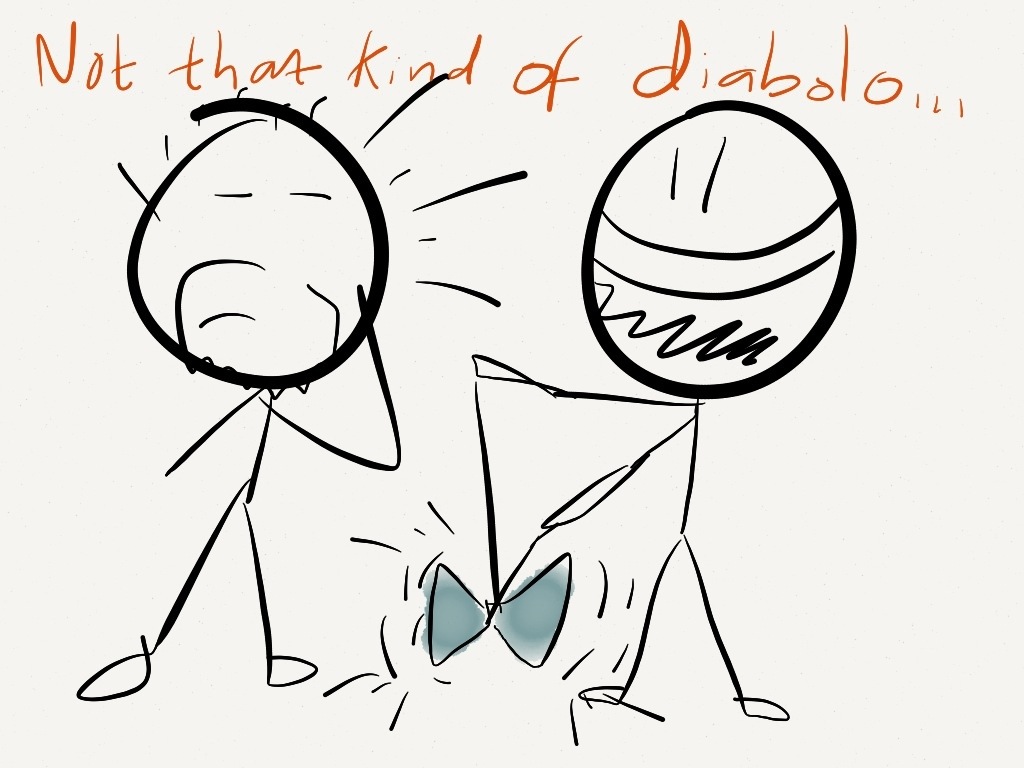
#oneaday Day 850: Diablolical

20120518-021217.jpg

My friends and I wasted many, many hours on both Diablo and its sequel over the years. We picked up cheap copies of the original game when we were in our first year of university and quickly figured out how to take advantage of our free phone calls between rooms to network our computers and play multiplayer. Later, we found ourselves enjoying the sequel a great deal — though I must confess, despite enjoying it a great deal, I only ever beat it once.

Fast forward a large number of years and we come to Diablo III. Does it still have the magic of its predecessors?

Simple answer? Yes.

Oh, you want a little more than that? All right.

First up, let's address the Big Issue that people have been ranting and raving about: the supposed "DRM" that requires a persistent Internet connection. If you spend any time actually playing Diablo III, you'll likely come to the same surprising realisation that I have, and that is this:

Diablo III is an MMO.

It's not an MMO in the same way that its stablemate World of Warcraft is — there's no open world and you don't randomly bump into other players wandering around — but it is a game designed to be played online, and it is a game where hundreds, thousands, millions of people all log in at the same time and are able to communicate and play with one another. There is a persistent chat interface allowing conversation with both friends and strangers even if you're not in the same game session with them, a persistent friends list (albeit one that isn't cross-region, annoyingly) and the ability to sneak a peek at your friends' equipment, achievements and other data. There is an auction house, allowing you to make some money (currently only in-game currency — the controversial "real money auction house" is due to launch later in the month) from those awesome items that your current characters can't use. Your characters are saved "in the cloud", allowing you to log in on any computer and pick up where you left off.

Most notably, there is the ability to immediately, instantly and seamlessly drop in and out of players' games. Friends who are playing are shown on the main menu, and joining their game is a simple case of clicking their name. Joining a public game (or opening your own session up to the public) is just as straightforward. The only thing that would make it easier to play with friends would be Steamworks compatibility, but this is Blizzard; that ain't going to happen.

Yes, you can play the game solo, but you can still chat to people while doing so. You can lock people out from auto-joining your game so you may only play solo if you want to, but you're still soloing online like any other MMO. You have the option to invite people or open your session up at any time without having to come out of your game or make a character specifically to play online with.

In short, the "always-online" thing is actually a key part of the game's design, and in execution really rather cool. While it may be frustrating to not be able to play "single player" offline, and the early server issues were a pain in the arse for a day (a single day, maybe two at a push — the game is running perfectly now) the fact that the game is, in fact, clearly an MMO makes it clear why this is the case. The entire game's infrastructure is designed around playing online.

But let's leave that aside for the moment, as it's a concept you'll either be on board with or you won't. What about the actual game itself?

Diablo III has undergone some significant changes from its predecessors. Gone is Diablo I and II's progression system, which allowed you to distribute stat points on every level up as you pleased, replaced with predefined stat increases. Gone is the "skill tree" system from Diablo II, which allowed you to "build" a character to your own specifications (or create a completely unworkable mess), replaced with a system where you unlock skills at predefined level boundaries and can only equip a limited number at once.

It takes some adjusting to, but Diablo III's way of doing things is streamlined and efficient without taking away the element of player choice. Everyone always levelled up their stats the same way in Diablo and its sequel anyway, and despite the illusion of complete freedom of choice that the skill trees offered, it was all too easy to create an underpowered character that wasn't particularly good at anything. What Diablo III lets you do is customise your character to work the way you want it to in any given situation, and then tweak it at any time. What you can't do, however, is hot-swap skills while you're in the middle of combat. You have to make some choices as to what skills you're going to use before wading into the fray, and reevaluate your decisions after various demon hordes have stopped having their wicked way with you.

The presentation is good, though not stellar. The in-game visuals work well but seem to have surprisingly demanding system specifications for their quality. In-engine cutscenes are a bit crap and look like something out of a game made in the late '90s. The special effects are great, however, with some wonderful physical modelling on bodies and objects around the game's environments, and spell effects are appropriately ridiculous, particularly when you're playing with several people all flinging pyrotechnics around the screen.

Sound design — always a strong point in Blizzard titles — is great, with some excellent voice actors and quality background music. Plus someone on the Diablo team has finally got wise to the fact that boss battles are infinitely more exciting with some boss music rather than the understated ambient rumbling of the previous games.

As with the rest of the series, it's the gameplay where Diablo III shines. There's a decent narrative running throughout the game, but the Diablo series has always been far more about killing thousands of monsters and stealing their stuff rather than paying much attention to the (surprisingly deep, if a bit po-faced) lore. And in that department it delivers in spades. Combat is straightforward, addictive and fun — particularly with friends. There is a huge variety of loot to collect, equip, sell, disenchant and craft. And a well-implemented achievement system actually makes you want to achievement whore because going after the challenges in question is so fun and satisfying.

I get the impression Diablo III is going to grow and change over time, too. We already know that a player-vs-player competitive element is coming, as is the real money auction house. But what then? Expansion packs? Content updates? New character classes? There are a ton of possibilities that Blizzard could incorporate into the game, and they could even use the patch process as a means of incorporating features which some are a little disappointed at the current lack of — things like voice chat. (Personally, I can take or leave voice chat — I suffer from telephobia when talking to people on the Internet almost as much as when I'm using the phone — but I accept that a lot of people expect it nowadays.)

In short, the future looks very bright for Blizzard's latest title, and if the amount of support Diablo II got — even once World of Warcraft arrived on the scene — is anything to go by, then players can likely look forward to a game that will last them for years.

#oneaday Day 845: Endless SPAAAAAACE

20120513-022002.jpg

As I believe has been well-documented on this very site a number of times, I am not very good at strategy games, be they of the board- or computer-based varieties. I have trouble prioritising what I want to do, and as soon as I do decide upon a course of action, some asshole other player comes along and beats the shit out of me before I have a chance to follow through on my master plan.

So it was with some trepidation that I decided I would give Endless Space a go. I've been playing a bit of Starbase Orion on iOS recently and, having recently won my first game (against one Easy-level opponent) I felt I wanted to investigate the space-based 4X genre a little further.

Aside: If you, like me, constantly forget what "4X" stands for, it means "explore, expand, exploit and exterminate" and is used to describe strategy games that involve a combination of building, expansion, collecting resources and military conflict. They're typically (though not always) turn-based in execution due to the amount of micromanagement necessary to keep an empire running smoothly, and depending on the game, victory can generally be attained in several ways. Sid Meier's popular Civilization series is one of the best-known examples.

With me? Good. Endless Space is an upcoming space-based 4X game from French indie developer Amplitude. You can preorder the game right now and jump into an impressively-complete alpha build and, in an interesting twist on the usual development cycle, participate in the decision-making process as the game gets closer to release. I shan't go into detail on that side of things right now (though I may in the future as it's a very cool idea to get the community involved in development) but I will talk a little about the game itself and how I've found it after a few hours of taking it for a spin earlier.

Endless Space, like many other games of its type, takes place in a randomly-generated galaxy. You're given a starting colony and a meagre supply of ships to get yourself up and running, and from there it's all about the empire-building. Scout out new systems, send colony ships to the richest-looking planets, then build, expand and conquer until you are the undisputed ruler of the Universe. Easy enough, right?

Unlike some similar titles, Endless Space's map is based around specific routes between star systems. (In Starbase Orion, for example, ships can move between any systems that are in range via the most direct route.) Because of this, it's much more straightforward to figure out how to defend yourself because attacks will only be coming from certain angles. Blockade your systems that are on the front line, then figure out a pathway through your opponent's defences that will whittle them down piece by piece. In some ways it reminded me of the excellent board-game adaptation of Blizzard's StarCraft, which is well worth a punt if you have a few hours (and a very big table) to spare.

The basic mechanics are similar to the classic Civilization titles. Each colony under the player's control produces food, industry, science and "dust", which is the currency used in the Endless Space universe. Food leads to population growth. Industry is used to build things — the more industry, the quicker things are built. Science is used to research new technologies. And dust is used for all sorts of purposes — hurrying production, upgrading ships and all manner of other things. Each colony in a star system adds to that system's pool of food, industry, dust and science (referred to in-game as "FIDS"), and each system may then use said pools to upgrade its population, contribute to the empire's overall research progress, build ships or build improvements to that specific system. It's simple to understand in practice, particularly if you've played Civilization before.

An interesting twist on the usual formula comes in the form of "hero" units, who are generated every few turns and may be hired for a fee of dust up front, then paid a salary each turn. Heroes come in two main forms: system governors and admirals. The former provide various bonuses to FIDS and morale in the system they're assigned to, while the latter may be used to take command of a fleet of ships and make them more powerful. As they do their jobs, they level up and may be customised with various abilities to specialise them or make them better generalists. They can be shuffled around the player's empire at will, too.

Combat, too, takes an intriguingly unconventional approach. Rather than going outright real-time such as in Sins of a Solar Empire, or almost completely hands-off as in Starbase Orion, Endless Space's combat takes a curious "cinematic" approach. A combat encounter unfolds over a set period of real time which is divided into several phases. There are a few seconds at the beginning of combat while both fleets approach each other, then the battle progresses between long, medium and short-range phases. The player may play a "card" on each of these three phases which provides numerous special effects. Cards have categories, too, and certain categories cancel out the other player's abilities. This gives an element of uncertainty to the combat, though the "combat preview" window, which estimates the player's chances of victory prior to the combat unfolding, is a pleasing addition, as are the Battlestar Galactica-style cinematic combat sequences (complete with ethnic instruments) and ability to completely skip the combat scene altogether if it looks like being a complete whitewash.

I haven't played a game through to completion yet, but I've been enjoying what I've tried so far. I don't feel overwhelmed with things to worry about and I don't feel I'm being "left behind" by the computer players. (I may feel differently if I get stomped on by one of them — my closest neighbour declared war on me just because I forcibly removed one of his scout ships from my border system with a fleet of destroyers.) The "hero" mechanic adds a cool sense of progression and the way the game is presented is simple, clear and easy to understand while remaining aesthetically impressive, with smoothly-animated, attractive UI elements, excellent background music and atmospheric sound effects.

If this is an alpha version, I very much look forward to seeing how the game evolves over the coming months. If you have the slightest interest in the turn-based strategy genre, I'd strongly suggest you give it a shot — and thanks to my good buddy Alex for the recommendation.

Check out the game here and preorder on Steam to get access to the alpha build.

#oneaday Day 840: Adventures on Environ

20120508-011145.jpg

[Explanatory note: One of my favourite things about procedurally-generated games like roguelikes, Minecraft and indeed A Valley Without Wind is the sense of emergent narrative they generate. While light on explicit narrative, the story of the player's own journey through the game becomes compelling in its own right. It's a big part of what makes story-light titles such as Demon's Souls so entertaining, too, if you're willing to invest in them.

What follows is the story of my first forays into the world of Environ via A Valley Without Wind. Some artistic license has been taken for brevity's sake but this is more or less how my early play sessions have unfolded.

Additional note: All names in this piece are exactly as they appeared in the game thanks to its glorious random name generator.]

Yan Sadovski awoke with a start in a snowfield. Spitting out the wet slush as it melted on his face, he unsteadily pulled himself to his feet and surveyed his surroundings.

Snow and ice as far as the eye could see.

This was nothing unusual, of course, for the world had been enveloped in a new ice age certainly for as long as he could remember. But something didn't seem quite right. He couldn't quite put his finger on what it was, but something was very much amiss, and he had a strange feeling that something terrible had happened. If only he could remember what.

Flexing his fingers within his snowsuit which had been keeping him warm for however long he had been unconscious outdoors, he experimentally cast the "fire touch" spell that momentarily set his hand ablaze — one of the first spells his people learned, but a useful one.

Good, he thought. That's still fine.

It was then he felt the strange presence behind him — a floating, glowing object depicting strange symbols.

Glyphbearer, said a resonant voice inside his head.

"What?" said Yan aloud, feeling immediately foolish, for there was no-one to speak to.

Wherever he turned, the glyph seemed to float behind him, meaning he couldn't get a good look at it. He shrugged and started trudging onwards through the snow in what he hoped was the right direction to get back to civilisation.

Gravestones littered the path here and there, marking the spots where previous Glyphbearers had fallen. Inscribed upon them were warnings and advice — "don't forget your wooden platforms", "don't jump into big holes unaware of what lies ahead", "don't forget a light source". He didn't know who had left the gravestones, but he felt it wise to follow their instructions, particularly as they always seemed peculiarly relevant to the situations in which he found himself.

Before long, he came upon the mouth of a cave. Curiosity getting the better of him, he walked inside and began to investigate.

The cavern was filled with strange mushrooms, lumps of rock and solid veins of purest gemstone. Greedily running his hands over the veins and letting the energy of elemental fire flow through his fingers, he gathered up the gemstones only to discover the strange glyph sucking them inside itself. He had no idea where the tiny, strange, floating object was putting them, but he had little doubt that they were safe.

Making a note of where the entrance was in his mind, Yan proceeded deeper into the caverns. Before long, he came upon what looked like a long-abandoned spellgem workbench — and it still held a selection of gems. He picked them up, the glyph "pocketing" them once again, and felt a rush of mystical energy flowing through him. Concentrating intently, he summoned forth a boulder of solid rock, flinging it into the air. Then a fireball, scorching the chill air as it passed. Then a ball of lightning, electricity cracking and fizzling around him as he chuckled to himself.

Satisfied with his haul, he picked his way through the caverns, back in the direction of the entrance. But he was no longer alone; the robots had come. The endless mechanical hordes had been blighting humanity throughout this new ice age, and now they were here, too. Grimacing, Yan fired off a bolt of lightning at the approaching mech, watching satisfied as it exploded into pieces. But still they came, in greater numbers.

Before long, he was surrounded. White metal robots jabbed him with their spears, while their red brethren — superiors? he thought — assaulted him with flaming masses.

He could feel his life slipping away as the machines continued their relentless assault. He was in pain, and he knew at that instant that he was never going to find out what disaster had befallen the lands.

Blackness.

Nothingness.

Anger.

Taquesha Garrett opened her eyes and found herself standing in a snowfield. She had no idea how she had got here, and no idea what the strange floating object behind her was. She sensed great power emanating from it, however, and sensed it wanted to accompany her.

She started walking through the snowfield in what she hoped was the right direction. Passing a small cave entrance, she hesitated for a moment, feeling an inexplicable sense of dread and rage emanating from within, before picking up the pace and moving on a little faster.

Before long, she came to an open area. A loud "thumping" noise was disturbing the peace, and it wasn't hard to see the source — a giant robot roaming the landscape. Figuring it was too strong to challenge by herself, she carefully and stealthily found a route past it without attracting its attention, and shortly afterwards found herself in a sorry-looking village.

A long-haired man staggered up to her. "What have we done?" he cried. "We must put our trust in the Ilari!"

Taquesha frowned, and followed the man's frantic gesturing to what passed for the village square, where three enormous crystals stood, glowing softly in the moonlight. She walked up to them and immediately felt a sense of warmth, concern and trust emanating from them.

Glyphbearer, they said in her mind. You have come.

She said nothing — she had no idea what she might be able to converse with these mysterious entities about — but in a flash, she understood her mission, if not the circumstances which had led to it.

The Overlord would fall. And these shattered lands would know peace.

She didn't know what the words that had burned themselves into her brain knew until she left the village for the first time, only to discover a strange sight. In one direction, lush green unspoiled forest. Behind her, the glacial fields she had grown up with. To the north, barren desert. And to the south, what looked like a junkyard.

Her studies of magic had given her a good working knowledge of how to craft her own spellgems, so she resolved to equip herself with some stronger magics before taking on this mysterious "Overlord", wherever he might be.

For the next few days, she explored the local area, poking her head into long-abandoned buildings and looting them of any valuables within. There was no sign of any human life anywhere save for the sole survivor she had seen back at the village. What had happened here?

In the distance, violent wind and rainstorms buffeted the landscape. She knew that if only she were able to push the winds further away from the settlement, she'd be able to better judge her surroundings and her eventual goal.

The Ilari, she thought. Maybe they can help.

She returned to the village and rested, then asked the strange crystal ones if they could help her with the wind.

Seek the wisdom of an Aquaurgist, they replied. Taquesha frowned in response. The other survivor in the village didn't seem to be much for working with water — he was more of a wood specialist, judging by the number of logs he'd chopped since she'd been there. But where to find an honest-to-goodness Aquaurgist in this strange, shattered land?

It took time, but she eventually discovered a survivor holed up in an abandoned town. Promising to protect the frightened, bearded man from the monsters that terrified him so, she led him back to the village, where he began work with the Ilari immediately on summoning the materials needed for the construction of a wind shelter.

A short time later, Taquesha had braved the howling winds and acidic rain and successfully constructed the shelter. Its vast blades span majestically through the air, and the storm, as if frightened, backed away from it, far towards the horizon.

For a time, life was good. Taquesha spent her days gathering materials for the good of the village and to assist her with her spellgem research, but one day cruel Fate decided that her time was up.

She'd snuck into a run-down warehouse, feeling confident that she'd be able to find a stash of unspoiled supplies within. Inside, it was dark, and the air was thick with tension. She knew that she'd have to be very careful here, or the strange creatures lurking in the darkness would surely destroy her.

She tensely picked her way through the first few rooms of the building safely, but before long she'd attracted the attention of a strange, fiery beast. Its roaring, in turn, brought others like it running, and as her body was wracked with pain from the burning embers striking her skin, she found herself melancholy.

It wasn't supposed to end this way, she thought. I was supposed to defeat the Overlord and save these lands. I've done so much for them already, and this is how–

Darkness.

Silence.

Rage.

Phlegethon Gogola suddenly awoke in an unfamiliar village, his long, unkempt beard and hair blowing in the chill wind of the disconcerting icy surroundings. Behind him floated a strange, unfamiliar object that unnerved him somewhat. But at the same time, he suddenly found himself with a sense of purpose.

Glyphbearer, came a voice in his head. It is time for you to begin your adventure.

Phlegethon grunted to himself. Adventure was all very well and good, but he was damned cold. He wouldn't be going far unless he could find some way to protect himself from the elements…

#oneaday Day 838: Still No Wind Here

20120505-233946.jpg

As promised, here are a few further thoughts on A Valley Without Wind, given that I've inadvertently spent most of today playing it.

First up, having read a few reviews around the Web which focused heavily on the visual side of things, I direct you to this post. Get over it. Not everyone has the budget to make something that looks like Final Fantasy XIII, and it's not as if AVWW's visuals are bad per se, they just look like something out of a PC game from the 1990s, shortly after we discovered Super VGA. If "8-bit" can be an acceptable aesthetic (and I shan't get into a rant on the misuse of that term here) then why not "mid-90s PC game" if the graphics don't actually hurt the experience?

Secondly, the music. You will, as the cliche goes, love it or hate it. Here's a simple test. Do you like chiptunes and electronica? You will like the music. If you do not like chiptunes and electronica, you will probably want to switch it off and listen to something else. (I love chiptunes and electronica.)

Those two glaringly obvious points which most reviews seem to focus on aside, let's discuss the gameplay a little more.

Following an initial tutorial which introduces key gameplay concepts to the player with various gravestones sarcastically describing how various predecessors could have avoided their fate, the player reaches a settlement. This is a sorry affair to begin with, with only a single, bedraggled-looking survivor staggering around it, but a selection of basic buildings already constructed and ready to go. Three of the giant crystalline "Ilari" life-forms are here, and later in the game they'll provide a means to purchase items, build things and cast far-reaching spells. To begin with, their most important function is to restore your hit points.

Leave the settlement and you'll be taken onto a grid-based randomly generated world map. Each tile has a particular terrain type which controls the type of enemies that will spawn there, the items you'll discover and, if you're lucky, the survivors you might come across. Each region comes from a specific time period — the game's story centres around the concept of the world being "shattered" both geographically and temporally — and this comes into play with some of the missions later.

When exploring a region, you'll come across buildings. You can enter every single one of them. Most of them are sprawling mini-Metroidvania adventures in their own right, but for the most part you'll be seeking out the "stash" rooms that contain plenty of treasure. These are conveniently marked on the graph-like abstract dungeon map in the corner of the screen, which shows the connections between rooms but not their exact layout. A key part of gameplay is "scouting" buildings, which means delving in just far enough to reveal the rest of the map — rooms that are within two "connections" of the one you're in appear without you having to go to them — and then weighing up whether it's worth exploring further.

The buildings are rather abstractly designed (not to mention having TARDIS-like properties), and call to mind retro classics such as Jet Set Willy, where a "real world environment" was simply a room with obstacles in it and various graphics representing toilets and televisions scattered around the place. They're far from "believable" environments, but it doesn't matter — you're playing a side-on platform game, so there's a limit to how realistically these structures can be designed anyhow. I'd rather have something that is interesting to explore than something where every building is the same.

Missions play a key role in progression. You'll come across missions either on the world map or tucked away inside buildings. These whisk the player off to a unique, special area and challenge them with a specific task. Sometimes you might be climbing a linear tower and bashing bosses on the way up. Another time you might be defending storage silos from incoming meteors like a Missile Command platformer. Another time you might be tasked with removing the "anachronisms" from an area, which involves figuring out which monsters don't "belong" in the region you're in and eliminating them. Destroying all the correct monsters concludes the mission. Destroying an incorrect monster spawns two more, either, both or neither of which may also be an anachronism. Yet another time you might be challenged with getting through a "one shot, one kill" dungeon where either you or the enemy grazing their knee results in instant death.

As you progress through the game, death becomes an increasingly frequent occurrence. When a character dies, they're gone for good, leaving behind a tough-to-defeat vengeful ghost at the location where they shuffled off the mortal coil. Fortunately, you don't lose all the stuff you've spent hours accumulating — you simply lose any upgrades you might have applied to that character's health, attack power and mana pool and have to pick a new playable character. As you rescue survivors from different time periods, you gain access to a range of characters with varying abilities — those from an "ice age" era, for example, are resistant to the cold, while those who are not will require special equipment to explore cold environments effectively.

The eventual goal is to storm into the local Overlord's lair and kick him squarely in the balls. Said Overlord has a bunch of lieutenants, too, who can either be knocked off individually before taking on the Overlord or battled at the same time as the big boss man. You can theoretically walk straight into the Overlord's lair from the beginning of the game, but you'll be ill-equipped to deal with the challenges therein. Instead, it's advisable to complete a bunch of missions to raise the continent's "civilisation level" (thus affecting both the strength of the enemies and the potential rewards on offer) while also collecting the raw materials required to buff up your character's spells. And rescue survivors. And build buildings. And construct wind shelters to push back the wind storms that buffet the region, making exploration difficult. And track down "mystery rooms" to find clues describing exactly what the hell happened to the world to get it in this state. And… you get the idea. There is a shitload of things to do, and completing the first continent then invites you to do it all again in a more diverse array of environments.

The sheer amount of things that there are to do can make the game seem like a daunting prospect. The game often draws comparisons to other open-world freeform adventures such as Minecraft and Terraria and that feeling of being alone in a vast, terrifying world is very much present and correct here. Focus on completing a few simple tasks, though — the game is good enough to suggest some to you — and things will gradually start to fall into place.

A Valley Without Wind is an ambitious title that tries very hard and while it's true there are elements of the experience that could do with a little refinement, it's a very memorable, compelling and addictive game that produces some excellent emergent narrative. Best of all, though, is the fact that the developers are still working on it, meaning the game experience will grow, change and evolve as time goes on. If it's this intriguing now, I can't wait to see what the game looks like in a few months or years.