#oneaday Day 717: Just One More Turn

I've been playing Civilization V. It's now 3AM. The two facts may be somewhat related.

I've only been playing the Civ series since its fourth instalment, and while I've found it entertaining and fun, like many heavily strategic board games, I find it difficult to actually succeed at it. It's a challenging series of games, for sure, and there are lots of things for you to focus on all at once — thankfully with the infinite time offered by turn-based games.

Civilization Revolution on consoles provided a different experience which I liked a whole lot. What we had in that game was a simplified (but not dumbed-down) Civ experience which could be played in relatively short sessions, and which was set up to encourage players to be at each others' throats almost constantly.

And now we have Civ V. I know we've had Civ V for a while now, but I've only just started playing it thanks to a generous Christmas gift. (Thanks, Paul!) Civ V, for me, is resonating nicely, offering a pleasing middle ground somewhere between the simplicity of CivRev and the depth of Civ IV. It's certainly a different beast from Civ IV, and those who have grown accustomed to the functions of the various buildings in IV will have to relearn everything for V. Thankfully, the game does a pretty good job of explaining what each building does, and offering enough suggestions to help you out without feeling like you're being shunted down a specific path or letting the game "play itself".

There seems to be a nice balance between number of players and game time, too. In Civ IV, I often found that playing a game with any more than two or three players total often meant it would stretch on into the "days long" territory, making it all the more disheartening when something went disastrously wrong in 850BC and you then spent the rest of the game playing catch-up, with no hope of winning. The game of Civ V I played tonight, however, went on for about three and a half hours. That's not short by any means, but it's certainly doable. A tabletop game of Arkham Horror takes three hours. And, of course, with Civ you can always save and come back to it later.

Except you can't. Because there's something in that game that means you can't just leave it alone. Something deep within the coding that taps into the pleasure centres of your brain and wants you to keep playing — yes, for "just one more turn". It's difficult to pin down what it is — certainly it doesn't resort to Skinner Box tricks like social games, but there's definitely something in there giving it a particularly addictive quality. Perhaps it's the fact that you have to come up with a long-term strategy and aim for a specific type of victory. (Cultural in the case of the game I just played, meaning my empire focused almost entirely on developing culture, and I spent the entire game hoping my neighbour to the North wouldn't feel the need to attack me. Fortunately, he was more interested in subjugating the city-state of Singapore to pay too much attention to me.) Perhaps it's the little countdowns showing how many turns until you complete that piece of research or build that cool building. Perhaps it's the little mini-rewards — famous quotes when you research a tech, short movies when you build a Wonder. Or perhaps it's just the satisfaction of seeing your empire grow and grow and grow and thinking "I made that."

Whatever it is, I say simply DAMN YOU, SID MEIER.

#oneaday Day 711: The Ancient Craft of Mining

Andie and I may have inadvertently spent pretty much the whole day playing Minecraft. I've spoken at length on the virtues of this game on several occasions on this blog, but every time I play it I find something new to appreciate, a new way to play or a new way to look at the game.

This, of course, is the central beauty of Minecraft as a game. No-one is telling you how to play it. The Achievements which were added a few updates ago give you a nudge in several possible directions — enough to get you started, anyway — but beyond that, it's entirely up to you what to do.

On the Squadron of Shame SquadCast, we've had a number of discussions on the subject of games that plonk you down into the game world and simply invite you to "get on with it". Traditional RPGs followed this format, though often had a questline to follow. Bethesda RPGs, too, follow this approach after a linear introductory sequence. But none do it quite like Minecraft, which is refreshingly old-school in its approach.

Minecraft doesn't have a story. At least, not an explicit one. Nowhere is it made clear exactly why you've been thrown into this blocky landscape with nothing to your name but your wits. Nowhere is there an introduction describing how and why the monsters that plague the landscape after dark came to be. And not once are you told what your "goal" is.

In some senses, this is a return to gaming's roots, when all the information you needed to know about the game's plot and setting could be fit on the back of the box. Minecraft's retro aesthetic would certainly seem to fit with that theory, but the complexity, depth and freedom that the game offers is something that simply wouldn't have been possible with older systems.

I do most of my playing on a small private multiplayer server which is in "survival" mode. This is fundamentally identical to the single player mode, where you're tasked with surviving against the elements (or, indeed, monsters) with only your wits and what you can scavenge. You start playing in a very small area, gathering resources and building materials near where you started in an attempt to create a convincing shelter before the sun sets and the monsters come out to play. As time goes on, however, you spread your wings and start to explore the randomly-generated landscape. In single player, you'll find yourself discovering a variety of different natural biomes — forests, swamps, mountains — but it's in multiplayer that the world of Minecraft truly comes alive.

Round a corner of a mountain, you might find a mysterious door set into the hillside. Entering, you might find some chests containing tools, food and building materials — along with a sternly-worded sign informing you that this stuff is not yours.

The beauty of it, though, is that if you want to be a complete git about it, you could just take all that stuff and run. The facility to leave signs with your own custom wording on them, too, means that it's not beyond the realm of possibility to, say, nick someone's hoard of diamonds, bury them in a chest somewhere in the depths of the desert and leave them a trail of clues to reclaim them. I hasten to add that I haven't done this, but it is enormously tempting to do so.

A multiplayer Minecraft server becomes something of a community. How active that community is depends largely on how many other players there are and how often they play. On a big, busy server, you'll find impressive structures all over the place as players attempt to outdo each other with outlandish construction projects. On a small, private server such as ours, the world will change gradually, evolving piece by piece as each player stakes out their claim to their own piece of territory. It's fascinating to watch — the fact that the world is persistent so can be changed by other players when you're not online means that there's often something new and player-made to take a look at when you next log in. It also means that eventually you'll have to start either competing for the finite resources that there are, or travelling further afield to locate the items you'll need to survive and/or complete your latest building project.

There are so many ways to play Minecraft, and the situations I've described here barely scratch the surface. It's whatever you want it to be, and it's for that reason that I believe that outlets "reviewing" the game when it finally reached Version 1.0 is an utterly futile gesture. For one, everyone's experience with the game is somewhat different — some are switched off by the lack of direction and give up in frustration; some "powergame" by building the bare minimum they need to survive and progress, attempting to reach the newly-added endgame; some take their time to build impressive structures; some roleplay in their mind, casting themselves in the role of a town planner, laying out buildings and imagining what each might be used for; some do everything they can to make life hell for other players. Not one of those ways to play is "wrong" — even the griefer — and that's why the game is such a work of genius, despite its glitches and flaws, of which there are still many.

Minecraft will continue to develop over time, though now it's emerged from beta and its creators are working on other projects, new versions will be released at a slower rate. There's still an enormous amount of potential there, though, and it's exciting to imagine what might come next. By putting the creation of the game world and its character in the players' hands, the team at Mojang have created one (or indeed many) of the most compelling game worlds ever seen in interactive entertainment. There really is nothing like strolling down a street you've built yourself, defending it from monsters who want nothing more to 1) kill you and 2) blast big holes in your hard work.

If you're yet to try Minecraft, then get yourself over here and join the 4.3 million people — yes, wow — that have bought the game to date.

#oneaday, Day 560: Enchanté, Elise

I very much enjoyed EasyGameStation's Recettear: An Item Shop's Tale, mostly due to the wonderful localization job done by Carpe Fulgur. I booted it up for the first time half expecting to be done with it within less than an hour — most games involving supposed "shop management" and the like these days are in fact social games and therefore pretty much devoid of any meaningful thought whatsoever. Recettear, though, was different — by blending the loot-whoring dungeon crawler with a simple business sim and some lovable characters, EasyGameStation and Carpe Fulgur managed to create easily one of the most memorable games of last year for me.

So it was with some anticipation that I heard the team was hard at work on localizing another EasyGameStation title — Chantelise: A Tale of Two Sisters. From what I'd heard of it, it sounded like a more conventional action RPG than Recettear, but I was confident that Carpe Fulgur's translation would prove super-effective once more.

The game came out the other day so I grabbed a copy — it was cheap, and I'm happy to take a risk on something from a developer I trust, particularly for a low price. I've been playing it for a few hours now, and while it's quite a different experience from Recettear, the similarities are pleasing — you can still heal yourself by eating egg on toast, for example, and a lot of the "miscellaneous treasure" items are the same. The monsters are almost identical, too, and protagonist Elise looks somewhat like what Recette would probably look like if she were a little older. And there's a fairy involved again, too.

What's been a pleasant surprise about Chantelise, though, is how unconventional it is. Despite looking to all intents and purposes like a fairly generic action JRPG, there's some inventive ideas in there.

For starters, there's no grinding for experience points, levelling up and that sort of thing. Powering up Elise is done entirely through purchasing items and/or completing parts of the story. This negates the need for tedious grinding, as money seems reasonably easy to come by.

Then there's the magic system. Rather than simply learning an arsenal of spells and then using magic points to cast them, Elise's sister Chante (who has been turned into a fairy) handles magic. If Elise collects magic gems dropped by monsters, Chante can then use these to cast spells — each colour causes a different effect. Multiple gems can be used at once, too, with different combinations yielding different effects. The twist is that Chante will only cast a spell using the last gem you picked up, meaning that there's an element of almost puzzle game-like strategy to picking up loot from the floor as you need to ensure you have a helpful arsenal of spells on hand to use.

The game structure is peculiar but effective, too. Split into various areas which are then subdivided into stages, Chante and Elise must batter their way through all the monsters in a stage to unlock the path to the next. The final stage in an area features a boss fight. Getting KOed along the way sends the heroic duo back to town, and re-entering the area requires them to start again — only this time they can charge straight through stages that have already been completed to quickly get back to where they were. This makes getting KOed mildly inconvenient, but not inordinately frustrating.

Alongside the basic game structure, every stage also has a secret treasure chest to find, too. Requirements for revealing this range from killing special enemies to destroying parts of the scenery, and the game keeps track of which areas you've found the secrets in and which you haven't. Interestingly, you don't have to run the whole gauntlet of stages if you're just going for a treasure chest — you can play individual stages in a time attack mode if you're just treasure hunting, but you have to follow the linear "story mode" path if you want to progress through the, well, story. Obviously.

In practice, the game is more of an action game with an upgradeable character than an RPG. The first few stages are deceptively easy but by the time you're into the second dungeon you'll find yourself having to thoroughly understand what Chante and Elise are capable of if you hope to succeed. Hordes of enemies — some of whom can only be defeated in a specific manner — attack the pair and it becomes rather more important to think tactically rather than charge in mashing the Attack button.

Chantelise likely isn't going to appeal to everyone. Its animé visuals look like pretty much every budget JRPG ever. There's a lot of repetition involved, particularly if you keep dying. The tutorial is rudimentary at best, leaving you to discover the vast majority of how the game works for yourself. The music's a bit annoying. And the Zelda-style BLING! BLING! BLING! BLING! noise when you're low on health will drive you nuts (pro-tip: don't get low health). But I happen to love all these things (even the annoying music and BLING! BLING! BLING!) so I'm looking forward to what promises to be a reasonably lengthy adventure with plenty of hack and slash action and the same wonderful localization that set Recettear apart as one of my favourite games of last year.

Carpe Fulgur have great things ahead of them — they're already working on two new titles, one of which is secret. Discovery of games like Recettear and now Chantelise — both blissfully Achievement, Online Pass and DLC-free — is why I'm very glad I'm now doing most of my gaming on PC.

#oneaday, Day 335: My Synapses Are Cold

I think it's pretty much a given now that I'm a fan of creative indie games, particularly ones that put unusual twists on established formulae. There's one I haven't really talked about here yet, and I feel I should rectify this forthwith.
My brother (John Davison of GameSpot, for those three of you who haven't realised that yet and are now going "Oh, yeah!") mentioned on Twitter the other day that asynchronous multiplayer was "multiplayer for grown-ups". Or specifically, multiplayer for people with little to no free time. Eminently suitable for those with jobs. Or those with families. Or those who simply suck at action/skill-based multiplayer titles.

Mode 7 Games' Frozen Synapse caters for this crowd, specifically the subset of it who wish that they could pull off a headshot at a hundred paces but no longer have the reflexes of a twelve-year old with too much sugar and caffeine in their system. Frozen Synapse is, at heart, a team-based first-person shooter, albeit one represented from a top-down view played in turns by only two people. So not a lot like a first-person shooter at all, really.

Except that it kind of is. For the uninitiated, Frozen Synapse features a wide selection of different game modes, many of which will be familiar to players of shooty-shooty-bang-bang games. The simplest is Extermination mode, which simply tasks one team with killing the other team before five turns are up.

Each turn represents a five-second period of time, during which your little people can run, walk, duck, crawl, aim, shoot and focus on specific targets. It's your job to set up a plan of action for them by setting waypoints and actions, then testing your plan to see where they'll end up after five seconds, then committing your plan. At the same time, your opponent is also doing this, and when both of you have committed your plans, the outcome is shown, and it may not be what you had anticipated.

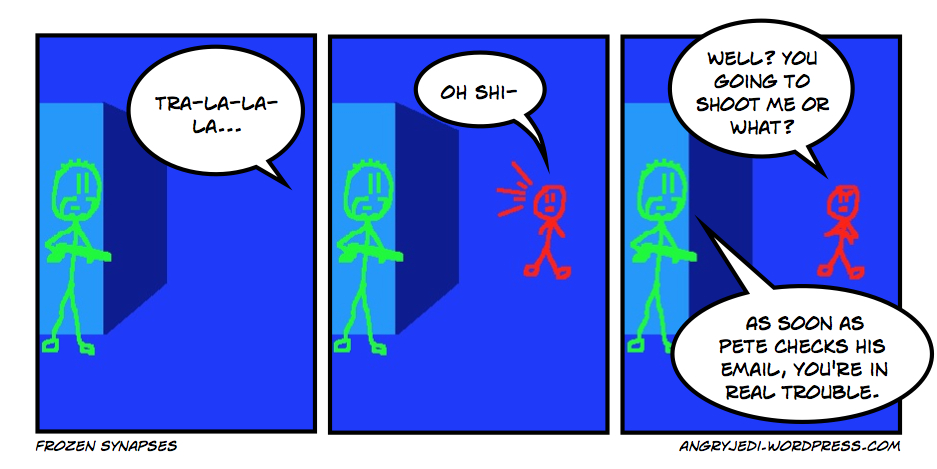
The cool thing about it, though, is that you don't both have to be online to play. It's essentially play-by-email, with the game sending a message to your opponent when you've taken your turn and it's time to check out the carnage. This means that you can have a whole bunch of games on the go at the same time, and be able to rattle through them all in a matter of minutes. It's a great idea, and it's awesome to see this kind of idea work in a setting other than a game with With Friends in the title.

Best of all, the game plays well and it's not even finished yet. The final product promises a single-player campaign mode, puzzle mode and all manner of other goodies. Those who are keen to support the game can pre-order and play the beta version right now, though, and you get a free copy to give to a friend, too. Which is nice.

Even better than that, the game is 30% off until Christmas. So if you're the slightest bit interested in the unusual concept—and it genuinely does work really rather well—I'd encourage you to support the hard-working three-man team that is Mode 7 and pre-order a copy now.

If you do, be sure to send me a challenge. I cordially invite you to the turn-based bloodbath.

#oneaday, Day 325: Interactive Fiction

There's a lot to be said for interactivity (or at least the illusion of interactivity) in storytelling. It allows things to be done that are simply impossible with non-interactive media such as books, TV and film.

I spent a couple of hours this afternoon playing Digital: A Love Story, a wonderful game set on the desktop of an Amiga "five minutes into the future of 1988". If you haven't played it yet and are intrigued by the premise, I suggest you play it before reading on, because I'm probably going to spoil some things about it. I'll try not to be too explicit.

At the outset of the game, the player is the proud recipient of a brand-new "Amie" computer with a built-in modem. Your benefactor also provides you with a phone number of a BBS that you might want to check out. And so the story begins with the player dialing into the BBS, complete with terrifyingly authentic-sounding dial and modem tones screeching from your computer's speakers. The player quickly gets friendly with a person named Emilia and things develop quickly in a manner that will be immediately familiar to anyone who has ever had an online relationship.

All is not as it seems, however, and the player, through a bit of investigation, discovers that there are strange things at work. The BBS crashes, and there is no way of getting in contact with Emilia. Just prior to the crash, she said she was "leaving home" and "getting out". Thus begins a quest across several BBSes, ARPANet and Sprint's long-distance calling-card system to track down Emilia and discover what happened.

The game is completely linear. Things happen in a set order, right up to the ending, when the player is faced with an inevitable conclusion that there really is no way around. At this point, we reach one of the most powerful things that gaming can do, and ironically one of the least interactive things about narrative games.

Offer the player the opportunity to do two things: do something, or walk away. Walking away is usually not an option, though Heavy Rain managed to convincingly offer this as an alternative at several points throughout its narrative. Digital: A Love Story, however, makes it abundantly clear that there is only one course of action open to you, and it's an unpleasant one. Given the great pains that the game has taken up until this point to make you "feel" for the characters involved, despite being based around screens of text, it is difficult to make that final mouse click.

This is something you just can't do with a book. Stopping halfway down the page and printing "Turn the page to see what happens next" is not an established literary convention, nor should it be. Same with TV and film; with those media, we're just along for the ride. It's the reason very few books save the Fighting Fantasy and Choose Your Own Adventure series are written in second-person perspective.

But with a game, the player has been driving the story all along, even if there is only really ever one thing they can do at a time to advance the plot to the next "event". That illusion of interactivity allows the player to be all the more invested in the story, as if they're part of the game world. This is further aided in titles such as Digital: A Love Story, which don't break "character" for a moment. As far as the player is concerned, they're using an Amiga… sorry, "Amie". They're not playing a game, they've been transported back in time to 1988, a land of 320×200 graphics, questionable multitasking capabilities and scanlines.

The ending of Digital: A Love Story is bittersweet and if you've engaged with the game up until that point in the way it is intended to be engaged with, you'll find it genuinely emotionally affecting. It's always interesting when a title which looks so unassuming can actually end up being more powerful than self-consciously "epic" CG cutscenes and over-the-top orchestral music with people singing in Latin.

So, if you remember 1988, if you ever had an Amiga or you remember the golden age of the BBS, check out Digital: A Love Story. It's free, and well worth your time.

#oneaday, Day 274: Seven Deadly Sims

[Click the comic to see a bigger version if you can't read the text.]
The Sims shouldn't be good. It really shouldn't. It represents all the things that people say they'd never want to do in a game. People always say that they don't want their characters modeled in such detail that they need to eat, sleep, poo and the like. But it was this level of detail that brought the original The Sims game to life.

Over time, the series has developed in many wild and crazy ways. To the casual observer, each game may appear to be fundamentally the same. But in fact, each new game (and, for that matter, each new expansion pack) has changed the way the game is played to a considerable degree. So much so that The Sims 3 now has the potential to go in any one of a wild number of disparate directions according to what the player feels like doing at any time. What other games do you know where you can do this:

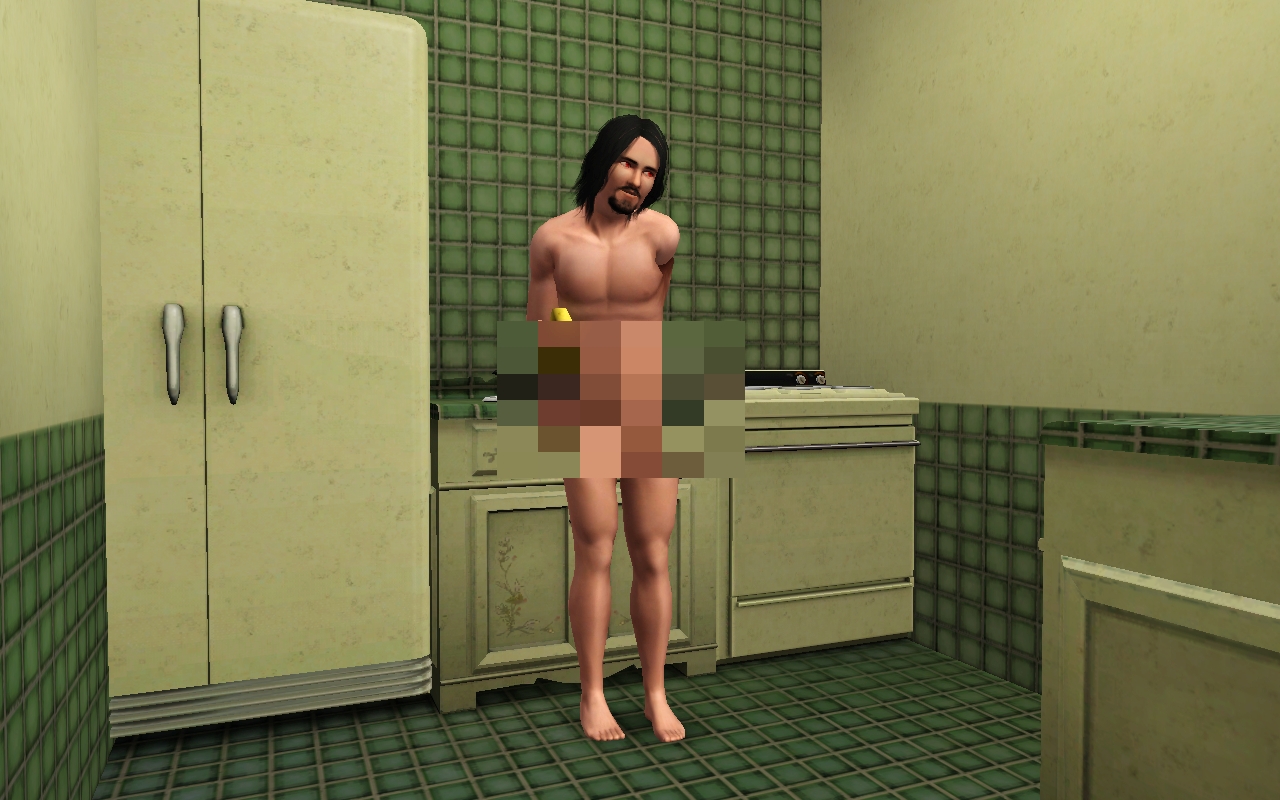
Evil Jeff Grubb takes a sponge bath in the kitchen.

AND this:

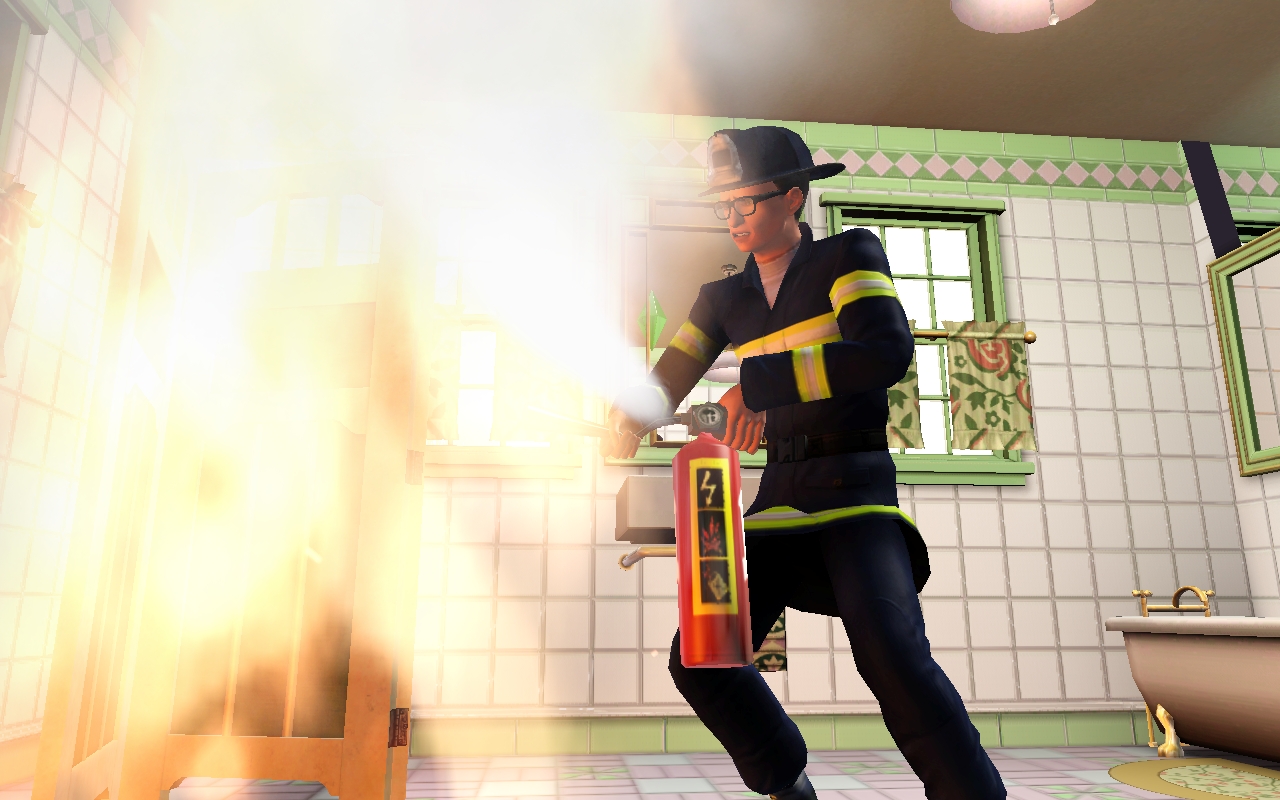
Non-Evil Mike Rougeau puts out a fire. Professionally.

AND this…

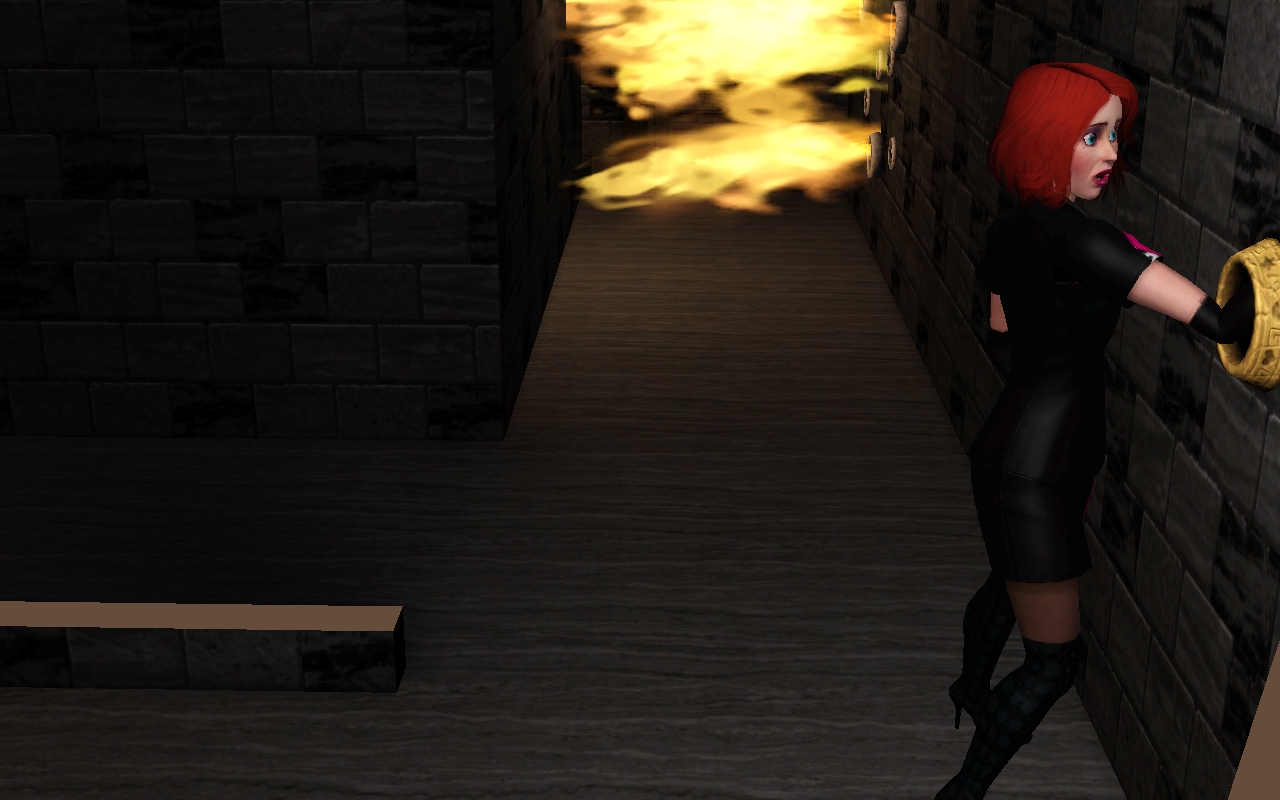
Amarysse attempts to find her way around a flaming death trap in an ancient Chinese tomb.

AND this…

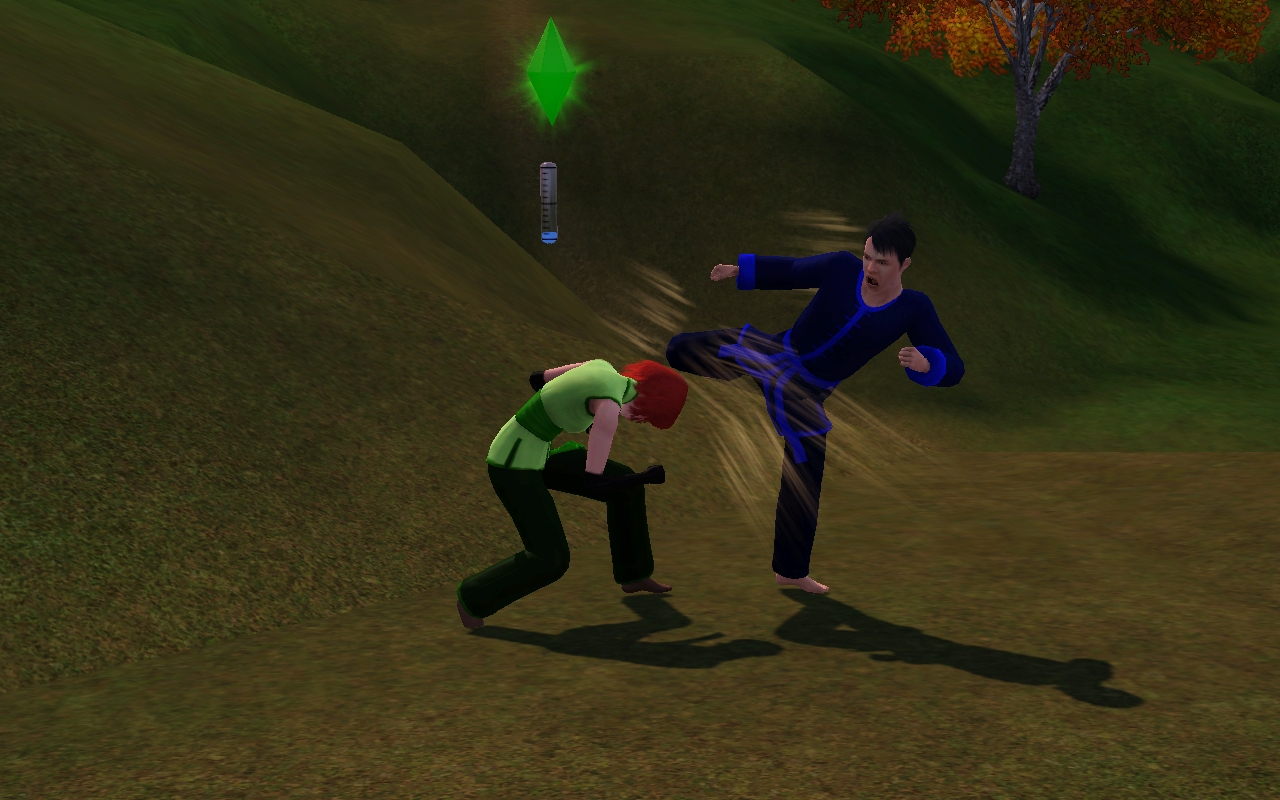
Amarysse spars with a fellow martial artist.

AND this…

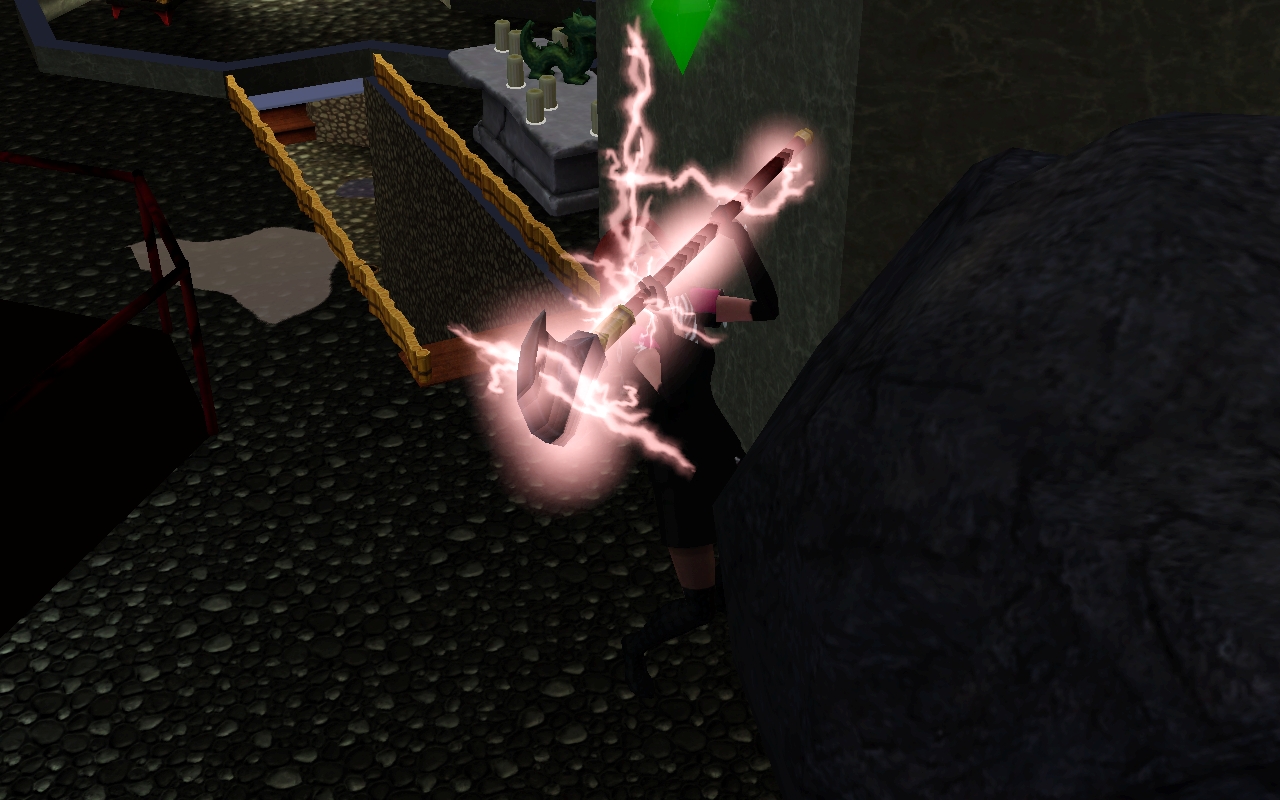
Amarysse prepares to use her magic axe to smash the crap out of a boulder.

AND… you get the idea.

The Sims 3, with its current two expansion packs World Adventures and Ambitions, represents an enormously diverse experience that is by no means just about telling little people when to go to the toilet. No, what we have is probably pretty close to what Will Wright originally intended when he envisioned the series. A life simulator. A game where the player is pretty much free to do as they please.

If they want to stay at home and concentrate on building a family, they can do that. If they want to go out and explore perilous dungeons around the world, they can do that. If they want to try and prove they're the best at a tricky profession, they can do that too. Or if they want to try and juggle all those things? Well, they can do that too. Amarysse, depicted above, is a successful athlete, lesbian, adoptive mother to a young child, treasure hunter and local hero in parts of China. And she's only about halfway through her life. By the time she eventually shuffles off this mortal coil and it's time for her adoptive son to take up the mantle of her family and prove himself, she'll have a whole ton of experiences to look back on.

As you may have gathered, I have very much rediscovered The Sims recently. And if you've never given it a try, I can highly recommend it, even if you've never been a fan of the series before. You will be able to find something in that game for you to enjoy. Even if it's something along the lines of this.