2019: Hero of Daventry: Some King's Quest First Impressions

0020_001Following on from my post the other day, I downloaded the first episode of King's Quest on PlayStation 4 today, and gave it a bit of a go earlier. Andie seemed to be enjoying it, so I paused for a bit while she went and had a nap, then we went and had dinner. Will probably play some more tomorrow.
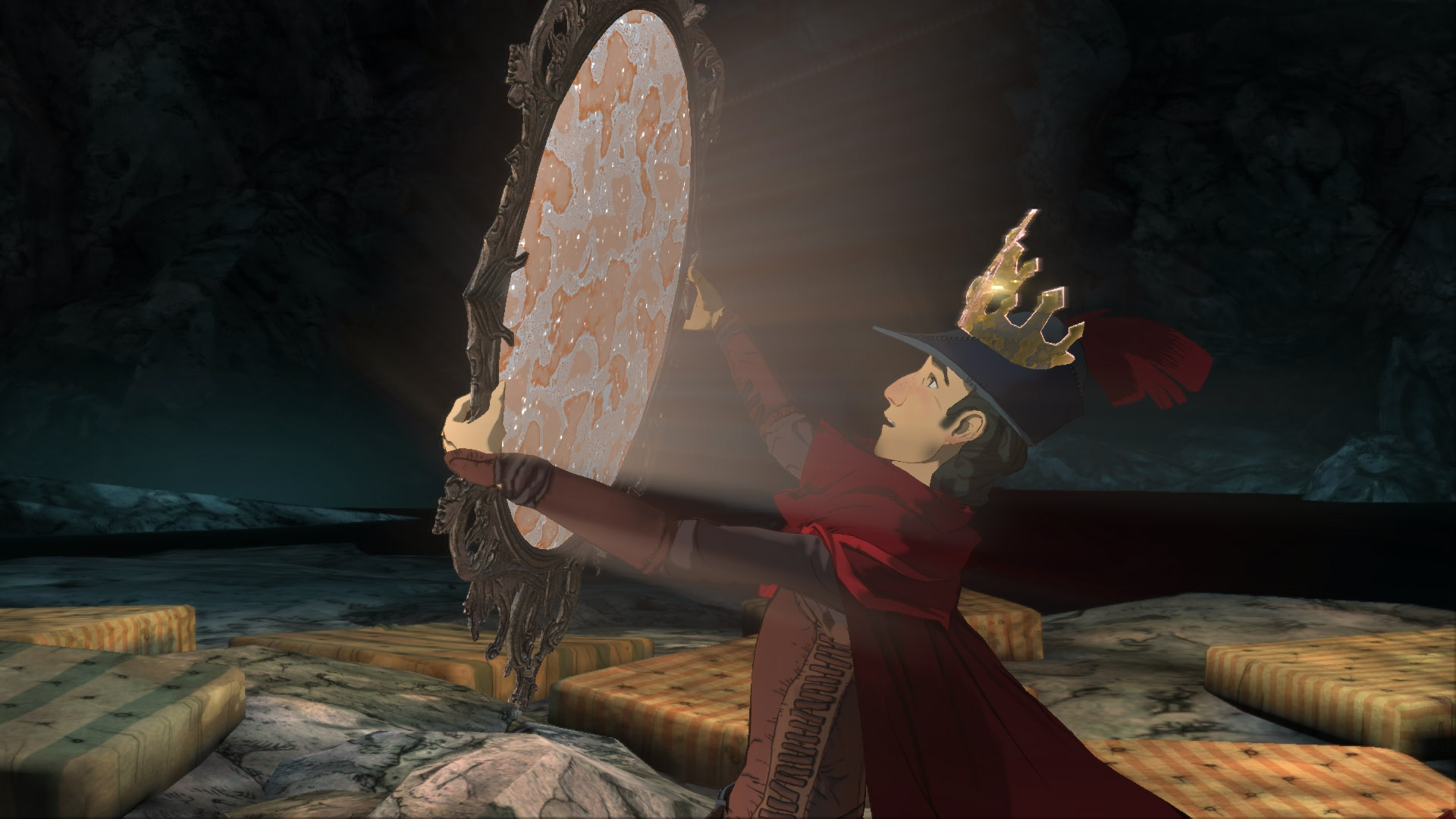
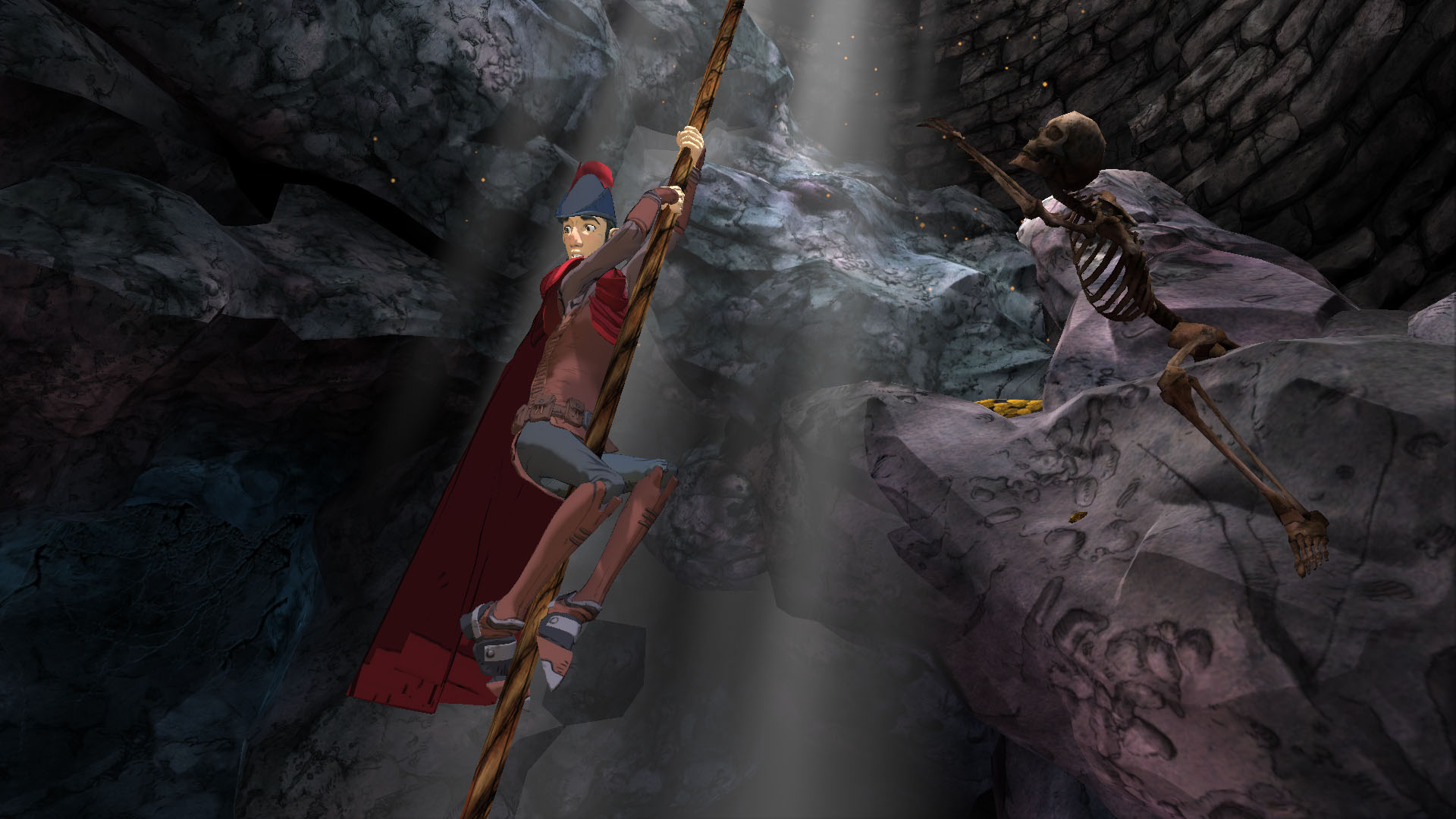
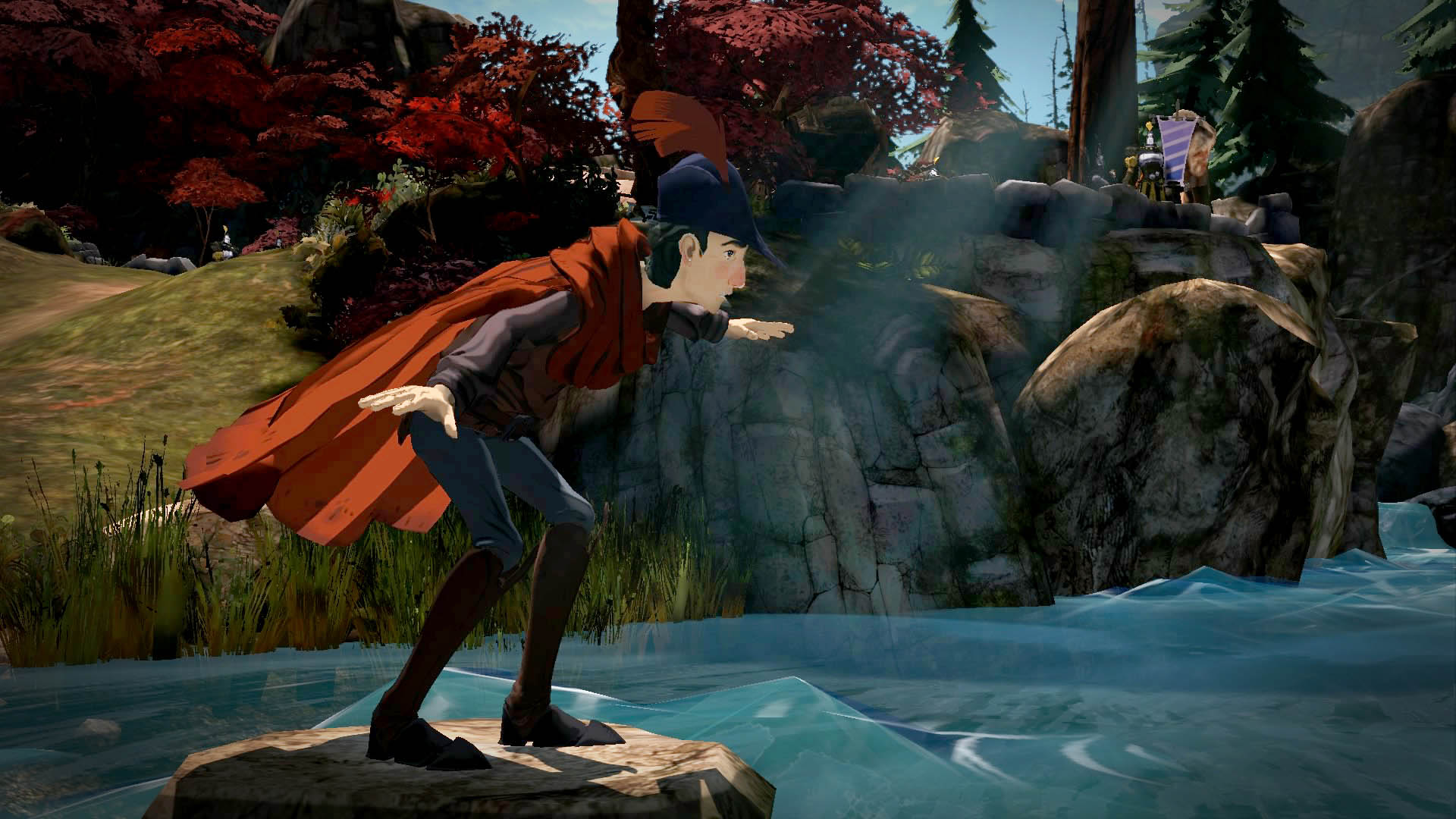
First impressions are very good indeed, though. The game has a gorgeous art style, wonderful animation and a spectacular voice cast, including Christopher Lloyd, Josh Keaton and Maggie Elizabeth Jones.

Most notably, though, the game is very much aware of its heritage. I was concerned that a new developer taking on such a legendary series would lose some of the magic of the original — or worse, try and retrofit their interpretation over the top of the existing format, or "reboot" it — but my mind has been very much set at rest so far, with a story and characterisation that feels very true to King's Quest's lightly comedic (but, at times, surprisingly dark) fairy-tale nature.

kq1

Of particular note in the animation regard is how much care and attention has been lavished on protagonist Graham. Although he's now a beautifully animated 3D model with a dramatically billowing cape as opposed to a tiny pixel dude with yellow skin, there's a bunch of wonderful little touches in the new game as callbacks to the original King's Quest games. Make Graham walk instead of run, for example, and his slightly cocky strut looks just like the crude walking animation of the original game's sprite. And in one sequence, you jump into a river; the animation as Graham flails about in the water is pretty much exactly the same as his old sprite did any time you wandered into a body of water and forgot to type "swim".

And, pleasingly, the new game incorporates the original series' fondness for killing you off in a variety of horrible ways — though, given the game's narrative framework of an elderly Graham narrating his past adventures to his granddaughter, any unfortunate demises are represented as Graham either making a mistake in his memories or cracking a joke.

kq3

The use of old Graham as narrator allows the game to do something that a lot of modern adventure games these days don't do: use a narrator. This is one thing that made Sierra adventures unique and distinct from their biggest rivals LucasArts — in every one of their games, the narrator was as much of a character as the characters who had actual dialogue. In most cases, the narrator wasn't a participant in the narrative, instead taking an omniscient viewpoint of what was going on, but there was a very clear sense of authorial voice that was often distinct between Sierra's different series. The narrators of King's Quest used flowery language and occasional cringeworthy puns — a habit Graham has picked up in the new game — while Space Quest and Leisure Suit Larry used lowbrow humour to good effect. Gabriel Knight, meanwhile, took the bold step of having a narrator with a very strong Creole accent explain what was going on — stylistically appropriate, though initially jarring if you were used to the somewhat cleaner, more easily understandable tones of the American narrators of Sierra's other games. (Once you became accustomed to her drawl, however, she delivered some delightfully sarcastic zingers at Gabriel's expense throughout the game.)

kq2

Pleasingly, old Graham's narration pays attention to what you are doing and has a variety of responses for when you try to do the same thing over and over again. There's no Discworld-style "That doesn't work!" here; instead, keep trying to do something that's clearly wrong and old Graham will come up with more and more fanciful reasons about his futile attempts, until eventually his granddaughter stops him in most cases. There's also a delightful running joke about That One Adventure Game Item You Use For Everything when you discover a hatchet which comes in useful for a while. After its final task, however, Graham leaves it behind, with old Graham putting special emphasis on the fact that he would "not need it ever again". (Prior to this, of course, you were free to attempt to use it on anything and everything, with suitable comments from both Graham and Gwendolyn along the way.)

So far, then, I'm delighted by how King's Quest has turned out. It's smart, funny, beautiful and captures the essence of the old games while bringing them right up to date. I'm looking forward to see how the remainder of this first episode continues — and how the series as a whole develops over time.

2017: Quest for the Crown

0018_001It's weird to see a new King's Quest game on sale. I haven't tried it myself yet — I'm probably going to — but the early buzz surrounding it is very positive indeed, even sans involvement from series creators Roberta and Ken Williams.

For those not quite as old and jaded a gamer as me, King's Quest was one of the very first graphical adventure games. I hesitate to call it a "point and click" adventure, because although it supported mouse control, you actually had to type things in to a text parser in order to actually do anything. As the series progressed, it gradually and noticeably improved; by the fifth installment, it had made the full transition to a more conventional point-and-click interface as well as offering a "talkie" CD-ROM version; the seventh installment abandoned traditional pixel art in favour of some distinctly Disney-esque animation, and the eighth… well, most people don't talk about that one.

For me, King's Quest as a whole is an important series to me. It represents one of the earliest game series I played, and also some of the earliest games I actually played to completion. They also represent an early form of using the video games medium as a means of telling a story — albeit a very simple one in the case of the first couple of games; from the third game onwards it started to get quite ambitious — as well as a wonderfully vivid realisation of the world of fairy tales.

Back in the days when King's Quest first appeared, it wasn't at all unusual for games to take heavy inspiration from existing works of art. Numerous games made use of famous classical tunes for their "themes", for example, and others drew liberally from popular mythology for inspiration. The original King's Quest games were no exception, as they saw you running into everyone from Rumplestiltskin to the Big Bad Wolf — and, in many cases, dying horribly at the hands of fairy tale monsters.

Despite the fact that it drew heavily on popular mythology, though, King's Quest had a feel and an atmosphere all of its own. Like the best fairy tales, it presented a world that appeared colourful, happy and vibrant on the surface, but which was mean, horrible and out to get you underneath. The King's Quest games were notorious for having a wide variety of means for the protagonists to die throughout them, ranging from being eaten by a giant to tripping over your wizard master's cat while being too far up the stairs, and subsequently breaking your neck when you hit the ground. So frequent (and frustrating) were the death scenes in King's Quest and other adventures from the same stable Sierra that main rival LucasArts made a specific marketing point of the fact that it was impossible to die or get stuck in most of their games — with the Indiana Jones games being the only real exceptions, and even there it was pretty difficult to die.

But as frustrating and irritating and, at times, downright illogical as the old-school King's Quest games could be, they represent one of my formative experiences. They're something that helped me understand a medium that, as you'll know, is very important to me. They're something I shared with my family, since many of us used to play them together and try to solve them. And they're something that I will always have fond memories of.

It's for this reason that I'm really happy to see King's Quest making a comeback — and, moreover, to see that it's being received very well so far. I'm excited to give it a try for myself very soon, and I look forward to seeing how the subsequent episodes develop over the course of the series.

2013: Starchaser

0014_001Interesting indie game time? Interesting indie game time.
I'm a big fan of the doujin (independently-developed) games that Playism brings to the West. Japanese indie games have a very distinctive character about them; they're rarely the most technically impressive games in the world (though there are exceptions, like wonderfully gorgeous shoot 'em up Astebreed) but it's rare to find one that doesn't feel like it's been infused with heart, soul and love. The doujin culture in Japan breeds people who are passionate and enthusiastic about their work; these aren't people who are making games to prove a point, these are people who are making games because they love making games.

starchaser1

One of Playism's most recent releases is a peculiar little platformer called Starchaser: Priestess of the Night Sky. This is the work of a doujin circle called Nonlinear, and the designer's philosophy behind the game is an interesting one: he wanted to make a 3D game where the concept of 3D actually mattered. He has a point; there's a lot of games out there that are presented in 3D, but which actually only practically play in two dimensions at once. Even renowned games like Super Mario 3D Land/World tend to only have the player worrying about two dimensions at a time for the most part; it's rare you have to worry about the width, length and height of an environment at the same time in a Mario game, and that format works well for its accessible, family-friendly formula.

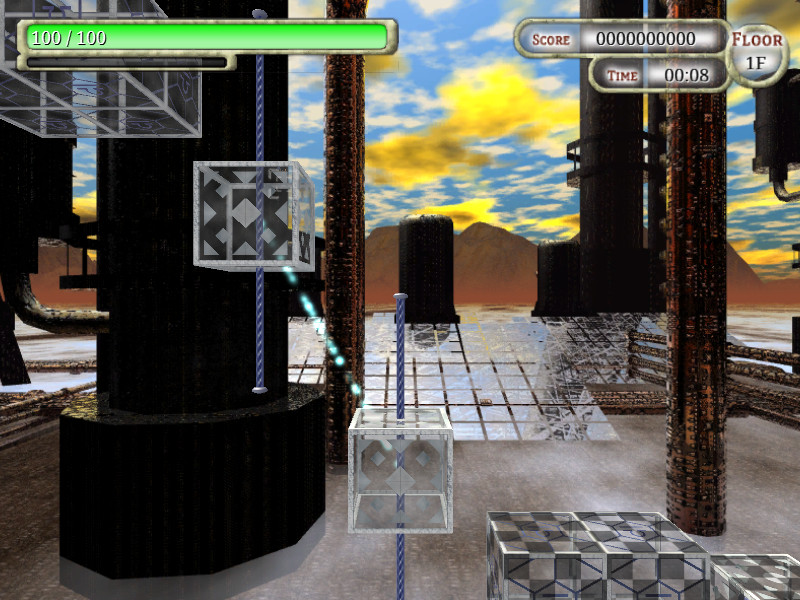
Starchaser, then, takes a slightly different approach to 3D platforming. Unfolding through a series of levels on both the inside and outside faces of a series of cubes, you control a young girl as she learns to commune with the stars by navigating through several perilous labyrinths of these cubes. The game starts very simple, but it's not long before it introduces one of its core mechanics: gravity floors. These checkerboard cubes have their own gravitational pull, so if you're airborne (through jumping, falling or walking off the side of something) you'll be sucked towards the nearest one if you're within its zone of influence. This may well be at a completely different angle to where you were standing a moment ago; Starchaser's levels unfold making full use of all three dimensions, and you'll have to look around in every direction carefully to negotiate a pathway towards your destination, making quick-witted use of the gravity mechanic and more conventional platform skills in order to survive.

starchaser2

It's actually a really delightful game to play. It reminds me somewhat of PS1-era puzzlers like Kula World, Kurushi Final and the like. At least part of this is due to its somewhat… functional presentation (it won't run in 1920×1080, and it won't exceed 30 frames per second) but even with its (apparently deliberate) technical limitations, it's a joy to play, once you get used to the peculiar control scheme. It's a very distinctive, original take on the 3D platformer, and a great game to dip in and out of when you fancy banging your brain against some fiendish environmental puzzles and enjoyable boss fights.

Starchaser is available now either direct from Playism or on Steam — buy on Playism and you get a Steam key for free.

2009: Into the Nexus

0010_001

Up until a few days ago, I thought I hated MOBAs1. Turns out I just hated Dota 2.

Actually, let me qualify that. I hate playing Dota 2, but I don't hate it. It's one of those games that, like Dark Souls or any fighting game released after the original Street Fighter II on Super NES, I feel like I'm doomed to never be any good at, and consequently have reached a point of acceptance where I feel I can and should respect it from afar, but not even attempt to get into it. And that's fine by me.

Let me qualify that further by saying that I feel there are way too many MOBAs on the market these days, as many developers appear to be seeing it as the new2 fad to latch onto in the (usually vain) hope that they will attract a large, world-beating multiplayer community.

With all that in mind, well, Blizzard's Heroes of the Storm is really good.

heroes-storm1

Heroes of the Storm is a MOBA that brings together a series of characters from Blizzard's various games from over the years — primarily Warcraft, StarCraft3 and Diablo, with a guest appearance from The Lost Vikings — and throws them into battle against one another in the usual 5v5, destroy-the-other-team's-base-before-they-destroy-yours MOBA gameplay.

Heroes of the Storm has a few little twists on the formula, though. For starters, individual players on your team don't level up independently of one another; you have a collective pool of experience that you share, so you all level up at the same time. You still need to do your part to make sure your team levels up faster than your opponents, particularly in the early stages of a match, but there's less feeling "left behind" than there is in stuff like Dota and League of Legends, in my experience anyway.

Tied in with this is the fact that a lot of the stupid arbitrary maybe-skill-maybe-luck-based bullshit that Dota includes — "Last Hit"4 being the one that always wound me up the most — is conspicuously absent from Heroes of the Storm, and it's much more fun as a result. It means you can focus on the overall team strategy rather than micromanaging your character to such a degree that it can become very distracting — if you're a newcomer, anyway; I'm sure veteran Dota players can Last Hit pretty much at will.

Then there's the fact that there's more than one map, and each map has its own little quirks. Some have two lanes to attack down, some have three. Some have objectives you need to defend to gain a temporary advantage, some have special enemies you need to defeat. Some have collectible items to unleash powerful attacks, and one even has an entirely separate "dungeon" map for you to descend into when the time is right. The objectives and the rewards you get from them don't necessarily make or break a whole battle, but they can make things swing one way or the other — and even provide a means for a struggling team to make a spectacular comeback, rather than being stomped into the ground.

HoSClasses

All of this is wrapped up in matches that generally don't take any longer than twenty minutes to play, as compared to the 30-90 minute slugfests that games of Dota can easily become. It's simple to understand, accessible and actually enjoyable to me, even as a newcomer and someone who is not generally very good at strategy games.

I haven't yet dared play a game against human opponents, but I feel much more inclined to give it a shot in this than in the notoriously elitist and short-tempered communities that play a lot of Dota and League of Legends. If you, like me, have been skeptical about MOBAs but like the idea of them, give Heroes of the Storm a shot. It is free, after all.


1 MOBA: Multiplayer Online Battle Arena, a team-based game where two teams compete for dominance of a map by attempting to destroy the other team's "core" by infiltrating their base.

2 Well, not that new any more, I guess.

3 The way they're capitalised differently has bugged me for years now.

4 Last Hit: a mechanic whereby you only get experience points for a kill if you were the last person to deal damage to it. Satisfying to veterans, the most fucking annoying thing in the world for newbies.

2006: Interstellaria

0007_001

I'd made a promise to myself not to get suckered into trying any more endearingly retro-styled 2D pixel-art exploration-centric games, because the last few I've tried (Terraria and Starbound spring immediately to mind) ended up being enormously disappointing and pretty boring to me. (I'm not necessarily saying they're bad, mind, more that the Minecraft model of "here's a world, do stuff in it" just doesn't really appeal to me any more.)

However, I happened to see Interstellaria on Steam earlier today, and for just £7 I felt I had to take a look at it. And, for once — so far, anyway — I wasn't disappointed.

Interstellaria is perhaps best described as a successor to the old late-'80s/early-'90s space exploration games like StarflightStar Control II and Space Rogue. You get a ship, you recruit a crew, you upgrade your ship, you explore the galaxy, you fight things, you discover treasures, you uncover a galaxy-spanning mystery and (perhaps) save the universe in the process.

interstellaria1

Interstellaria throws you straight in to its world from the outset. Thrown out of your erstwhile home by your flatmate who is no longer content to have a scrounging, unemployed wastrel living rent-free under their roof, you take to the streets in search of gainful employment. After dismantling a robot for the nice man who lives just over the road from you, you find yourself recruited into the slightly shady-seeming crew of a starship that is about to take off. The starship begins its grand adventure and fends off a pirate attack in a thinly-veiled combat tutorial, then is ripped to pieces by an unknown enemy craft, but not before your former captain runs away, leaving you in charge of the crash landing from which you are ultimately the only survivor.

Fortunately, it seems, you've crash landed on a planet where there's another starship that's almost in working order. You come across a fellow survivor and team up to get the elderly ship back into space again, and from there it's up to you to start discovering the truth behind the mystery of the "Abductors", a race of aliens who appear to be giving the galaxy a certain degree of grief.

interstellaria2

From here on, you have freedom to explore and do stuff around the galaxy, though you're nudged pretty strongly in the direction of following the plot. Gameplay is split into a few different areas: managing your ship, space combat and planetary exploration.

Managing your ship is a little like FTL: Faster Than Light in that you have to assign crew members to stations according to their skills (which develop over time). You also have to take care of your crew's needs — hunger, boredom and fatigue — by providing them with facilities to relieve these issues whenever necessary. The ship you start with has both limited space to include modules — there's pretty much room for basic navigation, sensors, engineering and tactical stations and one of each of the "needs" modules and not much else — and power to devote to them, so you have to juggle power around according to your ship's needs at any given moment.

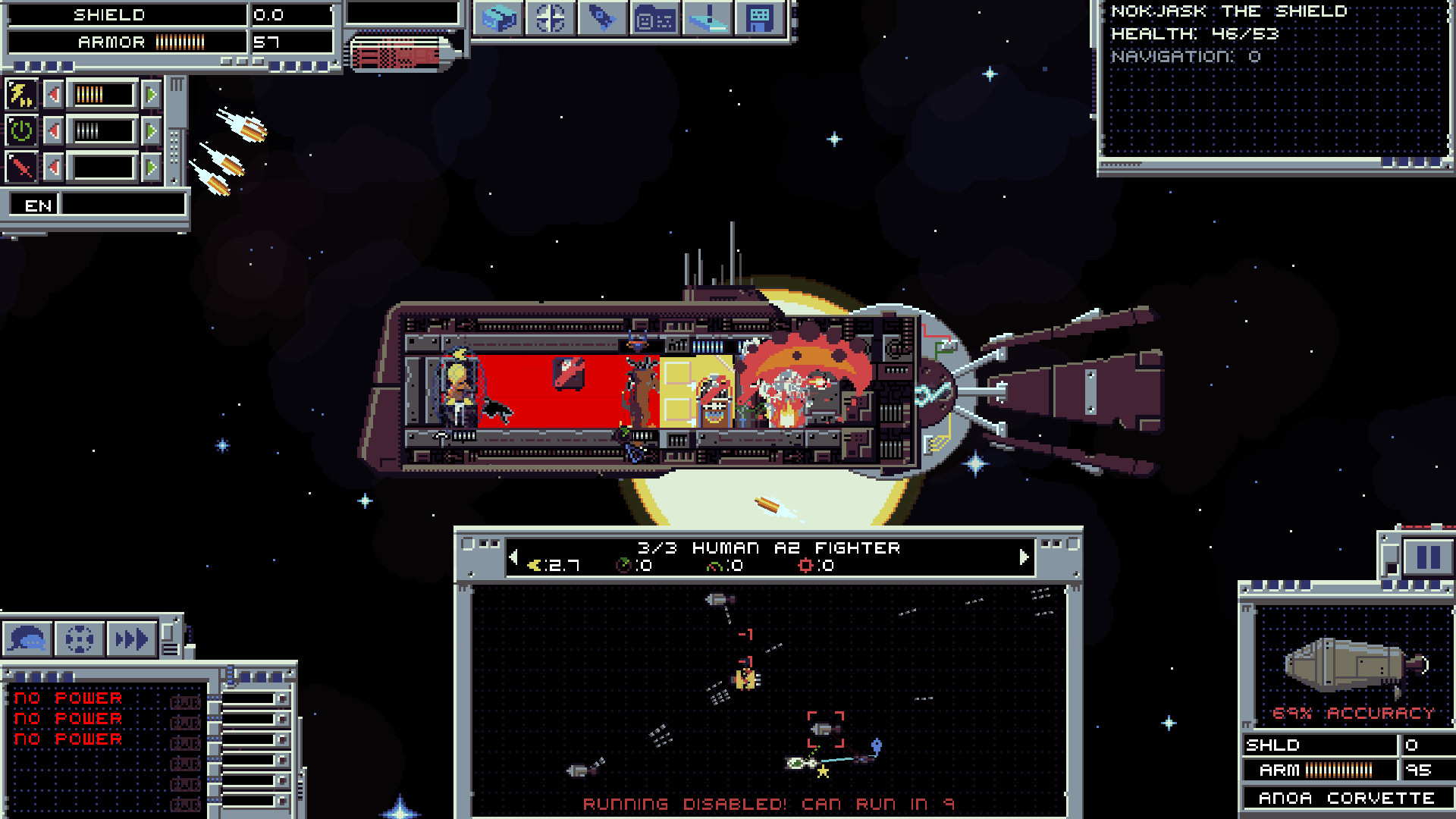
Get into combat and you'd better hope you remembered to put some power into the weapons systems and charge them up, because you'll need them. Unfolding on a small tactical display (which provides more information if you have someone manning the sensors) you can move your ship around in real time as well as see incoming missiles, cannon fire and other projectiles. In this way, you can dodge and avoid enemy fire while attacking your foe; it's an interesting, slow-paced take on "bullet hell" in some ways, and it's a nicely unconventional take on space combat that is in keeping with the 2D pixel art aesthetic.

interstellaria3

Head down onto a planet and you'll have the option of visiting one or more different landing sites, assuming the planet has a breathable atmosphere. Each landing site is a few screens wide (rather than a never-ending procedurally generated world) and usually features some enemies, some resources to harvest and, occasionally, interesting artifacts, characters and plot-related shenanigans. Controlling each of your crew members independently (or as a group) you can direct them to explore, harvest materials, enter into combat with enemies and interact with the locals. Each planet has a distinctive look, feel and soundtrack (the music is by chiptune artist Chipzel and is really rather good) and manage to feel relatively "organic" without falling back on random procedural generation. (At least I don't think so.)

The game's not without its flaws — the interface is a bit clunky in places, the keyboard inputs aren't as responsive as they could be, camera controls on ground missions are bugged and combat is… lacking in depth, to say the least — but all these issues are more than made up for by the fact that it's the first game in a very long time that I feel has proven to be an adequate successor to the classic space exploration sims I mentioned earlier. It has a lot of potential to improve over time, and is already an interesting, charming game that is well worth your time, particularly if you're feeling nostalgic.

1977: To The Heavens

Well, it's finally here: Final Fantasy XIV opened the doors to its first full expansion Heavensward today — for those who preordered it, anyway — and I've spent literally all day playing it.

It's good.

The story follows on directly from the end of the 2.55 story arc, which I won't spoil here for those who haven't seen it in all its ridiculous and tragic glory. Suffice to say, however, that it provides good reason for the Warrior of Light (that's you!) and occasional companion Alphinaud to head in the direction of Ishgard, a region which had previously been closed off to outsiders, but which became a little more open-minded after seeing how you (and seven friends) fended off an absolutely massive dragon towards the end of A Realm Reborn.

The city of Ishgard itself is beautifully rendered, being somewhat similar in design to a cross between Final Fantasy XI's cities of San d'Oria and Jeuno. It has its own very distinctive character that is separate to the three previous city-states we had the opportunity to visit in A Realm Reborn — the verdant, nature-filled environs of Gridania; the tall towers and tall ships of Limsa Lominsa; and the juxtaposition between extreme affluence and extreme poverty of Ul'Dah — with an austere, almost unwelcoming facade and some beautiful architecture. The kind of place where you'd be slightly afraid to touch anything, lest you befouled or defaced it in some way or another.

Outside the city, things get interesting. Early on, the main scenario quest sends you off in two separate directions: in one direction lies the Coerthas Western Highlands — a snowy, mountainous region similar to the existing Central Highlands region, but with more in the way of sheer cliff faces and inconvenient but impressive-looking lumps of rock all over the place — while in the other lies the Sea of Clouds, a floating archipelago of islands in the sky where skies are often clear and blue by simple virtue of the fact that the islands are above the clouds, but whose altitude drops the temperature to less-than-inviting levels. There's a huge contrast between these initial two areas; Coerthas is drab, monochromatic and somewhat grounded in reality for the most part (huge dead dragon corpse aside), while the Sea of Clouds is dramatically colourful, the stuff of pure fantasy. I haven't proceeded further afield just yet, but the main story is shortly to have me heading for Dravania, home of the dragons, so I'm interested to see how that compares.

One really striking thing about Heavensward is its sense of scale. A Realm Reborn was no stranger to sprawling environments that were impressive to behold, but Heavensward takes it to a new level. Ishgard is gigantic and imposing in the same way an old cathedral is; meanwhile, the field maps are huge in terms of both surface area and variation in altitude — the latter aspect of which is, in part, designed to accommodate the new flying mounts you can ride around after completing the surprisingly enjoyable task of hunting down a number of hidden "aether currents" scattered around the region.

Another striking thing about Heavensward is nothing to do with its architecture, however: a good 80-90% of the original voice cast appears to have been replaced, meaning some characters sound quite different to how they sounded in A Realm Reborn, with several even having picked up regional accents (primarily Yorkshire so far) in the intervening period. It's initially somewhat jarring, but overall the quality of the voice acting is much better than A Realm Reborn. This isn't particularly difficult, however, because although A Realm Reborn had an excellent localisation (albeit one that diverged quite a bit from the original Japanese script and took on something of a life of its own) its voice acting was passable at best and woefully awful at worst. At least in English it was, anyway; the Japanese voice acting makes use of well-known voice talent like Rie Tanaka (Hyperdimension Neptunia) and Eri Kitamura (Senran Kagura) and as such has always been pretty good, but it's clear that the English dub was perhaps, to put it politely, done a little bit on the cheap side.

It's not entirely surprising, mind you; A Realm Reborn was a huge risk for Square Enix given Final Fantasy XIV version 1.0's critical and commercial failure. As such, the decision to perhaps skimp a bit on the voice acting budget — many scenes in A Realm Reborn and indeed Heavensward also are unvoiced — was understandable. However, since A Realm Reborn achieved the seemingly impossible and rescued an all-but-dead MMO from oblivion, turning it into one of the company's greatest success stories in the process, it's gratifying to see that a bit more effort has been put into aspects of the presentation such as voice acting — even if the change in some characters' voices is a little surprising the first time you hear it.

I'm yet to try out a huge amount of the new gameplay features — I'm concentrating on levelling my main class Paladin to 60 before levelling anything further — but the new skills for existing classes look interesting, and the altogether new classes seem to be really cool, though it looks as if "lolDRK" is going to become the new "lolDRG". (Context for those unfamiliar: for the longest time, Dragoons (DRG) were notorious for dying a lot, due in part to their low magic resistance but also due to awkward animation locks on certain skills making it difficult to move out of the way of attacks; hence, "lolDRG" as the response to a Dragoon's inevitable death; Dark Knights (DRK), however, appear to be ready to take up the mantle for themselves, from what I've heard so far.)

Oh, and the music is amazing. And the story is interesting. And I've fallen in love with this stupid game all over again. There goes the next few years of my life…

1937: This Starry Midnight We Make

I'm a big fan of the work of Carpe Fulgur, the small, independent localisation team previously responsible for bringing English-speaking audiences the excellent Recettear, its predecessor Chantelise and the charming Metroidvania-ish Fortune Summoners, and who have most recently been working on the sprawling behemoth that is Trails in the Sky: Second Chapter alongside Xseed Games.

I was pretty intrigued, then, when Andrew Dice of Carpe Fulgur proudly announced the team's fifth project: a peculiar affair called This Starry Midnight We Make. Unlike Carpe Fulgur's previous output, it's not a role-playing game. It is… well, it's kind of baffling, to be honest. I guess technically it's a puzzle game of sorts, but I actually want to describe it more as a game about experimentation.

I sat down and played the demo version — available now on Steam, with the full version coming later this month — and recorded my experiences, bewilderment and all. Here's what happened when I had a go:

As you can see if you watched the video, the game blends visual novel-style storytelling with its main mechanic: creating "stars" in a magical basin that appears to influence what happens in Kyoto according to the astrological phenomena you create.

The basic format of the game involves plopping stones into this basin and watching them do stuff, then figuring out how to make them do other stuff. The basin is split into five elemental areas, represented by faint swirling coloured gases, and the combination of the elemental area you drop a stone into and the type of stone you drop determines what happens next.

As you progress through the game, you're tasked with a series of quests that ask you to create specific phenomena. What's interesting is that after an initial, rather brief and unenlightening tutorial, you're pretty much left to figure everything out for yourself. How, exactly, do you create a nebula? The game sure isn't going to tell you right off the bat, though it will record the phenomenon in your notebook once you've created it once, allowing you to refer back to it and check how you did it if you're not sure.

Beginning with the simple task of creating individual stars, the quests later start demanding that you create evolved forms of stars that involve mixing different types together, manipulating the amount of elemental gas in an area of the basin and even using "clay stars" to fuse others together. Beyond that, you're tasked with creating "constellations" using specific combinations of stars that you've created, and the game hints that once these have been created, they'll be used as "tools" to further manipulate your astral creations, though the demo stops before you get to see what this means for yourself.

What I found initially offputting but subsequently rather compelling about This Starry Midnight We Make is what I hinted at above: you have to figure out everything for yourself. And this is a huge adjustment from a lot of modern games, which spend much of their early hours walking you through every step of the mechanics you might be using throughout the game until you're absolutely sure you know what you're supposed to be doing. Not so in This Starry Midnight We Make. You are, in effect, a scientist, given some interesting things to fiddle around with and left to your own devices to try things out and see what happens. Some of the things you do will work — and these form genuine "Eureka!" moments, since you've figured them out for yourself — and others will not work, forcing you to analyse your "mistakes" and learn from them… or perhaps determine what caused an unexpected reaction to happen.

I find it difficult to envision how the game will carry this strange concept through a full-length narrative, but I'm kind of intrigued to find out. It's a slow burn of a game, for sure, and its obtuseness will doubtless put many people off within about ten minutes of starting, but if you put some time in and make the effort to actually experiment with it yourself, you'll find a strangely compelling experience waiting for you.

Do I recommend it? I'm hesitant to do so before seeing the full version, but I can at least recommend that you give the demo a try for yourself to see what you think and whether it might be for you. It's available now from Steam.

1924: Journeying Ever Onwards

So One Way Heroics Plus has pretty much devoured my soul with its wily ways and new features. I've been playing it a whole bunch, dying a whole lot and having a great time in the process.

I made a video of two unsuccessful runs earlier; here you go:

I'm really impressed with the additions to the base formula. In particular I'm excited about the fact that there are a number of new quests involved in unlocking the additional character classes; these quests replace the standard adventure to defeat the Demon Lord (or win in a couple of other super-secret ways) and task you with additional objectives, confronting you with new challenges and powerful foes on the way.

The small additions to the game's interface are great, too. The hotbar in particular is an excellent addition, even if you only use it to quickly access skills like Awakening (your default "stop time for three turns" ability, which is very useful for getting out of a pinch) and Lockpicking. It's also great to be able to customise the interface somewhat; it's still a little cluttered thanks to it running in 640×480 (or upscaled 640×480 now, at least) but simple changes like being able to put your gauges at the bottom of the screen and the minimap up the top make it a lot easier to see where you're going.

More subtle changes only become apparent if you've played both games. The pace of levelling has been considerably increased, but in exchange the "Goddess Statues" at which you can "spend" levels to get numerous benefits are considerably more expensive to use, and no longer provide the same possible bonuses every time. Skill merchants offer the ability to learn new abilities in exchange for stat levels, Iron Hags will make a random item for you (including "air", which just means you're out of pocket), benevolent Force practitioners will teach you defensive, utility or restorative spells… the list goes on.

And the game is still absolutely packed with charm and a surprising amount of depth. Most notably — and this was true of the original, too — is the fact that, despite initial appearances, the game does have a plot. Or, more accurately, a number of different intertwining narrative threads that only become apparent if you come into contact with the recruitable NPCs, figure out a way to stop the Demon Lord trying to set fire to you long enough to have a chat or try some of the daily "special campaigns" that add small but significant tweaks to the basic formula. A particular favourite that I had the other day was a world where every normal attack had a massive knockback effect on it, so you had to take care not to fight with your back to the encroaching Darkness lest you get slammed into it by your foe landing a blow. It shook up the way I played a great deal; unfortunately I didn't quite get far enough to take full advantage of it by whacking the final boss of the Force Knight unlock quest into the Darkness — the main means through which you deal damage to this rather unpleasant adversary — but it was an enjoyable journey nonetheless.

I'm well and truly hooked then. And if you're yet to discover the fun for yourself, I recommend giving it a look now. It's just $6.99 and it will keep you busy for a very long time. You can grab it from publisher Playism, or soon from Steam, too. (If you buy it now at Playism, you'll get a Steam key when that version releases.)

1922: Please Proceed to the Right, Again: One Way Heroics Plus

I'm planning on doing another video on this, but since I've been playing it a bunch today I thought I'd talk a little about One Way Heroics Plus.

As the name suggests, this is an enhanced and expanded version of the Japanese roguelike One Way Heroics, which I talked about a few days ago. It's positioned as an "expansion" but it's actually a new standalone game based on the skeleton of the original. Mercifully, however, you can import your saved data from the original game — though the conversion process means that you can't send it back to the original game once you've done this, but why on Earth would you want to?

One Way Heroics Plus follows the same fomula as its predecessor in that it involves you, the Hero, attempting to save the world from the ever-encroaching darkness, represented by the screen that scrolls every turn, regardless of whether you're actually moving "forwards" or not. Get pushed off the left side of the screen and you lose. Die and you lose. Beat the Demon Lord, who shows up after 400km of travelling on the easiest difficulty and at regular intervals on the other levels, and you win. There are also some other means of winning, but I won't spoil those for you now.

So what's new? Well, a few things. Firstly, the interface has had an overhaul. The original game didn't have a bad interface — although it was rather cluttered thanks to the game running in 640×480 — but doing things like repetitive actions was a little cumbersome. The addition of a customisable hotbar alleviates this issue by allowing you to set a series of items and abilities ready for quick access at any time. Other little tweaks have been done here and there, too; items now glow, tough enemies pulse red, there's a clear indicator when an enemy spots you, there's an XP bar that appears when you can XP, there's an auto-move function (with a customisable filter for whether or not it should automatically stop when enemies are nearby) and generally, the whole thing is just a bit slicker.

There are some new character classes and Perks, too, including some "negative" perks (or disadvantages, I guess they are, really) for those who want to make things a bit more challenging. There's also supposedly an expanded metagame involving collecting "Dimensional Coins" throughout your travels and using them to upgrade a castle, but I haven't explored this aspect of the game at all yet. Supposedly this unlocks new characters, quests and mechanics — I'm quite interested to see what it offers, as this is, from the sound of things, the most major addition to the game.

It's the same game at its core, though, and that's no bad thing, as the original was really solid. What One Way Heroics Plus does, however, is take that solid foundation and build an even more interesting, challenging and replayable game out of it; I'm very much looking forward to exploring it a bit more in the coming weeks — and at some point in the next few days, I'll post a video showing some of the new features in a bit more detail, too.

For now, though, I have to mourn my journey from earlier today, where I successfully travelled for over 850km and reached experience level 76 before making the ill-considered decision to swim across the ocean to a small island and rescue a little girl; sadly, my swimming skill was too low to allow me to outrun the creeping Darkness, and I, along with the little girl and Queen Frieda, who had been accompanying me for some distance (and gradually revealing her surprising backstory in the process), were swallowed up by oblivion, never to be seen again… at least until I hit the "New Game" button again.

1920: Old-School Shooting

In the same bundle I grabbed primarily for Crimzon Clover World Ignition the other day, I also received a copy of Raiden III. I haven't played a Raiden game since the original PS1 era, when the bundle of Raiden and Raiden II that came on a single disc (Raiden Project, I think it was called?) was one of my favourite games, despite it not exactly showing off the then-new hardware to its maximum potential.

Raiden III has been an interesting blast from the past, no pun intended. Although I very much enjoy danmaku (bullet hell) shooters, Raiden III is a pleasant reminder that you don't need to completely fill the screen with bullets to be challenging, and nor do you need an overly convoluted scoring system to be interesting. Raiden III is simple and straightforward, but actually has a surprising amount of depth and strategy to it, particularly with regard to the various weapon pickups available to you.

I was pleased to see that the bendy laser I always used to find so hilarious in the earlier Raiden games is back, though this time around it's green rather than purple. I was also pleased to see that the red weapon is still capable of filling the screen with as many bullets as a danmaku shooter's default player sprite configuration. And I was delighted that the game is accompanied by an appropriately cheesy yet pulse-pounding soundtrack that complements the on-screen action perfectly.

What I was most surprised about, however, is how good it actually looks despite running at 640×480 resolution (and vertically letterboxed, to boot, thanks to most shoot 'em ups' vertical screen orientation) and having precisely no graphical options to speak of whatsoever.

Raiden III, for the unfamiliar, eschews the sprite-based ships and 2D backgrounds of its predecessors in favour of full-on polygonal 3D. The backgrounds are 3D, too, which gives them the flexibility to pitch, roll, swoop and change altitude in a far more dynamic manner than the old-school 2D backdrops, making the game quite a thrill ride. (Recent shmups from Edelweiss such as the fantastic Astebreed and Ether Vapor Remaster have continued this proud tradition in glorious 1080p.)

The most surprising thing about the visuals is how much it still looks like a Raiden game. The distinctive appearance of the player ship, its weapons and even the enemies is kept completely intact despite the move to polygonal 3D, and I think this is a large contributing factor to the game still managing to genuinely look good on a 55-inch widescreen TV at vertically letterboxed 640×480. It runs as smooth as butter, too — although I'd hope so on my rig — and has proven to be a lot more addictive than I originally anticipated when I first booted it up the other day to kill a few minutes.

Raiden III, then, provided me with proof positive that resolution really doesn't matter to me, even as the new generation of consoles has players becoming increasingly sniffy about games that don't run in "true 1080p". If your overall design is up to snuff, you could be running at 320×200 and still look great, and Raiden III, like many other ageing games, is very much testament to that.