1918: GTA Online's Identity Crisis

I've been playing a bunch of Grand Theft Auto Online recently. My local friends and I all acquired copies so we'd have something we all enjoyed playing and that we could all get something out of: past attempts to do this have led to one or more members of the group being dissatisfied with our choices for whatever reason, and ultimately our multiplayer gaming sessions falling by the wayside. We're hoping, however, that Grand Theft Auto Online will provide some fun shenanigans for a little while yet.

And I think it might just do that, at least in part due to the game's curious identity crisis that it has going on. It doesn't feel like it really knows what it wants to be. In places it's downright messy, and the "session-based" nature of getting people together is cumbersome, clunky, unintuitive and simply broken at times. But even with all that, it's simply fun.

I talked a little about the basic structure of the game a few days ago, but having spent a few sessions actually playing it "properly" with at least one other friend now, I can see what it's doing.

The core of the game's identity crisis comes from the disconnect between typical Grand Theft Auto freeform open-world gameplay — in which up to 30 players can log in to the same session, run around anywhere on the map completely independently of one another and have fun doing whatever they see fit — and the "Jobs" that form the more structured activities in the game. This disconnect is nothing unusual for Grand Theft Auto in general, of course; ever since Grand Theft Auto III brought the series kicking and screaming into 3D it's been like two games in one, and this contrast has only become more pronounced as the stories have got better and more ambitious over the years.

Open-world freeform multiplayer is great fun. You can effectively make up your own silly little games and challenges and take them on with friends. You won't get much in the way of rewards for them, but if all you're in it for is some silliness, it provides that in spades. What doesn't quite work about the open-world stuff is that the moment someone activates an activity of some description — be it a race, a mission or even a game of darts — they are snatched out of the open-world session, temporarily unable to communicate with the people they were playing with, and put into a more traditional multiplayer lobby, from which they can invite people via several means: everyone from the open-world session, selected people from the open-world session, friends who are online or simply "anyone who is available".

Once you're into that lobby and with friends, you're effectively in a "party" like you'd be in something with more traditionally structured multiplayer like Call of Duty or Halo. You do an activity, you all vote on what's next, you do the next thing, repeat until someone gets bored or everyone votes to go back to Free Mode.

The activities are pretty fun too, and I understand why they're "instanced" separately from the main chaos of the open-world gameplay — trying to complete a mission while up to 29 other people are careening around the map causing mischief sounds like a recipe for disaster. It's the execution that is a little lacking: the absence of an MMO-style "party" system makes meeting up with specific people in public sessions tricky, and the way people are simply snatched out of the open world the moment they walk into a mission trigger is not explained at all well; if you don't know that's how it works, it's entirely possible you'd be left thinking that your friends had simply left the game altogether.

As I say, these issues and the fundamental disconnect between the freeform gameplay of Free Mode and the structured activities of the Jobs don't prevent Grand Theft Auto Online from being a good game. It's a lot of fun, particularly when playing with friends you already know. (I don't even want to contemplate how awful taking on the cooperative missions with random people might be.) There's just an awful lot of things it could do a whole lot better, too.

Still, it's enjoyable, and I'm confident it will provide some fun evenings of entertainment for my friends and I for a little while yet.

1916: How an MMO Taught Me to Be a Better Shmup Player, and Other Stories

Today I've been playing a few different games, including Grand Theft Auto Online, One Way Heroics and Crimzon Clover: World Ignition.

Before I go any further, I just want to share a video I knocked up in five minutes using GTA's built-in video editor. I'm looking forward to having a play with this; I haven't seen an in-game editor so flexible since Driver on the PS1, and my friend Woody and I used to spend hours making ridiculous car chase movies with that.

But GTA is not what I want to talk about today. Rather, I want to talk a little about the last game I mentioned: Crimzon Clover: World Ignition. As you can probably surmise from the overblown title, this is a Japanese game; those of you with particularly strong game genre intuition will also have doubtless correctly identified that it is a shoot 'em up, specifically of the danmaku (bullet hell) variety.

I grabbed Crimzon Clover this week as part of GOG.com's recent "tower of sales". They were selling a pack of shoot 'em ups, several of which I'd had my eye on for a while, and one of which (the rather marvellous Astebreed, which was one of the last things I reviewed over at USgamer) I already owned, but it turned out that removing that from the package actually made it more expensive, so now I have two copies. Anyway, I digress; the sale has now ended, but Crimzon Clover is still pretty cheap anyway, so if you're looking for some fun arcade-style blasting action, you could do far worse than grab a copy — and remember, there's no shame in playing on "Novice" difficulty, so long as you don't use the "Continue" function!

crimzon2

For those who haven't been following me for a while, are unfamiliar with the modern conventions of the shoot 'em up genre or with Japanese gaming in general, a danmaku shooter is characterised by its extremely hectic patterns of bullets filling the screen which, at first glance, look impossible to avoid. That is, until you realise that the ship you're flying has a "hitbox" much smaller than its complete sprite, which means you can get away with "grazing" bullets so long as they don't hit the (usually explicitly visible) hitbox. In fact, some danmaku shooters ever reward you for grazing bullets without being destroyed.

The other defining feature of a danmaku shooter is a somewhat convoluted scoring system. Crimzon Clover is a little more straightforward than some of the more obtuse systems that renowned genre specialist Cave has come out with over the years, but it still requires something of an understanding beyond "shoot everything" in order to get the truly high scores.

But again, chasing high scores isn't what I wanted to talk about today; instead, I want to talk about something I noticed while I was playing Crimzon Clover earlier today, and that's the awareness that I suddenly had of myself using disciplines I'd picked up from a completely different game: Final Fantasy XIV.

Crimzon Clover and Final Fantasy XIV would doubtless not appear to have anything in common at first glance, but bear with me. Boil both of them down to their purest essence and they are both games about learning attack patterns and responding to them. Neither of them depend on randomness for the most part, with every encounter instead being meticulously scripted and choreographed down to the last detail; both of them reward taking the time to familiarise yourself with these patterns and know how to deal with them. In other words, knowing your part of the overall intricate dance of death and destruction on the screen.

2014-04-14_00006

This becomes even more obvious when fighting a boss in Crimzon Clover and, indeed, most other danmaku shoot 'em ups. One thing that both Final Fantasy XIV and Crimzon Clover have in common is a phase-based structure for boss fights: the boss uses a certain set of attacks until you damage it a certain amount (or, in some cases, a certain amount of time passes), then it moves on to something else, then perhaps something else, then perhaps something else after that. The most complex fight in Final Fantasy XIV I've done to date, for example — The Second Coil of Bahamut, Turn 4 (aka Turn 9, aka Nael deus Darnus) is split across four different phases, each of which is completely different from the last, and each of which requires learning independently of the others.

Crimzon Clover, meanwhile, is no exception to this rule, with bosses having set bullet patterns and special attacks according to which phase you're on at any time; the one difference is that phase transitions are explicitly marked on the boss' health bar in Crimzon Clover (and, again, in most other danmaku shmups) while in Final Fantasy XIV it's a case of learning when the changeovers happen and how to time them so that you and your party are in a good position to deal with them when they happen. (The fact that Crimzon Clover is designed for one or two completely independent players while Final Fantasy XIV is designed for four to eight interdependent players is another difference, of course, but this added complexity is mitigated a little by the fact you're not dodging literally thousands of bullets at any given moment. At least not in any encounter I've challenged so far.)

The thing I became aware of as I had a go at the first few levels of Crimzon Clover today — I haven't managed to clear the game yet, as it's pretty tough, even on Novice difficulty! — was that I was using most of the same skills I used while playing Final Fantasy. I was learning to observe patterns and anticipate what came next; I was moving into advantageous positions before all hell broke loose; I was learning from my mistakes rather than becoming frustrated by them.

crimzon1

These are all skills that, if we pull back and look at a lot of different games, are fairly common. But I've become most keenly aware of them while playing Final Fantasy XIV in particular, and it was a little surprising — and pleasing — to be aware of how applicable they were in a "cross-discipline" situation in a completely different game today. (And yes, Dark Souls fans, I know they're applicable to that game too, but… I just can't, okay?)

Also, Crimzon Clover is fucking awesome and if you like beautifully slick, gorgeous shoot 'em ups then I recommend you go grab yourself a copy from Steam or GOG.com right now!

1910: Please Proceed to the Right - One Way Heroics

I've been revisiting a game I reviewed a while back: One Way Heroics from Japanese indie developer Smoking WOLF and localisation specialists Playism.

I made a video, even.

For those disinclined to watch a complete 40-minute playthrough of the game (the first time I ever beat it, fact fans — lucky I was recording, eh?) I shall also use the power of written words to explain what's going on and why you should give this game a shot.

One Way Heroics is a sort-of roguelike crossed with the auto-scrolling levels from old Super Mario Bros. games. If that sounds strange, you'd be right, but that's what makes the game interesting.

The concept is simple: the Darkness is swallowing the land a bit at a time, and it's up to you to track down the Demon Lord supposedly responsible for this whole mess and punch him in the face until he stops being such a rotter. The encroaching darkness is represented by the scrolling screen — every move or action you perform causes it to advance slightly, and if you fall off the left side of the screen, you die. Naturally, this opens up the possibility of getting "trapped" in places, so you have to plan your movements pretty carefully to make sure you don't get stuck.

There's a selection of different character classes to play, each with their own distinctive pixel-art appearance and base stats. They can be further customised by choosing "Perks" at the outset of the game, which give you skills such as lockpicking, swimming and mountain climbing, or simple bonuses to your base statistics. Each class has its own starting equipment and skills, too, and you'll have the opportunity to unlock additional skills and abilities as you progress.

This is a game in which you shouldn't get too attached to anything — the town you just visited, your character, your equipment — and should instead keep pushing onwards. As you progress, the path your journey takes will see you finding new items or upgrading your existing ones with scrolls you discover. Eventually, the basic weapon you start the game with can become something like what I had by the end of the video above: a high-quality sword that is difficult to break, sets things on fire and confuses enemies.

Although your characters and the worlds they explore are inherently "disposable", there is a degree of persistence in the game: completing a run, whether or not it was successful, rewards you with "Hero Points" that can be spent on purchasing new perks and character classes or expanding your Dimensional Vault, allowing you to carry items across into a subsequent playthrough.

There's also some interesting online features. Every day, a specific random world "seed" is set aside as one for online play, and while you don't directly adventure alongside other player characters — it's not "true" multiplayer — you get updates on how other people are doing and may occasionally run into the ghosts of those who were less lucky. If you successfully complete the game, you'll be told how many people got there ahead of you and you'll have the opportunity to compare your performance with them. It's a simple, subtle and unobtrusive use of online features, and it works very well in the context of the game.

I've really enjoyed revisiting this game recently, and was delighted to hear the news that it's being kind-of remade for Vita by Spike Chunsoft as part of their Mystery Dungeon series. As you'll know if you've played it, this game would be perfect for handheld play, so I'll absolutely be there when it releases!

For now, I've got a Demon Lord to punch in the face.

1798: Starlight Vigil

Today I participated in something that I had only previously heard about: an entire online community coming together to pay its respects to someone.

That "someone" was a person whom I only knew as Codex Vahlda, a Final Fantasy XIV player on the Gilgamesh server whom I became aware of this morning after a casual browse of Twitter.

I didn't know Codex at all. I don't even play on his server, so it's unlikely I would have come into contact with him unless he randomly showed up in a Duty Finder group for running a dungeon, since those pull players from several servers to make complete groups.

Sadly, I'll never have the opportunity to know Codex, as he passed away recently due to complications from renal failure. Both he and his family and friends seemingly knew that he was going to pass on, and it was as he lay on what was to become his deathbed that Final Fantasy XIV players from around the world, and from several different servers, all gathered in the same place — the beach in Ward 1 of the player housing district Mist — and held their own vigil for our fallen adventuring comrade.

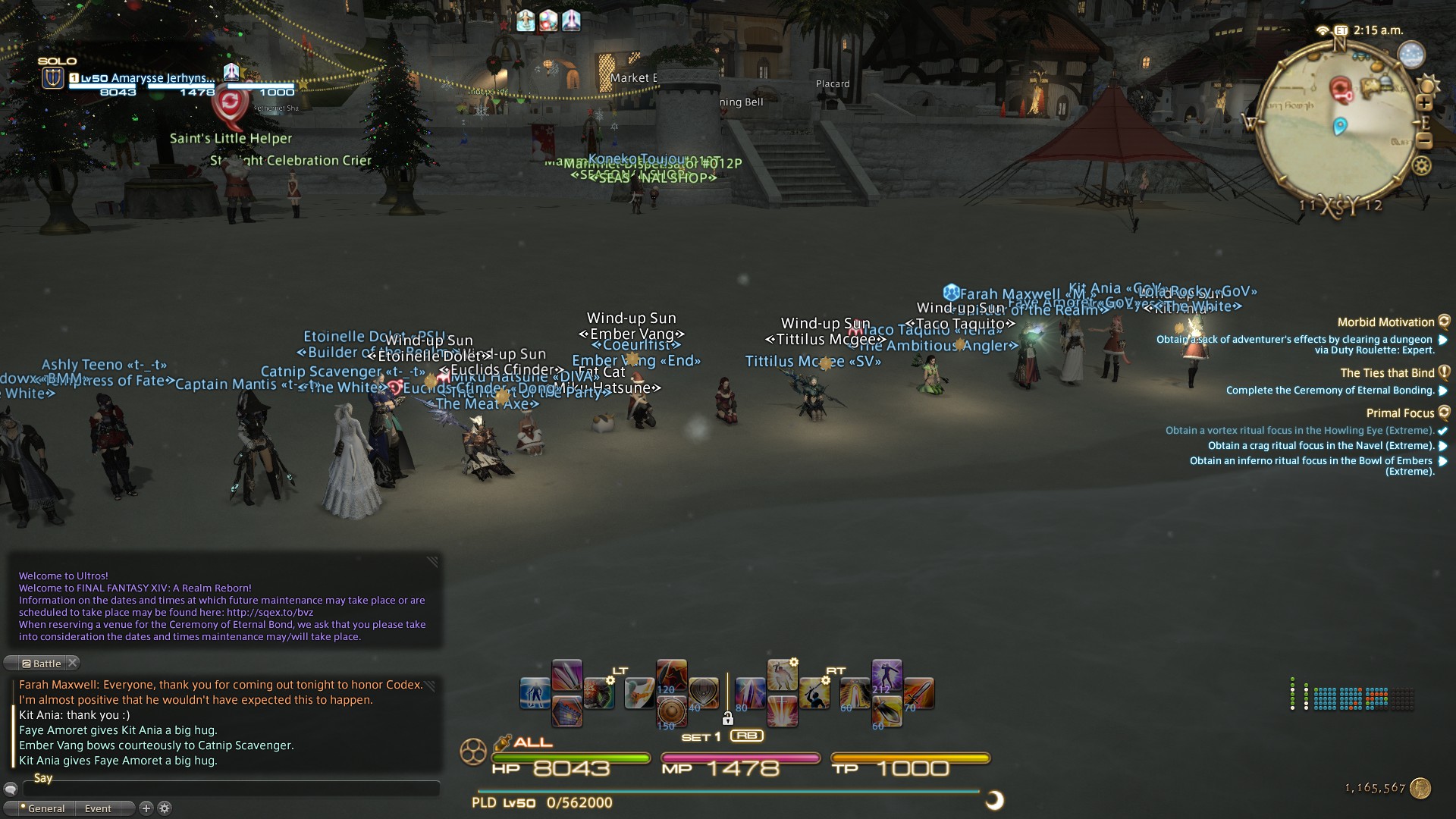
Normally, this sort of thing is an event that you tend to hear about after the fact, but I happened to be online just as someone on Twitter was posting about the vigil taking place on Ultros, the Final Fantasy XIV server which I call home. Largely out of curiosity, I logged in to take a look at what was happening, ran down to the beach and, sure enough, found a line of players facing out to sea, "wind-up sun" minions out, bathing the group in a soft light, contemplating whatever they chose to be contemplating as they paid their respects to Codex. I joined them.

17754480252836380672_screenshots_2014-12-21_00001

After a moment of quiet reflection, people spontaneously began letting off fireworks and balloons — these are items you can acquire in the game and are intended for use upon celebratory occasions such as seasonal events or the newly added "Eternal Bond" wedding system. It was a celebration not only of Codex's life, but also of how one stranger could bring all these disparate people from all over the world together in one place to do the same thing. It was a really, really beautiful moment, and extremely moving.

It's easy to think of the Internet at large, social media and online games in particular, as utterly "toxic" (that's a favourite word of critics at the moment) environments in which everyone is constantly at one another's throats. But every so often something happens that reminds you that an awful lot of human beings are fundamentally decent people, and that regardless of where you're from or what — if anything — you happen to believe in spiritually, the cycle of life and death is, pretty much without fail, something that will always bring us closer together with one another.

Rest in peace, Codex; I never knew you, but I hope wherever you are now, you feel the love of all the strangers who came together to celebrate your life today. May you forever walk in the light of the crystal.

1798: Chaos Reborn

I was pleased to see the other day that Julian Gollop's reimagining of his ZX Spectrum classic multiplayer strategy game Chaos has finally hit Steam. The version of Chaos Reborn currently available is, sadly, only an Early Access version containing nothing but online multiplayer and 7 levels of progression — no sign yet of the ambitious-sounding single-player mode and massively multiplayer/persistent elements — but despite this, it's already looking really rather good.

The original Chaos, for those unfamiliar, was a turn-based strategy game for up to 8 players, both human- and computer-controlled. The aim was simple: destroy your fellow wizards via any means you had available to you, be it direct-damage spells or an array of weird and wonderful creatures you were able to summon.

The "Chaos" of the title came in the form of a balance meter that tipped either towards law or chaos according to the specific spells that various players cast. As the balance tipped in one direction or another, the spells of that respective alignment became easier to cast, while their polar opposites became more difficult. Canny players could manipulate this to their advantage, though the ability to summon creatures as illusions meant that you could never quite be sure if your opponent had really summoned that Manticore or not… were you willing to potentially waste a turn attempting to "Disbelieve" it?

Chaos Reborn stays remarkably true to this original formula, albeit with a few changes. The maximum number of players is now 4 rather than 8, for one thing, and this is primarily to keep play sessions short and snappy — not a pair of adjectives you'd typically associate with turn-based strategy games, but having played a few games today, this particular approach is very welcome indeed, especially when I bear in mind so many multi-hour multiplayer Civilization games that never, ever reached any sort of satisfying conclusion.

Another core difference is the way spells are distributed. Rather than being given a random selection at the game's outset and then tasked with using them as effectively as possible, you now have a deck of "cards" depicting various spells and summoned creatures, and as you level up you'll gain access to more of these — though it's worth noting that these cards aren't necessarily "better", just different, so a level 1 player can still take on a higher-level player without the confrontation necessarily being a foregone conclusion.

This "cards" aspect looks to be interesting, as it promises the ability to build your own decks of spells as you unlock new creatures and attacks. There's a lot of potential to build your own personal play style, and it will be interesting to see how different people approach the game, how to build their decks and how to use the cards therein most effectively.

Chaos' roots are very much in board gaming — the original Spectrum version was even published by Games Workshop — and this aspect very much comes to the fore in Chaos Reborn. Between the deckbuilding and the ability to play games in an asynchronous manner as well as against live opponents, the game has a huge amount of potential, and I'm very much looking forward to seeing how it develops over time. For now, the Early Access version is a decent, if slightly limited package, but exciting things are on the horizon.

1782: The Crew: Project Gotham for a New Generation?

I wouldn't say by any means that I'm a die-hard petrolhead, but I do enjoy a good driving game, with the emphasis on game. That is to say, I tend to find the more hardcore driving "simulations" such as Forza Motorsport and Gran Turismo to be hard going, slow paced and more difficult than is enjoyable; I'd much rather play something where the "correct" way to play is to fling your car sideways around a corner, not caring if you're smashing street lights and fencing all over the shop, not worrying about fucking your car's performance up after a few bumps and scrapes, not having to engage in anything even remotely resembling "sportsmanship" when racing against other cars, be they computer- or player-controlled.

One of the driving game series that I did find myself enjoying a whole lot over the years was Bizarre Creations' Project Gotham Racing series, which actually began with the venerable (and awesome) Metropolis Street Racer on Sega's ill-fated 128-bit console, the Dreamcast. Project Gotham as a whole occupied a curious middle-ground between serious sim and arcadey racer; on the one hand, you were racing real cars around realistic environments and it wasn't really a "smash and bash" racer — in fact, Metropolis Street Racer even penalised you if you crashed too much, though this harshness was toned back a little in the later games, since they were already difficult enough — while on the other, you were flinging your car around with gay abandon, swinging its back end out whenever possible, darting between cone gates and playing chicken with upcoming walls as you tried to build up enough speed to actually leave the ground when racing down San Francisco's hilly streets.

In other words, Project Gotham demanded some genuine driving skill, but also knew that people liked having fun in cars, too — the sort of fun that would quickly get you arrested were you to try it… well, anywhere, really. Project Gotham allowed a safe environment for you to hop into various high-spec sports cars (and a few low-end crap cars towards the beginning) and just have some fun. It was later taken to the next extreme by the rather wonderful commercial flop Blur, which combined Project Gotham's semi-realistic racing (and real cars) with the stuff of pure fantasy — neon-coloured Mario Kart-inspired weapons that allowed you not only to race aggressively against your opponents, but to fire various explosive devices up their tailpipe, too. How sad that it wasn't more of a success than it was.

But I digress. Today I've been playing The Crew from Ubisoft, a game that I've been cautiously curious about ever since I first heard about it a year or two back. Promising a (somewhat scaled-down) recreation of the entirety of the United States of America, a variety of different mission types and a strong focus on working together with actual, real-life other people, it sounded like a natural evolution of the direction racing games had been moving in for a while.

Need for Speed Underground 2 introduced us to the idea of a racing game set in an open world. And boy did it work well. It worked so well that pretty much every Need for Speed game since has had some variation on this formula, with you driving around a vast (and suspiciously geographically diverse) map to discover events, take them on and complete them — or just to drive around for the fun of it. These open worlds didn't have the same level of detail about them as something like Grand Theft Auto, but they didn't need to; you only saw them from behind your windshield, and you never left your vehicle, unlike in Rockstar's classics. They did the job, though, and that was to provide you with an interesting environment in which you could get to know your car and the various roads, then challenge you with various events that would test your knowledge of both these things in a practical sense.

Later racing games played with this formula in different ways: Need for Speed Most Wanted had a strong emphasis on dramatic police chases, for example, while Need for Speed Hot Pursuit (the more recent version) actually allowed the choice of whether you were cops or street racers. Burnout Paradise, meanwhile, took that series' typically exaggerated crashes and built a whole game mode out of them, where you'd have to crash and then bounce your car along the street for as long as possible, hitting as many things as possible along the way. (Oh, you could race a bit, too.)

The reason why I'm bringing up all these other games is that The Crew, so far, feels like an entertaining mishmash of all of them. It has Burnout's crashcam, Project Gotham's driving through gates and beating speed milestones, Need for Speed's police chases. All of these different strands of DNA are very much apparent as you play, but for some reason it's Project Gotham I keep thinking of as I play, even though they're very different games; Project Gotham may have unfolded in realistic environments like The Crew does, but it took place entirely on enclosed courses rather than in open-world environments where it's possible to find shortcuts and go off-piste.

I think it's the variety of events which brings this to mind: most open-world racers in the last few years have included some sort of variation on the "race, destroy, time trial" formula, but The Crew adds a number of additional elements to the mix in the form of small, short skill challenges dotted around the various maps. Bringing to mind some of Project Gotham's short but teeth-gnashingly difficult challenges, the skill tests task you with everything from remaining above 50mph for as long a distance as possible in a time limit to slaloming around posts. And, of course, just completing these tasks isn't enough; there's bronze, silver and gold levels of completion to take on, plus online leaderboards.

Perhaps the most interesting thing about the game, though, is the "co-op" multiplayer, as this adds a strange and welcome twist to the usual online racing formula. Instead of everyone jockeying for first position as usually happens — or, more accurately, the person with the best car screaming off ahead, never to be seen again, as everyone else fights for second — these events just require that someone wins. Everyone else's job then effectively becomes ensuring that the computer-controlled racers don't have the opportunity to catch the person who is screaming off ahead, hopefully never to be seen again; it becomes a team effort, and when it works, it seems like a whole lot of fun. Unfortunately, I've only had the opportunity to try event in this manner so far, but hopefully as more people pick up the game there'll be more chances to enjoy the game the way it was clearly designed to be played.

The Crew is often described as an "MMO", though at present that's not altogether accurate. The execution is somewhat like Test Drive Unlimited, in which you'll be driving around minding your own business and occasionally see other people in the area. When you reach an event, you have the option to "quick invite" anyone in the vicinity to join you, or you can pre-form a crew of up to four people to tackle challenges in a more organised manner. There don't seem to really be enough players online as yet — at least not on the PC version — to make this feature shine as it should, but I'm interested to see how — or indeed if — it grows in the coming weeks.

Even if it doesn't, the single-player offering seems fairly solid, and it has so far made a good start at fulfilling my wish of a racing game with a semi-decent story, so I'm intrigued to see what happens next. I'm also pleased to see the protagonist is a bespectacled, bearded Gordon Freeman lookalike rather than the usual self-consciously cool douchebags that usually populate this sort of game.

First impressions are pretty good then; more will doubtless follow very soon.

1775: Geometry Wars 3: Some Initial Thoughts

Page_1I never thought I'd get to write the following sentence: I played a bunch of Geometry Wars 3 tonight.
Geometry Wars 2 was an absolute masterpiece, and one of my favourite games from one of my favourite studios — the sadly defunct Bizarre Creations, who were also behind some of my favourite racing games (the Project Gotham series and the wonderful Blur). It struck a perfect balance of challenge and instant gratification, allowing anyone to pick it up and play, but only those who took the time to concentrate on what they were doing to truly master it and attain the most astronomical scores. It also featured one of the finest implementations of online leaderboards of any game, ever. And the dissolution of Bizarre made me think that we'd never see a new game in the series. Here we are, though.

Is Geometry Wars 3 the masterpiece that its predecessor was? To be honest, it's a bit early to tell yet. I wasn't immediately taken with its new aesthetic — the old-school neon vector art has been toned down a bit in favour of a new (and still distinctive) look that I have a feeling will probably grow on me in time — but then I sat down to "try out" Pacifism mode (one of my favourite modes from 2, in which you may not fire your weapons and can only defeat enemies by dodging through exploding gates when they pass nearby), looked up and realised I'd spent somewhere in the region of an hour staring glassy-eyed at the screen just like I used to do with Geometry Wars 2. So that's a good sign, then.

Here are some further observations, bullet-pointed for your convenience.

  • It has 3D levels. The flat plane is still there for "Classic" mode — essentially a retooling of Geometry Wars 2's modes — but in the main single-player "Adventure" mode you'll find yourself fighting on spheres, cubes, dishes, sausages, flat planes with holes in, circles with spinning walls and all manner of other peculiar arrangements. And it really adds a different spin (no pun intended) on the gameplay; having to consider the ability to "wrap" around a 3D shape forces you to think about your strategy somewhat differently to being enclosed in an arena. Not only that, but moving around on irregular shapes (such as the aforementioned sausage) can lead to you having to play with the battlefield skewed at some crazy and challenging angles if you're not careful about how you move.
  • The music has been remixed. The tunes are all based on the various themes from Geometry Wars 2's various modes, but I think I preferred the old mixes. The new versions have suitably thumping bass and drum parts, but the mix of the Geometry Wars 2 versions just sounded "fuller" and more satisfying to listen to.
  • There are bosses. In "Adventure" mode, anyway. Said bosses have a habit of 1) sitting on an awkwardly shaped playfield (the second boss, whom you fight on a cube, is a particularly troublesome chap) and 2) launching hundreds of enemies at you while you're attempting to fill them full of hot plasma death. Naturally, you only get one life for boss levels, too, so no fucking it up and hoping for the best.
  • There's a progression and upgrade system. Again, this only applies to "Adventure" mode. Early in the game, you'll unlock a "drone" that follows you around and behaves in various ways according to which one you've selected. You can upgrade both your drone and its special attack using the little diamond-shaped Geoms you collect in the levels, which are normally used simply to increase your score multiplier. Additional drones and special attacks are unlocked by progressing through the levels in "Adventure" mode and by attaining a particular number of stars by beating target scores in each level.
  • There's a weird new mechanic called Super State. The clichéd computerised voiceover will occasionally say "Super State" and inform you that there's an arrangement of static targets somewhere on the playfield. Destroy them all and you get a powered-up weapon for a brief time, rather than the approach from previous games where once your shots were powered up, they stayed powered up. It's a fun little twist that forces you to weigh up whether it's worth the risk of trying to destroy the targets, or simply muddle on with your regular weapon. It can be particularly perilous on "Adventure" mode's 3D stages.
  • Leaderboards are still awesome. In the "Classic" modes, you can always see your nearest rival in the corner of the screen, and at the end of a session you can see how you stack up against your friends and the global leaderboards. In "Adventure" mode, each level has its own individual leaderboard for you to take on, giving you something to strive for even if you've cleared every level with three stars.
  • There's an online mode. There are two ways to play, only one of which I've tried so far. Summoner splits players into two teams and then puts them in a Domination-style game where you have to capture towers by shooting them, and then the towers start coughing up enemies for you to destroy with your teammates. Highest score at the end of a short time limit — matches are really short and snappy — wins. Die and your team suffers a penalty to its score multiplier. It seems like fun, but unfortunately in the matches I've tried so far all of my opponents (and teammates for that matter) have just sat there and not done anything. This did mean I won by default, however, which was nice.
  • There's a local co-op mode. I haven't tried it yet, but this was quite fun in Geometry Wars 2.

That's about it for my initial impressions, then. I'll undoubtedly play some more in the next few days and have some more detailed thoughts to ponder, but for now I'm quietly impressed. As I noted above, I'm not quite sure yet whether or not it's as good as Geometry Wars 2 was, but it's certainly a solid, enjoyable game that I'm looking forward to getting to know a bit better.

(Oh, and if you're playing the PC version, I recommend playing in Borderless Windowed mode; the full-screen mode inexplicably caps the frame-rate at 24fps, which is just baffling.)

1771: Dungeon of the Endless is Pretty Great

Page_1Before I left my friend Tim's yesterday, I quickly gave him a tour of Amplitude's Dungeon of the Endless, one of the three games in the studio's Endless series of sci-fi strategy games and, I think, my favourite of the three overall. Demonstrating the game to Tim reminded me how much I like it, and thus I spent a fair amount of time both last night when I got home and today playing it.

For the uninitiated, Dungeon of the Endless is a peculiar affair somewhere between roguelike, real-time strategy game, turn-based strategy game, tower defense game and board game.

Here's how it works. Your party of heroes (initially two, but expandable up to four by finding and recruiting additional characters as you progress) have crash-landed in a dungeon. The only way out is to use the otherwise destroyed spacecraft's energy crystal to power the ancient elevators which proceed upwards through the twelve levels of the complex. Inconveniently, of course, these elevators only go up one floor at a time, so on every level you have to go through the same process of exploring, finding the exit and then transporting the energy crystal from the start point to the exit. Do this twelve times and you win; let the crystal be destroyed or all of your heroes die and you lose.

Each level is randomly generated, and they get larger and more complex as you progress, but still follow the same basic formula. A level is constructed out of individual rooms separated by doors, and opening a door is akin to starting a new "turn" in Dungeon of the Endless' stablemates Endless Space or Endless Legend. Upon opening a door, you produce a particular amount of Food, Science and Industry, with the exact amount dependent on various conditions, including the heroes you have on your team, the modules you've built around the dungeon and whether or not there's anyone trained to operate said modules and improve their output.

Food is required for healing, levelling up and, occasionally, recruiting new heroes. Science is used for researching new modules to construct and resetting ability cooldowns. Industry is used to actually construct things. There's also a fourth resource called Dust, whose main use is to increase the power capacity of your crystal. Every ten units of Dust you acquire, you earn the ability to power an additional room. Powered rooms — which have to be connected to the crystal or to other powered rooms — can have modules built in them. Unpowered rooms have the chance of spawning waves of monsters every time you open a door — or indefinitely once one of your party members picks up the crystal and starts transporting it.

Playing the game effectively involves carefully strategising how you can balance exploring the dungeon to find the exit, constructing defensive positions to protect the crystal from attack, and powering rooms in such a way as to prevent enemies spawning in inconvenient locations — or perhaps to funnel them towards an easily-defended position. It's initially overwhelming, but once you master the basic strategy — power rooms along the path to the exit, place heavy defences in between where the enemies are likely to spawn and where you're going to be heading — it's satisfying, but still challenging. As the game progresses, the enemies get stronger and come out in greater numbers, so you'd better have levelled up your heroes and researched some better modules in preparation for the increasing intensity of the assaults.

Being inspired by roguelikes, Dungeon of the Endless has a pleasing amount of replayability thanks to random elements that make each playthrough a little different. The maps are different each time, for starters, but there are also more subtle changes like the technologies available to research. In the last game I played, for example, I had access to the "Knowledge is Power" turrets, which power themselves up significantly according to how much Science you've collected. I stockpiled an enormous amount of Science in the earlier levels, meaning that these relatively inexpensive turrets got me through a lot of the game thanks to their astronomical stopping power. (They didn't help me finish the last level, however, in which you're very short on power and other resources and powerful monsters just seem to keep coming.)

I haven't yet tried the multiplayer mode, in which you each control a single hero, but it has the potential to be interesting in a slightly different way to the single-player. I'm interested to try it sometime soon; hopefully the opportunity will arise!

1751: Speaking in Tongues

Page_1My Final Fantasy XIV Free Company was afflicted with something that seems to come to all MMORPG guilds at one point or another recently: that which is colloquially referred to as "drama".

Ultimately, the drama itself wasn't particularly serious — no-one was hurt and no damage was done, though arguably an ill-thought-out prank by an outgoing member was not the best means of handling the situation — but what I found interesting was the discussions that followed it up.

Essentially, the conclusion that many of us came to is that communication is important. It may sound like a simple piece of advice — common sense, obvious, even — but it's so easy to forget, even in an inherently social situation like a massively multiplayer online game. In a Free Company the size of ours, it's inevitable that cliques form, friendships blossom and smaller subgroups start doing things together. That's the natural way of things, and it's not necessarily a bad thing at all. That is, until it starts having a negative impact on the group as a whole for whatever reason — perhaps some members see these smaller subgroups as somewhat exclusionary; perhaps the subgroups find it difficult to relate to other people; perhaps everyone could just stand to be a bit more open and honest with one another.

There were a number of contributing factors in this instance that I won't bore you with now, but suffice to say that a lack of communication was the root cause of the issues we suffered. And, positively, said lack of communication was correctly identified quickly as the root cause of these issues, and people have been making determined efforts to try and make things right. Although the initial "drama" wasn't particularly pleasant or fun to witness, it turns out it ultimately had a positive impact; people are talking more, cooperating more and doing more things together. Plans have been put in place for more organised cooperation on the more difficult things the game has to offer, and people are just generally being more helpful and pleasant towards one another.

It's testament to the overall quality of people we have in the Free Company as a whole that the active members — many of whom could be argued to be implicated in the whole exclusivity/lack of communication thing — have taken this stuff happening on the chin, haven't got angry and upset and have done something positive from it: they've learned from it, identified things that we can do better and differently for one another, and ultimately the Free Company will hopefully be a far more pleasant place overall as a result.

Me, I'm mostly just glad it all seems to be over and done with for now. I hate to see friends fighting with one another, or — in this case — just misunderstanding one another. It's a great pity that the situation led us to lose a few Free Company members who had been with us since the beginning — and people I enjoyed playing with, moreover — but these things happen, and ultimately we'll be a stronger group as a result.

Now let's all just enjoy the game!

1746: Tomestones of Poetics

Page_1Andie and I have had more of a chance to delve into Final Fantasy XIV's latest patch Dreams of Ice today, and I've now had the chance to jump in to most of the new pieces of playable content, with the exception of the Final Coil of Bahamut (which is still a way off yet) and the Extreme difficulty version of the fight against iconic Final Fantasy character — or the Final Fantasy XIV incarnation of her, anyway — Shiva.

The first couple of days after a patch drops are an exciting, enjoyable time to be playing, because most people who are online at the same time as you are in a similar situation to you — they're learning new fights without any foreknowledge of what is to come, and with the fact that guides for these new fights tend not to crop up until a week or two after the actual patch drops, you have little option but to either try and figure things out for yourself or trust the word of the people you're playing with. It's a lot of fun, puts everyone on a much more level playing field than later in a patch's lifecycle, and leads to a certain degree of camaraderie as everyone comes together to work out the best ways to take things on.

After two days, we have a few bits and pieces figured out.

We know that the first boss in Sastasha (Hard) has a very powerful attack that hits anyone except the tank, and this can be stunned — though like most enemies in Final Fantasy XIV, it builds up a gradual resistance to Stun if you keep doing it over and over. Instead, it's important that the healers ensure no-one is afflicted with the "Slime" status effect when this attack comes, as although the attack is powerful, it will never kill you outright; the damage over time from Slime, however, may well finish you off after one of these almost-deadly blows.

We know that the second boss in Sastasha (Hard) is sometimes bugged, but that you can proceed through the fight even if it seems to have frozen up by stopping your attack for a moment.

We have no idea how the final boss in Sastasha (Hard) works, but it seems that killing all the Kraken's arms prevents it from summoning deadly waterspouts, while keeping out of reach of its tentacles allows you to pelt its head with impunity.

The Sunken Temple of Qarn (Hard) likewise has three interesting bosses. The first is a multi-part boss who seems to go down quickly if you kill his parts in a certain order, ending with the head. He has a habit of summoning nasty quicksand traps for you to be dragged under.

The second Sunken Temple of Qarn (Hard) boss features regular DPS checks, any time it starts casting 100,000 Needles (which actually only does 25,000 damage, disappointingly, but this is still enough to kill even the most well-geared tank). Throughout the fight, he has friends pop up, some of which are simple cannon fodder, one of which is aggro-locked to a random player — often the healer from the look of things — and another of which covers the main boss, protecting it from damage.

The third Sunken Temple of Qarn (Hard) boss is relatively simple mechanics-wise, but enjoyable to play. Essentially you're playing Waves mode from Geometry Wars 2, avoiding occasional sweeping waves of mummies that run across the battlefield, cursing you if they touch you, while simultaneously trying to batter the boss down to size. Later in the fight, you also have to contend with a line-of-sight attack which also inflicts the curse status on you — get four stacks of this and you temporarily turn into a mummy, running diagonally across the field and potentially afflicting your allies with the curse in the process if they don't get out of the way.

Snowcloak, meanwhile, is unusual in that it's actually part of the main story for once — most of the other level 50 dungeons have been unlocked through sidequests. Snowcloak is a part of the main narrative, however, but it still works in much the same way, and again has three interesting bosses to power through, as well as some enjoyable "enemy gauntlets" to fight through.

The first fight in Snowcloak is relatively easy. Like the final boss of Sunken Temple of Qarn (Hard), you're trying to avoid getting four stacks of a debuff on you — though in this case, it freezes you for a few seconds rather than turning you into a mummy.

The second fight in Snowcloak is becoming known as "Yeti Billiards" because it involves freezing Spriggan adds in the boss' area-effect attack, then hitting the snowballs this creates back into the boss. Freeze the same snowball more than once and it will grow in size, causing it to deal considerably more damage when it hits the boss.

The third fight in Snowcloak is actually pretty straightforward. You simply have to avoid icicles falling on your head, then spot the two that are going to shoot across the battlefield, injuring anyone in their path, then hide behind the third one before the boss does his group-wide Lunar Cry move, which freezes anyone it has line-of-sight with. There's a lot of moving around, and it's a lot of fun — if a little easy once you know what you're doing.

All this isn't even getting onto the utterly ridiculous but hugely enjoyable fight against Final Fantasy VI characters Ultros and Typhon, or the conflict against Shiva. There's been a lot to discover over the last few days, and people are still learning. It's a fun time to be playing; over time it will settle down into more of a "routine" like in previous patches, but for now, it's one of those times that, for the most part, tends to show the community at its best, most cooperative and most helpful towards one another.