2260: Have You Played Liberator Today?

0260_001

I like retro compilations, not just for the ability to play games from my youth on modern hardware, but also to discover some classics that, for whatever reason, I missed out on when they were first released.

Such has been the case after just a few minutes with Atari Vault, a new release on Steam that packages together about a hundred Atari 2600 and arcade games from the late '70s and early '80s — including a few previously unreleased prototypes, which is kinda cool.

One such discovery I made today was an interesting (and surprisingly impressive for the time) game called Liberator, a quasi-sequel to Missile Command that flipped the concept of the original Cold War-inspired game on its head by putting you in the role of the aggressors, attacking enemy bases on planets in order to liberate the population from the villains.

Liberator, I've discovered, was quite a rare game even on its original release, which might explain why I've never come across it before. According to Gaming History, the original arcade machine sold for a whopping $2,000 and did not prove particularly popular, with only somewhere in the region of 760 cabinets actually being made — all this despite it being a game absolutely made for cross-promotion with Atari's "Atari Force" comic series. The curse of old-school Atari constantly and consistently failing at marketing strikes once again, I guess.

Anyway. The game plays quite a bit like Missile Command in that it's a somewhat different take on the shoot 'em up. Rather than firing directly at things, you fire at a crosshair on screen, and your missiles detonate when they reach the point you fired at. Thus, to destroy things, you have to cause explosions at locations where the enemies will be when your missiles arrive — usually meaning you have to fire ahead of them carefully, anticipating their movements.

Much like Missile Command, you can fire from several different places on screen, and these missile launchers — here depicted as starships orbiting an enemy planet — can be independently destroyed, acting as your "lives" for the game session. The game, then, becomes a matter of balancing your offense on the planet surface, which requires you to destroy enemy missile bases on the rotating globe ahead of you, and defending yourself against incoming missiles and other attacks. Not every attack is guaranteed to hit you, either, so you also need to spot which things you need to prioritise destroying and which you can safely ignore.

It's an interesting game; very simple, but undoubtedly addictive in the same way that Missile Command is. It's a good-looking game for the time period (1982), as well, with some decent pixel art for "Commander Champion", who briefs you on your mission, and a well-done 3D rotating globe effect for the planets you're orbiting. Sound effects, meanwhile, are the same bleeps, burbles and booms from Missile Command — nothing special, but certainly iconic of this particular period in gaming.

There's a lot more to explore in Atari Vault, but I anticipate that Liberator will be one I keep coming back to!

2259: Back to Solo Play

0259_001

I've been back and forth on whether or not I should continue playing Final Fantasy XIV for a while now. I do love the game and all it offers, but the long period of time between the release of expansion pack Heavensward and its first major content patch caused me to get significant burnout, and while I did get temporarily enthused around the start of the patch 3.2 cycle, I'm once again feeling that I don't really want to do the endgame grind, nor do I want to raid.

Those who have been following my blog for a while will know that I've been one of the loudest, most enthusiastic people about Final Fantasy XIV ever since the beta of A Realm Reborn. So why the change of heart? Well, a number of reasons, really.

First up is the aforementioned endgame grind. This has always been present in the game — it is an MMO, after all — but first time around it somehow didn't feel so bad, perhaps because I never got "ahead of the curve" and made content irrelevant by outgearing it within a day or two of it releasing. In other words, taking on challenges was always exciting and there was always something to aim for; that aspect is still there, but if anything, I think there's now too much to grind on for what feels like relatively little reward.

Take the Anima weapons, for example — Heavensward's version of the Relic weapons from A Realm Reborn. The first step of this process either requires you to give up a fully upgraded level 50 relic (which a lot of people had at least one of by this point) or to repeatedly run FATEs around the Heavensward areas until you got Atma-like drops at a very low chance. The second step requires you to run ten dungeons that, at the level you're constructing the Anima weapon at, are completely irrelevant to you unless you're collecting gear for alt classes. The final step requires you to collect 20 each of four different items and then do some other bits and pieces.

The first step either takes seconds or hours of boring FATE grinding, though you can at least attempt to get the items from FATEs while levelling another class. The second step is just plain tedious, though it is presumably there as an attempt to keep older dungeons populated for those who are coming up through the 50s. And the third and final step is an absolutely brutal grind that either takes weeks of daily quests or repeated running of dungeons and/or the first (now largely irrelevant) part of the Alexander raid dungeon. Oddly, the jump in item level and power for this final step is significantly smaller than that for the second step, despite the final step being by far the most significant undertaking.

I currently have 8 out of the 60 items required to upgrade my Relic to its (currently) final form, and the next step of the process is coming soon. I just don't feel any inclination to do this alongside grinding daily quest reputation, Tomestones to purchase gear, XP for classes that haven't reached 60 yet, not to mention crafting and gathering, both of which are one of the few reliable ways to make a decent amount of money in the game.

The trouble, then, is not that there's nothing to do as such — it's that there's too much to do, but that too much is based on doing the same things over and over again for weeks or even months. The worst of both worlds, if you will — for me, anyway. There are plenty of people still playing who seem to be quite happy indulging in this grind. Some are even already working on their second or third Anima weapons.

I don't begrudge anyone how they spend their time, but having been playing a bunch of other stuff recently, I just don't want to commit the amount of time necessary to progress at a meaningful pace in Heavensward, because it means that I won't have time to enjoy other games like Senran Kagura Estival Versus, Dungeon Travelers 2, the upcoming Trillion God of Destruction and the many, many RPGs that are still on my game shelves, as yet unplayed. I've tried finding that magic balance between FFXIV and other games, and it just doesn't really exist for me — I always end up going in an "all or nothing" direction, and right now I'm feeling like I would rather play other things.

I'm not hanging up my Eorzean adventuring shoes completely; I fully intend to continue dropping in on the game to see how the plot develops with each new content patch, but I no longer have any desire to stay "current" with content progression, raids or Extreme-level Primal fights. In a way, I'm a bit sad that I feel this way, as FFXIV has been such a significant part of my life for so long — and my wife now plays more than I do — but ultimately, if you're not happy or having fun doing something that is supposed to be enjoyable, then there's really no point carrying on with it.

Alongside all this is the social matter: our Free Company has become very quiet over the last few months. I'm not entirely sure what's caused this and I don't really want to investigate for fear of dredging up any drama that might be involved. But playing the game isn't the same social activity it once was, with Free Company chat a lively place filled with people having fun, joking around and enjoying themselves. Many of the regular faces are still there, but remain quiet in "public", instead preferring to converse in small, private Linkshells rather than the main guild channel. It's made for an atmosphere that isn't anywhere near as welcoming and fun as it once was.

And alongside this is the matter of the overall game community and how it has declined somewhat over the last few months. MMOs always have a problem with elitism at their top end, but Final Fantasy XIV always used to feel like it was one of the more positive, friendly communities out there. Now, though, it's a place where you get yelled at if you don't speedrun dungeons, where newcomers to fights are sometimes kicked out of groups, and where players bitch about people they perceive to be "inferior" to them both in-game and on social media. The rise in popularity of DPS parsers also means that the particularly elitist players have data to hold over the heads of people they think are underperforming, and rather than offering feedback on how to improve, many of these people think that simply quoting them their DPS figure is enough to make them want to "git gud".

This is a generalisation, of course; I've still had plenty of positive experiences in the game in recent months, and I always made a point to be the change I wanted to see in the community by being friendly and conversational when playing with others, offering advice without berating when necessary. But it's just got to a point where this side of things has become exhausting and even stressful at times, and that's not conducive to having fun.

So I'm stepping away. For how long, I don't know, though as I say, I'm pretty sure I'll be back in for the next patch, at least to see how the main scenario storyline develops. Raiding, though? Nope. Sephirot EX? No thank you. Anima grind? No, thank you.

Now, I'm 86 hours deep in Dungeon Travelers 2 and I have grinding to do… he said, without a trace of irony.

2258: TrackMania Turbo: Impressions from the Full Version

0258_001

I knew after just a couple of minutes of playing TrackMania Turbo's demo that I needed the full game in my life, so it wasn't long before I was in my local game emporium picking up a physical copy. (Discs rule. Yes they do.) And I've been spending some time with the full version. Here are some things you might like to know about it.

It's an arcade racer with gloriously old-school handling

That means tapping the brakes to suddenly find yourself going sideways, powersliding around corners, releasing the accelerator to slow down only when you absolutely have to, and all that good stuff. It's not realistic in the slightest, but TrackMania has always been about having fun that just happens to be in cars; it's never been trying to be realistic, and it's always been all the better for it.

There are four distinct environments, each with a very different feel

Earlier TrackMania titles incorporated multiple environments, each of which had its own unique vehicle with its own unique handling. TrackMania 2 bucked this trend by releasing each environment as a separate game — Canyon, Valley and Stadium. It was a controversial move that some saw as new publisher Ubisoft trying to make a bit more money off the game and perhaps it was — but each of these environments was very well fleshed out with plenty of variety. Plus each individual game was a fraction of the price of a brand-new triple-A game.

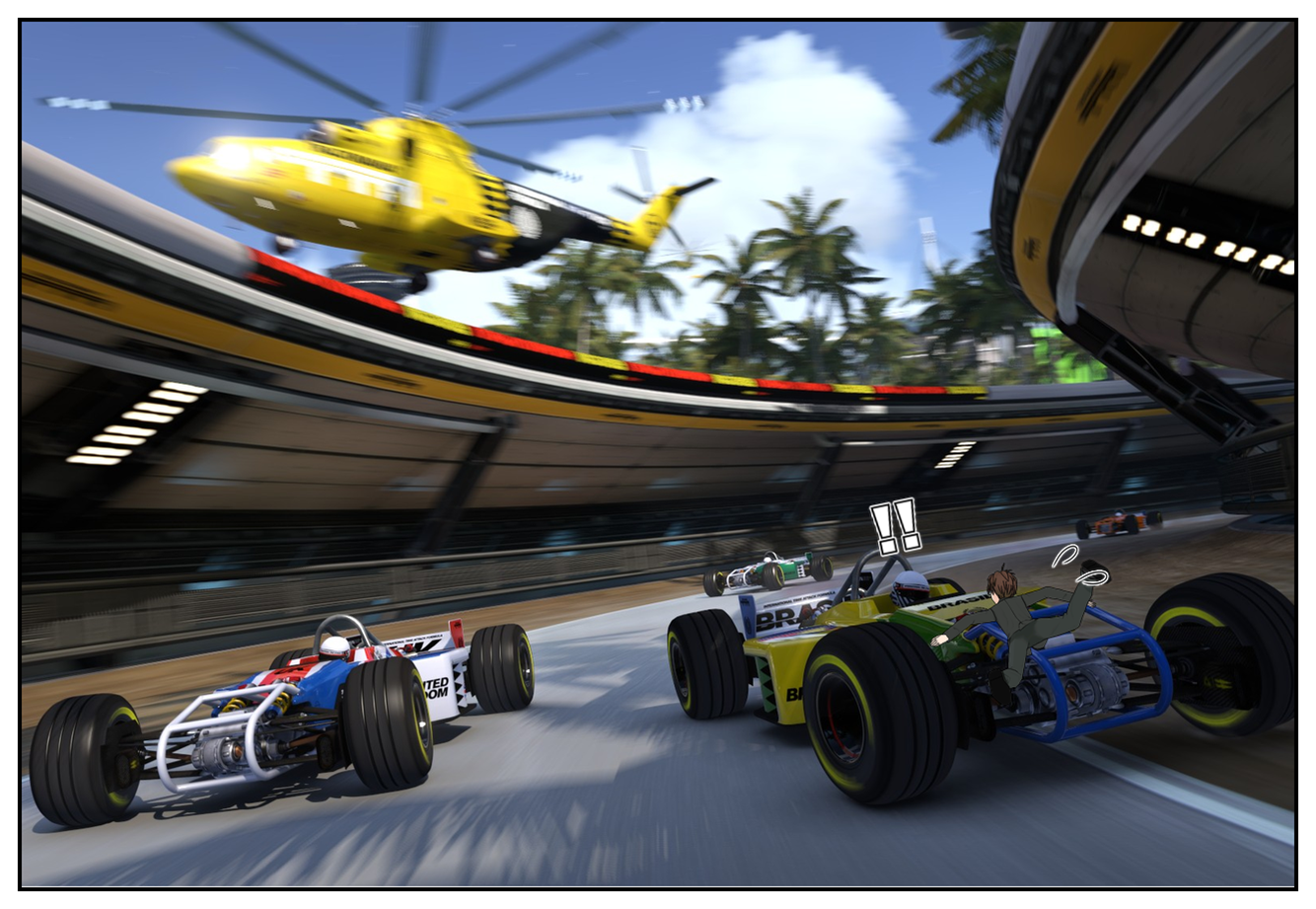
TrackMania Turbo incorporates revamped versions of the Canyon, Valley and Stadium environments from TrackMania 2 and adds its own Lagoon environment to the mix. Lagoon is somewhat similar to the Island environment from TrackMania United, but with a few additions — most notably magnetic rollercoaster tracks that your car sticks to, allowing for corkscrewing, loop-the-looping and all manner of other acrobatics with zero risk of your car flying off into the sunset or plummeting from a great height into shark-infested waters.

Pleasingly, each environment feels very different. The Canyon cars are extremely drifty — we're talking Ridge Racer territory here. The Valley cars, meanwhile, are a little more twitchy, plus the wider variety of road (and off-road) surfaces means that you have to adapt to several different ways of throwing your car around. The Lagoon cars are the most sensitive and grippy of all, able to get around very tight corners without having to drift (or even slow down, in some cases), and the Stadium cars are much like their counterparts from the previous games: heavy but grippy, with the ability to throw them into a drift with judicious application of the brakes.

There's a 200-level campaign

Yep, 200 races for you to complete. You can't just challenge them in any order, though; you have to start with the "White"-level Canyon tracks, then attain enough medals to unlock the "White" Valley tracks, then the "White" Lagoon tracks and finally the "White" Stadium tracks — only then will you be able to move up to the next tier. The top two tiers of difficulty require silver and gold medals respectively, while the first three only require bronze medals.

This structure is a bit more restrictive than past TrackMania games in that you can't jump back and forth between each environment's mini-campaign if you get fed up with a particular track, but ultimately it gives the game a good sense of progression.

There's a bunch of ways to play multiplayer

TrackMania has always been an incredibly overlooked local multiplayer party game, and hopefully its jump to consoles will help fix that. Turbo incorporates a number of different ways to play together.

Split-Screen is self-explanatory: everyone races together, first over the line wins, and the overall winner is determined by a best of three. This is noteworthy for being one of the only four-player split-screen games I've seen on the last two generations of consoles.

Arcade mode is a flexible mode where you can pick a track and then attempt to set a time using three "credits". The top ten times are recorded on a high score table, so you can challenge your friends to beat your best times that you've previously set — or have a mini-tournament there and then.

Hotseat mode is most similar to the previous games' multiplayer option. Up to 16 players can play in turn, each of whom is given a full tank of gas. Each player then attempts to set a time on the course; if the current leader is beaten, they then have to try and beat their challenger. The process repeats until everyone has run out of gas, and whoever is top of the leaderboard at that point is the winner.

All these local multiplayer modes can be played using any of the 200 campaign tracks (all of which are unlocked from the outset — no need to play single-player to open them up for multiplayer), any tracks you've built using the game's track editor, or a randomly generated track that the game builds for you. This latter option is fun, but a little time-consuming: you can watch the game building the track piece-by-piece, then it has to spend a few moments calculating shadows for the objects it's added. (Pro-Tip: choose "Fast" rather than "Nice" for lighting quality unless you want to wait a good 3 or 4 minutes before you can play the track.)

It's built for console

TrackMania has always felt like a PC game. And I don't necessarily mean that as a positive thing. Past installments have been highly customisable and expandable, but this came at a price: a clunky, inconsistent interface and an online component that required you know about (and are able to set up) dedicated servers and suchlike. The game was considerably expanded by a worldwide community of modders, in other words.

TrackMania Turbo doesn't support mods, nor does it do dedicated servers — at least not in the same way as the earlier PC games. This, naturally, has made the PC crowd get furious as they are wont to do, but really for the average player it's a change for the better. Multiplayer is now a case of just creating a room or joining an existing one. The interface is consistent and controller-friendly. You don't need to worry about having the right mods installed just to make other people's cars show up, or spend time tweaking settings to optimise performance. It is an overused phrase, but TrackMania Turbo just works, and thank God for that.

It's the best arcade racer for years

While many of the more "arcadey" racing games have gone in the open-world direction over the last few years, making for sprawling, unfocused experiences where you dribble from one type of activity to another, TrackMania remains so true to its arcade inspirations that on its title screen it prompts you to "insert coin or press X", followed by the sound of a coin clunking into an arcade machine when the main menu appears.

It's presented well, with a clear, uncluttered interface, wonderful handling and a pick-up-and-play nature that is accessible (but challenging) to all ages, and with the combination of the track editor, the ability to download other players' tracks and the random track generator, has potentially limitless replayability.

So if you like arcade racing — or the technical, puzzle-like stunt racing of titles like Ubisoft stablemate Trials — then you absolutely, definitely should pick up a copy of TrackMania Turbo as soon as possible.

2256: TrackMania Turbo Demo Impressions

0256_001

Those who know me well will know that I've been a huge fan of the TrackMania series since the original release of TrackMania United, and have spent many hours on the various updates to United and the eventual follow-ups TrackMania 2 Canyon, Valley and Stadium. So it was with some excitement that I realised that the next official sequel, TrackMania Turbo, was releasing this week, though I was torn on whether to pick it up for console (PS4, in my case) or PC, which has traditionally been the home of TrackMania.

After playing the PS4 demo for a bit this evening, I think I'm going to grab the PS4 version. I'm very impressed with how at home it feels on console — much of the clunkiness of the PC versions, particularly in the menus, has been tidied up considerably, making it much more controller-friendly, and the addition of a variety of local multiplayer modes makes it eminently suitable for console play. It, so far, seems to be a highly polished product, which addresses what has always been my main criticism of the series as a whole: the fact that in terms of gameplay, it is wonderful, but in terms of interface and user-friendliness, it has traditionally been a ridiculous mess, only made worse by the gazillions of mods server operators apply to their custom dedicated servers, making the game screen more complicated than your average MMO come raid time.

PC players on Steam seem to be a bit salty that TrackMania Turbo has stripped out a number of features they've come to take for granted: specifically, the ability for players to run their own dedicated servers and install gajillions of mods that make players' screens look more complicated than your average MMO come raid time. And while this is a bit of a shame from the perspective of the game's flexibility — something that TrackMania has always prided itself on — I don't think it's going to hurt the complete package, and in fact it may well be good for the series as a whole. TrackMania Turbo will serve as the friendly face of TrackMania, in other words, while the truly hardcore still have United and TrackMania 2 to play and mod to their heart's content. Both of those games are still a hell of a lot of fun to play, after all — and surprisingly good looking, to boot, especially considering their age.

But what of TrackMania Turbo then? How does it shape up compared to its illustrious, if clunky, predecessors? Judging from the five tracks available in the demo, extremely favourably. In fact, if the whole game handles in the way those early tracks do, I'm confident that it will become a new favourite arcade racer.

The thing I like the most is the unabashedly arcadey handling. We're talking Ridge Racer-tier drifting here: release the accelerator, steer around a corner and slam the gas back on and you're going sideways. Hit the brakes and you'll find yourself in an even tighter drift, allowing you to get around even the most ridiculous of corners without losing anywhere near as much speed as if you'd have to drive "properly" like in boring driving sims.

The game screen, sans custom mod clutter, is clean, clear and offers ample feedback on your performance as you play, including split times, worldwide and regional rankings, and fun little extras like arcade-style counters showing how far you've jumped or drifted for — a nice addition that gives the game a very "Sega" feel.

I was debating whether or not I wanted to grab the game today. Playing those five tracks in the demo has made me quite happy to pick it up, though; I can see it being a whole lot of fun, and I hope it's a big success, helping to show console players the joy of this wonderfully silly but skillful and creative series.

2251: GTA Online: More Fun Than I Originally Gave it Credit For

0251_001

Some friends and I have managed to spend most of today playing Grand Theft Auto Online, the sprawling multiplayer mode for Grand Theft Auto V on… well, everything, but we were playing on PC, because we all have excellent gaming rigs and like it looking lovely and running at 60+ frames per second.

Anyway. Regular readers will know that my reaction to Grand Theft Auto Online has been somewhat lukewarm in the past, but today we had a ton of genuine fun, both in the free-roaming mode and in the more structured activities. I think it's finally won me over as something I want to play more of — I'm still unconvinced that I want to play it with strangers, as popular triple-A game multiplayer modes tend to attract the very worst kind of person, but I definitely want to do a lot more with friends.

It has problems, though; fairly significant ones for an online game. Mostly the issues relate to the overall clunkiness of setting up and managing online sessions. There's no party system, for instance, which makes sticking together with the same group of players when moving from activity to activity a little troublesome at times, though the addition of the "Remain Host" option alleviates this somewhat by ensuring whoever initiates an activity remains in control of the session's options after it's over.

The problems with the party system are further compounded by Rockstar's insistence on using its own proprietary login system for online IDs — the Rockstar Social Club. I can understand why they've done this — there's some nice detailed stat-tracking and suchlike on the Social Club website — but it's a shame it doesn't integrate with something like Steam. On consoles it integrates perfectly with Xbox Live and PlayStation Network, making it straightforward to find and invite people, whereas the addition of an extra layer of user IDs and accounts on the PC version makes it a bit of a faff to get set up to play with friends. Social Club is also a bit of a temperamental beast; we spent nearly an hour at the start of our session earlier with one of our friends steadfastly appearing offline despite him being logged in to GTA Online; turned out the solution was just to open the Social Club interface in game, and then he magically appeared online. Dumb. Broken.

Fortunately, once it works, it seems to stay working for the most part, and while there are a few aspects of the experience you miss out on when playing in small, private sessions rather than in large public games, we certainly didn't feel like we were being deprived of anything to do. Pleasingly, there are a lot of activities tuned for 4 players, which is typically the number of people we manage to have available at any one time, so there were plenty of options for us.

Over time, Grand Theft Auto Online has expanded with a veritable fuckton of new game modes and ways to play, too; open-world activities in Free Mode might challenge you to capture and control an area on the map; "adversary" modes give you unconventional and sometimes asymmetrical ways to compete against each other; missions provide relatively freeform objectives for you to complete as a group. And then, of course, there are the Heists, which we are yet to see one through to its conclusion, but which promise to be a ton of fun.

Particular highlights for us today included the "Hasta la Vista" adversary mode, in which the four participants are split into two teams: two on pedal bicycles, two in big rig truck cabs. The players on the bikes have to reach the finish line. The players in the trucks have to stop them by flattening them. The huge difference in weight, size and manoeuvreability between the two teams makes for a really fun, silly experience that is much more interesting than a straightforward race.

We also had great fun with the air races. In our first race, which gave us free reign to choose our aircraft, I ill-advisedly attempted to fly a small passenger jet and failed miserably to complete the course. In the second, we all flew small, nimble aerobatic planes, and — particularly when played in first-person — it was thrilling and terrifying.

Even just straight deathmatches are fun. The realistic city environments in which the game takes place make for great places to play cat-and-mouse (with shotguns), and it's immensely satisfying to battle your friends for ultimate supremacy, or at least bragging rights.

Grand Theft Auto Online feels like what Grand Theft Auto has always wanted to be: a realistic-looking but chaotic, silly, cartoonishly violent and darkly humorous playground for people to let loose in using a variety of methods: driving, flying, boating, skydiving, cycling, shooting, bombing, robbing, running, climbing, jumping… while I don't think anyone will ever make the argument that it's great art, it's not trying to be; it's a stark contrast from the single-player mode, which does tell a good story and tell it well. Rather, it's a game where the stories are, for the most part, emergent; the stories are the things you reminisce about with the friends you've been playing with, and most of them start with "do you remember that time when…?"

So yeah. Grand Theft Auto Online, your interface sucks and you need to hire people who understand how multiplayer games work. But despite all that, you've won me over. I'm greatly looking forward to the next time I can flatten my friends in a dump truck and blow them up with a rocket launcher.

2237: The Insufferable Frame-Rate Obsessives May Have a Point

0237_001

I upgraded the processor on my PC yesterday. It was the last bit that needed upgrading to make it decently up-to-date, and I'd been meaning to do it for a while. It was also a good excuse to wipe everything, reinstall Windows and have a nice fresh, clean system that wasn't clogged up with all manner of crap. For a little while, anyway.

PC gaming, for many people, is the relentless pursuit of ever more impressive frame rates, preferably at ever more impressive resolutions. I've never felt particularly strongly about either, given that my PC is hooked up to my TV and thus is limited to a maximum of 60 frames per second at 1920×1080 resolution; in other words, anything above 60 simply wouldn't benefit what was on screen at all, and in fact would often result in unsightly "screen tearing", where different parts of the screen update at different times. Consequently, I habitually play everything with VSync on, which limits the frame rates to 60 and completely eliminates any tearing. It's kind of deliberately hobbling performance to look better.

That said, even with a theoretical maximum frame rate of 60, my old processor couldn't quite keep up with some of the more modern games. I have a decent graphics card, so nothing was actually unplayable, but I knew that I could probably get more out of said graphics card with better base hardware. Final Fantasy XIV, for example, ran perfectly well at anywhere between about 30 and 60 frames per second depending on how much was going on at the time — it would be pretty damn smooth in the relative peace and quiet of instanced dungeons, while the frame rate would drop a fair bit in densely populated areas or busy battle scenes with lots of players. I'm not someone that these frame rate disparities bothered a great deal, but they were noticeable.

So with some degree of curiosity, after assembling the new bits and pieces and putting my computer back together, I fired up Final Fantasy XIV to investigate if the performance was any better. After a little fiddling with settings — previously, it ran better in "borderless windowed" mode, while now it runs better in dedicated full-screen mode — I was very pleased to discover that it was now running at an absolutely rock-solid 60 frames per second, constantly, regardless of what was happening on the screen at the time. It didn't make a massive difference to the visual fidelity of the game, but it was nice.

Then I jumped into a dungeon, and the true nature of the improvements better hardware brought on became apparent. While the graphics had never really struggled much in dungeons — except with the bizarre bug in the old DirectX 9 version of the game where facing certain directions would cause your frame rate to tank, presumably because the game was trying to render more "out of sight" stuff at once — what really became obvious as I was running with my new hardware was how much more responsive everything was. While the background graphics never really struggled much on my old rig, you could occasionally see things like the interface elements juddering a bit, particularly the damage numbers and status messages that scroll up and down the screen during combat, keeping you informed of what's happening.

Now, those messages are just as smooth as the animations and effects. More importantly, the controls are significantly more responsive, because there aren't any "dead frames", for want of a better word, where the game doesn't register a button input for whatever reason. It was a minor issue before; now it's completely absent, which is lovely. I hadn't anticipated quite how lovely it would be, but it really is; knowing that my performance can no longer be hampered by the complexity of the visuals on screen or how much is happening at the same time around me is a thoroughly pleasant feeling, and, surprisingly, makes the game more enjoyable.

So okay, I'll admit it; frame rate does make a difference. Sometimes. I maintain that "cinematic"-style experiences such as adventure games and their ilk don't particularly benefit from 60fps visuals — they can look nice, but if you're going with realistic imagery, 30fps can sometimes look more "natural" as it's closer to the frame rate of film and TV — but in games where precision and split-second timing are important — fighting games, shoot 'em ups, arcade games, MMOs such as Final Fantasy XIV — smoother hardware performance leads to smoother player performance. Which is kinda cool.

Oh, and no, I haven't tried Crysis yet.

2231: Initial Impressions on Alexander: Midas

0231_001

Tonight, we cleared the last area of the new raid dungeon in Final Fantasy XIV… in its "normal" incarnation, anyway. Savage is likely to prove a somewhat stiffer challenge, but regular ol' vanilla had plenty of hurdles to overcome, too.

Now that we've been through all four of the new raids, I thought I'd ponder how I felt about them, and about Alexander as a whole compared to The Binding Coil of Bahamut.

The first thing to note about Alexander is that the overall tone of the whole thing is very different to Coil. Coil represented one of the most serious, dramatic parts of Final Fantasy XIV's story, and over its entirety revealed some very significant background lore about the Allagans and the Meracydians, both of whom we'd seen mentioned (and occasionally explored the relics of) but never encountered, mostly due to them both being long dead.

Alexander, meanwhile, largely concerns the goblins, and much like their Final Fantasy XI counterparts, goblins in Final Fantasy XIV are rather silly, afflicted with distinctive speech patterns and, for the most part, there for comic relief. They're not very threatening, in other words, so for them to be introduced as the main villains of the new raid cycle was… interesting, to say the least.

The overall aesthetic of Alexander is very different to Coil, too. Coil began as an expedition into the bowels of the earth and gradually gave way into a combination of fantastic, otherworldly scenery and pure sci-fi, futuristic environments, many of which were absolutely breathtaking in their scale. Alexander, conversely, has a pretty consistent "steampunk" look throughout its entirety, though Midas does a somewhat better job than Gordias in terms of presenting a bit of variety in the way things look.

This difference in aesthetic extends to the main attraction of the raids, too: the bosses. In Coil, you fought a wide variety of foes, ranging from a giant genetically modified snake to a fearsome dragon god via technologically advanced defence systems, a bioengineered lamia, a robot treant and, of course, the reincarnation of Final Fantasy XIV 1.0's main villain, Nael van Darnus, now going by Nael deus Darnus having apparently changed gender and gone a bit, well, dragonish.

Alexander, conversely, sees you fighting a lot of things in a similar mould: in Gordias, you fight a large steampunk robot thing, followed by a swarm of goblins and large steampunk robot things, followed by a squishy Pepsiman wannabe in what appears to be a sewage outlet, concluding with a battle against The Manipulator, which is a large steampunk robot thing. Midas is a bit better: first you fight a mad scientist goblin who keeps drinking his own concoctions and growing to Hulk-like proportions, then you fight a series of four large steampunk robot things, then you fight the main villain of the plot arc (and his cat), then finally you fight five large steampunk robot things — four of which you fought earlier in the raid — that then combine to make one enormous steampunk robot thing.

While I still like Alexander less than Coil in terms of its aesthetic and enemy designs, Midas is a big step in a better direction. Everything about it is better, from the variety between the four areas to the background plot that is revealed as you progress, which was rather lacking and forgettable in Gordias. It still lacks some of the outright drama that Coil had — the final boss of this particular cycle is an intense fight, but it's more chaotically humorous than terrifying like Twintania, Nael and Bahamut were — but things are improving a lot.

Of particular note is the boss music for the final boss, which I present with some pleasure for you below, in all its '70s anime glory:

Happy with how things have turned out with 3.2. I was getting concerned the game was losing its magic, but it's well and truly back on target.

2229: The Fist of the Son and The Cuff of the Son

0229_001

Been taking my time getting through the new Alexander raid (just the normal version) in Final Fantasy XIV over the last couple of evenings, and thought I'd write down a walkthrough for the first two floors, largely to refresh my own memory and perhaps to provide a convenient service to anyone passing by who wants to know such things.

As with Alexander: Gordias, Alexander: Midas is split into four areas, each of which allows you to get one piece of loot per week. These pieces of loot are tokens that can be exchanged for gear in Idyllshire in the same place you turn in Allagan Tomestones of Esoterics and Lore; like the gear from Gordias, you need varying numbers of tokens for different pieces of gear. Accessories require one bolt, so are the easiest to get, but are also often the smallest upgrade.

The Fist of the Son

Available loot: Bolt (1 needed for accessory), chain (1 needed for belt), pedal (2 needed for boots)

Run through the first area, and use the steam vents to jump up to the top of the room. Pass through the doorway and you'll be confronted with not one but two Fausts. They're much easier to handle than the one in The Fist of the Father, though; one tank take each, keep them together, focus down one at a time.

It's not over, though! After the second Faust drops, a pulsing AoE marker will appear on the floor. Get away from it, as Hummelfaust is going to drop down, dealing more damage the closer you are to its drop spot.

One tank should take Hummelfaust, the other should switch to DPSing and simply batter him down as quickly as possible. Much like OG Faust, this is designed as a DPS check to ensure that your group is going to be up to the job of toppling the subsequent bosses.

Once Hummelfaust is down, hop onto the conveyor belt to reach the boss room.

BOSS: Ratfinx Twinkledinks

This fight initially seems utterly bewildering, but it's actually fairly straightforward. You need to pay close attention to what is happening at all times, though; you might find it helpful to Focus Target Ratfinx to help keep an eye on what he's up to in case you need to target something else.

Before you start, mark the back-left corner of the room as A and the front-right corner as B. You'll be tanking Ratfinx at A, while B is set aside as a no-go area for a later mechanic.

Start the fight. Ratfinx will be reluctant to move as the battle begins, so take the opportunity to establish solid aggro if you're a tank. Once he transforms into his giant form, then you can move him over to A.

Ratfinx will proceed to pummel the main tank about the head, inflicting stacks of Headache, which increases damage taken. When Headache reaches 4 stacks, it becomes Concussion, which stuns you completely. When this happens, you'll see Ratfinx wind up for a big punch much like the one Sephirot does; at this point, the off-tank should immediately use Provoke and hit Ratfinx to take aggro from the original tank, and take the imminent big hit, which is slightly less big if you don't have Headache or Concussion.

Throughout the fight, Ratfinx will cast Bomb's Away, which brings one or more large bombs into the arena. When this happens, someone near the centre of the room should stand in the purple circle to activate the machinery, then at least one person should run to the red pool that forms to the side of the arena. Stepping in this turns you into a gorilla with just two abilities, the first of which allows you to punch bombs away with ease, and the second of which allows you to transform back into your normal form. Punch the bombs to B to keep them safely away from everyone, then change back and return to your normal role.

At various points throughout the battle, Ratfinx will mark a player and cast Glubgloop (or something similar). The marked player should get well out of the way of A, B and where the pools form under the syringes; after the AoE marker appears, a persistent puddle of goop will drop on the floor and stick around for a little while, so keep it out of the way, probably in one of the unmarked corners.

From his second giant transformation onwards, Ratfinx will start casting Boost. When he does this, a player needs to activate the machine in the middle and all players (including the tank) need to rush to the purple puddle to turn into a bird. By flying, you avoid his devastating ground-pound attack; once he's finished doing this, you can use Apothecary to change back into your normal form once again.

Repeat the process, with tanks keeping a careful eye out for Concussion and everyone else watching for Bomb's Away and Boost, and it won't be long before he's down. There are a few additional beasties that show up throughout the fight, but the off-tank can pick these up easily and they don't present much of a threat.

The Cuff of the Son

Available loot: Bolt (1 needed for accessory), pedal (2 needed for boots), lens (2 needed for headpiece)

Run forwards and engage the initial group of enemies. To take a bit of pressure off the main tank, the off-tank may want to take one of the two Gobwalkers. Burn down the enemies as quickly as possible and proceed down the corridor, where you'll be accosted by a number of Goblin Gliders. Tank and spank these, then jump down the passageway on the right of the corridor to be flung into the boss room, where you'll fight four bosses in succession. Don't worry; if you take one down, it stays down.

BOSS: Blaster

Blaster has two main attacks. The first is to drop mines in the arena. These will show AoE markers where they drop, and will continue to pulse afterwards. Do not stand on them, as they deal heavy damage and inflict various status effects in an area.

Blaster's second attack is to mark players; after a moment, he'll drop a Mirage version of himself on them, and after another moment or so, these will charge across the arena in the direction they're facing. Don't be in their way.

DPS down Blaster while avoiding these two mechanics and he'll fall easily.

BOSS: Brawler

Brawler has three attacks that don't have cast bars: you have to rely entirely on visual cues. These cues are related to the fists he holds up when he charges himself with energy; after the blue flash of light around both hands you'll see him have either a red fist, a blue fist or both fists, and you'll have a couple of seconds to handle the mechanic appropriately.

If he raises the red fist, a random player is going to get targeted and damaged. Everyone move away from the boss to minimise this damage; it declines with distance.

If he raises the blue fist, the off-tank should use Provoke to take aggro from the main tank, while the main tank gets behind the boss. Shortly after, the new main tank will take a big hit, but not as massive as the one the original tank would have taken with the Vulnerability debuff Brawler applies!

If he raises both fists, the current tank should turn Brawler around to face the rest of the party; he'll fire a massive dual laser whose damage is split between everyone it hits.

Best way to handle this is to have everyone stacked or lined up directly behind Brawler as the main tank tanks him, then move according to the mechanics. After a mechanic is finished, get back into position and continue.

BOSS: Swindler

This is a weird one that requires you to be observant, but it's not that complicated.

The main mechanic here is Swindlers High and Low Mathematicks debuffs that he applies to various players. High Mathematicks is a purple-coloured debuff icon, while Low Mathematicks is a red-coloured debuff icon. When you receive one of these, stand on a floor tile according to your debuff: if you have Low Mathematicks (red), stand on a red, elevated tile; if you have High Mathematicks, stand on a grey, normal tile. Note that the arrangement of the tiles will shift several times during the battle.

The only other mechanic for this fight sees a player marked with a circle around themselves and a number of orbs above their head. A number of people matching the number of orbs need to be in the circle to prevent horrible messy death.

Dance around according to the debuffs and you'll be good for the final battle.

BOSS: Vortexer

Vortexer will inflict a stacking Vulnerability debuff on whoever is tanking it; the off-tank should use Provoke and take aggro when this reaches two stacks.

Circle AoEs indicate that pools of fiery sludge (similar to Bahamut's attack in Turn 13) will be dropping in these places. Stay out of them, and don't run through them, as they debuff you while you're in them. Also make sure you don't have your back to one.

Super Cyclone is a massive knockback on everyone, centred on the boss. Position yourself so you won't get knocked back into a pool of sludge.

When a player gets marked, they'll drop a waterspout after a few moments. Position this somewhere near-ish and behind the boss.

Several players will get Shiva-style blizzard markers on and around them. At least one person needs to drop this with its circle over the waterspout to freeze it into a block of ice. These will leave a patch of Frostbite-inflicting ice on the ground for a short period, but these will dissipate after a few moments.

When Vortexer starts casting Ultra Flash, everyone (including the tank) needs to hide behind the frozen waterspout and break line-of-sight with Vortexer to avoid being instakilled. After this, the ice block will shatter and the process repeats. Once Vortexer is down, you're done!
2226: Sephirot, The Fiend

0226_001

Final Fantasy XIV's new patch came out today, bringing with it some new dungeons and a spectacular new boss fight against Sephirot, The Fiend, one of the Warring Triad previously seen in Final Fantasy VI.

Unlike most of the other Trials that have been in the game so far, the Sephirot battle is separate from the main questline, and having a pop at it earlier revealed why: it's surprisingly tough! Once you know what you're doing, though, it's pretty straightforward. As such, I thought I'd share my observations from a couple of goes today in the hope of helping out anyone struggling with it.

Note that this isn't intended to be a particularly comprehensive guide and I can't remember the exact names of many abilities, but given that the Sephirot fight is largely dependent on observing animations and visual cues rather than cast bars, ability names aren't actually terribly helpful here.

So then. Here's how it works. I think.

Phase 1: That's Not Sephiroth

First phase is pretty straightforward. Main tank should pull Sephirot and turn him away from the rest of the group as normal and proceed to wail on him. Apply DoTs and AoE DoTs as appropriate.

Sephirot has a few different attacks in this phase. He has a conal AoE in front of him called Triple Trial, so this is the main reason the tank faces him away from the group. It doesn't do a lot of damage, but you'll want to keep the MT's HP as high as possible. MT should save cooldowns for the moment though.

Next is a jumping attack away from the MT onto a random player, after which he returns to the MT. Again, the damage isn't horrific, but keep on top of things. Priority after the jump should be topping off and shielding the MT for what comes next.

Sephirot will pull his left arm back ready to deliver a powerful punch. (Note that if you are tanking him, his left arm will be on the right of your screen, as you're facing him.) When this happens, MT should blow a suitable defensive cooldown (Shadow Skin or Rampart is enough) and Convalescence if you want to help out your healers a bit. When the animation completes, the big punch Sephirot was winding up for will deliver a powerful tankbuster in the region of 16-17k or so, though this can be reduced with cooldowns and shields.

Other than this, Sephirot has a large AoE that he blasts out towards a non-tank member of the group, which should be healed through.

At around 60%, Sephirot will become untargetable and spawn a bunch of adds. Both tanks should pick them up and pull them all together for DPS to AoE them. Prioritise the larger adds first, as they hit a bit harder and have more HP. As one set gets close to being killed a second set will spawn, so be ready to pick them up and bring them to the group.

When the adds are down, Sephirot will do his ultimate. You have quite a long time to prepare for this, so make the best use of the time. Sephirot will fall backwards off the platform and nothing will happen for a few seconds. Use the time to heal everyone up, then when you see Sephirot's newly giant hand grab the platform to pull himself up, drop Sacred Soil or other suitable defences ready for the incoming damage.

Phase 2: He Got Big

Tanking Sephirot is less important here, since he stays in one place and fires out mechanics at random players rather than whoever has aggro. Tanks should feel free to switch to DPS stance and wail on him as much as possible.

Note that Sephirot's hitbox is huge and you don't need to be standing anywhere near his model to actually hit him. Target him and stand on the edge of the circle on the ground and you'll hit him no problem; this is important for one of his main abilities in the phase.

At intervals throughout Phase 2, Sephirot will drop blue puddles on the ground. After these have sat there for a moment, he'll slam his fist down on the puddle, knocking everyone backwards. To counter this, stand near (not in) the puddle with your back to the side of the arena furthest away from you — think the final boss of Neverreap. He'll do this three times, so run back into position after being knocked back: first one is always directly in front of himself, then on the left, then on the right.

For Sephirot's other attacks, you once again need to watch his animations rather than cast bars. When he lowers himself down so his head is level with the platform, he's preparing to do a huge raid-wide knockback, so stand in front of him with plenty of space behind you to avoid falling off.

Immediately after the knockback, three adds will spawn: two that you've seen before and one tornadoey whirlwind thing. DPS down the tornadoey whirlwind thing as quickly as possible and it will drop a (harmless) tornado marker on the ground: this will be important in a moment. Then kill the other two adds. Shortly after you've done this, a big flashing arrow marker will appear over the tornado marker, so get in it. Sephirot will probably do a small knockback on you while you're getting into position, so make sure you immediately move back into the tornado: the reason you do this is so that the tornado blows you up in the air to avoid Sephirot's devastating arm-sweep attack, which is an instant KO if you get hit by it.

When Sephirot seems to charge energy into his chest, everyone should spread out because people are about to get hit by energy blasts with splash damage. Simple enough to avoid.

When two players are marked with shining silver markers — the same as in Turn 13 if you've done that — these two players should move to the sides of the arena to bait Sephirot's Earthshaker line AoE move away from the rest of the group. (Yes, this is indeed the exact same Earthshaker that Bahamut Prime does.)

When Sephirot holds two orbs out in front of him… I must confess I'm not entirely 100% on what this mechanic does, but it appears to be something similar to the Angra Mainyu fight in World of Darkness in that the arena is split into two different coloured sections, and you need to stand in the correct one. Perhaps someone can clarify in the comments if you have a better idea.

Shortly before or after the two orbs, Sephirot will summon two towers similar to those seen in later stages of Turn 13. Like those towers, you need to stand in them to minimise raid-wide Bad Stuff happening. Only one person needs to stand in each tower.

After that, these mechanics just repeat, though Sephirot will be flinging small circle AoEs around the place while all this is going on too, but these are easy enough to dodge.

Congratulations, you've toppled The Fiend!

2209: Exploring the Cosmos

0208_001

Been playing a bit of Elite Dangerous: Horizons this evening and realising the "dream" of something I've wanted to do since I started playing: hop in a ship, point it in a particular direction and just go see what's out there.

I haven't got that far yet, to be honest — I'm still in populated space, albeit getting down to the dregs of the tiny factions rather than the warring empires of the PowerPlay system — but I can see interesting things on the galactic horizon, and I fully intend to check them out and see what's there.

The nice thing about Elite is that you can do this and it's a viable way to play the game. Its exceedingly freeform nature — more freeform than pretty much any other game I think I've played outside of Minecraft — allows you to play how you see fit, and enjoy it how you want. If you want fast-action combat dogfighting, it's there. If you want to run courier missions, that's there. If you want to collaborate with other players to strategically expand the influence of one of the major powers in the galaxy, that's there, too. Or, as previously mentioned, if you just want to hop in a ship, point it in a particular direction and just go see what's out there… well, you can do that too, because the galaxy is one hell of a big place.

Exploration gameplay is relatively straightforward. Equip a ship with the appropriate scanners — basic versions of which come as standard — and when you hyperspace into a new system, you can scan for astronomical objects. Once you've located some, either via your scanners or visually, targeting them and flying close-ish to them allows you to run a detailed scan of them and record the information in your ship's computer. You can then sell this information when you get to a suitable space station or colony that is at least 20 light years away from where you acquired the data — it's assumed that most areas are familiar with the region immediately around them — and profit accordingly. It's a valid career path with its own progression and the opportunity to make your own distinctive mark on the game universe: whenever someone visits something that you were the first one to discover, they'll see your name there, proudly recorded for all time as the first person to find that thing, whether it's a big burning ball of fiery sun, an unremarkable lump of rock or a spectacular planetary system.

I haven't travelled far enough to be one of these pioneers as yet, I don't think, but I'm already getting into a region of space that is less populated, both with the computer-controlled factions and players. The station my ship is currently parked at as I type this has seen just 12 player-controlled ships pass through in the last 24 hours, compared to the hundreds or thousands the more "core" stations in the centre of the populated area see every day.

I find the exploration aspect inherently satisfying for some reason, despite the fact that objectively speaking it's quite boring and repetitive — although I did get interdicted by an unpleasant NPC called "Starquake" earlier, who battered my ship about a bit before I was able to activate my Frame-Shift Drive and jump away from him — but mostly I'm curious to see what's out there, if anything. The original Elite had some strange things going on in the far reaches of the galaxy — most notably the spectacularly irritating Thargoids, who had a habit of pulling you out of hyperspace and killing you horribly — so I'm curious to see if there's anything interesting hidden in the furthest reaches of the galaxy.

There are a bunch of places I'm just curious to see, too. The "Coalsack" area looks most intriguing, what with its ominous black cloudiness, and, of course, the immense density of the galactic core is surely worth trying to see. Of these places, the Coalsack is probably reachable relatively easily; the galactic core perhaps less so, but I'm interested to see how far I can go. Theoretically, my current ship has infinite range thanks to its Fuel Scoop hardware, which allows me to refuel by harvesting the gases of appropriate stars, so as long as I don't get stranded in a region with crap stars and/or blown up by pirates or aliens who are hiding deep in "unpopulated" space, I should be good to go for quite some time. And think of the money I'll make when I eventually get back to human space to sell all this exploration data.

Oh, God, I have to fly back as well, don't I… Maybe I shouldn't go too far…