#oneaday Day 575: Independence

There was a good post that went around earlier by the VTuber, journalist and activist Ana Valens, reflecting on her time as part of the games media landscape, and how she was part of the sector's slow decline into almost total irrelevance as SEO-baiting and click-chasing became the norm. I strongly encourage you to give it a read — you can do so by clicking here. Go on, I'll be here when you get back.

One of Ana's points in her piece was that as games media slowly circled the drain, particularly as groups such as Valnet and GAMURS started hoovering up once-respectable brands and then systematically destroying them one by one, a new type of "media" stepped in to take its place. This, of course, is the oft-trumpeted advent of YouTubers and streamers, whom many claim to find more "trustworthy" than the traditional games media in many cases — despite the obnoxious rise of the term "influencer", and the clearly documented use of "influencer marketing" being far more egregious than any sort of "paid reviews" that, in my experience, never actually took place when the traditional games press was at its peak.

But I'm not here to rant about the rise of YouTubers and streamers. They have their place — hell, I do a lot of stuff on YouTube and I've dabbled with streaming — but for me, they've never been an adequate replacement for having a publication that was "yours". Back in the '80s and '90s, this would be your magazine of choice: the one you would dutifully buy a copy of every month, or subscribe to if you could convince your parents to do so. As the new millennium rolled around and this World Wide Web thing became the norm — particularly as high-speed always-on broadband Internet established itself as the rule rather than the exception — print gave way to online, and we had some wonderful websites like 1up.com that were as much community as they were professional publication.

Sites like that still exist to a certain degree — I believe IGN and Gamespot still have a certain amount of social features, and the relaunched Giant Bomb is more community-focused than ever — but no site has ever managed to quite recapture that wonderful time: an age of personalities, of brave new frontiers in writing about video games, of figuring out exactly what the "games media" really was.

YouTubers and streamers don't quite replace that for me. Sure, it's nice to find someone who aligns with your values and tastes — and sometimes challenges them — but it's not quite the same as finding an entire publication, put together by a team of people, that resonates with you for one reason or another. There are YouTubers I watch fairly regularly, but I don't think of them at all in the same way as I do 1up.com in the early aughts, or favourite magazines like ACE, N64 Magazine and Electronic Gaming Monthly from the late '90s.

Part of that is their individuality, but it's also a completely different medium with its own appeal elements — and there's not necessarily the crossover you might expect. I will gladly read a lengthy magazine article about something I am interested in, but present me with someone who has made a multi-hour YouTube video on the subject and I will immediately switch off. People keep recommending Noah Caldwell-Gervais to me, for example, and I'm sure his work is very good, but his video on the Resident Evil series is seven and a half hours long. I am not watching that when I could be spending those seven hours doing literally anything else — including beating multiple Resident Evil games in that timeframe.

I'm the same with streaming. I'm sure there are some streamers I'd enjoy watching, but I just can't be arsed to spend my time doing so. I'm not someone who can easily split my attention between a stream and Something Else, and I genuinely think it's disrespectful to the creators to engage with a creative work like a game while watching a video or listening to a podcast. (I also think the opposite, to be clear; if I'm watching a video or listening to a podcast, the absolute most I will be doing at the same time is a tedious, repetitive task at work, or driving somewhere.) And, given the choice between spending several hours watching someone else stream a game and sitting down to play a game myself, I'm always going to choose playing something myself.

Conversely, give me someone who writes well, is passionate about what they do and who tries to find the fun rather than get bogged down in negativity — all traits I try to follow in my own games writing — and I will follow that person's blog to the ends of the Earth. In fact, this year I'm going to make a specific effort to follow more individual blogs and independent gaming sites, because, for me, those are the nearest alternative to what I was describing earlier: a publication that speaks to you, and which you feel comfortable checking in on regularly.

But how is an individual writer different from a YouTube video essayist or streamer? I guess in some ways they aren't. But for me it's all down to how that person delivers their message. I see a seven and a half hour YouTube video and feel like that's not something I'm ever going to spend time watching, but I see a light novel-length article and will happily read it from start to finish. It's just inherently more digestible to me — I'm not in this to "consume content"; I actually want to read interesting things! And, honestly, fair or not, the first thing I think of when I see a YouTube video of a length that absurd is "content". I see a website with a bunch of interesting-looking headlines and I think "fantastic, something to read".

I don't know how much sense I'm making here, so I'll stop talking in circles. I guess the main point I want anyone who happens to stumble across this to take away from the whole situation is that we should continue to reject the click-hungry corporate interests of publications under demonstrably awful labels like Valnet and GAMURS, and instead focus our time and attention on individual, independent creators that we enjoy the work of, and that we feel represent our tastes and interests well.

I aspire to be that for at least some people, and I know MoeGamer in particular has at least semi-regular readers. So I encourage you: if you find something that particularly resonates with you, be sure to tell the people behind it that you enjoyed it — and share it with your friends who you think might also enjoy it! Word of mouth is still an incredibly powerful thing on our increasingly broken Internet, and as the world continues to collapse all around us, it's going to be these little communities we can build away from corporate interests that will remain important lifelines for many.


Want to read my thoughts on various video games, visual novels and other popular culture things? Stop by MoeGamer.net, my site for all things fun where I am generally a lot more cheerful. And if you fancy watching some vids on classic games, drop by my YouTube channel.

If you want this nonsense in your inbox every day, please feel free to subscribe via email. Your email address won't be used for anything else.

#oneaday Day 329: Open your wallet

One thing that has been a constant in all the discussions over the death of Giant Bomb and Polygon yesterday is that we need to support independent creators. We need to support worker-owned organisations, we need to support publications that aren't corporate-owned, and perhaps most importantly, we need to support individual creators who, in many cases, do not have the backing of a corporation or even an organisation to help them out.

What this means in practical terms is that if you like something a particular creator or group of creators does, you should open your wallet and toss them a bit of change now and then. It doesn't have to be a regular pledge, it doesn't have to be a lot of money, but it's something we all need to get better at doing.

Of course, for those of limited means, ways of supporting creators that don't involve spending money are helpful, too. Telling others about the creators and their work; sharing links to ways people can support them; telling their own stories about why that creator and their work are important to them.

But there has to be a slightly mercenary element to this: there are people out there working hard who deserve to get paid for the work they put in — particularly if it is their actual job — and that payment shouldn't be contingent on SEO optimisation and ad revenue. The obsession with those to the exclusion of all else — including the quality of the work — is what has led us to a situation where almost the entirety of the traditional games press has collapsed, with the scraps being hoovered up by corporations that pay peanuts for absurdly unreasonable quantities of work. And when that happens, you get an Internet flooded with shite. And when there aren't workers to do that but the content still needs to flow, that's when you get an Internet flooded with AI-generated shite that is riddled with errors as well as being crap.

In many ways, the democratisation of information that the Internet has brought everyone is an amazing thing. There is no need to spend thousands of pounds on an Encyclopaedia Britannica because you have access to all that information and more via the Web. But the trouble is, this same democratisation of information has led everyone to expect everything for free. And that is simply not sustainable. People who make things as their job need to get paid. That money needs to come from somewhere. And we've proven pretty clearly beyond any shadow of a doubt that the ad-driven model is not a good way of doing things, for a variety of reasons: the workload it places on underpaid workers; the unreliability of it as an income stream; and the fact it encourages a race to the bottom in terms of content churn rather than the production of actually meaningful, worthwhile work.

So I say again: open your wallet. Think back to the days when if you wanted to read something about your hobby, you'd walk into Smiths and pick up a magazine, maybe flip through it a bit, then walk over to the counter and pay a few quid for it. You might do this multiple times a month for different aspects of your hobby, or, hell, for different hobbies altogether. You might even set up a subscription so you got the magazines sent straight to you. In doing that, you were supporting the people who made the magazines, the people who wrote the articles, and you were helping to ensure the continued existence of that magazine.

Sure, you could read the whole thing for free in Smiths if you wanted to, but I think most people were honest enough to actually pony up for a copy of a magazine if they had a quick flip through and saw one or two things they thought were worthwhile. More often than not, you'd find things you didn't expect to find interesting when you later perused the magazine in its entirety later in the day. And sometimes, you'd even return to that magazine years later and rediscover things you had forgotten about, or notice things you never saw first time around.

You can't easily do that with the churn of SEO optimised website content because of the sheer volume of it — and the inability to guarantee that the information will still be there [x] years down the line. Someone on Bluesky earlier noted that they were doing research for a video they were making and found a good article from 2014, but was unable to follow up on any of the sources that article cited because every link in it was broken.

So, I say again: open your wallet, if it is within your means to do so. Help writers produce fewer articles with more words that are better and which stick around for longer. Help video makers produce fewer videos that are better quality, more in-depth and completely devoid of SEO or ragebaiting.

And if anyone makes a new paper magazine about your passions, you throw those goddamn heroes a subscription.


Want to read my thoughts on various video games, visual novels and other popular culture things? Stop by MoeGamer.net, my site for all things fun where I am generally a lot more cheerful. And if you fancy watching some vids on classic games, drop by my YouTube channel.

If you want this nonsense in your inbox every day, please feel free to subscribe via email. Your email address won't be used for anything else.
#oneaday Day 257: When it's bollocks, say it's bollocks

I am an avid reader of Ed Zitron's blog (sorry, newsletter, because apparently that's just what we call blogs now) Where's Your Ed At? If you're at all interested in the tech space, I highly recommend you subscribe or at least check in on it regularly, because Zitron is one of the only people in the space who has the balls to say it like it is: that an awful lot of what is coming out of the mouths of tech companies right now is complete and utter bollocks.

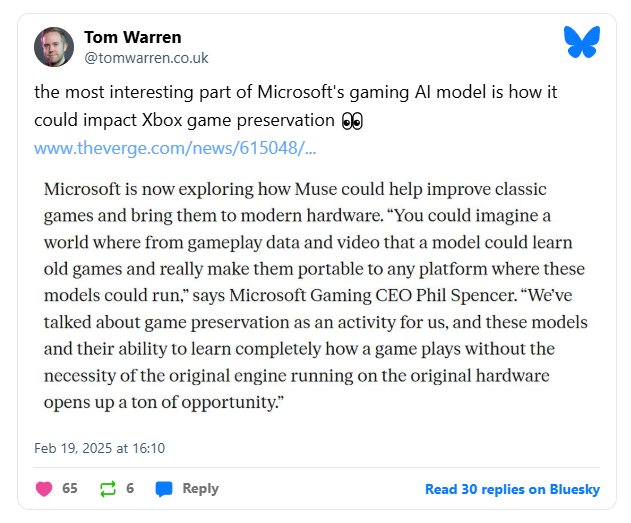
Today, a story went round about a research project at Microsoft where they were using generative AI for "game ideation", and also noted that they thought they could use their generative AI models for "preservation". This was reported on by Tom Warren, senior editor at The Verge, thus (screenshotted rather than embedded 'cause the coward deleted it after everyone dunked on it):

Now, if you know anything about video game preservation, you know that feeding an old game into a generative AI model and then hoping it will hallucinate at least a rough approximation of the original game experience is not "preservation". It's bastardisation at best, a completely useless endeavour at worst, and a massive waste of energy and money regardless of the result that comes out of the other end.

Game preservation is a problem that, for the most part, we have solved. We have excellent software emulation solutions, built over the course of decades of development. Hardware emulation via FPGA at an affordable cost for the general public has advanced hugely in just a few short years. Software libraries for pretty much any system you can think of are archived in their entirety at numerous places across the Internet, and strong strides have been made in providing commercial, legally relicensed versions of classic games for a modern audience, both on existing modern systems and on bespoke emulation-centric devices.

So why, then, why the fuck would we want a generative AI model to make a best guess at what a video game that already exists and has been preserved perfectly well might look like if you play it for longer than 10 frames?

That paragraph above is what tech journalists should be asking. And the reason I bring up Ed Zitron at the start of this post is because he's one of the only people to actually ask questions like this: to take a look at the utter garbage being spewed by today's tech companies and to say "this is complete horseshit, what the actual fuck are you on?"

And Zitron, being an outspoken type, is not afraid to call out today's tech journalism space for not doing this. And he's absolutely right to do so. It is the tech journalism sector's job to look at what it going on, to realise that it is complete horseshit and then have the confidence to say that it is complete horseshit.

But they won't do that, for a variety of reasons. Advertising deals. Exclusive access. PR partnerships. An inexplicable desire not to rock the boat, despite the fact the boat has a huge hole in it and has been steadily sinking for 15-20 years at this point.

I'm not one of those people who thinks that journalists are taking bribes for positive reviews in literally all circumstances — I have experience in the industry, remember, and the most I had to worry about in that regard was a mild admonishment from my editor for criticising a Mortal Kombat game's DLC plan when Mortal Kombat was the cover game for that issue of GamePro.

But come on now. Tech journos should be looking at this utter garbage that keeps getting flung our way, and instead of declaring it "interesting" and doing the stupid looky-eyes emoji that makes their post immediately look like a 14 year old girl wrote it, they should be going "hang on a minute, what does that actually mean?" then exploring it further, asking some probing questions (which inevitably won't get a response, but that in itself says something) and then confidently declaring the latest generative AI "innovation" to be what it is: complete and utter horseshit doused in the finest snake oil.

And people wonder why the entire journalism sector is floundering. Could it perhaps be because very little actual journalism seems to be getting done?

Shout-out at this point not only to Ed Zitron's aforementioned blog, but also the excellent coverage of the Elon Musk nonsense in the States by Wired's politics department, 404 Media being a rare example of tech journalism that actually asks those hard-hitting questions, and Aftermath for doing something similar with games journalism. There are still people doing good work out there. But the people on the big, well-known mastheads, like Warren above, need to step their game up, stop being so incredulous and start acting like actual journalists.


Want to read my thoughts on various video games, visual novels and other popular culture things? Stop by MoeGamer.net, my site for all things fun where I am generally a lot more cheerful. And if you fancy watching some vids on classic games, drop by my YouTube channel.

If you want this nonsense in your inbox every day, please feel free to subscribe via email. Your email address won't be used for anything else.