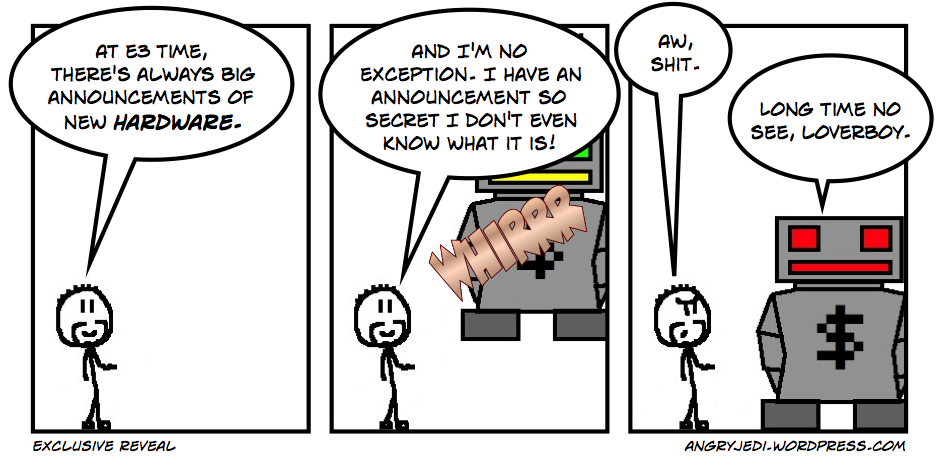
#oneaday Day 158: Wii3

More E3 gubbins today, with the big news being Nintendo's announcement of its new console, the Wii U, which features a controller with a big-ass touchscreen in the middle of it. It looks pretty damn impressive, to be fair, but it remains to be seen whether or not it'll become just another gimmick for people to deride.

That said, I liked the Wii. It was a good console for social gaming. And I'm not talking about bollocksy "Share This With Your Friends!" Facebook titles — I'm talking about getting together with actual real-life three-dimensional people in the same room and playing fun games. Maybe the Wii's games weren't the most hardcore — but have you ever played a "hardcore" game with friends who aren't particularly up on their gaming? It becomes an exercise in frustration, with experienced players either deliberately having to nerf themselves or the less-experienced ones giving up out of sheer frustration. The Wii knew exactly what its market was, and it tapped it perfectly with the minigame collections and the motion control. Hardcore gaming it was not, but the 360 and PS3 covered that more than adequately, so Nintendo had no need to compete.

Now, though, it's a different story. Microsoft is wooing the former Wii market with all its Kinect shenanigans and running the risk of alienating the core user base, were it not for platform mainstays such as Call of Duty, Gears of War and the like. Microsoft's E3 press conference left a lot of gamers frustrated that there wasn't more for "them" on offer, but Microsoft have seen the success Nintendo had with the Wii and want a piece of that pie — and given the Wii's dated technology, are perfectly entitled to that.

Nintendo, in response, fight back with a new console that purports to offer the best of both worlds — a casual-friendly console that supports all existing Wii hardware and software that is also a hardcore-friendly console that will see hopefully great versions of big-name games like Batman: Arkham City with the additional benefit of both the world's biggest VMU (Dreamcast-five!) and the ability to carry on playing whenever your significant other and/or housemate bursts into the room desperate to watch Britain's Got Desperate People Who Really Want To Be On Television Despite Being Shit and Absolute Cunts. It looks awesome, though a lot will depend on the price of the system — and its crazy controller.

Meanwhile, in PC land, we continue to have the most backward-compatible system in the universe with the cheapest games in the universe (excepting that little games exchange on Zargon Prime, they actually do have the cheapest games in the universe) and consoles start to look just a little bit gimmicky. Possibly.

Oh dear. PC snobbery is starting to infest my brain!

#oneaday, Day 64: Act Your Age, Fanboys

Why does the phenomenon of fanboyism still exist? And more to the point, why does it exist amongst men (and it pretty much is always men) who are old enough to know better?

The simple and easy answer is, of course, that it's always been around. I remember growing up as an Atari-based family and all of the Atari magazines at the time belittling the competition with stupid names like Spectrash (Spectrum) and Crappydore (Commodore 64). Then came the schoolyard arguments – SEGA vs Nintendo. Sonic vs Mario. "We've got Street Fighter II! Hah! …Oh wait, now you have, too." It got pretty silly.

Once the Dreamcast came out, it was hard to justify fanboyism because, certainly once SEGA's wondermachine came out, it was so far ahead of its competition – the 64-bit Nintendo 64 and the 32-bit PlayStation – that half-hearted attempts to call it things like "Dreampants" always came across as more than a little desperate.

Things then kicked off again with Sony vs Microsoft, with Nintendo kind of relegated to "background observer" by this point. The PS2 and the original Xbox both had fiercely loyal supporters when, in fact, you'd have a far better experience if you bought both systems, played the relevant exclusives on their respective platforms and played multiplatform titles on the Xbox. That's what I did, and I never felt the need to slag off any of the systems.

And it still goes on today, despite each of the consoles arguably offering a more distinct and unique experience from each other than ever before. The Xbox 360 offers its legendary ease of online play, the PS3 is home to a variety of unusual and interesting games (like Flower, flOw, Linger in Shadows, the Pixeljunk games) and the Wii is the family-friendly bundle of fun.

Still the hating goes on, though.

But nowhere is it more apparent than in the world of smartphones, particularly between the owners of iPhones, BlackBerries (let's pluralise it properly, please) and Android-based phones. iPhone owners are either Apple fanboys who bang on about how great Apple is all the time or jailbreakers who bang on about which ludicrously-named hack they're installing this week – and, of course, which apps they could get for free rather than paying for them on the App Store. BlackBerry owners seem to be updating their OS every night. And Android owners seem to be particularly sore about the iPhone for some inexplicable reason.

The question is: why? When it came to the early console wars, slagging off the systems your friends had was just schoolyard banter. You didn't really think that the systems were inferior, otherwise you wouldn't have gone around to their houses and played those games with them. The fact that this juvenile banter has grown up with people who have been using gaming and other consumer electronics for years is utterly baffling. Even people who started gaming at the same time as me – or before – are still bitching and moaning about how much better their handset is that [x]'s handset, and blahblahblah open source, blahblahblah build quality, blahblahblah BlackBerry Messenger, blahblahblah… You get the picture.

Am I alone in thinking that all of this stuff, without exception, is seven degrees of awesome and we should appreciate the brilliant things we have? Yes, some of them have more features. Yes, some of them are objectively "better" in terms of capabilities, power and technical specifications. But is that really any reason to act like 5-year olds telling each other that their respective Mums smell of wee?

No, it's not. So why does it still go on?