#oneaday Day 214: Anticipating Xenoblade... again

I'm a big fan of the Xenoblade Chronicles series from Monolithsoft and Nintendo, though I must confess I am very behind; I haven't yet played Torna, The Golden Country (the spinoff to the second game) or Xenoblade Chronicles 3 yet, nor have I replayed Xenoblade Chronicles: Definitive Edition on Switch. And yet here I am, gradually getting hyped for the return of Xenoblade Chronicles X in March.

Xenoblade Chronicles X is kind of special, see. While most of the rest of the series is pretty well-known to be awesome, outside of the few folks who can't handle anime-style aesthetics, Xenoblade Chronicles X has always been more of a cult favourite. For starters, it came out on Wii U, which means only a few people bought it, and it's also quite a different beast to the mainline Xenoblade Chronicles titles, arguably making it a bit more of an acquired taste for some.

Lest you're unfamiliar, the Xenoblade Chronicles series are a range of vast, open-world RPGs that take the concept Final Fantasy XII kicked off — MMO-style mechanics and structure in a single-player game — and run with it. For miles and miles and miles.

The mainline Xenoblade Chronicles titles are beloved not just for their expansive, beautifully crafted worlds, but also for the wonderful characters that make up the main cast. Each of them feature a wonderful balance between player freedom and in-depth storytelling, allowing you the opportunity to experience a truly epic narrative while also getting to know the complete, vast world very well.

Xenoblade Chronicles X differed a little from what was, at the time, its only predecessor, in that it downplayed the central narrative somewhat. Indeed, it's possible to blast through the entire main story of Xenoblade Chronicles X much quicker than any other game in the series. And this led some people to think that it "wasn't as good" as the original Xenoblade Chronicles.

In fact, Xenoblade Chronicles X isn't any lighter on story content than its predecessor. It's just structured very differently, primarily because of its overall concept. Rather than going on a long "hero's journey"-style quest, you're simply part of an organisation. Sure, you end up being the one who does some important and noteworthy things, but when it comes down to it, you're just another cog in a machine much bigger than you are.

Xenoblade Chronicles X's concept is that you, and a chunk of other humans, have crash-landed on an alien planet called Mira, and there's absolutely no hope of getting your spaceship back into space; moreover, there's likely no Earth to go back to, since the whole reason you were in space was escaping an alien invasion.

Consequently, rather than sitting around crying and gradually turning into cavemen, the former crew of the spacecraft decide to repurpose what's left of the ship as a city, then set about exploring the planet and making the best use of the resources that surround them. To that end, you're recruited as a BLADE: a Builder of the Legacy After the Destruction of Earth. This means you need to go out, find resources, build things to exploit those resources, deal with the local fauna, collect things and just generally make a big ol' map of Mira as a whole. And Mira is very big.

While playing Xenoblade Chronicles X, there's a really nice feeling that you're playing a game that is as much strategy/management game as it is RPG. On the Wii U, the Gamepad's second screen featured a hex-based map of the planet that you could use to plan your expeditions, build things and invest in areas; the long-term gameplay of Xenoblade Chronicles X involves "conquering" each of these hexes in various ways, be it through completing missions, discovering landmarks, defeating powerful foes or various other objectives.

And every time you come back to the city of New Los Angeles, as it becomes known, you will have new people to talk to, new sidequests to discover, new little stories about humanity's home away from home. It's a massively immersive game that I feel like I barely scratched the surface of back when I played it on Wii U, and I'm really looking forward to giving it another go when the Switch version rolls around.

Couple that with some interesting and quite innovative online features — which will be much easier to take advantage of on a platform people actually own — and you have a game that promises to take up a lot of your life.

Oh, and it has an amazing soundtrack that you will either love or hate.

I'm sure there's plenty more about the game that I've forgotten, but I do remember the game as a whole with great fondness from when I first played it and declared it my Game of the Year nearly ten years ago… and bemoaned the fact that it didn't get anywhere near the press attention and general praise that it clearly deserved, likely primarily because it was a Wii U game, and what kind of idiot bought a Wii U? (Hi.)

So yeah. Expect great enthusing about Xenoblade Chronicles X when it comes out. I'm just wondering whether or not I can fit in Torna, The Golden Country and/or Xenoblade Chronicles 3 before that happens… given that I'm playing through Fire Emblem Engage also right now.


Want to read my thoughts on various video games, visual novels and other popular culture things? Stop by MoeGamer.net, my site for all things fun where I am generally a lot more cheerful. And if you fancy watching some vids on classic games, drop by my YouTube channel.

If you want this nonsense in your inbox every day, please feel free to subscribe via email. Your email address won't be used for anything else.

#oneaday Day 212: Engage!

I've been playing Fire Emblem Engage since I finished Paper Mario: The Thousand-Year Door and The Legend of Zelda: Echoes of Wisdom, and I've been having a lovely time. Fire Emblem is a series that has always passed me by despite it being, in theory kind of in my wheelhouse.

I say "kind of" rather than "completely", because while I absolutely love the high drama fantasy RPG side of the narrative, I've always had a bit of a rocky relationship with strategy games. I'm not good at them, see, and I've always had a hard time trying to determine how to get better at them. Because while there are plenty of guides out there for games like Fire Emblem, none of them simply sit you down and talk you through how to play them effectively. And that, for me, has always been a problem. It's why I bounced off Fire Emblem Awakening on 3DS, the last entry in the series that I tried, and why I have held off on playing the copy of Fire Emblem: Three Houses that's been on my shelf for several years at this point.

Why am I playing Fire Emblem Engage when Three Houses, a game almost universally considered to be superior in every way, is right there on my shelf? Well, because I had somehow got it in my head that Engage was a little more "straightforward" — and, perhaps more importantly, shorter. Three Houses is an absolute beast of a game, particularly if you do all the narrative routes (which I'm assured you should), whereas Engage is a once-and-done sort of affair, with replay value coming from the harder difficulty levels.

Mechanically, I don't think Engage is any more straightforward than what I know of Three Houses. There are elements where it's arguably more complicated, in fact — most notably with regard to the Emblem Bond and Skill Inheritance systems — but I wasn't to know that going in, and I'm about 25 hours in now, so, well, I guess I've dealt with it successfully.

I'm not ashamed to admit that I'm playing on Normal difficulty and Casual mode — i.e. the one without permadeath. I was having enough difficulty with the initial missions in the game that adding the opportunity to completely gimp my playthrough via poor performance seemed like an unwise choice. I am new to the series, I am still finding my feet in how it all works and how to play effectively, and thus I want minimal barriers to just enjoying myself. The options are there, so I'm using them.

With that "guardrail" in place, Fire Emblem Engage is still quite challenging. If you lose a unit during a mission, you still have to do the rest of the mission without that unit, and that can really fuck you over. It took me a few early-game missions to figure out what I was doing wrong, but then something interesting happened: I figured out what I was doing wrong.

This is not something that normally happens with strategy games. I normally end up being trounced by whoever I'm playing against, then never wanting to play it again as a result — or, in the case of tabletop affairs, not getting much opportunity to "practice". But with Fire Emblem Engage, I've ploughed on, and I've started to get a real feel for how the strategy works, and what is effective. I still make mistakes now and then — and the game's generous "Draconic Time Crystal" mechanic that allows you to undo stupid moves has been very helpful here — but I am definitely getting better at How To Play Fire Emblem. And that's a good feeling.

Because Being Able To Play Fire Emblem means that you can Enjoy Fire Emblem. And there is a lot to enjoy. The story of Engage, while relatively clichéd RPG fare — dark dragon long thought safely sealed away has come back, heroic band must gather a bunch of rings to summon enough power to drive the bastard back to the abyss — has been really compelling so far, and the character-centric nature of modern Fire Emblem is exactly what I like in this sort of game. I'm getting a real feeling that I'm getting to know the individual characters, both through the protagonist character's interactions with them and their interactions with one another.

For the unfamiliar, modern Fire Emblem features a relationship mechanic whereby units can "support" one another by fighting alongside each other in combat and doing activities together between battles, and your reward for reaching a new milestone in two characters' relationship with one another is a "support conversation", which depicts the two of them getting to know one another. There's not a Support mechanic in play for every pairing of characters in the game, but plenty that make logical sense, and it's lovely to see everyone getting to know one another, having comedic misunderstandings and deepening their feelings of friendship.

Anyway. I'm not sure how far through the game I am — I reckon probably about halfway maybe? — but I've been playing it all weekend and having a great time. I should almost certainly have it finished ahead of Xenoblade Chronicles X coming out on Switch in March — because you better believe I'm revisiting that game thoroughly having adored it on Wii U — but in the meantime I think I'm a convert to the series. I'm sure longstanding fans will scoff at me playing on non-permadeath mode, but I bet all of them reload a save the second anyone dies anyway. Also it doesn't matter how someone else enjoys a video game.

So yeah. Fire Emblem, pretty good. Who knew?


Want to read my thoughts on various video games, visual novels and other popular culture things? Stop by MoeGamer.net, my site for all things fun where I am generally a lot more cheerful. And if you fancy watching some vids on classic games, drop by my YouTube channel.

If you want this nonsense in your inbox every day, please feel free to subscribe via email. Your email address won't be used for anything else.

#oneaday Day 194: My Switch Year in Review

I'm a bit fed up of "year in review" things, since absolutely everyone is doing them now. Even my fucking online banking app wanted to give me a "year-end wrap-up" last time I logged it, which is a step too far, I feel.

But anyway, there are a couple of these things that I actually find mildly interesting, and one of them is the Nintendo Switch Year in Review. Out of all my games consoles, the Switch is the one that gets the most use by far, so in theory any such "reviews" should paint a fairly representative picture of my interests. Let's go through it together, then!

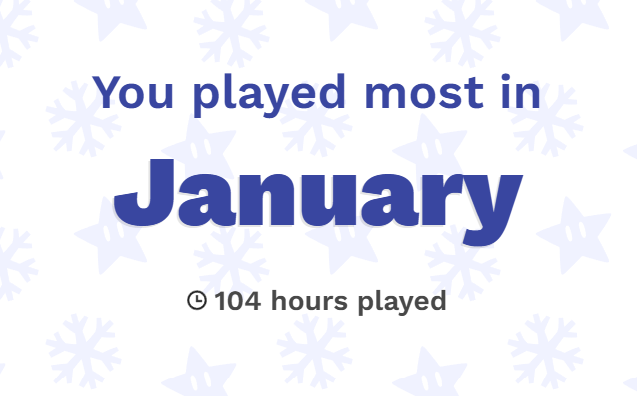
I apparently commenced my year with Final Fantasy II, which I'm sure some people will have strong opinions about, but I still rather like it, particularly in its Pixel Remaster format. I thought I'd miss the extra material from the PSP version, but I don't. Especially not the Soul of Rebirth postgame dungeon, in which you take all the underlevelled characters that died as part of the main story through a monstrously difficult challenge that requires a lot of grinding to get through.

345 hours feels a bit low, if anything, but it still works out to 14.375 days in total. I guess that averages a little under an hour every day, which sounds plausible, particularly considering some days have a lot more than others and some might have none at all.

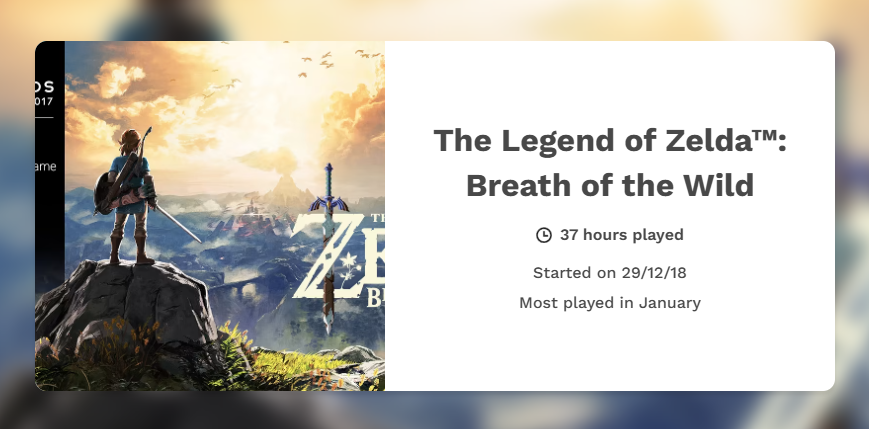
No arguments with that. I replayed the first two Ace Attorney games and decided that this would be the year I finally beat Breath of the Wild. Silent Hope had also been hanging over my head for a while, so I knocked that out late this year, too.

See that start date? That's why I wanted to get Breath of the Wild off the backlog.

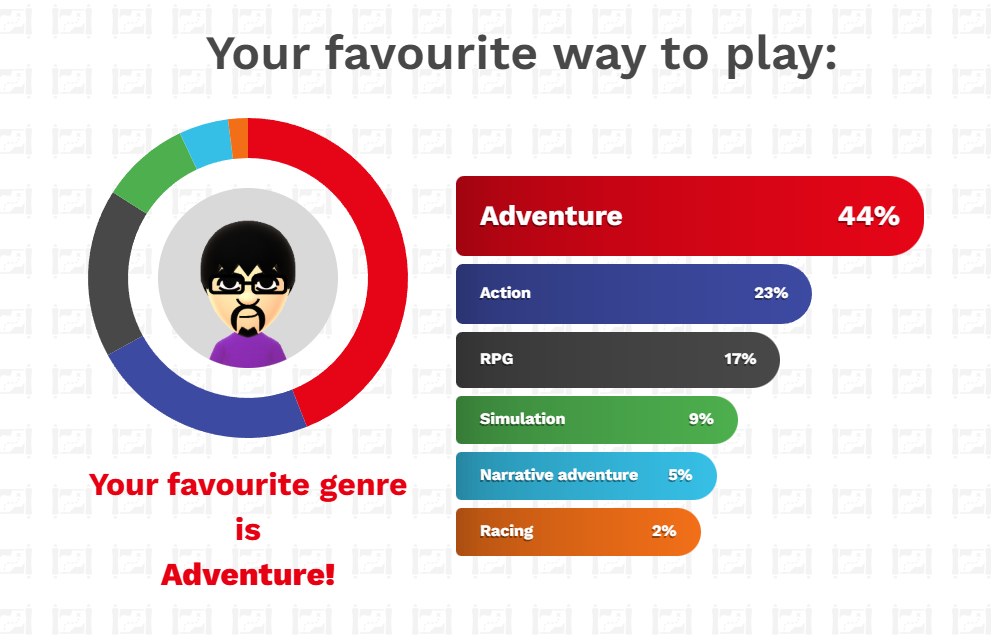
This honestly surprises me… a little. Not that "Adventure" is present at all, but that it's at the top. I would have thought RPG would be at the top, but nope; it's Adventure by a significant margin. And, given a bunch of the games I played this year, that makes a certain amount of sense: there's not only the Ace Attorney games I played, but also the three Spirit Hunter games, the Famicom Detective Club titles and doubtless some others I've forgotten.

Start as you mean to go on and all that.

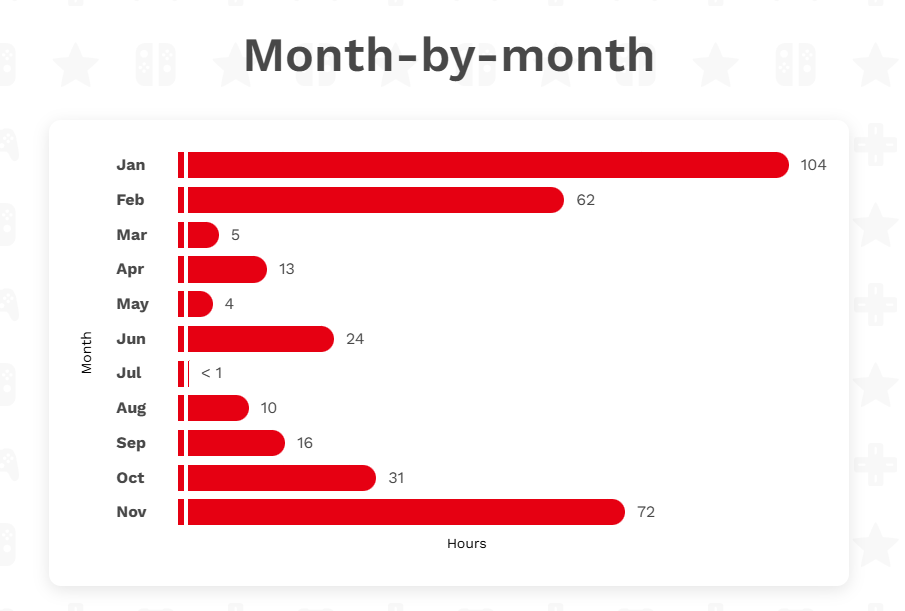
Now this was quite surprising. Some of those months have surprisingly low figures, so I can only assume I was playing something else on a different platform at those times. Looking back, I see that I was playing Final Fantasy XIV: Dawntrail in July, so that would account for there being less than an hour of Switch time that month.

Now here's a toughie! I played a lot of great games this year, so it's very tricky to choose between them.

I mean, look. The bangers keep coming.

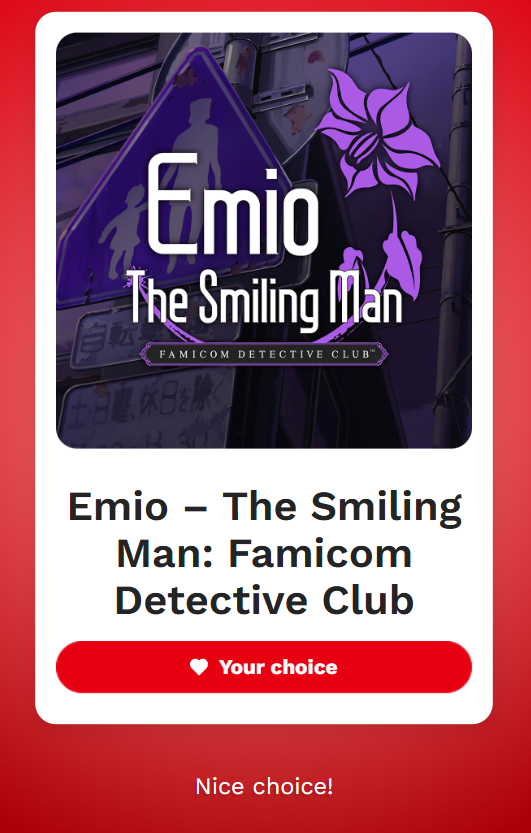
And coming! I was surprised to see the first two Famicom Detective Club games there, as I was sure I played those last year, but nope; I played them in February, meaning I played the whole series including new entry Emio, The Smiling Man this year. Neat!

And still they come! The Missing was a thoroughly interesting, deeply affecting experience. Super Mario Bros. Wonder is the best 2D Super Mario I've played for a long time. And Theatrhythm Final Bar Line speaks for itself with its vast array of music to play.

Atari 50 is definitely worthy of note for introducing us all to Digital Eclipse's excellent "interactive timeline" approach to digital museum curation. We're starting to get into games that I just dipped into a little bit this year now, though, such as visual novel Little Busters! and Etrian Odyssey.

So what should I pick…?

I think I'm going to go with this one. I was genuinely excited to see this game get announced and released in fairly short order, and I'm delighted to see the Famicom Detective Club series continue long after it first launched. I just wish they'd do a physical release of the first two games in English.

And so that's that, I guess. It's been a good year for great games, both on the Switch and elsewhere. My backlog, of course, hasn't gotten that much smaller, but let's not worry about that. I have plenty of stuff to keep me busy for a long time into the future, and I look forward to sharing those experiences with you here, on YouTube, and on MoeGamer.


Want to read my thoughts on various video games, visual novels and other popular culture things? Stop by MoeGamer.net, my site for all things fun where I am generally a lot more cheerful. And if you fancy watching some vids on classic games, drop by my YouTube channel.

If you want this nonsense in your inbox every day, please feel free to subscribe via email. Your email address won't be used for anything else.

#oneaday Day 192: The defeat of Culex 3D

I finished Super Mario RPG's postgame this evening, culminating with a rematch against the most difficult boss from the original game: Culex, who, in the postgame, finally gets his wish and becomes full 3D instead of being a piece of pixel art. To go along with his new look, he also gets a considerable buff in power, putting him into full-on "superboss" territory — though in keeping with the rest of Super Mario RPG, he's not overly difficult, he just needs you to pay attention and stay on top of things.

I really enjoyed Super Mario RPG, and I appreciate that "doing everything" in it took less than 20 hours. I have absolutely nothing against super-long RPGs — over the years, my favourite games have all been pretty lengthy affairs — but sometimes it's nice to play something breezy that knows when to stop. I'm sure Super Mario RPG could have dragged itself out to twice the length if it had really wanted to, but it didn't; the fact it didn't is testament to its good design. Nothing in the game feels like filler, and, outside of the Switch-exclusive postgame (i.e. it didn't exist in the original SNES version) there's really no need to grind at any point, either.

There are elements of the game where you can tell it has 16-bit roots, most notably in its overall storytelling; the narrative of the game is very lightweight, and you don't spend a lot of time getting to know the characters. I was particularly surprised to finally spend some time with Geno, a character that I've been hearing Super Smash Bros. fans bang on about for years, and find that, in terms of actual writing and characterisation, there's not really much to him.

But then this is a Mario game, not anything with pretensions of being high art or literature. To have Geno give overblown monologues at every opportunity would have almost certainly felt very out of place with the overall breezy feel of Super Mario RPG, and I suspect that during development, Nintendo probably had to rein in Squaresoft a bit in order to ensure that the whole thing didn't go too Final Fantasy. The inclusion of Culex may well have been some sort of "if you don't overdo the melodrama in the main story, we'll let you get super-ridiculous with the secret boss" deal.

Anyway, it's not that I feel Geno is a "bad" character as such, I was just a little surprised that he is so beloved when you don't really spend all that much time getting to know him beyond his basic concept. He does have some cool special moves, though, and in terms of power level he's one of the strongest characters in the party, so I suspect it's a bit more of an "all-round" thing as to why people like him, rather than him having a particularly strong story attached to him.

So yeah. That's that. Now to decide what I should play next! I still have Yakuza 5 on the go, and will get back to that some time soon, but I'm also still in a bit of a Nintendo mood. I have a few Nintendo titles on my shelf that I haven't gotten around to yet, so it's a matter of choosing between them — or maybe nabbing something from my wishlist that (I hope) no-one has grabbed me a copy of for Christmas yet. Do I move on to Paper Mario now I'm fresh from Super Mario RPG? Or do I finally bite the bullet and jump into the sprawling Fire Emblem: Three Houses… bearing in mind that I will definitely be wanting to revisit Xenoblade Chronicles X when it gets a Switch release in March?


Want to read my thoughts on various video games, visual novels and other popular culture things? Stop by MoeGamer.net, my site for all things fun where I am generally a lot more cheerful. And if you fancy watching some vids on classic games, drop by my YouTube channel.

If you want this nonsense in your inbox every day, please feel free to subscribe via email. Your email address won't be used for anything else.

#oneaday Day 185: 'Tis the season for Nintendo

As I alluded to the other day, I've been spending my time playing Super Mario RPG on Switch for the past few days. I rolled credits on it this evening and am very happy I took the time to play this. (There's a surprisingly extensive postgame that has been added to the Switch version, but I will be waiting until tomorrow to check that out, as it's getting late.)

One of the reasons I decided to start playing this is that the holiday season, for me, will always be associated with Nintendo. I'm not exactly sure why, as there was only one Christmas where I actually received something Nintendo-related under the tree — a Super NES with Super Mario World — but I've continued to make that association ever since. I think it goes along with how I associate Disney movies (the good ones) and Star Wars (ditto) with the holidays, too; fond memories of times gone by spent with family.

And Nintendo, it can be argued, has a fair amount in common with the House of Mouse. They're both gigantic corporations that absolutely dominate a particular industry. They both do business in a way that the particularly anti-capitalist people really don't like. And they have both, over the years, put out some absolutely magical pieces of work for people to enjoy: pieces of work that don't necessarily require you to engage your brain too heavily, but which are nonetheless extremely memorable and enjoyable.

Take Super Mario RPG. By console RPG standards, it's short, simple and very easy. You can roll credits on it within 12 hours. But every bit of the game feels like it's there for a good reason. There's no filler, no grinding, nothing that feels unnecessary; sure, there are some minigames you can engage with to a frankly obsessive degree that reward you with some optional items that aren't at all necessary to beat the game, but if you're just playing the game through to enjoy it, nothing feels out of place, nothing feels like it's actively getting in the way of your enjoyment.

And the presentation is wonderful, too. Sure, the Switch may be creaking a bit in its old age, but after a few minutes with something like Super Mario RPG it just doesn't matter. The music, in particular, is astounding. I hadn't realised it was the work of Yoko Shimomura, but in retrospect it makes a lot of sense — particularly with the newly orchestrated arrangements found in the Switch remake. The ending theme, in particular, was beautiful; it was like a full-on orchestral finale to something you'd watched in the theatre — with a touch of honouring the original by starting with the SNES mix of the music, then bursting into full orchestra by the conclusion.

(Don't ask why the creator of that video felt the need to brag about it being "4K" when the Switch only outputs 1080p, and a significant proportion of that end sequence is deliberately heavily pixelated.)

Anyway, I had a lovely time with Super Mario RPG, and I will be taking a look at the postgame stuff tomorrow. I'm happy I've finally played this — even if it wasn't in its original form, which, let's not forget, never came out in Europe back in the day — and now I feel suitably equipped to take on the Paper Mario games without feeling like I haven't played "the original". (I know Paper Mario is a distinct series from Super Mario RPG, but both it and the Mario and Luigi games count it as a common ancestor, so I've always wanted to give it a go.)

So that's that. If you're in a holiday funk, fire up a Nintendo game. I can guarantee it'll put a smile on your face remarkably quickly.


Want to read my thoughts on various video games, visual novels and other popular culture things? Stop by MoeGamer.net, my site for all things fun where I am generally a lot more cheerful. And if you fancy watching some vids on classic games, drop by my YouTube channel.

If you want this nonsense in your inbox every day, please feel free to subscribe via email. Your email address won't be used for anything else.
#oneaday Day 183: Plague day with Mario

Felt particularly rough this morning when I woke up with a raging headache and a cough that could wake the dead. I was hoping to get some The Dagger of Amon Ra recorded this weekend, but I rather wisely decided against doing any today; we'll have to see how I feel tomorrow.

Instead, I spent a significant chunk of today playing the Super Mario RPG remake for Switch. I've never played Super Mario RPG in any form, so I've been curious to try this for a long time, and something in my head makes an inextricable association between the holiday season and Nintendo games, so I thought I'd start it up and see how I got on with it. After all, what was originally a collaboration between Squaresoft and Nintendo was sure to be fun, right? And people always seem to be making references to both the game and some of its unique characters.

I've been very impressed so far. It's a lot of fun, and it moves at a brisk old pace, as RPGs that originated in the 16-bit era tend to, but that doesn't mean it feels like it's rushing things. Rather, it's paced well so that you're constantly moving forwards, exploring new areas, meeting new allies and discovering new items. And, pleasingly, the game is a lot more than just running from story trigger to story trigger; there are some actual puzzles along the way to solve, too, along with some light platforming. The only thing I'm not a super fan of is the Hidden Treasure system, where equipping a particular accessory just tells you that there is a Hidden Treasure somewhere in the room you're in, and then you just have to flail around hoping you headbutt it by chance.

As one would expect for a modern Nintendo title, the soundtrack is fantastic. I don't know the original Super Mario RPG soundtrack all that well — aside from a couple of MIDIs I downloaded in the late '90s to use in Klik and Play projects — but we have a fully reorchestrated version of the full soundtrack to go along with the updated visuals and the re-translated script. No speech, of course — it still doesn't feel quite right to have a talkie Nintendo game — but the writing so far has been concise and pretty witty. Perhaps not to the same degree as Paper Mario, which is a series that essentially built off the back of Super Mario RPG, but I wanted to play this one first before I jumped into the Paper Mario titles for the first time. Yes, believe it or not I've never played one; my wife Andie has played most of them, however.

Anyway, Super Mario RPG helped make an otherwise fairly unpleasant day — the weather has been awful here today, too — fairly tolerable. And I even made some time to get all my Christmas shopping done earlier, too. So that's good. But now it's probably a good idea for me to go back to bed, and here's hoping I feel a tad better in the morning. Not only do I want to record that The Dagger of Amon Ra playthrough, but I have the work Christmas do in the week, and I'd rather not still be coughing my guts up and feeling like a roasted dog turd by the time that rolls around.


Want to read my thoughts on various video games, visual novels and other popular culture things? Stop by MoeGamer.net, my site for all things fun where I am generally a lot more cheerful. And if you fancy watching some vids on classic games, drop by my YouTube channel.

If you want this nonsense in your inbox every day, please feel free to subscribe via email. Your email address won't be used for anything else.
#oneaday Day 138: Marked

I'm currently playing Death Mark, a game I've had on my shelf (along with its two sequels) for quite a while now, but have never gotten around to. I've been meaning to play it for "spooky season" for a few years now, but for one reason or another the timings have never quite lined up. This year, I made it happen!

As with most things, I'll do a full writeup on MoeGamer once I've finished it, but four chapters in now I can offer some reasonably well-informed thoughts on what I think so far.

For the unfamiliar, Death Mark is a horror adventure game by Experience Inc. Experience Inc. is a developer primarily known for making dungeon crawlers with beautiful artwork such as the excellent Demon Gaze series. Death Mark eschews most of the role-playing game trappings in favour of adventure game mechanics — though Experience haven't completely left behind what they're known for.

The premise of the game revolves around individuals suddenly finding they are "Marked" with a strange scar that looks like a bite mark. This indicates that very soon, they are going to lose their memories and then die horribly. The game consists of a series of discrete cases, during which you, as the Marked amnesiac protagonist, are tasked with helping out one or more companion characters and hopefully giving a restless spirit — the source of the Mark — some peace.

This involves exploring an area from a first-person perspective, discovering clues, solving puzzles and, when the time comes, confronting the spirit directly.

The first-person exploration is where Death Mark is closest to Experience's dungeon crawlers, though the locations you move between are static images rather than polygonal environments. If you know a pathway exists, you can simply hit a direction on the D-pad to go that way, but in some cases you'll need to investigate the environment in a point-and-click style with your torch to find hidden routes.

As you explore, you'll start to learn more about the Ghost of the Week. In the tradition of Japanese ghost stories, all the restless spirits have been wronged in some way, and they are designed to have rather sympathetic stories — even if their ordeals turned them into vicious, violent monsters. And this is relevant when it comes to confronting the spirit at the end of each chapter.

A "battle" with a spirit unfolds in a turn-based fashion. Each turn, you and your companion can use one of the items you've found during the chapter. Some items can be used repeatedly, others have a limited number of uses. And some items can be used in combination, allowing you and your partner to cooperate and achieve something.

The process of the battle generally consists of a couple of rounds of you finding ways to counter the spirit's attacks, and then, when they get close enough, you have the option of either killing them violently, or doing something that will pacify them and lay the troubled soul to rest once and for all. Taking the former option is usually a more obvious, easier choice, but will usually result in the death of your companion. Taking the latter option requires that you really have searched the environment thoroughly and acquired all the necessary clues to resolve the situation.

It works really well. The game is good about not allowing you to get into "unwinnable" situations, as if you mess up you can simply restart from a previous decision point or, in the case of the spirit battle, from the start of the confrontation. This means that even if you've reached the "finale" of a case, you can still wander off and make sure you haven't missed any important clues before taking on the spirit.

It's a game that is, for the most part, creepy rather than "scary" — there aren't many in the way of "jump scares", and the horror mostly comes from the gradual realisation of what has happened to the poor souls you're laying to rest. There are some gory, violent scenes, though, and many of these have a somewhat fetishistic angle, which, as you might expect, caused more than a few people to sniff and tut when it was originally released.

As anyone with basic media literacy knows, though, sex and horror are inextricably linked, and have been for the longest time in both the eastern and western traditions of the genre. So Death Mark is just doing what comes naturally for the genre; while this leads to some genuinely uncomfortable scenes, it's also good to see a game that doesn't feel like it has to hold back from showing you these things.

Anyway, that's enough for now. I'll have much more to say when I've beaten the whole thing. I believe I have two more cases to go, so I reckon I'll probably have it done by the end of the week. We shall see, though; in the meantime, it's been a great pick for Spooky Season so far, and I'm looking forward to exploring the follow-ups!


Want to read my thoughts on various video games, visual novels and other popular culture things? Stop by MoeGamer.net, my site for all things fun where I am generally a lot more cheerful. And if you fancy watching some vids on classic games, drop by my YouTube channel.

If you want this nonsense in your inbox every day, please feel free to subscribe via email. Your email address won't be used for anything else.
#oneaday Day 108: Punch punch punch

Because I'm sick of feeling like a decrepit old man and I can't quite muster up the mental wellbeing to head to the gym right now, I dusted off my copy of Fitness Boxing 2 for Nintendo Switch and have been giving it a go for the last couple of days. I considered grabbing the new Hatsune Miku version of the game, but it's £50 and I haven't yet established a good routine with the two previous entries in the series I have on my shelf. So I thought I'd do something about it.

The trouble with exercise is that it always feels like it's going to be a bloody nightmare to get started, particularly after a long period of inactivity, but then once you actually do it it's rather satisfying. My two sessions of Fitness Boxing 2 over the past couple of days have been hard work for someone as out of shape as I am — though my rhythm game skills have netted me a "Fitness Age" of 24 on both occasions, thereby proving once and for all that such a metric is, as everyone suspected, complete bollocks — but I've come out of both of them feeling like I've done something worthwhile, and something that, in the long run, will be good for me.

For those unfamiliar with Fitness Boxing, it's a game that somewhat follows the mould of Nintendo's classic Wii-era fitness games, only with a bit more of a specific focus rather than providing lots of minigames. At its core, it's a rhythm game, tasking you with using the Joy-Cons to punch in various ways and, in the more advanced workouts, ducking, weaving and suchlike, too — though pleasingly, given how dodgy the motion detection can be on movements other than punching, you can turn any troublesome exercises off, or set the game to automatically score you "Perfect" on them, regardless of what the Joy-Cons tell the Switch you were doing.

A full daily workout consists of several stages, beginning and ending with some simple stretches. In between, you'll have a series of specific workouts of varying degrees of intensity and difficulty, typically following your opening stretches and preceding your closing stretches with something relatively gentle and putting one or more fairly high-intensity (and longer) ones in the middle.

Each individual stage tends to unfold in the same way. You'll start in "orthodox" stance (left foot forward, right foot back) and gradually be introduced to a complete combo, usually one move at a time but sometimes a bit quicker in the shorter, lower-intensity stages. You'll gradually build up to performing the full combo, and in a special "Zone" sequence where you get more points, you perform the full combo multiple times in rapid succession — typically four, six or eight times in a row without a gap in between, depending on the length of the combo.

After that, you switch to "southpaw" stance (right foot forward, left foot back) and then do the exact same thing, but the other way around. In the higher intensity, longer workouts, you'll then do another combo, again both in orthodox and southpaw stances, and then you're done.

Typically a short stage lasts about 5-6 minutes, and longer stages are about 11-12 minutes apiece. The "Normal" intensity workout for a day consists of stretches, two short stages and two long stages, totalling about 35-40 minutes of activity altogether; you also have the choice of doing a slightly shorter or longer workout, which equates to about 25-30 or 45-50 minutes of activity respectively by varying the number of stages in the complete workout.

As someone who is desperately unfit, the pacing of the exercises seem OK to me at the moment. The longer stages definitely feel like an effort to endure, but that's good — they're not so difficult that I can't make it through them, but I do feel like I'm doing some actual work that will be beneficial.

I could be doing them better, of course; the game suggests that when you're not punching, you bob back and forth in time with the music and I can't quite manage to keep that up constantly along with all the other stuff, but I'm sure I can get there over the long term. The important thing is, after all, getting started.

The trainer voices throughout are rather repetitive, but helpful in giving you cues and encouragement, and the visual demonstration of what you're supposed to be doing ("mirrored" so you can follow along more easily) is very helpful. The game-like feel to the whole thing makes it feel more "fun" than some other forms of exercise, and there's a wide range of musical accompaniments to go along with your workouts — including both instrumental versions of "real" songs and some original stuff composed specifically for the game. The original stuff is actually quite a bit better than some of the Kidz Bop-tier arrangements, but honestly part of the fun of the game is the absurdity inherent in aggressively throwing punches to something like Hot and Cold by Katy Perry or the frigging YMCA.

I have a long drive tomorrow afternoon after work, and then a long drive back home after work the day after, so I'll likely take a rest for at least tomorrow and possibly the day after also, depending on how I feel when I get back, but I intend to get back to this as soon as I can. It feels pitched at about the level I can deal with right now, and I think it'll just be helpful to get moving a bit in any way. Because I'm sick of waking up aching all over like someone twice my age, and I suspect a significant part of the reason that is happening is because I haven't been exercising.


Want to read my thoughts on various video games, visual novels and other popular culture things? Stop by MoeGamer.net, my site for all things fun where I am generally a lot more cheerful. And if you fancy watching some vids on classic games, drop by my YouTube channel.

If you want this nonsense in your inbox every day, please feel free to subscribe via email. Your email address won't be used for anything else.
#oneaday Day 86: Emio - Roll Credits

I just finished Emio – The Smiling Man: Famicom Detective Club, the new Nintendo Switch release that, as the name suggests, acts as an official sequel to the two classic Famicom Detective Club games that were first released on Famicom Disk System, and subsequently remade for Switch a couple of years back. You can read my thoughts on both of them here and here.

I'll do a "proper" writeup on the game at some point in the next few days over on MoeGamer, but suffice to say for now that it was excellent, and acts as a wonderful successor to the already very good two predecessors.

For the unfamiliar, the Famicom Detective Club series unfolds as Japanese-style adventure games. That means you spend the majority of your time selecting actions from a menu, reading a lot of dialogue and searching for the next "trigger" to move the story along. Japanese adventures are more about the plot than solving puzzles; to put it another way, they are the modern equivalent of the narrative-centric "interactive fiction" versus the mechanics-centric "text adventures".

The first two Famicom Detective Club titles occasionally lapsed into "click on every option multiple times until something happens", which was mildly annoying, but this new third one makes the sensible decision of highlighting important words and phrases in the dialogue which generally gives you a solid idea of what you need to do next. You can actually turn this feature off if you prefer, but honestly just leaving it on is the best way to keep the story flowing.

The story this time around concerns a dead body that has been found. The corpse is a student named Eisuke, and he appears to have been strangled. Unusually, his corpse was found with a paper bag over his head, and a creepy smiley face scrawled crudely on the bag. What then follows is your attempts (as both the self-insert protagonist from the first two games and his long-suffering coworker Ayumi) to solve the case by interviewing suspects, examining important locations and gradually piecing everything together.

In the tradition of Japanese adventure games, you're not really "doing" much beyond simply advancing the plot, but that's fine. There's no "moon logic" to worry about here; it's just about enjoying the story unfold, and occasionally demonstrating that you've understood what you've witnessed through short "Review" sequences that quiz you on the most recent happenings. There aren't really any consequences for getting these wrong other than Ayumi giving you the stink-eye, but that will be punishment enough for many players.

I'll refrain from saying any more about the plot for the moment for the sake of spoilers, but I will say it's refreshing and welcome to see Nintendo going unabashedly adult with this one. It's PEGI 18 rated with good reason; it does not pull punches, and I mean that in several respects. The game is all the better for not holding back; it drives home the fact that the case you're investigating is very serious for a number of different reasons, and the complex motivations of the many characters you'll encounter over the course of the plot will keep you intrigued right up until the end.

I was also impressed by how comprehensively it wrapped things up by the conclusion. It pulls a little bit of a fast one on you in this regard, but I'll leave exactly how for you to discover.

Anyway, yes; Emio – The Smiling Man: Famicom Detective Club is proof that the Switch very much still has plenty to offer in what most people are assuming is its twilight year. And it's yet another reminder, if one were needed, that modern gaming isn't actually all that bad, really — so long as you steer clear of the shit bits.

More on MoeGamer at some point this week.


Want to read my thoughts on various video games, visual novels and other popular culture things? Stop by MoeGamer.net, my site for all things fun where I am generally a lot more cheerful. And if you fancy watching some vids on classic games, drop by my YouTube channel.

If you want this nonsense in your inbox every day, please feel free to subscribe via email. Your email address won't be used for anything else.

#oneaday Day 11: Direct to You

I did not manage to get up early and go for a swim today, but I wasn't really expecting myself to. Suddenly doing some exercise after a long period of… not doing that left me feeling a bit stiff (eyy) so I thought I would take today off and make an effort to go tomorrow. Easing into it and all that.

But that's not what I want to talk about today. Today was the latest Nintendo Direct, a presentation that many have been assuming will be one of the last big shows Nintendo do while the Switch is still their current platform. The Switch's as-yet unnamed successor has not yet been announced — and a clearly increasingly irritable Nintendo has been repeatedly pointing out that it has nothing to announce aside from the existence of a successor as yet — but it's clear that the console is currently doing its victory lap ahead of graceful retirement.

That does not mean there's nothing interesting coming for Switch, however! On the contrary, there were some really cool things showed at the Nintendo Direct, including some long-awaited news on Metroid Prime 4.

As always, the reaction to the show on the Internet has either been breathless enthusiasm or varying degrees of "well I never liked Nintendo anyway", but taking as balanced a viewpoint as is possible from someone who likes the Switch and probably uses it as his primary gaming platform, I thought it was a good presentation. Nothing earth-shatteringly amazing, but lots of things that were good. And, to be honest, that's absolutely fine.

A notable highlight from the show was definitely the new Zelda game, in which you get to play Zelda herself rather than Link. It adopts the same tilt-shifted toy-like style seen in the Link's Awakening remake from a while back; it's nice to see that applied to an all-original game rather than a remake.

One thing I've been puzzled by is the number of people who seem to just want "Zelda where you play as Zelda but she's just swinging a sword around like Link". This is not what we're getting with Echoes of Wisdom, as the new game is known, and as far as I'm concerned that's a great thing. Instead, we have the ability to capture "echoes" of objects and monsters in Zelda's wand, then summon these for various purposes. I can see this potentially being a very interesting mechanic, and a factor which sets Echoes of Wisdom apart from other Zelda games. I'm mostly just glad we're not getting another Breath of the Wild-style Zelda, though; Breath of the Wild was great and I'm sure Tears of the Kingdom is also, but Zelda is at its best when it's being experimental, interesting and notably different from one entry to the next.

Outside of Zelda, I was also thrilled to see the announcement of Ace Attorney Investigations for Switch, including the first ever official localisation of Ace Attorney Investigations 2. I was particularly pleased to see the game features the option to play with new high-res sprites or the original pixel art; that's a nice touch indeed, particularly as Ace Attorney Investigations has actual character sprites walking around as well as the animated busts seen in the rest of the series.

What else? Dragon Quest III HD-2D or whatever it's called looks great. I'm all for Dragon Quest being remade and made more generally accessible. It's curious that III appears to be coming out before I and II but I guess they had their reasons. I'm looking forward to giving it a go, and hoping that IV, V and VI get a similar treatment; I'm lucky enough to have copies of the DS versions (they're pricy these days!) but I would like to play them on the big screen.

The Hundred Line: Last Defense Academy looked very cool. I like the art style of the Danganronpa guy whose name I can never remember, and this looks like quite a different style of game. I dig it, but I'd like to see more of it.

The new project from Hironobu Sakaguchi and Nobuo Uematsu, aka the Final Fantasy grandaddies, looked a little underwhelming visually, but potentially mechanically interesting. I have faith that they can pull something cool out of the bag, based on their past post-Final Fantasy work together — The Last Story is a wonderful game, for instance.

Mario & Luigi getting a new entry in the form of Brothership is welcome news, even if I have never managed to get caught up on any of the Super Mario RPG-adjacent series. I do have a copy of the Super Mario RPG remake and Paper Mario: The Thousand-Year Door on Switch waiting for me to play, but it'll be after Final Fantasy XIV's new expansion Dawntrail before I get to those.

Metroid Prime 4 I'm excited to see on behalf of everyone else, even though my experience with Metroid pretty much starts and finishes with the excellent Super Metroid. I have the Wii version of Prime Trilogy to get to at some point, so I'll have to make the time for that. I liked Super Metroid a lot, so it's a series I've always been meaning to delve deeper into.

You know, the more I think about the Direct as a whole, the more I feel like it actually was a pretty strong one. I'm struggling to think of any games that were shown where I felt "ugh, this isn't for me". Sure, some certainly appeal more than others, but I'm pretty sure I could have some fun with absolutely everything that was shown off today. This is a good thing, and makes me feel like whenever the Switch's successor is finally announced, the good ol' Switch is still gonna be kicking for a while yet. And if Nintendo has any sense, said Switch successor will be backwards compatible. Here's hoping; sometimes they have sense, sometimes they do not.

So yeah. They did a good. I'm looking forward to finding out more about all the games they showed — not just the ones I remembered to talk about here — and feel pretty confident Switch will continue to bring the hits for quite some time to come yet.


Want to read my thoughts on various video games, visual novels and other popular culture things? Stop by MoeGamer.net, my site for all things fun where I am generally a lot more cheerful. And if you fancy watching some vids on classic games, drop by my YouTube channel.

If you want this nonsense in your inbox every day, please feel free to subscribe via email. Your email address won't be used for anything else.