#oneaday Day 623: The slow, agonising death of Xbox

In case you missed today's news, Xbox head Phil Spencer is "retiring", and his supposed heir apparent, Sarah Bond, has also resigned. Replacing Spencer is Asha Sharma, an AI person who has said that there will be no AI slop on Xbox. Suuuuure there won't.

The continual mismanagement of the Xbox brand pretty much ever since the Xbox One was first announced has been fascinating and horrifying to watch. Everyone knew something was up as soon as we saw "TV, TV, TV" and it hasn't really gotten any better since.

Oh, I know some of you are thinking "what about Game Pass?" and, to be sure, Game Pass seemed like a good thing for a while. Pay a monthly subscription and get access to loads of games? Brilliant! I'll never finish a video game ever again!

Of course, Game Pass wasn't so rosy for developers who were getting the video game equivalent of Spotify's fractions of a penny per stream, but the consumers didn't care about that, they got "free" games!

Today, I have seen some begrudging acceptance that Game Pass may have played at least a little role in the Xbox brand's current and ongoing woes, and I have to say, it's a tad frustrating. Those of us who saw Game Pass for what it was from the beginning have been screaming from the rooftops that this situation was inevitable for literally years at this point, and now you go "oh yeah, maybe that was an issue"? Come the fuck on.

Regardless, I cannot remember the last time Xbox announced anything that I was even a little bit excited by. I can barely name any things that are "iconically Xbox" at this point, because all their big franchises have jumped ship to other platforms — including their biggest rival, Sony, in numerous cases. So what reason even is there to own an Xbox at this point?

That's the root of the problem, really. There is no reason to own an Xbox. Couple that with confusing messaging about exactly what an Xbox "is" — I still maintain that going Xbox, Xbox 360, Xbox One, Xbox Series S/X is just bafflingly stupid branding, particularly given that consumers were demonstrably dumb enough to not know Wii U was a distinct thing from the Wii — and you have a disaster waiting to happen. Xbox didn't even really have the distinction of being a "Game Pass box", because you can get Game Pass on PC, too, and even stream a bunch of stuff without having gaming hardware up to the job of running these things locally!

I genuinely, truly believe that there's a fascinating story behind the scenes here, and I hope that one day it will be told. I feel like it will make a great book. For now, I can look back on the two Xbox generations that were actually good — the one where it was a stealth Dreamcast successor, and the one where it comfortably led the entire pack — and still enjoy those games, while shaking my head at the veritable litany of errors that have transpired since those days.

The games industry is in a funny old place right now. Between Sony shuttering Bluepoint Studio without allowing them to do the one thing that they're good at — remaking games — and this latest Xbox shenanigans, this feels very much like the high-end of things starting to crumble and collapse. When the dust settles, there will still be a games industry, but it's going to have to look and operate very differently from today if it wants to survive.

Turns out chasing perpetual growth in the name of the rot economy doesn't actually pay off. Whoever could have seen that coming?!


Want to read my thoughts on various video games, visual novels and other popular culture things? Stop by MoeGamer.net, my site for all things fun where I am generally a lot more cheerful. And if you fancy watching some vids on classic games, drop by my YouTube channel.

If you want this nonsense in your inbox every day, please feel free to subscribe via email. Your email address won't be used for anything else.


#oneaday Day 391: Step out of my Game Room

Every now and then, I like to hit the "Random Post" button on this site and see what I was writing about at some point in the past, be it a few weeks ago or, in some cases, years ago.

Today, the Random Post button threw up this post from early in my first run around the #oneaday track. For those too lazy to click (I know you are, everyone is these days), it was a post about the then-imminent arrival of Game Room on the Xbox 360, and some feelings of positivity towards the whole thing.

For the unfamiliar, Game Room was a piece of software for the Xbox 360 that allowed you to kit out a virtual arcade and populate it with not only virtual tat, but also real games. The software was free, but in order to get any real use out of it, you had to buy either individual games or bundles of games. These games could then be placed into your arcade as "machines" that you could go and play, and, in an attempt to get people to care about Xbox Avatars, you could sometimes see virtual representations of people from your friends list wandering around and playing the games.

What was rather interesting about Game Room for me at the time was the fact that it included not only arcade games — which we already had a few of in downloadable form via Xbox Live Arcade — but also Atari 2600 and Intellivision console games. I had a passing familiarity with some 2600 hits at the time, but Intellivision was completely alien to me, so I was fascinated by the prospect of discovering some new favourites from the dawn of gaming.

There were a lot of objections to Game Room prior to its release, though. Indeed, that post was partially in response to a post on the official Xbox forums (RIP), where an Xbox player called "A Patch of Blue" described the upcoming programme as "a shameless attempt to siphon off Microsoft Points by dumping regurgitated content into our laps with a pretty bow on it". Their primary objections were that the games cost an equivalent of $3 each (a bit tight, I feel) and also that "guests" in your arcade could only play a game once before having to pay-per-play to the tune of 40 Microsoft Points (approximately 50 cents) unless they went away and bought it themselves.

Here's part of my response:

The biggest concern people have with digital distribution is that one day, your content will be switched off and, despite having paid for it, you’ll no longer be able to use it. This is a fair concern, as no-one likes splashing the cash on things that they won’t be able to use at some point in the future – but when you think about it, in the world of tech, this is nothing unusual. Products come and go, specifications increase, chipsets change – and at some point it’s necessary to leave the old behind. Did people complain that the Amiga wasn’t backwards-compatible with the Commodore 64? Do music enthusiasts complain that it’s getting harder and harder to find a cassette deck to play those old albums that you only bought on cassette because they were cheaper?

Well, yes, they probably do, but that’s beside the point. What I guess I’m trying to say is this: isn’t the “built-in obsolescence” of digital distribution the same thing? I have a stack of PC games in a box here, some of which it isn’t possible to run any more. Okay, maybe with some tweaking and playing with software like DOSBox it’s possible to get it going – but to a (for want of a better word) “casual” user, they’re defunct and obsolete. The only difference with potentially expiring digitally distributed products is that there’s no workaround like DOSBox. Once the content’s gone, it’s gone. And yes, that’s not a great thing, but it’s not something to be surprised about.

Oh, dear 2010 Pete. How silly you were. How foolish. How you should have probably listened to A Patch of Blue. Because you can't play anything you bought for Game Room any more, can you? No, you can't, because they switched the servers off, and that means, for some reason, you can't play any of the stuff you paid for.

Actually, I do maintain that Game Room was a lot of fun while it lasted. In particular, I adored the real-time leaderboards, because it was a genuine game-changer in stuff like River Raid for 2600 to see yourself climbing the rankings as you played. No-one has done anything quite like it since; even Hamster's otherwise excellent Arcade Archives releases on modern platforms only update the leaderboards after you've completed a run and specifically told it to update your score.

That sort of stuff, being server-driven, obviously couldn't last forever. But completely switching off the entire application, meaning you could no longer play anything, even single-player stuff with no leaderboard functionality, was kind of shitty, and I'm still a tad bitter about it.

Game Room was a great idea for numerous reasons. As I point out in that post from 2010, Game Room was the first real attempt to put out a fully legal, officially licensed, console-based multiplatform "emulator for the common man" system out there. There was no faffing around with configuration, no diving into dodgy ROM sites looking for the games you wanted. You just fired it up, bought the stuff you wanted, played, and enjoyed the features it offered. It's unfortunate that it's no longer accessible, as there was no "end of life" plan beyond "just turn it off".

These days, we have other options for officially licensed ways to play classic games, including my place of work, the aforementioned Arcade Archives series, compilations for modern platforms and numerous other products. Most of these have been designed in such a way that they will continue to function indefinitely — assuming you have them downloaded, in the case of digital products like the Arcade Archives games — which is an improvement over Game Room's completely closed, proprietary and online-dependent ecosystem.

I still miss Game Room, though. I'd love to see someone take its really good ideas — chief among them that real-time leaderboard thing — and run with them in a way that's a bit more considerate to players over the long term, and compliant with things like the Stop Killing Games initiative.

Hell, this sort of thing is the exact situation Stop Killing Games is seeking to prevent happening again: it's not saying that Microsoft would have needed to run things like the leaderboard servers indefinitely, because obviously that's not practical or cost-effective. But in an ideal world, I'd still be able to open up Game Room today and still play all the games I bought to use with it. As it stands, the money I spent on it — and I seem to remember I spent a fair bit on it — now has absolutely nothing to show for it.

So yeah, 2010 Pete. I admire your optimism, but I'm sorry to say that it was misplaced. Still, I know you enjoyed it while it lasted, so it's not a complete loss. But I hope you learned your lesson.

I did.


Want to read my thoughts on various video games, visual novels and other popular culture things? Stop by MoeGamer.net, my site for all things fun where I am generally a lot more cheerful. And if you fancy watching some vids on classic games, drop by my YouTube channel.

If you want this nonsense in your inbox every day, please feel free to subscribe via email. Your email address won't be used for anything else.
#oneaday Day 390: Over Nine Thousand

Microsoft apparently laid off somewhere in the region of nine thousand people today. This is simultaneously horrifying and difficult to conceptualise. I think I've only ever worked at one company where it would even be possible to lay off nine thousand people at once and still have a company left afterwards, so it's borderline unthinkable to imagine how many people's lives and careers have been destroyed today. To put it in context, laying off nine thousand people would be akin to completely obliterating the company I currently work for approximately 450 times.

And the gall. The gall of the memo that delivered this news, telling everyone that the company has "more players, games and gaming hours than ever before" before giving some mealy-mouthed nonsense about "prioritising opportunities" that doesn't really say anything, and doesn't even have the courage to say, outright, that people are going to lose their jobs.

But then, it's always like this, in my experience, whatever size company you work at. When the layoffs come, they're always sudden, without warning, and without any support for those affected. I have been through the process more times than I would have liked to, and it's been hellish every time.

The first time I experienced it was when I was still working as a teacher. It was my first "proper job" out of university, and while I didn't love it, it was a stable income and a job that I could take a certain amount of pride in. Unfortunately, as my year at that school progressed, it became clear that the school was struggling quite a bit, and that redundancies were looming. Naturally, as one of the last in, I was also one of the first out, and I was given an utterly humiliating and pointless opportunity to "plead my case" to the headteacher and the board of governors before they confirmed the decision that they had absolutely no intention of changing.

The second time I experienced it was when I was working on GamePro. One morning just before Christmas, I awoke to find a flurry of activity on social media and in my email inbox. Several of my colleagues had announced that they were leaving, seemingly out of the blue, and then the email came. This time there was no opportunity for discussion, no support. Just a firm boot out of the door because the company didn't want us or our work any more. Truly horrible.

The third time I experienced it was when I was on USgamer. On the morning of my birthday, I received an email out of the blue from the head of what was then Gamer Network, who informed me that my services would no longer be required. On this occasion, I was given about a month's notice, but I was given no support, no severance, no assistance in finding a new position, not even a little bit of empathy or sympathy.

In every instance, these ultimately boiled down to poor leadership. And yet it's never the leadership that takes the fall; it's always the workers at the bottom of the pile; the ones who need those jobs just to survive. And the leaders get their golden handshakes for successfully "prioritising opportunities" and "streamlining the business", adding to vast fortunes that are already far more than any one person could ever possibly need to have in their personal assets, while real people suffer.

My heart sincerely goes out to everyone who has been affected by a situation that is clearly out of their control. Not just at Microsoft, but everywhere that is slashing workforces right now. Whether it's out of an attempt to save money or ill-advised going "all-in" on generative-fucking-AI, it always sucks, and I wish we, as a society, could find a way to move past this. Where does it end?


Want to read my thoughts on various video games, visual novels and other popular culture things? Stop by MoeGamer.net, my site for all things fun where I am generally a lot more cheerful. And if you fancy watching some vids on classic games, drop by my YouTube channel.

If you want this nonsense in your inbox every day, please feel free to subscribe via email. Your email address won't be used for anything else.
#oneaday Day 257: When it's bollocks, say it's bollocks

I am an avid reader of Ed Zitron's blog (sorry, newsletter, because apparently that's just what we call blogs now) Where's Your Ed At? If you're at all interested in the tech space, I highly recommend you subscribe or at least check in on it regularly, because Zitron is one of the only people in the space who has the balls to say it like it is: that an awful lot of what is coming out of the mouths of tech companies right now is complete and utter bollocks.

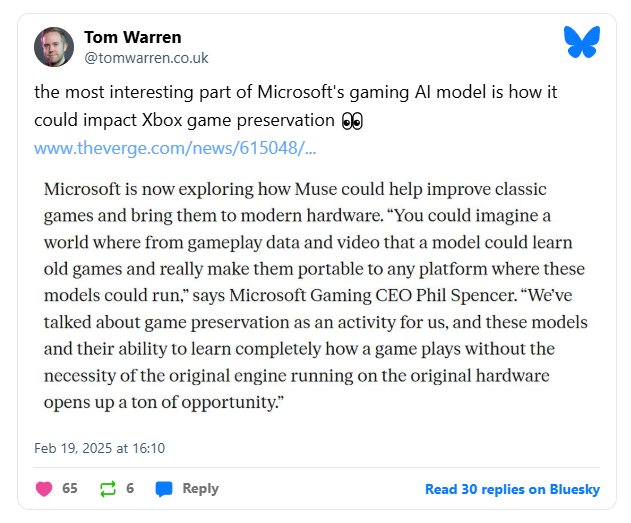
Today, a story went round about a research project at Microsoft where they were using generative AI for "game ideation", and also noted that they thought they could use their generative AI models for "preservation". This was reported on by Tom Warren, senior editor at The Verge, thus (screenshotted rather than embedded 'cause the coward deleted it after everyone dunked on it):

Now, if you know anything about video game preservation, you know that feeding an old game into a generative AI model and then hoping it will hallucinate at least a rough approximation of the original game experience is not "preservation". It's bastardisation at best, a completely useless endeavour at worst, and a massive waste of energy and money regardless of the result that comes out of the other end.

Game preservation is a problem that, for the most part, we have solved. We have excellent software emulation solutions, built over the course of decades of development. Hardware emulation via FPGA at an affordable cost for the general public has advanced hugely in just a few short years. Software libraries for pretty much any system you can think of are archived in their entirety at numerous places across the Internet, and strong strides have been made in providing commercial, legally relicensed versions of classic games for a modern audience, both on existing modern systems and on bespoke emulation-centric devices.

So why, then, why the fuck would we want a generative AI model to make a best guess at what a video game that already exists and has been preserved perfectly well might look like if you play it for longer than 10 frames?

That paragraph above is what tech journalists should be asking. And the reason I bring up Ed Zitron at the start of this post is because he's one of the only people to actually ask questions like this: to take a look at the utter garbage being spewed by today's tech companies and to say "this is complete horseshit, what the actual fuck are you on?"

And Zitron, being an outspoken type, is not afraid to call out today's tech journalism space for not doing this. And he's absolutely right to do so. It is the tech journalism sector's job to look at what it going on, to realise that it is complete horseshit and then have the confidence to say that it is complete horseshit.

But they won't do that, for a variety of reasons. Advertising deals. Exclusive access. PR partnerships. An inexplicable desire not to rock the boat, despite the fact the boat has a huge hole in it and has been steadily sinking for 15-20 years at this point.

I'm not one of those people who thinks that journalists are taking bribes for positive reviews in literally all circumstances — I have experience in the industry, remember, and the most I had to worry about in that regard was a mild admonishment from my editor for criticising a Mortal Kombat game's DLC plan when Mortal Kombat was the cover game for that issue of GamePro.

But come on now. Tech journos should be looking at this utter garbage that keeps getting flung our way, and instead of declaring it "interesting" and doing the stupid looky-eyes emoji that makes their post immediately look like a 14 year old girl wrote it, they should be going "hang on a minute, what does that actually mean?" then exploring it further, asking some probing questions (which inevitably won't get a response, but that in itself says something) and then confidently declaring the latest generative AI "innovation" to be what it is: complete and utter horseshit doused in the finest snake oil.

And people wonder why the entire journalism sector is floundering. Could it perhaps be because very little actual journalism seems to be getting done?

Shout-out at this point not only to Ed Zitron's aforementioned blog, but also the excellent coverage of the Elon Musk nonsense in the States by Wired's politics department, 404 Media being a rare example of tech journalism that actually asks those hard-hitting questions, and Aftermath for doing something similar with games journalism. There are still people doing good work out there. But the people on the big, well-known mastheads, like Warren above, need to step their game up, stop being so incredulous and start acting like actual journalists.


Want to read my thoughts on various video games, visual novels and other popular culture things? Stop by MoeGamer.net, my site for all things fun where I am generally a lot more cheerful. And if you fancy watching some vids on classic games, drop by my YouTube channel.

If you want this nonsense in your inbox every day, please feel free to subscribe via email. Your email address won't be used for anything else.

2244: Pouring One Out for Conker

0244_001

Conker's Bad Fur Day was one of my favourite games on the Nintendo 64 — if not my very favourite. It's certainly my very favourite of all Rare's mascot platformers — the Banjo series may have, objectively speaking, been better designed and more interesting, but Conker was just more likeable for the fact it didn't give a shit what anyone thought and was, without shame, wildly offensive and absolutely hilarious.

The Xbox remake Conker: Live and Reloaded was one of the first ever "remasters" of a video game, and to date it remains one of the most impressive efforts, taking the original game and giving it more than just a hi-res upscale — it's a game that still looks surprisingly impressive today, despite running in 4:3 aspect ratio and 640×480 resolution.

I've been looking to re-acquire a copy of Conker: Live and Reloaded for some time, since I traded my original copy in donkey's years back and haven't been able to find a replacement in recent years. By a stroke of good fortune, dropping into our friendly neighbourhood junk shop — which has a substantial retro gaming section — threw up a copy in good condition, so I dropped £12 on it and brought it home to revisit, partly in celebration of finding it, and partly to remember Conker's glory days after Microsoft revealed this monstrosity the other day:

young conker.png

That, if you're not familiar with Conker, is supposed to be a young incarnation of Conker and is just wrong, wrong, wrong on so many levels. This is what Conker is supposed to look like:

Conker.jpg

That second picture is from the original Xbox, by the way — you know, the contemporary of the PlayStation 2 — while the first picture is from the Xbox One, two hardware generations later. How is it that they've managed to make him look so much worse?

Anyway, that aside, I've been keen to revisit Conker's Bad Fur Day — which makes up half of the package of Conker: Live and Reloaded, the other being a surprisingly fleshed out multiplayer affair that sadly, with the death of OG Xbox Live, can no longer be played online — just for my own personal gratification. And, aside from a few frustrating sections — one of which I gave up on this evening just before writing this — it's still an absolutely great game, and a reminder of a different time.

If you are, for some reason, unfamiliar with Conker's original adventures, here's the deal. Rare were a partner of Nintendo in the N64 era, and brought us such games as Banjo Kazooie and Donkey Kong 64 as well as GoldenEye and Perfect DarkConker's Bad Fur Day initially looked to be a similar take on the Banjo Kazooie formula — family-friendly platforming fun featuring a strong mascot character of the small and furry variety.

At some point during development, Rare decided that enough was enough, and that the Nintendo 64 probably had enough family-friendly mascot platformers — no-one was going to outdo Super Mario 64 after all, and the only people who had come close were themselves with the excellent Banjo Kazooie games. So they decided to make a radical change in direction with Conker's Bad Fur Day. While maintaining the cartoonish, anthropomorphised animal aesthetic, they ditched the "family friendly" part and instead made Conker's Bad Fur Day into a platform game for adults.

The setup is Conker waking up with the mother of all hangovers and trying to find his way home to go to bed. Along the way he gets considerably sidetracked by the sort of bizarre tasks you always find yourself doing in mascot platformers, many of which, in this case, provide convenient excuses for parodies of movies such as Saving Private Ryan and The Matrix, which were both around at a similar time to the N64 original.

Conker's Bad Fur Day eschews Rare's normal collectathon formula in favour of being a more straightforward action adventure of sorts. Giving the appearance of being open-world and non-linear (but actually being pretty linear), the game is split into several distinct zones, each of which have a number of tasks to complete, with the reward being cash for Conker to stuff his pockets with. The cash is subsequently used as a means of gating certain areas in the game, though not, by any means, to the same degree as something like Super Mario 64's star doors and the like.

What's nice about Conker's Bad Fur Day is that as well as featuring some distinctly adult (albeit immature) humour, it also treats the player like an adult. There are no on-screen objective markers, no checklists, no guide prompts — you have to explore the area yourself, listen to what the characters say and figure out what you're supposed to do and how to do it. It isn't always obvious, and that's an entirely deliberate design choice: part of the challenge of Conker's Bad Fur Day is assessing each situation and determining what the relevance, if anything, of everything in the area might be.

What's impressive about this is that it's pretty rare you'll find yourself feeling stumped as to what to do next. Cutscenes might linger a little longer on something in the environment that you might need to investigate, or characters might point something out, but it never feels like the game is dictating what you should do: progression is very much led by the player, and it's all the more satisfying for that.

And progression is rewarded with some highly entertaining setpieces, lampooning everything from the lobby shootout in The Matrix to Ripley fighting one of the titular Aliens. The game keeps things fresh and interesting by providing context-sensitive areas that provide you with the items you need in a particular location, so you're never stuck carrying around an inventory of useless crap, trying everything on everything in the hope that you might find something that works. There are also several places in the game where getting drunk and pissing on something is the solution to all your problems; try putting that capability in an inventory screen.

I'm pleased at how well Conker's Bad Fur Day holds up, and that it's not just rose-tinted spectacles that cause me to look back on it so fondly. While there are a few annoyances by modern gaming standards — long load times, particularly when you get a "Game Over" (remember them?) are probably the most frustrating, though sluggish camera controls are a close second — the good far outweighs the bad, and the game as a whole acts as a potent reminder of a type of game we simply don't seem to get any more, either from a characterisation and aesthetic perspective, or even from a mechanical perspective, with its combination of exploration, action, platforming and puzzling.

Long live King Conker. I fear we shall never see your likes again.

2016: What an Achievement

0017_001I was chatting with my friends earlier this evening about the matter of achievements and trophies in games. As long-term readers will know, my opinions on these metagame awards that were introduced with the last generation of games consoles have gone back and forth somewhat, but on the whole I feel I'm starting to come down on the side of liking them.

The reason for this is simple: after nearly 10 years of them being A Thing in gaming, a lot of developers are getting the hang of how to use them effectively — and the reasons for using them.

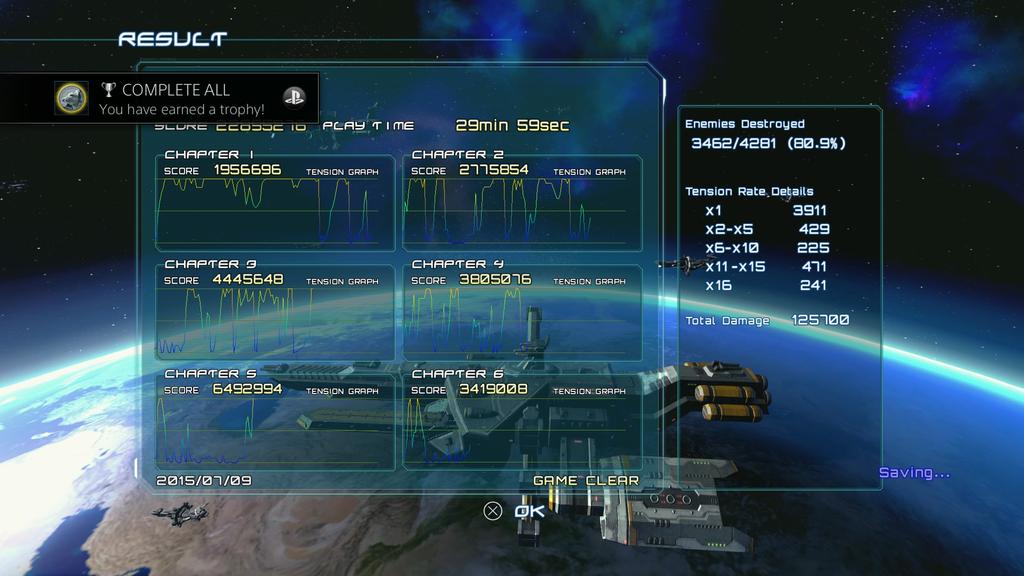
There are, in fact, several reasons for the existence of achievements. From a developer perspective, they provide feedback on just how much people are playing games and what they're doing. This is why so many games have a "started the game" achievement — look at the rarity statistics on PSN and you'll see that there are a surprising number of people who have booted a game up for long enough to add the trophy list to their profile, but not actually started to play it. I couldn't even begin to contemplate what the reasons for doing this might be, but it happens; as an example, the wonderful shoot 'em up Astebreed gives you a trophy for completing the interactive prologue sequence — something you have to do before you can even access the game's main menu — and yet only 91% of players have accomplished this, suggesting either that 9% of players simply turned the game off for some reason or other during the prologue, or were unable to complete it. And I'm not sure that last option is even possible.

CJex_cVXAAAFJlV

From a player perspective, a well-designed trophy list provides a metagame to layer on top of the existing game structure. They can provide challenges for players to complete and encourage them to explore a game in full rather than simply making a beeline for the credits — and, again, those rarity statistics suggest that relatively few people who pick up any game, regardless of length and quality, make it to the end, which is kind of sad — or suggest new ways to play.

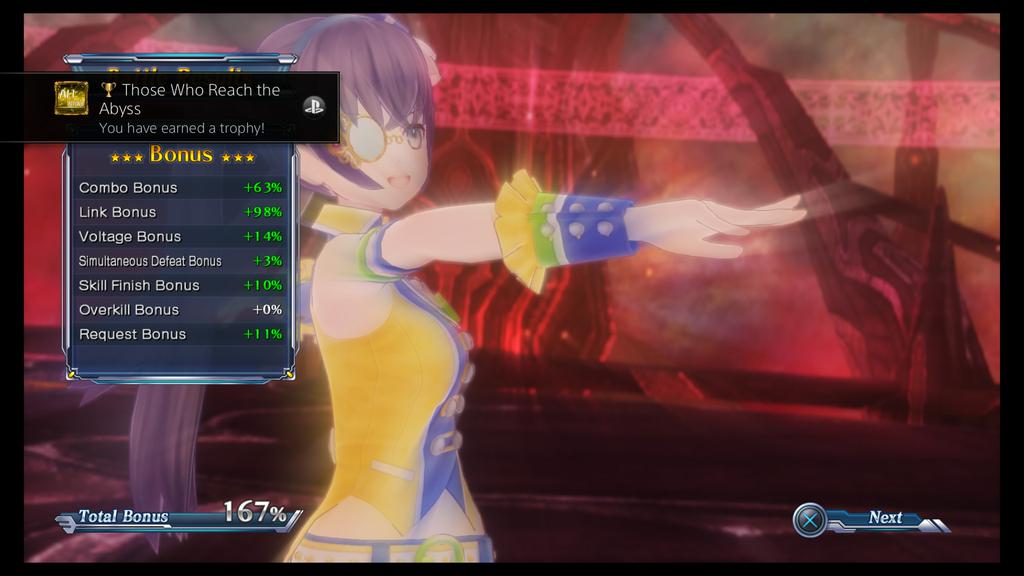
A good example from recent memory that I'm still engaged with is Compile Heart's PS4 RPG Omega Quintet. I have gone for the Platinum trophy in most of Compile Heart's games to date (largely the Neptunia games) because I have a keen awareness of how the developers probably use them for statistics, as mentioned above. I see attaining a Platinum trophy — which for those unfamiliar with PSN is the trophy you acquire when you have achieved all of the other trophies in a game — as a mark of support for the developer; a sign that someone out there cared enough about a game to play it to absolute death. (Omega Quintet's Platinum trophy, incidentally, has a 1.1% rarity rating, which is not altogether surprising as going by my own experiences it's something of a beast to attain.)

CKys-zPWUAES5s7

And in Omega Quintet's case, that Platinum trophy really is a sign that you have explored everything the game has to offer, because it's a good trophy list that runs the gamut from "deal 1 million points of damage in a single combination attack" (something that gets significantly easier the further in the game you go) via "complete all the quests" (something which you can miss in a single playthrough if you're not fastidious about cleaning up quests before advancing the story) and "see the True Ending on Advanced difficulty" (having figured out the conditions to do so, of course — hint: get Aria and Otoha's affection levels to 4 to guarantee this) to "defeat Double X" (a superboss who sits at the bottom level of the optional Training Facility dungeon and provides one of the stiffest challenges the entire game has to offer)

The interesting thing about Omega Quintet's trophy list is that by the time I finished my second playthrough (during which I achieved the True Ending on Advanced difficulty) I had only accomplished about 50% of the available trophies. Deciding early on that I wanted to go for the Platinum, I jumped into the post-game (the ability to keep playing the game after you've beaten the final boss and seen the end of the story) to explore what these additional challenges might be.

CKw_OBRWcAIOjoj

Nearly 50 hours of gameplay later, I'm still playing, though the end is finally in sight. In those 50 hours, I've beaten the 13-floor Training Facility dungeon, pretty much mastered the game's combat system — the extreme difficulty of the Training Facility encounters, including Double X, demands that you know what you are doing, otherwise you will get your ass kicked, even if you grind all the way up to the level cap of 999 — maxed out the affection values for all my party members, mastered all the weapon proficiencies with Kyouka and have come pretty close with a couple of the others, completed all the sidequests and recovered all the hidden archives. This latter one is particularly interesting, as the archives reveal an absolute ton of story context that isn't made explicit in the main narrative, largely because it's not directly relevant to the main cast's personal stories, but instead provides some interesting background lore and worldbuilding context. You stumble across some of these as you simply explore the main game, but quite a few of them are hidden in post-game content.

In other words, without the trophies to give me a nudge in the direction of this additional content, I might not have gone looking for it. One might argue that the game not necessarily signposting this sort of thing is a problem, but if the trophy system is there — and it's compulsory to use on both Xbox and PlayStation  — it may as well be used to push people on to explore things further. Combine that with PSN's "rarity" feature and there's a really nice sense of… well, achievement when you know that you're one of the 1.1% who has seen everything Omega Quintet has to offer.

CLBJINSWoAASbZh

(Just two more trophies left to go: kill 10,000 enemies and get 1 billion approval rating points. I sense that the challenging DLC dungeons and bosses — including the fearsome Banana Demon pictured above — will be my main means of achieving this!)

1248: OneEighty

So Microsoft reversed its stance on almost everything about Xbox One. I'll probably write something a little more detailed about this professionally tomorrow, but I thought I'd indulge in some general musings on here while it's fresh in my mind.

In case you haven't seen the news yet, here's the relevant post, in which Microsoft explains it's backtracking on almost every single contentious policy that it outlined prior to E3, and which had a significant proportion of the game-playing Internet up in arms.

On the whole, it's good that Microsoft has at least put across the image of being receptive to feedback and willing to act on it, though the ridiculously slow pace at which this news was revealed doesn't fill me with confidence. Negative public and press reaction alike was already swirling around the Internet even when it was just rumours about 24-hour checkins and restrictions on used games; I find it difficult to believe that Microsoft doesn't have at least a few social media monkeys on the payroll who would have noticed this sort of thing. And yet they went ahead and announced their plans anyway.

I'm not sure what they were hoping to achieve. They didn't even attempt to put a positive spin on the restrictions — they were just flat-out restrictions on things you could and could not (mostly the latter) do with your new console and your games. Restrictions that would have made the console completely inoperable in a number of countries on launch — including, amusingly, the homeland of The Witcher 3 developers CD Projekt Red, who were just as surprised to discover the restrictions as the rest of us were.

By posting this "We're Listening" stuff today, they're attempting to paint themselves as the good guy; the massive corporation who listens to Internet outcry and responds accordingly in a seemingly positive manner.

However, there are a few problems with this. They're all hypothetical situations, of course, but none of them bode particularly well for Microsoft in the future. Let's examine them one at a time.

Firstly is the possibility that the whole thing was a carefully-orchestrated PR stunt, which isn't beyond the realm of possibility. Announce a series of ridiculous restrictions on the Xbox One, then a week or two later, announce that you've "listened" to the public and relaxed said restrictions, come out looking like the good guy.

Secondly is the fact that if it's that easy for them to turn off these features on the system — the relaxing of the restrictions will apparently come from a day one patch that — oh snap — you need to be connected to the Internet to download — then it will be just as easy for them to turn them back on again without warning in the future. I'd like to hope that they're not that stupid, but… well, they announced this shit in the first place, so it's going to be a while before they earn the benefit of the doubt in my eyes again.

Thirdly is the fact that this was even considered. This suggests that Microsoft is keen to adopt some form of online strategy like this in the near future, and that if it didn't work like this, it could well be implemented in a much more insidious way.

As I say, most of this is conjecture for now, so I'll leave it at that. It's going to be interesting to see if Microsoft sticks to its promises, though, because they destroyed a lot of people's trust with this whole debacle.

1246: Eeeeee Three

It occurs to me that I don't think I've written my own personal thoughts on E3 and the stuff therein yet. Allow me to rectify that.

Let's start with the Xbox One. While it would be tempting to just write "HAHAHAHAHAHA" and leave it at that, Microsoft's strategy, if you can call it that, bears some examination.

The Xbox One was received very negatively when it was first announced, thanks to the reveal's focus on the box's TV aspect. Things didn't get much better when Microsoft revealed an FAQ document detailing the fact that yes, the things everyone had been fearing — the console needs to "phone home" once every 24 hours via the Internet; publishers may choose to restrict the resale and/or trading in of games if desired; you can "pause" Kinect but you can't turn it off — were all true.

The company's E3 presentation was reasonable, but didn't show anything that particularly blew me away. We had Call of Duty: Roman Wars, sorry, I mean Ryse: Son of Rome and a host of other stuff so uninspiring that I can't remember a goodly proportion of it. The few things that were genuinely interesting and outside the "norm" were glossed over; Below, a new title from Sworcery and that weird Might & Magic puzzle RPG that was actually really good developer Capybara was given a minute-long trailer with no explanation, for example.

However, as I wrote over on USgamer the other day, these press conferences aren't designed for people like me — they're designed for people who, for want of a better term, don't know any better. They're designed for the more casual gameplaying public and shareholders, in other words, and consequently need to show off the biggest, the best, the most exciting-looking. It's unfortunate that a significant proportion of the "core" gamer population is growing increasingly weary of the biggest, the best, the most exciting-looking, particularly as their favourite studios regularly suffer rounds of layoffs when, say, their five million-selling game "isn't performing to expectations" or some such nonsense.

All in all, I was left underwhelmed by Xbox One. I didn't see a single title that sold the system to me, and Microsoft's determination to make the platform even more closed off and irritating than it already is is just baffling. It's like they're looking at feedback and then doing the exact opposite. That can't be good business, surely.

As for the PS4, I was impressed. I can live without all the social nonsense, though I can see that being a bit of fun on occasion — so long as you can turn it off. The fact that Sony simply said "we're doing things the way we do now" and they got a round of applause says it all, really, though; it's not a case of people being "set in their ways", it's a case of people actively wanting to resist the suspiciously anti-consumer practices that Microsoft are trying to put in place.

Let me go off on a tangent to explain for a moment.

I like owning my games as physical copies, particularly on console. I feel less strongly about this on PC for a reason I haven't quite worked out, but given the option between getting a physical copy and a digital download on console, I will always, without fail, go for the disc.

The primary reason for this is that I want to always be able to play this game, even if, say, PSN no longer exists one day in the distant future. A secondary reason is that I enjoy displaying my collection the way a movie buff displays their DVDs, a music lover displays their CDs and/or records, and a book lover displays their books. There's a growing movement to "declutter" our lives from all this stuff we've collected over the years, and I really dislike it, because it encourages us to think of things as impermanent. While it can be a pain to store and move all this stuff, I know that if I got rid of any of it, I'd regret it. Sure, once I'm done with, say, Ar Tonelico Qoga it's unlikely that I'll go back to it in the immediate future, but what about five years down the line when I hear a snipped of EXEC_COSMOFLIPS and think I'd really like to relive Aoto's adventures?

I'm saying all this for a reason: PS4 fills me with more confidence than Microsoft does in this regard. Xbox One will have disc-based games, sure, but it's abundantly clear that Microsoft mean business on the whole "you are licensing this piece of software, you don't own it" thing that everyone ignores in EULAs these days. We still don't have a straight answer in place for them on what happens when Xbox Live goes down, or when you don't have Internet access, or when your account gets banned or hacked… or years into the future when the Xbox One is a "retro" console and Xbox Live doesn't exist in the same form, or perhaps at all. Can you still play your games? Or does the lack of authentication render them completely useless?

Video games are the only art form where I see this discussion happening, and we're drifting in the wrong direction. As modern games get more and more advanced, they become more and more worthy of preservation as genuine works of art. And yet with each passing console generation seemingly determined to get more and more restrictive and based around connectivity, it's a real concern to me that some of these titles will one day be lost forever.

Anyway. It remains to be seen whether Sony does anything stupid between now and the PS4 coming out — because this is Sony, let's not rule it out — but at present, I'm feeling much more confident about them than Microsoft.

As for Nintendo, well, they're Nintendo. Nintendo has always been happy bumbling along doing its own thing… and I'm absolutely fine with that. I have no need for them to try and compete with PS4 and Xbox One or try to become yet another Call of Duty machine. I have no issue with the third-party support that people were whingeing about all the way through the Wii's lifespan but which didn't hurt its profitability at all.

What Nintendo machines do are provide "pure games" — experiences which tend not to have any aspirations to be considered "art", but which provide excellent examples of simply entertaining and fun things to do. For this reason, I'm actually relatively excited to see things like Wii Party U, as Nintendo Land is a big favourite any time friends come over; having something with even more games to play together will be even better.

Anyway, I'm not sure if anyone "won" E3 for me, because I didn't really come away from the show thinking "I MUST BUY THIS GAME THE SECOND IT COMES OUT" with regard to anything, but it was certainly an interesting show. The coming console generation is going to be an intriguing one to watch, and I have a feeling that Microsoft is going to get its nose bloodied more than once in the process. Whether that will take them down completely or just relegate them to the position Sony spent most of this generation in remains to be seen, but it's going to be a hell of a fight to watch.

1219: Yes, The Third Xbox Really Is Called 'Xbox One'

May 21 -- Xbox OneSo Microsoft announced the third-generation Xbox console today, and just to confuse everyone they called it the Xbox One. I can't quite make up my mind whether this is more or less stupid than the "Xbox 720" moniker that everyone inexplicably latched onto a while back, but the fact remains that it's a stupid name. And not stupid in the same way that the Wii has a stupid name; no, calling the third Xbox "Xbox One" is stupid in that it is misleading and confusing. Have Microsoft learned nothing from Nintendo's apparent difficulty at communicating that the Wii U is a completely separate system from the Wii?

It seems not. And apparently Microsoft are not particularly keen to learn from anything either — least of all the general buzz surrounding the machine prior to its official reveal today.

No mention was made of the rumoured "always online" requirement, at least — though that doesn't mean it won't be there, of course — but in possibly the biggest facepalm news of the day, it was revealed by Wired that the Xbox One will indeed feature some anti-used games technology — not an outright block as was originally rumoured, thankfully, but instead an apparent requirement that all games be installed, and that once a game is installed it is tied to a single "account". Other "accounts" (and it's not clear whether this refers to a single console or literally a single user) may install and run the game by paying a fee. It's not yet been announced what this fee will be… but it's there.

Here's the quote from Wired:

There’s one feature of Xbox One from which we can infer quite a few conclusions: You can install any game from the disc to the console’s hard drive, and then play that game whenever you like without having to put the disc in.

Wired asked Microsoft if installation would be mandatory. “On the new Xbox, all game discs are installed to the HDD to play,” the company responded in an emailed statement. Sounds mandatory to us.

What follows naturally from this is that each disc would have to be tied to a unique Xbox Live account, else you could take a single disc and pass it between everyone you know and copy the game over and over. Since this is clearly not going to happen, each disc must then only install for a single owner.

Microsoft did say that if a disc was used with a second account, that owner would be given the option to pay a fee and install the game from the disc, which would then mean that the new account would also own the game and could play it without the disc.

But what if a second person simply wanted to put the disc in and play the game without installing – and without paying extra? In other words, what happens to our traditional concept of a “used game”? This is a question for which Microsoft did not yet have an answer, and is surely something that game buyers (as well as renters and lenders) will want to know. (Update: Microsoft called Wired after this story was originally published to say that the company did have a plan for used games, and that further details were forthcoming.)

Some of that quote is, of course, drawing conclusions from the things that Microsoft said (and, for that matter, didn't say) but the fact that this "fee" is present at all is further evidence of the growing anti-consumer trend in the mainstream gaming industry. Between all the stupid preorder bonuses, season passes, DLC that should have been part of the game in the first place, Online Passes (recently discontinued by EA — now we know why!), the "business" side of things is not presently particularly friendly to the people who, ultimately, hand over the money at the end of the day: the consumers.

The fact that Microsoft implemented this system at all is utterly bewildering. Surely someone at the company noticed the overwhelmingly negative attitudes expressed towards even the slightest rumour that the new Xbox would either block or restrict access to used games. There is absolutely no way that no-one at Microsoft would have noticed this — which means that they've taken an executive decision to simply ignore public opinion. This smacks of arrogance — and of pride before a fall. Although there are already Microsoft apologists in comments sections across the land saying that they "don't mind" this proposed "fee" system, there are significant numbers of people saying they will jump ship to Sony if this is the way that things are going to be.

Sony learned this lesson the hard way after enjoying the huge success of the PS2 and then falling on their asses when they tried to overreach with the PS3 — something they still haven't quite recovered from. That left room for Nintendo to swoop in and corner the market with the technologically-inferior Wii, and then for Microsoft to catch up with its successful courting of the casual gaming "dudebro" contingent who play little more than Call of Duty and Madden. While Microsoft has built itself a considerable degree of brand loyalty over the last few years, they're in serious danger of "core gamers" (ugh) leaving them in favour of the PS4 if they're not careful.

But perhaps this doesn't worry them at all. The Xbox brand has gone from a hulking dark grey slab that featured a warning not to drop it on children in its manual (really) to an all-in-one entertainment solution with an appalling interface and an all-but-mandatory subscription fee if you want to do anything vaguely cool with it. People are still buying the 360 even though its user experience has gradually got significantly worse over the years — and despite a proven track record of hardware failure. The Call of Duty loyalists still see their beloved game as an Xbox-centric title. With all these people, perhaps they don't need the support of the more dedicated gamers who want to do more than indulge in brown-tinted manshoots. Perhaps the Xbox One will be little more than a Call of Duty machine so far as games are concerned.

To be honest, if that happens, it's actually fine with me — it saves me a few hundred quid. It's just a bit sad that what should be something exciting — new consoles for the first time in quite a long while! — is instead reacted to with caution and cynicism rather than genuine enthusiasm. How the times have changed.

I'll revisit my opinion on the Xbox One once I see some games for it. But for now, Microsoft have done a very bad job of selling it to me — someone who has been playing games since he was old enough to pick up a joystick. And I'm not alone in that viewpoint.

1110: The Collector

Page_1Reading this post from Matt Mason earlier made me think somewhat about my own game buying and playing habits and how they have evolved over time. I've come to the conclusion that I'm becoming something of a "collector", particularly when it comes to more obscure games that almost inevitably become hard to find if you don't snag them immediately upon release.

This doesn't mean that I pay over the odds to get "Collector's Editions" of games, though, because I tend to think that for the most part those are a waste of time — or perhaps it's just that I've never really had a Collector's Edition for a game that I felt particularly passionately about. Had I known how much I was going to love Hyperdimension Neptunia mk2, for example, I might have seriously considered spending a bit more and picking up the swanky limited edition that came with a soundtrack CD, an art book and some playing cards. (Yeah, I know the cards are a bit lame, but I love soundtrack CDs.)

NepnepLE-More often than not, though, the super-expensive limited edition versions are for games I have no interest in, like Call of Duty, Assassin's Creed and Skyrim. For sure, these limited editions are often cool, but there's only so many gigantic statuettes that you can scatter around your house before people start asking questions. (Particularly if one of those statuettes is a gory female torso… but let's not open that can of worms again.)

I'm actually fine with this, though, because I've been tending to find that the games I'm most interested in playing are the ones that maintain their value the best — simply because they're often not put out in particularly large quantities and thus often become quite hard to find after a little while. As such, I've come to accept that taking a chance on a new game like this often involves an outlay of at least £20 and may, in a few isolated cases, require payment of a price considerably inflated from what it would have cost when the game was first released. (I ordered a copy of Fire Emblem for Gamecube recently, for example… I'm pretty sure that's not what it cost when it first came out.) The fact that I've had to hunt for these games and occasionally pay a bit more for them than something of an equivalent age that had a wider release makes them feel somehow more "valuable", and makes me feel like my growing collection is something that I can be proud of. I know they're "just" games, but they represent a hobby that I truly love and which inspires me to do other things.

What this "collector's" attitude has meant in practical terms is that I'm now much more inclined to pick up interesting-sounding titles as soon as I become aware of them, rather than when I know I have time for them. This inevitably leads to an ever-growing backlog, of course, but it also means that I have things to look forward to. It's also an approach which works for my personal circumstances at present. In other words, I don't spend a lot of money on other "vices" — I don't drink, I don't smoke, I don't buy DVDs (with the exception of anime that can't be found for streaming online), I don't tend to travel a lot and, by the end of this month, I won't have any car expenses either (apart from any contributions I make to help Andie out with hers). This means that I tend to have a fair bit of disposable income that I don't feel guilty about splurging on my collection, and still have plenty left over for living expenses and to do nice things for Andie.

I like having physical things that I collect. My bulging Steam library also counts as part of my collection, but somehow that big list of games inevitably acquired for a couple of quid during a holiday sale isn't quite as satisfying as seeing that big shelf full of cases. Downloadable games feel more "disposable" somehow, like they won't last; I often find myself worrying what will happen to all these games when, say, Steam or PSN or Xbox Live don't exist any more. How will future generations be able to play awesome stuff like Flower, or Journey, or any of the other titles which everyone raves about now but which are only available via download? (I got around this issue with some of the visual novels I own by burning a copy to disc and printing my own inlay for the DVD case. Sad? Perhaps. But it means I can add them to my shelf with some degree of pride.)

The unfortunate side-effect of collecting physical things, of course, is that you have to find space for all of them, and if you get into full-on "hoarding" mode, where you don't want to trade anything in, ever, then you need more and more space as time goes on. I've currently still got a few shelves free on the other bookcase, but it's starting to get a little bit tight… and then what? Creative packing time.

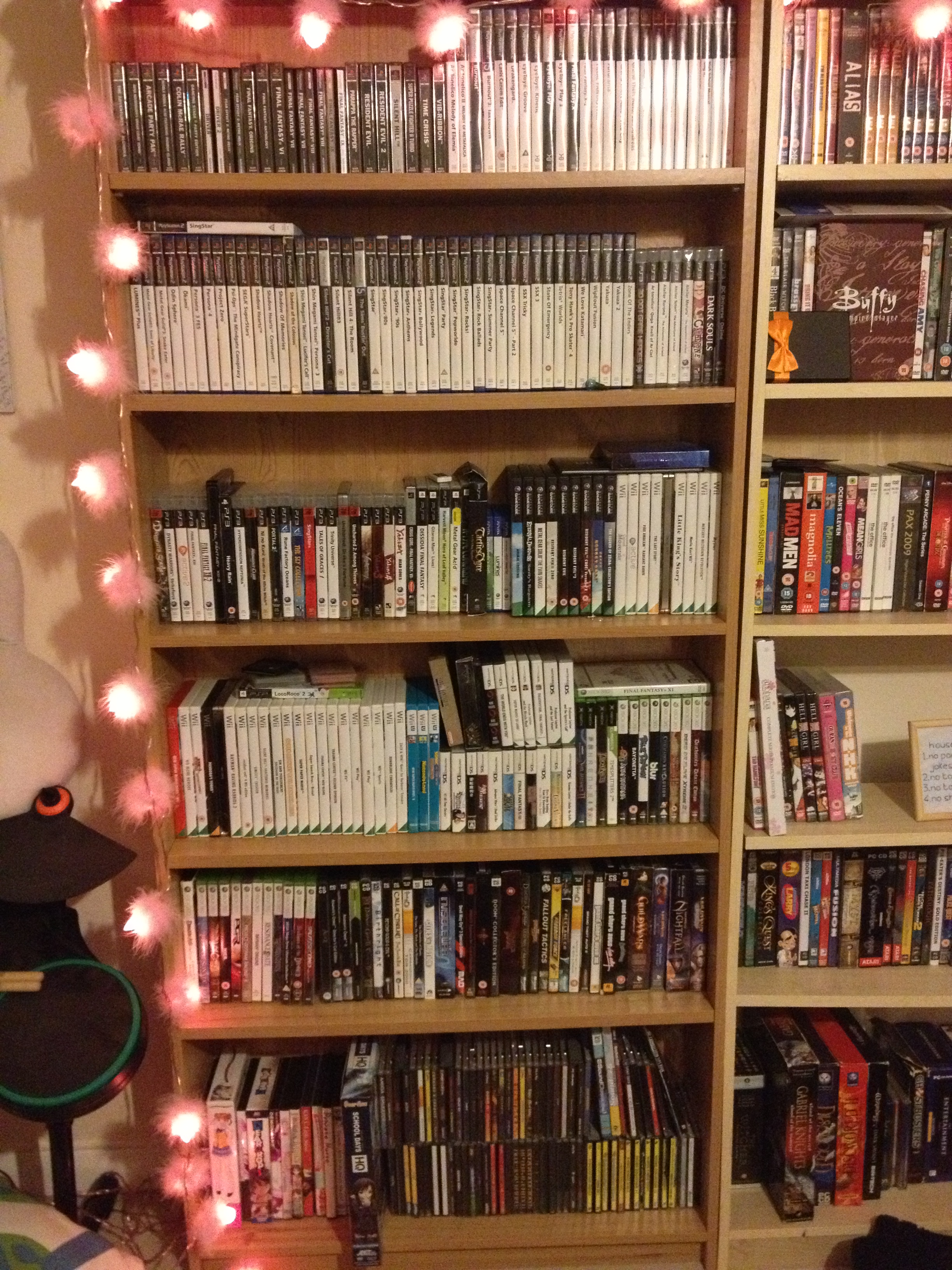
photo (3)If you're curious, here's my game shelf as it stands right now. (The fairy lights were Andie's idea, but they are pretty sweet.) If you click to embiggen and zoom in on the image, you might even be able to see individual titles of at least some of the games. I haven't played all of these, not by a long shot, but they each — even the array of PS2 SingStar titles — represent something with genuine meaning to me. And that's pretty neat to think about.