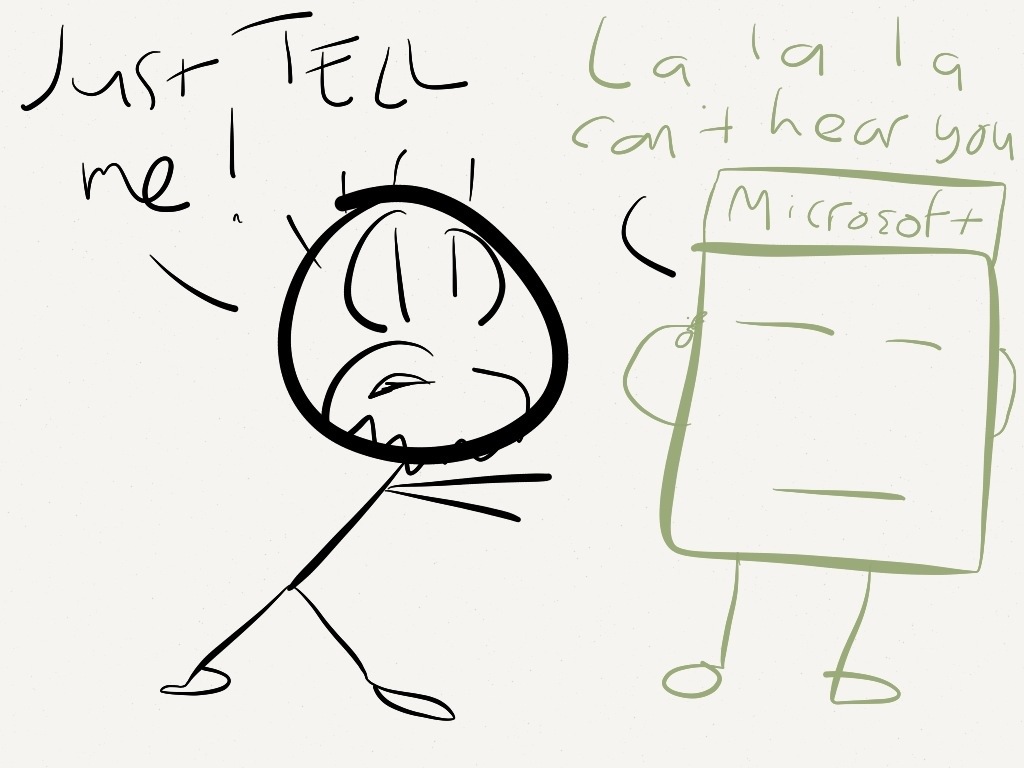
#oneaday Day 882: Microsoft Mysteries

20120619-011335.jpg

As I type this, Microsoft's mysterious event at which something may or may not be revealed is about to start. The usual rumours and speculation have been flying around and are just as infuriating as ever, but there's been something a little different about this event: unlike, say, Apple events, for which we tend to know the vast majority of the content well before it's announced, there's been nary a whiff of what this might be all about.

A lot of people seem convinced that the company are going to launch a tablet device, and that would make a good degree of sense what with the impending launch of Windows 8. But then there's a new Xbox on the cards. And Windows Phone is surely due for a kick up the arse. And then there's things like Surface, and all the things that Microsoft Research are up to — though let's not forget that they unleashed the monstrosity that is Songsmith on the world. (And now it's stuck in my head again. "You sing into a microphone while the drummer plays along…")

But the truth is that no-one knows. At all. No-one has any idea whatsoever what is going on, and this means that the event has the potential to be exciting. (It also has the potential to be a crushing disappointment, but that's part of what makes it exciting.)

This is something that to a large extent we have lost in the modern age of PR, leaks and the reporting of every little rumour that sneaks out. Think about it. If you reveal everything about your product months before it actually comes out, you walk a fine line between building anticipation and pissing people off with oversaturated marketing. I feel it all the time with modern high-profile video games, and I'm pretty certain tech enthusiasts feel the same way about new gadgets. I don't know to what degree it happens in other sectors, but given the way a lot of modern PR seems to work regardless of industry, I can imagine it is the same across a lot of different areas.

I can't be the only one who prefers to be surprised now and again by something. For all the mindless speculation that goes on around Apple product launches, the company itself is pretty good at keeping things under wraps until the last minute (though they let the cat out of the bag with iOS 6 somewhat). Microsoft has gone one better with this one by not letting even the slightest hint out to the press or the public. It's had a far greater effect on the public's anticipation than carefully-orchestrated "leaks" (most of which I doubt are really "leaks" at all) and "official" teasers — and as a result, everyone is on tenterhooks, watching the currently-running announcement (which still hasn't announced anything as I type this paragraph).

Basically, the lesson to be learned here, I think, is that sometimes it's okay to shut up and not tell anyone what you're doing. Because when you tease something and then respond to all questions with "we're not ready to talk about that yet" or "we do not comment on rumours or speculation" you just come across as a bit of an arse, really.

Ah, and there we go. The big announcement is the Microsoft Surface, though it's changed a bit since the table-sized device we last saw. The new gizmo is an iPad-like device with an interesting twist: its Smart Cover-like kickstand has a full multitouch keyboard secreted within it. There's also an optional other case with actual proper, tactile keys.

The fact the Surface is running Windows 8 means that it can run things like Office and the like. There'll apparently be a scaled-back version for Windows RT, and one with Intel chips for the full Windows PC experience. The latter will also incorporate stylus and "digital ink" input as well as multitouch, and apparently has the power of a full desktop PC — though whether or not it will run Crysis is yet to be seen as I type this…

Microsoft at E3

Just finished watching the Microsoft E3 presentation. As most people could have predicted even before seeing what was on offer, reception was somewhat mixed.

Predictably, everyone creamed themselves over the Modern Warfare 2 trailer and gameplay footage which I, ever the rebel, remain relatively indifferent about, though it is remarkably pretty. Halo fanboys spooged copiously over ODST and the "secret" Halo title, Reach. This I am completely indifferent about. When Bungie said they had a "top secret" project to announce, I was hoping they were going to show a new Myth game or something like that… but no. Bungie make Halo and nothing else now, it seems. Fair play, it's made them an awful lot of money but seriously guys, something new once in a while really wouldn't go amiss.

Other notable mentions went to Crackdown 2, sequel to the underrated open-world funfest from a while back – and for my money, one of the best implementations of co-op (or perhaps it should be more accurately called "concurrent play", since you can both happily charge off in opposite directions if you want to) I've ever seen.

Then there was Splinter Cell: Conviction, which does look like it's trying some revolutionary new tricks with presentation. Rather than having mission objectives and cutscenes taking players out of the action, many things appear "projected" on the walls, be these instructions or even flashback cutscenes. It was a really interesting approach, and the game looks to be supremely cinematic because of it. It's certainly enough to get me interested in Splinter Cell again, a series I haven't touched for quite some time.

Then there was Alan Wake, a game which many were worrying had fallen into the abyss of vaporware. But no – we saw it, including some gameplay footage. It looks to be something of a cross between Max Payne and Silent Hill, with, like Splinter Cell, some interesting presentational features. Wake's narration of the action hearkens back to Max Payne's overblown drawl from his games, and the use of light and dark is reminiscent of some scenes in the Silent Hill series. It certainly looks incredible, too, and could well be the thing that makes 360 owners feel a bit better about not having Heavy Rain to play.

Kojima also snuck onto stage and dropped the fact that a new MGS game starring Raiden would be hitting 360, and Square showed off some FFXIII footage. Both will likely be great, but there was nothing there we hadn't expected.

The main part of the keynote revolved around the Project Natal technology, which allows real-time motion capture and voice recognition, allowing players to interact with games without needing a controller. It was made very clear at the outset of the presentation that this was primarily intended to be a means by which non-gamers could be attracted to interactive entertainment – but of course, this hasn't stopped hardcore gamers bitching and moaning as they always do.

We saw a number of demos, including some questionable real-time avatar motion capture and animation and a fun-looking tech demo called Ricochet (essentially body-controlled Breakout). We also saw how Natal will allow users to interact with the Dashboard in a distinctly Minority Report manner by swishing their hands around and, much to the disgust of Atheistium over at viera.nu, allow their avatars to try on girly clothes while having a video chat. (To be fair, this was pretty cringeworthy, but I don't see it being a huge part of most gamers' lives.)

It was Peter Molyneux's work with Natal that provoked the most interest and curiosity, however. Presenting a virtual human called Milo, he demonstrated the capabilities of Natal along with software by showing someone interacting with Milo by speaking naturally and using realistic gestures to interact with the virtual world. At one point, Milo invites the player to look into the water and a real reflection of the player appears on-screen, with the ripples in the water responding to their "touch". It was a pretty incredible sight, and a glimpse of what the future might hold, especially for games like Oblivion. (Thanks to Ajguy for suggesting this.) Imagine being able to hold a naturalistic conversation with an NPC rather than tediously clicking through a list of topics.

As I mentioned earlier, reception has been mixed. Natal is undoubtedly amazing technology (assuming it works) but the self-professes "hardcore gamers" of the world are already up in arms about "dumbing down". But the fact is, just like the Wii is not a system for these people, Natal and its features are not designed for this audience. What Natal will allow Microsoft to do is broaden their audience from the core of gamers to families and other non-gamers. With the introduction of other services on the Dashboard such as last.fm, instant-on 1080p movies (I remain cynical about this, given the general crapness of my connection) and live TV from Sky, the aim is very much to turn the Xbox from a simple games system to an all-purpose multimedia box that sits under the television as the centrepiece of your digital life.

I don't think that's such a bad thing. No-one suggested once that hardcore gamers would be left out in the cold – quite the contrary, in fact, with the announcement of big titles like Modern Warfare 2, Crackdown 2, Left 4 Dead 2 (yayz!) and numerous others. What Natal will do is simply open up the field of interactive entertainment to more people. If all they want to do is prance around like a pillock in front of their TV, then let them. But there's always the possibility that they'll get interested enough in the hobby to join the growing number of gamers out there and enjoy this rapidly-changing medium.

I think that's quite a pleasant image of the future, in fact. Let's see what happens.