I'm a big fan of the work of Carpe Fulgur, the small, independent localisation team previously responsible for bringing English-speaking audiences the excellent Recettear, its predecessor Chantelise and the charming Metroidvania-ish Fortune Summoners, and who have most recently been working on the sprawling behemoth that is Trails in the Sky: Second Chapter alongside Xseed Games.
I was pretty intrigued, then, when Andrew Dice of Carpe Fulgur proudly announced the team's fifth project: a peculiar affair called This Starry Midnight We Make. Unlike Carpe Fulgur's previous output, it's not a role-playing game. It is… well, it's kind of baffling, to be honest. I guess technically it's a puzzle game of sorts, but I actually want to describe it more as a game about experimentation.
I sat down and played the demo version — available now on Steam, with the full version coming later this month — and recorded my experiences, bewilderment and all. Here's what happened when I had a go:
As you can see if you watched the video, the game blends visual novel-style storytelling with its main mechanic: creating "stars" in a magical basin that appears to influence what happens in Kyoto according to the astrological phenomena you create.
The basic format of the game involves plopping stones into this basin and watching them do stuff, then figuring out how to make them do other stuff. The basin is split into five elemental areas, represented by faint swirling coloured gases, and the combination of the elemental area you drop a stone into and the type of stone you drop determines what happens next.
As you progress through the game, you're tasked with a series of quests that ask you to create specific phenomena. What's interesting is that after an initial, rather brief and unenlightening tutorial, you're pretty much left to figure everything out for yourself. How, exactly, do you create a nebula? The game sure isn't going to tell you right off the bat, though it will record the phenomenon in your notebook once you've created it once, allowing you to refer back to it and check how you did it if you're not sure.
Beginning with the simple task of creating individual stars, the quests later start demanding that you create evolved forms of stars that involve mixing different types together, manipulating the amount of elemental gas in an area of the basin and even using "clay stars" to fuse others together. Beyond that, you're tasked with creating "constellations" using specific combinations of stars that you've created, and the game hints that once these have been created, they'll be used as "tools" to further manipulate your astral creations, though the demo stops before you get to see what this means for yourself.
What I found initially offputting but subsequently rather compelling about This Starry Midnight We Make is what I hinted at above: you have to figure out everything for yourself. And this is a huge adjustment from a lot of modern games, which spend much of their early hours walking you through every step of the mechanics you might be using throughout the game until you're absolutely sure you know what you're supposed to be doing. Not so in This Starry Midnight We Make. You are, in effect, a scientist, given some interesting things to fiddle around with and left to your own devices to try things out and see what happens. Some of the things you do will work — and these form genuine "Eureka!" moments, since you've figured them out for yourself — and others will not work, forcing you to analyse your "mistakes" and learn from them… or perhaps determine what caused an unexpected reaction to happen.
I find it difficult to envision how the game will carry this strange concept through a full-length narrative, but I'm kind of intrigued to find out. It's a slow burn of a game, for sure, and its obtuseness will doubtless put many people off within about ten minutes of starting, but if you put some time in and make the effort to actually experiment with it yourself, you'll find a strangely compelling experience waiting for you.
Do I recommend it? I'm hesitant to do so before seeing the full version, but I can at least recommend that you give the demo a try for yourself to see what you think and whether it might be for you. It's available now from Steam.
 And here's how a different moment in the game looks as of today:
 Not a huge difference, I know, but the astute among you will notice two things: firstly, the colour of the text box has changed to a deep navy blue rather than the default gradient fill, and the main game screen now has a Persona 3-style "clock" in the upper-right corner of the screen, indicating what time of day it is. Presently, this only shows the time of day, but I'm toying with it showing what day it is, too — my hesitation on this note is that which day it is is only relevant for part of the game rather than the whole thing.
 I figured I'd run with the "flat blue" colour scheme, and add a nice silhouette of Ami in the background for a bit of visual interest, and tweak the message box colour to match for consistency's sake. The silhouette image shows up nicely in the various menu screens without being too obtrusive, as you can see from this shot of the save menu:

 Environments like the one seen above are quite complex, and most stuff in the game is "examinable", so there's a lot of flavour text in there. Now it's done, though, if I want Ami to come back here with another character — which I probably do — I don't have to design that map all over again. Which is nice.
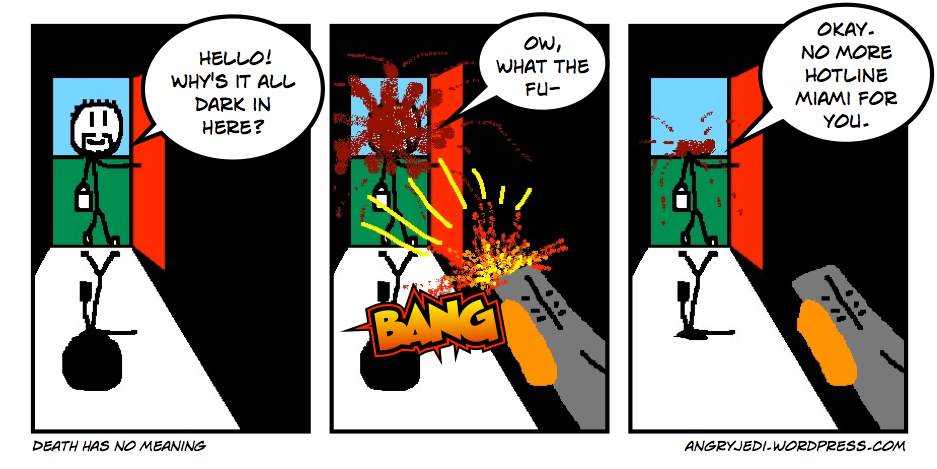 So, after being repeatedly bugged by almost everyone I know to try Hotline Miami, I tried Hotline Miami. Actually, to be more accurate, I sat down to play some Hotline Miami several hours ago and somehow here I am at 1am having completed it. What happened there?
 Yes, I have discovered
  I think it's pretty much a given now that I'm a fan of creative indie games, particularly ones that put unusual twists on established formulae. There's one I haven't really talked about here yet, and I feel I should rectify this forthwith.
 There's a lot to be said for interactivity (or at least the illusion of interactivity) in storytelling. It allows things to be done that are simply impossible with non-interactive media such as books, TV and film.
 The Xbox Indie Games Marketplace is, at best, a mixed bag, as the vast majority of community-led games portals tend to be. There are some extreme examples of awfulness in there—the most notable that I've tried recently being Dossun Island, an 8-bit style platformer with dreadful animation that was clearly designed by someone who has no concept of how parallax scrolling is supposed to work. But then there's some excellent stuff in there too—stuff which would be worthwhile on Xbox LIVE Arcade. Anyone who's played games such as Beat Hazard will be aware that there are some genuine gems amongst the millions of massage apps and video-based crap.