#oneaday Day 879: Flying Away

20120616-014758.jpg

Having gone off on one somewhat about the fetid pile of toss that is Rage of Bahamut yesterday, it's only fair for balance's sake to talk about a free-to-play game that is well-designed, player-friendly and actually rather fun.

I am referring to Pocket Planes, the newest game from Nimblebit, developers of the astronomically popular Tiny Tower, a game which made "tap, tap, tap" gamers out of even the most jaded hardcore members of the games industry.

Tiny Tower, as most people realised after varying amounts of time, was little more than a mindless busywork generator, as RedSwirl over the on Squadron of Shame Squawkbox puts it. You built floors, you attracted people, you stocked up your floors with stuff that made money, you went away, you waited for your phone to shout at you that something needed restocking, you tapped on it to restock it and repeated the entire process for more hours than you really should until you either keeled over dead or got bored.

Tiny Tower, then, had very little in the way of strategy and certainly wasn't a modern-day SimTower, as some referred to it on its original launch. It was an interesting little timewaster with an adorable pixel-art aesthetic, however, and crucially, it allowed the player to make progress without battering them over the head to invite friends, share achievements or purchase things with real money every five minutes. The game featured a premium "hard currency" that allowed you to do things quicker or rapidly acquire more cash, but it was handed out fairly generously just through play, so those who wanted to play for free could.

Pocket Planes builds on this formula and puts a more complex game atop it. There's still not a huge amount of depth there, but it's definitely more than simple busywork now.

In Pocket Planes, you run an airline company, and your goal is to own all the airports in the world. (This alone distinguishes the game from Tiny Tower, which had no long-term goal besides "build a fucking huge tower") You begin the game in one of several regions around the globe with a small fleet of rather crap planes and a desire to make money. Fortunately, there are plenty of jobs waiting for you that want to give you money, so getting started is a simple matter of loading up your planes with passengers, cargo or both (depending on what type of plane it is) and setting them on their merry way.

It's here that an element of very light strategy comes into play. Sending your planes off costs money, and you don't receive payments for flights until they're completed. To be efficient, you might want to try and hit several stops in a single run, but when doing so you need to note whether there's a big enough profit margin to make it worthwhile. Sometimes leaving passengers behind rather than fully loading is more profitable, and scoring a jackpot of customers who are all going to the same place nets a 25% bonus on the income attained.

That's it for the basics of gameplay. Beyond that, once you've earned enough money you can purchase new airports, which allow your flights to go further afield and also provide you with plane parts which can be subsequently assembled into new members of your fleet, assuming you have space for them. Old, crap planes can be retired to make room if you don't have the capital to expand your fleet's maximum size, or you can simply try to get as many aircraft in the air as possible. Plane parts and complete planes can also be purchased through the Market page, which restocks with a random selection of items every few minutes, and parts can also be traded with friends for a small fee.

Like Tiny Tower, a lot of these actions use the game's "hard currency", or "Bux" as they are known, but again like its predecessor, Pocket Planes is generous about handing these valuable commodities out through play. If anything, Pocket Planes is more generous than Tiny Tower, rewarding the player with Bux simply for completing certain jobs, levelling up and various other actions. Sometimes they even just float past the planes in flight, to be collected with a simple tap.

Pocket Planes also includes an interesting social mechanic in the form of its "Flight Crew" system. By simply typing in the same crew tag as other airline tycoons, players can team up in an attempt to complete as many jobs in special global events as possible, with flight crews ranked on a worldwide leaderboard and prizes awarded when the time expires. You can also see how you stack up to the rest of your crew and figure out who needs to pull their weight more — though those players who join your crew but aren't on your Game Center friends list simply show up as anonymous benefactors, which is a shame.

The interesting thing with Pocket Planes' social mechanics is that it assumes the player already knows how to socialise. There are no screen-filling exhortations to share achievements with friends; no "friend gating", where progress becomes impossible unless you have a certain number of friends playing; no demands that you "visit" friends and "help" them. In fact, the game's social mechanics are kept pleasingly minimalist — most screens offer the facility to tweet a screenshot using iOS 5's built-in Twitter functionality, but in the case of Flight Crews and the like, it's up to the player to encourage their friends and acquaintances to join in the fun however they see fit rather than spamming them in-game. This is a Good Thing.

Pocket Planes is, at heart, a simplistic game with very little substance, but it offers the same sort of idle satisfaction that Tiny Tower did with a bit more sense of structure. It will undoubtedly be another big success for Nimblebit and fair play to them for that — their recent games are proof that you can adopt a free-to-play business model without being jerks about it. The goodwill that builds will likely encourage many more people who wouldn't think to purchase virtual goods otherwise to dip into their pockets purely to show the developer their support.

Pocket Planes is out now for iOS. An Android version is following in the near future, but a release date hasn't been announced yet.
#oneaday Day 878: I'd Tap That for £70 of In-App Purchases

20120615-020941.jpg

Despite my day job, which is reviewing mobile and social games for the fine folks over at Inside Network, I have to confess that the reason some of these games end up being quite so popular eludes me. Don't get me wrong, I'm trained to spot a free-to-play game that's going to be profitable a mile off… I just can't pin down the reason as to why some of these games resonate with people so much. And no-one seems to want to tell me, either.

(Naturally it probably goes without saying that these are my personal, not professional views. But I'll say it anyway. Oh, I already did.)

Let's take a title called Rage of Bahamut as a case study. Rage of Bahamut is a game for iOS and Android devices. Ostensibly it's a "card battling" game in which you collect (virtual) cards a la Magic: The Gathering and then use said cards to do battle, either against other people or "boss" monsters. There's also a large number of "quests" that you can take one of the characters represented on your cards on, the ability to organise players into "Orders" and cooperate, trade cards, help each other out on difficult fights and all manner of other stuff.

Sounds pretty good, right? Well, it's not. The game features one of the most dreadful user interfaces I've ever seen, with most of the game looking like a Web page from the early '90s, albeit without animated "Under Construction" GIF files. The "quest" feature consists entirely of tapping a button, watching a short animation of a monster dying and observing your stamina bar gradually decrease as your experience and "quest progress" bars increase. Battling another player involves selecting your cards in advance, pressing "Battle" and then doing absolutely nothing. Battling a boss involves selecting your cards in advance, pressing "Battle" and then doing absolutely nothing. Oh, and there's no sound, either. It wasn't deemed necessary, it seems. The game's sole slightly redeeming feature is that the anime-style artwork for the cards is quite nice, but that certainly doesn't make it any fun to play. At all. Go on, try it. (Android users, go here.)

Despite this crippling lack of entertainment value, somehow the game is presently the third top grossing game on the iPhone — and it has been at the top of that chart in the last few days, too. It's free to download, meaning that people are enjoying this hateful, monotonous, tedious pile of steaming un-fun crap enough to want to voluntarily hand over money.

Why?!

It's not the only game of this type which has enjoyed success, it's just the most recent. Various studies by research companies indicate that the majority of profitable apps on the various app stores of the Internet include in-app purchases in one form or another — and many of these titles are of the free-to-play variety. I have nothing against free-to-play as a concept or business model, but I do question the taste of some people when something as unbelievably lacking in virtue as Rage of Bahamut proves itself to be more profitable than lovingly-crafted paid apps which developers have poured large quantities of time and money into. This depressing tale from Joystiq springs to mind.

I can't help but feel that the press is partly to blame in all this. Titles like Rage of Bahamut often get great reviews from the press despite their lack of innovation, gameplay, interface design or anything even resembling entertainment, when in fact they should be summarily panned for providing an experience akin to scrolling through an Excel spreadsheet equipped with a macro that requires you to click "OK" every ten seconds.

But then I guess I've never seen the appeal of football management games, either…

(Incidentally, if you're looking for a card-battling game that's actually good, try Gamevil's Duel of Fate, Hothead's Kard Combat or Kyle Poole's Shadow Era.)

#oneaday Day 842: The Captain's Chair

20120510-013852.jpg

I've started playing Star Trek Online again. It's been a good couple of years since I last tried this game, as I played in the beta and subsequently for about 40-50 hours or so immediately after launch. I liked it a great deal back then, but wasn't playing it enough to justify the monthly subscription fee so, like many other MMOs I've left in my wake, I set it aside, saying to myself that I might check it out again were it ever to go free-to-play.

The astute among you will be aware that Star Trek Online has, in fact, been free-to-play for some time now. I, too, am aware of this and have had the thing installed for quite a while but never got around to picking it up again. Until now.

It's been so long since I last played I ditched my old character and recreated it to play from the start again. I was originally doing pretty well, but I can't remember what the hell I was doing, so I figured it better to start again and re-learn the game mechanics — along with discovering what's been added since I last played. (Quite a lot, as it happens.)

For those groaning at the prospect of yet another MMO with a hotbar, hold it right there. Star Trek Online is worthy of note for several reasons. Yes, it has a hotbar, but no it most certainly isn't World of Warcraft in space. I remember thinking on its original release that, slightly rough edges aside, it's the Star Trek game that I always wanted to play. And my opinion stands today — arguably even more so.

For the uninitiated, Star Trek Online starts with a bang. The Borg are attacking, and the player, a new Ensign serving aboard a fairly pathetic little ship, is tasked with helping out. This process conveniently introduces all the basics of play, including running around inside places, shooting things, talking to things and interacting with things. The player subsequently gets to join a bunch of other Federation vessels in taking down a crippled Borg ship and eventually, thanks to the rest of the crew ending up dead, gets a promotion to Lieutenant and the chance to take command of aforementioned pathetic little ship. Thus begins their grand adventure in the stars.

Once the player is out of the introductory tutorial series of missions, they're able to explore the galaxy and take on a wide variety of missions, ranging from story-heavy "episodes" to exploration missions where uncharted sectors have to be, well, charted. Along the way, they'll engage in space combat, beam down to places and investigate mysterious goings-on, reconfigure the tachyon pulse emitters to scramble the grub-nuts frequencies and generally do all the things that Star Trek people do.

It's a deep game that has only grown and changed for the better since launch. There is always something for the player to do, be that pursuing a mission, participating in a multiplayer "Fleet Action" cooperative event, taking on the Klingon Empire in PvP combat, taking part in any of the nightly special events, exploring the stars looking for research material which may be used to develop better equipment or simply chilling out in some recognisable Trek locales like Deep Space Nine or Starfleet Academy.

The space combat is worthy of special note. It's often said that the space combat genre is all but dead, but it's most certainly alive and well in Star Trek Online, though X-Wing this ain't. Since pretty much all the ships in Star Trek are what other games would refer to as "capital ships", combat unfolds rather more like a naval skirmish than a fast-paced dogfight. It's all about manoeuvring around your opponent, flying alongside them, then letting rip with a broadside of phaser fire from both arrays, punching a hole in their shields and filling them with hot torpedo death.

If it were just a basic space shooter, it would be quite fun, but there's plenty of depth there, too. You can tweak the power systems to prioritise attack, defense, speed or whatever, rebalance the shields to provide more protection in a particular direction, use your three bridge officers' special abilities to aid yourself or hamper the enemy, and use your character's own personal specialisms to turn the tide of the battle in your favour. At times it's like being in the middle of a battle from something like Homeworld, particularly when taking part in the cooperative "Fleet Action" events or flying with some companions.

As you progress through the game, you get new ships and equipment with which to customise them, including some recognisable models from the Trek series. Yes, you can essentially fly Voyager, Defiant or the Enterprise if you want to. A bunch of alternative ships are available for real-money purchases, including some absolutely hulking behemoths that look very impressive — particularly when you're still in the pathetic little starting ship.

And this isn't even getting into the flourishing user-generated content community. Star Trek Online features the ability for players to create their own missions using a tool called The Foundry (that will also be seen in Cryptic's upcoming D&D MMO Neverwinter) and then publish them for the community to play at any time. I haven't yet delved into this side of things, but it's a big part of what drew me back in. The Architect facility in City of Heroes was a source of considerable entertainment for me, so I'm looking forward to something similar here.

Above all, Star Trek Online is a great example of how to get a free-to-play MMO right — and a truly excellent sci-fi game to boot. You can have a completely satisfying experience right up to the level cap without paying a single cent if you want to, or you can pick and choose how you want to customise your experience. So far as I can tell, none of it unbalances the game — always a big concern in titles like this — and is primarily there for bragging rights or visual customisation.

Check it out on Steam. No, there's no Mac version. (Boo!)

#oneaday Day 518: Championing the Free to Play Model

I mentioned a few days ago that I was going to give some of Steam's free to play games a try, and mentioned I might investigate APB Reloaded and World of Tanks. I have played a tiny bit of APB (it's quite fun, if nigh-on-incomprehensible to begin with) but haven't touched World of Tanks yet. I also continue to enjoy Spiral Knights, although with the game's lack of quest structure and progression system tied to your equipment rather than your character I'm not entirely sure what the "point" is — but it's fun, regardless.
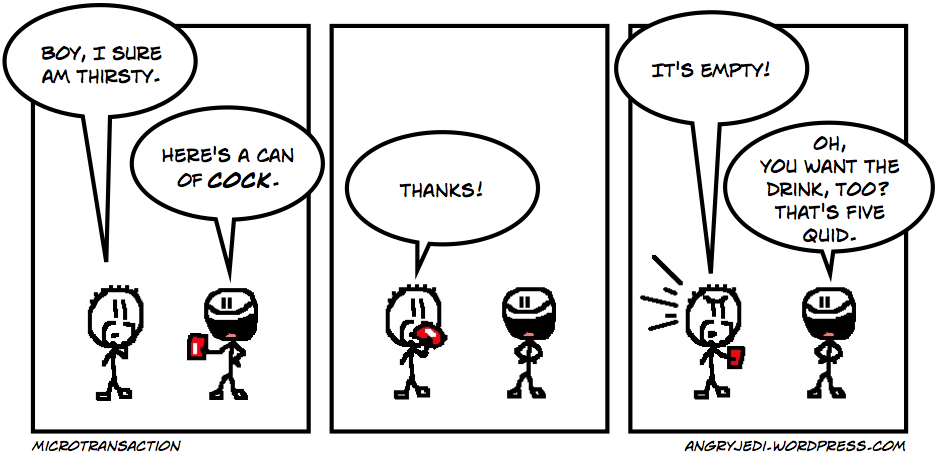
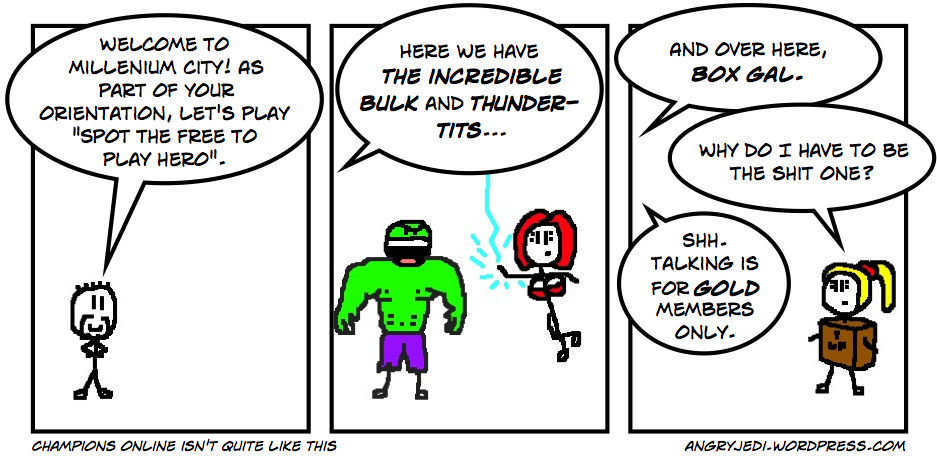
Instead, though, I've been spending a fair amount of time playing Champions Online, aka City of Heroes 2. This is one of a growing number of MMORPGs that used to be full-price products with subscription fees, but which have adopted the free to play model as a means of drawing in more customers and potentially earn more money via microtransactions.

Champions Online takes an interesting approach in that you can still pay a subscription fee for a "Gold" membership if you prefer, and that keeps the game pretty much in its original form — you get free access to all new content, are able to play a hero with your own completely customised set of powers and have a bit more flexibility in terms of how much currency you can own and the like. Free "Silver" members, on the other hand, are limited to selecting preset archetypes for their heroes and have to pay for episodic "adventure packs" — story-heavy instanced missions that offer experiences a little different from the regular world-and-instance-based PvE that the main game offers. Regular promotions allow Silver members to get access to some things for free for a limited period, and players can always buy individual things via microtransaction if they don't want to pony up for a full-on subscription every month.

The way this is implemented is incredibly smart. The fact that Silver players are limited to preset archetypes which are nigh-on-impossible to fuck up while Gold members actually have to plan out their builds in advance means that people are less likely to get themselves into a situation where it's impossible to proceed due to some unfortunate decisions 20 levels ago. It also allows players to effectively try out the various combinations of powers with characters that actually work properly — and have a lot of fun in the process. I'm playing a "Soldier" character right now and she doesn't feel gimped at all — she feels like a preset character class in a traditional action RPG. There's just enough level of choice to allow me to customise her a little bit without daunting me with complete freedom.

Champions Online falls into the usual traps that MMOs do — the interface is a bit clunky, the animations in cutscenes are either laughable or non-existent and aforementioned cutscenes have been put together by someone who doesn't know what "directing" or "cinematography" is. But that doesn't stop it being fun — and definitely higher quality than some of the crap that has been released under the free to play banner in the past. Quality of these games is definitely increasing, and I foresee that Champions Online will hold my attention for quite a while yet. So if you're a player, do join me! Look for "Lap Cat@AngryJedi" or just add me on Steam to see when I'm playing. Feel free to give me a shout and we can team up.

#oneaday Day 512: Freebie-Jeebies

Free to play games are here to stay, it seems, with Steam launching a dedicated category for the little buggers today — complete with Achievement support and Steam-powered microtransactions.
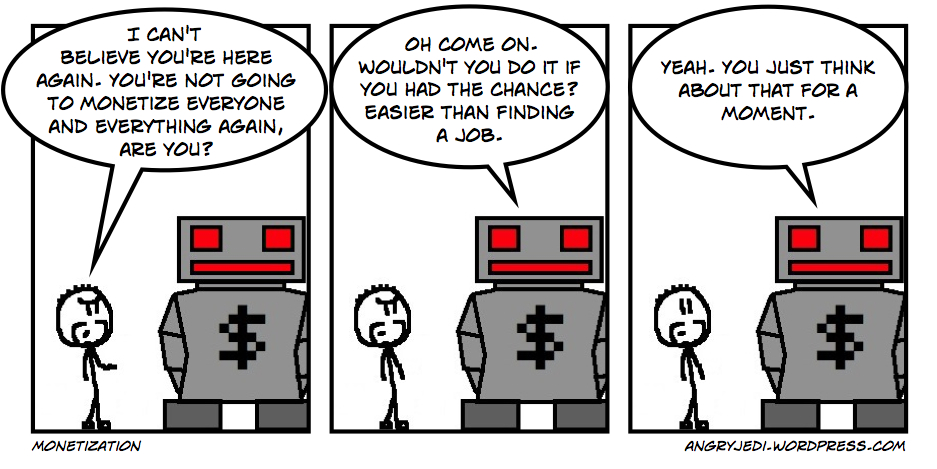
With that in mind, I've decided I'm going to delve into some of them and try to determine if any of them are actually any good. A lot of people hear the words "free to play" and assume it's going to be some lame-ass Facebook game with no gameplay whatsoever (seriously, I played one earlier that literally gave you experience points for doing nothing at all) but in actual fact, there's a surprisingly rich range of titles on offer out there.

I've just spent about half an hour with Spiral Knights from SEGA. This one appealed because of a recommendation from a friend, the most excellent CampfireBurning, who described it as a cross between Zelda and Phantasy Star Online. This sounded like an excellent combination of awesomeness, so I set Steam to downloading while I did some work.

It's a small download — less than a gig (when did that become "small"?) — and works on both PC and Mac. It has endearingly simplistic graphics that will likely run smoothly on absolutely anything and, unlike many other F2P titles, understands widescreen resolutions. It also has a pleasantly chiptuney sort of soundtrack, a straightforward control system and a no-nonsense approach to getting you into a party for some dungeon-delving.

Gameplay is similarly straightforward. You have a sword, with which you can slash, and a gun, with which you can pew. The sword does more damage than the gun, but the gun can pew at things that can't reach you. There are also blocks and bushes that hide coins and hearts, as well as "treasure blocks", which are self-explanatory.

I've only played the tutorial so far so I can't speak for the variety of the dungeons, but the simple, cartoonish nature of the graphics means that little more than a palette-swap is all that's really needed to give a level a distinct look — hopefully it offers a little more than that, though, as time goes on.

Hopefully the ease with which these games are apparently going to integrate with Steam will convince a lot more people to check them out. And the fact Steam has introduced a full free to play section should mean we get a lot more of these games on Steam, too, bringing them to a potentially huge audience. The future's bright for people who don't like paying for things but also don't want to pirate them!

I'm going to spend a bit of time with Spiral Knights and then post some more detailed thoughts in the very near future. After that, I'm going to investigate APB Reloaded and World of Tanks. Any other suggestions for free to play excellence?

#oneaday Day 506: Monetize Me

Comin' atcha like a machine-gun today. And by that I mean I will be using bullet-points.

  • I have changed my day counter to the number of days since I started posting every day because 1) it's more satisfying that way, 2) I'm annoyed I missed my 500th day and 3) I'm sick of having to bring up a calculator every time I want to work out how many days I've done this non-stop.
  • E3 coverage has calmed down somewhat. Most of the big announcements have been made. Now it seems to be mostly up to the show floor team to flesh out those announcements with some hands-on impressions. Kind of sad I'm not there. One day! Maybe.
  • Getting people to pay for things is complicated. Whiskey Media did a bold experiment with charging for content and so far it seems to have been mostly successful for them. I haven't signed up, but then I don't read their sites that much. If I was more attached, I might be convinced — as someone on the other side of the potential paywall, I'm all for ways in which content creators can get paid for their work. Unfortunately, some people are still wary of this sort of thing — although porn sites have been running a successful "pay for content" industry for years. Like most things technological, porn once again leads the way.

    I think about this every time I cover a Facebook game. Who is paying for the stuff in these games? There are fucking hundreds of the bastard things, so they must be making money somehow. Are people really forking over hard-earned money purely so they can pussy out of completing a quest objective? Are people really spending money on an "exclusive" cat statue to put in the middle of their field that is not real?

    Then there's the free-to-play "proper" games — many of which are actually getting seriously good. These I can actually understand paying money for somewhat more. The recently-remastered APB, for example. You can play it for free, but for access to full character customization (which is probably something of a bandwidth hog) you have to fork out for a premium subscription. This is still cheaper than the game was on its initial release, though, because although you're paying monthly, you didn't have to pay anything for the game in the first place. Unless you went out and bought it when it was released, in which case more fool you for not reading reviews first. (As a free to play game, though, it's pretty good fun — I suggest you check it out.)

    The key, it seems, is to make sure that people don't feel like they have to pay for something. If you grind to a complete halt in a game until you fork over some Facebook Credits or you bank details, that's a bad thing. If you can make progress in a game without having to pay anything, but spending a bit of money speeds things up a bit or gives you some sort of additional (non game-breaking) benefit, that's a good thing. If you can spend money in order to not have to complete mission objectives, that's a bad thing, although some people really are that lazy, I guess.

    The next few years are going to be interesting to see. Will people start paying for content on websites? Will people want to shell out $60 for Call of Duty and then subscribe to Elite on top of that when free to play games offer competitive services for significantly less?

    Will this bullet point ever end?

  • Why yes, yes it will.