1024: Still-Untitled Month-Long Work of Fiction, Chapter 7

I was in a dark room, the only illumination coming from a small candle in the middle of a table in front of me. The rest of the room was filled with the sort of darkness so thick it looked like it would be hard work to walk through; like it would try to suffocate you, smother you.

I walked towards the table — there was nowhere else to go — and stood in the small pool of light around it.

Nothing happened for a moment. I looked around with some curiosity, but for some reason I didn't feel uneasy or scared. I felt like I should just wait, so I did.

There was no sound. The room, wherever it was, just wasIt simply existed. I couldn't hear any sounds from outside, nor any noise from in here. Even the slightly-flickering candle flame wasn't making a sound.

Then, suddenly, I heard something. Footsteps? They were slow and tentative, and they sounded like bare feet on a tile floor. I looked down at my own feet, but the light from the candle wasn't enough to tell what I was actually standing on. I tried to move my feet and make a sound with them, but I found I was rooted to the spot. I couldn't move.

I still felt curious rather than scared or uneasy. This was happening and there was nothing I could do about it.

The footsteps were coming closer now. They sounded like they were slow; tired.

I knew who they would belong to before the shadowy figure emerged from the impenetrable darkness.

"Alice," I said quietly, in a calm, emotionless voice. She looked up and continued walking towards me slowly but regularly; not quite stumbling, but looking like she had walked for a long time and just wanted to rest. Her eyes looked at me, but there was no spark behind them, no glimmer of recognition. She looked, to all intents and purposes, like she was–

As she stepped into the visible pool of light around the table, suddenly she vanished, her body seemingly shattering into a pale smoke. I watched it rise into the air and gradually disappear into the darkness–

–and then my eyes flicked open, and I was gazing at the ceiling of my room again. The familiar sounds of the middle of the night — the gurgling of the radiators, the occasional sound of a car driving past in the distance — were back once again.

I rubbed my face and sat up, groaning to myself. I glanced over at the clock. 2:30 again. What was it about this time?

I decided to go downstairs and get myself a glass of water, as my throat felt completely parched. I did so, the cool yet not-that-nice water from the tap washing down smoothly, feeling like it was filling me with life.

The details of the dream were fast fading from my mind, but I knew that Alice was involved in there somehow. I wasn't quite sure what to make of it all. Perhaps it meant something, or perhaps it was just my unconscious mind struggling to make sense of what was, after all, an inexplicable series of events that had taken place over the last few days.

I began to wonder if Alice would be in her room again tonight. I wasn't sure what I'd do if I saw her, but I felt a powerful urge to check in on her anyway. The prospect of seeing her again still caused my guts to tie themselves in knots and my heart to begin pounding, but tonight felt different somehow — like I was expecting, wanting it to happen. I walked quietly up the stairs and hesitated outside her room just as I had done several times before.

I pushed the door open slowly and it gave its usual little creak. Inside, it was dark; the moon was clouded over again, so there wasn't much light coming in through the crack in the curtains. I could tell from the strange feeling I was getting that Alice would be in her bed, though.

I sat down on the side of it and reached out to touch her. She groaned a little and rolled over, then I heard her take a sharp breath.

"You're here again," she whispered. "Why?"

"That's what I'm trying to figure out," I said in a low voice.

"I don't have a clue either," she said. "It's weird. It's like… I don't know. One minute you're here, the next you're not. Or one minute I'm there, or the next I'm not. What's going on?"

I paused in thought for a moment. Could it be–

"Wait," I said. "Is something… strange happening to you?"

"Besides my dead brother creeping into my room in the middle of the night?" she hissed sarcastically. "No, things are just peachy." She paused. "Yes, of course something strange is happening to me, you prick. I was hoping you'd be able to explain why you keep showing up like this."

"I… was actually hoping the same thing," I admit. "I don't understand what's going on. So far as I'm concerned, you're…"

"Dead?" she said. Her bluntness stung a little. "No, I'm not dead. Look."

I couldn't see what she was doing in the darkness but I heard and felt her moving around in the bed. I figured it might be best that I didn't see exactly what she was doing.

"Well, I'm… still here, too," I said. I reached out my hand and touched where I assumed her arm was.

"Ew!" came the response. "Don't be weird. Also, your hands are cold."

Evidently that wasn't her arm.

We both sat in silence for a moment. I cleared my throat a couple of times to let her know I was still there. It seemed that we were being allowed to stay together for a little longer than usual.

"You know," she said after a while, "I know I give… gave, whatever… you shit all the time, but I am glad to know that you're sort of alive somewhere."

It was a clumsy sentiment, but it was a strange situation and there really wasn't a better way for her to express it.

"Yeah," I said. "I'm glad too. I thought you were gone forever."

There was no response, and I knew that we'd been torn apart once again.

*

The next morning, Laura showed up as usual, but when I opened the door she came in.

"You're taking the day off," she said. "You need rest. Lots of rest. And I'm going to make sure you get it."

She said it in a tone that indicated there was to be no arguing with this arrangement. I knew that it was futile to resist.

"Fine," I said. "But is it okay?"

"I called Gladwell," she said. She was on good terms with our tutor. "He'd noticed you'd been a bit out of sorts recently, so I arranged it all with him. Don't worry."

I instantly found myself wondering exactly what she'd said to him.

"I said don't worry!" she said, seeing my face. "I didn't tell him anything specific. Not that I really know anything specific, either. Come on. Talk to me. Please?"

"I'll try," I said. "At least come in properly. Take your shoes off."

She obliged. I closed the front door behind her and I led her into the lounge. I plopped myself down in one of the armchairs and she sprawled on the sofa.

"Make yourself at home," I said sarcastically. I didn't mind, really. I spent very little time in this room. There was no real reason to. When I was at home, I spent most of my time in my room, and when I wasn't here, I was at college. This was what my life, such as it was, had become.

"So," she said, sitting up and propping herself up on the sofa arm. "Let's try and have this conversation again. Before you start, I know it's tough. And I know it hurts. I also know you. I know you're trying to be strong and carry all this on your own shoulders because you feel that you have to for some weird reason. But I'm telling you that you don't have to. I'm here. I want to help."

I sighed. Rationally speaking, I knew she was right; I was being an idiot, and that was probably what was leading to these tricks my brain was playing on me — assuming they were tricks — but it was difficult. I didn't "do" opening up to people. I didn't "do" talking. It wasn't that I didn't want to. I couldn't. Laura had been literally my only friend for a long time now, so I'd had very little practice at expressing myself properly.

It was a strange feeling. Often I could imagine the conversation I'd want to have with her, or at least the way I'd want to start it, but would end up choking on the words. Not literally. Well, not quite. But I would feel my throat tighten and become dry, and the words would be impossible to get out. I'd either end up just staring at a wall or making an excuse, and the things that probably needed to be said were left unsaid. This was starting to develop a strong risk of becoming one of those times.

"Laura, I–" I began, then paused. "Thank you," I said simply. "You've always been there for me, and I don't deserve it. I treat you like shit, but you're still around."

"That's not true," she said. "You know me well enough by now, surely. I wouldn't stick around if I actually thought you were treating me like shit. I'd tell you off first, but yeah. If you kept it up, I'd be off."

I smiled a little. Her words weren't overly convincing. I did worry a little about her.

"Really," she reassured me. "I promise. I would tell you if you were taking the piss."

"All right," I said.

I paused and contemplated what I should say next for a moment.

Then I released the safety catch on my mind, and started talking.

I explained about the previous evenings, how I'd been absolutely convinced that I'd seen my sister, alive and well, in her bedroom. I explained about the weird darkness I'd experienced at school. I even told her about the voice I'd heard in the classroom, and the weird figure in the mirror. I just kept going and going and going because I knew that if I stopped, I wouldn't be able to start again. I had to get this all out of my head. I had to tell someone. I had to release this tension. I had to–

"Holy shit," she said eventually. "I… I'm not quite sure how to respond to that."

There was an awkward silence.

"You think I've actually gone insane, don't you?" I said wearily. My tirade had taken all of my mental strength, and now I felt exhausted, despite the fact it was barely an hour since I'd got out of bed.

"Well, no…" said Laura. "I don't know. No. You're not insane. If you'd actually gone crazy I doubt you'd be able to talk about this right now. But something's going on, and — don't hate me for saying this, I know you don't like it — you could probably do with some help."

"You might be right," I said, closing my eyes and leaning back in the chair. It was a moment before I spoke again. I sat up again and looked at her. "I honestly don't know what to do. It happened again last night. I saw her, spoke to her, but then we were pulled apart again. And the weird thing is, the same thing seems to be happening to her. She seems to think that I'm the one who's… you know."

"That is strange," said Laura. She swung her legs down off the sofa and stood up. Then she walked over to me, leaned over me and put her arms around me. "We're going to get through this. You're going to be fine."

At that moment, I believed her.
#oneaday Day 683: Debrief

So, for the last 30 days I've been doing (almost) nothing but creative writing on here. What have we learned?

Firstly, I remembered that creative writing is fun. Not that I'd particularly forgotten that fact, but I've always enjoyed it, ever since a young age. It's actually knuckling down and doing it that can be the stumbling block for many, though — which is, I guess, what projects like NaNoWriMo and what I was doing here are all about. Once you discipline yourself to do something, then you can do it, no problem — over the course of the last 30 days I've churned out over 30,000 words of creativity. Whether or not they're any good is another matter, of course — but they're there, and once they're there, they can become a starting point to something else, even if that "something else" turns out to be something completely different, simply spurred on by what you've achieved previously.

Secondly, improvisatory storytelling is fun, although not necessarily the most practical way to write something coherent. As I said at the start of the whole exercise, I hadn't planned anything out, created any characters, settings or overarching plot — I was making things up as I went along. This was probably evident from any number of plot holes that I'm sure are still in there, and points where I retroactively made something relevant, perhaps not in the way I'd originally intended. Why? Because when I originally wrote something, I'd had one thing in mind, only to come up with a Brilliant New Idea a couple of days later that made the original something either irrelevant or very difficult to fit in to things.

Thirdly, tenses are a bugger. I made a conscious decision once I introduced Evie's narrative to distinguish the two narrators through their use of tense, but it was so easy to naturally shift to the wrong one throughout the course of one chapter. I'm pretty sure I spotted it every time it happened, but if there are a few examples of incorrect tenses, then I apologise.

Fourthly, I already knew this, but stream of consciousness is a fun way to explore characters. With stream of consciousness writing, you can create an interesting, compelling character and narrative without any other characters being present. The majority of Adam's story was just him, for example, and Evie didn't speak much until later. The characters' internal monologues can provide interesting ways to explore the way they think and feel without having to have conversations with others to make things explicit.

I picked up on the whole "stream of consciousness" thing back at school when we read Jean Rhys' Jane Eyre prequel Wide Sargasso Sea, a book which explores exactly what happened to Mrs Rochester before she became the scary woman in the attic. I can't remember a huge amount about the book itself, but many things I've written since that time have taken the first person stream of consciousness approach, as it's a style in which I enjoy writing. Other influential books from my past include the Adrian Mole series — diary-style writing is often pretty similar to stream of consciousness, after all, though there has to be something of a suspension of disbelief at times as few real diaries would include complete word-for-word transcriptions of conversations that had happened — and (don't laugh) John Grisham's The Rainmaker, which was the first book I ever read that wasn't written in past tense.

On the whole, I'd say the experiment was a success. Tucked away in my Google Docs account right now is 14,455 words of another story I'm writing — and this one I have mostly planned out, or at least have some "key events" and characters in mind. One day I might actually get around to finishing it — and since I find myself with a bit of free time on my hands at the moment, I guess there's no time like the present. As such, assuming no-one suddenly phones/emails me on Monday and hires me, I will start doing a bit of (non-blog) writing each day in lieu of having an actual job. Who knows? Something awesome might come of it. At the very least, a creative project which has been on my drawing board for about a bajillion years might finally come to fruition, which will be satisfying. And, frankly, given some of the dross out there which does make it to publication, I'm pretty sure I can do better. I mean, I know I'm not the perfect writer — no-one is, and to assume so is both arrogant and very, very stupid — but I like to think I'm pretty good, at the very least. And also, you only get better through practice, right?

The one thing I can say about the last year is that I've got a ton of experience writing. I mean, I know I did the year before too, what with contributing to sites like Kombo and GamesAreEvil as well as writing this nonsense every day, but this year it's been my actual full-time job, and for the vast majority of that time I've had the privilege of working with some talented editors who know their craft and give good feedback. Too many outlets these days settle for getting things published as quickly as possible rather than taking their time over ensuring everything is as good as it can be. This year, I've picked up a bunch of little tips to ensure good-quality output. Even if I've had to spend the whole year professionally spelling words like "theorise" and "colour" incorrectly. (Love you, USA.)

So, where to from here? We'll see. It's a weekend coming up (it is, right? Losing one's job causes one to immediately lose all sense of what day it is, in my experience.) so that will be spent attempting to relax and unwind after, frankly, what has been a particularly crappy week. Following that, on Monday, as I say, I'll be setting aside some time to do some non-blog writing every day in lieu of actual work, and seeing how that develops. And from there, who knows?

On the job front, there are several irons in the fire at the moment, so hopefully something will come of (at least) one of them. Now I have a bunch of experience under my belt, hopefully I won't find myself spending a year out of work again. Because that sucked a big pile of donkey dick. An actual pile of it. And I have no desire to return to that situation. So I won't.

Hopefully, anyway.

Enough rambling from me. Have a pleasant weekend, all.

#oneaday Day 616: Characterisation

What makes a good character? It's not necessarily one you can engage with and sympathise with because some of the most memorable characters there are are villains. A tragic villain who has some sort of dark past that led him to his evildoing is often the most interesting, but sometimes villains who are just plain evil in a variety of creative ways can be memorable, too.
On the "good" side of the spectrum, distinctive, likable characters are fun to "hang out" with. Even slightly irritating characters can be memorable in their own way — though perhaps not for the reasons their creator intended. They don't necessarily have to "do" much, but they have to be more than a sounding board delivering lines in a flat, dry sort of way.

In the world of video games, characterisation may be frequently exaggerated, but it often leads to memorable encounters — particularly if you spend a protracted amount of time with said characters, as you frequently tend to do in RPGs. JRPGs, for all their faults and linearity, often present the strongest characters in all of gaming, even though many of them tend to fall into the cliché trap. Despite this, though, if you've engaged with the gameplay sufficiently over the course of the 20/40/50/90/100 hours it takes to beat whatever RPG you're playing then you'll probably find yourself missing those characters when the time comes to leave them behind.

On the Western front, BioWare are often regarded as masters of characterisation, and indeed characters such as Mordin in Mass Effect 2 and Shale in Dragon Age: Origins are pretty memorable. But very often when I beat a BioWare game, I don't find myself wishing I could spend more time with those characters in quite the same way I do when I beat a Persona game, or as I anticipate I'm going to feel when Xenoblade Chronicles eventually comes to an end.

Video games are, in some ways, a more unrefined medium than other formats. Technical limitations often get in the way of being able to make use of techniques used in, say, film or writing. Writing in particular allows the author to explore a character in a level of detail arguably unrivalled by any other medium. Of course, said author has to be careful not to give away too much too soon, otherwise the pacing of the character's story is thrown out of whack and the reader might not feel inclined to go on. Getting to know a character should be a gradual process — that doesn't necessarily mean that a chapter of their "dark past" comes to light at a time, since a character doesn't need a dark past to be interesting — but each hour the audience spends in the company of that character should be like getting to know a real person. You start to recognise that character's traits, their likes, dislikes, foibles, weaknesses and the forms of adversity in which they find they can stand the strongest.

There's an occasionally-mentioned piece of writers' wisdom that states that to make the best stories, you have to be as mean as possible to your main character. While following a protagonist's struggles is often entertaining, it doesn't necessarily have to involve them being kidnapped, tortured, raped, mutilated and all manner of other things. Psychological torment can be profoundly affecting, too — and different characters have different triggers by which they can be psychologically traumatised. For one strong-stomached character, it might only be the most depraved and horrendous images imaginable that could torment their mind and keep them awake at night. For another, it could be something as simple as the fact that the guy at the coffee shop didn't pay them as much attention as they would have liked. Characters are people, after all — and like people, they're all different.

Inventing your characters is one of the most fun parts of creative writing. Figuring out what to do with these characters is the challenging bit that comes afterwards. Get your head around that and you've got yourself a story.

#oneaday Day 100: What a Novelty

[Side note: Day 100! Yay. This marks my 448th day of blogging every day. I've been half-tempted to start numbering the posts from when I originally started again, but then that will just get confusing. Perhaps I'll put the total number at the end of each post or something. I don't have an eventual goal number in mind—I fully intend to keep doing this until I can't do it any more, for whatever reason. But given that I continued writing through the disastrous events of last year, it'll take something pretty severe to stop me being here every day. Now, on to your regularly scheduled blog post.]

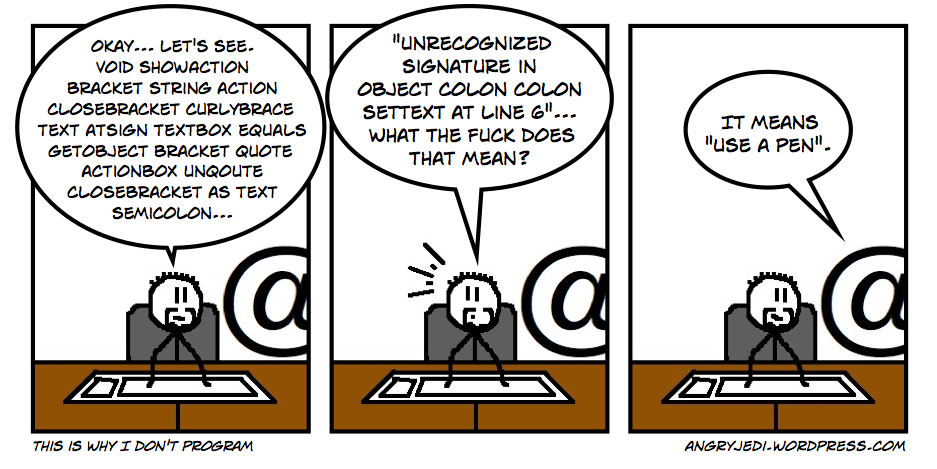
I can't program. Actually, that's a lie; I wrote a very good Treasure Hunt game in ATARI BASIC once. It used Graphics Mode 2, a custom character set, featured a randomly-generated playfield and custom sound effects. Okay, it perhaps wasn't "very good" but it was at least a completed project. Since then, though, my programming knowledge has tailed off somewhat. It's when everyone stopped using line numbers that it got confusing. I know ditching line numbers was actually a good thing in that you could more easily insert code where it needed to go rather than having to resort to increasingly-convoluted GOSUB/RETURN subroutines, but as soon as all these punctuation rules started to come in? Hmmm.

Perhaps it's just that I haven't spent enough time trying to learn one language. I spent a bit of time doing JavaScript and managed to get some fancy DHTML working, but have since forgotten it. I did some Java once, though it didn't do much. I worked my way through the first two chapters of a C# (pronounced "C-sharp", for anyone who had been wondering about it for as long as I had before I eventually found out) book and thought I was doing pretty well until I got to the first "independent project" type chapter and completely failed to produce the program required.

This is why I enjoy tools that allow you to express your creativity without having to know how to write a complete program. Sure, if you need to do something exciting, you can (and probably will) delve into scripting, but for the most part, the built-in tools are enough to get something up and running.

Over the years, I've used many different tools like this. By far my most beloved (and now outdated) is Klik & Play from Clickteam, which later became Games Factory and Multimedia Fusion. These required absolutely no programming knowledge whatsoever and simply a logical mind to figure out a series of "When this happens, make this happen" statements. Winner. And surprisingly flexible.

I'm also a big fan of the RPG Maker series, especially the later ones that do include a scripting language that allows people far cleverer than me to completely replace the game's battle system with something cool.

Most recently, I've come across Novelty, which is a tool for making Japanese-style visual novels. This is a completely free application—though still in beta—and is one of the most polished pieces of free software I've ever seen. It's incredibly flexible and allows for everything from barely-interactive "click to continue" visual novels that don't require any player decisions, to more in-depth Phoenix Wright-style affairs with buttons, hotspots, branching story paths and all sorts. There's not only a scripting language, but also an impressive markup language for creating graphical assets. There's no need to delve into these if you don't want to, of course, but for "power users" they'll be a boon I'm sure.

My only trouble with tools like these is that I have trouble getting started on something. I get some grand plan in my mind and either end up getting daunted by all the preparatory work which will need to be done (gathering/creating assets, planning and whatnot) or find myself starting, getting too ambitious and bumping into an insurmountable roadblock.

Still, it's nice to know these tools are out there for creative types. I have idle plans to experiment with making some sort of visual novel, but whether or not that will ever happen is anyone's guess.

void blog(string bollocks)
{
     Object@ myBlog = GetObject("Blog");
     if (myBlog !is null)
     {
            myBlog.SetText(bollocks);
     }
}

See? No problem at all.

blog("Cock! Piss! Partridge!")

Day 448