It's not that often I play games shortly after they've been released, but starting Omega Quintet on literally the day it came out in Europe (physically, anyway; the digital version is out tomorrow, apparently) has reminded me of one interesting thing that you can only do in the moments after a game has been released: play the damn thing without a guide.
GameFAQs is such an ingrained part of gaming culture now that it's very difficult to resist its allure, particularly when playing a complicated, sprawling game like an RPG. It's natural to want to track down every single little secret and see every possible hidden scene, and GameFAQs provides a valuable service to people who feel this way but don't necessarily want to have to put in the hard work to figure things out for themselves. (This isn't a criticism, by the way; sometimes game secrets are so incredibly obtuse it's difficult to fathom how anyone ever discovered them without assistance directly from the developers, and in these cases your average player has little choice but to rely on a guide.)
But playing Omega Quintet before seemingly any guides have hit the Internet is proving to be a pleasurable experience. It's intriguing and fascinating to discover the intricacies of the game system for myself rather than relying on someone else's interpretation. It's satisfying to discover things that work well, and also the things that don't work so well. And, the more I discover about the game — I'm sure I haven't even seen all its mechanics yet, even as I approach the 30-hour mark — the more I'm actually quite grateful for one of the game's most common criticisms: the fact that it doesn't explain a lot of things immediately. Because without the game explicitly setting some things out for you, you have to make use of what information it does give you in order to extrapolate the rest for yourself. And that's enjoyable.
Take today's discovery, for example: a means of acquiring over 200% more rewards at the end of a battle than normal. The game gives you a few brief tutorials in its early hours that mention "bonuses" at the end of battle, and hint that things like your combo hit count and something about "linking" will increase this bonus, but it doesn't sit you down and say "Now you try!" like so many other modern games do. As such, it's possible to forget all about this bonus system and enjoy the combat on a fairly superficial level. But start to delve into it and suddenly it becomes a much more interesting, complex experience, and consequently far more rewarding as a result.
I went from using the same skills in every battle to attempting to make as long a chain of "linked" skills as possible, because the longer this chain, the more significant the bonus you get after battle. This involves looking at the skill information when you select one and taking note of the "link" type marked; in the case of weapon skills, it's inevitably another weapon type. Kyouka's spear skills, for example, link to Otoha's hammer skills; Kanadeko's gauntlet skills link to Aria's fan skills. Where it gets interesting is in the few instances where a character like Nene has some skills that can potentially link in several different directions — one skill might link to Kanadeko's gauntlets, for example, while another might link to Kyouka's spear. In this way, it becomes an interesting challenge to try and optimise the sequence of skills you use in order to link as many as possible without breaking the chain. I haven't quite figured out if it's possible to link everyone's skills that I have so far together into one long sequence yet, but I'm coming perilously close to getting a piece of paper and drawing flow charts to try and work it out.
I'm actually reminded somewhat of the original Hyperdimension Neptunia; perhaps unsurprising, since that was also an Idea Factory/Compile Heart game. The original Neptunia didn't have a particularly popular or well-regarded combat system, but I actually rather enjoyed it for much the same reasons I'm enjoying Omega Quintet; Neptunia, too, had a distinctly puzzle-esque strategic element to how you set up your skills, with much of the challenge and interest coming from setting up your characters with combos that flowed well, maximised the amount of damage you put out and made efficient use of your available action points in a turn. Omega Quintet's combat is considerably more elegant than Neptunia's — IF and Compa have learned a lot since then! — but, to return to the original point of this post, I'm pleased to discover this depth for myself rather than reading about it in a guide.
I'd say I fully intend to try and play the next few games I tackle without looking at a guide at all, but we all know that isn't true. For now, though, I'm greatly enjoying "flying blind" in Omega Quintet, and I feel I have plenty left to discover.
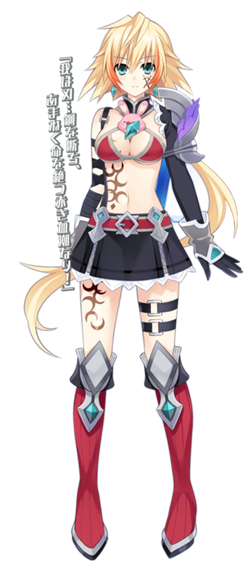 Take Ein Al on the right here. As you can probably infer from both her name and design, she is intended to be the personification of the Final Fantasy series.
 Hyperdevotion Noire is packed with characters like Ein Al who beautifully encapsulate their source material while being their own entertaining figures in their own right. Lid, pictured to the left, is another great example. She personifies the stealth-centric Metal Gear series with obvious visual elements such as her cybernetic eye, bandana and use of the exclamation mark motif — a recurring visual element in the Metal Gear series, much like Final Fantasy's use of crystals — on her breast tattoo, but also reinforces this with more subtle character traits like her habit of mispronouncing words when she is stressed or nervous — perhaps a reference to Metal Gear Solid 2's notorious "Fission Mailed" section which is deliberately designed to confuse, upset and stress out the player.
 Having beaten Senran Kagura Burst recently at last, I've been turning my attention back to Vita title Hyperdimension Neptunia Re;Birth1, the "remake" of the original Hyperdimension Neptunia — a series that I first discovered in
  Been playing a bit more Hyperdimension Neptunia Victory this evening. While the newest game is, as I mentioned a few days ago, more of an evolution from mk2 than the revolution that mk2 was over the original, I'm starting to notice some more pronounced differences — differences that make it abundantly clear Idea Factory and Compile Heart are both receptive to feedback and keen to iterate on their past work in order to make things better in subsequent installments.