1099: Nep-Nep-Nep-Nep

Page_1It's another Hyperdimension Neptunia post, I'm afraid. Normally I'd make an effort to try not to talk too much about the same thing several days in a row, but having started the sequel to Hyperdimension Neptunia (imaginatively titled Hyperdimension Neptunia Mk2) this evening, I felt compelled to share some of my first impressions. (Besides, this is my blog, dammit.)

That first impression can largely be summed up by me nodding and smiling at developers Compile Heart and Idea Factory and going "Good job, guys."

You see, Hyperdimension Neptunia Mk2 takes all the things that were good about its predecessor — an amusing but oddly well-realised world; some excellent, memorable characters; some lovely 2D art — and ditches all the things that were a bit rubbish. Consequently, out go the endless cookie-cutter dungeons, out go the PS1-era random encounters, out go the weirder aspects of the battle system (like the bizarre mid-combat "item crafting" system and the seeming necessity to skip animations to take full advantage of the "guard break" mechanic) and out go the sequences that served no purpose (waiting for landmasses to approach and then having to run an insultingly easy dungeon every time you wanted to travel anywhere).

In comes a game which is not just a dream come true for a Hyperdimension Neptunia fan, but a game which actually appears to be a very good JRPG generally. Okay, you're still controlling an all-female party of candy-coloured self-referential anime archetypes so if you're not on board with that you're never going to be on board with this series, but almost everything about the first game that sucked a bit has seemingly been rectified with this new game. It's still not perfect and it's still rough around the edges — the in-engine graphics are still a bit PS2-ish in quality, riddled with jaggies (can't remember the last time I wrote that word!) and the frame rate still blows, but just like the original managed to be entertaining despite its flaws and technical shortcomings, so too does its sequel. Only said sequel is, as I say, a much better game on the whole, too.

The biggest overhaul to the game's base can be seen in the battle system. It's still focused on making combos, but there's no longer the need to micromanage every possible combination of three different buttons pressed up to four times. I actually quite liked this aspect of the original, as it gave the game a fun puzzly mechanic as you attempted to make combos that flowed nicely in to one another, but it did make getting a new character a bit tiresome, as you had to spend a good 10-15 minutes setting up their button combinations — usually only to discover in a boss fight that you'd done something wrong somewhere. (Fortunately, it was possible to rejig combos in mid-fight, which was nice.)

Nope, what we have now is a much more streamlined system — triangle button does multi-hit attacks, square button does powerful attacks, cross button does attacks that prioritise damage to the enemies' "guard gauge". Like before, each attack costs a certain number of Ability Points (AP) to perform. An initial attack is of a fixed type, but from that point on, you can customise the specific "move" (and AP cost) that is assigned to each of the three buttons depending on if it is the second, third or fourth attack in a combo. Characters unlock "EX" attacks as they level up, requiring that the player use both a specific button combination and expend a particular number of AP during a combo before triggering a more powerful special move. Each character has their own suite of "skills" outside the attacks, too, which cost a combination of AP and Skill Points (SP, which charge up through attacking enemies) to perform. These vary from special attacks to support buffs and healing skills, and mean there's no longer the reliance on random chance when attempting to keep your party at full health.

Combat now allows characters to move, too, giving the whole thing a light strategic feel, as all attacks cover a particular area, and characters clustered together can all feel the brunt of one enemy's attack if you're not careful. The whole thing is way more fast-paced than the previous game — a feeling helped even more by the fact that the load times between field and battle screens are lightning-fast.

I'm not far into the story yet, but it's been enjoyable so far, despite what essentially amounted to an extremely mild tentacle scene approximately five minutes into the experience. (Said "tentacles" — actually cables — weren't doing any more than just holding the previous game's "CPU" goddesses prisoner, but it's very clear that it was a reference to… well, you know.) New protagonist Nepgear (hah) is appealing and endearing, and successfully distinguishes herself from her ditzy sister — the previous game's protagonist — by basically being the exact opposite in terms of personality. Where Neptune was loud, brash, confident and, let's not beat around the bush, endearingly stupid at times, Nepgear is much more reserved, rational, intelligent and innocent. There's a lot of scope for her to grow as a character — particularly when accompanied by the increasingly world-weary IF (rapidly becoming my favourite character in the series) and the ever-optimistic Compa — so I'll be interested to see how she develops as her journey progresses.

There's still a heavy focus on non-linear and repeated sidequesting in the new game, but it actually explains what effect doing quests has right from the beginning this time instead of, you know, not at all. Yes, the "shares" system from the previous game is back again, but it's integrated into the story this time, representing the world's level of belief in the "good" goddesses and the evil forces of "Arfoire" — the previous game's villain and a thinly-veiled reference to the popular Nintendo DS storage device that was often used for piracy. Essentially, doing quests now wrests back "control" of particular areas from Arfoire's followers, allowing you to strengthen an area's belief in the goddesses and ultimately turn things around for the world, which has seemingly gone to shit in the intervening time between the end of the first game and the start of the second. Manipulating the shares is also key to unlocking certain events.

Oh, and there's a whole relationship system between Nepgear and her party members now, rather charmingly called "Lily Rank". (For those who don't get why it's called this, the Japanese word for "lily" is "yuri", which is a word also often used to refer to same-sex romantic and/or sexual relationships between women — rather appropriate for describing the relationships between members of an all-female party, particularly as within the first three hours Nepgear has already been kissed by one of them, ostensibly to shock her into transforming into her "goddess candidate" form for the first time since escaping captivity in the intro.) Characters with a better Lily Rank between them provide bonuses to one another in combat, and can be paired up to do various joint special abilities. Naturally, a better relationship between them also results in more scenes between them, too.

Also the music's much better by about a thousand percent.

Also it's just great. I like it a lot. Actually, I liked the first one a lot, despite its flaws. I can see myself really loving the second one. And the third one's coming in March! Yay!

I'll shut up now.
1098: Nepgagaga Complete!

Page_1I finished Hyperdimension Neptunia tonight, thereby proving beyond a doubt that review scores are now completely and utterly useless to me. I kind of suspected this already, but the fact that I devoured and loved a game that Eurogamer gave a 2/10 speaks volumes about how far my tastes have drifted from the mainstream.

With that in mind, some people have been expressing curiosity about this game after hearing me talk about it, so I am going to use this post in an attempt to share some facts about it that may help you reach a decision as to whether or not you would find it an enjoyable experience. Not everyone will like it, and that's fine — I really enjoyed it, but I recognise its flaws.

So here we go then.

It's roughly 50% visual novel. Story scenes in Hyperdimension Neptunia are selected from a menu rather than occurring naturally during exploring a town or something, and are all presented in a head-and-shoulders visual novel style. In a twist on the usual way in which VNs are presented, however, the portraits are animated — they breathe, change expressions, have lipsyncing and move their heads. It's not quite the same as a fully-animated anime scene (or indeed in-engine cutscenes) but it looks very nice and the art is lovely.

The other 50% is old-school JRPG dungeon crawler. You'll spend your non-story time in Hyperdimension Neptunia wandering through a variety of rather samey dungeons. There are a very limited number of environments, and only a set number of layouts to explore. Objectives are generally either "reach the exit" or "kill the boss", with occasional "collect [x] of [y]". Structurally, it's nothing special, and the "collect [x] of [y]" or "kill [x] of [monster]" objectives are largely dependent on luck, which some may find frustrating. The game is non-linear all the way through, however, meaning if you're struggling on one dungeon (or even the final boss!) you can simply shoot off and do something else for a bit.

There are random encounters. A hangover from the old days of JRPGs, random encounters are the bane of some RPG fans' existence. They are present and correct in Hyperdimension Neptunia. Whether or not you get irritated by random encounters will play a big part in determining whether or not you will have an enjoyable time.

This girl is the PlayStation personified. I'm not even joking.The combat system is GREAT. To counter the potential annoyance of random encounters, the combat system is hugely enjoyable. Taking its cues from Xenogears, each character has a set number of Action Points to spend per turn. Three of the PS3 controller's face buttons are assigned to different attacks (each costing a particular number of AP) by default, and as each character levels up they learn new moves. These moves must then be manually assigned to individual button presses in any of the possible combinations of four buttons that make up a combo. Different moves have different "end bonuses" if placed in the fourth slot of the combo — some allow the combo to continue registering after the fourth button press, others allow the party member to "switch" with one in the back row, effectively granting the player a free turn, and some characters have the magical girl-esque ability to transform. It's great fun setting up and naming your own combos, and there's a pleasing almost puzzle-like element to working out which ones will flow nicely into other ones while still leaving you with enough AP to be effective.

You can customize a whole ton of stuff in combat. You can rename button combos and apply your own images to certain special attacks. Other special attacks that you find throughout the course of the game are all based on old Sega games, allowing you to do things like summon the dude from Altered Beast or Alex Kidd to lay the smack down on your enemies.

There's a really weird item system. Rather than a conventional item system, Hyperdimension Neptunia makes use of a strange "crafting" system in combat to handle healing and the like — you can't heal outside battle, except by leaving or completing a dungeon. There are four crafting materials that you collect and/or purchase, and different combinations of these are required to activate each character's unique "item skills", each of which has a time when it occurs, a trigger condition and a target. For example, a basic healing item skill might be "When damaged and HP is 50% or less, heal 30% of HP in exchange for 5 of one item and 5 of another." The twist is that each character only has a limited number of "item skill points" which can be funneled into any of their item skills — one point equates to a 1% chance that when the condition is fulfilled at the appropriate time, the skill will trigger. For example, the character IF has a skill that will resurrect any fallen party members with 50% HP at the end of her turn, but this is only absolutely guaranteed to happen if you put 100 points into that skill. You can shift these points around at will — even during combat, except in the middle of a combo — and it adds an interesting degree of strategy to an otherwise attack-focused combat system, but it's bizarre, only sort-of works as a concept and will almost certainly piss some people off. I quite liked it by the end of the game, but it takes some adjustment to get your head around.

There's a "skip animation" button in combat. If you're starting to find the endless fighting rather dull, you can simply tap the L2 button to skip any animation, whether it's a regular attack by you or the enemies or a lengthy piece of JRPG "final attack" showboating. This means that you can romp through combats super-quickly if you're not too concerned about watching animations.

There's a bunch of grinding later in the game if you want to get the best ending. There are three endings to the game that are dependent on whether or not you recruit three characters in the story — a "bad" one if you don't recruit any of them, a "good" one if you recruit one or two of them and a "true" one if you recruit all three of them. Getting all three of them involves manipulating a mechanic which is never explicitly explained in the game, and requires replaying a lot of dungeons that are, by that point, far too low-level for you and thus almost insultingly easy. Fortunately, you can make use of the aforementioned "skip animation" button to rip through most of these dungeons in a minute or less.

The in-engine graphics aren't great. While the hi-res visual novel scenes look lovely, the in-game graphics look distinctly PS2ish and suffer from a fairly poor frame rate when compared to their mediocre quality. This is, apparently, fairly common practice for the developers Compile Heart and Idea Factory, and doesn't affect the enjoyment at all, but those who appreciate super-pretty graphics will only find functional visuals here. That said, the animations are nice and the characters all have plenty of personality about them.

The music is annoyingly catchy, but limited. There aren't many different music tracks in the game, which means by the end you may well be tiring of some of them. That said, they are catchy, recognisable themes that you may well find yourself humming along with, and there are multiple battle themes rather than the same one all the way through the game.

The game offers both Japanese and English voiceovers. Both have their merits, though some parts haven't been dubbed into English, meaning they're just text. On the whole, the Japanese voice track is superior in terms of acting quality (though beware the high-pitched voices if that sort of thing bugs you), but it's nice to hear the American voice actor who plays Yukari in Persona 3 again on the English track.

The game is genuinely amusing… if you're a fan of Japanese media and video games. The game prides itself on affectionate lampshading of anime and video game tropes, with the characters regularly breaking the fourth wall to talk about their role in the game. There are also plenty of optional scenes with references to various video games and anime, though some feel a little forced. If you don't like things being very obviously referenced, the humour in this game may not be for you. See also:

The game is stuffed full of innuendo and fanservice. The party in Hyperdimension Neptunia is exclusively female, and male characters throughout are very limited, mostly represented as silhouetted portraits alongside the huge, animated head-and-shoulders shots of the girls. There's a lot of boob-related humour, particularly surrounding the discrepancy in size between several party members' breasts, and a number of comic misunderstandings that initially appear to be somewhat sexual in nature but later turn out to be something far more innocuous. There's also a clearly-underage openly-lesbian character (though it's implied that most of the characters have at least a slight inclination in this direction), you'll see a lot of pantsu-flashing and suggestive positions (see below) over the course of the game, most of the girls wear incredibly impractical outfits (see below), and their boobies bounce on the special "event" pictures that normally accompany a character's first appearance (see below!). It's all fairly harmless and there's nothing outright pornographic; it feels cheeky and light-hearted rather than malicious or exploitative and is certainly no worse than anything seen in popular anime, but some may object to it or find it embarrassing.

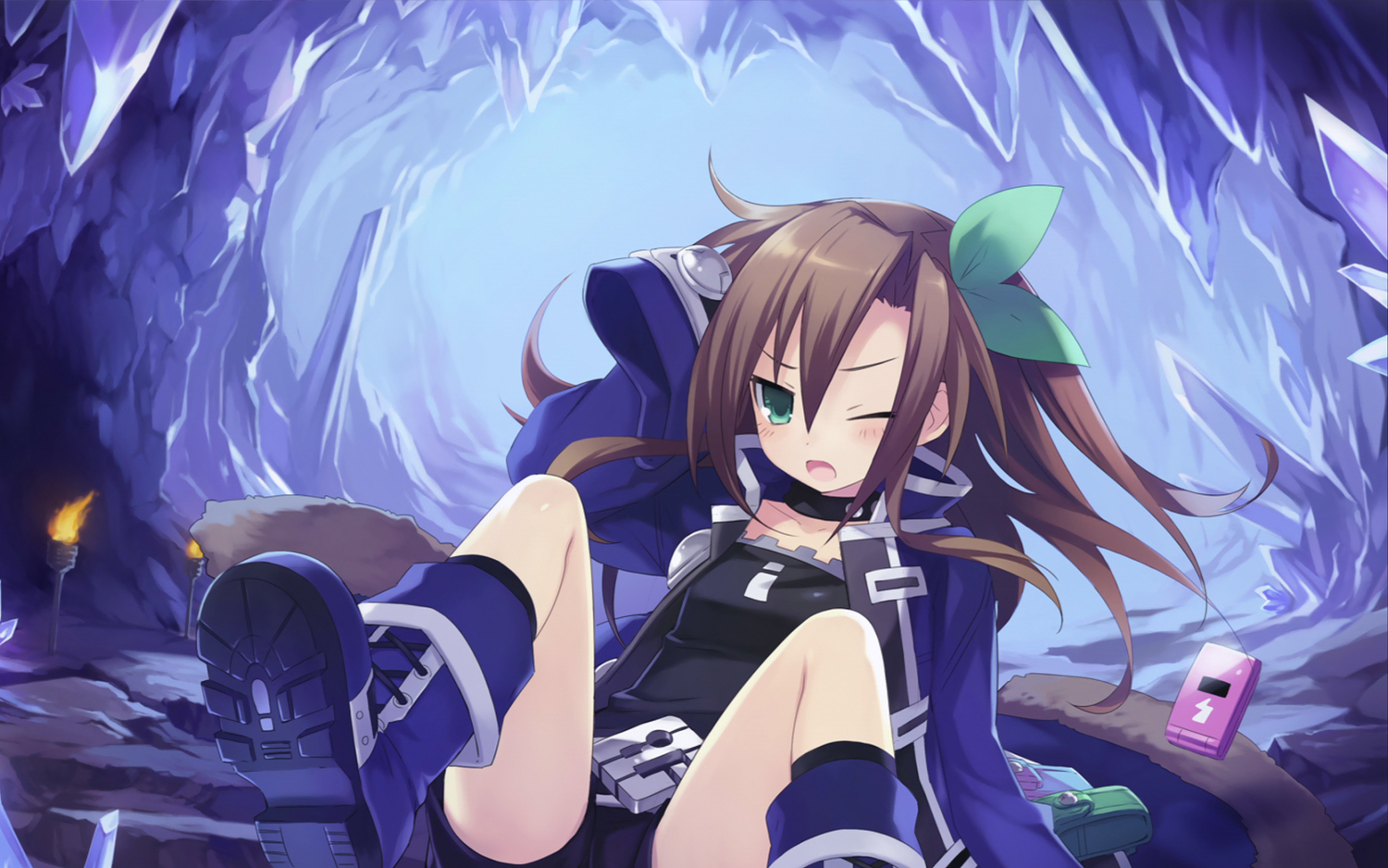
This is how you first encounter IF, Iffy, I-chan.There's a bunch of DLC, 90% of which is completely unnecessary. For the true Hyperdimension Neptunia fan, the game carries a wide selection of downloadable content, most of which takes the form of free additional quests that can be added into the game. Most players who download these will be very surprised to discover that a lot of them have recommended levels well into the hundreds, while the level cap in the game is just 99. You can, however, purchase extensions to the level cap to take it right up to 999, along with "boosters" to increase the various characters' stats if you're really struggling. None of these are essential, and these high-level dungeons provide the exact same experience as the rest of the game, so they're really not worth downloading. (If you do want to grind to 999, it will take you roughly the length of the rest of the game put together doing the same dungeon over and over and over again. Methinks someone was having a laugh with this DLC.)

The other 10% of the DLC should probably have been in the game in the first place. There are four pieces of DLC that are worth buying — two "battle tickets" that allow the use of otherwise non-playable party members in combat, and two additional characters who have their own sequence of event scenes. Again, none of these are essential — the additional characters' plotlines tend to be kept fairly separate to the main core of the party, and you get plenty of characters over the course of the main game to fill up your party — but it's curious that these weren't just included on the game disc. (They're not on-disc DLC, either — each is a 100MB+ download.) Given that you can find a copy of the game for not-very-much-money fairly easily these days, I didn't really object to paying a couple of extra quid to see what I might be missing out on — as it happens, they were a nice addition, but I'm not sure I would have missed them if I chose to forgo the DLC.

The characters are memorable and adorable. For all the game's flaws, the thing that kept me coming back over and over again until the very end was the cast. While most of them are recognisable anime archetypes, the self-aware nature of much of the game's humour means that they're not above calling each other out when they're behaving in a particularly stereotypical fashion. The central cast of the ditzy, airheaded Neptune, the pink and fluffy cries-at-the-slightest-provocation girly-girl Compa and the rational, sensible but somewhat tsundere IF complement each other perfectly, and poor old IF, as the "straight man" (well, woman) of the ensemble usually ends up having to deal with the aftermath of all the other characters' idiosyncracies. She's by far the most sympathetic character by the end of the game, but there's something eminently likeable about all the rest of them, too.

So there you go. A list of facts about Hyperdimension Neptunia. Don't go into it thinking it's going to be the best thing ever because you will almost inevitably be disappointed. If you have a lot of patience for what is essentially a combination of an old-school, combat-heavy JRPG and a visual novel, however, there's a highly enjoyable experience with some very memorable characters and some endearingly self-referential humour to be had here. If that sounds like your sort of thing, give it a shot.

I'll be starting the sequel tomorrow, and I understand that's a superior experience. I'll be interested to see quite how different it is.