#oneaday Day 646: #justice4rts... again

The thoroughly lovely video maker and online pal RoseTintedSpectrum has just received an unwelcome email from YouTube informing him that his channel is "no longer eligible for monetisation" due to "reused content". A link in the email then goes on to define "reused content" as material that "is not clearly an original creation of this channel and may have been repurposed from another source without adding significant original commentary, substantive modifications or educational or entertainment value."

If you've ever watched any of Rosie's videos, you will know that he absolutely adds "significant original commentary, substantive modifications" and "educational or entertainment value" to every one of his videos. If you're unfamiliar, Rosie's shtick these days is to go through an old TV show and provide acerbic, sarcastic but thoughtful commentary that is frequently hilarious. This commentary is often punctuated with original creative work that Rosie has produced, including remixes of songs in the show, all-original songs that he has created, and sometimes some absolutely brilliant overdubbing and re-editing.

His difficulties largely seem to stem from the fact that he primarily covers old TV shows now, and, as you might expect, making use of clips of these is rife with potential copyright issues. However, YouTube's provisions — and indeed the legal definitions of "fair use" and "fair dealings" — allow the use of copyrighted material, so long as the creator using that work is making substantive changes to them, making it clear that they cannot in any way be confused for the original material.

No-one is going to watch a video on Rosie's channel and say that he is making anything that could be confused for the original. No-one can possibly watch his channel and say that he has not made substantive, creative changes to the stuff he is providing commentary on. He puts in a whole lot more effort than a lot of "reaction" YouTubers — and at the very least, his work could be described as "reaction content". In reality it's much more than that, but since "reaction content" is one of the specific examples YouTube provides of material that can safely be monetised, it's a relevant, absolute bare minimum definition.

The infuriating thing about whenever something like this happens is the completely opaque way in which YouTube communicates these things. There's a problem with "reused content" — sure. Where? When? What video? Why, exactly, is this being picked up on now when it's been fine for several years? None of those questions are answered by YouTube, and you can bet your sweet bippy that they will make it as hard as humanly possible to speak to a living, breathing person who should be able to get this resolved in a matter of minutes.

It's bad enough when something like this happens to small creators who are making little to no money off YouTube. But Rosie, who has found some decent success on the platform over the last few years — and deservedly so — is using YouTube as an important income stream to support himself and his family. For that to be suddenly taken away without warning last thing on a Sunday night, of all times, is completely unacceptable.

At the very minimum, platforms like YouTube should be legally obligated to say exactly what the problem is when inflicting as harsh a punishment as "you now can't make any money from your videos". I suspect the reason they don't is because the majority of this shit is the fault of their "automated systems", and they don't want to admit that sometimes (quite often) they get things very, very wrong.

This is, after all, the second time this has happened to Rosie after a similar incident in November of 2024. Thankfully, that was eventually resolved after a concerted effort by Rosie and people who cared about him — here's hoping that this time is similarly fixed, and our friend can get back to doing what he does best, and what he loves doing.

In the meantime, if you're not subscribed to Rosie, drop by his channel. He's got a lot of great videos there, and deserves your support.


Want to read my thoughts on various video games, visual novels and other popular culture things? Stop by MoeGamer.net, my site for all things fun where I am generally a lot more cheerful. And if you fancy watching some vids on classic games, drop by my YouTube channel.

If you want this nonsense in your inbox every day, please feel free to subscribe via email. Your email address won't be used for anything else.

#oneaday Day 257: When it's bollocks, say it's bollocks

I am an avid reader of Ed Zitron's blog (sorry, newsletter, because apparently that's just what we call blogs now) Where's Your Ed At? If you're at all interested in the tech space, I highly recommend you subscribe or at least check in on it regularly, because Zitron is one of the only people in the space who has the balls to say it like it is: that an awful lot of what is coming out of the mouths of tech companies right now is complete and utter bollocks.

Today, a story went round about a research project at Microsoft where they were using generative AI for "game ideation", and also noted that they thought they could use their generative AI models for "preservation". This was reported on by Tom Warren, senior editor at The Verge, thus (screenshotted rather than embedded 'cause the coward deleted it after everyone dunked on it):

Now, if you know anything about video game preservation, you know that feeding an old game into a generative AI model and then hoping it will hallucinate at least a rough approximation of the original game experience is not "preservation". It's bastardisation at best, a completely useless endeavour at worst, and a massive waste of energy and money regardless of the result that comes out of the other end.

Game preservation is a problem that, for the most part, we have solved. We have excellent software emulation solutions, built over the course of decades of development. Hardware emulation via FPGA at an affordable cost for the general public has advanced hugely in just a few short years. Software libraries for pretty much any system you can think of are archived in their entirety at numerous places across the Internet, and strong strides have been made in providing commercial, legally relicensed versions of classic games for a modern audience, both on existing modern systems and on bespoke emulation-centric devices.

So why, then, why the fuck would we want a generative AI model to make a best guess at what a video game that already exists and has been preserved perfectly well might look like if you play it for longer than 10 frames?

That paragraph above is what tech journalists should be asking. And the reason I bring up Ed Zitron at the start of this post is because he's one of the only people to actually ask questions like this: to take a look at the utter garbage being spewed by today's tech companies and to say "this is complete horseshit, what the actual fuck are you on?"

And Zitron, being an outspoken type, is not afraid to call out today's tech journalism space for not doing this. And he's absolutely right to do so. It is the tech journalism sector's job to look at what it going on, to realise that it is complete horseshit and then have the confidence to say that it is complete horseshit.

But they won't do that, for a variety of reasons. Advertising deals. Exclusive access. PR partnerships. An inexplicable desire not to rock the boat, despite the fact the boat has a huge hole in it and has been steadily sinking for 15-20 years at this point.

I'm not one of those people who thinks that journalists are taking bribes for positive reviews in literally all circumstances — I have experience in the industry, remember, and the most I had to worry about in that regard was a mild admonishment from my editor for criticising a Mortal Kombat game's DLC plan when Mortal Kombat was the cover game for that issue of GamePro.

But come on now. Tech journos should be looking at this utter garbage that keeps getting flung our way, and instead of declaring it "interesting" and doing the stupid looky-eyes emoji that makes their post immediately look like a 14 year old girl wrote it, they should be going "hang on a minute, what does that actually mean?" then exploring it further, asking some probing questions (which inevitably won't get a response, but that in itself says something) and then confidently declaring the latest generative AI "innovation" to be what it is: complete and utter horseshit doused in the finest snake oil.

And people wonder why the entire journalism sector is floundering. Could it perhaps be because very little actual journalism seems to be getting done?

Shout-out at this point not only to Ed Zitron's aforementioned blog, but also the excellent coverage of the Elon Musk nonsense in the States by Wired's politics department, 404 Media being a rare example of tech journalism that actually asks those hard-hitting questions, and Aftermath for doing something similar with games journalism. There are still people doing good work out there. But the people on the big, well-known mastheads, like Warren above, need to step their game up, stop being so incredulous and start acting like actual journalists.


Want to read my thoughts on various video games, visual novels and other popular culture things? Stop by MoeGamer.net, my site for all things fun where I am generally a lot more cheerful. And if you fancy watching some vids on classic games, drop by my YouTube channel.

If you want this nonsense in your inbox every day, please feel free to subscribe via email. Your email address won't be used for anything else.

2488: That Happened

0488_001

Are you familiar with the subreddit /r/thatHappened? It is one of the more popular subreddits out there, devoted to posting the sort of "PLEASE LIKE AND SHARE!!" garbage that people so like to festoon their social media walls with these days.

Posts that crop up on /r/thatHappened typically have a number of things in common.

Firstly, they usually involve someone making a point of saying they were doing something entirely mundane, like going to school or filling their car with petrol.

Next, they introduce another character of some description, typically a stranger, but one whom the author of the post mysteriously seems to know absolutely everything about, right down to their ethnicity, age, employment status, affluence and anything else you'd care to mention.

Optionally, a child can be involved in the story. If a child is involved in the story, said child will be quoted saying something that no child in the world has ever said, something which can easily be discerned by the use of vocabulary or turn of phrase. Even at my most precocious growing up, when I knew what words like "floccinaucinihilipilification" and "antidisestablishmentarianism" meant (and how to spell them), I still spoke like, y'know, a kid. Kids in these stories never do, usually coming out with some sort of profound wisdom you'd normally expect to hear from a wizened old karate master or something.

The author of the story, the character they introduced (who is inevitably a minority of some description) and/or the child will then become involved in some sort of altercation with an antagonist, who is almost definitely a white male, because as we all know white men are all literally Satan.

The story will then go one of two ways. 1) The author, the character and/or the child will then devastate their opponent in some exaggerated manner, either physically or with razor-sharp wit. The white male(s) will then inevitably leave with their tails between their legs. Alternatively, 2) The author, the character and/or the child will suffer some sort of sexist, racist, ableist, homophobic or transphobic indignity that is so profoundly terrible that the author's immediate reaction was to post it on Facebook rather than take it to the authorities.

In the case of 1): If the altercation took place in a public place such as a school, petrol station or coffee shop, everyone surrounding the author, the character and/or the child will then spontaneously break into applause and at least one person will be crying.

In the case of 2): The author will blame the altercation on a major event that has happened in the news recently and will confess to be "crying right now", with bonus points if they are doing so "into [their] cereal" or some other foodstuff.

In both cases, the author will then attempt to sign off with some sort of quasi-poetic but ultimately asinine truism and encourage everyone to Like, Comment and Share their post to "raise awareness". Said post (which is inevitably set to Public visibility, even if the author typically keeps their social media pages private) will then receive multiple thousands of Likes, Comments and Shares through the phenomenon of virality, with a significant number of people sharing it doing so blindly without bothering to ponder how exactly something quite so improbable happened, or indeed questioning the author on further details of the incident. (This was a terrible racist/sexist/ableist incident, don't you know? You can't ask questions, you might traumatise the poor soul further!)

Once you're familiar with this template, you can spot bullshit a mile off. I encourage you to get intimately acquainted with it before clicking that "Share" button in the future. On a related note, I also encourage you to familiarise yourself with Snopes.com if you aren't already.

That is all.

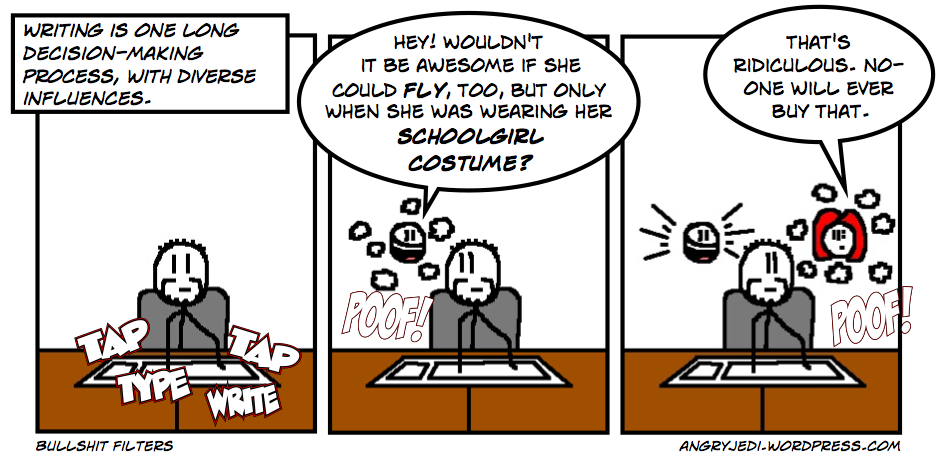
#oneaday, Day 344: Bullshit Filters

One of the biggest challenges in creative writing is overcoming your own personal bullshit filters—those parts of your brain that point out what you're writing is complete worthless nonsense and garbage that no-one in their right mind would ever want to read.

My own tolerance for nonsense is pretty high, as my enjoyment of JRPGs and love of Bayonetta will attest. But even when I'm writing creative stuff myself, I end up picturing some variant on Comic Book Guy reading what I've written and saying "BUT THAT WOULD NEVER HAPPEN!" I guess I have bullshit filters by proxy, as if I were writing stuff purely for myself, it could make as little sense as I please.

One simple way to overcome your own bullshit filters (whether or not they're proxies like mine), though, is to watch some movies or read some books. When you see how much nonsense other people—published people who actually get paid for their bullshit—put out, you'll feel a lot better.

Let's take Tron: Legacy for a moment, which I went to see the other night. This is a movie built almost entirely on nonsensical premises. Why are the programs in the computer personified as humans? Why do they behave in a human way? Why do they need vehicles? And given that the main distinguishing feature of one group in the movie is that they act "more human", what, in fact, is the difference between them and those who are already acting pretty human? How does a virtual projection of an aircraft stall at altitude in a virtual environment which presumably has no air? THAT WOULD NEVER HA—

Stop. Tron: Legacy isn't a bad movie despite the fact that all of the above issues are clearly nonsensical plot holes which spectacularly fail to be resolved by the end of the movie. I enjoyed it very much and intend going to see it again. In fact, Tron: Legacy is a movie which actually benefits from you specifically not trying to read too much into it. The reason the programs act human? Because it's relatable. The reason they drive vehicles? So there can be awesome action sequences. The reason a virtual aircraft stalls at altitude? Because it's exciting. Nothing more than that.

So it is when you're writing. Not everything has to be laced with hidden meanings, metaphors and commentary on the human condition. In fact, some of the best "hidden meanings" come about completely unintentionally, as an unconscious communication on the part of the author, an unconscious expression of something deep-seated in their mind that comes out in the things that they are writing. A window onto their soul, if you will.

Of course, some people can transcend that kind of writing and deliberately do clever things. But then they probably get labelled as "pretentious" and don't get appreciated in their own lifetime. And everyone wants to be appreciated in their own lifetime, right?

So, the next time you're writing something, take care that it makes sense, sure. But if you want to write something which initially appears to be "stupid", think about the rest of what you're writing too. Does it make sense in context, however "unrealistic" it might be when compared to reality? If so, then there absolutely is no reason that the Blood Sausage of Agamemnon can't turn into a semi truck at the push of a button when combined with the Amulet of Lindor under a full moon.

And if you still feel what you're writing is ridiculous, go watch Tron: Legacy.

One A Day, Day 12: It's pronounced B-O-LL-O-CK-S.

Good evening! Since my wife's viewing of televisual car crash Popstar to Opera Star precludes my playing of Mass Effect and its sequel on the TV, and Star Trek Online has decided to update itself with a patch that will take 5 hours to download on Steam (despite the fact I was playing it earlier with no problems), now's as good a time as any to get today's entry done.

Today I would like to rant about phonics, since I had a long, boring, pointless and patronising training day on this very subject today.

For the uninitiated, phonics is the theory which suggests that children should learn reading by sounding out individual phonemes in words, then learn how to "blend" them together where appropriate. It also suggests that it's sensible to teach six-year olds the words "morpheme", "phoneme", "grapheme", "digraph" and "trigraph" – words which I didn't come across until I studied English Language at A-level (age 16-18) and again at university.

The flaw, in case you haven't spotted it, is that English isn't a phonetic language. We have so many different ways of pronouncing each letter in our alphabet that using phonics to teach reading quickly becomes useless – and in the meantime, it fucks up spelling ability.

As if to emphasise this point, the official materials for teaching phonics from the government include an appendix of the most "high-frequency" words in the English language. Out of the thirty most-used words in the English language, fourteen of them are designated "tricky" words, which means that the phonics rules don't apply to them. Well, if the phonics rules don't apply to almost half of the most common words in the language, exactly what use is it to anyone?

The funny thing is, I can't remember how I learned to read. I imagine that's not an uncommon thought – childhood memories fade over time, after all – but I'm pretty sure it didn't involve phonics at any point. I can tell this because I can spell, and don't think that because "rough" is pronounced "r-u-ff" that it should be spelled that way too, which is what I see kids doing on a daily basis.

It's difficult to know what to suggest, though. Phonics is fashionable. Someone somewhere said it was "good" and it stuck. As with most fashions, this is nothing to do with how good it is. It is simply the "in" thing at the time.

It doesn't help, of course, that the leader of today's training day was a patronising, aggressive middle-aged harpy who clearly had a chip on her shoulder about something. Her holier-than-thou attitude towards phonics and teaching reading and her steadfast refusal to consider any alternatives (even doing an arrogant "shaking head" movement whenever anyone raised a point she didn't agree with) made everyone resent the process even more than its inherent stupidity already did.

This video pretty much sums up the problem:

(Thanks to Jeff Parsons for bringing this to my attention.)

Here's a poem, too. Don't say I'm not good to you.

I take it you already know
Of tough and bough and cough and dough?
Others may stumble, but not you,
On hiccough, thorough, lough and through?
Well done! And now you wish, perhaps,
To learn of less familiar traps?
Beware of heard, a dreadful word
That looks like beard and sounds like bird,
And dead: it’s said like bed, not bead –
For goodness sake don’t call it deed!
Watch out for meat and great and threat
(They rhyme with suite and straight and debt).
A moth is not a moth in mother,
Nor both in bother, broth in brother,
And here is not a match for there
Nor dear and fear for bear and pear,
And then there’s dose and rose and lose –
Just look them up – and goose and choose,
And cork and work and card and ward,
And font and front and word and sword,
And do and go and thwart and cart –
Come, come, I’ve hardly made a start!
A dreadful language? Man alive!
I’d mastered it when I was five!

Quoted by Vivian Cook and Melvin Bragg 2004,
by Richard Krogh, in D Bolinger & D A Sears, Aspects of Language, 1981,
and in Spelling Progress Bulletin March 1961, Brush up on your English.