2251: GTA Online: More Fun Than I Originally Gave it Credit For

0251_001

Some friends and I have managed to spend most of today playing Grand Theft Auto Online, the sprawling multiplayer mode for Grand Theft Auto V on… well, everything, but we were playing on PC, because we all have excellent gaming rigs and like it looking lovely and running at 60+ frames per second.

Anyway. Regular readers will know that my reaction to Grand Theft Auto Online has been somewhat lukewarm in the past, but today we had a ton of genuine fun, both in the free-roaming mode and in the more structured activities. I think it's finally won me over as something I want to play more of — I'm still unconvinced that I want to play it with strangers, as popular triple-A game multiplayer modes tend to attract the very worst kind of person, but I definitely want to do a lot more with friends.

It has problems, though; fairly significant ones for an online game. Mostly the issues relate to the overall clunkiness of setting up and managing online sessions. There's no party system, for instance, which makes sticking together with the same group of players when moving from activity to activity a little troublesome at times, though the addition of the "Remain Host" option alleviates this somewhat by ensuring whoever initiates an activity remains in control of the session's options after it's over.

The problems with the party system are further compounded by Rockstar's insistence on using its own proprietary login system for online IDs — the Rockstar Social Club. I can understand why they've done this — there's some nice detailed stat-tracking and suchlike on the Social Club website — but it's a shame it doesn't integrate with something like Steam. On consoles it integrates perfectly with Xbox Live and PlayStation Network, making it straightforward to find and invite people, whereas the addition of an extra layer of user IDs and accounts on the PC version makes it a bit of a faff to get set up to play with friends. Social Club is also a bit of a temperamental beast; we spent nearly an hour at the start of our session earlier with one of our friends steadfastly appearing offline despite him being logged in to GTA Online; turned out the solution was just to open the Social Club interface in game, and then he magically appeared online. Dumb. Broken.

Fortunately, once it works, it seems to stay working for the most part, and while there are a few aspects of the experience you miss out on when playing in small, private sessions rather than in large public games, we certainly didn't feel like we were being deprived of anything to do. Pleasingly, there are a lot of activities tuned for 4 players, which is typically the number of people we manage to have available at any one time, so there were plenty of options for us.

Over time, Grand Theft Auto Online has expanded with a veritable fuckton of new game modes and ways to play, too; open-world activities in Free Mode might challenge you to capture and control an area on the map; "adversary" modes give you unconventional and sometimes asymmetrical ways to compete against each other; missions provide relatively freeform objectives for you to complete as a group. And then, of course, there are the Heists, which we are yet to see one through to its conclusion, but which promise to be a ton of fun.

Particular highlights for us today included the "Hasta la Vista" adversary mode, in which the four participants are split into two teams: two on pedal bicycles, two in big rig truck cabs. The players on the bikes have to reach the finish line. The players in the trucks have to stop them by flattening them. The huge difference in weight, size and manoeuvreability between the two teams makes for a really fun, silly experience that is much more interesting than a straightforward race.

We also had great fun with the air races. In our first race, which gave us free reign to choose our aircraft, I ill-advisedly attempted to fly a small passenger jet and failed miserably to complete the course. In the second, we all flew small, nimble aerobatic planes, and — particularly when played in first-person — it was thrilling and terrifying.

Even just straight deathmatches are fun. The realistic city environments in which the game takes place make for great places to play cat-and-mouse (with shotguns), and it's immensely satisfying to battle your friends for ultimate supremacy, or at least bragging rights.

Grand Theft Auto Online feels like what Grand Theft Auto has always wanted to be: a realistic-looking but chaotic, silly, cartoonishly violent and darkly humorous playground for people to let loose in using a variety of methods: driving, flying, boating, skydiving, cycling, shooting, bombing, robbing, running, climbing, jumping… while I don't think anyone will ever make the argument that it's great art, it's not trying to be; it's a stark contrast from the single-player mode, which does tell a good story and tell it well. Rather, it's a game where the stories are, for the most part, emergent; the stories are the things you reminisce about with the friends you've been playing with, and most of them start with "do you remember that time when…?"

So yeah. Grand Theft Auto Online, your interface sucks and you need to hire people who understand how multiplayer games work. But despite all that, you've won me over. I'm greatly looking forward to the next time I can flatten my friends in a dump truck and blow them up with a rocket launcher.

2250: Is There Anything More to 'Senran Kagura 2' Than Big, Bouncing Cartoon Breasts?

0250_001

Senran Kagura 2: Deep Crimson is actually something of an increasing rarity in the modern games sphere: it's a sequel that actually rewards knowledge of its predecessors rather than acting as a standalone story or reboot. For sure, you can play through Deep Crimson without having played Senran Kagura Burst or Senran Kagura Shinovi Versus — despite the "2" in the title, this is actually the third in the series canonically, or fourth if you count the original Japanese release of the first half of Burst as Senran Kagura: Portrait of Girls — but you will get far, far more out of it if you have knowledge of the setting, characters and backstory of what's going on.

Senran Kagura as a series concerns itself with the happenings in the secret world of the shinobi. Trained in secret at specialised academies, shinobi are split into two main groups: "good" and "evil". "Good" shinobi follow orders, help people, Do No Wrong, that sort of thing. "Evil" shinobi do the more shadowy work that is more traditionally associated with those of the ninja persuasion — assassination, espionage and generally being a bit of a bastard without anyone finding out about it until it's much too late.

youma1Life can't be interpreted in such black-and-white terms, however; there are myriad shades of grey, and this becomes particularly apparent over the course of the Senran Kagura series' overarching narrative threads and themes. In Senran Kagura Burst, the "good" shinobi of Hanzou Academy came to understand a little more about their "evil" Hebijo counterparts and that they weren't so different despite their theoretically opposing ideologies; in Senran Kagura Shinovi Versus, we learned the truth about this stark good-evil divide: it's an artificially created construct intended to provoke bloodshed between the two opposing sides, the net result of which lures horrific creatures known as youma out of the darkness so they can be slain by high-ranking shinobi.

In Deep Crimson, the questions over what "good" and "evil" really mean are further raised when the Hanzou students are tasked with initially capturing and then slaying a young girl called Kagura. Kagura, it seems, is destined to fend off the youma in particularly spectacular fashion, so surely the "good" shinobi want to keep her safe rather than splatter her over the nearest wall? Being good little, well, good shinobi, though, they set about making preparations for their mission, because good shinobi follow orders and don't question them. It takes the "evil" shinobi of Homura's Crimson Squad — the former Hebijo students — to convince them to think for themselves and realise that questioning this sort of drastic action is really probably okay if you stop to think about it for just a moment or two. And indeed, there's quite a lot more to Kagura than initially appears.

youma2In Senran Kagura Burst, the relationships between the Hanzou and Hebijo girls was explored through each of them fighting one another and coming to an understanding with their opposing counterpart. It was revealed that "evil" is actually a more inclusive concept than "good" in the world of Senran Kagura, since "good" can turn people away for "not being good enough", while "evil" accepts everyone, no matter how nice or nasty they might have been in the past. Indeed, Burst's storyline — particularly the Hebijo-specific path — takes great pains to humanise the Hebijo girls and depict them as interesting, flawed and often tragic characters who all have their own reasons for turning to the darker path.

In Deep Crimson, these relationships are further explored in a number of different ways, both through the narrative and through the game mechanics. A significant addition to Burst's 2.5D brawling action is the ability to play missions in cooperative pairs, either with another player on a second 3DS system or with the AI taking control of the other character and you being able to switch the one you're in direct control of at will. The game's narrative makes a point of putting "opposing" — or perhaps it's better to say "complementary" — characters together; here, rather than fighting against each other, as in Burst, the girls come to understand one another better by fighting alongside one another against the shared threat of the youma. This doesn't, of course, preclude the fact that a number of comic misunderstandings lead to physical altercations between these pairs at several points in the story — Senran Kagura as a series has always known how to strike a good balance between pathos, drama and humour — but the net result of all the girls' battles right up until the end of the game is that they all come to understand, appreciate and like one another better.

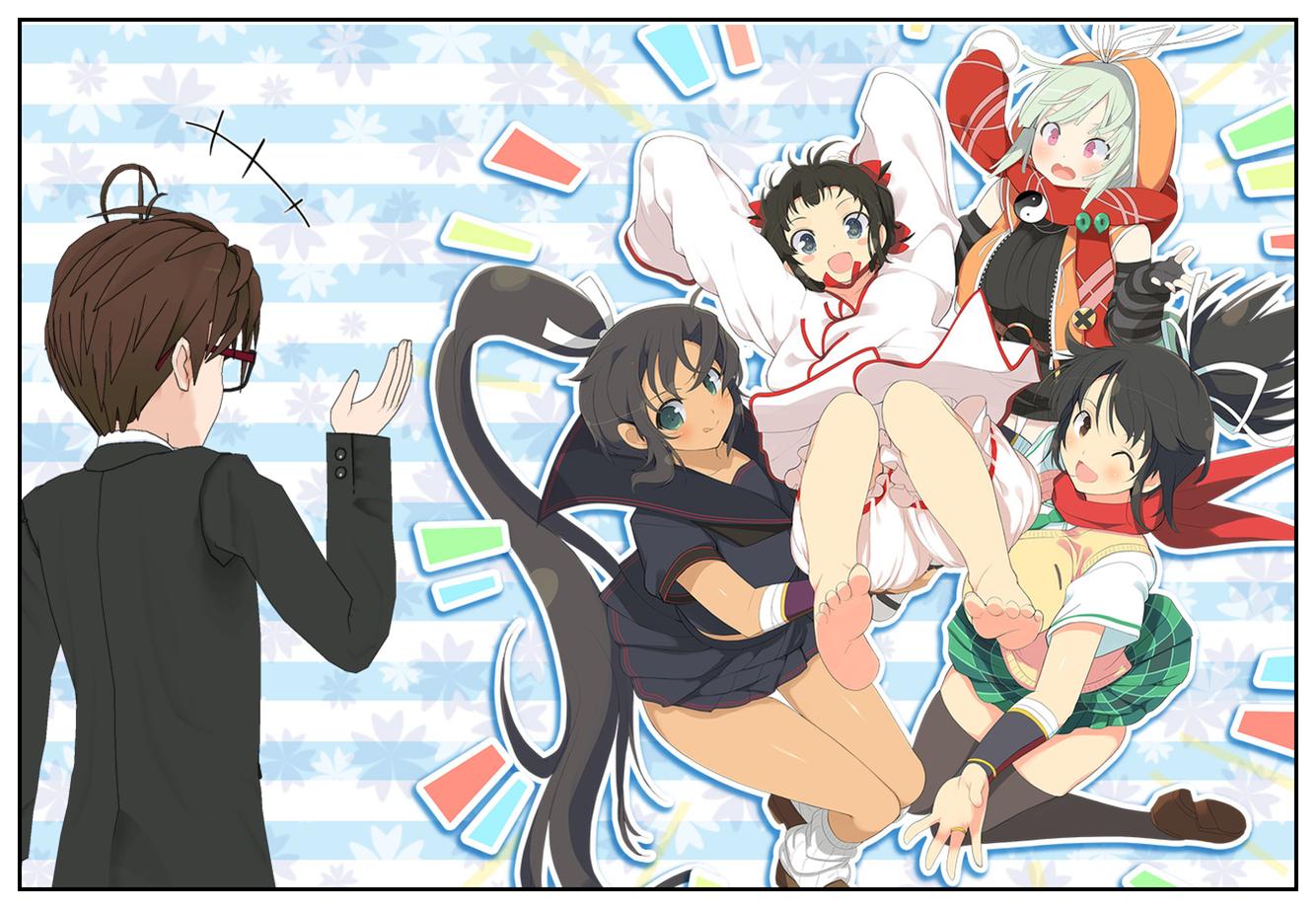
youma3This paired-up action is more than just a gimmick, too; the way it's presented really creates a strong sense of these characters being real people and having actual feelings towards one another. Whether it's the tomboyish, loudmouthed Katsuragi giving the emotionless Hikage an enthusiastic high-five after a successful combat or the dour but utterly besotted Yagyuu catching her darling Hibari in a perfect princess hold after a joint special attack, the game's beautiful animations are absolutely packed with personality, giving each character both a unique look and feel, making them all instantly recognisable.

This uniqueness extends to the way each of the girls plays as well. Far more so than in Senran Kagura Burst, at least, each girl has a very different fighting style, with their own unique button combinations required to unleash combo attacks and specific moves. While you can get away with button-mashing to a certain degree early in the game, once you start fighting more powerful bosses — and even more powerful individual enemies — factors such as positioning, launching, air control and dodging become significantly more important, and there are even some RPG-style status effects to inflict and contend with, just to make things that little bit more interesting.

Each character's three special moves are unique, too; while some are simple area-effect nukes around the character position, others are charge attacks across the arena, good for cutting through swathes of enemies, while others have more specialised uses that can turn the tide of battle in your favour. Of particular note is Haruka's "Death Kiss" move, which charms anyone hit with a large heart-shaped projectile and prevents them from attacking for a brief period; frustrating and combo-breaking when it hits you, massively useful when you're able to do it yourself.

youma4Unfolding across five separate chapters — each with an escalating focus and scope from the previous — and culminating with some dramatic moments of personal growth and epic conflict in the final chapter, Deep Crimson's narrative is a strong one that is paced well and feels like it's the series really hitting its stride. While Burst in particular felt like it was more concerned with introducing the characters and their relationships with one another — no bad thing in a series as characterisation-focused as this — Deep Crimson feels like the overall narrative of the series is moving significantly forwards. The characters aren't treading water: their personal growth in the previous installments is acknowledged and used as a basis for this game's narrative to build on, and this is where the particularly rewarding aspect of complete series familiarity comes in. It has, so far, been an absolute pleasure to witness these girls growing up and finding out more about themselves, their place in the world as people — and their place in the world as shinobi.

As I say, you can absolutely get some appreciation out of Deep Crimson if considering it in a vacuum, but the Senran Kagura series as a whole is at its most rewarding when you take in every piece of information available out there: creator Kenichiro Takaki and his team have created a very strong and believable setting and sense of context across these games, with some wonderfully human-feeling characters that interact with one another in relatable, believable ways — even when they're being silly rather than serious. Like other prolific Japanese series such as Neptunia, the cast has transcended its original context to become a convincing set of "virtual actors" who wouldn't feel out of place in situations other than fighting for their lives — indeed, we've already seen them put their weapons down and do other things in the immensely silly (but immensely entertaining) Senran Kagura Bon Appetit — and I sincerely hope that we see a lot more of these girls in the coming years.

Fortunately, I needn't lament that my time with them has come to a close with the conclusion of Deep Crimson's story, since Estival Versus has just released and is eagerly awaiting insertion into my PS4. More thoughts on that to come when I've spent some time with it.

Oh, hold on now, I didn't answer the question in the headline, did I?

YES

2249: Catching Up on Deep Crimson

0249_001

My copy of Senran Kagura Estival Versus arrived the other day. I haven't booted it up yet, because I realised that I was yet to play through its predecessor, the 3DS-based Senran Kagura 2: Deep Crimson. Since the Senran Kagura series is heavily narrative-based and subsequent installments often make reference to events in their predecessors — even between the "main" series on 3DS and the Versus subseries on Sony platforms — I didn't want to jump into Estival Versus until I had, at the very least, beaten the main story of Deep Crimson.

I find the contrast between the 3DS and Sony incarnations of Senran Kagura to be quite interesting. The 3DS games, being the "canonical" storylines, for want of a better word, play like modernisations of 2.5D brawlers such as Streets of Rage, while the Sony games unfold with more of a sense of "3D", feeling more like a blend between Dissidia Final Fantasy and Omega Force's Warriors/Musou series. I'm torn as to which I prefer, to be honest; I've always had a major soft spot for 2.5D brawlers, and, upon firing up Senran Kagura Burst for the first time and discovering it was essentially a new Streets of Rage game, I was delighted. That said, the Versus series seems to be the one that tends to be more well-received, and I like the larger, extended cast that they incorporate.

I don't have to pick a favourite, do I? No? Then I won't. I love them all.

All right, Deep Crimson then. I'm coming up on the last missions of the game having blasted through the previous four chapters, and I've been really enjoying it so far. One thing that has developed considerably from Burst is the fact that each character feels very different to the others now. A lot of Burst could be got through by mashing the attack button and occasionally avoiding enemy attacks, though naturally you'd get more out of it — particularly in boss fights — if you learned some of the combos and when the characters' special moves are especially effective. Deep Crimson, meanwhile, roundly punishes button-mashing, since there appears to be some sort of attack priority system going on, where hurling yourself at the front of an enemy while flailing wildly is a sure-fire way to get yourself defeated swiftly. Instead, mixing up light and strong attacks with air attacks, launches and special moves is essential; it feels much more like a "fighting game" than a button-mashing brawler, which is both enjoyable and rewarding. (Not that there's anything wrong with a button-mashing brawler, of course; I still love me some Streets of Rage.)

Of particular note is the increased emphasis on special moves' usefulness. I got through a lot of Burst and Shinovi Versus without making heavy use of these impressive, powerful moves, but Deep Crimson makes effective use of them a necessity. In a nice nod to series narrative continuity, all the girls start with their powered-up moves that they learned in the previous games, too, providing three distinct, situational moves to unleash at the appropriate time — and if you've wailed on your opponent enough to charge up your ninja scroll meter too, of course. There's a nice mix between area-effect nukes, frontal cones, charge attacks and some outright bizarre abilities (Hibari's "now I'm a giant and I'ma stomp on you!" move is particularly peculiar) that means learning how each character plays is essential; you can't go in hitting buttons randomly and hope for the best, particularly in the tougher fights against stronger individual opponents or duos.

Narrative-wise, Deep Crimson raises the stakes significantly from Burst and even Shinovi VersusBurst was, up until its final moments, heavily slice-of-life in nature, albeit slice-of-life with shinobi battles. There was a big, ridiculous final boss battle in its final chapter that teased where the series might go in the future, but then it ended. Shinovi Versus, meanwhile, again concentrated on the daily lives and backstories of the characters, but ended with an even bigger tease about the truth behind shinobi in the modern world: their mission to reveal and battle youma, hugely destructive evil creatures who demand blood sacrifices and generally fuck shit up.

After two games of us only ever seeing one youma though — Burst's final boss Orochi, whom you fight both on the inside and the outside depending on which of the two main narrative paths you follow — I was beginning to wonder if youma were going to be one of those threats that was always mentioned in hushed whispers but never actually seen. I thought it would be disappointing if we didn't get to fight some big slobbering monsters, though, because although it's fun to see some shinobi-on-shinobi action, some big slobbering monsters would mix things up nicely.

Deep Crimson is well aware that I probably wasn't the only person feeling like this, and opens with a retelling of Burst's final moments, and then only continues to escalate from there. It tells an interesting tale that delves further into the overall series mythology — particularly the role of the high-ranking ninjas and of Kagura, a mysterious young girl who shows up and appears to be destined to fight youma.

The particularly interesting thing about the narrative is how it plays with the concepts of good and evil. This is always something that Senran Kagura has been particularly good at, with the majority of both Burst and Shinovi Versus exploring the nature of what "good" and "evil" shinobi really mean, and how people can find ways to build bridges across the frothing waters of conflicting ideologies. With Deep Crimson, though, the Hanzou girls — canonically the "good guys" — find themselves confronted with an order that they're not sure is really the right thing to do. Meanwhile, Homura's Crimson Squad, the former Hebijo Academy students and the characters originally positioned as the "bad guys", are placed in the position of doing what you'd traditionally expect the heroes of the piece to be doing.

The other thing that's interesting — and the thing I love the most about Senran Kagura as a whole — is how it juxtaposes the heavy, violent and often philosophical shinobi drama with the breezy silliness of a bunch of teenage girls trying to figure out who they are and what their place in the world is. Every single character in Senran Kagura is a well-defined, interesting person with a unique and worthwhile backstory, and they all get their own time in the limelight. Some characters — Homura is a particularly good example — undergo a huge amount of personal growth and development over the course of the series, and it's been a real pleasure so far to watch these girls grow up, learn about themselves and their place in shinobi society.

This latter aspect in particular is what makes me so infuriated when people dismiss the series as "just boobs". There's some truly remarkable character and plot development going on in this series. Yes, there are big jiggly boobs; yes there are panty shots; yes, combat usually concludes with all the participants stripped down to their undies, but none of this takes away from the well-written, extremely well-characterised drama (and comedy!) that provides the context for the action. It truly is a series deserving of more credit than it gets, and as I close in on the end of Deep Crimson I find myself enormously excited to jump in to Estival Versus, whose core concept promises to tug at the heartstrings particularly strongly. But that's a story for another day, of course.

"Just boobs" my arse.

2248: Pinning Down the Problem with Coverage of Niche Games Like Senran Kagura

0248_001

I made a mistake last night; actually, I made two. I read a Kotaku article, and then I commented on it.

The article in question was Mike Fahey's "Let's See How Long it Takes Senran Kagura to Make You Uncomfortable", which took the form of a Let's Play of the first half an hour of the game — well, the first half an hour of story, to be precise, up to the opening credits — and which was written in an obnoxiously holier-than-thou tone, with Fahey claiming that he is okay with fanservice, but then going on to completely contradict himself by not engaging with latest Senran Kagura game Estival Versus on anything more than the most superficial level.

I'm not going to take that article apart piece by piece because I already did that in my comment, which, within two replies, had me being accused of being a paedophile — how predictable thou art, Internet — but instead I want to talk a bit more broadly about what I think the issue is with coverage of popular but niche-interest titles such as Senran Kagura and Japanese games in general.

Sex.

Not the presence of sexual, titillating, provocative, ecchi or even hentai content; I'm all for that, and happy whenever games feature it in an unabashed manner. But the fact that whenever mainstream games writers come across one of these games, that is all they can fucking talk about.

Let's focus specifically on Senran Kagura for a moment. As legend has it, Senran Kagura as a series exists because creator Kenichiro Takaki wanted to see boobs popping out of the Nintendo 3DS' stereoscopic 3D screen. A shallow inspiration, for sure, and if he'd left it at that — if Senran Kagura had been nothing but pretty girls thrusting their boobs in your face — then the series would have sunk without trace before it even became a series. Instead, we're now confronted with Estival Versus, which is the sixth game in a series that has only been around since 2011 — a series which shows no sign of slowing down and, rather, much like fellow beloved niche series Neptunia, continues to go from strength to strength with each installment.

Surely "3D boobs" aren't enough to carry six games' worth of content, though, I hear you say, and you'd be absolutely right. The reason why Senran Kagura is so popular, and why it now spans four different platforms (Vita, PS4, 3DS and mobile) is because for all Takaki's bluster about "tits are life, ass is hometown", it is extremely, painfully obvious throughout every installment of the series that both Takaki and the people he works with absolutely adore these characters and want to tell interesting, enjoyable, emotional and thought-provoking stories with them. They also want to tell silly, funny, self-parodying stories with them. And they want us to watch these girls grow up, both as young women and as trainee shinobi. In other words, they want us to think of the complete Senran Kagura cast as, effectively, a set of "virtual actors" who can come back time and time again in different games, and fans will follow because they want to see what their favourite characters are up to, not because they want to see 3D boobs.

This is the frustrating thing that pieces such as Fahey's nonsense completely fails to take into account. Sexuality is part of Senran Kagura's aesthetic and appeal, sure, but it's not the main point. There are far more interesting things to talk about, such as the relationships between the girls, the nature of good and evil, the series' extensive use of Japanese mythology (specifically the subject of youma), the juxtaposition between the narratives' slice of life elements and the more fantastical shinobi elements, and how each and every one of those characters has gone on a significant personal, emotional journey since their first appearance in their respective games. (Mobile game New Wave is arguably the exception to this, being your bog-standard Mobage virtual collectible card game with non-existent gameplay, but, what with it being a mobile game, I don't really take it particularly seriously anyway.)

To put it another way, when writing about Senran Kagura — or indeed any other Japanese game that decides to make use of a provocative art style or aesthetic — focusing entirely on the sexual elements and how "weird" they are or how "uncomfortable" they make you feel is doing both the game and the audience an enormous disservice. The majority of the games' audience know what they're getting into with regard to the fanservice, so they probably want to hear more about what makes each particular installment unique; what the most interesting parts of the narrative are; whether they stand by themselves or fit into a larger narrative — that sort of thing. Focusing on sexuality and how "problematic" this sort of thing is is nothing but lazy writing that requires little to no research; indeed, when Senran Kagura 2 came out last year, there was at least one review that proudly stated it was based on less than half an hour of playtime, and I'm honestly surprised we haven't seen more Estival Versus bullshit. The European release isn't until Friday, so perhaps there will be some more then — or perhaps I'll be pleasantly surprised. I'm not holding my breath.

What I want to see, then, is someone covering a title like Senran Kagura and treating the sexy stuff as just what it is: part of how the game looks, but not the point. I'd even like to see someone challenge themselves to write about it without mentioning the sexy stuff at all if they didn't think it was directly relevant to what they found interesting. I want to see someone engaging with it on a personal, emotional level: how did the story make them feel? Which characters did they relate to? Were they particularly attached to any specific pairings of characters? Which characters did they enjoy playing as, and did that match up with the characters they liked as people? Did they learn anything from the experience? Did they come away from the experience feeling like they had taken something away from it, either emotionally or in terms of knowledge or skills?

These sorts of things are surely basic questions when it comes to criticism of creative works, but it seems they're too far beyond your average games journalist in 2016, who would rather post animated GIFs, talk about how jiggly boobies make his swimsuit area feel a bit funny and make implicit assumptions about people who do like this sort of thing — assumptions that are further reinforced by the attitudes of people in the comments section, who make people with differing viewpoints afraid to speak their mind for fear of being branded as something extremely unpleasant.#

The sad thing is that something like Senran Kagura ticks a whole lot of boxes that these hand-wringing idiots claim to want from their games: powerful, non-submissive women in lead roles; the presence of "people of colour" (God how I hate that fucking phrase); stories that acknowledge the complexity of emotions within the human heart and mind; gameplay that reflects the narrative themes; sensitive treatment of distinctly "adult" concepts, including trauma… the list goes on.

And yet because boobs, they either fail to see — or deliberately ignore — the presence of all these things. That's just sad; not (just) because I'm fed up of reading this sort of spastic dribbling on wannabe tabloid sites (not to mention feeling the need to write my own spastic dribbling in response) but because there are a lot of people out there who are deliberately, willfully depriving themselves of some excellent, intriguing, engaging and emotional gaming experiences, all because they can't look past something a bit sexy.

As I said on Twitter earlier today: thank heavens for social media and personal blogs, at least, where people who are actually into this sort of thing can find one another and enthuse about the things they love at great length without worrying about offending the always-offended. I just wish we hadn't been so let down by the media.

2247: Yuru Yuri: Charming, Dumb, Gay as a Window

0247_001

I finally started watching the third season of Yuru Yuri, an anime whose first two seasons I found immensely enjoyable despite it being one of those "slice of life" affairs where pretty much nothing of note happens throughout.

Yuru Yuri is packed with charm and some wonderful characters, though, and it's through the strength of these characters that the show truly shines.

For the uninitiated, Yuru Yuri follows the total lack of adventures of a group of four schoolgirls who form a club that doesn't really do anything except hang out and drink tea. Over the course of the first couple of series, a few other regular cast members were added, and each of these put in frequent appearances in the third season — so frequent, in fact, that, judging by the new title sequence, they're now considered to be core members of the cast rather than regular recurring characters.

The astute and/or weebtastic among you will know that yuri is used to refer to Japanese popular media with lesbian undertones (or indeed explicit overtones) and the inclusion of this term in the show's title is no coincidence. There are no male characters in the show whatsoever, and there are numerous members of the cast — both regular and irregular recurring — who clearly have the hots for another one of the girls.

The most obvious is first-year Chinatsu's infatuation with her cool, calm and collected senpai Yui, but there's also the clear attraction between the mostly sensible (but painfully tsundere) student council vice-president Ayano and the utterly chaotic, hilarious Kyouko, who is a total dick but somehow immensely likeable with it. Then there's former series protagonist Akari's older sister Akane, who puts up a facade of being the sensible onee-san, but is actually a complete siscon, degenerating into wildly inappropriate acts with Akari's possessions whenever she's by herself (or thinks she's by herself). And Chinatsu's sister Tomoko, who is infatuated with Akane. And… you get the idea. There's a whole lot of lady-love going on.

This isn't an ecchi show by any means, though; the yuri side of things isn't fetishised at all, and we never actually see anything going on between these characters. It's a show that, when it deals with feelings of affection, prefers the more romantic side of love in the schoolyard rather than anything overtly sexual. It's all sidelong glances, lingering looks, wondering if that contact was intentional; of course, some characters make their feelings more obvious than others — Chinatsu and Ayano both being the most obviously gay for their respective objects of affection, albeit in different ways — but still, for the most part, the show depends on the feeling of "will they ever realise or acknowledge their feelings for one another?" and actually resolving one of these strung-out instances of romantic tension would almost certainly throw the rhythm and feel of the show off somewhat.

Mostly, though, Yuru Yuri is a show that makes me feel happy when I watch it. It's not deep and meaningful and it doesn't have anything especially profound to say beyond "friends are great", but it's always a pleasure to enjoy an episode. It's one of those shows where you feel like you're being included in a group of friends just hanging out and having fun; there's no real point to it all, but it's nice to experience nonetheless.

2246: Games Journalists, Please Think of Something More Imaginative Than These Articles

0246_001

While browsing Twitter yesterday, I happened to notice a piece from my former place of employment USgamer pondering that age-old question "which Zelda game is best?" — presumably to tie in with the recent release of Twilight Princess HD on Wii U. (EDIT: I've just noticed that to add further clickbait to injury, it was split into three completely separate articles, one covering 25-18, another covering 17-11, and a final one covering the top 10.)

Now, "which Zelda game is best?" is a reasonable question to ask — I've asked it myself, back when I was getting back into the series a month or two ago — but it is a question that has been answered many hundreds of times already, both by gaming websites ("professionals") and the general public, too and, to be frank, we haven't had a genuinely new Zelda game for quite a while. Moreover, it's not a question that there is a definitive answer to; the entirely subjective stuff of playground arguments and, indeed, Internet arguments.

I found myself getting a bit annoyed at the sight of this article, though, because it just felt like such a lazy, obviously clickbaity attempt to cash in on the recent Zelda release, and just a lazy idea for an article in general. As I say, it's an article that has been written many times before by numerous different websites, and one that really didn't need to be written again. It is far from the only example of this sort of ever-present non-discussion coming up in games journalism as a side-effect of clickbait culture, though, and it's frustrating to see; when there are thousands and thousands of great, interesting, remarkable, unusual, weird games out there that these writers could be covering and they instead post the same article that they themselves have probably written before for a different site, they are doing a bad job writing about games.

With that in mind, here is a list of game articles I would like to never, ever see ever again on any website, not because they're necessarily bad ideas for articles, but because they've been done many, many, many times before. Use your imagination. Write something new.

  • Which Zelda Game is Best?
  • Those Zelda CD-i Games Sure Were Shit
  • Which Mario Game is Best?
  • Which Metroid Game is Best?
  • Which Nintendo First-Party Franchise is Best?
  • Gosh, Dark Souls is Hard
  • Dark Souls isn't Hard, You Just Have to Learn How to Play
  • [obscure indie game] is the Dark Souls of [unrelated genre]
  • Goodness Gracious, Battletoads was Hard
  • That One Level in Battletoads was Really Hard, Even Compared to the Rest of the Game
  • Which Final Fantasy Game is Best?
  • Where Did Final Fantasy Lose its Way?
  • Player Makes Thing in Minecraft
  • The Ten Best Xbox One/Xbox 360/PlayStation 3/PlayStation 4/Wii U/3DS/Vita Games
  • PlayStation 2 Classics That Deserve a Re-Release (actually, you can have this one if you pick something that isn't immediately obvious to everyone who ever owned a PS2)
  • The HD Remasters We Really Want (see above)
  • Ubisoft is Releasing an Open-World Game
  • Activision is Releasing a Call of Duty Game
  • Mobile Games Make Lots of Money
  • There Aren't Enough Women in Games (bonus points if you cry "sexism" on a game that actually has excellent female characters)
  • There Are Still People Playing World of Warcraft
  • I'm Scared of Boobs
  • Gamers are Horrible People
  • Anita Sarkeesian Says Something
  • Vita Games Don't Sell Many Copies
  • Vita is Dead
  • PlayStation 4 Has No Games
  • Xbox One Has No Games
  • Wii U Has No Games
  • Wii U is Dead
  • Nintendo is Dead
  • Hah, That Super Mario Bros. Movie was Rubbish, Wasn't It?
  • [Franchise] [vaguely related verb] onto [platform], e.g. Ridge Racer Screams onto PlayStation. (You can have this if you deliberately make the verb a completely inappropriate non-sequitur. Ridge Racer Masticates onto PlayStation)
  • Here's a Weird Thing from Japan, Judge It
  • Can Games Be Art?
  • Sonic the Hedgehog Used to Be Good
  • What's Next for [annualised series]?
  • Michael Pachter Says Something Blindingly Obvious
  • [popular annualised franchise] Sells [large number] of Copies
  • A Movie that People Who Like Games Might Like Came Out Recently, It Has Nothing to Do with Games but We Think You Want to Hear About It Anyway
  • Look, Star Wars

Ugh. It's depressing writing this list and realising how many times I've seen most of these on several different sites. We all know exactly why it happens, of course; these are the sorts of articles that either provoke an emotional response (and, consequently, clicks through to the comment section) or that are likely to be ranked highly on Google for unimaginative people searching for information.

In an ideal world, writing about games should be about the love of games, and the authors' passion for the things they're writing about should come through in their writing. Sometimes it does, but it happens a lot less frequently than it used to, and that's really sad.

At least I try and do my bit to show my passion for the things I love. I suggest you do too; if the press aren't going to provide, it's up to the public to provide the more valuable insights.

2245: Dungeon Travelers 2: Some Tips and Tricks

0245_001

With my post from the other day in mind, I thought I'd do the greater community a favour and compile some observations, tips and tricks that I've stumbled across during my time with Dungeon Travelers 2 on the Vita.

Dungeon Travelers 2 is a surprisingly complex game. Don't be discouraged if you find yourself struggling in the early game — there are plenty of opportunities to power yourself up and even put right any mistakes you might have made with character advancement. Experiment and find things that work for you; there is no real one "definitive" way to play that works for everyone, which is part of the beauty of the game.

I say this because the tips and tricks I'm about to share with you are based on my own experiences, and your mileage may vary according to how you prefer to play. In other words, these are not definitive strategies; rather, they're what's worked for me and the way I play.

So let's jump in.

Illuminate the situation

Light is your friend. It may not seem important in the early dungeons — largely because it isn't, for the most part — but the further you progress in the game, the more you're going to start running into illusionary walls, which are a real pain, since they, well, look like walls, but you can walk through them.

Fortunately, you're not expected to walk around butting your head into every wall on the off-chance it might lead somewhere. Firstly, you can use your map to determine if there's likely to be something beyond a wall; if there's a conspicuous gap, there might be something there, so you could try walking into it — or you could light up the dungeon using either the Flashlight item or the Priestess spell Light.

What does this do? Simple. Not only does it make the field screen brighter — helpful in those pesky Dark Zones — but it also renders all illusionary walls invisible, making formerly hidden passages visible. As such, you'll want to keep Light pretty much permanently up via one means or another — if you have a Priestess in your party, they can take care of this, otherwise you should make sure you carry a bunch of Flashlights with you.

Don't be too proud to retreat

Along the same lines, being able to escape quickly is also your friend. Conveniently, there's both an item and a Priestess spell to help with this too: the item Emergency Exit and the Priestess spell Return both immediately transport you out of the dungeon and back to the world map, allowing you to nip back to the Library to lick your wounds, sell all the crap cluttering up your inventory and restock on any items you might have used up.

Don't be too proud to do this. If your inventory is full, or your party is struggling, take a step back and return later.

Look out for shortcuts; unlock them before ending an expedition

With the above in mind, you'll want to keep an eye out for shortcuts, particularly if you were deep inside a dungeon. Shortcuts can usually be spotted by doors that are locked "from the other side" when you first come across them. At some point later in the dungeon, you'll reach the other side of that door and be able to unlock it, allowing you quick and easy access to the deeper reaches of the dungeon without having to go through the rigmarole you went through first time. Ideally, if you can push far enough through a dungeon to unlock a shortcut before escaping, that will make your life easier when you return.

Buff up before bosses

You will always get a warning before a boss fight — you'll "hear someone on the other side of the door" or "sense a strong presence on the other side of the door". When this happens, save and use any and all buff spells and abilities you have — because many of them can be used outside of combat. If you can go into a boss battle with useful skills like Brave, Protect and Moon Curtain up before you start, that means fewer initial turns wasted getting into a good position — initial turns where the boss may well decimate your party if you're not careful.

Think about party composition

There's a certain degree of flexibility in party composition, but you'll have an easier time of it if you stick to the old faithful "holy trinity" of tank, healer and damage-dealers. One or two tanks can make up your front line, while your back line can be ranged damage-dealers and your healer.

Remember that not everyone has to deal damage to be useful; tanks, for example, are well-served by investing skill points in defensive abilities that help them protect the rest of the party, rather than trying to be a physical damage-dealer class.

Do note that if you want to see all the sub-events in the game, you'll need to take trips into the dungeons with as many different combinations of characters as possible — and sometimes ensure you have some peculiar items in your inventory.

Know your stats and equip your party accordingly

Tanks want DEF and probably some decent ATK too.

Ranged attackers want ATK, DEX and AGI doesn't hurt.

Mages want INT, which primarily comes from staves.

Priestesses and other healers want RES, which primarily comes from tomes.

Maids want AGI.

Everyone wants as much physical and elemental resistance as you can possibly get them.

Tank, tank, tank?

I've spotted three distinct ways to tank with the characters I have so far in the game.

Alisia is set up to be a damage-resisting tank — she progresses naturally into the Paladin and Valkyrie classes, which are able to equip heavy armour, protect and cover the party and have extremely good defensive capabilities on their own. Alisia works well using the Paladin's Cover ability, perhaps coupled with the physical damage-nullifying Parry, since this can protect squishy back-liners from powerful single-target attacks. The Valkyrie ability that allows her to reduce damage to the back line if she has a shield equipped is very helpful, too.

Grishna, meanwhile, is set up to soak large amounts of damage through her large pool of HP and her Berserker abilities that allow her to buff her maximum HP still further. She also benefits from a very helpful ability that debuffs enemy stats if they hit her — the more points you throw into this, the more stats are affected when she takes damage. The fact that you essentially want Grishna to be the one getting hit is further compounded by abilities that make her more powerful and faster when she is low on HP — though, obviously, use these with care!

Eltricia, you may be surprised to hear, can also tank to a certain degree if you advance her into the Magical Princess class, even though this class is an offshoot of the Magic User base class. Magical Princess boasts Paladin's Cover ability as well as a Kunoichi-style ability to absorb damage into illusionary afterimages. In other words, you can use an appropriately set up Eltricia as an evasion tank; as a Magical Princess, she makes a decent front-line fighter even if she's not tanking, too, particularly with her stat-boosting Magical Change ability, AoE strikes and Circle skills that buff the whole party with Brave and/or Protect.

Maids: the backbone of your party

You'll want a Maid in your party at all times. Whether it's Conette or Ist is a matter of preference, though Ist does have a unique passive that gives her a bonus to all her Maid abilities, so once you get her she's technically "better" in that role.

Why do you need a Maid? Well, because they're an amazing support class, particularly when you develop them into their later evolutions. Even as a base Maid, though, they're an essential part of your party due to their completely TP-free skills that heal HP and TP, as well as Generous Heart, arguably the most useful passive in the game, which restores party HP and TP after battle — whether battle was concluded by victory or escaping.

Once Maids develop into Bards, Dancers and their advanced-level counterparts, they become even more formidable, able to buff the party or debuff the enemies while continuing to provide their essential TP battery services. One thing worth noting is that song-based skills are treated as magic — they have a Chant time and are affected by Anti-Magic Zones — while dance skills are physical, and can consequently be used even if the user is Silenced. Freeze will stop a dance in its tracks, though.

Enchant, enchant, enchant

Make sure you step into a dungeon with a bulging coin purse — more on that in a moment — just in case you run into the blacksmith. If you do, be sure to enchant as much equipment as you can; note that you can otherwise defy the laws of the game during this process by using Sealbooks in your Guild storage to perform enchantments, and even bring equipment out of your Guild storage into your party's inventory by enchanting it.

When you enchant a piece of equipment, its +x value increases by the "tens" digit of the level of the Sealbook used to enchant it. Thus a level 15 Sealbook will increase a piece of equipment by +1, while a level 35 Sealbook will increase it by +3. Try to enchant efficiently; you can only enchant each piece of equipment five times, so that could potentially be the difference between an increase of +5 and an increase of +20 or more depending on the levels of the Sealbooks you use.

The passives that get attached to the piece of equipment aren't fixed, either; you'll notice that most equipment is only able to hold two additional characteristics, with further enchantments potentially "overwriting" attributes that you previously attached. However, you can game the system somewhat by choosing a Sealbook, checking the preview of what the new equipment will look like, then cancelling out. When you choose the Sealbook again, there's a decent chance you'll get a different combination of attributes. Keep doing this until you get the combination of bonuses that you want.

Making money

Enemies don't drop much gold and gold drops from treasure chests are fairly rare, too. Your main sources of income will likely be equipment drops and making Sealbooks. Be sure to identify equipment and check whether it's an improvement on your party's loadout before selling it on, and take a look at each Sealbook's bonuses before tossing it. Also remember that Sealbooks can be used for enchanting, too, so it's worth keeping those with particularly useful bonuses in your storage for later use. Those with crap attributes, though — or those that are too low-level to be particularly useful any more — are fair game for selling on. Take a trip to a dungeon where you can clear out enemies easily, rip through them with AoE attacks, make a bunch of Sealbooks, profit. Simple.

Also worth noting: the Treasure Hunter passive Negotiate works even if the Treasure Hunter in question isn't in your party. If you're not planning on taking a Treasure Hunter out and about with you, at least pump as many skill points as you can into this skill to get you significantly cheaper prices in both the Libra-Shop and the wandering merchants.

If you're spamming Attack, you're doing it wrong

Basic attacks will become more of a last resort later in the game, since with a well-levelled Maid in your group, your party will be considerably more self-sufficient than one without. Even without a Maid, though, most classes have a passive that allows them to regenerate TP to varying degrees, and it's a very worthy investment. There are also a number of Sealbooks that include TP restoration as one of their bonuses, so either equip one or enchant the effect onto your equipment to make yourself even more self-sufficient.

Once you have a good flow of TP going in the party as a whole, you'll want to forego the Attack command in favour of your characters' more specialised abilities. They should play to their strengths, in other words: mages should cast, healers should heal, archers should pelt everything with arrows, tanks should protect themselves and the party. Don't be shy with your skills; while you might find yourself short on TP in the early game, it doesn't take long before your party can survive for much longer expeditions without getting exhausted. Once you reach this point, the only time you will probably use the Attack button is if your weapon has a particularly useful "on hit with basic attack" effect attached to it.

In most combats, you'll want to debuff the enemy group as much as possible while putting yourself in an advantageous position. This doesn't necessarily mean you need to buff yourself in every combat, but debuffing the enemy, preventing them from casting or using skills, is always useful, particularly if you recognise the foe as having unpleasant party-wide attacks. (Beware the Kraken in the Underground Waterway; their party-wide water attack is horrid.)

Gear is more important than levels

The golden rule of dungeon crawlers: equip your party effectively, and they'll be able to fight effectively. If you're struggling to overcome a particular challenge, don't immediately assume you need to grind, particularly if you're still playing the main story, which is paced quite well in terms of XP gain. Instead, take a look at your equipment and see if there's anything obvious you can improve. Do each of your classes have optimised primary stats? Can you improve their DEF or resistances at all? Is there a Sealbook or enchantment that might help the situation?

With this in mind, if you have a character you think might be useful but you feel they're underlevelled, don't be afraid to bring them along on an expedition, probably in the back row and definitely in as good gear as you can find for them. They'll get a decent amount more XP for being part of a kill on a monster that is higher level than them — assuming they don't get knocked out, of course — so be sure to protect them and they'll catch up with the rest of the party in no time.
2244: Pouring One Out for Conker

0244_001

Conker's Bad Fur Day was one of my favourite games on the Nintendo 64 — if not my very favourite. It's certainly my very favourite of all Rare's mascot platformers — the Banjo series may have, objectively speaking, been better designed and more interesting, but Conker was just more likeable for the fact it didn't give a shit what anyone thought and was, without shame, wildly offensive and absolutely hilarious.

The Xbox remake Conker: Live and Reloaded was one of the first ever "remasters" of a video game, and to date it remains one of the most impressive efforts, taking the original game and giving it more than just a hi-res upscale — it's a game that still looks surprisingly impressive today, despite running in 4:3 aspect ratio and 640×480 resolution.

I've been looking to re-acquire a copy of Conker: Live and Reloaded for some time, since I traded my original copy in donkey's years back and haven't been able to find a replacement in recent years. By a stroke of good fortune, dropping into our friendly neighbourhood junk shop — which has a substantial retro gaming section — threw up a copy in good condition, so I dropped £12 on it and brought it home to revisit, partly in celebration of finding it, and partly to remember Conker's glory days after Microsoft revealed this monstrosity the other day:

young conker.png

That, if you're not familiar with Conker, is supposed to be a young incarnation of Conker and is just wrong, wrong, wrong on so many levels. This is what Conker is supposed to look like:

Conker.jpg

That second picture is from the original Xbox, by the way — you know, the contemporary of the PlayStation 2 — while the first picture is from the Xbox One, two hardware generations later. How is it that they've managed to make him look so much worse?

Anyway, that aside, I've been keen to revisit Conker's Bad Fur Day — which makes up half of the package of Conker: Live and Reloaded, the other being a surprisingly fleshed out multiplayer affair that sadly, with the death of OG Xbox Live, can no longer be played online — just for my own personal gratification. And, aside from a few frustrating sections — one of which I gave up on this evening just before writing this — it's still an absolutely great game, and a reminder of a different time.

If you are, for some reason, unfamiliar with Conker's original adventures, here's the deal. Rare were a partner of Nintendo in the N64 era, and brought us such games as Banjo Kazooie and Donkey Kong 64 as well as GoldenEye and Perfect DarkConker's Bad Fur Day initially looked to be a similar take on the Banjo Kazooie formula — family-friendly platforming fun featuring a strong mascot character of the small and furry variety.

At some point during development, Rare decided that enough was enough, and that the Nintendo 64 probably had enough family-friendly mascot platformers — no-one was going to outdo Super Mario 64 after all, and the only people who had come close were themselves with the excellent Banjo Kazooie games. So they decided to make a radical change in direction with Conker's Bad Fur Day. While maintaining the cartoonish, anthropomorphised animal aesthetic, they ditched the "family friendly" part and instead made Conker's Bad Fur Day into a platform game for adults.

The setup is Conker waking up with the mother of all hangovers and trying to find his way home to go to bed. Along the way he gets considerably sidetracked by the sort of bizarre tasks you always find yourself doing in mascot platformers, many of which, in this case, provide convenient excuses for parodies of movies such as Saving Private Ryan and The Matrix, which were both around at a similar time to the N64 original.

Conker's Bad Fur Day eschews Rare's normal collectathon formula in favour of being a more straightforward action adventure of sorts. Giving the appearance of being open-world and non-linear (but actually being pretty linear), the game is split into several distinct zones, each of which have a number of tasks to complete, with the reward being cash for Conker to stuff his pockets with. The cash is subsequently used as a means of gating certain areas in the game, though not, by any means, to the same degree as something like Super Mario 64's star doors and the like.

What's nice about Conker's Bad Fur Day is that as well as featuring some distinctly adult (albeit immature) humour, it also treats the player like an adult. There are no on-screen objective markers, no checklists, no guide prompts — you have to explore the area yourself, listen to what the characters say and figure out what you're supposed to do and how to do it. It isn't always obvious, and that's an entirely deliberate design choice: part of the challenge of Conker's Bad Fur Day is assessing each situation and determining what the relevance, if anything, of everything in the area might be.

What's impressive about this is that it's pretty rare you'll find yourself feeling stumped as to what to do next. Cutscenes might linger a little longer on something in the environment that you might need to investigate, or characters might point something out, but it never feels like the game is dictating what you should do: progression is very much led by the player, and it's all the more satisfying for that.

And progression is rewarded with some highly entertaining setpieces, lampooning everything from the lobby shootout in The Matrix to Ripley fighting one of the titular Aliens. The game keeps things fresh and interesting by providing context-sensitive areas that provide you with the items you need in a particular location, so you're never stuck carrying around an inventory of useless crap, trying everything on everything in the hope that you might find something that works. There are also several places in the game where getting drunk and pissing on something is the solution to all your problems; try putting that capability in an inventory screen.

I'm pleased at how well Conker's Bad Fur Day holds up, and that it's not just rose-tinted spectacles that cause me to look back on it so fondly. While there are a few annoyances by modern gaming standards — long load times, particularly when you get a "Game Over" (remember them?) are probably the most frustrating, though sluggish camera controls are a close second — the good far outweighs the bad, and the game as a whole acts as a potent reminder of a type of game we simply don't seem to get any more, either from a characterisation and aesthetic perspective, or even from a mechanical perspective, with its combination of exploration, action, platforming and puzzling.

Long live King Conker. I fear we shall never see your likes again.

2243: Issue 2 of the Digitally Downloaded Magazine is Now Available

0243_001

Hello! I'm rather pleased to announce that, as the header says, the second edition of the Digitally Downloaded magazine, put together by me and Mr Matt Sainsbury (from the site of the same name), is now available. You can read it here, or hopefully it will embed correctly below.

The topic is "fanservice", but we're not limiting ourselves to the tits and ass variety of fanservice; no, we take on fanservice in all its forms, including life and hometown as a deliberate aesthetic choice, continuity fanservice, plain ol' titillation and fanservice as characterisation.

The specific games we cover in the magazine range from Senran Kagura to Hatsune Miku: Project Diva F via Final Fantasy XIV and Sonic and Sega All-Stars Racing Transformed — quite an eclectic mix of games to cover, I think you'll agree. There's also an interesting interview with some Aussie developers who are making their own take on the Zero Escape/Danganronpa formula and deliberately incorporating fanservice for an authentically Japanese-style feel, plus some lovely pictures of Digitally Downloaded mascot Danica "DeeDee" Dee.

I'm really pleased with how this project is coming together, and response to the magazine so far has been good. With each issue, we'll try something new, and hopefully we'll be able to make this a long-running feature. I'm certainly having a blast doing games writing the way it used to be done… or rather, a distinctly 21st century take on print format games writing.

Next issue we'll be covering the thorny topic of "not-games" — those experiences that critics are quick to (often unreasonably) brand "not a game" for not falling into neat genre categories, or perhaps not incorporating traditional "gameplay" in the way you might expect. Yes, we'll be exploring the walking simulators, software toys, visual novels and other interesting interactive entertainment experiences of the world in an attempt to figure out why these titles "not being games" bothers some people quite so much.

Matt and I hope you enjoy the magazine; please share it around and let people know about it! If you like what you see, please consider throwing us a few quid via Patreon; you can find Matt's page here, and mine here.

2242: Another Frustrating Way Clickbait Ruins the Internet

0242_001

Earlier today, I was browsing around the Internet looking for some tips and tricks on how to better play Dungeon Travelers 2. I tried GameFAQs, and the content there was disappointingly light, though there is a good character guide at least. Then I resorted to Google, and I was reminded of something that's been bugging me for a while.

Here's my Google results for "dungeon travelers 2 walkthrough":

Dungeon Googlers 2.png

"Oh," I thought, skipping past the GameFAQs entry because I'd already checked it out. "There's some more walkthroughs out there. IGN have got one, huh? Well, that should be decent enough."

As anyone who has ever attempted to look at one of IGN's walkthroughs — or indeed one on the "GameWise" site above it — will know… no. This is emphatically not the case. Here is IGN's walkthrough for Dungeon Travelers 2:

IGN DT2.png

That's right! There's absolutely fuck all there besides the most basic database information for the game itself. And if you thought GameWise might be any better, being higher ranked on Google? Nope.

GameWise DT2.png

GameWise takes considerably more words to say that it doesn't have any content for the guide, and outright lies to the reader by saying its "team of contributors will help you work through the game via a step-by-step tutorial" and that it will "take you all the way through the game to 100% completion including unlockable quests and items". It's boilerplate text, of course, but it's complete bollocks and, more to the point, it's evidence of a particularly dishonest practice that goes on alarmingly frequently these days: sites that put up "landing pages" for things that people might be searching for, then don't populate them with content right away (or sometimes, as we can see here, at all) so that they can get some of that sweet, sweet ad revenue by someone who doesn't know any better clicking on them without having to put any actual work in.

This is actively making the Internet less useful, particularly as both IGN and GameWise have clearly made the effort to get themselves highly ranked on Google as a "trustworthy" source. And indeed both of these sites may well have helpful walkthroughs and guides for more mainstream, popular games, and in that instance, them showing up on Google is absolutely fine. But to list a "false positive" result like this is extremely dishonest and incredibly frustrating for the reader.

I'm reminded of the evolution of my time at USgamer. When the site launched, each of us on the team were specifically given pretty much free reign to cover what we wanted in our own personal style: the thinking was very much along the lines of 1up.com back in the glory days, when there would be distinct "personalities", each with their own specialisms, building up their own communities of readers. It was great; it was fun to write, and the community appreciated this honest style of writing.

Unfortunately, it didn't satisfy the suits as it wasn't raking in enough ad revenue. So out went the freedom and in came a more strict regime. Whereas once I took the approach that I had once taken so successfully on GamePro — look out for things that looked interesting that other sites hadn't covered in detail, then cover them in detail — I was reduced to having to seek approval for every news story I posted, and this led USgamer's news section to start looking more and more like every other gaming news site out there, covering the same old stories in the same old way.

This only got worse once I got laid off and was working out my notice; the site started to post guide content for recently released games, partly through the site's partnership with Prima Games, whose website was also part of the Gamer Network umbrella. I had to split guides into parts so they could be published across several days and rake in more clicks than they would have done if posted all in one lump; worse, I didn't have the creativity to write my own stuff, since all the content was already done and I was pretty much reduced to being a data entry person, editing and tidying up the raw copy so it looked good on the site. And, of course, even worse than that, the hours that I was tied up pissing around with these stupid guides were hours that I couldn't spend writing more interesting things or telling people about games they might not have heard of before. (I am 100% sure that this was deliberate.)

Guide content has its place, but it should be on a dedicated site that specialises in it — such as GameFAQs — not used as insultingly transparent bait to get people to visit your site and cross your fingers that they might read something else you've written while they're there. (They won't.) And it absolutely, definitely should not be used in the way IGN and GameWise use it, which is to hook people in without actually providing any content at all.

It's not just guide content, of course — IGN in particular has been caught playing the SEO game with articles about games and tricking Google into thinking they are "reviews" when they're nothing of the sort — but guide content represents by far the most egregious examples of this bullshit going on.

If you are engaging in this, you are making the Internet a less useful place to find information. Stop being a cunt and write something helpful to go with your beautifully optimised search engine bullshit, or don't list the page at all.