2261: Tracer's Ass

0261_001

In yet another disappointing example of developers caving in to the demands of a minority of players, it seems that World of Warcraft developer Blizzard has made changes to a character in its upcoming game Overwatch, apparently for little reason other than to placate one poster who played the "sexualisation!" card. Here's an archive of the thread in question, in case it mysteriously disappears.

Now, normally I would say that everyone is perfectly welcome to give their opinions on character design and appropriateness and whatever. But what we have here is Blizzard explicitly stating that they're going to change an animation for one character because a poster is worried about it sending the wrong message to their young daughter, who is already interested in the character through trailers. This goes a step beyond someone just stating their opinion, and it's a dangerous road for any developer to embark on, because if you make changes for just one poor soul, where do you then draw the line when someone else claims to be offended by something you found to be quite innocuous and may even be proud of or happy with?

There's an argument, of course, that there were people in Blizzard who already wanted to change the pose and this simply provided a convenient excuse, but I'm not sure I buy that. Even if true, it doesn't send a great message to the community, and it has the potential to put Blizzard in a sticky situation down the line, as previously noted.
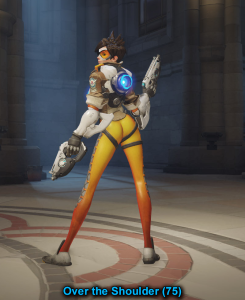
TracerThe pose in question, incidentally, can be seen in the picture here. There's nothing particularly offensive about it; the only even vaguely sexualised thing about it is the fact that Tracer is wearing very tight trousers indeed, and that some people have chosen to interpret this as her "presenting" (you know, like baboons do when they're in heat) rather than, you know, just doing a cool action hero pose.

I'm not going to argue about whether or not this is sexism or objectification or sexualised or whatever because I'm frankly really, really tired of that discussion happening over and over and over and never, ever going anywhere. Instead, what I wanted to do was share this response — and my own thoughts, too.

"Today, I feel like my voice no longer matters to Blizzard," writes disappointed Blizzard fan and longtime World of Warcraft player Ginny Higerd, a 30 year old woman who goes by @mahoumelonball on Twitter. "I'm not attractive. I'm not skinny. I've been teased about my appearance since elementary school. […] I love being a sexy night elf character. I love being Tracer. I love being Nova. I LOVE these strong women that can be confident in their abilities and their appearance, because in the real world, I'm none of those things. These games were an escape for me. I channel myself into these characters, because I would give anything just to be like them."

Higerd's words resonated with me a great deal, because it kind of sums up how I feel about the whole thing with "sexualised" or "sexy" characters. When I play a game with an attractive female cast — or deliberately make my custom avatar, where available, to be an attractive woman — I am not doing so to get my rocks off. I'm doing so because I like the way the character looks, and I like feeling like I'm taking on the role of someone else — someone who's not me, and someone I'd like to be, but will never get to be. Much like Higerd, I am none of the things that these characters represent, and I love having the opportunity, however limited it might be, to feel like I'm if not one of them, then certainly at least hanging out with them.

To take things a bit deeper, I've always been fascinated by what it would be like to be female, for a variety of reasons. Some of these reasons are sexual in nature, others are simple curiosity about the differences between the sexes — and the different ways people respond to men and women. I have recurring dreams and fantasies about having the ability to switch between being a man and a woman at will, and it's sometimes frustrating that I can't do that, even though it's obviously an impossibility. This isn't an indirect means of coming out and saying that I want to make any sort of transition, I might add — it's just something that has fascinated me for a long time, and here's the thing: video games have always provided me with a means to explore that fantasy in its most idealised form. Because what's the point in getting to live out a fantasy if it's not quite perfect? Assuming you can recognise the difference between fantasy and reality, of course, which all but the most deluded, mentally unstable have absolutely no problem with, what with the escape from reality into fantasy being one of the main reasons people like to game in the first place.

Games are, at their core, pure escapist fantasies of various descriptions. Like any other form of art, they can be autobiographical, realistic, fantastical, historical, abstract, stylised, childish, provocative, erotic and any number of other descriptors you might care to mention. I have an almost infinite amount of respect for the talented men and women who make these experiences come to life on my television and in the palm of my hand, and I would never, ever question how an artist has chosen to represent a character that they created, nor would I start demanding that there are more characters that look like me for the sake of that increasingly irritating buzzword "diversity". Instead, I would look to understand the character in question through playing as them, and determining what I can learn about them — and about myself — through how they play and how they act. Over the years, I've found far more characters I can relate to that don't look like me than those that do.

Characterisation is a great deal more than just physical appearance. And, ironically, it is the ones who judge characters like Tracer based solely on their physical appearance who are the ones indulging in objectification, not those who enjoy the designs of these characters for whatever reasons they might have. And I'm growing increasingly impatient with those who cry "sexualisation!" at every opportunity without 1) offering any "solutions" (to this non-existent problem) and 2) explaining exactly why it's somehow bad to have characters that look nice in our interactive fantasies.
2260: Have You Played Liberator Today?

0260_001

I like retro compilations, not just for the ability to play games from my youth on modern hardware, but also to discover some classics that, for whatever reason, I missed out on when they were first released.

Such has been the case after just a few minutes with Atari Vault, a new release on Steam that packages together about a hundred Atari 2600 and arcade games from the late '70s and early '80s — including a few previously unreleased prototypes, which is kinda cool.

One such discovery I made today was an interesting (and surprisingly impressive for the time) game called Liberator, a quasi-sequel to Missile Command that flipped the concept of the original Cold War-inspired game on its head by putting you in the role of the aggressors, attacking enemy bases on planets in order to liberate the population from the villains.

Liberator, I've discovered, was quite a rare game even on its original release, which might explain why I've never come across it before. According to Gaming History, the original arcade machine sold for a whopping $2,000 and did not prove particularly popular, with only somewhere in the region of 760 cabinets actually being made — all this despite it being a game absolutely made for cross-promotion with Atari's "Atari Force" comic series. The curse of old-school Atari constantly and consistently failing at marketing strikes once again, I guess.

Anyway. The game plays quite a bit like Missile Command in that it's a somewhat different take on the shoot 'em up. Rather than firing directly at things, you fire at a crosshair on screen, and your missiles detonate when they reach the point you fired at. Thus, to destroy things, you have to cause explosions at locations where the enemies will be when your missiles arrive — usually meaning you have to fire ahead of them carefully, anticipating their movements.

Much like Missile Command, you can fire from several different places on screen, and these missile launchers — here depicted as starships orbiting an enemy planet — can be independently destroyed, acting as your "lives" for the game session. The game, then, becomes a matter of balancing your offense on the planet surface, which requires you to destroy enemy missile bases on the rotating globe ahead of you, and defending yourself against incoming missiles and other attacks. Not every attack is guaranteed to hit you, either, so you also need to spot which things you need to prioritise destroying and which you can safely ignore.

It's an interesting game; very simple, but undoubtedly addictive in the same way that Missile Command is. It's a good-looking game for the time period (1982), as well, with some decent pixel art for "Commander Champion", who briefs you on your mission, and a well-done 3D rotating globe effect for the planets you're orbiting. Sound effects, meanwhile, are the same bleeps, burbles and booms from Missile Command — nothing special, but certainly iconic of this particular period in gaming.

There's a lot more to explore in Atari Vault, but I anticipate that Liberator will be one I keep coming back to!

2259: Back to Solo Play

0259_001

I've been back and forth on whether or not I should continue playing Final Fantasy XIV for a while now. I do love the game and all it offers, but the long period of time between the release of expansion pack Heavensward and its first major content patch caused me to get significant burnout, and while I did get temporarily enthused around the start of the patch 3.2 cycle, I'm once again feeling that I don't really want to do the endgame grind, nor do I want to raid.

Those who have been following my blog for a while will know that I've been one of the loudest, most enthusiastic people about Final Fantasy XIV ever since the beta of A Realm Reborn. So why the change of heart? Well, a number of reasons, really.

First up is the aforementioned endgame grind. This has always been present in the game — it is an MMO, after all — but first time around it somehow didn't feel so bad, perhaps because I never got "ahead of the curve" and made content irrelevant by outgearing it within a day or two of it releasing. In other words, taking on challenges was always exciting and there was always something to aim for; that aspect is still there, but if anything, I think there's now too much to grind on for what feels like relatively little reward.

Take the Anima weapons, for example — Heavensward's version of the Relic weapons from A Realm Reborn. The first step of this process either requires you to give up a fully upgraded level 50 relic (which a lot of people had at least one of by this point) or to repeatedly run FATEs around the Heavensward areas until you got Atma-like drops at a very low chance. The second step requires you to run ten dungeons that, at the level you're constructing the Anima weapon at, are completely irrelevant to you unless you're collecting gear for alt classes. The final step requires you to collect 20 each of four different items and then do some other bits and pieces.

The first step either takes seconds or hours of boring FATE grinding, though you can at least attempt to get the items from FATEs while levelling another class. The second step is just plain tedious, though it is presumably there as an attempt to keep older dungeons populated for those who are coming up through the 50s. And the third and final step is an absolutely brutal grind that either takes weeks of daily quests or repeated running of dungeons and/or the first (now largely irrelevant) part of the Alexander raid dungeon. Oddly, the jump in item level and power for this final step is significantly smaller than that for the second step, despite the final step being by far the most significant undertaking.

I currently have 8 out of the 60 items required to upgrade my Relic to its (currently) final form, and the next step of the process is coming soon. I just don't feel any inclination to do this alongside grinding daily quest reputation, Tomestones to purchase gear, XP for classes that haven't reached 60 yet, not to mention crafting and gathering, both of which are one of the few reliable ways to make a decent amount of money in the game.

The trouble, then, is not that there's nothing to do as such — it's that there's too much to do, but that too much is based on doing the same things over and over again for weeks or even months. The worst of both worlds, if you will — for me, anyway. There are plenty of people still playing who seem to be quite happy indulging in this grind. Some are even already working on their second or third Anima weapons.

I don't begrudge anyone how they spend their time, but having been playing a bunch of other stuff recently, I just don't want to commit the amount of time necessary to progress at a meaningful pace in Heavensward, because it means that I won't have time to enjoy other games like Senran Kagura Estival Versus, Dungeon Travelers 2, the upcoming Trillion God of Destruction and the many, many RPGs that are still on my game shelves, as yet unplayed. I've tried finding that magic balance between FFXIV and other games, and it just doesn't really exist for me — I always end up going in an "all or nothing" direction, and right now I'm feeling like I would rather play other things.

I'm not hanging up my Eorzean adventuring shoes completely; I fully intend to continue dropping in on the game to see how the plot develops with each new content patch, but I no longer have any desire to stay "current" with content progression, raids or Extreme-level Primal fights. In a way, I'm a bit sad that I feel this way, as FFXIV has been such a significant part of my life for so long — and my wife now plays more than I do — but ultimately, if you're not happy or having fun doing something that is supposed to be enjoyable, then there's really no point carrying on with it.

Alongside all this is the social matter: our Free Company has become very quiet over the last few months. I'm not entirely sure what's caused this and I don't really want to investigate for fear of dredging up any drama that might be involved. But playing the game isn't the same social activity it once was, with Free Company chat a lively place filled with people having fun, joking around and enjoying themselves. Many of the regular faces are still there, but remain quiet in "public", instead preferring to converse in small, private Linkshells rather than the main guild channel. It's made for an atmosphere that isn't anywhere near as welcoming and fun as it once was.

And alongside this is the matter of the overall game community and how it has declined somewhat over the last few months. MMOs always have a problem with elitism at their top end, but Final Fantasy XIV always used to feel like it was one of the more positive, friendly communities out there. Now, though, it's a place where you get yelled at if you don't speedrun dungeons, where newcomers to fights are sometimes kicked out of groups, and where players bitch about people they perceive to be "inferior" to them both in-game and on social media. The rise in popularity of DPS parsers also means that the particularly elitist players have data to hold over the heads of people they think are underperforming, and rather than offering feedback on how to improve, many of these people think that simply quoting them their DPS figure is enough to make them want to "git gud".

This is a generalisation, of course; I've still had plenty of positive experiences in the game in recent months, and I always made a point to be the change I wanted to see in the community by being friendly and conversational when playing with others, offering advice without berating when necessary. But it's just got to a point where this side of things has become exhausting and even stressful at times, and that's not conducive to having fun.

So I'm stepping away. For how long, I don't know, though as I say, I'm pretty sure I'll be back in for the next patch, at least to see how the main scenario storyline develops. Raiding, though? Nope. Sephirot EX? No thank you. Anima grind? No, thank you.

Now, I'm 86 hours deep in Dungeon Travelers 2 and I have grinding to do… he said, without a trace of irony.

2258: TrackMania Turbo: Impressions from the Full Version

0258_001

I knew after just a couple of minutes of playing TrackMania Turbo's demo that I needed the full game in my life, so it wasn't long before I was in my local game emporium picking up a physical copy. (Discs rule. Yes they do.) And I've been spending some time with the full version. Here are some things you might like to know about it.

It's an arcade racer with gloriously old-school handling

That means tapping the brakes to suddenly find yourself going sideways, powersliding around corners, releasing the accelerator to slow down only when you absolutely have to, and all that good stuff. It's not realistic in the slightest, but TrackMania has always been about having fun that just happens to be in cars; it's never been trying to be realistic, and it's always been all the better for it.

There are four distinct environments, each with a very different feel

Earlier TrackMania titles incorporated multiple environments, each of which had its own unique vehicle with its own unique handling. TrackMania 2 bucked this trend by releasing each environment as a separate game — Canyon, Valley and Stadium. It was a controversial move that some saw as new publisher Ubisoft trying to make a bit more money off the game and perhaps it was — but each of these environments was very well fleshed out with plenty of variety. Plus each individual game was a fraction of the price of a brand-new triple-A game.

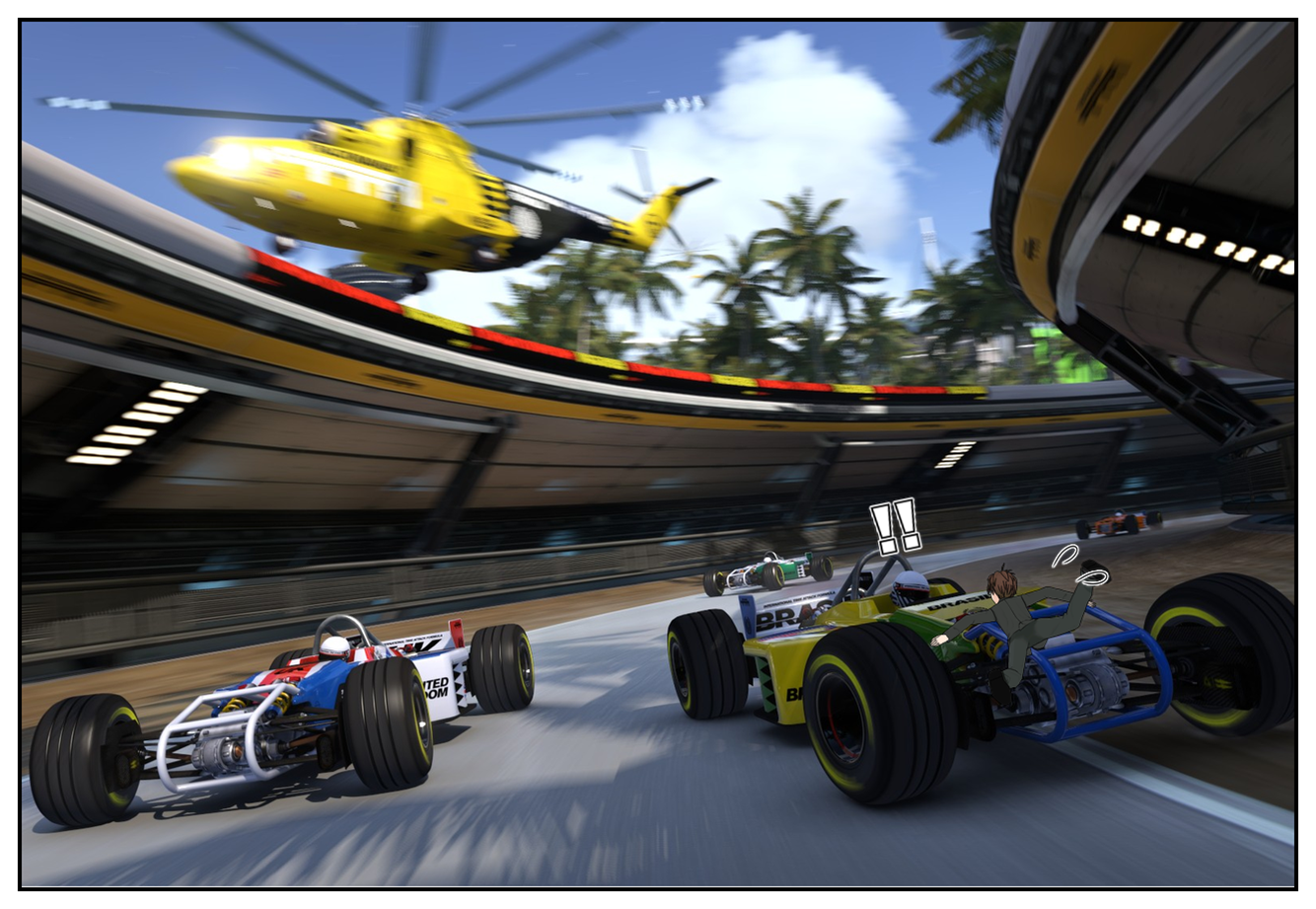
TrackMania Turbo incorporates revamped versions of the Canyon, Valley and Stadium environments from TrackMania 2 and adds its own Lagoon environment to the mix. Lagoon is somewhat similar to the Island environment from TrackMania United, but with a few additions — most notably magnetic rollercoaster tracks that your car sticks to, allowing for corkscrewing, loop-the-looping and all manner of other acrobatics with zero risk of your car flying off into the sunset or plummeting from a great height into shark-infested waters.

Pleasingly, each environment feels very different. The Canyon cars are extremely drifty — we're talking Ridge Racer territory here. The Valley cars, meanwhile, are a little more twitchy, plus the wider variety of road (and off-road) surfaces means that you have to adapt to several different ways of throwing your car around. The Lagoon cars are the most sensitive and grippy of all, able to get around very tight corners without having to drift (or even slow down, in some cases), and the Stadium cars are much like their counterparts from the previous games: heavy but grippy, with the ability to throw them into a drift with judicious application of the brakes.

There's a 200-level campaign

Yep, 200 races for you to complete. You can't just challenge them in any order, though; you have to start with the "White"-level Canyon tracks, then attain enough medals to unlock the "White" Valley tracks, then the "White" Lagoon tracks and finally the "White" Stadium tracks — only then will you be able to move up to the next tier. The top two tiers of difficulty require silver and gold medals respectively, while the first three only require bronze medals.

This structure is a bit more restrictive than past TrackMania games in that you can't jump back and forth between each environment's mini-campaign if you get fed up with a particular track, but ultimately it gives the game a good sense of progression.

There's a bunch of ways to play multiplayer

TrackMania has always been an incredibly overlooked local multiplayer party game, and hopefully its jump to consoles will help fix that. Turbo incorporates a number of different ways to play together.

Split-Screen is self-explanatory: everyone races together, first over the line wins, and the overall winner is determined by a best of three. This is noteworthy for being one of the only four-player split-screen games I've seen on the last two generations of consoles.

Arcade mode is a flexible mode where you can pick a track and then attempt to set a time using three "credits". The top ten times are recorded on a high score table, so you can challenge your friends to beat your best times that you've previously set — or have a mini-tournament there and then.

Hotseat mode is most similar to the previous games' multiplayer option. Up to 16 players can play in turn, each of whom is given a full tank of gas. Each player then attempts to set a time on the course; if the current leader is beaten, they then have to try and beat their challenger. The process repeats until everyone has run out of gas, and whoever is top of the leaderboard at that point is the winner.

All these local multiplayer modes can be played using any of the 200 campaign tracks (all of which are unlocked from the outset — no need to play single-player to open them up for multiplayer), any tracks you've built using the game's track editor, or a randomly generated track that the game builds for you. This latter option is fun, but a little time-consuming: you can watch the game building the track piece-by-piece, then it has to spend a few moments calculating shadows for the objects it's added. (Pro-Tip: choose "Fast" rather than "Nice" for lighting quality unless you want to wait a good 3 or 4 minutes before you can play the track.)

It's built for console

TrackMania has always felt like a PC game. And I don't necessarily mean that as a positive thing. Past installments have been highly customisable and expandable, but this came at a price: a clunky, inconsistent interface and an online component that required you know about (and are able to set up) dedicated servers and suchlike. The game was considerably expanded by a worldwide community of modders, in other words.

TrackMania Turbo doesn't support mods, nor does it do dedicated servers — at least not in the same way as the earlier PC games. This, naturally, has made the PC crowd get furious as they are wont to do, but really for the average player it's a change for the better. Multiplayer is now a case of just creating a room or joining an existing one. The interface is consistent and controller-friendly. You don't need to worry about having the right mods installed just to make other people's cars show up, or spend time tweaking settings to optimise performance. It is an overused phrase, but TrackMania Turbo just works, and thank God for that.

It's the best arcade racer for years

While many of the more "arcadey" racing games have gone in the open-world direction over the last few years, making for sprawling, unfocused experiences where you dribble from one type of activity to another, TrackMania remains so true to its arcade inspirations that on its title screen it prompts you to "insert coin or press X", followed by the sound of a coin clunking into an arcade machine when the main menu appears.

It's presented well, with a clear, uncluttered interface, wonderful handling and a pick-up-and-play nature that is accessible (but challenging) to all ages, and with the combination of the track editor, the ability to download other players' tracks and the random track generator, has potentially limitless replayability.

So if you like arcade racing — or the technical, puzzle-like stunt racing of titles like Ubisoft stablemate Trials — then you absolutely, definitely should pick up a copy of TrackMania Turbo as soon as possible.

2257: Rebooting MoeGamer

0257_001

I've already written a substantial post over on my other site MoeGamer about a new plan I have to start writing more hefty long-form pieces on a regular basis, but I figured I'd write something here too. And, since I'm the sort of person who will happily write the same thing in two different ways because he enjoys the act of writing itself, I'm not just copying and pasting the text over, oh dear me no.

I'm rebooting MoeGamer. It's not a drastic reboot, change of theme, change of layout or anything like that: it's changing the way I'm thinking about it. To date (well, until last August) I posted on MoeGamer as and when I felt like it: when I particularly wanted to write about a favourite game, or when I particularly wanted to refute something stupid I'd seen from the mainstream press. ("There haven't been any good RPGs since Final Fantasy VII" was a good example; "Dungeon Travelers 2 is a creepy, porn-lite dungeon crawler" was another.) I made an effort to post pieces of several thousand words in length, much as if I'd be writing a feature article on a regular games site.

And that was fine, apart from a couple of issues, the major one being that it's very difficult to stay up to date on things to write about if you set yourself even quite a conservative schedule of posting. Eventually, the prospect of running out of things to write about became a bit demoralising, so I stopped to have a think and reflect on what I wanted to do with the site, if anything.

Today, Destructoid published a review of Dead or Alive Xtreme 3 which attracted some attention. Not only was it written by a writer with a lengthy track record of baiting the outrage brigade at every opportunity, said writer took the opportunity to insult both the game and the people who might be interested in it over the course of his article. And, once again, I was reminded of the woeful inadequacy of the mainstream games press when covering more specialist titles such as modern Japanese games.

As foul a taste as the review left in my mouth, it gave me an idea. Why not try doing something completely different? By not being beholden to advertising revenue, I have the freedom to wax lyrical about games I find interesting or noteworthy as much as I want. And in-depth analysis is what these games in particular are sorely lacking. Now, I'm not particularly saying Dead or Alive Xtreme 3 is necessarily worth some in-depth analysis — although I haven't played it yet, so couldn't say for sure — but there are plenty of games out there which are being done an enormous disservice by games journalists who either don't have the time to invest in 100+ hour RPGs, or who feel "this game is about boobs" is somehow sufficient to describe Senran Kagura.

Much of the problems with modern games criticism come from the twin pressures of time and performance. Everything posted on a site has to perform well, and it has to be timely, otherwise the ad revenue will be shit and no-one will get paid. Unfortunately, this leads to clickbait of various forms — most commonly of the outrage variety these days. I don't necessarily blame the games journos themselves for this — though there are certain writers, whom I shall refrain from naming for the moment, who can eat a thousand dicks over their incompetent coverage of games that deserve better — because I know from experience they quite simply don't have the time to explore a game fully in the same way a regular ol' player will.

But I do. Because I'm a regular ol' player. So why not leverage that fact and take an extremely in-depth look at a game after the fact, pick apart why it's noteworthy (or not) from several different angles, and ultimately build up a library of deep, interesting analyses of games that don't get the time of day from the mainstream games media?

The plan's pretty simple. Pick a game each month, focus exclusively on that. Write about its mechanics, narrative, aesthetics and context — going into a full article's worth of detail on each rather than trying to cram everything into a single "review". Add additional detail as appropriate. Move on to something new the following month. Repeat.

This approach gives me time to work my way through substantial games such as JRPGs and visual novels and complete them to my satisfaction, then write about them in detail. It provides a suitable structure for me to post content regularly. And it provides a variety of perspectives for people who are interested in games for different reasons — not everyone's as much of a narrative junkie as I am!

I'm sure it'll be a challenge and I'll doubtless run into some hurdles along the way. But while I have the time to pursue various creative endeavours, it's probably best I do that rather than sitting at home twiddling my thumbs and occasionally bursting into tears at the fact I still don't have an actual job.

I'll be kicking off this new-style MoeGamer at the beginning of April with coverage of the recently released Senran Kagura Estival Versus, and taking things from there. I'm looking forward to this new challenge, and I hope you'll be interested to read my work.

2256: TrackMania Turbo Demo Impressions

0256_001

Those who know me well will know that I've been a huge fan of the TrackMania series since the original release of TrackMania United, and have spent many hours on the various updates to United and the eventual follow-ups TrackMania 2 Canyon, Valley and Stadium. So it was with some excitement that I realised that the next official sequel, TrackMania Turbo, was releasing this week, though I was torn on whether to pick it up for console (PS4, in my case) or PC, which has traditionally been the home of TrackMania.

After playing the PS4 demo for a bit this evening, I think I'm going to grab the PS4 version. I'm very impressed with how at home it feels on console — much of the clunkiness of the PC versions, particularly in the menus, has been tidied up considerably, making it much more controller-friendly, and the addition of a variety of local multiplayer modes makes it eminently suitable for console play. It, so far, seems to be a highly polished product, which addresses what has always been my main criticism of the series as a whole: the fact that in terms of gameplay, it is wonderful, but in terms of interface and user-friendliness, it has traditionally been a ridiculous mess, only made worse by the gazillions of mods server operators apply to their custom dedicated servers, making the game screen more complicated than your average MMO come raid time.

PC players on Steam seem to be a bit salty that TrackMania Turbo has stripped out a number of features they've come to take for granted: specifically, the ability for players to run their own dedicated servers and install gajillions of mods that make players' screens look more complicated than your average MMO come raid time. And while this is a bit of a shame from the perspective of the game's flexibility — something that TrackMania has always prided itself on — I don't think it's going to hurt the complete package, and in fact it may well be good for the series as a whole. TrackMania Turbo will serve as the friendly face of TrackMania, in other words, while the truly hardcore still have United and TrackMania 2 to play and mod to their heart's content. Both of those games are still a hell of a lot of fun to play, after all — and surprisingly good looking, to boot, especially considering their age.

But what of TrackMania Turbo then? How does it shape up compared to its illustrious, if clunky, predecessors? Judging from the five tracks available in the demo, extremely favourably. In fact, if the whole game handles in the way those early tracks do, I'm confident that it will become a new favourite arcade racer.

The thing I like the most is the unabashedly arcadey handling. We're talking Ridge Racer-tier drifting here: release the accelerator, steer around a corner and slam the gas back on and you're going sideways. Hit the brakes and you'll find yourself in an even tighter drift, allowing you to get around even the most ridiculous of corners without losing anywhere near as much speed as if you'd have to drive "properly" like in boring driving sims.

The game screen, sans custom mod clutter, is clean, clear and offers ample feedback on your performance as you play, including split times, worldwide and regional rankings, and fun little extras like arcade-style counters showing how far you've jumped or drifted for — a nice addition that gives the game a very "Sega" feel.

I was debating whether or not I wanted to grab the game today. Playing those five tracks in the demo has made me quite happy to pick it up, though; I can see it being a whole lot of fun, and I hope it's a big success, helping to show console players the joy of this wonderfully silly but skillful and creative series.

2255: Things I Feel Irrationally Weird About Saying Out Loud

0255_001

Number 9,752 in my List of Things That I Don't Quite Understand About Myself is the fact that there are some things I feel irrationally weird about saying out loud.

Normal things, to be clear; the sort of things that regular people probably happily say out loud without a second though. And yet I always feel peculiar whenever I'm put in a situation where I might have to say one of them, and will often do everything I can to avoid saying the thing in question.

Here is a non-exhaustive list.

  • My own name. I've felt awkward about saying my name — particularly my full, non-abbreviated name — ever since I was little. I find it hard to pin down exactly why this is or what set me off thinking this way in the first place, but I have a feeling it has something to do with how much I disliked my speaking voice when I was growing up; I used to absolutely hate hearing recordings of myself, both before and after my voice broke, because I really didn't like my accent and the way I pronounced things. I actually have reasonably good diction for the most part; when I was little — and to an extent even now — I worried that I sounded "too posh", and the name "Peter" is a name that it is very difficult to make sound cool when you sound even the slightest bit posh. As such, I have gravitated towards "Pete" ever since, but still avoid saying it out loud whenever possible.
  • Other people's names. I know lots of people on first-name terms. I hate calling any of them by name. Unlike my hang-ups about my own name, this is nothing to do with not liking their names — it's a peculiar reaction I have where I feel that someone's name has significant power and meaning to a person, and that using it in a carefree manner to attract their attention or address something to them is somehow insulting. This is, of course, complete nonsense, since we rely on our names to identify ourselves to one another. I feel this one may be something to do with my own reaction to my own name: perhaps I'm subconsciously worrying that other people don't like hearing or saying their own name too.
  • Tummy/belly. Stomach. Always stomach. My stomach hurts. I have a stomachache. Never, ever, ever I have a tummyache or a bellyache. Why? My reaction to these words is that they are somehow "childish" and not something an adult should be saying. Once again, this is nonsense, of course, but I still just can't bring myself to say them.
  • Variations on "goodbye". I hate saying goodbye. Not in the romantic "I hate goodbyes!" sense, but in the fact that I simply hate saying goodbye, bye-bye, see you later, see you round, ta-ta for now, bye. I honestly don't know where this one has come from because saying "goodbye" is a fundamental part of human interaction: it's a means of demonstrating that your time with someone else has now ended, and that you are going to go elsewhere and/or speak to someone else. Perhaps I think it's "rude" somehow — that I always think the other person I'm speaking to should be the one to terminate the interaction? I don't know, but what I do know is that it's ruder to leave without saying goodbye, which I have been known to do on numerous occasions simply to avoid this hideous awkwardness.
  • Excuse me. "Excuse me" tends to go hand-in-hand with speaking to strangers, and I do not like speaking to strangers, particularly those I perceive to have more "power" than me in a particular situation. Which is, to be honest, most people most of the time. This one I kind of understand, but it's still fairly irrational.
  • Toilet. I cringe every time I use the Americanism "bathroom" to mean "toilet", but I still use it anyway, particularly when in an unfamiliar place or with unfamiliar people. "Do you have a bathroom I can use?" Of course you do, what sort of house would it be if you didn't? Somehow I see framing the question in this manner as more polite than "Can I use your toilet?" — evidently my mind subconsciously converts "can I use your toilet?" to "can I get my penis out and spray urine into something in your house?" which results in feelings of shame.

I'm pretty sure there are more, but making this list is depressing me about my own lack of social skills. (Not really, but, well, that's probably enough to be getting on with for now.) So let's leave it there for now. I may well return to this topic if I think of some more!

2254: The Irritating Trend of Gleeful Negativity

0254_001

Earlier today, a rumour broke that Nintendo would supposedly be stopping Wii U production by the end of this year. Nintendo subsequently denied this, of course — even if it turns out to be true, Nintendo keeps an Apple-esque veil of secrecy over all its upcoming plans and doesn't tend to comment on rumours and speculation.

Predictably, as soon as the first report was published, everyone was all over the news like vultures circling a still-warm corpse. The Wii U is arguably tied with the Vita as the gaming industry's favourite whipping-boy, and it honestly makes me feel a little disgusted at the amount of glee some people seemed to be directing at the prospect of what is a very good console — albeit less powerful than its Sony and Microsoft counterparts in this generation — going the way of the Dreamcast.

Nintendo aren't particularly popular with certain groups of gamers at the moment, largely due to the controversy surrounding the English localisations of Fire Emblem Fates and Bravely Second due to perceived unwelcome pressure from sociopolitical groups. Regardless of whether or not the decisions made for those games were mistakes or not — and sales figures for Fire Emblem certainly seem to suggest that there are a lot of people who aren't particularly bothered — Nintendo is still in a unique position in the business, however: they have a console platform that is completely separate from its competitors, which is the only place to play certain games, and which is still the only place to play first-party Nintendo games.

Platform exclusives might not be as much of a big deal as they used to be — both Sony and Microsoft's first-party work in recent years has been a little lacklustre for the most part — but they're still Nintendo's bread and butter. Super Mario, Mario Kart, Super Smash Bros. and Zelda are all staples of any Nintendo platform, and with the Wii and Wii U generations we've added Splatoon and the Xenoblade series to that list. All very strong, polished games; all games that make the Wii U a unique console with a ton of its own character.

This is what bugs me, y'see: the most important thing about a games console is the software library that runs on it — the games. And the Wii U, despite not being the most technologically advanced system on the market, has some of the very best games in recent years available for it. Not only that, but it continues to fly the flag for family-friendly gaming while Sony and Microsoft primarily court the gritty realism of modern triple-A titles. Wii U games, for the most part, are awash with primary colours, cheerful music and the clear self-awareness that they are games; they're not trying to be movies, or works of art, or anything like that: they're just trying to be a ton of fun for their audience — and succeeding.

But despite that strong (albeit small) library of games for the system, it's everything else about Nintendo's system that gets criticised: so much so that the worthwhile achievements of the games — and make no mistake, there are enough good games available for Wii U to make purchasing one worthwhile — get overshadowed. Their online system sucks! (Except all these bits that don't!) Their marketing is rubbish! (You're not helping!) The controller is weird! (Play Splatoon with it, then tell me that's not infinitely better than playing an FPS/TPS with a regular gamepad!) You can't buy new GamePads! (Then don't break it!) Their downloadable games are too expensive! (Then don't buy them!)

I'm being facetious to an extent — there are valid criticisms to be made of much of what Nintendo has done in recent years, but there's also a lot to praise. And when it comes down to it, none of these criticisms are particularly important to the Wii U doing what it is primarily designed to do: to play games.

Which is why I get so frustrated when I see people who don't own Wii U's revelling in its "failure". And why I get so frustrated with a media who will post 57 articles about the latest mediocre triple-A blockbuster game to be released on Xbox One and PlayStation 4, yet barely mention the incredible technical achievement of something like Xenoblade Chronicles X. It's part of an increasingly overwhelming culture of gleeful negativity in all aspects of society: schadenfreude has always been a thing, of course, but there seems to be an increasing number of people out there who do nothing but piss, moan and complain about absolutely everything rather than finding something they do like and enjoying it — either quietly or, as I tend to do, as loudly as possible so other people might be able to discover and enjoy the things I've grown to love.

Still. If the Wii U does fail and does cease production this year, it's all but assured a place in gaming's Valhalla alongside Sega's Dreamcast: consoles dead before their time, with libraries of great games that only a few people played when they first came out, and that more and more people regret getting rid of when they become super-rare a few years down the line. Yep, I'll be holding on to mine for sure; I may not have a ton of games for it, but those that I do have are among my favourites in my game collection.

And no, you may not borrow Xenoblade Chronicles X in five years' time.

2253: It is the Piece of a Smile Everyone Acquires

0253_001

I've already written generally about how much I like yuri/shoujo ai slice-of-life anime Yuru Yuri, but I wanted to single out a particular episode as a great example of what this genre does really well: the third season's eighth episode, boasting the impressively Engrish title It is the Piece of a Smile Everyone Acquires.

Yuru Yuri has a few aspects in common with other, similar slice-of-life shows, but the show it reminds me of most is Squid Girl/Ika Musume — a show where, despite its fantastical, ridiculous premise, manages to be oddly believable and comforting in how it depicts its relationships between characters. It's not so much the thematic similarities that I'm concerned with, more the format: Ika Musume explicitly splits each of its "episodes" into several smaller vignettes that tell miniature stories in their own right, and within these vignettes the show often experiments with form, structure and even aesthetic. Its most striking episodes are the ones where it goes completely off-piste, such as those that feature the "miniature Squid Girl", whose sequences are completely dialogue-free, and which make wonderful use of music and animation to produce surprisingly evocative, emotive scenes.

The similarities between Yuru Yuri and Ika Musume struck me during the pre-credits opening of It is the Piece of a Smile Everyone Acquires because it adopts a similar approach to the aforementioned "miniature Squid Girl" episodes: it's completely dialogue-free, focuses on a character that isn't normally at the forefront (or, in the case of mini-Squid Girl, isn't normally in the show at all in that form) and does all its storytelling through its soundtrack.

In the case of It is the Piece of a Smile Everyone Acquires, the episode opens by focusing on the student council president, a character who is so meek and timid that we only ever see her mouthing words in regular episodes; she has no voice, so far as the audience is concerned. The characters always understand, her, though, which is the core joke of her character, but this opening sequence approaches it from a different angle, showing how she understands people — and makes herself understood — without the use of words.

Yuru Yuri already has a wonderfully evocative soundtrack that complements its on-screen action perfectly, but this opening sequence in It is the Piece of a Smile Everyone Acquires takes things to a new level: adopting an almost programmatic approach to its music, with distinctive themes and instrumentation being used for the individual characters who show up over the course of the sequence, it's a fine example of how words, sometimes, simply aren't necessary: you can make an interesting and heartwarming piece of art using only visuals and sound. (You can make an interesting and heartwarming piece of art using only one of those things, too, of course, but this is a TV show we're talking about here; to deliberately refuse to use one of the core features of the medium is noteworthy.)

The rest of the episode is entertaining in itself, too, but somewhat more conventional for the most part; this pre-credits sequence, however, was so striking I felt I had to write something about it. I'd share the video here if it was on YouTube, but no-one appears to have ripped it; you can, however, watch the full episode on Crunchyroll at this link, and I can highly recommend the whole series from the very beginning if you want some enjoyable, lightweight fluff to cheer yourself up with.

2252: Estival Versus: Early Impressions

0252_001

As I said the other day after finishing Senran Kagura 2: Deep Crimsonthe follow-up to the Vita spinoff Shinovi Versus, Estival Versus, was waiting for me to stick it in my PS4 and start rumbling in the sunshine. So that's what I've been doing.

A recap for those who aren't familiar with the complete Senran Kagura series and its continuity: first came 3DS game Senran Kagura Burst (actually a remake of the Japan-only Senran Kagura: Portrait of Girls with an additional full-length story from the perspective of the "evil" shinobi), which introduced the ten girls who make up the cast members from "good" shinobi school Hanzou and "evil" shinobi school Hebijo (as well as recurring guest characters Daidouji and Rin) and took the form of a 2.5D brawler with simple RPG-style character progression.

Then came Vita game Senran Kagura Shinovi Versus, which followed on directly from Burst's story and introduced ten new characters: five from another "good" shinobi school Gessen and five who took the place of the now-renegade Homura's Crimson Squad at Hebijo. The story focused on characterisation of the four groups and their interactions with one another, but in its final moments teased what would become the main conflict of the Senran Kagura series: the clash between shinobi (both good and evil) and the demonic youma. Gameplay made the jump from fixed-perspective 2.5D to third-person 3D, leading many to (somewhat erroneously) draw comparisons to Koei Tecmo's Warriors series.

This was followed by 3DS game Senran Kagura 2: Deep Crimson, which left behind the new Gessen and Hebijo characters in favour of focusing on the original cast once again, and pushing the shinobi-youma plot arc forward with the introduction of legendary character Kagura and a strong focus on the machinations of the evil Hebijo chairman Dougen. Deep Crimson returned to fixed camera angles but had a stronger sense of depth than Burst, making it feel more along the lines of a somewhat less setpiece-heavy Devil May Cry than Streets of Rage.

And then we come to Estival Versus, the latest release. (There was also Senran Kagura Bon Appetit among all that lot somewhere, but that's a deliberately comedic spinoff rather than a canonical entry in the main narrative.) Estival Versus is the first of the series to appear on home consoles as well as handhelds thanks to its simultaneous PlayStation 4 and Vita releases, and it marks a return to Shinovi Versus' 3D fighting formula, with battles unfolding in large 3D arenas rather than side-on, linear levels.

My initial impressions here are based exclusively on the PlayStation 4 version, I should probably point out; from what I understand, the Vita version is pretty solid, mind, it just runs at a lower framerate and resolution — and, obviously, is on a smaller screen (unless you use a PlayStation TV). As such, take comments about the technical performance of the game accordingly.

Well, then, that would seem like a decent place to start: for the most part, Estival Versus runs beautifully fluidly, with crisp, high-definition graphics, the beautiful character animation that has come to exemplify the series, and a smooth framerate that usually sticks around the 60 mark with a few exceptions when things get particularly busy. Even when the framerate drops, however, the action continues to feel fast and fluid, giving the game a pleasantly "arcadey" feel.

The jump to the big screen makes a surprising amount of difference. Combat feels rather more weighty than it did in Shinovi Versus, particularly when you use the characters that wield heavy, slow weapons rather than the more hack-and-slash-friendly characters. This is a good thing, on the whole; every character feels noticeably distinct from one another, and getting to learn some of the more challenging characters is satisfying.

Besides the returning cast from Shinovi Versus, there are a number of new characters, too: the three "Mikaruga Sisters", each of whom handles very differently, along with some other characters who are particularly important to a number of aspects of Senran Kagura lore at large.

I can't speak for the entire story yet, but Estival Versus so far seems to be following a similar pattern to Shinovi Versus: beginning with what sounds like it should be a throwaway plot that simply provides an excuse for all the characters to fight one another, but which actually turns out to be a means of exploring these characters in a considerable amount of depth. Here, the basic concept is that the casts from the four schools have been somehow whisked away to a tropical paradise where dead shinobi who have not yet found rest appear to linger. Shortly after arriving, the girls are challenged to take part in the "Shinobi bon dance" ritual — a battle royale that demands each of the groups smash the others' festival platforms in an attempt to assert their dominance and, subsequently, be allowed home first.

It sounds kind of dumb initially, and indeed the first couple of chapters of the game largely consist of the girls messing around and being silly with one another. By the third "day" of the festival, however, things start picking up, and some of the central mysteries surrounding the situation the girls find themselves in start to unfold. I anticipate that by the eighth day, there will have been some very significant happenings in the world of Senran Kagura, though I shall refrain from conjecture here for fear of inadvertent spoilers.

Estival Versus so far appears to be a very fun game indeed, with a solid single-player mode, some interesting-sounding online multiplayer modes (both cooperative and adversarial) and the now-obligatory Dressing Room feature, which allows you to play dress-up with your favourite girls, pose up to five of them in a diorama and then snap pictures of them from various angles. I'm not sure I'd recommend it to someone as their first Senran Kagura game, since, like Deep Crimson, it's the midpoint of a series — a series that currently has no end in sight, I should add — and, unlike many other franchises out there, it begins by immediately working on the assumption that you already know who these characters are, how they relate to one another and what they went through together in the previous games. Like Deep Crimson, there are some efforts made to give a bit of context in the early hours of the narrative, but you'll get far more out of it if you've played through the stories of Burst, Shinovi Versus and Deep Crimson beforehand to understand where things are in these girls' world right now.

Very much looking forward to seeing how things develop — and perhaps jumping into the multiplayer a bit, too. If you have a copy and are playing online, feel free to add my PSN ID Angry_Jedi to your friends list; do please leave a note with your friend request if you know me from here or Twitter, however!