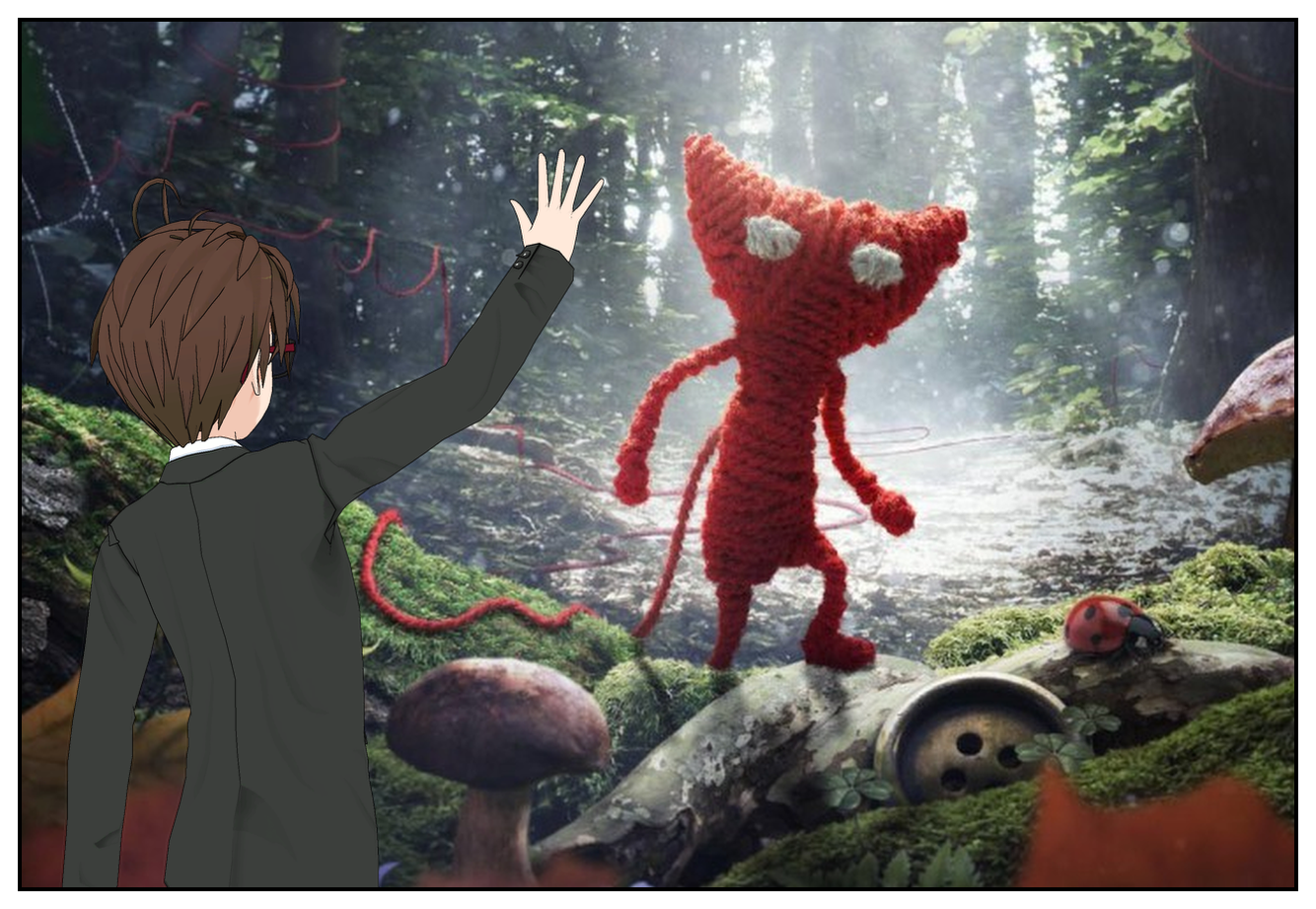
2211: On "Burn in Hell, Yarny"

0211_001

A videogame called Unravel will be released tomorrow. It may be a good game, and it is certainly a good-looking one, with a soft focus and hazy depth of field; tree leaves rustle convincingly and thick snowflakes pile up as the camera pans ever right-ward. It appears to make use of this tactile world for a series of physics-based puzzles, like moving rocks to get up on ledges and creating makeshift vines with which to soar across little ponds. These may be very clever puzzles, building toward a resolution that is very satisfying, but I will never know, because I will never play Unravel, and that is because its protagonist, a little red yarn-man named Yarny, can go fuck himself.

This was the opening to an article from Kill Screen, a site that originally positioned itself at the very spearhead of "new games journalism", boasting both a print magazine and an online component that would offer something a little different from the usual consumer advice/PR/news, previews, reviews cycle that most games-focused sites had provided up until that point.

I remember Kill Screen launching; it was actually at the first PAX I went to — I even still have a copy of their "Issue Zero" that I picked up at the show somewhere. It looked like it was going to be a great read, and a bold new frontier for games criticism.

Look at that opening paragraph again. Look at the last half of the last sentence.

"I will never play Unravel, and that is because its protagonist, a little red yarn-man named Yarny, can go fuck himself."

Needless to say, I do not feel the same way about Kill Screen as I did when it was first launched. I hadn't felt the same way for quite some time, to be honest, since its take on intelligent criticism had started to veer rather too heavily in favour of heavily ideological-based arguments rather than actual analysis of the art on its own merits — a scourge that the entire games press has been afflicted with for the past few years — but this article today has cemented my feelings.

What I did want to talk about, though, is the staggering hypocrisy of some people — within and outside games journalism — when censuring this article, and it most certainly has received almost universal censure from all angles. Deservedly so.

The key thrust of the article is that the author has no plants to play Unravel because he doesn't like the look of it. He doesn't like the look of the protagonist, and he doesn't like the fact that the game looks like it's going to be a narrative-centric, emotional experience that emphasises artistry (in the traditional sense) over game design.

You know what? Those are perfectly valid reasons to not want to play a game. There are lots of games I don't want to play because I don't like the look of them, because I don't like that type of game, because the subject matter doesn't appeal or because I know people I don't like love them. Rational or not, pretty much any reason you can think of not to play a game is an absolutely valid one from your own personal perspective: we're already living in an age where it's literally impossible to play every single game out there, even if all you did all day every day was play games, so everyone, consciously or not, has their own set of selection criteria for what they put on their plate at any given moment.

What isn't okay, though, is then picking on something that 1) you confess doesn't appeal to you and 2) you admit you have no intention of playing (and therefore speaking from a position of authority on) anyway — and then writing a critical article about how it's symptomatic of everything wrong with modern gaming. The author has some fair points — that some developers believe emotional manipulation of the player is an end unto itself, and that this isn't the same as creating something truly artistic — but they are completely invalidated by the position of ignorance from which he is speaking: he's criticising Unravel and games like it without any knowledge of what they're actually like — he's speaking on the basis of assumptions, not taking the time to research it for himself.

Where else have we seen this happen? Oh, right, with pretty much every niche-interest Japanese game released over the last few years. We've seen series like Senran Kagura berated for having boobs in them, but little to no discussion of their more progressive aspects such as homosexuality, sexual kinks, forming friendships across ideological barriers and accepting people for who they are. We've seen my longstanding favourite Hyperdimension Neptunia all but rejected from any cultural significance for being "hypersexualised" and having characters that both possess breasts and breathe, with little to no mention of the series' perpetually on-point satire of games and game culture, excellent writing and characters strong enough to carry games in a wide variety of styles. We've even seen people branding the "Amie" feature from the Japanese version of Fire Emblem Fates as "creepy" and expressing pleasure that it had been removed, despite displaying no understanding of its context, either in-game or within the Japanese cultural context of "skinship" or "naked association". And I could go on. For pages.

Sound familiar? Why, yes, in all the above cases, the critics of these titles were speaking from spectacularly ill-informed, ignorant positions — in some cases not even playing the games, or barely playing them for more than a few minutes in the instances where they did bother to boot them up at all — and, thus, were speaking from a position where they were unqualified to offer meaningful, trustworthy criticism of these games. And yet because games journalism is very much a cult of personality, people who didn't know about these games already take these critics' words at face value — assuming they're a high-profile critic like Jim Sterling, or at least from a site seen as "reputable" (i.e. big) by the masses — and don't bother to question them. And this leads to these games being pushed further into the niches they're already in, and to a lot of people missing out on experiences that they may well find themselves pleasantly surprised by.

The worst thing it does is contribute to the overwhelming air of negativity and cynicism that pervades modern games writing. Many members of the press are extremely burned out on the increasingly penny-pinching tactics of triple-A publishers — day-one DLC, preorder incentives, platform-exclusive content, betas-that-are-not-betas-they're-demos-that-you-can-only-play-if-you-preorder — and this causes the exhaustion and cynicism to infect their explorations of anything that might be just slightly outside the norm. Oh, sure, there's plenty of indie darlings that get elevated to "gaming Messiah" status — Undertale, The Witness and Firewatch all spring to mind in recent months — but poor old Japan repeatedly gets shafted by people who, like the author of the Kill Screen piece, have no intention of exploring them in sufficient detail to provide adequate comment and criticism on them.

Life is too short — and there are too many games out there — to waste time on negative articles about "why I don't like this" or "why I don't want to play this" or "why this doesn't appeal to me". So why does it keep happening? I'd much rather read a games press that is more positive in tone: willing to criticise where appropriate, but where the thing first and foremost in every critic's mind is the celebration of this amazing, growing, constantly changing medium that shatters cultural borders into something the whole world can truly understand and enjoy together.

You don't have to love everything. I certainly don't. But how about we think about keeping our mouths shut about the things we hate, let the people who do love them enjoy them, and we focus on the things that we love, too. Doesn't that sound much nicer than "I have no intention of playing this game because I don't like the look of the protagonist"?

(Oh, and for the record, I have no interest in playing Unravel either; Braid and Limbo were enough to put me off arty platformers for quite some time. I would not, however, dream of attempting to offer criticism on it having not played it — and I wouldn't even feel comfortable commenting on Braid and Limbo because I don't feel I played them enough to be well-informed before tiring of them. Now, I'm off to go and play some disgusting degenerate pervert Japanese role-playing games and probably fap myself into a frenzy in the process. Or perhaps just enjoy the things I love rather than bitching about things I hate and have no intention of trying to enjoy.)

2210: Live to Eat

0209_001

"Some people eat to live, while others live to eat. What about you? How far would you travel for the best meal of your life?"

The Daily Post, February 7, 2016

Some time ago, I wrote about how I'm not a foodie. Things haven't changed all that much, but I mention this now because it's relevant to the Daily Post prompt for today.

For me, food is something I very much enjoy — hence my weight problems, to be perfectly frank — but not in the same way as people who really enjoy food enjoy it. No, I'm not one who is keen to have a delicate bouquet of flavours exploding on my tongue as I take a miniscule mouthful of something that looks more like a piece of modern art than an actual meal — I'm someone who likes to have a big ol' gobful of something that tastes good, and preferably a lot of it. If the thing that tastes good is also reasonably not-awful for you, then so much the better, since if there's one thing I learned since starting Slimming World, it's that there are a lot of tasty things out there that you can eat completely guilt-free.

I was particularly conscious of my feelings towards food when Andie and I were watching the recent series of Masterchef: The Professionals. I found the programme a bit tedious, to be honest, because every episode was very similar to the last, and very little of the food actually looked appealing to me. These chefs — who I'm sure are at the very pinnacle of their craft — were taking things that would have been delicious in their most basic forms, then complementing them with bizarre crap like "pea puree" and baffling combinations of herbs and spices. Even on desserts. If there's one thing I can't abide, it's putting weird combinations of herbs and spices on desserts. Rosemary is for lamb in a pinch — though I prefer it without — not cake or ice-cream.

The most peculiar thing I think I've eaten and actually enjoyed was when my friend Tim — who emphatically is a foodie; you can tell this by the fact he has a favourite truffle oil — made a Heston Blumenthal (I think) bacon ice-cream for us to enjoy one evening. I wasn't entirely convinced that this was going to be nice when it was first posited, but then I thought about it — and thought about how nice bacon is with sweet things like maple syrup and pancakes — and realised it might not be that bad. And indeed it wasn't that bad at all — indeed, I'd go so far as to say it was genuinely nice. Would I have it in preference to a nice bowl of Cornish vanilla slathered in chocolate, caramel or strawberry stickies, though? Of course not.

So in answer to the question above, then — how far would I go for the best meal of my life? — I guess I would have to say "the kitchen". Or, at a push, "the pub" or "Tesco". Because although I enjoy my food, I can't say it's something I seek a life-changing experience from. And I know from experience that no amount of Michelin Star-winning chefs will make me enjoy nouvelle cuisine or whatever you're supposed to call that bollocks now; give me a nice hearty chilli, or a lump of pork with some nice potatoes, or a rack of lamb, or anything that just makes you feel full and happy to eat, and I'll be satisfied. And you can keep your pea purees.

2209: Exploring the Cosmos

0208_001

Been playing a bit of Elite Dangerous: Horizons this evening and realising the "dream" of something I've wanted to do since I started playing: hop in a ship, point it in a particular direction and just go see what's out there.

I haven't got that far yet, to be honest — I'm still in populated space, albeit getting down to the dregs of the tiny factions rather than the warring empires of the PowerPlay system — but I can see interesting things on the galactic horizon, and I fully intend to check them out and see what's there.

The nice thing about Elite is that you can do this and it's a viable way to play the game. Its exceedingly freeform nature — more freeform than pretty much any other game I think I've played outside of Minecraft — allows you to play how you see fit, and enjoy it how you want. If you want fast-action combat dogfighting, it's there. If you want to run courier missions, that's there. If you want to collaborate with other players to strategically expand the influence of one of the major powers in the galaxy, that's there, too. Or, as previously mentioned, if you just want to hop in a ship, point it in a particular direction and just go see what's out there… well, you can do that too, because the galaxy is one hell of a big place.

Exploration gameplay is relatively straightforward. Equip a ship with the appropriate scanners — basic versions of which come as standard — and when you hyperspace into a new system, you can scan for astronomical objects. Once you've located some, either via your scanners or visually, targeting them and flying close-ish to them allows you to run a detailed scan of them and record the information in your ship's computer. You can then sell this information when you get to a suitable space station or colony that is at least 20 light years away from where you acquired the data — it's assumed that most areas are familiar with the region immediately around them — and profit accordingly. It's a valid career path with its own progression and the opportunity to make your own distinctive mark on the game universe: whenever someone visits something that you were the first one to discover, they'll see your name there, proudly recorded for all time as the first person to find that thing, whether it's a big burning ball of fiery sun, an unremarkable lump of rock or a spectacular planetary system.

I haven't travelled far enough to be one of these pioneers as yet, I don't think, but I'm already getting into a region of space that is less populated, both with the computer-controlled factions and players. The station my ship is currently parked at as I type this has seen just 12 player-controlled ships pass through in the last 24 hours, compared to the hundreds or thousands the more "core" stations in the centre of the populated area see every day.

I find the exploration aspect inherently satisfying for some reason, despite the fact that objectively speaking it's quite boring and repetitive — although I did get interdicted by an unpleasant NPC called "Starquake" earlier, who battered my ship about a bit before I was able to activate my Frame-Shift Drive and jump away from him — but mostly I'm curious to see what's out there, if anything. The original Elite had some strange things going on in the far reaches of the galaxy — most notably the spectacularly irritating Thargoids, who had a habit of pulling you out of hyperspace and killing you horribly — so I'm curious to see if there's anything interesting hidden in the furthest reaches of the galaxy.

There are a bunch of places I'm just curious to see, too. The "Coalsack" area looks most intriguing, what with its ominous black cloudiness, and, of course, the immense density of the galactic core is surely worth trying to see. Of these places, the Coalsack is probably reachable relatively easily; the galactic core perhaps less so, but I'm interested to see how far I can go. Theoretically, my current ship has infinite range thanks to its Fuel Scoop hardware, which allows me to refuel by harvesting the gases of appropriate stars, so as long as I don't get stranded in a region with crap stars and/or blown up by pirates or aliens who are hiding deep in "unpopulated" space, I should be good to go for quite some time. And think of the money I'll make when I eventually get back to human space to sell all this exploration data.

Oh, God, I have to fly back as well, don't I… Maybe I shouldn't go too far…

2208: Am I Better Than This?

I've been wracked with anxiety recently, as the more astute among you may have been able to tell. Partly this has been to do with my work situation — i.e. the fact that currently I don't have a regular job. Thankfully, I don't have zero income thanks to some regular freelance work I've been doing, but that is a little too erratic to be able to rely on completely.

As such, I've been looking for regular positions elsewhere. Having genuinely enjoyed my stint with Game over the Black Friday-Christmas period, I was looking into other retail positions around the place. I've actually had a couple of interviews in the past couple of days, but today in particular I was hit with a crisis of confidence. This is nothing unusual for me, but what was a little more unusual was the circumstances surrounding it.

Basically, what happened was this: I was speaking with the company's area manager about my application and my background. The way the retailer in question does things is a bit different from the retailers I've previously worked for (Apple and Game) and he pointed this out. He then said something that gave me pause.

"Your previous job," he said. "That sounds like it was the ideal job for you. Just speaking to you now, I can say that I'd be happy taking your advice and buying from you; you seem authoritative, knowledgeable and trustworthy."

He wasn't wrong; were it not for the low wages — the curse of retail in most instances — then I'd absolutely agree; my stints with both Apple and Game have been the jobs I've enjoyed most and derived the most satisfaction from in my "career", such as it is. And that's because I felt like I knew what I was doing: I understood the job, I felt comfortable with my responsibilities and as a result, I exuded confidence and passion when speaking with customers.

And that's where the problem comes in. While interviewing for the positions in the last couple of days, I just felt… uncomfortable. And it was more than the usual sort of discomfort anyone feels when faced with unfamiliar circumstances: I got a very strong gut feeling that I'm Not Doing The Right Thing. And, for the first time in quite some time I felt inspired to look for something more: to look for something that I know I'll be able to do well at, and preferably be paid appropriately for. I will, however, settle for something I'll be happy and comfortable doing at this point, because that can always develop into something with better hours and/or pay.

I have the weekend to mull things over a bit but I think I'll be taking a new approach from the start of next week. Rather than casting a wide net and hoping something sticks, I'll be pursuing things I know I'll be good at more aggressively. At the same time, I'll be upping the tempo on some projects I've had on the go for a while: the magazine I shared with you all yesterday, some ideas for non-fiction games books, and many, many ideas for fiction books. I may even look into editing and self-publishing some of the fiction I've previously written on this blog as an experiment, and perhaps into using a service like Patreon to allow people who enjoy my work to show their appreciation.

This route will doubtless be harder and take longer to get going, but I want to be happy and satisfied in what I do. I'm tired of constantly falling off the "ladder" and having to start climbing all over again. There has to be a better way. I have to be better than this. I know I am better than this.

Big words, I know. Whether I'll be able to follow through on them remains to be seen, but I feel that anything is better than settling for something that is convenient but miserable rather than rewarding and fulfilling.

2207: Proudly Flying the Flag for the Magazine Format

0207_001

Ladies and gents, I'm pleased to announce the very first issue of Digitally Downloaded: The Magazine, put together as a collaborative effort between me and Matt Sainsbury, head honcho of the site of the same name.

You can read the issue here for free, or hopefully it will embed below if the magic of the Internet does its thing properly:

The magazine is something Matt and I have been kicking around for a while now. We both have a background in print publications, and both have a strong preference towards the sort of long-form pieces you get in magazines. This kind of format is something which clickbait sites tend to discourage these days unless they're being particularly provocative with the things they're saying at length, so really starting this magazine was an opportunity for us to create something that we would want to read.

The broad intention behind the magazine is to "theme" each issue around a particular subject, then focus in on that subject with a main feature and a series of articles about games that typify the subject. In the inaugural issue, we went for the concept of the unreliable narrator: an established trope in literature, but one that games are just starting to get to grips with. Our investigations took us across the world, from Japanese visual novel Steins;Gate to "walking simulator" Everybody's Gone to the Rapture via the chaotic genius of Deadly Premonition.

There are doubtless some kinks to work out (most notably the fact that the web-based reader appears to inexplicably cut some of the letters off on some of the page footers, seemingly at random, despite the source PDF looking just fine) but we're planning on making this a regular — hopefully monthly — thing going forward, and we hope you'll support and enjoy it.

A pre-emptive thank you for taking the time to read through our hard work, then, and we look forward to having more to share with you in the near future!

2206: Accentuate the Positive

0206_001

I'm feeling utterly shitty at the moment, but it doesn't do to keep dwelling on things that, at this specific moment in time, I can do nothing about. Best to try and focus on some more positive aspects of life — which I can at least be thankful there are a couple of, albeit not that many right now.

It was Slimming World this evening, and not only did I drop 4.5lb this week — successfully shifting the bit I gained last week and then some — but Andie and I were voted "Couple of the Year" by the group for being an inspiration to others. (Andie wasn't actually present at the meeting as she's not well and currently asleep at the time of writing, but the thought was there.)

My weight loss efforts with Slimming World have continued to surprise and, dare I say it, delight me. While the instances of me really, really craving something like a cinnamon bun seem to have increased a little recently — I blame the stress, since I always turned to food as a means of making myself feel better — on the whole I still don't really feel like I'm particularly missing out on anything. I've learned to like sugar-free/diet drinks (although Diet Coke is still shit; Diet Pepsi for life) and not to drink milk by the gallon; I've learned to control my bread intake; I've learned ways it's possible to enjoy favourite foods without making them enormously calorific and fatty.

And, over the course of the last year — almost to the day — I've lost over 6 stone in weight, which is like, a whole kid's worth of weight. A stone is actually pretty heavy; our previous group consultant used to bring in various sandbags weighing a pound, half a stone, a stone and so forth so we could physically feel how much weight we were carrying around or losing, and lifting up the "stone" one was rather enlightening; when I think that I've lost six of those, I think several things: firstly, I'm not surprised I was feeling exhausted when doing something as simple as walking up stairs, and secondly, wow, that is a lot of weight.

I'm still not quite where I want to be — and I suspect I'm going to have to do some sort of "toning" work when I am at the weight I want to reach to prevent having too many unsightly flappy bits — but I can, at least, point to my weight loss efforts as one single thing in my life that is actually going in the direction I want it to go in. I can only hope that more positivity will eventually radiate out from there. Eventually. Maybe.

2205: No End in Sight

0205_001

Regular readers will know that I'm going through a bit of a Rough Patch at the minute, to say the least. Tonight it's hitting me particularly hard, for various reasons that I shan't go into in detail. I wanted to talk a little more generally, as I find this often helps me sort things out in my mind a bit.

The thing that's making me feel particularly bleak right now is that it feels like there's no end in sight for this Rough Patch. I don't know how to resolve it; I don't know how to "fix" it. I feel like I've messed up — not once, not twice, but repeatedly, and I'm now reaping the anti-rewards that are the consequence of all the things I've done wrong in my life, all the poor choices I've made.

For sure, I know that I have made plenty of poor choices along the way, but many of them didn't seem like it at the time — and rationally speaking, I also know that I'm not the only one to blame for my current situation. The blame for that can be laid at the feet of a wide variety of people, including me, but that doesn't make it any easier to deal with — particularly as many of the non-me people that I blame for this situation are essentially "untouchable" despite me wanting nothing more than to at the very least yell at them and, were I feeling particularly feisty that day, slug them one right in the face.

Mostly I'm just frustrated because I'm not sure I deserve this. I feel like I have plenty to offer the world, and no way of making it clear to everyone that I matter, that I have value. I have friends and family, sure — both local and far-away — and that knowledge, to an extent, takes care of part of my emotional well-being, but it doesn't pay the bills, and it doesn't give me a sense of satisfaction that I am, in any way, making the most of my existence. Were I to drop dead tomorrow, 1) would anyone notice? and 2) would I be remembered for anything particularly worthwhile? Again, rationally speaking, I know the answer to both of those questions is probably "yes" — and I'm not planning on dropping dead tomorrow — but it's difficult to remember that sometimes when you find yourself struggling to stay afloat.

I really don't know what to do any more. For every bit of progress I feel like I make, I suffer some sort of setback. I end up not going anywhere — and, in the worst case, going backwards. When I left university, I was a teacher earning over £25k a year. Later, I had my dream job of writing about games for slightly less than that. Now I'm looking at retail jobs with wages of a relative pittance in comparison, on the grounds that 1) I feel like I can do them and 2) that's all I feel like I can convince prospective employers I'm good for. (Not that there's anything wrong with retail, obviously; it just feels like all that education was a bit of a waste, is all.)

I'll figure something out. Bad things have happened to me before and I made it through. And on those past occasions, it felt like I was drowning in black tar, with no means of escape visible in any direction — and yet I still did. I have no reason to believe this time will be any different; it's just a matter of when I can see the shoreline at the edge of this inky sea. At the moment it's somewhere beyond the horizon.

2204: Elite

0204_001

I spent a chunk of today trying out Elite Dangerous: Horizons. This was actually pretty much my first experience with Elite: Dangerous generally, aside from giving the tutorials a go yesterday, but I felt I was long overdue to try it out, particularly as I had bemoaned the lack of a good Star Trek game the other day. Elite is not a good Star Trek game, but it is one hell of a space sim. And, for once, that "sim" part seems apt; this certainly isn't an arcade-style dogfighting game, as evidenced by the fact that in several hours of play today, I didn't fire a single shot.

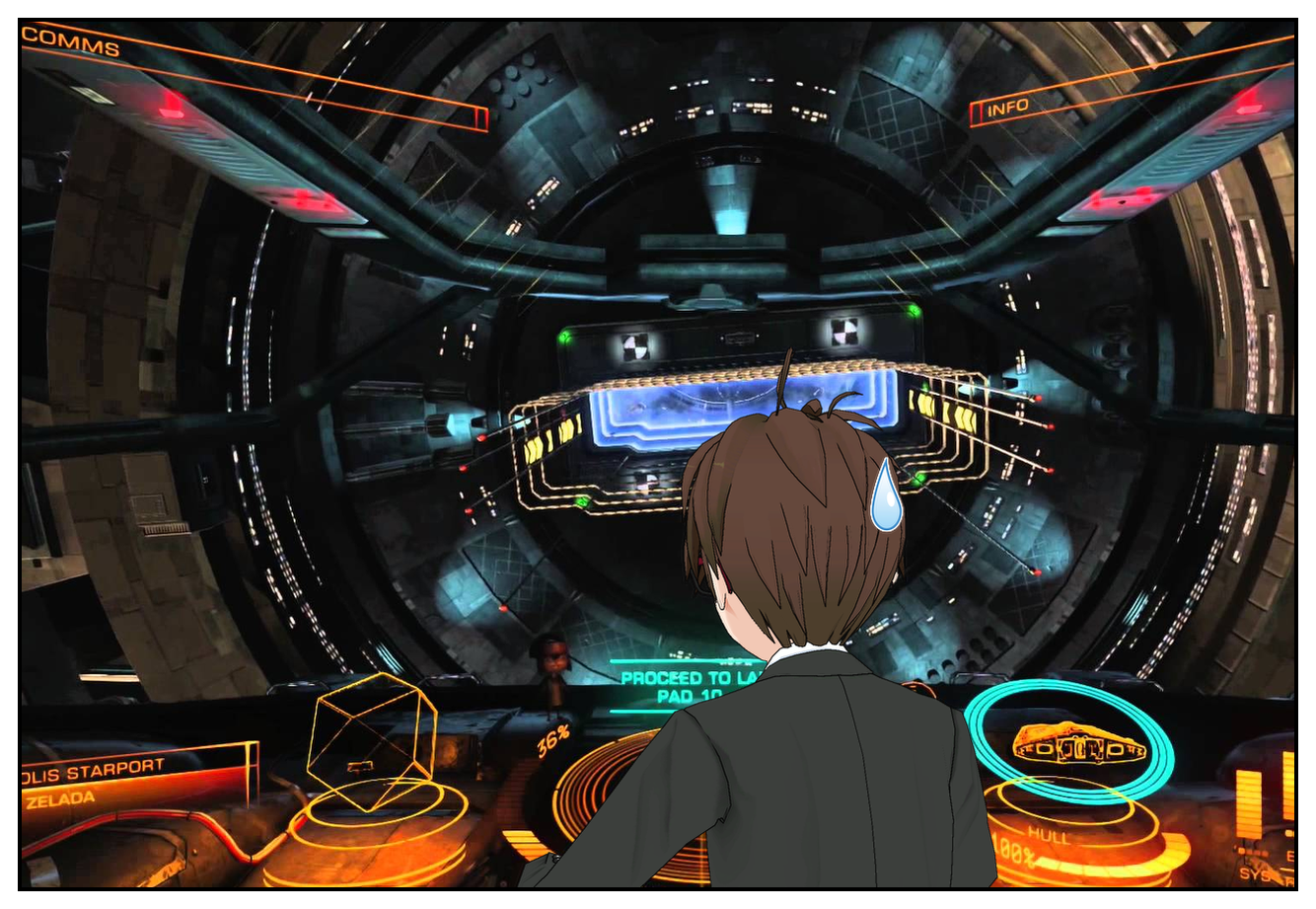
I used to really enjoy space games back in the 16-bit era — particularly those of a more free-form nature such as Paul Woakes' Mercenary series, Rainbird's Starglider series (particularly the enormously ambitious second installment) and, indeed, the original Elite. I say that — Elite is actually one that I never quite managed to get my head around when I was young, because there was a lot of things to think about while you were playing, and pages full of numbers that confused and bewildered me. Also docking with those spinning space stations was fucking impossible, so every time I tried I usually ended up quitting in disgust after smashing my ship to smithereens on the space station you start near.

I made the mistake of reading a few Steam reviews of Elite: Dangerous before giving it a go; while there are a few fair criticisms there, there's also a whole lot of whining about 1) not knowing what to do and 2) Frontier's business model for the game which, if you're unfamiliar, sees them essentially re-releasing the game at full price each year with the promise of a year's worth of major updates to the game systems. It's perhaps better to think of it as a yearly subscription fee, particularly as the game has a significant massively multiplayer element for those who care to engage with it.

Anyway. Discarding the Steam reviews and jumping in to try things out for myself, I was quickly enraptured by the feeling of flying my Sidewinder. I even unplugged the 360 controller and plugged in my 11-button joystick; it's no full HOTAS (Hands On Throttle And Stick) setup, admittedly, but it feels great when used in a game like this, particularly with the lovely visual feedback the game gives you with regard to movement: unlike the original Elite, whose cockpit was a static bitmap with a viewport into the flat-shaded 3D polygonal universe outside (I was playing the Atari ST version, so it had colours!), Elite: Dangerous' cockpit is set up to feel like you're actually sitting in it. Handling the controls causes your viewpoint to shift slightly according to how you're moving; it tilts when you roll, pulls forward and back when you speed up and slow down, and pulls up and down when you pitch. Given the game has been designed for virtual reality headsets from the get-go, it's understandable that the game would model head movement pretty well, but I'm glad to see that even when playing on a flat (admittedly large) TV screen it still looks very convincing.

What I've found most satisfying about the game so far is the moment-to-moment simulation of flying your ship. Everything you do is just satisfying to pull off, just for the sake of doing it. Especially fun is taking off and landing from various structures and space stations — and, in Horizons, you can now land on planets, too, either at settlements with dedicated landing facilities or just on the ground if you find a suitably smooth patch of terrain to set down. The handling of the ship is beautiful; pulling the stick around feels like you're wrenching a big, slightly unwieldy lump of metal around in zero- or low-gravity, and the sound design, where you hear your thrusters firing and your engines throbbing according to whatever you're doing, is absolutely impeccable. There's even a wonderful crescendo of your engines reverberating off the ground and surroundings as you set down for landing; it is, I think, the most convincing depiction of plausible pure sci-fi space travel I've seen for a very long time, perhaps ever.

The most common criticism of Elite: Dangerous is that it's "a mile wide and an inch deep", and I can kind of see where that's coming from: interactions with NPCs are rather sterile and menu driven, though later updates look set to put "faces" to significant characters in the universe. There's no prescribed narrative, either; you can get involved in the PowerPlay mechanic to swear allegiance to one of the various factions attempting to control the universe, which actually has a significant effect of the game for all players, but there's no "story" to follow as such besides that which you make for yourself.

In many ways, I think I sort of prefer that for Elite, though; while I do love a bit of story in my space games a la Wing Commander and the like, when playing something as freeform as Elite a story can kind of get in the way a bit, making you feel obliged to go and do certain things rather than exploring the galaxy at your own pace, making a name for yourself however you see fit.

I'll be interested to see if Elite holds my attention, but for now, it certainly feels like the space game I've wanted to play since I was a kid.

2203: Pete Reacts to Growing Older

0203_001

A significant proportion of the Internet has been up in arms over a recent copyright kerfuffle on YouTube recently, where a collective I've never heard of called the Fine Bros had apparently attempted to trademark the word "react". Digging deeper, it seems that the Fine Bros had done this ostensibly as a means of trademarking the concept of "reaction videos" and allowing others to make videos in the same format — one which the group have had plenty of success with in the past — while allowing themselves an opportunity to profit from licensing fees.

Leaving aside the whole ethical implications of attempting to trademark a common word such as "react" — one of several different "brands" that Fine Bros had attempted to trademark, theoretically as a catch-all term to encompass any specific series they might concoct in the near future — this whole debacle brought one thing into sharp focus for me, and that is that there are certain aspects of modern popular culture that I simply don't understand the appeal of whatsoever.

The concept of a reaction video is simple. You show some people — preferably from a specific demographic such as "teenagers" or "the elderly" — a thing that is Shocking in some way, then you film what they do while they're watching or looking at the thing that is Shocking. Early examples of reaction videos included various instances of people seeing the notorious "2 Girls 1 Cup" video (for heaven's sake, don't Google that if you've never heard of it) as well as well-known shocking scenes from TV or online videos such as Game of Thrones' "Red Wedding" scene.

Trouble is, in the few reaction videos I've managed to stomach, it all feels so painfully forced as to not be entertaining. No-one I know whoops and hollers at the television, bellowing "OH MY GOD!" as something shocking happens. The most do when seeing something shocking is flinch and wince at something gory, particularly if it involves eyes, but I don't shout and scream or anything. (That said, given the general difficulty I have with expressing emotions clearly when I'm "in person", I may not be the most representative example, but none of the people I know are like this either.) In other words, it doesn't seem believable, with the whole situation being so contrived as to seem utterly pointless.

And aside from the implausibility of some reactions, I simply don't see the appeal whatsoever. Why on Earth would I want to watch a group of people gathered around a TV that I can't see all screeching and gesturing at something I may or may not already be familiar with? And, by extension, why on Earth would anyone want to trademark such an utterly inane concept on the arrogant assumption that other people would want to pay them for the dubious privilege of churning out more culturally bankrupt tat like this?

I guess you can just add reaction videos to the ever-lengthening list of things that I just don't "get" in modern online life. It joins the illustrious ranks of Twitch chat, Twitch in general (unless you're hanging out with an actual friend), MOBAs, unboxing videos and doubtless a whole bunch of other things I'm not even familiar with yet.

I'm 34 years of age. Some days I feel like I'm still 16. Today, however, I'm feeling every one of those years. Now get off my fucking lawn.

2202: Three Games I'd Like to See Made

0202_001

Posting my piece about Neptunia games I'd like to see the other day got me thinking more broadly about other interactive experiences I'd like to indulge in, should they ever be made. (Or perhaps they already exist, in which case please do let me know in the comments and I will investigate!)

The following games either don't exist at all, or the last time they were properly explored in gaming — in my opinion, anyway — was far too long ago for my liking. So here we go, then:

A proper spy game

I downloaded Sid Meier's Covert Action from GOG.com a while back when it was on sale for some ludicrously low price, and discovered that it was an immensely satisfying, fascinating game with a number of distinct facets. I wrote in detail about the game a while back, but for those of you too lazy to click through, the elevator pitch is thus:

You are Max (or Maxine) Remington, an agent. A Dastardly Plot is about to unfold in the world, and it's up to you to stop it. Ideally, you will find out what is going on before it happens, arrest everyone involved and follow the trail of clues to find the Mastermind behind it all. You will then repeat the process until all the Masterminds there are in the world are behind bars — or until you give up at the ludicrous level of difficulty the game escalates to on its higher settings.

Covert Action incorporates a variety of game styles ranging from puzzle (phone tapping) to code-breaking, car chases and top-down action-stealth-adventuring. While clunky by modern standards, it's an extremely clever game that, in true Sid Meier tradition, is busily simulating a whole bunch of things happening in the background while you appear to be doing something relatively simple. None of it is pre-scripted, either; each case you get is randomly generated, so there's no easy way to find the solution other than putting in the hard graft yourself.

To cut a long story short, we need a new Covert Action. There have been spy-themed games, sure — the most memorable of which for me is, without a doubt, Alpha Protocol — but these tend to be more scripted and action movie-like, rather than focusing on the interesting but perhaps less glamorous aspects of the job. I want a spy game where it's rare you'll pull your gun on anyone; I want a spy game that's more about setting up surveillance and investigating than shooting terrorists; I want a spy game where it feels like I'm a spy, not an action movie hero. (To put it another way: I want a spy game where it feels like I'm old-school James Bond, rather than new-school James Bond.)

A good Star Trek game

There's plenty of space games around, since they've been making a bit of a resurgence over the last few years. With the success of Elite: Dangerous and the anticipation for No Man's Sky, the time is surely ripe for a new Star Trek game to hit the market.

Oh, there are a couple of relatively recent Star Trek games around, of course, but neither of these quite scratch the itch I have. Star Trek Online is a massively multiplayer online RPG, with everything that entails — including lots of grinding and free-to-play monetisation that requires you to pay up for the coolest ships rather than earning them — while Star Trek Timelines is a mobile game with everything that entails — including lots of grinding and free-to-pla… you get the idea.

Neither of these games are particularly bad as such — though Star Trek Timelines' use of the obnoxious playtime-limiting "Energy" system that I really wish would die a horrible death is something I find hard to forgive — but neither of them are quite right. Both have good aspects: Star Trek Online has a great feeling of taking your ship around the galaxy, exploring uncharted areas and engaging in battle, while Star Trek Timelines presents you with some interesting non-combat scenarios to deal with, albeit only in text form. The trouble is, neither of them go far enough in simulating what it's like to be a crewman on a Starfleet vessel.

There are a few approaches I'd like to see a new Star Trek game take. Firstly and perhaps most obviously is a starship bridge simulator. I know these exist and are available on GOG.com, but with modern technology it would be possible to do something far more impressive — and perhaps even multiplayer, a la Artemis Starship Bridge Simulator.

Another possible approach is something along the lines of Spectrum Holobyte's elderly Star Trek: The Next Generation – A Final Unity, which combined starship operations (including combat and power management) with point-and-click adventuring down on planet surfaces. While the combat and engineering sections on the ship ended up feeling a little superfluous when compared to the game's narrative aspects — particularly as you could put them both on automatic without penalty — the whole thing felt suitably authentic as an interactive episode of The Next Generation, and ripe for updating.

I guess one of the main issues with the Star Trek license is that there's not a current TV series running to tie it in with, so it would probably have to be an original work, perhaps with guest appearances from established characters. That's not an issue for me, so long as it feels like Star Trek, but for some fans it may not be acceptable.

I believe there is talk of a new Star Trek series of some description coming soon, though, so it will be interesting to see if anything interactive comes of it. Anything's better than that dreadful third-person shooter that came out for consoles a year or two back and was promptly completely forgotten about…

A game about running a school

There are tons of management games out there, but outside of an extremely peculiar mobile game by Kairosoft called Pocket Academy, I don't recall all that many that focus on educational institutions, and I think this is something that would be ripe for the interactive treatment.

SimSchool, as we'll call it, has a considerable degree of scope to be a much more "personal" strategy game than many other management sims, since although running a school does include the standard stuff like budgeting, staffing and training, a key part of what keeps a school running effectively is interpersonal communications, rapports and morale.

In SimSchool, you'd play the new, young headmaster of a school that was struggling, and you'd have a certain amount of time to set things right. In true strategy game tradition, you'd be able to set up various conditions at the beginning of the game such as the affluence of the area the school is in, the size of the school, when it was built, its condition and suchlike, and have the game create a challenge for you accordingly.

As you worked your way through a campaign, you'd not only have to perform managerial duties to keep the establishment in the black and keep an eye on the day-to-day operations of the school, but you'd also have to interact with students, staff and parents in order to keep them happy. There'd be dialogue sequences in which you'd have to negotiate things and determine the best way to handle problem children — sometimes you'd even have to convince the local authority that the decision you'd made was the right one for the greater good. And, on the harder difficulty levels, you'd also have to contend with various "disasters" that make your life more difficult — this is a Sim game, after all!

My time working in schools was hellish, and I have no desire to return — but that doesn't mean I don't still find them interesting places. A game like this has a lot of scope to be an interesting twist on the strategy-management genre, and I'd certainly love to play it.