#oneaday Day 283: We should probably be resisting generative AI more than we are

There was a good piece by 404 Media on "AI slop" today. Author Jason Koebler described the issue as AI slop being a "brute force attack on the algorithms that control reality", and goes on to explain how those taking advantage of AI are exploiting social media algorithms to such a degree that platforms are now flooded with this garbage, making it hard to find 1) anything made by a real person and 2) anything made by someone you might actually want to connect with.

There is zero value to this stuff, other than self-fulfilling engagement. Presumably the long game is to build up "the numbers" with this shit, then sell the accounts, or make bank off impressions-based ad revenue. And the platform holders don't give a shit; as Koebler points out in his piece, it seems like Mark Zuckerberg actively wants the experience on Facebook to be real humans arguing over AI-generated slop rather than anything real and meaningful.

And I don't understand why we're letting this happen. Not only on social media, but in more "traditional" industries, too. It's happening to a frightening degree in publishing, with myriad "get rich quick" schemes fundamentally being based on churning out multiple AI-generated books every week (or even day) and then profiting off, let's face it, vulnerable people who aren't able to tell the difference between garbage churned out by a robot and something written by an actual human being.

As Koebler puts it, "there is a dual problem with this: it not only floods the Internet with shit, crowding out human-created content that real people spend time making, but the very nature of AI slop means it evolves faster than human-created content can, so any time an algorithm is tweaked, the AI spammers can find the weakness in that algorithm and exploit it."

At the moment, there are a few common responses to generative AI:

  • "I love generative AI! The genie is out of the bottle, so if you're resisting it you're a Luddite who isn't embracing the latest technological innovations!"
  • "Generative AI is just a tool that people can add to their arsenal, like digital art packages. I can't really tell you how or why that's a good thing, but I heard someone else say it so I'm saying it too."
  • "Generative AI might be useful in certain circumstances, but I can't really tell you what they are because no-one really knows or can offer specific, concrete examples that aren't prone to hallucinations to such a degree to make them worthless."
  • "Generative AI sucks balls and I hate it."

I'm somewhere towards the bottom of that list, leaning towards hating it and very much wanting it to go away. At present, I am disinclined to trust the people who claim it will be "revolutionary" for things like medicine, because of the amount of times it fucks simple things up, still. I am also concerned for the field of programming, because as more and more junior coders show up who are only capable of feeding prompts into an AI, not actually doing (and checking!) the coding themselves, we're going to have a real problem on our hands with software development.

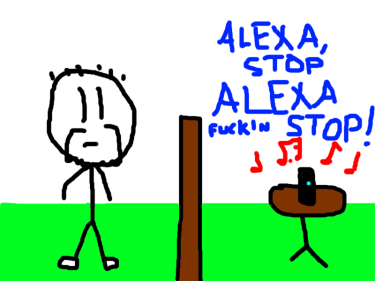
At the same time, I'm sure there are some worthwhile use cases for a means of communicating with a computer using natural language. I mean, hell, look at Star Trek; the assumption there was that you could just say "Computer" like you say "Alexa" today, then rattle off an often fairly abstract task for it to complete, and it would do it. That is, presumably, the goal.

But AI isn't there yet, not by a long shot, which is why ChatGPT costs $200 a month for a subscription and can't really tell you what it's for, let alone how to stop it making stupid mistakes, and in the meantime the companies involved in all this shit are burning through both money and the planet's natural resources in pursuit of something which might, in fact, be impossible. "Agents" are coming, apparently, but all we've seen of them so far is making things that are already pretty straightforward to do on the Web (like grocery shopping) actively more cumbersome, and OpenAI's "deep research" tool is utterly laughable at this point, pulling out citation-free forum posts and SEO-optimised slop ahead of actual, worthwhile information written (and reviewed) by humans.

You, reading this, almost certainly know all this, and perhaps you've even read or shared some articles talking about the problems with AI slop and the problems that is causing all over the Internet. But what have you done about it? Because I feel like we should be doing more about it, rather than just pointing and tutting at it, going "whoo, lad, that generative AI sure is a bit shit, isn't it? Someone should do something about it."

The trouble, of course, is that it's difficult to do anything meaningful about it, particularly when big corporate entities like Microsoft are the ones forcing it onto people through things people use every day like Windows, Office 365, and even the bloody Xbox. I mean, sure, you can find ways to disable it when it does show up, but these workarounds often end up circumvented by the corporations, meaning you need to faff around even more to get rid of the shit. And sure, you can install Linux, but that carries its own burden of needing to know how to do that. Which you and I might be comfortable doing, but what about people who use computers more casually; those who don't know how they work, but just want to be able to get on with simple tasks without intrusive AI features popping up every few seconds?

All we can do, really, is make a specific effort not to use generative AI tools when there are other alternatives available. I will never, ever use generative AI on this site, MoeGamer or my YouTube channel to produce words, scripts, images, thumbnails or videos, however tempting it might be as a "quick fix" to get something done. If that means there are things I either can't do or would have to pay a specialist to be able to do, I will either go without the thing or pay a specialist. Or perhaps even learn how to do the thing myself.

That's a crucial one, I think. Over the years, I've learned how to do a lot of things on computers simply by running into an issue I don't know how to solve, researching it myself and learning how to deal with it. Some of that knowledge I've retained, some of it fell out of my brain the moment I finished using it, but on the whole I've had a net gain on knowledge simply through running into problems and taking the initiative to learn how to fix them myself. I suspect many people who grew up with computers throughout the '80s and '90s are the same.

I'm not going to tell you what to do. But I am going to tell you what I'm doing:

  • I will not use ChatGPT to research anything, when perfectly good information is available through well-established, reliable, trustworthy and peer-reviewed sources both online and offline.
  • I will not use AI image or video generation for anything, period. If I need an image or video of something, I will produce it myself, search for a usable (and suitably licensed) stock or otherwise publicly available image or video, providing credit where appropriate, or just not use that image or video.
  • I will not use AI voice generation to make a "famous" voice say something it never said. Even if it's really funny. I will freely admit to having done this in the past (only among friends), but that was before we really knew or understood the numerous negative impacts that generative AI has on both the environment and on culture.
  • I will not use AI to create content for the sake of content. I write here because I like writing. I write on MoeGamer because I like writing about games. I make videos because I like making videos. I am not entitled to a "share" of the Internet based on the volume of stuff I churn out, nor am I entitled to be able to make a living from it. I will not pollute the Internet with meaningless slop.

Someday, there may be a valid use case for generative AI. I am open to that. Right now, I do not believe that is there, and I believe the continued proliferation of generative AI online is actively harmful to the Internet specifically, and human culture more broadly.

It needs to stop. But I'm concerned the "genie in a bottle" people are right, and that now we've started this process of enshittifying the entire Internet, we can't stop it again.

But we can make our own little corners of the Internet a safe haven away from the deluge of sewage. And that's what I'll continue to do.


Want to read my thoughts on various video games, visual novels and other popular culture things? Stop by MoeGamer.net, my site for all things fun where I am generally a lot more cheerful. And if you fancy watching some vids on classic games, drop by my YouTube channel.

If you want this nonsense in your inbox every day, please feel free to subscribe via email. Your email address won't be used for anything else.

#oneaday Day 257: When it's bollocks, say it's bollocks

I am an avid reader of Ed Zitron's blog (sorry, newsletter, because apparently that's just what we call blogs now) Where's Your Ed At? If you're at all interested in the tech space, I highly recommend you subscribe or at least check in on it regularly, because Zitron is one of the only people in the space who has the balls to say it like it is: that an awful lot of what is coming out of the mouths of tech companies right now is complete and utter bollocks.

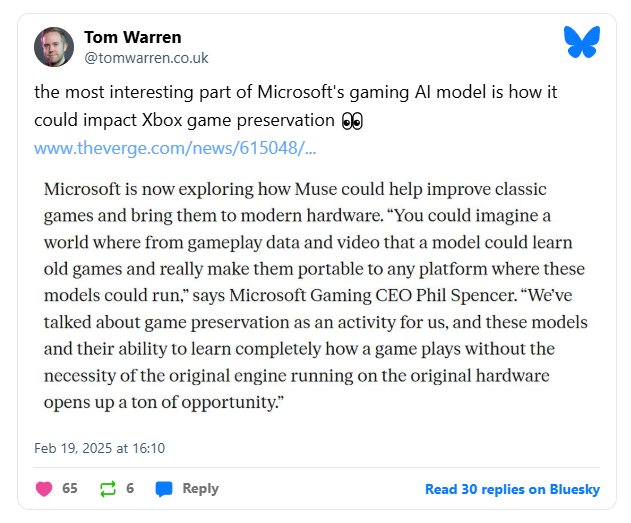
Today, a story went round about a research project at Microsoft where they were using generative AI for "game ideation", and also noted that they thought they could use their generative AI models for "preservation". This was reported on by Tom Warren, senior editor at The Verge, thus (screenshotted rather than embedded 'cause the coward deleted it after everyone dunked on it):

Now, if you know anything about video game preservation, you know that feeding an old game into a generative AI model and then hoping it will hallucinate at least a rough approximation of the original game experience is not "preservation". It's bastardisation at best, a completely useless endeavour at worst, and a massive waste of energy and money regardless of the result that comes out of the other end.

Game preservation is a problem that, for the most part, we have solved. We have excellent software emulation solutions, built over the course of decades of development. Hardware emulation via FPGA at an affordable cost for the general public has advanced hugely in just a few short years. Software libraries for pretty much any system you can think of are archived in their entirety at numerous places across the Internet, and strong strides have been made in providing commercial, legally relicensed versions of classic games for a modern audience, both on existing modern systems and on bespoke emulation-centric devices.

So why, then, why the fuck would we want a generative AI model to make a best guess at what a video game that already exists and has been preserved perfectly well might look like if you play it for longer than 10 frames?

That paragraph above is what tech journalists should be asking. And the reason I bring up Ed Zitron at the start of this post is because he's one of the only people to actually ask questions like this: to take a look at the utter garbage being spewed by today's tech companies and to say "this is complete horseshit, what the actual fuck are you on?"

And Zitron, being an outspoken type, is not afraid to call out today's tech journalism space for not doing this. And he's absolutely right to do so. It is the tech journalism sector's job to look at what it going on, to realise that it is complete horseshit and then have the confidence to say that it is complete horseshit.

But they won't do that, for a variety of reasons. Advertising deals. Exclusive access. PR partnerships. An inexplicable desire not to rock the boat, despite the fact the boat has a huge hole in it and has been steadily sinking for 15-20 years at this point.

I'm not one of those people who thinks that journalists are taking bribes for positive reviews in literally all circumstances — I have experience in the industry, remember, and the most I had to worry about in that regard was a mild admonishment from my editor for criticising a Mortal Kombat game's DLC plan when Mortal Kombat was the cover game for that issue of GamePro.

But come on now. Tech journos should be looking at this utter garbage that keeps getting flung our way, and instead of declaring it "interesting" and doing the stupid looky-eyes emoji that makes their post immediately look like a 14 year old girl wrote it, they should be going "hang on a minute, what does that actually mean?" then exploring it further, asking some probing questions (which inevitably won't get a response, but that in itself says something) and then confidently declaring the latest generative AI "innovation" to be what it is: complete and utter horseshit doused in the finest snake oil.

And people wonder why the entire journalism sector is floundering. Could it perhaps be because very little actual journalism seems to be getting done?

Shout-out at this point not only to Ed Zitron's aforementioned blog, but also the excellent coverage of the Elon Musk nonsense in the States by Wired's politics department, 404 Media being a rare example of tech journalism that actually asks those hard-hitting questions, and Aftermath for doing something similar with games journalism. There are still people doing good work out there. But the people on the big, well-known mastheads, like Warren above, need to step their game up, stop being so incredulous and start acting like actual journalists.


Want to read my thoughts on various video games, visual novels and other popular culture things? Stop by MoeGamer.net, my site for all things fun where I am generally a lot more cheerful. And if you fancy watching some vids on classic games, drop by my YouTube channel.

If you want this nonsense in your inbox every day, please feel free to subscribe via email. Your email address won't be used for anything else.
#oneaday Day 253: Why do I need software to make my keyboard charge

I've been having an issue with my fancy, expensive Razer keyboard for a while. I've had it plugged in to USB, but as soon as I take the USB cable out, it seems to completely forget that it's been on charge and just die. This meant that I couldn't use it wirelessly, which was one of the keyboard's main selling points: it was a rare example of a mechanical keyboard that was also wireless. It didn't used to do this.

For a while, I just thought the battery was dead. Then I remembered that I'd uninstalled the Razer software a while back, because a shonky update process had made it cause my computer to pitch a shitfit and completely lock up for ages. So, out of curiosity, today I reinstalled the Razer software, plugged in the keyboard to charge and went off to play Xenoblade Chronicles for a couple of hours.

I am now typing this with the keyboard's USB cable unplugged, and the battery reading 100%. So it was the fucking software. My keyboard officially will not charge its battery unless you have Razer's stupid software installed.

Thankfully, they seem to have fixed whatever the locking-up issue was when I uninstalled it, so it's not a huge inconvenience to have it installed again. But it's pretty annoying to have spent several months thinking that my keyboard was broken in some way, or that it needed a new battery, only to discover that a completely arbitrary piece of software was preventing my keyboard from doing something that, you'd think, it should be able to do without any software intervention whatsoever. I mean, USB charging is a fundamental part of most of our tech these days, and most pieces of tech can charge without a piece of software running. You just plug them into a wall, the device goes "ooh, there's power coming in, I should route that to the battery" and that's that.

But no. Not for Razer, apparently, and I suspect there's other manufacturers who do the same thing, too. Logitech, for example, pissed people off when they tried to install some weird AI software into people's mouse drivers a while back, and the general enshittification of tech is, at this point, extremely well documented — though the number of people actually doing something about it, or even acknowledging that it's a problem, is rather slimmer than it perhaps should be.

Now, I'm not saying that my £150 keyboard not charging when its software isn't installed is really making my life significantly worse in the same way that Facebook and Instagram's abusive practices are systematically destroying the mental wellbeing of individuals in the name of perpetual corporate growth, but it's still symptomatic of the age we're living in. 20 years ago, if I had a wireless thing with a rechargeable battery, I could just plug it in and be safe in the knowledge that it would, y'know, charge. Today, apparently, that is not the case. And that seems stupid. Really stupid.

But I guess that's the world we live in now. So, for now at least, we just have to live with the stupidity.


Want to read my thoughts on various video games, visual novels and other popular culture things? Stop by MoeGamer.net, my site for all things fun where I am generally a lot more cheerful. And if you fancy watching some vids on classic games, drop by my YouTube channel.

If you want this nonsense in your inbox every day, please feel free to subscribe via email. Your email address won't be used for anything else.
#oneaday Day 184: Deprecated feature

I went into my Amazon wishlist earlier today, as I know it's the first port of call for several family members when trying to determine what to get me for Christmas, and I was a little perturbed to discover that it is seemingly not possible to change the order of the things on your wishlist any more. Or, to be more accurate, you can rearrange the order of the items in the first three rows in Grid view, but everything else doesn't respond to clicking and dragging like it used to.

I did a little research online and, indeed, it seems that Amazon deliberately removed this a while back. It's a "deprecated feature", apparently.

I always find the idea of "deprecated features" bizarre, because inevitably the features that get "deprecated" are ones that are actually useful, and in many cases they don't actually get replaced by something with similar functionality. In the case of Amazon wishlists, aside from the Grid view exception I note above (which I suspect is a bug) you can now only sort them in various automated ways, or you can push something to the top of the wishlist by going to its product page and "re-adding" it. You can also move it to another list and then move it back to the original list. Both of these are, I'm sure you'll agree, inferior to being able to just drag the damn thing to the position you want it — or, indeed, click a "send to top" button, which I'm sure also used to exist.

Modern software — be it stuff you run on your computer or that which powers billion-dollar ecommerce platforms — seems to be full of stuff getting "deprecated" without any real net benefit to the user. The usual interpretation of this is that the creators of said software want to discourage users from doing something in favour of doing something else with a similar function. But in Amazon's case I'm really struggling to see why I might be discouraged from reordering my wishlist into whatever order I want… particularly as there is no real alternative, aside from the rather clunky options I've just outlined.

There's a lot of discussion going on right now about how tech is genuinely getting worse year on year, and it's not just people "getting old". The writer, blogger and tech commentator Ed Zitron does some great work in this field, and I encourage you to check out his blog Where's Your Ed At and his podcast Better Offline, because while both paint a bleak picture of the tech landscape as it exists in 2024, some of you might find it reassuring that no, it's not just you, things really are getting worse in terms of usability and overall functionality.

As for me, well, I guess it's time to go re-add some stuff to my wishlist so it gets pushed to the top!


Want to read my thoughts on various video games, visual novels and other popular culture things? Stop by MoeGamer.net, my site for all things fun where I am generally a lot more cheerful. And if you fancy watching some vids on classic games, drop by my YouTube channel.

If you want this nonsense in your inbox every day, please feel free to subscribe via email. Your email address won't be used for anything else.

#oneaday Day 179: Your occasional reminder that AI can fuck off

I saw a TV ad for "Apple Intelligence" yesterday. The concept of the ad is that someone is angry someone at their workplace keeps stealing their pudding — hahaha, so hilarious and cosy and relatable — and writes them a furious email. They then click the "Friendly" button on Apple Intelligence and the email is rewritten to be the most milquetoast, handwringy, insincere thing you've ever seen. And this is supposed to be a selling point.

Elsewhere, a YouTuber I know had someone in their comments getting pissy about how they pronounced "ZX81", and, presumably in an attempt to further their argument, the commenter in question then copy-pasted a ChatGPT conversation — without editing out the "ChatGPT says:" bits — that didn't even particularly help their cause.

I keep seeing YouTube thumbnails made with AI art-stealing machines. Coca-Cola made a Christmas ad with AI. The memorial lunch for beloved broadcaster Steve Wright had an invitation that was made with AI. Entire websites are made of AI slop. And even here in fucking WordPress, I can't escape the sodding "Generate with AI" button.

I fucking hate it. I want it to go away. I want people who say "but it's good for summarising things" to drown in the sea. I want people who say "but it's better than doctors at diagnosing problems!" to be the victims of the worst malpractice the medical industry has ever seen. I wish eternal loneliness and desolation on those who use it to write emails. And I want it out of the pieces of software I use on a daily basis.

We're even starting to get accounts on BlueSky that pretend to be real people, but simply respond with ChatGPT answers that are tuned to be deliberately argumentative. What is the fucking point of all this shit? How is it benefiting humanity and productivity in any way whatsoever?

It isn't. All it's doing is continuing to make tech worse, year on year, while keeping oblivious shareholders — who aren't interested in anything but seeing "growth" — happy that companies are providing supposed "new innovations" that actually don't provide any sort of useful functionality whatsoever.

I'm aware I'm ranting incoherently, but honestly right now it feels like it's pointless to even try and come up with a cogent argument. This shit is infesting everything, and it's becoming impossible to escape from. And I legitimately do not understand how anyone can possibly think this shit is in any way better than what we had before.

I guess the one upside is that with how much AI is being used pointlessly to provide "summaries" of Google Searches, YouTube videos and other such shite, the planet will burn down all the sooner, so eventually we won't have to worry about it at all. Then the Great Thinkers of the day — assuming anyone survives — can stroke their chins for two hundred years about "where it all went wrong".

Here. Here is where it all went wrong.


Want to read my thoughts on various video games, visual novels and other popular culture things? Stop by MoeGamer.net, my site for all things fun where I am generally a lot more cheerful. And if you fancy watching some vids on classic games, drop by my YouTube channel.

If you want this nonsense in your inbox every day, please feel free to subscribe via email. Your email address won't be used for anything else.

#oneaday Day 159: To upgrade... or downgrade?

I'm due an upgrade on my phone, and for the first time I'm holding off because I'm not sure I want one. All the new phones are rammed with AI bullshit and I don't want to encourage that crap in any way whatsoever, so the prospect of getting one makes me a tad uneasy.

The other thing that is causing me to hold off is a growing desire to break my attachment to smartphones. I don't like being dependent on a smartphone. I don't like having that stupid black rectangle follow me everywhere I go. I don't like feeling like I compulsively "have" to fiddle with it if I don't have anything to say or anything to do.

There are a few things stopping me from immediately ditching my smartphone and "downgrading" to a modern feature phone. I thought I'd ponder each of them in turn. I probably won't come to a conclusion, but it might help me sort some things out in my mind. And maybe it'll be helpful for you, too, I don't know.

WhatsApp

I don't use WhatsApp as much as a lot of people, but I do have a few ongoing chats that are my sole means of connection with friends I haven't seen for a while. On top of that, the people from my job use WhatsApp for communication outside of work — for example, when we're having a group social trip together.

Giving up WhatsApp would mean giving up a connection to people I don't want to "disconnect" from entirely, and would also make life inconvenient for my work colleagues. That last one I'm not super concerned about, but I do like my job and my colleagues, so I don't really want to be a pain.

Beyond those maybe two group chats (both of which have declined in activity anyway) and my work colleagues, I'm not super attached to WhatsApp. I could probably live without it.

The camera

Phone cameras these days are pretty excellent. I shoot anything that isn't direct capture from gaming hardware on my phone. Upgrading my phone would mean I can get an even better camera.

However, two things: 1) I can still use the camera on my existing phone even if it doesn't have a SIM card in it (I think, anyway). And 2) I could just, y'know, buy a nice camera.

So while it's certainly convenient to be able to snap photos and take video with a device that is with me anyway, it's probably not actually a dealbreaker in this situation.

Music and podcasts

I am, I'm afraid, "part of the problem" with music, though not out of any belief that streaming is "better" than having your own collection of tunes. It's just a lot more convenient to be able to stream music (I use YouTube Music, because I have YouTube Premium and might as well use the additional benefit) and podcasts from, again, a device I have with me anyway. Plus my phone's Bluetooth connects to my car stereo with no difficulty, making it easy to queue up entertainment for long journeys, such as my monthly drive to the office.

I haven't looked at standalone MP3 (or equivalent) players for probably 20+ years at this point. I'm sure they exist. In fact, hold on.

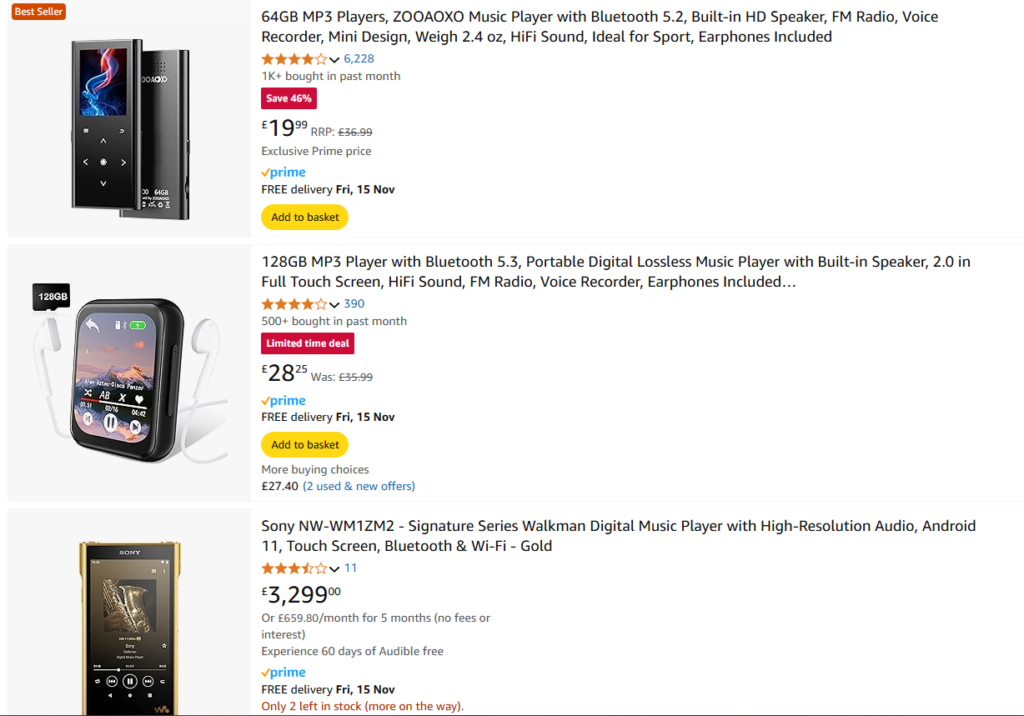
It seems I can get a cheap Chinese shitbox for £20-£30, or I can spend three thousand pounds on a gold Sony thing (just £659.80 a month!) if I'm feeling particularly insane. What the actual fuck.

Uh… anyway. MP3 players do indeed still exist, and many of them have Bluetooth. Some of them even have WiFi, and some of them take the iPod touch approach where they're basically a phone without the "phone" bit. I will steer clear of those, at least, because that would just be replacing one problem with the same problem, but mildly less convenient.

So an MP3 player with a decent capacity is not expensive. That would require me to organise my MP3 library, though, which has been in a right state since Google Music (RIP) invited me to upload it all "to access anywhere", then promptly closed down and was replaced with the considerably inferior YouTube Music… and when I downloaded it all again the organisation was all fucked.

It wouldn't be the end of the world to have to do that, but I'd rather not have to. So I think we can consider the music player side of things covered.

Navigation

In-car navigation is easily solved: buy a satnav. But I also use Google Maps when I'm on foot to see what's nearby and figure out how to get to places. That is a problem that is a little trickier to solve. GPS devices for on-foot navigation certainly exist, but they're primarily geared towards hiking and cost more than I'd be willing to spend on something that I'd only use occasionally, particularly if I had already bought a satnav for the car.

I can't see an easy solution to this one. I believe some feature phones are able to access a Web-based form of Google Maps, but I don't know how useful or effective that is.

I mean, I guess I could kick it really old school and just buy an A to Z of wherever I happened to be going. I can't check what time Sainsbury's closes with one of those, though, unless they've considerably enhanced the level of detail they go into since I last used one.

Conclusion?

I could probably find solutions to all of the above problems, except WhatsApp. I believe there are some feature phones that are capable of using a text-only version of WhatsApp, but from a cursory glance around earlier today it seems a lot of them don't work in the UK for some reason.

I will continue to mull it over. The prospect of truly breaking free from the smartphone becomes increasingly appealing day by day… I'm just not quite sure I'm truly ready to pull the plug. My main concern is suddenly running into a use case that I haven't thought of while farting this blog post out of an evening, and then being kind of fucked when I'm stuck with a modern-day Nokia and no means of fulfilling the function I suddenly, urgently require.

But really, what might that even be? It can't be that important, or I would have thought of it by now, surely.

Anyway, I haven't reached a definitive conclusion. But I have definitely convinced myself that there are at least some of the features I use on my smartphone that I absolutely can live without. Is that enough, though?


Want to read my thoughts on various video games, visual novels and other popular culture things? Stop by MoeGamer.net, my site for all things fun where I am generally a lot more cheerful. And if you fancy watching some vids on classic games, drop by my YouTube channel.

If you want this nonsense in your inbox every day, please feel free to subscribe via email. Your email address won't be used for anything else.
#oneaday Day 143: You should consider a mini PC

I realised that I don't think I've talked about this on this 'ere blog before, so now's as good a time as any.

You should consider a mini PC. You know, those little square things that are much too small to put anything in and don't have graphics cards. Yeah, them. I got this one and it has completely taken over from "the gaming PC" (which is hooked up to the TV in the living room) as my daily driver for work, and also for video capture and streaming. (I still do video editing on the gaming PC, though, because having an actual graphics card is helpful there.)

I've been very pleasantly surprised how capable that thing is, even if I continually want to call its brand name "Beedrill" instead of "Beelink". (I had to look up my order to check.) It's a nippy little thing when running Windows 11 — which is nowhere near as bad as naysayers think, particularly when you turn off/forcibly remove all the AI shit — and for anything other than bang up to date graphically intensive polygonal games, it performs admirably. It is superb at emulation, for example.

Its small form factor makes it very portable — I now take it to the office when I have to go in, instead of a laptop — and it has plenty of connectivity, including Wi-Fi and Bluetooth. I've added a powered USB hub to mine just for maximum flexibility — I have a lot of things hooked up to it — but if all you need is a wired mouse and keyboard and maybe some additional USB storage, you're sorted with just the included ports.

I hadn't even considered mini PCs prior to picking this one up, but when I decided I wanted to move my day-to-day work from home out of the living room and up into my study, something made me give them a look. And I was surprised to read plenty of positivity about them — it seems these little things are quite fashionable at the moment. And, having now owned one since May of this year (it feels like longer already — it's a fixture now!) I am delighted with how it's performed and how flexible the damn thing is.

The only thing — besides triple-A gaming — that I've found it's not really up to is simultaneously running a reasonably modern game and recording/streaming it at the same time. It's fine doing this with emulation — my last few Atari ST videos were done on this machine — but when I thought about streaming UFO 50 a few weeks back, it wasn't quite up to the job. Which is a shame, but not the end of the world, because I also have an Elgato hooked up to it, so I can just stream/record from other devices such as the 400 Mini, Evercade VS and, soon, Switch — I've bought a second Switch dock specifically so I can dock my Switch and stream from it.

So if you're in the market for a new PC and you know that your uses aren't going to be super-demanding — and yes, this even includes games, so long as they're not, like, super-fancy ray-traced gubbins — I can confidently say a mini PC is a good investment. They're particularly ideal if you want to set up some sort of emulation box or a system primarily used for entertainment — video streaming, music, that sort of thing. They're small, compact, quiet and, best of all, cheap.

So yeah. That's my sales pitch. You should consider a mini PC. I'm glad I did!


Want to read my thoughts on various video games, visual novels and other popular culture things? Stop by MoeGamer.net, my site for all things fun where I am generally a lot more cheerful. And if you fancy watching some vids on classic games, drop by my YouTube channel.

If you want this nonsense in your inbox every day, please feel free to subscribe via email. Your email address won't be used for anything else.

#oneaday Day 76: Nopegrade

I'm due a phone upgrade. This is probably the first time I've come to that point and haven't been tempted to immediately get a new shiny phone. And the reason? So many of the latest models appear to be absolutely rammed to the gills with "AI" features I don't want anything to do with.

And it's a shame, because some of these phones do otherwise look good. The Google Pixel 9 looks like it has an excellent camera, for example, and that's pretty high up my list of priorities these days. The newest Samsung devices also look quite nice, and having had a Samsung device for my last couple of phones, I'd be quite happy to go with them.

If it wasn't for the bloody AI crap, that is. I know I could just "not use it", but that's not really the point. I don't really want to send any sort of message that AI junk is something that I'm interested in in the slightest, and my concern is people happily jumping on with Google Pixel 9 and "just trying out" Gemini will just prolong the amount of time we all have to suffer with AI garbage being jammed into places we don't want it.

I'm sure there are some "valid" uses for AI, but honestly, I don't really see the usefulness right now. Earlier on, I watched a Marques Brownlee review of the Google Pixel 9, and everything that was "AI-powered" seemed very superfluous and unnecessary. An on-phone image generator? Cool, now I can steal artwork wherever I am in the world! An assistant I can talk to about what I should do about a wasp infestation? I'd rather talk to a real person that doesn't hallucinate, thanks. The ability to turn on my lights with my voice? 1) I can already do that with several other devices and 2) I don't want to do that. The ability to insert myself into a photo I wasn't in? Cool, now I can create "memories" of things that didn't actually happen. I'm sure that's healthy.

It's the voice stuff that really gets me. I genuinely do not understand how any of that is desirable. How is getting an Amazon Alexa, Google Gemini or whatever to read out your email headers better than tapping on the email icon and looking at them? How is getting a device to give you a "daily briefing" better than just doing a quick round of your favourite websites to check on the headlines? How is bellowing "SET A TIMER FOR THREE MINUTES… no, THREE minutes. THREE. MINUTES." better than going to the clock app and typing the number "3"?

It isn't. These things are all gimmicks. They're not actually useful. The grand dream is presumably some sort of omniscient, omnipresent Star Trek-style capital-C Computer that we can call upon to dispense its knowledge and information wherever we are at any time of day. But we're not there yet. We're not even close to being there yet, with how unreliable and hallucination-prone modern AI still is. And if reports are to be believed, we've already pretty much hit a cap on how good the current "AI" tech can get, because the various models are already starting to feed on themselves, making hallucinations more likely, not less likely, as they inadvertently guzzle up AI-generated swill rather than material that has had a human involved at any point during its creation.

And it disgusts me to see how many publishing companies are gleefully signing up to feed their writers' work into ChatGPT, almost certainly without consulting the actual writers for their consent beforehand. Today it was Condé Nast. Previously it was Vox Media. And I'm sure there's a lot more all over the place, too.

I cannot wait for this odious trend to be over. And I suspect it will be over within a few years, as the money is almost certainly going to run out. None of these models are sustainable; none of them have a "killer app" that convinces naysayers that actually, AI might be quite good after all; none of them even really have a marketable product beyond "look at this thing that might one day be able to do something vaguely useful (but doesn't just yet)".

The sooner that fucking sparkly magic icon goes away, the better.


Want to read my thoughts on various video games, visual novels and other popular culture things? Stop by MoeGamer.net, my site for all things fun where I am generally a lot more cheerful. And if you fancy watching some vids on classic games, drop by my YouTube channel.

If you want this nonsense in your inbox every day, please feel free to subscribe via email. Your email address won't be used for anything else.

#oneaday Day 19: The AI Rot

Look at this bastard little icon. You probably see it every day right now. Hell, I see it every time I pop open the WordPress toolbar, because Automattic, makers of WordPress and Jetpack (back-end technology that helps WordPress sites do what they do) are cramming it in absolutely fucking everywhere, just like every other tech company is right now. No-one asked for this, no-one wants it, no-one is happy with the results it produces.

And yet, look at that bastard little icon. Such promise it carries in its little sparkly starbursts! The suggestion that magic is about to happen! The implication that, were you just to click that bastard little icon, creativity will be magically produced from nothing, allowing you to truly express yourself without any of that pesky "thinking"! You will truly be once and for all free!

As a creative type, naturally I object to generative AI being jammed in everywhere that it doesn't belong. I'll admit to having found some uses of it potentially interesting — music generation is intriguing, feeling like a step onwards from a program we used to have on the Atari ST called "Band In A Box" — but whatever use case I come across, it's hard to shake the feeling that its only real use is to enable laziness, and to prevent having to pay a real person for doing the creative work that is their specialism. (The actual computing and environmental cost of such tech doesn't matter to AI zealots, of course.)

That's not to say there's no money in AI, mind; no, by golly, the big tech companies are falling over themselves to hoover up investor cash right now, and every big generative AI site features some sort of predatory monetisation system, usually involving "credits" that obfuscate how much you're actually paying, and/or "monthly" subscriptions that are actually charged annually, because apparently that's just a thing you can lie about now and no-one calls you on it.

I think one of the clearest signals I've felt that AI bullshit has gone too far is its encroachment into pornography. It's now easier than ever to produce "deepfake" pornography featuring people who have not consented to appear in pornographic material. Of course, AI-generated slop has plenty of telltale signs, still, but the fact this stuff exists at all was already cause for concern even before it was easy to produce it.

On top of that, sites that were once about posting collections of erotic art and animations from artists, movies, anime series and video games are now overflowing with AI-generated swill; a cursory glance at e-hentai's front page earlier revealed a multitude of galleries tagged with "[AI Generated]", making them virtually worthless. Of course, e-hentai and sites like it already skirt the borders of morality by often including artwork artists intend to be kept behind Patreon, skeb or Fantia paywalls — but many of these galleries seem to suggest that there are a significant number of individuals out there attempting to position themselves as "artists" when all they are, in fact, doing is plugging prompts into an AI model that doesn't chastise them in a patronising way when requesting erotic material.

I'm sick of it. I'm sick of Jetpack emailing me to join an AI "webinar", I'm sick of ClickUp, the productivity tool we use at work, constantly spamming me about some AI feature I don't care about, I'm sick of the breathless zealotry from the cryptobros who have found the next big thing to latch onto before it all inevitably comes tumbling down in burning wreckage… and I'm sick of the uneasiness that I'm sure anyone in a vaguely creative field is feeling right now.

And I'm not sure it's going to go away for a while. Big Tech seems determined to make "AI" a thing. And while I'm not averse to actual, helpful uses of it — which I'm yet to see a convincingly working example of that can't be better fulfilled by other, existing methods — I think we all know that with the people we have in charge, those actual, helpful uses are inevitably going to take a back seat to ways of screwing poor old Joe Public and his friend Struggling Artist out of their hard-earned money more than anything else.

(Aside: I tried running this article through Jetpack's stupid "AI Assistant" to "get suggestions on how to enhance my post to better engage my audience", and the thing just crashed. Good show!)

So fuck that bastard little icon. Take your magic sparkles and jam them right up your robotic arse. The only things allowed to sparkle like that are fairies and ponies, and AI is neither of those things. So into the trash it goes, so far as I'm concerned.


Want to read my thoughts on various video games, visual novels and other popular culture things? Stop by MoeGamer.net, my site for all things fun where I am generally a lot more cheerful. And if you fancy watching some vids on classic games, drop by my YouTube channel.

If you want this nonsense in your inbox every day, please feel free to subscribe via email. Your email address won't be used for anything else.

2529: Mobile Phone Apathy

0529_001

I've always thought of myself as something of a gadget-head, but over the last few years I've become increasingly underwhelmed and bored with those most ubiquitous of devices, the mobile phone.

I remember getting my first mobile phone towards the end of my schooldays. It was a big fat Motorola thing with an extendable aerial, and I remember the most exciting thing about it was discovering that I could hold down a button to write lower-case letters in text messages, whereas I'd previously been writing in all-caps like a grandmother learning to use email for the first time. (We were all writing in all-caps like a grandmother learning to use email for the first time at the time.)

Every year or two after that, there was the excitement of The Upgrade. I upgraded from my Motorola to a Nokia 3210, which was exciting because it had Snake on it, and everyone loved Snake, despite it being something that I'd played some 15 years earlier on my old Atari 8-bit computers. Then I upgraded to a Nokia 3330, which had Snake II on it (which was essentially Snake with mildly better graphics). These two phones were pretty similar to one another, though this was also the age that phones were getting smaller rather than bigger, so the 3330 was pleasingly compact after the relatively bulky 3210.

After that, I went for a Sony Ericsson phone that had a colour screen and a camera. Well, I say it had a camera; actually, the camera was a separate unit you had to snap on to the bottom of it which took photos at approximately the size of a postage stamp that weren't any use to anyone. The colour screen was nice, though.

After that, I got a phone whose make and model I can't remember, but which I think was actually one of my favourite phones of all time. It had a pretty big screen — in colour again, a reasonable quality camera and, best of all, the ability to record sounds that could subsequently be used for ringtones, message tones, alarm tones and all manner of other things. It was a lot of fun, and an early phone to support Java, too, which meant you could download games for it. And there were some decent games available, too — most notably the excellent puzzle game Lumines, which had previously been something exclusive to PSP owners.

If I remember correctly, my next phone after that was the ill-fated Nokia N-Gage, which I picked up out of interest in its gaming capabilities. I actually ended up liking it as a phone more than a gaming device, since its vertically-oriented screen made a lot of games impractical and tricky to play, but the dedicated directional pad, the way you held it and the big, bright, clear screen made it a very comfortable personal organiser device. Sure, you looked dumb talking on it — it was notorious for its "side-talking" posture, whereby you looked like you were holding a taco up to your ear while talking on it — but I rarely talked on the phone anyway, so this simply wasn't a big issue for me. It's actually one of my most fondly remembered phones.

I forget if I had any other phones between the N-Gage and the iPhone that I was given for free while I worked at Apple — I was working retail during the launch of the device — but none spring to mind. The iPhone, meanwhile, was actually a little underwhelming when it first launched; while its bright display and capacitive touchscreen certainly looked lovely, iOS 1.X was severely limited in what you could actually do with it. About the most interesting thing you could do with a first-gen iPhone was browse the "full" Internet rather than only WAP-enabled mobile-specific pages. (Interestingly, with responsive sites, we've now actually gone back to having mobile-specific pages, albeit with a lot more functionality than old-school WAP sites.)

The iPhone was a bit of a watershed moment for mobile phones, though, because it's at that point that devices stopped being quite so different and unique from one another. Each and every iPhone is much like the last — perhaps a little faster, a little bigger, a little clearer, a little more lacking connection ports we've previously taken for granted — and each and every Android phone is much like the last too, except, of course, for the ones that function as inadvertent incendiary devices.

I've had my HTC One M8 phone for over two years now. I picked it up as an upgrade from my crusty old iPhone 4 because I was bored with iOS and wanted to see what Android was like, and discovered that yes, I liked Android, though it's just as boring as iOS is. Now, even as I'm eligible for an upgrade to the newest, latest and greatest, I have absolutely no desire to investigate my options whatsoever. The M8 works fine for what I use it for, and I find most new phones virtually indistinguishable from what the M8 offers. Again, they might be a little bit faster or offer a higher resolution screen — although at the size of a mobile phone, there comes a point where resolution becomes completely irrelevant, since individual pixels are too small to distinguish — but they don't do anything new or exciting in the same way that my pre-smartphone upgrades offered.

Each and every upgrade before the iPhone I had was genuinely thrilling, and something I wanted to show off to people. Each phone was unique from the last, and each brand offered its own particular twist on things. Now, the actual devices themselves are uninteresting and virtually indistinguishable from one another; simply a delivery medium for their operating system of choice. And operating systems aren't interesting.

I think a big part of my growing cynicism and apathy for this particular side of technology also comes from the fact that the mobile marketplace in general just feels a bit sleazy. Ever since the world was given in-app purchases — something which I knew would be a terrible idea as soon as it was announced — we've been subjected to revolting, exploitative free-to-play garbage, ad-infested messes and all manner of other bullshit. Rather than being the cool, exciting gadgets they once were, mobile phones feel increasingly like just another way for advertisers to invade your life and snake oil salesmen to part you with your case — although what part of life isn't this way these days?

All this is a rather long-winded way of saying that I'm in no hurry to upgrade my HTC One M8, and in fact, I've considered on more than one occasion actually "downgrading" to a feature phone rather than a smartphone. Maybe I should see how much N-Gages are going for on eBay…