#oneaday Day 784: Does the Games Press need a "6 Music"?

20120312-233914.jpg

I was chatting with a few people on Twitter the other day, one of whom was the fine and lovely Aubrey "Chupacaubrey" Norris, better known as Deep Silver's Information Tarantula and the sender of the best PR emails in the known universe. The main thrust of our discussion was that the games press is seemingly becoming increasingly homogenised, with the latest "blockbuster" releases consistently monopolising coverage to such a degree that smaller games such as those Aubrey frequently represents are finding it particularly difficult to get noticed by big sites like Gamespot, IGN et al.

In practice, the games press is likely no more homogenised than it has been in the past, but the medium it examines has, over the course of the last few years, diversified to such a degree that it's nigh on impossible for the staff of high-profile outlets to cover absolutely everything — particularly when you throw the burgeoning social and mobile markets into the mix. It's the "Cambrian explosion of possibilities" that Sim City creator Will Wright talked about back in 2008. On the one hand, it's great that the audience playing games covers a much wider demographic than ever before. But on the other, coverage hasn't adapted enough to be able to celebrate the full breadth of experiences on offer. No one site can do that by itself.

Instead, behind the scenes at outlets decisions are made, and those decisions inevitably err on the side of "cover the shit out of whatever is going to be a massive seller this month". There's also something of a crossover between the outcome of this decision and the amount of assets tossed out by publishers — those big publishers who are responsible for getting hot new titles noticed and scoring the fat sales figures ensure that absolutely bloody everyone knows about their game by issuing a press release every time they release three new screenshots. (This is not an exaggeration.) This has the side effect of, at times, taking over the front page of press release aggregators such as GamesPress, particularly if the announcements show up in several different languages. Consequently, announcements regarding smaller titles often fall by the wayside.

It's not just with press releases that this happens, either. At gaming shows such as Gamescom, which I had the pleasure to attend last year, large publishers often throw big events lasting for several hours, which can cut into the valuable time available for journalists to scoot around smaller companies and pick out what are likely to be the "sleeper hits" of the year. And no-one wants to be that one outlet who didn't cover, say, EA's press conference.

At the other end of the spectrum, we get the phenomenon of the "indie darling", whereby a developer which hasn't followed the same sort of marketing strategy as a giant, multi-million dollar publisher has grown to seemingly disproportionately huge success through viral promotion and word of mouth. It's great to see this, but again this can lead to the monopolisation of coverage as outlets consistently pick out titles like, say, Minecraft and Bastion to point at any time they want to go "LOOK, WE COVER INDIE GAMES TOO!" Then the problem starts all over again in a slightly different form. Look at all the lists of awards for last year, for example. Most of the awards which celebrated indie games mentioned Minecraft, Bastion or Superbrothers: Sword and Sworcery EP. Where was the love for Frozen Synapse? Dungeon Defenders? Sequence? Dungeons of Dredmor? Dustforce?

In many cases, it's not that these titles don't get covered at all, it's more that they're treated as curios at best, deemed somehow "unworthy" of the excessive amount of behind-the-scenes footage, interviews, opinion pieces, previews, multiplayer previews, DLC previews and what have you that the big hitters get. There are occasional outliers — look at the positive effect Jim Sterling's celebration of Deadly Premonition had, for example — but for the most part, I can see why people like Aubrey get frustrated when they just want people to give the games they represent the attention they deserve. Tom Ohle of Evolve PR — an agency which represents some of the best, most underappreciated games in recent years — wrote an excellent post on this very subject about a year ago.

So what's the solution? It's a difficult prospect, to be sure, for coverage of these large blockbuster titles is, in theory, what the majority of the audience wants. The games sell bucketloads of copies on release, everyone is talking about them months before they're on shelves and reviews often seem like foregone conclusions by the time the embargoes eventually lift. But the trouble with all this is it means that one outlet becomes very much like another. Sure, each outlet has their own distinctive "voices" and some try to make a point of having a "unique" editorial style — sadly, this often translates simply to "snark" or "swearing" — but all of them are generally covering the same things at the same time.

For a possible alternative way to look at things, I looked to a different creative industry with a similar sort of overwhelmingly massive breadth to gaming: music. In the music business, no one outlet attempts to cover absolutely everything. That would be pure folly, quite simply for the fact that it would be literally impossible to do, even with a massive staff. But not only that, the audience doesn't want that, either. A kid who's into One Direction and Justin Bieber doesn't give a toss about what Vladimir Ashkenazy is up to. Similarly, a classical music buff probably isn't that interested in what Skrillex has to say about his latest beats. All across the music business, coverage is tailored to a specific, more specialised audience according to any combination of popularity, genre and target demographic, with occasional overlap and crossover. This happens with magazines, TV shows, websites and radio stations. It's been like that for a pretty long time, and it works.

BBC Radio 6 Music is a digital radio station from the publicly-funded British Broadcasting Corporation. It is almost the complete antithesis to the small-playlist, youth-targeted pop-focused station that is the BBC's flagship station Radio 1. It purports to focus on "alternative" genres of music including indie, folk, rock, punk, funk, blues, soul, jazz, hip-hop and all manner of other disparate (but still "non-classical") genres, though it doesn't eschew the mainstream entirely. It is, however, the place to go if you're tired of hearing a loop of Adele-Katy Perry-Maroon 5-Justin Bieber-repeat, and is regarded by many as a fine example of How To Get It Right. In fact, it is so well-regarded that when the corporation proposed closing the station to provide commercial rivals with more "room" in July of 2010, outcry from fans was so vehement that the BBC Trust rejected the proposals, noting that the station was "well-liked by its listeners, was highly distinctive and made an important contribution".

But what, you may be thinking, does any of this have to do with the games press? Well, quite simply, why isn't there a high-profile outlet in the games media performing a similar function to 6 Music? Why isn't there a successful, "well liked, highly distinctive" games media outlet making an "important contribution" by specifically choosing not to let the mainstream dominate its coverage, instead preferring to delve deeper into the game's industry's equivalent of "alternative music" while still acknowledging the blockbusters exist? A site which focuses on, for want of a better word, "single-A" and "double-A" titles to the same degree that every site and their dog has been focusing on Mass Effect 3 for what feels like the last aeon?

The audience is certainly there. I can't be the only one in the world who would rather read that site than bear witness to the increasingly-predictable coverage provided by leading games sites today. And should the site have the chops to prove itself as a go-to destination for this "alternative" side of gaming — to the exclusion of blockbuster-centric sites for those who prefer to avoid the big titles (or who don't want to hear about them quite as much) in favour of slightly less well-known fare — there'd definitely be the full support of hardworking PR types. The BBC has the benefit of an established name to promote itself as well as public funding, of course, but there have been stranger success stories.

Food for thought, huh. Perhaps I should just start it myself!
#oneaday Day 782: Is It Worth Complaining?

20120311-020858.jpg

I had an interesting discussion on Twitter earlier with Peter Skerritt of Armchair Analysis and Craig Bamford of Leveling Criticism. Peter argued that gamers had made their bed with regard to questionable business practices surrounding downloadable content, preorder bonuses and all of the other annoyances which this particular generation of consoles has developed — that since so many people have bought into these schemes over the last few years that it's now too late to go back, that any sort of "action" is not worth taking, and that anyone feeling the need to speak out about it should understand that doing so will have negligible effect.

Craig, meanwhile, countered that "'shut up and consume' is just greasy", noting that Mass Effect 3's controversial day-one DLC "prompted a huge backlash which the company had to expend serious PR resources to fix."

I'm not going to get back into this specific argument here, but I did want to address some more general points which Peter, Craig and I discussed. Namely, the question of whether or not it's worth complaining about something.

It's easy to complain about things on the Internet. Start a blog or a Twitter account. Rail against anything you find personally objectionable. Talk up the people who agree with you and either ignore the people who disagree or get into very loud and public slanging matches with them. "Internet Rage" is its own meme now, though ultimately the concept of "the Internet being angry at something" has arguably done more harm than good to the concept of actual, genuine protest.

The trouble is that there's an element of bandwagon-jumping. With any kind of disagreement, most people are going to come down on one side of the fence or the other. In the case of Internet arguments, those who are skilled in rhetoric will have very little difficulty in recruiting people for their side, as all it takes, in some cases, is a particularly persuasive YouTube video or an article featuring carefully massaged statistics to get people onside. People are lazy. If you lay an argument out on a plate for them, relatively few of them will have the inclination to go and research things for themselves. 'Twas ever thus, and we even see this in the professional specialist press to a certain degree.

It loses its effect after a while, though. Words are just words, after all, and as any protestor worth their salt will undoubtedly tell you, actions speak far louder than words.

Or do they? I haven't bought Mass Effect 3 but do I think EA give a shit about that fact? No, because a healthy number of people have bought Mass Effect 3, and those are the only people that EA care about. Those are the people that say to EA "what you're doing is acceptable, please do it more." It's not just something that happens in video games. It happens with all sorts of shady business practices. The more people just accept something as "that's the way it is" (houuuuuaaahhh!), the more likely companies are to want to keep pushing the boundaries a little bit further each time, like a toddler trying to figure out exactly how naughty is too naughty, only with millions of dollars instead of plastic things made by Fisher-Price.

Does that invalidate the criticisms that those people who object to it have? Does the fact that, say, EA has no need to take those people's criticisms into account mean that they should stop speaking out against those things which they find unacceptable or distasteful?

Absolutely not. For if those people stop complaining, then we have no dialogue. We have no discussion, no debate. We simply blindly accept, consume, bend over, take it. You may be happy to blindly accept, consume, bend over, take it. You may believe that there are more important things to worry about in the world than whether or not a software company squeezes an extra $10-$20 out of its most loyal fans. You may believe the lines spun by public relations in an attempt to limit the damage done to a brand's reputation. But that doesn't mean that the people who don't feel the same as you should be silenced. State your case. Come out from your corner fighting. You might change their mind — though given my experience of debates like this, you probably won't — or you might at least give them an alternative perspective to consider, even if they ultimately end up feeling the same way.

In short, I believe that yes, it is worth complaining. In the video games case, Peter argued that complacency is what has led consumers to the point they are at now, where buying a $60 game is no longer the end point of the relationship between the customer's wallet and the publisher's pockets — it's the beginning. If that's the case, though, while it may be too late to salvage matters with regards to things like DLC, preorder bonuses, shady sales practices and all manner of other considerations, surely that's a sign that consumers upset by all this should be more vocal in order to preempt publishers attempting to take advantage of them any further in the future?

Those expressing upset and annoyance at what they see as unfair shifts in business practices are now often accused of being "entitled". But that's simply lazy rhetoric. There's a big difference between being "entitled" (typically used in this context to mean "expecting something for free") and having very valid concerns about getting value for money or being treated fairly as a consumer. In the Mass Effect 3 case, no-one's expecting something for free. They want to pay for the game, to support the developer, but they don't want to be treated like idiots and/or bottomless cash pits in the process. Personally speaking, I don't think it's unreasonable or "entitled" to expect a complete product when you hand over your money for it. But, well, we've been over that already and I know far too well how futile it is for both sides to try and convince the other of their viewpoint.

The point: complaining or protesting may not have a direct or immediate effect. But it ensures that we continue to discuss, debate and consider things a little more carefully than we would otherwise if there was a complete consensus of opinion. It keeps things interesting, it prevents people from becoming too complacent and it allows people to retain their individuality rather than being treated as an amorphous mass of identical, anonymous "consumers".

Sounds better than the alternative to me. But then you probably disagree. In which case you're wrong, you entitled twat.

#oneaday Day 780: Nihon

20120309-010142.jpg

It's a big ol' stereotype for someone who is "into" video games to have an interest in Japan — at least it was, anyway. As popular, mainstream titles have shifted far more towards Western studios with this current console generation, Japan and all things related seem to have been relegated to something of a niche. And that's absolutely fine, I think, because it means that people like me can explore things like the country's culture without feeling like they're jumping on some sort of bandwagon.

I say "explore". Most of my knowledge of Japanese culture comes from, you guessed it, video games. (That and following J-List on Facebook.) But before dismissing that out of hand, it's worth noting that many Japanese games do explore and celebrate Japanese culture and traditions in a way that you hardly ever see in Western titles.

I can remember the first game I played in which I was conscious of this: Shenmue on the Dreamcast. I found it interesting that the main character removed his shoes every time he entered his house. Not only was this a pleasing attention to detail, I discovered that this is traditional behaviour. And given that Shenmue was based very much on the idea of creating a realistic, small-scale game world in which to "live" as much as pursue the game's story, this was just one of many things which initially jarred but started to make sense the more time I spent with them.

The Persona series are notable for this, too. To date, I've only played Persona 3 and 4 (and have recently started the first game in the series) but I feel I got a good sense of what it's like to be a high school kid in Japan — or at least, as close an interpretation as the media will ever give you. I do wonder if the depiction of Japanese schoolkids in anime and video games is akin to the depiction of American "highschoolers" in TV shows and movies like Buffy the Vampire Slayer and Clueless.

From these games and numerous others (including Katawa Shoujo which, interestingly, was actually developed by Westerners who clearly had a good understanding of Japanese culture) I've picked up all sorts of useless facts (mostly centring around schools) which may come in handy should I ever find myself in Nihon-koku. I know that schools have big shoe racks inside their front doors. I know that kids are expected to join clubs as well as attend classes. I know that traditional festivals with fireworks are A Big Deal, and that boys supposedly go crazy for girls in yukata. Boys also go crazy for girls in hot springs. I know that udon and soba are types of noodles, and that takoyaki is both made from octopus and regarded as a kind of fast food. (I also know that your stats have to be high enough to finish a big beef bowl, but the same could be said for a big-ass steak in the West.) Moving into more esoteric territory, I know that popular supernatural mythology suggests that restless spirits often hold grudges and can do very unpleasant things to people who piss them off.

It strikes me every time I play one of these Japan-centric games (the most recent being Persona and Corpse Party) that it's rare to see an analogous "learning experience" in Western games. Or is it? Perhaps I'm just too immersed in Western culture on a daily basis to notice; or perhaps Western culture has lost a lot of its traditions over the years, leaving most people free to behave in a manner of their own choosing. Consider what you did when you walked into your house today: did you take your shoes off? The answer is "maybe", because it wasn't expected (unless you have a self-decided "shoes off household") so it was up to you.

We still have plenty of strange traditions of our own, though, mostly, like Japan, surrounding significant festivals. Look at Christmas: we have carol singers, German markets in city centres, mulled wine, mince pies, midnight mass, christingles and all manner of other things. We have very specific rituals in place to celebrate things like birthdays. We cheer when waiting staff drop trays of drinks (though I really wish we wouldn't), and we have songs for all occasions.

As I think about it further, it's becoming clearer to me why there's something of a tendency to see comparatively less traditional culture in Western video games than we do in Japanese ones. It's to do with subject matter and setting: Japan is very fond of mixing the mundane and the uncanny for dramatic and unexpected effect, whereas in the West we're rather fond of "hero"-type characters who focus on getting the job done, not pissing around building up his Social Links. This is a generalisation, of course — there are plenty of games that involve a lot of sitting around talking, though even then they tend to be through a self-deprecating lens rather than taking a genuine pride in traditional culture. When was the last time you saw an English character (i.e. someone from England, and not just a character with an English accent) who was not either 1) evil or 2) posh — or sometimes both?

Perhaps there's no place for traditional culture or ritual in Western video games — or no traditional culture or ritual left in our modern society to even incorporate into a game. That's fine, of course, though I think it rather sad, in that case, that we have the opportunity to learn a great deal about Japanese culture from their creative output, while any Japanese players exploring the Western body of work will arguably take little from it save "nice architecture".

Am I wrong? If so, please feel free to share some of your favourite examples of video games that exemplify Western culture, tradition and ritual in the comments — I'd be curious to hear what people think, or even, if they don't think it's relevant, why they don't care.

#oneaday Day 779: Snark Pit

20120307-235746.jpg

I've kind of had it with snark. The whole "let's piss on everything" parade that shows up any time something vaguely interesting or cool happens is getting really rather tiresome, and over the last few weeks and months I've actually been taking steps to minimise my exposure to it by simply unfollowing people on Twitter who prove to be irritants in this fashion. (British game journos, you don't come off well in this poll, by the way, naming no specific names.)

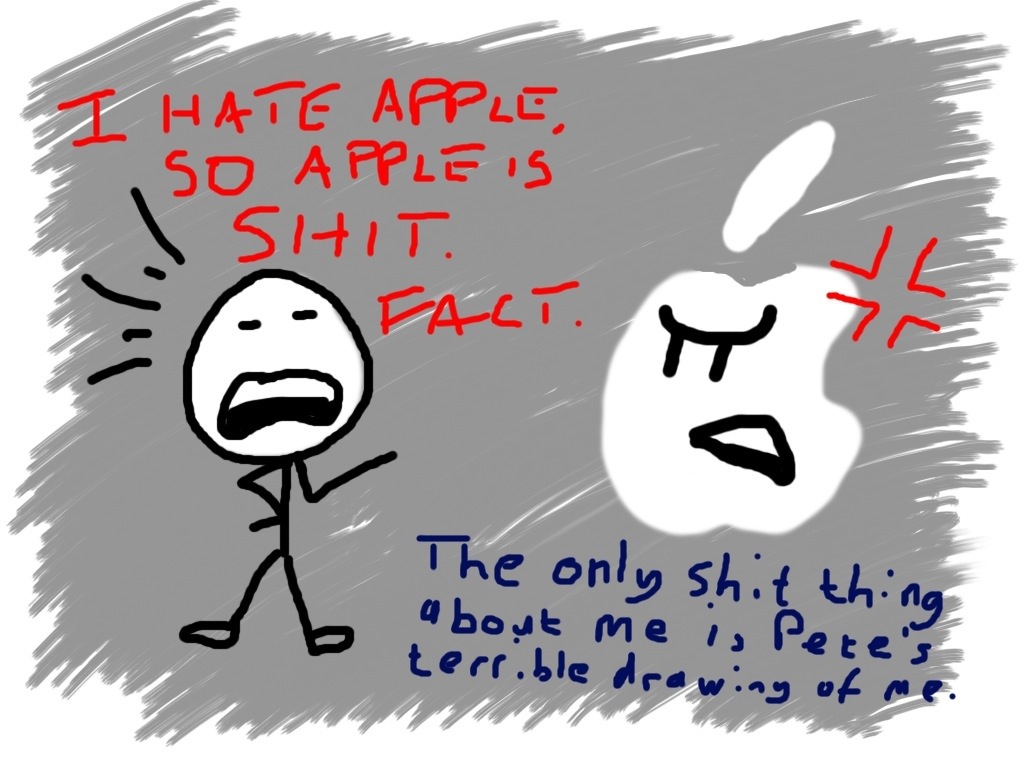
Unfortunately, on a day like today, which held among other things the promise of a hotly-anticipated iPad-related announcement from Apple (which turned out to be "The New iPad" with its shiny retina display and quad-core processor… yum) it's difficult to avoid said snark. It seems that for a lot of people nowadays that if something isn't to your own personal preference, then no-one should enjoy it.

At this point I'll say that I'm well aware I've been guilty of this in the past, and for that I apologise. (The X-Factor is still unquestionably shit, though. There is no valid argument in favour of a show that gave the world Jedward. I'm just not going to rant at length about the subject any more.) I am trying my best these days to see arguments from both sides, but unless you're some sort of level 99 mediator, you're always going to come down on one side or another. So long as you don't force your views on others and expect everyone to agree with you, everyone should be free to do that. (Unless it's about something dickish. I think we can pretty much universally agree that those who judge people based on skin colour or sexual orientation can all pretty much just bugger off and sit on a spike.)

I digress. I was talking about snark, and specifically relating to today's Apple announcements. The new iPad is, by all accounts, a lovely-looking device, and the Retina display is sure to raise some eyebrows. As per usual for an Apple event, the company came out with its usual stuff about how it believed we were entering a "post-PC" era and about how people supposedly "preferred gaming on their iPad" to consoles and computers.

Contentious comments, for sure, but firstly, they're marketing hyperbole — Apple announcements are press events, after all, and a company as big as Apple is never going to be humble about its achievements or lofty ambitions — and secondly, it might not be quite so unreasonable as you think. Already many households are making use of iPads for simple tasks such as browsing the Web, checking email, watching TV and movies, playing games, keeping themselves organised and all manner of other things. And the sheer number of people who have downloaded Angry Birds, whatever you may think of it (I hate it) should give you pause when considering the gaming-related comments.

But instead of thinking these points through rationally and considering the perspective that Apple might have been coming from, in it was with the snark about how wrong Apple was and how much bullshit they were talking. Up went the defensive walls, and a veritable barrage of snark was fired over the parapets towards anyone who dared to say "hmm, hang on, that's actually quite interesting, and possibly plausible". (I'm not saying their comments were true, rather that they deserved greater consideration than immediate outright dismissal.)

It only continued when, as usually happens in Apple announcement events, software started to be shown. The new versions of iMovie and GarageBand for iOS drew particular ire, with various Twitter users making acidic comments about how awful the music people makes with GarageBand supposedly is, and how terrible the "movie trailers" facility of iMovie is.

Once again, no consideration was given to the audiences that these features might be directed at. As a former employee of the Apple Store, let me assure you there is absolutely no love lost between me and the tech giant of Cupertino, so I have no "need" or contractual obligation to defend them — and also, a company the size of Apple certainly doesn't need my defence either. But as a former employee, I know that Apple customers aren't just high-falutin' creative types, gadget freaks, tech snobs and people with more money than sense. I know that people who walk through the front door of that store range from very young to very old; from experienced computer user to complete beginner. I know that there's a considerable proportion of that audience who came to Apple because of its products' reputation of ease of use. I've even taught plenty of those people how to achieve simple tasks in products such as iMovie and GarageBand, and to see the looks on their faces when they realised that yes, they could be creative with their computers despite their lack of technological knowhow was, to use a word Apple itself is very fond of, magical.

As such, I feel it's grossly unfair and downright blinkered for people (including professional commentators in some situations) to completely dismiss a considerable proportion of Apple's audience and declare a feature to be "awful" or "crap" simply on the grounds that they don't see the appeal, or think that its results are cheesy. (They are, but imagine if you had no idea how to edit a video and suddenly discovered you could put together a slick-looking movie trailer from your holiday footage and upload it to the Internet. You'd be pretty stoked, and you wouldn't care that it was a bit cheesy. If you were inspired by this ease of use, you might even look into the subject further to find out how to take more control over the stuff you were creating.)

I'm using Apple as an example today since the announcement is still pretty fresh in everyone's mind. But the presence of snark can be found pretty much any time something interesting is announced or discussed, especially in the tech or gaming industries. You can count on there being an unfunny hashtag pun game mocking the story within a matter of minutes; endlessly-retweeted "jokes" trying to look clever; and, of course, protracted slanging matches any time someone calls these people out on it.

And, you know, I've had enough. If you have a valid criticism of something, by all means share it and back up your point. But if you have nothing to say other than "I think this is crap, therefore everyone else should too" then kindly keep it to yourself. Because, frankly, your opinion isn't anywhere near as important as you think it is.

#oneaday Day 770: February Blues

20120228-004639.jpg

It's a long-held tradition in my family that the month of February is the best time to get really depressed and despondent about nothing in particular. I say "tradition". It just seems to sort of happen sometimes, and as someone who struggles with depression at the best of times, I'm certainly not exempt from the February Blues.

I thought this year that I'd got away with it. It is, after all, almost the end of February and here I am having been feeling reasonably positive about things recently. I'm working, I'm enjoying it, I'm living in a place I like with a person I love and generally, things are pretty hunky-dory, whatever that means.

The last couple of days have seen a marked downturn in my mood, however. I'm not sure if it's the weather, the fact it's still getting dark quite early, the fact I'm tired, the fact I'm not sure if I'm ill or just have a bit more flatulence than usual — basically, though, something's got my goat and is jiggling it around furiously, refusing to let go. (Note: "goat" in this instance is not being used to refer to my penis. The grabbing of that, refusing to let go and jiggling around is normally quite pleasurable, but that's a topic best saved for another blog altogether.)

This is the frustrating thing about depression, particularly seasonally-affected depression, which is what I assume the "February Blues" are all about. There isn't always a reason for it. Sometimes you just wake up of a morning, consider getting out of bed and realise that no, there's not really anything exciting out there and it's actually quite warm under the duvet and wouldn't it be nice if you just closed your eyes again for a couple of minutes and relaxed and shit it's midday and so on.

The above-described is also laziness, lethargy or whatever you want to call it, but it can be brought on by an irrational black mood. Sometimes the world is just inherently unsatisfying, leaving you wondering if there's something better you could be doing, some greater purpose to your life.

Inevitably, the answer to those questions is "no", so after a while you settle back into a nice comfortable routine of doing what you do and finding the whole thing perfectly satisfactory.

Sometimes asking those questions spurs you on to do other things, though. It's from feeling bleak and wanting a convenient outlet that I started posting these daily blog entries after all, and now I feel they're a big part of "me". It's just habit now, but when I casually mention to someone that I've written a blog post of varying quality every day for the last 770 days, they usually seem quite impressed. Most of them, too, are kind enough not to mention that if I hadn't been wasting my time writing nonsense like this every day, I could have probably churned out a ton of novels by now. (I know this. Shush.)

Similarly, it's from feelings of bleakness and blackness that I have started on exercise journeys several times — though at the times of the bleakest blackness it's sometimes difficult to motivate oneself to proceed. (This is where a structured, scheduled programme like Couch to 5K comes into its own, as you then have feelings of guilt to contend with if you miss a session. Guilt is a powerful motivational factor, particularly if it doesn't hurt anyone but yourself.)

Will these feelings spur me on to do anything this time around? I don't know. I have a few irons that are not-quite-in-the-fire-but-at-least-somewhere-near-the-fire right now that I might give a poke from tomorrow. As previously mentioned, I'm running through Couch to 5K again. I'm still blogging. And I'm making sure to take the time to talk to friends both online and off.

February's nearly over. And when it departs, may the colour come back to the lives of any of those of you who have been afflicted with a surfeit of blue.

#oneaday Day 768: Two Weeks

20120226-001224.jpg

Two weeks of my second runthrough of the Couch to 5K running programme, that is, and it's going reasonably well so far.

Much as I discovered last time, building up stamina is actually a somewhat easier process than you might expect. I'm not sure if this is just because I've been doing semi-regular exercise for a while, a hangover from the last time I ran through this programme or something else entirely, but in the space of two weeks I've found that each time out there gets slightly, marginally easier than the last.

Of course, at this point in the programme I'm still only running for a minute and a half at a time, then walking for two minutes, then repeating the process. But still, every great journey starts with a single step and all that.

Running has, for me, always been one of the most challenging exercises there is to do, partly because there's nothing "helping you". Even when you're running downhill, your body still has to do stuff, whereas on a bike all you have to do on a downhill stretch is stay upright and occasionally steer. But when you're running, you're constantly active — moving your body, lifting your entire body weight off the ground, shifting your legs, pushing forwards, pumping your arms, working all those muscles. It's a pretty intense workout all round, so it's perhaps not surprising that it's pretty challenging.

As I found the last time I tried all this, though, it's infinitely more interesting than running/cycling/rowing/whatever it is you're doing on a crosstrainer on the spot, staring at a digital readout, trying desperately to ignore the terrible, terrible music the gym is pumping into your ears and also trying desperately not to look at the visible panty line of the woman with the nice arse in the yoga pants on the machine in front of you.

Sorry, momentarily distracted there.

But no. It is infinitely more interesting than working out in a gym simply because you have freedom, and that's important. Okay, it becomes harder to control your workout so precisely when you have to deal with the sometimes unpredictable undulations of the route you decide to take, and at times you find yourself dodging pedestrians, dogs, low-flying seagulls and various animals' poo. But that makes it interesting and exciting, even if you're running the same route every day. You can mix things up by running at different times — that loop round the estate and past Sainsbury's looks quite different when the sun has set to how it looks in the daytime. You can go the other way. You can take a random turning elsewhere and deliberately get lost in order to explore the area. You can run down darkened country lanes with a torch in the dead of night and pretend you're Alan Wake. You can run down mysterious forest paths in the hope you might find some magical kingdom or The Faraway Tree inside (hint: you probably won't, and all that is likely waiting for you at the other end is a large, muddy field that smells a bit like shit). In short, you can have a bit of fun with your exercising rather than enduring the businesslike approach of the gym.

That's not saying the gym's bad, of course — it's good to have a sense of structure and "formality" to your workouts at times. But it's also helpful to get out there and enjoy yourself with it, otherwise it simply becomes a chore, and chores are no fun whatsoever, and then they don't get done and they build up and you feel guilty and obliged to do them all at once and then you swear never to let them get to that stage ever again and then you do and you swear lots and then you die.

Or something. Perhaps not.

This is my experience, anyway. I still go to the gym and I still enjoy doing so, but getting out there and running through my thrice-weekly Couch to 5K sessions has reminded me that going outside and Doing Stuff can be fun too. I recommend you try it.

#oneaday Day 766: Light Musical Entertainment Involving Tigers, Tents and Poo

20120223-232234.jpg

I can vividly recall the first few times I heard the Bonzo Dog (Doo-Dah) Band. I was introduced to it by a combination of my partner in crime on teacher training and a good friend from my university days, and the sheer bizarreness of the music I heard has stuck with me ever since.

It's not that it's bad music. Quite the opposite, in fact, in many cases — many of the pieces by the Bonzo Dog Band are, in fact, very memorable and catchy, which is where part of their enduring appeal stems from. It's just that I'd never heard anyone sing a song about having a shit, or extolling the virtues of spending time in a tent, or a song which featured a trouser press solo.

I thought I'd share a few of their greatest hits with you tonight, in the form of YouTube videos so everyone can enjoy them.

First up, Tent. I have always found this song inexplicably hilarious. I think it's simply because he sounds so passionate about his tent. Also, there is a break partway through where people just shout "Tent! Tent!" as well as the most hideously inappropriate saxophone solo I think I've ever heard. In a brilliant way. PARP.

The Strain is a song about having a poo. No two ways about it. There's no double entendre here, no attempt to hide the fact that yes, this is a song about having a particularly difficult poo. Why difficult? Well, listen to the "chorus", which simply consists of screams of agony and coughing over the top of some entertainingly funky guitar and sax backing. And the backing to the second part which makes use of the saxophone to sound like one of those squeaky farts that it's a bit of an effort to push out for fear of the fact you might shit yourself.

Jazz Delicious Hot, Disgusting Cold is the perfect piece with which to mock anyone who enjoys the chaotic sound of trad jazz. A self-referential piece parodying the band's trad jazz roots, the track features some of the most spectacular deliberate terrible playing ever, including a clarinet solo that is truly magnificent in its ineptitude.

Trouser Press makes a mockery of the various songs in the late 60s and early 70s that took the form of "Do The [insert random noun here]". It is the only piece of commercially-available music that I am aware of that features a solo on a genuine trouser press fitted with a pickup.

And finally for now, this performance of Hunting Tigers Out In Indiah [sic] was seen on the pre-Monty Python TV show Do Not Adjust Your Set. The song itself is actually a cover of a 1920s/30s piece by Hal Swain And His Band. The original version was non-ironically super-British, whereas the Bonzos version played this angle up to an absurd degree.

I hope these few pieces of ludicrous musical entertainment have brightened your day somewhat.

#oneaday Day 765: Social Overload

20120222-235815.jpg

It may be simply my "over 30s" grumpiness starting to show, but I'm starting to find "brands'" use of social media to be immensely irritating. And even more irritating is the fact that their techniques seem to work — which, of course, perpetuates the whole hideous cycle until someone snaps and goes on a mad katana rampage.

I'm talking primarily about that faux cheerfulness that pretty much every brand page out there shows when addressing its audience. "Hey [insert collective noun here that is tangentially related to being a fan of the product in question]! [exclamation mark is important to show enthusiasm] We thought it'd be a great idea to [adopt some out of date Internet meme/take goofy photos of our office/make a cringeworthy video] so we did! And here's the proof! [insert link to photo/video/blog post]".

Getting your audience to engage with you is one thing. Getting them to engage with you on a meaningful level is an altogether different thing. I genuinely once saw the The Sims 3 Facebook page ask the community what their favourite colour was. Nearly a thousand people replied. I "Unliked" them shortly after that.

As I'm writing this, I'm trying to pin down exactly what it is that riles me so about this sort of thing. After all, the very fact that nearly a thousand people wanted to tell the faceless Sims 3 page that their favourite colour was, in fact, blue shows that it's a system that seems to work. But does it have any value whatsoever? Does feeling like a brand is someone you can "talk to" help you feel any more fondness towards the product in question, or is it simply a novelty and a means of building community?

It depends on how you handle it, of course. If a question posed by a brand page is the start of a larger discussion which representatives of the brand then participate in, then it's a good thing, in my opinion. However, for the most part in my experience, these sort of posts tend to just be "post something that lots of people won't be able to resist replying to or Liking, light the blue touch paper and stand back". After the initial question is posted, the brand steps back and doesn't participate in the discussion any further, leaving the community to fight each other over whether or not the man who said pink was his favourite colour is gay or not.

The side-effect of all this relentless posturing by brands is that it leads to a feeling of saturation. By way of example, I've been so bombarded with teaser videos, images, exhortations to "celebrate FemShep Friday" and numerous other pieces of detritus that I've, ironically, lost any enthusiasm I may have had for Mass Effect 3 and probably won't be buying it.

"Ignore it," you may say. "Unlike it. Unfollow it."

Believe me, I have. But sometimes you need to venture on to those pages to find out useful pieces of information — like, say, release dates — and end up having to mine your way through pages and pages of completely, utterly worthless nonsense in order to find anything relevant. That, surely, isn't how it's supposed to work. Or perhaps it is, and that's why I don't work as a "social media guru" or whatever.

On the flipside to all this, companies seem to be a lot better at using Twitter in a manner which doesn't infuriate me. The very way in which Twitter works — you don't see replies from people/brands you are following that are directed to people you aren't following yourself — means that a lot of this unnecessary noise is filtered out. And the fact that tweets are, by their very nature, somewhat transient means that there's no means for a 1,000-post comment thread discussion on favourite colours to take place. This is a Good Thing.

The best brands on Twitter do one of two things: post relevant information at a steady pace for you to check out at your leisure (see: feeds from websites or companies that have regularly-updating news) or use Twitter for one of its primary functions — as a means of communication.

In the former case, what you essentially get is a bit like an RSS feed relating to the product or company you're interested in. In the latter case, you get some of the most helpful customer support I've ever had the pleasure to experience.

Take the poor souls over on the XboxSupport Twitter account, for example. These absolute saints have to deal with bombardments of questions every day, and somehow they still manage to remain polite, professional and — most importantly — get straight to the point. Ask them a question and they'll do their best to answer you in a single tweet, and often very quickly, too. What you don't get from them is vapid crowd-baiting questions or upselling suggestions to check out/buy additional products.

A lot of other companies have cottoned on to this in the last couple of years. I was particularly impressed with Orange's support Twitter account, which helpfully resolved an issue I had tried (and failed) on several occasions to sort out over the phone. Xbox Support, too, have been great, and I'm sure there's plenty of other examples out there.

I suppose there's a lesson in all this somewhere. I should probably resist that inviting-looking Like button at the top of Facebook pages I can see are filled with vapid nonsense, and stick to only following things that actually provide useful information. Otherwise all that ends up happening is you feel completely burned out by the multisensory marketing bombardment you experience on a daily basis — and you end up hating things that you formerly liked. (Sorry, Mass Effect. It's not you, it's me.)

#oneaday Day 764: Sports Day

20120222-011234.jpg

Sports and me have never really got on. There are a variety of reasons for this but the long and the short of it is that said antipathy towards each other meant that 1) I was usually picked last for the teams in PE (when I wasn't, it was usually Steven Finnegan instead) and 2) my body isn't exactly a rippling temple of man-beef.

That doesn't mean I haven't tried to get involved with sports over the years. I was in my Cub Scout football team, for example, a team so terrible we were sponsored by a junkyard. Our best result ever was 1-0 to us. Our worst result was 20-0 to them. No, that's not a typo. Twenty-nil.

Despite my ambivalence towards sport, I do also have some fond memories of various school sports days, particularly if it happened to be a nice day out at the time. I can't remember a lot about primary school sports days, but secondary school sports days tended to be a pretty big deal, bringing most of the school to a standstill for a wide variety of track and field events.

My tutor group (the erstwhile 7FMQ, later 8QU, 9QU, 10QU and 11QU) were the very souls of apathy for the most part. There were certain events that people just plain didn't want to enter, which would have put us at a significant disadvantage on the leaderboards (yes, this was in the day when it was still acceptable for school sports days to have "winners" and "losers") had I not stepped in.

I'm not sure why I stepped in, given that I knew full well I was crap at sports, was not very good at running and wasn't particularly agile. Therefore, you may be thinking, it would be somewhat foolhardy for me to enter both the 800m race and the high jump, but enter them I did, and I learned a number of things. Firstly, that I was surprisingly quite good at high jump, and secondly, that I was very poor at pacing myself when running — something which I still struggle somewhat with today.

The problem stemmed from the fact that I had never even considered running a long(ish)-distance race before, so I didn't really know how they worked. As such, I was off the starting blocks like a fucking rocket and exhausted by the end of the first lap. This gave the rest of the pack, who had been pacing themselves somewhat more modestly, ample opportunity to catch up. I don't think I finished last, to my credit, but it certainly wasn't very far off. After the race ended, I went back to my tutor group's area of the field, lay on the floor and didn't move for a very long time.

The thing that sticks in my memory about that race, though, is not the fact that I ballsed it up so spectacularly. It's the fact that for once, the rest of my tutor group was rooting for me. I spent a lot of my school days feeling like something of an outsider thanks to my awkward social skills, my weird accent, my crap hair and my forehead and nose's tendencies to flare up with greasy zits. I was a geek and someone who did well, too, which made me pretty much the polar opposite of "cool". Thankfully, barring a few exceptions, I was mostly left to my own devices to hang out with my equally geeky friends (most of whom had better hair than me) but this meant I didn't feel a particularly strong sense of camaraderie with the rest of my tutor group.

Until that day. I heard them cheering for me as I ran past them on the first lap, and staggered past them on the second. And when I finished, far from being admonished for my poor pacing, I was congratulated and praised for getting out there and giving it a shot. It was a surprisingly special moment that's stuck with me over the years. And while in short order things went back to being the way they had always been, for those few short minutes when I was on that track, I meant something. I was cool.

#oneaday Day 759: I Said Byte, Byte, Mrs Raspberry Pi

20120217-014019.jpg

The Raspberry Pi is here!

If you have no idea what I'm talking about, here's the official website.

Still no clue? It's a little computer (and I mean little — it's about the size of a credit card) that costs approximately £16 and is capable of outputting 1080p video via HDMI. David "I Made Elite, No Not the Call of Duty thing" Braben was involved in its development and has been a vocal spokesperson in the run-up to its release, but the device itself is the brainchild of one Eben Upton, a former lecturer at Cambridge University.

You're probably thinking that £16 is pretty cheap for a fully-functional computer, and that there must be some sort of catch. Well, it's not a "catch" as such, but don't expect to be playing The Old Republic on this little beast. Boasting 128MB or 256MB of RAM and a 700MHz ARM processor similar to that found in a low-end smartphone, it's not going to set the world alight with its performance, but that really isn't the point of it.

Instead, Upton, Braben and the other industry luminaries who have worked on the project are hoping that the device will inspire a quiet revolution in computer science teaching. Due to the system's low cost, it will be a simple matter for schools to outfit themselves with a veritable arsenal of Raspberry Pis, allowing large numbers of kids the opportunity to get hands-on time with a real computer and learn some useful skills.

This is a hot-button issue in the UK at the moment, as the Livingstone-Hope Next Gen Skills report published last year found that computer science teaching in the UK was, to put it politely, somewhat lacking. The National Curriculum prescribes that children should be equipped with certain information and communication technology skills by the end of their school career, but the goals are distinctly unambitious and, more to the point, have not exactly moved with the times. There's a strong focus on Microsoft Office and little else — no exploration of web design, website administration, database management, programming, and certainly very little in the way of creative design work such as Photoshop.

Part of this is a cost issue, of course — even at educational pricing, Photoshop is still pretty frickin' expensive — but that doesn't diminish the fact that kids aren't leaving school with the computer skills that they'd need to find jobs in the tech industries. They're maybe leaving with enough knowledge to allow them to fulfil a secretarial role, but that's about it. They certainly wouldn't be building a website, looking after a CRM or even inputting data into a CMS. Any knowledge of social networking and blogging is done on their own time — and all credit to the kids of today, they take to it like a duck to water.

What the Raspberry Pi team hopes to achieve with the little computer that could is to provide kids with a piece of kit that is built for tinkering with. Many pieces of consumer electronics in the home these days are locked down tightly to prevent modification and experimentation — in the case of games consoles, users are even punished for unauthorised system modifications in many cases. There's also a high barrier for entry to development in many cases — expensive software packages, development kits, membership in "developer programmes" all build up costs to a level unfeasible for the hobbyist to contemplate, especially if they're not sure whether or not they'll be able to develop the skills necessary to enjoy success.

The Raspberry Pi, running on Fedora Linux and designed to be expandable with all manner of external hardware, is a low-cost step that will allow a much greater number of people access to some truly open hardware with which they can experiment, tinker and learn all manner of exciting things. And even if they find that their brain is completely incapable of wrapping itself around complex computer-related concepts, they're only out of pocket by £16 when all's said and done. (Plus the cost of monitor, keyboard and other bits and bobs, but that's beside the point.)

Hopefully the Raspberry Pi will convince schools to throw out the abject tedium of the National Curriculum's ICT programme and start exploring more relevant, exciting topics surrounding computing. It might also convince schools to hire ICT teachers who actually know something about computers, rather than treating it as a second-class subject to be handled by teachers of completely unrelated disciplines as a means of filling up some of their free periods. What a brave new world that would be.

Will it be a success? Impossible to say at this juncture, as the simple existence of the product doesn't necessarily mean that there will be buy-in from the people who it is aimed at. But we'll see.

To find out more, check out the official site. You'll be able to order one for yourself at the end of this month, and educational packages including additional equipment, documentation and all manner of other goodies are on track for a September-ish release from the sounds of things.