#oneaday Day 936: Biggest != Best

No, I'm not talking about penises.

Let's talk about Facebook.

Facebook is massive. Facebook has taken over most people's daily existence on the Web to such a degree that there are plenty of people out there who genuinely believe that it is the Web. Like, all of it.

It's not. But then you probably knew that already.

But the fact stands that it is a massive global phenomenon, and something that has happily grown and evolved over time from its humble beginnings up to the multi-bajillion dollar business it is today.

Thing is, though, as it's grown, it's sort of lost sight of what it's for.

"Facebook is a social tool that connects you with people around you," the login screen used to say. When adding a friend, you used to have to indicate how you knew them, and the recipient of that friend request had to verify your story. It was actually quite a good idea that got around the MySpace "friend collecting" issue, whereby people would just add and add and add each other and then not talk to any of their 40,000 friends. Facebook's systems ensured that you 1) were actually friends with the people you marked as friends and 2) didn't fall into the "popularity contest" trap.

Whizz forward to today, and the Facebook of 2012 is a very different place. Now we get people promising "2,000+ friend requests" if you Like one of their pictures. I don't want two thousand friends. I want my online friends to reflect people I actually know, and occasionally give me the opportunity to meet someone new who is relevant to my interests and/or knows people that I know. Give me two thousand newcomers from all over the world, all of whom are vying for my attention simply to make some arbitrary number higher than everyone else, and you sort of lose that.

Part of the reason for this change is the different in what Facebook thinks we should use it for these days. I first joined the site quite a while after many of my friends had — at the time, I assumed it was going to be one of those passing fads like MySpace, and would quickly disappear into obscurity. But I found its value while on a trip to the States to visit my brother — while abroad, I could share the photographs I'd taken and easily stay in touch with my friends as a large group rather than emailing them individually. It was nice.

Over time, things started to shift. Facebook's big change to something a bit closer to its current layout upset a lot of people, and the addition of "applications" marked the beginning of how the social network looks now. At the time, I was of the attitude that the people complaining about it were bleating on about nothing, but in retrospect they may have had a point. As everyone's news feed started filling up with FarmVille brag posts, the signal to noise ratio started getting worse.

Then came the brands. Facebook undoubtedly thought they were doing everyone a favour when they opened up the previously "personal" social network to companies and businesses who wanted to grow their social presence. And in some cases, it worked well, with companies able to engage with their customers and post important information as and when needed.

Unfortunately, this too lost the plot somewhere. Now, pretty much every brand page uses the same obnoxious "engagement strategies" to keep people commenting, talking and Liking — the worst of which by far is the fucking awful "fill in the blank" status update that invites commenters to give their own meaningless opinion on something utterly asinine and irrelevant to the company's product. ("My favorite color is ____________!" proclaimed the Facebook Page for The Sims 3 on one memorable occasion. Over four thousand people replied.)

You see, people seem to absolutely love posting things that have absolutely no value. People love thinking their opinion is important, that they are being listened to, that the things they say are somehow valuable to someone.

The things you say are valuable to someone. The people they are important to are called your family and friends. Not the PR representative for The Sims 3. They don't care what your favourite colour is. They just want you to keep giving them page impressions and comments and Likes.

Likes. Fuck Likes. The Like button is Facebook's most enduring legacy, and one of the biggest blows to actual communication in today's connected world. Why comment any more when you can just click "Like"? It means nothing, particularly when it's connected to a sentence for which the verb "like" is completely inappropriate. ("My grandad died. So sad right now." "Insensitive Twat likes this.") It's a meaningless metric designed to measure how many people have seen something you have posted and want to interact with it, but are slightly too lazy to actually write anything.

The diminishing sense of Facebook's usefulness for actual communication is perhaps best exemplified by the current way someone's profile looks. Known as "Timeline", the theory behind it is that it is an easy to navigate history charting everything interesting that has happened in someone's life.

It's a sound plan. Unfortunately its implementation is just terrible.

The problem is that there's no consistency in how posts show up, and seemingly no understanding of how people read content. Leaving aside the fact that one's profile cover image and fairly pointless basic information takes up over 500 lines — or nearly half of a 1920×1080 display — there's seemingly no rhyme or reason as to what gets posted at the "top" of one's profile.

The conventions established by blogs and earlier social networks dictate that the most recent things go at the top, so anyone checking in on someone's page doesn't have to scroll around or search to find something new. Yet with all the sources from which Facebook can pull information these days — games, external sites, apps, Spotify, Netflix —  there is no consistency in what goes where. For example, at the time of writing, this is what the top of my Timeline looks like:
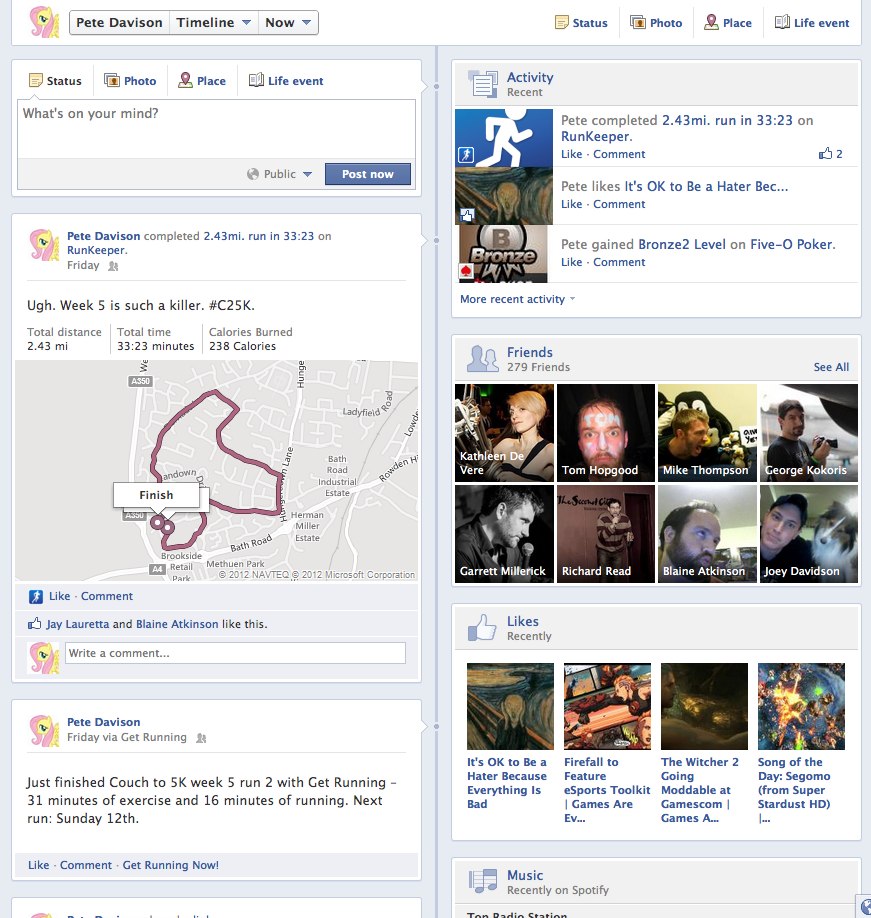
What a mess, and very little of it is stuff that I 1) actively shared and 2) feel people really need to know. I deliberately shared the RunKeeper stuff because I like sharing my fitness achievements because it helps keep me honest, but I have no need to show people who eight of my friends are, nor do people need to know that I achieved Bronze Level 2 in Five-O Poker, a game I reviewed earlier in the week and specifically told not to share shit on my timeline. At the other end of the spectrum, pages that I have "Liked" elsewhere on the Internet — and thus wanted to share with others, perhaps because I wrote them or just found them interesting — have been unhelpfully collected into a single box that shows just four of them. This behaviour changes seemingly daily, with Liked pages sometimes showing up as individual posts on one's Timeline (useful) and sometimes being collected into that box (not useful). At the time of writing, Facebook appears to have decided that "not useful" is the way to go on this one.

Let's scroll down a few "page heights" and see what else we have:
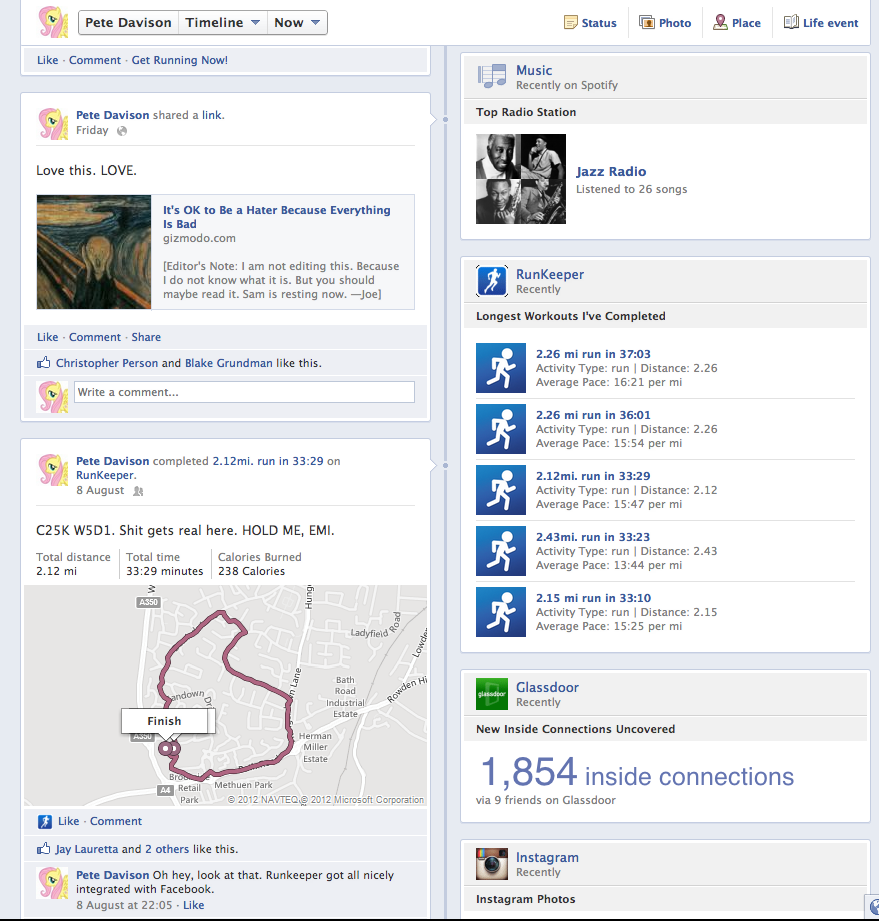
The left column? Sort of all right. The right column, though?
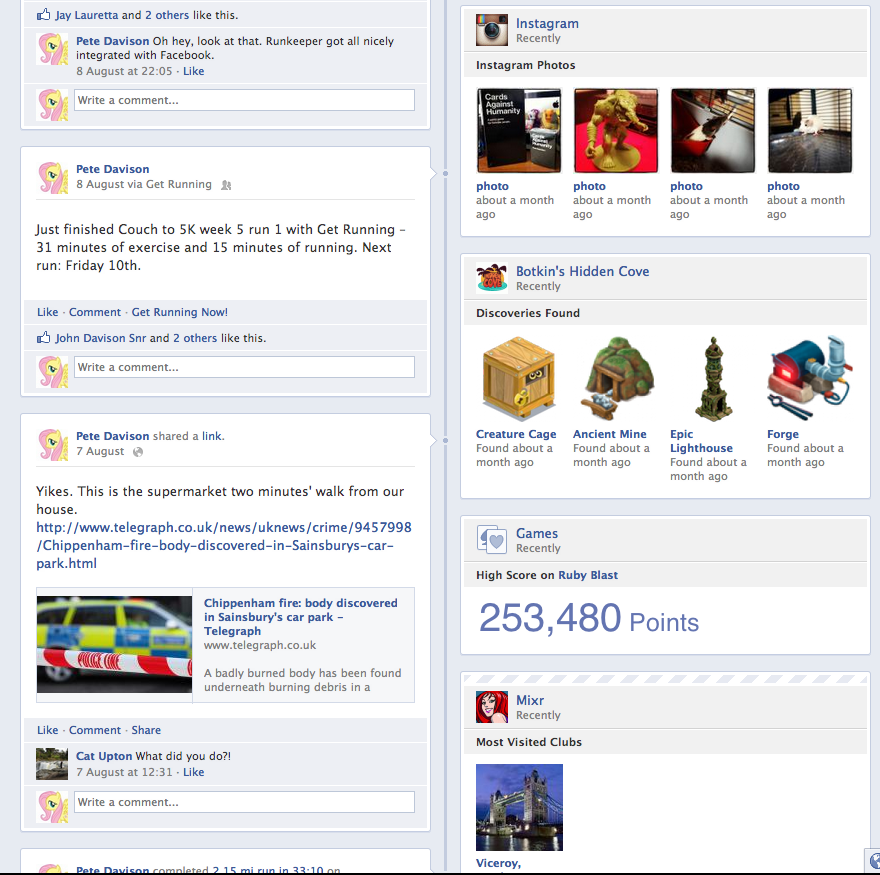
SO MUCH IRRELEVANT CRAP.
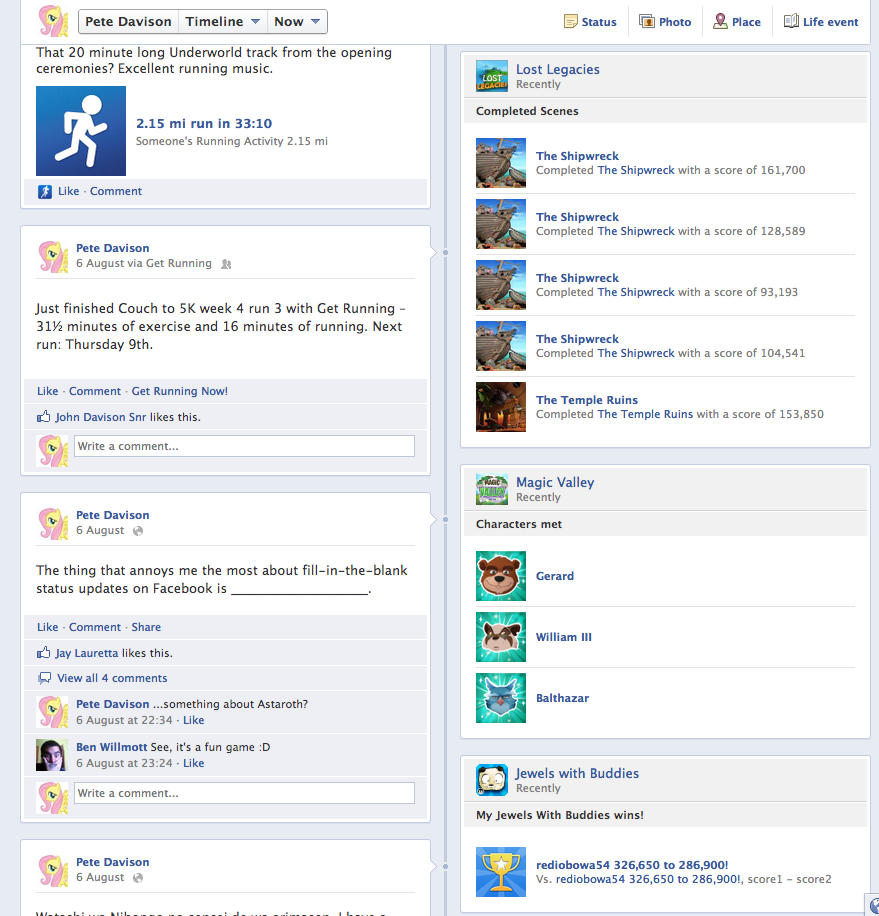
Including posts from games that I 1) didn't press a "Share" button in once and 2) have since removed from my Facebook account.
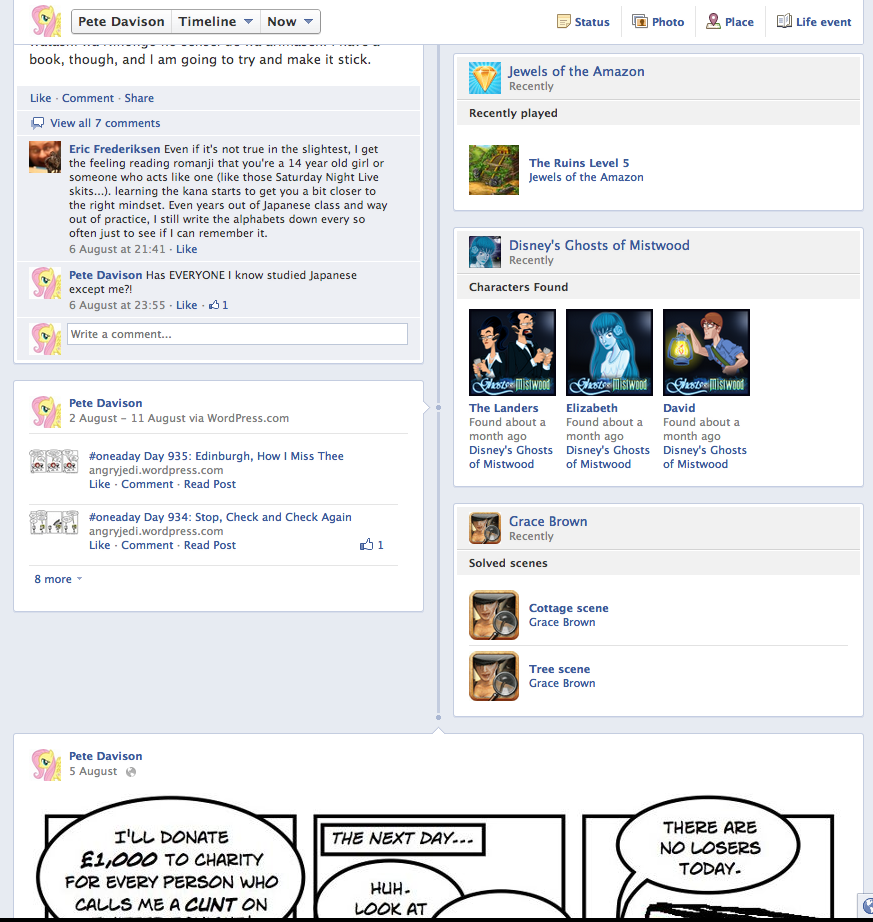
There. After five screen-heights worth of scrolling, I finally get to one thing that I actually want to share with people — my recent WordPress posts, aka a feed from this blog to my Facebook Timeline. Again, though, like the Likes, they have been collected together into a box that displays very little relevant information and, in this case, is put in a stupid, stupid place. Why stupid? Because the most recent post in that little WordPress.com box came considerably after the RunKeeper post at the top of my Timeline — and certainly considerably after all the spammy crap those games have plastered all over that infuriatingly useless right column.

"Facebook is a social tool that connects you with people around you" my arse. "Facebook is a digital scrapbook maintained by a five-year old with ADHD," more like.

I'll see you on Twitter.


#oneaday Day 935: Edinburgh, How I Miss Thee

A brief Twitter conversation with the always-awesome Mitu Khandaker got me all nostalgic this evening. Y'see, Mitu has just come back from the Edinburgh Interactive Festival, where she was speaking about exciting and clever things to do with love, sex, relationships and obsession in games — a topic which I find particularly fascinating, as my extensive series of posts on Katawa Shoujo will attest.

But that's not what I want to talk about today, as I'm sure video and/or slides from Mitu's presentation will be available online at some point soon, and they will probably say things rather more coherently than I can. (I LOVE YOU EMIIIIIII)

No, instead I just want to look back on why Edinburgh is awesome. Because it is awesome, and if you've never been I strongly suggest you take the opportunity to do so.

My memories of Edinburgh stem entirely from my several trips to the Fringe festival with the Southampton University theatre group, known on various different occasions as SUSU Theatre Group, "Blow Up" and "RATTLESNAKE!", for reasons that I have, sadly, since forgotten.

My first trip there came during my first year at university. I'd joined the theatre group and had already had a small part in our overly-elaborate and rather pretentious production of Macbeth. The Matrix was still fashionable, you see, so it was seemingly obligatory for every student theatre company in the country to do a Matrix-inspired Shakespeare production, and we were no exception. (It actually ended up being quite good, though vastly over budget.)

Anyway, Wachowski-Shakespeare crossovers aside, my association with the theatre group eventually led to me auditioning for the Edinburgh production and successfully securing a part. The play we'd decided to take up was Ivan Turgenev's A Month In The Country, which is a good play with interesting characters (I played Afanasy Bolshintsov, a character for whom I was legitimately able to leverage my legendary Harold Bishop impersonation), but quite heavy going. Our bright idea was to perform it outdoors in the Edinburgh Botanical Gardens, which sounded like a great idea on paper.

Actually, it was a pretty great idea that added some lovely atmosphere to the play, the only flaws in the plan being 1) the amount of rain that Scotland gets and 2) the fact that the Botanical Gardens were rather off the beaten track. As a direct result of 2), we had rather disappointing viewing figures, but soldiered on regardless, despite having no more than one or two people watching most days.

Performing the play was just a relatively small part of the whole experience, though.

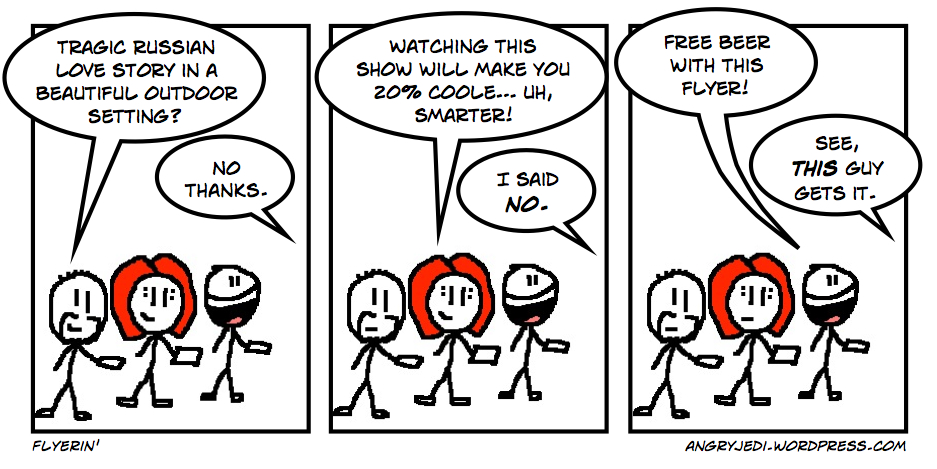
In the mornings, we'd be flyering on the Royal Mile, one of the main streets in Edinburgh that attracts entertainers and promoters come Fringe time. Flyering was always fun, even if it was rather difficult to sell the idea of a tragic Russian love story performed outdoors in a venue no-one really knew the location of to passing tourists. We managed to get a few people coming along, though — and not just all our respective parents.

In the evenings, we'd take in some shows (all right, lots of shows) and then go drinking. Lots of drinking. You see, at the time, Scotland's licensing laws were significantly different to England's — in England, you could only drink until 11pm in a pub and 2am in a club; in Scotland you could drink until… actually, I can't remember what time you could drink until in a Scottish pub (I want to say 2am) but I certainly remember that the clubs were open until 4am.

Our two regular haunts for drinking purposes were the "Frankenstein" pub, a rather tacky (but awesome) theme bar that sold overpriced (but awesome… and deadly) cocktails; and a club just around the corner called Espionage, which had five floors, each of which was themed after a far-flung locale that James Bond had visited in one of his movies. (Incidentally, I am very pleased to note that both of those venues are still there. That makes me feel warm and fuzzy.) Following drinking until some ungodly hour in the morning, we'd often decide that The Thing To Do at that point was to get a pizza from the conveniently-located all-night pizza place that was near Frankenstein — an all-night pizza place which provided you with said pizza at an astonishingly high speed.

It wasn't all roses, though. On this first trip, I was enjoying the experience but found myself suffering considerably from the social anxiety that has wracked my personal life for as long as I can remember. I found it difficult to start up conversations with the people I was living with at times — despite the fact I was acting with them every day — and I found myself worrying that people would think the things I said would be stupid. I recall one evening getting very depressed, breaking down in tears and being very embarrassed about the whole situation despite the fact I was sitting by myself in the hallway when it happened.

Two of the guys I was staying with came to my rescue: Chris and Des (no relation to Des). I was very grateful to them, because they proved to me that the things rattling around in my head were completely wrong. They took me in to their room, talked to me, got to know me and let me stay the night in there with them. (To sleep. This was not a period of "experimentation" for me.) We had some laughs, particularly at Chris' expense when he fell asleep in mid-sentence, and I got up the following morning feeling considerably more positive about myself, my situation and my ability to make friends.

That night was a real turning point for me. Remembering that night gave me the confidence to go back to Edinburgh on two other occasions with the theatre group — once without a show, once with a double-bill of The Importance of Being Earnest and Alan Ayckbourn's Round and Round the Garden. Both visits were amazing, and neither were tainted by feelings of anxiety. In fact, the experiences I had on those two visits were remarkably akin to the way I felt when I visited PAX East a couple of years ago before my life went to shit — I felt like I was "home", "among friends", and completely comfortable. I would have given anything for it to have lasted forever.

But these things don't last forever, sadly. What will stay with me forever, however, is the memories — Des getting told off for trying to dry-hump a guy dressed as a dinosaur on the Royal Mile; recording our drunken conversations on a Dictaphone in the kitchen of the hostel we were staying at; climbing Arthur's Seat after a solid night of drinking, reaching the summit in time for sunrise, drinking sake in silence as we witnessed dawn breaking, then sliding down the muddy hillside on our arses.

Thinking about it, my positive memories largely revolve around what I did while I was there than the city itself. I've never been there when it wasn't Fringe time, see — and at Fringe time it's a magical place, infused with a wonderful atmosphere all day and all night for the entire duration of the festival. But from what I saw beneath the glitz and slightly grotty glamour of Fringe time, it's a beautiful city, too, and one that you really should visit if you've never had the opportunity. One day I'll make it back there, though whether or not it'll be at Fringe time I don't yet know!

#oneaday Day 933: So What Happened Again...?

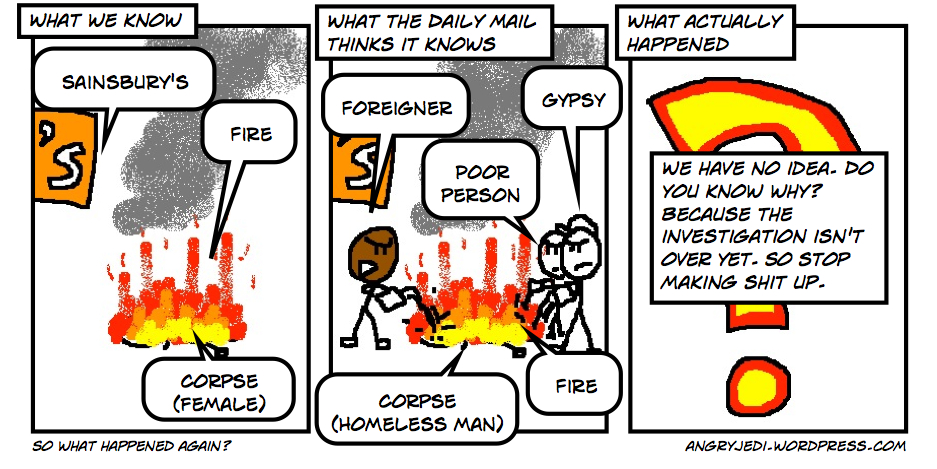
Yesterday they found a dead body in the supermarket car park approximately two minutes' walk away from my house. It was spotted around 3AM, when a dog handler on patrol saw a fire and alerted the appropriate authorities. Upon dousing the flames, a badly burned corpse was found — so badly burned that it was impossible to immediately identify it as male or female.

I am curiously unfazed by this knowledge. It's a horrible thing to happen and I can't help feeling I should be more unnerved than I am by the fact that it happened not far from my doorstep. But I'm not. And that's not what I'd particularly like to talk about in relation to this incident.

I'd instead like to talk about the reporting of the incident in the newspapers and online.

Most outlets did a decent job of reporting the known facts, which I outlined in the first paragraph. Nothing more was known, and nothing more would be known until 1) the police had completed their investigations at the scene and 2) the body had been examined.

The ever-resourceful Daily Mail, however, decided to just make some shit up to make it a better story. "CHIPPENHAM TRAMP SET ON FIRE AND KILLED BY 3 THUGS AS HE SLEPT IN SAINSBURY'S CAR PARK" proclaimed the headline. (For comparison, the Daily Telegraph went with "Chippenham fire: body discovered in Sainsbury's car park".) They then proceeded to explain that an attack was "caught on CCTV" (later changed to "thought to be caught on CCTV") and that "sources" had seen "three men" filling up jerry cans at Sainsbury's petrol station shortly before the blaze was found. (Sainsbury's petrol station isn't open at that time in the morning, which should give you a rough idea of how true the rest of it is.)

This went on for several paragraphs, explaining that the fire had been caused by this gang of three men dousing a homeless man in petrol and then setting fire to him. A horrible crime, I'm sure you'll agree, but a fictional one.

How do I know this? Because the body was confirmed as female today, not male, and the original Mail article describing these "facts" has mysteriously disappeared, to be replaced with this rather similar, but much more vague account that more accurately reports the facts. Moreover, there has been no further mention of this supposed "attack" that was caught on CCTV, just an appeal from police for people who were seen in the area to come forward and assist them with their enquiries.

Now, for all I know, the story about the victim being a homeless person could end up being true, but the fact is, the Daily Mail were guilty of some incredibly irresponsible reporting on this incident. They presented their theory as fact without providing any evidence whatsoever — who were these "sources," for example, and how did they see what  happened while apparently no-one else did? — and thought that this was somehow okay. It's another example of the Daily Mail just not giving a shit about… well, anything really. It's beyond parody. It's just pathetic. And yet somehow it still continues to exist. How? And why? How has no-one stepped in to shut this crap down yet? Does the Mail's questionable "comedy value" outstrip its obligations as a news outlet?

Apparently so. And I think it's too late to do anything about it now.

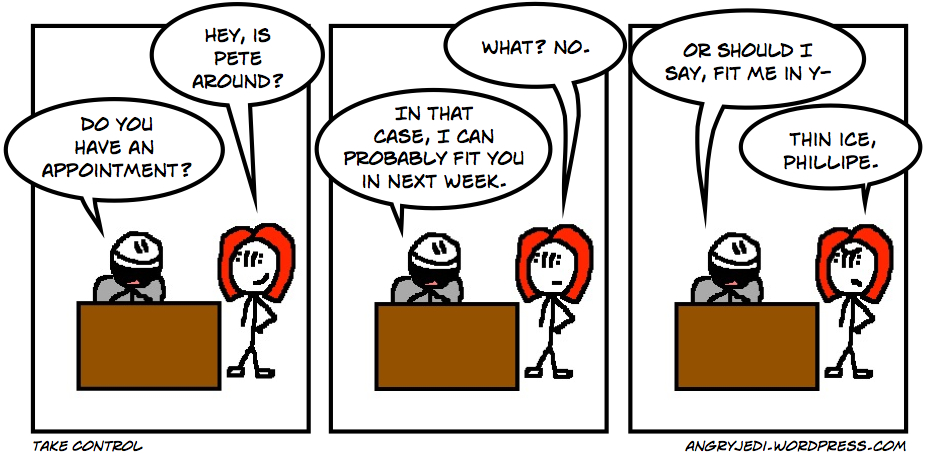
#oneaday Day 932: Take Control

I'm generally a pretty disciplined sort of person. I'm good at prioritising, and if I have something that I have to do I'll make sure that I complete it before I do things that I want to do.

It's when it comes to prioritising the things that I want to do that things go a bit pear-shaped.

It's easy to stumble through your days as normal and just let things happen. But if you do that it's easy to fall into routines and patterns and then wonder where the minutes, hours, days go. Those things that you want to do sometimes get forgotten amid your default activities, your comfort zone, the things that you do without thinking.

In order to fit in all the things that you want to do, sometimes you have to take drastic steps. Steps like scheduling your time.

This approach doesn't work for everyone. Some people are terrible at sticking to schedules, others simply don't like the lack of flexibility. But I've discovered (and rediscovered) several times over the years that I actually seem to work better and be rather more efficient if I plan out my time carefully rather than simply taking things as they come. It's a hangover from quite enjoying the sense of "structure" from school and university (even if — ssshhhh… I didn't always show up to my university lectures and seminars) and it's something that I should really start doing more of in my daily life if I want to fit everything in. Because even with scheduling, it's sometimes tricky to squeeze all your desired activities in, and that's when you have to decide how to make compromises and sacrifices. Thankfully, with the things that I want to do at the moment, I haven't had to make too many of the latter.

The ironic thing about people not wanting to organise themselves these days is it's so easy to do so now thanks to technology. You can make your phone remind you to do things, set email-based nags to pop up in your inbox, create task lists that synchronise between devices, take snapshots of things and store them "in the cloud" (urgh) for future reference. You can even get social and be public about the things that you want to do, making use of your friends as a means of browbeating… sorry, "encouraging" you to actually get on and do stuff.

I use a few simple tools to sort myself out. Firstly and most simply is Google Calendar. I use this in favour of iCal on my Mac because it's easier to sync between devices, is stored online rather than tied to a single device and works with iCal and iOS anyway. Google Calendar is a decent tool with enough features for what I need to do — multiple colour-coded calendars, email reminders, the ability to invite people, time zone support — and it proves valuable when I have taken on lots of things and only have a limited time in which to do them. It was especially valuable this time last year when I was going to Gamescom in Germany and every developer and publisher in the world suddenly wanted a bit of my time. (Apart from EA. They ballsed up my appointment — their fault, not mine — and wouldn't let me in to their stupid high-security compound. Fuck them. I went to go and see Larian Studios instead, which was much more fun.)

Alongside Google Calendar, I've tried several other tools over the years. Evernote is pretty neat, for example. Epic Win was a cool idea that gamified your own productivity, but development seemed to stop quite a while back and it's still lacking a few features that many other task manager apps offer. Most recently, I've been playing with Springpad, which I like a lot, despite a few rough edges.

Springpad is quite a bit like Evernote, but with a few interesting twists. It's based around the concept of "notebooks", which are ways of grouping related content together. Within a notebook, you can create a wide variety of different notes, ranging from simple text notes to checklists (mini to-do lists, essentially) via tasks, recipes, books, product information (scannable via the RedLaser barcode-scanning interface on the mobile apps) and all manner of other stuff. A webclipper bookmark allows you to easily clip things into your notebooks, and the interface generally does a pretty good job of figuring out what kind of content you're trying to store — I tried it with a recipe from BBC Good Food earlier and it successfully recognised it as a recipe, though failed to import the ingredients list correctly.

Springpad also features a "social" component which allows its users to make its notebooks public, too. While I'm not entirely sure that this has been particularly well thought out, it does provide an interesting alternative use for the service, effectively turning it into a kind of blogging platform. Notes can be used as entries, the more specific types of notes used to provide specific information, and the site's in-built commenting facility allows users to build up a community. It's a neat idea. I'm not entirely sure how useful it is, of course, but it's a nice idea.

So anyway. Armed with these simple (and free) tools, I'm attempting to organise myself a bit better. After two days, I've already managed to do a bit more than I would have done otherwise, which is pleasing. I shall continue with this system for a little while and see if it's something that I want to make stick. It will be an interesting experiment if nothing else, and it might actually spur me on to get some things done that I've been meaning to get done for a while.

Further updates on exactly what when I have something to share.

#oneaday Day 930: Conditional Philanthropy

I will never understand people — particularly famous types — who are deliberately obnoxious, and who clearly get off on negative attention, conflict and repeatedly proving what an arse they are.

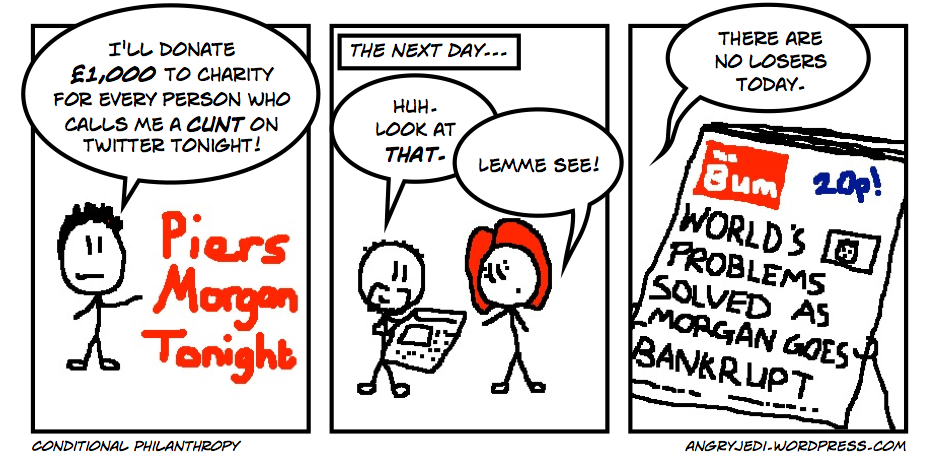
There are a number of people I can think of who fit into this particular category, but the one who springs most readily and frequently to mind is Piers Morgan, erstwhile editor of the News of the World and the Daily Mirror and presently dripping his own peculiar brand of slime over American television sets thanks to CNN.

Piers Morgan's crimes against common decency are too many to enumerate, but his recent behaviour regarding the Olympics has drawn the ire of a number of people.

For those unaware of what he has been up to, it started here:

And continued:

And continued…

AND CONTINUED…

Morgan, it is fair to say, had something of a bee in his bonnet over the fact that some members of the British Olympic team didn't sing God Save The Queen after winning a medal. He appeared to think that this was incredibly important, and that it was worth putting down their impressive, world-beating sporting achievements for.

Then came the bribery and guilt-tripping:

Generous, non? Well, it could be argued as such, yes — he has no obligation to donate anything to Great Ormond Street children's hospital, after all — but dig a little deeper and this whole thing just becomes a bit sleazy, really. By not donating a proportion of his undoubtedly vast wealth to Great Ormond Street simply because of an athlete not singing the anthem — not taking into account the fact that winning an Olympic event is probably a pretty emotional moment for any sportsperson — Morgan is implying several things: firstly, that his apparent philanthropy is, in fact, conditional, and secondly, that athletes who do not sing the national anthem after winning a Gold medal are somehow child-haters.

The gloating didn't help.

Neither did the inconsistency:

Or the abuse:

Basically, there was just something incredibly distasteful about the whole thing. Morgan was clearly just trolling for responses, and he got them by the bucketload — and yes, I'm aware I'm part of the problem here. We don't even have any guarantee that Morgan is actually going to cough up the £15,000 he currently "owes" Great Ormond Street.

He probably will, of course, because he then gets to look like the hero who donated £15,000 to a children's hospital — and also gets to rub how much money he has in the peanut gallery's faces, of course — but I can't help thinking that it is for entirely the wrong reasons. If he feels that strongly about supporting Great Ormond Street, he should just donate the money, not hold his contributions to ransom based on something completely unrelated — something that could potentially make the non-singing athletes look like child-hating dicks in the hands of an unscrupulous (read: Daily Mail) reporter.

Morgan's not making a point here. He's simply waving his willy around in an attempt to make us all feel bad in one way or another. Don't sing the anthem? You're unpatriotic. Don't have as much money as him? HAHAHA YOU'RE POOR. Criticise Morgan's true motivations for this little exercise? YOU HATE SICK KIDS AND ARE A PIG-IGNORANT VACUOUS LITTLE TROLL.

There are several things that remain a mystery out of this whole thing. 1) Why is Piers Morgan still relevant? 2) Why are there people standing up for him? 3) Why does he have to be so fucking infuriating and get off on all this "controversy" he's stirring up? He's like that school bully who would just shrug off any insults you threw at him then punch you in the face and still, somehow, end up being the most popular kid in the school despite being the very worst kind of odious cretin imaginable.

Fortunately, this being the age of social media, at least one good thing has come out of this whole debacle: this JustGiving page aiming to make up the difference in donations that Morgan has refused to give due to athletes not singing God Save The Queen. It's a lofty goal, but if the world can harness its hate for Piers Morgan to raise £14,000 for sick kids… well, admittedly that's not the best reason in the world to give money to charity, but it's sure better than holding the donations from your own incredibly deep pockets to ransom.

#oneaday Day 927: On Stickmen

I draw stickman primarily for one reason: I'm not very good at drawing anything more complicated. I've never practiced drawing particularly hard — I've always enjoyed doodling and drawing stupid things, but I've never tried particularly hard to actually practice good technique or anything. I spent a few weeks reading up on how to draw manga-style characters a few years back, but never really got the hang of drawing things that look particularly "convincing". My manga-style drawings always end up looking like the sort of thing a 12-year old kid scrawls in their art book in an attempt to look cool, rather than anything particularly convincing. So no, you won't be seeing any of those here for the moment.

And then I inevitably run into various other issues if I do decide to draw more detailed characters, which I shall now demonstrate for you forthwith. Note: I am not doing this to solicit feedback, nor am I fishing for compliments (not that these pics deserve any) — simply to demonstrate a point.

Let us begin.

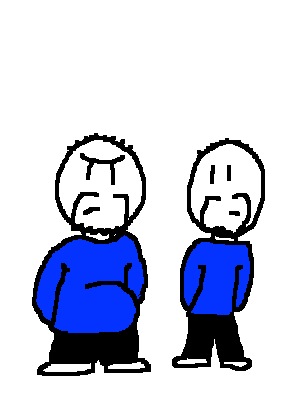
The first question I inevitably end up asking myself regards body image. I put "myself" in my cartoons frequently, and drawing a body makes me ponder whether or not I should draw an "idealised" version of myself (right, obviously) or a more… ummm… "accurate" depiction.

This also raises difficult questions when a friend of mine asks for a guest appearance, as I then have to make the same decision regarding how I represent them — I don't want to cause offence, but at the same time I want them to be recognisable, and their "shape" is often a part of that factor. It's just easier to do a stick body because everyone is equal, then, and the main distinguishing factor between characters is not something people (including me) can be particularly sensitive about, but instead the part that really matters to their "character" — their face.

Also, I'm not very good at drawing fat people. Or boobs.

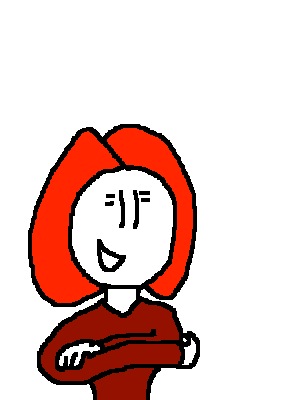
Another thing I am not very good at is posing characters, as the slightly uncomfortable-looking Alex above will attest. I am fond of "arms folded" and "hands on hips" as strong poses, but these are tricky to draw. In the case of "arms folded", I have no idea where the fuck to put people's hands, and I'm not even entirely convinced I know where people's arms go. I then run into mild perspective issues as I try to figure out what would be behind those arms, and it all just gets to be a bit of a mess. (I should probably do it the other way around — body first, then overlay arms on top.)

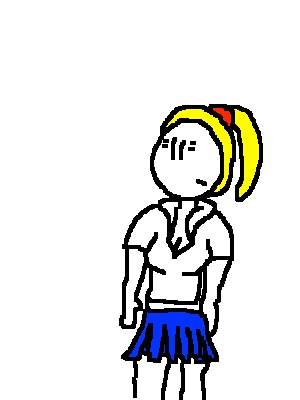
Questions of clothing then rear their head. What should characters wear? Should they wear the same thing all the time as part of their "look", or should they switch things up occasionally? Will I ever learn how to draw bare legs beneath a skirt?

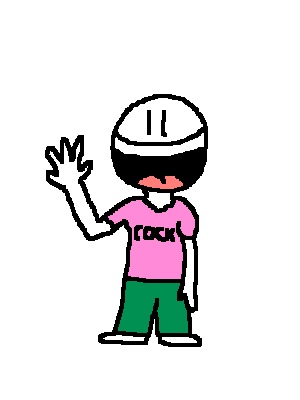
Finally, I have to figure out what on Earth to do with more bizarre characters such as Phillipe here. Phillipe works as a stickman because stickmen can get away with exaggerated expressions such as his perpetual gurning. But does that really work when placed atop a more "normal" (i.e. not stick-figure) body?

Looking at the pics I've drawn above, it actually sort of does. (Also, I can take further advantage of Phillipe's perverted nature with offensive T-shirt slogans.) But I still find myself looking at drawings like that and thinking to myself that they're crap, whereas I'm much happier with the way these characters come out as stick figures. Stick figures can be easily posed, manipulated, mangled and otherwise abused. As soon as you add a "proper" body to the mix, you have to think about things a little more. They're not as bendy. Well, that's not true, you can do whatever you want with them. But contortions are easier to draw on a stick figure than on a character with a body. Also you don't have to worry about lighting with stick figures, whereas cartoons with "proper" bodies inevitably look better if there's a sense of light and shadow in there.

Why am I thinking about this now? Well, every so often I get a hankering to write a visual novel, but the one thing that usually stops me before I even start is thinking "I'll never find anyone to draw some good-looking graphics, and I certainly can't do it myself." I've contemplated making a visual novel using just stick-figure characters and I think it might sort of work — it'd certainly be a distinctive aesthetic — but then I lose confidence and think it would be the rubbishest idea ever.

What I should actually do, of course, is actually script the thing for myself and then see if I can actually recruit someone who can Do Drawing afterwards. But then I go and get into a loop where I want to "see" the character as I'm writing their dialogue, and I go around and around and around and don't do anything at all.

Screw graphics, basically. They just get in the way.

#oneaday Day 924: Hey Daily Mail, This Isn't Okay, And It Isn't Funny Any More

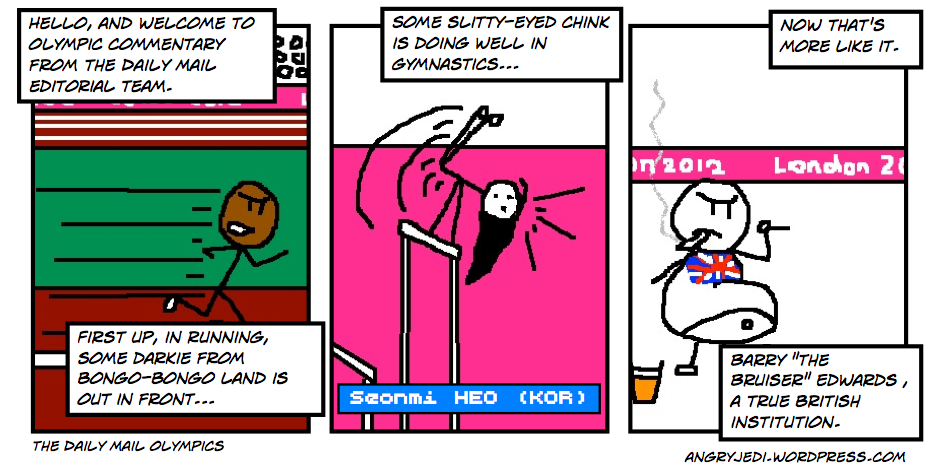
[Note: This will probably go without saying if you read the whole post, but the cartoon above obviously does not reflect my own opinions, and is a parody of what I am about to describe below.]

The Daily Mail has long endured a popular perception as the racist, old, slightly mad uncle of the British newspaper industry. Regularly spouting crap on all sorts of subjects and displaying astonishing hypocrisy on plenty of issues, The Daily Mail has always been sort of tolerated as a kind of national institution we're all slightly ashamed of — and one that we all secretly enjoy getting comically angry at.

With some recent articles, however, I think it's time that people actually started getting properly angry at the Mail. The first of these two articles is no longer available on the Mail website — presumably after a ton of complaints — but is by far the worst example of a Mail correspondent poking the fire with some frankly astounding racism. You can read the article via FreezePage here.

"The NHS did not deserve to be so disgracefully glorified in this bonanza of left-wing propaganda," wrote correspondent Rick Dewsbury as the headline to his piece ostensibly focused on the Olympic opening ceremony. He then launched into a lengthy diatribe regarding the incompetence of NHS staff in the case of Kane Gorny, a diabetic who died due to neglect by hospital staff. A tragic case, sure, but hardly evidence that the NHS — regarded by many as a rather good aspect of this country — is worthy of "shame" as Dewsbury seems to believe.

Dewsbury's article then continued on its rambling way, pausing to note that the athletes' parade featured "banana republics and far-flung destinations nobody has ever heard of or even cares for" and later decrying the "multicultural equality agenda" that he found "painful to watch."

"It was the absurdly unrealistic scene — and indeed one that would spring from the kind of nonsensical targets and equality quotas we see in the NHS — showing a mixed- race middle-class family in a detached new-build suburban home, which was the most symptomatic of the politically correct agenda in modern Britain," wrote Dewsbury. "It is likely to be a challenge for the organisers to find an educated white middle-aged mother and black father living together with a happy family.

"Almost, if not every, shot in the next sequence included an ethnic minority performer," he continued, as if this was somehow a bad thing. "The BBC presenter Hazel Irvine gushed about the importance of grime music (a form of awful electronic music popular among black youths) to east London."

Yes, there was a lot of "multiculturalism" in the opening ceremony, but here's the thing: the Olympic stadium is in the east end of London, which is a particularly multicultural part of an already very multicultural city. To deny that people with non-white skin live in London — and, for that matter, are capable of integrating with Caucasians — is blinkered at best, amazingly racist at worst. Britain as a whole is filled with a diverse array of people from all over the world, and to deny this is to deny what has become part of our national identity — something which the Daily Mail regularly claims to want to defend.

Let's get one thing clear: this is Not Okay, free speech be damned. It is Not Okay for someone to write a piece for a national newspaper's website displaying such flagrant disregard for certain parts of the population. It is Not Okay for someone to use their racism as a rather tenuous part of their argument against something which a lot of people believe is actually quite a good thing. It is Not Okay to speak of camera shots including "ethnic minority performers" in a disparaging tone, as if they had no right to be there.

And it is Not Okay to refer to a non-British Olympic competitor who happened to beat the GBR contender (who still won a medal) as "some bitch from Holland" — which is exactly what Jan Moir did in a separate piece — which also gave an undue amount of attention to whether or not certain athletes and presenters had had any cosmetic work done. (The piece is still up here; FreezePage here; a screengrab can be seen here if it does get pulled or ninja-edited, or if the FreezePage is unavailable.)

The Olympics are about the world coming together in peace and competing against one another in sporting events. It's always touching to see competitors from "rival" nations competing with good sportsmanship rather than animosity, and the whole event is, by its very nature, inclusive and — yes — multicultural. To complain about a "multicultural equality agenda" and to refer to a foreign competitor as "some bitch" is just awful. It really is.

It's obvious why the Mail does this, of course — to get hits. They know that people will get fired up and upset about these issues. They know that the articles will be shared across social networks with people making indignant comments — but they still get their page views and ad revenue every time it happens. It's become a depressingly predictable trend that people have just been putting up with until now.

But it needs to stop. Whatever "comedy value" the Daily Mail's flagrant racism once had — if indeed it ever had any — has no place in modern society. This isn't "political correctness," as Dewsbury would put it — it's just common decency, acceptance and tolerance. It's 2012. We should be over the "skin colour" and "horrible foreigners" thing by now. But sadly, it seems, some people really aren't.

Screw the Daily Mail. It's stuck in the past, just like that racist old uncle lying in his hospital bed, his bigotry tolerated because "he's old" or "he's ill" or "he doesn't know what he's saying". Unfortunately, the Daily Mail knows exactly what it is saying, which is why this keeps happening.

It's Not Okay. And it's time that those of us with a sense of common decency about us should start speaking up a bit more about this rather than just laughing it off as we have done in the past.

#oneaday Day 921: Oimpylcs

I watched (almost) all of the opening ceremonies for the London 2012 Olympics (as it seems they must be called) and didn't hate them.

I was surprised.

I mean, I wasn't going to watch them at all. I have been guilty of Olympic cynicism in recent weeks — not helped by media coverage of the Games being predominantly negative. To be fair, if even half of the stuff regarding the overzealous branding nonsense is true, then yes, that is ridiculous and should be shouted about, but it's easy to get caught up in and neglect to focus on the things that the Olympics are supposed to be about.

I don't like sports as a general rule. They go on too long and the ones that are on telly are usually undertaken by people who are being paid far too much to, essentially, do what kids do on lunch break at school. But the Olympics regularly manages to capture my attention in a way that no other event — certainly not anything football-related — ever manages to do.

I attribute this fact at least partially to the number of Olympic-style computer games I played as a child — Summer Games, Winter Games, Decathlon, World Games, Track and Field, Olympic Gold, Arena — the list goes on. Most of them were responsible for the destruction of at least one joystick, and Arena did its damnedest to mangle the Atari ST keyboard with its inexplicably joystick-phobic control scheme. But they helped me to understand a wide variety of the weird and wonderful events that make up the Olympics — events which you tend not to see on television under normal circumstances. I attribute my knowledge of the fact that "skeet shooting" is a thing that exists to having played Summer Games, for example.

I remember the first Olympics I actually made an effort to watch — though not specifically what year it was, unfortunately. I want to say Barcelona 1992, but I might be making that up. Anyway, I was staying at my grandparents' house with my parents (and my grandparents, obviously) and the Games just happened to start while we were there. I decided that I was going to Make An Effort to watch them. (Actually, thinking about it, I'm pretty sure it was 1992, because I vividly remember Queen singing "BAAARCELOOOOONA, such a beautiful horizon" at the start of every broadcast.) So I did. I made an effort to watch some of the "traditional" track and field events as well as some of the weird shit. It was quite entertaining, though I can't remember the names of any of the athletes I saw or any of the medals that were won. I would be a crap sports fan.

But back to today and the opening ceremonies. I was ready to dismiss the whole thing after the faintly cringeworthy beginning section (particularly the gratuitous and unnecessary insertion of the Eastenders "dum, dum, dumdumdumdum dum"), but the "industrial revolution" section hooked me back in with men in top hats and an excellent soundtrack. It then lost me a bit with a distressingly awful "age of social media" section with gratuitously-overlaid "LOOK THIS IS FACEBOOK BUT IT ISN'T" fake status updates and a poorly-mixed (but otherwise solidly-selected) playlist of excellent British music. By this point, I was oddly hooked, so I didn't even mind the interminably tedious parade of athletes.

Oh, also, there was a bit where James Bond skydived (skydove?) out of a helicopter with The Queen. (Okay, the skydiving bit clearly wasn't The Queen. But the VT involving her and Daniel Craig was pretty neat.) And there was a lengthy tribute to the NHS, which the current government is doing its best to either get rid of or privatise. This was then followed by an army of Mary Poppinses battling a giant Voldemort. Yes, that happened. I think.

So yes, on the whole, the Olympics opening ceremony was what people tend to refer to as a "triumph", shaky bits (and yes, I include Paul McCartney in that description) aside. There were some impressive visuals, an excellent soundtrack (helpfully listed over on The Telegraph) and a few cringeworthy bits. And also some mindblowingly bizarre sections. (The whole "tribute to children's literature" bit was mildly terrifying and will likely give more than a few people some horrendous nightmares this evening.)

Well done, then, London. I don't know if I'll be watching any of the Games themselves, but having sat through that lot this evening I kind of feel a bit obliged to now…

#oneaday Day 920: Zu Heiss

[No cartoon tonight — the Mac (on which Comic Life is installed) is currently installing Mountain Lion!]

It is hot. Really hot. I know, I know, it's nothing compared to feeling your brain melt out of your ears in the desert, and nothing compared to what would happen if you couldn't find a nice shady spot on Mercury, but it's still really hot.

Hot weather is widely regarded by people as a positive thing. Everyone gets all excited about the onset of summer and the prospect of sitting out in the garden slowly irradiating yourself to death. But you know what? Balls to that. Hot weather sucks, and I can't wait for it to 1) piss it down with rain and 2) get back to the normal overcast weather for which this country is so well-known.

My feelings on this matter may be partially due to the fact that I got a bit burnt and suffered some mild heatstroke on the wekend — though thankfully nothing compared to the time I went to Gran Canaria for a couple of weeks and came back looking like I'd changed ethnicity (apart from my bum and associated front regions). The weather is just so damn oppressive right now — stepping outside the front door feels like stepping into an airless greenhouse. It's hard to breathe, it's exhausting to do anything and it's just plain unpleasant. And, this being the UK, we're not as enlightened regarding air conditioning as our American cousins, which means going indoors rarely helps very much, either. In fact, at several times over the last few days, it's actually ended up being even hotter indoors (particularly upstairs) than it has been outdoors.

Honestly. I can't wait for it to cool down. It just makes me not want to do anything except sit directly in front of a fan sucking on ice cubes and chugging back anything in a can that has been in a fridge for at least six hours.

Of course, the moment the temperature drops, I'll probably complain that it's too cold, too wet or too something else, so the weather can't win really, unless it's just sort of "nondescript" rather than hot, cold, wet or any combination thereof. Fortunately, as I said previously, the UK is particularly good at weather that is best described as "nondescript". A grey sky, no rain, no snow, no sleet, perhaps a gentle breeze (but not too much) — that's what I can live with.

Perhaps I should move somewhere like Scotland. The weather there seemed to be like that all the time on every occasion I've been there. But then, of course, I'd live in Scotland, which I have nothing against per se, but would somewhat stand in the way of my objective to move back closer to where my friends are.

Perhaps I'll just invent some sort of environmental suit with built-in climate control. That sounds like the ideal solution, really. Now, just to strip the air conditioning unit out of Andie's car while she's not looking…

#oneaday Day 919: Friendship Is Magic

I've been delving a little into the Brony community recently. As an open and "out" fan of My Little Pony: Friendship is Magic, I felt it behooved me (no pun intended… all right, maybe a little) to actually try and engage with the wider community of fans. As such, I Googled for Brony communities and came across the Friendship Is Magic forum, which I promptly signed up for.

I haven't been an active member of a forum since, ooh, about 2006 or so, I guess, when I was a relatively well-known member of the Times Educational Supplement forums. They were a good place to blow off steam about educational and general life issues as well as just chatting to like-minded people from a pretty wide variety of backgrounds — albeit usually with an interest or involvement in the teaching profession. I haven't logged in there for a very long time now for a multitude of reasons, just one of which is the fact that social media has mostly taken over the functions that dedicated online communities once had.

But I was determined to make a go of it on Friendship is Magic. I introduced myself in the relevant section and started replying to a few threads. While I don't think I've made a "name" for myself as yet, I like to think that my relatively few contributions so far have been noticed — and meanwhile, it's given me a good opportunity to observe the Brony community from within.

You see, I had no idea what a "Brony" really was. Who are these people? Are they actually anything like me, or is the only thing we have in common a love of a show that is ostensibly for little girls? I was hoping to find out through joining the forum — and, as an aside, keeping an eye on the results of the intriguing Brony Study research project, which has been aiming to clarify attitudes both towards the community from without, and towards various pertinent issues surrounding the fanbase from within.

Thus far my (purely anecdotal) observations have been interesting. Bronies cover a wide and diverse array of human beings — young and old, male and female, and varying degrees removed from what society would deem "normality". Some Bronies use 4chanesque dialect ("newfags", "copypasta" et al), others use a clear, straightforward and polite means of communication. Some Bronies like to act "in character" and roleplay their original pony creations on the forum as a means of escapism; others are simply themselves; others still take the middle road and incorporate Ponyville dialect ("everypony", "fillies and colts" et al) into their posts. Some Bronies love the show and actively participate in the huge creative community that has sprung up around it; some simply appreciate the content that others have created; others have no interest in it whatsoever.

In short, there's not really a single unifying characteristic that it's possible to point to and say "that's a Brony" — besides an appreciation for My Little Pony: Friendship is Magic, of course, and a seemingly-genuine sense of tolerance, acceptance and understanding, regardless of a person's background and regardless of the depth of their affection for the show and its surrounding subculture.

Then, of course, there's Rule 34, the aspect of the fandom that tends to get the most attention from outside. (If you don't know what Rule 34 is, you need to brush up on your Rules of the Internet. Borderline NSFW and will probably offend everyone. No porn, though.) Indeed, when radio personality Howard Stern set out to explore the fandom in a recent show, an undue level of attention was given to certain parts of the community who generally prefer their activities to be kept behind a closed stable door, shall we say. This naturally and understandably upset those Bronies who don't participate in that particular aspect of the fandom, and even prompted voice actor Tara Strong (who voices series protagonist Twilight Sparkle) to defend the entire community (and particularly the "Rule 34" crowd) on Twitter.

While the "Rule 34" stuff isn't to my taste, I'm not about to denounce anyone for either enjoying or being involved in making it. It's easy enough to avoid if you don't want anything to do with it, and it's there if you do. If it's not hurting anyone, then knock yourself out, I say. Live and let live. Stern's logic was based on a flawed assumption: the idea that if one fan likes something that is seen as "deviant" in some way, then clearly they all do! This is clearly, as I've seen even in my limited dealings with the community at large, absolute nonsense. Bronies, just like any community, come from a wide variety of backgrounds and each indulges in their passions to a varying degree. No-one's approach to their fandom is "wrong" — assuming it's not causing anyone (including the person themself) any distress — and if it's a good outlet or means of getting away from the stresses of the day then, well, keep on cloppin'.

…wait, clopping means what?