1284: MIRAKURU ROMANSU

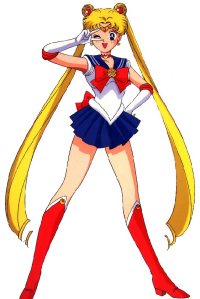
I'm a little further into Sailor Moon now. (That sounds a bit wrong. Never mind, let's just run with it.) Still not a long way, but long enough for both Sailors Mercury and Mars to have shown up, which has thrown an interesting twist into things.

As I suspected, both Mercury and Mars are considerably more competent than poor old Usagi, who is still a clumsy crybaby even when transformed. That said, it's interesting to see the different ways that Mercury and Mars come to "competence" — Mercury, in keeping with her "normal" incarnation as Ami, is quiet, intelligent and thinks things through; Mars, meanwhile, is aggressive, quick to anger and courageous. Mercury is by far the most "mature" of the bunch, despite Mars clearly being the oldest (I assume, anyway; I'm judging largely on the basis of their physical development and the fact that Mars has a job rather than attending school) [correction — the episode I watched the day after this post was written saw Mars turn up in a school uniform, so scratch that!] — the episode I watched today featured Usagi and Mars arguing throughout, with Mars in particular betraying the facade of maturity she clearly tries hard to keep up by getting sucked into Usagi's ridiculous world. I'm spotting a bit of a tsundere streak in Mars, too (well, mostly tsuntsun at present) which, of course, means I find her tremendously attractive.

The show continues to be simplistic, entertaining fun at its current stage. I don't know if it gets any more complex later on, but to be honest, I don't mind at all if it continues in its present, rather formulaic fashion. You don't have to think too hard about it or try to hunt for hidden meanings; you can just flop down in front of it and enjoy the silliness. It's the Saturday morning cartoon formula — predictable villains who are always after the same thing (the curiously non-specific "energy" in Sailor Moon's case), a predictable main cast who get to do one majorly awesome thing per episode that can be easily represented through the insertion of stock footage, and a comic sidekick character. (That said, Sailor Moon's sidekick character Luna the cat is actually the most mature, sensible one out of all of them.)

What's interesting about Sailor Moon at this early stage — and I could be wrong about this, since I'm only ten episodes into the whole run — is that it's essentially a superhero show, focused almost exclusively on female superheroes, in which said female superheroes don't appear to be there just to be "sexy". Sure, they're all in short skirts, Sailor Mars is wearing some distinctly impractical-looking high heels and there was a rather gratuitous pantsu shot (Sailor Mars again) in the last episode I watched, but for the most part when they're in their Sailor Senshi forms, it's all business, bubbles, fireballs and Moon Tiara Action. (Incidentally, I feel that Sailors Mercury and Moon drew the short straws when it came to their awesome powers — Sailor Mars can set things on fire, while Mercury can, err, make a lot of bubbles, and Moon can throw her tiara at things. Granted, getting hit by Sailor Moon's tiara generally appears to make things turn into dust, but still. Sailor Mars can set things on fire.)

Anyway, yeah. Sailor Moon is awesome. I'm disappointed in myself I haven't watched it sooner, but at least I can make up for lost time now.

1281: MIRACLE ROMANCE

SMoonI guess about now is a good time to admit that I've started watching Sailor Moon and, predictably, enjoying it a great deal.

In my defence, after watching Revolutionary Girl Utena and finding it enjoyable but immensely confusing, I felt obliged to check out Sailor Moon for further education in the ways of the magical girl. I have a sort of ulterior motive for educating myself on this particular aspect of anime — for starters, I've always been interested in it, but never got around to checking any of it out; secondly, I hear that Puella Magi Madoka Magica or whatever it's called is very good, but is something of a deconstruction of the magical girl genre as a whole and consequently is best appreciated when you have more than a passing familiarity with its tropes.

So, Sailor Moon, then. In stark contrast to Revolutionary Girl UtenaSailor Moon is charmingly unsubtle about everything it does. The lead character Usagi seems to do nothing but shout or cry all the time, and the show's moral messages are only a couple of steps removed from He-Man's posturing. While there's no "Hey, Kids!" moment at the end of a Sailor Moon episode, the inherent "message" of each chapter is so startlingly obvious within about five seconds of it starting that it becomes more of a Columbo-style show, where you're waiting to see how it reaches the conclusion you already know from the outset, rather than holding on tight for some narrative twists and turns.

That's not to say it's bad, though; simple is good sometimes, and God knows it's appreciated after UtenaSailor Moon's characters are charming and endearing, even if they're loud, and they've all grown and developed even in the space of the few episodes I've watched to date. I'm looking forward to seeing how Usagi — who, spoiler, is also Sailor Moon — develops over the course of the 300 bajillion episodes there are, because she is comically incompetent at present, despite ostensibly being the show's heroine. Her "sidekicks" who are teased in the show's opening titles haven't shown up yet, but I assume it's only a matter of time.

It's clear even from this early stage that Sailor Moon was very influential, however. I'm seeing elements of its humour and characterisation in the latest Hyperdimension Neptunia game, for example, where Neptune takes on the Usagi role of "amusingly rubbish protagonist who's aware she's rubbish", and her companions are actually far more capable than she is. There's also the more obvious fact that Neptune and co are all themselves magical girls, able to transform into their "Hard Drive Divinity" forms to power up and become stronger — though there's less "identity hiding" in the world of Neptunia than there is in the more "grounded in reality" world of Sailor Moon.

And that music. Amazing. While the copies of the episodes I'm watching aren't brilliant quality — or perhaps they really were that poor quality when originally broadcast — the amazing background music still stands out, if only for the fact it sounds like it belongs in a 1960s TV series rather than the 1992 anime from which it actually hails. Huge string orchestras, wakka-wakka guitars, choirs of singers mewling "oooooooh, oooh-ooooooohh, Saiiiiloooor Mooooooon…" as Usagi transforms. Marvellous stuff.

Anyway. I'm going to watch a lot more of Sailor Moon, I predict. I have the whole series to hand, but it remains to be seen if I can manage all of it. I'm sure I can, and I'm sure I will feel suitably satisfied at its conclusion. I hope there's a good ending. Please don't tell me if the ending is rubbish!

1272: The Worst Headache in the World

I went to see Akira at the cinema this evening. I recall around the period anime first got fashionable in the UK that there was a considerable degree of snobbery about this movie, with people saying "oh, you have to see it on the big screen" and whatnot whenever it came on TV.

You know what, though? Having now seen it both on TV and on the big screen… yeah, the snobs were right. It's spectacular.

The reason I was seeing Akira at all this evening was because my good friends George and Mitu, whose marriage we are attending later in the year, happened to be in the area and had booked tickets. George popped up on Steam earlier and asked me if I fancied coming out at short notice for a 10.30pm showing, and because I'm never really doing anything of note, I accepted. (If anyone else is in the area and wants to do something fun… try me. I'm usually available.) So thanks, George and Mitu, for getting me out of the house on a Saturday evening and seeing a film I don't think I've seen for at least 15 years or so.

I first saw Akira when it came on Channel 4 late at night one evening. Well, to be more precise, I taped it, because it was on at some ungodly hour in the morning. Eventually I sat down and watched it, though, and was thoroughly bewildered by almost everything about it. I hadn't really watched many foreign-language films before, so watching something with subtitles was new, and I also hadn't really had much contact with anime before, either, so the concept of an "adult" animation (not that kind of "adult," though there is one pair of visible boobs, albeit not in an even slightly titillating context) was also something new to me.

I think it's probably fair to say that I didn't really "get" Akira the first time I saw it. Those who have seen Akira will know that not "getting" it is part of the point, really; again, this was a concept that was somewhat new to me at the time I first saw it. I was used to things being much more literal, and indeed even today I do sometimes find it difficult to latch on to stuff that is being too deliberately obtuse.

Seeing it today, though, I feel I appreciated it a lot more than when I first saw it. It's a real spectacle, all the more remarkable for the fact it came out in 1988 and thus would have been largely hand-animated. As George pointed out when we came out, a lot of things blow up, shatter and collapse in Akira, and someone had to animate each and every one of those bits of rock, glass and other miscellaneous bits of debris by hand. Quite a feat.

Akira's also interesting for having quite a distinctive style. While recognizable Japanese in appearance, it doesn't look like modern anime, nor does it look like stuff that came a little later in the '90s. I'm mostly familiar with more recent anime, but '90s stuff in particular has a very distinctive look that is a bit different from today, and Akira is different again.

One thing I thought that was quite interesting about the film's look is that all the characters actually look like Japanese people, whereas from '90s anime onwards, we tended to see a lot more in the way of the heavily-stylised, big-eyed look that typifies the medium today. The characters are also relatively subdued in their defining characteristics, and realistic in their appearance. Of the three female characters who put in an appearance in the movie, not one of them is intended to be "the hot one" or "the cute one" or anything like that — they're just women. (Well, okay, one of them is a weird, wrinkled, old-looking child with blue skin, but eh.) Very progressive, particularly for 1988.

Anyway. I enjoyed myself. It was good to revisit a movie I hadn't seen for a long time, and it was good to see friends I hadn't seen for a long time, albeit in a situation where we couldn't really talk a lot! Now it is 1:30 in the morning so I had probably better get some sleep.

1264: Smash the World's Shell

I finished watching Revolutionary Girl Utena at last today.

Honestly, I'm really not sure what to make of it. I don't mean I didn't like it — I did — but rather, I feel like I've woken up from a dream and don't really know how to parse what I watched.

As anyone who has watched Utena will tell you, of course, this is part of the attraction of the show. It is a show that prides itself in its surrealism, symbolism and deeply metaphorical nature. There's a sense throughout that nothing is quite as it seems, and that you probably shouldn't be taking some of the things that happen over the course of the 39 episodes too literally — not least because none of the characters appear to. They seem to shake off the frankly utterly baffling things going on with alarming rapidity, which leads you as the viewer to question whether those things were really happening at all, or whether they were merely representative of something else.

One of the best yet most frustrating things about Utena is that there are no definitive answers, though. The show's creator, I'm told, enjoys taunting fans and deliberately misleading them, and pointedly won't say what the definitive explanation for it all is. This might be because there isn't a definitive explanation for it all; or it might simply be an attempt to get people to figure it out for themselves, come to their own conclusions and take whatever they want from the show as a whole.

In some respects, the whole thing reminded me somewhat of Silent Hill, of all things. Obviously the two series are very different from one another despite having a common heritage — Silent Hill is Japanese psychological horror, while Utena is colourful Japanese anime — but both actually have a surprising amount in common, not least of which is the fact that both are pretty open to a hefty degree of interpretation.

Both are riddled with psychosexual imagery, too. Neither are outright explicit with it — though Silent Hill 2 does feature a scene where Pyramid Head, that game's iconic recurring monster, is raping a tailor's mannequin — but both feature a very strong sense that sex and sexuality are a core theme. In Silent Hill's case — particularly Silent Hill 2 — there's a sense of guilt and shame attached to sexual desires for a variety of reasons; Utena, meanwhile, is rife with both phallic and… uh… whatever the word for the vaginal equivalent of phallic is… imagery. (Just "vaginal", I guess, but that doesn't seem to fit quite right.) There's a strong sense of Utena's characters reaching sexual maturity and coming to terms with that in different ways, much as James had to come to terms with aspects of his own sexual desires in Silent Hill 2.

Frankly, I'm not sure I'm intelligent enough to be able to do a particularly deep reading of Revolutionary Girl Utena without spending a significant amount of time researching, but suffice to say I enjoyed it and very much respected what it was doing, even if I didn't always understand it fully. As I say, though, that was probably sort of the point all along.

If you're curious, I'll share a super-interesting essay I read earlier immediately after finishing the series. It doesn't claim to be a definitive interpretation of the show, but it's certainly a plausible reading of it, and definite food for thought. Check it out here.


1236: On Being That Guy Who Picks 'Japanese' in the Sound Menu

Jun 07 -- AaaaaaaaI always used to be one for having my game's voices in English. I liked being able to understand what they were saying as well as reading the subtitles on screen. In some cases, I didn't have the option; I'll always associate Persona 3 and 4 with English voices, for example, even though, in retrospect, it would probably be better with Japanese voice acting. In others, the English voiceover job was so genuinely good that I didn't want to try the Japanese version — Xenoblade Chronicles springs immediately to mind in this regard.

I can remember the moment that I realised Japanese voice acting was something worth exploring even though I didn't speak the language, though. It was while I was playing the utterly terrifying PSP visual novel/adventure game Corpse Party — one of my favourite games on that platform, and legitimately one of the most disturbing games I've ever experienced — that I realised that, frankly, Japanese video game voice actors aren't afraid to let rip with the utterly raw emotion. They'll shout until their voice cracks; they'll scream; they'll cry. And by God, they sound like they mean it.

It was around one of the many points in Corpse Party where one of the characters is bawling their eyes out and screaming in terror at the horrific situation they've found themselves in that I realised when it comes to voice acting in games — which are typically accompanied by subtitles, particularly in the visual novel and JRPG genres — it's not about the words that are being said, but about how they're being said. It didn't matter that I didn't understand the Japanese words that were being screeched into my ears (seriously, play that game on headphones and you'll never want to turn the light out again) — the meaning was all too clear simply from the tone of voice.

Those who have been reading regularly will know that I've been playing Ar Tonelico 3 recently. I played the first game in that series in English, largely because I found the English voices in the video cutscenes too jarring when paired with Japanese speech in the main game. I played the second in Japanese because I'd been warned that the English dub, much like the overall translation job, was somewhat questionable. And I started the third in English, but after not very long I switched to Japanese. It is a decision I did not regret.

It's very obvious from the huge rift in quality between the English and Japanese voice tracks in something like Ar Tonelico 3 that the English actors are, for the most part, phoning it in somewhat, while the Japanese actors care about what they're doing. In many cases, it is the difference between a rush job (English) and having well-known professionals handle the voices.

I witnessed a scene this evening — no spoilers — that had me more than a little choked up due to the amount of raw emotion and passion that the actress playing one of the characters was throwing into the delivery of her lines. I believed that she meant what she was saying. This character was supposed to be upset, and I believed that.

The other thing that comes into play is that when a game's dialogue has been translated relatively literally from the original Japanese rather than fully localised, reading it out loud in English often sounds very stilted and artificial, simply because that's not how English people talk. We don't say things like "what is this, all of a sudden?" and start entire conversations with "By the way". We don't refer to ourselves in the third person to be cute. (Usually. Saki will do it!) And we don't use the term "lovey-dovey" anywhere near as much as Japanese people apparently do.

There's nothing wrong with doing a literal translation from the Japanese — so long as you do it with enough care to make it understandable, of course — but if you're going to take this approach to translation, I've come to the conclusion it's best to leave the voices as they are. If, on the other hand, you're going to take the Ace Attorney/Cherry Tree High Comedy Club/Recettear approach to localisation and actually make the dialogue significantly and noticeably more "Western" in the process, then we can talk about English voiceovers.

I must confess to always having found an attitude like the one I just described a little snobby in the past. Having immersed myself in this side of gaming (and anime) culture for this long, though, I totally get it. Once you get used to the infinitely more professional job Japanese voice actors do on productions like Ar Tonelico (and even on lighter fare like Hyperdimension Neptunia, for that matter) you'll likely never want to go back.

1221: How Do You Make Friends Again...?

May 23 -- FriendsOne of my earliest and most enduring memories of my time at secondary school is also, coincidentally, the first time I was consciously aware of what I now recognise to be a longstanding case of social anxiety.

It was the first day of secondary school. Everything was big and new and scary — I'd come from a small village school in which the entire school population was roughly the size of a single year group in my secondary school. I'd chosen to go to said secondary school because a lot of my friends were going there, and also my brother had attended there some years previously and had come out of the experience as what is generally accepted to be a Good Person. Also, a lot of the people who had been bullies to me in primary school were going to a different secondary school, so I knew that I wanted to avoid that one like the plague.

But I, as ever, digress.

It was the first day of secondary school. I was sitting in my new seat in my new tutor group, and our tutor, Miss Quirk (yes, really), had tasked us with spending a few minutes getting to know the people around us.

I gazed around me. I was sitting next to a boy named Murray whom I didn't know. In front of me was a girl named Claire, whom I had instantly fallen in love with due to her long shiny blonde hair and the fact she wore short skirts with tights — something which I found (hell, find) inexplicably attractive. (Hey. I was eleven years old and easily pleased — but to be fair, she did remain consistently stunning throughout our entire school career.)

Behind me was my sometime best friend from primary school, Matthew. I say "sometime" because he wasn't always my best friend — he was a somewhat fickle chap rather prone to occasionally deciding he'd rather hang out with the "cool" kids, whose opinion of me tended to flip-flop back and forth on an almost weekly basis. Needless to say, I ditched him fairly soon into my secondary school career as a result of two events: one, him sneezing so hard he snotted over his hands and then ate it — mmm — and two, him deciding that sitting in his chair, miming masturbation and bellowing "I'm a wanker! I'm a wanker!" would be somehow amusing. (To be fair, it was sort of amusing, but perhaps not in the way he intended; needless to say, I didn't really want to be associated with him after that.)

Anyway. Our seating arrangements were the way they were in order to encourage us to interact and get to know each other. We'd been deliberately seated next to people we didn't know to encourage us to break out of our primary school "cliques" and widen our friendship circles — a theoretically sound idea that even at that tender age, I could see the benefits of.

Unfortunately, I couldn't act on it. Given the prospect of being thrown into enforced interaction with someone I didn't know from Adam, I froze up. I had no idea how to begin a conversation, how to get to know this person. Frantically, I turned around to gaze at Matthew (a pre-"I'm a wanker! I'm a wanker!" Matthew, I might add) and looked at him pleadingly.

"I can't remember how to make friends!" I said quietly to him. He just laughed and motioned for me to turn around and talk to Murray. He obviously hadn't taken my statement seriously, and that was frustrating, but I had little option but to try. It was a terrifying experience, though, and obviously I didn't set a particularly good first impression on Murray, because he became a complete bellend who bullied me on a regular basis. (I got my own back by punching him in the face just as the principal was walking around the corner and, although I was punished for lashing out like that, the unspoken consensus between my parents and the teachers involved was that he probably deserved it — and to be fair, he didn't bother me again after that.)

That first day and that pitiful statement — "I can't remember how to make friends!" — stuck with me, though. Because I can't remember how to make friends. It just sort of happens. I have made friends with people over the years, of course — the friends I made after I abandoned Matthew following the "I'm a wanker!" incident (such as Edward James Padgett, who has been mentioned in this post since it was first written, he just didn't see it); my university flatmates; my fellow students on my music course (though not on my English course — I didn't really get to know anyone on that side of things); and people I've worked with — but if I'm thrown into a new situation with unfamiliar people, or simply decide that I want to get to know new people who perhaps share my interests… I still have no idea how to do this.

This is, as I'm sure you can appreciate, frustrating, particularly as at the age of 32 I finally feel that I have found a number of geeky "niches" that I fit nicely into, and would like to share these experiences with like-minded people. I greatly enjoyed spending time with Mark and Lynette while we were over in Canada because they are both My Kind of People who enjoy the things I do — but I also found myself somewhat envious of them for having a group of friends they play Dungeons & Dragons with, watch anime with while drinking cocktails and all manner of other things that are in keeping with their interests.

This isn't to say I don't have friends, obviously. The friends I see most frequently are my regular(ish) board gaming group, and I wouldn't exchange them for anything, since I really, really appreciate the time I spend with them indulging in our mutual hobby. However, we do have our own incompatibilities — two of our number are really into football, for example, while the rest of us either have no strong feelings or actively hate it. (I fall into the latter category.) Similarly, I very much like Japanese video games, while several of the others cling to common misconceptions about them and thus either refuse to play them or have little interest in exploring them and having their misconceptions disproven — though at least they are patient and willing to listen to me talk about them. Conversely, a couple of our number are big into Skyrim, a game which I found almost unbearably tedious after a while. To continue the pattern, I'm a big fan of anime and would really like it if I could have a semi-regular viewing session with a small group of people, but no-one from that particular group is biting for various reasons — some don't like or don't see the point of sitting and watching something together as a group; some aren't interested in anime.

You get the picture, anyway. I obviously don't begrudge my friends these incompatibilities we have — everyone is different, after all, and thus has their own tastes — but I find myself wishing on a regular basis that it was a bit easier to find additional friends (note: not "new" friends, because to me that implies a degree of "replacement", which I don't want) who have common interests.

Actually, let me qualify that somewhat: I find myself wishing that it was a bit easier to find additional local friends who have common interests. It's obviously no problem whatsoever to find new friends on the Internet who have similar tastes to me, and I'm very grateful for the fact that I do have so many people on the Internet that I can rant and rave about how awesome Ar Tonelico is or how much Kana Little Sister made me cry or whatever. But as much as I appreciate these friends in far-flung corners of the world, it's not quite the same as having someone you can just pop over and see at short notice, hang out and do some things that you both enjoy.

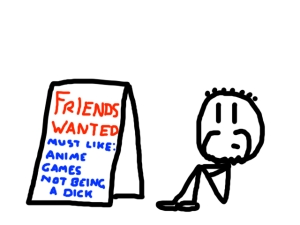
So, uh, anyone want to hang out, play some games and watch some anime?
1186: Don't Hate

There's a curious phenomenon in comments sections around the land. And that phenomenon is that it is seemingly the law that someone, somewhere, must hate everything. Actually, that's badly phrased; I don't mean that one person hates everything — though I'm sure there are people who do — but instead I mean that whatever the thing that has been posted, there will always be at least one person who dislikes it for some reason and is inevitably the sort of person who is very vocal about their dislike of it.

This seems to happen particularly frequently in sectors that already have passionate userbases, or in which the userbases are seen as being a "subculture" and/or outside the "norm" somehow. I'm thinking specifically of the video games and anime sectors here — and before you start on me, for all the massive steps forward these media have made in terms of mainstream acceptance over the last 20-30 years they are still indelibly tarred with the "geek" brush to one degree or another.

Today, I was exploring the RPG Maker community who, by all accounts, appear to be a fairly friendly and helpful bunch for the most part, as I've previously mentioned. I was curiously browsing through some of the other users' projects in progress and came across a few interesting-sounding games. One of the users noted that they had submitted their game to Steam Greenlight, the process whereby a game can end up being sold on Valve's popular PC gaming digital download storefront if it gets enough positive votes from the community.

The game, by all accounts, sounded interesting and unconventional, and something I'd be intrigued to play. It was an "artistic" game, for want of a better word, designed as a means for the author to show what it was like living with depression. The author said upfront on the site that it was a mostly-linear, narrative-centric experience with a lot of text, and made no apologies for this fact. (For people like me, the terms "narrative-centric" and "lot of text" are selling points, not things to be ashamed of!)

Sadly, the Greenlight comments section was less than supportive for various reasons, featuring disparaging remarks for everything from it being "another depression game" (oh, sorry, there have been so many of those) to dismissing it simply because it's an RPG Maker game. I've made my feelings on the latter point quite clear in the past, but they bear repeating: if a tool is available to help someone realise their artistic vision, there's no reason why they shouldn't use it, regardless of how many other people are also using it. And besides, some of my favourite games in recent memory have been RPG Maker titles — Corpse Party, To The Moon, Cherry Tree High Comedy Club… all of them were made in earlier versions of RPG Maker that were considerably less sophisticated than the excellent toolset that is VX Ace.

But I digress. The point is that the comments section was filled with hate for the sake of hate rather than actually constructive feedback. The fact that the game in question (Actual Sunlight, I believe it was called) was "another depression game" and an RPG Maker project had nothing to do with its quality, or its "value" to the Steam community as a whole, and yet these things were used as reasons to reject it, without even bothering to check it out.

In the anime sector, it seems that it's fashionable to hate on whatever the biggest name show is at the time. Most recently, this has been seen with Sword Art Online, which I found to be a rollicking good time with an astonishingly spectacular soundtrack, some memorable characters and an interesting, intriguing and pleasingly mature (for the most part, anyway) storyline. It was a good show, in short; while it perhaps wasn't the most intelligent anime you'll ever see, it was certainly far more than a dumb, formulaic show.

Perhaps not something everyone would want to watch, no, but certainly far better than the overly-negative comments that would appear on J-List's Facebook page any time site owner Peter Payne posted a piece of artwork relating to SAO. (Granted, J-List's Facebook page is a place where any time a picture of a vaguely attractive anime girl is posted, one specific user will always be along within three comments of the start of the thread to helpfully inform everyone that "[he] would fuck her", so it's perhaps not the best place to go for objective criticism, but still; you'd expect a community of Japanophiles such as the followers of J-List's page to be a bit more enthusiastic about the things they supposedly like!)

I honestly don't get why this happens, and it seems to happen a lot. Why waste your time on hate when there is so much stuff out there to get you excited? Wouldn't you rather feel happy and intrigued by something than angry or upset?

1176: Absolute Destiny Apocalypse

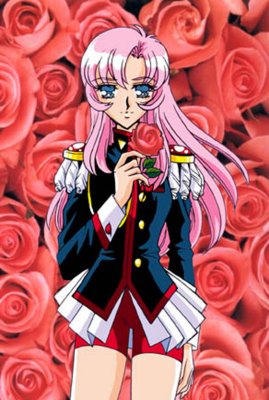
Utena-1-_(2)At the insistence of my good friend Lynette (well, all right, she mentioned it a couple of times and I was intrigued) I have been watching an anime series called Revolutionary Girl Utena, also known in various places as Shoujo Kakumei Utena and La fillette révolutionnaire Utena.
Utena, as I shall refer to it from hereon, is clearly from a very different period to the anime I have watched to date. It has a very distinctive "'90s anime" appearance to it, particularly with regard to character proportions and design — everyone has chins that could cut glass, and all the girls have inhumanly long legs, a fact usually accentuated by their clothing — but it still makes use of a lot of common non-realistic "stylized" features that we see in modern anime, particularly with regard to facial expressions and the way people move.

Thematically, it's also of a genre I haven't really explored before — technically, it could be described as a "magical girl" anime since Utena regularly gains special powers accompanied by special effects and recognisable catchphrases, but it's a lot more than just Pretty Girl Fights Crime. No; so far I'm only relatively few episodes into the whole thing but it's very clear that there are a lot of things going on.

A friend of mine described Utena as being "like a fever dream" and that's absolutely true. There's a curious sense of surrealism about most of the episodes, with fairly mundane activities juxtaposed with obviously fantastic happenings that only certain characters are aware of. The whole thing is also absolutely riddled with imagery and visual metaphor, some of which are more obvious than others and most of which only contribute to the strange, surreal feelings of things not quite being what they seem.

But you probably want to know what it's all about, right? Well… as I say, I've only seen a few episodes so far so I can't comment with full authority on everything that has happened, but here goes.

00003sp0Utena is a statuesque high school girl who habitually dresses as a boy. The reason for this is that when she was younger, she was helped by a kind "prince", who gives her a ring with a rose signet and tells the young Utena that it will "lead her to him". It transpires that there are other people out there who wear the rose signet on their rings, and they're at Utena's school. Specifically, they're the student council, who appear to have some sort of special relationship with an unknown entity, person or organisation known as "End of the World" and are keen to "smash the world's shell to bring about revolution" as dictated by their creed. ("If it cannot break out of its shell, a chick will die without being born. We are the chick. The world is our egg.")

Key to the plans of the Student Council is the "Rose Bride" Anthy Himemiya, who also happens to be a student at Utena's school — and who appears to share some characteristics with the "prince" from Utena's past. Anthy, for the most part, appears to be a normal girl, but whoever is "engaged" to her "possesses" her and can make her do anything they want. Through a series of unfortunate happenings, Utena becomes engaged to Anthy and then proceeds to protect her from the other members of the Student Council, who all have their own reasons for wanting to possess the "power of Dios" that Anthy contains.

The interesting thing about the series so far is that no-one is really outright "evil" — there are plenty of obnoxious characters who are unpleasant or dislikable, but they all appear to have their reasons for doing the things they do. In fact, there are several characters who, despite being on the Student Council and thus at various points taking the role of "antagonist", are actually rather sympathetic and/or likable. It's really cool, and I'm looking forward to finding out the truth behind some of them.

Anyway, given that I'm only partway through the series' first story arc, that's really all I can say for now, but I will say that I'm enjoying it, even if it's currently very confusing and bewildering. I get the impression that's entirely deliberate, though — I wonder how many answers I'll have by the end of it all?

1166: The Invader Comes from the Bottom of the Sea!

It's been a while since I talked anime here, so I'm going to talk anime. Oh yes indeedy. Specifically, I'd like to talk about a bizarre little show I've just started watching called Squid Girl, also known as Ika Musume.

squidgirl1Squid Girl is a rather peculiar show in a number of ways. Firstly, it's not quite "episodic" in the same manner as other anime series, though there is a sense of progression throughout. Instead of being a sequence of 20-minute episodes, each "episode" of Squid Girl is instead made up of three short self-contained mini-stories that tend not to have a great deal to do with each other besides having the same core cast. However, the whole thing does have a clear chronology, since characters, concepts and settings introduced in earlier episodes tend to show up again later rather than being "one-shots". I haven't watched far enough to know exactly how it all ties together — if at all — yet, but already in the four full episodes I have watched we've seen the introduction of certain characters and their subsequent return — and I'm sure there'll be more to come.

Secondly is the concept, which anime pros probably won't bat an eyelid at, but which those used to more… "conventional" Western entertainment might find a little bizarre. As you might expect from a show called Squid Girl, the main character is a girl who shares a number of characteristics with squid. Specifically, her blue hair is actually a set of ten tentacles which she can manipulate independently at will, her hat causes the shape of her head to resemble that of a squid (and removing it will apparently kill her) and she is able to spew squid ink from her mouth. She also has the abilities of various different types of squid, including luminescence, the ability to change her weight at will and flapping the… flappy bits on her hat. The English subtitles and dub also see her making frequent squid- and tentacle-themed puns in her dialogue, while in Japanese she tends to end her sentences with "de geso" (translated literally, something to do with squid legs) similar to how super-cute moe characters often deliberately overuse or exaggerate the "desu" or "desu no" final particle (see Compa and Gust from Hyperdimension Neptunia for good examples), and she also tends to emphasise the syllables "ika" ("squid") in her speech whenever they come up, regardless of whether or not doing so would really make sense. (Aside: I love finding out about the equivalent of puns and the like in other languages, as I do often find myself wondering how non-English languages deal with jokes, slang, dialect and puns like this. It's fascinating to learn this stuff through things I enjoy.)

squidgirl2The basic premise of the show sees Squid Girl coming ashore ostensibly to subjugate all of humanity in revenge for the shitty way they've treated the ocean, but she instead finds herself forced into working as a waitress at a beachfront restaurant when an outburst and demonstration of her "power" ends up smashing through the wall. The various mini-stories that make up the episodes depict Squid Girl learning more about human society and what a "normal" life is, and much of the humour comes from her complete unawareness of how to behave like a human despite resembling one for the most part. There's also a huge amount of comedy value inherent in her interactions with the owners of the beachfront restaurant she damaged, who seem completely unperturbed by the fact that she is obviously not human and each have their own distinct characters and means of dealing with the girl-shaped hurricane that is Squid Girl. Eiko is slightly weary and a little tsundere but tolerates Squid Girl for the most part. Her sister Chizuru, meanwhile, initially appears to be the stereotypical quiet, demure and kind "older sister" type, but reveals herself very early on to have a distinctly dark side that utterly terrifies poor old Squid Girl. In actual fact, this "dark side" is not truly threatening or unpleasant — it's simply the ability to perform a "withering look" that is the Holy Grail for parents and teachers alike, but which is often depicted as a horrifying dark aura from Squid Girl's perspective. Even as Squid Girl tries to convince herself that she's still going to subjugate humanity, she quickly learns not to step out of line when Chizuru is around.

For the most part, Squid Girl is thoroughly silly fun, and I frankly wasn't expecting much more than something fairly throwaway to watch while I had breakfast and then forget about shortly afterwards. However, one of the mini-stories I watched earlier well and truly changed my mind and convinced me that this is actually a show doing some surprisingly clever things. I shan't spoil it completely for those who are planning on watching the show, but I'll just say that the "mini-Squid Girl" vignette — which was depicted almost completely wordlessly — was surprisingly heartfelt and touching, and I was very surprised to realise that even after just a few episodes, I already cared very much about these characters.

squid girlI shouldn't have been surprised, really; one of the things that continually strikes me about Japanese media the more of it I consume — be it video game, anime or manga — is the deft skill with which creators are often able to weave their magic to create compelling characters and make you care about them remarkably quickly. Squid Girl, as ridiculous as it sounds on paper, is certainly no exception to that, and I look forward to seeing the rest of this surprisingly captivating nonsense.

1118: My 1,118th Blog Post Can't Be This Cute

Page_1Anime is full of surprises and frequently subverts your expectations, prejudices and preconceptions. In few places is this more apparent than in the recent show Oreimo, also known as Ore no Imouto ga Konna ni Kawaii Wake ga Nai or, literally in English, My Little Sister Can't Be This Cute.

Now, with a title like that, you'd be forgiven for thinking that this show is one of two things — or perhaps both. One: moe moe happy funtimes featuring a wacky little sister running around being cute. Two: incestuous "sister complex" story in which male protagonist ends up falling for his little sister through various shenanigans they get up to together. While I can't speak for number two in the show as a whole — I've only watched four episodes so far, so I'm still half-expecting them to pull the frequently-used "but they're not blood relations!" trope out of the bag (please don't spoil it even if that is the case!) — number one couldn't be further from the truth. Far from being a wacky show about nothing in particular as I expected it would be, Oreimo is, it turns out, an oddly personal show about being true to oneself and accepting each others' idiosyncrasies.

The concept is fairly straightforward. The main character Kyosuke is a 17-year old high school student who has had a somewhat strained relationship with his 14-year old sister Kirino for some time now. The reasons why they have been struggling aren't explained, at least at the start of the show, but it's clear that there's a certain degree of tension between them, whether that be the usual case of siblings resenting one another or something more. Kirino is a model student — she's pretty, she's popular, she gets good grades and she's a top athlete — and she also makes a lot of money doing modelling work for various catalogues and magazines.

But she has a secret.

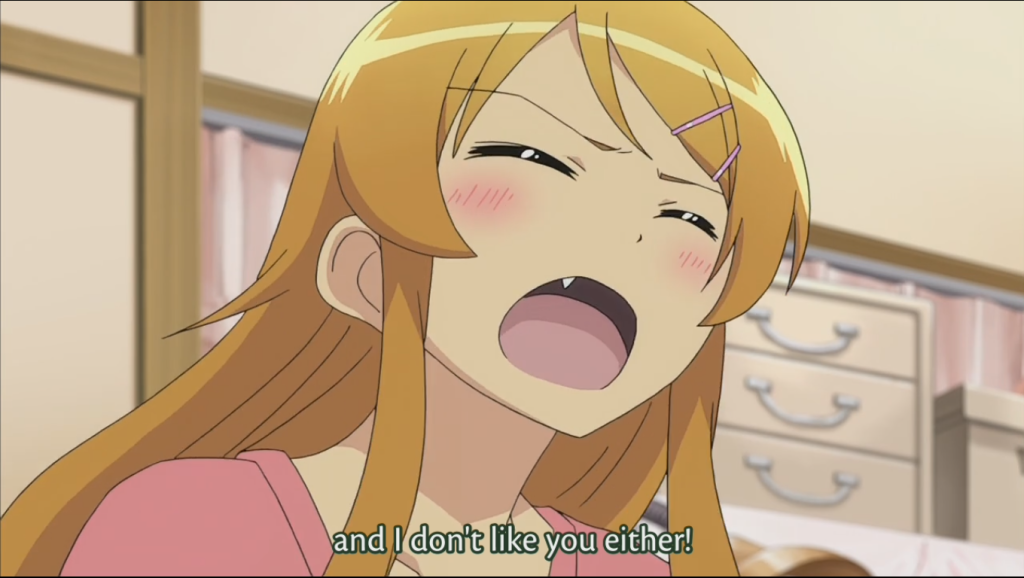
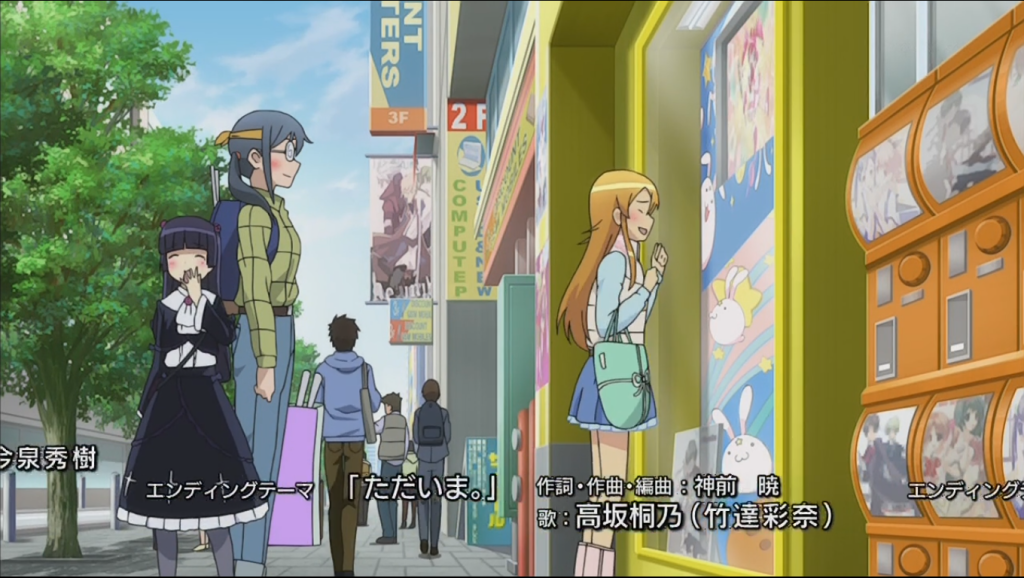
Oreimo12-23Early in the first episode, Kirino makes a bold move. She comes to Kyosuke's room in the middle of the night, wakes him up and confesses something that she's been hiding for a long time: she's a secret otaku with a hidden closet full of anime, manga, doujinshi and eroge — all paid for with her modelling earnings — with a particular focus on one particular (fictional) magical girl show, and also on anything related to little sisters. Kyosuke initially isn't sure how to react, but it becomes clear that Kirino wants his help, even though her own pride and somewhat tsundere nature prevents her from stating this outright. He agrees to help her work out how to handle her secret "addiction" and figure out what to do with her life, because the stress of leading a "double existence" is starting to take its toll on her, as she feels uncomfortable showing the world who she really is.

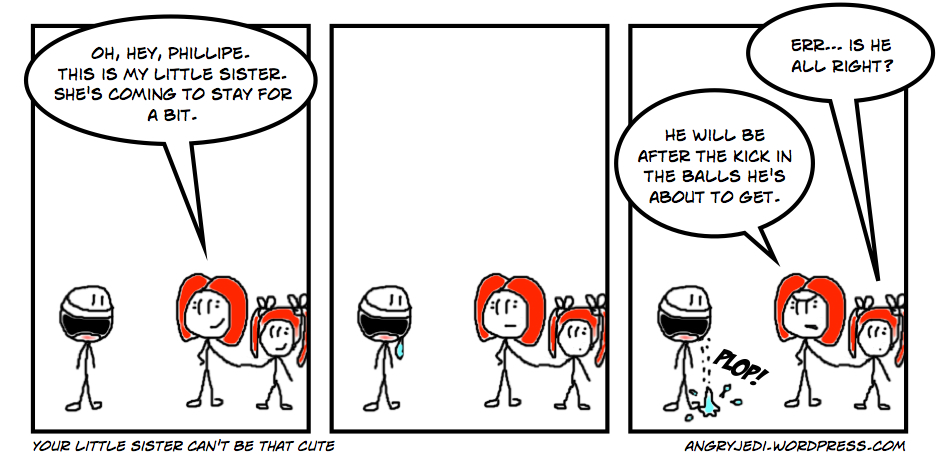
As the series progresses, Kirino learns to make friends who are into her secret hobby, and comes to trust them. Kyosuke watches with some degree of pride as he sees his little sister starting to open up and be herself, but it isn't an easy ride — particularly when her two worlds start to collide as the siblings' parents and Kirino's non-otaku friends start to find out what has been going on. Kirino faces constant judgement and scorn from people who look down upon her hobby, and has a habit of becoming defensive and lying as her first reaction, often leaving Kyosuke to take the fall — something which he usually resigns himself to without complaining, even when it involves (as it frequently does) him being kicked in the testicles.

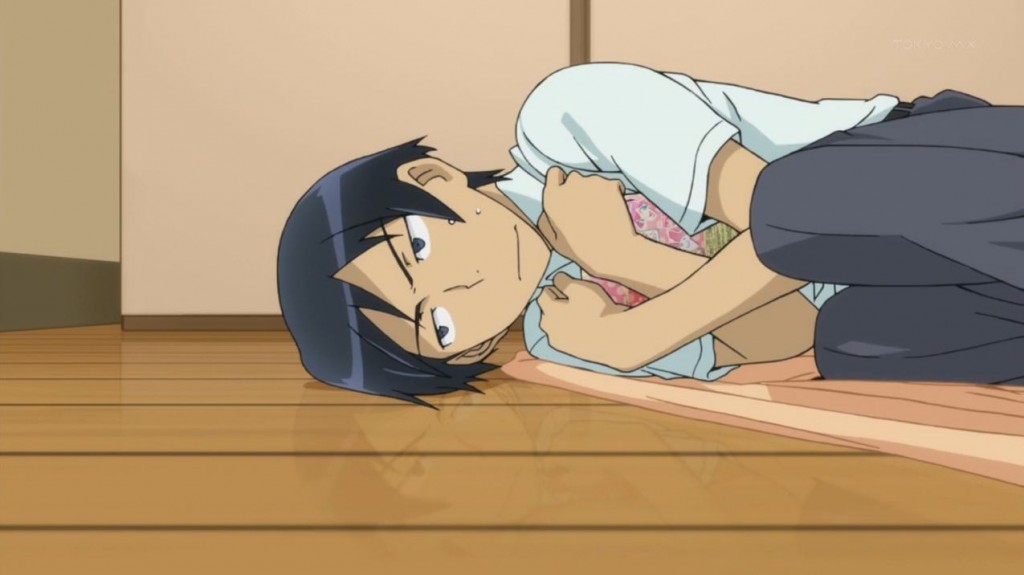
The face of a defeated man.

When it comes down to it, though, Kirino will often (eventually) stand up for herself and say what she believes in; she's passionate about her hobby, and over time begins to accept the fact that there will always be people out there who will judge her for it — often without knowing anything about it. Kyosuke, meanwhile, comes to understand his little sister a bit better, and also becomes something of a focal point for all her friends and acquaintances when various problems arise.

The nice thing about Oreimo that I've seen so far is that, a little like the excellent series Welcome to the NHK, it deals with subject matter that divides opinion but does so without being judgemental or preachy about it. You don't get the impression from watching the show that it specifically wants you to think that being an otaku is either okay or that it is vile and shameful; it simply presents things the way they are, places a strong focus on the concepts of people's "public" and "private" faces, and others' reactions to those faces. Far from being wacky, silly fun times, it's actually proven so far to be an interesting, very human story that doesn't hide behind moe shenanigans despite having, as the title suggests, a super-cute female lead. (It could probably do without some of the occasional curiously-angled shots of said super-cute female lead's bum, admittedly, but… well, there's not much you can do about that, really.)

Oreimo12-42Anyway. Thus far I've been enjoying it a lot, and am looking forward to seeing how it continues. Further reports will undoubtedly follow.