1104: Tsuntsun, Deredere

Page_1It's funny to think that it was only this time last year that I played Katawa Shoujo, rekindled my love for all things Japanese and got properly "into" the visual novel medium. Over the course of last year, I played a bunch of VNs and took some tentative steps into the world of anime, too, and I haven't really looked back since. I've found a medium (well, several forms of closely-related media, really) that "speaks" to me, and that's always a pleasant feeling, particularly when there is a whole shitload of stuff in that medium for you to explore and discover.

Because it was only last year that I got into all this shit, though, it was only last year that I found out what the word "tsundere" means. I had occasionally heard it mentioned by people I knew were into anime and Japanese games, but I'd never thought to look it up before — perhaps because I assumed it was an obscure, specialist piece of jargon relating to something that I wasn't, at the time, particularly immersed in.

There's a good chance that there are a few of you reading this who have absolutely no fucking idea what I'm talking about right now, so allow me to educate you. Then you can walk away from one of these posts feeling like you've learned something for once. Wouldn't that be nice? Of course it would. Let's go, then.

"Tsundere" is a word primarily (though not exclusively) used in relation to characters in Japanese media (manga, anime, games and everything in between) who run "hot and cold". Tsunderes are usually female, though not always. The word is a portmanteau that combines parts of two different words to describe the two main moods of the character — tsuntsun describes the part of the personality that is aloof and/or irritable or even outright hostile; deredere describes the soft, squishy and adorable lovestruck centre that the abrasive exterior is protecting.

The tsundere is a stock character in a variety of Japanese works, and can pretty much be guaranteed to put in an appearance in any "harem" stories — i.e. those that include a male protagonist and a disparate gaggle of female heroines who flock to him for various reasons that are not always to do with love or sexuality. (Popular anime Sword Art Online has been described by some as a harem work, for example; even though the main focus of the story is on the romantic relationship between protagonist Kirito and female lead Asuna rather than Kirito attempting to knob his way around cyberspace, a number of episodes introduce a female character who is drawn to the protagonist for some reason before disappearing without a trace by the next episode.) They are a character type that is obviously exaggerated for either comic or dramatic effect — sometimes both — and thus it's unlikely that you'd find a real-life tsundere. At least, not one that takes quite the same form as you'd see one in an anime or game.

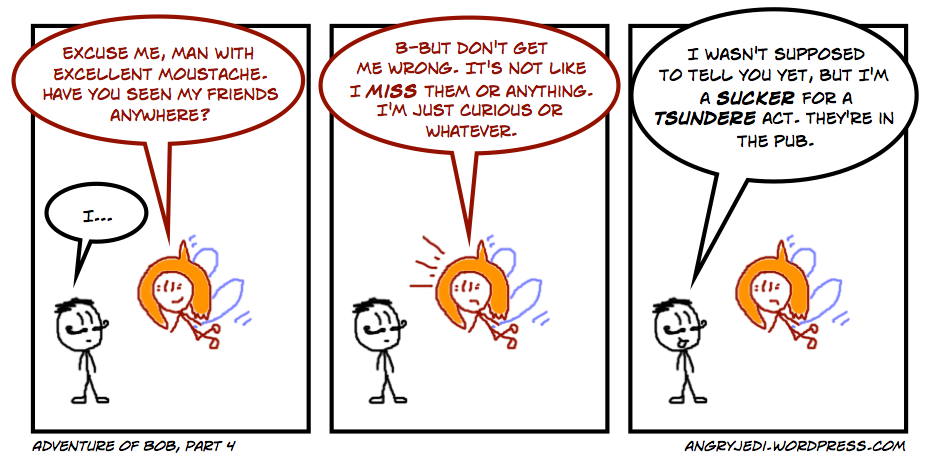
The tsundere can be recognised through a number of different means. Most commonly, it's through the use of the iconic combo of stuttering slightly when around the object of their affections, and the curiously-specific denial of something that belies their deredere side through what initially appears to be tsuntsun behaviour. ("What? I-it's not like I've been thinking about you or anything…!") Other tell-tale signs include excessive use of the word "baka" (idiot, stupid) for the slightest misdemeanour and blushing beet red when confronted with an obviously romantic or sexual situation that they haven't steeled themselves for.

Most tsunderes have tsuntsun as their default behaviour pattern and lapse into deredere when they let their guard down, but characters who represent an inversion of this format exist, too, spending most of their time adorably lovestruck and occasionally lapsing into abrasiveness and hostility if provoked. The latter type can easily be confused with the yandere, which also has deredere as their default behaviour type, but hides proper full-on psychotic mania underneath if the object of their affections either doesn't want them or is taken away from them. (A tell-tale sign that an anime yandere is about to go bonkers, incidentally, is that their eyes go completely blank, lacking the usual "sparkles" seen in the corner of anime eyes. If a character goes like that, you should probably get worried, and you can pretty much guarantee that someone is going to die very soon.)

Yanderes aside, the tsundere's behaviour is usually tolerated and accepted by their friends, and rarely commented on directly — it's just the sort of person they are. The object of their affections usually has to take the brunt of the tsuntsun side, but close friends who want to help the tsundere get closer to the person they obviously like often have to deal with this, too. More often than not, the long-suffering best friend either just shakes it off or is completely oblivious to it, having presumably learned to tune it out a long time ago.

There's something oddly attractive about a tsundere character, which probably explains why it's such a commonly-appearing trope. I couldn't possibly speak for everyone on why this is, but from my own personal perspective, I find the commonly-used "hard-hearted bitch showing a softer side" approach to be an effective one that helps me to sympathise with the characters in the relationship. Reasons that "tsuntsun by default" tsunderes act the way they do vary by story, but one thing is constant — letting that deredere side out is a sign that they're letting down the barriers around themselves and showing another character that they both trust them and care about them. It can be a very touching moment if handled effectively.

Here are a few of my favourite tsunderes. Oh come on, you knew this was coming.

noireNoire (Hyperdimension Neptunia)

Noire, the character who represents Sony and the PlayStation in the Hyperdimension Neptunia series of games, is very obviously a tsundere thanks to her regular use of curiously-specific denials when talking to Neptune in particular. She seems aloof, arrogant and abrasive most of the time, but gradually reveals herself to be someone who just really likes to try and do their best at all times. She obviously likes Neptune, despite what often appears to be open hostility, and has found that her efforts to make the land of Lastation as good as it can be have left her lonely.

President4Irina (My Girlfriend is the President)

Irina Vladimirovna Putina, the Rusian [sic] president in the visual novel My Girlfriend is the President, is a textbook tsundere. Spending most of her time early in the game alternating between yelling at the protagonist Junichiro and twatting him around the head with her slapping fan every time he does something pervy (which is quite often), she eventually shows a softer side and ends up being a positive influence on Jun. Jun also has a positive effect on her; while she manages to mellow him out somewhat, his easygoing nature helps her be less uptight.
Yuru Yuri no Uta Series 07 - Sugiura AyanoAyano (Yuru Yuri)

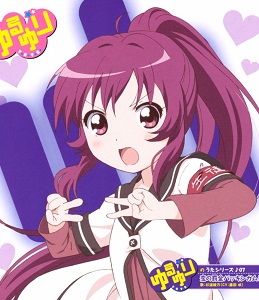
Poor old Ayano is the butt of a bunch of jokes in the slice-of-life anime Yuru Yuri. The feisty redhead is obviously carrying a rather large torch for resident chaotic character Kyoko and is completely unable to express her feelings adequately, instead regularly flying into a blind rage at Kyoko's slightest misdemeanours. Kyoko, being Kyoko, doesn't mind at all, and is oblivious to Ayano's feelings. The only one who is truly aware of Ayano's crush is student council member Chitose, who regularly fantasises about the pair of them, usually resulting in a violent nosebleed.
1052: Kiss, Kiss, Fall in Love

Page_1During November, as you know, I was writing non-stop fiction in my own NaNoWriMo spinoff. This doesn't mean I wasn't doing anything worth talking about in my spare time, however. You may recall that a relatively short while back I well and truly "got into" anime and had some enthusiastic words to say about a number of different series. I thought I'd share my thoughts on one more that I finished at some point in the middle of last month: Ouran High School Host Club.
This was a recommendation from my anime-enthusiast friend Lynette, who has been the source of many good recommendations to date. I wasn't entirely sure what to expect from it, though armed with my relatively limited knowledge of "host club" culture that I'd picked up from playthroughs of Yakuza 1, 2 and (I'm still yet to tackle 4, but I'll get there) I had a general idea.

(For those unfamiliar with this particular quirk of Japanese culture, host/hostess bars are establishments in which patrons can come in and settle down for a pleasant evening's chat with a host/hostess of their choice. Their chosen companion will ply them with drinks and food and attempt to get them to spend as much money as possible, though if Yakuza is to be believed there's every possibility that the host/hostess and their client will strike up a genuine friendship "and maybe more" in the process — good for the people and good for the business, too. It is, it should be said, rather different from prostitution.)

Anyway. Ouran High School Host Club revolves around a group of bored, rich male students at a very exclusive high school (the titular Ouran Academy) who formed their own host club in an attempt to entertain the equally bored, rich female students. The club covers a diverse array of "tastes", ranging from pretty boy Tamaki to the borderline-incestuous twins Hikaru and Kaoru via the… whatever the male equivalent of "loli" is embodied by the childish, cake-loving "Honey".

Enter Haruhi, who is a girl. Haruhi stumbles upon the Host Club's premises — the disused music room — and inadvertently breaks an incredibly valuable vase in the process. She is saddled with a debt that she couldn't possibly repay, so the club agrees that if she joins as a host and entertains the girls of Ouran Academy, they will let her "work off" her debt.

Thing is, certain members of the club initially don't realise that she is a girl, since she first appears dressed in a boy's uniform and sporting a rather boyish short, shaggy haircut. Hilarity, as you might expect, ensues, and the series progresses as Haruhi and the gang get into a series of increasingly silly scrapes, all the while learning new things about each other and their backgrounds. The rich kids of the Host Club learn about Haruhi's poor background, her deceased mother and her cross-dressing father — one of the more memorable characters in anime I've seen recently — while Haruhi learns to come out of her shell a bit, and solidifies her own idea that gender doesn't define her personality.

At heart, Ouran High School Host Club is a very silly show. The characters are heavily exaggerated, and the visual aesthetic is very stylized — everyone has noses that you could cut glass with, for example, and the show isn't afraid to pop up captions to explain various things or even to put big flashing arrows over the top of something that will become important in a few minutes' time. Similarly, the show is a textbook example of anime not being afraid to have characters that defy the laws of physics for comic effect — there's lots of exaggerated facial expressions, black clouds looming around the depressed and angry people suddenly becoming inexplicably huge. The whole thing is presented with an almost childish degree of enthusiasm, and the energy is relentless. It's perhaps for this reason that I actually found it difficult to watch more than one episode at a time, whereas conversely I can and will watch a whole bunch of slower-paced stuff in a single sitting. (I devoured the entire series of AnoHana in one go, for example, but that's a story for another post altogether.)

As well as being silly, though, there's a tender heart beating within. The characters have very real affection for one another and their relationships deepen and blossom as the show progresses. It manages to pull this off without dropping into the realms of cliché, either, except where it is deliberately lampshading romantic clichés — usually through the identical twins duo of Hikaru and Kaoru.

The show is gloriously, gloriously camp, managing to pretty much out-gay both Bayonetta and Space Channel 5 (both of which are games, I know, but they're the yardsticks by which I measure relative campness) but it also knows when to show restraint. There's a time and a place for shenanigans and prancing around, it seems to say, and a time for people to be serious. The good pacing that the show enjoys means that it builds to a very satisfying payoff come the end of the series — and not necessarily in the way you might expect, either. I shan't spoil it for those who are planning to watch it, but suffice to say it's worth sticking it out for the whole run, even if the seemingly-relentless chaos of some episodes feels like it might be a bit much sometimes.

In short, I enjoyed it a lot. It doubtless won't be to everyone's taste — what is? — but I found it a lot of fun. Give it a chance if you're looking for something a little bit different from the norm.

1048: HELLO

Page_1

Hello! I'm back. Yes, it's me. You know, Pete. The guy who runs this blog. I'm not writing in character or being creative any more. Well, I am being creative. Sort of. Just not in quite the same way I spent the last month. It's back to my normal ramblings from now.

It occurs to me every so often that I write an absolute buttload of words every day. Seriously, if we could power the world on words, I could probably power a small city on the number of words I produce each day. I don't have to produce this many words each day, as only a portion of them are for paid employment but, you know, I like it. So I do it in my spare time, too. You probably knew that already, particularly if you've been following this blog for even a fraction of the 1,048 days I've been writing daily nonsense, or if you've been good enough to check out what I've been doing with the rest of the team over at Games Are Evil.

Occasionally I get the urge to write something for a purpose a little bit less amorphous than that of this blog, and consider writing a novel, or a game, or something else with lots of words in. Unless I specifically set myself a target, though, those things can and do fall by the wayside. My hard drive and Google Docs account are filled with half-finished (or barely-started) novels; I have at least a few awesome game intros that I've made, too. (There's also one three hour-long game called The Adventures of Dave Thunder that was lost to a catastrophic computer failure a few years back, which I've never quite forgiven Sony for, even if it was my own fault for not backing the bastard up.)

Recently, a games writer released a 50,000 word ebook on the subject of a single video game. I'm not a big fan of the writer in question, to be honest — and no, there shall be no bitchy blog post explaining why, they just rub me up the wrong way — so I have very little intention of actually reading (let alone purchasing) said book. However, what I have found is that the mere existence of this ebook has given me a bit of a nudge to start on something that I've been considering doing for a while. Said nudge is a result of the ineffable law of Well If They Can Do It I Certainly Can Too combined with the fact that I knocked out over 50,000 words of creative writing over the course of the last month without breaking too much of a sweat. Which is nice.

This is what I'm going to do: I'm going to write a book on the subject of the visual novel medium. Regular readers will know that I'm hugely enamoured with this largely Japanese subgenre of gaming, and you may even check in regularly on my weekly "READ.ME" column on Games Are Evil each Sunday. The visual novel medium has a lot in common with anime, but is very much its own distinct thing. And there are books on anime out there — so why not visual novels?

READ.ME is by far my favourite thing to write each week (scathing reviews of particularly awful mobile apps aside) and thus I figured it's a natural extension to 1) write more about something that I genuinely love and 2) spend some time delving deeper into the background of the medium and its cultural context. Rather than focusing on a single game for the entire book — which is probably possible in many cases, given the depth of their narratives — I have decided to take a "collected essays" approach in which I tackle a selection of different titles, each of which exemplifies a particular theme, narrative style or tone. This gives me the excuse to play a wide variety of different titles as well as write more about the ones that I've already played (and, in some cases, written about) to death. It also means that the complete project can be broken down into smaller, more easily-manageable targets rather than being a single, daunting task.

So yeah. That's the plan. I've already started, having bashed out 2,500 words on Kana Little Sister today (with more to come when I've seen its other endings) and lined up several other chapters while their subject matter is fresh in my mind. We'll see how it goes. To Scrivener!

1010: Connected Hearts

I finished watching another new anime tonight specifically so I could write about it for today's post. Oh, don't worry (as if you were) — I was enjoying it a lot, so I was more than happy to zip through it and see how it concluded.

Kokoro Connect is its name, and it's an interesting one. It's also not at all what it makes itself out to be initially, which I can't help but feel is perhaps not to its benefit. But that aside, it's worth a watch, and here's why.

The elevator pitch of Kokoro Connect is as follows: five high school students have escaped their school's You Must Join A Club rule by establishing the Student Cultural Society, or StuCS for short. Ostensibly, StuCS is responsible for putting together a school newspaper, but in actuality they spend most of their time hanging out in their club room in relative privacy, talking to one another.

Everything is shaken up one morning when two of the group show up visibly shaken by what appeared to be a strange dream they both had at the same time. For half an hour, they believe that they had switched personalities, with their respective consciousnesses swapping places and then shooting back with no explanation. The others are understandably skeptical of this bizarre story… until it happens again while everyone is watching. Thus begins a rather peculiar tale.

That's how Kokoro Connect sells itself, anyway. The reality is, in fact, much more interesting, as while the whole "body-swapping thing" is cool, it's a difficult concept to sustain over a long period. Consequently, the supernatural "hook" of Kokoro Connect actually ends up taking a back-seat to the real reason to watch it — its five characters and their growth over the course of the show's 13 episodes.

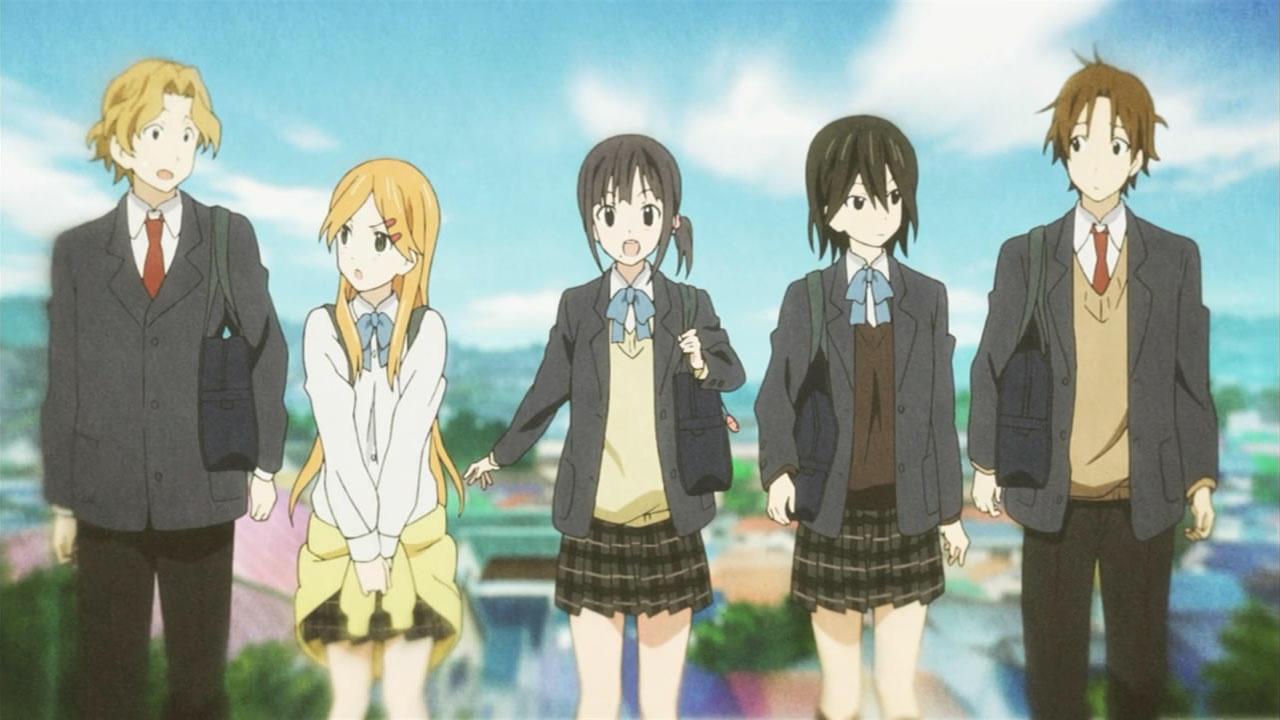
Kokoro Connect's cast is a relatively diverse one, initially appearing to cover a selection of predictable tropes. We have Taichi, who is the relatively "blank slate" male character; Aoki, who is the jocular "best friend" character; Yui, who looks (presumably unintentionally) identical to Asuna from Sword Art Online and is the "quiet girl"; Iori, who is the "loud, immature girl"; and Himeko, who is the "cold, aloof, mature girl".
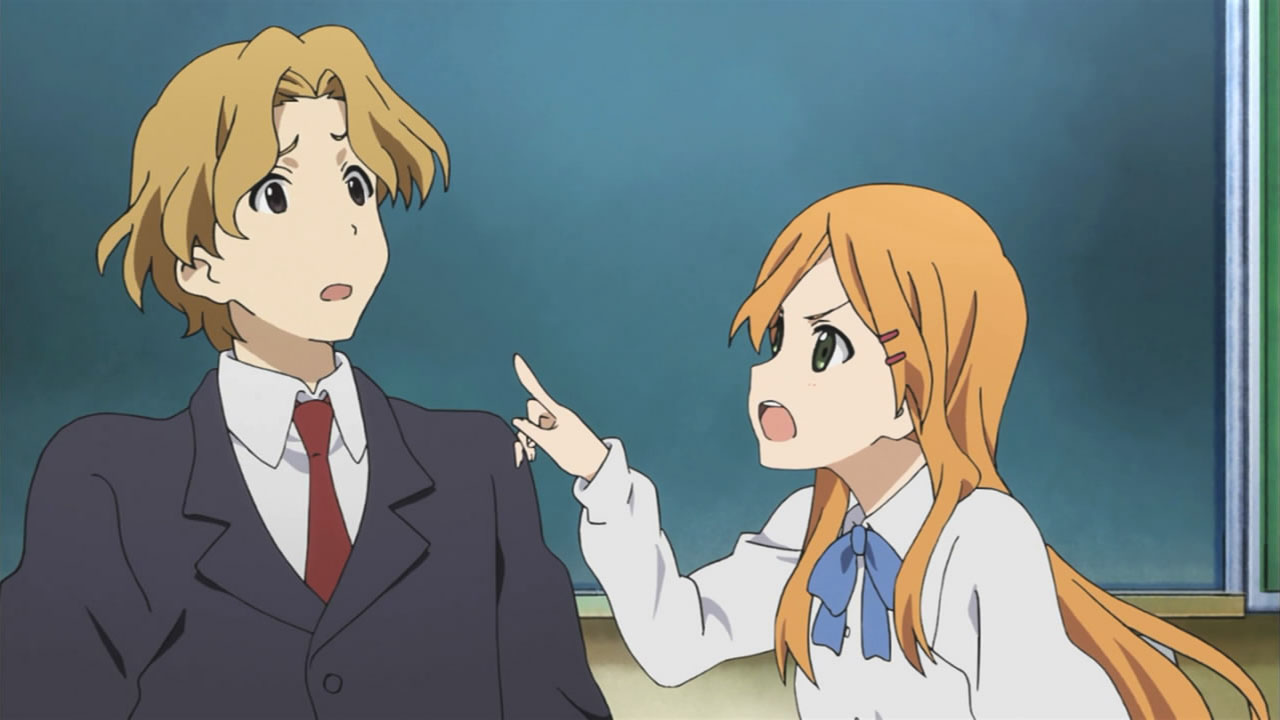
As you might expect from modern anime, however, none of these characters are quite what they appear to be at first glance. I shall resist spoiling exactly what's up with each of them — because there is something "up" with all of them — but suffice to say that they all have plenty of hidden depth that is explored throughout the course of the series. The various supernatural happenings (which eventually extend beyond body-swapping) serve as a trigger for each of them to confront their various issues and discover their "true" selves — sometimes independently, but more often than not with the help of their friends.

Kokoro Connect is, at its core, a show about friendship and the way people can and/or should help each other through hardships. A key theme is whether or not you should always help someone when they're hurting, or whether or not it would be more beneficial to let them work things out themselves in the long run. A question that is asked explicitly partway through the run, in fact, is whether or not you should hide from your problems (both individual and collective) or face them head-on, knowing full well that doing so will probably hurt both you and those around you.

It's actually quite Persona-ish in many ways — specifically, it's a lot like Persona 4, which is about people accepting themselves, including the parts they might not want to acknowledge. The supernatural aspect of Kokoro Connect is significantly toned down compared to Persona 4 and is never really adequately explained — a situation which may well be resolved in the four new episodes set to be released next year — but it doesn't really matter. If it wasn't there at all, these would still be interesting characters and interesting stories. (This does, of course, raise the question of why it's there in the first place, but it does serve as a good catalyst for a number of subplots throughout the show's run.)

If I had to critique the show specifically, I'd say that a couple of the characters' "issues" are resolved a little too quickly and I would have liked to see some more time spent exploring them, but to be fair, no-one ever comes out and suggests that they've been magically "fixed" — the resolution of said issues tends to be of the "I think I know how I might be able to deal with this now" variety rather than anyone having a "magic bullet" to administer.

This aside, it's a great watch with some very likeable characters who make up a good ensemble cast. There's a nice balance of light-hearted comedy alongside the fairly serious issues the story tackles, and it isn't afraid to depict high school kids like how high school kids actually are rather than the squeaky-clean paragons of virtue they're sometimes portrayed as. (There's a particularly toe-curling exchange of "secrets" between Taichi and Himeko at one point, but I'll spare you the details.) This latter aspect is another thing that the Persona series was particularly good at, and it's a big draw here, too.

All round, then, if you like character-driven stories that tackle personal issues with just a dash of the supernatural, then you should give it a shot. If you can get Crunchyroll where you are, you can do just that right here.

1009: Some Favourite Characters

One of the things I always find most memorable about any story I experience, be it a book, TV show, movie, anime or game, is the characters. If the characters aren't interesting, chances are I'm not going to get hooked in. It's the reason I usually cite as to why I loved the open-world adventuring of Xenoblade Chronicles but find Bethesda role-playing games and most MMOs rather tiresome after a while, but it applies to pretty much any medium.

As such, I would like to present to you a randomly-chosen selection of five of my favourite characters that have popped into my head immediately upon attempting to think of my favourite characters. If that makes sense. I make no apologies for the fact that some or all of these are likely to be big-eyed anime or computer game people.

Grace (Gabriel Knight)

Most people cite Tim Curry's memorable portrayal of the lewd, womanising bookshop owner in Gabriel Knight: Sins of the Fathers as the highlight of that game, but the unsung heroine of the piece is most definitely Grace Nakamura, his long-suffering assistant.

Grace is a realistic female character in that she's not there to be eye candy, she's not there to be a useless sidekick hanging on everything the hero does and she actually has a personality. She doesn't take any shit from Gabriel, and you'd better believe that he regularly gives her shit — his always-rejected advances are a highlight of their interactions, and yet it's clear that the pair of them do, in fact, care deeply for one another, otherwise Grace would have been out the door long ago.

The exact nature of Grace and Gabriel's relationship, at least in the first game, is kept deliberately rather ambiguous. Grace often acts as something of a mother figure towards Gabriel, though it's never quite clear if she actually wants to "tame" him or simply sand down a few of his rough edges. Gabriel is certainly receptive to the things she says and appreciates the hard work she puts in for him — and yet the clear sexual tension between the two of them goes unresolved. Proof that you can have two characters of the opposite sex to one another without them ending up in a predictable love scene.

Angel (Buffy, Angel)

Buffy the Vampire Slayer and its spin-off series Angel remain two of my favourite TV shows of all time. David Boreanaz's brooding vampire Angel appears in both, but really comes into his own when he gets his own series.

It would have been easy for Whedon and the gang to leave Angel as your stereotypical brooding vampire, haunted by his past and trying to make amends for deeds that can never be forgiven. And indeed for many of his appearances early in Buffy, he's little more than that, providing a convenient "forbidden love" interest for Buffy while allowing the show to explore some traditional vampire themes.

In Angel, however, he cuts loose and we get to see him for who he really is. Sure, he broods and spends a lot of time sitting in the dark — something that is regularly commented upon by his companions — but he also does a fine line in completely deadpan one-liners.

Also, this.

Incidentally, a comment on that YouTube video reads thus: "I always thought Angel was a ponce in the first three season of Buffy…then He moved to L.A. L.A. changes people."

Damn right.

Toshino Kyouko (Yuru Yuri)

If there's one reason to watch Yuru Yuri, which I believe I have already extolled the virtues of on several occasions, it is Toshino Kyoko.

Kyoko, as you can probably tell from the image above, does not give a shit what people think of her, and she's immensely entertaining as a result. She's often the instigator of the various scrapes the group gets into, and her hyperactivity is a big part of what gives the show so much energy. Part of her appeal comes from the fact that her blonde-haired, blue-eyed appearance sets her up to be "the pretty one" and she then subverts stereotypical expectations completely with her wild and crazy behaviour.

At the same time, though, she's a dedicated friend and companion, and the whole "possibly unrequited love" thing going on between her and the huggably tsundere student council vice president Ayano (whom I also considered including on this list, but settled on making her my Facebook avatar instead) is another big draw for those who enjoy seeing blushing anime girls simpering at one another and then denying their feelings vehemently. I-It's not like Ayano wants to spend every waking moment with Kyoko or anything, after all! Idiot!

Seiko (Corpse Party)

Seiko was one of my favourite characters from Corpse Party, a game with an incredibly well-defined and interesting cast all round. The best thing about Seiko, though, was how self-consciously "not girly" she was. She's open, honest, brash, crass and, a bit like Kyoko, does not give a damn what people think of her. At the same time, she's cheerful and does her best to keep the people around her in high spirits, even as they are trapped in a horrifying, terrifying situation from which there appears to be no escape.

It becomes clear after only spending a short amount of time with her in the game that she has a number of deep bonds with her friends — particularly with the character Naomi, for whom it's rather strongly implied that she's harbouring romantic and/or sexual feelings.

To say too much more about Seiko would probably be to spoil Corpse Party more than I'm willing to, but suffice to say that she's a definite highlight of the game. And, oh look! Corpse Party is half-price on the PlayStation Store (PSP and Vita) right now. You should go and buy it if you have a Sony handheld, otherwise I'm not sure we can be friends any more.

Polgara (Belgariad, Malloreon)

David Eddings' Belgariad and Malloreon series are rather traditional pulp fantasy novels in many ways, but a few aspects of them cause me to remember them fondly — and I've even re-read the whole set of books several times, which is not something I normally do.

One of these aspects is Polgara the sorceress. For those unfamiliar with Eddings' epics, they follow a relatively traditional pattern in which an unassuming young farmhand named Garion gradually gathers a party of various ne'er-do-wells and, through various combinations of circumstances — spoiler! — becomes incredibly powerful, battles against an evil god and wins.

One of Garion's constant companions throughout the entire series is his "Aunt Pol," who has been a constant presence in his life since childhood. It transpires that "Pol" is actually Polgara, a four thousand year old sorceress and daughter of Belgarath, sorcerer of legend and he who recovered the mystical artifact The Orb of Aldur from — look, let's just say he's Kind of a Big Deal, all right?

The reason Polgara is interesting is not because she's a kick-ass sorceress, though, it's the fact that she's a very well fleshed-out character with a hell of a lot of hidden depth. Garion learning the truth behind her heritage in the Belgariad is just the tip of the iceberg — Eddings went on to publish two additional books known as Belgarath the Sorcerer and Polgara the Sorceress which explained the ancient magicians' history in exhaustive detail, giving the entire world in which the two series were set an extremely strong feeling of being a "real" — or at least believable — place. Polgara and Belgarath's constant presence throughout the world's history give you something to latch on to as millenia tick by in the pages of the books — and yet both of them remain entertainingly "human" despite their obvious… non-humanness.

____

That was fun. I'll do this again sometimes soon. I won't ask what your favourite characters are, because no-one ever replies when I end a blog post with a question. I'll just say good night and leave it at that!


1005: Easygoing Lilies

Well, as I suspected might happen when I wrote my first post on the subject of Yuru YuriI appear to have become mildly addicted to the thoroughly silly adventures of the Amusement Club.

For those who missed aforementioned post and are too lazy to click on the link and see what I'm talking about, Yuru Yuri is a show about lesbian schoolgirls. No, not like that. That is basically what it is, though. (A show about lesbian schoolgirls, not porn.) It's a show that features an all-girl cast where homosexual feelings towards one another are the norm rather than the exception — rather refreshingly, the show regards same-sex feelings of attraction and love as just something that happens rather than something that is in any way "shocking" or out of the ordinary. It's not a show that's trying to push a particular agenda on its viewers, in short — certain members of the cast feel certain ways towards one another, and they just happen to be girls. Which is cool with me.

After a little while, this simply becomes something you accept in the world of Yuru Yuri, and you are then able to focus on the real highlight of the show — the characters. This is not a show where anything earth-shatteringly important happens, you see; no-one is struggling with Big Issues, no-one is feeling a sense of guilt over their sexuality, no-one suffers anything other than the most temporary setbacks (and then usually only for laughs) and no-one gets hurt in anything more than the most ridiculous slapstick fashion — we're in the territory of comedy "bumps" popping out of people's heads here, which is something I don't think I've seen since I was a kid.

But no; there are no Big Issues to come to terms with, which lets the characters shine simply by being themselves. It's an excellent and diverse cast made up of an interesting mix of established tropes and characters who subvert said tropes nicely.

Chinatsu, Akari, Yui and Kyoko, the four girls who make up the school's "Amusement Club" pictured above, are the main stars, with Akari ostensibly being the "protagonist". Akari's main distinguishing feature is that there is absolutely nothing remarkable about her whatsoever, however, which tends to lead her being the butt of many episodes' jokes as she gets left behind entirely or, in some cases, ends up turning completely invisible due to her lack of presence. She is endearing and entertaining in her own right, however, and despite the show's joking insistence that she is not worth focusing on, she's sweet and cute. She also has the most terrifyingly creepy siscon older sister I've ever seen, too — in one particularly hilarious and memorable (if weird as fuck) scene, said sister settles in for a comfortable evening home alone, clutching her Akari body pillow which she's dressed in one of Akari's uniforms, and wearing a pair of Akari's knickers on her head. It's a gloriously uncomfortable scene, particularly when Akari comes home early and her sister only just manages to hide the evidence of her misdeeds.

Yui, meanwhile, is "the sensible one", and a bit of a tomboy. She's the sort of character who rarely smiles and is quite softly-spoken. In many ways, she's the mother figure of the group, as she lives by herself and puts up with the others — particularly Kyoko — invading her home and demanding food. Yui sometimes seems to be a bit of a "blank slate", but occasionally we get a glimpse of her humanity through her getting into a video game or playing with her younger relative Mari. Yui is also particularly skilled in dealing with Kyoko, regularly shutting down her often-incoherent hyperactive rants with just a single word.

Chinatsu is the exact opposite of Yui. A lively, energetic young girl with bright pink frizzy hair in bunches, Chinatsu is carrying a rather large torch for Yui and will do anything to try and get closer to her. While she is initially presented as a sweet, innocent, shy girl, it becomes very apparent very quickly that Chinatsu can be aggressive, grumpy, mean and a bit of a bully at times — though she's not particularly good at any of those things, often leaving her looking rather ridiculous. She's also terrible at drawing, creating pictures that look like something out of a particularly unpleasant horror movie.

Kyoko is the clear highlight of the show, however. Kyoko does not give a shit what anyone thinks and just does what she feels like. She clearly has some sort of attention-deficit disorder, and is usually hyperactive. Despite this, however, she is fiercely loyal to her friends and clearly values her time with the group. She's also caring and considerate, and is also the most obviously "gifted" of the group — not only is she a talented (and respected) doujinshi manga artist, but she's also able to score full marks on almost every test she takes with minimum effort, much to the chagrin of her rival Ayano. She's also mildly obsessed with Chinatsu's unbearable cuteness, and takes every opportunity to find an excuse to make her cosplay as "Witch Girl Mirakurun", to whom Chinatsu bears an uncanny resemblance even when out of costume.

Although these four make up the main cast, the secondary characters are all interesting and entertaining too, particularly in the second season, where they each get much more of a chance to shine. We have the aforementioned tsundere student council vice-president Ayano, who likes Kyoko but would never admit it; her best friend Chitose, who has a habit of getting nosebleeds as a result of perverted thoughts about Ayano and Kyoko getting together every time she takes her glasses off — and also goes on a kissing rampage any time she ingests chocolate; and the ever-entertaining duo of rivals Sakurako and Himawari who are absolute polar opposites in almost every way but clearly care deeply for one another. Sakurako is extremely childish, aggressive, demanding, hot-headed and flat-chested; Himawari is mature, motherly, firm but fair and in possession of a fine pair of breasts which Sakurako is quite understandably very jealous of.

The way these girls interact with one another and play together is the reason to watch Yuru Yuri. You can get to the end of an episode and realise that absolutely nothing happened beyond "some girls hung out together" — but that despite this, you still had an entertaining experience. It's one of those experiences where you feel like you're "friends" with the characters and that you're getting the opportunity to just chill out and hang around with them. It's not a show that's going to slap you around the face with The Feels on a regular basis, nor does it ever claim it's going to be, but for something that's just plain fun to watch, I think it's going to be hard to beat.

1001: Yuriyurarararayuruyuri

Hello! And welcome to the first post-1,000 post on this blog. I hope you like the "New Game+" redesign I've done. I figured it was worth doing something noticeable to highlight my achievement. And now I'll stop blowing my own trumpet. Back to business as usual.

I've been continuing my journey through the strange and bizarre world of anime recently. I finished watching The World God Only Knows a while back, so I was looking for something new to explore. I have a few DVDs of recommendations from my friend Lynette on the way, but I was interested in trying something a little bit different while I waited for them to arrive.

So it was that while browsing Crunchyroll I came across Yuru Yuri, an anime that I'd seen mentioned by a few people around the place. I didn't really know anything about it save for the fact that "yuri" is a term often used to refer to "girls love" or, to be less euphemistic about it, material with lesbian themes. I had no idea whether Yuru Yuri's title actually had anything to do with yuri as a genre, or whether it was just part of the name. "Yuri", after all, is also a fairly common Japanese name that means "lily".

As it turns out, Yuru Yuri (literally "easygoing yuri") is most certainly a yuri work, though more in a sense that it focuses on close personal relationships between a group of girls rather than having sexual overtones at its core.

Yuru Yuri centers around a group of middle-school girls who start an "amusement club" in the defunct Tea Club's premises at their school. They essentially use this as an excuse to goof off and avoid doing anything that would actually require effort, and over the course of the series, their relationships with one another (and with a small cast of supporting characters outside the main four) grow and change — in some cases into love; in others into fantasies about one another that will (probably) never be fulfilled; in others still into close friendship. The show doesn't make a big deal of the fact that seemingly almost everyone at the all-girls school they attend is homosexual; instead, it's simply treated as the way things are. People can like each other, regardless of gender, and this can lead to exactly the same sort of awkwardness and confused feelings as in heterosexual relationships. Just like real life! Who'd have thought it.

All this perhaps makes Yuru Yuri sound a bit more serious than it actually is. The girls' relationships and feelings for one another are an important part of the show, sure, but for the most part it's very much a "slice of life" anime in which the cast get into various amusing scrapes that are usually resolved by the end of the episode. It's very lightweight and cheerful in tone throughout, and the characters are all very distinctive and exaggerated in terms of their appearances, personalities and iconic behaviours — though the show isn't above subverting its own tropes at times if the opportunity to play something for laughs exists.

One amusing aspect of the show is that Akari, the character set up to be the series' "protagonist" in the first episode, gets some fairly harsh treatment throughout. Not necessarily in terms of the things that actually happen to her, mind — this isn't a show that does nasty things to its characters — but in the fact that more often than not an episode ends up focusing on the other characters to her exclusion. On more than one occasion she gets sidelined in favour of seemingly incidental plotlines, and in some episodes she's not even present at all. This particular aspect of the show is lampshaded continually, with the "next episode" previews often consisting of the characters arguing over who is actually the protagonist, regular references to Akari's lack of presence (often represented by her literally turning invisible) and the pre-credits "Yuru Yuri is starting!" sequence (hosted by Akari) getting increasingly ridiculous as the series progresses. It's a fun commentary on the "blank slate" nature of a lot of anime protagonists.

There are also plenty of silly things that happen in almost every episode, too. For example, Chitose, one of the supporting cast members, is obsessed with her best friend Ayano the student council vice-president getting together with Kyouko, one of the main four cast members. Every time Chitose takes her glasses off, she "tunes out" of reality because she can't see and ends up fantasising about what Ayano and Kyouko would get up to if they ever admitted their feelings to one another. These fantasies are usually rather suggestive, but always stop before anything actually happens, usually because Chitose has a near-fatal nosebleed as a result of her pervy thoughts.

It's a strange show, to be sure, and an acquired taste. It's one of those things where nothing of any particular note happens in any episode, but the comfortable familiarity of the characters and the gentle sense of slightly suggestive humour that pervades it gives it a very endearing feel, assuming you can stomach its unrelenting moe cuteness. The whole cast — main and supporting — is likable and distinctive, and it's just a very pleasant watch if you don't want to have to concentrate too hard or be bombarded with The Feels at every opportunity.

You can watch Yuru Yuri on Crunchyroll.

#oneaday Day 999: Appeal Elements

I think I might have nailed down one of the big reasons that Japanese games and anime appeal to me quite so much. It's actually a relatively obvious conclusion, now that I think about it, but watching several different types of anime and playing several different types of Japanese game recently has pretty much confirmed what I suspected.

The thing I find most appealing about these forms of media is that they consciously and obviously divorce themselves from reality while retaining just enough that is relatable to make it still feel "relevant" to the viewer. I'm not just talking about the obviously outlandish storylines of titles like JRPGs and My Girlfriend is the President here, I'm talking about the heavily stylised way in which characters are represented, emotions are depicted visually and how character traits are often exaggerated to make individual cast members obviously distinctive from one another.

As I gradually get deeper in to the world of anime in particular, a lot of conventions are starting to make themselves apparent. One of the most obvious breaks from reality is the use of "emoticons" to depict how characters are feeling. (There may be a proper name for them, but I'm not sure what it is, if so.) Things like the throbbing red "vein" when someone's angry; the physically-impossible shadow being cast over someone's face when they're disappointed or scared; characters who literally catch fire or become engulfed in dark mists when they're feeling particularly strongly about something; the fact that anyone having pervy thoughts immediately gets a nosebleed. They're crazy and completely physically implausible, of course, but they create a handy visual shorthand for emotional reactions that might be otherwise difficult to depict in the relatively simplistic imagery of animation. For as much as anime characters (particularly of the moe variety) are designed to elicit emotional responses from the viewer, there's only so much you can do when you're not working with a real person who doesn't have all those muscles in their face to work with.

Actually, that's not true at all — when you're dealing with a drawing of someone, you can do absolutely anything with them, even things that are physically impossibleWhat you can't really do quite so easily, though, is show subtle nuances of emotion, which may account for the fact that an awful lot of anime features not only heavily-exaggerated characters, but also strongly-exaggerated emotional responses to situations too. Everything from the embarrassed "arm-flap" of a teenage girl having her crush revealed to a heroic protagonist running towards his rival engulfed in flames — these exaggerated, symbolic responses make it abundantly clear to the viewer what these characters are thinking and feeling.

At the same time, as I said at the start, they divorce the work from reality. They make a statement — this is not real — and encourage the viewer to suspend their disbelief. And that, for me, is one of the more appealing things about this type of media. I indulge in video games and watching anime as a means of escaping from the doldrums of everyday life which is, let's face it, rather tedious and dull at the best of times. At the same time, though, I like to maintain a connection to something relatable — usually characters — and I've found that anime and Japanese games have often provided a good balance between those two considerations for my tastes.

Obviously I don't expect everyone to agree with me — it'd be easy to see anime's exaggerated reactions as overly-comic, silly or childish, for example, sometimes making light of serious situations — but it works for me. Perhaps I just like having emotional responses clearly telegraphed to me rather than being expected to read the often-inscrutable faces of real human beings.

As a vaguely-related contrast to this, we went to see the Lion King stage show last night in Bristol. I did not enjoy it that much, and while I was sitting there a bit bored I found myself wondering exactly why I could suspend my disbelief for an anime about schoolgirls who have perverted fantasies about their classmates (and subsequent nosebleeds) every time they take their glasses off, but not for a bunch of people dressed as savannah animals leaping and cavorting around on stage. I found this a particularly interesting question to ponder given that I normally have a lot of patience for musicals.

The conclusion I came to is somewhat difficult to describe, but it's largely the fact that I found The Lion King difficult to relate to. I enjoyed the original Disney movie, but the stage show focused, for me, far too much on visual spectacle rather than making the characters relatable in any way. I didn't give a toss about young Simba (who was not portrayed particularly well by the child actor, which didn't help) and was painfully aware that these were just people wearing masks and weird costumes throughout. I couldn't suspend my disbelief and think of them as their characters. It went too far off the edge of reality and deep into the realm of "this is pretentious arty wank" for me, not helped by the amount of frankly unnecessary prancing around from certain members of the cast.

I was somewhat in the minority, though, as the show got a standing ovation at the end. Oh well. This certainly isn't the first time something with mainstream popularity has left me somewhat cold, as this blog will attest on a number of occasions!

#oneaday Day 995: Cultural Victory

Can you have too much culture? Can the sum of human creative endeavours add up to too much for someone to take in?

Well, first of all, those are two different questions. The answer to the second one, at least, is "yes"; the former? I'm not so sure.

We're already at a point where there is so much Stuff in the world it's impossible to keep on top of it all. Whatever media you're into, be it books, movies, TV shows, music or games, there's enough Stuff out there to keep you entertained probably for the rest of your life in just one of those formats, let alone if you, like most people, spread your time between several. Even if you spend your time focusing entirely on one genre within a single medium, you'll never get to the bottom of the pile. You'll never "finish" culture. You'll never see everything there is to see.

Depending on your outlook, this is either a fantastic thing or incredibly depressing news. For many, there's a degree of "shame" over not having caught up on things that are supposedly "canonical" or "essential" for everyone to have read/seen/played/whatever. The very term "pile of shame" (from which the Squadron of Shame takes its name) is used to refer to one's backlog of entertainment that has been purchased but not consumed — or, in some cases, the definition is stretched a little to include Stuff that the owner of said pile intends to consume at some point in the future, but perhaps hasn't quite got around to just yet.

With books, it's fine. Books are passed down from generation to generation; republished and republished. Today, we can keep a book alive forever by converting it to a digital format and scattering it to the four corners of the Internet. Sure, you lose some of the joy of turning paper pages and that distinctive musty smell they have, but at least the important bit — that's the work printed on those pages, lest you forget — is immortalised. You can read it on your computer; on your tablet device; on your e-reader; on your phone. You can annotate it and share your thoughts with other people around the world in an instant. Books are just fine.

Music, too, has proven itself to be pretty timeless over the years — for the most part, anyway. Throughout history there has been plenty of "disposable" music, but the true greats endure for years. Look how long the works of Bach and Mozart have lasted — people are still listening to, performing and studying these pieces hundreds of years after they were first composed. In more recent years, look at how the music of artists such as Elvis Presley and the Beatles is still interesting and relevant today. In very recent years… well, it remains to be seen which artists (if any) will leave a lasting legacy on culture, but there will almost certainly be some. (And if there's any justice, it won't be anyone who has ever won or been involved with The X-Factor.)

Movies, too, have become increasingly timeless with the improvements in technology over the years. While once a movie only lasted as long as the medium on which it was physically printed, now, like books, we can archive and keep movies forever. Sure, some moviemaking techniques now look antiquated and are unpalatable to modern audiences, but those truly interested in the full history of the medium can trawl back as far as they wish and see how it has developed.

Games, though, are arguably a bit more tricky, as they have an inherent "expiry date" due to the numerous proprietary technologies involved. While emulation technology is getting better all the time, it's still not perfect, and the legal grey areas surrounding it make it something that some people prefer to shy away from altogether. When you consider "PC" games, too, there's even titles that are ostensibly on the same platform that will no longer run on more modern technology. Fortunately, there are places like GOG.com who aim to keep these titles alive for modern audiences, but eventually even their remastered, tweaked versions will "expire" as technology makes the next big leap forward. What happens when computers become wearable and we don't use TVs any more? Will we still be able to play classic titles designed for the flat screen?

With all this, it's easy to wonder how you can possibly get through all those things that you're "supposed" to watch/read/see. The answer is surprisingly simple: don't. Accept the fact that you're never going to read Great Expectations; you're never going to see Citizen Kane; you're never going to listen to anything by The Smiths; you're never going to get caught up on the Assassin's Creed series. Cherry-pick the stuff you're interested in, finish what you start, and don't feel obliged to jump in to things just because they're brand new and everyone is talking about them right now. Get to them when you have time to appreciate them rather than rushing through them in the ultimately futile attempt to feel "relevant".

Crucially, enjoy (or at least appreciate) the culture you consume, whatever medium it's in. Your tastes are your own, and no-one has the right to try and change them. People can share their own opinions, sure, and these may help sway your thoughts one way or the other, but ultimately your feelings about the things you like and dislike are entirely up to you. There's no "correct" opinion; no gold standard of cultural awareness you need to aspire to; no "checklist" to complete. The sooner you recognise this fact, the sooner you can get on with working your way through that "pile of shame" — because there's some great stuff in there that you haven't discovered yet. And the stuff that is shiny and new right now will still be here in a few years time.

Take your time. Enjoy it. It's the least you can do for the people who have invested their time, money, blood, sweat and tears into entertaining you.


#oneaday Day 989: Blackout

I was all set to write something profound tonight, then the Internet died and I'm relegated to blogging from my phone.

All right, I didn't have anything hugely profound to say and even if I did I could clearly still say it from my phone, but the Internet has gone down, which is, as everyone thoroughly immersed in 21st century living knows, incredibly annoying.

Given its prevalence in our everyday lives, it's very easy to forget what life without the Internet was like. Something as simple as checking the news or finding out what time something was on TV relied on you having… oh, it's back. I'll return when I finish watching this episode of The World God Only Knows. Ja ne!

… … … …

20 minutes later…

There we are, that's better.

Shit, now there's pressure on me to write something meaningful. Umm…

Nope, I got nothing. And fuck all that Internet talk. I've written that exact same post at least five or six times already in the last 989 days.

I finished watching Welcome to the NHK today. The last few episodes were major-league Feels territory. It was a fascinating show, all-told, that I may write about in more detail at some point in the near future. What I particularly liked was that it wasn't particularly easy to pigeon-hole into a specific category of genre. It had elements of comedy, drama, romance, surrealism and all manner of other stuff too. On the whole it was quite an emotional experience for me — I'm not sure how much it would resonate with someone who couldn't relate to some of the issues therein, but I certainly found it to be an excellent, worthwhile, enjoyable and moving watch.

Tonight, as I mentioned earlier, I've started watching The World God Only Knows after recommendations from several people. I'll blog in more detail about this when I've watched more than two episodes, but it seems to be highly entertaining so far.

The premise, for the unfamiliar, is that dating sim addict Keima inadvertently enters into a contract with the unfeasibly cute and broom-wielding demon Elsie to help round up "Loose Souls", runaway spirits that hide themselves inside the hearts of girls. Keima is thus tasked with making said girls fall in love with him, thus releasing the Loose Soul for Elsie to catch. Keima, sadly, is more than a little socially awkward, having spent all his time dating 2D girls rather than interacting with real people. However, since reneging on the contract means that both he and Elsie will be decapitated by the magical collars placed upon them, he has no choice but to go along with the outlandish plan. Consequently, he attempts to use his knowledge of dating sim tropes to figure out girls in the real world and, of course, Hilarity Ensues.

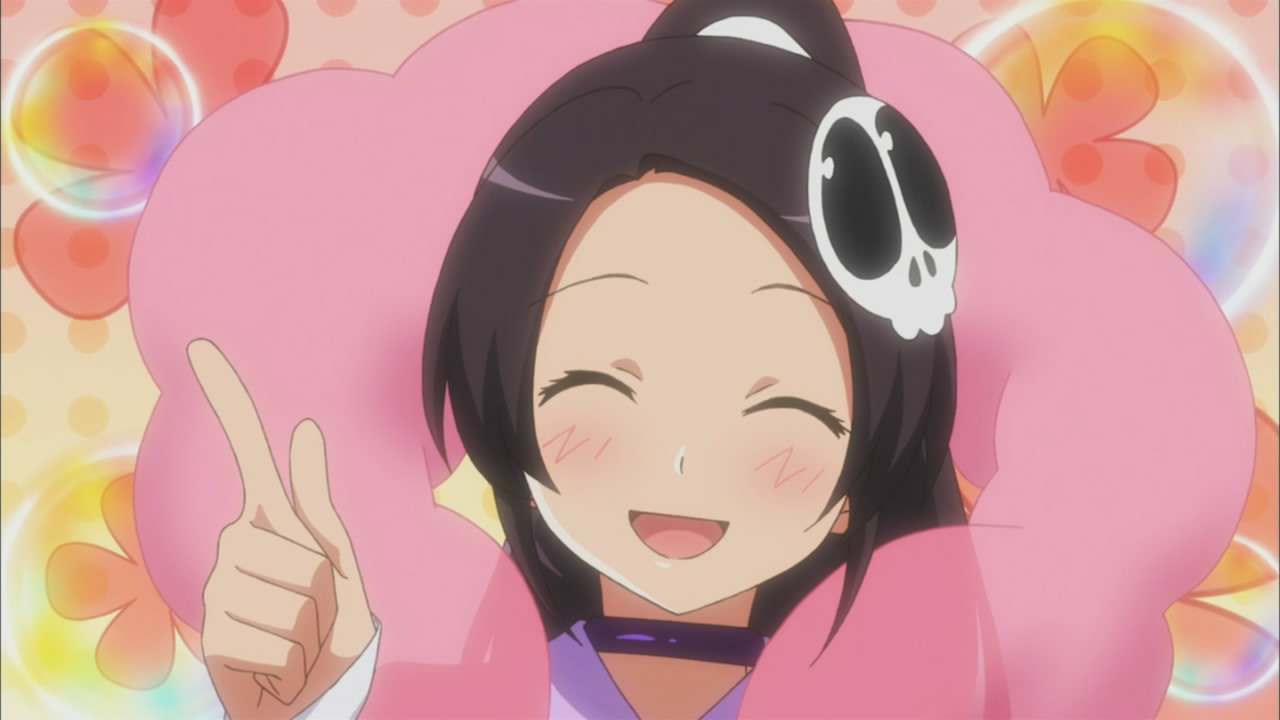
I've watched two episodes so far and already I want my own Elsie to hug. Certain characters just nail the whole adorableness factor, and she has this particular characteristic in spades. The show as a whole is rather endearing, too, though, regularly lapsing into heavily-stylized and chibi sequences rather than trying to remain too grounded in reality. The concept is, after all, ridiculous, so rather than trying to take itself too seriously the show appears to very much embrace its silliness. I'm fine with that, and am looking forward to exploring the rest of the episodes.

Anyway, on that note I think it's probably time I hit the sack. Hopefully tomorrow will see a more coherent entry and less in the way of Internet outages.