#oneaday Day 928: Begun, The Clone Wars Have

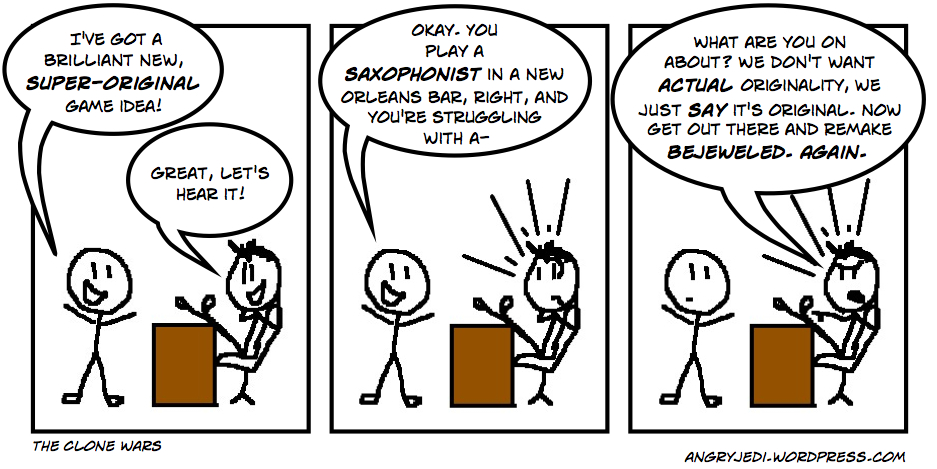
EA has filed a copyright infringement lawsuit against Zynga. The reason? The uncanny resemblance between Zynga's latest "invest-and-express" game (their term, not mine) The Ville and The Sims Social. I won't cover the case in detail because my friend and colleague Mr Mike Thompson has already done a fine job of doing so over at Inside Social Games.

Despite the clash between EA and Zynga looking to many like Darth Vader fighting Sephiroth (I know that would actually be awesome, but it's more the "evil" thing I'm going for) I'm actually sort of glad that this is going ahead, even if EA is actually on shaky ground due to, as Zynga's general counsel Reggie Davis noted, the uncanny resemblance between EA's own SimCity Social and Zynga's CityVille.

But then Zynga doesn't exactly have the best track record. FarmVille, one of the company's biggest hits, was accused of being a clone of Slashkey's Farm Town on its original release. Its iOS title Dream Heights was rather publicly called out by Tiny Tower developer Nimblebit for being a ripoff. CityVille's roots can be traced back to a number of similar titles. And… you get the picture. Zynga is good at one thing: marketing. They are not good at thinking up original ideas, as we've seen a number of times previously.

Zynga is by no means the only one to blame in this situation, however. It is a widespread problem that is simply brushed under the carpet by developers, publishers, press and public alike. Clones are taking over the market and oversaturating it. At some point, we are going to reach critical mass, and there's the potential for a real mess when that happens.

I review mobile and social games every week. In any one week I can guarantee that I will come across at least one of each of the following:

  • An isometric-perspective citybuilding game where you have to complete quests and construct buildings to increase your population cap. More effective buildings either cost real money or require you to bug your friends for "materials" before you can construct them. Usually involves farming.
  • An isometric-perspective ranching game where you have to complete quests and construct buildings to allow you to expand your territory in several directions by clearing mist/chopping down forest/"exploring". Usually involves farming.
  • An isometric-perspective farming game where you have to complete quests and construct buildings to allow you the ability to plant and harvest better crops. Almost definitely involves farming.
  • An isometric-perspective pet/monster care game where you have to complete quests and construct buildings in order to attract various different pets/monsters, which you can then care for and/or sell by clicking repeatedly on them. Usually involves farming.
  • A slot machine simulator where you can pay real money in order to win virtual money which cannot be used for anything except playing that particular slot machine simulator. Does not usually involve farming.
  • A "match-3" puzzle game in which you create horizontal or vertical lines of three or more like-coloured gems (always gems) in order to make them disappear and score as many points as possible in 60 seconds. Rarely involves farming.
  • A "match-3" puzzle game in which you create horizontal or vertical lines of three or more like-coloured gems (always gems) in order to make them disappear and complete a linear series of levels. Almost never involves farming.
  • A "match-3" puzzle game in which you create horizontal or vertical lines of three or more like-coloured gems (always gems) in order to make them disappear and either score as many points as possible in 60 seconds or complete a linear series of levels. (Yes, some games feature both modes!) Does not generally involve farming.
  • A "match-3" puzzle game in which you click on groups of three or more contiguous like-coloured gems to make them disappear and score as many points as possible in 60 seconds. Usually free of farming.
  • A "match-3" puzzle game in which you click on groups of three or more contiguous like-coloured gems to make them disappear and complete a linear series of levels. Generally lacks a farming component.
  • A "match-3" puzzle game in which you click on groups of three or more contiguous like-coloured gems to make them disappear and either score as many points as possible in 60 seconds or complete a linear series of levels. (Yes, some games of this type also feature both modes.) Usually lacking in the farming department.
  • A "bubble shooter" puzzle game in which you fire coloured bubbles from the base of the screen in an attempt to attach groups of three or more like-coloured bubbles together and make them disappear in order to score as many points as possible in 60 seconds. Generally farming-free.
  • A "bubble shooter" puzzle game in which you fire coloured bubbles from the base of the screen in an attempt to attach groups of three or more like-coloured bubbles together and make them disappear in order to complete a linear series of levels. No farming here, no sir.
  • A "bubble shooter" puzzle game in which you fire coloured bubbles from the base of the screen in an attempt to attach groups of three or more like-coloured bubbles together and make them disappear in order to either score as many points as possible in 60 seconds or complete a linear series of levels. (You're getting the picture now, huh?) Farming? Nope.
  • A hidden object game where your uncle has gone missing in time and/or space and the only way to save him is to build a mansion and then repeatedly search the same rooms over and over for a selection of arbitrarily-discarded bric-a-brac which, for some reason, you need to find as quickly as possible.
  • A hidden object game where your uncle has gone missing in time and/or space and the only way to save him is to repeatedly search the same rooms over and over for a selection of arbitrarily-discarded bric-a-brac which, for some reason, you need to find as quickly as possible — but hey, you don't need to build a mansion.
  • A hidden object game in which your uncle has not gone missing in time and/or space, but in which your mansion has become invaded by ghosts and the only way to get rid of them is to build a mansion (again, presumably) and then repeatedly search the same rooms over and over for a selection of arbitrarily-discarded bric-a-brac which, for some reason, you need to find as quickly as possible.

Of course, you can probably boil most of gaming down to a selection of basic formulae like this, but for some reason the issue of cloning is always particularly apparent in the social and mobile gaming space. Perhaps because the developers of these titles generally make no attempt to hide the fact that they're simply cribbing from the unwritten template. (Currency, energy and experience meters go at the top. The Shop button goes at the bottom right. You must start your game with a non-skippable tutorial that treats the player like a complete idiot. You must present map screens from an isometric perspective. GOD HELP YOU if you go top-down or — heaven forbid — 3D.)

In mainstream gaming, the closest we get to a "cloning" problem is the number of similar first-person shooters we have on the market, but in this case, these titles do enough to distinguish themselves from one another with their aesthetic, narrative, gameplay modes and general "feel" to make them unique from one another. Call of Duty: Modern Warfare 3 and Battlefield 3 may both be brown-coloured manshoots, for example, but play them both and it's clear that there are marked differences between the two of them, because they're different games that just happen to be in the same genre, not clones.

Play something like CityVille then SimCity Social, however — or indeed The Ville then The Sims Social — and you'll be hard pushed to tell them apart.

This is not a positive direction for one of the most exciting, creative industries in the world to be moving. There's a huge amount of potential in both the social and mobile gaming markets, and only a few developers tap into this. Most, sadly, choose to take the path of least resistance and make one of the games on the list above.

Come on, folks, we're better than this. Stop trying to tell me that your isometric-perspective FarmVille clone is somehow "innovative" and make something that actually is innovative.
#oneaday Day 885: Foul-Smelling Vagina

20120622-013552.jpg

There, that got your attention, didn't it? Mention a stinky faff in your headline and everyone suddenly takes note. I'll remember that for the future.

Anyway, I do actually sort of want to talk about fragrant fannies today, but not in quite the way you might be expecting. I am instead referring to the social media backlash which "intimate hygiene" product line Femfresh encountered today on its Facebook page.

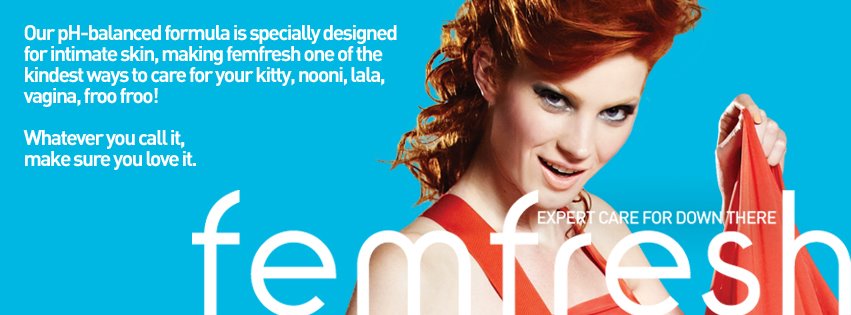
There were a number of reasons that Femfresh drew the ire of the Internet community today, but one of the most common complaints was its cover photo. Here it is:

Apparently, it seems a lot of ladies find the company's seeming inability to use "adult" words for their respective minges somewhat patronising — and before I go any further, I will point out that my use of various offensive euphemisms throughout this post is purely for facetious comedy value (and variety) rather than any ulterior motive — and thus took umbrage with Femfresh's page as soon as they saw the top of it. (Quite what they were doing on it in the first place is their business and their business alone.)

Not only that, but it seems that on the whole (shush!) women are, in fact, rather well-educated about what is and isn't appropriate to smear over or stick up their flange. "Bacterial vaginosis" is the result of using the wrong things, it seems, and no, I haven't Googled that because I don't want to. Don't let me stop you from doing so, however, if you're curious. Just don't come crying to me if Google Images decides to serve you up some tasty treats.

Anyway. Here are a few choice comments from the public:

"I call it a vagina because I'm not 12 years old and because I love it I'll go nowhere near this vile 'care range. Cheers."
— Holly Rae Smith.

"Are you kidding me? Trivialising something innately precious by calling it something so thoroughly ridiculous offends me and, believe it or not, all the posters on this page. Did you not perform any market research on this area and then develop a communication and marketing strategy? It appears not otherwise you wouldn't have received such an insane backlash on your attempts to flog a thoroughly unnecessary and damaging product…"
— Helen T

"Just to clarify, is Femfresh for vaginas or vulvas? Because your ad says vagina, which implies your product is a douche, in which case you're advertising a harmful product. If it's for vulvas only, change the words you're using to make it clear."
— Kirsten Hey

I shan't talk any more about the science of quim because I'm not a gynaecologist (I can, however, spell gynaecologist without using spellcheck) but I will focus on the larger issue here, which is that social media advertising campaigns can and will go very, very wrong if they're not thought out effectively. Instead of simply advertising their (apparently controversial) product, Femfresh made the mistake of attempting to engage with their "fans" when there was really no need to. By actively encouraging people to comment on their posts (and by posting vapid, patronising nonsense) they essentially brought about their own downfall. Everyone has been talking about Femfresh today, and they haven't come off too well. "All publicity is good publicity" doesn't really apply when the vast majority of those "publicising" your product are pointing out proven health risks.

The broader issue here is that social advertising should not be "essential" as so many advertisers seem to believe it to be. On Facebook, you can "Like" everything from HP sauce to a favourite video game. Doing so used to simply be a means of self-expression — quite literally, demonstrating that you liked something. Now, publicly "Liking" something is inviting the brand in question to bombard you with crap, ask you asinine questions at all hours of the day in an attempt to "build a community" around things that really don't need a community built around them. If people honestly think that their lives are going to be enriched when they click "Like" on the page of a thing that they're quite fond of, they are sorely mistaken.

Those who have "Liked" (or at least come across) Femfresh have taken a stand against this sort of pointless nonsense that is infesting social media like, well, bacterial vaginosis. In this case, it's because the advertising was both patronising and inaccurate. For less contentious products, it's going to be harder to train people to not be corporate shills — the last post on Pepsi's Facebook page has 1,094 "likes" and 74 comments, for example, none of which say anything remotely meaningful — but it seems we're starting to see a backlash of people who are no longer willing to be an unpaid part of a product's promotional team. I've certainly started "unliking" pages on Facebook that post nothing but pointless questions or fill-in-the-blank exercises rather than useful information (although seriously, what "useful information" could the official social media presence of HP Sauce ever really give you?) and I'd encourage others to do so too. This form of social advertising adds nothing of worth to society and, as Femfresh have seen today, can be completely counter-productive for the brand in question. (I guess there's an argument for the fact that today's debacle may have educated some women about bacterial vaginosis, but still.)

I'll leave you with this:

#oneaday Day 872: Haters Gonna Inspire Worldwide-Trending YouTube Videos

I really love it when someone I know achieves success with something. That's why it was so utterly delightful to see something that a friend from university worked on gradually spread around the world today.

I am talking, of course, about this video, which if you haven't watched yet… well, you just should. (Probably NSFW.)

I don't know Isabel Fay (the lead performer) directly, but I do know one Mr Tom Hopgood, who co-produced the piece and has worked very hard with Isabel and the rest of the team at Clever Pie TV to produce some high-quality comedy skits over the last few years. Today, it seems, all that hard work really paid off.

I watched it happen over the course of the day. Another university friend shared the video. I expected this. But then someone who, to my knowledge, had no direct connection to Tom or Isabel shared the video, which surprised me. Then I shared it after watching it and finding it hilarious.

Then I went and did some work. As the day progressed, I saw the video start appearing in various tweets along with Facebook and Google+ posts.

Then Stephen Fry shared it, which is pretty much a guarantee that you're going to be a sudden global sensation, at least temporarily. Sure enough, a lot of the YouTube comments indicated that Stephen Fry sent them.

As it gets close to bedtime, I see more and more people still sharing it, including other unrelated Twitter followers. It truly is something which has spread worldwide and has enjoyed universal appeal among everyone I know online. This is delightful to see.

It's especially delightful to see as it was absolutely perfectly timed. I have a feeling it was just a happy coincidence that it happened to appear on everyone's radar today, but after reading this depressing post over on Feminist Frequency regarding the harassment, misogyny and silencing tactics the author had endured after promoting her upcoming research and video series, it just seemed perfectly, perfectly apt. Perhaps the fact that hateful comments on the Internet are very much at the forefront of people's minds right now meant that it resonated more than it might have done otherwise.

Or, you know, perhaps it's just a great piece with an infuriatingly catchy melody.

Whatever the reasons were for the video enjoying the success it has done so far (and still is — Twitter mentions of it are still flowing in even as I type this) don't really matter, though. I'm absolutely stoked for Isabel, Tom and the rest of the Clever Pie gang, and though I haven't seen Tom for a large number of years now I'm very proud to say that I have both known and worked with him. I have photos to prove it and everything.

I hope this is the beginning of something really big for Clever Pie. If they can continue to tap into relevant topics like this, then they've got it made. "Thank You Hater!" manages to be both topical and timeless at the same time — Internet trolls are always going to be an issue, but they're particularly prominent in people's minds right now for various reasons.

Enough gushing. Time for the weekend. Have a good one, everyone.

#oneaday Day 863: Trash-Talkin'

20120531-023836.jpg

It's not often I feel able to say this and mean it, but there's a piece over on Kotaku right now that is an excellent read. Go check it out, then come back to me.

I can't comment on being a rape survivor or anything like that, but I think that article sums up why I feel deeply uncomfortable with the idea of playing online with strangers in competitive games. I hate abuse, particularly pointless, rage-filled, deliberately offensive abuse designed to provoke an intensely emotional reaction out of the victim — and competitive online gaming seems to pride itself on this so-called "trash talking".

In my own case in the past (and not in games, in the "real world") abuse I have received has been in the form of hurtful comments about my appearance and my weight. I can't begin to fathom what must have gone through the minds of the bullies in question as they said those words that lashed at me like a cat o' nine tails, but they hurt. They perhaps weren't intended to hurt quite as much as they did — "I was only having a laugh" is seen as a valid defence by many these days — but the fact is that they utterly ruined my day when they burst into my ears, regardless of intention.

If I feel that shitty after some stranger makes some low jab at my appearance, I can only imagine how awful it must feel to be a rape survivor and hear how freely the word "rape" is bandied about to mean "beat" or "defeated". I feel uncomfortable using the word, given that I know at least a couple of survivors (to my knowledge), so picturing how it must feel to have such an awful thing trivialised by, say, Gears of War players is disturbing, to say the least. Like the behaviour of the bullies I described above, the intention may not necessarily have been to offend or upset, but there are plenty of people for whom such comments could completely ruin an otherwise fun experience — and, really, let's face it, there's no need for it, is there?

Lest you think me some sort of prude, I will point out at this juncture that I'm certainly not above light-hearted insults with my friends, which often skate into sexist, racist, homophobic and other generally offensive territory. But that's something that we do among ourselves in private — we've set the boundaries as to what is "acceptable" in our group, we stick to it and, crucially, we don't do it in public where anyone might misinterpret our words as genuine sexism, racism, homophobia or any other form of misanthropy. Not one of us would even contemplate the prospect of telling a complete stranger that they'd "raped" them — or indeed hurl any other sort of abuse at them, whether or not there was social "context" for such behaviour.

An example springs readily to mind. I was playing the then-new Dungeons and Dragons Online MMORPG, and I was doing my first run through one of the game's cooperative dungeons with a "pick-up group" of random players. All had been going well until we got to the end and there was an unnecessarily difficult platforming section. The platforming controls in D&D Online were not very good, to say the least, so it took me a good few minutes to get through the bit that the other (evidently more experienced) players had passed with ease. I apologised and made light of it, hoping that they'd do the same. Instead, I was confronted with a torrent of abuse through the private chat channels. I turned the game off at that point and never played it again.

The unnecessary, unprovoked wrath of a complete stranger had ruined the game for me. Whether or not they had intended to upset me that much was irrelevant. It had happened. I grant that I am the sort of person who is very easily upset even by heated arguments, debates and disagreements, let alone abusive words, but being sensitive about such things shouldn't preclude you from taking part in certain activities. Something like an online computer or console game — regardless of whether it's cooperative or competitive — should bring people together, not leave them feeling marginalised, or that their own anxieties, issues and mental scars are somehow trivial. There's no excuse for it, and it's something which gaming culture really needs to clean up if we want our hobby to be inclusive to all.

Therein lies part of the problem, I think, though; some people don't want that inclusiveness. Some people want to feel powerful, to be the top of that little clique, to feel like they have achieved something important and are therefore "better" than others. And they go about that by lashing out at the weak spots, triggers and hot buttons of others. Anything goes in the quest to make them feel like The Big Man. (Or Woman. But let's face it, it's significantly more likely to be a male person.)

It feels like such a futile question at times, but why can't everyone just, you know, get along?

#oneaday Day 853: Friend Collecting

20120521-013731.jpg

I didn't understand it back in the MySpace days, and I still don't understand it now.

Friend collecting. Why? Just… why?

I am, of course, referring to the phenomenon seen in the comments thread of this Facebook post here:

(with apologies to Kalam, who is nothing to do with this.)

"Who wants 2,000+ friend requests?" asks Ahmed Hamoui, only with poorer use of punctuation and a seeming inability to use the number keys on his keyboard.

To his question, I answer "Not me. Fuck off."

Facebook is noisy enough at the best of times. Can you imagine how chaotic and useless it would be if you 1) got 2,000 friend requests and 2) accepted all of them? It would completely negate the core concept of Facebook (or what it used to be, at least) which is to be a "social tool" that helps you to connect with family and friends. The very nature of the way Facebook works pretty much encourages you to limit the friends you add to being people you actually know, otherwise there's that horrid risk of people seeing photos they shouldn't. Because despite the fact that everyone knows you shouldn't post embarrassing photos online, everyone still does. (Not to mention the fact that you have no control over what other people post.)

This sort of thing happens on Twitter, too, with the whole "#TeamFollowBack" thing, whereby certain tweeters promise to follow back if you follow them. At heart, this sounds like a relatively admirable thing to do, promoting mutual, equal discussions and– oh wait, most of them are just collecting followers for no apparent reason then filling their entire timeline alternating between bragging about how many followers they have and bleating about how close to the next "milestone" they are. (Please RT.)

I trimmed my Twitter list massively a month or two back because it was just getting too much to deal with. I flip-flopped between two equally annoying problems: things moving too fast for me to be able to keep up with, and everyone posting the exact same thing at the exact same time either due to press embargoes or the death of a celebrity. So rather than complain about it, I cut the people who were irritating me or whom I hadn't "spoken" to for a while, and now enjoy a much more pleasurable life online. Sure, my timeline still gets flooded every time a celebrity (usually one I've never heard of) dies, but at least I can keep up with the conversations for the most part.

Which makes me wonder why on Earth you would want to put yourself in a position on Facebook or Twitter where it is literally impossible to follow and engage with that many people. Surely at that point social media ceases being at all "social" and simply becomes white noise?

Or perhaps I'm just getting old. It seems to be mostly young kids (particularly Justin Bieber fans for some reason) engaging in this behaviour. Perhaps they have a much greater tolerance for being bombarded with crap than I do. Perhaps they're numb to it. Perhaps they don't really want to "socialise" at all online, simply grow a bigger e-peen than their friends and/or strangers they don't know.

Whatever. I don't really care. I have cultivated a relatively small but close-knit circle of friends online, much as in "real life", and I'm happy with it that way. It's nice to have occasional new people trickle into the mix through, say, this blog or Twitter or what have you, but I certainly don't feel any need to bellow at the top of my lungs about how close I am to 1,500 Twitter followers, and I have no idea how many friends I have on Facebook — nor do I care.

If you'd like 2,000 friend requests on Facebook, simply "Like" this post then go fuck yourself.

#oneaday Day 836: Brandwatch

20120504-010317.jpgSo, at the time of writing, the No. 1 free iPad app and No. 2 free iPhone app is this game. A quiz. About logos.

This seems to be something of a craze at the moment, as it's far from the only title like this available in the App Store, and doubtless there are similar offerings on Android that I can't be arsed to look up right now.

This is what we're reduced to for entertainment now? Seeing how deep the brainwashing of advertising has burrowed into our skulls? I'd argue that scoring highly on one of these quizzes is not anything that we should particularly be proud of, as all it simply proves is that advertising has successfully drilled its way into your subconscious.

The same goes for anyone who uses the word "simples", describes anyone as being "so Money Supermarket" non-ironically or sings that bloody "Go Compare" advert. (If you do the latter, I will likely punch you in the face. If you do the "so Money Supermarket" one, whether or not you get punched in the face will depend entirely on how good your Patrick Stewart impression is.)

The counter-argument to this, of course, is that many of these brands, logos and slogans have transcended their original meanings and become pop culture phenomenons or memes in their own right. And to an extent that's true, but I can't shake off the feeling that these things have been forced into the public consciousness, while true phenomena and memes should grow organically, naturally and without marketing spend. In many cases, they do, of course — look at the Know Your Meme page for Katawa Shoujo or the astonishing popularity of My Little Pony among people that it wasn't originally intended for, for example. But I think we can all agree that anyone who takes an opportunity to sing the Go Compare song is a grade-A arsehole of the highest order.

Perhaps I'm just being grouchy. Or perhaps I'm just fed up with feeling like I can't escape advertising any more. It seems to encroach on my time more and more. It's all over the Internet. I get text messages from lawyers inviting me to seek compensation for the accident I supposedly had (funny, I don't remember it). I get phone calls from twats trying to sell me shit even though I'm registered with the TPS. (Note: this is the main reason I never answer my landline. Call my mobile if you need to speak with me.) I get people knocking on my door trying to sell me double glazing or get me to switch energy suppliers. It's plastered over certain games. It's smeared all over Facebook like festering shit. It encroaches on Twitter occasionally in the form of "Promoted Tweets" and "Promoted Users" — though these are, thankfully, easy to ignore. I even had to remove a Chrome extension yesterday because it was inserting an ad at the bottom of every page I viewed.

Ads allow things to be put out there for free, of course, and without them we'd be having to pay a lot more money for the things that we do, so I guess we should sort of be grateful for them. That said, it doesn't excuse the sleaziness of some ads, particularly on the Internet — take the large "Download" links on software sites, for example, or the "You Have 1 New Message/Virus/Picture" banners you get on mobile apps. Or indeed the "lose 3 tons of belly fat with one weird old tip" thing. (Spoilers: you probably won't, otherwise the world would be talking about it.)

You know what? Thinking about it, I'd actually be happy to pay for more things and have them advertising-free. I pay for Spotify premium and don't have ads. I'll happily pay to remove ads in iOS games I intend to play for more than five minutes. I pay for Netflix and get movies and TV shows without ad breaks. I'd even happily hand over some money to WordPress if it became a premium-only service, such is the excellent use I've got out of it for free over the years.

In short, provide me with a quality product and the means to not be battered around the face with people trying to sell me shit I don't want, and I'll happily hand over some money. Yell "Buy! Buy! Buy!" repeatedly at me with no means of respite and I will, yes, punch you in the face.

#oneaday Day 825: Bull, Horns, That Sort of Thing

20120422-235753.jpg

The Black Dog of depression has been rearing its ugly head a bit again recently for various reasons, and I'm sick of it. While there's not necessarily much I can do about it showing up and being a pain in the arse, I can at least try and work on some things to make me feel a bit better about myself.

For starters, getting upset at one's own reflection isn't particularly great news, and it's something that I can at least attempt to do something about. I have been fitness-ing off and on for some time now, but I figure it's Time To Get Serious. That means I'm going to hit the gym every morning before I start my working day rather than leaving it until last thing in the evening when it's easy to go "nah, fuck it". (Of course, it's easy to stay in bed and say "nah, fuck it" also, but I'm going to attempt to get out of this habit before it starts.) I won't necessarily be doing everything every day, but I'm going to attempt to get at least an hour of cardio stuff in per day at the very least. This will likely mostly be done on the exercise bikes, where I can sit back and play Final Fantasy VI on my fancy-pants tablet while I'm sweating. At other times, I'll use the crosstrainers and whack on a podcast — the Exploding Barrel Podcast from my good buddies Mike and AJ Minotti is always a favourite — or some inspirational music of some description.

As motivation and progress tracking, I'm going to be using Fitocracy, which I've posted about before here. I also considered resurrecting my Jedi Health Kick Tumblr from a while back, but given that Fitocracy provides the ability to post lengthy, blog-like status updates and has its own built-in community features, I'm going to stick with that. As well as tracking my workouts, I'm going to write a short post each day detailing how it went, how I'm feeling and what I'm aiming for. I'm also going to use Fitocracy's excellent Quests feature to take on some challenges that I might not have otherwise thought of — this will help prevent complacency if I'm making a "game" out of it all.

I'd also like to eat better. I think I eat when I get depressed, and I get depressed a fair bit, which doesn't help matters. I'd rather kick that particular habit in the face if possible — or at the very least change it so I munch on, say, carrot sticks instead of ALL THE BISCUITS, but that's the sort of thing that will take plenty of teeth-clenching willpower to resolve. I have faith in my own ability to do this, however — if there's one thing I'm good at it's clenching my teeth and stubbornly resisting things. Sainsbury's cream cakes are my most formidable adversary to date, however, so it remains to be seen whether I'll be able to defeat them using the power of my clenched teeth (and/or buttocks) alone.

So that's the plan. We'll see how long I'm able to stick with it. I'm saying this publicly so I have a bit more pressure to follow through on it. If anyone would care to join me and work out alongside me or just offer some words of encouragement, come cheer me on over on Fitocracy — it's free to sign up and there's a nifty companion iPhone app too.

#oneaday Day 823: Information Diet

20120421-013424.jpg

Know what I hate? Chavs. Know what else? Teaching. Know what else? We could be here a while. I'll tell you. Press embargoes.

I get why they happen, obviously — publishers and their PR people want to ensure that coverage of something is coordinated nicely so that everyone gets suitably whipped up into a frenzy all at the same time. But there's an unfortunate side-effect if you happen to, say, follow a bunch of different video games outlets at the time a major announcement happens: everyone bellows the same fucking thing at the exact same fucking time.

It's happening more and more nowadays, too. The most notable examples that stick in my head in recent memory are Assassin's Creed III and Borderlands 2, both titles that I have a passing interest in but find myself becoming curiously resistant to the more and more I get battered in the face with the same information from slightly different angles.

I think, on the whole, this is the "problem" I have been having with mainstream gaming overall. There's too much information out there — too much coverage, too many "behind the scenes" videos, too many "exclusive" interviews, too many press releases announcing a single screenshot (yes, that is a real thing I received today and I have no shame in naming Square Enix as the perpetrator). After a while, you become completely saturated with information about a product and subsequently have absolutely no inclination to want to touch it, ever. This was a big part of why I didn't want to play Mass Effect 3, for example — EA's appalling behaviour was just the straw that broke the camel's back, really.

I feel for my friends who work in games PR for "B-tier" games, too. It's hard enough to get a title like, say, Risen 2 noticed at the best of times but when you're competing with everyone beating themselves into an orgasmic and/or angry frenzy over Mass Effect 3, there's little hope for your title outside of groups of people like me who have forsaken the mainstream in favour of enjoying less heavily marketed titles.

Conversely, the games I have been playing and enjoying are the ones where information has been trickling out slowly, usually straight from the developers mouths without dribbling through the PR sieve. Take the "Operation Rainfall" RPGs Xenoblade Chronicles, The Last Story and Pandora's Tower (which I'm currently playing), for example — these received very little in the way of press attention despite being fantastic games. The aforementioned Operation Rainfall, a grassroots campaign to get these three excellent games localised and released in Europe and the US, received plenty of press, but information on the games themselves was conspicuously absent. As a result, I was able to go into all three of them pretty much blind and have a fantastic experience in the process — a big part of what made all of them great is the sense of discovery inherent in all of them. That just doesn't happen if you've been smothered in information for the six months leading up to the game's release.

As a result of all this, I've come to a decision, and if you're feeling the same way as me, I recommend you follow it too.

Cut back. Cut out the crap. If you follow a buttload of games journalists and outlets on Twitter, unfollow them. If you want some gaming news, pick one outlet and keep it on your follow list, but chances are if you follow lots of gaming fans, someone will retweet the news as it happens anyway. Otherwise, go seek out the news when it's convenient for you. Check the sites when you feel like it. Subscribe to their RSS feeds. Use Google Currents or Flipboard to receive information in an easily-digestible format. Receive information on your terms, not that of a carefully-crafted PR campaign.

This doesn't have to apply just to games — it can apply to pretty much anything that suffers from the problems described above. Film, TV, celebrity news, business, tech… anything, really.

I'm going to give this a try. It will doubtless initially feel somewhat weird to not see some familiar faces and logos in my Twitter timeline, but I have a strange feeling that I'll be a lot happier, less frustrated and less cynical as a result. Check back with me in a week or two and we'll see.

(If you're one of the people I do happen to unfollow, it's nothing personal. You just might want to consider getting separate professional and personal accounts!)

#oneaday Day 818: "So Fed Up With SOMEBODY..."

20120415-222839.jpg

Passive aggression. It's an ugly business, for sure, but never has it been easier to participate in than in this age of social media. While the phenomenon has been around for many years in the form of bickering couples saying things like "SOMEBODY didn't do the washing up" or making other such pointed remarks either directly at each other or to other people within earshot of their partner, it wasn't until people gained the ability to broadcast their every waking thought to the entire world that it became the worldwide craze that it is today.

I'm not sure exactly what it achieves. I've indulged in it in the past — in my defence, there were extenuating circumstances at the time — and it didn't really make me feel any better, though it did have the effect I desired at the time: to get some validation and reassurance from friends, and to piss off, upset or otherwise get the attention of a specific person. I wasn't particularly proud of the result. I ended up feeling worse about the thing I was trying to get out of my system than before the passive-aggressive incident. So I try and avoid it in most cases these days. (Note: most. No-one is infallible. And I'm aware that not sharing the details of said incident above could be construed as a form of passive aggressiveness. But, well, shut up.)

Why has social media been a catalyst for the growth of passive-aggressiveness, though? Quite simply, it's because it gives people the ability to feel like they're being heard even when no-one is really listening. Post something along the lines of "SO PISSED OFF WITH SOMEONE RIGHT NOW!!!" on Facebook and within a matter of minutes you'll have at least one "Like" and one comment saying something along the lines of "u ok hun?". Since you're being passive-aggressive, though, you couldn't possibly say exactly what's up with you at the time, and as such you drop vague hints as to what is bothering you without actually saying it. Or, worse, you leave a comment to the "u ok hun?" commenter saying "I texted you", letting everyone else reading the comment thread know that you're telling someone all about what/who has pissed you off this week, encouraging a flurry of private messages and texts to said person asking "Do you know what's up with so-and-so?"

Eventually, of course, the whole sordid saga comes out because statistically, someone in your group of friends is likely to have loose lips. We know this from sitcoms where one member of a group of friends is forced to keep someone's secret but finds themselves increasingly tempted to reveal everything to someone else, whom it transpires actually knew it anyway. Or, to base ourselves back in reality, some people like telling others secrets because it gives them a feeling of power — "I know something you don't, but I'll tell you if you buy me a drink/buy me a pony/sleep with me" — and thus said secret gradually spreads and spreads until, inevitably, it gets back to the person it originated from, who traces it back to the person who they told in confidence and then posts another passive-aggressive status update about how they're, like, totally so pissed off with people who can't keep secrets.

You get the idea, anyway.

As human beings, we have a variety of means of communication at our disposal, and it's pretty clear to most of us that being upfront and honest about things often makes life a lot easier in the long run, even if it might be a bit like tearing off a plaster in the short term. But in the heat of the moment, it's all too easy to focus on that "short term" bit and take the easy option, which is to bottle up the things we're really feeling and simply spout vague bullshit into the ether in the hopes that someone — anyone — will reach out to us and give us someone to talk to.

We never learn our lesson, though — at least not if my Facebook news feed and Twitter timeline are anything to go by.

#oneaday Day 813: Fitocrat

20120411-000948.jpg

I last wrote about up-and-coming "fitness social game" Fitocracy back in… [checks] Ooh. October of last year. I thought it was more recently. I feel less guilty about writing about it tonight, in that case.

For the uninitiated, Fitocracy is a site which gamifies your exercise regime. Completing exercises rewards you with points. Points mean level ups. Level ups mean… well, nothing actually, but they provide you with bragging rights plus also give you a rough idea of how much cumulative exercise you've done since you started tracking it (and, in theory, "got serious" about it).

Tracking exercises can be done in two ways: manually logging them or linking to a Runkeeper account. The former is necessary for exercises which can't be automatically tracked such as resistance machines, free weights and bodyweight exercises. The latter is the easiest way to track cardiovascular workouts — particularly those where you've actually, you know, gone outside — but you can also track CV stuff directly within Fitocracy if you don't want to plaster your information over yet another site. (Runkeeper is a pretty cool app, though, so if you're serious about your fitness, enjoy attempting to draw GPS penises via your exercise route and have a smartphone, it's worth a download.)

If Fitocracy was just an exercise-tracking system with a levelling system, it'd be pretty decent. But the team behind it has gone the extra mile and included a bunch of other stuff, too. There are Achievements for a variety of things ranging from engaging with the site's social features to performing challenging exercises. There is a Quest system that provides specific, one-off missions for you to undertake — a good means of setting yourself long-term goals if you can't think of any of your own. You can save your favourite routines so you can easily recall and record them. There's a solid Groups system whereby you and your friends can work together and even set up mini-challenges to see who can earn the most points in a set time period. And the whole thing is wrapped in a straightforward, conventional but effective and highly-polished social interface that encourages interaction and encouragement between "players".

All in all, it's an excellent motivational tool. Everything combined together forms a powerful system that makes you feel like you're being "rewarded" for bettering yourself when, in fact, you're simply making a variable go a bit higher each time or occasionally unlocking intangible shiny things. The thing is, though, you are actually rewarding yourself. You're bettering yourself. You're getting fit. You're learning how to self-motivate. And, assuming you've managed to badger some friends into joining up too, you're also being rewarded by positive encouragement and reinforcement from other people who are going through the same thing. It's a social network for people who are serious about their fitness — or who want to get serious about their fitness. And it does its job extremely well.

Fitocracy was in closed beta for a pretty long time, and during that period it was only possible to use the service if you had an invite. Now, though, the whole thing is open to the public and is completely free to use — though power users have the option of shelling out $4.99 a month to become a "hero" and get early access to new features. The service has had a fresh new coat of purple paint, its site looks great and the new iPhone app is a pleasure to use with its simple, intuitive and attractive interface.

So why not give it a try? Here's my profile. I'll be your friend! NOW GET MOVING, MAGGOT!