1066: Doubleplusgood

There's been a lot of hand-wringing over both Facebook and Twitter recently, mostly due to both of them tweaking their terms of service in various ways that some people don't like very much. Me, I don't particularly mind too much because at the end of the day, I'm not paying for either of them, so as the saying goes, "if the product is free, then you are the product" — I accepted this some time back and think back on it any time one or the other of them does something apparently stupid. I use both daily to stay in touch with various people, so quitting either is out of the question.

For those feeling somewhat wary of the big F and the big T, however, I'd encourage you to give the big G another shot. (Unless you're one of those people who irrationally hates Google too, in which case… err, I hear Myspace is coming back soon?) Yes, G+ is still a smokin' hot social networking service that is far from the ghost town the media likes to portray it as. It's an active, thriving community that has only gotten better over time.

The latest addition to the service, and one which could well prove to be a "killer feature" with a little refinement, is Communities. Communities are little mini-networks within G+ that allow members to post content as they would do normally on G+, but keep it all within one community rather than sharing it publicly or having to use the slightly cumbersome "Circles" system. It's a good way of bringing people together who want to talk about the same thing, and it's pretty customizable, too — you can change the community's iconic image, title, headline and basic information, but also create categories for posts to help keep things organised, too. The latter feature needs a little tweaking — you can't reassign a post to a new category if you miscategorise it upon creating it, for example — but the groundwork is there for a solid community system.

And, crucially, people are using it. Google+ may not quite have the same number of daily active users as Facebook, but there are more than enough to make these communities active, vibrant places to hang out. The board games community I joined has over 2,000 members, for example, while there are over 3,500 bronies hanging out in the "Pony+" community. The anime community has over 20,000 members, as do various photography-related communities. G+ is an attractive destination for photographers, as it provides practically unlimited space for high-quality photo storage along with some basic editing tools — and the G+ interface is a nice means of showing off one's work, too.

G+ is built to be used on a variety of platforms, too. The mobile apps for both iOS and Android are quick to be updated with new features and are consistent in their behaviour and functionality. Pretty much everything you can do on the desktop website can be done from the mobile app — and the mobile app has the added bonus of looking rather lovely, too, for those who like that sort of thing.

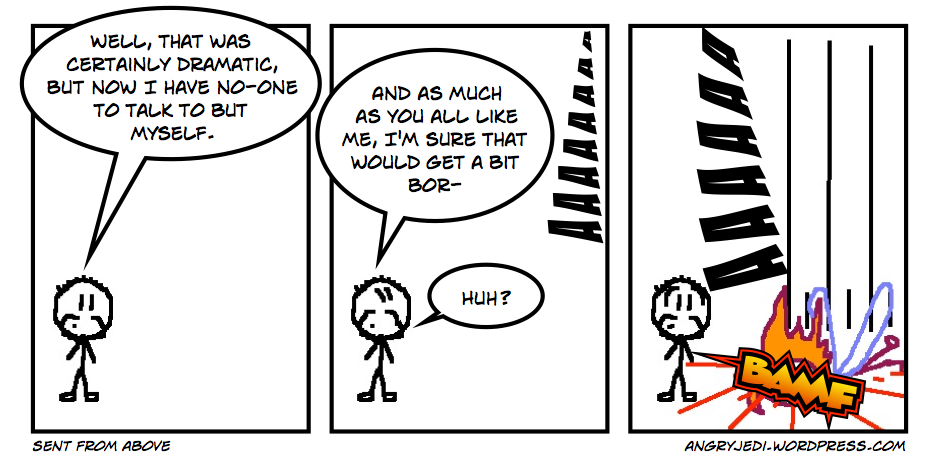
So if you've got a Google account, give it a shot. And by "give it a shot" I mean do more than just open it up, complain that there's no-one to talk to and then close it down — like Twitter, you need to actually "follow" some interesting people before it starts to show its true value. The new Communities feature will help people find like-minded friends more easily, as this was one weakness of the old version — it was quite tricky to find new people to follow.

Here's some links to get you started. Here's my profile. Here's the Squadron of Shame Community. Here's the "Too Old For This" Community run by my buddies Chris and Jeff. Here's the board game Community.

Now get on there and get chatting! I'll leave you with this, from The Oatmeal.

#oneaday Day 998: Generally Generalising

First up, read this. It's an impressive piece of investigative journalism regarding a Reddit user known as "ViolentAcrez" — a notorious user for his practices of posting creepy photos of often-underage women without their consent. The piece describes the reporter Adrian Chen's (successful) attempts to unmask ViolentAcrez and publicly shame him for the things he has spent the last few years doing.

Fair enough. As a number of people have said in relation to this story today, the "free speech" so beloved of Reddit users does not mean the same thing as "free of consequences". And while Michael Brutsch, the man behind the handle "ViolentAcrez", has not technically broken any laws with his activities — he wasn't posting child pornography or anything illegal, simply reposts of images that were already in the public domain on Facebook and other services, and later voyeuristic images taken without the knowledge of the people depicted — the fact stands that his behaviour was more than a little creepy, inappropriate and actively harmful in a society that is, for the most part, actively trying to improve attitudes towards women.

I'm not denying any of this. While I find the tracking down and public shaming of a notorious Internet troll a little creepy in and of itself, what Chen did in the name of journalism is a far cry from what Brutsch has been doing for the past few years — and probably for the best in the long run. Brutsch will certainly think twice — or at least be a lot more careful about his "social media footprint" — before trying anything like this again. There's a lesson to be learned in all this — if you're a dick on the Internet, sometimes it will come back and bite you in the ass.

There is something that bothers me about this story, however, and that's been the reaction to it. Specifically, the negativity directed towards the entire Reddit community as a result of this story and surrounding issues. For those who haven't been keeping up on this story over the past few days, a number of Reddit subforums, or "subreddits" as they're called, completely blocked all Gawker links in a showing of solidarity for Brutsch who was, despite his behaviour, regarded as a valuable member of the community and a "necessary evil" by many — while he was a notorious troll, the Reddit staffers made active use of him to police the less salubrious parts of Reddit and ensure that nothing that actually was illegal was being posted. A "man on the inside", as it were.

Because certain parts of Reddit decided to show their support for and/or actively defend Brutsch's behaviour on the grounds of "free speech", apparently all of Reddit is now something to be reviled — a "cesspit", as I saw it referred to earlier today.

This is the bit that makes me uncomfortable — an entire community being blamed and ostracised for the behaviour of one man in particular, and also for that of those who support him.

I've been on Reddit. I haven't been on there for a while but I enjoyed a brief stint on there a while back. I joined some interesting discussions on a variety of topics ranging from gaming to TV shows  via funny pictures and an accidental excursion into naked photographs that users had taken of themselves. (In the latter case, the notorious "gonewild" subreddit, the majority of comments were in fact, body-positive — particularly on the pictures of those who had been brave enough to post a picture of their obviously-overweight body — rather than perverted, which I found to be interesting. Also, it genuinely was an accident that I found myself in that subreddit — Reddit's main screen gives little to no indication what "gonewild" is all about. In retrospect, I should have thought about it a little more before jumping in, but hey, I'm pretty hard to shock. But I digress.)

I didn't spend long enough to make any particular friends there, but I have heard plenty of stories of people getting to know each other and making lasting friendships or relationships through the site. There are plenty of stories of Reddit communities pulling together to support others, too — stories of helping people through difficult times; stories of helping people who are struggling for money; stories of, in short, human helping human. I know at least one person personally who is using a specific subreddit for support in getting help for some of their personal problems and issues. There is plenty that is positive to say about Reddit.

And yet for the obnoxious, totally inappropriate actions of one man and his supporters — some of whom, it seems, have been or are on Reddit's staff — apparently this entire, incredibly diverse Internet community should be ostracised.

Something really doesn't sit right with that for me. To generalise one of the largest communities on the Internet as all being scumbags like this just seems both dangerous and unfair. I have plenty of friends who enjoy using Reddit for completely innocent purposes, be it discussion, promotion of things they have been working on or discovering interesting new reaction .GIFs. I know that they'd be the first to distance themselves from the sort of behaviour that Brutsch has exhibited, and yet if you were to take what a number of commentators are saying at face value, you'd have to brand these people as deviant perverts and assholes, too, simply by virtue of the fact that they're Reddit users.

This is not helpful.

I'm fully aware that I've been guilty of this sort of thing in the past — not specifically with regard to Reddit, but with 4chan. I've referred to that place as a "cesspit" before and certainly it has more than its fair share of trolls and unpleasant people there — but equally now I realise that there are also plenty of other people who just make it their hangout of choice. They, subsequently, become guilty by association with the "/b/tards" who are responsible for the majority of objectionable material and behaviour on 4chan (and, by extension, the rest of the Internet. And they're probably pretty pissed about that.

The same thing is happening with Reddit. As much as Reddit would like to market itself as a "social news" tool, let's not be under any illusions — it's nothing more than the world's biggest forum. Like most forums, it has tons of subcultures and cliques, most of whom stick to their own neatly-carved niches for the most part. Some of these subcultures and cliques are objectionable in nature, and it's up to the site admins and moderators to determine what to do about that — something that they haven't done a great job with so far, and something they need to work on.

However, the mere presence of some objectionable subcultures and cliques does not mean that the entire website as a whole is somehow objectionable. It's the same as saying that a particular city is a "cesspit" because, say, a greater-than-average number of registered sex offenders live there. Or the same as saying that all people who like a particular thing are a bunch of assholes. Or, in fact, the same as almost any other unfair, unsubstantiated generalisation. It's not helpful — all it does is turn everyone outside that group against them, and everyone inside that group becomes defensive. The two sides inevitably clash, and things just get worse and worse rather than better. It doesn't help anyone.

So by all means think that Michael Brutsch is a creepy old pervert whom you wouldn't want anywhere near your children. By all means criticise those who supported him — including members of Reddit's staff.

I agree with you.

But take a moment to think of the thousands — more likely millions — of people who make use of Reddit on a regular basis and have absolutely nothing to do with this before you start branding the entire community as pond life. Would you want to be made guilty by association with something you had no involvement in whatsoever? I doubt it very much. So quit doing it to others.

#oneaday Day 994: I Don't Care

I'm coming to the rather cynical conclusion that I'm not sure I care enough about certain issues to want to shout and scream and rant and rave about them all day, every day. A big part of the reason behind this is the fact that people who do care enough about certain issues to shout and scream and rant and rave about them all day, every day are wearing me down significantly. I won't get into specifics, as that will likely only provoke more shouting, screaming, ranting and raving, but suffice to say I really can't be arsed with it any more.

I am fully aware that taking this rather apathetic attitude towards Big Issues makes me officially Part of the Problem. But, you know, I just don't care any more. I have had my share of shit things happen to me in my life — nothing on a par with the abuse and crap some social groups have to put up with, though, obviously — and I am just exhausted. I am 31 years old and I just want to settle down with a nice, quiet life. I want to have a nice house with a cat and/or a dog, a car that doesn't rattle when it goes around corners, a job that I enjoy that also allows me the free time to do things I want to do. I am partway there already (mainly on the job front) after a difficult couple of years, and I just do not have the energy to get upset and angry over things outside of my immediate situation any more. It's selfish, and I'm completely aware of that — and mildly guilty about it, to my annoyance — but it's true. I want my own life to be sorted before I try and fix the rest of the world, and I've still got a long way to go yet.

In honesty, it's not that I genuinely don't give a shit about the issues in question and don't think they're a problem. It's that any time a "discussion" on said issues comes up, it devolves within a matter of seconds into people throwing tables at each other, telling each other to "get a grip" or that Their Opinion Is Wrong. I've tried on several occasions to engage in such discussions in a reasonable, rational manner and every time this pattern has emerged, without fail. It's utterly predictable. Someone makes an inflammatory statement deliberately designed to provoke, someone else comes along with a counterpoint, then both sides gather the troops and proceed to bitch and scream at one another with no resolution being reached. Then the whole thing just happens again and again and again. In some cases, people in question repeatedly stoke the fire in an attempt to get the arguments to flare up again long after the initial flurry has passed.

I have one far-off friend in particular whom I otherwise like very much who I now feel I can't really engage with via social media any more because 90% of their posts seem to follow the pattern outlined above. This sort of person attracts like-minded individuals, most of whom are strong-willed and keen to argue their case aggressivelyI hate unnecessary aggression and will do anything possible to avoid it, whether it's in actual conversation or on the Internet. If that means no longer talking to someone online, then it's a sad situation for sure, but it's what I'll do.

There's also the fact that in a lot of cases these screaming matches don't achieve anything whatsoever. A lot of the people who hold these strong opinions can very much talk the talk but then don't do anything to back up their bold words. If they took some sort of action regarding the things they feel so strongly about, I might be more inclined to care more one way or the other. But when the same old arguments arise day after day after day, I just get tired and don't want to engage with it any more. The impact is lost. I don't care any more. I just want to have a quiet life. If your points are making me — and doubtless plenty of others like me — feel like that, you are not arguing your case well.

Is that such a bad thing? Apparently so. But if it's wrong, to mangle the cliché, I really don't have the energy or give enough of a shit to be right.


#oneaday Day 988: Love and Tolerate

The world is full of social issues that really, thinking about it, we should probably have gotten over by now. As a general rule, hating anyone for arbitrary reasons such as their gender, race, sexuality or haircut is something that the human race of the 21st century should have moved past now, but it's sad to see that this sort of thing still goes on. And yes, people probably should speak out against sexism, misogyny, racism and all manner of other issues when they crop up. If they don't, then these issues just continue to fester and get worse. If you don't get any sort of feedback on the things you say, you never learn that they aren't acceptable, after all.

At the same time, I can't help feeling discomfort at the tone in which some of these criticisms are presented. I read an article over on Boing Boing today about "why the fedora grosses out geekdom". Perhaps I'm not clever enough to "get" Leigh Alexander's writing, but I came out of that article having absolutely no idea of what she was getting at. Supposedly she was exploring why the fedora had such negative associations, even among members of geek culture — this is the first I've heard of it, I have to say — but it actually came across to me as yet another rant against the phenomenon of "Nice Guys". I've written about this topic in the past and it really does bother me — even more so since learning that a very good friend of mine (and a genuine nice guy (no caps) to boot) abandoned his previous (excellent) blog due to its name — "Nice Guy Gamer" — having negative connotations. While I don't argue that there are guys out there who do fulfil the "Nice Guy" (with caps) stereotype, as someone who believes himself to be nice (no caps) it irks me enormously any time this discussion comes up.

In short, Alexander's piece just came across as rather judgemental, even if that wasn't the intention. In providing links to the various "shaming" Tumblrs that focus on men wearing fedoras and these supposed negative connotations, she has fuelled the fire and made people aware of another avenue of bullying people based on their fashion choices. Not only that, she has also drawn attention to a supposed connection between the people who choose to dress this way and undesirable character traits. Statistically speaking, there probably are some men who wear fedoras and who are manipulative jerkwads, but equally, there are probably also plenty of men who choose to wear them purely as a means to express themselves. We geeks aren't particularly known for dressing well at the best of times, so perhaps we should cut those who make an effort to give themselves a distinctive appearance a bit of slack. (NB: I do not own a fedora. I do have a straw trilby that was purchased entirely to stop me giving myself sunstroke when sitting outside, and not as a fashion statement.)

I guess my point is that while there are plenty of issues that really do need resolving — the way that many women are treated on a daily basis is unacceptable; racial epithets just need to go away; medieval attitudes towards sexuality need to be thrown through the window — there are clearly better ways of going about it than attacking (or at least drawing unnecessary attention to) subcultures or trends that may or may not have anything to do with undesirable character traits. Attack sexism, misogyny, racism, homophobia and all that other bullshit the world can do without when it comes up, yes. Speak out against injustices. Make a difference.

But seriously. Dudes in hats? Let them enjoy their quirks. Love and tolerate. Not everything is bad. At this rate there will be very little left in the world for people to enjoy without feeling guilty or self-conscious. And that sounds like a pretty miserable existence to me — especially as a geek who feels perpetually uneasy and self-conscious.

#oneaday Day 962: Signal to Noise

We're reaching saturation point with social media. In fact, I think we got past that point a long time ago, meaning that we're at the "completely sodden and dribbling all over the carpet" stage.

There is too much social media. There are too many possible places for people to share things that nobody cares about with people they don't know. And it seems that every day some bright-eyed startup CEO decides that what we really need is yet another social network service of some description.

I've indulged in a few of these superfluous social networks over the years. GetGlue was a bit of fun, allowing you to "check in" to movies, books, games and even "topics" that you were interested in, leave comments and discuss things with other community members. This was at the height of the "gamification" craze, so there were plenty of achievements to collect, and you could even get some real-life physical stickers sent to you if you collected enough achievements.

Similarly, Foursquare and the now-defunct Gowalla proved fun for a little while. During the period of time when I was unemployed and quite spectacularly depressed, I made extensive use of Gowalla to "tag" various places around Southampton and assist with building up a crowdsourced map of places of interest. I even made some actual real-life friends through it, but since then location check-ins have lost their lustre — what's the point, really?

Then I tried Path, which promised to be a high-quality mobile-focused social network. But since you can access Facebook, Twitter and Google+ — the biggest social networks in the world — via your mobile phone, why on Earth would you need a mobile-specific one? Sure, Path had a lovely interface and the bizarre ability to track when you woke up and went to sleep, but it was ultimately pointless.

Today, I reviewed an app/social network whose purpose remained completely obtuse to me even as I made use of it — and even as an employee of the company frantically tried to convince me that the service was worthwhile via both Twitter and the service itself. (I'm not going to name it as I really can't be bothered to be chased further — I gave it a fair shot, I explored it, I found it to be a complete waste of time. Sorry.)

The service in question allows users to, like GetGlue, "Like" things. Any things. Like cake? Then "Like" cake. Like Tori Amos? Then "Like" Tori Amos. Not sure whether you like broccoli and stilton soup? Then add it to your "To-Do" list, then "Like" it if you like it. Great. Sure. Fine. One question: why?

This questionable usefulness was only further obscured by the fact that the app also, for some utterly unfathomable reason, allows its users to "plant" "Likes" at actual physical locations, meaning you can claim to have hidden, say, an iPhone 5 in your local McDonalds, or Jedward in your local sewage works. Fun for about five minutes again, sure — and a means of seeing who lives vaguely near you and likes Jedward — but again… why?

There's too much noise and not enough signal in social media these days, in short, and this fact is a big part of why I stripped back on all "non-essential" social apps a while back. I keep Facebook, Twitter and G+ around because there are people I regularly speak to on all of those, but outside of those "big three"? There's really very little reason for a lot of these services and apps to exist, but the amount of money being thrown at them by venture capitalists is terrifying.

Kind of makes me think that I should come up with an "innovative" idea for a mobile social network in order to attract several million dollars' worth of funding.

Okay… give me a minute.

Thinking.

Eureka! I got it. Everyone likes taking Instagram photos of food, right? Well, I propose a social photography network that is nothing but pictures of food with a selection of retro filters (some of which are available via in-app purchase). You can "check in" to the food you're eating, discuss it with other people and share photographs of your lunchbox. It'll be a big hit. I'll call it "füd", all in lower case, naturally.

That'll be two million dollars, please, Mr Venture Capitalist. KTHX.

#oneaday Day 938: Stop Shouting, Start Talking

As I have said before on a number of occasions, I do not enjoy conflict, disputes, arguments or anything that gets a bit "heated". My own social anxiety tends to make me overthink it and repeatedly go over it in my mind and worry that it's "personal", even if it isn't. And the sort of passive-aggressive comments that inevitably come up when one of these situations arises inevitably make me paranoid that they're talking about me, even if they aren't.

But that's a little off the point of what I wanted to talk about, though it does involve conflict.

For those who weren't following the debacle on Twitter earlier, Gearbox Software, developers of Borderlands 2, chatted with Eurogamer about an addon character that would be following the game's launch. The developer in question (Hemingway? I'm writing this on my phone so can't be arsed to multitask) commented that this character had a skill tree called "Best Friends Forever" that provided a number of significant boosts to a less skilled player, allowing them to play alongside someone very familiar with first-person shooters and still have a good time. Things like being able to ricochet bullets into enemies if you aimed vaguely near them rather than having to be properly accurate — real noob-friendly stuff, and actually a really good idea to make the game accessible to less skilled players, or two co-op partners of uneven skill.

The trouble arose when the developer referred to this particular set of abilities as "for want of a better term, the girlfriend skill tree". This was misquoted by Eurogamer in its own article as "girlfriend mode" and the whole thing then spiralled out of control through the usual game of Chinese Whispers, making significant proportions of the Internet very angry indeed and effectively tainting what was actually a very good idea with the distinct whiff of sexism.

The dude's words were ill-considered and stupid and Gearbox should have apologised for them rather than poncing around trying to do "damage control" like they instead chose to. The fact they were said at all is symptomatic of a large sexism problem within the video games industry, and this is an issue that should be addressed.

Addressed calmly and rationally.

Unfortunately, that latter part is what is escaping commentators on both "sides" of this debate. One side starts yelling about how awful this is, making increasingly over-the-top arguments, then the other strikes back in exactly the same way, leaving everyone looking rather foolish. I of course understand that this is something that people are passionate about — particularly feminists who work hard to promote a much-needed female equality agenda — but "passionate" should not mean the same as "angry" or, at times, "disrespectful". Any time either side descended into all-caps sarcasm (and BOTH sides were guilty of this several times throughout the day) it just ruined the point of what they were trying to say and ended up looking rather childish, really.

I'll reiterate: I believe sexism is a problem in society, particularly in the video games industry. But spitting feathers, swearing, making false comparisons, wilfully misquoting things and taking a "who can shout loudest" approach is just counterproductive, surely. I accept that it is frustrating every time something this stupid happens, and I agree that it should be talked about — there were plenty of people out today just wishing everyone would shut up, which isn't a helpful attitude to take — but yelling isn't the right way to go about it because it just leads to a downward spiral of both sides becoming more and more defensive.

Instead, what is needed is rational, sensible, calm and honest discussion. Those upset by the comments should be able to point out that they were upset — and why — without fear of reprisal. Those who didn't see why there was a problem should open their minds and see the other side's viewpoint rather than immediately going on the defensive. And the hidden third faction who just wanted everyone to shut up should calmly accept that different people hold different views, and just because they don't want to hear about something doesn't mean that no-one should talk about it.

Unfortunately, the very nature of the Internet means that immediate, passionate knee-jerk reactions are the way most people go — and once someone gets up on their high horse it's very hard to get them down again, regardless of what viewpoint they hold. It becomes exhausting for everyone involved and everyone observing, and just ends up leaving a distinctly bitter taste in the mouth — one that could have easily been avoided had the issue been addressed promptly, calmly and rationally by everyone involved.

Instead, we get what we had today, which was a bit of an embarrassment for everyone involved. I sincerely hope that one day we can sit down and talk about these things without all of the RIGHTEOUS FURY, because then we're much more likely to get something productive done about it.

Because seriously, people, it's 2012 and we're still discussing gender issues. Surely the human race should have moved past this sort of discrimination by now?

At least there are certain corners of the Internet where sexism is tackled effectively, calmly and rationally — just as it should be. Check out this great story to see How It's Done.

#oneaday Day 937: The Olympics Are Closed

The Olympic closing ceremony finished not long ago, a little late, and now it's back to normal for Britain until the Paralympics start, at which point everyone will suddenly get interested in sport that isn't premier league football again for two weeks and then forget all about it when that is finished. (Incidentally, people, you can stop saying "don't forget about the Paralympics" any time you want. They're still quite a way off. I doubt anyone is going to forget they're happening — and more to the point, I doubt the media will let anyone forget they're happening, either.)

The closing ceremony was… well… uh… a bit poo, really. After the genuinely impressive spectacle that was Danny Boyle's opening ceremony — noteworthy for its greatest achievement, which was stopping British people from being snarky for two whole weeks — the closing ceremony just couldn't match up, and seemingly made no effort to.

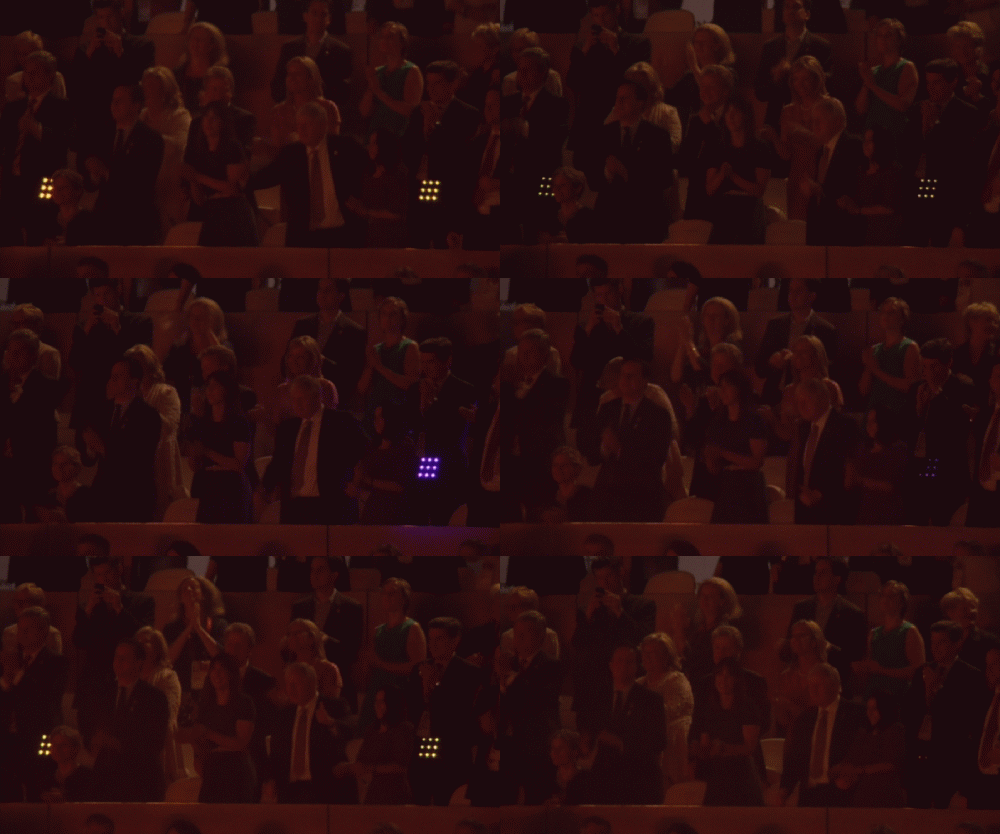
This is nothing new for Olympic closing ceremonies, of course, which always tend to be a bit poo, particularly when compared to the opening counterparts. But this was just… bizarre, really. And not especially good. There was a lot of celebration of British music that wasn't that good — Jessie J, Tinie Tempah, Taio Cruz (no, I didn't know he was British, either) were particular lowlights — and some utterly sacriligeous bollocks in the form of Jessie J butchering Queen with her characteristic out-of-tune caterwauling. Apparently the Spice Girls were involved at some point, but since I had left the room to go for a dump as soon as a video of John Lennon came on whining his way through "Imagine" showed its face, I missed them. And I'm not sorry. The Spice Girls never were good live. They were, however, responsible for this .gif of David Cameron clapping on "1" and "3" (twat!) and Boris Johnson dancing like your embarrassing uncle at a wedding:

Perhaps the most noteworthy thing about the closing ceremony was the palpable sense of relief as 60 million British people all unlocked their underpants and let rip with one of the biggest waves of snark I've ever seen. Everyone was obviously backed up from two weeks of genuine pride in the country, the achievements of our athletes and the fact that holy shit you guys, we did an Olympics and it didn't suck! It was obvious that everyone felt a lot better after ripping the shit out of the closing ceremonies, so it is, of course, entirely possible that the whole event was designed with precisely this in mind. In which case the whole thing was a wonderfully-crafted work of art that managed to get two weeks' worth of clogged-up snark well and truly ejaculated from the British public just in time for us to go back to the humdrum mundanity of everyday life tomorrow.

Or perhaps it was just a bit poo, really.

Still, regardless of how it ended, the Olympics have been an impressive spectacle and it's been nice to see people taking pride in athletes who obviously do what they do for the love rather than the money. There have been many comments over the last two weeks concerning the obvious differences in attitude between the (mostly) very sportsmanlike Olympians and the whiny, overpaid, spoiled little crybabies that are premier league footballers, and it's true. I hate football precisely for the attitudes that are typically on display from the oafs who are at the top of their game, and there was not a trace of that throughout the Olympics… well, for the most part, anyway. Winners often appeared to be genuinely humble and proud of their victories, while those who missed out on gold didn't tend to blame the referee, the other team, the other manager, the fans or anyone — they simply remained gracious in defeat and, in many cases, promised to come back fighting even harder at the next opportunity.

That's the true thing that should be celebrated from these Olympics. The opening ceremony was cool, sure, and the closing ceremony was entertainingly bad, but neither of those two things are what the whole experience is about. It's about taking pride in the sporting achievements of one's country, and if it can even crack the jaded, cynical old heart of a curmudgeon like me then it's truly something to be applauded.

#oneaday Day 936: Biggest != Best

No, I'm not talking about penises.

Let's talk about Facebook.

Facebook is massive. Facebook has taken over most people's daily existence on the Web to such a degree that there are plenty of people out there who genuinely believe that it is the Web. Like, all of it.

It's not. But then you probably knew that already.

But the fact stands that it is a massive global phenomenon, and something that has happily grown and evolved over time from its humble beginnings up to the multi-bajillion dollar business it is today.

Thing is, though, as it's grown, it's sort of lost sight of what it's for.

"Facebook is a social tool that connects you with people around you," the login screen used to say. When adding a friend, you used to have to indicate how you knew them, and the recipient of that friend request had to verify your story. It was actually quite a good idea that got around the MySpace "friend collecting" issue, whereby people would just add and add and add each other and then not talk to any of their 40,000 friends. Facebook's systems ensured that you 1) were actually friends with the people you marked as friends and 2) didn't fall into the "popularity contest" trap.

Whizz forward to today, and the Facebook of 2012 is a very different place. Now we get people promising "2,000+ friend requests" if you Like one of their pictures. I don't want two thousand friends. I want my online friends to reflect people I actually know, and occasionally give me the opportunity to meet someone new who is relevant to my interests and/or knows people that I know. Give me two thousand newcomers from all over the world, all of whom are vying for my attention simply to make some arbitrary number higher than everyone else, and you sort of lose that.

Part of the reason for this change is the different in what Facebook thinks we should use it for these days. I first joined the site quite a while after many of my friends had — at the time, I assumed it was going to be one of those passing fads like MySpace, and would quickly disappear into obscurity. But I found its value while on a trip to the States to visit my brother — while abroad, I could share the photographs I'd taken and easily stay in touch with my friends as a large group rather than emailing them individually. It was nice.

Over time, things started to shift. Facebook's big change to something a bit closer to its current layout upset a lot of people, and the addition of "applications" marked the beginning of how the social network looks now. At the time, I was of the attitude that the people complaining about it were bleating on about nothing, but in retrospect they may have had a point. As everyone's news feed started filling up with FarmVille brag posts, the signal to noise ratio started getting worse.

Then came the brands. Facebook undoubtedly thought they were doing everyone a favour when they opened up the previously "personal" social network to companies and businesses who wanted to grow their social presence. And in some cases, it worked well, with companies able to engage with their customers and post important information as and when needed.

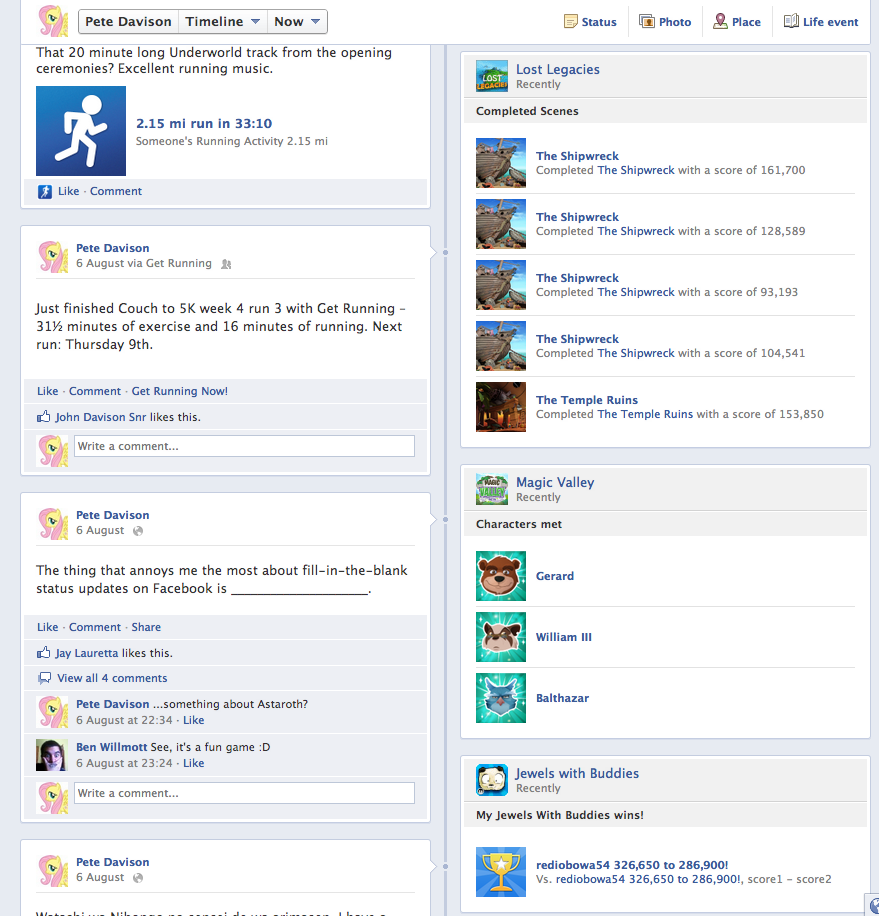
Unfortunately, this too lost the plot somewhere. Now, pretty much every brand page uses the same obnoxious "engagement strategies" to keep people commenting, talking and Liking — the worst of which by far is the fucking awful "fill in the blank" status update that invites commenters to give their own meaningless opinion on something utterly asinine and irrelevant to the company's product. ("My favorite color is ____________!" proclaimed the Facebook Page for The Sims 3 on one memorable occasion. Over four thousand people replied.)

You see, people seem to absolutely love posting things that have absolutely no value. People love thinking their opinion is important, that they are being listened to, that the things they say are somehow valuable to someone.

The things you say are valuable to someone. The people they are important to are called your family and friends. Not the PR representative for The Sims 3. They don't care what your favourite colour is. They just want you to keep giving them page impressions and comments and Likes.

Likes. Fuck Likes. The Like button is Facebook's most enduring legacy, and one of the biggest blows to actual communication in today's connected world. Why comment any more when you can just click "Like"? It means nothing, particularly when it's connected to a sentence for which the verb "like" is completely inappropriate. ("My grandad died. So sad right now." "Insensitive Twat likes this.") It's a meaningless metric designed to measure how many people have seen something you have posted and want to interact with it, but are slightly too lazy to actually write anything.

The diminishing sense of Facebook's usefulness for actual communication is perhaps best exemplified by the current way someone's profile looks. Known as "Timeline", the theory behind it is that it is an easy to navigate history charting everything interesting that has happened in someone's life.

It's a sound plan. Unfortunately its implementation is just terrible.

The problem is that there's no consistency in how posts show up, and seemingly no understanding of how people read content. Leaving aside the fact that one's profile cover image and fairly pointless basic information takes up over 500 lines — or nearly half of a 1920×1080 display — there's seemingly no rhyme or reason as to what gets posted at the "top" of one's profile.

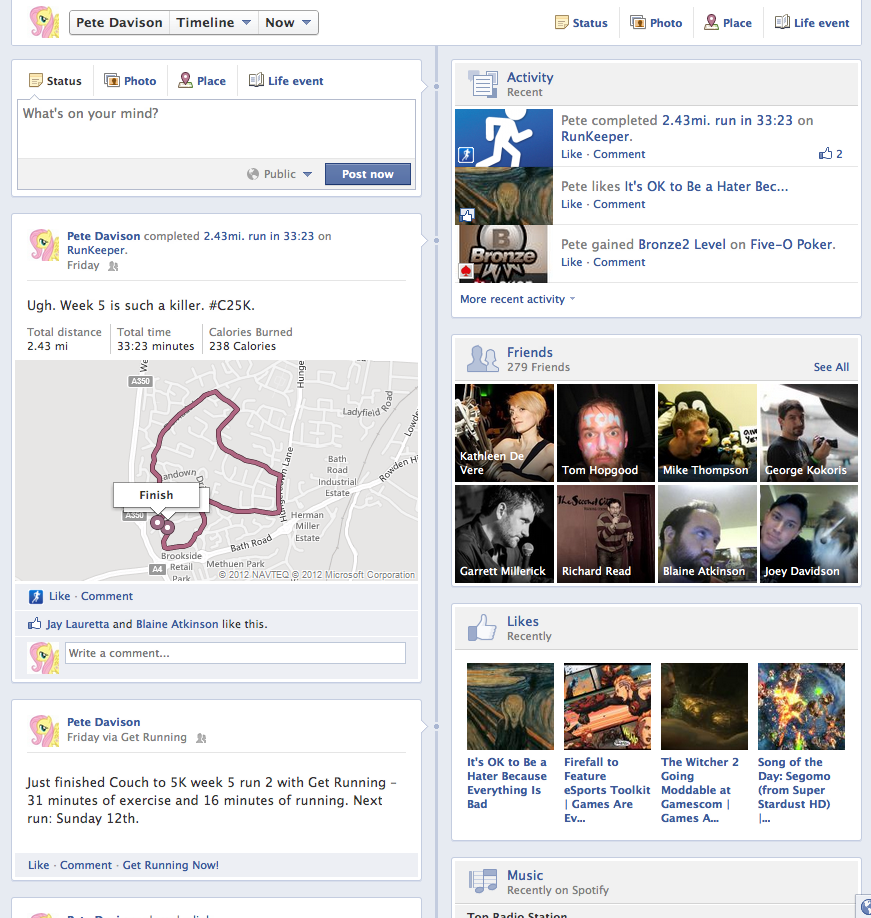
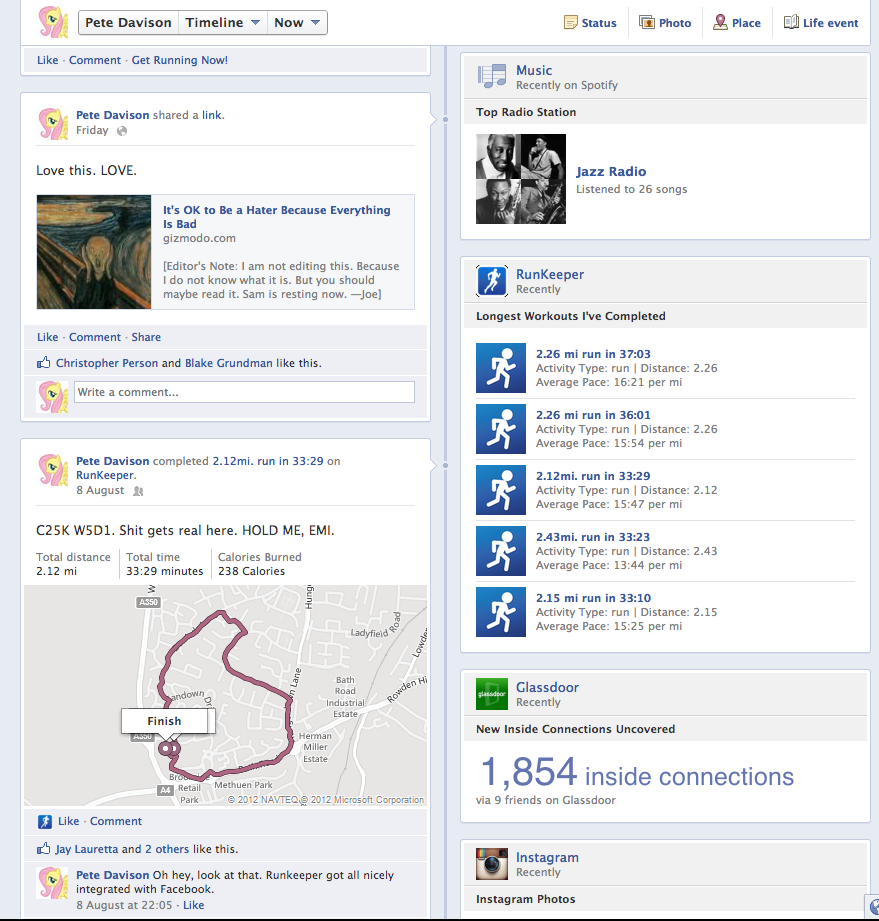
The conventions established by blogs and earlier social networks dictate that the most recent things go at the top, so anyone checking in on someone's page doesn't have to scroll around or search to find something new. Yet with all the sources from which Facebook can pull information these days — games, external sites, apps, Spotify, Netflix —  there is no consistency in what goes where. For example, at the time of writing, this is what the top of my Timeline looks like:
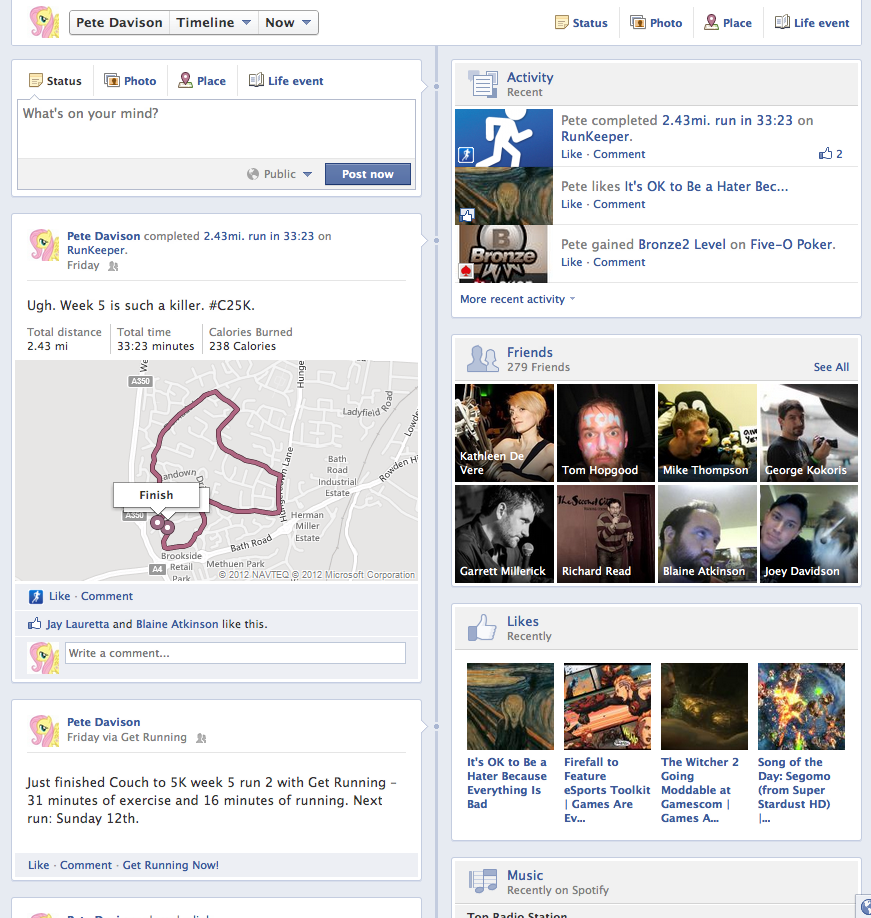
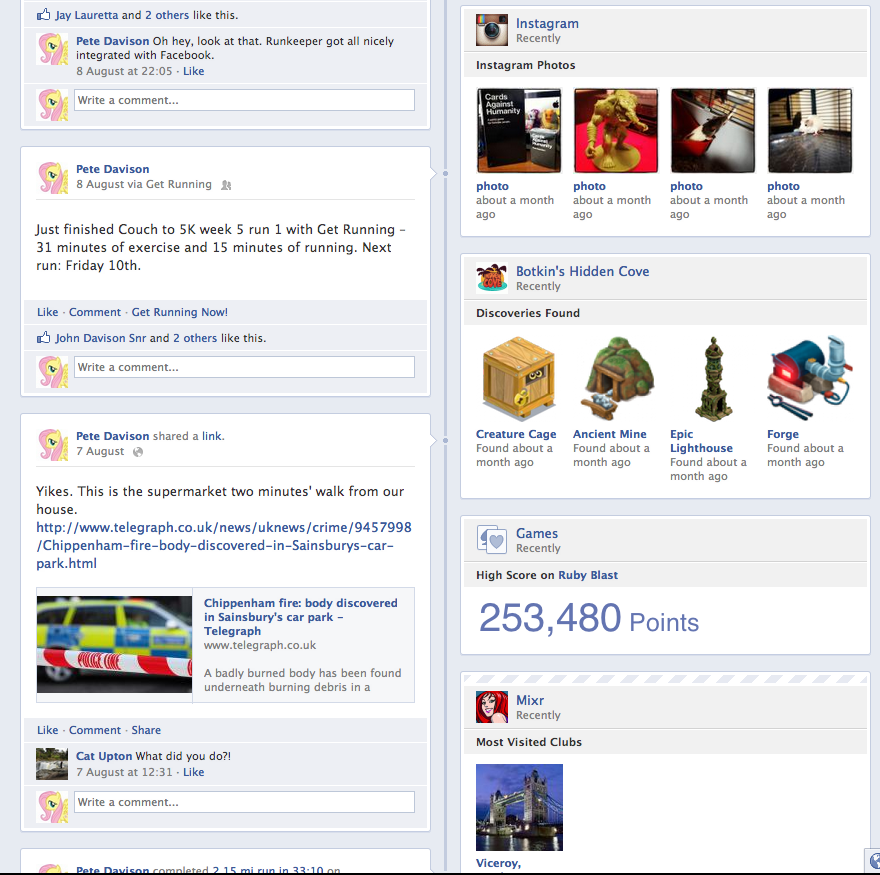
What a mess, and very little of it is stuff that I 1) actively shared and 2) feel people really need to know. I deliberately shared the RunKeeper stuff because I like sharing my fitness achievements because it helps keep me honest, but I have no need to show people who eight of my friends are, nor do people need to know that I achieved Bronze Level 2 in Five-O Poker, a game I reviewed earlier in the week and specifically told not to share shit on my timeline. At the other end of the spectrum, pages that I have "Liked" elsewhere on the Internet — and thus wanted to share with others, perhaps because I wrote them or just found them interesting — have been unhelpfully collected into a single box that shows just four of them. This behaviour changes seemingly daily, with Liked pages sometimes showing up as individual posts on one's Timeline (useful) and sometimes being collected into that box (not useful). At the time of writing, Facebook appears to have decided that "not useful" is the way to go on this one.

Let's scroll down a few "page heights" and see what else we have:
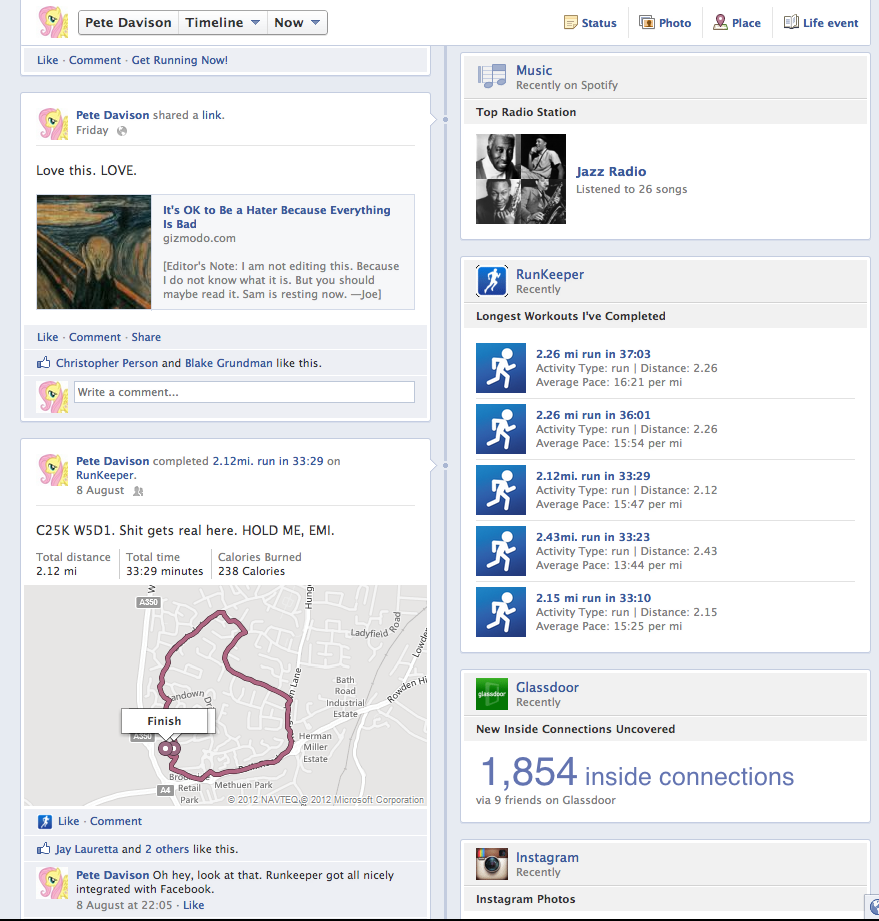
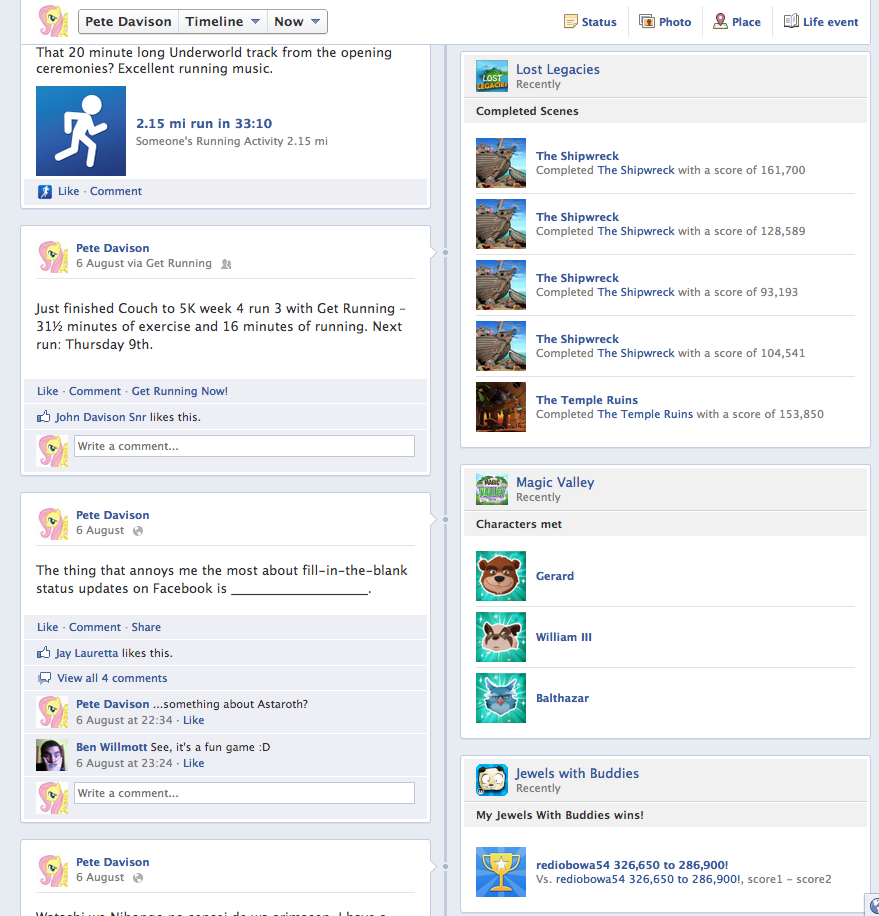
The left column? Sort of all right. The right column, though?
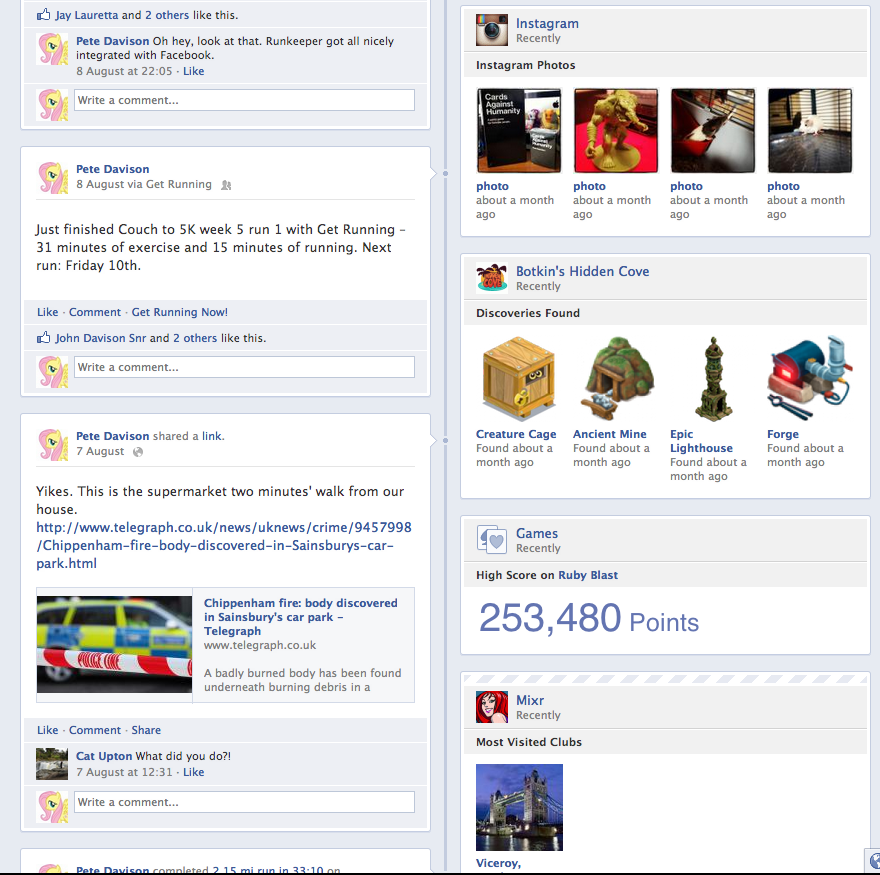
SO MUCH IRRELEVANT CRAP.

Including posts from games that I 1) didn't press a "Share" button in once and 2) have since removed from my Facebook account.
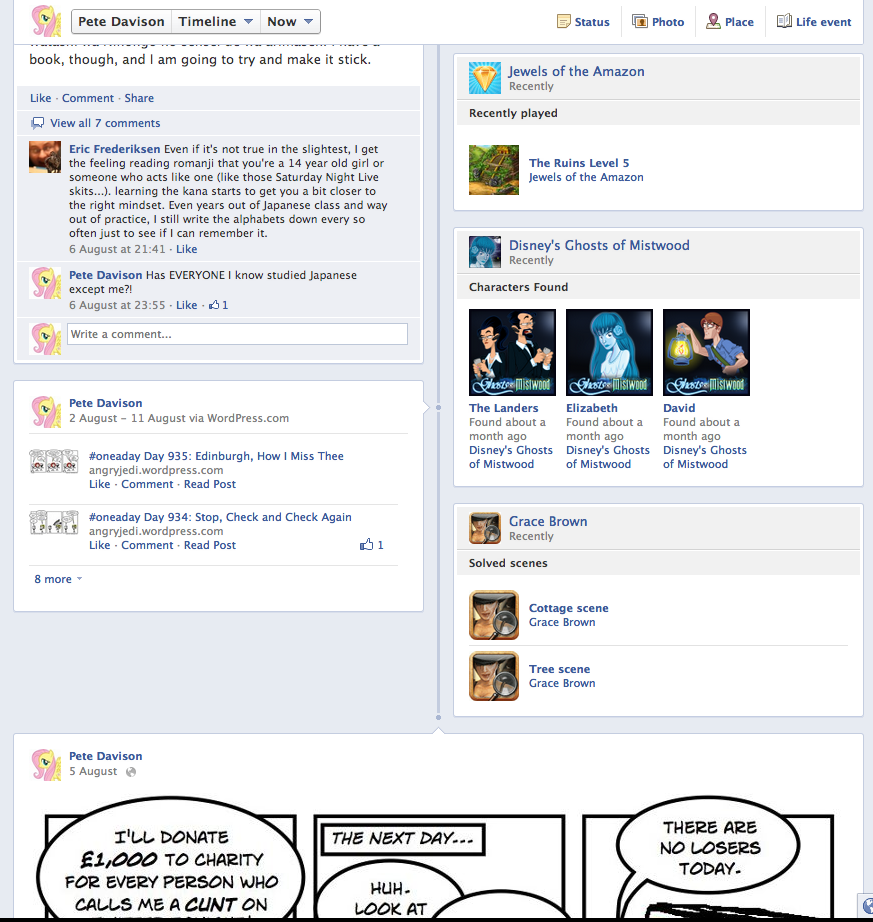
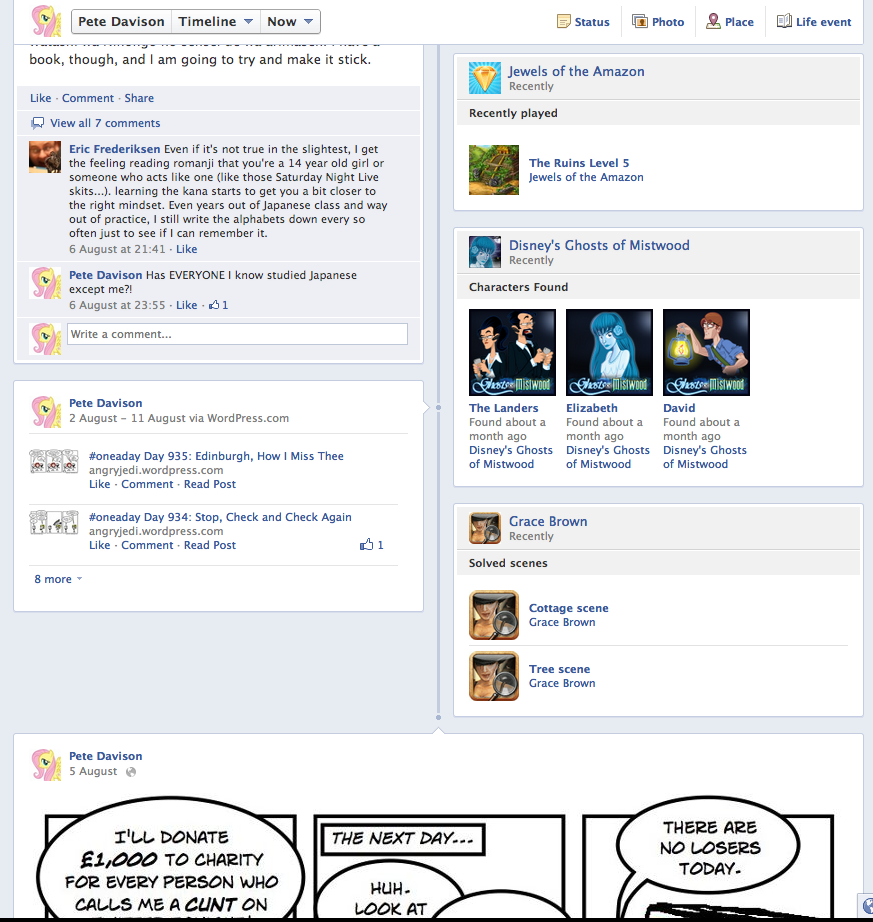
There. After five screen-heights worth of scrolling, I finally get to one thing that I actually want to share with people — my recent WordPress posts, aka a feed from this blog to my Facebook Timeline. Again, though, like the Likes, they have been collected together into a box that displays very little relevant information and, in this case, is put in a stupid, stupid place. Why stupid? Because the most recent post in that little WordPress.com box came considerably after the RunKeeper post at the top of my Timeline — and certainly considerably after all the spammy crap those games have plastered all over that infuriatingly useless right column.

"Facebook is a social tool that connects you with people around you" my arse. "Facebook is a digital scrapbook maintained by a five-year old with ADHD," more like.

I'll see you on Twitter.
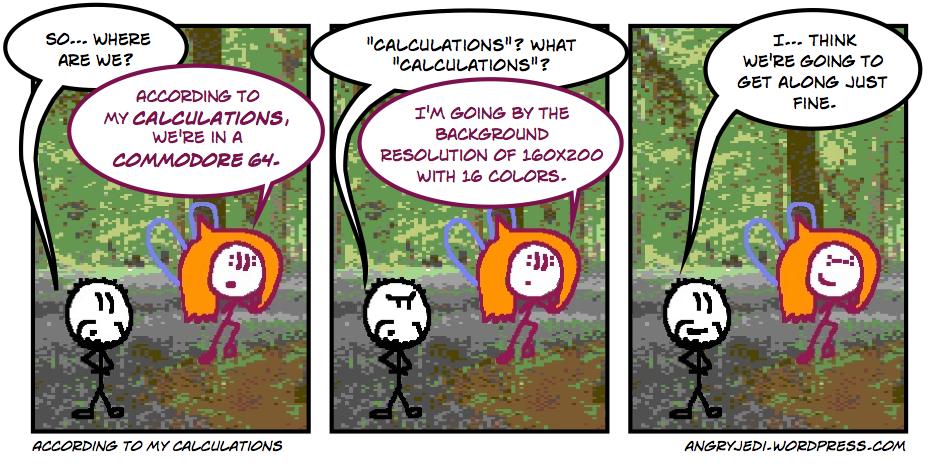


#oneaday Day 934: Stop, Check and Check Again

The social Web is an incredibly frustrating place to be at times. I'm aware that I've commented on this subject a number of times before, but it's important: the spread of misinformation is at best irritating and at worst incredibly dangerous.

The most recent example was a result of this image:

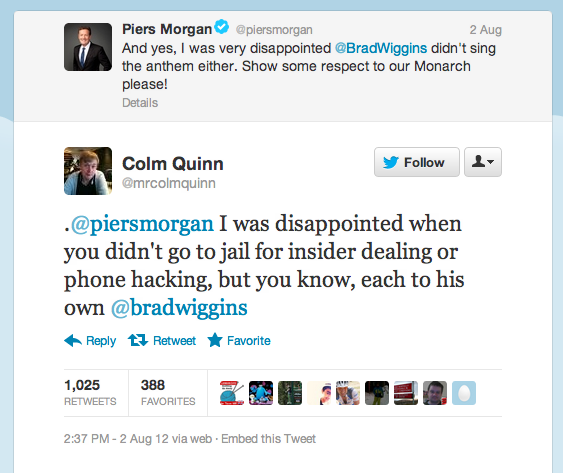
This image has been doing the rounds recently — first on Twitter, where the supposed exchange took place, and subsequently, as tends to happen, a day later when Facebook's denizens caught up with the rest of the Internet.

It is, of course, bollocks. This exchange took place, oh yes, but it was not between Piers "Cuntface" Morgan and Bradley Wiggins. No, instead, this is what happened:


You have doubtless noticed that the person who replied to Piers Morgan was not, in fact, Bradley Wiggins, and was instead one Colm Quinn, who just happened to mention Wiggins in his tweet, which is where the misunderstanding came from — probably from someone who doesn't quite understand how Twitter works. (Ending the message with "@bradwiggins" could look like a "signature" to someone not familiar with the way a typical Tweet is structured.)

As usual, however, the fact that "BRADLEY WIGGINS GAVE PIERCE MOREGAN AN AWESUM COMEBAK" makes a better story than "SOME DUDE YOU'VE NEVER HEARD OF GAVE PIERS MORGAN AN AWESOME COMEBACK" struck, and it struck hard. The (inaccurate) story spread like wildfire, of course, with no-one bothering to actually check Wiggins' timeline to see if he actually said the things that were attributed to him. And it spread. And spread. And spread.

Over time, some people got wise to the truth of the matter and pointed this fact out. But more and more people continued to post the inaccurate details — and then it spread to Facebook, and the whole thing started all over again, with both sides getting increasingly frustrated with one another.

I know it's a seemingly silly little thing to get riled about, but like I say, consider the potential implications if the "fact" that started spreading was something that could actually put someone in danger, or ruin a person's reputation. When the entire social Web starts acting like Daily Mail reporters by just blindly reposting things without even bothering to see if they're true or not, we have the potential for a real mess. Just look at the reactions of Facebook-bound idiots who don't know what The Onion is for a preview of what might be.

Fact-checking isn't just for journalists. Of course, there are plenty of journalists out there who seem to think it doesn't apply to them, either, but that's another matter entirely. It takes a matter of seconds to check something like a Tweet is the genuine article. You should be immediately skeptical of anything posted as a screen grab of a bit of plain text that looks like it was written in WordPad, or anything described by someone as SO AWESOME/FUNNY/HILARIOUS/LMAOOOOOOO etc. And, most importantly, if something sounds like it was too awesome to be true, it probably was.

Respect to Mr Colm Quinn for his excellent admonishment of Piers Morgan's twattish behaviour. Disrespect to all of you out there (you know who you are) who fall for this crap every time, whether it's "OMG TODAY WAS THE DAY MARTY MCFLY WENT TO IN BACK TO THE FUTURE PART II!" (for the last time, it is October 21, 2015) or "OMG! PIERS MORGAN GOT BURRRRRRRRNED BY BRADLEY WIGGINS".

Simple routine: before you retweet or share something, stop, check, then check again. It's not that hard.


#oneaday Day 930: Conditional Philanthropy

I will never understand people — particularly famous types — who are deliberately obnoxious, and who clearly get off on negative attention, conflict and repeatedly proving what an arse they are.

There are a number of people I can think of who fit into this particular category, but the one who springs most readily and frequently to mind is Piers Morgan, erstwhile editor of the News of the World and the Daily Mirror and presently dripping his own peculiar brand of slime over American television sets thanks to CNN.

Piers Morgan's crimes against common decency are too many to enumerate, but his recent behaviour regarding the Olympics has drawn the ire of a number of people.

For those unaware of what he has been up to, it started here:

And continued:

And continued…

AND CONTINUED…

Morgan, it is fair to say, had something of a bee in his bonnet over the fact that some members of the British Olympic team didn't sing God Save The Queen after winning a medal. He appeared to think that this was incredibly important, and that it was worth putting down their impressive, world-beating sporting achievements for.

Then came the bribery and guilt-tripping:

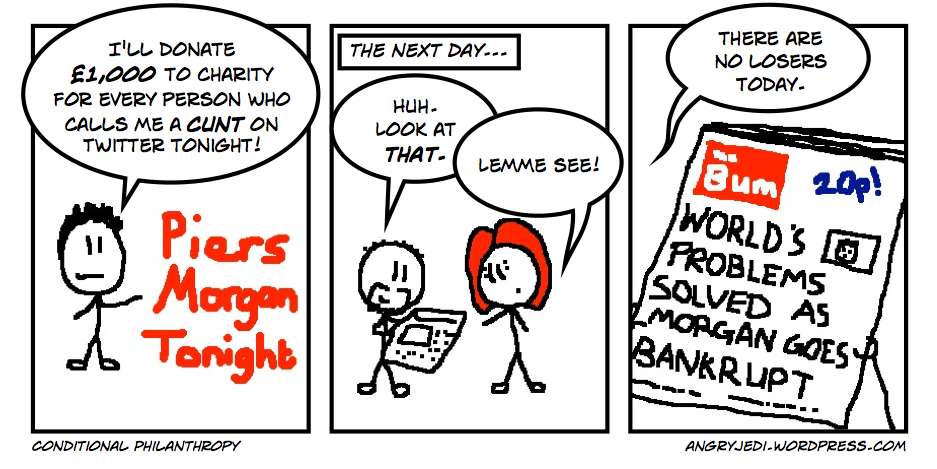
Generous, non? Well, it could be argued as such, yes — he has no obligation to donate anything to Great Ormond Street children's hospital, after all — but dig a little deeper and this whole thing just becomes a bit sleazy, really. By not donating a proportion of his undoubtedly vast wealth to Great Ormond Street simply because of an athlete not singing the anthem — not taking into account the fact that winning an Olympic event is probably a pretty emotional moment for any sportsperson — Morgan is implying several things: firstly, that his apparent philanthropy is, in fact, conditional, and secondly, that athletes who do not sing the national anthem after winning a Gold medal are somehow child-haters.

The gloating didn't help.

Neither did the inconsistency:

Or the abuse:

Basically, there was just something incredibly distasteful about the whole thing. Morgan was clearly just trolling for responses, and he got them by the bucketload — and yes, I'm aware I'm part of the problem here. We don't even have any guarantee that Morgan is actually going to cough up the £15,000 he currently "owes" Great Ormond Street.

He probably will, of course, because he then gets to look like the hero who donated £15,000 to a children's hospital — and also gets to rub how much money he has in the peanut gallery's faces, of course — but I can't help thinking that it is for entirely the wrong reasons. If he feels that strongly about supporting Great Ormond Street, he should just donate the money, not hold his contributions to ransom based on something completely unrelated — something that could potentially make the non-singing athletes look like child-hating dicks in the hands of an unscrupulous (read: Daily Mail) reporter.

Morgan's not making a point here. He's simply waving his willy around in an attempt to make us all feel bad in one way or another. Don't sing the anthem? You're unpatriotic. Don't have as much money as him? HAHAHA YOU'RE POOR. Criticise Morgan's true motivations for this little exercise? YOU HATE SICK KIDS AND ARE A PIG-IGNORANT VACUOUS LITTLE TROLL.

There are several things that remain a mystery out of this whole thing. 1) Why is Piers Morgan still relevant? 2) Why are there people standing up for him? 3) Why does he have to be so fucking infuriating and get off on all this "controversy" he's stirring up? He's like that school bully who would just shrug off any insults you threw at him then punch you in the face and still, somehow, end up being the most popular kid in the school despite being the very worst kind of odious cretin imaginable.

Fortunately, this being the age of social media, at least one good thing has come out of this whole debacle: this JustGiving page aiming to make up the difference in donations that Morgan has refused to give due to athletes not singing God Save The Queen. It's a lofty goal, but if the world can harness its hate for Piers Morgan to raise £14,000 for sick kids… well, admittedly that's not the best reason in the world to give money to charity, but it's sure better than holding the donations from your own incredibly deep pockets to ransom.