1151: Twitter Let Me Down (Or: Why I'm Not Going Back)

Page_1Let's recap.

About a month ago, I was the victim of an organised "cyberbullying" campaign on Twitter. (Aside: I hate the term "cyberbullying", but it seems to be the accepted terminology so I will use it for now.) Members of an Internet-based organisation known as the "GNAA" (NSFW Wikipedia link) started harassing me, attempting to spread slanderous rumours that I was a paedophile, and copying me in on their pronouncements, presumably attempting to get a rise out of me. I blocked and ignored them as is the sensible thing to do in this sort of situation, but still they kept coming.

They started phoning people close to me — specifically, my brother and the owner of Games Are Evil, both of whose phone numbers are stored in the "WHOIS" information for their respective websites. Not just one phone call, either — several, each increasing the intensity of the threats to get the authorities called on me for my supposed (and, I'm sure I don't have to add, fictional) perversions.

The reason for this group's attack on me, it transpires, was the fact I had the word "Brony" on my Twitter bio. ("Brony", for those who don't know, is the term for adult-age fans of the recent My Little Pony: Friendship is Magic TV show, a group which I identify myself as being a part of. Seriously, that show's great.) This group had been attacking Bronies for a while and attempting to slander them in similar ways. They were also responsible for a high-profile attack on the social networking/blogging platform Tumblr back in December — said hack was also an attack on the Brony community.

Because this unprovoked assault on both me and my reputation was frightening and unpleasant, I reported it to Twitter. Because it was spilling out of the online sphere and into the "real world" with the phone calls, I also reported it to my local police station. The latter weren't able to do much about it — I wasn't really expecting them to be able to, to be honest — but I did at least feel somewhat reassured that I'd done all the things they would have suggested I do in this situation: change my username, block the perpetrators, do not engage with them, let other people know what's going on. Eventually, the perpetrators tracked down my new username and hijacked my old one, using it to impersonate me with the most obviously fake "this is what a paedophile does" sort of posts you'd ever see.

I reported the impersonation to Twitter as a separate issue, which required me to fax them a copy of my passport at my own expense to prove my identity. (Fax? Seriously?) It took them a few days to respond to this, but they eventually suspended my old Twitter username to prevent it from posting further offensive content in my name; in the meantime, I closed my Twitter account completely.

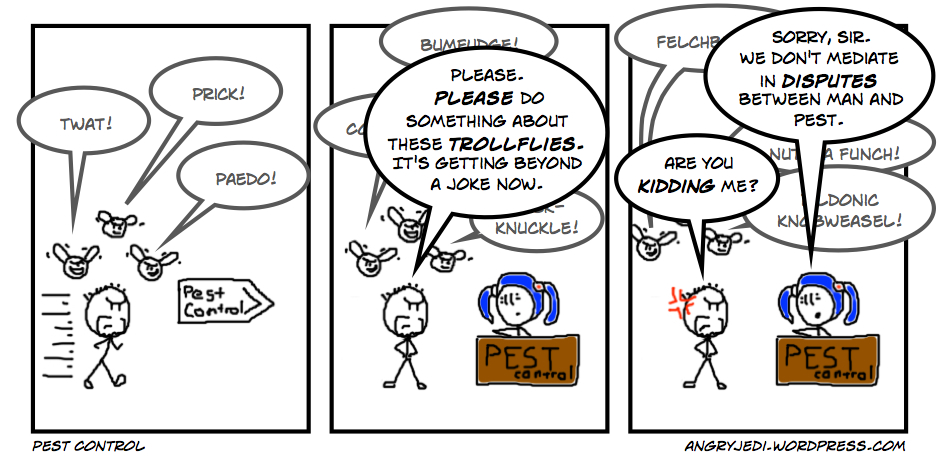
What I'm particularly disappointed about is Twitter's handling of the rest of the issue. I reported the problems I had been having back when that original post I linked to was written — mid February — and only received a response last night. The response I received was boilerplate text that simply said there had been no violation of Twitter policy, and that they didn't mediate in disputes between users. No attempt to address my concerns. No response to the fact that I had clearly laid out a series of tweets that showed an organised — and demonstrably unprovoked — campaign of hate against me. No concern for my wellbeing.

There is a difference between a "dispute between users" or a "difference of opinion" and an organised campaign to victimise someone based on their tastes and preferences. The offenders in this particular case went above and beyond simple name-calling into full-on harassment of not only me, but also my family and friends — and not only on the Internet, but also over the phone. None of this appears to have been taken into account in the month that Twitter's safety team have had to review this situation. In the meantime, the unpleasant individuals responsible for causing me such upset remain at large and unpunished, free to do it again to someone different for just the same stupid reasons they attacked me.

For this reason, I will not be returning to Twitter as a means of personal communications or social networking. While I appreciate a network of that size is difficult and time-consuming to police, that doesn't mean that the site's user safety department should get to just sit back and say "deal with it." This incident caused me considerable personal distress, and doubtless it upset and confused my family and friends who were dragged into it, too. The complete lack of concern Twitter's user safety department has shown towards a demonstrable case of organised harassment and bullying means that I do not feel comfortable trusting them in future; consequently, I will not be returning.

I doubt they care, of course; one user is but a drop in the ocean. I felt the need to share my frustration regarding this issue, however. Cyberbullying is a real problem that destroys lives — literally in many cases — and for Twitter to just turn a blind eye like this doesn't strike me as particularly acceptable.

If you used to follow me on Twitter, please feel free to share this post with any of our mutual friends. I would like to spread the word about this if at all possible.

Thanks, as always, for listening.

1144: A Life Without Nerd-Rage

Page_1I haven't even contemplated going back to Twitter yet, but not because I have no desire to run into the scumbuckets who drove me off it in the first place. No, my lack of desire to go back to Twitter stems from my dislike of irrational table-thumping arguments on the most ridiculous of subjects, usually video game-related.

Mr Craig Bamford said it best back in February:

CAN WE PLEASE STOP TRYING TO HAVE SERIOUS DEBATES ON TWITTER OF ALL THINGS?

See title.

No, really. See title. I’m enormously, impossibly tired of how everybody who writes about games seems to think that the best-or-only way to have debates on serious, often wrenchingly-personal issues is on Twitter.

Yes, I’m guilty of this myself. I know. But every single time it happens, I feel like I’ve made a mistake. I’m just reminded of how Twitter is an incredibly dumb way to handle these things. The posts are too short, there’s no proper threading, you can’t follow the discussion properly unless you follow everybody involved, expanding the size of the group makes it even worse, you can barely mention people without drawing them in…

…it’s just a gigantic dog’s breakfast that makes absolutely everybody involved look bad.

Worse, it elevates bad arguments. It seems custom-tailored for dumb appeals to authority/popularity and thrashing of strawmen and misquotation and pretty much everything OTHER than an actual grownup  discussion of issues. It’s absolutely one-hundred-percent boosting the arguments that are “simple, straightforward, and wrong”, as the saying goes. That likely has a lot to do with why everybody seems to rush to the most extreme interpretation of arguments and positions. Extreme arguments tend to be straightforward ones.

Sure, there’s worse. Facebook, for example. But every day I’m more and more convinced that Twitter should really be used to link to  arguments, instead of make arguments. It’s not working. So, please, stop.

I agree with him entirely. Too many times over the last year in particular have we seen game journalists and critics with disproportionately loud online "voices" telling us what to think. Usually these loudmouths are attempting to address the issues of sexism and misogyny in the industry — a noble goal, for sure, as few can deny that women still get treated like shit at times through no fault of their own — but more often than not they get so embroiled in beating their fists on their desk that they lose all track of their arguments and end up coming across as… well, a bit childish really. Often these rants come about when the full information on a given situation isn't available, either — they're a kneejerk response to things which often aren't the "problem" they appear to be at first glance.

Let's take the recently-released Tomb Raider reboot as an example. I haven't played it yet, but I've been discussing it with a friend who has this evening. He's an intelligent sort of chap with a keen critical eye, and he has found himself very impressed with the depiction of the young Lara Croft as a vulnerable young woman caught up in a situation that she isn't entirely comfortable with, and having to do things that she finds difficult or scary. The tale of Tomb Raider is as much one of Lara overcoming her own difficulties at dealing with particular things as it is about… whatever the overarching plot of the new game is. (I'm intending to "go in blind" when I eventually play it, so I have no idea what the actual story is about.) My friend compared it to the movie The Descent, with which it sounds like it shares many of its themes and much of its tone. This means that Lara is frequently put in various types of danger — from the environment, from wild animals, and from other people. This also means that there are times when the wet-behind-the-ears young Lara is absolutely fucking terrified of what is happening to her, and justifiably so.

Is this sexist? No, not really; it's a perfectly human response to shit your pants (not literally… I don't think) at the prospect of having various forms of unpleasantness inflicted upon you, regardless of whether you're male or female. Likewise, as much as we would like to forget it happens, violence and sexual assaults do happen to women — and men too, for that matter — because there are certain portions of human society who are complete scumbags who have no regard for human life, male or female.

Lara happens to be female, which means that the situations she is put in over the course of Tomb Raider have been under a disproportionately greater amount of scrutiny than if she was a male hero — regardless of whether or not said male hero is a realistically-rendered character (as Lara is intended to be in this reboot) or a muscle-bound caricature. Lara is put into some difficult situations over the course of the game, including at least one scene where she appears to be at risk of sexual assault. Much was made of this scene when it was first revealed — particularly comments from the development team that it would make players "want to protect Lara". This was immediately interpreted by the aforementioned loudmouths as being misogynistic and in a sense they're correct to say that — the characters in the game are misogynists who don't care about Lara's wellbeing. But — and here's the thing — this doesn't mean that the developers share these attitudes just because they put these characters in the game. You have to have conflict and tension for something to be exciting. Did it have to be the implied threat of sexual assault? No, of course it didn't, but equally that doesn't mean we should shy away from such subjects in our entertainment — to do so can actually be pretty harmful, as it makes genuine victims of this sort of thing feel like their suffering is something to be ashamed of. It's also just plain insulting to grown-ups who want their entertainment to acknowledge that Sometimes Bad Shit Happens to Good People.

I don't want to get too bogged down in Tomb Raider because it's just one example of this sort of thing going on. I happened to sneak a glance at Twitter earlier out of curiosity and it seemed that the latest controversy to hit the Intertubes related to Sony's new God of War game, which features an automatically-attained story-related Trophy awarded to the player the moment after the lead character Kratos stomps on the face of a Fury following what, I assume, is one of the series lengthy combat sequences. The trophy is called "Bros Before Hos", which is arguably somewhat in bad taste, but we're talking about a series full of a muscle-bound man ripping the eyeballs out of mythological creatures the size of your average Ikea while shouting incoherently, so I think we can agree that subtlety went out of the window a long time ago.

Because a Fury is a woman, this scene (and by extension the Trophy) is now misogynistic. Again, it might well be in the context of the game — I haven't played any of them so I don't know what sort of person Kratos is (besides "the angriest man in Greece") and what his attitudes towards women are — but in the case of the game's development, God of War is based on established mythology (or an interpretation thereof, anyway) in which the Furies were (are?) female, and not very nice things to encounter to boot. If you had the opportunity and the means, you would probably want to stamp on their face too, and that's nothing to do with the fact they are women — it is, however, everything to do with the fact that they are infernal goddesses of much unpleasantness. Do we now have to disregard established mythology because of concerns over violence against women? No, that's ridiculous; that's wrapping the world in cotton wool, which helps no-one.

Note that in all of these cases I am not advocating for people to be free to promote things that are harmful to society. I would feel deeply uncomfortable playing a game in which you were somehow rewarded for inflicting domestic violence on someone, for example — although if tackled with sensitivity and care (which many triple-A developers lack, but which many smaller-scale or indie developers have proven themselves to possess in abundance) it could be possible to create an interesting, if distressing sort of interactive story about domestic violence. (In fact, it has sort of been done at least once, to an extent anyway: for a fascinating and challenging exploration of an abusive relationship through the use of allegory, play the game Magical Diary — which was written by a woman — and pursue the romance with Damien.)

What I am instead saying is that getting outraged any time a female character (or, for that matter, a non-white, young, elderly, homosexual, trans or other "non-white twentysomething cis male" character) is placed in peril, regardless of the circumstances, is counter-productive. It diminishes the value of the arguments as a whole, and distracts attention from content that genuinely is a problem. After the controversy over the Hitman trailer with all its leather-clad nuns and other assorted ridiculousness dreamed up by the 14-year olds in Square Enix's marketing department, I confess I found myself blocking most of the people involved in the "discussions" around the issue on Twitter not because I wanted to deny there was a problem, but because I couldn't deal with the way people were arguing about it. There was no debate, no discussion — nothing but "I'm Right, You're Wrong" for day after day. And as soon as one controversy subsided, another appeared. And so it continued for month after month after month. It made me stop caring completely, which is the complete opposite of what these people presumably intended.

Rage like this doesn't even have to be directed at a sociological issue, though; just recently everyone has been getting extremely angry at EA because of SimCity's online requirement, just like they did with Diablo III. Again, very few people are considering all the facts at play here, which I won't get into now, and instead resorting to kneejerk rage which, if you disagree with, you're somehow an asshole. There always has to be something to be angry about. And it's exhausting.

So, in summary, I am very happy to have now, for the most part, taken a step back from the seething masses — and while said masses are still seething I have very little intention of heading back in a Twitterly direction unless absolutely necessary.

I'll let Irina sum up how I feel about all this with the Understatement of the Century.

President6Quite.


1139: Just Shut Up

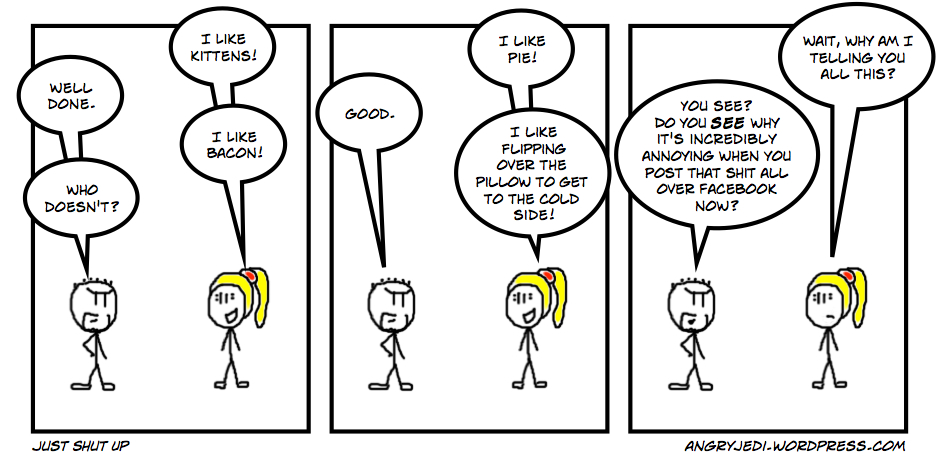
Page_1I think I'm "over" social media. Allow me to clarify that bold statement, however, as it's perhaps not entirely accurate as is. I think I am over social media as it exists today — a sprawling, disorganised mess of ill-defined concepts that contribute very little to the people's understanding of one another, and more often than not is about vanity rather than actual socialisation.

In other words, I yearn for the days when social media was simple and straightforward — when its sole intended purpose was to allow people to stay in touch with each other and perhaps, occasionally, share a photograph or two with them.

Looking back on this blog, I see I have written about this subject at least twice in the past, and my disillusionment with it has only grown over the last year or so — perhaps due in part to the fact that as part of my job I come into contact with some of the most utterly pointless examples of social media that I've ever seen.

These days, there are social media apps to share anything you can think of. I mean, there are literally (YES LITERALLY) apps and services that allow you to share anything you can think of. There are also more specialised ones with questionable usefulness to society as a whole. I reviewed one recently where the entire purpose was to share what your current mood was — you couldn't add any text explaining said mood, only an emoticon — and another where you could share the weather in your local area, then "like" or comment on the weather in other places. Another still allowed you to send a video or photo to someone, but they were only allowed to look at it for ten seconds, after which it locked itself and became useless (I swear I'm not making this up).

The trouble with these things is that despite their pretensions towards being "social media," they're not actually all that social at all in terms of the way in which people use them. They're a means of broadcasting things and seeking approval of other people rather than a means of actually engaging in conversation with anyone. Take a look at the average comments thread on an Instagram picture of a moderately-attractive person (usually a woman) and you'll see what I mean. No-one's actually talking to each other — everyone's just dropping an asinine opinion bomb and then never coming back. The poster of the selfie is seeking approval from commenters telling them how attractive they are; meanwhile, the commenters are seeking approval from the poster and hoping that their specific compliment is the one that will get them some specific attention.

This isn't the case universally, obviously. There are still some actual conversations that go on on Facebook, for example, but these can easily be lost in the torrent of people resharing crap from pages like "I fucking love science" (do you? Then go do some rather than recycling endless fucking memes) and "LIKE AND SHARE!!" (NO!!). Twitter is a reasonable platform for discussion at times, but conversations are easily derailed and, as has been proven hundreds of times in the past year alone, 140 characters is really not enough to make a coherent argument about a complex issue. It's also incredibly easy to be taken out of context on Twitter.

Google+ perhaps fares the best out of all of these services in my experience, though even that's variable. Join a good, small community that has a clear focus and whose moderators keep a tight leash on discussion and you'll have a good experience chewing the fat with people who may well become good friends. Follow Felicia Day or Wil Wheaton and you might see some interesting content, but the quality of discussion goes out of the window. Follow Google+'s own page and all you get are blithering idiots making ill-informed political rants any time the team behind the page even dare to mention the President.

I think the thing that's been striking me most heavily recently is "do I really need to share this? Do people really need to know this?" And more often than not, the answer is "no". I don't feel the need to collect an arbitrary set of "Likes" with services like CircleMe or GetGlue. I don't feel the need to "check in" to places with Foursquare. I don't even really need to use stuff like Raptr to broadcast my gaming activity, but that has, on occasion, sparked some good discussions — as, I'm sure, the other services do in some cases. Just not mine. Not any more. Perhaps once in the past — I met some good friends through Foursquare's now-defunct competitor Gowalla — but not now.

Consequently, since quitting Twitter a while back (and not really missing it, to be honest — though I do miss some of the people) I've been paring back my personal social media use hugely. I've closed my Tumblr account — I never really understood the point of that site, and these days all it seems to be used for is white people shouting about how guilty they are about being white and how we should all stop being such racists/misogynists/fedora-wearing perverts — and I've unistalled the vast majority of social apps from my phone, including Twitter and Instagram. Facebook made the cut, because as much as I dislike it at times, it's still a good way of staying in touch with a lot of people, and Google+ also survived, as it's the new home of the Squadron of Shame and serving our needs well.

Obviously this blog is still going, too (and will be for a long time to come, hopefully!) and I still comment on friends' blogs — but I don't really count that as "social media" in the same way, particularly as the discussions had tend to be (for the most part, anyway) wordy and thought-provoking rather than inspiring little more than a knee-jerk "lol".

Everything else, though? Out the window. And life is much calmer and more pleasant as a result.

1130: Pour One Out for 1up.com

The "digital age" brings with it many benefits — most of which relate somehow to the concept of "convenience" — but an unfortunate side-effect of it is that things aren't as permanent as they once were. Sites grow, change and relaunch, and occasionally die altogether.

Today it emerged that Ziff Davis, former owners of 1up.com until it was sold to IGN, and now the company that owns IGN (and consequently 1up.com again… yes, it's confusing) would be shuttering three sites, including 1up.com.

This is immensely sad news for a number of reasons. Today I will primarily be outlining my own personal feelings about that site; I'm sure a number of people reading this will have their own opinions and thoughts about the site and the changes it's gone through over the years, so feel free to share them in the comments.

I first became aware of 1up.com while my brother was working at Ziff Davis on Electronic Gaming Monthly and the Official U.S. PlayStation Magazine (I think I've got that chronology right). He played an important role in shaping the site and its content, and it became a regular hangout for me not just because of me supporting my bro, but also because I really liked what it was doing. It was my first real contact with what was to become "social networking", and I found myself really enjoying making use of all the site features — the ability to blog, the forums, the ability for users to create clubs and communities as part of the main site. My 1up blog was one of the first places where I wrote about games regularly, primarily for myself but also in an attempt to keep myself in "practice" should I ever find myself in a situation where I'd be able to do so professionally.

My main reason for thinking so fondly of 1up.com is the Squadron of Shame. I've told this story before, but it doesn't hurt to tell it again.

The Squadron of Shame was a group of people who came together as the result of a fairly throwaway feature on one of 1up's podcasts. The podcast participants had got talking about their "Pile of Shame" — all the games they owned but had never got around to finishing (or even playing in some cases) — and discussion had turned to Tim Schafer's cult classic Psychonauts. The intention was for the Pile of Shame to become a regular feature on the podcast as the participants played through the games together and gave their thoughts on more obscure titles that people might have missed out on.

It was a short-lived feature, and quickly abandoned on the show — but a bunch of people on the 1up forums really liked the idea and thus decided to come together and finish the job they'd started. We checked out Psychonauts and had a blast playing through it together. Then we started talking about other games that people might have missed — System Shock 2Psi OpsOdin Sphere and all manner of other titles. For each one, we made a thread on the forums for discussion, played through it together and got to know each other a bit better in the process. It was a fantastic experience, and I made a lot of very good friends in the process — friends who I still "talk" to on a daily basis even today.

Trouble was on the horizon, though. The once-sprawling 1up.com forums, which used to be split into a wide variety of distinct sections, were merged into simple "Games" and "Not Games" categories. The Squadron of Shame's threads used to call the "1up Radio" forum home — this forum primarily related to the site's podcasts and the features therein, and was generally a home of more mature, respectful discussion than other parts of the forums as a whole. Suddenly, though, our thoughtful threads — which often included long posts with members writing mini-essays on their experiences with the games we were playing — were lumped in with all the "wot iz ur favorit wepon in halo" threads from the hoi polloi of the site. Consequently, on at least one occasion we found ourselves being rather unpleasantly trolled by users who, for some inexplicable reason, took great umbrage to our writing of posts that included more than five words, knew how to use paragraphs and punctuated properly, and discussion wasn't quite so easy any more.

Around that time, the "club" pages on 1up got an overhaul; there used to be a "communal blog" where individual members could post in a linear fashion, but this was replaced by a dedicated forum just for that club. We made use of that for a while, but further trouble was on the horizon with the event which became known as the Great Upheaval, when a huge proportion of the talent from the site was laid off as part of the transition to new owners UGO. The site wasn't the same after that, so a lot of people drifted away from the community, mostly to places such as Twitter.

It was around this time that we started producing the Squadron of Shame SquadCast, an irregularly-occurring podcast that continues the Squad's original mission in earnest. To this day, we still have a small but dedicated following keen to tune in and hear our thoughtful, mature (and lengthy!) discussions on obscure games and gaming-related topics. It's something I'm really happy to be a part of, and something that still feels me with great pride any time I hear someone from outside my core friendship group talking about — people like Garnett Lee, one of the original 1up podcasters who gave us the idea in the first place.

Today, the Squad primarily lives on Google+, which seems to be a good home for our discussions. You can check out and join our community here. Prior to that, a healthy amount of discussion also took place on the "Squawkbox", a WordPress site we set up to emulate the old-school "club journal" format from the original 1up.com club, but which is now primarily used as a site linking to the SquadCast's archives. There have been plans on and off to make a "proper" Squad site for many years now (including a nice-looking mockup), but they're yet to come to fruition. One day…?

Anyway, I'm drifting off the point somewhat. The main thing I wanted to say is that none of this would have happened without 1up.com. Without 1up.com, I never would have met this disparate group of people from all over the world and made a group of friends with whom I really feel that I can be "myself". Without 1up.com, I wouldn't have as solid a "support network" as I feel I do today. Without 1up.com, there's every chance that I'd be a lot more lonely than I am today. I feel privileged and honoured to have met everyone who came together as a result of the Squad, and am glad that we're still attracting new members a few at a time every so often, many of whom are fast becoming just as good friends as those who I have known since those early days of the group. I now have a solid group of international friends that I trust and depend on, and without 1up.com I simply wouldn't have that. (Of course, there's every chance that I would have made a similar group of friends on a different website, but, you know.)

So it's for this reason I'm sorry to see 1up.com go. The loss of the articles and writing talent on the site is sad too, of course, but for me it will always be the community side of things that captured my heart and imagination, and showed me that my passion for video games was not something to be embarrassed or ashamed about, but instead celebrated and explored.

So thanks for the memories, 1up. You'll be sorely missed.

1128: Suddenly Silenced

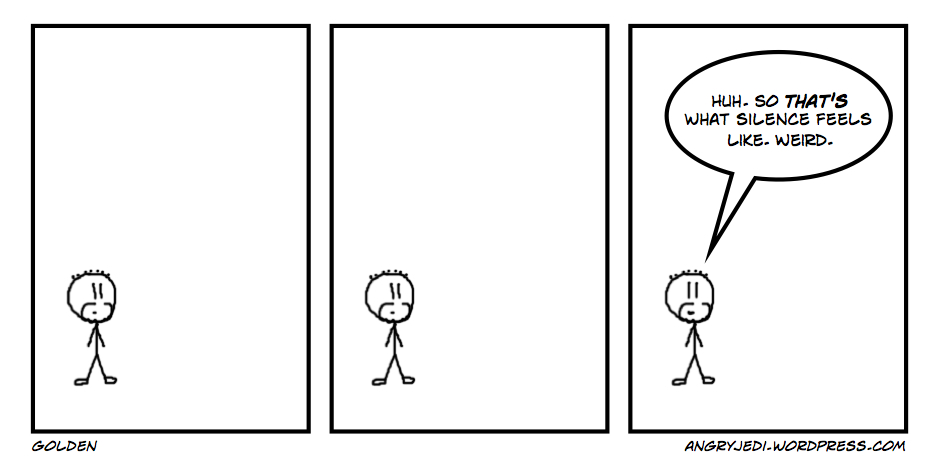
Page_1While I don't particularly relish the circumstances under which I left Twitter recently — which I won't go into now as it's all still a bit "raw" and upsetting, to be honest — it's sort of been nice to not have the omniscient little blue bird hovering over my shoulder all the time.
Twitter was a big part of my life for a very long time. According to my Twitter archive — which I downloaded before I closed my account — I first posted a tweet on May 8 of 2008, but didn't really do anything with it until the end of June of that year. It's fair to say that I — like many other people — didn't really "get" what it was all about to begin with, largely because it was so ill-defined and hadn't pervaded popular culture quite as much as it has today. "It's like Facebook statuses," I'd say to people when trying to explain it, "but without all the other crap."

It sort of is like Facebook statuses without all the other crap — those early tweets of mine very much followed the "Pete is… [doing something]" format — but it quickly became a lot more than that. It became one of my primary means of communication with my international friends.

As many of you reading this may know, I have a lot of friends, but disappointingly few of them live in the same place as me. I have at least rectified that a little by moving back to Southampton to be near my university and board game buddies, but many of my other friends are still scattered the world over, all the way from America to Japan and lots of places in between. It's sort of awesome to have such a global group of friends, though it naturally means that I've never actually met an awful lot of them and possibly never will in some cases. It also meant that I needed a good, simple, reliable means of staying in touch with them; Facebook was all right, but as it gradually became more and more cluttered with crap, fewer and fewer people were using it as a serious means of communication. Today, it's a bloated mess that it's very difficult to be "heard" on, but it still has a place.

Twitter, meanwhile, was simple, pure and to the point. It was like exchanging text messages with friends, only on a global scale. I made a lot of new friends through Twitter and got to know some a bit better. I got through some tough times, too; the immediacy of the service meant that it was a good outlet for me to talk about the way I was feeling when I was going through my "difficult period" a few years back, and I appreciated the support I got from my friends — and sometimes strangers — during that dark period.

Twitter is addictive, though. It becomes a compulsion. Install it on your phone and you'll find yourself idly opening the app to see if anyone has said anything interesting in the last two minutes, even if you just stepped away from your computer where you were staring at a Twitter client. You'll find yourself wanting to step into (or start) conversations at silly hours in the morning, and get relatively little sleep as a result. It'll worm its way into your life, in short, and start to take over.

Not that that's necessarily a bad thing — as I've already outlined above, it proved to be a good means of communication for me, and a good means of meeting new people. It allowed me to put myself out there a lot more than I feel comfortable doing in the "real world", and in many ways helped me to build confidence. And let's also not forget that I met Andie through Twitter, so that's pretty cool.

The recent things that happened to me, though, brought the service's public nature into sharp focus. Sure you can be free to be open and honest about your feelings, your likes and dislikes, but that also means that you can be open to attack, too, without provocation. And once you're in the sights of one of these obnoxious groups, it's very difficult to get yourself out of them. Twitter the company aren't much help, either — after several support messages keeping them apprised of everything that was going on, the only thing I've heard from them is a request for a clarification on something. They take great pains in their terms and conditions to say that they don't mediate personal disputes — though I feel there's a strong case for what happened to me to be considered a criminal offence, and as such I reported it to the police and intend to keep hounding Twitter until they do something about it.

In some ways, I feel sickened and angry that I was forced off a service that has been a prominent and important part of my life for a long time now. In other ways, it's actually quite relieving to know that I don't need to read that feed of inanities any longer, or get frustrated at people trying to have in-depth discussions on tricky issues in 140 characters when what they should really do is pen a 3,000-word blog post. I'm not ruling out a return in the future when the scumbags who drove me away give up and do something else, but for the moment I can certainly live without it — and there's no way I'm going back to a service which I don't feel safe using.

1125: Low Ebb

After the events of the last few days, which I won't go into right now, I feel compelled to write a few words about bullying in general. I've already written a considerable number of words on the time I suffered workplace bullying towards the end of my time working at an Apple Store (check it out here) but I wanted to talk a little more about the subject in general.

The word "bullying" is an incredibly loaded one that brings to mind images of schoolkids taking the piss out of each other for the most ridiculous reasons. When I was a young child at primary school, it was my ears. They stuck out and looked quite large, so naturally I was picked on and ridiculed for that — not just occasionally, but pretty much daily. The experience left me with mental scars that  are yet to heal, and which manifest themselves in my cripplingly low sense of self-esteem.

But bullying isn't just something that children suffer from. Adults can suffer bullying, too, in a variety of forms. It could be workplace bullying such as that described in my previous post, where those in a position of "power" or "authority" use their influence to negative, unfair ends; it could be one group of people taking an irrational dislike to another group and expressing that dislike through verbal or physical abuse; it could be organised campaigns of hatred using the Internet.

The latter is an option that didn't exist when I was a youngster. The Internet wasn't a widespread thing until I was well into my teenage years, and social media certainly was nowhere to be seen. As such, any instances of bullying tended to confine themselves to the "real world" where they could normally be dealt with relatively easily, since there was usually an identifiable perpetrator to pin the blame on. It wasn't always easy for the victim to come forward and report the perpetrator, of course, for fear of reprisals — that "knowing them in real life" thing worked both ways — but if they could muster up the courage to do so, then the situation could often be dealt with.

With online bullying, though, it's a much more difficult proposition. There isn't always a visible perpetrator, because they often choose to hide behind a veil of anonymity. Some particularly arrogant online bullies do so under their real name because they've also taken steps to ensure that they will never get caught, and herein lies part of the problem: the very nature of online crime makes it extremely difficult to police, meaning that more often than not the groups responsible for making some people feel really, really shitty go completely unpunished and thus receive the message loud and clear that what they are doing is Okay.

The worst thing about bullying in all its forms is the degree of self-doubt it can instill in its victim. Am I worthless? they'll think. Do I deserve this? Are those things they're saying actually true? Do people really think that about me? Is that how other people see me? These are, of course, all things that I've found myself thinking at various points in my life.

It's useless and irrational to think that way, of course, but sadly, often the sort of people who are affected the worst by the actions of bullies are those who, like me, turn irrational when they have to deal with a difficult situation like this. Because it's not easy to stay rational in the face of totally irrational, unprovoked hatred, either, for in many cases these instances of bullying are born from little more than boredom rather than feeling particularly strongly about the person or group in question. It becomes a sport for the bullies, more about the chase and the observation of the victim's behaviour than specifically trying to hurt a person. This is particularly apparent when it comes to online bullying, where it's very easy to conveniently forget that the target of your vitriol is actually a real person with real feelings, and that any hurtful things you send off into the ether after you click that "Send" button may have a very real impact on that person's emotional, mental and, in some cases, physical wellbeing.

There's no easy solution, either. And that's sad. What's even more sad is the fact that we seem to have got to a stage as a society where we just accept that this sort of thing happens, and we don't do anything about it. I don't have any suggestions or solutions, either, mind you, but surely by the year 2013 you'd think humanity might have gotten over irrational hatred by now.

But apparently not.

(Sorry for the lack of comic today. I'm emotionally exhausted and there's no real way I can make all this shit funny.)

1115: Twittertwat

Page_1Quite a few people I know have quit Twitter in the last year or so. A few of them have also come back again, and some have gone through this process more than once, but a few have gone, never to return, either. Fortunately, in the cases of people I'm actually interested in staying in touch with, I have alternative means of contacting them, and Twitter was only ever a way of easily sending short messages to them — a global texting service, if you will.

I use Twitter a lot, for engaging in conversations, posting links to my work and just generally being part of the global community. But over the past few weeks, I'm starting to understand why increasing numbers of people are jumping ship.

The experience is, of course, as with so much else on the Internet, exactly what you make of it, and I've taken fairly ruthless control of my experience by simply blocking people I find objectionable and/or annoying. Not necessarily people who are being abusive — I appear to be a relatively inoffensive tweeter that doesn't attract trolls compared to some — but people whom I just don't want to hear from. (If only real life were that simple.)

Even with doing this, though, it's still increasingly frustrating when the entirety of my timeline is taken up by some sort of snark on one subject or another. Today, there were several subjects — a report by Edge about the next-generation Microsoft console which framed a bunch of rumours as if they were confirmed facts; the ECA announcing that HipHopGamer was going to be their new ambassador; and something about J. J. Abrams and Valve. I've only really dipped in and out of Twitter today, and the snark in relation to all of these things was unbearable then, so I can't imagine how irritating it would have been had I had a client open all day.

This is the thing, though. There's nothing really fundamentally wrong with having strong opinions on matters such as those mentioned above — which will, of course, mean nothing to people who don't follow the games industry — but Twitter is not a particularly good place in which to have discussions about those opinions. It's fine for raising awareness of something — perhaps posting a link to a relevant story — but when people start trying to have "debates" about these things, it all sort of starts to fall apart a bit, really. Any pretext of rational discussion is inclined to quickly go out of the window in favour of short, snappy arguments, and the ease with which a tweet can be posted means that things are often spoken in haste without any real thought. To me, the very benefit of arguing a point using the written word is that you can take your time over it and consider it carefully; not so if you're in a Twitter argument.

I haven't been involved in any of these discussions/debates/arguments as I know how they inevitably go. I also know the people to avoid engaging with by now — those who seem to take offense at everything it's even slightly possible to take offense to. Even though I don't engage with them, though — and in many cases, as mentioned above, have blocked them — it's still exhausting to feel that there are certain subjects which just can't be broached; certain turns of phrase which can't be used; certain words which are off-limits. (And I'm not talking about anything explicitly offensive like racial epithets or anything like that; I'm talking about words which these people specifically choose to interpret using the worst possible meaning rather than the tone and context in which they were intended.)

I'm rambling a bit, I know, but the gist of the matter is that this week I've come closer to quitting Twitter altogether than I have ever done. Twitter has been an important part of my life for a long time, a key way in which I stay in touch with a lot of my international friends and the means through which I first met Andie, but I'm beginning to feel that "honeymoon" period is over. It doesn't feel like the warm, welcoming, positive community it used to be. Perhaps that's just the people I follow, and I'm long overdue for a ruthless unfollow-and-block session — or perhaps people really are being more snarky than they were. Either way, the negativity is starting to get to me a bit.

It's doubtful that I will quit Twitter at any point in the near future — I still have too many friends who use it as their primary means of communication, and it's still the best way to quickly and easily share things that probably don't really need to be shared with the world — but I just found it mildly interesting that this is the closest I've ever come to actually ditching it.

1113: Thin Skin

Page_1You know one of the people I admire the most on the whole Internet? Jim Sterling. While I may not always agree with his opinions and the way he argues them, that's not why I admire him. No, the reason I admire him is how he can say something which may end up being controversial in some way (either due to subject matter or by going against popular opinion) and then not let the subsequent barrage of vitriol flying his way bother him. Or, if he does, he manages to hide it exceedingly well and simply brush it off as part of the job. (I have a sneaking suspicion that if it really did bother him, he wouldn't still be in this business.)

I last wrote about this topic back on day 795 of this blog, and the things both I and Sterling said back then still ring true. I'm envious of Sterling because of the way in which he can rise above the abuse and not let negative comments get to him, because I am the exact opposite.

Let me explain to you what it's like to browse a comments section when you suffer from anxiety and depression in various forms. First of all, you find yourself hoping that there are comments there at all. It's nice to know that something you wrote has resonated enough with someone to compel them to respond. It's even nicer if said someone comes along and agrees with you. Everyone likes to be agreed with and made to feel like they're "right", even in topics where there is no clear "right" or "wrong" answer. It's particularly pleasing to know you've made a connection with someone who is often a complete stranger, and that you've been able to bond over the words that came out of your head and onto the page.

Now let's say there's a dissenting comment in there, too. It doesn't have to be a vitriolic or abusive one, just one which disagrees with you in some way. Immediately, all the good work done by the positive comment is undone. Immediately, you feel a knot in your stomach as you start to read the dissenting opinions, and immediately you start to feel like a failure as a human being because your thoughts didn't coincide with someone else's. Should you have written that article at all? Should you continue writing at all? Or should you just pack it in altogether, because every time a dissenting opinion comes along, you end up feeling sick to your stomach?

There is, of course, a specific example I'm thinking of in this case. As you may be aware, I write a regular column about visual novels every week for Games Are Evil. I don't claim to be an expert on the subject, just someone with a strong interest in the medium and an urge to tell others about the great experiences I've had with them. This week, I decided to write about the treatment of sex in visual novels, which often tend to be very explicit on the erotic content front. The first comment I got was from a regular commenter on the column, and fell into the first category I described above. A subsequent one fell into the second category, telling me that I'd chosen bad examples to back up my points and accusing me of not knowing my subject matter. The comment itself was relatively respectful in tone, now that I've had a few hours to stew on it, but I came away from initially reading it feeling pretty shitty about myself. I'd worked hard on that piece and had put myself out there by sharing my opinions, and to have them shot down in that manner and accused of not knowing my stuff was actually quite upsetting.

I am aware that I broke one of the cardinal rules of the Internet by looking at the comments section at all, I am also aware that it's highly possible that I will never see or hear from that commenter again, and I am also aware that everyone is entitled to their opinion and no-one is obliged to agree with me — but that simple failure to connect made me rather upset and has left me feeling quite glum all evening. It's a total overreaction, I know, and I should learn from Sterling's example and grow a thicker skin — or argue my corner better — but, well, that's the experience of living with anxiety and depression. It only takes a few poorly-chosen words to make someone like me feel like crap, and it's mostly our fault for being that way and not doing anything about it.

You should, of course, be able to freely express your opinions just as much as me, but just think about the way you're saying the things you want to say before you hit that "post" button, please?

1093: 'Problematic' is This Year's 'Entitled'

Page_1Remember last year when everyone was busily calling each other "entitled" for complaining about stuff like the Mass Effect 3 ending and Capcom's absurd DLC-on-disc policies? Ah, good times. They were fun, weren't they? Particularly when members of the press who should really know better starting insulting their audience. But let's leave that aside for now, because now it's 2013, and we have bigger fish to fry.

Now, you see, the fashionable thing to do is to declare something "problematic". I can't quite work out what irks me so about this word — in all likelihood it's simply its overuse — but it really does bug me.

The declaration of something as "problematic" usually ties in with the growing trend of guilt-ridden white straight cis men to want to champion the poor downtrodden parts of society — the women, the transsexuals, the homosexuals, the people of non-white ethnic backgrounds — and show themselves to be enlightened enough to stand up to the privileged of the world. Trouble is, a white straight cis man standing up for these groups only helps to reinforce that perceived "weakness" in many ways — and in worst-case scenarios, it starts to look a bit like bandwagon-jumping.

Such is the case with many of these things that have been declared "problematic" in recent months. A while back we had that beyond-stupid Hitman: Absolution trailer, more recently we had CD Projekt Red's actually quite excellent Cyberpunk 2077 trailer, and today we had the announcement of Dead Island Riptide's ridiculous "Zombie Bait" special edition. Leaving aside Cyberpunk 2077 for a moment, which is something of a different issue, both Hitman: Absolution and Dead Island Riptide are obviously incredibly stupid marketing ploys designed for shock value, little more. I find it honestly hard to believe that either Square Enix or Deep Silver genuinely want to condone violence against women or misogyny in general, but that is what they're being accused of with these "problematic" marketing materials — in the case of Dead Island, within minutes of the images hitting the Interwebs.

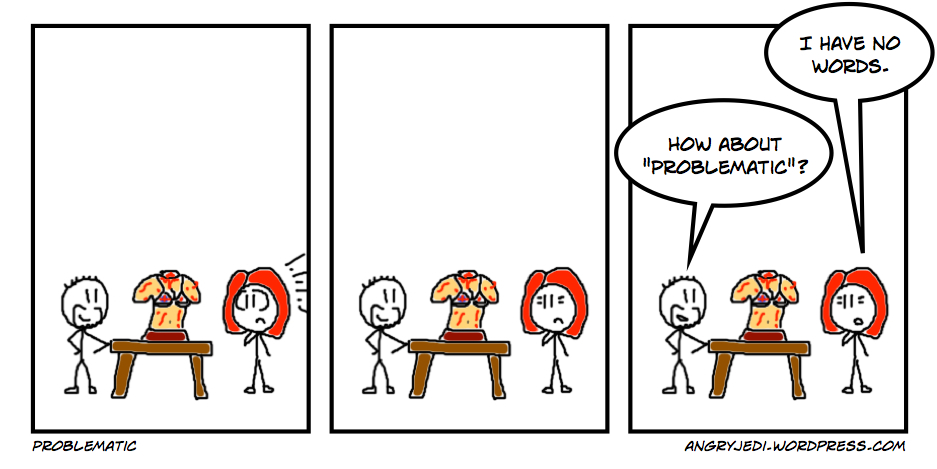
The thing is, all the shouting about how "problematic" these things are actually just plays right into the marketers' hands. For every table-thumping opinion piece that decries these things as the most awful thing ever dreamed up by a game's marketing team, there will be at least a few readers who will think "well hang on, actually I'm quite interested in that now," whether or not they actually admit to it in public. The amount of "OMG THIS IS AWFUL" stuff floating around about Dead Island Riptide's bloody torso is only really serving to make people more aware of the game's striking, gross (and Europe/Australia-exclusive) special edition; the hoo-hah over the Hitman: Absolution trailer likely helped raise awareness of the game in the run-up to its release to a considerable degree, and it had been all but forgotten by most people by the time the game actually came out.

In short, they're stupid and in poor taste, but all they are are marketing ploys, little more. And they're doing their job admirably — both games now have considerably higher visibility than they once had. As they say, all publicity is good publicity. If you really want to punish them, don't provide them with any coverage whatsoever.

The Cyberpunk 2077 trailer is a little more complex to discuss. Taken out of context, it could be seen as a representation of brutality against a sex worker — until it pans out and she reveals her MASSIVE FUCKING ROBOT SCYTHE BLADES, that is — but taken in the context of the original Cyberpunk 2077 source material from the '80s, it is, to my knowledge anyway, entirely in keeping with the aesthetic and atmosphere of that which it is based on. I observed some lengthy discussions about this on both Facebook and Google+ recently, and now that I know the context, it's clear that this trailer is entirely appropriate for the setting. One may argue that the use of a scantily-clad woman is somewhat unnecessary, and you might be right about that, but that doesn't mean that this is suddenly a huge violence against women issue. It's a stylistic choice; little more — a subversion of audience expectations. "A woman being abused by the police… oh wait, no, she's actually some sort of hideous mechanical monster with very little humanity remaining." (Spoilers.)

You could also argue that the requirement to be familiar with the source material before being able to recognise the trailer for what it is is something of a failing of the marketing, but then Cyberpunk 2077 was always likely to appeal to a very specific, niche audience — those who remembered the original tabletop RPG — anyway, so is there really anything wrong in catering to that specific, niche audience rather than attempting to make something bland, unremarkable and mainstream?

My point, essentially, is that by shouting and screaming about how "problematic" these things are, you're fuelling the fire. You're helping the things that you hate. You're making people aware of them, and not in the way you probably intend. It's a catch-22, really. If you say nothing, you might feel as if you're tacitly condoning things that you don't agree with; if you say something, you actually end up bringing it to a much wider audience, many of whom may become defensive when confronted with your viewpoints that counter their feelings.

The key thing, I think, is moderation. The trouble with the number of things that have been declared "problematic" recently is that it's losing its impact. We're apparently supposed to find so much stuff "offensive" these days that it's getting difficult to keep track — and who are the people who get to say what is and isn't offensive, anyway? Following the release of the Dead Island Riptide pictures today, for example, I saw a variety of comments from female gamers (as in, gamers who just happen to be female, not girls who make a big deal out of the fact they play games or specifically identify as "girl gamers") along the lines that it really didn't bother them and that they just found this sort of thing rather childish and amusing.

That, to me, is a more healthy attitude to take. All of the outrage I've seen today has been from men — always the same men, too, so much so that any time something like this comes up it's incredibly predictable who will be the first to jump on their virtual soapbox. It's easy to play the "champion of feminism" from behind a computer keyboard, but I have to question how many of these self-appointed arbiters of taste and decency have actually done anything beyond pen an angry blog post (yes, just like this one, I know) to help make life better for these groups they're supposedly standing up for.

Dead Island's bloody tits are a horrid thing you probably wouldn't want on your mantlepiece. Hitman: Absolution's nuns trailer was an exercise in how ridiculous a trailer they could get away with. I'm not defending either of them, because they're both shit, let's not beat around the bush. But I really don't believe they're symptomatic of anything more than marketing departments that are highly adept at taking advantage of "shock value". And attempting to make these into anything more than that will achieve little more than starting arguments that have little value to the real concerns, which are a much more complex set of sociological issues.

I like women and have never, ever thought of a woman as someone "inferior" to me. The thought of perpetrating violence against a woman in reality is, to me, abhorrent, but then the thought of perpetrating violence against a man is also, to me, abhorrent. But then I liked the Cyberpunk 2077 trailer, too. Does that make me an awful, hideous misogynist?

No, of course it doesn't. But what do I know? I like Hyperdimension Neptunia.

1091: You've Got... You Know

Page_1Speaking as someone who grew up with the early days of popular online activity (BBSes, CompuServe and finally the "proper Internet") I find it mildly interesting (or at least worthy of a late-night blog post, which isn't necessarily the same thing) how much the role of email has changed over the course of the last 15-20 years or so. I am prompted into these thoughts by a casual glimpse at my own inbox, which currently contains a devilish 666 messages, none of which visible on the front page are, to my knowledge, written directly to me by an actual human being.

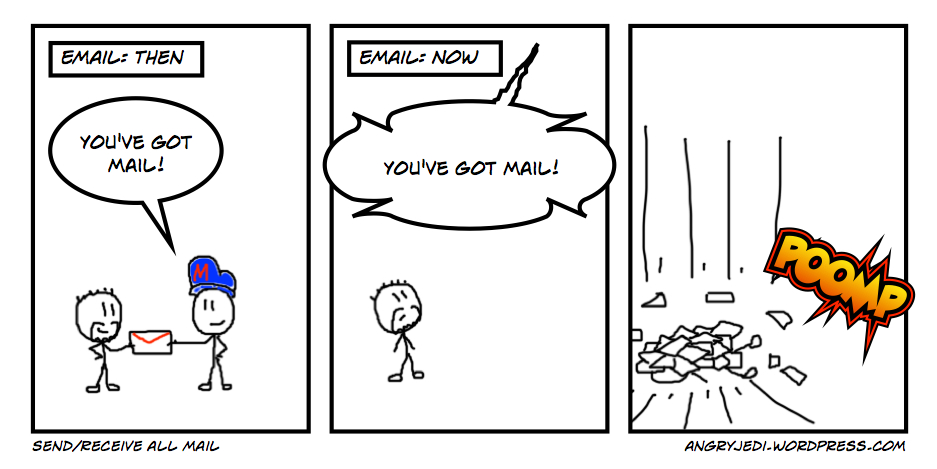
This is something of a change from the earlier days, when clicking "Send/Receive Mail" in Outlook Express was an exciting moment, and you knew if the progress bar came up you had email incoming. Who would it be from? Would it be from someone interesting? What would they have to say? Would there be an attachment? In just a minute or two (LOL DIALUP) you would find out, and then you'd lovingly file the email into an appropriate folder to keep for all eternity. (I say "you" again when, of course, what I actually mean is "I". I don't know if everyone else was quite so fastidious with their email organisation when they first got online, but I certainly ran a tight ship… for a while, anyway.)

Looking at my inbox today, though, it's clear that email has a very different purpose today to what it once had. Whereas once it was effectively one of the only forms of social media (the others being forums and live chat rooms) it is now a general repository for crap. You'll occasionally get a meaningful message in there from someone who actually has a brain and a soul, but more often than not, if my inbox as of right now is anything to go by, it'll be a string of automated messages notifying you that so-and-so has added a new track to a playlist in Spotify (unsubscribe!), so-and-so has commented on something you don't give a fuck about on Facebook (unsubscribe!) or that that website you signed up for just so you could download a .zip file containing some porn/games that you wanted wants to wish you a happy birthday.

A relatively recent addition to the types of email you get nowadays is the guilt-trip "PLEASE COME BACK!" email. This happens with everything from mobile apps to online games, but the execution is always the same. "Here's all the great stuff you're missing out on!" it'll say, usually worded in such a way as to make you think that you're somehow doing something wrong by not using a service you currently have no need for. Often there will be some sort of bribe involved in getting you back, particularly when it comes to online games of various descriptions.

A Facebook game I reviewed a while back known as Outernauts was particularly bad for this. Outernauts was highly-anticipated by a lot of people because it was from a high-profile studio (Insomniac, for those in the know) and was aiming to be a social game that appealed to the sort of people who typically only played standalone, "pay once, keep forever" games on computer and console. It wasn't awful, but the overzealous means through which it was monetised — the ever-obnoxious "energy" mechanic — prevented anyone from being able to enjoy it for more than a few minutes at a time. Consequently, after an initial surge of interest, the very players it was trying to attract dropped it. Some months after I reviewed it and criticised it for its aggressive monetisation, it "relaunched", apparently with "fast recharging energy". It was still a pain in the arse to play. Some months after that, it relaunched again, this time promising "near limitless energy". Note: "near limitless", not "limitless".

I'm getting off the point slightly, but the fact is, every time Outernauts decided to do something a little different, it sent a begging email to me pleading for me to take it back, because it can change, it won't annoy me any more, it won't do that thing that annoys me any more. It was too little, too late, though; my experiences with Outernauts while reviewing it left such a sour taste in the mouth that I had (and still have) no desire to return, "near limitless energy" or not. That probably won't stop them sending me another email the next time they change something, though. Unless I blocked them. I might have blocked them.

Another offender in this sort of thing is a service called Earndit which I evidently signed up for at some point in the past. (I think I mistakenly signed up for it while looking for Fitocracy while the latter was still in closed testing; the two are different services but do have a few things in common.) Earndit sends me an email every week with sickly-sweet, overly-apologetic language about how I haven't earned any points this week, and that if they have it wrong I should get in touch with them PLEASE LOVE ME etc. It's annoying.

The response to all this annoying email is, of course, to unsubscribe from the mailing lists I've found myself on, send these messages to the spam folder or just to stop using my actual email address to sign up for things. But it's a pain to keep on top of. You can be as careful as you like to tick/untick the boxes that give websites permission to spam you with crap, but some will still get through, and over time there'll be so much incoming stuff that it's almost impossible to keep on top of your "unsubscribe" needs. The knock-on effect of all this is, of course, that genuine messages from real people can easily drift by completely unnoticed. If this has happened to you, it is nothing personal; you can blame Zynga, EA, Facebook, Twitter, Spotify, Google and indeed any of the million-and-one completely unnecessary social networking apps for mobile devices that I've reviewed over the course of the last year.

I miss the old days; the days when being notified you had a new message was exciting. Checking your email used to be a pleasure; now it's a chore.