#oneaday, Day 264: Cupid Rules OK

OKCupid! is a fascinating site. Even if you're not looking for a potential partner, soulmate or someone to shout "gief cyb0r plz" at, I'd encourage you to take a look at it for the simple reason that the site itself is pretty unique when it comes to the world of social networking, finding friends and dating.

If you've ever dipped a toe into the murky waters of online dating, you'll know that most sites are 1) filled with people who are apparently far more attractive than you (but in fact are either using a fake photo or a very good photographer) and 2) demand that you give them vast quantities of cash every month for the privilege of being able to actually talk to anyone. Fair enough if they work; certain places like match.com even offer a money-back guarantee if you can't find yourself someone to talk to on their network. There's also that interminable string of "OMG! GET LAID WITH GIRLS IN [insert location from your IP address here] TONIGHT!!" that you get on some of the Internet's less salubrious sites. But the less said about them the better.

No, OKCupid takes a different tack by first of all being free to use. Marvellous. Second of all, rather than relying on people searching via simple criteria ("I am looking for a woman aged 25-35 in the Outer Hebrides") it does some rather clever profiling of your personality via a bank of approximately five bajillion "match questions", some of which are "official", but many of which have been submitted by other users. All of them are multiple choice, and all of them require you to not only put your own answer, but the answer you'd like your ideal partner/friend/fuckbuddy to put, too. And they don't have to match. Perhaps you're spoiling for a fight, so you put that you like immigrants, but you'd rather your ideal match were a card-carrying Daily Mail reader with borderline racist tendencies. Or perhaps you want to find someone who will never, ever argue with you about anything, ever. In which case you put that your ideal partner/friend/fuckbuddy should answer the same as you, and that it is MANDATORY (like the sex party) that they do this. And you won't accept anything less. No sir.

Anyway, the upshot of all this is that the site builds what is probably a pretty accurate psychological profile of you and, as such, allows you to find people who you're likely to "click" with fairly quickly. It's pretty remarkable in the way it works, and it's surprising to see how accurate a picture of your personality it can build from these questions. And of course, the more you answer, the more accurate said picture becomes.

Not only that, though, but the site also does stuff like tracks how likely people are to respond to unsolicited messages. So that hottie you have your eye on may only have a 5% response rate, in which case your declarations of a desire for a night of wild and steamy passion will probably fall on deaf ears. Or at least ears that will go "ugh" and block you promptly.

All that for free, while the sites out there that demand your credit card information to even get you to sign up still cling to the old ways. Why not go on over and find out a little something about yourself? You might even make some awesome new friends. "AND MAYBE MORE!!" as the saying has it.

For the curious, these are my Sims-style personality traits based on the 389 questions I've answered so far. (It's super-quick to answer questions using the convenient iPhone app. Also, I get bored at night-time.)

From left to right, said icons indicate that I am less aggressive than average, less ambitious, less compassionate (not sure I'd agree with that one), more attentive, more pessimistic, less spiritual, more loving and more scientific. The magic robots have spoken. That is me. Until I answer some more questions and prove them wrong, of course. Apparently I need to grind my spirituality and compassion stats a bit.
#oneaday, Day 255: The Big Pixels are Here!

Ladies and gents, it's my great pleasure to reveal The Big Pixels to you.
You may recall some days ago that I was mourning the loss of Kombo. Kombo's still not dead yet—feel free to drop by and support the remaining writers—but, to be frank, it's probably only a matter of time. It's very sad to see the end of something which has clearly had love, care and attention poured into it over the last few years, and I'm happy that I was part of the experience for a short while.

But this post isn't about mourning the past; it's about celebrating the future. And that future begins with today's launch of The Big Pixels.

The Big Pixels are a group of friends first and foremost, video game writers second, and we decided to band together to produce something that we'd want to read ourselves. Intelligent, thought-provoking games writing. No flamebait. No traffic-whoring. Just the kind of thing that gets people stroking their chin and going "Hmmm", and hopefully provoking some discussion. Those of you who follow The Squadron of Shame will undoubtedly dig what we're doing. And those of you who are tired of the same old news stories posted everywhere day after day will surely enjoy our work, too. It's an N4G commenter-free zone!

We're there to have fun and build a community, not to chase page hits. So the important thing for you (yes, you!), the reader, is that you enjoy it. Read our work. Tell us what you think in the comments. Feel free to share any pieces you find particularly interesting or entertaining. And help us to build up our own unique little corner of the internet; a home away from home for those who are sick of "Top Ten Tuesdays" featuring boobies, guns or any combination thereof, or people who are sick of seeing the same picture of Michael Pachter on every article where he says something contentious and/or stupid.

Since you're reading my blog, I'm going to draw particular attention to my own posts, of course. I am nothing if not a whore, after all. So while you're over there, feel free to check out a "reprint" of my article on game development's gender divide (featuring much-appreciated assistance from the very lovely Mitu Khandaker and Lauren Wainwright), a companion article to the most recent SquadCast on video game music, and a discussion of adult gaming. I hope you like them; and be sure to check out my buddies' work while you're over there. And don't forget the Looney Bin, receptacle for all manner of game-related crap that we've encountered in our journeys around the web.

It's been an interesting journey over the last few days, and it's only just beginning, for sure. Stay tuned to The Big Pixels, as we'll all be pushing out a wide variety of articles on all manner of game-related subjects every week. Follow us on Twitter and/or Facebook for the latest and to make us look popular and awesome.

Also, our review scoring system has a rainbow unicorn pixel in it. And there is absolutely no way you can say that isn't the most amazing thing you've ever seen. Unless Maru is your cat.

#oneaday, Day 254: Be The First Of Your Friends To Like This

I remember back in primary school we were encouraged to never use the words "nice" or "said" because they were boring. There are always better words to use, we were told, so we should be creative and extend our vocabularies.

Fast forward to today and we have much the same issue with the word "like", a word which is rapidly losing all meaning thanks to its total domination over the social networking space. Every day on Facebook, it's a fair bet that there is at least one entry in everyone's news feed that says "Amber likes OMG!! Where did you get you're shoes LOL! on ♥." or "Bob likes I hate it when your trying 2 go 2 sleep and u cant on Likebook." Not only do these sentences make no sense, they're a symbol of a peculiar shift in communication styles that has taken place in recent years, particularly amongst teens and tweens.

Essentially, rather than just typing "I hate it when you're trying to go to sleep and you can't" and sharing that particular inanity with the world (not to mention spelling it correctly), it seems that it's now much more the done thing to go and find a website which lists hundreds of said inanities for the sole purpose of allowing people to Like them on Facebook. There's a kind of "distancing" involved. Anyone can click "Like" on something. As soon as you write it yourself, it becomes more personal, and harder to do.

Trouble is, the word "Like" is being used so much that it stops making sense sometimes. Or its context is completely inappropriate. Take the latest "check-in" craze, GetGlue, which is actually a pretty neat idea. Users tag the things that they, yes, like as well as the things that they dislike and can then get suggestions of other things they might like based on other users' tastes. Fair enough. However, when a site offers you the opportunity to not only "Like" ebola but also check into it, you have to question if the correct terminology is really being used in this instance.

And where's the opportunity to dislike things? GetGlue is unusual in that it does specifically allow people to say "I don't like this". There's no opportunity to do that on Facebook. If a friend posts a status update that informs everyone that, say, their leg has fallen off and their family are dead and not only that, someone posted a bag of poo through their letterbox then the only things to do are to "Like" it, which seems rather tactless and inappropriate, or to actually leave a comment which will probably start with "I wish there was a Dislike button" and end with too many exclamation marks.

Perhaps Facebook is attempting to make us all more positive. Instead of writing "I'm so sad. My family are dead, my leg has fallen off and someone posted a bag of poo through my letterbox" which, let's face it, no-one is going to click "Like" on, perhaps you should put a positive spin on it. "My family are dead, my leg has fallen off and someone posted a bag of poo through my letterbox. But at least I found 76p in small change in my jacket pocket, Snickers later ftw!!!"

aplenty from there on, I feel.

#oneaday, Day 253: Pay-Per-Everything

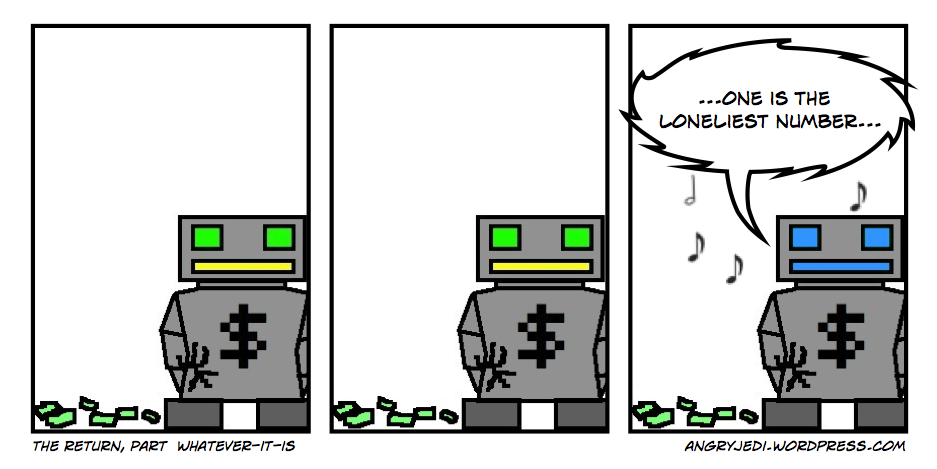
I came to a realisation today. I have a thing about the word "monetize" (or, arguably, "monetise" if you want to be English about it, although the latter is not recognised by a British English spellchecker). This is not news to those of you who have been following this blog for some time. Some of you may even recall the Money Robot, star of Day 128 on this blog, and, of course, the thing that goes around monetizing everything in sight by applying green electricity to their genital areas, assuming they have genitals.

But, as I say, I came to a realisation today. And my problem is not with the word itself as it is with the fact that we even need a word for this concept at all. "Monetize", after all, pretty much means "convince people that it is acceptable to pay money for". And sure. There are some things out there that could stand to be charged for—certain content online, for example, could be charged for in order to make sure that writers could actually get paid for once. The iPad, Kindle and other devices like them are doing a lot to help people think about how they consume content—a move away from the whole "EVERYTHING SHOULD BE FREE!" philosophy that the Internet has embraced for so long and a move towards "most things should be free, but really good stuff should be an appropriate price".

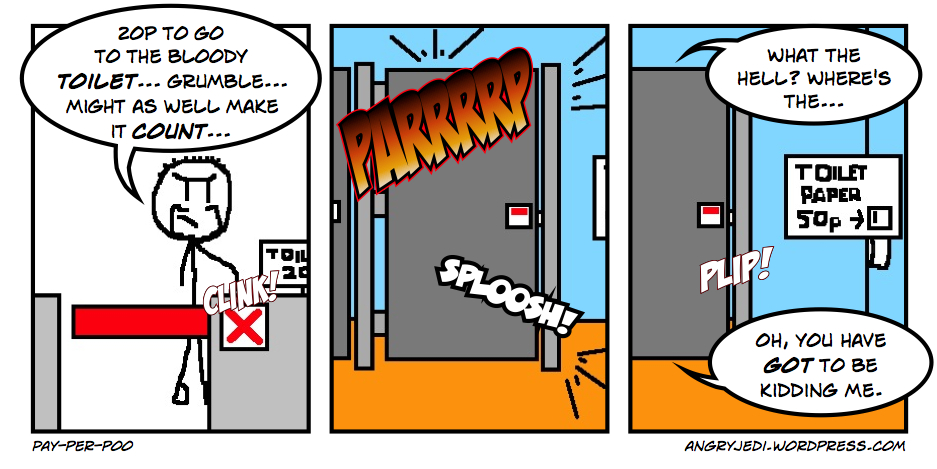
At least that's the theory of how it should work. How monetization works in practice is that you get people charging you to go to the toilet at railway stations. You get a 30p "convenience charge" for paying your parking fees via phone instead of via small change in a machine—change which some poor sod will have to come and collect at some point rather than an automated robot who steals your credit card numbers over the phone, I might add. You get charged £30 to disconnect your broadband (at least you do if you go with Orange Home, fuckers). And Endsleigh Insurance (also fuckers) wanted to charge me £85 for the privilege of cancelling my home insurance, all because I had moved house just after the policy had renewed, ignoring the fact I'd been paying them for the last ten years. Let's not even get started on bank charges, where they take the money you haven't got in order to punish you for not having any money.

You get the picture. Not everything being monetized is good. And that's why I think the fact it's happening so much that we need a new word to describe the concept is very much a bad thing. We don't need to pay for everything. I pay a bloody fortune to travel by train in rubbish, smelly, drunk-infested conditions so the least I should be able to expect is the opportunity to have a piss for free at the other end. Conversely, I'd be more than happy to pay for some exclusive content, eBooks or virtual magazines delivered to the iPad I don't have. It's all a question of value.

You may argue that the ability to have a piss is inherently more essential and therefore valuable than an eBook. But technically I can have a piss anywhere. The charge on the toilet is not stopping me from, say, pissing myself. The nice policeman standing on the corner might, however.

The eBook or virtual magazine, however, has had love, care and attention ploughed into it and therefore, it's only fair that the writers and producers should receive some recompense for that. So more premium, high-quality content, please, and less in the way of "convenience charges".

THANKS.

#oneaday, Day 249: Remember Reach... Uh, Kombo

The death of a website is a curious thing. In practical terms, it's no different to deleting a file, switching something off, throwing out a piece of technology that is no longer used. But it's more than that. A dying website normally knows it is dying before the plug is finally pulled. And, these days in particular, it's not just a website that dies. It's the community that the site built. The readers who came back every day, whether they were vocal ones who commented on everything or people who just diligently read every article because they'd chosen that particular site to be their "home".
I've witnessed the death of several websites I've been involved with either as an employee or an active community member of in my time, and it's never pleasant. 1up.com isn't dead, of course, but when The Great Exodus occurred some time back, the Squadron of Shame and I left the site behind and never looked back. The site still maintains an active blogging community, but it's a shadow of its former self when I think back to the glory days of the 1up Radio boards.

Then came B4HD, a relatively short-lived retro games project that I was involved with. We had a team of dedicated writers who loved games of the past with a passion and loved writing about them. But for various reasons documented in the site's final post, it had to close and those involve seek other outlets for their work.

Most recently, of course, is Kombo. Kombo is still there, of course, for now. But the staff aren't. Sure, there are some who are still there diligently posting articles on the site and holding things together as the site's last few commitments are fulfilled. But some time soon, that site and everything attached with it—the content, the artwork, the community, the recognisable writers—will cease to be.

What happens at that point? Where do all these lost souls go? Sometimes they have nowhere to go straight away, and simply have to pick another place to call home and latch on to it. Sometimes they have to start from scratch again, building a reputation from the ground up like they once did. Sometimes they float aimlessly for a while. And sometimes they immediately land on their feet and produce something awesome.

It's perhaps premature to be holding a "wake" for a site like Kombo when it hasn't even died yet. Rest assured that the talented crowd from Kombo are not going anywhere. That dedicated team who knew and loved their audience (even Wiiboy) and what they wanted to hear are alive, well and waiting.

"Waiting for what?" you may ask. That's not for me to say… yet. But let's just say that those of you who enjoyed the writing of myself, Jeff, Brad, Joey, Eric, Keri, Ryan, Mike, Matt, Joel, Dan, Ryan and Geoff won't have to wait too long to see what we're up to. It's going to be great, and we hope you like it a lot.

A love of the cloak and dagger prevents me from saying anything else right now. For those of you who care, though, we're fine. And I know that I for one am hugely happy to have met such an awesome crowd of writers, and even happier that we're sticking together for new and exciting projects.

Watch this space for the latest.

#oneaday, Day 247: This Is Why We Can't Have Nice Things

Twitter broke earlier today. This in itself is nothing unusual, as the existence of the term "failwhale" will attest. But this time it was partly a result of some new changes that the service made, particularly with regard to posting links.
Twitter recently launched its own link-shortening service, called "t.co". This is one of the shortest link-shorteners out there, and when characters are a precious commodity as they are on Twitter, that's really important.

Unfortunately, some clever young person discovered that by using t.co it was, in fact, possible to embed HTML code and, worse, JavaScript in these links. It was also possible to format tweets, change their colour and black them out.

Said exploiter quickly discovered that by blacking out a tweet and adding a "mouseover" JavaScript event to automatically retweet the exploit, post giant text on the screen or in some cases, redirect to websites you wouldn't want anyone to catch you on ever whenever a user moved their cursor over the blocked text, they could cause absolute chaos. Thankfully, most people got wise to the exploit pretty quickly and retreated to the safety of Twitter client apps, as it only affected users on the website itself. Of course, there were a few people who started screaming "OMG VIRUS!!!" and panicking, but most of them were put in their place pretty quickly with a simple, calm explanation (hah, right) that an exploit and a virus are two very different things. And Twitter stepped in to plug the security hole reasonably quickly, too. So the whole thing was over within a matter of hours.

The main point of this, though, is that it wouldn't have happened at all without the new functionality that Twitter was offering. It seems that every single time something new and potentially awesome appears, there is at least one person out there who wants… no, seemingly needs to break it. Why? Because they can.

This explains the existence of "glitchers", people who deliberately play video games in order to break them. It explains the existence of software pirates, who are out to break copy protection and DRM on software. It explains the existence of hackers, people who write viruses and spammers. And, indirectly, it's the reason why every single time you turn on Windows you have fifteen bajillion updates to install.

This is all getting a bit tiresome now. It's such a shame that things that are new must seemingly go through the "initiation" of being broken by some idiot sitting in his pants in his basement, probably masturbating furiously as he watches the chaos unfold before his eyes. Because you just know it's a "he", too. (I'm all for equality, but when it comes to stupid, pointless and inconvenient things to do with computers, it's always a guy.)

Thankfully, the world seems adequately set up to deal with such dribbling idiots these days. We have spam filters, virus scanners, scripts to clean out malicious code from websites. Companies have teams to fix broken functionality like we've seen here. And of course, it's easy to say that things should be tested more thoroughly before release. But there's no way you can predict every single possible stupid thing that some member of the human race will try and do. If we could, no-one would ever go outside and the world and everything in it would be covered in sponge just in case we fell over and hurt ourselves and/or tried to kill someone else with something.

So if you know anyone who's ever come up with one of these exploits, or anyone who's ever ruined a Nice Thing for anyone else, do the world a favour and go and punch them really, really hard in the testicles.

#oneaday, Day 245: Obituary or Rebirth?

Dear GOG users,

We have recently had to give serious thought to whether we could really keep GOG.com the way it is. We've debated on it for quite some time and, unfortunately, we've decided that GOG.com simply cannot remain in its current form.

We're very grateful for all support we've received from all of you in the past two years. Working on GOG.com was a great adventure for all of us and an unforgettable journey to the past, through the long and wonderful history of PC gaming.

This doesn't mean the idea behind GOG.com is gone forever. We're closing down the service and putting this era behind us as new challenges await.

On a technical note, this week we'll put in place a solution to allow everyone to re-download their games. Stay tuned to this page and follow us on Twitter and Facebook for updates.

All the best,
GOG.com Team

An hour or two ago, that message had done the rounds of the Internet. If you hadn't seen it yet, I apologise for being the bearer of bad news. If you head on over to Good Old Games right now, that's all you'll see. No store. No games. No community. All gone.

For the uninitiated, Good Old Games was the place to go to purchase and download DRM-free copies of old (and not so old) classic games for low, low prices. It was, for a long time, the only place to go to find the classic Sierra adventures, or sci-fi Wolfenstein 3D spinoff Blake Stone: Aliens of Gold, or the best puzzle game of all time, The Incredible Machine. I wrote a number of pieces for that site, so yes, I have something of a vested interest in it and actually feel pretty sad about its apparent demise. But even if I didn't have such a personal stake in it, it was a fantastic place to go to pick up the games of my youth. Even better, they'd been tweaked and optimised to work on current hardware.

The tragic news above comes after a tweet posted by the company a few days ago:

Sometimes it's really hard being DRM-free… hard to keep things the way they are and keep management and publishers happy 🙁

It didn't sound good. Someone was obviously putting a bit of pressure on the company, and some cracks were starting to form. Those who had supported the service since the beginning knew that a DRM-free service in an age of rampant piracy was going to have its work cut out for it. But was that really the reason?

No-one knows as yet. No-one except the people at GOG, who are playing their cards close to their chest. The community are assured that this isn't the end of GOG, however, just the end of this chapter of its existence. Those who have purchased games from the service in the past will be directed to a "solution" to re-download these games in the next few days. And some announcements will hopefully be forthcoming very soon.

Personally speaking, I'm hoping it's good news. There were a ton of games on the site that I'd love to have had the chance to play again. Games like Gabriel Knight 2, which a friend borrowed some time ago and never gave back, and now I can't remember which friend it was.

The games of this era represent a time when gameplay was everything and graphics were necessarily limited by the hardware of the time. And it may just be nostalgia talking, but some of my fondest memories of childhood and adolescence come from the games I was playing at the time. It'd be shame if the memories of these games fade. But, as I say, GOG claims that this is not the end, just the end for the service in its current form.

So pour out a stiff drink, take off your hat and, I don't know, sing a mournful song in honour of GOG or something. Hopefully they'll be back better than ever sometime soon.

Rest in peace, GOG. For a little while. Then come back as an awesome zombie who wants to sell us old games rather than eat our brains.

WHATAREYABUYIN'?

#oneaday, Day 240: Making your Mark

It's odd (and not a little morbid) to think about the things that you leave behind that people might remember you by. Those little marks you make on the world, whether they're physical marks scrawled on a toilet door with permanent marker pen, mental marks left in the mind of people or now, technological marks, too.

There'll always be a little trace of me left in Southampton thanks to largely-pointless but fun geotagging app Gowalla. When I first downloaded said app, there weren't many people using it but I liked the idea of it. Go out, walk around, "collect" places. If nothing else, it was a nice way of building yourself your own custom tourist map of a place.

So on more than one occasion, I went out for a walk with the specific intention of creating a bunch of Spots around Southampton. This became something of an obsession, with the vast majority of Spots around the city centre being created by me. General way of telling: if it has a lengthy and slightly sarcastic description, or is the kind of thing you wouldn't find on a typical tourist map (such as "The Pedestrian Crossing That Makes The Funny Noise"), it was probably created by me.

Now, as pointless as Gowalla is in many respects, there are many reasons why it'll always hold a fond place in my heart. Firstly, as I say, it's been my way to leave my mark on Southampton. I "found" these places and tagged them the way I wanted them to be tagged. This means that Greggs on East Street will forever be remembered as "fine dining for chavs". At least until they realise and ask politely for the description to be changed. Which, let's face it, they probably won't.

But the second reason is that my wandering around, creating these spots, marking my territory (as it were… albeit with less piss than is usually implied by that phrase) caused me to meet one of my dearest friends from that city. She happened to use Gowalla, stumbled across some of my sarcastically-described Spots and decided that the person who tagged Greggs as such was someone she'd like to get to know better. So we progressed from stalking each other via Gowalla, to tracking each other down on Twitter, to chatting on Twitter, to finally meeting face to face. It was one of those random instances of chaos theory at work, where one little choice made slightly differently would have meant we'd never have met. And, given what was going on in my life at the time we met, and how much she helped me through that difficult time, that would have made things go very differently for me.

So I'm certainly glad that I've left a "mark" on a few places over time, be it physically, emotionally or technologically. Because you never know when those marks might lead to something great, even after you're gone.

#oneaday, Day 238: Nerd Rage

As a new acquaintance from Twitter would say, nerd rage is one of the most formidable forces known to Man. It is a dreadful and terrible force, both specific and unfocused at the same time, often showing itself via the personification of inanimate objects who really don't know any better and are just attempting to do their job and failing. Raging at said inanimate objects or poorly-constructed pieces of software rarely does any good, but it is commonly assumed that it makes one "feel better".

As the years have passed, though, everyone's bullshit-tolerance threshold has lowered significantly to the stage we're at now, where if something doesn't work immediately and instantly and then remain working 100% of the time, people blow their top and spew their vitriol to whoever will listen, which is usually the Internet. Assuming the Internet connection isn't the thing which is causing the nerd rage, in which case alternative outlets have to be explored.

This is why issues such as the Xbox 360's infamous "red ring of death" smart so much. Not only is it a shoddy flaw in the system which should never happen in the first place, but people's tolerance for such shoddiness is far lower now than it would have been, say, twenty or thirty years ago. Hell, in the days of the NES, everyone was quite happy to accept the fact that if a game didn't boot up first time, it clearly and obviously meant that you had to blow in it to "get the dust out" despite no actual evidence that it was actually dust causing the game not to work correctly. And no evidence that those tiny flecks of gob that probably got into the cartridge circuitry while you were blowing in it actually helped matters, either.

It's also why we get such whingers in places such as Apple's App Store. "OMG 1 STAR COZ IT DIDNT WORK ONCE THIS IS A DIGSRACE REFUND PLZ". "Is it working now?" "Yes, but…" (etc.)

It's fair enough to want things to "just work". Apple in particular like to pride themselves on the fact that their products "just work" (which they do approximately 95% of the time, which means the remaining 5% incites nerd rage of a degree you've never seen before, particularly amongst recent converts and/or Android users). But it's worth remembering a time not so long ago when we enjoyed tape load errors, boot errors, numerical error codes you had to look up in a book, garbled graphics, tape decks that chewed up tapes and then spat them out, CD players that seemed to deliberately wait for you to insert your favourite disc then sprout internal blades to scratch the crap out of it and dial-up network connections where it was possible to get a "busy" signal for hours at a time. And there was no Internet to spew your vitriol over back then.

Nowadays we have complicated devices and software that no-one except superhumans understand really, and established solutions such as blowing on it, shaking it, hitting it, shouting at it, turning it off and back on again and setting fire to it don't work. So the only thing left to do is get frustrated. And possibly call up one of those superhumans. Because everybody knows at least one. (Note: If you don't know a superhuman nerd or don't want to bother them, you can save yourself a lot of time by referring to this chart.)

In other news, the router here is rubbish and crap and I hate it and it disconnects Xbox LIVE every five minutes when I'm playing Fable II and it doesn't like WordPress and SRSLY who uses AOL nowadays anyway and… (repeat to fade)

#oneaday, Day 225: This Post is Controversial

Want to get your voice heard on the Internet? Then you'd better have something contentious to say, or at the very least something to say about something contentious.

I've seen it myself on this blog. The day I wrote about Kevin Smith's experiences with Southwest Airlines (day 28, if you're keeping score) was one of the highest-traffic days that I've ever seen. Granted, this being a personal blog which not that many people know about, that still wasn't very many people. But it was enough to make a noticeable spike on that handy little pageviews graph that WordPress helpfully provides you with.

And today. I happened to tweet earlier that Xbox LIVE's prices were going up by $10 a year. Thinking nothing of it at the time, I returned about an hour later to discover that this tweet, out of the other 16,740 that there are (I know, I know) was retweeted by something in the region of three billion people. All right, that's an exaggeration. But you get my point.

And then, an article published by a colleague over on Kombo has seen one of our highest ever "temperature" ratings on gaming news aggregator N4G. The subject of the article? "Top Ten Most Overrated Games". Compare this to an article I wrote on the subject of women in the games industry, which attracted ill-informed, stupid comments from people who obviously had read nothing more than the title, and you'll see that at times, the Internet is not the place for reasoned discourse. Incidentally, this isn't a slight against Lucas' great article, which actually makes some fair points.

A friend and colleague described services such as Digg and N4G as "places where lazy people go to yell at each other over stories they didn't read concerning topics they don't understand". It's sad, but it's true. It's also an awesome quote. Thank you, Brad.

So it seems that in order to get people interested and reading what you have to say, it either has to be a contentious opinion, or an opinion on a contentious topic. It's possibly a side-effect of the celebrity culture I discussed the other day, where apparently our own lives aren't interesting enough and therefore we must go look for scandal, opportunities to accuse "the system" of screwing us and chances to argue and flame at every opportunity. Are our own lives really that boring, though? Do people really have that little to say about themselves? Should I turn this into a blog about what the latest celebrity idiots have been getting up to recently?

No. Because if everyone goes about doing that, it just makes the situation worse. I'm writing here for me. I write about what I want to write about, when I want to write about it… so long as it's still one thing a day. The fact that other people read and enjoy it is a happy bonus. And it gives me some faith that the Internet isn't solely populated by dribbling spastics.

Just mostly.