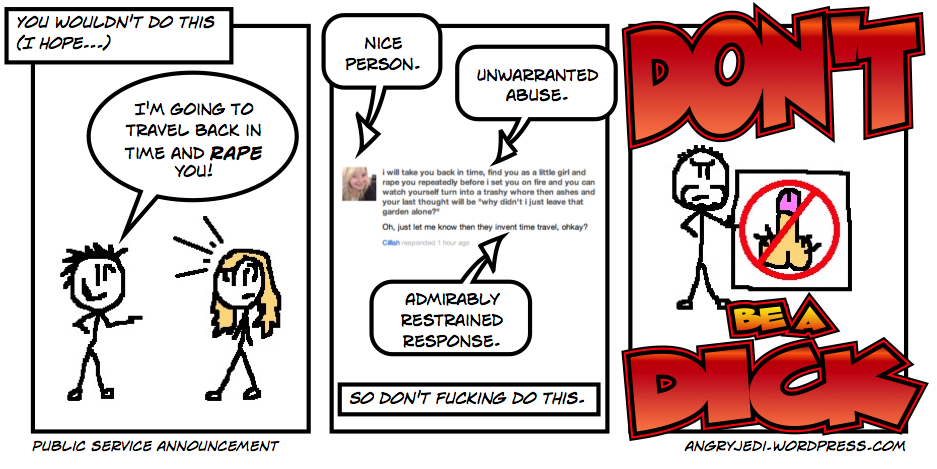
 I should stop being surprised at this, but I still am.
People on the Internet are dickholes. Well, not all of them. I know a lot of very nice people who live in the Internet. Many of them are writing blogs like this one—hello!—but then there is another breed out there—the breed who thinks it's appropriate to hurl unwarranted abuse at others. Others that they've never met or spoken to, in some cases.
Ever been on Formspring? It's pretty fun. People can submit questions to you, either anonymously or under their username, and then you can answer them. That is the sole purpose of the site. I've had a lot of fun with it, thanks mostly to my very creative friends who are excellent with coming up with bizarre, thought-provoking questions. And somehow the questions are much more fun when you're not quite sure who they're from. It becomes a game in itself to work out who submitted the bizarre question about the robots and the cabbage.
Unfortunately, as we've seen many times by now, the potential anonymity that the Internet offers causes some people to think that they can say absolutely anything. So it was earlier on when my lovely Twitter-friend @Cilllah was bombarded with violent and pretty offensive nonsense from some nutjob banging on about his "garden" and about how he was going to rape and kill her.
Now, given all the nonsense over the #TwitterJokeTrial a while back, I don't for a second believe that this moron was actually going to do these things. But how is it in any way appropriate to say things like that to someone who's just going about their business on the Internet? Hiding behind the veil of anonymity to throw out abuse to strangers? That's kind of pathetic.
This sort of thing shouldn't annoy me so much—it's been going on for years after all. It doesn't make it right, though. I've been using the Internet and related technologies since the early days—a 300 baud modem on an Atari 8-bit, then on the Atari ST, then CompuServe under Windows 3.1, up through various incarnations of the "proper" Web to the stage we're at today. And at no point have I ever felt the need to pick on some poor person and be an asshole to them.
Perhaps I'm just too nice of a person to understand why people do the things they do. But I can live with that; I'd much rather be a person that the vast majority of people like and respect (and perhaps a few assholes think is a bit of a pussy) than someone who gets their kicks from threatening rape and violence on strangers.
The joke's on them, of course. The mental image that springs to mind as soon as anyone starts trolling like that is one of a Jabba-esque freak in his (you know it's a he) piss-and-cum-stained pants, probably with their semi-erect penis clasped firmly in their left hand (right hand is for mousing) and a folder called "HOTTYZ" on his desktop containing profile pictures of all the women he's harassed.
And if you're not that person? You can feel pretty good about yourself.
 I am aware of the factual inaccuracies in the title of this post. It is neither my first day writing #oneaday blogs, nor is it dawn. However, there are two reasons for naming it as I have: firstly, any excuse to get in a Zelda: Majora's Mask reference, and secondly, since the other members of the 2011
  Pete
Pete Alex
Alex Phillipe
 Lucy
Lucy Des
Des The MoneyBot
 I've never seen myself as the "leader" type. I follow orders well, but when I'm asked to take charge of something, I find myself thinking whether or not I'm "qualified" to make those decisions, particularly if they're on behalf of other people. Now, I'm a qualified teacher, so in the most literal sense of the term I am qualified to make decisions on behalf of other people. But if you're the sort of person who suffers a bit from self-doubt or a lack of self-confidence, then it's difficult to make yourself get into a position to "lead" others.
 I was going to write this post yesterday but then I got all wrapped up in the whole next-year thing, which you should read about if you're interested. It's the entry before this one. Which means it's after this one on the page. Which… oh, be quiet.
 Okay. I'm going to go ahead and make this pledge now, since I've been farting around with it for the whole day and don't want all that work to go to waste.
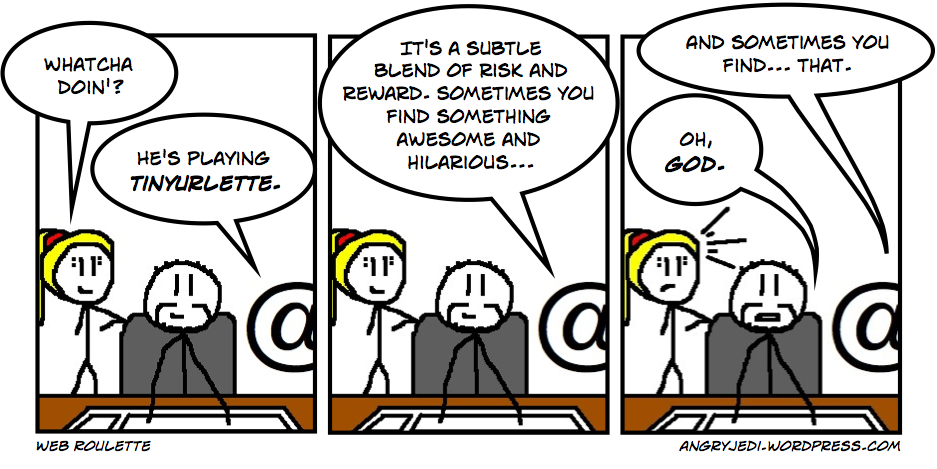 It's easy to get stuck in a rut when browsing the web, visiting the same few sites over and over and over again in a vain attempt to find something new to waste your ultimately meaningless existence with. Facebook is usually the timesink of choice for many people, closely followed by Twitter, TVTropes, Wikipedia and a few others.
 Well, it serves you right. Get on with what you're supposed to be doing and I won't have to embarrass you again.
 The few of us who are still flying the #oneaday flag are closing in on the grand finale. 365 posts of non-stop bollocks, some of which might have been entertaining, some of which may have been utter nonsense. If you haven't checked out the fellow survivors' blogs yet, I encourage you to pay
  You're sitting in front of your computer right now. You're either working, or bored, or wondering what on Earth you should do with yourself. You probably wouldn't be reading this otherwise.
 http://twitpic.com/felch comes up with this image, with the caption "THIS. My cousin is me all over", worryingly, though as the astute commenter beneath the picture observes, there is no actual felching in the picture.
 http://twitpic.com/crunk displays this disappointingly dull image of someone on their way to Charlotte for training. Unless Charlotte is a person, in which case the implied "training" which will be going on can take on an altogether more interesting meaning.
 http://twitpic.com/arse gives us more food. People really love to show each other what they're eating on Twitter, it seems. It appears that one of the stereotypes about Twitter users is true.
 http://twitpic.com/butts gives us a sleeping man. Why is he asleep? No-one knows. But the cameraperson is certainly very close to this sleeping man. Sleeping man also appears to not be wearing a shirt and have slightly flabby shoulders.
 And finally, http://twitpic.com/dirty gives us a collection of jazz music, thereby confirming something we've all known for a very long time: the fact that jazz music is dirty. The internet has proved it.
 This game also works with a variety of other sites, including imgur, yfrog and numerous others. For the truly brave, you could also try it with URL shorteners such as bit.ly and tinyurl. There's no telling where you might end up with those, and so that, dear friends, is a game we shall save for another day.
 With the increasing mechanical complexity and narrative ambitiousness of many modern games, it's easy to forget the purity of how gaming used to be. Just a player, a joystick, and an arbitrary number representing how "good" the player was at the game. In other words, the score.
 There are people out there who are paid frankly obscene amounts of money to develop a company or brand's "social media strategy". This is a position that wouldn't have existed five years ago, yet now it's the new hotness. If you've got anything to do with marketing, social media is where it's at.