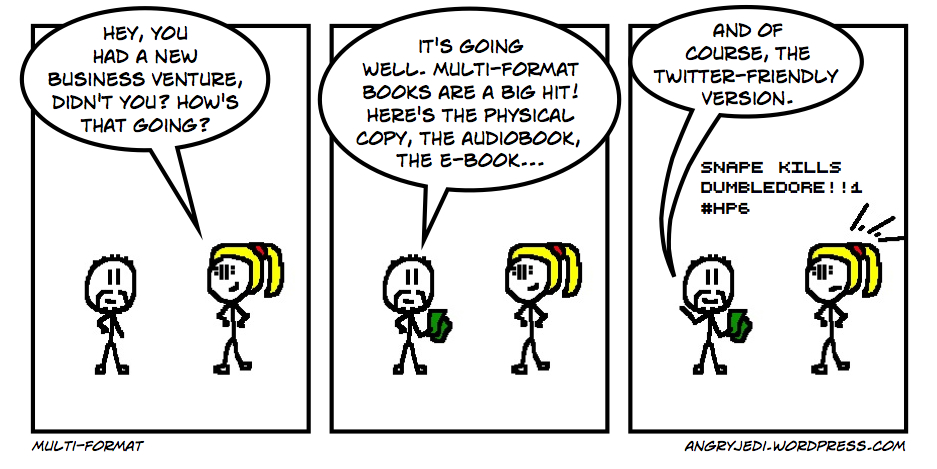
#oneaday Day 110: Private Hysteria

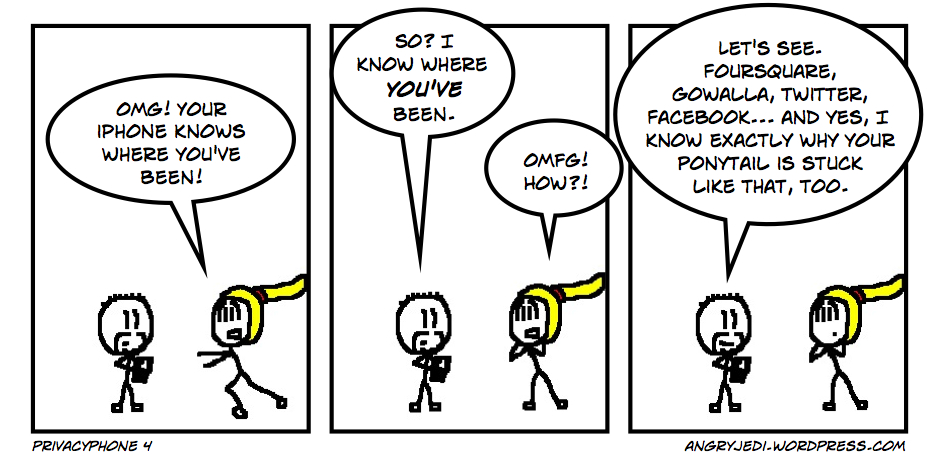
Earlier today, a story broke which caused a fresh round of privacy concerns, as it was revealed that the iPhone is, in fact, recording where you've been and storing that information in its backup file that it transfers to your computer every time you sync it. Here's the story from the Telegraph's "Technolgoy Consultant" (a typo which doesn't immediately inspire me with confidence) — judge for yourself.

Here's my take, and I understand completely you may not feel the same way: I don't give a damn. Why should I? What possible use could that information serve? What could people find out that I haven't already made abundantly clear via other means of social media? That I like to drive to Southampton a lot? That I tend to prefer Costa Coffee as my coffee outlet of choice? That I have been known to drive to Tesco in the dead of night for groceries and snacks?

"But, privacy," people bleat, without really explaining what they mean. Well, what about privacy? The minute you connect a device to the Internet, you're putting yourself on display. The minute you use your GPS-enabled phone to find out where the hell you are and where you should be going, someone knows where you are. The minute you search "oily lesbian midgets" on Google, someone knows what a complete pervert you are. If you're that concerned about privacy, you should reconsider your decision to carry around a constantly Internet-connected device with satellite tracking in your pocket. Or at least turn the fucking thing off.

Most of the time, though, the hysteria over privacy seems to be worry for the sake of worry. Take the app Color which came out a while back, for example. Color is, in theory, a clever way for people in the same place to collect the candid mobile photos they snap of an event — and possibly meet new people. It does this through a variety of means — GPS tracking if possible, then Wi-Fi identifications, mobile phone base stations and even recording the background noise when you take the photo and comparing it to the noise print taken when other people take photos. My first reaction on hearing how it worked was "Jesus Christ, that's clever," followed by "but ultimately unnecessary as most people I know with iPhones will just immediately upload their photos to Facebook anyway." My immediate reaction was not "Shit! My iPhone is recording me without telling me! Bastards!" — which was the reaction of a few people I spoke to about it.

Why, though? Why the panic? It's just sound. Are you a secret agent? Probably not. And if you were, it's unlikely you'd be using social media to share photos on your iPhone. Again, what possible sinister use could the recording of background noise have? Could advertisers figure out that you like hanging out in noisy places and start providing you with targeted AdSense ads for earplugs and ear drops? Perhaps. But again: so what?

The main objection seems to be that the device is doing this without the user's knowledge. But I even can't see the problem with this, really. If you're going somewhere you shouldn't be or doing something/one you shouldn't be, then don't take an Internet-connected GPS-enabled device with you that — shock horror — might know where you are. And for fuck's sake, don't check in on Foursquare while you're at your bit on the side's house. It's always your choice. If you want to be part of the digital revolution, then you have to get used to the fact that your information is out there for as long as you're connected to the Internet.

Potential spoilarz for Don't Take It Personally, Babe, It Just Ain't Your Story ahead.

If you've played Christine Love's Don't Take It Personally, Babe, It Just Ain't Your Story, you'll know that the culmination of the plot deals with this very issue — the supposed "erosion of privacy". The young characters in the game have grown up with this attitude to data, and as such are not surprised to know that other people are looking at their theoretically "private" information — and indeed take full advantage of this fact. I'm starting to feel like I can understand their attitude somewhat. I'm not sure if I should be pleased about that, or if I should be more worried than I am that my iPhone knows how many times I've been to public toilets in the last year.

Ah well. Can always turn it off. At least until The Machines take over.

#oneaday Day 106: A Wealth of Useless Knowledge

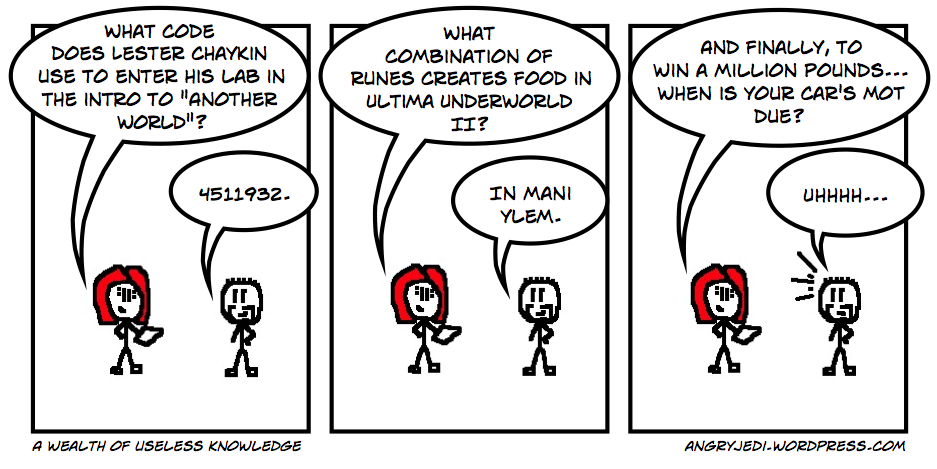
The above comic isn't actually that far from the truth. (I remembered the code from Another World but had to look up the Ultima Underworld II spell. I at least remembered that "ylem" was one of the runes, however.) All this leads me to the conclusion that our brains are clearly wired up all wrong, and we need some sort of GMail Labs-style multiple inbox feature in order to appropriately prioritise the things that enter our brain and the things that we can safely delete when there's something very important to remember, such as girlfriends' birthdays. (November 19. I sacrificed the cheat code for Sonic 2 to make way for this information.)

I'm not sure if everyone else's brain works in this way or if it's just a side-effect of being a massive nerd. But most people have something that they're extremely interested in, and will remember all sorts of useless facts about to bore their friends with down the pub. If you're lucky, you'll be friends with people who also know useless facts. If you're unlucky, you'll have all this knowledge squirrelled away with no-one to share it with—which is why the Internet exists, of course. And if you're particularly unlucky, you'll be friends with someone who's an even bigger nerd than you and is fond of correcting you every time you slightly misquote Ghostbusters. (Seriously. Fuck that guy.)

But I don't think it's necessarily a bad thing. Imagine how dull life would be if the only things wedged into your long term memory were your unique taxpayer reference number, your national insurance number, every password you've ever used and the sites they work for, and those arbitrary user IDs online banks insist on you using rather than allowing you to pick your own ID that you might be able to remember. And, of course, your car's MOT expiration date. (Sometime in August. I think.)

No. I'd much rather have cool stuff lodged in my brain that I can surprise and delight people with. (I have nerdy friends who find the fact I can remember Lester Chaykin's keycode from Another World immensely amusing… possibly at my expense, but I don't care at this point. Embrace who you are, I say.) Cool stuff in your brain allows you to become An Authority on a subject. And being An Authority is fun, because it means people come and ask you stuff about things you're interested in. It's like having people respect you and your opinions.

And sure, not everyone necessarily understands why you're so obsessive about Buffy the Vampire Slayer/Final Fantasy/Dungeons and Dragons/the collected interactive works of Jane Jensen/Minecraft/Twilight/Formula 1/porn stars of the 1980s/the board game Agricola. But it's important to you, and it gives you something to explore when you haven't got anything better to do—and something with which to bond with like-minded people via the Internet (or even real life if you're very, very lucky.)

It must be kind of sad to not have anything to obsess over. Do those people have any fun?

#oneaday Day 104: Acrid Black Smoke

Earlier today, a story broke that divided opinions somewhat. The point and content of the story at this stage isn't especially important or relevant to what I'm particularly interested in right now, but the gist of the arguments that people are having is that it was a report based on anonymous sources that sounded like "just another rumour".

And perhaps it was. Or perhaps it wasn't. Anonymous sources aren't the most convincing sources of information to some people, thanks mostly to their anonymity. But these are people who would likely be immediately fired if their names were attached to things which are—presumably—supposed to stay secret for now.

Again, not the point I'm trying to make.

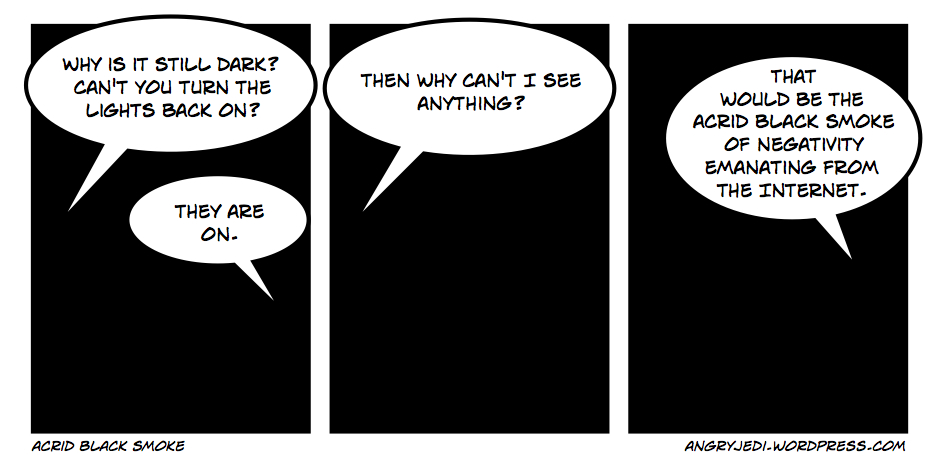
The point I am trying to make is the surprising amount of negativity the story in question attracted, and the subsequent high-school clique-style bitching and sniping that ensued on Twitter between high-profile members of the industry for the next few hours. People laugh and joke about passive-aggressive status updates from people who want to bitch about someone without naming them—"I wish SOMEONE would stop being such a jackass!"—but this was taking it to a whole new level, with, in some cases, high profile representatives of respected publications taking the passive-aggressive approach and arguing with thin air, presumably to try and make some kind of point.

I'm not going to name and shame anyone because there's no point in doing that and it wouldn't achieve anything. All I am going to say is that any time something like this erupts, I'm surprised and disappointed in people. Perhaps the story in question will turn out to be nothing—or perhaps it will turn out to be something big. Regardless, it was a rumour, and an interesting one at that, and people will want to know it. The original article made it very clear that it was a rumour based on things that anonymous sources had said. People can make their own minds up whether or not to believe it, but there's really no need for all the bitching and sniping.

It is, sadly, a hallmark of the Internet, though; comment sections were described on a radio show earlier today as "the bottom half of the Internet" due to their relentless negativity—a fact which made Charlie Brooker sit up and take notice, unsurprisingly. But why? Why the hate? Why the behaving like teenage girls?

Perhaps I'm just too much of a nice guy. I don't hate anyone, and I respect the work of others. I'll slag something off if it's genuinely bad, but I don't hate things for the sake of hating them like some people seem to. And whatever the reason for people's reactions to the story which broke earlier (still not getting into it!) there's certainly no reason for the ugly and thinly-disguised jealousy which has been evident this evening.

If people could just be a bit nicer to each other and a bit less negative about everything, the whole world would be a much more pleasant place.

It's nice to want things.

Day 452

#oneaday Day 102: A Hundred and Two

I Googled the number 102. The results might surprise you. If you're really bored and easily surprised.

The first page of results appears to be largely radio stations. Top hit for Googling 102 is Capital FM in Manchester, claiming to be Manchester's Number 1 Hit Music Station and conveniently ignoring the fact that Manchester is not the capital of the UK.

The second result is the Wikipedia entry for the number 102. I wasn't even aware Wikipedia had entries for individual numbers, but here it is—proof. Apparently 102 is special because it's an abundant number, a semiperfect number (its mother must be so proud) and a sphenic number. It is also the sum of four consecutive prime numbers, the sum of Euler's totient function, the third base 10 polydivisible number and a Harshad number. I do not know what any of those things mean and I'm sure that 98% of you don't either.

Wikipedia also tells us that the number 102 is the emergency telephone number for police in Ukraine and Belarus, the emergency number for fire in Israel and the emergency telephone number for ambulance in parts of India. And, of course, everyone knows that the Empire State Building has 102 floors, right?

Having clicked on a few links on that Wikipedia page, I'm genuinely astonished that there does indeed seem to be an individual entry for every single number. At least, every single number in the immediate vicinity of 102. Isn't the collected knowledge of the human race fascinating?

Well, actually, if you are the sort of person who despises maths, such as my 15-year old self (who regularly genuinely got angry at maths homework, despite the fact it was essentially inanimate and couldn't fight back) you probably don't find the fact that you can look up numbers on Wikipedia that interesting.

So for those people, back to Google it is.

Other radio stations that feature 102 include the stunningly boring-sounding "Town 102" from Ipswich, Wave 102 from Dundee (presumably not quite as good as Southampton's Wave 103), Warwickshire's saucy-sounding 102 Touch FM and Salisbury's Spire FM 102.

Google also brings up the IMDb listing for 102 Dalmatians, which has 2 stars or a rating of 4.4 out of 10 from 7,812 users. Because it's a movie and not a video game, we can assume that this means it is, in fact, slightly below average and not OMG CRAP. The title of that movie always struck me as incredibly dumb, however, because it should surely be "101 Dalmatians 2" if you are Disney and you are making an ill-advised sequel to your ill-advised live-action remake of your beloved animated movie. I guess they thought they were being clever. Perhaps they were.

Anyhow. I hope I've educated and informed you about the number 102. I promise I won't stoop to finding out fascinating fact about a number ever again. Unless I get really stuck for ideas.

Day 450

#oneaday Day 77: Updates Are Available

Remember when we didn't have to update things? I do. It was a good time. You could put something in to your computer or console, safe in the knowledge that it (probably) worked… and if it didn't work, it would probably get recalled and/or refunded. It was a binary state. In the world of consoles, this situation prevailed until the last generation ended—the era of the 360 and PS3 ushered in the Age of the Patch.

Of course, PC users have been dealing with this for considerably longer. Anyone who has ever used Windows will be intimately familiar with the incremental update process. It just used to happen slightly less regularly before we had the Internet there with easy access. You might get a disc (or huge pile of floppy disks) with an updated version on providing significant new features, rather than just plugging Security Hole Number 5,237,429.

Nowhere is "update culture" more apparent than in the world of smartphone apps. It's like keeping on top of your email inbox—you'll never beat it. Update everything on your phone and within an hour or two at least one app will have been updated with either "bug fixes" or "AMAZING NEW FEATURES". And people have come to expect, nay, demand these updates. Read reviews in the App Store (I know, I know) and you'll see products which have just been released with consumers demanding updates.

Of course, you don't have to update things when they come up. People who don't have an Internet connection don't, of course. And in theory, this shouldn't cause much of an issue—unless you own an Apple device.

I've become convinced with the past few iOS updates that Steve Jobs has a big magic "obsolescence" button in his office that immediately renders all iOS-based devices nigh-on unusable unless they're running the absolute latest version of the system software—even if they were happily working just fine the day before.

You may accuse me of paranoia at this juncture, and it wouldn't be an unreasonable assumption. However, let me cite the example of last night to you. Last night, Twitter for iPhone started playing silly buggers and decided to start crashing every five seconds. I deleted and reinstalled it and still it had trouble. So I downloaded Echofon instead. This ran, but slowly and jerkily. Given that I'm running an iPhone 4, supposedly THE MOST POWERFUL MAN IN THE UNIVERSE (Smartphone. I meant smartphone.) the word "slowdown" really shouldn't be in the vocabulary I use when talking about it. But slowdown there was. And lo, it was annoying.

It then occurred to me that I hadn't updated to iOS 4.3, which came out a few days earlier. So I quickly (ha!) updated my phone. And wouldn't you know, everything suddenly, magically ran the way it was supposed to. How about that?

So, the moral of this story, then, is update your shit. Otherwise the CEOs of the world will enjoy torturing you from afar.

#oneaday Day 75: Yar-Har Fiddle-De-Dee

Piracy is a crime. Most people are aware of this by now, but it still goes on. And as much as I'm not a fan of piracy per se, it's becoming increasingly understandable why people resort to less-than-legal means to get hold of digital content. Sometimes it's because said content isn't available where they live without paying exorbitant amounts of money to import things. Sometimes it's to get a different version of some content they enjoy. And sometimes it's because the legal versions of the content don't work in the first place.

Let's take YouTube as an example here. YouTube launched a service in the UK last year called YouTube Shows, which carries content from Channel 4, Channel 5 and various other sources, allowing viewers to catch up on programmes they've missed, rather like iPlayer. This is a great service, particularly considering it's available for free, thanks to the fact it's supported by advertising.

At least, it's great in theory. Until the advertising service breaks, rendering the content completely inaccessible. Because there's no failsafe to skip a broken ad, no means of reloading with different ads if they cause the video to fail and no means to report broken content, if YouTube decides that you're not going to watch something, you're not going to watch it.

This is obviously a Bad Thing, but of course it's not YouTube's fault directly. Computers fuck up, that's part of What They Do. But when the fact that Computers Fuck Up That's What They Do means that a service becomes unusable, that's when alternative means start to get 1) sought and 2) provided.

Take the various means of digital rights management that many PC games come bundled with these days, too. Several of Ubisoft's games won't run at all if you're not connected to the Internet constantly while you're playing, so if you have a dodgy wireless signal in your home, good luck playing Assassin's Creed on the PC, since it'll kick you from the game every time your connection drops. And now some console games are starting to take the same approach, too, with Bionic Commando Rearmed 2 on PSN being one of the first. Modern consoles are very much geared towards "always-on" connections these days, of course, but with the number of times my PS3 logs itself out of PSN with no warning every day, playing a game that depended on Internet connectivity would quickly become very frustrating.

It ends up as a vicious cycle, however. The pirates determine more and more inventive ways to circumvent the more and more inventive protective systems that publishers put in place to deter the pirates from circumventing their protective systems. And it never ends. At the moment, particularly when it comes to PC gaming, cracked versions often offer a more convenient, "better" experience than legitimate copies. And when it comes to DVDs, not having to sit through several minutes of unskippable bullshit every time you want to watch a 20-minute episode of How I Met Your Mother is always going to be a mark in favour of downloading the episodes rather than buying the DVDs.

Piracy is a crime. But buying a product isn't, and nor is tolerating advertising to make use of a free service. So how about the legitimate consumers stop getting treated like dirt, huh?

#oneaday Day 66: Is Traditional Writing Dead?

It seems every other week, particularly in tech-related industries, there is some sort of discussion over whether this or that is "dead". Inevitably, the answer is usually some vague waffle about how most people may have stopped using their Nokia N-GAGE but there are a few people out there utterly determined to beat Tomb Raider on a portrait-wise screen on a device which can survive being run over by a bus (I speak from experience) and thus the thing in question isn't dead, just on perpetual life support. Until it gets run over by one bus too many, of course.

A discussion I participated in earlier today on Twitter regarding grammatical usage of hashtags got me thinking, though. Is the concept of "traditional writing" dead?

When considering this, though, it's first important to determine what you mean by "traditional writing". And it's not an easy thing to define. Is this blog "traditional writing"? It mostly follows grammatical conventions (except when I'm being deliberately obtuse or conversational) and uses paragraphs. But no; I'd argue that it isn't writing in the traditional sense. Blogs are designed as a platform upon which people can share their thoughts on a subject and invite responses from other people. That last bit—the invitation for other people to respond, whether or not it's taken up by commenters—is the important part of blogging for many people. The best blogs are "conversations"—or at the very least, pieces which start discussions amongst other people.

You could argue, of course, that persuasive writing, philosophy and the like has had this sort of thing covered for many years, and you'd be right—people still debate Nietzsche down the pub, right? (I don't go to the pub that often.) But the key thing is that with blogs and their commenters, everyone has a voice of (relatively) equal power. Ironically, though, the popular blogs diminish the power of their own commenters by having so many that people are unlikely to read them all. But at least some of them get read, unlike a weighty tome on all matters philosophical, in which those pub conversations rarely go any further than the pub.

Then there's Twitter, the reason I got thinking about this in the first place. Here's the kind of tweet that got me wondering:

We'll leave @tanaymodi1's absent apostrophe and misspelling of "myself" aside for a moment, and look at those hashtags. Being someone brought up on "traditional" writing and grammar rules, those hashtags in the middle of a sentence are somewhat jarring to me and interrupt the flow of what's being said somewhat. Now, in theory, the use of those hashtags allows anyone reading that tweet to click on either #AngryBirds or #Mac and read what other people are saying on those topics. A sensible idea for hot topics under discussion. But I've seen people do it with more vague concepts, such as "I'm writing a #novel" or "Is Sasha Grey a model of fashionable female #sexuality?" that could be taken in all manner of different contexts. Are they still useful?

Apparently so; a number of people came forward in response to my query and said that they find it useful to have the facility to find out what other people are saying on the subject. The only fly in the ointment, however, is that not everyone uses them. If I'm writing a tweet about my Mac, for example, I'll use the word "Mac" and have never, ever hashtagged it, if only for the fact it saves one of Twitter's precious 140 characters. The only time I use hashtags are if I'm participating in a discussion about something (like, say, a TV show that's on at the time) and appending the hashtag on the end of the tweet, for these blog posts or for #lamehashtaghumourthatifindquitefunnysometimes.

This is obviously a different use of writing to how it's used here on my blog, how I use it when writing for GamePro, how I use it when writing an email and how I'd use it if I were writing a book. But it doesn't mean that any of these forms of writing are "dead" or "dying". Increasingly what's happening over time is that things that were once on a relatively linear path, such as the evolution of language, are splitting off into separate branches with their own contexts and purposes. Some people stick resolutely to one path and thus find it rather jarring when something from one of the other paths invades their consciousness. Other people can happily jump back and forth between the different strands, adapting their language to the situation as they see fit.

So no. I don't believe that traditional writing is dead, nor is it a niche interest that only a few dedicated souls are continuing with. It's simply one branch of an increasingly-complicated tree. As we find ourselves with more and more different means of communication available to us, language adapts, changes, broadens. And it will continue to do so for some time.

Where does it stop? Will (English-speaking) people on Twitter end up speaking their own language that looks a bit like English but isn't? Perhaps not. But it's something to ponder.
#oneaday Day 63: Mr Sheen

So. Charlie Sheen, eh? What a card. Winning. Tiger blood. I wish there were some way to show my appreciation for him through the medium of the Internet, such as saying "winning" every few minutes. Oh wait.

Sarcasm aside, I find this whole farrago (yes, farrago, deal with it) surrounding Mr Sheen somewhat bewildering. As someone pointed out on Twitter yesterday, Pete Doherty does a bunch of drugs, acts like a dickhead and is vilified, while Sheen does a bunch of drugs, acts like a dickhead and is elevated to Internet meme deity status? It makes no sense whatsoever.

Sheen himself isn't helping, with his Twitter account attracting over a million followers in the course of 25 hours, a new Guinness World Record. (I wasn't even aware there were Guinness World Records for how quickly people got Twitter followers, but I guess you live and learn.) His bewildering gibberish seems to have the majority of the Internet frothing at the mouth in giddy euphoria, wondering what on earth he's going to say or do next. Sheen acquired well over half a million followers before he'd posted anything at all on Twitter, with rubberneckers urging each other to "hold on to your hats" and the like.

I've never been one for celebrity culture and gossip, or gossip in general for that matter. As far as I'm concerned, what people do in their personal life should remain personal, whether they're the man on the street or someone in the public eye. Sure, public figures arguably have a responsibility to set a good example to impressionable people—but if they do this when they're out in public, is there any need to go prying into their private life?

Of course, one could argue that Sheen was rather public in his dickheadishness, in which case at that stage the press should step in and see what's up. But if that's the case, why is he being put up on such a pedestal? Is being a drug-addled twat really something to aspire to? If so, that's kind of sad. Or is it that he's a broken man acting more and more erratically as he makes more and more of a mess of his life, and everyone's laughing at him? Because that's kind of sad, too.

Not only that, but the LA Times revealed yesterday that Sheen had signed up with celebrity ad-whoring agency ad.ly, who pay Sheen and a number of other corporate shill "celebrities" including the Kardashians (whom I'm still not sure why are famous), Mike Tyson, Linkin Park and 50 Cent, to advertise products in their Twitter stream. A clever, if arguably obnoxious, idea. Fortunately, none of them are the kind of people I have the slightest interest in following, so I've remained relatively free of their selling-out-ness. But the fact remains that ad.ly are clearly taking advantage of Sheen's questionable mental state (and people's fascination with it) to make a quick buck.

Still. The usual response to disapproving of a situation like this is to advise one to "just ignore it". So, barring anyone coming up and shouting "WINNING!" in my face (who will get a punch in their face) that is what I intend to do from now. Having just written 541 words on the subject.

Now who's winning?

#oneaday Day 62: Too Long, Still Read

I'm almost entirely certain I have ranted on this topic at least once in the past. But, well, it bears repeating, given what I do both here and professionally.

More than one paragraph isn't bad.

More than 140 characters isn't bad. (Unless you're using Twitter, when all the deck.ly and TwitLonger nonsense kind of defeats the object.)

I read an answer to a question on GameFAQs earlier. The original poster had asked something which required quite a detailed answer. One respondee gave a detailed, good answer that was two paragraphs long, probably about 150-200 words or so. He apologised for writing "alot of text" (sic)—and I'll let the "alot" slide for the minute because there are bigger issues at work here, dammit. (Incidentally, if you've never seen this, well, you should.)

No. Stop apologising when you write things. Stop complaining at people in forums if they write detailed thoughts. Stop providing lazy people with "TL;DR" summaries and make them read. No wonder people haven't got the patience for books any more if they can't bear to read more than 10 words of someone else's opinion at a time and inevitably respond with something utterly inane like "lol". (And I bet they're not even really laughing out loud either, the bastards.)

Language is an incredibly powerful thing. Look at all the things it's built over the years. Those things didn't come about by people worrying about writing an "OMFG WALL OF TEXT" and people ignoring them. Those people had something to say and damn well said it, in detail, and argued their case. Their passion for what they were talking about came through in the power of the words that they chose, their enthusiasm for the topic came across with the depth into which they explored their topics verbally and on paper.

Now granted, there are times when brevity is better than verbosity. Anything from any government agency or law office, for example. I received a letter from the tax office a while back which went on for 3 pages when the single word "no" would have sufficed. These people have nothing to say and ironically spend pages and pages proving how little they have to say. Why? Who knows. To sound "official", perhaps.

But people with opinions? People debating things? People being—who'd have thought it—helpful? There's no sin in using a few more words if it might make someone think, discuss or smile.

So stop apologising when you write something, be it a blog post, forum post, Yahoo! Answers answer (well, someone has to write them) or blog comment. If you have something to say, it is absolutely your right to be able to say it without worrying about whether its length is going to put people off (*deftly sidesteps "that's what she said" gag*). And those who are too lazy to read a couple of paragraphs of comment? Well, they're probably not the sort of person you'd want to engage in a debate anyway. So F them in the B.

TL;DR: Stop being a dick.

#oneaday Day 60: Just Imagine...

Not so long ago, the world was a different place. Saddam Hussein was still in charge of Iraq, no-one knew who the Liberal Democrats were and Call of Duty was but a twinkle in a young Bobby Kotick's eye. Sounds like delightful times, doesn't it?

Well, the other thing about these glory days is the fact that we didn't have the Internet. And these days it's easy to take that fact for granted, given that most of the things we do throughout the course of every single day involve the Internet somehow, from the smallest little things to huge, life-changing events.

It wasn't always that way, and oddly enough it's a piece of educational software that really drives the difference home. Where in the World is Carmen Sandiego? was a game that tested your geographical knowledge and encouraged you to find out about the wider world. And you had to do it without the aid of Wikipedia, a website which means you can rattle through the Facebook version in a matter of minutes. Sure, it was often necessary to use reference material to pass the game's missions, but there's something a little different about using an encyclopaedia or atlas to find things out rather than typing things into Google.

For me, though, there's no going back to those dark days. I think about all the people I have in my life right now, and I bet over half of them are in my life because of the Internet, whether it's directly or indirectly. Some people I initially met face to face and then ended up getting to know via email or IM chat sessions. Some people I met online first and then met face to face later. Some people I've only ever met online, but want to meet face to face. And a few people I know online and am more than happy to keep them at a very long arm's length!

It's difficult to imagine how the events of the last year would have gone without the Internet. For starters, the situation wouldn't have arisen in the first place, for many reasons. But let's assume it had for a minute; the people from whom I had the most support were people I knew because of the Internet. A couple of them happened to be physically close to me, but a lot of them were on the other side of the planet. How different would it have been without them?

Perhaps if there was no Internet then I'd have more friends who are physically close to me. But then would that lead to a "compromise" sort of situation, where you hang out with people you don't really like because it's convenient?

Who knows? All I know is that I'm pretty damn grateful the Internet exists, and I'm equally grateful that the people I know because of it exist. You rock, so keep being awesome, and on that day when I win a bajillion pounds on the Inordinately Generous Lottery for People Called Pete (which doesn't seem to have started yet, sadly) I will be travelling around the world to meet each and every one of you, buy you a drink and/or call you "dick-tits" to your face.