Yesterday, the tech blog 404 Media reported on a horrifying development in the story of the World Wide Web's gradual decline into AI-encrusted unusability: the apparent resurrection of the once-beloved TUAW (aka The Unofficial Apple Weblog), a site that hasn't been active for 10+ years, into an AI-powered slop machine.
To make matters worse, the new owners of the twitching corpse of TUAW have apparently seen fit to "borrow" the identities of the site's former regular contributors, replacing their original headshots with AI-generated portraits or stock images of completely unrelated people and replacing their original archived work with AI-powered "summaries".
Naturally, the former TUAW writers are not all that happy about this. One of the affected individuals, Christina Warren, pointed out that the reason this has been done in the first place is likely "an SEO scam that won't even work in 2024 because Google changed its [algorithm]". She then concluded that those responsible were "Assholes!", which I thoroughly concur with.
This is just the latest in a long line of absolute bullshit brought about by the infestation of "AI" into everything online. There is absolutely no excuse, no justification for what has gone here. Not only is it defacing the legacy of a publication that was once loved — and trusted — by a significant number of readers, it's also destroying the portfolios of the writers in question, who are now saddled with AI-generated slop that has their name attached to it.
"I don't want people to come across the contents coming out of that site and think that I actually wrote like that [very poorly]," Warren told 404. And I can't help but agree — because we have a very real problem online in that sites shuttering often means vast swathes of work by talented writers just goes in the dustbin without warning. And while sites such as the incredible, wonderful archive.org do their best to keep a record of everything that once was, the sad reality is that a lot of stuff is just plain lost.
I know, because I've been on the receiving end of it multiple times.
My stuff might be in here… somewhere… maybe?
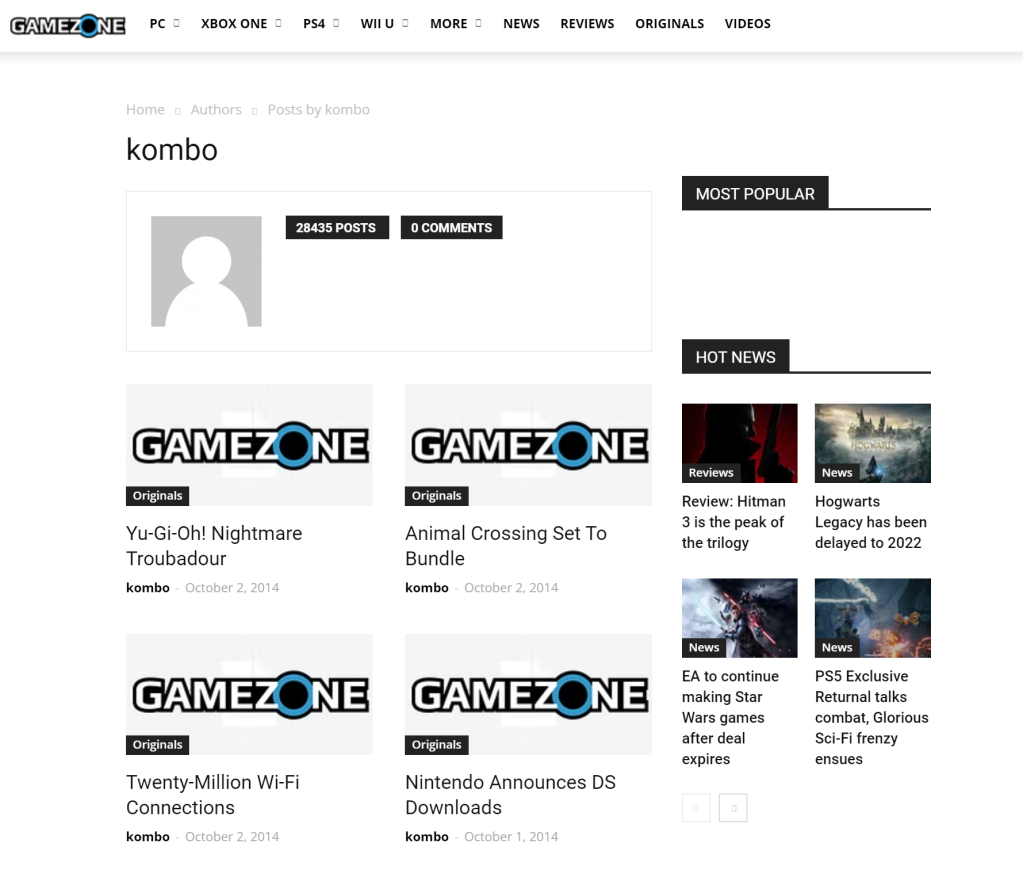
One of the first sites I ever wrote for professionally, Kombo.com, no longer exists, and its URL now redirects to a site called "GameZone". Surprisingly, GameZone does seem to have some of Kombo's old articles archived, though none of them are under their original byline, instead all attributed to "kombo" (lower-case). There are 28,435 articles attributed to "kombo", all with the wrong dates on them — they claim to date back to 2012, but there are some with the headline "E3 2010", suggesting that they were simply republished on the "newer" site in 2012 — and no means of identifying who wrote what. As such, it's useless for me to use as part of a portfolio.
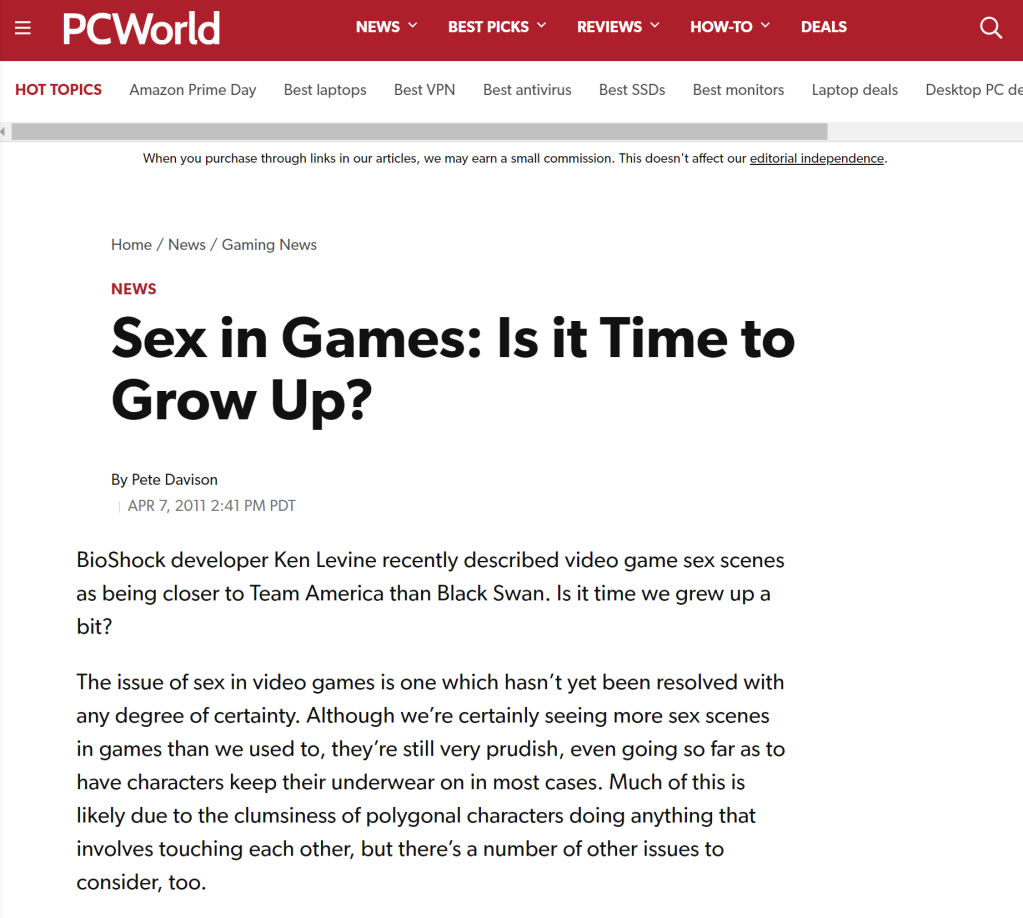
The two "big" sites I wrote for, GamePro and USgamer, also went belly-up at various points. In both cases, again, some of my work ended up archived on other sites. In the case of GamePro, some of my stuff found its way to the American tech site PC World, but a search for my name now throws up a list of useless garbage that quotes my name but doesn't actually link to anything I wrote without manually scrolling through several pages of junk. And, of course, there's no link to my byline for me to easily find everything by me, despite my byline being right there on the articles in question when I can find them!
This is the one and only GamePro article by me I could find after a few minutes of searching. It appears on page 2,689 of a defunct archives page. None of the images or links in the article remained intact.
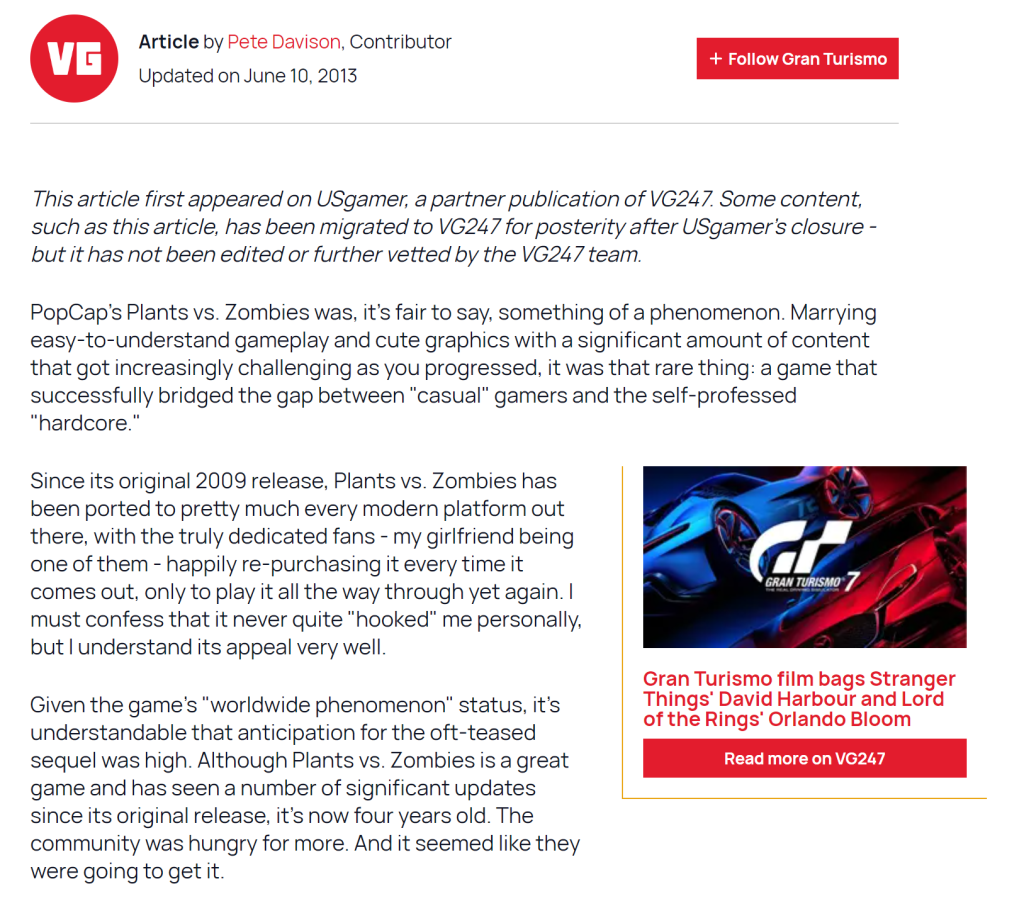
USgamer, which folded a little more recently, fares a little better in that I actually have an author page on VG247, where the articles ended up — although said author page has no picture, no bio and a link to a Twitter account that no longer exists. There's 8 pages of material from me, which I suspect isn't all of my work from USgamer, but it's a decent amount, at least. I just wish it wasn't on VG247, which is a site I am… not a fan of.
Better than nothing — or being "AI summarised", at least. Just wish it was under a different masthead.
In this respect, I guess I'm actually kind of lucky that my identity hasn't been co-opted by a content farm and all my past work fed into ChatGPT to regurgitate at considerably lower quality than I originally wrote. But I have to confess that reading stories such as this one about TUAW fills me with genuine dread. I'm not overly concerned about AI "taking my job" because it's rapidly becoming very clear that AI writing is both easy to spot and demonstrably inferior to a human being doing the same thing.
But I am concerned about the potential for AI slop with my name attached to it dragging my reputation through the mud. As a writer, I find it grossly insulting to my profession. And simply as a human being, I find what has been done here to be absolutely, totally unconscionable.
There has to be a breaking point somewhere. Soon. Please. I am rapidly running out of what little faith in humanity I have left. And there wasn't a lot left in the first place.
Want to read my thoughts on various video games, visual novels and other popular culture things? Stop by MoeGamer.net, my site for all things fun where I am generally a lot more cheerful. And if you fancy watching some vids on classic games, drop by my YouTube channel.
If you want this nonsense in your inbox every day, please feel free to subscribe via email. Your email address won't be used for anything else.
A lot has been made about the supposed proliferation of "fake news" and, regrettably, because discussion about it started around the time of Trump's last ascendancy (and to quite a significant degree from the Trump camp), not everyone takes the concept entirely seriously. But it's definitely something that happens, and it's making the Web less and less useful.
Earlier today, a member of a Discord I'm in posted a link to the following tweet:
The screenshots are of Windows Defender supposedly finding a plain text file containing nothing but the text "This content is no longer available." to be a piece of malware — specifically a Trojan called Casdet!rfn. Obviously a plain text file is not malware, so this is ridiculous, and thus Microsoft must have made a silly mistake and we can all laugh at them, ho ho ho.
I tried it.
Windows Defender did not find it to be malware.
I Googled it and found several outlets reporting on this "story", including some that really should know better (looking at you, Tom's Hardware) — and not one of them had seemingly put in the minimal amount of effort required to verify that this was actually a thing. In other words, none of them had done what I did above: recreate the situation by composing a blank text file, putting the words "This content is no longer available." in it and then scanning it with Windows Defender. A two-minute job, tops.
No, instead the most rigour anyone put in was to look at the replies to the Twitter post, which are fairly slim in number, making me wonder exactly how this misinformation had spread in the first place. The tweet in question has nearly 700,000 views, though only 800 of whatever the Muskrat is calling "Retweets" this week, suggesting the majority of its minor virality has come about through situations exactly like the one I describe above: people sharing it via means other than Twitter.
Now, I don't blame the chap on Discord. He was just sharing something he thought was funny. I don't even blame the original Tweeter, because it's entirely possible that this was true once and it was quietly fixed in a Windows update. But I do blame all these people, and Google.
Not only for reporting on this without doing the absolute bare minimum of fact-checking, but for not correcting these stories if indeed it was once true and now is no longer correct.
Either way, the result is the same: a lot of misinformation gets spread very easily, often by people who have no ill intent. It's not the fault of the people who share this stuff — although I personally would check any sort of claim like this before resharing it myself — but it absolutely is the fault of outlets authoritatively sharing this as "news" without doing any sort of research beyond looking at a few Twitter posts.
Sadly, this is what "news" is these days. Get a good hook for a story that might be the slightest bit clickable and/or shareable, then write it up (with at least 600 words for SEO purposes, of course) and just make some shit up in the middle if you need to. Doesn't matter if the story is true or not; by the time people have clicked or shared, the article has done its job, and it doesn't matter if anyone twigs that it's bollocks or not.
In some respects, I'm sad that I'm no longer working the games journalism beat. But in others, I know that if I was still a newshound, I'd likely be gently encouraged into this sort of odious practice in order to get the numbers up.
I had more integrity and rigour when I was covering stuff for GamePro and USgamer. I'd find stories, research them myself and report on them only when I was good and sure that there actually was a story there. And I didn't have to make a big deal out of doing that at the time, because that was the expectation for someone working a News Editor position.
Now? Engagement above all. Who cares if something is true? Numbers go big, suits stay happy. Fuck the actual audience who might want the publications they read to be reliable and trustworthy; they are, after all, the least important part of the whole equation these days.
If you're looking for the Web as it once was, then I'm sorry to inform you that This content is no longer available.
Want to read my thoughts on various video games, visual novels and other popular culture things? Stop by MoeGamer.net, my site for all things fun where I am generally a lot more cheerful. And if you fancy watching some vids on classic games, drop by my YouTube channel.
If you want this nonsense in your inbox every day, please feel free to subscribe via email. Your email address won't be used for anything else.
Is 30 days a milestone? I guess you can look at it that way, depending on if you consider nice round numbers a milestone. You can also look at 30 days as "about a month", too, so I guess it's significant from that respect. It's a long way off the 2,541 daily posts from last time around, of course, but that all started with baby steps, too. And then it just kept going.
Now and again I like to hit the "Random Post" button on this site to jump to one of the myriad posts in the archives. I often find myself surprised how often it throws up the same things, given how many of them there are, but computerised randomisation is, as we hopefully all know by now, imperfect.
That gives me an idea for today's post. I'll hit Random a few times and see what I think of what shows up. Are you ready? Then let's begin.
First up, Day 693 from first time around, and a post named Endings. In it, I contemplated the fact that I had just finished L.A. Noire, a game that I enjoyed a lot at the time but which I have forgotten almost everything about since. I pontificated on particularly effective endings that had stuck with me over the years — particularly downer endings. And Conker's Bad Fur Day was one that stuck with me, due to it coming after all the foul-mouthed ridiculousness that had come before.
I still agree with this. Conker's Bad Fur Day ends absolutely perfectly. It's a huge bummer in a lot of ways, of course, what with our hero losing his true love, but it also provides something of a sense of "reality catching up with him". The strange journey that Conker goes on over the course of Conker's Bad Fur Day starts silly and cartoonish, but gets darker and darker as you progress through things. By the last few sequences in the game, things are still silly, but there's a definite sobering undercurrent. The World War II-inspired sequence may have you fighting against teddy bears, but it's still World War II, and a lot of people get hurt and die.
The ending of Conker's Bad Fur Day is as much a signal to the player as it is to Conker. "Wake up," it says. "The time for play is over. Now it's time to get back to the grim reality of life." Sobering, to be sure.
Next up, post 850 from first time around, entitled Diablolical [sic]. In it, I lay out how I'd been having a good time with the then-newly released Diablo III, and that I didn't have as much of a problem with it being "always online" as the rest of the Internet seemed to. And that's because I recognised that Diablo III, far more than its predecessors, was actually an MMO. A well-disguised one, yes, but still an MMO.
I actually stand by this assessment, though my opinion on Diablo III itself has soured somewhat for a variety of reasons. Firstly, after playing it a bunch, I realised that its setting and unrelenting grimness was just plain boring to me. The world of Diablo is a world in which there is no hope; one in which you defeat the Big Bad of the hour and there's inevitably an even bigger bad lurking just around the corner. And once you've beaten all the Big Bads, they all come back, because that's what Big Bads do in Diablo-land.
Secondly, it's hard to get the various revelations about working conditions at Blizzard Entertainment out of my head. I'm not about to go on a big crusade about it or anything, but given that the Diablo series is already one I'd been feeling a bit "ehhh" about since the very beginning, knowing that some of the staff at the developer are shitheads makes it a lot easier to just go "fuck it" and never play anything from them again… particularly as all of their last few releases have some combination of loot boxes, battle passes or predatory "free-to-play" monetisation. So yeah, fuck Blizzard and fuck Diablo. Diablo III is still an MMO, though.
Next up, an earlier post: number 303, from 2010, in which I ponder the nature of Panic Stations. Specifically, through some exceedingly heavy-handed masking, I outline the things that cause me a sense of irrational anxiety, even when I know they're not anything really worth getting het up about. 2010 was before I'd really sought any sort of help for mental health, and well before I'd been diagnosed with either anxiety or Asperger's, but I still recognised anxious feelings in myself — and my brain's tendency to blow things out of proportion.
This post is one I should probably return to now and again to remind myself not to get so wound up about stupid things.
Finally for today, an even earlier post from 2010: number 57, Look into the Eyes, in which I talk about the Derren Brown show my ex-wife (who was, at that point, just my wife) and I had been to see at the Mayflower theatre in Southampton. I really enjoyed that show, and both of us had a lot of time for Derren Brown. I feel like we don't see much of him these days; I wonder what happened to him? Looking on Wikipedia, it seems he's still active, but I guess the changing nature of how we look at media these days makes him less visible — I don't watch "TV" any more, for example, and that tended to be where I saw him the most.
All right, that's enough looking back for one day. My cat has just been sick and the other cat is eating it. I think that's as good a cue as any to just go to bed.
Want to read my thoughts on various video games, visual novels and other popular culture things? Stop by MoeGamer.net, my site for all things fun where I am generally a lot more cheerful. And if you fancy watching some vids on classic games, drop by my YouTube channel.
If you want this nonsense in your inbox every day, please feel free to subscribe via email. Your email address won't be used for anything else.
In theory, the opportunity for developers to respond to user reviews on storefronts such as Steam, Google Play and the like should be a good thing. It should provide the opportunity for the developer in question to open a dialogue with a customer — be they satisfied or dissatisfied — and help move things in a positive direction in one way or another.
How it actually works, meanwhile, is quite different. Because most developers, it seems, can't be bothered to do anything other than a stock response to everyone, even when it's woefully inappropriate to do so.
I'd like to share with you a review I wrote recently, in which I found a "teleprompter" app for Android (this one, if you're curious, which was recommended by one of the bajillion SEO-baiting "best teleprompter apps for mobile" articles festering on the modern Web) but was dismayed to discover it was asking for an extortionate subscription fee rather than a flat price. I am pretty vehemently against subscription fees for simple, single-purpose apps, particularly when they don't have an online component, and I made this clear in my review.
Not unreasonable, I don't think. Now let's look at the developer's response:
Now this is an excellent developer response. "You think the monthly subscription is too expensive, so why not use the more expensive annual one" is a ballsy move, to be sure. "You don't like monthly subscriptions, but it's okay because you can cancel any time and lose access to the app you paid for" is also high up my list of "stupid things to say".
More than that, it's just plain bollocks. This comment is symptomatic of a widespread issue with all manner of software today, whether they be single-purpose mobile apps or more elaborate services. And that issue is that everyone seems to see a perpetual need to "introduce new features".
I'll remind you that when I came across this app I was looking for something that did one thing and one thing only: provide a "teleprompter" facility that I can use on my phone. To elaborate, that means provide the ability to display some text on the phone's screen while the camera is recording, allowing me to make "eye contact" with the camera while reading from a script.
This app does that already. It does not need any new features. It is already fit for purpose, aside from the subscription fee. Therefore it does not need additional development or new features to be introduced. (Especially not a "Rewrite your script with AI!" feature, which it proudly boasts.) Perhaps a compatibility update every now and then to ensure it works with whatever current version of Android has been loaded onto my phone without telling me this week. But that does not warrant a fee of five quid a month or even twenty quid a year.
As I said, I would have quite happily paid a fiver up front for the app, and that's being extraordinarily generous in the mobile space, given that most people don't like paying more than 79p for anything.
The stock response from "Phil" about "introducing new features" and "continuing to improve the app" didn't convince me in any way that the subscription fee was worth paying, and I suspect he knew that as he copy-pasted the words into the response box. So why did he bother posting it at all? Just so the fact he "responds to feedback", even if it is with utterly stupid suggestions, is visible to anyone browsing the page and not looking too closely?
A few minutes later, I found another teleprompter app that does just charge once and then doesn't bother you again. So I bought it without a moment's hesitation. Don't stand for exploitative, predatory subscription models, particularly on mobile where it's extremely easy to forget about them. And support those folks who are actually providing a good, useful piece of software without trying to fleece you.
And Phil? Eat a thousand cocks.
Want to read my thoughts on various video games, visual novels and other popular culture things? Stop by MoeGamer.net, my site for all things fun where I am generally a lot more cheerful. And if you fancy watching some vids on classic games, drop by my YouTube channel.
If you want this nonsense in your inbox every day, please feel free to subscribe via email. Your email address won't be used for anything else.
See? I told you I'd be back. And I thought I'd talk about something other than Final Fantasy XIV: Dawntrail. Specifically, as the title says, I want to talk about how trends have made the Internet boring. Or perhaps more accurately, why everyone all wanting to do the same thing all at once makes things deathly boring.
There are a few practical examples I'd like to give. First is a YouTube channel I was introduced to recently called Obscurest Vinyl. This channel is run by a designer and musician who found some joy in creating fake record sleeves for songs with names you definitely wouldn't have gotten away with in the eras they're parodying. Songs like the wonderful Pullin' Out My Pubes (She Loves Me Not) by The Sticky Sweethearts:
You'll notice from that video that the record label now has some music attached to it. I was initially a little perturbed to discover that the person behind the Obscurest Vinyl YouTube channel had been using AI music generation to create the tracks, though my mind was set somewhat at rest by how he had written the lyrics (which are generally far too offensive to be the product of the typically rather po-faced Large Language Model AI bots) and tinkered with the initial output to make it flow properly, incorporate all the filthy language and sound consistent with the other works from the same fictional "artists" on the channel.
Of course, what the YouTube algorithm then did was go "oh, you watched a video about a fake record with lyrics about someone gluing their balls to their butthole, HERE, HAVE A MILLION MORE OF THEM". And it became very apparent that Obscurest Vinyl has a lot of copycats out there, none of which have anywhere near the same magic; these other channels are just trying to ride a trend.
This, of course, is symptomatic of one of the main things that is killing the Web right now: excessive Search Engine Optimisation or SEO. Have you ever searched for some information on something, only to find a billion unrelated websites all magically having articles headlined "What Time Is The Superbowl On?" or "Where Do You Unlock Pictomancer in Final Fantasy XIV?" That's SEO at work, and that's a problem that is only getting worse with the amount of AI sludge that is being fed into the Internet at large. Sites want quick and easy clicks, so they look at what people are searching for — the trends of the hour — then provide a hyper-specific article about the thing.
Helpful? Arguable. I hate it, because I'd rather have the information directly from the original source — in the latter case above, for example, it took me a fair bit of scrolling before I got past all the websites jockeying for SEO juice to the actual website for Final Fantasy XIV, the thing I was looking for.
More than being frustrating if you want the information straight from the horse's mouth, it just makes the Web boring as fuck, because every site (including a lot that should really know better) are doing the exact same thing. Daily Wordle solutions. Individual articles for things that would have been much better incorporated into an FAQ. Outright copying and plagiarism of other sites. It really is a shame to see what online media has become — and frustrating to see that certain portions of the creative types on sites such as YouTube are more obsessed in chasing trends with transparently copycat material rather than, you know, being creative.
I don't know what the endgame of all this is. I hope we're in a "things will get worse before they get better" kind of situation, but honestly right now, it feels unlikely that the "get better" part will happen. The Web gets demonstrably worse, less useful and less fun day by day. And we've all let it happen. I don't know if we can undo that.
Want to read my thoughts on various video games, visual novels and other popular culture things? Stop by MoeGamer.net, my site for all things fun where I am generally a lot more cheerful. And if you fancy watching some vids on classic games, drop by my YouTube channel.
If you want this nonsense in your inbox every day, please feel free to subscribe via email. Your email address won't be used for anything else.
I'm compelled to write today by the thoroughly lovely Neil and Dave of the This Week in Retro podcast, who had a discussion about "the youth of today", and how some parents are concerned that their children spend the vast majority of their time on an endless cycle of Fortnite, Roblox and Minecraft, perhaps punctuated by social media in between times. The show and its discussion can be found below:
People who grew up pre-Internet doubtless all have their own experiences to share. The listener who wrote in with the question described how while they did spend time with their computer playing games, they also played outside, rode their BMX bike and all manner of other things, while both Neil and Dave described their own experiences as being a bit different, both from one another and from the listener's recollection. So I thought I'd share my own experiences, with the benefit of hindsight.
I grew up in a country village that, at the time I lived there, had somewhere between 800 and 1,000 people living there. It was seven miles away from the nearest town, there was no bus service unless you went to the next village over (and even then, it was pretty much a "once a week" sort of affair) and… I guess you could look upon it as either being ideal or terrible for growing up in. Ideal because it was quiet, safe and full of places to go on childish "adventures"; terrible because, particularly once I reached adolescence, all of my friends were a car journey away.
I went back and forth on my feelings about living in that village. When I was of primary school age, I attended the village school, and as such my social circle was pretty much all people who lived nearby. I had a small group of friends, only one or two of whom I actually went to see outside of school time, but mostly kept myself to myself. In retrospect, my relative lack of socialisation compared to some of my peers was likely down to the social anxiety I felt as a result of my then-undiagnosed autistic spectrum condition.
But at the time, I didn't really begrudge living in the village. I knew it was a nice place, that I lived in a nice house with supportive parents and a stable home life. I enjoyed when my grandparents came to visit and we'd go for a walk, inevitably to landmarks around the village that had acquired nicknames; "The Kissing Gate" (one of those awkward gates into a farmer's field), "The Brook" (a pathetic little stream that, these days, has mostly dried up and smells awful), "The Bullocks" (the farmer's field beyond The Kissing Gate that sometimes, but not always, had bulls in it). Looking back on it now, I have lots of fond memories.
When I entered my teens and started attending school in the aforementioned town seven miles away, my feelings changed a bit. While I was still somewhat anxious about social situations, I started to feel a bit more left out. As I grew older, I started to feel like there were lots of things that I couldn't do because I didn't live close enough. These feelings persisted until I turned 17, passed my driving test and suddenly had a lot more independence… so long as my Mum didn't mind me borrowing her car of an evening.
I promise I'm getting to the video games.
Point is, I don't remember spending a lot of time as a kid or a teen "playing outside". I didn't learn to ride a bike until well after many of my peers — memorably, I suffered a rather large setback on my initial efforts when I came a cropper and skidded along a rough concrete farm road, shearing a significant chunk of skin off my legs and arms, which made me a little hesitant to try again for a while — and I didn't spend much time with many of my peers, except on rare occasions when I'd go over to a friend's house for one reason or another.
Throughout all that time, I was fascinated with computers. Not just games, but computers in general. I knew my Dad worked for IBM, but didn't really know what he actually did (and still to this day don't think I could actually tell you). I knew my brother and Dad both contributed to an Atari computer magazine that we got regularly known as Page 6. And I knew all of my family, at one point or another, were keen computer users for various reasons. My Dad used it for "serious" software and subLOGIC's Flight Simulator II (which he insisted was "not a game" and was thus still counted under the "serious software" category"); my Mum liked the occasional blast on Millipede and Space Invaders; my brother was the one who was into games, though he had a much more active social life than I did, helped at least partly by being ten years my senior.
Since I determined quite early on that I rather enjoyed — or at least felt most comfortable — in solitude, I was grateful for the company of the computers of our household: initially the Atari 8-bit and ST, then later the MS-DOS and Windows 3.1/95/98 PCs. In the early days of the Atari 8-bit, I devoured books and magazines about the computer, typing in listings and learning how to program in BASIC myself. I never really got what I'd call good at it, but I developed a basic (no pun intended) competence that was greater than that of someone who just used their computer to play games.
But I also played games. A lot of games. I learned a lot from those games, too. Text adventures helped me with my reading (and, indirectly, my writing); keyboard-based games played a significant role in developing the typing skills I still have to this day; puzzle games helped me with my general intelligence and problem-solving; action games helped me develop my imagination and my motor skills.
It's stereotypical to say that "games help with hand-eye coordination", but I was diagnosed dyspraxic in primary school, which basically meant I was a bit clumsy with certain things; video games helped me feel like I was competent at something, even if I was unable to hold a pencil "properly". Playing games, and more broadly "going on the computer", was important to me. It felt like it was something I could enjoy without compromise; I didn't feel like I had to make any sort of adjustments, or have people "go easy on me" as I did in activities like sports. It was just something for me to enjoy. And, as I moved into my teens and broadened my circle of friends at secondary school, they proved to be a good backdrop for social interactions, too.
More often than not, if I went over to a friend's house or had a friend over to mine, we would spend our time playing games together, or at the very least just using the computer. I have fond memories of spending time with several friends just messing around with speech synthesis programs on the Atari ST and Amiga, and even programming in STOS, a dialect of BASIC for the Atari ST, or making silly in-joke games with Clickteam's wonderful Klik and Play and The Games Factory. I was happy that my formerly solitary activity was something I could share my enjoyment of with others.
This continued as I came to the end of my time at school and moved into university. I made new friends, at least partly through computing and video games, and many of those folks are people I still make an effort to spend time with today — even if sometimes that effort doesn't feel like it's reciprocated with quite the same enthusiasm. Computing and gaming remained something that was important to me, even as the Internet came into its mainstream ascendancy in the late 1990s.
I have some fond memories of those early days of the Internet. Chatting with strangers on CompuServe's "CB Simulator", aka just a public chatroom. Posting messages on CompuServe's GAMERS forum, which eventually let to me earning $200 for making ten Wolfenstein 3-D levels that were included in an official expansion pack. Chatting with my friends from my course on MSN Messenger. Randomly getting into a conversation with a young woman on AOL Instant Messenger, only to discover that, completely by chance, she was the housemate of one of my existing friends.
Computing was always there as part of my life, but I think a key difference between then and now is that in my formative years, it was there as a backdrop to socialisation, rather than the means of socialisation itself. The This Week in Retro listener commented that their children feel genuine anxiety and FOMO ("Fear Of Missing Out") if they have gaming time privileges revoked for whatever reason, because rather than Fortnite, Roblox and Minecraft being the backdrop for their socialisation, those activities are the socialisation.
There's also social media to take into account. I am genuinely glad that social media did not exist when I was a child, because I'm not sure I would have made it through my adolescence intact. Sure, there are positive aspects to it, such as being able to reconnect with people you haven't spoken to for a long time, but there's also the insidiously manipulative nature of all the major platforms today, and how none of them are really concerned with being a platform for communication; they are, instead, platforms for advertising.
The thing that really makes me feel like social media may well have done me in, though, is how easy it is for it to be used for bullying. I suffered a fairly significant amount of bullying throughout both my primary and secondary school life, and it was hell. It left me wary of trusting people; it made me frustrated about communicating with others; it made me feel like it was, at times, simply not worth making the effort to interact with people.
For a long time, I used to say that the Internet allowed me to "be myself" for the first time… well, ever, really. I could find like-minded people who understood me and respected me for who I was, and I felt like I was among friends. I don't feel that way any more; nowadays, I feel the same way about online interactions as I do about interacting with real strangers: genuine anxiety and fear. I dread getting notifications in apps or on websites where I've posted something publicly. And yet, I still do it — here I am, after all — because I feel like it's important to not let the bullies win, whether they're real or imagined. I need to feel like I can still express myself the way I want to express myself; to enthuse about the things I want to enthuse about. That's why I write here and on MoeGamer, and why I make videos over on my YouTube channel.
Even then, though, I feel a lot of frustration, because I know a significant portion of the world looks on the Internet, social media and general social interactions in a different way to me. That can often leave me feeling lonely and isolated. But the one thing I've always had as a constant is being able to immerse myself in a video game or other activity on the computer, and feel like I am, for once, at peace — even if, with each passing year, it feels like it's getting harder to share that haven of peace with others.
That went a tad deeper than I perhaps thought, and I'm not sure I have an answer to the original poster's questions or concerns. I do know, however, that spending time on the computer isn't necessarily a bad thing in and of itself, particularly when it brings someone comfort and stability. It's when that "safe" activity starts to get "unsafe" things encroaching on it that you need to perhaps take action — but that's going to be something that is different for everyone. For me, it's meant largely removing myself from the public-facing part of the Internet except in places where I can very much control and curate my experience, and continuing to enjoy those things that I always have enjoyed in peace and quiet. No video game ever betrayed me, after all.
Want to read my thoughts on various video games, visual novels and other popular culture things? Stop by MoeGamer.net, my site for all things fun where I am generally a lot more cheerful. And if you fancy watching some vids on classic games, drop by my YouTube channel.
If you want this nonsense in your inbox every day, please feel free to subscribe via email. Your email address won't be used for anything else.
Earlier today, someone I haven't spoken to for a while popped up on Steam and asked if I was OK, because I'd been "posting way more politically than usual" of late.
Confused, I asked for more details, since I wasn't aware I'd been doing anything of the sort, and it transpired that he somehow thought I ran the Twitter account for a certain website that I'm not going to name for reasons that will probably become obvious. (It's not Rice Digital, the site I used to be in charge of, before you wonder!) I explained that no, that was nothing to do with me, I had never written for that site and I wasn't even on Twitter any more, which I'm not.
Hopefully reassured, my acquaintance wished me well and that was the end of that.
He got me curious, though, so I went and looked at what the account in question had been posting, and it didn't take me long to stumble across what the issue was. It seems that the main problem stems from a story the site in question had recently posted that was, in essence, nothing but a rumour with sources that could be called questionable if one was being charitable, non-existent if one was being realistic. The thrust of the story was that it was one of many instances of a supposed conspiracy that "DEI" (Diversity, Equity and Inclusion) consultants are destroying modern gaming.
I'll address some things up front, because I have spoken about these things in the past, often critically, and I want to make it clear what my own stance on the situation is.
Diversity, equity and inclusion are not bad things. Do some companies and individuals take things a little too far in terms of pussy-footing around protected groups in an attempt to not offend anyone? Absolutely, particularly in the corporate space. Have there been instances of games journalists slagging off games that they knew nothing about because there was sexually suggestive content in them? Most definitely. Both of those things are, I believe, still worthy of criticism. Any creative work deserves to have a fair shake at expressing what its creators want to express without interference, and without those engaging with it treating it in bad faith.
However, this current conspiracy theory — and make no mistake, it really is a conspiracy theory — goes a lot further than those things. The current belief is that a cadre of games journalists and diversity consultants are running an extortion racket on game developers and publishers in the name of making all the women ugly and not white. To these people, if this situation continues unchecked, all of gaming will be completely destroyed, because having the opportunity to select your pronouns in a first-person role-playing game where you play a self-insert avatar is somehow responsible for the complete downfall of western society. It'll turn all your kids into immigrant transgender gays, I tells ya.
This is, of course, complete bollocks. It is true that the triple-A space has been making some marked steps towards improving diversity in many of its games, but as I've argued numerous times both here and over on MoeGamer, the triple-A space is just a tiny piece of the complete behemoth that is the games industry. Just because some triple-A blockbuster game has a woman with "woke chin" (an actual quote from one of these nutcases, criticising the new Joanna Dark for having a wider chin than she used to) does not mean that games with anime titties are going anywhere. Right now, you can play Final Fantasy XIV as a bunnygirl with big tits running around in bra and pants if you want, and Steam is filled with games where you can fuck your aunt. Hell, there are physical releases of Switch games that feature uncensored jizz-filled vaginas. Jizz! In a Nintendo game! (Actually, don't, you'll need to do more than blow in the cartridge afterwards if you do.)
Here's the thing: diversity means that you end up with diverse things. Some of those things will appeal to you, personally, while others will not. Those things that do not appeal to you, personally, are not a personal affront to you. Consider something that you really really love, but which other people don't seem to get. Now contemplate someone with a completely different worldview to you — be it a differing political ideology, racial background, sexuality, gender identity or any of the myriad other distinguishing characteristics we all have — finding something that they really really love, but which you don't seem to get. It's the exact same situation, only you're seeing it from the other side. Neither of those things cancel out the other.
The longstanding concern that this conspiracy theory stems from is that the growth in progressivism in the games industry — and particularly in games journalism — is somehow going to be responsible for the death of games that push boundaries or cater specifically to those with particular tastes, especially if those tastes are "playing games with conventionally attractive female characters in them". Well, ten years on from the shitshow that was GamerGate, I think we can say pretty conclusively that this has not happened. If anything, we're far more likely to encounter boundary-pushing games today than we were ten years ago… arguably to a fault, in some situations, such as with the amount of AI-generated "Hentai"-labeled crap that infests both the Nintendo eShop and Steam.
What we have now is a landscape that has changed. Triple-A may well be taking aim at a more diverse market, and that's entirely understandable, because with budgets spiralling out of control and layoffs happening left, right and centre, those games have to appeal to the broadest demographic possible. And just because some set-in-his-ways white dude doesn't like that a new big-budget game has black/gay/transgender/[insert minority group of choice here] people in it doesn't mean that others won't like it. It makes the most sense for triple-A to try and include as many people as possible, because, cynically speaking, that's how you make the money.
But the thing to remember is that none of this is "taking your games away" or "killing gaming".
I will freely admit that, ten years ago, I had some serious concerns that the strong push for progressivism in games journalism in particular would push certain forms of interactive media underground or possibly even cause them to dry up altogether. I almost certainly made some ill-advised comments during that time which are likely still on this blog and MoeGamer somewhere — but I'll say now, in 2024, those fears some of us had ten years ago completely failed to materialise, and I'm not afraid to admit that I was wrong about those things.
Triple-A has changed, yes. But ten years ago I wasn't concerned about triple-A because I'd bounced hard off that part of the industry several years prior — and I still don't care about triple-A today. I was worried about the games I did enjoy, which were B-tier titles, primarily from Japanese developers and publishers, that had a laser focus on their target audience.
Despite never engaging with triple-A beyond games with "Final Fantasy" in the title, I have never been short of things to play. If anything, I have too many things to play, as my rapidly filling shelves will attest. If I threw triple-A in the mix, I'd really be overwhelmed.
There's no "great replacement" of video games. There's no "DEI" or "Modern Audiences" conspiracy to make every woman in gaming ugly. There's no "extortion racket" causing games journalists to circle the wagons and protect a firm of diversity consultants from the "true gamers".
There is, however, a problem with intolerance. And it seems to be getting worse, fuelled by conspiracy theories such as this. I've seen way more in the way of racism, homophobia and transphobia in Internet comments — particularly in busy, public places such as YouTube and what is left of the burning garbage fire that is Twitter — than ever before.
Just last week I watched an episode of the Game Grumps' spinoff show Ten Minute Power Hour, in which Arin and Dan got gussied up as drag queens with the assistance of a professional. While there were plenty of comments in support of the episode — particularly as it aired during Pride Month, which is ongoing as I type this — there was some serious ugliness further down in the comments below where the moderators had been doing the majority of their work.
I'd say I was kind of shocked, but I've seen this intolerance and outright hatred rising over the last few years, and it's not pretty at all. It was particularly shocking to see it in the comments of a Game Grumps video, though; while the Grumps have toned down some of the more colourful elements of their humour over the last 10+ years — no more "Sad Hoshi" in an exaggerated faux Japanese accent, for example — they certainly have not, in any way, abandoned who they are or the overall vibe their humour creates. What has changed, however, is how vocal the intolerant and hateful have become.
Browsing Twitter as I was earlier, I stumbled across an absolutely enormous thread by one fan of the website that started this whole discussion, collecting "evidence" of the supposed conspiracy — actually just screenshots of games journalists saying that maybe this website shouldn't report on stupid rumours without even attempting to verify them, or commenting in support of progressive talking points. As I scrolled through page after page of this guy collecting these tweets, all I could think of was the old wisdom that if more and more people seem to be against you, perhaps you are the one who actually has the problem.
Look, I have absolutely no time for the militant end of the left wing. I find them insufferable, tedious and just plain annoying. But I feel like I'm seeing a lot less of them these days; the problem we have right now is coming from the opposite end of the spectrum. And it is a problem. When people like me, who have long made a specific effort to try and steer as clear as possible of anything even vaguely politically charged or controversial, are noticing an uptick in intolerance and hatred, there's definitely an intolerance and hatred problem.
It may be a cliché to say, but it sure would be nice if we could just all get along. We're talking about video games, after all.
Want to read my thoughts on various video games, visual novels and other popular culture things? Stop by MoeGamer.net, my site for all things fun where I am generally a lot more cheerful. And if you fancy watching some vids on classic games, drop by my YouTube channel.
If you want this nonsense in your inbox every day, please feel free to subscribe via email. Your email address won't be used for anything else.
One of the "innovations" of modern tech and software that I am most consistently baffled by is the concept of "Suggestions".
Don't get me wrong, I am under no illusions as to what "Suggested Content" really means on websites and social media platforms (it's advertising, in case you somehow weren't savvy enough to know that by now) but I'm talking more in contexts where it's not obviously advertising, or where it doesn't make sense for advertising to try and worm its way into places.
Places like, you know, just Microsoft Windows in general. Or Google Drive. Both of those have features where they provide you with a list of "Suggested" files, and I absolutely, genuinely do not understand why that feature is there or what it is for. Right now, for example, my Google Drive "Suggested files" list is a non-chronological index of things that I have opened or edited recently. Fine, you might say, except there is a perfectly good "Recent" option in the sidebar which does give me a chronological list of things I have opened or edited recently.
Likewise, the Windows 11 start menu on my "work" computer (it came preinstalled, otherwise I would have been quite happy continuing with 10 as I do with my "play" computer) appears to "suggest" applications almost completely at random, with its first two suggestions usually being the things I have installed most recently, and the others being… pretty much anything that I have installed, for no discernible reason.
Under certain circumstances, I get the idea. When it comes to media, a "suggestion" feature might inspire you to look at photos or listen to music that you haven't enjoyed for a while — though this can also backfire somewhat. Earlier today, my phone's "Gallery" app decided to send me an unasked-for notification that I presume someone somewhere thought was "cute", with the text "Feline footprints in Southampton". The attached image? Our dearly departed cat Meg. I'm still quite upset about Meg's passing, so I emphatically do not want my phone randomly bringing her up out of the blue for no apparent reason. I will look at pictures of her when I'm good and ready, thanks very much.
The push for "AI" in everything is only making this shit worse, too; the Gallery app on my phone recognising that the image in question was a picture of a cat is a result of improving image recognition technology, and I suspect as generative AI becomes more and more pervasive and invasive in our daily online life, situations like this are only going to become more and more common — because you can bet your bippy that all these "Suggestion" features are going to be turned on by default.
What happens when your phone decides to "suggest" a photo of something you'd rather keep private at an exceedingly inappropriate moment? Well, some might say you should keep your private photos private, but realistically, practically speaking, most people these days are not that organised, because we've made the mistake of trusting our software and online services to do the organisation for us. I actually like the fact that Google Photos can pick out, say, pictures of cats, or pictures that mention something specific in a piece of text, because that is indisputably useful — but what I don't want is my phone going "HEY REMEMBER YOUR CAT THAT DIED? HUH? HERE SHE IS, I PICKED HER OUT FROM ALL YOUR PHOTOS, AREN'T I SMART?"
There's a place for some — some — of the innovations that are currently going on in tech. But, as always, it seems we're going to have to endure a period of people pushing things to absolute breaking point before we settle into something approaching a useful routine. And, unfortunately, that period appears to have been going on for quite a while now… and people don't seem to be willing to push back against the more unreasonable uses of these features.
"Suggested Content" can get in the fucking bin. I know what I need on my computer and when. And, more often than not, when I'm browsing the Web, I know what I'm looking for, too. Sadly, it feels increasingly unlikely that I'm going to be left in peace these days.
If anyone mentions Linux, they are getting a slap.
Want to read my thoughts on various video games, visual novels and other popular culture things? Stop by MoeGamer.net, my site for all things fun where I am generally a lot more cheerful. And if you fancy watching some vids on classic games, drop by my YouTube channel.
If you want this nonsense in your inbox every day, please feel free to subscribe via email. Your email address won't be used for anything else.
I'm sure discussing things with people online wasn't always as exhausting as it feels these days.
I have some extremely fond memories of time spent on 1up.com's forums and "club" pages talking about games with a varied crew of folk, all of whom had come together through our shared interest in the video game medium. We didn't always agree on things, but that made for interesting discussions as we strove to understand one another's viewpoints. There was no shaming, there was no telling each other we were wrong (apart from on one podcast, where a couple of participants got a little more heated than a reasonable person perhaps should over whether Fallout 3 was playable from the third-person camera) and there was just a nice atmosphere of mutual respect.
These days, it's becoming more and more of an effort to open my virtual mouth online in places supposedly made for "discussion", because to a disproportionately large number of people, "discuss" appears to mean "disagree vehemently and aggressively". And it's inevitably over something that simply doesn't matter, but the nature of such exchanges make it easy for hot heads to prevail and things to get stupidly, absurdly aggressive over an absolute nothing of a subject. (No, I'm not citing specific examples, for reasons that I hope are already obvious.)
This is a disappointing development to me, because 20 years ago, I would have sat here and quite confidently said that on the Internet, I could be my "real" self much more than I could be in "the real world". I actually do still feel that way to a certain extent — outlets such as this blog, MoeGamer and my YouTube channel allow me to express myself in the way I want to, rather than how I'm "supposed to" — but even in those places, there's always the risk of some weirdo turning up and getting weirdly angry about something which absolutely does not matter.
Thing is, I sort of get it. I get why those people exist, because there are times when I'll read something online and I'll feel my own heckles rising (you feel it start around the balls) and contemplate posting some sort of snippy remark in response. Most of the time, I've conditioned myself to not do that. Occasionally one slips through, and I pretty much always regret it, because it inevitably leads to a disproportionately furious argument over something I actually don't feel that strongly about, because the whole "sense of honour" thing kicks in and you want to save face, no matter the cost.
It's exhausting. It's exhausting when you get pulled into situations like this, and it's exhausting making an effort to avoid situations like this, because it's very easy to take things much too far and end up simply not wanting to talk to anyone. I have definitely reached that latter end of things, as there are times when I feel extremely lonely but unable to reach out to someone because I simply don't have the mental fortitude to be able to fully process how today's online interactions tend to work.
I think about this sort of thing quite a lot, and when I do, I always end up asking myself if it's really worse than it used to be, or if my perspective has just changed. And honestly, I'm not completely sure of the answer to that. I suspect it's a bit of both, because I know I have deliberately changed my online habits for the sake of a quiet life — but then I'll look at something like this legendary thread from Usenet circa 1997 and see that people getting really very cross about things that don't matter was still a thing back when I thought the Internet was much nicer.
I guess the difference is that there was a certain "barrier to entry" for the "tougher" parts of the Internet back then; I never went on Usenet, so I never saw any of that sort of thing. These days, that aggressive means of interacting with one another is just the norm; social media has become what Usenet was, only rather than being neatly segregated into interest groups, everyone has all been plunged into the same vat of boiling piss to fight it out among themselves and see who has the loudest voice. I'm aware that was an utterly tortuous metaphor but I don't care. My blog, my rules.
The other difference, of course, is that today I am aware of my own mental health conditions, including depressive and anxious episodes that occur sporadically, along with my underlying condition of Asperger's. Being aware of why I find certain things about socialising difficult is useful, but it can also make me feel more hesitant than I perhaps "should" be to engage with certain scenarios.
I don't really have a conclusion for all this; I just felt like thinking "out loud", as it were. And so there you have it. Now I'm off to go and eat chilli.
Want to read my thoughts on various video games, visual novels and other popular culture things? Stop by MoeGamer.net, my site for all things fun where I am generally a lot more cheerful. And if you fancy watching some vids on classic games, drop by my YouTube channel.
If you want this nonsense in your inbox every day, please feel free to subscribe via email. Your email address won't be used for anything else.
I fucking hate TikTok. I hate "short-form content" in general, which means I loathe YouTube Shorts, Instagram/Facebook Reels and anything anyone feels the need to send me that is in a 9:16 aspect ratio. So if you're considering it… don't. I won't watch it.
My reasons for despising short-form content are numerous and varied, so I won't go into all of them here, but one thing in particular vexed me so when I stumbled across it yesterday that I felt the need to get this particular rant out of my system. And that is what I call the TikTokification of comedy — or, to put it another way, the divorcing of comedic moments from context purely so that idiots can quickly and easily steal them and share them on their mindless social media.
I've actually been thinking about this for a while. The first time I was particularly conscious of it was when I started seeing that a number of comedians had started upping their YouTube presence. And all their videos had a few things in common. Take a look at these thumbnails:
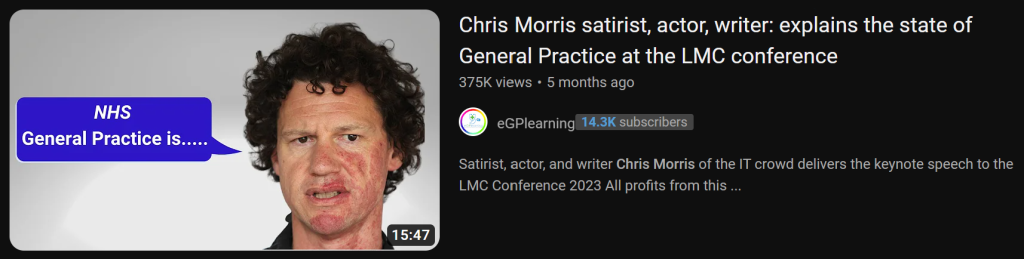
All of these are completely transparent clickbait. And while a certain amount of clickbait is a necessity on a platform as saturated with material as YouTube is, I really detest the whole "half a sentence" thumbnail format. I didn't click on this one, which has almost certainly floated across your YouTube recommendations at some point, either:
This, to me, is the YouTube equivalent of the Twitter engagement bait (that thankfully seems to have died a bit of a death… along with the rest of Twitter) where a brand would go "[our brand] is _________" and expect people to "fill in the blank". And people, dumb consumers that they are, absolutely would. And it didn't matter whether they were filling it in with obscenities or bootlicking nice things, it was engagement. It made the numbers go up. That's all that mattered.
It's the same with these comedy clips. I like all of those comedians above, but I don't want to click on their videos because it's rewarding manipulative behaviour, and also encouraging the main problem that I want to talk about today: encouraging people away from enjoying a creative work in its entirety and towards a grab-bag full of "best moments" that completely lack their original context.
Good stand-up comedy makes the entire show into an event, and runs a narrative thread through the whole thing. Not all comedians do this, but the best comedians, in my experience, make you feel like you've enjoyed a complete story by the time you've left the room. Sure, there may have been some deviations along the way, and the story may not have made all that much sense… but there was still a sense of narrative progression. A beginning, middle and end, if you will. For some great examples, check out Rhod Gilbert's show Rhod Gilbert and the Award-Winning Mince Pie and pretty much anything by Eddie Izzard.
When you slice a show up into little bite-sized bits, you lose that context. Sure, the individual moments might be funny on a superficial level, but you lose the added depth of them being part of something bigger. And that's a real shame. And this leads me on to the real reason I'm writing this today: my discovery yesterday that Friends, a TV show I absolutely adored during my formative years, has its own YouTube channel.
And yes, you guessed it, the Friends YouTube channel looks like this:
The stand-up comedy thing I can sort of forgive. While I much prefer seeing an entire stand-up set and enjoying that feeling of context and narrative, there are sometimes just single jokes or routines that you want to share with someone. And you can probably make the same argument about Friends.
But for me, and regardless of what you and/or the general public might think of it now in 2023, Friends was always about more than just the jokes. Friends was a phenomenon. Friends was about us spending 10 years alongside these characters in an important, turbulent part of their lives, and watching them grow and change. Friends was about us simultaneously being envious of these twentysomethings somehow being able to afford massive apartments in Manhattan, but also feeling like the moments they shared were relatable in their own ways.
And an important part of the entire experience was context. While Friends actually starts kind of in medias res, halfway through a member of this pre-existing friendship group telling a story in their favourite coffee shop, it still makes an effort to introduce us to everyone through the way Rachel enters the picture as a formerly estranged friend of Monica.
We feel included. We feel like we're learning who these people are — and over the course of the subsequent ten seasons, we really get to know everyone. And while the age of the show means that life in general is quite different for most folks right now — look how infrequently anyone on the show uses a mobile phone or a computer, for example — it's still relatable to anyone either going through that "20s to 30s" part of their life, or who has already been through it.
These characters grow and change as a result of the things that happen to them and the simple act of getting older. They enjoy amazing high points and some heartbreaking low points — although nothing too heartbreaking; this was a primetime comedy show, after all. But everything that happens helps to define these characters and make them more than simple, mawkish, two-dimensional representations of a single personality trait.
Slice all 236 24-minute episodes up into one-minute chunks, though, and you have content. You have individual moments that, in many cases, simply don't really work as standalone "jokes" because they rely on you knowing and understanding the characters and their relationships. And you have no sense of that ongoing growth and character development, because all these clips are posted in a seemingly completely random order determined by whatever the person running the Friends YouTube account felt like putting up today.
I realise this is a bit silly to get annoyed and upset over, but it's frustrating to me to see something that I loved so much in its original form and its original context be treated as fodder for the mindless content consumption machine of 2023. It irritates me to think that there are doubtless some people out there whose only contact with Friends will have been minute-long clips on YouTube, and through those they will likely have formed a totally different opinion of the show than someone who watched it from start to finish.
Is this elitist and gatekeepery? Not really, since Friends itself is easy enough to watch in its entirety via either streaming services or undoubtedly cheap DVD box sets that no-one wants any more. It's just the latest symptom in a disease that blights society, where no-one believes they have "time" for anything any more, so watch badly cropped minute-long 9:16 clips on double speed while they're doing their daily quests in Mindless Gacha Bullshit X, rather than settling down, taking some time to relax and just enjoying something in its entirety.
I hate it. Hate it. And while I'm aware there's nothing stopping me from doing what I describe above — I think I even still have my Friends DVD box set somewhere — it's exhausting just to be around all this short-form garbage, and frustrating to live in a world where seemingly no-one has an attention span longer than a TikTok video.