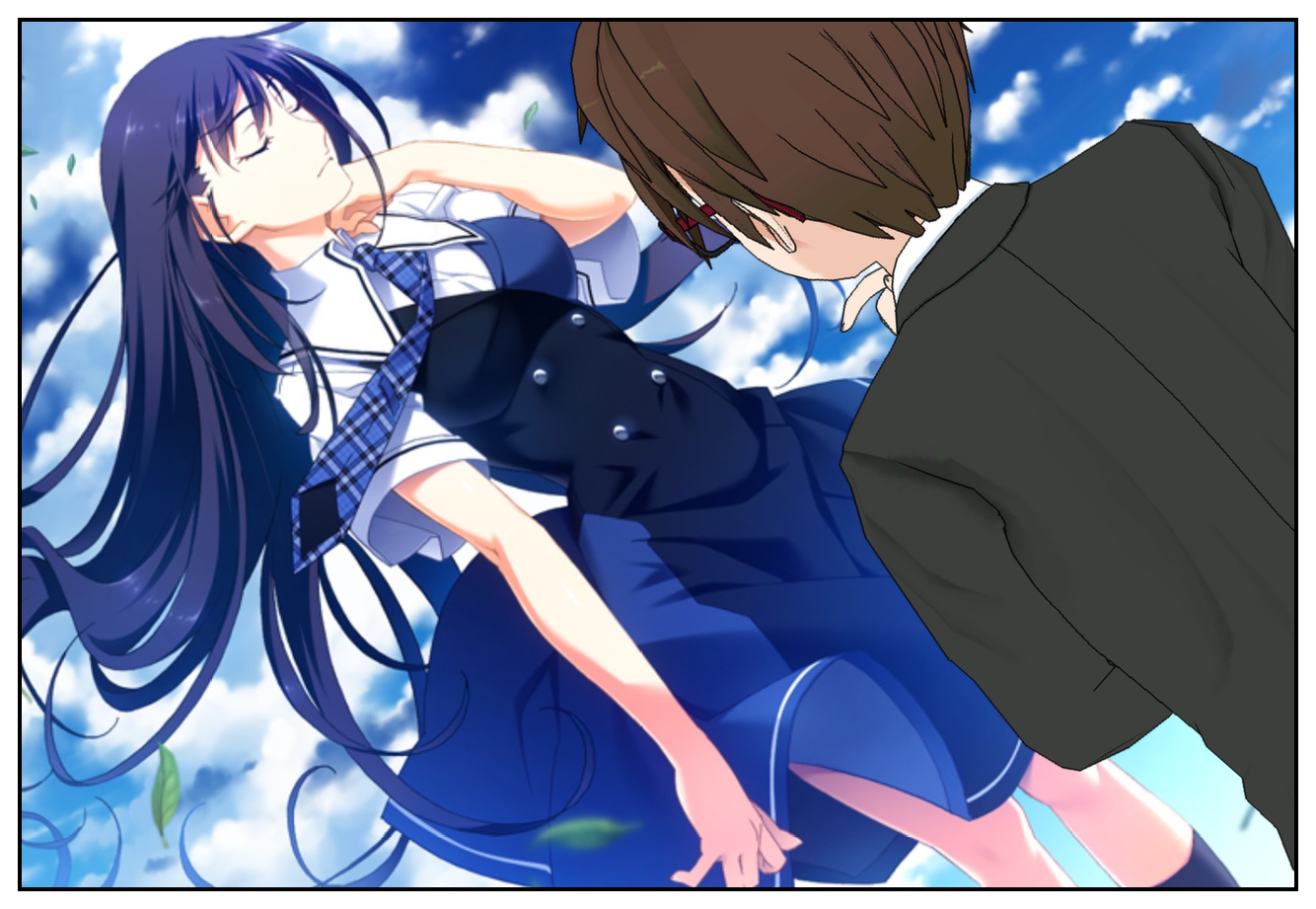
2064: Makin' Marios

0064_001

I picked up Super Mario Maker for Wii U the other day. I originally wasn't going to bother with it, but a lot of positive feedback from people I know, like and trust convinced me to give it a shot.

I like the concept of games with built-in level designers very much, but the execution has to be good to make them something I want to engage with in the long-term. TrackMania does it well; LittleBigPlanet less so. For me personally — and this doesn't apply to everyone, I know — the key is the balance between simplicity and flexibility: the freedom to realise your creative ideas without it being too much work to do so.

Fortunately, Super Mario Maker strikes an excellent balance, and part of that is due to how it gradually dishes out new parts, themes and level types over time from launch. It can be mildly frustrating to have a level concept in mind and be unable to realise it completely until you've unlocked the relevant pieces of content, but there are ways to game the system if you feel that strongly. In the meantime, though, it's worth exploring the initially limited toolset, because artificial limitations can often stimulate creativity in the strangest of ways.

It's ridiculously easy to make a level in Super Mario Maker. Choosing from a palette of objects at the top of the screen, you just draw things onto the level using the Wii U GamePad stylus. There are limits on how much you can put down, but they're pretty generous; likewise, the overall width and height of a level can be fairly large. We're not talking Metroidvania territory, of course, because that would go against the philosophy of a Mario game, but you can certainly put together some fairly intricate designs in the available space if you so desire.

As with any type of game like this, it's always fascinating to see what other people have come up with, and the creative ways in which they've used the tools. TrackMania, for example, fostered a subculture of track creators who made "press forward" tracks, in which all you had to do to complete it was simply continuously accelerate; the design of the track would take care of the rest, automatically flinging the car through a series of ridiculous stunts, with objects placed in the absolute perfect locations to ensure that you always landed in the right place and the right way up.

It's the same with Super Mario Maker. The game's only been out for a few days, and some of the most popular levels out there are already of the "don't press anything" variety; in other words, they play themselves. These levels aren't any challenge to play, of course, but it's fascinating to see the intricate "machinery" these creators have put together, and worthy of respect, because it must have been a painstaking process of trial and error to get it working perfectly.

As for me, I haven't unlocked everything just yet, but I've been enjoying dipping in and out of the game, playing a few levels here and there and even making a few. I like the whole package very much, though there are a few things it would be nice to see expanded on over time: most notably, it would be good to see the in-game score and coins actually matter, because outside of the "Mario Challenge" modes, in which you're presented with a randomly selected series of levels to complete, even the concept of "lives" is completely irrelevant. It would be good to see some sort of leaderboard system with clear times, scores and number of attempts, for example, and perhaps coins could be used to unlock additional features.

It remains to be seen if Nintendo will expand this over time, but with Mario Kart and Splatoon on Wii U, Nintendo has shown itself to be open to the idea of games growing and changing over the course of their lifetime. Super Mario Maker already has a wealth of content in it, but it would be fantastic to see more features — perhaps even based on the Amiibo compatibility, since most currently available Amiibo already unlock character sprites; it would be cool to be able to unlock visual themes, sound effects and music through the Amiibo, too; I might even be tempted to collect a few more then.

In the meantime, though, Super Mario Maker is an enjoyable package that is well worth a purchase. Even if you never make any levels yourself, it's great to fire up for a quick blast of Mario action — and if you do make your own levels, it will give you a whole new level of appreciation for what professional level designers do all day!

2063: No, Apple TV Isn't "Game Over" for Xbox and PlayStation

0063_001

Cometh the new Apple announcements, cometh the silly season of people making all sorts of bold statements about how what Apple is doing is somehow The Future, even if what Apple is doing is actually the same thing as other people have been doing for several years, only with more shiny knobs on.

The latest instance of this happening comes courtesy of Forbes, where contributor David Thier gave Smule's Jeff Smith the opportunity to wax lyrical about How Amazing iOS Is, and How Amazing tvOS Will Probably Be.

Smith brings up some good points about "mobile" development (I'm going to keep calling it that, even if we're referring to Apple TV, because the iOS and tvOS ecosystems are intertwines) — the most important being the fact that iOS and Android are both relatively "open" platforms so far as development is concerned; pretty much anyone with the knowhow can download development tools and crank out an app or two if they have the inclination to learn the ins and outs of both development and the two platforms' respective publishing processes.

This is admirable in some respects: it lowers the barrier of entry to fledgling developers and allows them to get their name known without being subject to the whims of a monolithic megacorporation like Sony or Microsoft, though it's worth noting that the barrier isn't completely gone; Apple still has a reasonably rigorous approvals process for the App Store, though unfortunately this isn't always enough to prevent some fetid turds from filtering through.

We've seen more than a few success stories over the last few years, where small developers put out a simple game that turned out to be a huge success, though, as with Flappy Bird creator Dong Nguyen (who was unprepared for the attention his shitty but popular game attained and subsequently retreated from the Internet) these tales don't always end entirely happily.

But unfortunately a low barrier means that it's easier for people to get over it, and, as well as allowing talented but unknown developers to get stuck in, it also allows the very worst kind of shovelware to get churned out by the bucketload. And, as we've already seen over the last few years, neither Apple nor Google are inclined to do anything about the massive "cloning" problem on mobile, where the market is flooded with literally hundreds of knockoffs of a popular game, all in the hope that, in the best cases, they can score some sweet income from people who think they're downloading the actual popular game, and in the worst cases, mislead ill-informed customers into downloading something outright malicious.

We see this elsewhere, too. Popular PC digital distribution storefront Steam used to be much more heavily curated than it is now, and while its somewhat more relaxed approach these days means that we get lots of stuff on there that we wouldn't have seen three or four years ago, it also means that there's a veritable deluge of crap hurled at an unsuspecting public on pretty much a daily basis. This is bad for customers, who are forced to wade through lots of inferior products in order to find what they're looking for, but it's also bad for developers, because it absolutely tanks discoverability; sometimes word of mouth is enough to mitigate being pushed off the front page of "new releases" by the latest triple-A game, but more often than not something small-scale gets released on Steam and is promptly never heard from again.

Smith's assertion that Apple TV means "game over for console" appears to be otherwise based on the fact that the iPhone and iPad made fairly rapid leaps in graphical fidelity and performance over the course of several hardware generations. But what this — and his enthusiasm for the relative "openness" of the iOS and Android marketplaces — doesn't take into account is the quality issue. Sure, there are developers putting out decent-quality games for mobile devices (and, Smith clearly hopes, many of these will jump to Apple TV when the new tvOS arrives) but I am yet to play any mobile game that truly competes with a game on a dedicated games-playing platform, be it a handheld like the Vita, a console like the PlayStation 4 or a gaming-spec PC. The experiences you get on the latter platforms are just more fleshed out; they may be more expensive to buy a ticket for in the first instance, but once you're in, you're in for a good long while, immersed fully in the experience.

By contrast, the sort of games that iOS and Android developers are mostly inclined to put out are short, bite-sized experiences designed to be dipped in and out of throughout the day. This is fine for those who just want a bit of lightweight entertainment or brain exercise, but it's far from ideal for those of us — and there are many of us! — who take our gaming time seriously, sitting down with a game much like an avid reader would sit down with a book, or a movie buff would enjoy their favourite director's works. Mobile platforms treat gaming as disposable, moment-to-moment entertainment; the market for Xbox, PlayStation, PC and handhelds, meanwhile, expects more substance — something more than a timewaster: something they can truly call a hobby.

So no, Apple TV isn't "game over" for Xbox and PlayStation. It will probably do quite well, sliding nicely into the niche the Wii left behind and which the Wii U has subsequently struggled to fill — family entertainment for people who don't really know a whole lot about gaming and are disinclined to explore in great detail — but there's no way it's ever going to replace dedicated gaming boxes for those who take their playtime deadly seriously.

2062: By Request: 100 Reasons You Should Play Metal Gear Solid V

0062_001

Continuing with my exercise from the last few days in which I take "requests" from my Twitter followers, today I follow the suggestion of Josh "Musubi Azeyma" Major, a friend whom I originally met through Final Fantasy XIV. Josh requested that I present a hundred reasons why people should play Metal Gear Solid V, because he's obsessed with it right now and thinks everyone else should be too. So, who am I to argue with that logic?

DISCLAIMER: The only real potential issue with this task is that I haven't actually played Metal Gear Solid V, nor do I own a copy. Since we have, however, established that it is acceptable for professional journalists to comment negatively about things without putting in a substantial amount of time with them — or in some cases, without even playing them at all — it's surely fine for some nobody blogger in the wilds of the Internet (albeit one who used to be a professional games journalist) to speak positively about something he has absolutely no experience with whatsoever. So, without further ado, let's begin.

  1. It's part of the Metal Gear Solid series, which people have heard of.
  2. Hideo Kojima is a cool dude who posts pictures of Eggs Benedict on Twitter and makes jokes about them jiggling like boobs.
  3. Konami fucked Hideo Kojima up the ass pretty royally towards the end of Metal Gear Solid V's development, so while buying a copy and enjoying it may support Konami to a certain degree, it also shows your support for Hideo Kojima's creation.
  4. The graphics are quite pretty.
  5. It's available on Xbox 360, Xbox One, PlayStation 3 and PlayStation 4, so unless you're a weirdo who only has a Wii U in the house, you can almost certainly play it.
  6. Quiet has nice tits.
  7. Quiet is pretty badass.
  8. Appreciating Quiet's feminine wiles pisses off the outrage brigade.
  9. There are guns in this game.
  10. And dogs.
  11. And a horse that you can command to shit whenever you want.
  12. You can attach balloons to bears and send them flying off into the sky.
  13. You can do the same with enemy guards.
  14. There's apparently some sort of story that's pretty good.
  15. Something interesting happens in the medical bay or something, everyone keeps yammering on about it without actually saying what it is because spoilers.
  16. Something about cassette tapes.
  17. METAL GEAR?!
  18. It is, I am assured, open world without being directionless.
  19. It does that thing I like where it presents each mission as its own self-contained "episode", complete with intro and outro credits sequences.
  20. Each mission is apparently pretty tightly focused rather than making use of the open world unnecessarily.
  21. It's not Splinter Cell.
  22. Revolver Ocelot.
  23. Metal Gear is a Japanese series that it's apparently still acceptable to like without people calling you a paedophile.
  24. There are achievements and trophies in the game.
  25. If you're really good at a mission, you get an S-rank and feel all happy.
  26. You can tranquilise people.
  27. You can kill people.
  28. You can sneak up on people.
  29. You can charge in the front door of an enemy base brandishing an assortment of improbable military hardware, then blow everything up with reckless disregard for the "Tactical Espionage" part of the game's subtitle.
  30. Something about tanks.
  31. Anita Sarkeesian's puppetmaster Jonathan McIntosh doesn't like Hideo Kojima for the jokes he makes on Twitter (see #2).
  32. Posting things about Metal Gear Solid online at the time of writing is a sure-fire means of getting those sweet-ass clicks.
  33. There's a Mother Base that you manage or something.
  34. You can get soldiers and dogs and stuff for your base or something.
  35. Some of it's a bit like Peace Walker, which I also haven't played but people seemed to like.
  36. Kojima has dialled back the "I'M MAKING A MOVIE!!" chaos. A bit.
  37. Kiefer Sutherland is like a proper famous actor, innit.
  38. The probably-vain hope that David Hayter will show up at some point in the same, growl "SURPRISE", snap the neck of KieferSnake, forcing you to play the rest of the game as Snake with his proper voice.
  39. Lid from Hyperdevotion Noire was pretty fit.
  40. You can hide in cardboard boxes.
  41. You can play as people who aren't Snake if you so desire.
  42. Including women. SHOCK
  43. But Snake has a robot arm or something, so he's clearly the best.
  44. If you're playing this game, you are contractually obliged to put the word "Punished" in front of your Twitter name, because it makes you at least 20% cooler to do so.
  45. This coolness quotient increases to 30% if you also scrawl an eyepatch on your avatar using Microsoft Paint.
  46. Hurt me more, Snake
  47. There's a sweet-ass limited edition PlayStation 4 to tie in with the game's release, because we all know Metal Gear is a series that belongs on PlayStation.
  48. There's some sort of online feature, I think.
  49. You're banned from soliciting relationships with other people through Metal Gear Solid V's online features, which means you can protect yourself against people who are on the pull through Metal Gear Solid V's online features.
  50. Who does that?
  51. I anticipate it will be less than a week before someone recreates a scene from this using nothing but Super Mario Maker.
  52. Someone already did the microwave tunnel scene from Metal Gear Solid IV.
  53. This game is longer than Ground Zeroes.
  54. It is also a lot longer than previous Metal Gear games.
  55. My friend Josh claims to have spent over a hundred hours on this game so far.
  56. A lot of stuff is optional, so you can probably whizz through it a bit quicker if you want to.
  57. Something about vagina bombs. (I didn't play Ground Zeroes either.)
  58. You like Castlevania, don't you?
  59. There are no navel-gazing codec conversations between Raiden and Rose.
  60. There are, instead, navel-gazing cassette tapes, but you can listen to these while you're attaching helium balloons to bears.
  61. Metal Gear games usually have good villains. (I have absolutely no idea who the villains are in this.)
  62. Ditto boss fights. (Likewise.)
  63. The old games had good music. This one probably maybe does too.
  64. Ditto voice acting.
  65. You can level up Snake or something.
  66. I think you can possibly maybe level up the other soldiers you collect too.
  67. If Quiet's boobylicious outfit bothers you that much, she has numerous other costumes, including being completely covered in blood and Sniper Wolf's somewhat more conservative but still boobylicious outfit.
  68. Apparently there's some explanation for why Quiet dresses the way she does.
  69. Something about photosynthesis.
  70. Or possibly nanomachines. Son.
  71. That big speech at the end of Metal Gear Solid 2 was kind of cool in how eerily prescient it was.
  72. That means that in roughly ten years' time, something in Metal Gear Solid V will probably be looked back on and numerous chins stroked thoughtfully.
  73. This installment uses a Roman numeral instead of the Arabic digit 5, because Roman numerals are, as everyone knows, inherently classier.
  74. The Phantom Pain sounds kind of cool as a subtitle.
  75. Although it's a bit close to The Phantom Menace for my liking.
  76. Although it looks as if Metal Gear Solid V may well be reclaiming the subtitle structure The Phantom [x] from the damage that Star Wars did to it.
  77. George Lucas had nothing to do with this game.
  78. This game does not feature, at any point, in Disney Infinity.
  79. If you play this game, you can talk about it with your friends rather than just nodding and smiling and pretending to know what they're blathering on about.
  80. The Steam version might have trading cards or something, I don't know because the Steam store isn't working for me right now.
  81. The PC port has to be better than that dogshit effort with the last Batman game.
  82. Hey, it's a Metal Gear Solid game that you can actually play on PC without dicking around with emulators!
  83. You should still probably play it on PlayStation, preferably on that sweet-ass limited edition console.
  84. If you buy one of those sweet-ass limited edition consoles from me when I'm working, do me a solid and also buy the extended warranty coverage and preorder some other stuff.
  85. The person who hired me for my part-time seasonal retail job is a huuuuge fan of Metal Gear Solid.
  86. I was hired for said job partly because I included the words "nanomachines, son" under the "Skills" section on my CV.
  87. I'm running out of things to write here.
  88. I'm honestly impressed that I've made it to 88 without much padding.
  89. If you buy a physical copy of the game you can put it on your shelf alongside all the previous Metal Gear Solid games for a cool display of the series over time.
  90. The uneven sizes of the boxes for Metal Gear Solid over the years — CD-sized PSone cases, DVD-sized PS2 cases, slightly-smaller-than-DVD-sized PS3, PS4 and Xbox One cases — makes for an attractively wibbly-wobbly effect on your shelf.
  91. The hardback strategy guide for Metal Gear Solid V is very pretty indeed, and if you can still find a copy anywhere you often get a free poster with it.
  92. The softback one is still pretty meaty and can probably do some damage to an assailant if you have it to hand when you come under attack.
  93. Even if you have no intention of playing Metal Gear Solid V, tossing the disc case out in front of a passing guard will distract them long enough for you to sneak up behind them and snap their neck.
  94. You probably shouldn't do that.
  95. Instead, you can indulge such fantasies in the new video game from Hideo Kojima, Metal Gear Solid V: The Phantom Pain.
  96. There's some sort of kawaii idol girl posters scattered around the place in the game.
  97. Have you considered trying Mad Max as well, which came out the same day? Polygon hated it, which is reason enough to try it.
  98. You should probably also give Until Dawn a go if you have a PlayStation 4, because Sony idiotically released it last week and not at, I don't know, Halloween.
  99. You can probably edit together some entertaining and silly videos using the next-gen consoles' video capture facilities and software such as the PS4's ShareFactory.
  100. If you bugger off and play Metal Gear Solid V, I don't have to keep writing this, and I can get on with playing Super Mario Maker instead.

2060: A Fruitful Relationship: More Grisaia Impressions

0060_001

In an effort to steer away from three solid days of ranting about games journalism, I asked my followers on Twitter for some suggestions of things to write about, and got a few nice ideas, so I'll be making use of those over the next few days.

I thought I'd start with a request from my friend Mr Michael Cunningham, who wanted to hear a bit more about The Fruit of Grisaia, the visual novel I'm currently reading, and which I gave some first impressions of here.

So far, I believe I'm still in the "common" route of Grisaia, since I've only made a single choice so far, and that didn't come until after a considerable number of hours of reading. The lack of interaction hasn't been a problem, though; the early hours of Grisaia are clearly intended as a means of helping you get to know the characters and the context in which they find themselves, and the distinctly leisurely pace at which the early hours of your typical visual novel such as Grisaia unfolds allows it to dangle some truly tantalising mysteries in front of you, mostly with regard to the backgrounds of the characters and what has actually brought them all together.

Even the basic concept of Grisaia is still a slight mystery to me at this juncture. Although the early hours have been relatively typical high school slice-of-life so far, there's clearly something more going on. From the protagonist's frequent references to his mysterious "job" and use of military terminology and tactics to the unpredictable, trope-subverting nature of all the heroines, nothing seems quite "right" in Grisaia's world, and that's what makes it so intriguing. The fact that the school which they all attend has no-one but them in it — making for a student body of just six people — is perhaps the biggest mystery: why are they all there? What has pulled them out of "normal" life? What is the school for?

2015-09-09_00008

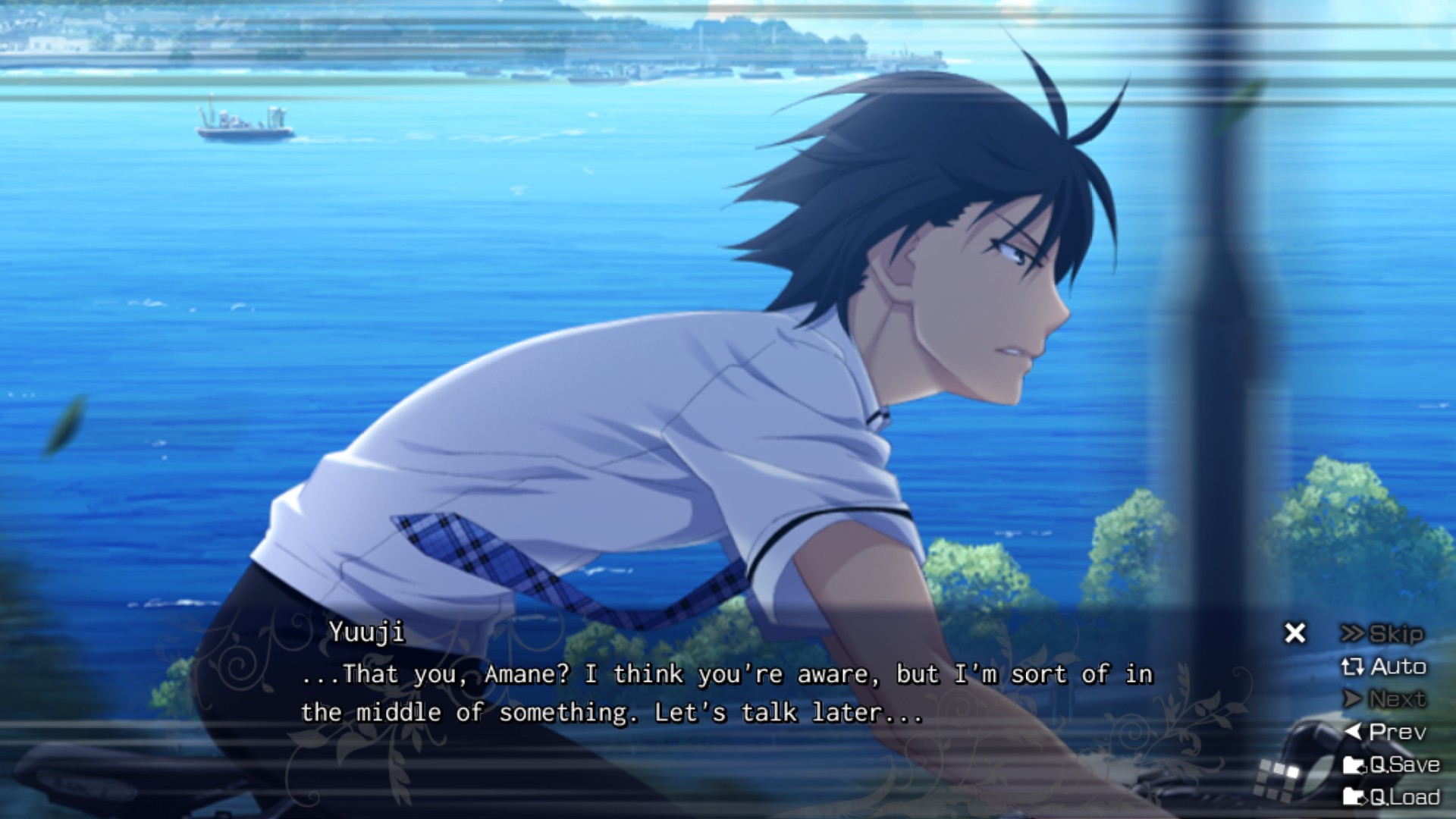
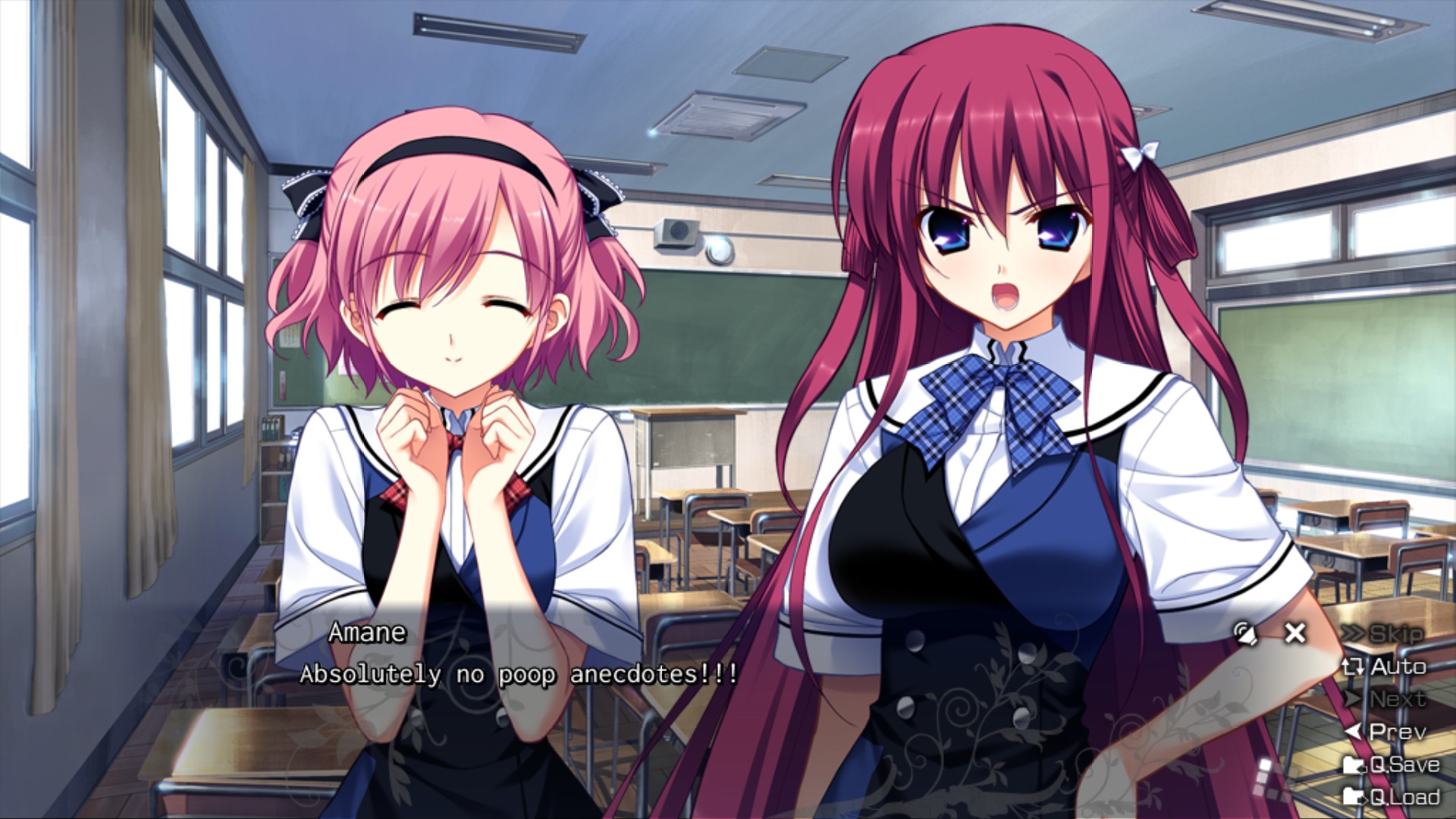
Amane initially appears to be the most "normal" of the cast. She likes to play the role of the older sister, and does so with great enthusiasm, particularly when it comes to protagonist Yuuji. Yuuji is initially resistant to her advances but eventually allows her to indulge a little for the sake of having a marginally quieter life, because even when she's getting what she wants, Amane is forthright, frank, open and honest about everything — arguably to a fault.

She's also seemingly very much at ease with herself as a woman, happily stripping off and getting changed in front of other people (including Yuuji) and wearing clothes that emphasise her curves. She's also rather sexually aggressive towards Yuuji even as they're first getting to know one another, often grabbing him and pressing herself against him, and on one memorable occasion, sneaking into his room while she thinks he's out and inhaling his scent from his clothes and his bed; Yuuji catches her just before she starts masturbating.

I'm not quite sure what to make of Amane yet. I certainly like her a great deal, but I have a feeling that her forthrightness may, in fact, be compensating for something. Exactly what, I couldn't say just yet, but I'm pretty convinced that there is more to Amane than meets the eye.

2015-09-06_00003

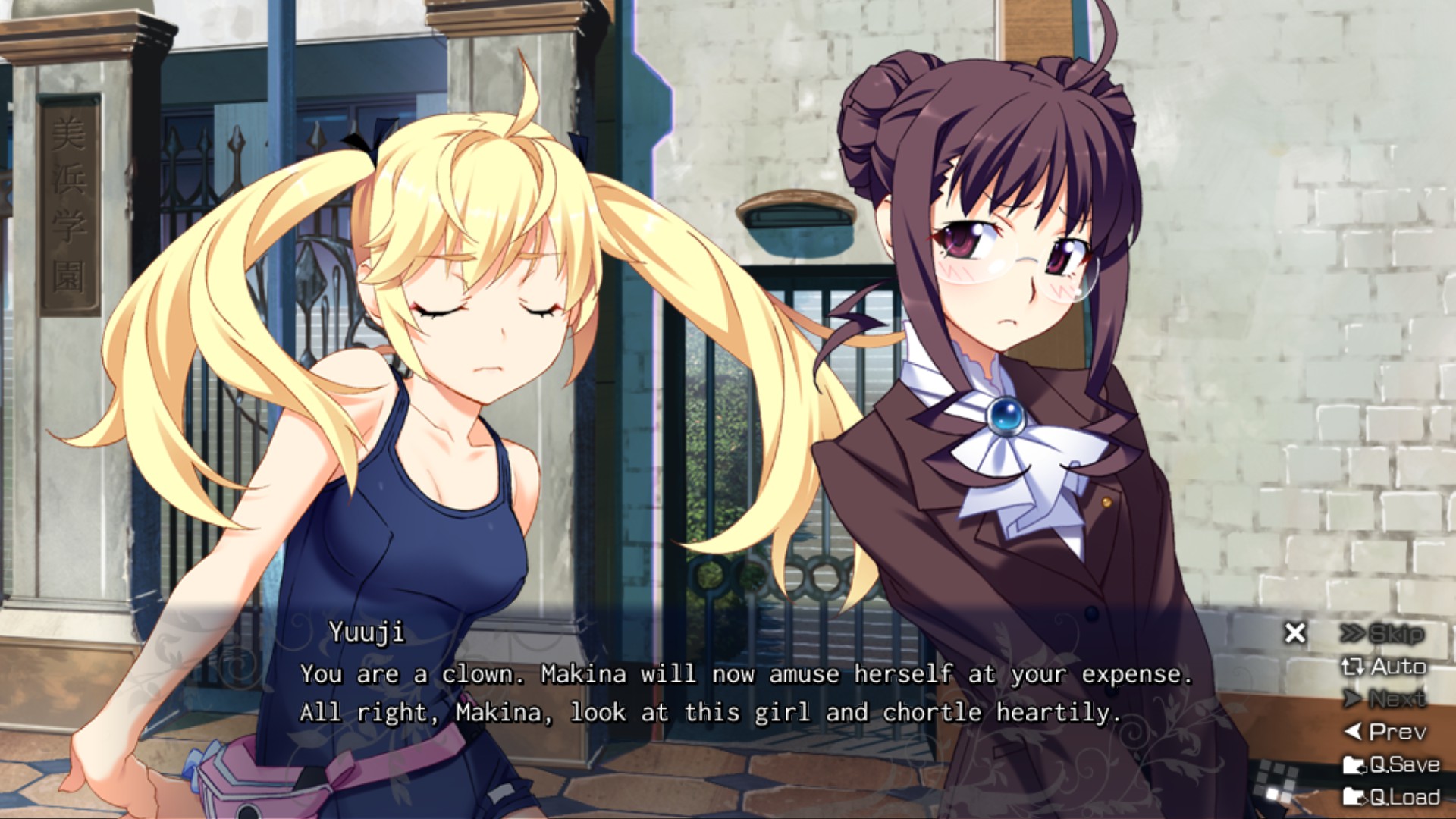
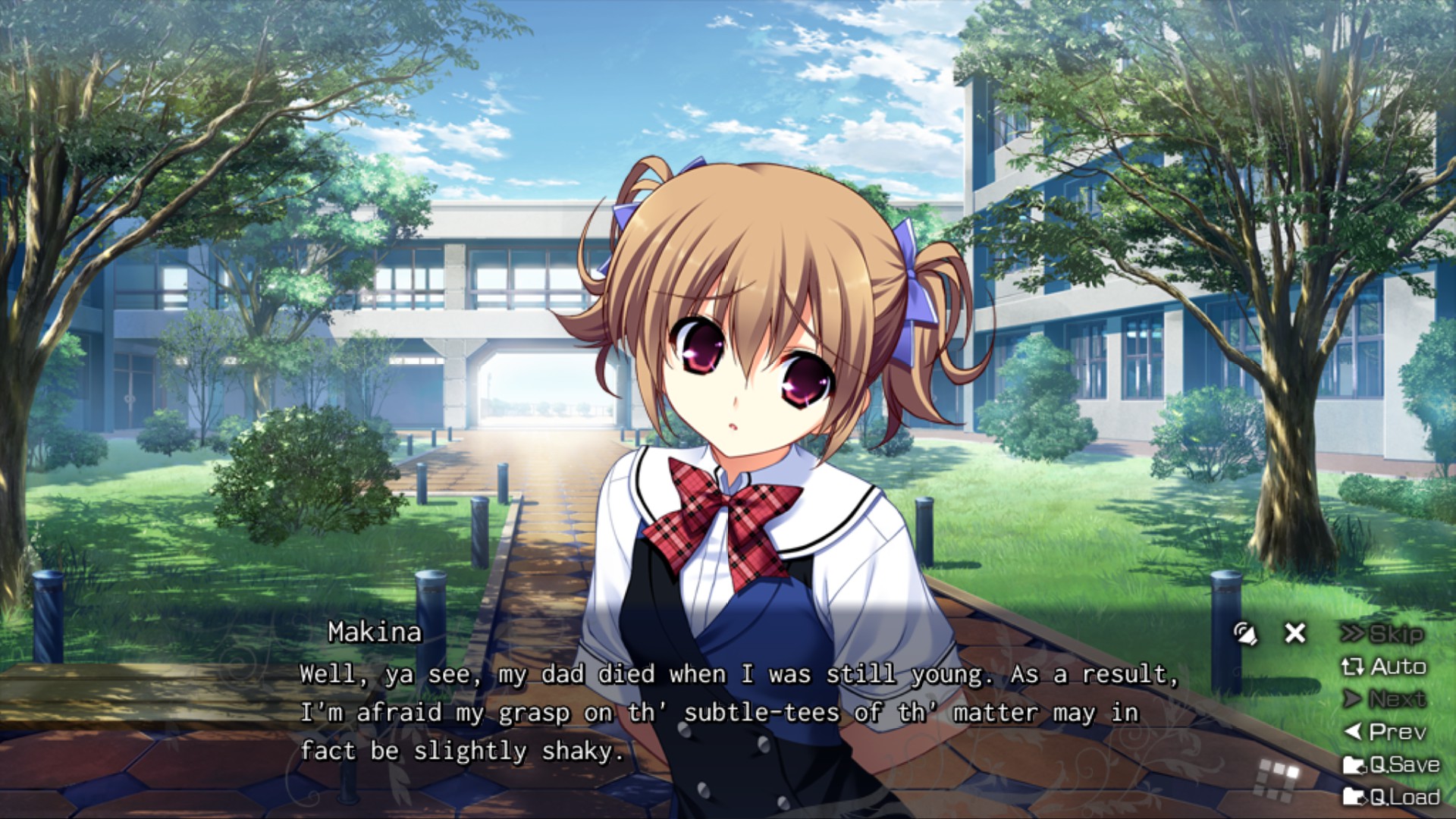
Makina is brilliant. Initially presented as the dimwitted loli of the group, it takes a little time for Makina to take to Yuuji, but they eventually bond, much to the surprise of Amane, from whom Makina is otherwise almost inseparable. It transpires that Makina is far less stupid than she likes to make out, and that she may well be putting on an act for her own mysterious reasons.

This doesn't mean that she's entirely "normal", though. Her impressive ability to take mental photographs of books she's reading and instantly recall information from them — albeit only in black and white — reminds Yuuji of his deceased sister, who had a similar ability. Perhaps not coincidentally, Makina quickly starts calling Yuuji "Onii-chan", despite his resistance; much like he softens towards Amane somewhat, so too does he eventually just let Makina continue along in her own bizarre little world.

Perhaps the most amusing and intriguing thing about Makina is the way she talks. Far from being stereotypically cute and shy, Makina is foul-mouthed and frequently comes out with things you'd expect a dirty old man to say. Amane occasionally admonishes her for this, but since she occasionally slips into her own Kansai region colloquialisms, she doesn't really have a leg to stand on in this instance.

Again, I wouldn't like to conjecture what brought Makina to Mihama Academy in the first place, but it's clear that something traumatic happened in her past; so far, however, the conversation has always been steered away from it any time it looks like getting into dangerous territory.

2015-09-04_00004

In contrast to Makina's front of stupidity, Michiru actually does appear to be pretty dimwitted. Obsessed with the tsundere character trope to a fault, Michiru deliberately tries to act as stereotypical as possible, but in the process frequently breaks character in order to seek the approval of others — and, to a certain degree, herself — on how well she's doing at playing the spoiled princess.

In keeping with the other characters, though, there's seemingly a lot more to Michiru than meets the eye. As time progresses, whenever she is alone with Yuuji, she seems to want to open up to him somewhat. In some instances, she drops the tsundere act completely and attempts to have a serious conversation, though her inability to articulate herself in anything more than the most simple terms sometimes means she finds it challenging to get across quite what she wants to say.

Michiru is clearly struggling with depression — perhaps as a result of a condition or illness she has. Her adoption of the tsundere personality is a coping mechanism designed to hide any outward signs of her pain and suffering; by being deliberately aggressive and contrary about everything, she puts up a formidable barrier around the truth that lies in her heart, though, of course, I'm sure by the end of her own narrative route we'll get to the bottom of exactly what is bothering her so much. She is the butt of a considerable number of jokes throughout the common route, but I have the distinct feeling she's going to end up being one of the most sympathetic characters.

2015-09-05_00001

Sachi (right) is something of an enigma. Sweet, innocent and largely emotionless to a fault, something in Sachi's past has caused her to become someone who takes everything she hears absolutely literally. This means that a joke about how she should wear a maid costume all the time because of all the hard work she does for others means that she now wears a maid costume whenever she's not in her school uniform; it means that someone requesting "the freshest milk possible" sees her catching a train out to the countryside to go and milk a cow.

Sachi's initial impression is that she's a thoroughly nice and considerate person, but there's something else at work. Occasionally — particularly when she's dealing with Michiru — some uncharacteristically hurtful, acidic comments will come out of her mouth. There's evidently some bitterness festering beneath the surface, though for the most part, she simply refuses to talk about it and quickly puts her façade of being the perfect maid back up.

The other thing about Sachi is that her tendency to take things literally means that she has absolutely no sense of shame or propriety whatsoever. When Yuuji jokes with her about the power a glimpse of lingerie has over men, she turns up to school the next day in nothing but lacy undies, stockings and suspenders. When she and Yuuji are cleaning the dormitory bathroom together, she falls over and gets her maid costume wet, then subsequently decides that the appropriate thing to do — after another joke from Yuuji — is to take it off, attach it to her mop ("to cover more ground") and continue the rest of the cleaning job in her underwear. I anticipate that this aspect of her character in particular will cause more than a few awkward situations by the conclusion.

2015-09-03_00002

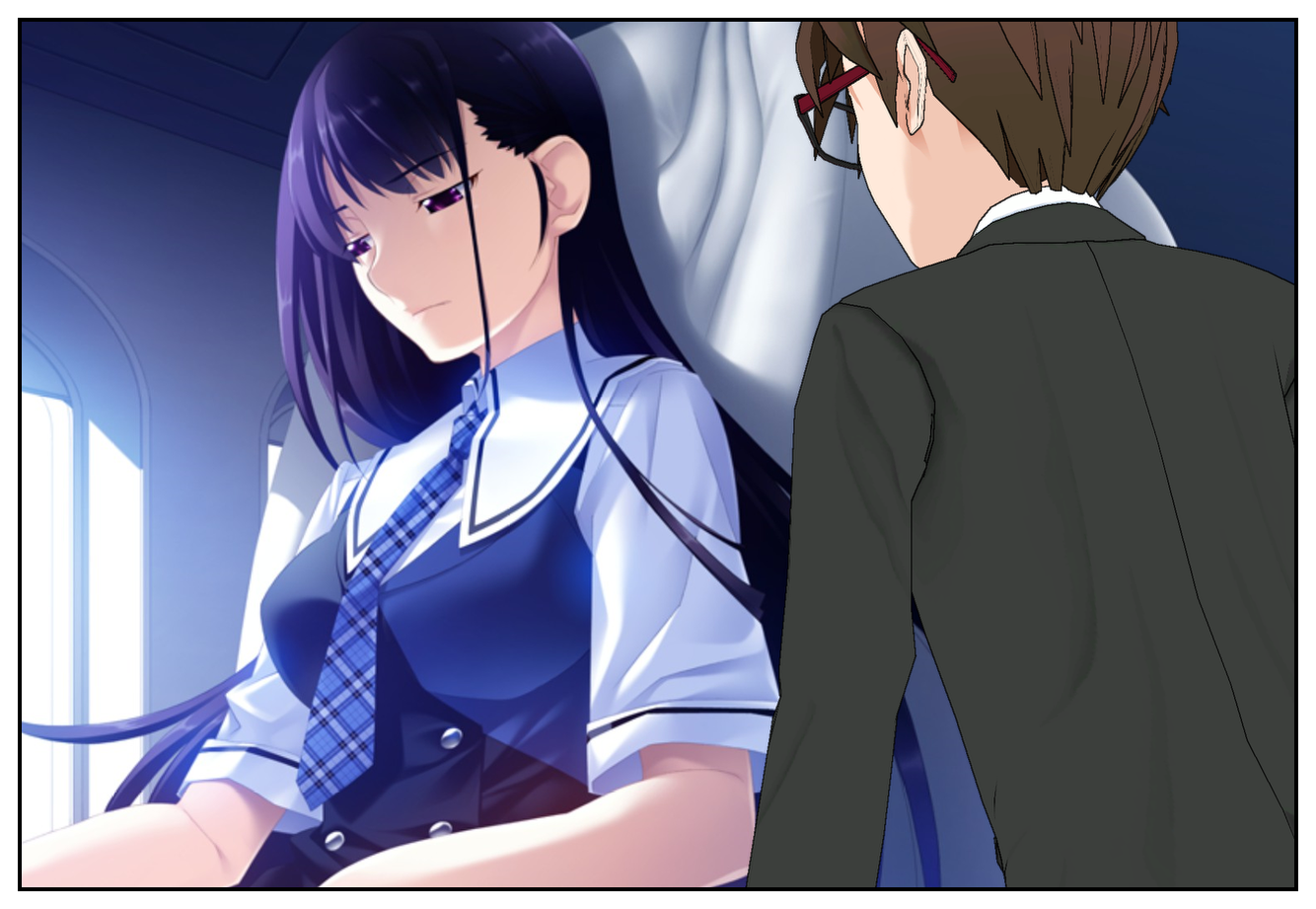
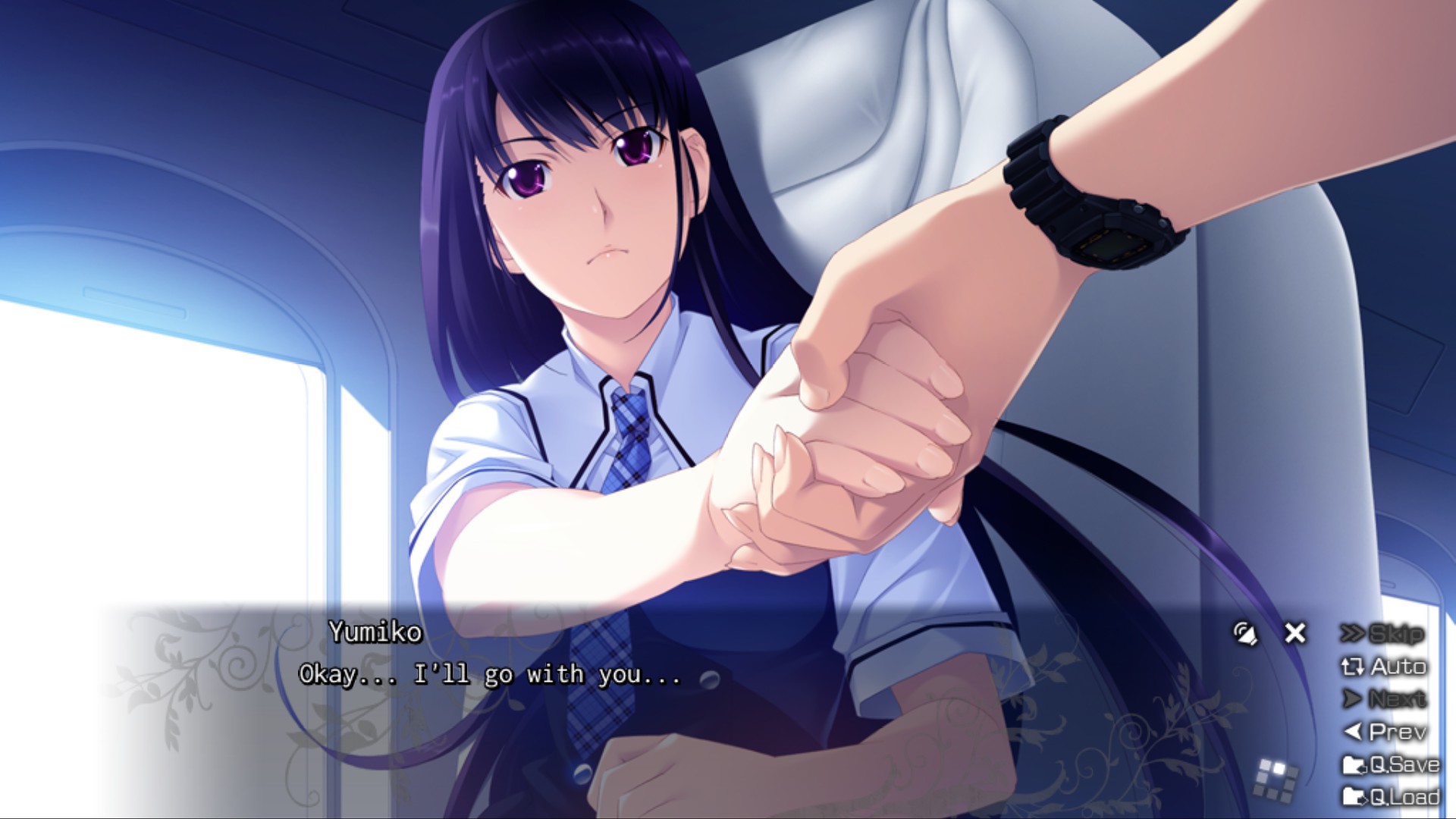
Finally, Yumiko is the most obviously fucked up of the main cast. Initially refusing to even speak to Yuuji, instead preferring to first of all slap him when he approaches her, and subsequently attack him with a box cutter at every opportunity, the barriers around Yumiko's heart are nigh-impenetrable, it seems, but Yuuji's ability to shrug most awkward situations off — perhaps due to his own background, which he hints at regularly throughout the common route without explicitly explaining it — means that he takes her violence and anger in his stride. He eventually manages to get through to her enough to be able to speak to her and subsequently have an honest conversation with her, even spending some time with her alone without her trying to attack him.

Yumiko's basic character trope is that of the perpetually grumpy "student council president" type, but rather than being a blushing, awkward individual beneath the façade, it's clear that her outward grumpiness is a sign of outright rage and bitterness bubbling beneath the surface. She is, so far as I've read at least, the biggest mystery among the main cast — both to me and to the rest of the cast, too. She keeps herself to herself, and no-one seems to know anything about her history. No-one even seems to know where she's going or what she's doing at the weekends when she sneaks out of the dormitory in the early hours of the morning carrying a tote bag full of "wooden objects". I'm looking forward to finding out more about her.


That's what I know so far, then. They're an interesting bunch of characters, to be sure, and I'm really looking forward to each of their routes to discover exactly what makes them tick and what has brought them to the strange circumstances in which they find themselves. I sense it's going to be a long road to find out, but up until this point, it's been a compelling and intriguing ride with a ton of tantalisingly unanswered questions.

Number one visual novel of all time? I couldn't say with confidence as yet. But it's certainly one of the most immediately compelling, well-written — and well-localised — ones I've read for quite some time, and if you have the slightest interest in the medium, I'd encourage you to support it.

2059: Why I Care, and Why It's Important to Fight

0059_001

I grew up with computer and video games journalism all around me.

I mean that literally: while I was growing up, both my father and my brother wrote for a newsstand magazine initially called Page 6, then subsequently New Atari User once it merged with another publication called, unsurprisingly, Atari User. My father regularly wrote about flight simulators and making music with computers and MIDI instruments, and my then-teenage brother had a steady stream of incoming Atari ST games which he would play, explore and then write about in chunks of anywhere between 250 and 1,000 words according to how much discussion the game in question warranted. Pretty much our entire collection of Atari ST games was made up of review copies; I think I remember purchasing a grand total of about four or five games altogether during the 16-bit era.

I was both fascinated by and proud of the work my father and brother did at the time — so much so that, in that way that kids do, I tried to imitate them. I would fire up AtariWriter on the Atari 8-bit — for some reason I always enjoyed using the 8-bit computers just that little bit more than the 16-bit ST — and write my own reviews of things that I'd played, trying my best to imitate the style and structure of my father's and brother's work. I would then print them out on our noisy Epson-compatible dot matrix printer and file them away in a blue binder that had come home from my father's day job at some point — it once housed the IBM "Manager of Managers Programme" material, and I have no idea why I remember that — and pretend that I, too, was a published writer.

Some years later, I had the opportunity to follow in my family's footsteps and provide my own contributions to New Atari User, and I took to this with great enthusiasm, reviewing games such as Psyclapse's Defender-alike Anarchy and taking an in-depth look at Atari's revolutionary but regrettably flawed forays into the handheld and home console markets, the Lynx and Jaguar. Meanwhile, by this point, my brother was getting ready to finish his school career and contemplate his future, whether that be heading off to university or jumping straight into a job.

He chose the latter option, finding himself working for Europress up in Macclesfield on a revolutionary new games magazine called Games-XGames-X was remarkable for one main reason: rather than being monthly, as most magazines were at the time, it was published weekly. This meant that it had the opportunity to be a whole lot more timely with the things it was writing about, and essentially acted as a precursor to the immediacy of Internet writing we have today. It ran for a decent number of issues before it folded, too, and was a pleasure to read, combining a somewhat irreverent, humorous editorial voice with authoritative, knowledgeable content from staffers who knew their stuff about gaming.

I followed my brother's career with great interest and pride as it developed through a series of further magazines on which he took increasing levels of responsibility — among them Mega Drive Advanced Gaming (whose speculative feature about what Sonic 2 might be like from well before any details were actually revealed to the world remains one of my favourite video game magazine articles of all time, alongside its Super Mario 5 counterpart in its sister publication Control) and the deliciously classy PC Player — before eventually hitting what can arguably be called "the big time" in the games magazine industry of the late '90s by landing the role of Editor on PC Zone.

Such was my interest in the games press and pride in my brother's career that when it came time for my Year 10 Work Experience placement at school, I chose to take the awkward route and refuse any of the convenient positions my school would have been able to arrange for me, instead opting to spend a couple of weeks down in London with my brother helping out in the PC Zone offices. I spent a lot of time making tea and being mothered by art editor Thea, but I also had the opportunity to write a full review of the non-3D accelerated version of Virtua Fighter and write the captions for some screenshots in a number of different articles.

I was sold. This was what I wanted to do, and I was good at it. In the subsequent years, I found myself freelancing both for PC Zone — both during and after the time my brother was in charge, and in all honesty, even when he was editor, he wouldn't have allowed me to contribute if he didn't have faith in my abilities, so this certainly wasn't a nepotism situation — and the Official UK Nintendo Magazine. Most of the time I found myself writing walkthroughs, which were things that no-one else really wanted to do, but which I enjoyed doing because it gave me an excuse to play through some favourite games in great detail while writing about them. (I liked it less when my preview copy of Turok 2 on N64 crashed on the last boss and I had to play the whole thing through again on a retail copy just to get a single screenshot, but thankfully this only happened once.) I even found myself writing a whole book on Carmageddon which was subsequently included in the Virgin Megastores special edition of the game one Christmas, and which can now be found as a .PDF e-book included with GOG.com's rerelease of the game.

It would be a number of years before I'd have the opportunity to do some more work in the games press. I went to university, I trained as a teacher, I did some teaching work, I had a nervous breakdown, I did some other work. Eventually I found myself working alongside some friends I'd met on 1up.com — a site that my brother had taken charge of, initially as an extension of the magazine Electronic Gaming Monthly, but which subsequently became very much its own thing — on a site called Kombo. Kombo wasn't a particularly big site, nor did it pay especially well, but during an extremely rough period of my life — shortly after my first wife had left me and I knew that I was going to end up having to move back home — it provided me with a connection to some other human beings as well as a trickle of income and a reason to get up in the morning. I proved myself to be pretty good at the whole news reporting thing, picking out interesting stories and presenting entertaining editorial spins on them where appropriate.

Kombo, unfortunately, folded after a while, and eventually I found myself living back at home again. After a period of unsuccessfully looking for work that I wanted to do, I stumbled into an opportunity to write some freelance articles for GamePro, yet another publication which my brother had worked on but had subsequently moved on from. I wrote the articles, they turned out well, and eventually found myself with a regular position on the site's staff, covering the news shift on UK time so the site would have plenty of content by the time its native North America woke up. Again, I made a point of picking out interesting stories that other sites weren't necessarily covering, and this helped to make GamePro a distinctive publication rather than one of the many identikit blogs out there. My contributions were effective, too; on a number of occasions, I was responsible for some significant traffic spikes to the site thanks to the interesting articles I'd written — though ultimately, sadly, it was all for naught as the publication folded, with most of its online content lost and the rest devoured by its sister site PC World.

A few years later, I was contacted by Jaz Rignall, with whom I'd previously worked at GamePro. Jaz was working on a new project that was hush-hush at the time, but he wanted me on board. Said project turned out to be USgamer, a North American counterpart to the popular Eurogamer. My job would be both to cover the news shift on USgamer, much as I had done on GamePro, as well as "localising" Eurogamer articles and republishing them on USgamer to give them a wider audience. Initially, we were given almost total editorial freedom with USgamer, with each of the writers contributing articles in their own particular areas of expertise and interest, and this made for a site with a very distinctive editorial voice that reminded me of 1up.com back in the glory days. Unfortunately, however, this proved too good to be true, and in the interests of that ol' bugbear of online publications, traffic, we all ended up having to rein it in a bit and taking a more structured approach to "content strategy".

It was during my GamePro-USgamer years that I first became conscious of something I hadn't seen before in the games press: an apparently growing level of hostility towards the audience. This was at its clearest when Mass Effect 3 was released and the player base objected to what they felt was a poor ending to the series as well as EA's increasingly exploitative DLC strategy, which in this case even went as far as to excise a whole playable character from the game if you didn't purchase a particular edition. Suddenly, the press turned on gamers as a whole, declaring them "entitled" and claiming that they didn't have a right to complain at BioWare choosing to end their series in that way. There's an element of truth in there, of course — a work of art is its creator's responsibility, not its audience's — but the wilfully aggressive manner in which this argument was presented just didn't sit right with me at all.

Around the same time, we started to get a lot more in the way of sociopolitical commentary in gaming. My friend Jeff Grubb, with whom I'd previously worked on Kombo, found himself on the receiving end of an Internet dogpile after reporting on some off-colour comments that Twisted Metal and God of War creator David Jaffe had made, but without editorialising on them or condemning them as being "wrong". Such was the ferocity of attacks he suffered from supposedly respected critics such as Brendan Keogh and Justin McElroy that he had to retreat from Twitter for a while, and I became genuinely concerned for his safety. Thankfully he was all right, and was eventually able to dismiss the whole situation — though when the GamerGate thing broke last year, he once again came under attack for not condemning the people hurling abuse at Zoe Quinn and instead just reporting on the facts.

I was starting to feel a little uncomfortable about this. This was not the games press which I had admired from afar and eventually from within as I was growing up. I wasn't sure what was happening, but I sure as hell didn't like it.

Things came to a personal head for me when USgamer published a review of Hatsune Miku Project Diva F for PlayStation 3 in which the reviewer Dustin Quillen repeatedly referred to the game as "creepy" and "voyeuristic" and, in an earlier draft which was thankfully edited out, referred to people who might enjoy the game as "degenerates". Both I and my colleague Cassandra Khaw took great exception to this, particularly as prior to this, we had both made USgamer a site that was inherently friendly to fans of Japanese games — an aspect of gaming which most modern gaming publications were, by this point, either ignoring completely or devoting a disproportionately small amount of their attention and effort towards. We made our feelings known, and, after a bit of arguing, this situation eventually resulted in the creation of my weekly JPgamer column for USgamer, a feature through which I made a number of very good friends, and which my audience seemed to appreciate very much indeed.

Things proceeded comfortably for some months from here, though I was conscious that the sociopolitical commentary surrounding gaming — particularly with regard to the treatment of women, spurred in part by Anita Sarkeesian's high-profile Kickstarter campaign, and with regard to representation of people outside the heterosexual cissexual majority — was ramping up. This was particularly apparent on sites like Polygon, which appeared to have interpreted its original mission of "reinventing games journalism" as "posting as much inflammatory nonsense under the pretense of 'progressiveness' to blow things out of proportion as possible", which, to be fair, is something Kotaku had been doing for years and still continues to this day.

Now, I've commented a number of times with regard to my feelings about this, but I'll reiterate them here: I have absolutely no objection with people using theoretical frameworks such as feminism to talk about games — they're a mature art form and means of creative expression by now, and as such it is absolutely possible to analyse them in these terms. Where the problem comes is when only a single ideology — in this case modern, borderline radical "third wave" feminism — becomes completely dominant to the exclusion of all others, and where any attempt to question, challenge or refute the claims made by this ideology is met by ridicule at best, harassment and abuse at worst.

This problem only gets worse when writers with no background in artistic criticism try to jump on board the feminist bandwagon by throwing in terms like "problematic", "sexist" and "misogynist" at every opportunity, often without backing up their assertions with evidence or explanations of why they feel [x] is problematic, sexist and/or misogynist. This is high-school English stuff; even at the age of 34, I remember my English teacher Ms Derbyshire encouraging us to "PEE all over our work" by making a Point, giving an Example and Explaining its context and relevance, but this simply doesn't happen a lot of the time; "sexist" and "misogynist" in particular are used as catch-all terms to look "progressive", but because of the amount of power these words have managed to attain over the last few years, we've reached a situation where mainstream journalists now seemingly feel that they don't have to back them up with evidence, explanations or theoretical context.

Which — finally — brings us to yesterday's Senran Kagura 2 article, why it's unacceptable and why it's worth criticising rather than ignoring. That Senran Kagura 2 piece was the perfect example of what I've just described: he refers to the game as "unapologetically sexist" without giving any evidence other than the fact that the girls have big breasts and some of the art is sexualised. Pro-tip: "sexualised" or "sexy" is not the same as "sexist".

The reason the author doesn't give any evidence is that, despite appearances, Senran Kagura is not sexist. Senran Kagura as a series features an increasingly large cast of capable female protagonists who don't need men to help them out, save them or tell them what to do. They're comfortable with their bodies (for the most part — characters like Mirai are an exception, but this is used as one of the aspects of her overall character development) and many of them take ownership of their sexuality, with characters such as Katsuragi, Ryouna and Haruka being pretty up-front about their tastes and fetishes. Each game passes the Bechdel Test, as flawed and stupid as it is, with flying colours, and the overall story and lore of the Senran Kagura world is fleshed out to a surprisingly comprehensive degree, repeatedly refuting the author's shallow assertion that "it's about breasts".

Now, the reason why we shouldn't stand for this, why we should criticise this and why we shouldn't ignore it should be clear: passivity simply sends the message that it's okay to carry on like this. Passivity is why things have gotten to the situation they are now; people haven't been willing enough to stick up for themselves and demand better from the press that is supposed to be representing them. The perpetually offended outrage brigade already have the press on their side, whereas fans of games like Senran Kagura and its ilk only have each other to turn to. The "feminism as default" ideology adopted by most of the mainstream press these days means that there is absolutely no way that games such as Senran Kagura will ever get a fair shot at coverage and criticism because of an overwhelming unwillingness to engage with them on anything more than the most superficial level possible. And that's unfair both to fans of the games, and to the people who make, publish and localise them for the fans.

Let me close with a few relevant quotes from the SPJ Code of Ethics, and how they relate in particular to the Senran Kagura piece but also to games journalism as a whole.

Journalists should:

– Take responsibility for the accuracy of their work. Verify information before releasing it. Use original sources whenever possible.

– Remember that neither speed nor format excuses inaccuracy.

– Provide context. Take special care not to misrepresent or oversimplify in promoting, previewing or summarizing a story.

– Gather, update and correct information throughout the life of a news story.

That piece breaks all of these principles. It is inaccurate, it does not verify its information, and it does not provide any sources. It outright boasts about its lack of context, misrepresents and oversimplifies the subject and, following its publication, the author has proven that he is unwilling to "gather, update and correct information" regarding the game. It may not be a "news story" as such, but it should still be held accountable, and the audience should demand better.

Journalists should:

– Balance the public’s need for information against potential harm or discomfort. Pursuit of the news is not a license for arrogance or undue intrusiveness.

– Show compassion for those who may be affected by news coverage. Use heightened sensitivity when dealing with juveniles, victims of sex crimes, and sources or subjects who are inexperienced or unable to give consent. Consider cultural differences in approach and treatment.

[…]

– Avoid pandering to lurid curiosity, even if others do.

[…]

– Consider the long-term implications of the extended reach and permanence of publication. Provide updated and more complete information as appropriate.

That piece has the potential to cause if not outright harm then certainly discomfort. Consider if someone who knew nothing about Senran Kagura read nothing but that post, then met another person who told them that they were a huge Senran Kagura fan. What impact would the author's piece have on the first person's perception of the second? I'd like to think that the first person would have enough in the way of critical faculties to realise that the second person probably isn't a sex offender, but as human beings we are inherently judgemental creatures, and there will be at least a hint of negative prejudice there.

Not only that, but the piece shows woeful insensitivity towards a variety of people, including victims of sex crimes. He also shows a complete lack of consideration for "cultural differences in approach and treatment" with regard to Japanese games, in the process pandering to "lurid curiosity" by giving woefully ill-informed impressions of a creative work he spent no more than an hour with in total.

And on top of that, there is no consideration for the long-term implications of the extended reach and permanence of publication. Consider an extreme case, if you will: a lonely, depressed individual who finds great comfort in video games and who draws strength and courage from the things they enjoy, particularly if they're as rich in story and characterisation as Senran Kagura is. Now consider how that lonely, depressed individual might react to reading that piece, with its dismissal of the thing that is so important to them and its implication that enjoying it makes them a deviant at best and a criminal at worst. The potential consequences aren't pretty — granted, as previously noted, this is an extreme example, but you need to take these things into account.


The final thing I want to address is why we should give pieces like that any attention in the first place instead of just ignoring them: the argument runs that giving them attention just "gives them what they want", and falls into the trap of clicking on clickbait.

Well, aside from the fact that not criticising these severe lapses in judgement sends the implicit message that It's Okay To Keep Doing That, we live in an age where it is almost painfully easy to completely nullify clickbait through the use of archive sites and adblockers. In doing so, we are able to acknowledge, discuss and criticise bad and potentially harmful examples of writing without providing any benefit to the outlet on which they are published. Some may see that as a low blow, but it's the Internet equivalent of "voting with your wallet", and it's important to do so.

Why? Because as is so often said that it's become a running joke now, games journalism is broken. Completely broken. Until we get that message across, sites like Vice are going to continue doing a disservice to significant proportions of their audience — and that, to me, is completely unacceptable. So let's do something about it.

TL;DR: I used to love games journalism, now I hate it, because it hates me for the things I love.

2058: Hi Games Journalism, It's Time We Had Another Chat

0058_001

And so soon after the last one! My goodness me. It's almost as if you don't listen or have any consideration for your audience whatsoever. Although if you're writing for "dead" people, I guess I shouldn't be all that surprised, since the dead don't usually talk back.

Today in Unacceptable Articles That Should Never Have Gotten Through the Editorial Process, If There Even Is One, I present Vice UK's depressingly predictable article "Is There Anything More to Senran Kagura 2 Than Big, Bouncing Cartoon Breasts?".

I learned early on that you should never write a headline that is a question that can be answered with a single word. There are a number of reasons for this, the most obvious being that most people will look at the headline, think of their own personal answer to the question and then not bother to read the article to find out what the author thought. But beyond that, these sorts of headlines are often inherently loaded questions, too, demonstrating clear prejudice before you even get into the article itself. In the case of the article here, it's immediately apparent that the author has come to Senran Kagura 2 with the assumption that there is "nothing more" to the game than "big, bouncing cartoon breasts" and, as such, will probably take some convincing that, in fact, the series is considerably deeper than that. Or, more likely, he simply won't even entertain the possibility that his prejudices might, in fact, be mistaken and based on flawed assumptions.

senran-kagura-2-deep-crimson

The author kicks off his article by burying the lede — admittedly only by a single paragraph, but he still opens the article by talking about Metal Gear Solid V, Mad Max and Super Mario Maker instead of Senran Kagura 2. This is an immediate warning sign; it sends the signal that he would rather be doing anything other than writing about Senran Kagura 2, which, of course, begs the question as to why he is writing about it in the first place, but I think we all probably know the answer to that already. (Hint: it rhymes with "dicks".)

The second paragraph then introduces Senran Kagura 2 by giving some important context: the fact that the author downloaded the game "a couple of weeks ago" and, since that time, has "played maybe an hour" of the game in total, across "five or six brief sessions" that we can extrapolate to have been no longer than ten minutes each. He also briefly discusses developer Tamsoft's history, implying that the PS1 era's Toshinden is their most noteworthy and "acceptable" work, while everything since (including Senran Kagura and Oneechanbara) has been "rather more exploitative fare". (He's not wrong to call Oneechanbara in particular exploitative, but in that game's case in particular, it's a direct reference to "exploitation" horror films and as such is rather more clever than he gives it credit for.)

"60 minutes is enough to know what [Senran Kagura 2 is] all about," the article goes. "Breasts. Boobs. Tits. Baps. Knockers, Bosoms. Norks. Melons. Insert your own local, colloquial variation, here. Seriously. That's it. Breasts. This is a game about breasts."

I would perhaps be more receptive to this appraisal were it not for the fact that the article contradicts itself in the same paragraph by saying "oh, sure, there's fighting too, and a storyline I cannot even begin to fathom on account of it directly following the events of its preceding game, Senran Kagura Burst, which I'd not even heard of prior to picking this up."

Hold on there. Hold on just a minute. There's a little thing that you can do as a journalist called "research". If you're not familiar with a series — and the fucking great "2" in Senran Kagura 2's title should be a pretty obvious tip-off that it is part of a series and a sequel to something — then you should probably find out a bit more about it before you jump in halfway. You wouldn't start reading The Lord of the Rings (or watching the movies) halfway through The Two Towers without at the very least familiarising yourself with a synopsis of what had come before; you wouldn't start watching Breaking Bad halfway through its third season and then whinge that you had no idea what was going on; you wouldn't read His Dark Materials starting at the third book. (Or at least, you shouldn't do any of these things, or if you do, you shouldn't moan that you "cannot even begin to fathom" what is going on, because it's your own stupid fault.)

Feature-Banner-Homesk21440x730-8

"There's an extremely long, context-setting intro, but I fell asleep halfway through it," continues the piece, again contradicting itself by demonstrating that the game clearly does make an effort to get people up to speed even if they haven't played Burst, and also demonstrating a clear unwillingness to engage with the game on anything more than the most superficial level.

Here's the thing: Senran Kagura, as a series, is essentially a visual novel in which story sequences are punctuated by brawler-style action sequences — the 3DS games feature 2.5D-style fighting similar to arcade classics such as Streets of Rage, while the Vita and PS4 games feature 3D brawling somewhat akin to the Dynasty Warriors series. Although the games are regarded as "brawlers", their main reason for existence is not, as the article claims, "breasts", but to tell their stories. And they do this through a medium that Japan has proven time and time again to be an effective means of exploring and developing characters: the visual novel.

It is quite surprising to a lot of people coming to Senran Kagura for the first time quite how much effort the game makes with its storytelling. Certainly, it's not particularly flashy in its execution — it alternates between "NVL"-style full screens of text overlaid on static backdrops or event images for longer, more dramatic sequences or internal monologues exploring characterisation, and "ADV"-style head-and-shoulders conversations for shorter, more incidental and immediate conversations between characters — but it's an effective means of getting its point across. The longer NVL sequences put the story in context and often feature past-tense narration explaining things that happened in the past, while the shorter ADV sequences give us an insight into how the characters are right now, and how they are responding and reacting to one another.

In other words, ignore Senran Kagura's visual novel sequences — or "fall asleep" during them — and you are Missing The Point fairly spectacularly, not to mention completely invalidating your own assertion that "this is a game about breasts".

kagura2_release_1920x1080B

"That a game like this can come out in 2015 is ridiculous," continues the article, now in full-on table-thumping mode. "It's brazenly, unapologetically sexist. And it's all as arousing as a dinner date with Des O'Connor, where [at this point it trails off into the author's own bizarre fantasy which I will spare you for now]. The thin waists and titanic whimwams might represent wank fantasy material for teenage boys who, for some reason, can't bring themselves to find actual pornography on the Internet, but to a grown adult, a married man, a father of two, this is just the dullest, most tired tripe masquerading as titillation. I get more excited making toast."

Here we get to one of the important issues with this piece's appraisal of the series: the assumption that it is pornography. As anyone who has actually played the series will tell you at great length, Senran Kagura is most certainly not pornography. It has positive attitudes towards sexuality — most notably fetishes such as sadism and masochism as well as lesbianism — but that doesn't make it pornographic.

Even the game's notorious "clothes ripping" mechanic and its jiggly breasts don't make it pornographic; both of those things have been put in there for two reasons: firstly, simply as part of the game's aesthetic, in the same way that Bayonetta has masturbating angels and naked witches all over the place but isn't "porn" — to be honest, you sort of stop actively noticing it after a while, and it just becomes "the way the game looks" — and secondly, as a reflection of the characters' attitudes towards their own bodies, sexuality and selves as a whole. Compare Haruka's positive glee as her opponent shreds her defenses to Mirai's embarrassment at her skinny, childlike body no longer being hidden by her big, baggy Gothic Lolita dress as a great example of how this is used as a means of characterising the cast in a non-verbal manner.

The author then plays what he clearly believes to be his trump card: that he's a "grown adult, a married man, a father of two" and that this somehow makes him better than all this. To refute this, all we have to do is go back to his first paragraph, where he mentions Metal Gear Solid V (a game in which you can make a horse shit on command), Mad Max (a game in which you fix up a pretend car and blow up people you don't like) and Super Mario Maker (a game in which you fashion crudely-drawn penises out of platforms floating in the sky in a magical mushroom kingdom, and then invite your friends over to giggle childishly as they leap all over them). I don't actually think all of these games can be reduced down to these stupid descriptions, of course — but in the same way, Senran Kagura as a series cannot be reduced down to "this game is about breasts", particularly after just 60 minutes across five or six sessions with a single game in the fucking series.

It continues, though. "Yet this is a game — a series, which has spawned its own manga and anime offshoots — with so many fans," says the author with apparent surprise that something he doesn't like could possibly be popular or well-received. "Sales of the games to date have passed the million mark [significant for a niche-interest title like this] and coverage elsewhere has emphasised the gameplay improvements made to Deep Crimson, compared to its predecessor. And, you know, I'm absolutely fine with people playing this game, and enjoying it (be fair, most likely in the privacy of their own homes, despite the portability of the platform), and claiming that they're primarily in it for everything but what's inside all those fancy blouses."

No you're not, sir. You are not "fine with people playing this game, and enjoying it", as your incredibly judgemental parentheses indicate. But we've already covered this; in your five or six ten-minute sessions with the game, you made no effort to engage with its more interesting aspects, and instead chose to reduce it down to "what's inside all those fancy blouses". I feel that you, sir, may be the one with the issue here.

"Of course, they're fucking lying, as this is a game about breasts," continues the author, proving the point I made in the last paragraph. "And nothing else, so stop kidding yourself. You're not playing Deep Crimson for its multi-layered gameplay, for its sole playable male…"

Hold on a minute. Games journalism as a whole is always whingeing about how there's no female representation in games, and yet here we have a game with eleven playable female characters, each of whom are developed and explored in great detail across the course of the series as a whole, and yet the "sole playable male" is something worth fixating on or criticising? I'm not even sure what point the author is trying to make by mentioning this — perhaps the mistaken assumption that horny young men refuse to play as women and as such will only want to play as Murasame? I don't know. But I digress.

"…its pair battles or its tangled tale of… sorry, again, no idea, but I get that the baddies aren't all that bad in the big scheme of things."

Senran Kagura's "baddies" want to summon youma and take control of these legendary monsters to assert their dominance over the world, and have no problems resorting to kidnapping and even murder in order to further their own goals. I guess the author is right about one thing: he really does have "no idea" about what the game's "tangled tale" is all about.

"You're playing it because misshapen cartoon girls with weirdly massive eyes, piss-poorly made outfits and ginormous gazongas do it for you," he continues. "And that's okay, I suppose. Better that you feel up fictional girls on your 3DS screen rather than grope a stranger on the bus."

Hold on a fucking minute there. The rest of this piece has been dismissive and judgemental, yes, but this particular passage crosses the line into just plain offensive. The not-at-all-subtle implication that people who enjoy Senran Kagura would be committing sexual assaults in public if they didn't have their terrible, awful pornographic games to sate their depraved appetites and slake their thirst for young flesh is absolutely unacceptable. I don't think any more really needs to be said about this, particularly as we've already had words about this. You do not imply that portions of your audience are criminals based on what kind of entertainment they choose to enjoy. You do not demonise people based on their open-mindedness. And you do not get to pass judgement on a game you have played for "five or six" ten-minute sessions without making any attempt to engage with it beyond "this is a game about breasts".

This article is completely unacceptable, and should never have made it through Vice's editorial process — if indeed there even is one. I've mentioned before that I strongly believe in a case for specialist writers who know what they are talking about in the field of video games, and nonsense like this just goes to prove the point. The article achieves nothing other than reinforcing prejudices and frustrating people who know better. It doesn't drive discourse about gaming forwards, it's utterly backwards and completely closed to debate; for all the author's protestations that he's "fine" with people liking it and that it's "okay, I suppose", it's abundantly clear that he believes anyone who has even a passing interest in the Senran Kagura series is a sexual deviant who is just one 3DS away from committing a criminal sexual assault in public.

Well, sir, your attitude is not fine. It is not "okay, I suppose". Your piece is a vile, hateful, ill-considered and poorly researched screed about a topic you clearly have no business writing about. Go back to Mad Max and pimp up your wasteland-mobile, since that's clearly what you'd rather be doing — though I'll expect a 3,000-word essay from you about how the game's depiction of women is "problematic" by the end of the week, assuming someone from Polygon doesn't beat you to it.

In the words of Senran Kagura creator Kenichiro Takaki, "the world is full of stuff people will think is fun to them. It just seems so pointless to waste your time on things you don't like or can't understand." If only a few more people took those words to heart.

2057: Assault Android Cactus is Out Later This Month, and Here's Why You Should Buy It

0057_001

First things first: please forgive the Kotaku-style headline, but I started capitalising headlines in this way when I first started posting on this blog and now I can't bring myself to change to AP style without going back and changing all my previous ones. And, since there are well over 2,000 "previous ones", that would take a very long time indeed. So awkwardly capitalised headlines it is for now.

But I digress, and I haven't even started yet, so let's begin again.

Nearly two years ago, my then-managing editor Jaz Rignall pointed me in the direction of an intriguing-looking Early Access game on Steam called Assault Android Cactus. After taking a peek at the pre-alpha build, I began corresponding with Mr Sanatana Mishra from developer Witch Beam Games, and it transpired that the game would be on show at the then-new Eurogamer Expo (now known as EGX). Since I was heading to EGX anyway, I made an appointment to meet with Mishra and have a chat about the game, and in the meantime I familiarised myself a little more with the early build.

cactus3

When I first heard about Assault Android Cactus, I wasn't sure what to think. On paper, it sounds like any number of games that bloat Steam's marketplace daily — it's an arcade-style twin-stick shooter inspired by retro classics — but it quickly became apparent from playing through the limited number of levels in the early build that there was actually something quite special taking shape here. This feeling was further compounded when I eventually made it to the Eurogamer Expo and had a thoroughly enjoyable chat with Mishra about the game and the team's plans for it in the long-term — to cut a long story (which you can read in full here) short, it was apparent that Witch Beam was a small team who were absolutely dedicated to making Cactus the best experience it could possibly be, and to creating a truly authentic Dreamcast-style experience heavily inspired by the masters of Japanese shoot 'em ups like Treasure, Cave and their ilk.

Since I first gave Cactus its glowing write-up on USgamer, I've checked in on the Early Access build numerous times as it's developed, and regularly talked about how much I like it. I've also kept in touch with Mishra and the rest of the team at Witch Beam via Twitter, and it's been a genuine pleasure to witness the passion they've been pouring into their project. It's been a long and slow road to release for the game, but recently the team finally announced that the full, non-Early Access version would be hitting Steam on September 23, 2015, and that the promised console versions would be following early next year.

cactus1

I received an email from Mishra last night containing a beta code for the review build of Assault Android Cactus' full version as a "thank you" for the support I've shown them over the last couple of years. Touched by this thoroughly nice gesture of appreciation, I made a point of downloading the new build this morning and playing it for a good few hours. And it seems my early impressions were very much correct: Assault Android Cactus is something very special indeed, and if it doesn't end up taking its rightful place of honour alongside modern arcade classics like Ikaruga, DoDonPachi, Geometry Wars and their ilk, something is very, very wrong.

For the unfamiliar, Assault Android Cactus is, as previously mentioned, a twin-stick shooter. There's a few twists on the usual formula, though: the right stick just aims rather than shoots, for one, so you have to actually pull the trigger to fire, while the left trigger swaps between your chosen character's main and secondary weapon. Main weapons have unlimited ammunition; secondary weapons have a cooldown before they can be used again, but tend to be considerably more powerful.

Another major twist on the formula is the fact that there's no lives system, with the challenge factor instead coming from a time limit represented by the characters' declining battery charge. Blowing up a wave of enemies allows you to collect a recharge item, while getting knocked down wastes time and battery charge as well as costing you some points, so avoiding getting hit is a very important part of going for high scores. The battery system proved to be a controversial addition to the game when it was first put in place, but it's now such an integral part of the game structure that it's difficult to imagine Assault Android Cactus without it. It ensures the game strikes a good balance between accessibility for casual players and rewarding skilful play from the people who know what "1CC" stands for.

cactus2

One of the most noteworthy aspects of Cactus' gameplay is its selectable characters, who are gradually unlocked as you progress through the main series of levels. Far from just being different skins, each of the playable android characters handles uniquely, with very different main and secondary weapons allowing you to play in different ways. Title character Cactus is the most straightforward, boasting a simple machine gun and short-range flamethrower combination, while Aubergine is one of the more peculiar offerings due to her main weapon being an independently controlled helicopter drone and her secondary weapon being the ability to summon a quantum singularity and suck everything into it. The way the different characters play is one area where Witch Beam has clearly taken inspiration from classic Japanese shoot 'em ups, since many of these have selectable ships with different weapon setups. There's a huge amount of creativity in the way the characters play, though, and it's a real pleasure to get a handle on how some of the more outlandish characters work. (I still have no idea how to use Aubergine effectively, mind.)

Another interesting aspect is in the level design. Cactus could have easily been a straightforward arena shooter, but instead the levels show a great deal of variety in their structure. While they all have the same goal — destroy all the enemies — some of them take place in a confined space; some of them unfold in an arena that changes shape over time; some of them are in levels that force you to move from one place to another. One particularly memorable one scrolls infinitely in every direction, with checkerboard floor tiles flipping up and down according to which direction you're going; the backdrops are always interesting and exciting to look at as much as the main action is.

Cactus' long-term appeal comes from the same place as other arcade-style shooters: score attack. Completing a level immediately shows you a leaderboard as well as a letter grade, with the elusive "S+" rank being reserved for those who chained all of the enemies in a level into a single combo, didn't die and were generally a bit of a superstar. After attaining an S+ rank, you unlock "Pro Mode", which puts an on-screen indicator on your HUD showing whether or not it's still possible to attain an S+ on the level you're playing; you can also quickly restart a level if you make a mistake along the way somewhere.cactus4

The ranking system has been well thought out. Levels are designed so that you can "learn" them, much like a bullet hell shooter, and attaining the best ranks is dependent on you figuring out these enemy patterns, how to avoid their attacks and how to ensure that you're always on the offensive to keep your combo active. Bosses are similar, unfolding across several learnable phases, with the boss' health bar clearly showing where there's a phase transition so you can ensure you're in an advantageous position ahead of time.

If you're not in the mood for score attack, though, some Sega-inspired "EX options" allow you to play the game in various different ways. You can try the game in first-person, for example, or from a fixed isometric perspective rather than the dynamic camera angles of the regular game — though both of these options disable the leaderboards. There are also several graphical filter options — including an entertaining "JJ Mode", which spooges lens flare and bloom all over the screen for an incredibly colourful experience — as well as options for having AI players alongside you or taking on co-op enemy waves with just a single player.

In short, if you're a fan of arcade-style shooters and you're looking for something entertaining to feed your virtual quarters into, Assault Android Cactus is pretty much an essential purchase. Combine the solid main campaign with other enjoyable modes such as the never-ending Infinity Drive mode and the randomly generated Daily Drive confrontation, and you have a game that will keep you occupied for a very long time indeed — and one that I will quite happily purchase again on PS4 when that version hits early next year.

2056: Pete's Probably Non-Comprehensive Visual Novel Primer

0056_001

I posted the following over on the Squadron of Shame forums the other day, since we were getting into a discussion on visual novels. I thought it might be of some interest to people who don't frequent the Squawkbox, so I present it here in slightly extended format for your enjoyment and information.

Pete's Probably Non-Comprehensive Visual Novel Primer

What is a visual novel?

First things first, get out of the habit of thinking of a visual novel as a "game", despite the fact that they're typically sold as games, referred to as "games" and share a number of stylistic and mechanical elements with games. In Japanese popular culture, visual novels are treated as their own distinct medium, and in the pantheon of media which creators tell stories across, they comfortably sit alongside light novels, manga, anime, movies, live-action TV shows and, yes, video games. Transmedia productions often span several or even all of the above formats, and any one of them can prove the starting point for a successful franchise.

The reason I mention visual novels' distinction from traditional games is because visual novels very often don't have any "gameplay" as such, and coming to them with the expectation that you will be "doing" anything is often a recipe for disappointment. There are exceptions of course, since some visual novels do incorporate "game" elements — notable examples include Aselia the Eternal's extremely deep and satisfying strategy game and its spiritual successor Yumina the Ethereal's dungeon-crawling and peculiar argument-based battle system — but for the most part, visual novels are about reading reams of text accompanied by some combination of art, music and voice acting. In other words, they're a dedicated storytelling medium that occupies a peculiar space at the intersection between manga, anime and traditionally written prose.

Danganronpa, Corpse Party and Ace Attorney are often described as visual novels due to their text-heavy nature and emphasis on linear storytelling, but there's a strong argument that they are more adventure game than visual novel due to their balance between story and game being firmly in favour of "game". Ultimately it doesn't matter all that much; if you're less than familiar with the visual novel medium as a whole, though, just don't go in expecting to actually have any interaction whatsoever, and then you can only be pleasantly surprised if you do get to do something. The appeal of a visual novel is in the storytelling, not the interaction.

Types of visual novel

The presentation of pure visual novels can be roughly broken down into two main types:

  • NVL ("novel") types fill the screen with text, usually in a semi-transparent box so you can see the artwork behind it, and read like a traditional novel. Examples of this type include Kana Little Sister and KiraKira.
  • ADV ("adventure") types look more "gamey", with a dialogue box at the bottom of the screen and a clear view of the art and characters. These tend to have a sharper demarcation between narration and dialogue, compared to NVL types, which will often mix both on a single screen of text. Examples of this type include Katawa Shoujo and The Fruit of Grisaia. This is probably the more common type we see in the West.

Visual novels can also be split into a couple of different categories according to structure:

  • Kinetic novels have no choices whatsoever. You start them up, you read them, you reach the end. You have absolutely no interaction whatsoever — it's a pure storytelling medium.
  • Multi-scenario visual novels are the more common type. Most of these start with a common route, then branch off in a number of different directions according to choices you make in the common route. Some further split the branches into other routes, not all of them necessarily ending well; others guarantee you a specific good ending once you lock in a particular route.

You can then further subcategorise visual novels by basic subject matter and audience:

  • Bishoujo games — aka bishoujoge, literally "pretty girl games", have a (usually heterosexual) male protagonist and a cast of heroines who usually correspond to the various narrative routes. The story isn't necessarily focused on dating the heroines, but the girls tend to be the ones pushing the story forwards. This is by far the most common type of visual novel brought West.
  • Otome games — aka otoge, literally "maiden games", are the inverse of a bishoujoge in that they have a female protagonist and a cast of heroes who usually correspond to the various narrative routes. Again, the story isn't necessarily focused on dating the heroes, but the non-player characters are the ones who push the story onwards. We're starting to see more of these in the West — both Aksys and Idea Factory International are starting to bring more over — and Western visual novel developers seem to favour these over bishoujoge, perhaps because of the disparity in the number of bishoujoge and otoge from Japan that get localised.
  • Yaoi games — stories that focus on homosexual relationships between men. These are often designed to appeal to women as much as gay men, so if you like some hot man ass, go nuts. So to speak. These are relatively rare in the West, perhaps because of our seeming hesitance to depict homosexual relationships in interactive media, but we are starting to get a few. The most recent example is MangaGamer's No Thank You!!, but JAST USA have also released a few.
  • Yuri games — stories that focus on homosexual relationships between women. Like yaoi is designed to appeal to women as much as gay men, yuri is often designed to appeal to men as much as gay women. Notably, the first ever uncensored visual novel to make it to Steam unscathed is a yuri game.
  • Utsuge — literally "depression game", these are visual novels specifically designed to be upsetting, depressing or emotional. A visual novel of this type is generally an utsuge alongside being something else; Kana Little Sister, for example, is both bishoujoge and utsuge.

Alongside all that you can also refer to visual novels by basic genre, much like a book or movie — there are visual novels of all types, whether they're horror, comedy, romance, erotica, thriller or slice-of-life.

You can further subdivide visual novels by their approach to erotic content:

  • All-ages visual novels have no explicit erotic content, though the "all-ages" part is a bit of a misnomer in many cases; since visual novels tend to deal with mature themes even when there's no explicit depictions of sex in them, you should still be aware that "all-ages" visual novels might include challenging subject matter ranging from violence to explorations of sexuality and everything in between; the lack of traditional "gameplay" in a visual novel means that they're free to explore subject matter that wouldn't be "fun" to play.
  • Ecchi games are often found under the "all-ages" umbrella. They stop short of explicit sex, but may include "teasing" content such as non-explicit views of naked people, people in provocative poses and/or people in their undies. They may also strongly imply sexual activity without outright depicting it. This is as close to the knuckle as console and handheld visual novels and visual novel-style games get due to the platform holders' restrictions on what content they allow to be sold.
  • Eroge are visual novels that incorporate erotic content, but where the erotic content isn't the main point. In other words, these are stories where the characters might have sex with one another as part of their developing relationships — or there may also be explicit depictions of sexual abuse, so be aware of that — but the point of the game is not simply to jump into bed with one of the heroines. Eroge are a strictly home computer affair, since Microsoft, Sony and Nintendo are all unwilling to have fully explicit sexual material on their platforms for the most part, and you tend to have to acquire them through specialist retailers or direct from the publishers, since most regular retailers won't stock unrated games or those with an ESRB "Adults Only" rating.
  • Nukige are visual novels where the erotic content is the main point. These are your porn movies of the visual novel sector; while they often do have plot and characterisation — sometimes surprisingly good ones, too — make no mistake, the main reason to play one of these games is to see some fucking as quickly as possible. Like eroge, these are usually only available through specialist retailers or direct from the publishers.

Other useful terminology

  • Bad/Wrong/Dead End — an ending in which the protagonist and/or hero/heroine dies, usually. Not necessarily a "fail" state; if the story is a tragedy, there might be nothing but bad endings!
  • Good End — an ending in which everything resolves nicely and cleanly, and (usually) no-one dies.
  • True End — an ending which is treated as canonical for the purposes of sequels, whether or not sequels actually exist. True Ends are often inaccessible until you complete all the other routes.
  • Decision point — being presented with a choice. Not every choice in a visual novel has an impact on how the story ends out, but most don't tell you one way or the other, and some don't even allow you to save while a decision point is on screen, so choose wisely!
  • Clear — reading a visual novel to one of its conclusions.
  • Full/100% Clear — reading all of the possible routes to a visual novel, including bad endings, and unlocking all the bonus content.
  • Flag — hidden binary variables that are set and unset according to the choices that you make. The most commonly referenced is the "death flag", where a choice you made will result in someone's death, not necessarily immediately. Some visual novels use flags to determine which route you end up on.
  • Points/stats — other visual novels have hidden "stats" according to your choices, and use these to determine which route you end up on. Kana Little Sister is an example of this; the choices you make in the first half of the game determine the personality of the protagonist and his sister, and this determines how the latter half of the game plays out.
  • Skip — the ability to fast-forward through text you've already read. All but essential for subsequent playthroughs to get different routes, unless you really want to read all the same text again. Most visual novels stop skipping when they reach a decision point.
  • CG/event image — a piece of artwork that isn't a character sprite overlaid on a background, usually depicting something significant happening. You are considered to have 100% cleared a visual novel when you have unlocked every CG in the game's gallery page.
  • H-scene — pronounced "ecchi scene", these are the erotic scenes in an eroge or nukige. Many eroge and nukige allow you to watch these scenes by themselves once you've cleared the game once. You know, for… you know exactly why.

2055: Adventures at Seal Rock

0055_001I've been playing some of Final Fantasy XIV's player vs player mode recently, and I've been pleasantly surprised how much fun it is.

I've tried PvP in various other MMOs and never really got along with it. I never got far enough through Guild Wars for the PvP to be relevant outside of the single match you're forced to play in the introductory chapter; Star Wars: The Old Republic's PvP was unbalanced garbage; and The Secret World's PvP just seemed too chaotic to be manageable.

The trouble with PvP in a game with RPG mechanics is that it often becomes nothing more than a numbers game rather than a test of skill. In other words, whoever has the best gear will almost definitely win every time. This is particularly apparent in games that make seemingly no effort whatsoever to balance things out for a fair competition, the most egregious example of this I can think of being Blizzard's Diablo II. (To be far, PvP wasn't really the point of that game at all, but the fact it was in there at all in such a gleefully unbalanced state was just baffling.)

One of the nice things about Final Fantasy XIV's PvP is that it puts everyone on a pretty level playing field by syncing gear levels to a relatively low standard — iLevel 80 for level 50 PvP and iLevel 150 for level 60 PvP. This means that even if you haven't spent months farming content for the very best gear, you can still be both competitive and an asset to your team, making PvP as a whole a lot more accessible to a wider bunch of people. Which is good, because it's pretty large-scale, with 72 participants across three teams fighting it out all together in most cases.

Seal Rock is the newest addition to Final Fantasy XIV's PvP lineup. The previous PvP matches on the Carteneau Flats saw you either capturing and defending points from enemy assault, or simply attempting to defeat as many of the enemy teams as possible. The "Seize" mode you play on Seal Rock, meanwhile, is a slightly more involved, dynamic affair that requires coordination and teamwork, challenging your team to activate and hold Allagan Tomeliths that activate at random at various points across the battlefield, with the ultimate goal being to score 800 points before the other teams.

Points are scored by holding onto the Tomeliths; when one is in your team's possession, your Mammets gradually download data from it until it runs dry, at which point new Tomeliths will activate after a short period, and the process continues. The twist is that not all Tomeliths are created equal; there are B-, A- and S-rank varieties, with B-rank Tomeliths being worth the least potential number of points and S-rank Tomeliths being worth the most.

It's not as simple as just charging for the most valuable Tomelith, though. At times, it can be more advantageous to watch the other two teams scrap over an S-rank while you sneak around behind their backs and capture all the other ones for a greater total number of points than the S-rank by itself is worth. Add to that the fact that every time one of your team members is knocked out, your team loses a few points, and you have a mode where confrontation is something you want to avoid as much as you can unless you have a significant numbers advantage, at which point it's enormously satisfying to steamroller members of the enemy team.

What I think I like most about playing PvP is how different it feels from the PvE content. PvE can often feel quite "by rote" after a while, particularly in the more scripted encounters, and while this is satisfying in its own way at times — I've described the more intricate boss fights as being delightfully dance-like — PvP keeps you on your toes, challenging you to respond to new and unexpected situations as they crop up, and no two matches are ever quite alike. This makes it fun and enjoyable even if you're on the losing side, particularly as matches are wrapped up within 20 minutes at the very most, usually less.

I haven't quite figured out what the best strategies are quite yet, but I've been enjoying the experience a great deal so far, and I'm looking forward to battling those scoundrels of the Maelstrom and the Adders again soon.

2054: The Fruit of Grisaia: First Impressions

0054_001

A while back, increasingly prolific visual novel localisation company Sekai Project — whose first commercially released title was the JAST USA-published School Days HQ, one of my favourite visual novels of all time — ran a Kickstarter campaign for the localisation of a series of Japanese visual novels collectively called Grisaia.

I didn't know anything about these save for the fact that they were particularly well-regarded for one reason or another so, wanting to support Sekai Project's efforts — their localisations are generally really solid efforts — as well as wanting to continue supporting the localisation of visual novels in general, I put my money where my mouth was and backed the Grisaia campaign to the tune of $120 — my largest pledge to a Kickstarter to date. Said contribution would net me a boxed set of all three Grisaia visual novels as they were released, and I later supplemented my original pledge with an additional $40 to support the digital release of the 18+ versions via Denpasoft, since Sekai Project's original plan was only to port the Vita versions of the trilogy, which had all erotic content excised in order to comply with Sony's platform requirements.

The Fruit of Grisaia, the first installment in the trilogy, came out a little while back, but I held off checking it out because I was waiting for the 18+ version for a more "authentic" and true to the original experience. (Also, boobs.) A short while ago, I received an email notification that the 18+ version was now available, so I decided that now would be a good time to finally check it out, particularly as I'd just finished up Hyperdevotion Noire and had a bit of a hankering for a pure visual novel, the last one of which I'd played was the PC version of Steins;Gate, and that was some time ago now.

2015-09-03_00007

I'm a few hours into The Fruit of Grisaia so far, still in the "common" route (at least, I assume so; I haven't made any choices as yet) but I am already enjoying it a great deal. It's a delightfully well-written (and well-localised) tale so far, with just enough intrigue about it to keep you reading in order to try and find out what happens next. I'm particularly excited to get into the branching routes in the latter half of the game, since I understand each of these are really interesting and go in some surprising and exciting directions.

In the opening of The Fruit of Grisaia, we're introduced to the protagonist Yuuji. Yuuji is a young adult of indeterminate age — we can assume he's around 18 or so, since he's still of school age — who, when we first meet him, has walked about 150km to start his new life at his new school. Unfortunately, things don't quite go according to plan, since his bedraggled figure seemingly wandering around aimlessly attracts the attention of the police, who take him in for interrogation even despite him skilfully taking down a purse-snatcher during his disagreement with the officer in question.

This minor inconvenience eventually dealt with — seemingly through someone pulling strings behind the scenes — Yuuji starts his new school life at what turns out to be a very strange educational establishment indeed. Yuuji is one of just six students at the academy, none of whom appear to be quite "normal", for want of a better description. Yuuji, meanwhile, is the first to admit that he isn't exactly normal, either, having suffered the loss of his entire family at an early age, lived on the streets and worked under the tutelage of an apparently Amazonian woman he refers to only as his "former Master" until she, too, died, leaving him as an employee of a mysterious organisation whose details have not yet been revealed to me so far as I've read.

2015-09-04_00003

Yuuji's five classmates — all of whom are female, as these things tend to go — are a peculiar bunch. Amane is the most seemingly "normal" of the bunch, with a warm, friendly — if somewhat sexually aggressive — "older sister"-type personality that means you can't help but like her; Yuuji feels a connection — or perhaps a morbid fascination — with her immediately as her rather tall stature can't help but remind him of his mysterious "Master".

Makina is the resident loli of the group, with what initially appears to be a distinctly childish attitude, as well as a habit of blurting things out in English instead of Japanese, a personality quirk that is attributed to her having spent lots of time in non-Japanese countries during her formative years. Makina claims not to be particularly bright, but it's not long before she starts revealing that she's oddly quick-witted and has a pretty acidic tongue at times.

Michiru, meanwhile, is a self-conscious tsundere, or at least she wants to be. Yuuji's first encounter with her comes as she is rehearsing stereotypical tsundere lines, and she even congratulates herself on the successful delivery of a cliched zinger like "i-it's not like I'm doing this for you or anything!" or its ilk. Yuuji takes great pains to point out to the reader that he's not someone who likes to judge people on first impressions, but he finds the conclusion that Michiru is, in fact, a complete idiot inescapable after just a few days — though she does gradually start to reveal other sides to herself as time passes, particularly a caring, considerate side.

Sachi is a character Yuuji refers to as being "robotic" or "cyborg"-like, and this is because of her naturally demure nature and seeming inability to be particularly flustered by anything. She's extremely loyal, but also has a tendency to take things very literally and follow the "orders" of others without question. I don't quite know what her deal is yet, but I'm very interested to find out.

2015-09-03_00002

Finally, Yumiko initially appears to be the stereotypical "class president" type — aloof and haughty — but quickly reveals herself to have somewhat more disturbing tendencies, most notably her habit of swinging around a box cutter willy-nilly when she feels threatened. Despite the risk of injury — she attacks Yuuji very aggressively and persistently at the outset of the story — everyone seems to just sort of accept this as "just part of who she is", despite no-one seemingly knowing the circumstances behind what made her this way. I can see that there's going to be some interesting revelations about her later.

What I've enjoyed the most about The Fruit of Grisaia so far is how much it sets things up and teases them, revealing little pieces of information over time. We know nothing about Yuuji at the outset of the story, but he drops in details to his narration and internal monologue piece by piece until we can start to figure out a few things for ourselves. This keeps things interesting and compelling, particularly when combined with the more intriguing aspects of the main heroines' personalities. It's clear that each of them have something if not outright traumatic in their pasts, then certainly something that affected them deeply; the reason for the school's existence isn't yet clear so far as I've read, but it seems that their shared bond of "something not being quite right" with each of them is going to be a key aspect of the overall story.

I've been very much enjoying The Fruit of Grisaia so far, then; I have no idea how far through the whole thing I am, but I'm looking forward to reading it from "cover to cover" as it were; each of the five heroines are intriguing in their own unique ways, and far from being a typical harem setup, each of the characters seems to go out of their way to subvert some of the more typical tropes found in this sort of story. In short, it's already clear why this visual novel was voted the number one visual novel of all time by the folks over on Reddit's /r/visualnovels subreddit a while back; I'm sure this deeply interesting creative work will continue to enthral me for quite some time yet.