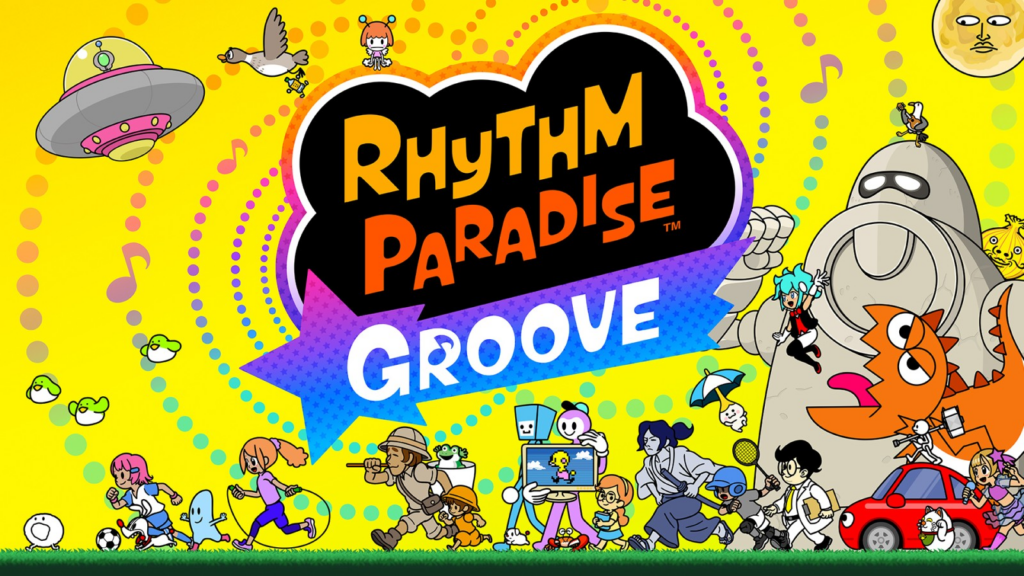
Around the same time Sony is doing its best to completely murder the traditions and culture surrounding video games, and Xbox continues to implode, Nintendo has gone and put out multiple games that feel… almost out of their own time. And I mean that in a very complimentary way; both Star Fox (released on the 25th of last month) and Rhythm Paradise Groove (released yesterday, also known as Rhythm Heaven Groove if you're American) feel like games from at least two hardware generations ago, and that's absolutely a good thing.
The two games are very different experiences, but the one thing they have in common is that they respect your time in the way that titles from, say, the PlayStation 2 era did. You can do a complete playthrough of Star Fox in under an hour, and Rhythm Paradise Groove consists entirely of self-contained sequences that are no more than two or three minutes, tops. You can blast through all the "content" both games have in a relatively short space of time, but their longevity comes from their replay value: Star Fox for the pursuit of "medals" by attaining specific scores on each level while ensuring all your computer-controlled companions survive, and Rhythm Paradise Groove for attaining "Amazing" and "Perfect" ratings on each stage.
I'm growing increasingly fond of games that aren't a huge commitment to play; games that you can just pick up and enjoy whenever you feel like it, without feeling that strange sense of "guilt" many of us have if we already have a "big game" on the go and start something else that is likely to take more than 40 hours to get through. I'm not just talking about bite-sized arcade-style games, either; the other night I started playing Soul Blazer on Super NES, and I know that's relatively short in the grand scheme of RPGs, so I'm looking forward to finally making my way through the whole thing; something I've been meaning to do for ages.
I like a good long game to get my teeth into now and again, you know that — but I won't lie; there are times when I start something that I think is going to be relatively light and breezy, see it has an endless skill tree and various numbers to grind up very slowly in the name of increasing my poison damage by 0.1%, and just think "oh no, this is going to take ages, isn't it?" There are a significant number of games that have been released over the course of the last 10-15 years or so that would have really benefited from just scaling back, like, a lot, and providing a much more focused experience. They usually don't because they have to justify their massive budgets and thousands of people working on them — plus, unfortunately, there is a subculture among capital-G Gamers™ who complain any time something comes out with what they perceive as "not enough content".
It's unfortunate that so many developers have listened to the people who whine in Steam forums about games being "abandoned" because they haven't had an update in the last three weeks (protip: sometimes those games are finished) or that they need to see a "roadmap" of "new content" coming down the pipeline. I always feel the exact opposite to this; if I see a game that has a lengthy roadmap — particularly if that roadmap involves copious amounts of DLC — I lose a lot of interest in that game. Sometimes I will return to it later to see if there's some sort of "complete" edition available, but most of the time I will just shrug my shoulders and go and play a game that is actually finished instead, rather than spending valuable time playing something that I know is probably going to change and expand in the time it takes me to beat it.
I like both Star Fox and Rhythm Paradise Groove because they are both finished games, and seeing everything they have to offer is within relatively easy reach. Both will require some practice and some actual playing skill to see all that stuff, but neither of them feel like they're going to be commitments with hour counts that number into the three digits just to see the credits roll.
I suspect Star Fox might see some updates to its multiplayer mode if it proves popular, but as a single-player experience, it is completely self-contained and does everything it needs to. Rhythm Paradise Groove I suspect will just stand as it is — it didn't even need an update when I put the cartridge in for the first time earlier, which is always a very welcome sight these days.
I hope we see more games like this. Nintendo seems to be quite keen on them right now, and I'm not complaining when they are as good as Star Fox and Rhythm Paradise Groove are — and speaking of which, I'll have more to say about the latter over on MoeGamer when I've played a bit more of it. For now, I'll just say "cha, cha, cha, bom bom" and leave it at that…
Want to read my thoughts on various video games, visual novels and other popular culture things? Stop by MoeGamer.net, my site for all things fun where I am generally a lot more cheerful. And if you fancy watching some vids on classic games, drop by my YouTube channel.
If you want this nonsense in your inbox every day, please feel free to subscribe via email. Your email address won't be used for anything else.
Yesterday, I talked generally about the impact PlayStation had on me and my friendship group thanks to stone-cold classics like Ridge Racer, Tekken and Final Fantasy VII. Today I want to talk about another aspect of that time which I have fond memories of — but which hasn't been a thing for some years now, and which will definitely no longer be a thing once Sony finally pulls the plug on production of physical PlayStation discs. (Incidentally, their announcement of this is now, at the time of writing, up to 135 pages of comments, with over 7,000 universally negative responses, and I suspect these numbers will continue to grow for some time as yet.)
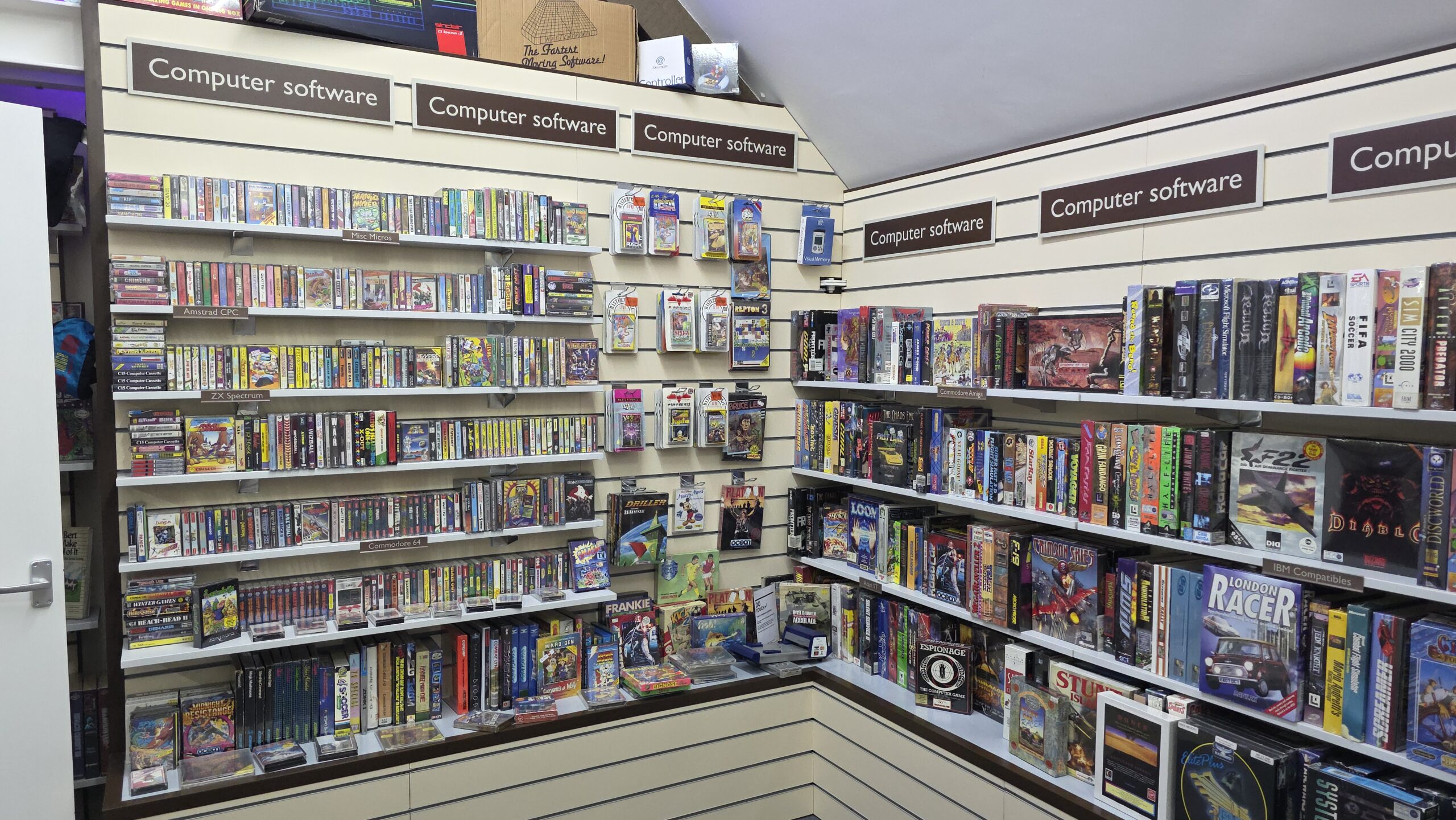
The Cave museum, part of the Retro Collective, has an interactive recreation of what an old software shop would have looked like back in the day.
Anyway. Yes. What I wanted to talk about was the fact that once we got into sixth form, a lot of us started to enjoy our first real tastes of proper independence, despite, in most cases, still living with our parents. Learning to drive allowed us to go places without having to rely on getting our parents to give us a lift — and give them the full details of where we were going. We were trusted to take responsibility for our own education, meaning several of us went to one single General Studies lesson in two years and still managed to ace the exam. Taking part-time jobs of various descriptions allowed us to earn some money, giving us considerably more financial freedom than childish "pocket money" provided. (Although saying that, my grandparents were always very generous in that regard.)
That latter one is an important one, as it coincided with us being able to spend that money on things that we liked. For my friends and I, those things were video games. And it was an enormously exciting time to be interested in video games, with the PlayStation having hit the market a few years earlier, and the Nintendo 64 finally arriving in Europe as we were kicking off our period of post-compulsory education.
I have fond memories of sixth form not just because I enjoyed the academic side of things — that's something I've talked about elsewhere — but also because of what happened between those classes. For my friends and I, we spent the majority of our time hanging out in the Art department of the school rather than the main sixth form common room; the corner of the Art department had essentially been taken over as a semi-private secondary common room that was almost exclusively used by my friends and I. It was a comfortable place to hang out, and we had many pleasant free periods spent there enjoying a bacon and cheese baguette from the recreation centre on the school site, just chatting about all sorts of silly things.
Quite often, if we had several free periods in a row, or free time up to and including lunchtime, we would wander off the school site — as we were allowed to do now, because we were big, brave, responsible 16+ year olds — and walk into the town centre. This was a walk of about a mile in total — my 45 year old bones ache just thinking about that — but we did it on a pretty regular basis. When we got into town, we had a bit of a routine: we'd go to The Baker's Oven for a bacon and cheese puff and a Belgian bun (though not if we had recently consumed one of the aforementioned baguettes), then head to Barneys, the local record shop, and have a little look around. I would always feel mildly uneasy in there because it was still the age where one felt distinctly judged for one's taste in music, but after a while I learned to just own my self-described "eclectic" tastes in music.
Barneys wasn't the main attraction of our trips to town, though. We saved the best for last by heading to First Compute, a pokey little shop in the "Cross Keys" shopping mews that was initially little more than a cupboard with games for pretty much every platform you can think of festooning every wall (and a fair bit of the floor). By the time we were in sixth form, though, the owner, who we only knew as "Richie", had moved venue to a slightly larger establishment, but the distinct feeling that as much stuff as possible was being crammed in remained. There were big box PC games on some shelves on the left, and PlayStation and N64 games on the right.
At the time, I had had the good fortune to score a few freelance writing opportunities for outlets such as PC Zone and the Official Nintendo Magazine. These at least partly came about because I did my Year 10 work experience on PC Zone when my brother was the editor, but my brother's the sort of person who wouldn't have recommended me to his successors if he didn't think I could have done a good job. And I did do a good job — and, more to the point, in those days, you got paid a hell of a lot more for cranking out an article than you do for many of today's websites. We're talking about £300-£500 per piece here.
As you can probably imagine, being in a situation where I had very little in the way of living expenses thanks to still living at home, this cash very quickly burned a sizeable hole in my pocket, and my friends knew this. I would often get a little "gentle encouragement" to pick up a new game for either PlayStation or Nintendo 64, and honestly, as much as peer pressure very much was involved, I didn't need much convincing. I found both systems to be a ton of fun, and I loved being able to share my enjoyment of them with my closest friends.
On the Nintendo 64 front, we quite often picked up games with a multiplayer focus, as we spent a lot of time around one another's houses, crowded around the television enjoying split-screen fun. We even tried some types of game that, in prior years, we would have never considered, like EA's World Cup 98 when the eponymous tournament was on.
On the PlayStation front, my preference was, as you can probably imagine if you know me even a little bit, for role-playing games, and dear Lord do I ever wish I'd held on to the vast majority of those games I bought all those years ago, because little was I to know that role-playing games in particular would become enormously expensive on the second-hand market.
Of all those times I was mildly peer-pressured into buying a new game, I only remember one solitary occasion when I was disappointed and regretful enough in my purchase to actually return the game in question. That game was a title for PlayStation called Blaze & Blade: Eternal Quest, and it was a polygonal action RPG for up to four players. It looked like it might be cool from the box art, and there were some interesting ideas in it, but it was very much not what I was looking for from a game at the time. I'm actually quite curious to revisit this game through older, more mature eyes, as I suspect I may have treated it a bit harshly.
The pattern of go-to-town, buy-a-game continued once I got to university and fell in with friends who also enjoyed gaming. Since I was still getting some cash from freelancing, I still had a bit of disposable income, though living away from home meant I did actually have living expenses now. Still, I managed to pick up a bunch of interesting games, and reading the manuals while on the bus home was always a highlight of these times that I think back on fondly. It's a cliché to talk about reading the manual on the way home, but it really was a thing we did, and it really is something I have exceedingly happy memories of.
New games haven't come with manuals for a long time now, outside of a few special cases in limited-print editions, and situations like Evercade where the whole thing is built on the idea of "how it used to be" — and with the apparently impending death of physical releases, even the experience of going to a game shop, picking up a game and coming home with it will be lost. Of course, many people — including me — tend to order their games online these days anyway, so many of us haven't been doing that anyway — but it's still sad to think that there are generations of video game enthusiasts who will never be able to enjoy things in quite the same way we did around the end of the millennium and the turn of the century.
I'm mad at Sony for actively encouraging the death of that. They are deliberately trying to destroy what was once an important part of the overall culture surrounding video games. I suspect those who have never been deeply into them might not understand why this is a big deal — and I equally suspect the C-suite execs who mandated this are exactly the sort of people who have never actually given a shit about video games as a creative medium or form of expression — but it really was. Sony's announcement left a lot of people feeling like they really had lost something; feeling something akin to grief. It might sound silly to say that about something as simple as going into a shop and buying a box with a bit of plastic inside it, but it really is the case.
I sincerely hope the company does a hasty U-turn on this, but I very much doubt they will. If that's the case, that's the end of me and PlayStation. Once there's no more games to buy and proudly put on my shelf, that's it for me and new games. I've always said this. And in some respects, I don't mind, either — it'll mean I don't have to worry about running out of what little space I have left on my shelves, and that I will be able to focus on diving deep into my collection and discovering all the things I haven't gotten around to yet.
But still. I will be sad to have lived long enough to see a medium and a culture surrounding it grow, thrive and then wither. I am already sad that I have seen that happen, but every new week seems to bring a new horror in that regard.
We will always have the good times, though. That's the one thing they can never revoke the license for.
Want to read my thoughts on various video games, visual novels and other popular culture things? Stop by MoeGamer.net, my site for all things fun where I am generally a lot more cheerful. And if you fancy watching some vids on classic games, drop by my YouTube channel.
If you want this nonsense in your inbox every day, please feel free to subscribe via email. Your email address won't be used for anything else.
As I absorb the news that Sony is giving up on physical releases of games — something I have had a good rant about at much more length over on MoeGamer, so please go read that — I can't help but think back to the time PlayStation hit the scene, and the incredible amount of promise that video games showed back then. This coincides with a period of time I often describe as the happiest of my life, and the video games were a big part of that, for a variety of reasons.
I remember my first encounter with PlayStation vividly. My brother had come home to visit, and, as he often did, he had brought some gaming hardware with him. On previous visits — and prior to me getting my own SNES — he had brought both a Super Famicom and Mega Drive back with him on various occasions, but this new PlayStation thing was one of the most exciting things I had ever seen.
We loaded up Ridge Racer and you could play Galaxian while it was loading. Supposedly you could unlock some stuff if you could win the Galaxian game before the game finished loading, but I didn't manage that right away. (I mastered it some time later.) Then, once Ridge Racer was loaded, it was another example of something we'd previously described the SNES as being: "like having an arcade machine hooked up to your TV".
This feeling didn't go away with Tekken, which my brother had a prerelease copy of. He also had Raiden Project, which, while less obviously "impressive" than both Ridge Racer and Tekken, I found myself enjoying a lot, and still consider one of my favourite PlayStation titles to this day.
Eventually, my brother left behind this Japanese-model PlayStation at my parents' house for me to have — he had got his own British model. I was thrilled, particularly once I learned the "pen-lid trick" — a means of circumventing the console's region and copy protection by propping the disc tray open and carefully timing the swapping of discs. It was a good way to wear out your laser before long, but until I got my own UK PlayStation, it was my main means of experiencing PAL releases.
My friends got PlayStations around a similar time, and we all really enjoyed them, each cultivating our own little collection of games.
Then came Final Fantasy VII. I first heard about this from my brother, and one thing made me want to pick it up immediately: he told me that it was the first game that had made him and various other people he knew cry. This might seem like a strange reason to be excited for a game, but having been enjoying point-and-click adventures on PC for a few years at this point, I was immensely excited by the possibilities that interactive storytelling offered, and I was curious exactly what this game actually was.
I started to play it and was initially confused. Why did the screen go all swirly and then I couldn't move, but I had to select things from a menu instead? Why did the characters look different when they were walking around to when they were in battle? Why were numbers popping out of things?
I'd encountered the RPG genre in a very early form back on the Atari 8-bit, but had always found those games to be difficult to understand as a child. Some years later, I got into HeroQuest and Advanced Heroquest, and started to understand how numbers and turn-based combat worked together. And with Final Fantasy VII, I quickly learned how the computerised take on an RPG worked — and that I liked it a lot.
My friends loved it, too. We all swapped stories of our custom-named parties at school, arguing over who had given their characters the "best" names and who had recoloured the text window the most attractively garish combination of shades. We all agreed it was an incredible experience, and played it multiple times in succession — often in immediate succession. I estimate over the course of one particular summer, each of us must have played through the entirety of that game somewhere between six and ten times.
My parents went away for a few weeks and left me in charge of the house. I hosted an ill-advised party that I got into a lot of trouble for — I have to laugh in retrospect — but the best thing about that summer was having my friends over pretty much every day, and we would just play Final Fantasy VII together while eating Pot Noodles and getting steadily quite drunk. On one particularly memorable occasion, we challenged one another to play from the beginning and stay up as long as possible; we played through the night and into the next morning, hitting each other with sofa cushions to wake each other up if we looked like we were nodding off. It was a truly wonderful experience, and absolutely a treasured memory.
It all feels so far away now. I would love to have a summer like that which I just described again, but it feels like a far-off dream at this point.
Still, I mean I am still in touch with some of those friends, so perhaps, just perhaps, we could make something like that happen once again sometime. Maybe.
Want to read my thoughts on various video games, visual novels and other popular culture things? Stop by MoeGamer.net, my site for all things fun where I am generally a lot more cheerful. And if you fancy watching some vids on classic games, drop by my YouTube channel.
If you want this nonsense in your inbox every day, please feel free to subscribe via email. Your email address won't be used for anything else.
As I often do on my regular trips in to the office (when I'm driving, anyway), I listened to a bunch of the Fun Factor podcast over the last couple of days. If you're unfamiliar, this is an excellent show hosted by sports writer Ty Schalter and video game critic Aidan Moher where the pair (and sometimes guests) discuss old video games magazines, the reviews therein, and the games covered.
Here's a stock image that appears to be scientifically designed to upset anyone who knows anything about video games. Photo by Mahmoud Yahyaoui on Pexels.com
I am quite a few episodes behind, but the nice thing about the show is that its very nature means that it is somewhat timeless, and each episode can be enjoyed at any time. Thus, yesterday and today I enjoyed some discussion of Next Generation magazine's "Are You a Hardcore Gamer?" quiz (circa 1998) and the pair's collaboration with Coury and Try from My Life in Gaming to discuss a "draft" of games from the 1995-1997 period covered by Fun Factor's first season.
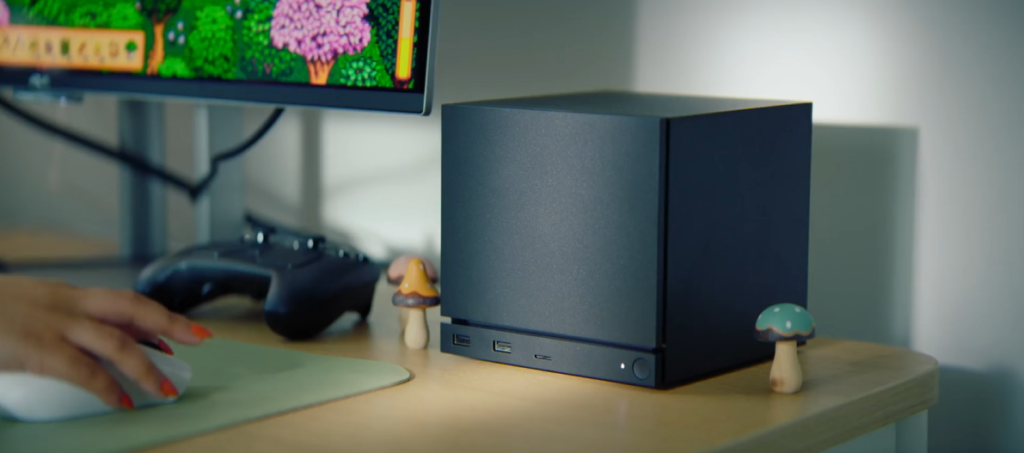
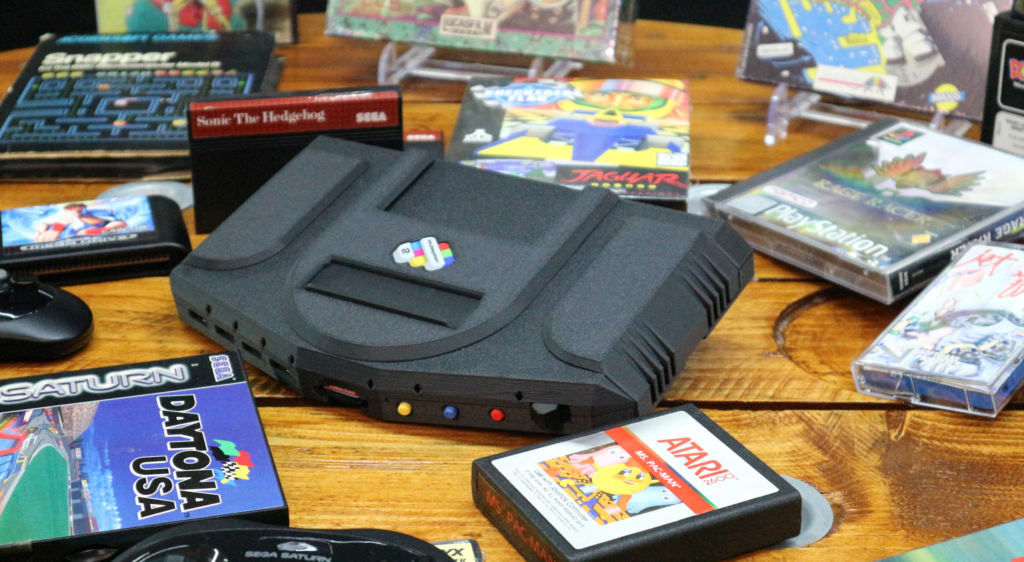
Obviously I will take this opportunity to recommend you go give Fun Factor a listen (or even better, watch: the podcast's YouTube channel lets you look at the magazines as they're talking about them!) but today's post isn't specifically about the podcast. Rather, it's about how the discussions on the episodes I listened to, particularly the "draft" episode, have inspired me to make some time to play through a bunch of games I keep telling myself I've "always meant to get around to". By this I am primarily referring to retro games, particularly of the RPG variety, of which I have about a bazillion loaded up and ready to go almost immediately thanks to my MiSTer Multisystem 2 setup upstairs. And I can even play them on a CRT!
I hesitate to start new RPGs because I have it in my head that they're all massively long. And to be sure, your average RPG does tend to be on the longer side. But listening to the chaps enthusing about various titles like Chrono Trigger (which, to my shame, I've never finished), Final Fantasy IV (which I have finished and know is pretty short) and various others makes me think… I should just sit down and play some of these things that I've been "always meaning to". Including some that I've started and never got around to finishing, like Soul Blazer.
Soul Blazer is definitely one I want to tick off my list because it is an excellent game, and I've always felt like it wouldn't be quite right to tackle Illusion of Gaia and Terranigma, both of which I want to play, before beating that one. They are considered an extremely loose "trilogy", after all, and I think it would be particularly interesting to play in succession.
Part of me says "no, don't start something new, you have Final Fantasy XI on the go". But Final Fantasy XI is very long indeed, and sometimes you just want a palate cleanser. Sometimes that's something really quick and breezy, like the new Star Fox, while at other times, it's another game with a bit more substance, but which is unlikely to end up with an hour count that is three or more digits in length.
So probably not tonight, because it's getting late and I still have a farty stomach full of regret from the pizza I had last night, but very soon, I'm going to set some time aside to enjoy some retro gaming. I have all the kit — I might as well make good use of it and enjoy myself, non?
Want to read my thoughts on various video games, visual novels and other popular culture things? Stop by MoeGamer.net, my site for all things fun where I am generally a lot more cheerful. And if you fancy watching some vids on classic games, drop by my YouTube channel.
If you want this nonsense in your inbox every day, please feel free to subscribe via email. Your email address won't be used for anything else.
To no-one's surprise, it has been revealed that Rockstar's upcoming Grand Theft Auto VI will be $80 on release for its regular version, and $100 for the "Ultimate" version, because of course there's an Ultimate version. Hilariously and/or tragically, the "Ultimate" version even goes so far as to lock you out of specific shops in the game unless you buy it — a decision that some poor Forbes writer in complete denial has tried to astroturf already. No, but honestly, it's fine — they're probably only going to put the Ultimate Edition-exclusive items in those stores, there will definitely be other stores you can use!
Oh, and on top of that, the "physical" release of the game is a code-in-a-box. Fuck off with that.
I can't think of many series that have managed to so very thoroughly turn me off as Grand Theft Auto. I absolutely loved the original one, from the moment my underage self bought the original big-box PC version from "First Compute" one lunchtime at sixth form. ("Ol' Richie", the guy who ran the shop, knew I was lying about my birthdate, but he didn't really care. My friends and I spent too much money in his shop for him to make a fuss.) I likewise adored Grand Theft Auto III (I never played the second one to this day) and quite liked Vice City, particularly its soundtrack, which I had the box set of CDs for.
The series started to lose me around San Andreas. There's no way of saying this that doesn't sound a bit racist, so I'm just going to say it, acknowledge that is what it sounds like, and attempt to explain myself: I found that game's focus on strongly black-coded urban culture to not only be difficult to engage with, but outright indecipherable at times. To put it another way, I had found Grand Theft Auto III and Vice City to be a lot more accessible, simply because I was more familiar with the tropes of "mafia-style" gangsterism that they both leaned heavily on; by contrast, San Andreas' central culture felt jarringly different to me the moment I started playing, largely because I was so unfamiliar with it. I had never watched any movies or TV shows that dealt with inner-city black urban culture — I hadn't even really listened to much in the way of contemporary black urban music at the time I played San Andreas — and thus being thrown into the deep end of it right from the start of San Andreas was… an adjustment.
There is, of course, a very strong argument to be made for using video games to immerse yourself in a culture that is different from your own — hell, I do it all the time with Japanese games — and in many respects we should look at San Andreas as quite admirable for unashamedly putting black culture front and centre at a time there was not nearly as much truly inclusive, representative media as there is now.
But two things. One, I'm not sure Grand Theft Auto as a series is the one to tackle this in the most respectful manner; I don't know enough about real-world urban culture, particularly from the 1990s, to know how "authentic" San Andreas was — or if it was, in fact, just riddled with stereotypes. And two, I, personally, a middle-class white dude, with everything that entails, just found San Andreas, at least in its early hours, to be so far outside of what I was familiar with, both in my life and in the media I had previously engaged with, that I found myself thinking about the game as a whole much less fondly than I had done towards Grand Theft Auto III and Vice City, even though there are a lot of ways in which San Andreas is, in theory at least, a "better game". I'm sorry, that's just how it is; I can't change my own reaction to a creative work!
Anyway, the upshot of all that is that after San Andreas, I was a lot more lukewarm on the series as a whole than I had been previously. When Grand Theft Auto IV came out, I didn't pick it up right away, and when I did pick it up, I found that I wasn't enjoying it nearly as much as I had done III and Vice City. Part of that was down to the different cultural context in which I was playing it, I feel; both III and Vice City were games I played while I was at university, so I also associate them with drunken nights out with friends that ended with collapsing back to my place to play either of those games until ugly o'clock in the morning. This is probably another reason San Andreas didn't resonate as hard, thinking about it; by the time that game came out, we'd all finished university, and thus we were no longer spending several nights a week around one other's houses playing video games together.
I never finished Grand Theft Auto IV, and never even tried its DLC. I thought about trying it again on more than one occasion, but I could just never really muster up the motivation for it. I don't know what it was; it just… didn't click with me at all, for some reason.
By the time Grand Theft Auto V first came out — which, let's not forget, was thirteen fucking years ago — I felt I was ready to try again, though. The new three-protagonist structure sounded interesting, and the online mode sounded intriguing, too. I gave it a go. I finished the single-player story. I had what I would describe as a moderately good time with that PS3 version, but it didn't have that magic for me. It felt too self-consciously edgy, like it was trying desperately to be taken seriously, but also wanted to combine that with the over-the-top satire that the previous entries had incorporated, and it just didn't really work for me. And all the fluff in it was… cool, I guess, but most of it felt like it was just there for the sake of it, rather than in an attempt to make a better game.
Online was even worse. Aside from the fact it just flat-out didn't work for quite a long time on console after release, the few times I tried later it on PC (I bought the PC version on deep discount later to play with friends more easily, as they didn't have consoles) were such overwhelmingly negative experiences that I had absolutely zero desire to spend any more time in it than I "had" to. And I didn't "have" to spend any time in it whatsoever.
What was so bad? Flagrant cheating, with nothing being done about it. Behaviour that went beyond the simple antagonism the game is built around, into malicious attempts to spoil other people's fun. Load times that were approximately sixteen years long. The complete inability to form a "party" with your friends, making it near-impossible to stay together between individual "events". And, woven into the very fabric of the experience, pay-to-win microtransactions.
Don't get me wrong, I had a few good times in Grand Theft Auto V's online mode, but those only really happened when we had a private friends-only session and just pissed about a bit. I won't deny that doing things like impromptu bicycle races across mountainous countryside, with one of us driving an enormous truck instead, were very enjoyable. Stepping into a public game, however, provided some of the most miserable online experiences I think I've ever had.
And then, of course, Grand Theft Auto V just would not fucking go away. It came to PlayStation 4 and Xbox One. Then it came again to PlayStation 5 and Xbox XBOX or whatever they're called now. More and more guff kept being added to the online mode, all in the name of getting people to pony up the cash for those odious "Shark Cards", because playing the game normally in order to earn your way to rewards was, very obviously, a chump's game.
I got to the point where I actively resented the sight of Grand Theft Auto V. It felt like it had become everything the series had once satirised, and worse. I had no desire to play it ever again.
I tried a few other Rockstar games along the way, too, and the only one of them that clicked with me was Bully, a post-San Andreas game that switched gears by placing you in the role of a teenager at a school in a small town, rather than a hardened criminal in a huge conurbation. I didn't enjoy Red Dead Redemption at all — at least partly because I've never found Westerns to be appealing as a genre — and have felt no inclination whatsoever to really explore the company's broader output since. (Max Payne was good, mind, though I've never really thought of those as "Rockstar games")
Grand Theft Auto VI is frustrating to me because it's being hyped up as some great Second Coming of Christ, to such a degree that game developers and publishers putting out games that are not Grand Theft Auto competitors in the slightest are terrified of releasing even vaguely near it. This, to me, just seems counter-productive; while I'm sure a lot of people are going to buy and play Grand Theft Auto VI on release day, there are plenty of people out there, I'm sure, who feel just like I do — sick to death of this goddamn series, and not looking forward to the inevitable flood of nothing but GTA VI articles we're going to get on the two and a half remaining video game journalism websites for months after it releases. Those people are going to want to play literally anything else on November 19th!
I'm pissed because not only am I sick of the sight of Grand Theft Auto, I'm also furious at how they're clearly exploiting the public with the pricing, garbage not-actually-a-physical-release and bullshit like locking in-game stores behind a $20 more expensive premium edition. I'm furious because people are still going to buy it and reward this nonsense, and no-one will learn a goddamn thing from it. It is the absolute worst example of the excesses of the top end of today's video game industry, and it's going to get away with it because it's "the most-anticipated video game ever".
And this, of course, is to say nothing of Rockstar's union-busting activities that they're currently fighting a legal battle over. But I'll leave that for people who understand such things better to discuss.
I'm aware that me having a little rant here is going to change nothing, and this odious game is going to sell gangbusters when it comes out. But I feel a bit better having said my piece now. And, outside of the game doing anything even more egregious than the shit that has been announced today, this is probably the last time I will mention it, or even think about it — and I'm certainly not going to try and stop anyone who has actually been looking forward to it from enjoying it.
I might silently judge you a bit, though.
Want to read my thoughts on various video games, visual novels and other popular culture things? Stop by MoeGamer.net, my site for all things fun where I am generally a lot more cheerful. And if you fancy watching some vids on classic games, drop by my YouTube channel.
If you want this nonsense in your inbox every day, please feel free to subscribe via email. Your email address won't be used for anything else.
Valve apparently announced the price of their long-awaited Steam Machines today and, unsurprisingly, given the general price of tech right now, they ain't cheap. They're "starting at £879" not cheap, and that only gets you 512GB of storage; they break the £1,000 mark if you want the 2TB model, though both are expandable with microSD cards.
Image: Valve
We have long since reached a point where it is not particularly cost-effective to start taking an interest in modern gaming if you are not already involved in the overall ecosystem and thus resigned to vast swathes of your monthly pay packet disappearing on your chosen hobby. Sure, you can get away with a somewhat lower-end mini PC if all you want to play is relatively small-scale indie games — but even those lower-end mini PCs are going up in price nowadays. Therefore, it is worthwhile looking at more cost-effective options for enjoying video games — even if the video games you will be enjoying are a few years old. Good games are still good years after they're released, you know! So here's my personal recommendations on that front.
Evercade
Of course I'm going to recommend Evercade because I work for them, but the reason I work for them is because I was all-in on the idea of the system from day one. A new, affordable system with a focus on retro gaming that provides officially licensed physical releases of classic games from home consoles, computers and arcade machines? Regardless of if I'd ever managed to secure employment with Blaze, makers of the Evercade, I would have been a "full setter" from day one — indeed, when the original handheld released, I immediately took advantage of the "All-In" bundle to get the first 10 cartridges included with the system.
Why recommend something like Evercade when emulation and other options exist — some of which we'll talk about in just a moment? Well, that "officially licensed" part is important. The current state of the games industry may appear to be teetering on the brink of unsustainability, but that doesn't mean people who enjoy video games want the whole thing to collapse. It would be rather nice if we could recover from this situation we're currently experiencing — and one way to help that come about is to support officially licensed rereleases of classic games, updated to play nice with modern audio-visual equipment, particularly televisions. On top of that, Evercade also plays host to physical releases of a lot of "modern retro" titles — games originally designed with vintage hardware in mind, but developed in recent years.
Image: Evercade
Many of the rights holders of these old games are also game companies that exist in the modern sector, and so throwing your support behind retro rereleases that don't require turbo nutter ninja bastard hardware to run is one way of helping ensure we still have a healthy video game economy whenever the AI bubble finally bursts and — hopefully — hardware prices start to settle back to what we have previously thought of as "normal".
Plus the physical nature of Evercade collecting allows you to rediscover the fun of having a shelf full of games to pick from, rather than a boring old list of downloads on your PC, many of which you scroll past without even noticing every single day.
MiSTer
Evercade is great, but there are some classic games that are never, ever going to get a rerelease for one reason or another — be it the rights holders being unwilling to put them out again, more complex licensing situations (such as video games based on movies, or which feature licensed music, vehicles or actors' likenesses) or some other reason entirely. For those situations, that's where what I would describe as more "community-focused" solutions come into play — as a general concept, this covers emulation, but I would specifically call out the MiSTer project as being a particularly worthwhile investment in these peculiar times.
For the unfamiliar, MiSTer is a platform based on "FPGA" (Field Programmable Gate Array), which is a technology I have absolutely no understanding of whatsoever, save for the fact that it effectively allows a device to recreate the way another piece of hardware would have worked in the past, not through simulation in software (which is how emulation works), but through a reconfigurable chip that basically "pretends" to be the old system. Some describe it as "hardware emulation"; all you really need to know is that, under most circumstances, it results in the most authentic recreation of a classic console, home computer or arcade cabinet possible, particularly if you happen to have an old CRT television hanging around that you can hook it up to. (Never fear if you don't, however; one of the core concepts of MiSTer from the outset was to provide a relatively straightforward means of enjoying classic "hardware" on modern displays, and the platform has a variety of built-in and fully customisable visual filters that allow you to recreate the CRT "look" if you so desire.)
Image: Heber Electronics
MiSTer is a project you can build yourself, but it's actually probably more cost-effective these days to go for a pre-built solution such as Heber's Multisystem 2 (pictured above, which I use) and Taki Udon's SuperStation One. You will also need to add some form of storage to whatever setup you go for, which is likely to be the expensive bit these days; however, it's a one-off expense, and you can look at it as a lump sum you are spending on your own entertainment, rather than buying a bunch of individual things piecemeal. Tot up how much you've spent on individual games in the last year or so, and an SSD probably won't seem quite so expensive.
MiSTer requires a bit of setting up, including installing the actual software on the device to make it work, and then loading up your storage medium of choice with games — which, of course, you will have to "procure" yourself. For everything from the earliest games consoles right up to PlayStation, Nintendo 64 and Saturn, however, a MiSTer is all you need for… honestly probably enough games to last you the rest of your life.
Why do I recommend this and not investing in some classic hardware? Several reasons. One, classic hardware is prone to failure. Two, the games for classic hardware are often ludicrously expensive these days thanks to all the arseholes who have bought them as "investments" rather than to enjoy them — and you paying £400 for a copy of Buggy Run on Sega Master System doesn't help anyone other than the person you're foolish enough to hand over those notes to; the original creators certainly don't see a penny of that money! And three, getting classic hardware working on modern displays can be a bit of a pain… or at least demand you invest further expenses in a decent scaler.
Sixth- and seventh-generation consoles
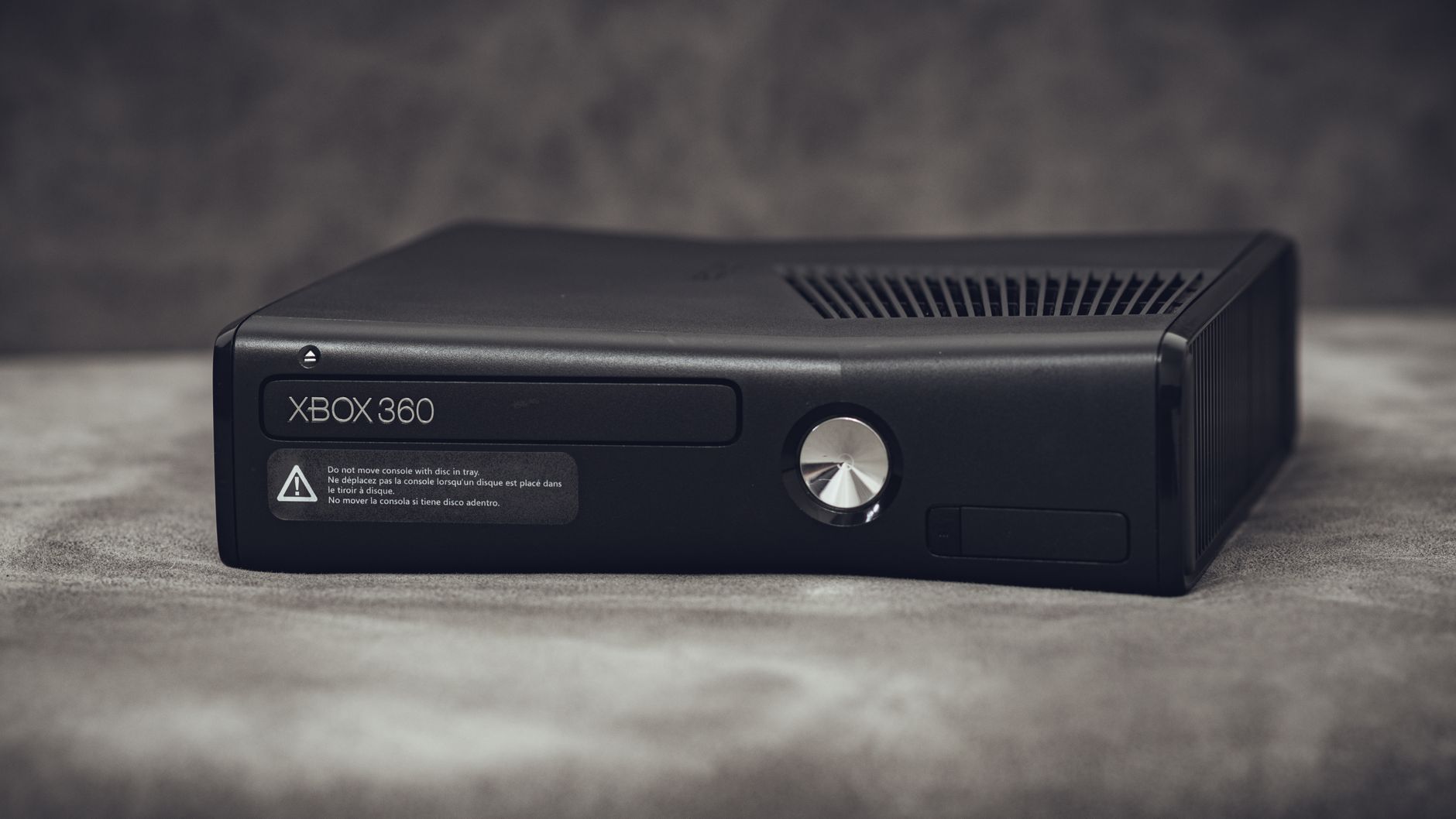
If you have the cash, I would recommend investing in, at the very least, an Xbox 360. This platform has a vast library of excellent games available, many of which can be bought for not very much money at all, and doesn't require any faffing around to get working on a modern TV. You may also wish to consider a PlayStation 3, as there are a number of exclusives on both platforms — plus a few cases where either the 360 or PS3 version is just plain better for one reason or another.
After that, a Nintendo Wii or Wii U is well worth considering. The Wii U, while mocked in its lifetime for its small library of games, has some absolute bangers, plus it is backwards compatible with the Wii, which has a vast library of excellent games, many of which can, again, be picked up for not very much money at all. Wii U is an HD console that can be connected to a modern TV, but the original Wii is a standard-definition console, though it can still be hooked up to a modern TV via component cables for a 480p "Enhanced Definition" picture. If you don't have component inputs on your TV, you will probably want to run an original Wii through a scaler, as composite or SCART inputs on modern HDTVs — if they even have them any more, which I'm sure some models don't — are complete cack.
Speaking of standard definition, this brings us onto the other worthwhile investment: a PlayStation 2. Again, you can actually run one of these through component cables — and even get an actual high-definition signal with a few very specific games — but you will probably want to also grab yourself a scaler if you take your PS2 gaming seriously. And you should take your PS2 gaming seriously, as the system plays host to one of the richest, most diverse libraries of any system ever released, with titles ranging from bargain bin puzzlers to sprawling epic, cinematic affairs — and some of the best RPGs ever created. While the latter can command high prices these days, many PS2 games — and good ones! — can be picked up for not very much money, making it easy to build a library of stuff that will keep you busy for a good long while.
If you're feeling flush, an original Xbox and Nintendo Gamecube are worthwhile investments, as both have some nice exclusives and in the case of multiplatform games, Xbox and/or Gamecube versions are often superior to their PS2 counterparts. Do note, however, that original Xboxes sometimes need a bit of maintenance, and Gamecube games tend to be significantly more expensive than equivalent games on other platforms from the same period. Also be aware that the earlier models of Wii also play Gamecube games, so you may not even need to buy a separate Gamecube if you're lucky enough to track down one of those. (You can tell if you have one of those by if it has a removable panel with Gamecube controller ports underneath.)
Let's price a starter setup as outlined above from a hardware perspective:
£ 89.99 - Evercade VS-R
£264.00 - MiSTer Multisystem 2 (analogue-compatible model)
£ 47.99 - 512GB microSD card (price from Amazon 22/6/2026)
£110.00 - Xbox 360 250GB "E" model (unboxed from CEX 22/6/2026)
£ 65.00 - Nintendo Wii (unboxed from CEX 22/6/2026)
=======
£576.98
About half the price of the top-end Steam Machine, and between that lot, you should have access to more than enough games to keep you busy for a very long time indeed — and no need to spend half your life complaining about derivative triple-A trend-chasing, microtransactions, mandatory 50GB updates, lengthy install processes and shoehorned-in multiplayer modes.
Plus if you have friends over, they'll think your setup is super cool. And if they don't, question whether they really were your friends in the first place.
Want to read my thoughts on various video games, visual novels and other popular culture things? Stop by MoeGamer.net, my site for all things fun where I am generally a lot more cheerful. And if you fancy watching some vids on classic games, drop by my YouTube channel.
If you want this nonsense in your inbox every day, please feel free to subscribe via email. Your email address won't be used for anything else.
There is increasing talk of the video games industry staring down an honest-to-goodness crash — and this time around, unlike the notorious Great Global Video Game Crash of North America from 1983, it looks very much like it could be one that will happen across the world. All this said, I feel like, at this point, there is enough disparity between the bit that will be affected by it and the bit that will be able to continue on regardless for the latter to be able to survive comfortably.
This will, in its own curious way, reflect what happened in 1983, where a significant portion of the game-playing world — the UK and Europe, notably — were blissfully unaware of the problems the broader games business were suffering, because they were enjoying the fruits of a thriving cottage games industry. Here in the UK, we had no idea a "crash" was happening across the pond because we were all cheerfully buying £1.99 Mastertronic tapes from our local corner shop.
Something's gotta give, though, because the relentless torrent of shit that is coming out from shareholder-beholden companies — particularly with regard to the odiousness that is generative AI — is completely unsustainable. And we've reached a point where all but the most ardent bootlickers are feeling more and more emboldened to criticise what's going on — though sadly this also coincides with a period where thousands of people are being laid off and games aren't actually getting any better.
Take this statement attributed to Sony, posted on Bluesky earlier today:
This is a complete nothing of a statement! It says nothing! It gives precisely no examples of how AI "improves productivity", "drives efficiency, personalisation and customer value at scale" and "unleashes the creativity of Sony Interactive Entertainment's studios"! It is five paragraphs that explain nothing and say nothing, but which exist purely to, supposedly, placate shareholders who, apparently, have absolutely no functioning brain cells between them and desire nothing more than every stupid fucking company to follow every stupid fucking trend in existence, even when they are demonstrably, actively harmful and just plain shit!
I am mildly heartened that a number of developers are starting to speak up a bit more about this. There's a good piece on Aftermath on the subject, and another on gamesindustry.biz. There are still the annoying sycophants in every single comments section who all parrot the exact same lines about "the genie being out of the bottle" and "get used to AI or get left behind", but there is, I feel, increasing resistance to that side of things. A lot of smaller-scale developers are also making a good name for themselves by saying, out loud, and prominently, that they do not use generative AI at any point in their development process. Good!
The utterly dumbshit thing about corpos like Sony sucking Sam Altman and Wario Amodei's robophalluses is that there is not a single documented instance of a project involving generative AI being well-received by either press or public. I'm not even convinced that it's actually what shareholders want to see. The otherwise excellent Clair Obscur: Expedition 33 was soured for a lot of folks (including me) when it was found that they had used generative AI for "placeholder" (sure) assets, and likewise for the apparently also very good The Alters. New projects coming out that are revealed to be using generative AI are subject to mass shunnings and censure from press and public alike — and rightly so. It is starting to feel less and less desirable to have any involvement whatsoever in the top end of today's games industry — a once-exciting, vibrant place — and more and more understandable when people choose to focus their time and attention on both small, independent projects and retro titles.
On top of that, the very generative AI that all these shareholder-appeasing corpos are rushing to use for no real specified purpose is becoming increasingly responsible for pricing people out of games and tech! No good having "volume and diversity of content" (ugh) if no-one can fucking afford the devices to play it on, is there?
All this can easily be avoided! We have been making games for a very long time without the use of a glorified Autocorrect trained on stolen data! I find it near-impossible to believe that every game developer has suddenly completely forgotten how to do things the way we've been doing them for many years at this point, just because you can tell "Claude" to churn you out some spaghetti code using conversational English. And yet. And yet.
I don't know exactly what a "crash" is going to look like in this instance, but I feel like it's not going to be pretty — and the potential knock-on effects concern me somewhat. Like, if games consoles go away — and with the current tech pricing situation, that's a real risk — what does that then mean for people who like to collect games, and for the long-term archival of games using physical media? There are so many potentially terrible things that could happen that I don't feel like the world of video games has adequately prepared for, and it's really quite worrying.
Still, if the worst comes to the worst, I have shelves full of games, many of which are complete-on-disc or complete-on-cart, and a fully-loaded MiSTer. I could, at this point, duck out of "modern gaming" at any time — and with each passing month, it feels more and more like I might end up doing that.
To pre-empt the inevitable comments from weirdly aggressive generative AI-boosting corpo bootlickers: fuck off; you are not welcome here, if the above doesn't make that abundantly clear already, and your comments will just be deleted, so you may as well just not bother. Hope that helps!
Want to read my thoughts on various video games, visual novels and other popular culture things? Stop by MoeGamer.net, my site for all things fun where I am generally a lot more cheerful. And if you fancy watching some vids on classic games, drop by my YouTube channel.
If you want this nonsense in your inbox every day, please feel free to subscribe via email. Your email address won't be used for anything else.
If you're anything like me, when you encounter a period of great uncertainty or emotional turmoil in your life, it can feel like your brain has pressed a big old "pause" button, making it near-impossible to even contemplate going about your life as normal. Your job feels like the least important thing in the world, you feel like interacting with people in the way you usually would is the most tiring and difficult thing imaginable, and it somehow feels "wrong" to simply continue on with the things that you were doing prior to the aforementioned period of great uncertainty or emotional turmoil.
This is, inevitably, not particularly convenient or helpful, either for yourself or for people who are, for one reason or another, depending on you and your input into various aspects of their own lives, be it personal, professional or a bit of both. I unfortunately do not have a good answer for how to just "get over it" at times like this, since, as you have probably noticed from recent posts, I am slap bang in the middle of one such period right now. And I will doubtless continue to be so for quite some time. I apologise in advance to anyone I don't reply to, am rude to, have no patience for or for whom I am unable to complete a requested task. It's not you, it's very much me, but I do at least hope you have some understanding for what I am contending with.
One of the things I find most difficult about times like this is, as I talked about the other day, getting other people to understand the sheer depth of the things you are feeling, and how all-encompassing they can feel. I feel like not everyone's brain presses that big tempting "pause" button when something like this happens; some folks can, I suspect, handle things a lot better than I can. Or, no, that's perhaps not fair to myself. Some folks, I suspect, handle things differently to how I do. Regardless of self-deprecation, I envy them somewhat; the way in which they can allow their life to continue moving forward during times of great uncertainty and emotional turmoil.
Or perhaps they're just better at hiding it than I am. Perhaps they're feeling exactly the same as I do in private, but are better at "masking" the way they feel when they are around others. Putting on a brave face, stiff upper lip, that sort of thing — but breaking down in tears when they're off the clock, staring into space, feeling despair at simply not knowing what to do or how to feel.
At times like this, as I say, it can be difficult to engage with the things that would normally bring you joy, because sometimes it can feel like taking hold of a feeling of transient joy is somehow "wrong" or "disrespectful" to the thing you are uncertain, upset, sad or angry about — even if you know that it's a momentary distraction that you probably need for the sake of your own mental health. The other side of this is that when you're experiencing those feelings of great uncertainty and emotional turmoil, it can simply be difficult to focus on something that, under normal circumstances, would bring you joy, but requires a certain amount of concentration and engagement.
This is an exceedingly long-winded way of saying that I have not gone back to Final Fantasy XI since Oliver's disappearance, despite the fact that it was bringing me great joy, and would probably be an excellent distraction right now. But it just doesn't feel quite right to be going back to that just yet, which is what led me to reach for something from my shelf this evening that does not particularly require continuous concentration, focus and engagement — or, perhaps more accurately, demands a different kind of continuous concentration, focus and engagement; a kind that, when your brain is all a-churnin' with great uncertainty and emotional turmoil, you can still get along with.
For me, this is where video games that are entirely mechanics-focused come in. I am generally someone who prefers playing things with strong stories, but there are times when something that is pure mechanics is exactly what the doctor ordered. These types of experiences demand a different kind of focus to works that want you to concentrate on narrative, themes and characterisation, and they can make excellent distractions from periods of great uncertainty and emotional turmoil.
The absolute ideal form of this type of experience is something that, when you reach a "fail" state, you can jump right back into with minimal fuss, ad infinitum if necessary. In technical video game terms, the best implementation of this is a game where, when you hit a "Game Over" or equivalent, you can just press a button and be immediately playing again, ideally without any waiting around for load times or anything like that.
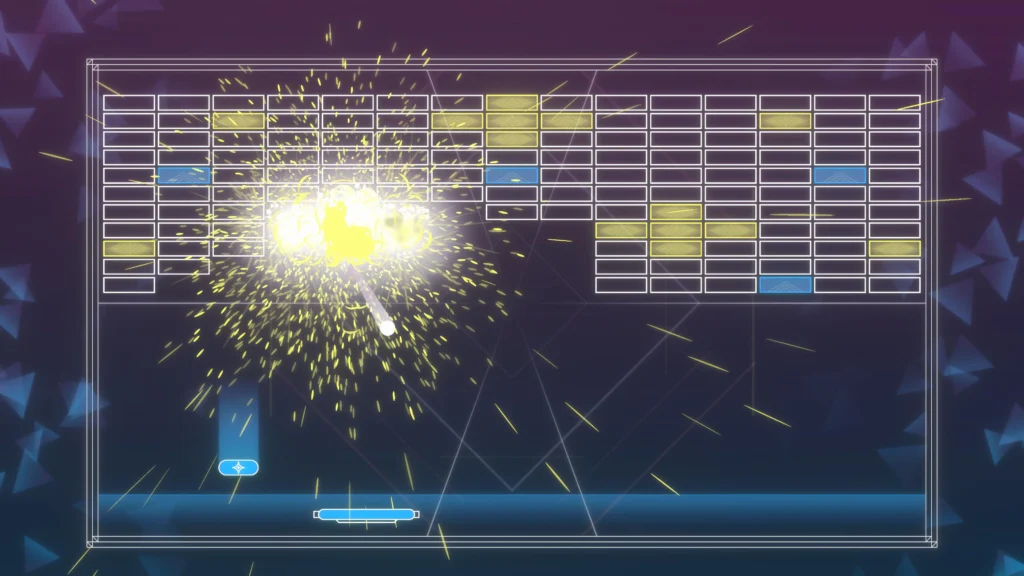
This evening, I have been playing some of the Atari Recharged games, which fit the bill perfectly for this sort of thing. I've had lovely boxed versions of these on my shelves for ages, but still haven't yet got around to exploring all of them fully. This evening, I have been playing Asteroids Recharged and Breakout Recharged, and they have very much been having the desired effect.
For the unfamiliar, the Atari Recharged games are modern reimaginings of classic Atari arcade games. The ones I have played all have the same structure: they have an infinite "arcade" mode, where you simply play to survive as long as possible and attain a high score, and a "challenge" mode, which consists of a large number of predefined, standalone, self-contained levels, each of which challenges you to accomplish a particular objective, often under difficult circumstances.
Both of these are excellent for calming the storm of a turbulent mind, as both function as I describe above: they demand concentration and focus without having to engage the part of your brain that deals with pesky things like words, subtext, narrative themes and characterisation, and they allow you to quickly and easily try again if you mess up. And you will mess up a lot more than you win — particularly in the arcade mode, where there is literally no way to win other than beating your own high scores, or those of people you have set your sights on from the online leaderboards.
In a way, they are "mindless", but I don't mean that in a denigratory way. There's something primal and instinctual that happens to you when you play games like this, and it leaves no room for abstract emotions. You'll feel enjoyment, satisfaction, frustration and even anger, but allow yourself to become one with the experience and you will, at least for an hour or two, forget about those feelings of great uncertainty and emotional turmoil.
It is important to give yourself an escape hatch; a lifeline. When your brain decides to put your life on pause, it often isn't healthy. It might cause you to not take as good care of yourself as you should. You might not eat properly. You might find yourself pushing away people who want to help — or at the very least want you to open up about what's wrong. It can be easy to immerse yourself in those feelings of great uncertainty and emotional turmoil; an all-encompassing, opaque black bubble of misery from which it can be very difficult to escape if you allow it to form completely.
So take those moments, as little and fleeting as they might be, and step out of that darkness for a moment. It's not a betrayal of the things you are upset about; it is allowing yourself a moment's peace, preventing you from being consumed completely, and perhaps giving you the strength to be able to pull yourself out of the mire, little by little.
Want to read my thoughts on various video games, visual novels and other popular culture things? Stop by MoeGamer.net, my site for all things fun where I am generally a lot more cheerful. And if you fancy watching some vids on classic games, drop by my YouTube channel.
If you want this nonsense in your inbox every day, please feel free to subscribe via email. Your email address won't be used for anything else.
Hello. I am Pete, and I love the Atari 8-bit range of computers. You probably knew that already, but I wanted to talk about it a bit today.
By Evan-Amos – Own work, CC BY-SA 3.0, https://commons.wikimedia.org/w/index.php?curid=18553927
I think I'm probably going to make a video along these lines sometime soon — although my prior video on the announcement of The400 Mini a while back covers a lot of the points I'd want to cover — but it's on my mind today, so that's what we're talking about today.
One of the reasons I want to talk about Atari 8-bit computers is because I don't feel they get nearly enough respect. No, they were by no means as popular as the Commodore 64 and Spectrum — the former of which is the subject of a cover feature in Retro Gamer magazine this month — but I also feel like they had a significantly stronger foothold in the market than other "failed" micros from the era. Not only that, but they are historically very significant for a number of reasons, some of which I'll try and outline today.
This is going to be a bit of a stream-of-consciousness sort of probably autistic infodump, because I'm just banging this out as I feel like it. If and when I do decide to make a video about all this, there will probably be a bit more structure, research, that sort of thing. Like I say, this was just rattling around in my head today, though, so I wanted to at least get some thoughts down on paper. So here it is.
For the unfamiliar, the Atari 8-bit range consists of several models:
The Atari 400, which released in 1978, and initially features 8 kilobytes of RAM, though later revisions bumped this up a bit. This was marketed in some areas as a games machine, as it was the cheaper of the two models to release in 1978, had four joystick ports and sported a flat, supposedly spill-proof membrane keyboard to make it suitable for "family" use.
The Atari 800, which released alongside the 400 in 1978, and was positioned as a more "serious" machine. It had a "normal" keyboard, user-upgradable RAM (up to a maximum of 48 kilobytes) and two cartridge slots instead of one (though there were very few releases that took advantage of this) — and it cost considerably more.
The Atari 1200XL was the first step in a refresh of the Atari 8-bit line in 1983, intended to replace the 800. It came with 64 kilobytes of RAM, a completely redesigned case, built-in self-test features and a rather nice keyboard. It was also much too expensive and had a number of issues, causing Atari to pull it from sale before long, and to not release it in PAL territories at all.
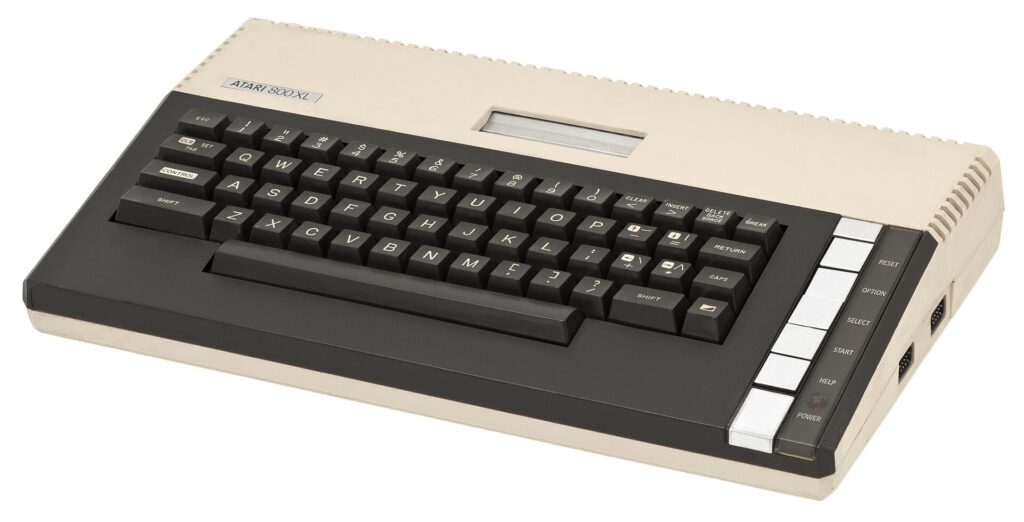
The Atari 800XL (pictured above) was a do-over of the 1200XL project. It also had 64 kilobytes of RAM, the newly designed case (now not quite so deep), built-in self-test features and lovely keyboard, but also added built-in BASIC to the mix along with revisions to the operating system. It was Atari's best-selling 8-bit home computer.
The Atari 600XL was a cost-reduced version of the 800XL, which had an even slimmer case and only 16 kilobytes of RAM. With the 800XL replacing the 800, this was effectively the replacement for the 400, but it did not sell very well compared to its big brother.
The Atari 130XE was launched in 1985, after Jack Tramiel took over Atari, and was designed to look like a "little brother" to the 16-bit Atari ST. It featured 128 kilobytes of RAM, new revisions of the operating system and BASIC and a new case design, but otherwise didn't bring anything significantly new to the table. It is a nice machine, though, and my Atari 8-bit of choice.
The Atari 65XE was essentially identical to the 130XE, only with 64 kilobytes of RAM instead of 128.
The Atari XEGS was a 65XE in a console-style case with a detachable keyboard. It was positioned primarily as a games console, even more explicitly than the 400 back in 1978, but was a fully functional computer that would work with all Atari 8-bit peripherals.
Broadly speaking, these models are all cross-compatible with one another, aside from obvious exceptions such as programs that need a particular amount of RAM to run properly. There are a few compatibility issues between very early pieces of software that were designed for the 400 and 800 and the later XL/XE models, but these can usually be got around by using a "translator" program to temporarily load in an older version of the operating system, and the Atari community at large has also been hard at work patching many games to work universally on all Atari 8-bit systems.
Like most other 8-bit computers, the Atari 8-bit had three means of loading software: ROM cartridge, cassette tape or 5.25" floppy disk. ROM cartridges are incredibly simple: plug them in, turn on the machine and the software is there, ready to go. These were primarily used for games, particularly in the early days of the platform, but there are some pieces of utility or productivity software that run from cartridge, too. Notably, using a cartridge effectively allows the ROM within to "extend" the Atari's capabilities; a good example of this is the SpartaDOS X package, which adds an MS-DOS style command line for manipulating files on floppy disks.
Cassette tapes were certainly used by Atari enthusiasts, but not to the same extent as on the Commodore 64 and ZX Spectrum. The reason for this is that the tape loading system in the Atari 8-bit was significantly slower than on its main rivals, resulting in load times of half an hour or more for games that would take just a few minutes on other platforms. That said, the Atari 8-bit could make innovative use of the tape medium by playing back audio during a program — a good example of this is the Conversational Language series of packages, which teach French, German, Italian and Spanish through interactive lessons, with recorded speech coming straight off the tape and being played back through the TV speakers at the appropriate moments.
By Bilby – CC BY 3.0, https://commons.wikimedia.org/w/index.php?curid=48108881
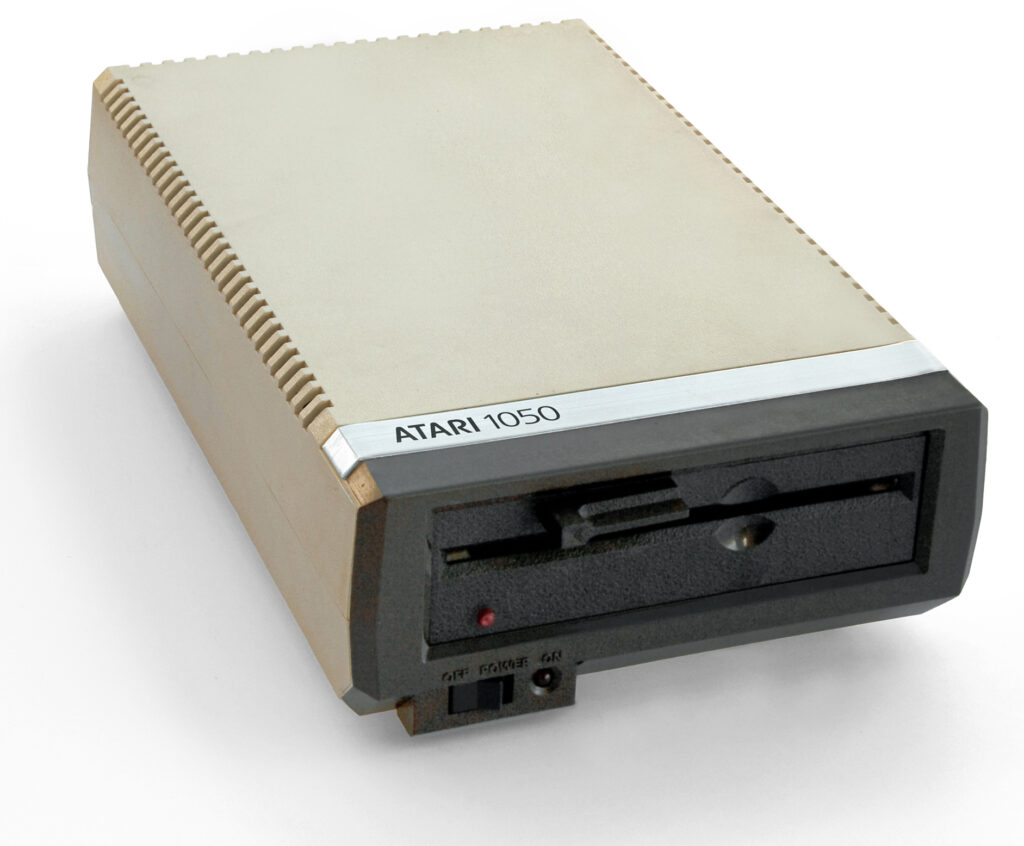
Instead, disk drive use was very popular. There were two main disk drives in the prime of the Atari 8-bit's lifespan: the original Atari 810, which followed the design language of the 400 and 800, and the Atari 1050, which was designed to fit in alongside a 600XL or 800XL setup. There was an even later XF551 drive, but this didn't really catch on for various reasons, and these drives are a lot harder to find today.
You connected a tape deck or disk drive to the Atari via its proprietary Serial Input/Output (SIO) port, and this brings us to one of the most historically significant things about the range: SIO was designed as a universal connector for all manner of different peripherals, not just media storage devices. Sound familiar? That's right; it's very much a precursor to modern USB; Joe Decuir, who created this architecture, holds patents on USB.
SIO had a few differences to modern USB, most notably the fact that devices could be daisy-chained together. This means that even though the system only had one SIO port, you could connect multiple devices simply by linking them together. Obviously this was dependent on the device in question having a suitable port — and not every device did — but in theory you could keep on linking as required, making it easy to have, for example, setups that used multiple disk drives, and even cassette and disk simultaneously if you so desired.
Using a disk drive with the Atari 8-bits required one extra step: the use of a Disk Operating System, or DOS. Atari made its own DOS that underwent several revisions over the lifespan of the Atari 8-bit models, and although closed source and distributed under a proprietary license agreement, it could be redistributed. Good job, too, because in order to actually boot something from disk, DOS needed to be loaded first. If you wanted to be able to save BASIC programs to disk, you also needed to boot DOS from disk before starting to write your program.
The most commonly seen versions of Atari's DOS from back in the day used a menu-driven interface that allowed various disk functions such as copying and deleting files as well as locking/protecting them, loading executable files that were not set up to automatically boot when turning the computer on, formatting disks and creating new DOS disks.
Programming on the Atari used, like most of its contemporaries, a dialect of BASIC. Unlike many other BASICs at the time, it is not a version of the popular Microsoft BASIC (although this was available) and thus had a number of its own unique Atari-specific commands. Carrying out many functions, particularly relating to graphics, that would require POKEs on other platforms could be done with dedicated commands on the Atari, but conversely Atari BASIC lacked the ability to create arrays in string variables. It was, on the whole, a well-liked language, and the two main Atari magazines of the era, Page 6 and Atari User (which later merged to become New Atari User), typically printed type-in listings for all manner of programs in every issue. Not just games, either; both magazines were keen to position the Atari computers as capable, multi-function devices that were far more than just sources of entertainment.
Other programming languages were, of course, available. Those keen to get their hands dirty could write programs using 6502 assembler, while as the years went by, speedy languages such as Action! and Turbo BASIC XL came along and offered compelling alternatives to the built-in or cartridge-based BASIC that was, for many, the foundation of programming on the Atari range. These languages could be compiled into executable binaries, too, meaning that an end user would not need a copy of the language to run a program written in it.
The Atari's audio-visual capabilities were very solid. The dual ANTIC and GTIA graphics chips offered hardware scrolling, built-in "player-missile" sprites, and a wealth of different graphics modes allowing various balances between memory usage, resolution and colour depth. The POKEY chip offered four-channel audio with a good amount of customisation — although not quite as flexible as the SID chip found in the Commodore 64. It also handled a lot of the Atari 8-bit's input/output, meaning the system has the charming feature of making blippity bloop sounds when loading and saving from/to disk or tape rather than the horrific screeching heard on other platforms.
And then we come to the games. While some of the high-profile software houses — notably outfits like Ocean, Imagine, Ultimate and suchlike — refused to support the Atari 8-bit, others, like Electronic Arts and Activision, did, at least in the early days, and the budget companies like Mastertronic, Atlantis, Zeppelin and Alternative had a good presence on the platform, too. The end result of this from a 2026 perspective is that the Atari 8-bit library is largely unique, with many titles not being found on any other platforms — and in the case of multiplatform affairs, the Atari release often being a particularly good version. (There are exceptions, of course; the Atari 8-bit versions of Action Biker and The Last V8 are woeful compared to the C64 releases.)
There's also the fact that a lot of games which went on to worldwide success on a variety of platforms often originated on Atari 8-bit. All-time classics like Boulder Dash, M.U.L.E., Miner 2049'er and Spelunker debuted on Atari before spreading to other platforms, and esteemed creators like Archer Maclean were really able to make the system sing with games like Dropzone.
The only thing the library is lacking compared to its more successful 8-bit counterparts is a library of solid arcade conversions from the years following the initial early '80s "golden age"; those early '80s titles are well-covered, however, with excellent versions of Pac-Man, Dig Dug, Pole Position, Qix and plenty more — and a wealth of "unofficial" clones, too.
So why doesn't this system get anywhere near the love and attention that the Commodore 64 and ZX Spectrum do? I honestly don't really know, because although the platform undoubtedly sold considerably less than both of its main rivals, I don't think one can in any respect call it a "failure". Its longest-lasting magazine published its final issue in 1998, for heaven's sake — and said magazine was including material for the Atari 8-bit right up until that very final issue. Not only that, the modern "homebrew" scene is incredibly active and vibrant to this day, with some truly amazing new games being released for the platform on a regular basis, along with some excellent ports of C64 and Spectrum games that never made it to Atari back in the day.
I would love to see the Atari 8-bit get more acknowledgement. There are some YouTubers who do give it its dues — Kim Justice is a good example — but I do wish the field of "gaming history" would, more broadly, pay attention to the Atari 8-bit: a platform that still has a lot to offer, which is a hell of a lot of fun to have been involved with since its original inception, and which is dead easy to explore today with solutions like Altirra for software emulation, and the excellent Atari800 core for MiSTer if you're an FPGA person.
Still, that's a big reason my YouTube channel exists. So I will continue to champion the system how I can — and at least then I know that I have done my part in remembering this wonderful platform and the many amazing journeys it has taken me on over the years.
Want to read my thoughts on various video games, visual novels and other popular culture things? Stop by MoeGamer.net, my site for all things fun where I am generally a lot more cheerful. And if you fancy watching some vids on classic games, drop by my YouTube channel.
If you want this nonsense in your inbox every day, please feel free to subscribe via email. Your email address won't be used for anything else.
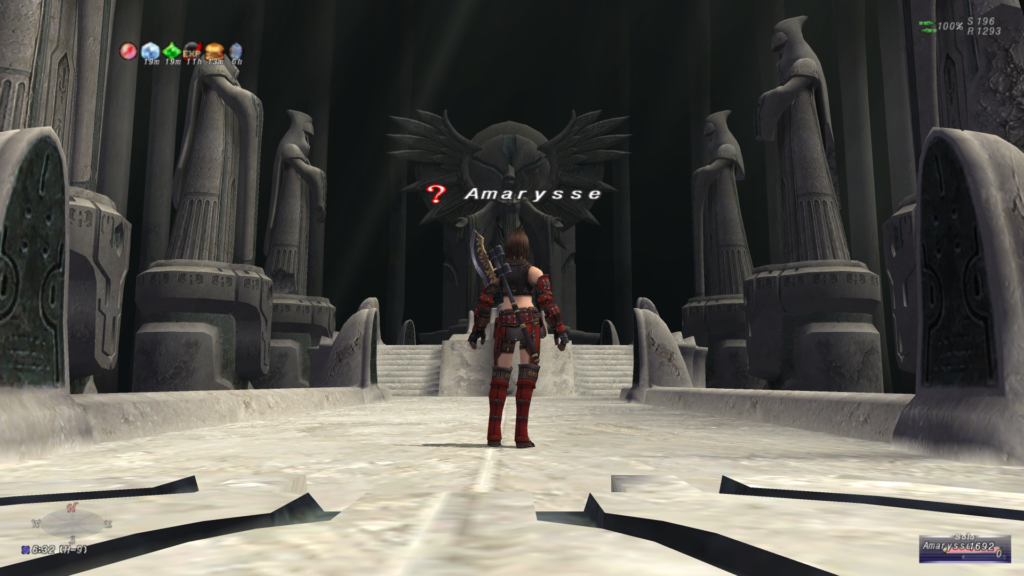
I have finally beaten both Final Fantasy XI's base story and its first expansion, Rise of the Zilart, which was released alongside the game when it first came west. This means that I have, at last, beaten the entirety of what most people seem to regard as "the original Final Fantasy XI story", since most folks seem to consider Rise of the Zilart the actual conclusion to the story that begins when you start playing the game.
It's been a lot of fun thus far. I'm about 80 hours deep into the game, and I haven't really felt particularly "roadblocked" at any point. There have been two separate occasions where I have had help from higher-level players — once to open the "Three Mage Gate" I mentioned a few posts back, and once to help me with the fight against Siren as part of the Rhapsodies of Vana'diel series of missions that run parallel to all the main stories — but for the most part, I have successfully beaten and bashed my way through the game as a solo player using the computer-controlled "Trust" party members.
I thought I had reached a roadblock towards the end of the Rise of the Zilart storyline where you are presented with a chain of five difficult boss battles, and I was having real difficulty with a couple of them. As I'm playing a Warrior, I have been working on the assumption that I should be the main "tank", you see, and thus trying my best to ensure all enemies fixate their attention on my while my Trusts repeatedly punch them in the buttocks. This is, after all, the way things are in Final Fantasy XIV, even though mechanically the two games are otherwise quite different.
However, what I discovered in these difficult fights (the "Ark Angels" fights, to any FFXI veterans) is that being the sole human player and the main tank is not always desirable. Y'see, some high-level enemies have the ability to Charm you, and when that happens all your Trusts get unsummoned and the fight effectively resets. It's an instant "kill", in other words, and I really thought this was going to roadblock me.
Then I thought about things a bit, and wondered what might happen if I let one of the Trusts handle the tanking instead. Wouldn't you know it, those fights suddenly went much more smoothly. I could keep dealing damage — which, besides tanking, is the other thing FFXI Warrior is good at — while Trust-y Valaineral the Paladin took the brunt of everything the boss threw at a single target, including that pesky Charm. And, because I also had Kupipi the White Mage and King Of Hearts the Red Mage in my party, they cleansed that status off him pretty quickly. I only really came close to failing in one of the fights, where everyone got Silenced and Valaineral got knocked down because no-one could heal him. Thankfully, this happened late enough in the fight that the remaining party members, including me, were able to finish the job.
By contrast, the actual final boss of Rise of the Zilart was very easy indeed. Granted, I was probably a few levels higher than "intended" for this encounter — Final Fantasy XI isn't particularly rigorous about locking stuff to particular level restrictions, particularly in the main story sequences — but it was still pretty straightforward. Fun, though; it was satisfying to finally bring down a "big bad" who had been taunting me for some time.
Now I'm on to the Chains of Promathia expansion, which a lot of longtime players seem to think is one of the best bits. It makes the curious decision to base the early hours of its story around the level 30 mark, rather than assuming you would be at the level you're probably at around the conclusion of Rise of the Zilart — 75+ — but I assume that things ramp up pretty quickly, as the official "content guide" on the Final Fantasy XI website recommends the expansion as an activity for level 75+ players.
I'm really glad I've done this! I'm going to write a big, detailed article about my experiences over on MoeGamer when I'm finally done with everything I want to do in the game, but for now, my feelings are that, in terms of gameplay, progression and a general sense of adventure, this is actually one of the very best Final Fantasy games. Yes, it is the very epitome of a "guide dang-it" game, in which you will almost certainly not get very far without looking some stuff up, but the moment-to-moment gameplay, the overall sense of progression and the fact that it feels like a Final Fantasy game, arguably a lot more so than XIV, has really left me with a big grin on my face. I'm looking forward to seeing what the rest of the game has to offer.
I have played pretty much all day, though, so I should probably stop for now, though, right? Probably…
Want to read my thoughts on various video games, visual novels and other popular culture things? Stop by MoeGamer.net, my site for all things fun where I am generally a lot more cheerful. And if you fancy watching some vids on classic games, drop by my YouTube channel.
If you want this nonsense in your inbox every day, please feel free to subscribe via email. Your email address won't be used for anything else.