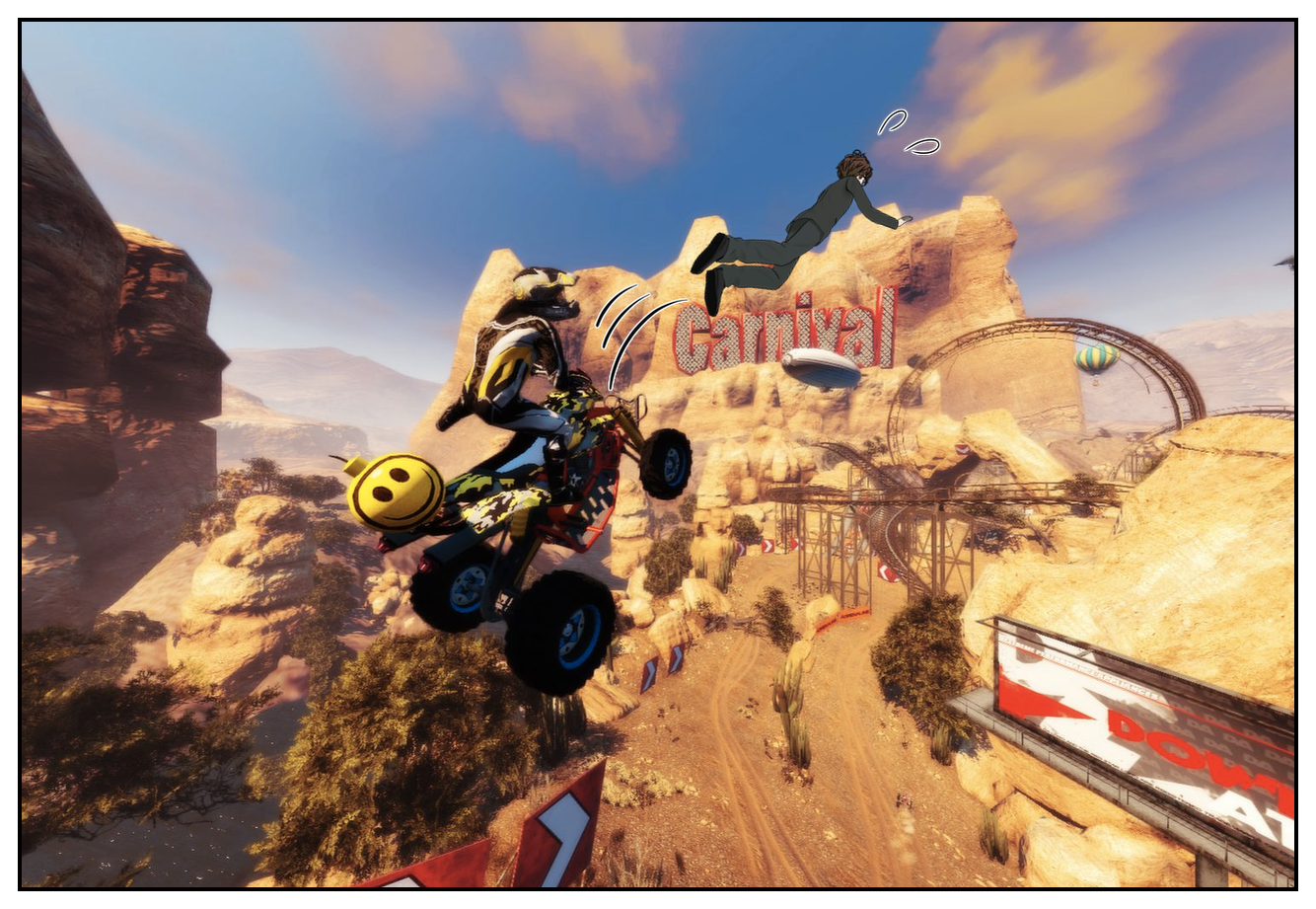
I am a fan of what I described to my friend Alex yesterday as "the vulgar side of racing games". This is a pretentious way of saying that I'm a fan of arcade racers more than more realistic fare, but it kind of goes a little deeper than that: I'm a fan of racing games that firmly put an emphasis on fun and spectacle as opposed to providing a faintly plausible virtual driving experience.
Codemasters' Dirt Showdown, which I picked up in the Steam Halloween sale, pushes all of my buttons in this regard.
Dirt Showdown is the very essence of vulgar racing. It's loud, it's brash, it's very American (despite the Codies being British), it's full of scrappy-looking cars that you'd expect to find burnt out in a council estate in Croydon… and it's a ton of fun.
A lot of Dirt Showdown's fun factor comes from its hyperactive nature — and this is true both within single events, all of which are chaotic and specifically set up to encourage full-contact racing, and within the game structure as a whole. The single-player campaign sees you flip-flopping from one discipline to another — one minute you'll be racing, the next you'll be smashing your way around a course made up of barriers, the one after that you'll be trying to knock all of your opponents off a raised platform — and multiplayer is much the same, with the added chaos of some rather "sport-like" competitive games modelled on Capture the Flag and Halo's Oddball mode.
You're never stuck doing the same thing for very long, in other words, and this is what keeps the game interesting. Of course, there's nothing stopping you setting the multiplayer mode to do nothing but races, but where's the fun in that? The beauty of Dirt Showdown is that it encourages you to master flinging your car around with a variety of different goals in mind, be it dispatching opponents as quickly as possible, or simply beating them to the finish line.
The big appeal element in Dirt Showdown for me, though, is the fact that it's an honest-to-goodness arcade racer. This is not a game intended to be taken seriously or be regarded as a sim; it's not a game where you can admire lovingly detailed cockpit views; it's a game about taking a hunk of junk (or, indeed, a few licensed rally cars) and then hurling it at a bunch of other hunks of junk and seeing who comes out on top. It's a game about tapping the handbrake rather than using the actual brake to go around corners; it's a game that features races specifically designed to encourage pileups. I approve of all of this.
Plus it's super-cheap in the currently running Steam sale. So if you haven't given it a shot yet — assuming you're a racing game person — be sure to check it out.
I find the evolution of British developer-publisher Codemasters rather interesting, since they've been part of my life since I was very young, and they've changed significantly over the years.
When I was a kid, Codemasters was a label primarily associated with budget-price games for 8- and 16-bit computers. Their games were typically released on a wide variety of platforms ranging from the ZX Spectrum to the Commodore Amiga and everything in between, and development of these games was such that every platform had a decent version of their games within the limitations of its respective hardware. It was quite an impressive achievement, when you think about it, especially considering the sheer number of different platforms that were around between the '80s and '90s.
Old-school Codemasters' most well-known franchise was probably the Dizzy series. Vaguely positioned as a home computer alternative to the fashionable "mascot platformers" of the consoles — stuff like mainstays Mario and Sonic as well as third-party attempts like Bubsy and Cool Spot — the Dizzy games were actually rather interesting in that they weren't so much platform action games a la Mario and Sonic, but instead were more akin to adventure games. You explored a 2D side-scrolling open world, you probably wanted to make a map, you collected items to put into your inventory, you used said items to make things happen and solve puzzles.
Each Dizzy game was essentially the same structurally, but they differed in setting, and this often made a surprisingly large difference to the overall "feel" of the games. Compare Treasure Island Dizzy, which unfolded on a tropical island, to Fantasy World Dizzy, which took place in a world that stretched from the ground to the clouds. Despite having the same basic mechanics, both were very distinctive from one another, and well worth playing.
I'm not sure when it was that Codemasters shifted from a budget label to their present position, but it's gratifying to see what a huge success they've made of themselves in the last few years in particular. Not through modernising Dizzy, though; instead, the Codemasters of today is a very specialist publisher, focusing entirely on racing games of various descriptions.
And it's been a huge benefit to them to focus on this one, single genre of game that they've ended up being rather good at. Much like the different Dizzy games shared mechanics but had a unique look and feel to them, the various series that Codemasters offer today all have similar structures and mechanics, but unique feels to them. Compare the rally-centric Dirt series with the disparate disciplines of the GRID series, for example — or even the destructive chaos of Dirt Showdown to the rather more disciplined but still fun Dirt 3.
An awful lot of developers and publishers these days try to have a broad portfolio and appeal to lots of different people. But, to my mind, Codemasters have the right idea: find what you're good at, then focus exclusively on that. That's how you build up a loyal fanbase who will almost certainly purchase pretty much anything you put out — and how you become recognised as industry leaders in your specialist field.
Now, about applying the same philosophy to the games press…
I finally got around to firing up Senran Kagura 2: Deep Crimson today and so far I'm already very impressed — both with how it's a significant improvement on the 3DS original game, and how it's a markedly different experience to both its Nintendo-based predecessor and its Vita-based spinoff Senran Kagura Shinovi Versus.
For the uninitiated, Senran Kagura is a series involving two rival ninja schools, one of "good" shinobi and the other of "evil" shinobi. The Versus spinoff series introduces two additional groups into the mix, each with their own narrative, but the mainline series focuses on the conflict — and, at times, cooperation — between the Hebijo and Hanzou academies, and their respective elite classes.
Senran Kagura tells its stories via several forms of media within the game itself: narration-heavy visual novel sequences delivered from a first-person perspective by one of the characters, allowing us insight into how that particular character thinks, feels and responds to the situations in the narrative; more "game-like" talking head sequences between characters, involving animated, very expressive character models; and dialogue during gameplay itself. The series is noteworthy for its depth of characterisation, relatable casts and total lack of shame when it comes to discussing everything from the philosophy of "good" and "evil" to sexuality.
The first Senran Kagura game we saw in the West — actually a compilation of the first Japanese Senran Kagura game and its follow-up, which made the original "villains" of Hebijo playable and provided them with their own story — played out like a modern version of Streets of Rage. Unfolding from a side-on 2.5D perspective, you (usually) ran from right to left, beating up everyone who got in your way until a big flashing "GO" sign appeared indicating you should move onto the next area and repeat the process. Many levels concluded with a boss fight against one of the shinobi from the opposing school, and there was a bizarre final boss fight that kind of saw Shit Get Real just before the credits rolled.
Senran Kagura Shinovi Versus, meanwhile, eschewed its predecessor's 2.5D nature in favour of something more akin to a scaled-down Dynasty Warriors. Battles now unfolded in full 3D arenas, though the basic structure of the game remained the same — fight enemy group, proceed to next area and/or wave of enemies, fight boss, win. The shift to 3D gave the game quite a different feel, but the combat was tight and responsive, and every character felt very different.
Senran Kagura 2 shifts the style of play once again, blending elements of the original game and Shinovi Versus to create something that — so far, anyway — seems to be a lot of fun. Rather than providing the full freedom of a 3D arena, Senran Kagura 2 instead unfolds from fixed camera angles, mostly presenting a vaguely side-on view, but with considerably more depth than the first game. The game actually makes very good use of the 3DS' stereosopic 3D visuals to allow you to judge depth, range and distance, and, given the 3DS' lack of a right stick to control the camera, this more "controlled" perspective on the action makes a lot of sense.
I've only played a few of the introductory levels so far, but already the game feels a lot more challenging than its predecessor, too; while button mashing will get you through trash enemies reasonably reliably, bosses no longer respond to such simple tactics, instead demanding that you position yourself carefully, wait for a suitable opening and then use an appropriate attack to get within range without putting yourself in danger. I can see the Super-Secret Ninja Arts being Super-Secret Ninja Useful too, since these are often a good means of throwing an enemy off balance as much as dealing significant amounts of damage to them.
I'm pretty excited about the new structure of the game, too; as well as the main story, Senran Kagura 2 features a couple of additional modes. Youma's Nest sees you working your way through a "pyramid" of challenge levels and attempting to complete as many of these as possible without healing in order to earn rewards; Special Missions, meanwhile, allow you to earn new equipment for your shinobi as well as presenting you with challenges under various conditions.
There seems to be a whole lot more variety to the experience, and lots of things to unlock. I'm excited to get stuck in, because I both enjoy the Senran Kagura games as old-school brawlers, and enjoy spending time in the company of these lovely characters, too.
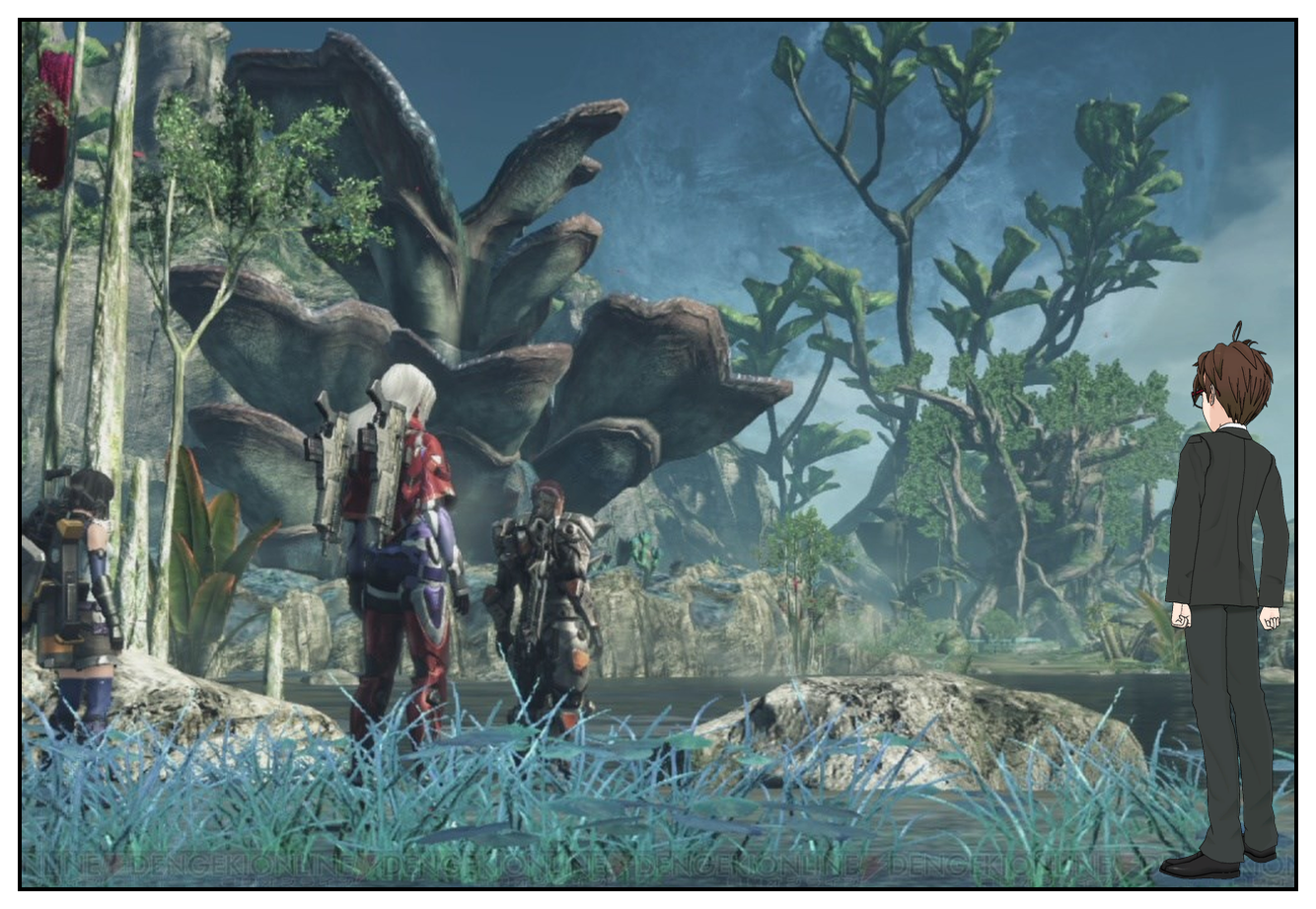
One of the most common complaints I've read about Xenoblade Chronicles X recently is that "the story isn't as good as Xenoblade Chronicles". And, if you look at it in a somewhat superficial manner, that's true to an extent; it suffers a little from the open-world RPG's perennial problem that is putting Important Things on hold while you go and pick flowers or whatever.
You may feel this way until you get your head into the mindset of Xenoblade Chronicles X. It's not a typical JRPG with a fast-paced, completely linear storyline that you can then break completely when the game opens up towards the end. With a few exceptions — most notably the giant mech "Skells" and, later, the ability to fly in them — much of the game is open to you from the very outset, and the whole game is designed around the concept of "what would happen if you (and the rest of humanity's survivors) were stranded on an alien planet with no hope of getting away any time soon?"
In that sense, Xenoblade Chronicles X's narrative — and the way it is told — starts to make a whole lot more sense. The story isn't just about the "story quests" and the cutscenes they incorporate; there's only twelve chapters to the main story, after all. Instead, the complete Xenoblade Chronicles X narrative consists of a blend of all the game's elements: your freeform career as a BLADE operative and the emergent narrative that comes from your adventures in the field; the simple, short stories that come from the Normal Missions and give context to many of the NPCs in the world — and, in many cases, have significant impacts on the world as a whole; the more in-depth, character-centric stories of the Affinity Missions — which also have cutscenes and are fully voiced, unlike the Normal Missions; the conversations you overhear from NPCs you meet in town and in the field; the implied, non-explicit narrative you can deduce from the scenery of the world; and, finally, the "main" story itself.
I mentioned at the beginning the open world RPG's curse of the party putting saving the world (or equivalent activities) on hold while they went to pick flowers, but in fact Xenoblade Chronicles X has been designed with that very criticism in mind. It's strongly implied that a fair amount of time passes between each of the story missions, since there are numerous references to time-consuming things happening "off-screen" throughout. Rather than simply asking you to accept that several days/weeks/months have passed, however, it's more than likely that, unless you're taking a "critical path" approach to racing through the storyline as fast as you can, a significant amount of time probably will have passed between each of the story missions. And it's in those "in between" moments that Xenoblade Chronicles X has some of its most interesting moments.
The aforementioned Normal Missions, for example. While these may appear to have had less attention lavished on them than the cutscene-heavy Affinity and Story Missions, in actual fact they tend to have more noticeable impacts on the world as a whole. As a result of Normal Missions and your choices therein, characters move around and live or die; buildings are built or destroyed; relationships between characters change; and, in the most drastic example of things changing as a result of your actions, new alien races move into the human city of New Los Angeles, meaning that you can then see them wandering around the streets as random crowd NPCs, talking to named members of their species and even accepting missions from them. As you play through the game, your understanding of Mira — and the wider universe outside the planet — begins to grow, as you get a feel for who the Ma-non, Zaruboggan, Prone and numerous others are, and, more importantly, how they feel about both one another and humanity.
The complete picture you build up in your mind as you play is one of the most comprehensively detailed pieces of worldbuilding I've seen for a very long time. It brings to mind the whole idea of "extended universes" for things like Star Trek and Star Wars, only in this instance, the "extended" universe is right there in the game for you to discover if you see fit. There's no obligation to do most of this stuff — though some story missions have prerequisite Affinity or other missions before you can proceed — but doing so makes the game several orders of magnitude more rewarding, as it starts to tell its story in all manner of different ways rather than simply through cutscenes.
As the year draws to a close, there's no doubt in my mind that Xenoblade Chronicles X is absolutely my "game of the year". It's full of all the things that I love, and, while its way of doing things may not to be everyone's taste — particularly the complexity of its systems and the subtleties in its storytelling — I feel pretty confident in saying that it's a landmark game that deserves to be counted among the greats of not just the RPG style of game, nor just the sci-fi genre of narrative games, but of gaming as a whole.
Super Smash Bros. really has become something rather marvellous: a kind of interactive "museum" of gaming, wrapped in an incredibly accessible but surprisingly deep fighting game shell.
I mention this because I grabbed the new Cloud Strife DLC for the game earlier and have spent a bit of time getting to know the new character. I like him a great deal; his moveset makes me very happy indeed, consisting almost entirely of Cloud's iconic Limit Break moves from Final Fantasy VII, and he's also a character I feel reasonably confident about how to use.
I've had mixed feeling about Super Smash Bros. over the years, partly because I've never been that good at it, and I have a friend who is very good at it, meaning it's not always 100% fun to play it with other people. Ultimately, though, I'm pretty sure I've come down on the side of liking it, because it really is a game like no other: the combination of characters, backdrops, music and sly references to all manner of games, both new and old, is absolutely delightful, and the complete antithesis to the homogeneous nature of most triple-A games.
It's also a damn good fighting game. A few weeks ago, out of curiosity, I read the beginning of an e-book about how to git gud at fighting games, since I've never really got my head around them. The book recommended learning to play using Street Fighter II, since that is the foundation on which most modern fighting games are built, but I was very surprised to discover that much of the advice contained therein very much applied to Super Smash Bros. I could feel myself playing better immediately after reading the book; it was the most obvious example of learning something new and then immediately putting it into practice that I've felt for a long time.
There are, of course, all manner of questions over whether Super Smash Bros. is balanced, whether it's "casual" and whether it's a "fighting game" by the traditional definition at all, since it's so different to your average one-on-one fighter such as the Street Fighter series. But its accessibility — no complicated button commands to learn here, allowing you to focus on using the moves effectively rather than struggling to use them at all — is its best feature, allowing rookie fighting game players to jump in and go toe-to-toe reasonably confidently against veterans. Sure, they'll almost certainly get obliterated — since despite how chaotic Super Smash Bros. looks for the most part, it's a very technical game that is almost frightening to watch high-level play of — but, unlike many other fighting games, it probably won't be for lack of knowledge of the mechanics. No special meters, no indecipherable jargon; all you really need to know is that you need to smack your opponents around a bit to increase their damage gauge, and the higher their damage gauge is, the further they'll fly when you whack 'em with a Smash move, with your ultimate aim being to knock or lure them off any side of the level.
I don't know if I'll ever be any good at Smash Bros., particularly compared to people who really know what they're doing with their favourite characters, but it's a fun time, and probably the fighting game series I've had the most fun with over the years.
But anyway. My original thinking that prompted this post was looking at the character select screen for my copy of Super Smash Bros., which includes the base game plus the DLC for Ryu and Cloud Strife, from Street Fighter and Final Fantasy VII respectively. Super Smash Bros. already has an incredibly diverse roster that draws from series ranging from Super Mario to Metroid via Star Fox and F-Zero, but the really interesting thing that started to happen in the last few installments is the addition of third-party, non-Nintendo characters, beginning with Solid Snake from the Metal Gear games a while back, and in the newer Wii U version, everything from Pac-Man to the aforementioned Ryu and Cloud.
Back when I was a kid playing Super Mario World on my Super NES at home, I would never have predicted that one day I'd be playing a game in which Mario, Sonic, Pac-Man, Cloud Strife, Ryu and the fucking dog from Duck Hunt all feature; it's kind of mind-blowing when you think about it, particularly if the horrible names Sega and Nintendo fans — including the press! — used to call each other are still fresh in your memory!
I spent a bit of time before my shift at work today playing Splatoon. Having finished the single player, I jumped back in to the multiplayer for a few games, and was reminded quite how much I like that game — a fact that surprised me somewhat when I first played it, given that I'm not normally one for competitive multiplayer shooters, team-based or otherwise.
Splatoon is a bit different from your usual multiplayer shooter, though, in that there are no game modes that require you to kill the other team. Instead, most of them are about territory control of various types: the basic "Turf War" game mode, for example, involves covering the ground with ink of your team's colour, with the winner being decided by majority coverage after three minutes. Other game modes found in the Ranked Battle mode vary somewhat in what they require you to do, but none of them are straight-up deathmatches, which means there's no necessity to be a 1337 MLG noscope pro.
Splatoon is testament to Nintendo's desire to make games accessible to everyone. Competitive multiplayer shooters are historically rather elitist in nature, with inexperienced players often being mercilessly mocked or picked on until they "git gud". Unpleasantness in chat — be it voice or text — is so expected that it's become something of a cliché to talk about racist thirteen-year olds playing Call of Duty; consequently there are many people — myself included — who, preferring their games to be fun rather than an unpleasant experience, avoid this type of thing and thus tend to miss out on games that, despite everything, are often quite culturally significant, not necessarily from an artistic perspective, but as an activity that brings significant numbers of people together.
Splatoon could have easily been a disastrous failure, being a Wii U game. Yet it has gone on to become one of Nintendo's biggest success stories all around the globe, with it rarely being difficult to find people to play with, whatever hour of the day you happen to be online. I was expecting it to be hard to get a full group together when I played this morning, for example, but was pleasantly surprised to be matched with a full team almost immediately — since Japan was awake and happily playing away already.
The other nice thing about Splatoon is that it doesn't have a chat function. Like, at all. This drew some criticism on its initial release, since it's sort of an expected feature in your typical multiplayer games these days, but in Splatoon's case it really isn't necessary or desirable. The GamePad screen allows you a tactical overview of the entire battlefield and what your team is up to, and simple controls allow you to send messages of support or requests for assistance to your teammates without having to speak. By taking away the chat facility, the ability to abuse one another is also taken away, keeping things family-friendly for everyone and encouraging veteran players to play nice with newbies, since if you're not being a team player you'll just end up dragging your teammates down and, in most cases, throwing the game as a result.
The other thing I particularly appreciate is that games are over quickly. No twenty-minute slugfests here; a single match is just three minutes long, meaning that even if you're stuck with a team of AFKers, you don't have to suffer for too long before things are mixed up and you can try again with some new companions. And since teams are jumbled up before each match, even if the same players stay together, it's rare to see unfair dominance from one side or another.
Above all, Splatoon is just plain fun. It's colourful, it's energetic, it's humorous and it's highly enjoyable — even if you don't typically like multiplayer shooters. I'd highly encourage you to jump on it even if it's not usually your sort of thing — you may just find yourself pleasantly surprised by how much fun you end up having.
I made a difficult decision today: to quit Final Fantasy XIV. Temporarily, at least.
This is a decision I've been mulling over for quite some time, I must admit, since following the initial excitement over the expansion pack Heavensward, the new content that's shown up since was 1) very, very late indeed and 2) not great. The one thing that had kept me clinging on was the good friends I've made while playing it, but I've come to the conclusion that with the state of endgame as it is now, it's just not fun enough to warrant the endless grind.
Before we go any further, I would like to point out that Final Fantasy XIV is still an excellent game, and its storyline through A Realm Reborn and Heavensward is one of the best Final Fantasies I've had the pleasure of playing over the years. Its battle system is great, its graphics are wonderful, its music is without peer and it has numerous memorable setpieces and boss fights that will doubtless stay with me for years afterwards.
The issue comes with endgame — what you do when you get to level 60, have no more experience points to gain, and hit the ceiling of available content. At this point most people do one of two things: level another class, or get on the gear treadmill to equip their "main" class as well as possible, either simply for the satisfaction of doing it, or with a mind to taking on the game's most challenging content such as raids.
The main trouble with Heavensward endgame as it exists today is that it's not all that different from A Realm Reborn's endgame, only with a fraction of the level cap content that A Realm Reborn had by the end of its cycle of patches. This may be an unfair comparison, but given that most people who played through Heavensward spent months or more at level 50 in A Realm Reborn, the shift back to having a very limited selection of meaningful content to play was somewhat jarring — particularly as people raced through Heavensward's main scenario and initial levelling process to 60 way quicker than they beat A Realm Reborn, despite them being comparable in length.
So what do you do in endgame? As previously mentioned, you gear up. This is primarily accomplished by collecting "tomestones" from running dungeons, daily roulettes and a couple of other sources. There's a weekly cap on one of the types of tomestones — the one that gets you some of the best equipment in the game currently — which means that it unavoidably takes several weeks, even months, to put together a complete armour and weaponry set for just one class, let alone multiple.
There are other means of acquiring gear, of course; the newly added Void Ark raid is designed to get people into better gear without grinding for tomestones by allowing them one piece of gear per week of comparable level to an unupgraded Tomestone piece. And The Diadem, the home to the exploration missions, can drop some seriously good equipment, though in that case it's very much left up to random chance.
Part of the problem with Heavensward's endgame right now is that the high-level raid — the most difficult thing in the game, and source of some of the best equipment — just isn't very interesting. A Realm Reborn's The Binding Coil of Bahamut was spectacular: it told its own story, had unique bosses and music, and was extremely rewarding to play through, particularly once its entire saga was completed and gave you an opportunity to fight A Realm Reborn's "true" final boss.
Alexander, the current level 60 raid, meanwhile, suffers for a number of reasons: firstly, its Normal mode incarnation, designed so those who aren't up to the challenges of raiding could enjoy its story, is far too easy and quite dull. And secondly, said story is not interesting at all, building on one of the more ridiculous side stories from A Realm Reborn rather than the world-shaking drama that Coil offered. For many people, clearing Coil wasn't about gear; it was about seeing a cool story through to its conclusion. And while Alexander has a story, it's not a patch on Coil's.
There's also the fact that Normal mode removes that incentive to progress that Coil had. The only way to see Coil's story was to beat Coil, whether you did that when it was fresh, new and extremely difficult, or when it got considerably nerfed (but was still a stiff challenge) months down the line. With Alexander, you can beat its Normal mode rather easily, even if you have no experience with raiding, and by then you've seen its whole story, meaning its Savage incarnation becomes little more than a more difficult version of exactly the same thing.
This is my main problem, but there's a number of other issues that have been bugging me for a little while too. I was really looking forward to the exploration missions, since they sounded like something new and interesting, but they turned out to be glorified Hunts, and Hunts are rubbish, since all they are is 300 people dogpiling a monster designed to be fought by 8 people, closely followed by at least 150 more people whining in /shout about someone "pulling early". Diadem at least limits the chaos to 72 players at once, but there's no "exploration" going on; within hours of it appearing for the first time, people had already figured out the most "efficient" way of getting the best rewards, which involves standing in one place and fighting the same damage sponge enemies over and over again until some slightly stronger damage sponge enemies show up and hopefully drop some slightly better loot. There was a "loot whore" angle to Diadem that showed promise, but in practice, with the way Final Fantasy XIV is designed in terms of stats, it's not really a concept that works within the game's overall framework.
Perhaps the thing I've found most offputting, though, is the changing attitudes of a lot of the playerbase. I recall complimenting Final Fantasy XIV's community when it first launched for being incredibly friendly and helpful to one another, sharing information and tips with newcomers and cooperating to make the virtual world of Eorzea a better place for everyone. Over time, this appears to have dissipated somewhat, to be replaced with a bevy of whiny players who insult you if you don't speedrun a dungeon, and people who constantly run damage parsers in the background just so they can post screenshots on Twitter and bitch about how awful the Bard they just ran Brayflox with was. The unfortunate elitist attitude of a lot of these players drives off newcomers and makes them afraid to make mistakes, which in turn puts people off trying more difficult content, which ultimately only hurts the high-level players, who can often be found in Party Finder bitching about not having anyone to clear Alexander Savage with.
I'm not sure why this shift in attitude happened, or if it's always been there and I just hadn't been aware of it. I know that a lot of Final Fantasy XIV players that I follow on Twitter seem to have changed for the worse, though, preferring to post screenshots of bad parses and arguments in party chat rather than celebrating their victories.
There's part of the trouble, though, I think; there's not that many victories to celebrate for veteran players any more. Even victory over a floor of Alexander Savage feels somewhat hollow, because everyone doing Savage will have already beaten all those bosses in Normal mode. "I beat The Manipulator" doesn't have the same gravitas to it as "I killed Bahamut!", after all.
With the lack of new victories to celebrate, it's understandable that people might get jaded and want to complain about things. It's understandable that those who want to be challenged with new content would get frustrated and start to take it out on people who haven't been running Savage for several months, or who don't know how to beat Ravana Extreme. It's not particularly okay that these people do this, but it is at least understandable.
And I don't want to be one of those people, continuing to play a game that feels like work and complaining about it endlessly when I could, instead, be doing something more fun — exploring new worlds in other RPGs, or catching up on my backlog, or enjoying some retro classics for the nth time.
Final Fantasy XIV will always be special to me. It's a virtual world that I've spent a good proportion of the last few years in. I made some great friends while playing, all of whom I sincerely hope will continue to be friends outside the game — something I'm confident about, since we all hung out together at PAX and didn't kill each other. And it was the setting for my proposal to my wife. So although my criticisms above may sound harsh, they're entirely personal, and I certainly do not and never will hate the game at all. It's simply time to take a break from it — perhaps indefinitely, or perhaps just temporarily.
Either way, thanks, Eorzea, Square Enix and Yoshi-P; it's been a wild and magical ride for the last few years, and I'm never going to forget it.
On something of a whim, I decided to fire up XCOM: Enemy Unknown this evening: a game that I have owned since 2013 and never even installed, let alone played. (Damn Steam sales.)
Regular readers will know that I'm quite a fan of the board game of this, with its interesting blend of cooperative action and real-time strategising overseen by an app that acts as both timer and gamemaster. The original video game it's based on is a somewhat different experience, but having finally played it a bit today, it's clear that the board game very accurately captures the atmosphere and overall "feel" of the source material.
For those unfamiliar, XCOM: Enemy Unknown is a remake of a much older PC game called UFO: Enemy Unknown, in which the player was tasked with overseeing the top-secret XCOM organisation in its attempts to repel an alien invasion of Earth. Rather than being a linear story-based affair, both UFO: Enemy Unknown and XCOM: Enemy Unknown are somewhat more freeform strategic affairs in which you're tasked with making the tough decisions as you go along — and dealing with the consequences of those decisions.
XCOM: Enemy Unknown is immediately more accessible than its much earlier counterpart, however. Since it was designed to be playable on console with a controller as well as with mouse and keyboard, the interface is simple, intuitive and easy to use with either control scheme. It also kicks off your first game with a selection of cutscenes and story missions introducing you to the various aspects of gameplay, which is a good way to ease you into what you should be doing. Over time, the game gradually stops holding your hand until you're running the whole operation, prioritising tasks as you see fit until Earth is either overrun by the aliens, or you successfully complete the final mission and humanity lives to survive another day.
Despite its new-found accessibility, XCOM: Enemy Unknown remains remarkably true to the formula set by its predecessor. You survey the world — initially a small area, but your coverage expands as you send more satellites into orbit — and respond to alien activity, be it UFO sightings, abductions or news of important people who might be able to help your war effort. Should a situation come up that requires the direct intervention of XCOM, the game switches to a tactical turn-based strategy game, in which you take a small squad of soldiers into battle against the alien menace.
Being a Firaxis game — they're the folks who made Civilization, for those who don't know their strategy classics — XCOM: Enemy Unknown is a game that expands in scope as you progress. Your squad members level up and learn new skills, allowing you to specialise them into various roles. Your research branches off in a number of different directions, allowing you to produce new equipment and items. You build up your base with new facilities to boost your overall capabilities. And along the way you need to make sure to keep the mysterious "Council" happy along with ensuring that the various regions of the world don't fall into panic.
The game is set up in such a way that you can't do everything. When alien abductions are reported, inevitably they're in several places at once, and you can only make it to one of the sites in time. The region you assist will reward you; the regions you leave to suffer will start to panic more at the horrible things happening to them.
The board game reflects all this really well with its inherent scarcity of resources. You never quite have enough soldiers or Interceptors to deal with all the shit that is happening in the world at once, so inevitably as you play through the game, various regions will start to panic more and more. It's essential to manage that as best you can; you can't prevent panic from mounting, but you can do your best to try and control it, and to prioritise tasks that will help you keep everything under control.
I'm interested to continue playing XCOM: Enemy Unknown, though. I'm playing on the Easy difficulty at the moment because I'm generally absolute crap at strategy games — particularly those by Firaxis — but I'm open to the idea of another playthrough on a harder difficulty if I make it to the end. So far it seems like an exciting and challenging but accessible strategy game, and I'm keen to check it out some more in the very near future.
I beat Splatoon's single player mode this evening, and was thoroughly impressed with the final boss battle — a thoroughly old-school and long fight that demanded you put into practice pretty much every skill the rest of the game had subtly taught you up until that point.
That got me thinking, then: what are some of my favourite final boss battles? I am, as I've previously mentioned on these very pages sometime in the dim and distant past, a real fan of a good finale to a game, since I'm one of those apparently rare breeds of gamer that actually likes to beat games. I love well-done final boss fights that go the whole hog, with impressive graphical effects, a stirring and unique soundtrack and a feeling of excitement and satisfaction unlike anything else in the rest of the game.
So here are five of my favourites. Not necessarily my absolute favourites, but five that spring immediately to mind, and in no particular order.
Final Fantasy VIII: Ultimecia
The easy choice would be Final Fantasy VII's Sephiroth, of course, and to be sure the battles against Bizarro Sephiroth and Safer Sephiroth are indeed spectacular, particularly with the stirring tones of One Winged Angel accompanying the latter.
But I actually really appreciated Final Fantasy VIII's final conflict, because it unfolded in a number of interesting and dramatic phases, each one raising the stakes significantly until the final final boss, which, by this point, you absolutely wanted to throw everything you had at.
The battle begins with the party attacking a regular-sized Ultimecia accompanied by the "sorceress battle" music that has marked major battles throughout the rest of the game. This is then followed by Ultimecia summoning Griever, an embodiment of the protagonist's image of the "ultimate Guardian Force". New music comes in here. After this, Ultimecia "junctions" herself to Griever, creating a monstrous entity, and fighting the party to the sounds of the famous battle theme Maybe I'm a Lion. And finally, the obligatory "fighting the true form of the final boss in something that looks like space" phase is accompanied by The Extreme, a high-intensity, pumping piece of music that gives this final phase of the battle a real sense of urgency.
Like most Final Fantasy games, Ultimecia was a bit of a pushover if you'd spent the time preparing properly, since final bosses are never the most powerful things in a Final Fantasy game; optional, so-called "superbosses" are, since their extreme difficulty would likely prevent more casual fans of the game from clearing the story. Make no mistake, though, she didn't go down particularly easy — particularly compared to Sephiroth in VII — and the necessity of throwing your most powerful spells and Limit Breaks at her meant that the fight was consistently interesting and thrilling to watch.
Space Channel 5 Part 2: Purge
It's kind of strange to think of a rhythm action game having a final boss, but Space Channel 5 was far from being a typical rhythm action game; the emphasis was very much on the "action" side of things, as between the two installments, it told an enjoyable — if utterly camp — story filled with dancing, singing and guitar battles.
The final battle in Part 2 felt surprisingly climactic and movie-like. It was also a textbook example of a "spirit bomb" battle, in which the protagonist looks like they've been completely defeated — indeed, some theories suggest that Ulala is outright killed by Purge's initial assault — but is then given new-found strength and abilities by the power of friendship/love/belief/whatever. In the case of Space Channel 5, this is reflected in both the visuals — you see throngs of people dancing behind Ulala as the battle progresses — and the audio, which features a crowd of people shouting the directions as opposed to just Ulala as in the rest of the game.
This battle also does something I particularly love with its soundtrack: it provides a new twist on the game's main theme, bringing a wonderful sense of closure to the whole experience.
Super Mario World: Bowser
I mention this one not because it's a particularly amazing fight — compared to some other battles I could mention, it's fairly unremarkable — but because, to the best of my recollection, Super Mario World was the first game I ever played to completion and saw the end credits of. Consequently, it was also the first time I had ever encountered a final boss battle, and I very much enjoyed how it was a slightly different setup to the rest of the game, that made you realise Shit Was Getting Real.
The usual status bar at the top of the screen was no longer there, it was a single-screen stage rather than a scrolling level, and it was accompanied by unique music and graphical effects — in this case a rather rudimentary but effective thunder and lightning effect.
This being the era long before GameFAQs use was widespread, I had to work out how to defeat Bowser myself. It took a good few attempts to determine what to do, and a good few more to actually correctly put it into execution. But my goodness when I finally achieved it for the first time it felt absolutely amazing. I probably cheered. Like, out loud. I forget. But, needless to say, it was a very exciting moment indeed.
Ace Combat 4: Megalith
I came to the Ace Combat series relatively recently and still haven't played them all to completion, but I was thoroughly impressed with Ace Combat 4 from start to finish. It took air combat, something that could have easily been extremely dry and clinical — the old MicroProse sims of yore sprang to mind — and turned it into something cinematic and dramatic, with wonderful setpieces and incredible music.
The crowning glory of the game, though, was the final mission, which was set up and executed absolutely perfectly. The prior missions had set you up to expect something horrendous to fight against, and it's finally revealed as "Megalith", a superweapon that will, not to put too fine a point on it, wreck everyone's shit if allowed to do its thing.
You know that things are getting real when the pre-mission briefing screen, which usually had some rather arcadey music accompanying it, was instead accompanied by near silence, with only a heartbeat-like throb in the background. And then once the mission begins, you hear this:
Incredible stuff. Particularly as, in appropriate action movie style, you wreck Megalith's shit by flying inside it and dropping bombs in its most sensitive areas.
Splatoon: DJ Octavio
Finally, the reason I'm writing this at all: Splatoon's final boss.
The battle against DJ Octavio is a textbook example of an old-school boss battle, particularly those favoured by Nintendo. It's a lengthy affair that is far more than simple tank-and-spank: you need to make use of all your skills to beat it, and it's not easy. It's also quite unforgiving, giving you only three lives to play with (though you can replenish these by reaching checkpoints in the fight, which is one thing we didn't used to get in the old days) and lots of opportunities to fall off into oblivion or be splattered by his many and varied attacks.
The cool thing about DJ Octavio is that it's designed in the same way as the rest of Splatoon's single-player mode: it's made to encourage you to use various skills and techniques that will serve you well in competitive multiplayer, which is, after all, the meat of Splatoon. Multiplayer battles are chaotic, and the fight against DJ Octavio introduces you to this fact gradually over the course of the battle, beginning by simply throwing missiles and punches at you — the one constant throughout the fight is that you have to "reflect" his punch attacks back at him by shooting them before they strike you or the ground — and gradually, over time, stepping things up with more treacherous ground to fight on, additional enemies, powerful superweapons and more things happening at the same time.
By the end of the fight, you're essentially handling the same mechanics, but at a much higher speed and with more distractions. Deal with that and you're almost certainly ready for the unpredictability of human opponents.
For bonus points, the DJ Octavio fight also includes a lightweight spirit bomb in its final phases: the music changes from the dubstep-techno-type stuff Octavio has been playing at you throughout the fight to a song sung by Splatoon mascots Callie and Marie, who have been helping you out in not-very-good disguises throughout all of the single player mode. It's a great way to close out the fight, with a real feeling that you're being encouraged to do your best against seemingly impossible odds — and consequently finally getting everything right and clearing the game feels just as satisfying as that first time I beat Super Mario World all those years ago.
So good job, Nintendo; while many people may not think of you immediately when contemplating spectacular finales to games, it's clear you know your shit when it comes to badass bosses.
It will probably come as no surprise to you, dear reader, to learn that I enjoy the Dead or Alive Xtreme series — perhaps even more so than the fighting game series that they are a spin off of. Dead or Alive has always been the one fighting game series that I've actually felt like I sort of almost understood, though I've never been able to play it at anything approaching competitive level; however, the fact that I've always enjoyed it has, at least, meant that I know a lot of the characters reasonably well, and am a particular fan of several of them.
So when the original Dead or Alive Xtreme Beach Volleyball came out on the original Xbox, of course I was all over it, but not only for the prospect of seeing Kasumi's delicious curves in a swimsuit. No, the concept of the game actually sounded rather interesting to me; bear in mind that in the original Xbox generation, getting our hands on some of Japan's quirkier games — particularly those that weren't RPGs or fighting games — was a bit of a rarity, especially in Europe, and I had always been fascinated by the idea of non-violent games about relationships. Dead or Alive Xtreme Beach Volleyball, despite the name, is more a game about relationships than it is about volleyball — and this is a pattern that continued throughout subsequent installments.
Let's back up a moment for the benefit of those unfamiliar with the Dead or Alive Xtreme series. The concept is simple and rather silly: Zack, a character from Dead or Alive who is noteworthy for having some of the more outlandish costumes among the male cast, lures a bevy of beauties to his own private island under the pretext that he's holding a new round of the titular fighting tournament that forms the ultimately irrelevant backdrop to the plot of all the main installments in the series. When the girls arrive, they are momentarily shocked to discover that Zack lied to them, and instead has simply lured them to his island so they can take some time off from kicking each other in the tits and so he can enjoy the view. No-one involved appears to have a problem with any of this, and thus begins a virtual vacation in the extremely pleasant surroundings of Zack Island. Dead or Alive Xtreme 2 is based on the exact same concept, and almost certainly Dead or Alive Xtreme 3 will be too.
The gameplay involves you taking on the role of one of the girls and doing whatever you feel like on the island for two virtual weeks. On each day, you have the opportunity to hang out with characters, buy swimsuits and items, play volleyball, roll around in the sand provocatively, play a pool-hopping game and, in Dead or Alive Xtreme 2, go jetskiing and watersliding. It initially seems like a rather shallow, silly game — and it is — but there's actually more going on than meets the eye.
Essentially, at its core, Dead or Alive Xtreme is a game about collecting things. There's not really a set way to "beat" the game, but most players would probably agree that this is achieved when you've successfully filled every character's inventory with every single possible swimsuit and every single collectible item. This takes a very long time indeed, since it's not a simple case of just grinding out enough money to buy all the items; many of the swimsuits in particular can only be put in a girl's inventory by successfully giving them to her as a gift — and in order for her to accept them as a gift, she has to like both you and the gift itself, and in order for that to happen, you have to hang out with her, partner up with her, play volleyball with her and all manner of other things. Manipulating the relationship system in order to further your collection is the main point of the game once you get into it.
There's another reason I like Dead or Alive Xtreme, though, besides the relationship gameplay and the boobs. It's the fact that each game in the series is, without question, one of the most unashamedly happy, cheerful and genuinely summery-feeling games I've ever played. This is achieved through a combination of brightly coloured, highly saturated visuals, beautiful character models and animations, an airy, lightweight tone to everything that happens, and some simply wonderful soundtracks that feature some of the most horrendously cheesy summer pop hits you'll ever hear. We're talking Baha Men, B*witched, Hilary Duff and all manner of other goodness. It's quite something, and even if you don't particularly like listening to the songs on the soundtrack in isolation, it's hard not to have a broad grin on your face when they're used in context in the game to add to the overall atmosphere.
In short, it saddens me that there's so much negativity surrounding Dead or Alive Xtreme, largely from people who have never played it, because it's a wonderfully positive, happy, uplifting and enjoyable series of games in which you can just switch off your brain and enjoy a virtual holiday alongside beautiful people. And, in a world increasingly filled with cynicism, bitterness and snark, something so unabashedly honest about its intentions — to make the player happy — is refreshing and enjoyable.
So yes. I will be importing Dead or Alive Xtreme 3's Asian English version when it releases. And I'm far from the only one; import specialist PlayAsia has had so many preorders following the announcement that it would not be officially localised that they've even dropped the price today.
So much for people not wanting this game on Western shores, huh.