#oneaday Day 158: Wii3

More E3 gubbins today, with the big news being Nintendo's announcement of its new console, the Wii U, which features a controller with a big-ass touchscreen in the middle of it. It looks pretty damn impressive, to be fair, but it remains to be seen whether or not it'll become just another gimmick for people to deride.

That said, I liked the Wii. It was a good console for social gaming. And I'm not talking about bollocksy "Share This With Your Friends!" Facebook titles — I'm talking about getting together with actual real-life three-dimensional people in the same room and playing fun games. Maybe the Wii's games weren't the most hardcore — but have you ever played a "hardcore" game with friends who aren't particularly up on their gaming? It becomes an exercise in frustration, with experienced players either deliberately having to nerf themselves or the less-experienced ones giving up out of sheer frustration. The Wii knew exactly what its market was, and it tapped it perfectly with the minigame collections and the motion control. Hardcore gaming it was not, but the 360 and PS3 covered that more than adequately, so Nintendo had no need to compete.

Now, though, it's a different story. Microsoft is wooing the former Wii market with all its Kinect shenanigans and running the risk of alienating the core user base, were it not for platform mainstays such as Call of Duty, Gears of War and the like. Microsoft's E3 press conference left a lot of gamers frustrated that there wasn't more for "them" on offer, but Microsoft have seen the success Nintendo had with the Wii and want a piece of that pie — and given the Wii's dated technology, are perfectly entitled to that.

Nintendo, in response, fight back with a new console that purports to offer the best of both worlds — a casual-friendly console that supports all existing Wii hardware and software that is also a hardcore-friendly console that will see hopefully great versions of big-name games like Batman: Arkham City with the additional benefit of both the world's biggest VMU (Dreamcast-five!) and the ability to carry on playing whenever your significant other and/or housemate bursts into the room desperate to watch Britain's Got Desperate People Who Really Want To Be On Television Despite Being Shit and Absolute Cunts. It looks awesome, though a lot will depend on the price of the system — and its crazy controller.

Meanwhile, in PC land, we continue to have the most backward-compatible system in the universe with the cheapest games in the universe (excepting that little games exchange on Zargon Prime, they actually do have the cheapest games in the universe) and consoles start to look just a little bit gimmicky. Possibly.

Oh dear. PC snobbery is starting to infest my brain!
#oneaday Day 157: E3

I'm in the middle of covering E3, with only Sony's press conference left to go today. It's in half an hour and is likely to be about a million hours long, so I'm hoping I'll stay awake for it.

I've got to say, considering that E3 is the biggest event in the games industry's calendar, I'm largely underwhelmed by what's been on show so far. Battlefield 3 is impressive — even for a non-military shooter sort of man — and of course there's a tent in my pants over TrackMania 2 Canyon, but when the most impressive thing you've seen so far is arguably a new 2D Rayman game, you have to wonder what's going on.

Perhaps it's cynicism. It's easy to become jaded by endless news posts and press releases about how awesome this not-particularly awesome feature of some obscure game is. You get to a point where you just stop listening to the endless hyperbole and make your own mind up — but unfortunately by that point, all you can hear when you see something genuinely impressive is the PR person in your ear going "Revolutionary! Innovative! Game-changing! First time ever!" and you just want to punch yourself in the nose. Well, maybe not. That would hurt.

Cynicism aside, though, there's a few disappointing no-shows so far. Ubisoft still won't make Beyond Good and Evil 2, despite it being an obvious fan favourite. Microsoft's press conference is depressingly predictable, being full of Kinect and other bollocks. And EA didn't announce an Xbox Live Arcade version of M.U.L.E.

EA's conference has, so far at least, been the strongest one, with some great-looking titles on offer. Need for Speed: The Run in particular looks fantastic, and the addition of QTE-driven "get out and run away frantically in a 24 stylee" sequences look set to give the whole thing a wonderful action movie vibe. QTEs aren't to everyone's tastes, but I like them when used effectively, and The Run looks like it will be using them well to create a dramatic, exciting road adventure. Plus it uses Autolog, so it's time to get ridiculously addicted to challenging each other's times again.

As for Sony's conference, which is coming up in about 20 minutes at the time of writing, I'm not sure what to expect. Couldn't give a damn about Resistance 3, though I'm sure someone out there is excited. Will be intrigued to see how uncomfortable it all is following the PSN woes of recent months.

One thing's for sure, though: I will sleep well tonight. Or indeed this morning, whenever I am able to actually get to bed.

Head over to GamePro to check out my show coverage so far.

#oneaday Day 156: PrE3

LOS ANGELES, June 06, 2011 — GeneriCon is today proud to announce its announcement of an announcement at the world's largest electronic entertainment expo — E3! The announcement is for a top secret project that will not be revealed at E3, but the announcement will not reveal what that project is — rather, it will reveal when to expect the announcement of the project!
"I'm tremendously excited about this announcement," said Papa Bear, CEO of GeneriCon. "Our 15 years of experience at teasing the industry is sure to pay off this E3 when we build up to absolutely nothing of any substance whatsoever. They'll be begging for more by the time we're finished — but they're not going to get it!"

GeneriCon's announcement ceremony will feature a special appearance by the Cirque de la Lune, a fraternity of performing minstrels from Paragon City who have not yet realized that they are fictional constructs born from the imagination of massively multiplayer online RPG players. Supporting Cirque de la Lune will be a troupe of performing badgers and the worlds most synchronized brigade of elephants.

"The practice of announcing a new project at E3 is passé," said Julian Ivanov, VP of Commercial, Corporate and Certifiable Communications. "We are revolutionizing the practice of announcements. After this E3, people will be wondering whether they should even bother attending the show in the first place, so little will actually be revealed on the show floor. But the answer is simple, of course — come to see our elephants."

Visit GeneriCon's booth on the show floor, booth number 6969, to see absolutely nothing whatsoever. Private media showings, including exclusive reveals, can be arranged by emailing suckitup@genericon.com.

ABOUT GENERICON

Founded in 1996 by the son of an advertising legend and a Belgian, GeneriCon has since proven itself to be a world leader in the field of PR and marketing teasers as well as having the highest staff turnover of any company in history. Despite ample coverage from the press, consumers have not yet noticed that the company is yet to release an actual product onto the market.

CAUTIONARY NOTE REGARDING FORWARD-LOOKING STATEMENTS

From time to time, GeneriCon may use statements such as "will", "might", "should", "hope to", "want to", "intend to", "will possibly", "maybe might", "probably", "definitely will", "definitely won't", "possibly will", "almost certainly will", "absolutely, positively, totally will", "really wish we could", "have extremely good intentions to", or "think we might just". These statements should not be taken as official confirmation of an intent to do anything at all and, in fact, it's probably safer if you just ignore them altogether, just like you're ignoring this whole paragraph because it waffles on forever and ever and doesn't really make any sense. GeneriCon reserves the right to decline all knowledge of the use of any forward-looking statements at any time, even if they were on the record and appear on audio or visual evidence, because you probably just made it up because that's what journalists do, isn't it? Any use of forward-looking statements is not admissible in a court of law and is not an admission of liability should someone come to injury as a result of waiting for a non-existent product. All rights reserved, except the ones which might cost us money.

#oneaday Day 154: Shame on You

Have I told you about The Squadron of Shame? If you're a long-time reader, then I probably have, several times. But if you're here by chance, you might not be familiar with our little group.
Born in the dim and distant past of 1up, before the various 1upocalypses which have hit the site since then, The Squadron of Shame came about as a result of a podcast feature dubbed "The Pile of Shame". The concept of The Pile of Shame seems to have entered into popular consciousness in recent years, but the first time I ever heard it was on 1up Yours, when it was used to describe that ever-growing pile of shrink-wrapped games (or, these days, things in your Steam Library) that you somehow never get around to playing for one reason or another.

The 1up Yours guys agreed to play Tim Schafer's Psychonauts, which was widely regarded as being "good" and somewhat overlooked by the masses. They lasted a week before they gave up, so a number of members of the community stepped up to the plate in an attempt to succeed where they had failed.

Putting together forum threads and a 1up Club page to discuss the game, we found a number of like-minded gamers who enjoyed coming together to discuss games at considerable length, and in a markedly more intelligent manner than many of the "lol noob"-type people out there on the Internet. Over time, we took on a wide variety of other "missions" — taking on games which the masses had passed by and delving into them to discover whether it was actually worth going back and exploring them. Sometimes it was, sometimes it wasn't.

The turning point came when 1up merged its largely-disparate forums into just three general-purpose areas. The formerly intelligent discourse found on the 1up Radio boards was drowned out by the million voices of 12 year olds who thought Master Chief was da bomb, and our experiences were sullied by trolls coming on to our threads, criticising us for "walls of text" and completely derailing the discussion.

Before UGO took over 1up, we decided it was time to leave once and for all. We took to Twitter for a while, but we were scattered, and not everyone in our group used Twitter. It felt too "public" — although we always were a public group, there was an element of the "book club" mentality about it — a group of friends who knew each other well and enjoyed each other's company, but were still welcoming to newcomers.

Over time, we tried to come up with a way to resurrect the Squad formula. Thus, the Squadron of Shame SquadCast was born. Beginning as a game-focused podcast in which we concentrated on a single game and discussed it at great length and morphing into the topic-led discussion show we have today, the show has always been an enjoyable thing to be part of — and to listen to. We also have a small but active community at our "temporary" home: the Squadron of Shame Squawkbox. And we've all remained fast friends through thick and thin, through everything life's thrown at each one of us.

This, ladies and gentlemen, is what the Internet is all about. And you can be part of it, too — our latest episode was released today, with a discussion of game worlds. You can check it out by paying the Squawkbox a visit, and there are links to subscribe there if you so desire, too. If you have a WordPress account, too, you can join the discussions on the 'box, too — don't be shy. We like new people, and we also don't mind "walls of text". So long as you use paragraphs. So far as conditions for entry go, that's not an unreasonable one, I don't think.

Anyway. There you have it. They're my favourite group of people on the Internet, and I haven't given them a plug for a while, so there you are. Join us. Or at least listen to our new episode.

#oneaday Day 151: Not To Be Read Until 4pm

This won't be news to any of you, but sometimes in the games industry, you find out things and you're not allowed to talk about them. The technical terminology for this is an "NDA" or non-disclosure agreement, or an embargo preventing publication of something until a particular time.

It's obvious why publishers insist on this sort of behaviour: it allows them to control how and when information gets released. This means that they can effectively control the press to release the information that the company wants talked about at a specific time, ensuring that it doesn't "clash" with anything else and get upstaged by something cooler.

Still, when something gets embargoed until a particular time, you'd expect the information that was being held back to be complete, wouldn't you? Not so in the case of today's Call of Duty Elite announcement, which explained what the service would be but failed to mention anything useful like how much the premium option would cost and indeed what the premium service actually offered, compared to what free members would get.

The practice of embargoes seems to be a relatively recent one. I don't remember them being mentioned all that often before a couple of years back — but then, I wasn't involved in the games press full-time at that point, so this sort of nonsense may well have been going on for years.

The thing is, though, it ultimately hurts everyone. People tease embargo reveals all day, then EVERY FUCKING SITE UNDER THE SUN releases the same information at the same time when the embargo expires, and then I don't read any of it. If you follow games sites on Twitter and you do happen to be interested in the coverage, you'll probably only click on the first link you see. This means it becomes a race for whichever outlet can get the content live and tweet it first. Sensible outlets will have prepared the material well in advance, of course, but sometimes that doesn't happen and you end up with sloppy, rushed reporting.

Then sometimes you wonder why on Earth certain pieces of information are embargoed. I had a press release from NVidia earlier today talking about their new pair of wired 3D glasses for 3D Vision-equipped PCs. It was embargoed until 5pm Pacific on the Sunday just gone. It's a pair of 3D glasses — not the most exciting thing in the world, even if they are under $100 for once. Why did that need to have a timed reveal?

As with most things in the industry, if one person does it, everyone has to do it. Gone are the days* when a developer could just go "Yeah, I'm experimenting with a thing. It's pretty cool. Might not go anywhere though." No, now it has to be a countdown to an announcement of a teaser trailer which leads to a countdown to an announcement of an exclusive reveal of the first gameplay footage which will coincide with an exclusive reveal of one little piece of information that no-one gives a shit about. (OMG! The main character's eyes are directly scanned from an actor/rapper no-one's heard of! Fuck off.)

I've never worked in the music, film or "general" journalism industries so I can't say for certain whether this sort of thing goes on in them. But somehow I doubt it's quite so tightly controlled as the ever-peculiar games industry.

* The exception to this is, of course, the indie development industry, who rarely, if ever, use embargoes and are usually pretty candid and open about the projects they're working on. And all credit to them — honesty gets them far more respect from me than an intricately-planned campaign which drives journalists and consumers alike utterly crazy.

#oneaday Day 145: Wotcher, Witcher

I've been playing a shit-ton of The Witcher recently, and if you haven't played it, you probably should. Unless you have a PC that won't run it very well. And even then, you should at least try and play it, because even on low detail it's still an excellent game — as is the sequel, from what I've heard… though the sequel is significantly more demanding on your poor old graphics card and processor than its predecessor.

But anyway. Why is The Witcher good? Many reasons. Sure, it has approximately ten different character models, many of which are used for both major NPCs and minor ones, making visual identification of characters a bit jarring sometimes. And sure, some of the animations are a bit clunky, and characters standing talking to each other look distinctly uncomfortable, unintentionally. And the interface isn't wonderful, though I've seen worse. But despite these little flaws, the game is a genuine gem.

Probably the biggest selling point is the titular Witcher himself, Geralt of Rivia. PC RPG purists often baulk at the idea of playing a fixed, non-customizable protagonist, but the (slightly cliched) amnesia subplot helps go some way to justifying the player moulding Geralt into the protagonist they'd like him to be. More than that, though, it's the fact that The Witcher features choices with genuine consequences, and a complete lack of an oversimplified "good/evil" or "paragon/renegade" meter. Simply put, there is no good and evil in the world of The Witcher, only shades of grey. Geralt is often thrown into awkward situations and asked to make a decision to side with one or the other of the parties involved — but notably, abstention is often an option, also, and that, too, carries with it consequences.

The best thing about these choices, though, is that the consequences don't make themselves immediately apparent. This helps get around the "quicksave/try out dialogue options" problem that some games are plagued with. In The Witcher, you have to make choices, and live with the consequences of those choices — because said consequences might not become obvious until a good 5 or 6 hours of play later.

This is a Good Thing. If nothing else, it forces players to immerse themselves in the role of the protagonist and decide What Would Geralt Do? on a regular basis. But beyond that, it neatly sidesteps the accusations of overly-simplified morality systems that are sometimes levelled at BioWare's otherwise-excellent games.

Then there's the fact that the game treats you like a grown-up. Sure, there's the notorious "sex cards" (abolished in the sequel in favour of some good old-fashioned full frontal nudity) but besides that, characters speak to each other in an unashamedly adult way that never feels forced. There's some very strong swearing from a number of characters, but it's worked into conversations in a pretty natural way, rather than a Kingpin (the game, not the movie) sort of way. It's nice to see a game have the guts to unashamedly use the word "cunt," for example, and it's also nice for the sequel to avoid BioWare's prudishness when it comes to sex scenes. There's no keeping underwear on and dry-humping here. Gratifyingly, in the first game, there's even a Captain Kirk-style "let me show you that sex without procreation can be good" scene with a thoroughly naked dryad. And for those who feel that Geralt's naked adventures are a bit gratuitous — well, there's always the option to not shag your way around Temeria.

I haven't finished the first game yet but I'm looking forward to seeing how it concludes. The story so far has been interesting, combining political intrigue, magic, monsters and world lore into an engrossing "dark fantasy" setting that — dare I say it? — is much better than Dragon Age. If you've never spent a night with Geralt, then what are you waiting for? Get thee over to Good Old Games and score yourself a copy for just $9.99 — bargain.

#oneaday Day 139: Tr-Tr-TrackMania

Those who have — ooh. Hold on. [gets momentarily distracted by the new WordPress interface that has apparently launched today.] Pretty.

Ahem. What was I saying?

Oh yes. Those who have known me for a while will know all about my love affair with Trackmania United Forever Star Edition, née Trackmania United Forever, née Trackmania United. And indeed my Steam usage statistics would seem to back this up — with 24 hours' playtime recorded on it, and nothing else close. Granted, Steam doesn't seem to have tracked my playtime on quite a few games I know I've played through to completion, but 24 hours on a silly driving game is pretty substantial, and it just doesn't get old.

Yes, it's unpolished. Yes, certain aspects of it are inaccessible. Yes, it doesn't tell you about a good 95% of the possibilities it offers anywhere in the documentation — but somehow, despite all this, a huge, dedicated community has sprung up around the game and has been supporting it and driving it forward ever since its release. So much so, in fact, that it's spawning a proper, bona fide sequel, along with two exciting-sounding companion games.

TrackMania 2 Canyon looks like it will be a lot of fun from what I've seen so far — though the Canyon subtitle does make me wonder if it'll have the variety of environments and vehicles that United offers, but it's the other two ManiaPlanet games that intrigue me more, if anything. The possibilities on offer in ShootMania and QuestMania, offering the facility to create FPS levels and RPG games respectively, are potentially limitless. And while little has been revealed about how — and if — the three games will interact, the fact that they share a common community portal in the form of ManiaPlanet is immensely intriguing and offers some very exciting possibilities for those, like me, who are interested in game design but whose experience with building tools is limited to Lego, Scalextric and the Wolfenstein 3D map editor. (I remember trying to make a Duke Nukem 3D level once. That didn't end well, much like several efforts to make a Doom level work in any shape or form. And those games weren't even proper 3D. I like tiles. Tiles are good.)

For those who have never experienced the joy of TrackMania, it's worth remembering that the game's probably most oft-used environment — the stadium — is available as a completely free game to download, with a significant amount of content and the ability to make your own tracks as well as play online. It's not often you see that sort of generosity from a developer offering what is essentially a "demo", but there you go. Steam users? Knock yourself out.

Okay. That's enough TrackMania ranting for this year. See you next year.

So I'll see you on the loop-the-looped circuits, no?

#oneaday Day 131: Thoughts on Star Raiders

1979's Star Raiders and its 1986 sequel are, to me, two of the most memorable games I've ever played. The original Star Raiders was notable for being a pretty convincing simulation of what it might like to be to fly a spaceship and defend a galaxy that absolutely, 100% wasn't ripped off from Battlestar Galactica, oh no, from the "Zylons". Sure, it had crude graphics and sound, but its interesting blend of spaceflight, combat and light strategic elements made it a compelling example of early gaming that is actually still perfectly playable today, unlike many other retro "classics". It also taught me what "red alert" meant long before I ever saw my first Star Trek episode.

Its sequel upped the ante with better graphics, a wider variety of foes to battle against and more things to do than just fly around and shoot Zylons in space — you got to orbit planets, take on motherships, bomb bases and all sorts of things.

Now, some 25 years after the last Star Raiders game made an appearance, we have a brand new one for both Xbox 360 and Windows (and, if Sony ever gets PSN up and running again, PS3.)

I will preface this by saying that if you are thinking about playing this game on a console, just don't, all right? If you never played Wing Commander III on PlayStation 1, you've never known the horror of having too many controls and not enough buttons on your joypad. Hint to developers: if you need to include a "shift" button in your joypad-based control scheme, you may wish to rethink it somewhat.

Try it on a PC with a proper Giger alien-penis joystick and some not-inconsiderable control redefining, though? Now that's more like it. What we have here is a relatively simplistic space game that, unlike many recent examples, remembers that space is three-dimensional, and that it is, in fact, possible to "loop the loop" in space, along with go up and down, turn left and right and roll around your axis.

A good start. Add a transforming ship to that mix and you have some interesting possibilities. Your all-new Star Raiders ship (called, inexplicably, "Jasper") can transform between "Attack" (constant forward movement, high top speed, poor turning, guns and missiles), "Assault" (mech-like move-and-strafe, lower top speed, excellent turning, guns and heavy laser beam) and "Turret" (rapid aiming, snail's pace movement, super-powerful heavy weapons) modes. When I first started playing, I wondered why you'd ever want to switch out of "Attack" mode, until I realised that I was spending an awfully long time chasing down Zylon fighters that were more manoeuvrable than me. So I switched to "Assault" mode and found that I could kill them rather more easily. And "Turret" mode came in handy for dealing with capital ships.

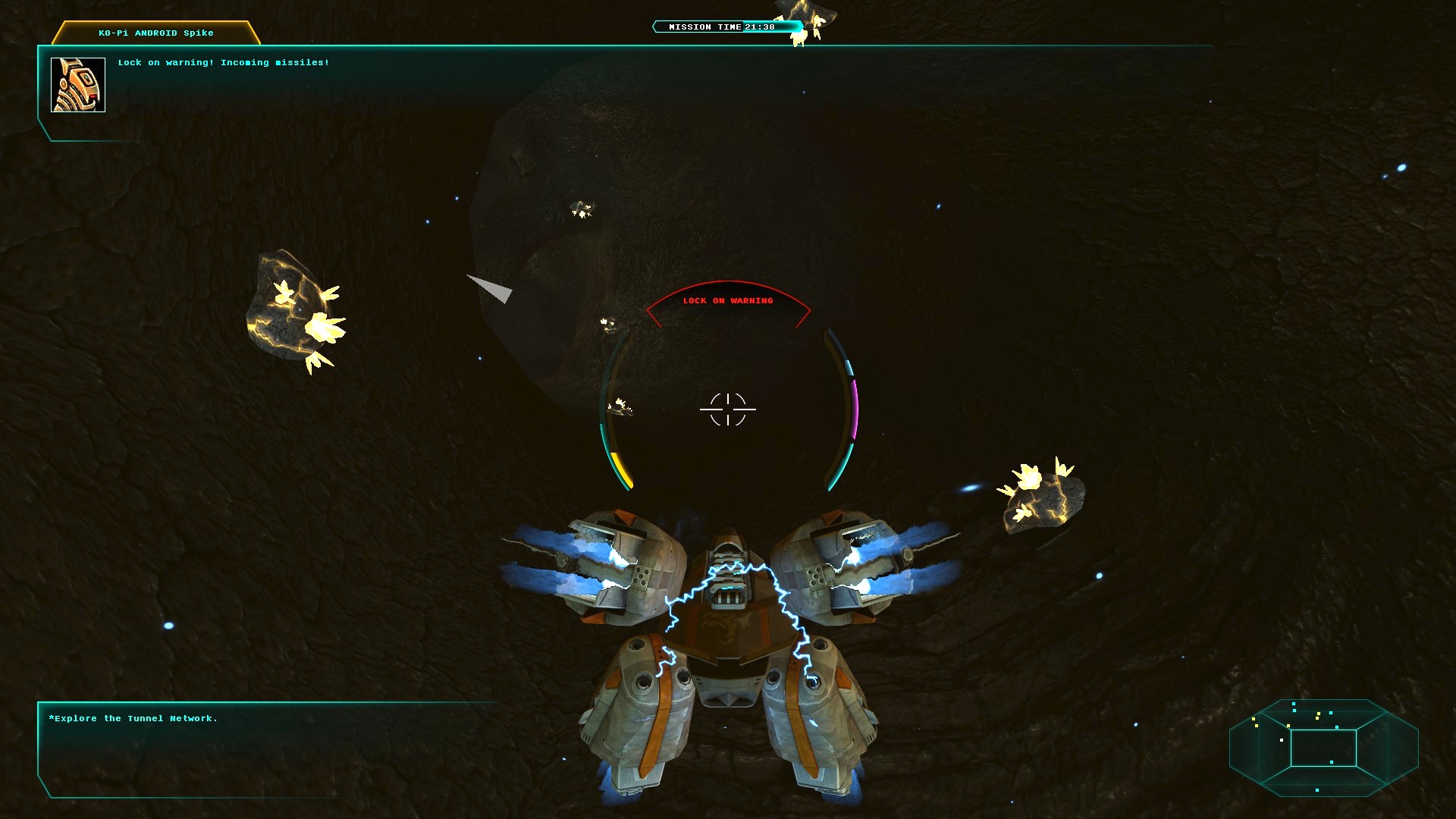
The first few missions were a bit samey, despite claiming to be "recon" and "combat" missions — they all seemed to involve "destroy [x] number of Zylon fighters", possibly against a time limit. But then the fourth "story" mission came along, which tasks you with finding a piece of a secret weapon that will help you deal with a Zylon secret weapon. Said piece of secret weapon is stashed somewhere in an asteroid. And this asteroid is pretty big. So big that when you're flying over its surface, you'd be forgiven for thinking you were conducting a planetside mission. Not only that, but part of the mission involves going inside the asteroid, at which point switching to Assault mode effectively turns the game into Descent, which is awesome. I'll ignore, for now, the fact that the game crashed on me at this point just as I was about to finish that mission.

I wasn't sure what to think of Star Raiders when I first started playing it. Then I looked at the clock and realised I'd been playing for nearly two hours. So something must be right somewhere. It's clearly not the original game in any shape or form — the "galactic map" interface in the game is a glorified mission select screen rather than the strategic overview of the original — but what it does offer is a good, fun, if simplistic space combat game with some nice ideas and a horrendously poor control scheme on console.

At £6.99, though, you can probably afford to take a chance on it, though, right?

Oh, if you're interested, then…

Old:

New (previously-mentioned Descent bit):
#oneaday Day 128: That's Not Very PC

I just bought a new PC. Well, technically, I bought a case with a motherboard, processor, RAM and PSU pre-installed along with a graphics card, the wrong wireless adapter, a hard drive, a DVD drive and a few other little bits and pieces. Technically speaking, it cost a lot of money that I don't really have, but while I can at least "sort of" afford it (that's the closest I'm going to get for a while) I figured I'd take the plunge as a birthday treat to myself.
I have it hooked up to my HDTV and it looks glorious at 1080p. Naturally, the first thing I did was download a bunch of stuff from my Steam account that used to run like ass on my Mac and see how well it works on the new machine. Here are my findings so far:

  • Mass Effect – Silky smooth, character models are blurrier than I remember from the Xbox version, but the gorgeous framerate makes up for that.
  • The Witcher – Super-sexy hi-res, though the frame rate chugs a bit if there's a fancy magical effect taking up a lot of the screen. It otherwise looks great, though.
  • Crysis – Bought for £2.50 in the EA sale the other day even though I have been fairly anti-Crysis in the past — granted, I haven't played it and was ready to dismiss it as a shooter. But by God that game looks fantastic. Am actually intrigued to play it, too — it seems to be rather different from your typical corridor shooter.
  • Left 4 Dead 2 – Silky-smooth. Hi-res. Actually playable rather than borderline unplayable.
  • Borderlands – My God why did I ever play this on a console? (Although the PC interface is a bit crap in the menus.)
  • Magicka – actually runs and looks like fun. Bit juddery at times though I think that is more down to its questionable programming than performance issues.
  • TrackMania United – Looks great on a 40" HDTV and is just as fun as ever. Looking forward to TrackMania 2 now.
  • Amnesia: The Dark Descent – Had a copy of this for ages, just started. Looks utterly terrifying. Looking forward to it.

So. Looking forward to playing some games the way they are meant to be played. And of course, if any of you want to add me on Steam, you can feel free — Steam community username is, as always, "angryjedi". Say hey and feel free to send me a message or send me an invite to a game.

Now I'm off to go and shit my pants at Amnesia. See you in the morning. Maybe.

#oneaday Day 125: He's Having an Episode

Episodic gaming is, for many publishers, the "holy grail" of digital distribution. If they can figure out a way to hook a player in and keep them interested in their piece of interactive entertainment, there's no reason why it shouldn't keep going and going and going until people lose interest — like a TV show.

But the trouble is, a lot of developers have great difficulty releasing episodic content in a timely manner. Valve are obviously right out with their years elapsed between Half-Life 2 episodes and the conspicuous lack of Episode Three. Telltale are closer, with their monthly episode, but it's still not quite the same as a TV show.

Oddly enough, the games that have pretty much got it spot on are two games buried deep in the heart of the App Store that you'll probably never pay any attention to. But I'm here to tell you that if you're the slightest bit interested in exploring a bold experiment in episodic interactive content, then you really, really need to try out Cause of Death and Surviving High School, two games built around the same basic visual novel-style engine but which manage to be very different from one another.

Cause of Death is a full-on interactive detective show. It's presented very simply with static backdrops, text narration and character portraits, but it works extremely well thanks to the attractive artwork, well-written (if overly-peppered with exclamation marks) dialogue, strong characters and excellent music. It's also interesting in that you regularly switch between different characters — including the victims of crimes, which is an interesting approach. Gameplay is extremely simple, consisting of reading text and occasionally making choices, some of which are against a time limit (and for some of which the correct option is to not make a decision) and acquiring "Detective Score". Acquiring enough points in each chapter unlocks bonus scenes, so there's plenty of incentive to do your best.

Surviving High School, on the other hand, is very different, despite using the same game engine. It's more of a social/dating sim, based around a character you name and choose the appearance of yourself. There's a lot more "branching" to the story depending on who you talk to, who you choose to date and decisions you make. And there's a lot more minigames which would be pretty cheesy in a computer-based adventure game (wordsearches, pop quizzes, that sort of thing) but work extremely well on the iPhone's touchscreen. Again, it's written with some very appealing (if stereotypical) characters who all have a story to tell. Plenty of replay value, too, as decisions you make mean that you'll see certain scenes and not others.

But that's the game you download. The really interesting thing comes in the episodic content. The app you download is "Season One" of the respective game, which tells a complete story and is a satisfying experience in itself. Beyond that, though, there's a new episode that "airs" every week and can be downloaded for free while it's available. And past episodes are available "on demand" for a fee — in the case of Cause of Death, you can buy the whole of Season Two for under two quid and it's then 59p per pair of episodes after that. Haven't checked Surviving High School yet but it's probably something similar.

This, right here, is the correct way to do it. Weekly updates mean that people will stay engaged with the game, especially as they're free while they're "airing". Episodes on demand allow the developers to make some money from the games, which can then be ploughed back into development of further episodes or new titles. And because the tech of the games is so simple, it probably doesn't cost that much to make new episodes — meaning both games are probably nice little money-spinners for EA.

Regardless of how much money EA is making off them, though, they're both excellent titles for fans of the visual novel style of gameplay, and I will certainly be exploring the further episodes in more detail. Both games have free, ad-supported versions available (and they're only 59p each for ad-free versions, so they don't exactly break the bank) so why not check them out?