#oneaday Day 521: It's Your Turn Now

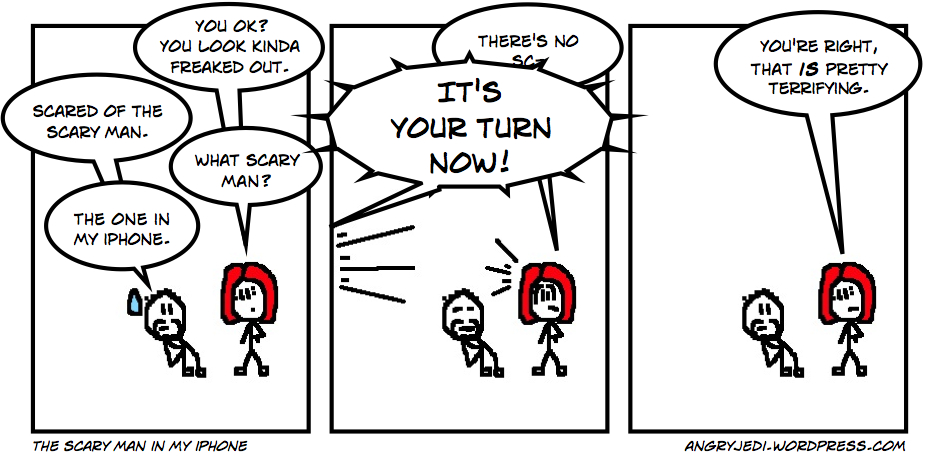
I've discovered the most terrifying thing in the universe: the man who very politely, but incredibly loudly, tells you "It's your turn now!" on the iPhone version of Carcassonne. It's terrifying because hearing someone's voice when you're not expecting to — such as, say, when you're trying to get to sleep — is a frightening thing. Quite why a murderer or rapist would say "It's your turn now!" is… no, hang on, that sort of works, doesn't it? Shit.

But anyway. The terrifyingness of Carcassonne is not what I wanted to talk about — at least not directly, anyway. I wanted to take a moment to talk about asynchronous games, how awesome they are and where they can go from here.

The iPhone (and, presumably, Android) is home to a wide range of excellent asynchronous-play games, allowing people to play at their own pace at a time to suit them. The upside to this is that people even in wildly disparate time zones can play games against each other. The downside is that it's easy to forget what games you're playing, particularly if your push notifications decide not to work properly.

But that downside isn't sufficient to dampen the awesomeness that is the ability to play Carcassonne with someone across the other side of the world. The "…with Friends" series (Chess, Words and Hanging) are all excellent examples of How To Do It Correctly, too, providing a simple, intuitive interface to games that most people know how to play. The quirky and entertaining Disc Drivin', too, offers a fun experience, even if whoever goes first has a clear advantage over everyone else. (That's my excuse, anyway.)

Certain social games are taking steps to incorporate asynchronous features, too. Dragon Age Legends, for example, allows players to recruit their friends' characters — complete with equipment and abilities — into their party for combat. This allows people to play with their friends without their friends actually being there — defeating the object of a multiplayer game, you might think, but actually making the best of the fact that it's pretty rare for you and all your friends to be online at the same time.

Consider this taken to the next level, though. Why haven't we seen an asynchronous MMORPG yet, where players can party up with AI-controlled characters based on their friends' equipment and ability lists? It works in Dragon Age Legends, though admittedly that's a very simple turn-based game. But most MMORPGs have AI built in for enemy and ally characters anyway, so why shouldn't there be a way for players to "play" even when they're not actively logged in to the game? I think that'd be kind of cool, actually — and it would certainly get around my biggest bugbear with MMORPGs, which is the fact that a good 90% of my friends live in a completely different and mostly incompatible timezone to me.

On a related note, then, if you live in Europe and want to play Champions Online, Spiral Knights or anything else you'd care to suggest (preferably of the free to play variety) do please get in touch!

#oneaday Day 518: Championing the Free to Play Model

I mentioned a few days ago that I was going to give some of Steam's free to play games a try, and mentioned I might investigate APB Reloaded and World of Tanks. I have played a tiny bit of APB (it's quite fun, if nigh-on-incomprehensible to begin with) but haven't touched World of Tanks yet. I also continue to enjoy Spiral Knights, although with the game's lack of quest structure and progression system tied to your equipment rather than your character I'm not entirely sure what the "point" is — but it's fun, regardless.

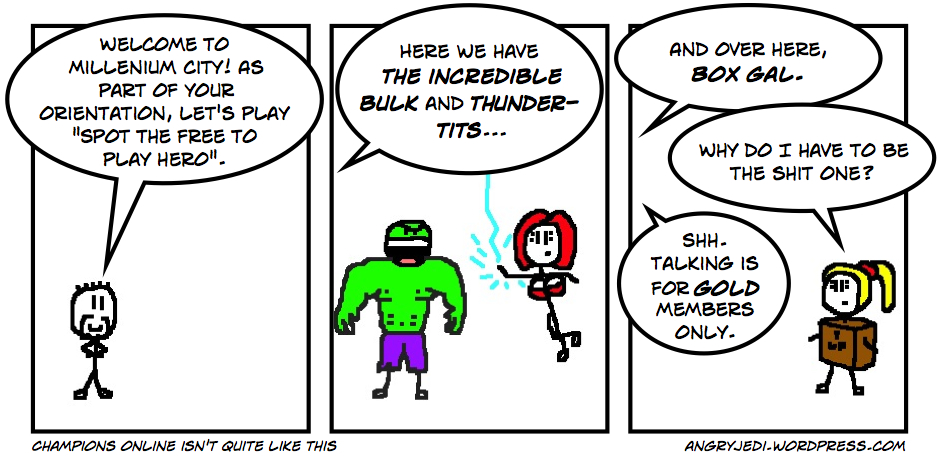
Instead, though, I've been spending a fair amount of time playing Champions Online, aka City of Heroes 2. This is one of a growing number of MMORPGs that used to be full-price products with subscription fees, but which have adopted the free to play model as a means of drawing in more customers and potentially earn more money via microtransactions.

Champions Online takes an interesting approach in that you can still pay a subscription fee for a "Gold" membership if you prefer, and that keeps the game pretty much in its original form — you get free access to all new content, are able to play a hero with your own completely customised set of powers and have a bit more flexibility in terms of how much currency you can own and the like. Free "Silver" members, on the other hand, are limited to selecting preset archetypes for their heroes and have to pay for episodic "adventure packs" — story-heavy instanced missions that offer experiences a little different from the regular world-and-instance-based PvE that the main game offers. Regular promotions allow Silver members to get access to some things for free for a limited period, and players can always buy individual things via microtransaction if they don't want to pony up for a full-on subscription every month.

The way this is implemented is incredibly smart. The fact that Silver players are limited to preset archetypes which are nigh-on-impossible to fuck up while Gold members actually have to plan out their builds in advance means that people are less likely to get themselves into a situation where it's impossible to proceed due to some unfortunate decisions 20 levels ago. It also allows players to effectively try out the various combinations of powers with characters that actually work properly — and have a lot of fun in the process. I'm playing a "Soldier" character right now and she doesn't feel gimped at all — she feels like a preset character class in a traditional action RPG. There's just enough level of choice to allow me to customise her a little bit without daunting me with complete freedom.

Champions Online falls into the usual traps that MMOs do — the interface is a bit clunky, the animations in cutscenes are either laughable or non-existent and aforementioned cutscenes have been put together by someone who doesn't know what "directing" or "cinematography" is. But that doesn't stop it being fun — and definitely higher quality than some of the crap that has been released under the free to play banner in the past. Quality of these games is definitely increasing, and I foresee that Champions Online will hold my attention for quite a while yet. So if you're a player, do join me! Look for "Lap Cat@AngryJedi" or just add me on Steam to see when I'm playing. Feel free to give me a shout and we can team up.

#oneaday Day 515: Rational Discussion Forever

I've said it before, but one of the best things about the Squadron of Shame is their willingness to engage in reasoned (usually, anyway) debate on a wide variety of subjects. Given the venom and bile that's been the hallmark of most high-profile Duke Nukem Forever reviews over the last week or so, I figured it would probably be down to the Squad to have a reasoned debate on the matter.

How right I was. I present to you a selection of highlights from today's discussion of the matter. I'm sharing this here because I believe this was a very interesting discussion and I want more people to know about it. If you like what you read and would like to join us, use your WordPress account to contribute over at the Squawkbox — we're very welcoming of newcomers and, as you'll see below the fold, have absolutely no problem with "Walls of Text" so long as you know how to use paragraphs!

This is an extremely long post so I'm putting a Read More tag here. Do take the time to have a read if you're interested, though — I maintain this is the most reasoned, rational discussion of Duke Nukem Forever you'll find anywhere on the Internet.

Continue reading "#oneaday Day 515: Rational Discussion Forever" →

#oneaday Day 514: Looking Back

It's ironic, really, that one of the best things about living in The Future is the ability to recapture the past at will. While we may not have managed to nail the whole time travel thing just yet, despite our speculative fiction authors coming up with a number of potential solutions, technology provides the next best thing, which is to revive things from our past in our present.

There's lots of ways this happens. We have the pixel art movement, creating art from the graphics of 20 years ago. We have sites like Good Old Games celebrating, well, the good old games of the world. We have YouTube and its magical, ever-expanding collection of tat from your childhood which someone has lovingly gone to the effort of finding, digitising and putting on the Internet for all and sundry. (On a side note, the word "digitised" doesn't seem to be used much these days. I remember it used to be a word to denote excitement in the late 80s and early 90s — "this game has digitised speech!" "WOW!" etc.)

Is this healthy, though? Wikipedia (I know, I know, I don't have an actual dictionary to hand) describes nostalgia as "a yearning for the past, often in an idealised form". The rose-tinted spectacles syndrome. Nostalgia sees you thinking back to past experiences and thinking "God, that was awesome" with an implied "but I'm not sure I'd want to go back and do it again." If you can actually go back and do those things that inspired such nostalgia, does it lose its impact?

It varies. Sometimes old things really don't hold up well to close scrutiny. And sometimes they do. In the video game world, Ultima Underworld holds up a whole lot better than, say, anything on the Atari 8-bit computer. Granted, there's more than a few years between them, but they're both things that evoke a feeling of nostalgia in people who knew them first time around — and they're both things that you can recapture the feeling of, either through an emulator in the case of the Atari computers (or indeed finding a working model on eBay) or in the cast of Ultima Underworld, through Good Old Games, which has very graciously recently made both games available once again after a very long time.

The same is true of non-gaming experiences, of course. Things that you thought were delicious and tasty in your youth might taste like crap now because your palate is more refined. Having a farting competition on the school field might not hold the same appeal. Doodling cocks on exercise books might cease to be amusing. (Though I doubt it. If I ever get to that stage, kindly kill me.)

A lot of it is due to your own attitude towards the past, of course. If you're an inherently nostalgic person, then you'll be predisposed to enjoy rediscovering old things, whether this is an old video game, a diary you wrote when you were twelve or a CD you used to listen to on repeat over and over and over. But some people prefer to move on, always pushing forward, leaving the past behind, preferring to let bygones be bygones. They get to enjoy the latest, the greatest, the biggest, the best. But they never get to do the things that once made them happy again. That's kinda sad.

You can probably guess which category I fall into. If you're having trouble, the fact that I replaced my Windows "busy" cursors with the pixelated monochrome bee cursor from the Atari ST today should make it abundantly clear.

#oneaday Day 512: Freebie-Jeebies

Free to play games are here to stay, it seems, with Steam launching a dedicated category for the little buggers today — complete with Achievement support and Steam-powered microtransactions.

With that in mind, I've decided I'm going to delve into some of them and try to determine if any of them are actually any good. A lot of people hear the words "free to play" and assume it's going to be some lame-ass Facebook game with no gameplay whatsoever (seriously, I played one earlier that literally gave you experience points for doing nothing at all) but in actual fact, there's a surprisingly rich range of titles on offer out there.

I've just spent about half an hour with Spiral Knights from SEGA. This one appealed because of a recommendation from a friend, the most excellent CampfireBurning, who described it as a cross between Zelda and Phantasy Star Online. This sounded like an excellent combination of awesomeness, so I set Steam to downloading while I did some work.

It's a small download — less than a gig (when did that become "small"?) — and works on both PC and Mac. It has endearingly simplistic graphics that will likely run smoothly on absolutely anything and, unlike many other F2P titles, understands widescreen resolutions. It also has a pleasantly chiptuney sort of soundtrack, a straightforward control system and a no-nonsense approach to getting you into a party for some dungeon-delving.

Gameplay is similarly straightforward. You have a sword, with which you can slash, and a gun, with which you can pew. The sword does more damage than the gun, but the gun can pew at things that can't reach you. There are also blocks and bushes that hide coins and hearts, as well as "treasure blocks", which are self-explanatory.

I've only played the tutorial so far so I can't speak for the variety of the dungeons, but the simple, cartoonish nature of the graphics means that little more than a palette-swap is all that's really needed to give a level a distinct look — hopefully it offers a little more than that, though, as time goes on.

Hopefully the ease with which these games are apparently going to integrate with Steam will convince a lot more people to check them out. And the fact Steam has introduced a full free to play section should mean we get a lot more of these games on Steam, too, bringing them to a potentially huge audience. The future's bright for people who don't like paying for things but also don't want to pirate them!

I'm going to spend a bit of time with Spiral Knights and then post some more detailed thoughts in the very near future. After that, I'm going to investigate APB Reloaded and World of Tanks. Any other suggestions for free to play excellence?

#oneaday Day 511: Your Opinion is Valid, Unless It's Wrong

The few days since Duke Nukem Forever has been released have been interesting ones, from the perspective of looking at reactions to it, if nothing else. As I mentioned the other day, I've been playing the PC version and enjoying it a great deal. It's a thoroughly silly game full of ridiculous diversions, some old-school shooting coupled with some new-school sensibilities.

The combination doesn't always quite work, but to call it a "broken mess" and a "terrible game" as some people are doing seems a bit harsh, particularly when you bear the game's troubled history into account.

But I'm not going to go off on one defending Duke Nukem. Instead, what I will ponder is how many people will avoid playing it altogether based on the negative buzz surrounding it? And more to the point, how many people will pass up the PC version, which is significantly more technically competent than the apparently-dodgy console ports, based solely on reviews — pretty much all of which I've seen have been based on the console versions?

I picked up Duke Nukem because it's a piece of gaming history — the world's most notorious piece of vapourware. I enjoyed Duke Nukem 3D but wasn't obsessed with it or anything — it was simply an enjoyable game. For its sequel to come so many years later after it looking like it was never going to arrive at all? That's kind of cool — like, as one person on Rock Paper Shotgun pointed out earlier, witnessing an unfinished novel, symphony, play, whatever that was completed posthumously. I'm by no means saying Duke Nukem Forever is a work of art — it really isn't — but I'm also saying that it's an interesting curiosity that I fear people will pass by completely purely because the opinion-formers of the world say they should.

Perhaps they won't, though. Perhaps the game will drop to a bargain price at some point in the near future and people will be inclined to pick it up out of sheer curiosity. I'll be pleased if that happens, for even if you end up hating the game, I believe that the sheer amount of history that this title has is worth the price of admission alone. As many have pointed out, you can practically see where George Broussard insisted the team take the game back to the drawing board time after time after time — it's manifested itself in a game that's trying to be the biggest, the best, the greatest at everything it does and not really achieving it — but what it does achieve is provide one of the most varied experiences you'll ever have in a first-person shooter. One minute you'll be driving a remote-control car through a burning casino. The next you might be scaling the outside of a tower that has alien tentacles wrapped around it. The next you may be deep underground, exploring a genuinely unpleasant and disturbing level where you witness first-hand exactly what the aliens are doing to the "babes". And the next, you might be wandering around a strip club, looking for popcorn, a vibrator and a condom.

So if you've been put off by the early reviews of Duke Nukem Forever but have always been intrigued by the idea, I'd encourage you to check it out. Maybe not while it's full price if you're not happy with that idea, but certainly once it drops in price. It's an interesting and genuinely fun game despite its flaws, and it also has a simplistic but excellently entertaining multiplayer mode which is being rather unfairly dismissed by much of the media.

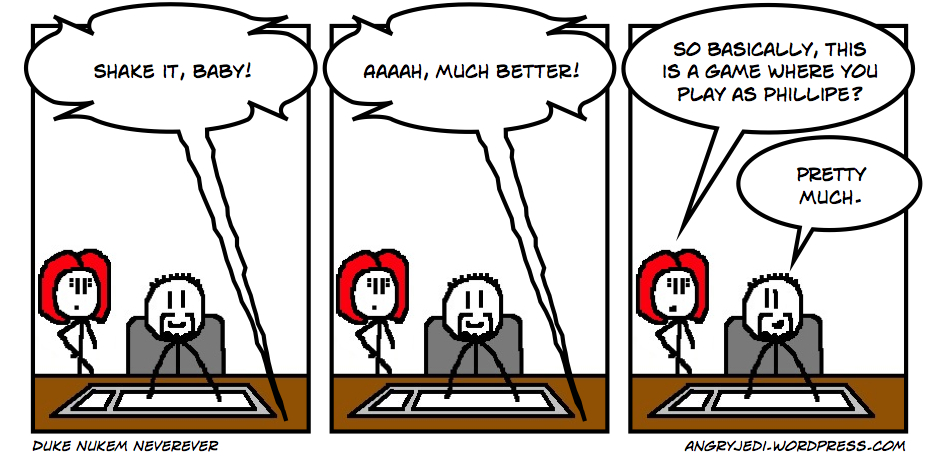
Shake it, baby. Never thought Duke Nukem Forever would have serious potential to become Squadron of Shame material.

#oneaday Day 510: Come Play with Me

Some of you may not be aware that I've been writing regular pieces on up-and-coming social games for Inside Social Games. A number of things have become apparent during my ongoing whistle-stop tour of the social gaming space. Firstly, Facebook games are getting better, and secondly, there's still a lot of work to do.

Here's a few things that, to my mind, would improve the Facebook gaming experience immensely. I'm not a professional analyst, nor have I done extensive research into online usage habits, so I imagine a man with a beard bigger than mine will probably be able to counter each and every one of these arguments, but anyway. This is my opinion — and some games do one or more of these already, so fair play to them, I say.

Stop copying each other.

Imitation may be the sincerest form of flattery, but when you're making a game that is mechanically and aesthetically identical to a competitor's product, you're not giving a potential player a reason to play your game. Differentiate yourself — and not just by making the game in a different setting. Ripping off two distinct but similar titles does not count either, so if you make a city-building game where you can farm crops, think of something better. Little Cave Hero is a good example — while the city-building mechanics are similar to a million other titles out there, there are extra bits, such as your "factory" structures producing crap that either you or a friend have to clean up, user-generated content, and then the meat of the game — puzzle-based mine exploration.

Stop insisting I "share" everything.

The number one complaint people have about Facebook games is when a player spams their wall (and, in worst cases, other people's walls) with bollocks about what they've just "achieved". The reason for this is that in the vast majority of social games, completing any mundane task pops up a huge window inviting you to share your "achievement" with friends. In some more extreme cases, the "Share" button is much more obvious than the "No thanks, kindly piss off" button.

Sure, there's a viral marketing thing at work here — but at least make it optional for people who just want to play the game. Add a Share button, sure, but don't make it quite so in-your-face. Better yet, add the option for players to switch off notifications like this altogether.

Stop insisting I "give you a five star review".

By all means solicit user feedback. But to be perfectly honest, many average Facebook users either aren't that bright, aren't very computer literate or — in some hopeless cases — are neither. As a result, many of them are apparently incapable of doing anything other than what is written in front of them. Invite them to "write an honest review" rather than "give a five star review" and you might get some honest, if badly-spelled, feedback. Invite them to "give a five star review" and you'll get lots of five-star reviews, very often with no feedback whatsoever. This not only makes Facebook's app rating system utterly worthless, it also removes a potential way for players to get their voices heard.

If you want me to Like your page, post something worth following and commenting on.

Screenshots of your game are not interesting — I've played it. I know what it looks like. Attempts to engage with the community are interesting. Take a vote on what new quest you should add next, or what character you'd like to see more of. Let the community play a part in the development of the game.

Stop claiming you're the "first/best/most [something] on Facebook".

If everyone says it — and they do — no-one believes it. If your game's good, word will spread, both via the press and word of mouth. The elusive "core gamer" market isn't going to flock to your Facebook game just because you say it's built for core gamers.

Give my friends something to do.

Yes, being able to look at a friend's town is cool. But it's ultimately pretty meaningless if I can't interact with anything there. Let us do stuff together. Provide some multiplayer content, or rebalance the single player content for people to play together — perhaps even simultaneously! Diablo did this years ago.

My friends aren't going to want to play or add me as a neighbour if there's no real reason to do so.

Don't break the game with your premium items.

By all means monetize your game — you made it, so you deserve to earn something from it. But don't make paid-for items into "win buttons". Also, don't allow people to buy their way out of quest objectives. Allow players who pay to make quicker progress — perhaps increase their experience gain — or customize their character/city/world to a greater degree, but don't undermine the game mechanics.

Offer a subscription.

Someone who plays your game regularly will be quite happy to spend a fiver a month to get access to additional features or make quicker progress. Microtransactions can mount up easily without people noticing — good for business, not great for ethics.

Let me fail.

If I fuck something up, give me a consequence. Life isn't all about happy-happy-joy-joy. Sometimes you get things wrong, in which case I should have some sort of penalty more severe than "wait five minutes and try again". In city-building games, don't let me move my buildings. If I built something in the wrong place or planned my city ineffectively, punish me by making me demolish my hard-earned building and spending the time and money to construct it again.

Make the tutorial optional.

Some Facebook gamers need step-by-step help on how to get started. Others have played games — either Facebook or otherwise — before and already know how it works. Offer the opportunity to skip the tutorial — especially if it's a long and incredibly boring one.

Provide a reference manual.

Perhaps I've forgotten what one of your beautifully-designed but obtuse icons does. Perhaps I can't remember how to do something. Let me look it up.

Let me start again.

Maybe I called my character the wrong thing. Maybe I hate my city and want to build a new one. Let me wipe everything out and start afresh.

Try a different look.

The vector-graphics Farmville look is old hat. Try a different look. This is one of those few instances where it's actually desirable to have something that's a bit more dark and gritty than normal. If your Facebook game is based on an established franchise, do try and make it look like other entries in the same franchise. You don't have to "kiddy it up" for Facebook — grown-ups use Facebook, too.

Ditch game mechanics that don't belong in a particular genre.

A game about completing wordsearches and crosswords has no place for an experience system. Allow players to unlock new challenges via their progress, not via arbitrarily-issued experience points. Similarly, ditch the Energy system, as it often leads to players being stuck halfway through something and then forgetting what they were doing when they come back to it. If you must control how much people play (and monetize the ability to play more) then find a different way that allows players to complete something before they get locked out.

Provide a meaningful mobile experience.

Create, at the very least, an iPhone and Android-compatible web experience. Ideally, you'd create an app for both iPhone and Android that allows players to participate in your game when they're on the go. Don't make a mobile version of your game that has nothing to do with the Facebook version!

Polish your game.

Proofread your text before you release to the public. Spelling mistakes and grammatical errors look unprofessional. Make sure the game works and fix it promptly if it doesn't. Little details like this can make the difference between a popular game and a laughing-stock.

Have some character.

Games are fun! Stop being so po-faced and get a proper writer to inject a bit of wit into your dialogue. If people are made to smile or even laugh by your game — or even be scared or upset by it — then they're more likely to return for further emotional experiences. If the whole thing is very businesslike and dull, despite a cartoonish appearance, then it's not going to hold anyone's interest.

There we go. Some free advice for any of you developing or considering Facebook game development. As I say, I mention all these things with the caveat that I can't develop games as I don't have any programming experience. Many of these games are undoubtedly impressive technical, creative achievements. But for them to be taken more seriously by some parts of the community, changes need to be made — but making those changes will not only please those who feel turned off by Facebook games, it'll also present additional revenue streams for the developers and publishers in question. Everyone's a winner.
#oneaday Day 508: Come Get Some

The observant amongst you who have me on your Steam friends list (and if you don't, add me) will have, well, observed that I've been playing Duke Nukem Forever tonight. I played it for quite a while, actually, which I took to be a good sign. Here are some initial thoughts.

  • "Duke, you're a relic from another time." This line spouted right near the start of the game is clearly deliberate. The game itself is a relic from another time — not just in the sense that it's the world's most notorious piece of vapourware, but also in terms of its gameplay sensibilities. A lot of people seem to think this is a bad thing, but given my general distaste for the po-faced nature of Call of Duty and its brethren, I have absolutely no problem with this whatsoever. Consequently, I expect to love the game and everyone else to hate it. It certainly wouldn't be the first time this has happened.
  • Interactivity! Duke 3D, despite its primitive engine, was all about walking up to things and pressing Spacebar to see if they did anything, or if not, enjoying the sound of Duke muttering "Where is it?" Duke Forever takes all this to the next level by providing all manner of things to see and do, including fully-functional pool and pinball tables, weightlifting benches and lots of other things besides. There's a purpose, too — using these items adds to Duke's maximum "Ego", aka his shield. So you're encouraged to piss about with the world — exactly as it should be.
  • Pacing. It's interesting to come to this off the back of Far Cry (which I'm still intending to finish, but the introduction of silly and hard-to-kill mutants has dulled my enthusiasm somewhat) as they're polar opposites. Far Cry is mostly about evaluating a situation from afar and determining the best way to tackle it. Duke is about charging in screaming and blasting the shit out of everything, and then punching it in the balls a few times for good measure.
  • Whatever your opinion on Duke the game, Duke the character is still a strong one. Sure, all he does is spout one-liners from movies, but his attitude gives the game a great deal of character. Cheesy, stupid character, sure, but that's all part of what the Duke experience is supposed to be all about. When he growls something amusing after a particularly gruelling firefight, it's satisfying to be "rewarded" with that.
  • Multiplayer looks interesting. I haven't tried a game yet, but there's a full Call of Duty-style progression system, with a Duke twist. Levelling up and completing challenges gives players the opportunity to customise both their multiplayer Duke and their own apartment, which they can then wander around, ogle their babes and bum around in. A nice touch.
  • The graphics are reasonable, but not stunning. There's also a few frame rate issues at times — I doubt very much it's that my computer's not up to it, as for the majority of the time I'm getting 60+ frames per second. But there seem to be certain things that cause a little bit of stuttering — not game-breaking stuttering, but noticeable. A shame. Perhaps they'll be patched out — or perhaps there's a setting I can tweak somewhere. Turning off anti-aliasing helped a lot, actually, and didn't degrade the quality of the graphics that much.

So. There you have it. Duke Nukem Forever, the game we thought we'd never see. Sure, after this long, it's never going to live up to the hype. But having played it for quite a bit this evening, I can say with some confidence that I like it quite a bit.

#oneaday Day 507: Bang

I often labour under the mistaken assumption that I don't like shooters. I know, I know, to assume is to make an "ass" out of "u" and "me", and to incorrectly assume things about yourself is doubly stupid because after all, you should know yourself pretty well by now.
But anyway. What I mean to say is that I've fallen a bit out of love with recent shooters. Sure, they're pretty, and spectacular, and they make a bucketload of money. But they're boring. With a lot of modern shooters, you have two choices: incredibly linear, tightly-scripted single player campaign, or endless hours of multiplayer against people you will never, ever beat because all they do is play Call of Duty all day.

In the Ubisoft sale a while back, I picked up the two Far Cry titles for an obscenely low price, along with Crysis. I tried Far Cry 2 briefly and am looking forward to delving into that later, but the original Far Cry in particular is reminding me that the genre can indeed be fun if handled correctly.

The difference is in feeling like you have a choice of how to handle things. In my (admittedly limited) experience with the Call of Duty series, it's very scripted — go here, do this, proceed to this mission objective, use this weapon right now because we say so, BAM — car chase, things exploding, save this guy, oh you can't because it's scripted that he should die, etc. etc. But Far Cry is a bit different. Besides featuring hilariously atrocious voice acting and the most sarcastic protagonist I've ever had the pleasure of looking out from behind the eyes of, Far Cry's objectives are less tightly scripted, being of the "There's a thing you have to do about a mile away" variety, and then leaving it up to you how you approach it.

Do you steal a vehicle, powerslide through the middle of a bunch of enemies then pick off the rest with a mounted rocket launcher? Do you swim out to sea, jump atop a rock and pick them off from a distance? Do you lie in the bushes, observing their patrol patterns and assassinate each of them quietly one at a time? The answer is "yes", because you can handle situations in pretty much any way you please. The "all guns blazing" approach rarely works, but that's good — it forces you to think of solutions that are a bit more creative.

Even the indoor missions, while necessarily slightly more linear, have multiple paths and alternative routes to try. Do you open the door, throw in a grenade then clean up afterwards? Or do you crawl through the air vent in an attempt not to be seen? It's top-quality stuff, and the simple fact that when you die you don't have to go back and handle the same bit in the same way makes the whole experience infinitely more appealing than a more linear — albeit probably more spectacular — recent title.

So, good job, Far Cry. I am enjoying you. And I am looking forward to your sequel, despite it apparently having literally nothing to do with you.

#oneaday Day 506: Monetize Me

Comin' atcha like a machine-gun today. And by that I mean I will be using bullet-points.

  • I have changed my day counter to the number of days since I started posting every day because 1) it's more satisfying that way, 2) I'm annoyed I missed my 500th day and 3) I'm sick of having to bring up a calculator every time I want to work out how many days I've done this non-stop.
  • E3 coverage has calmed down somewhat. Most of the big announcements have been made. Now it seems to be mostly up to the show floor team to flesh out those announcements with some hands-on impressions. Kind of sad I'm not there. One day! Maybe.
  • Getting people to pay for things is complicated. Whiskey Media did a bold experiment with charging for content and so far it seems to have been mostly successful for them. I haven't signed up, but then I don't read their sites that much. If I was more attached, I might be convinced — as someone on the other side of the potential paywall, I'm all for ways in which content creators can get paid for their work. Unfortunately, some people are still wary of this sort of thing — although porn sites have been running a successful "pay for content" industry for years. Like most things technological, porn once again leads the way.

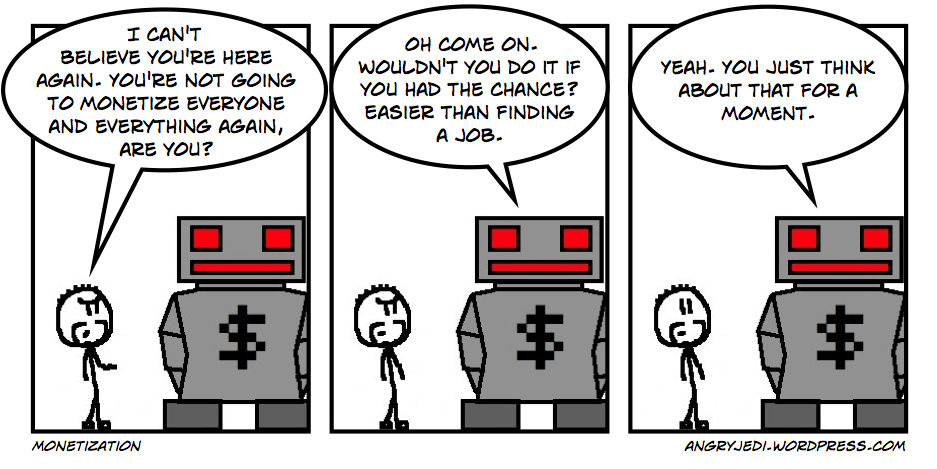
    I think about this every time I cover a Facebook game. Who is paying for the stuff in these games? There are fucking hundreds of the bastard things, so they must be making money somehow. Are people really forking over hard-earned money purely so they can pussy out of completing a quest objective? Are people really spending money on an "exclusive" cat statue to put in the middle of their field that is not real?

    Then there's the free-to-play "proper" games — many of which are actually getting seriously good. These I can actually understand paying money for somewhat more. The recently-remastered APB, for example. You can play it for free, but for access to full character customization (which is probably something of a bandwidth hog) you have to fork out for a premium subscription. This is still cheaper than the game was on its initial release, though, because although you're paying monthly, you didn't have to pay anything for the game in the first place. Unless you went out and bought it when it was released, in which case more fool you for not reading reviews first. (As a free to play game, though, it's pretty good fun — I suggest you check it out.)

    The key, it seems, is to make sure that people don't feel like they have to pay for something. If you grind to a complete halt in a game until you fork over some Facebook Credits or you bank details, that's a bad thing. If you can make progress in a game without having to pay anything, but spending a bit of money speeds things up a bit or gives you some sort of additional (non game-breaking) benefit, that's a good thing. If you can spend money in order to not have to complete mission objectives, that's a bad thing, although some people really are that lazy, I guess.

    The next few years are going to be interesting to see. Will people start paying for content on websites? Will people want to shell out $60 for Call of Duty and then subscribe to Elite on top of that when free to play games offer competitive services for significantly less?

    Will this bullet point ever end?

  • Why yes, yes it will.