#oneaday Day 943: School Days HQ First Impressions

I mentioned a while back that I'd acquired a copy of School Days HQ from JAST USA/JList, but I didn't play it very far due to a few rather nasty bugs that unfortunately made it on to the master CDs. Two rather hastily-deployed patches later and the game now appears to be fully playable without issue, which means I can get stuck into it. I'm now two "episodes" in — I'm not sure how many there are in total — and ready to give some first impressions.

School Days HQ, for the uninitiated, is a remake of a visual novel originally released in 2005 for Windows, PS2 and PSP. It's unusual in the visual novel genre in that instead of static backdrops with characters and text overlaid atop them, it's fully animated. "Fully" might be a slight exaggeration, as the game has something of a tendency to cut to images of the sky or a particularly interesting piece of ceiling whenever something that might have been difficult to animate happens, but for the most part the game looks rather convincingly like an animé series you'd watch on TV and, occasional strange cuts aside, is well-directed, with good use of split-screen and other special effects. In essence, it's an interactive movie rather than a visual novel, but it tends to be lumped in that genre due to its similarities in structure and gameplay. And, of course, the fact it has bonking in it.

Said gameplay involves a lot of watching and occasionally making decisions that will branch the story off in different directions. You can't afford to sit back and relax in School Days HQ, however, because decision points come without warning and "expire" after a short period of time — effectively making "say nothing" a valid option in most situations. This is an unusual feature for visual novels and for narrative-based games in general — the only other recent examples I can think of are The Walking Dead from Telltale and Heavy Rain, both of which have more in common with the visual novel genre than more "conventional" game styles. (I suppose choosing not to do the Paragon or Renegade actions in Mass Effect might sort of count, too.)

School Days HQ's narrative is all about close personal relationships, a favourite theme of mine. Protagonist Makoto finds himself sitting next to class cutie Sekai when their seats are rearranged, and through a bit of underhanded manipulation on Sekai's part, admits that he has a bit of a crush on the very shy Kotonoha, a girl from another class. Sekai, who firmly establishes herself early on as a complete control freak, makes it her goal to get Makoto and Kotonoha together and succeeds in her machinations.

Both Makoto and Kotonoha are almost painfully awkward together, however — extremely hung up on the conventions of polite Japanese society and not quite sure how to cope with the prospect of a relationship — it takes two dates before they'll call each other by their first names. Sekai, meanwhile, appears to have her own designs on Makoto, but so far in the story has done nothing but help the couple — with a bit of gentle teasing along the way, however. Given that she took her "payment" for getting the two together in the form of a kiss from Makoto and then spent her train journey home crying, however, it's clear that all is not as it seems with Sekai, and I'm expecting a distinctly messy love triangle as the story proceeds — something which has already been rather strongly foreshadowed.

So far I've very much enjoyed what I've seen. The animation and voice acting is decent quality, the subtitles appear to be well-translated and the timed decision points give the player a strong feeling of involvement even though, as usual for the genre, they're relatively infrequent. The characters are interesting, and the plot, while seemingly mundane, certainly has a lot of potential to head off in a bunch of different directions — including, as I understand it, some distinctly fucked-up ones. Which is nice.

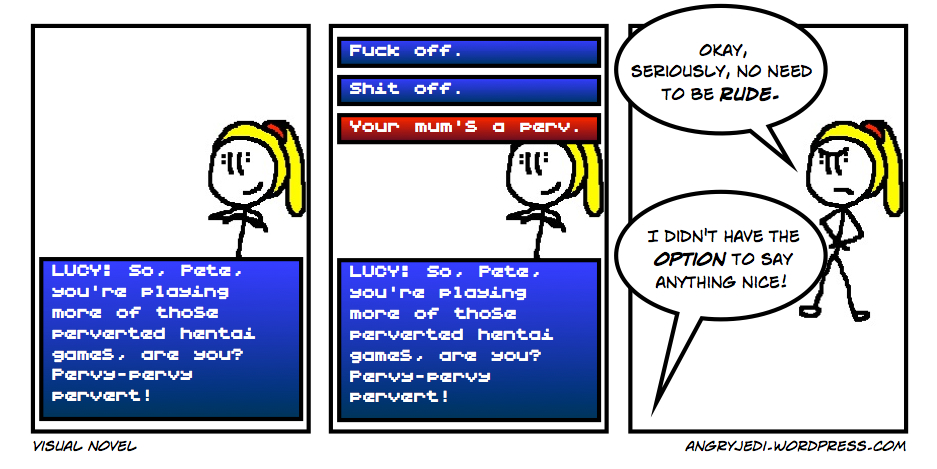
As with many visual novels, the game is specifically for adults and features explicit sexual scenes. There haven't been any yet, but given that the game supports bona fide wanking machines for both sexes, it's fair to expect that there will be at least a few on the game's various paths. There's also the usual unnecessary (but seemingly expected) "fanservice" throughout — there were two rather gratuitous shots of shimapan in the first episode alone, though the second episode seemed to restrain itself from further pervertedness — fitting, since it largely revolved around Makoto worrying whether or not him attempting to hold Kotonoha's hand would make her see him as a "pervert".

I'm looking forward to continuing through the story. Its episodic nature means that it can be easily digested in small chunks like a TV series — and I mean this literally, as each episode opens with a short teaser, plays an opening title sequence and ends with a credits crawl. As such, it's an experience that can easily be fit around other things or marathoned all in one go.

Will I get a good or bad ending, though? That remains to be seen. I hope I get a good one. I kind of like these characters.
#oneaday Day 942: Trails in the Sky

[Aside: This is the one-thousandth post on this blog. Hooray! Another 58 days until I've completed a thousand days of daily blogging, however.]

My current gaming "jam", as I believe the kids are saying nowadays, is Legend of Heroes: Trails in the Sky, just Trails in the Sky or its immensely entertaining acronym TitS for short. It's a Vita-compatible PSP game from Falcom, published by Xseed in the States and Ghostlight in the UK, and it was originally available for Windows PCs in Japan, though in the West I believe we've only seen the PSP release.

It's good. Real good. And, like recent RPGs that I've had a particular blast with — Xenoblade Chronicles, The Last Story, Pandora's Tower — it is good due to its willingness to dispense with the conventions of the JRPG genre and to incorporate good ideas from both Western RPGs and the more specialist strategy/tactical RPG subgenre. This exhibits itself in two main ways: its battle system and its game structure.

Battles in Trails in the Sky are a slightly more involved affair than your stereotypical "line up in front of each other and take it in turns to slap one another" JRPG combat system. Instead, battles take place on a grid, and characters have to actually move around as well as use their skills. Certain skills can affect areas, too, meaning that positioning is more than just a gimmick. This system is combined with a mechanic similar to the "Conditional Turn-Based Battle" system seen in Final Fantasy X, whereby the turn order for the next few rounds is displayed at the side of the screen and can be affected by various factors.

The game's "Craft" special ability system also allows player characters to "jump the queue" in the turn order at times if their "Craft Points" bar is full, allowing the player to manipulate the turn order to their advantage. This is an important aspect to gameplay, as certain turns are marked with symbols that denote various bonuses to the active character — a guaranteed critical hit, increased damage, a small amount of healing.

Structurally, the game is somewhere between a traditional JRPG and a more freeform Western title. The game's main plot is rigidly linear and leads the party through various locales which then become their "base" for a while. But while they are there, they have the opportunity to take on a bunch of optional quests which range from defeating tough monsters to delivering packages or locating ingredients. They're generally pretty simple stuff, but each is bookended by a short story sequence for context, giving the player a greater feeling of immersion in the game world by allowing them to get to know some of the incidental characters a bit better. It also makes the game feel less linear, as these optional quests can be tackled in any order — though some will expire if too much progress is made on the main plot before completing them.

There's another reason to do these quests: they're one of the few ways to make money. Rather than monsters inexplicably dropping fountains of gold when they expire, they instead drop crystals that can be used to synthesise new special abilities at a special location in towns, or sold for a profit. Questing is a much more reliable source of income, however, as it's better to save up the crystals for upgrading characters.

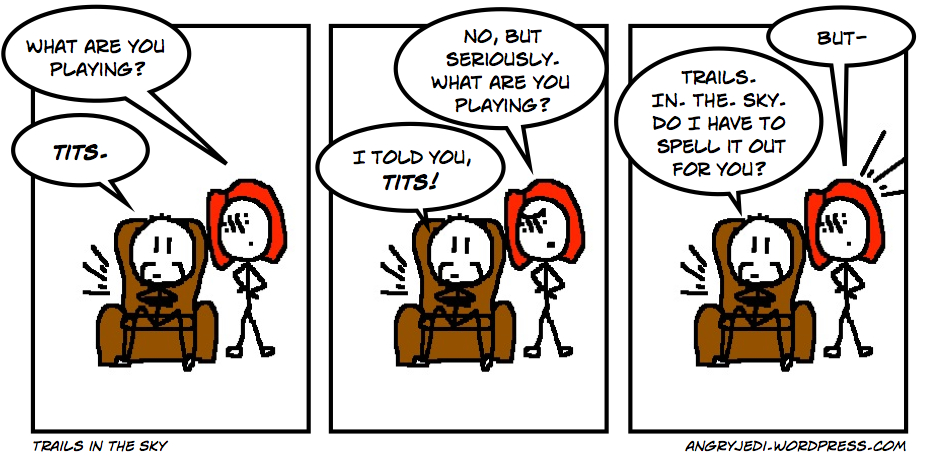
Mechanically, then, Trails in the Sky is interesting if not quite "revolutionary" — it's certainly enjoyable to play. But the highlight for me so far has been the excellent localisation. Characters are well-defined and have a strong sense of personality even though there's no speech or any real animation. Through a simple combination of well-written text and mood portraits, you get a real feel for who these people are and how they relate to one another. Particular praise should be given to the interplay between the two main protagonists Estelle and Joshua, who have clearly been set up to have a ridiculous amount of sexual tension between them for the duration of the game despite being polar opposites in terms of personality. It's also surprising to see an openly bisexual character making an appearance, though he is treated somewhat less than respectfully by Estelle, as she refers to him as a "pervert" within minutes of finding out about his preferences. (To be fair to her, though, he kind of is a bit of a pervert, though not because of his sexuality. His stalkerish lusting after Joshua seconds after meeting him for the first time is a bit creepy.)

I'm only about 10 hours in to the game so far but it claims to be about 50 hours in total. That's a decent size for a handheld RPG — hell, it's a decent size for an RPG generally. Any more than that and it can become a bit of a slog. I hope the excellent characterisation and fun battles continue throughout, as it's been a blast so far — so if you have a PSP or Vita and are looking for some top-quality questing, give it a shot.

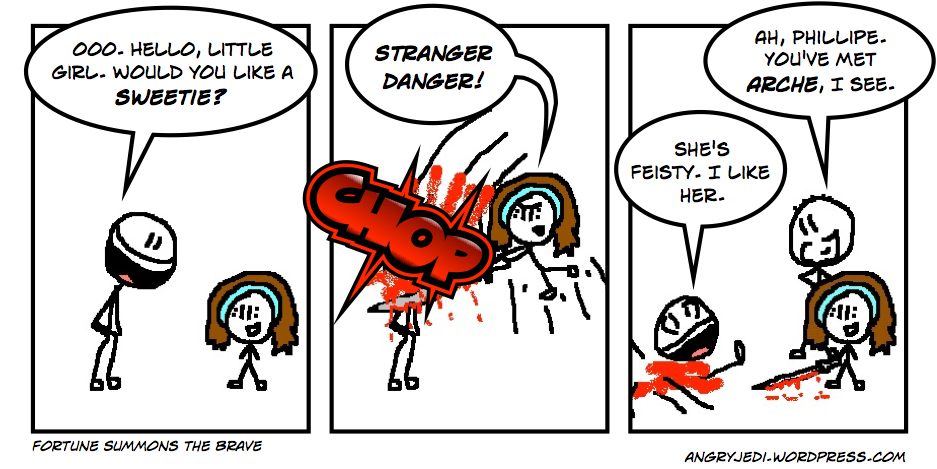
#oneaday Day 926: Fortune Summons the Brave

Having finished Chantelise the other night I decided to move straight on to the latest of Carpe Fulgur's translated Japanese titles, Fortune Summoners: Secret of the Elemental Stone. Unlike Chantelise and Recettear, Fortune Summoners was not originally developed by EasyGameStation, so I knew it was going to have some significant differences from the previous two games — I was curious to discover exactly what.

Fortune Summoners is a side-scrolling platform-RPG in which you play a prepubescent girl named Arche. Arche has moved to a new town with her family, and her father — an ex-adventurer — has decided to settle down with his wife and daughter, and open an item shop.

Arche is an endearingly ditzy little girl, charmingly naïve in the ways of the world. She's not very bright, she's terrible at arithmetic and she comes to her new magic school woefully unprepared, lacking the one component necessary for her to be able to begin her magical studies — an Elemental Stone. She does, however, have a strong sense of Doing What Is Right, and so decides not to mention the fact that she needs a stone to her family — who are somewhat lacking in funds due to their move and the start of their new life — and seek out one for herself. Thus begins an adventure that sees Arche discovering a great deal about the true power of the Elemental Stones and the origins of magic, accompanied occasionally by two equally prepubescent little girls.

If this all sounds terribly adorable, you'd be absolutely right. Like Carpe Fulgur's previous releases — and despite originating from a different developer — Fortune Summoners is awash with bright colours, squeaky Japanese voices and well-defined characters who all have their own distinctive personalities. Witnessing Arche's endearingly naïve responses to life-threatening situations never gets old, and her interactions with her party members and other characters is always a joy.

But beneath this brightly-coloured, charming exterior beats a heart of pure evil. Like Chantelise, Fortune Summoners isn't afraid to drop-kick the player into a dirty toilet full of acid-tipped spikes and expect them to come out unscathed, undiseased and smelling of roses. This game is hard, and it is the very definition of "don't judge a book by its cover."

Each of Fortune Summoners' three characters has their own unique abilities. Arche specialises in swordplay, while her companions Sana and Stella provide backup with water/ice and fire magic respectively. It's possible for the player to switch between these characters at will, and during the game's dungeons this frequently becomes essential to progress. Sana, being a water mage, is able to breathe underwater using her magic, for example, while Stella is able to burn down obstacles with her command of the fire element. Arche, meanwhile, doesn't have access to magic for the vast majority of the game and thus is the "tank" of the group (and yes, the concept of a little girl being a tank is hilarious), with a higher hitpoint value, better defensive capabilities and an array of fighting moves designed to go toe-to-toe with the various horrible monsters that wander the countryside — and that none of the game's cast seem particularly concerned about. ("Watch out for the slimes on your way home!" says their teacher at the end of a school day. You'd think they'd arrange a bus service or something.)

Each of the game's characters make use of their abilities in a different manner. Arche, for example, can only swing her sword if she has drawn it first, which takes a valuable couple of seconds and thus is best done before combat rather than during. Following this, she can unleash various attacks by using Street Fighter-style direction and button combinations, allowing her to slash, thrust, use combination attacks, roll to evade, cartwheel backwards out of harm's way and leap down on an enemy from above for unblockable damage. There's a level of depth to combat that you don't normally see in 2D-perspective role-playing games — and the game will most certainly punish you if you don't get the hang of it, because wildly flailing at enemies will not get you far.

Sana and Stella, on the other hand, are better at hanging back and unleashing their magic from a distance. Sana has access to an icicle-flinging spell, for example, while Stella is able to create fire walls and homing fiery missiles. Sana also has a healing spell, which means she is really missed when you don't have her. Spells are cast by making them active from a "hotbar" (or toggling through them with a controller button) and then holding down the "attack" button until a magic circle appears. Getting struck while casting causes the spell to fail, so it's essential that Arche keeps the enemies occupied — or that the mages hang back before attempting to cast if, for whatever reason, they're going solo.

The surprising complexity of the combat system really gives the game a pleasing amount of depth, where it could have been something very "hack and slash". Instead, the game's sword-and-magic play becomes very technical, and almost Demon's Souls-esque at times. Different enemies require different strategies, and blocking is essential — though thankfully the game does come with a helpful "auto-block" option if you're not performing any other actions, which does make things slightly easier — though not by much. Once again, though, like Chantelise, this means that Fortune Summoners is only going to appeal to a particular type of person — the type of player who doesn't mind taking a bit of abuse from their games, and the type of player who doesn't mind practicing in order to get better. (They also have to be the type of player who doesn't mind playing as an adorable little girl, either, and there's not always crossover between all of the above criteria. I happen to find the concept of a monstrously difficult game starring three very girly young girls hilarious, however, so I'm sure there are plenty of other people like me out there.)

Fortune Summoners, then, is not for everyone — and unashamedly so. This is, of course, no bad thing, as we all know by now that attempting to appeal to everyone is a lost cause that ends up with you making the most generic, inoffensive thing possible as you pander to everyone's sensibilities. Fortune Summoners is for those who like a challenge from their games; for those who enjoy old-school sensibilities combined with the more complex gameplay or modern titles; and for those who have absolutely no issue with their on-screen protagonist being a loli.

If that sounds like you, then be sure to check it out here. (There's a free demo, too, and you can even transfer your progress from said demo into the full game.)

#oneaday Day 923: A Tale of Two Sadistic Sisters

Something convinced me that it was time to finally go back and finish Chantelise: A Tale of Two Sisters. It's been almost a year since I actually purchased that game, and it's been mocking me from my Steam list ever since, reminding me of how much I loved Recettear: An Item Shop's Tale, which was developed by the same team, and localized by the (different) same team.

For those unfamiliar with Chantelise, it's a peculiar beast indeed. In its native Japan, it was Recettear's predecessor, but localization team Carpe Fulgur brought it to Western audiences after Recettear. This had the unfortunate side-effect of giving people perhaps unreasonably high expectations for it when it came out, since Recettear was pretty much universally loved by everyone who has ever come across it. In Japan, there was a noticeable upswing in quality and creativity between the two games; over here, people misinterpreted Chantelise as being a step backwards, since it appears at first glance to be much simpler and shallower than its shop-running successor.

After over 12 hours with it (probably about 15 in total — I started again for this play sesssion) I can say with some confidence that Chantelise certainly isn't a shallow game, it's just very, very different from Recettear. You can see how people would get confused, however, since a good 90% of the graphical assets are shared between the two games, and  the music for the final dungeon in both games is almost (but not quite) identical. When you consider this, it becomes easier to see why everyone had such lofty expectations for Chantelise and were then disappointed when it wasn't what they expected.

Note: "not what they expected" is not the same as "inferior", though some chose to interpret it that way. While Recettear was an accessible, adorable game combining action-RPG dungeon crawling elements with a simple business management sim (and a surprising amount of hidden depth for those willing to jump down that rabbit hole), Chantelise initially appears to be a rather straightforward action-RPG. Hack, slash, rinse, repeat. Job done.

And while there certainly is an element of mindless hack and slash to Chantelise's gameplay, the game has a sadistic streak in it that I haven't seen since Dark Souls. If you do not learn to play Chantelise properly, the game will punish you and send you back to the start of the area you've been challenging, effectively putting a big red "X" through your homework and telling you in no uncertain terms to "DO IT AGAIN! BETTER!" And, assuming you're not the sort of player who gives up after suffering a setback like this, you will get better, because the game will keep punching you in the face until you understand what it's trying to tell you.

You see, while Chantelise may initially appear to be a simple hack-and-slash RPG there's actually a considerable amount of depth that many commentators don't give it credit for. The fact that protagonist Elise doesn't level up traditionally, for example — all modifications to her stats are achieved through equipment, and she gains HP through finding or purchasing special medicine. Finding the correct combination of equipment to make it through a particularly challenging stage is key to victory in Chantelise — some stages will require that you buff up your physical defense; others will practically require the use of an elemental crystal to defeat monsters with resistances; others will need you to focus on magic. As you progress through the game and defeat bosses, Elise gains the ability to equip more items simultaneously, allowing her a substantial increase in power.

The game's magic system is an interesting aspect of gameplay, too. Rather than simply allowing Elise and her companion fairy Chante to cast spells as they please, they have to pick up coloured magic crystals in order to cast spells. Each crystal corresponds to an element — red for fire, blue for water and so on. The twist comes when you use more than one crystal at the same time. Using two, three or four of the same colour produces different spells with different effects — for example, one yellow crystal produces a metal ball that spins around Elise for protection, two causes her to gain a great deal of defensive power and resistance to being knocked back, three causes her to drop a giant boulder on her enemy and four summons an earth elemental who casts the other three spells at random for a short period.

But then there's spells the game doesn't tell you about. Augment the "two yellow" Super Armor spell with two red crystals, for example, and Elise gains a large amount of both attack and defensive power. Use of this spell is an absolute necessity in the later stages of the game, but it will only be discovered through experimentation (or reading an FAQ), because the game sure isn't going to let you know about it. Similarly, the game doesn't tell you that equipping a Darkness Crystal and hitting a baddy with a "charged" attack will drain health from the enemy and give it to you, making it a very efficient means of staying alive against baddies who do lots of damage.

All these factors — the surprisingly brutal difficulty; the uncompromising, punishing nature of the game; the hidden depths of the game's various systems — combine to make a game that is very much an acquired taste, but one that is infinitely more satisfying than it first appears, assuming you find those aspects of it palatable.

In short, it's not Recettear. It's not easy (not that Recettear was, particularly — though with enough determination and patience you'd make it through eventually). It's not traditionally "accessible" despite the simplicity of its controls. It doesn't give up its secrets easily. And it wants very much to hurt you, make you scream, and cackle maniacally as you fling your controller across the room at your fifteenth death that session. Yet it does this with the same veneer of adorable characters and a compelling "small-scale" plot, just as in Recettear. You can see why people got confused.

In summary, then, is Chantelise a bad game? Its Metacritic score certainly seems to suggest so, but as we established a while back with Nier, a Metacritic score is absolutely not a reliable metric as to whether or not a game is "worth playing". And such is the case here — though I certainly wouldn't recommend the game to everyone. If, however, you fall into that category of gamers who enjoy being punished by their games and figuring out how best to make use of the seemingly-simple systems with which you've been presented, then you should certainly check it out. If you feel like doing so, here it is.

#oneaday Day 890: Glorification

20120627-011456.jpg

I'm probably about halfway through Quest for Glory IV so far and I have to say, I'm a big fan of the series. Back in "olden times" our family were pretty big fans of Sierra adventures, but the Quest for Glory series was one which passed us by for some reason. While the games have aged better in some respects than others, one thing has become very clear from playing them: the combination of adventure game and RPG works. And it works very well indeed.

The reason it works so well is because the two aspects are intertwined so seamlessly with one another. Rather than being an interactive storybook with battles (as I once heard Final Fantasy VII described ) the RPG elements are woven into the adventure gameplay. Your character's stats are for more than simply how tough they are in battle — and in fact, combat plays a relatively minor role in most of the series. Instead, standard adventure game actions in Quest for Glory often involve a behind-the-scenes "skill check", with the on-screen character either succeeding or failing at the action in question according to his skill levels. What this means in practical terms is that there are multiple solutions to every problem according to the player's chosen play style and character class. A wizard might get through a problem relatively simply with a flick of the wrist and the cast of a spell; a fighter might have a more direct approach; and thieves have plenty of their own nefarious plots to get up to at night. Yes, here we have a thief character who is actually a thief rather than simply a DPS.

In terms of mechanics, the closest equivalent today would probably be one of the Elder Scrolls series, though it's not a great comparison. In both series, you gain in power simply by practicing skills; in both, there are multiple solutions to problems that are often related to skills; but where the two diverge is in the amount of character and personality they're infused with — not to mention the fact that The Elder Scrolls' idea of a puzzle is rarely anything more complicated than switch-flipping.

The Elder Scrolls has rich lore but I've never felt like I was a particularly important part of the story. I was just "that guy" who turns up and solves problems whom everyone then promptly forgets about — in Oblivion, for example, you do all the hard work but then Sean Bean gets to do all the spectacular stuff at the end. Meanwhile, in Quest for Glory you are the hero. You are the most important person in the room when you walk in, and the game's characters quite rightly come to love and respect you as you systematically sweep through, right all their wrongs and proceed on to your next adventure.

There's a number of contributing factors as to why this works so well in Quest for Glory yet feels so bland and uninspiring (to me, anyway) in Bethesda's epics. The main issue is one of scale — while it's unquestionably impressive to explore all of Skyrim, Cyrodiil, Morrowind or the other provinces seen in the earlier Elder Scrolls games, this vast scale means that you never really get to know the locales and the people therein. The vast majority of characters are templates who say the same thing to you, and most of them have no personality whatsoever, acting simply as walking quest-giving machines and information kiosks.

Contrast with each Quest for Glory game, each of which is set in a very tightly-focused locale — usually simply a single town and its surrounding environs — and it becomes abundantly clear why it has that much more personality. Because there's not so much vast empty space to fill with NPCs, quests and random events, everything was hand-crafted rather than resorting to templates. As such, everyone you meet in Quest for Glory is an interesting character — often with hidden depths. The plot for each game manages to remain mostly non-linear, with the required steps to proceed to the climactic "endgame" scenario in each usually completable in any order, but somehow it manages to provide a far more satisfying, compelling experience than I ever got from 50 hours in Skyrim.

The comparison between these two series isn't fair at all, of course, as I've already said, but it's somewhat telling that the closest equivalent to Quest for Glory I can find in modern gaming is so vastly different from these fascinating old titles. Why did the adventure/RPG crossover never take off? It's clearly a combination that works, and imagine what a great job we could do of it today. One could argue that games such as Dragon Age and Mass Effect from BioWare take heavy cues from the adventure game genre, particularly with regard to interpersonal interactions, but even in those indisputably excellent games it's still pretty rare that you'll find yourself solving problems in creative, class-specific ways. They're still stat-based, combat-focused RPGs first and foremost (with Mass Effect becoming more of a shooter as time went on) rather than adventure games that use RPG mechanics to help colour and direct the experience.

Part of the reason we haven't seen more of this type of game is, of course, due to the supposed "death" of the adventure game as far as the press and, presumably, publishers are concerned. But look around for a moment; the adventure game most certainly is not dead. High-profile developers such as Telltale are putting out some high-quality, well-written point and clickers. The genre is having something of a resurgence on touch-based devices such as the iPad. And some developers are even still releasing 320×200 super-pixelated traditional point-and-clickers like the recent Resonance. Why hasn't anyone just lifted Quest for Glory's system and applied it to a whole new adventure, perhaps in a new setting? I'd play a Quest for Glory in space, or in a 1920s noir style, or… you get the idea. The stat-based adventure game where the outcomes of your actions are determined by your skill values has a lot of scope for exploration, and I really wish we'd see more of it. Unfortunately, it seems that despite the universal adulation the Quest for Glory series receives, no-one is willing to defile its long-dead corpse and resurrect this fascinating subgenre for a modern game.

The first developer who does shall most certainly be in receipt of some of my money.

#oneaday Day 886: King's Space Police Quest for Glory Suit Larry

20120623-032608.jpg

I've been playing through the Quest for Glory series recently for the Squadron of Shame's upcoming podcast. I'd never played them before, and it turns out they're rather good — particularly once you get on to number 4 and you get John Rhys-Davies on narration duty. I shall refrain from further discussion of that particular series for now, however, as that would get into spoiler territory.

I do want to talk about Sierra in general, however. Sierra, if you're unaware/a young whippersnapper, was the developer and publisher of these games, and was notorious for being one of the "big two" names in adventure games in the '80s and '90s. The other was, of course, LucasArts.

Sierra and LucasArts took wildly differing approaches to what was ostensibly the same genre — the point and click adventure. While LucasArts embraced movie-style presentation and player-friendly interface features such as an intelligent cursor (i.e. one that automatically highlighted interactable objects for the player), Sierra games were punishing. LucasArts made a point in their game manuals to say that they wouldn't kill off the player character unnecessarily, and indeed in most of their games it was impossible to die or even fuck things up beyond all recognition. The exception to this was the Indiana Jones series, in which Indie found himself in danger and could indeed die — but generally only if the player really messed up.

Sierra games, meanwhile, at least in the early days would kill players if they took a wrong step on a mountain path. Or if they said the wrong thing to another character. Or if they got caught by a wandering monster. Or… you get the idea. They were hard, and not necessarily fair about it either. But the constant sense of peril that you felt a Sierra protagonist was in (at least until later games such as King's Quest VII and Gabriel Knight, anyway) provided a very distinctive flavour.

This isn't the only way in which Sierra adventures were unique. They're some of the earliest "auteur" games I can think of, where a selling point of each game was who it was written by. Each of Sierra's stable of game designers had their own specialisms — Roberta Williams handled the fairytale King's Quest series, Lori and Corey Cole handled the adventure/RPG hybrid Quest for Glory series, Mark Crowe and Scott Murphy worked on Space Quest, Al Lowe was in charge of the smutty Leisure Suit Larry series, and Jane Jensen worked on a variety of titles including the seminal Gabriel Knight. Each had their own distinctive "voice" and "style" that was all over their respective work, despite the things all the games had in common.

Different people were drawn to different series for different reasons — King's Quest provided a Disneyesque take on popular fantasy and fairytale tropes, for example, while Space Quest was a self-consciously silly sidelong glance at the world of sci-fi. Despite the early titles all being very clear parodies or homages to existing work, each series evolved over time to develop its own unique flavour — and, curiously, pretty much all of them managed to self-destruct with disastrously awful final instalments, the most notorious being King's Quest VIII's inexplicable shift into becoming a Zeldaesque action RPG rather than the gentle, light-hearted and family-friendly adventure it had been before.

Despite the fact that each series managed to commit seppuku in its own distinctive way, that doesn't make the earlier titles in the series any less worth checking out. Sure, many of the early entries have graphics that weren't exactly bleeding-edge even at the time of their original release, but their gameplay is solid, and their stories are the sort of thing I'd describe as being part of a gaming "canon" if such a thing existed. (It doesn't, making that whole statement pretty much redundant. But they're certainly fondly remembered by pretty much everyone who played them — even with the frequent and frustrating deaths taken into account.)

They're a reminder of a simple time when there weren't quite so many new games being released each month, and "a new game from Roberta Williams" was an exciting prospect. That excitement is still present in gaming to a certain extent today — many people are keen to see what auteurs like Jane Jensen (who's still steadfastly producing adventure games), Nintendo's Shigeru Miyamoto, Hideo "Metal Gear Solid" Kojima, Swery65 (Deadly Premonition) and Suda51 (No More Heroes, Lollipop Chainsaw, Shadows of the Damned) are up to today. The difference is that these "auteur games" are regarded as niche interests or cult hits today rather than big releases.

If you've never tried any of Sierra's games, head over to GOG.com and check 'em out now.

#oneaday Day 879: Flying Away

20120616-014758.jpg

Having gone off on one somewhat about the fetid pile of toss that is Rage of Bahamut yesterday, it's only fair for balance's sake to talk about a free-to-play game that is well-designed, player-friendly and actually rather fun.

I am referring to Pocket Planes, the newest game from Nimblebit, developers of the astronomically popular Tiny Tower, a game which made "tap, tap, tap" gamers out of even the most jaded hardcore members of the games industry.

Tiny Tower, as most people realised after varying amounts of time, was little more than a mindless busywork generator, as RedSwirl over the on Squadron of Shame Squawkbox puts it. You built floors, you attracted people, you stocked up your floors with stuff that made money, you went away, you waited for your phone to shout at you that something needed restocking, you tapped on it to restock it and repeated the entire process for more hours than you really should until you either keeled over dead or got bored.

Tiny Tower, then, had very little in the way of strategy and certainly wasn't a modern-day SimTower, as some referred to it on its original launch. It was an interesting little timewaster with an adorable pixel-art aesthetic, however, and crucially, it allowed the player to make progress without battering them over the head to invite friends, share achievements or purchase things with real money every five minutes. The game featured a premium "hard currency" that allowed you to do things quicker or rapidly acquire more cash, but it was handed out fairly generously just through play, so those who wanted to play for free could.

Pocket Planes builds on this formula and puts a more complex game atop it. There's still not a huge amount of depth there, but it's definitely more than simple busywork now.

In Pocket Planes, you run an airline company, and your goal is to own all the airports in the world. (This alone distinguishes the game from Tiny Tower, which had no long-term goal besides "build a fucking huge tower") You begin the game in one of several regions around the globe with a small fleet of rather crap planes and a desire to make money. Fortunately, there are plenty of jobs waiting for you that want to give you money, so getting started is a simple matter of loading up your planes with passengers, cargo or both (depending on what type of plane it is) and setting them on their merry way.

It's here that an element of very light strategy comes into play. Sending your planes off costs money, and you don't receive payments for flights until they're completed. To be efficient, you might want to try and hit several stops in a single run, but when doing so you need to note whether there's a big enough profit margin to make it worthwhile. Sometimes leaving passengers behind rather than fully loading is more profitable, and scoring a jackpot of customers who are all going to the same place nets a 25% bonus on the income attained.

That's it for the basics of gameplay. Beyond that, once you've earned enough money you can purchase new airports, which allow your flights to go further afield and also provide you with plane parts which can be subsequently assembled into new members of your fleet, assuming you have space for them. Old, crap planes can be retired to make room if you don't have the capital to expand your fleet's maximum size, or you can simply try to get as many aircraft in the air as possible. Plane parts and complete planes can also be purchased through the Market page, which restocks with a random selection of items every few minutes, and parts can also be traded with friends for a small fee.

Like Tiny Tower, a lot of these actions use the game's "hard currency", or "Bux" as they are known, but again like its predecessor, Pocket Planes is generous about handing these valuable commodities out through play. If anything, Pocket Planes is more generous than Tiny Tower, rewarding the player with Bux simply for completing certain jobs, levelling up and various other actions. Sometimes they even just float past the planes in flight, to be collected with a simple tap.

Pocket Planes also includes an interesting social mechanic in the form of its "Flight Crew" system. By simply typing in the same crew tag as other airline tycoons, players can team up in an attempt to complete as many jobs in special global events as possible, with flight crews ranked on a worldwide leaderboard and prizes awarded when the time expires. You can also see how you stack up to the rest of your crew and figure out who needs to pull their weight more — though those players who join your crew but aren't on your Game Center friends list simply show up as anonymous benefactors, which is a shame.

The interesting thing with Pocket Planes' social mechanics is that it assumes the player already knows how to socialise. There are no screen-filling exhortations to share achievements with friends; no "friend gating", where progress becomes impossible unless you have a certain number of friends playing; no demands that you "visit" friends and "help" them. In fact, the game's social mechanics are kept pleasingly minimalist — most screens offer the facility to tweet a screenshot using iOS 5's built-in Twitter functionality, but in the case of Flight Crews and the like, it's up to the player to encourage their friends and acquaintances to join in the fun however they see fit rather than spamming them in-game. This is a Good Thing.

Pocket Planes is, at heart, a simplistic game with very little substance, but it offers the same sort of idle satisfaction that Tiny Tower did with a bit more sense of structure. It will undoubtedly be another big success for Nimblebit and fair play to them for that — their recent games are proof that you can adopt a free-to-play business model without being jerks about it. The goodwill that builds will likely encourage many more people who wouldn't think to purchase virtual goods otherwise to dip into their pockets purely to show the developer their support.

Pocket Planes is out now for iOS. An Android version is following in the near future, but a release date hasn't been announced yet.

#oneaday Day 875: Kiryu Kazuma

20120612-030746.jpg

I've been playing a lot of the Yakuza series recently — I'm intending on playing them all back-to-back, and at the time of writing am probably slightly less than halfway through Yakuza 2.

I'd specifically like to talk about Yakuza 2 because the first Yakuza game was covered in a suitably comprehensive level of detail by the Squadron of Shame in this podcast:

The original Yakuza was great. It was another fine example of a "kitchen sink" game — a type of game which incorporates a wide variety of other experiences to produce one surprisingly coherent whole. In the case of Yakuza, it blends JRPG, brawler, dating sim, scavenger hunt and open-world adventure into one of the finest experiences of the PS2 era, marred only by long-ass loading times, a sometimes-clunky fighting engine and the questionable decision to use American voice actors (including some surprisingly big names like Eliza Dushku, Mark Hamill and Michael Madsen) swearing more than your average Tarantino movie to depict the unique idiosyncracies of the Japanese criminal underworld.

Yakuza 2, still on the PS2, fixes almost everything that was flawed about its predecessor. It's still riddled with loading breaks, but they're much shorter than in the first game. The American voice acting has been replaced by a much more authentic Japanese voice track — though the subtitles are well-localised and entertainingly written rather than being a literal translation. The fight sequences have been refined to be much more fluid, incorporating far fewer instances of protagonist Kazuma facing the wrong direction and unleashing a devastating combo onto thin air and far more situations where it's possible to make use of the brutal (and darkly amusing) "heat" actions — smashing people's faces into walls, battering them over the head with street furniture, sticking a beer crate on their head and then punching them repeatedly in the stomach to name just three.

For the uninitiated, the Yakuza series' game flow is much more akin to a traditional JRPG than something like Grand Theft Auto, to which it got rather unfairly compared on its first appearance in the West. Kazuma wanders around the extremely well-realised fictional district of Kamurocho (based on Kabukicho in Tokyo) in an attempt to get to the bottom of whatever disaster is befalling him and his buddies in the organised crime world this time. Along the way, he'll encounter a wide variety of non-essential activities to distract him, many of which are deep, involved quests in their own right, and the pursuit of which causes a game which can be completed in about 12 hours to balloon up to well over 40 hours in length.

By far the best thing about Yakuza is the sheer variety of things to do. It's an evolution of the Shenmue series' anal attention to detail, though rather than providing players with the ability to open every drawer in every house for no apparent reason, Yakuza provides players with a well-realised city district in which they can romance hostesses, get into street fights, collect lost locker keys, gamble at an illegal casino, get a "massage" of questionable morality, play slot machines, play a crane game and play baseball. Yakuza 2 adds even more to the mix, including a lengthy sequence where you have to run your own hostess club; another lengthy sequence where Kazuma becomes a host at a club in an attempt to unmask the manipulative, abusive owner; a full Mahjong simulation; a first-person fighting game; golf; "video booths" where Kazuma sometimes learns new abilities; and some other stuff I doubtless haven't discovered yet. Oh, and Yakuza 2 also includes a whole other district almost as large as Kamurocho again, also packed full of things to do.

None of this stuff really feels like "filler" though, because it is clearly optional — the experience point rewards for completing any of these activities are generally laughable, though sometimes you get some cool items. Rather, the inclusion of all these activities helps the world of Yakuza to feel far more alive than almost any other game world I've ever encountered. Not only that, but it gives the player an incredibly strong understanding of Japanese culture, with a particular focus on the seedy underbelly of it — the side that Japan doesn't like to talk about. It's a game that draws you in with its interesting story and then encourages you to stay for the hostess bars, gambling dens and men with "FART" written on the back of their hoodies.

Of course, the great thing about the series is that if you do want to rush through them and just see the story, you're not penalised for doing this in the slightest. I'd already played the first Yakuza back when we recorded the aforementioned podcast, but I just wanted to remind myself of what happened, so I raced through without doing any of the side missions and still had a satisfying experience. (In fact, one could argue that the story is a little more coherent if the game is played in this way, but I wouldn't trade all the other stuff for anything.)

Yakuza 2, so far, then, is proving to be every bit as good as its predecessor and then some. I have no idea how long it's going to take me to beat, but I'm enjoying taking my time with it so far. And once it's done, I get to move into the HD age with Yakuza 3 and 4… and possibly the utterly bizarre Dead Souls after that. It's quite a ride.

#oneaday Day 866: NierCast

20120603-013721.jpg

I've finally beaten Logic into submission and got it up and running on my new Mac, which means I've finally been able to edit the most recent Squadron of Shame SquadCast. Here it is:

(Direct link for those who can't see the inline player)

The subject of the podcast is Nier, an action RPG for PlayStation 3 and Xbox 360 published by Square Enix and developed by Cavia. You may recall I was enthusing about this game quite a lot back in early May, and that enthusiasm was what sparked the desire for us to do this particular podcast.

Nier is a fascinating game. Whether or not it's actually a good one is up for debate somewhat, but it's certainly a unique experience in the console space. In fact, to call it an "action RPG" as I did above is a gross injustice, since the game also incorporates elements of bullet hell shooters, text adventures, 2D platform games and open world quest-based "traditional" RPGs. The only games I can think of that offer a comparable experience include Space Rangers 2 and King Arthur: The Role-Playing Wargame, both for PC, and both offering wildly divergent experiences from Nier, but both taking this "kitchen sink" approach to genre blending.

Nier also distinguishes itself by having a mature plot that is worth following through. Sure, it's pure fantasy, but it's good, compelling fantasy — and the fact that the game was released as part of a much larger opus that spans several forms of media is very much apparent if you take the time to read up on it using sources such as Grimoire Nier. The game can most certainly be enjoyed in its own right without exploring any of the additional background material, but it becomes a far richer experience once you delve into the lore of the world — and, for that matter, the story of the game's creation. It's very much an example of a game whose world and characters are "bigger" than the game they inhabit, much like an author who plans out their characters by writing scenes for them that never appear in the book in question.

Perhaps the most interesting thing about Nier, though, is its treatment of "New Game+" — the ability to go back and replay it after you've beaten it once. In many role-playing games, taking on a New Game+ is simply a matter of starting again with all your awesome items, equipment and buffed-up characters from the end of your first playthrough and then romping through the game slicing off heads with gay abandon and nary a fear for your own safety. Nier certainly does this — on subsequent playthroughs, boss fights that were once challenging are an absolute joke — but it's not the most important point.

Without getting into spoilers, Nier's New Game+ gradually adds new layers of complexity and nuance to the plot, calling into question the actions that you undertook without even thinking in your first playthrough. The player is given additional context with which to understand exactly what is really going on — and this manages to seamlessly pull the player's perspective around between several different characters and conflicting viewpoints while still keeping them in direct control of the titular hero. It's a very interesting experiment in a variation on the "unreliable narrator" trope, and one which could really only be done so effectively in an interactive form of entertainment such as a video game. It also makes Nier's New Game+ something that is actually worth doing rather than something which is just there for a bit of fun — and it's worth noting that it makes it abundantly clear when you've done absolutely everything there is to do by actually deleting your save file when you're done. In the context of the game, this somewhat dramatic action makes a great deal of sense (though you are asked to confirm whether you're sure you're okay with this five times) — but can you imagine what would have happened if, say, Mass Effect had pulled something similar? It would have been brilliant, but those complaining about the game's ending would have been even more furious than they are.

The final thing worthy of note about Nier is that it takes no more than 40 hours to do absolutely everything in the whole game including three New Game+ runs (an utterly stupid real-time farming minigame aside, which can be easily gamed by dicking around with your console's clock), making it eminently friendly to the busy lifestyles we grown-ups tend to lead these days.

So if you've never given Nier a shot, give it a chance. You might be pleasantly surprised. And if you have played and loved Nier — or, indeed, have no intention of ever playing it, ever — be sure to listen to our podcast for some in-depth discussion on this remarkable game.

#oneaday Day 865: All Change on Squad Mountain

20120602-003703.jpg

Those of you who follow what I do over at the Squadron of Shame may have already noticed that some changes have been going on recently.

First up, longtime mainstay hosts of our podcast Chris Whittington and Jeff Parsons have moved on from their presenting duties to host their own show. Too Old For This… is a show for ageing, busy geeks who still like to keep up to date with the latest happenings in comics, games, movies, music and beer (lots of beer), and it's a great listen. Chris and Jeff have a great dynamic together and their show deserves your support.

With Chris and Jeff out of the podcasting picture over at the Squad, we're going to be doing a lot more in the way of our traditional "mission" podcasts whereby we investigate a "shameworthy" game thoroughly and then discuss it at great length. This decision came about partly due to the success of our show on Katawa Shoujo, which attracted a bunch of new listeners and community members, but also because it's something we've always done well — and something which is still very distinctive in the crowded world of gaming podcasts. That's not to say we won't be doing any more "topic" shows or "genre primers" — but a bunch of listeners have been clamouring for more "missions" for a while now, so it's time to give them what they want.

The long-term goal for the Squadron of Shame has always been to be a place for mature, wordy, niche-loving geeks to call home. The "Squawkbox", our freeform discussion board which I set up temporarily several years ago using WordPress. has been a good start to that, but I figured it was time we took it to the next level. We have a number of talented writers among our ranks, so I thought we should showcase that fact a little better. And those who don't want to write will certainly appreciate some interesting things to read and comment on.

Enter our new experimental Articles section, in which long-form articles can be presented, featured and archived separately from the main Squawkbox discussion. They still appear in the main feed, but have their own dedicated sections now. Over time, this part of the site will hopefully become populated with numerous long-form pieces from our members (and guests) about things they think are truly "Shameworthy". The categories I've put in place so far are largely games-focused, but there's no reason this can't expand to other media over time — the joy of using WordPress is that it's easy to tweak, poke and rejig everything as the need presents itself.

I'm excited about what the future might hold for our little site, and this is the first step towards that bright future. Be sure to drop by, join the conversation and let us know what you think.