1054: Death Means Nothing in Miami

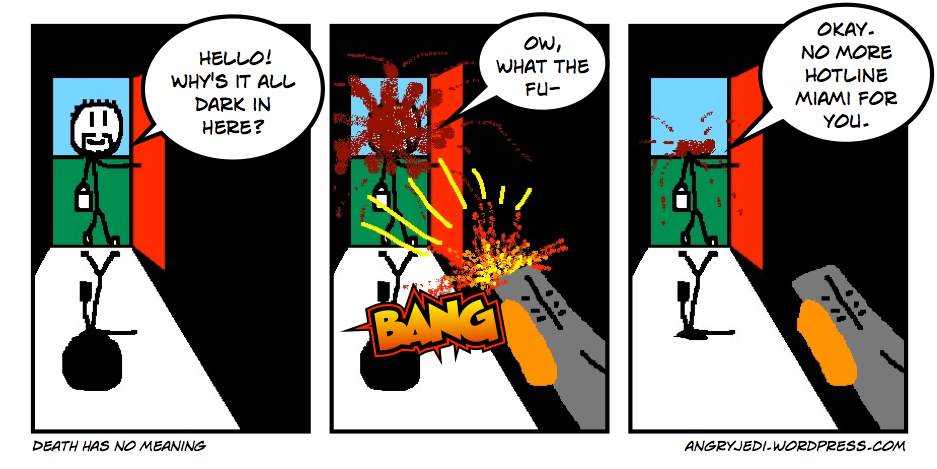
Page_1So, after being repeatedly bugged by almost everyone I know to try Hotline Miami, I tried Hotline Miami. Actually, to be more accurate, I sat down to play some Hotline Miami several hours ago and somehow here I am at 1am having completed it. What happened there?

I had been warned of the strange time-distorting properties of this curious little game by those who had played it, but having experienced it myself this evening… yes, there's something very odd going on there. A genuine feeling of, for want of a better word, "addiction" — of not wanting to stop until you've seen it through, even if the level you're on is ridiculously difficult. My "Die 1,000 times" achievement attests to the fact that I apparently did spend quite some time on it this evening.

But allow me to back up for a moment for those who are unfamiliar with Hotline Miami and its dubious charms.

Hotline Miami is basically that game the Daily Mail have been worried about for years. It's a straight-up game about murdering people with a variety of implements. It's gory, it's gross… and after about five or ten minutes of playing, it completely desensitises you to the acts of wanton violence you're committing. It then shows its true (neon) colours — despite its hyper-violence, it's actually a sort of puzzle game, a sort of lightning-fast strategy game, a sort of… I don't know. I don't like throwing this word around as it's rarely true, but I have a suspicious feeling that it's *whisper* unique.

The setup of Hotline Miami is that you, the faceless, nameless protagonist, repeatedly receive strange phone calls from a variety of sources. The phone calls themselves seem relatively innocuous, but when you get to the location you were told to go to, you apparently feel a strange urge to don an animal mask and then slaughter everyone who is there. Which is sort of convenient, because everyone there also wants to slaughter you.

You work your way through the levels by killing all the enemies. You have to scavenge weapons from dead enemies or the environment, and guns only have a small amount of ammunition in them when you do find them. Melee kills are silent, whereas attacking with a gun will often bring enemies running. When enemies are unaware of your presence, they follow very simple, predictable patterns. All you have to do is complete each stage of each chapter by killing all the enemies, at which point you'll receive a score breakdown showing how you did. The better you score, the better your grade and the more stuff you unlock.

Unlockable stuff includes weapons, which show up randomly in the levels, and masks, which you can equip before the level starts. Each mask has a special ability — one provides larger amounts of ammunition in guns, for example, while another makes your bare-handed attack (which normally just knocks enemies down, necessitating a ground attack to finish them off) a fatal strike. After unlocking the latter, I found that I didn't really use the others all that much. Perhaps I'm just unimaginative.

There is a plot that gradually unfolds as you progress through the levels. Like the swirly, pixelated, colourful visuals, it is rather vague and dream-like, and the end leaves a large number of questions. There are a few nice twists and turns, but it's not really the star of the show here — it simply provides a loose justification for the various top-down locations in which you visit and kill everything.

Hotline Miami is tough. There are levels that will repeatedly kill you over and over and over again — a thousand times or more, apparently — but somehow it will keep you playing in that same, inescapably compulsive way that Super Meat Boy encourages "just one more go". The fact that respawning after death is completely instantaneous helps this somewhat — there's no real feeling of being "penalised" for dying, it's simply part of the learning experience for each level. Death ceases to become something that makes you want to throw your controller out of the window, and instead becomes an exhortation from the game to try again and do better. It's still frustrating — I called the game (or possibly myself) "dickhead" a good few times while playing — but the important thing to note about it is that when you die, it's usually your own fault rather than that of the game. This is the sign of a well-designed difficult game — one where you accept that you'll make mistakes and learn from them, rather than where dying repeatedly simply makes you want to switch off and play something that repeatedly massages your ego, gives you a cuddle and tells you everything is going to be all right.

Anyway. That's Hotline Miami. If you have no issue with your games being borderline abusive in terms of difficulty, hyper-violent with little to no remorse, and leave you feeling like you've had some sort of drug-fuelled experience for several hours, then you should probably check it out. Conveniently, it's 50% off on Steam this weekend. How about that.

You should also check out this "two-headed review" over at Games Are Evil.

Now, if you'll excuse me, I need to sleep… and probably have some very peculiar dreams.

1016: A Few More Aselia Thoughts

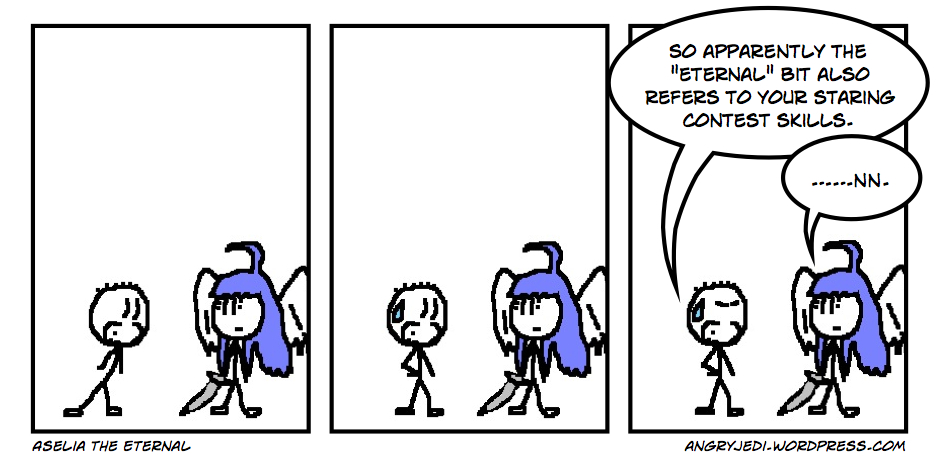
I finished my first playthrough of Aselia the Eternal this evening. Clocking in at about 54 hours, this $30 title is certainly good value for money in terms of its dollars-to-hours ratio.

It's also a very, very good game, though one that will undoubtedly not be to everyone's taste. Simply put, if you enjoy the narrative being the focus of a game rather than its gameplay, you will dig Aselia the Eternal. If you're the sort of person who skips cutscenes even if you haven't seen them before, you will not like Aselia the Eternal.

This is not to say that Aselia the Eternal is as "gameplay-free" as most other visual novels, however — in fact, it plays host to an excellent strategy-RPG component as well as its decision-based visual novel aspect — but you have to be willing and able to deal with the fact that the game will frequently break without warning in mid-"mission" for a considerable amount of plot exposition. I love that the game does this, as it gives a nice feeling of "coherence" to the experience rather than sharply demarcating where "plot" and "game" are. Equally, it will doubtless annoy some others. If it sounds like it might annoy you, you will probably not appreciate Aselia the Eternal.

There are eight endings to the game. I have now seen one of them. After the break, some spoileriffic thoughts on the whole playthrough.

MAHOOSIVE SPOILERS AHEAD, in case that wasn't already clear.

Continue reading "1016: A Few More Aselia Thoughts"

1014: Aselia the Exceedingly Lengthy but Still Well Worth Playing

Back in early October, I did an initial blog on my impressions regaring a Japanese-developed visual novel known as Aselia the Eternal. Since that time, I've written two columns on the subject for Games Are Evil one about the game itself, the other about how it creates a convincing, coherent-feeling game world mostly through words — and there's still a huge amount more to say about it. So I'll brain-dump it all here and you can sift through at your leisure.

The first thing I want to say is that it's a pity more people won't play this. I can shout its name from the rooftops all I like, but I know for a fact that most of you reading this are not even considering picking it up and trying it out. This is the one failing of the video games medium becoming so broad and wide-ranging in recent years — no-one has time to play everything, so the vast majority of people concentrate on the recognisable names, the new releases, the triple-A blockbusters and the "indie darlings" of the moment, leaving titles like Aselia to — relatively speaking — flounder. Take a look at this great article by Rowan Kaiser, for example, in which he suggests a variety of games to give a gaming newbie a "crash course" in what the medium is all about. Everything on that list is, I'd argue, mainstream or at least "well-known", and yes, I include titles like Journey and Papo and Yo in that description. They're all "safe" options — and that's not a particularly bad thing, especially when trying to introduce someone new to the medium — but a lot of people don't ever step out of this comfort zone because there's no real need to.

On the plus side, however, this means that the fans of these particularly niche games are almost infinitely more passionate and willing to discuss them than someone who has completed, say, Assassin's Creed III. (There are exceptions, of course — I know I follow several people on Twitter who are obsessed with Ezio di whateverhisfullnameis and the overly-complicated lore of the Assassin's Creed series to an unhealthy degree — but I'd argue the people who care that much are in the relative minority.) And, of course, there's the fact that titles like Aselia represent "mainstream  PC gaming" in Japan, so if you can actually speak Japanese (I'm working on it… slowly!) you'll find like-minded people out there.

But anyway. If you have played Aselia the Eternal (or indeed any other visual novels) and want to enthuse about them with me, please feel free to do so at any time.

Now. To business. Indulge me a moment while I explain what it is that makes Aselia the Eternal particularly noteworthy or at least "interesting" to look at.

First of all, a little history. Aselia the Eternal was originally released in 2003 on PC as an 18+ eroge called Eien no Aselia – The Spirit of Eternity Sword. In 2005, it was stripped of its erotic content and released on PlayStation 2 as Eien no Aselia – Kono Daichi no Hate De (Aselia the Eternal: At the Ends of this Earth). Rather than the excision of the erotic content making it a "gutted" experience, however, the game was rewritten to make it more friendly to a wider audience. This "all-ages" version was later backported to PC in 2010, and translated into English by JAST USA in 2011, leaving us with the version we have today. JAST took the decision to translate the "all-ages" version rather than the 18+ original due to content which would have proven "problematic" to get around the censors — specifically, there are a number of characters who look very young (despite, as with most eroge, character ages not being made explicit anywhere), which makes erotic content involving said characters out of the question to Western audiences; and also, the original carried an "evil path" through the story which featured graphic scenes of violence and sexual assault — also deemed unpalatable to Western players. 

The upshot of all that is that the version of Aselia the Eternal you can buy legally today is not compromised in any way from the vision of its writers, but equally it does not feature any content that you might not want anyone viewing over your shoulder. In other words, this is not a hentai game; rather, it is simply a Japanese visual novel/strategy game/RPG type thing sans bonking.

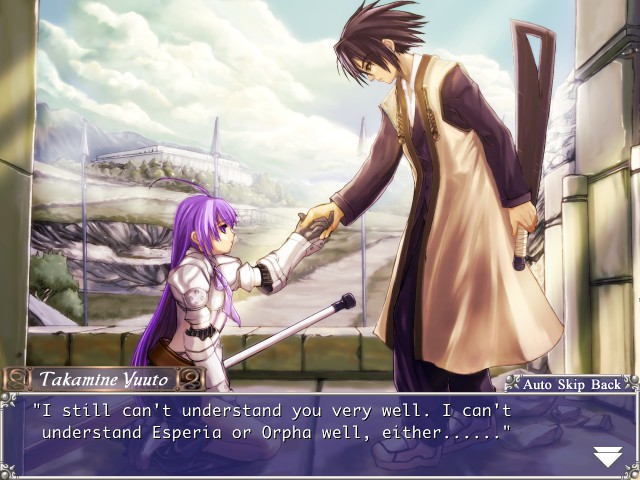
It's the peculiar blend of genres in its gameplay that makes Aselia the Eternal an interesting one, though. Initially appearing to be a fairly conventional visual novel involving a cast of high school students, a pair of (foster) siblings with a mildly questionable relationship and the occasional innocuous-seeming choice that you just know will have surprisingly far-reaching ramifications, the game gets truly interesting after about 5-6 hours of pure exposition — 5-6 hours that will determine whether or not you're in it for the long haul. The game's player-protagonist Yuuto as well as several other characters get spirited away to a mysterious fantasy world, and a battle for survival begins. From this point on, you'll be splitting your time between the number-crunching of a strategy RPG and the plot-heavy relationship manipulation of a visual novel. The two aren't necessarily clearly demarcated, either — the game frequently breaks in mid-mission for 30-60 minutes of plot advancement — but this actually works in the game's favour as it tries to tell its story, and stops story feeling like a "reward" and instead like everything you do is part of the ongoing narrative.

It helps, of course, that the actual gameplay in the strategic side of things is extremely solid. Here's how it works.

As you progress through the game, you gain control of a wide variety of female "spirits" of different colours, as well as the protagonist. Differently-coloured spirits have different specialisms — blue spirits are good at direct attacks, for example, while green spirits tend to have higher HP and defense. Red spirits, meanwhile, are good at magic, while black spirits are a bit of a "jack of all trades, master of none" class, with good HP and defense, decent attack power and some useful enemy-crippling abilities.

Your forces are split into four "squads" of up to three units each. The unit in the first position of the squad is the Attacker, the second is the Defender and the third is the Supporter. The Attacker's job is to… well, attack… the Defender's job is to soak up damage and prevent critical hits, and the Supporter's job usually involves casting spells of some description, which might be direct attacks, buffs or debuffs. Each unit has up to three equipped skills for each of the three different squad positions, for a total of nine skills at any one time. I say "at any one time" because as they level up, abilities get overwritten — sometimes this is your choice, other times, "Limited Skills" mean that you must overwrite a previous level of a skill when you earn a new one. Only one skill from each category may be "set" at once — this is the one which will be used in battle — and each skill only has a limited number of uses before the unit needs to return to a friendly town to rest and recharge.

You move around the "campaign map" via preset pathways, one "space" per turn. If you move onto an enemy, you attack them. Before the battle resolves itself, you can see the lineup of the enemy squad (including HP and abilities), and you then have the opportunity to rearrange your squad members and set the abilities you would like them to use in the upcoming battle — this is an immensely important step that can mean the difference between life and death — and then it's into combat.

Battle unfolds in several phases. First of all, the attacking side's Supporter casts an "Attack Support" spell if it has one set — these include buffs or some healing spells. Then the other side gets to do the same. Then the attacking side's Attacker gets to make an attack, which is usually intercepted by the Defender if there is one, then the Supporter, then the Attacker finally. Certain skills allow units to target specific units other than the Defender — this can be particularly useful if the Supporter has a nasty spell ready, but not many HP left.

Following the first attack, the Supporter gets to cast a Divine Magic spell if they didn't already case an Attack Support spell. These are mostly offensive in nature. Then the defending side gets to attack, then Divine Magic. This then repeats until all the units involved in the battle have expended the number of "actions" for the skills they have set. Certain skills may be used more than once per battle, and this can be used to your advantage — if, for example, the enemy Defender can only use their damage reduction skill once per battle and you have a powerful attack that can be used twice, that second attack will connect and do "critical" damage.

There's an added twist with the Attack Support and Divine Magic spells — blue spirits have the special "Ice Banisher" ability when in the Supporter role, which can interrupt certain spells. Naturally, there's a trade-off — blue spirits are also the strongest Attackers, so having one in the Supporter slot means that they're not doing damage, but making effective use of Ice Banisher is essential to survival as the enemy gains access to stronger spells.

It's a system that initially appears rather complex and confusing, but becomes second nature after no time. It's actually a very elegant system that forces you to think carefully about which characters would be most useful in dealing with the situation in front of you, and requires that you manage your army carefully to ensure they're strong enough to take on the challenges ahead of them. It also means that there are often a number of ways of getting past seemingly insurmountable challenges — that boss who is giving you grief may hit hard, but he only has two uses of his attack skill before he's left unable to damage you, so if you can just keep your green spirit alive for two turns, you can then exact bloody revenge at your leisure.

Pleasingly, there's no grinding in Aselia the Eternal. While you're wandering the game world, your captured towns are converting their stored "mana" to "ether" at a rate dependent on how many Ether Refinery buildings you've constructed. The more towns you have, the more mana in your pool, but mana can't be used in its raw state — it has to be converted to ether first. Once you have ether, however, this can be spent on constructing new buildings or, most importantly, levelling up spirits and the protagonist. To do this, they must be located in a town which has a Training Facility constructed, and their entire squad must rest while the individual unit trains. You gain access to various different trainers with different specialisms as the story progresses, putting an effective "cap" on your progress as you go through — but sometimes you hear rumours of trainers in far-off locations, and can enlist their services if you send a squad to go and pick them up.

So Aselia the Eternal would be an interesting strategy game even if it didn't have the plot attached to it. What makes it a remarkable experience, however, is how the plot makes you feel about those units scampering around the world map. Because you get to know all the people in your squads in various story scenes, not just the main characters, you care about them and you don't want them to die. Letting a unit die means that you'll never see them again in the story, because there are no revive skills until very late in the game. When you see how many little subplots involving these seemingly "unimportant characters" are weaved into the overall narrative, you'll very much want to be "that guy" and reload every time someone kicks the bucket. After all, Halion promised you that she'd bake some special treats for you in her shop when the war is over… you can't let her die, now, can you?

And goodness me. The Feels. Aselia the Eternal has them by the bucketload, particularly when it comes to chapter finales. This is a game that doesn't hold back on the emotional manipulation at all, and does its very best to make you feel terrible about every virtual life you take. The overarching story is at once both epic in scale and very personal to the protagonist, and the romantic subplots are expertly weaved into the narrative as a whole rather than serving as the sole focus as in some other visual novels.

I have one more chapter of the story to go, and I'm very interested to see how it concludes. Hopefully that will happen sometime this week.

But I feel I should probably stop there, as I've wittered on for over two thousand words. I won't tell you to buy and play Aselia the Eternal because I know that probably 95% of you aren't going to, but if, on the off-chance, you do, be sure to come and enthuse about it with me sometime.

1004: Thwarting The Fall

I finished Persona 3 FES: The Journey this evening, something I've been meaning to do for a very long time and finally got around to. Persona 3 remains one of my favourite games of all time, and the additions to The Journey — the story told in the original version of Persona 3 — are very welcome, offering deeper insight into the characters as well as some good old-fashioned fanservice.

Persona 3's biggest strength is also one of the reasons why I imagine an awful lot of people won't finish it: its length. Having played The Last Story earlier this year, I'm very much of the opinion that JRPGs don't have to be incredibly long to be tell satisfying stories, but in the case of Persona 3 and its sequel, both of which are somewhere in the region of 85-100 hours in length, I can't help but think that a lot of the respective stories' impact would be lost if they decided to reign things in a bit and keep them snappy.

Persona 3, for those who haven't played it, takes place over the course of a school year in Japan. You start in April, increasing amounts of Bad Shit comes to pass as the year progresses and you eventually finish either on New Year's Eve with a bad ending or on January 31st with a good ending. And you're expected to play through all the days in between, with only a couple of exceptions.

A day in Persona 3 typically consists of getting up, going to school (assuming it's a school day), perhaps answering a question or two in class, hanging out with friends after school then either going dungeon-crawling, studying or socialising in the evening. The format occasionally gets shaken up with public holidays (and Sundays) when you don't have school to worry about, and there's a couple of trips out of the game's main Japanese town setting at specific points in the story, but for the most part you are living the life of a Japanese teenager, albeit one who fights monsters after midnight.

It's a long, slow slog through the game's days, in short, but it's only through dealing with this that you truly come to respect the sacrifices the game's main cast has made in the name of trying to build a better world and beat back the darkness. Sometimes you really want to hang out with that hot girl who seems to have taken an interest in you, but instead you know that you should go shopping with the nice policeman who sells you various sharp implements, then go climbing the mysterious tower that appears after midnight and start twatting some Shadows in the face. Having to find this optimum "work-life balance" means that the time you do actually get to spend with your in-game friends becomes more precious — particularly as each of the "Social Link" stories that is attached to each person ends up being interesting and often emotional.

By the time you reach the game's final battle, you have been through Hell and back with these characters, both in terms of having to cope with the everyday stresses of teenage life — exams, angst, friendship drama — and in having fought your way through hordes of Shadows to strengthen your party. By the time the final boss appears, you are ready to kick some ass and save the world.

And then the final boss fight takes somewhere in the region of an hour to complete. The game isn't going to let you win so easily. It's not an especially difficult fight if you've prepared appropriately, but it is long — a test of endurance… and of whether or not you remembered to stock up on items before wandering into the dungeon. It's not boring, though — it's paced in such a way that it shakes things up regularly, requiring you to change and adapt your strategies accordingly, particularly as you get closer and closer to final victory. By the time you finally take down the boss and get onto the "home straight", as it were — and there's actually a surprising amount still to see even after you've kicked its ass — you are physically and mentally exhausted, just like the characters, and the game knows this, hitting you with some intensely emotional scenes while you're weakened.

Persona 3, then, uses its length to its advantage. While there is plenty of stuff in there that is clearly designed to allow masochistic players to inflate their play time yet further (I didn't beat the Reaper, for example, and I seriously doubt I will ever seelet alone beat the "Ultimate Opponent" secret boss that only appears in New Game+) for the most part, it's good stuff that allows you to immerse yourself in the small but very well-realised game world. You're either doing teenagery things, or you're fighting Shadows. Fight too many Shadows and you'll exhaust yourself, meaning you'll need to make sure you get some rest before you do anything strenuous — but while you recover, all your friends are waiting for you.

There's always something to do and someone to see, and meanwhile the clock is ticking ever-onwards towards an inevitable conclusion. As time passes, everyone's life goes on — even the incidental NPCs sitting around in various locations all have their own stories to tell that progress gradually as the seasons turn. Will the shy girl ever talk to the boy she's stalking? Will the girl who's obsessed with Mitsuru ever confess her feelings? Will the elementary school student at the station ever stop being a jerk to her obviously-nervous new teacher?

"Bonds of people are the true power," runs the tagline to the Persona 4 anime, and it's right. Both Persona 3 and 4 are what they are because of the people in their respective game worlds. After 80+ hours with them, it's difficult to not feel a sense of attachment to them — even the most seemingly-innocuous incidental character. This sense of "belonging", of immersion in a game world with realistic, believable characters — that, right there is why I love these games so much.

On to The Answer next, which I know nothing about beyond the fact it's supposedly very difficult and wraps up the ambiguities left by The Journey's ending. I'm very intrigued to see how it concludes for real, so doubtless you can expect another post on the subject after another 20 hours of gameplay or so.

#oneaday Day 995: Cultural Victory

Can you have too much culture? Can the sum of human creative endeavours add up to too much for someone to take in?

Well, first of all, those are two different questions. The answer to the second one, at least, is "yes"; the former? I'm not so sure.

We're already at a point where there is so much Stuff in the world it's impossible to keep on top of it all. Whatever media you're into, be it books, movies, TV shows, music or games, there's enough Stuff out there to keep you entertained probably for the rest of your life in just one of those formats, let alone if you, like most people, spread your time between several. Even if you spend your time focusing entirely on one genre within a single medium, you'll never get to the bottom of the pile. You'll never "finish" culture. You'll never see everything there is to see.

Depending on your outlook, this is either a fantastic thing or incredibly depressing news. For many, there's a degree of "shame" over not having caught up on things that are supposedly "canonical" or "essential" for everyone to have read/seen/played/whatever. The very term "pile of shame" (from which the Squadron of Shame takes its name) is used to refer to one's backlog of entertainment that has been purchased but not consumed — or, in some cases, the definition is stretched a little to include Stuff that the owner of said pile intends to consume at some point in the future, but perhaps hasn't quite got around to just yet.

With books, it's fine. Books are passed down from generation to generation; republished and republished. Today, we can keep a book alive forever by converting it to a digital format and scattering it to the four corners of the Internet. Sure, you lose some of the joy of turning paper pages and that distinctive musty smell they have, but at least the important bit — that's the work printed on those pages, lest you forget — is immortalised. You can read it on your computer; on your tablet device; on your e-reader; on your phone. You can annotate it and share your thoughts with other people around the world in an instant. Books are just fine.

Music, too, has proven itself to be pretty timeless over the years — for the most part, anyway. Throughout history there has been plenty of "disposable" music, but the true greats endure for years. Look how long the works of Bach and Mozart have lasted — people are still listening to, performing and studying these pieces hundreds of years after they were first composed. In more recent years, look at how the music of artists such as Elvis Presley and the Beatles is still interesting and relevant today. In very recent years… well, it remains to be seen which artists (if any) will leave a lasting legacy on culture, but there will almost certainly be some. (And if there's any justice, it won't be anyone who has ever won or been involved with The X-Factor.)

Movies, too, have become increasingly timeless with the improvements in technology over the years. While once a movie only lasted as long as the medium on which it was physically printed, now, like books, we can archive and keep movies forever. Sure, some moviemaking techniques now look antiquated and are unpalatable to modern audiences, but those truly interested in the full history of the medium can trawl back as far as they wish and see how it has developed.

Games, though, are arguably a bit more tricky, as they have an inherent "expiry date" due to the numerous proprietary technologies involved. While emulation technology is getting better all the time, it's still not perfect, and the legal grey areas surrounding it make it something that some people prefer to shy away from altogether. When you consider "PC" games, too, there's even titles that are ostensibly on the same platform that will no longer run on more modern technology. Fortunately, there are places like GOG.com who aim to keep these titles alive for modern audiences, but eventually even their remastered, tweaked versions will "expire" as technology makes the next big leap forward. What happens when computers become wearable and we don't use TVs any more? Will we still be able to play classic titles designed for the flat screen?

With all this, it's easy to wonder how you can possibly get through all those things that you're "supposed" to watch/read/see. The answer is surprisingly simple: don't. Accept the fact that you're never going to read Great Expectations; you're never going to see Citizen Kane; you're never going to listen to anything by The Smiths; you're never going to get caught up on the Assassin's Creed series. Cherry-pick the stuff you're interested in, finish what you start, and don't feel obliged to jump in to things just because they're brand new and everyone is talking about them right now. Get to them when you have time to appreciate them rather than rushing through them in the ultimately futile attempt to feel "relevant".

Crucially, enjoy (or at least appreciate) the culture you consume, whatever medium it's in. Your tastes are your own, and no-one has the right to try and change them. People can share their own opinions, sure, and these may help sway your thoughts one way or the other, but ultimately your feelings about the things you like and dislike are entirely up to you. There's no "correct" opinion; no gold standard of cultural awareness you need to aspire to; no "checklist" to complete. The sooner you recognise this fact, the sooner you can get on with working your way through that "pile of shame" — because there's some great stuff in there that you haven't discovered yet. And the stuff that is shiny and new right now will still be here in a few years time.

Take your time. Enjoy it. It's the least you can do for the people who have invested their time, money, blood, sweat and tears into entertaining you.


#oneaday Day 993: Why You Should Probably Play Quest for Glory

It feels like a good time to explain Why You Should Probably Play Quest for Glory, because 1) the complete series is available on GOG.com for $3.99 for one more day and 2) the Squadron of Shame just released a podcast detailing exactly why it's awesome. You can listen to it in the player below and go leave a comment here.

Quest for Glory remains to this day an aberration in both the point-and-click adventure and RPG genres, in that it is both. For those who have no experience of the series, the basic gist of all games in the series is that you have the mouse-driven "walk, look, use, talk" interface of an adventure game coupled with the stat-based system of an RPG. You wander around, you find out about quests, you get into fights, you save the sleepy Germanic valley/city/African-style savannah region/world.

Sounds simple, right? After all, RPGs and adventure games already have a lot in common — mainly the fact that both often involve a lot of talking — thus it's not much of a stretch to imagine an RPG with a point-and-click adventure game interface (or, in the case of earlier games in the series, text parser).

Except Quest for Glory doesn't stop there, because it makes its games noticeably and significantly different depending on whether you initially choose to play as a fighter, magic user or thief. (It's also worth noting that the "thief" class is a proper thief who breaks into houses and nicks stuff for personal gain, none of that namby-pamby "rogue" nonsense)

That's right — join the quest as a fighter and, for sure, you'll be doing a lot of fighting, but you'll also be using your brawn to solve non-violent problems. Become a thief and you'll be using your agility, climbing ability and stealthiness to sneak around and solve problems from the shadows. Become a mage and over the course of the various games in the series you'll outfit yourself with a diverse array of spells, only a couple of which are of the traditional "throw fiery objects at opponents" variety.

Best of all, if you're the sort of indecisive person who likes to play as a "hybrid" class, you can spend a few extra points on character creation to take a skill that doesn't normally belong to that type of hero. Want to be a wizard that's good at climbing? Go ahead. A thief with a good line in magic tricks? Sure! A fighter who knows what the word "sneak" means? Knock yourself out! All skills that are at higher than zero can be raised through grinding — the Quest for Glory series subscribes to the Final Fantasy II/Elder Scrolls mentality that skills should be raised organically as you use them rather than at arbitrary level boundaries. Crucially for the whole fun factor, though, it's relatively rare that you'll need to grind a skill, unless you're specifically aiming to do and see absolutely everything the game has to offer. (And if you are, you're a masochist.)

Then there's the fact that the Quest for Glory series was one of the first series that allowed you to transfer your save file from one game to the next. Beat one game and you'd be invited to export your character ready to import once the next game released. This was remarkably forward-thinking (and confident) of the developers at the time — and also somewhat symptomatic of the different times back then. Now, sure, we have franchises like Mass Effect and Dragon Age allowing you to import your save file from the previous game, but each game in the series didn't specifically include with a promise of the next one. In other words, whether or not a game gets a sequel these days isn't necessarily preordained — it's often dependent on sales. In Quest for Glory's time, it was built in to the design from the very beginning, even as technology improved over time.

This is one of the other interesting things about playing through any of Sierra's old adventure series. You can see how gaming technology evolved from game to game. Quest for Glory I and II initially used 16-colour 320×200 EGA graphics and a text parser, though Quest for Glory I was subsequently rereleased with 256-colour 320×200 VGA graphics and a mouse-driven interface. Quest for Glory II never got the same treatment officially, but a fan-made free remake (approved, but not funded or assisted by, the original team) brought it into the latter days of the 20th century rather nicely. Quest for Glory III then brought the series officially into the 256-colour VGA age, and Quest for Glory IV was the first CD-ROM based episode, featuring none other than John "Gimli and That Professor Bloke I Can't Remember the Name Of from Sliders" Rhys-Davies on narration duties.

Quest for Glory V marked a bit of a turning point, however, not just for the series, but for Sierra's fortunes and the adventure game genre at large. Being a CD-ROM only multimedia extravaganza with 256-colour 640×480 Super VGA visuals, polygons and a prerendered intro sequence that, while impressive at the time is utterly laughable if you watch it nowQuest for Glory V marked the point where, for many, the franchise lost its way. There are plenty of people who adore the game, of course, but those who grew up with the earlier entries in the series can't help but mourn the direction it took with its fifth instalment and its subsequent demise.

This wasn't the only time Sierra did something weird with one of its established series. In fact, almost all of Sierra's classic, long-running series ended up as something completely different to their original forms — King's Quest became a 3D action RPG with its eighth instalment; Police Quest became the tactical SWAT series after its fourth incarnation (later dropping the Police Quest moniker altogether); and Leisure Suit Larry just went off the rails altogether after its sixth episode (which, naturally, is called Leisure Suit Larry 7). In comparison to these other titles, Quest for Glory V's changes were actually relatively modest — but still enough to put some off.

Perhaps the saddest thing about the demise of the Quest for Glory series is that we really haven't had anything like it since. We've had a resurgence of point-and-click adventures in the last couple of years, sure, but nothing that so deftly blends two genres together with interesting stories, a genuinely amusing sense of humour and satisfying gameplay.

However, there's some good news for fans of Lori and Corey Cole — they're working on something new called Hero U, and will be opening a Kickstarter funding drive some time later this month. More details here. I'm pretty excited — they've said outright that it's not going to be a new Quest for Glory game, but it will incorporate some of the things they learned from making those games. Sounds awesome, right? Of course.

Hope you enjoyed the podcast. We certainly spent long enough recording it — and then I spent even longer editing it. 🙂

#oneaday Day 979: Personal Thoughts on Demonbane

I wrote a piece on visual novel Deus Machina Demonbane over at Games Are Evil earlier today and I would be terribly thankful if you went and read it, even if you're not a particular visual novel fan. Demonbane, while fundamentally not that different from most other visual novels — you read, read, read, read, read, read and occasionally make a choice — is, as I say in the article, interesting and noteworthy for the fact that it's not your typical galge/eroge. The main point of the game is not to pursue a particular female character romantically, but rather to work your way through a more "traditional" (for want of a better word — its combination of thematic influences is anything but "traditional") narrative that wouldn't be out of place in a JRPG.

I wanted to talk a little more about the game than I had the chance to get into in that article, however, and I'm probably going to get spoilery from this point onwards, so if you are intending to play Deus Machina Demonbane and would like your mind to remain virgin pure beforehand, I suggest you stop reading now. For courtesy's sake, I shall put in a "More" tag for your convenience. Click the "Continue Reading" link to… you know. Continue reading. Otherwise, I'll see you tomorrow.

Continue reading "#oneaday Day 979: Personal Thoughts on Demonbane"

#oneaday Day 971: Y'All Should Probably Play This FTL Thing

Things weren't going well. The rebel fleet were closing in, and the last jump had put the UNS Scruttocks perilously close to a rather active star that was currently enjoying a period of intense flares. Pete, best pilot in the remnants of the Federation (which wasn't saying much) frantically struggled to power up the Scruttocks' FTL engines as the ship was rocked  by the explosions of the overly-joyful sun.

It turned out that wasn't the only problem, though. A pirate ship, seemingly undeterred by the solar activity, stood staunchly in the path of the Scruttocks, matching its every move and doing its best to ensure that this would be the end of the intrepid crew's journey.

Andie ran from the bridge to her station at the weapons console at the rear of the ship. Lara followed her, splitting off at a rear bulkhead to head for the engine room. The undermanned Scruttocks was going to need every ounce of power she could give them if they were going to get out of this alive.

"Fire! Go for the shields!"

Andie didn't need to be told twice. She diverted power from non-essential systems, powered up the ship's missile launcher and laser cannon and took aim for the pirate ship's shield systems. The first missile sailed harmlessly past, while the first volley of laser fire was absorbed by their assailant's shields; the second struck true, the missile penetrating the shields and knocking out the shield generators, the cannon fire now free to inflict damage directly on to the enemy's hull.

The pirates weren't going down without a fight, though.

"Fire!"

"I am!"

"No, seriously, FIRE! Get out of there!"

Lara came running through the aft section, severe burns over one side of her body. Andie watched in astonishment as her determined crewmate headed for the medical bay. She smelled smoke, and knew that trouble was ahead. But if she could just hang on a little longer…

The air started to become thin; it became harder to breathe. Andie knew that Pete was trying to put the fire out by venting the oxygen out of the affected sections, but it seemed like the ship's oxygen distribution system had been damaged by the fire, as even though the weapons room was firmly enclosed, she was definitely starting to feel light-headed.

Lara came charging back through. "Come on!" she cried. "Help!"

Andie left the weapons controls on automatic and followed her companion through the aft sections of the ship. Sure enough, the fire had gutted the ship's oxygen distribution room, but the damage wasn't so severe it couldn't be repaired. The pair set about their important work, doing their best as the ship was continually rocked by impact after impact.

Finally, through the window they saw the debris of the destroyed pirate ship drifting sliently past. They had done it. The Scruttocks had survived another day, for now — all they had to do was get this oxygen tank back up and running before–

A loud bleep confirmed to the rapidly-weakening Andie and Lara that their efforts to repair the oxygen tanks had been successful. As they heard the air distribution system start up again, they breathed in heavily, gulping down the precious, life-giving air.

"Preparing for jump to lightspeed," came Pete's voice over the comm system. "Ready in 3… 2…"

At that moment, a solar flare erupted. The Scruttocks' hull, weakened from the protracted battle, tore apart like a snail shell beneath a wellington boot. Its crew's last thoughts as they were suddenly cast into the silent vacuum of space?

"Bollocks."

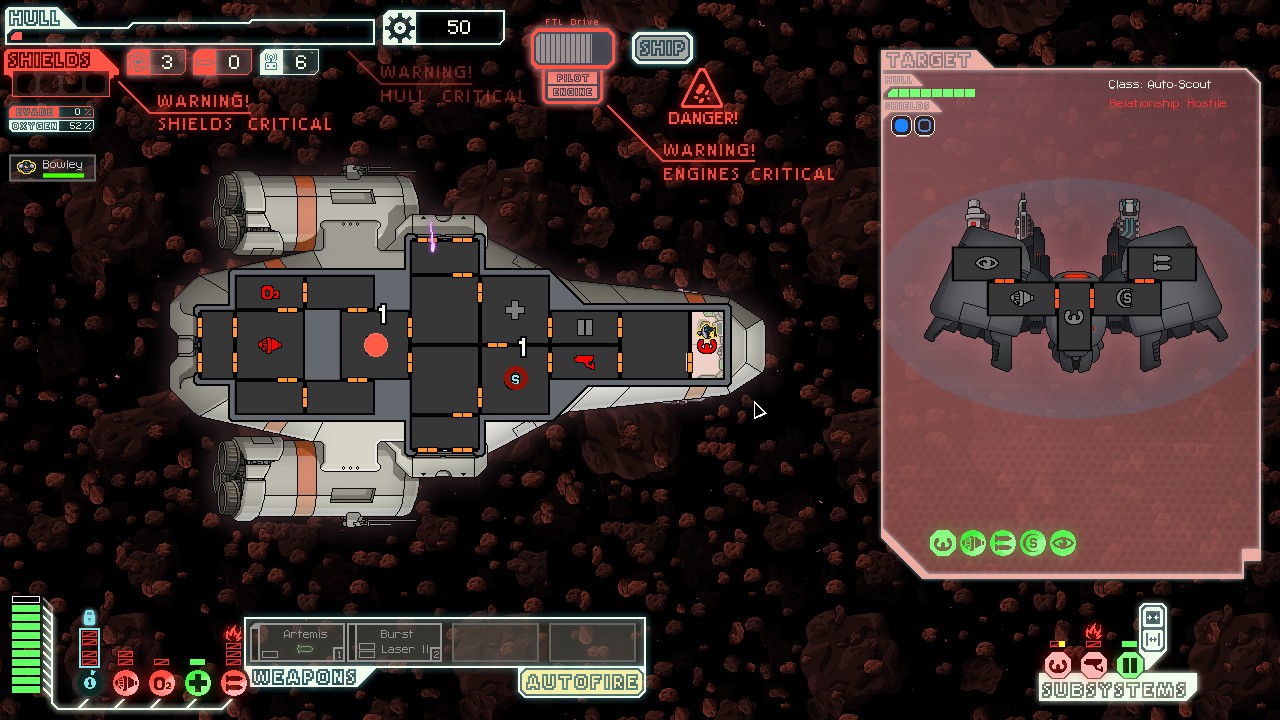
That's a typical day in the life of the crew of FTL: Faster Than Lighta new independently-developed game that officially came out today. In it, players oversee the crew of a starship frantically running from the mysterious "Rebels" as they attempt to deliver important secrets to the remains of the "Federation". Little more context than this is given, and little more is needed, because FTL is a game about the struggle that is the journey rather than its beginning or its conclusion.

The most apt descriptions of FTL would draw comparisons to the board games Space Alert and Battlestar Galactica. Like those games, FTL gives its players a small number of crew members and a sprawling ship in which to deploy them, then continually bombards them with increasingly-unreasonable challenges until they explode, die, asphyxiate or reach one of a variety of other sticky ends. It is possible to "finish" the game by beating a final boss, but for your first few playthroughs at the very least, you'll be dead within half an hour.

FTL strikes a great balance between simple mechanics and depth, and presents its unfolding emergent narrative in a manner that is abstract enough to allow the player to use their imagination, yet explicit enough to make it clear to understand exactly what is going on at any given moment. Players can route power to different parts of their ship, fire weapons on specific systems of enemy ships, move crew members around to man stations, deal with intruders and put out fires, and even faff around with doors. Doors are very important. You might not think that they are, but the moment your remote door control systems get blown out and you're unable to vent your engine section that is currently on fire, you'll come to appreciate the power of being able to sit in the driver's seat and open the back doors without running the risk of asphyxiation.

FTL describes itself as a form of roguelike and there's certainly plenty of resemblance there — a randomly-generated challenge at the start of each new game, permadeath and a wonderful sense of unfolding, unscripted narrative — but it has a unique identity that is all its own. It's not trying to be Star Control or Master of Orion or anything like that, nor is it trying to be Angband in space — it's the personal story of a few brave men, women and slugs who want to make a difference in a turbulent galaxy. Whether they do so, or whether they end up suffocating as they run around panicking at the fact that half the ship is on fire and the pilot is in the process of being eaten by a praying mantis? That's entirely up to the player's skill and/or sense of sadism.

Either way, you should buy FTL because it's fucking great.

#oneaday Day 961: I am Thou

I wrote a piece about Persona 3 over on Games Are Evil earlier today. Go read it, please.

I have, as you may have guessed from the fact I chose to write about Persona 3 today, been playing Persona 3. I have been meaning to play the extended FES version for many, many years now and have started several times. This time I intend to finish it, including battling my way through The Answer, which I understand is a bit of an ordeal. Then, if I'm feeling particularly masochistic, I will proceed to play Persona 3 Portable as the female protagonist.

I fucking love Persona 3 and 4. They are still my favourite games of all time. I own the first two for PSP/Vita, too, but found the first one a little hard to follow plot-wise and haven't delved particularly deeply into yet. Fortunately, each one stands quite nicely by itself — though and are nicely interconnected, even if certain aspects clash (why do the kids in P3 need Evokers to summon their Personas, but the ones in P4 don't?).

My love for these games stems primarily from the fact that they push all my gaming happy buttons. I love JRPGs and I love visual novels, and Persona 3 and combine the best bits of both genres. You have a simple-to-understand, hard-to-master combat and character development system; you have an in-depth storyline tackling very "human" issues. You have "saving the world" drama; you have characters dealing with personal crises that can, at times, seem more important than impending disaster. Somehow the game manages to avoid pretty much every cliché that critics of JRPGs hate to create an emotional, mature experience with an absolutely badass soundtrack.

The highlight is, of course, the cast of characters throughout. And as I said in my piece over on Games Are Evil, the interesting thing about Persona is that it's not only the heroes and villains who "matter" in the grand scheme of things. The "Social Link" mini-stories that arise as the protagonist gets to know his new school friends and people in the community are fascinating plotlines to follow through in their own right, and help to lend a greater sense of poignancy to the overarching narrative of the Persona-users attempting to Sort Shit Out. In other words, everyone has their own demons to deal with — sometimes these are literal demons, others they are the barriers we create for ourselves: fear, anxiety, shyness, a lack of self-belief. Watching the protagonist touch the lives of these people and be there with them as they come to terms with their own issues gives the small game world a much greater feeling of "life" than almost any other RPG I've played.

It also, once again, highlights the difference between Eastern and Western game design philosophy. When it comes to RPGs, I am firmly in the Eastern camp. I am yet to come across a Western RPG that has captivated me in the same way as the Persona series. You can rant and rave all you like about the beautifully-rendered worlds of Bethesda adventures or BioWare's (increasingly questionable) storytelling chops, but, for me anyway, no-one has the Japanese beat when it comes to interpersonal relationships and a sense of "human" drama amid supernatural chaos.

#oneaday Day 949: I Love You, Kotonoha... No, Wait, Sekai

You may recall back when I was rather obsessed with visual novel Katawa Shoujo that I put together a lengthy series of posts dissecting each of the characters and each narrative path it was possible to follow in the game. School Days HQ is inspiring me to do that again, and I know that there's at least one person reading this who is finding my descriptions of this game interesting (Hi, Calin!) so… well, here we go.

I make no apologies for the length of this post.

Spoileriffic thoughts follow. If you're going to play School Days HQ and don't want it spoiled, stop reading. Yeah, you.

The first thing I'll say is that I have not seen all of this game's endings yet. Given that there are twenty of them (I think), doing so will take a while. I have, however, seen five of them, and I feel this is starting to give me a good understanding of the characters involved.

School Days is structured in an interesting manner. As opposed to Katawa Shoujo's heavily branching first act and then five completely discrete "paths" through the game, School Days' narrative branches all over the bloody place. There are two distinct "paths" that the story splits into at the end of the second of the game's six "episodes", each seeing protagonist Makoto apparently pursuing one of the two leading ladies, but whether or not he will end up with his "chosen" girl is by no means a foregone conclusion. The various paths which the story can follow give additional context to various scenes, and help provide the player with additional understanding of a variety of characters — both the three leads and the more incidental characters. Let's look at them one at a time.

Makoto

Protagonist Makoto is, unlike a lot of visual novel/eroge protagonists, his own person rather than a "blank slate" onto which the player can project themselves. We join him as he finds himself attracted to the mysterious girl he sees on the train every day. This is Kotonoha. Shortly afterwards, his homeroom teacher rearranges the class' seats, and Makoto ends up sitting next to Sekai, whom he has not had much occasion to speak to before.

Makoto initially isn't sure how to respond to Sekai — she appears to be strong, pushy, loud and talkative. When she catches him apparently attempting to do a "charm" with his mobile phone — schoolyard rumour has it that if you take a photo of the person you like and keep it a secret for three weeks, they'll fall in love with you — things get interesting.

The very fact that Makoto is attempting this charm in the first place shows us that he's obviously quite a lonely person. He seems quite solitary at the best of times, and lacks the confidence to approach Kotonoha on the train. It takes Sekai's assistance for him to be able to talk to Kotonoha, and even then he struggles. Conversely, he appears to have absolutely no trouble talking to Sekai, though that might just be because she doesn't take "no" for an answer.

But why is Makoto lonely? We see that he has friends — he often hangs out with his best buddy Taisuke in class, for example, and he still has occasional contact with Katou, a girl whom he went to his previous school with. But he's distant, cold and aloof at times. At least some of this can probably be attributed to his home life. His parents are divorced; he lives with his mother and his little sister lives with his absent father. We don't see Makoto's sister often (or possibly at all — I can't speak for paths I haven't followed yet) but it's clear that he misses her; on a number of routes, he seems genuinely pleased that he's going to get to spend the weekend with her when we hear that she is coming to visit.

When Makoto does eventually get into a relationship, we find out a few more things about him. We discover that he's quite awkward in embarrassing situations, particularly when coupled with the equally-awkward Kotonoha, but like any red-blooded male, he has "needs" — specifically, a need for physical intimacy, even if it's just holding someone's hand. His sensitive side comes out even here, though — in one conversation with Sekai he worries about coming across as "perverted" when all he did was take Kotonoha's hand. Granted, she did slap him around the face when he did so, however, so what is the poor chap to think?

We also learn that he's easily swayed, particularly by women. He is weak-willed and unable to stand up for himself when another woman confesses their attraction to him, and he finds saying "no" difficult to do. Given the other facets of his character we know about, however, it's probably fair to say that this isn't because he's a horny pervert — on the contrary, he's a very considerate lover, given the evidence we see — but rather because he doesn't want to hurt anyone's feelings. This is a character trait he clings onto in most paths, though in the one where he focuses on Kotonoha to the complete exclusion of everyone else around him, he says explicitly to her that he no longer cares who he hurts, so long as he gets to be with Kotonoha always.

Despite the fact he is so easily swayed, he does have the capacity to devote himself to something (or, indeed, someone) and tune out all other distractions. While it takes quite some time in most of the paths for him to figure out whether it's Kotonoha, Sekai or someone else he wants, once he does figure this out, he sticks to his guns. Unfortunately, whoever ends up spurned doesn't always cooperate.

Which brings us neatly on to Kotonoha.

Kotonoha

Kotonoha initially appears to be a "Hanako" — a shy girl who is almost painfully awkward in social situations, particularly those involving members of the opposite sex. She speaks in a quiet voice and clearly thinks about the things that she is going to say before she says them, presumably in an attempt to ensure that they are the "right" things and that she doesn't make a fool out of herself.

We discover in several paths what one of the root causes of Kotonoha's shyness is: bullying, both in the past and the present. We learn that Sekai's tomboyish friend Nanami went to the same school as Kotonoha in the past, and Kotonoha regards her as a bully. We also learn that the other girls in her class bully her and take advantage of her whenever possible. This becomes particularly apparent at the school festival, when they leave her to man their class' reception desk all day while they go off hunting for boys to take back to the secret "break rooms" to have their way with them.

Kotonoha's difficulties stem largely from her appearance. She's cute and she has noticeably larger breasts than many of the other girls, and she tells Sekai that it has been this way since the end of primary school. She resents this fact, however, because it makes the boys look at her "in an indecent manner" and the girls assume that she is wrapping all said boys around her little finger. The truth of the matter is quite the opposite, however, as Kotonoha has never dated anyone prior to meeting Makoto, which explains her awkwardness around him.

Kotonoha is heavily hung up on the conventions of polite Japanese society. It takes her two days of effort to summon up the courage to ask Makoto if she can call him by his first name, even after they've already been on a date and have spent several days eating lunch together. She is terrified of being touched, worrying about being seen doing anything improper, and resists all of Makoto's advances when they are first together.

This particular facet of Kotonoha's personality can be attributed to her father, whom we don't see but we do hear about. He's very strict and doesn't approve of her consorting with boys, and also imposes a curfew on her to ensure she doesn't step too far out of line. Interestingly, her mother, whom we do see much more often, is the polar opposite of this, encouraging her to take more bold steps with Makoto, even going so far as to teach her the family's "secret lemonade recipe".

Kotonoha, like Makoto, isn't quite sure what to do once she's in a relationship. However, one thing is abundantly clear in every path: once she considers herself to be in a relationship, she considers that to be for keeps. She is not good at admitting when something isn't working, and continues clinging to false hope long after the object of her affections has clearly sought solace elsewhere.

If Makoto decides that Sekai is the one he really likes, then Kotonoha will continue to doggedly pursue him, eventually assuming that the reason he doesn't want her is because of her reticence and fear of being touched. She grows more and more bold and discovers that she can take advantage of Makoto's easily-swayed personality, particularly if sex is involved. She appears to develop something of a taste for sex after she seduces Makoto for the first time, going so far as to do some rather indecent things to him on the way home, and in one last-ditch attempt to break him and Sekai up (if, indeed, that is the path down which the story is going) seduces him once more and surreptitiously snaps a photograph of him in a very compromising position.

Kotonoha's stubborn, dogged determination stems from the fact that she has nothing to lose. We learn early on that she has no friends, preferring to absorb herself in a book than try and make peace with the girls who bully her in her own class. She welcomes Sekai into her life, however, believing that she is helping her altruistically. When it becomes clear that Sekai also has feelings for Makoto, however, Kotonoha becomes very jealous and clearly worries that she is going to end up alone again, so figures that she might as well throw everything she's got into trying to rekindle whatever spark there once was. On the flip side, if Makoto devotes himself to her, she doesn't appear to care one little bit about Sekai's feelings, because she knows that she'll always have Makoto and doesn't have to worry any more.

Kotonoha is a prime example of a character who is not at all what she seems at first glance. The shy, demure-looking cute girl actually turns out to be something of a master manipulator if provoked — given that she has nothing to lose, who knows what she's capable of if things really don't go her way?

Sekai

Sekai is the exact opposite of Kotonoha in almost every way. While Kotonoha is always immaculately-groomed and generally in her shy, quiet and demure persona, Sekai has shaggy, scruffy hair and is loud, brash, and confident, usually saying exactly what she thinks. She has a close group of friends whom she confides in regularly, and she latches on to Makoto as soon as the pair are made to sit next to one another.

It transpires, of course, that Sekai has actually had her eye on Makoto since the school's opening ceremony, when Our Hero helped out her childhood friend Setsuna. (Setsuna also fell for him around this time, though this only becomes apparent or an issue in one path that I've seen so far.) She is secretly delighted at the chance to spend more time with him, even if it is just to get him together with someone else.

It quickly becomes apparent that Sekai's interest in Makoto is a borderline obsession, as she refuses to give up on him even if it's clear he's favouring Kotonoha. She allows herself to be strung along in a "friends with benefits" relationship that arises from Makoto's frustration and Kotonoha's unwillingness to be touched. She is frustrated by this arrangement, but sees it as better than nothing. "It's a lie," she says every time Makoto tells him he loves her, "but it makes me so happy." On the rare occasions where she does get frustrated and voices these concerns to Makoto, he immediately apologises and decides that they should stop doing what they're doing, but every time she retracts what she says out of fear of losing him.

On the occasions when she does lose him, she shows that she does not cope well with rejection. She sinks into a deep depression, often becoming so upset that she's completely unable to function. Often her friends are able to help her out of this, but if Makoto proceeds down the path where he devotes himself entirely to Kotonoha, she becomes completely inconsolable. She loses all sense of self-respect and self-worth, submitting to Makoto's friend Taisuke as a "second best" option, culminating in a horrifying scene where Makoto and Kotonoha walk in on the aftermath of her clearly having been raped, despite the fact that both parties involves deny this. (This is the same path where Makoto comments that he doesn't care who he hurts any more, so his reaction to seeing one of his best friends having clearly been abused by another of his best friends is simply to be irrationally turned on by the fact he saw her in a dishevelled, half-naked state, going so far as to whack one off over the memory when he gets home. What a cock.)

Alongside the fact she is prone to depression, she also has something of a defeatist streak. In one path, her mother gets a new job in Paris and it becomes apparent that Sekai is going to have to leave with her. She does everything possible to try and avoid this but eventually concludes that it is hopeless and gives up entirely. It takes Setsuna stepping forward and mock-seducing Makoto (and secretly hoping that it can go further) for her to realise that she is willing to fight for him, and is unwilling to give up on her own happiness just because of something that may or may not be out of her own control.

Sekai does not appear to have a mean bone in her body. Even when Kotonoha is doing her best to secure Makoto as her own, Sekai never stoops to insults or manipulation, instead preferring to "win" on her own merits. The worst she gets is yelling "Coward! Idiot! Die!" down the phone at Makoto towards the start of the game when he's getting cold feet about asking out Kotonoha — a sequence which caused me to mistakenly describe her as "dangerously unstable" when I first started playing.

And while she describes herself as "quite a perverted girl" (despite being a virgin when Makoto first meets her) she never uses sex to get what she wants, unlike Kotonoha — although it could perhaps be argued that the times when she willingly goes along with Makoto's "friends with benefits" relationship is a form of manipulation to try and keep him around for as long as possible. She has no real power, however; she even jokes at one point that getting Makoto to say that he loves her more than Kotonoha is "more than I can get you to say, even with your dick in my hand".

Sekai's clearly a better fit for Makoto. The two of them both seem considerably happier when they're together, but shaking off Kotonoha proves to be rather difficult on most of the paths through the game. When they do get it together, though, there's much less of a feeling of "bittersweetness" than in some of Kotonoha's endings.

____

All three characters are fascinating to study, and not one of them falls into the trope trap. All of them have a surprising degree of hidden depth, and their interactions with one another is what makes School Days such a fascinating game to play. I'm looking forward to discovering even more about them as I creep ever-closer to 100% completion — it might be a while yet, though, since after seeing five endings I'm still just at 31%.