2355: Playing God

0355_001

After reading up on their work a bit over on Hardcore Gaming 101, I've become interested in the Super NES games of a developer called Quintet. Their work consists of several games that I've heard of but never actually played, plus one PS1 game that I did enjoy and feel to this day is rather underappreciated: the unusual and interesting action RPG The Granstream Saga.

Quintet are perhaps best known for early SNES game ActRaiser and their subsequent Heaven and Earth trilogy, consisting of Soul Blazer, Illusion of Gaia and Terranigma. (The Granstream Saga is kinda sorta also part of this series, too, though in an unofficial-ish capacity and on a different platform to its three predecessors.)

I decided to start with ActRaiser, since when exploring a developer's work like this I like to start with their early titles and work my way forward through them to see how they developed over time. ActRaiser has primitive elements, for sure — most notably an almost total lack of narrative development, though there are some interesting events that come and go as you play — but by God it's an interesting game, the likes of which I've only ever seen on one (two?) other occasion(s) in the form of Arcen Games' similarly unusual and fascinating A Valley Without Wind.

ActRaiser casts you in the role of God. (Due to the SNES era being the dawn of Nintendo of America's prudishness that persists to this day, He is known as "The Master" in the localisation.) Your job is to deal with Satan. (Likewise, everyone's favourite Ultimate Evil is known as Tanzra in the English version.)

Satan has been up to no good, you see; taking advantage of God having a much-needed rest after Ultimate Good and Ultimate Evil had their last showdown, Satan decided that he should wipe out all of humanity, taint the land to make it uninhabitable by humans should God decide to try and repopulate the world, and then ensconce some of his most trusted lieutenants to make doubly sure that those pesky white-winged types didn't try and undo all their hard work. God isn't standing for this, of course, and so begins your unusual quest.

ActRaiser is split into two very different sections. When you first arrive in a realm tainted by Satan's machinations, your first order of business is to clear out the monsters roaming freely over the land. You do this by descending to the surface and possessing a conveniently placed warrior statue, which comes to life with God's holy power and proceeds to dish out some righteous justice on anyone who dares come in range of its blade. Fight your way through a distinctly Castlevania-esque level to a boss, kill the boss and you're ready for the next phase.

Once you've cleared out the monsters, God has enough power to create two followers, who immediately start shagging and pumping out new population for you, so long as you tell them to build some nice streets to put their houses on in a completely different mode that is somewhat like SimCity "Lite". The town then proceeds to repeatedly inbreed with each other as you direct their expansion efforts, with your ultimate aim being for them to build over the top of the inconveniently placed monster lairs around the land, each of which spit out annoying creatures that steal your population or set fire to your buildings at inconvenient moments. Once you've successfully redeveloped the monsters' areas of outstanding natural beauty, you then unlock the second action-platforming stage of the region, which is different and harder, with a different boss at the end. Once this boss is defeated, the region is at complete peace and you can then continue developing it or move on to a new region.

While these two elements of the game are obviously very disparate, they do feed into one another. Your performance in the initial action phase, for example, partly determines the maximum possible population the region will be able to sustain when you start developing it — score more points and you'll have a higher (unseen) cap on your population. Conversely, the more your population expands in the building phase, the stronger the warrior statue gets in the action phases and the more "SP" God has to spend on Miracles.

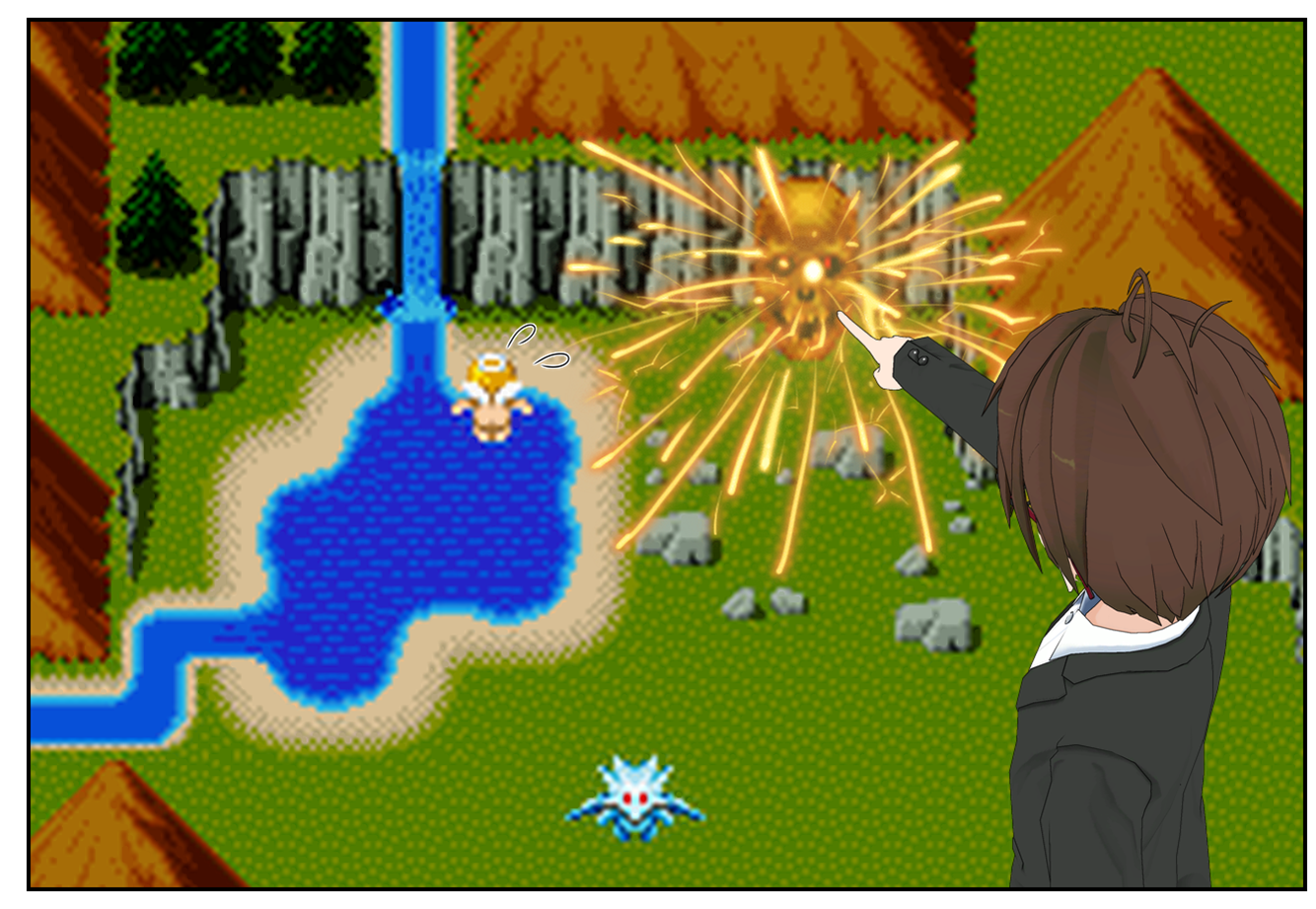
Oh yes, Miracles; these are a rather integral part of the building phase, and obviously the most fun, too. Beginning with a lightning bolt that burns down most things on a single tile (including houses) and working up to an earthquake that knocks down all low-level structures in a region, your Miracles are used to both direct development of the towns and clear obstacles out of the way. You have to force yourself to feel a certain amount of detachment when doing this, since as the tech level of each region increases and it becomes able to support houses that hold more occupants, it becomes necessary to demolish low-tech houses to make way for denser developments. And, being God, you don't use a bulldozer; you use natural disasters, which is far more fun. It's hard not to feel a little pang of guilt when you watch the little counter of "total population" in the upper-right corner of the screen plummet after you unleash an earthquake, though.

ActRaiser is a really interesting game. Both elements are solid, though neither of them are especially complicated. This is probably for the best; it keeps things reasonably accessible for those who tend to gravitate more towards one of the two styles of gameplay than another, though the difficulty of the action phases in particular is a little on the high side if you're not accustomed to how unforgiving old-school games are.

Ultimately it's a satisfying experience to descend to Earth and smite Evil before watching your little minions gradually spread out to cover the entire continent. You really do get the feeling that your people are relying on your divine powers, too; they pray to you every so often and ask you to help make things happen, and they'll reward you with offerings if you fulfil their requests. Many offerings can then be used in other regions to spread various innovations or culture, making the whole world work a bit better; for example, as soon as the second region discovers that wheat is a more productive crop than corn, you can then export wheat from this region to everywhere else so they can all take advantage of this improved efficiency. Likewise, when your followers reach a man lost in the desert a little too late, a distraught artist discovers the secrets of music, which you can then take to another region and use it to lift their spirits after they've been feeling a bit bleak. In this way, the world of ActRaiser feels very much alive, even if you're not dealing directly with named characters or a rigid, ongoing plot.

I like it a lot, in other words, and it makes me excited to check out Quintet's other work. You can count on a full report when I get to them.

2347: Discovering the Neo Geo

0347_001

To date, my knowledge of the Neo Geo platform has largely been limited to "it was that one where games cost over £100". Thanks to a recent Humble Bundle, though (running for another 16 hours at the time of writing) I've had the opportunity to have a go at what my friend Chris assures me are a pretty classic selection of games from the platform.

I'm kind of sorry I haven't checked out Neo Geo games earlier, because they fulfil every criteria I have in my head for what I think an "arcade game" should look, sound and feel like. This is largely because as well as being a home console, the Neo Geo also powered plenty of arcade machines in its time, and the versions you played on the console were exactly the same as you'd play in the arcade. Very few other consoles at the time could boast arcade perfect gameplay and presentation.

But what do I mean by what an arcade game should look, sound and feel like? Well, it's largely a nostalgia thing. When I think of arcade games, I think of childhood trips to the seaside — primarily either Hunstanton if we were going for a day trip, or Newquay if we'd gone on holiday to Devon and/or Cornwall — which always involved a trip to the arcades. To Americans, this might sound like a strange thing to get excited about, but here in the UK, we never really had much of an arcade culture — except, for some reason, at the seaside. In other words, an arcade was a rather unusual sight unless you happened to live on the waterfront, so it was a rare treat to be able to pump some small change into these games, many of which either didn't see home ports at all, or saw vastly inferior ports to home computer and console hardware that couldn't keep up with the specialised, dedicated arcade hardware.

When I think of these trips to the arcade, I think of several things. I think of the feeling of putting a coin in. I think of the sound the machines would make when it accepted your credits. I think of the sounds they'd make when you'd press the Start button, and the dramatic presentation of a new player joining or the Game Over screen.

I think of beautifully defined pixel art, far sharper and more detailed than anything I'd see on a system connected to the TV. I think of impressive animation. I think of sprite scaling and rotation. I think of specialised controls.

When I boot up a Neo Geo game, all of these feelings come flooding back to me. Individually, these elements aren't much, but they add up to the "arcade experience" for me, and said experience carries some fond memories.

I'll talk a bit more about the specific games I've had a go with in a later post, but for now I'll just say that, in terms of gameplay, the Neo Geo games are a reminder of a time when gameplay was first and foremost, and "gitting gud" wasn't something seen as elitist or exclusionary — if you wanted to see the end of the game, you either had to git gud at the game, or you had to keep throwing those coins into the machine. (Of course, when playing at home, you have the option to keep putting virtual credits in indefinitely — though as any shmup fan will tell you, the real challenge in these games is going for a 1CC, or 1 Credit Clear — beating the game without ever using the Continue feature.)

I like them a lot, in other words, and I'm looking forward to exploring the rest of these interesting, unusual and extremely addictive games further in the near future.

2262: Have You Played Major Havoc Today?

0262_001

Continuing my exploration of Atari Vault on Steam — and partly in honour of the fact that for some inexplicable (but welcome!) reason, Atari founder Nolan Bushnell followed me on Twitter earlier today — I thought I'd take a look at another game I was previously unfamiliar with: Major Havoc.

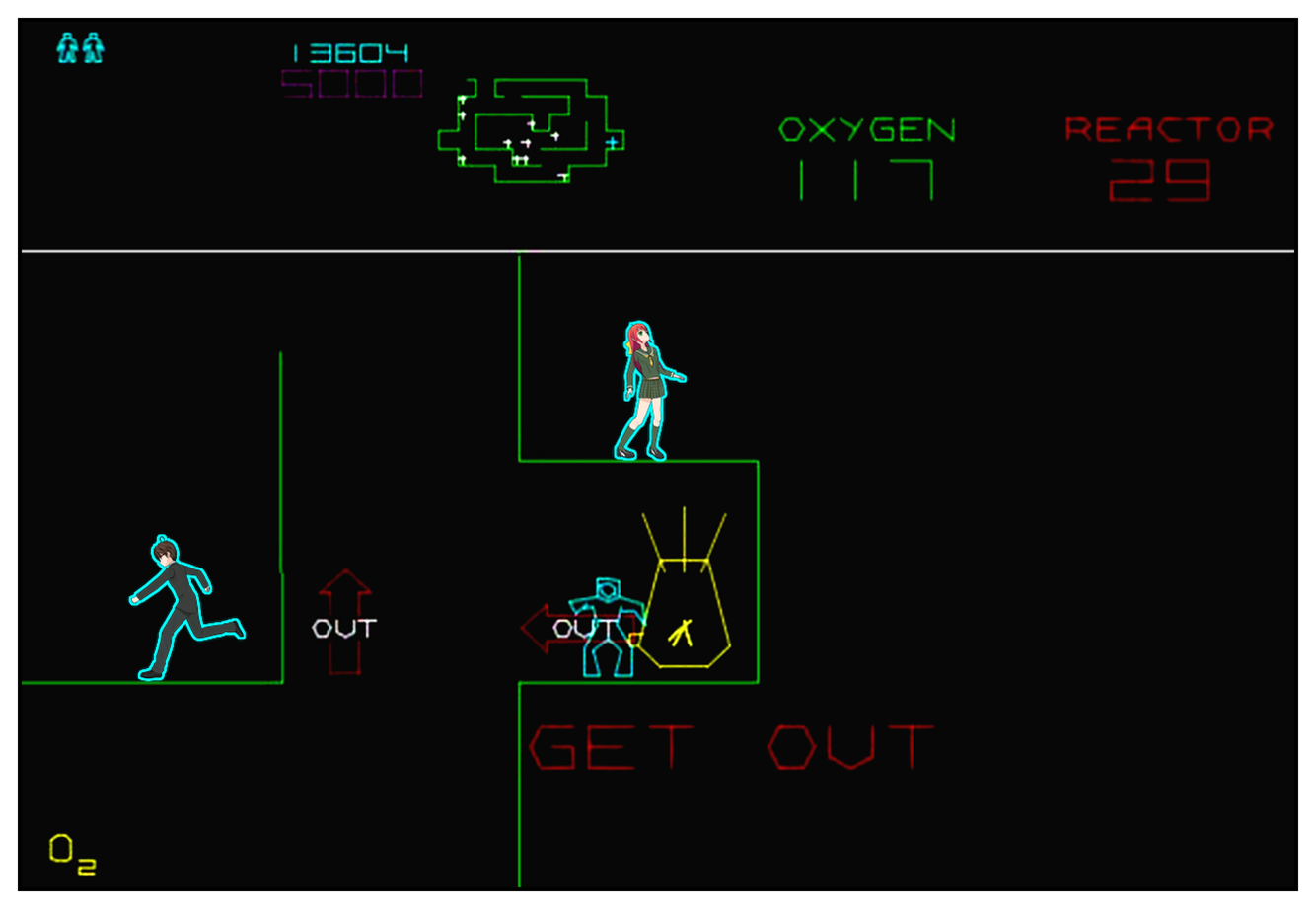
Major Havoc is one of those games from the early '80s that eschewed sprites, bitmaps and pixels in favour of vector graphics, giving it a very distinctive, recognisable look that stands alongside other vector games such as Asteroids, Battlezone, Red Baron, Tempest and Star Wars. In keeping with the inventiveness of video gaming's youth, Major Havoc is a rather peculiar game with some ambitious concepts, and quite possibly one of the first attempts at cross-genre gaming.

Major Havoc is split into several phases. First of all there's a quasi-3D shoot 'em up section, where you control Major Havoc's spaceship at the bottom of the screen and shoot incoming enemies as they come towards you. The interesting thing about this part is that it's not just straight Space Invaders-style waves of enemies: the first level features enemies that turn into a different form and home in on you when you hit them; the second features Galaxians-style swooping enemies, and the third starts with swirling, spiral enemies that draw lines on the screen, which subsequently become a maze you have to navigate your ship through as you approach your destination. (I can't get past this one, so I can't speak to what comes later!)

Following this, you have a Lunar Lander-lite section where you have to land Major Havoc's ship on a flashing white platform atop the target you were approaching in the first phase. Then Major Havoc gets out of the ship and you're seamlessly taken into a side-on platformer with weird gravity (hold the jump button down and you keep rising; let go and you'll fall) where you have to find a reactor, set it to explode and then get back out to your ship before you blow up with it. After that, the process repeats with a different wave of enemies, different platform to land on and different maze to negotiate.

It's a really cool game that tries some things I certainly haven't seen before, and the blend of space shooter and platforming hasn't really been attempted again (to my knowledge, anyway) until FuturLab's very recent Velocity 2x on PlayStation 4 and Vita.

It's also a stark reminder and interesting reminder that differences between Eastern and Western games have always been very apparent, though not always in quite the same way as today — Atari's games of the early '80s capitalised on the popularity of futuristic sci-fi thanks to Star Wars and made effective use of technologies such as vector graphics to create that aesthetic, while Japanese games of a similar era were often based around pixel art with cute aesthetics and more mascot-like characters.

Major Havoc, then: pretty neat, and another nice discovery from the Atari Vault. Looking forward to discovering more. (Also, hi, Mr Bushnell, if you're reading, which you probably aren't. Thank you for following.)

1936: Modern Old-School

One of the games I've been playing a bunch on my shiny new PlayStation 4 is Resogun, a game that I was previously moderately excited about, and which, prior to Omega Quintet (and, arguably, Final Fantasy Type-0, which I'm interested to try at some point in the near future) was a game I often cited as the only (then-current) reason that I'd be interested in a PlayStation 4.

But it wasn't enough by itself to make me want to buy one. For a new platform to be truly compelling for me, there needs to be some long-form games that I'm interested in, whereas Resogun is an arcade game, intended to be enjoyed in relatively short bursts. This isn't a criticism of it, mind, but I'd have had a tough time justifying a PlayStation 4 purchase to myself purely on the strength of what is, essentially, next-gen Defender.

But oh, what a game Resogun actually is! I'm still skeptical of whether I'd have found it worth buying a PS4 for by itself — although in retrospect, I bought an Xbox 360 primarily because of Geometry Wars, which is even more simplistic than Resogun — but I'm absolutely in love with it, because it represents a true fusion between classic old-school arcade-style gameplay and modern presentation.

At its core, as previously noted, Resogun is similar to the classic arcade game Defender. You fly a little ship that can move and fire left and right at will. Like Defender, the game unfolds on a scrolling, wrapping stage, though here it's represented as a cylinder that you fly around the outer surface of. Like Defender, your job is to save little green humans from being abducted by invading alien flying saucers. Unlike Defender, there's significantly more to it than that.

For starters, the humans are held in captivity before you can rescue them. In order to do so, you need to destroy "Keepers" — special enemies that show up every so often with a green glow surrounding them. You'll get an audible announcement when some Keepers show up, but not a visual indicator showing where they are if they're around the other side of the level, so you'll need to find and destroy them quickly to save the human in question, because if you miss any of them — or, in some cases, destroy them in the wrong order — the human will immediately die. Succeed, however, and the human will pop out of his little prison box and start running around on the ground, at which point he becomes vulnerable to being abducted, falling into holes, drowning and being splattered by unpleasant things. He also becomes available to be picked up by your ship and transported to one of the rescue pods at the top of the level.

To complete a level, you need to proceed through three "phases". Each phase requires you to destroy a certain amount of enemies represented by a bar filling up at the bottom of the screen. When you complete a phase, you get a brief "time out" where you can still move and fire, but you're invincible and the enemies move in slow-motion. This allows you a moment to compose yourself and get yourself into an advantageous position before proceeding. The end of the third phase, however, jumps directly into a boss battle, with bosses taking the form of various peculiar geometric shapes that warp and twist before your very eyes as you shoot chunks off them and chip away at their energy bar. When the boss is dead, the whole level explodes and you move on to the next one. Repeat for five levels, beat game.

Except that's not all that there is to Resogun — at least not with the excellent DLC packages that have been released since it originally came out. Between these two packages (available as a bundle or individually) there are several new modes, including Survival, which places you on a single level and tasks you with surviving through a series of increasingly difficult days, acquiring power-ups by picking up humans; Protector, which requires you to deliver humans to cities to rebuild them and subsequently defend them from giant alien flying saucers; Commando, which casts you as a human attempting to protect his house from falling meteors in scenes somewhat reminiscent of Missile Command for a new generation; and Challenge, which gives you a series of unconventional ways to play the game and tasks you with completing some generally pretty fiendish objectives.

Resogun is unabashedly a score-attack game, and consequently it naturally comes with online support, allowing you to compare your scores both to your friends and the rest of the world's players. You can also filter these scores by time, allowing you to challenge friends each week or month to see who is truly the best (this week/month), and scores are tracked completely independently for each mode and difficulty setting.

Combine this with a robust ship editor, allowing you to create your own custom ships using the 3D "voxel" pixels from which the entire game is built (and which it is very fond of exploding things into at a moment's notice) and the ability to share said creations online and you have a remarkably "complete"-feeling package that, now I've spent some time with it, I'm pretty confident in recommending as an essential purchase for anyone with a PlayStation 4. (Assuming you like shooting things and watching numbers go up. And who doesn't like shooting things and watching numbers go up?)

So yeah. Buy Resogun. You won't regret it.

1824: First Fantasy

I finished Final Fantasy I last night, bringing the first chapter in my Final Fantasy marathon to a close. And you know what? I really, really enjoyed it.

This may have something to do with the fact that I was playing the PSP version, also known as Final Fantasy Anniversary Edition, which has been substantially tweaked and rebalanced from both the original NES release and the subsequent enhanced PSone Final Fantasy Origins version, which I played last time I beat this first installment.

While there's an argument that it's worth experiencing the game in its original, purest, grind-heavy and rather difficult form — complete with its Vancian Magic system, just one of many influences the game drew from Dungeons & Dragons — the PSP version proved to be a lot more enjoyable generally. The pacing was better, there was a lot less running around in circles grinding — the original required you to do this to even beat the first boss, which appeared before the game's title screen — and the more traditional Magic Points system made some of the more lengthy encounters and dungeons later in the game somewhat more feasible.

Those late-game dungeons — four of which were added in the Game Boy Advance Dawn of Souls release of the game and the last of which was added in the Anniversary Edition release — proved to be really great, if a little bizarre. Collectively dubbed the Soul of Chaos, the first four extra dungeons live up to their name by tasking you with exploring 5, 10, 20 and 40 floors that feature set layouts but randomised floor orders and available treasures. There's not really a coherent theme to the dungeon floors as such — although the less interesting floors tend to be of an appropriate element to the dungeon's name: fiery caverns in Hellfire Chasm, for example — but the chaotic, unpredictable nature of them is what makes them interesting. On one floor you might be exploring a cave; the next you might be paddling a canoe around a flooded village; on the next, you might be attempting to navigate a maze of bookshelves while scholars mumble about their research and get in your way.

The final new dungeon, known as the Labyrinth of Time, was the most interesting by far, however. The Labyrinth of Time creates a new dungeon each time by picking ten different "puzzle floors" out of a selection of 30, then challenging you to beat these puzzles against the clock and with one or more of your abilities sealed off. The more abilities you seal off — and the more useful they are — the more time you have available to complete a floor. Run out of time and a dark miasma descends, damaging you every second and increasing the number of monsters you encounter.

The puzzles vary from simple observation puzzles, in which you have to answer questions about something you've just seen, to challenging physical tasks such as marching in line with a group of NPC soldiers. Like the Soul of Chaos dungeons, they have little to do with the overall Final Fantasy story — what little story it has anyway — but they're immensely enjoyable and challenging to complete. And then at the end of it all you have Chronodia, one of the toughest bosses in the game, to fight for ultimate bragging rights… oh, and the best sword in the game, too.

The first time I played Final Fantasy I, with the Origins release, I did so in order to understand the series' roots, and sort of had a good time, but found it a bit of a chore after a while. The PSP version, meanwhile, I found genuinely enjoyable, even from a modern perspective, and was inspired to go on and complete the game's most challenging content. I have absolutely no hesitation in recommending it to anyone looking for a fun portable RPG experience — and those of you without a PSP can even play it on your phone.

Onwards to Final Fantasy II, then, which I remember enjoying quite a lot the first time I tried it (again, with Origins) but which is widely regarded to be one of the worst installments in the whole series thanks to its bafflingly bizarre mechanics. For Fynn! Wild Rose!

1373: Steem-Powered

Although I grew up with the Atari 8-bit range of computers, some of my fondest early memories of using computers and playing games relate to that range's successor: the Atari ST. Unlike the 8-bit range, the ST was a 16-bit machine with an 8MHz processor, either 512K or 1MB of memory, support for MIDI, hard drives and floppy disks that held up to 720K of information. It was a huge leap over the 8-bit systems in many ways — though it did suffer from an appalling soundchip that actually sounded worse than the 8-bit range's POKEY chip in the hands of anyone other than the most skilled chiptune musicians.

I had a sudden urge to revisit some old ST memories the other day, prompted partly by a discussion with Andie on the subject of chemistry, of all things. (Andie's in hospital right now, if you didn't know, so discussions naturally turn to vaguely medicine- and science-related things on occasion.) Our discussion caused me to randomly remember an old Atari ST puzzle game from Psygnosis and Blue Byte called Atomino in which you had to create molecules by attaching atoms to one another and not leaving any… err… connecty bits (I'm not a chemist!) dangling loose. Remembering turned into downloading the Steem emulator and a copy of the game just to see if it held up. And it does!

I played Atomino for a bit until the emulation crashed (I think it was more a problem with the dodgy pirate disk image rather than the emulator itself) and then suddenly remembered a few other things — specifically, a few entries from the demoscene that I used to enjoy indulging in on occasion.

The demoscene is an odd old beast when you think about it, but it was a popular movement that, I believe, is still going on today. For the uninitiated, a demo disk was exactly what it sounds like: it was something you booted up when you wanted to demonstrate what your computer was capable of. More often than not, said demos were technically impressive in some way — they might use graphical trickery to get more than the normal 16 colours on screen, for example, or they might show off by putting graphics in places where it was normally "impossible" for the ST to render graphics. They'd often have good music, demonstrating skilled chiptune artists' mastery of the ST's crappy three-channel sound chip, and they were also often notable for quite how much stuff they fit onto a single disk.

One demo I remember particularly fondly — and which I successfully found a disk image of, so am enjoying while I type this out — was called The B.I.G. Demo. I can't remember why we had a copy with our original computer — chances are it was one of the disks acquired via my dad and brother's attendance at the local "computer club" (actually more of a local piracy swap meet — everyone was at it in the '80s and early '90s) that adorned the several big boxes of 3.5-inch floppy disks we had for the ST.

Anyway, The B.I.G. Demo was pretty neat. It wasn't the absolute flashiest demo I've ever seen, but it was cool. It had graphics in the borders, it had 256-colour visuals, and it had renditions of a wide variety of music from the 8-bit era. In fact, the main point of the demo was to act as a jukebox, providing access to a huge number of C64 classics in glorious ST-o-phonics. There was also a "Digital Department" menu that loaded separately and included digitised (more than likely MOD file-based) renditions of a number of the same tracks. Aside from this, though, everything in The B.I.G. Demo was loaded into the ST's memory, meaning no loading breaks whatsoever — not bad for a 512K machine.

One of the most interesting things about many of these demos was the scrolling text that inevitably adorned them. In many cases, the length of the scrolling message in the demo was the source of considerable bragging rights for the developers — not an unreasonable boast, given that when you only have 720KB tops to play with on a double-sided ST disk, even a short bit of text can and will eat into that space significantly.

The B.I.G. Demo had a whole bunch of scrolling messages, including one on the main screen that bragged about its lower border artwork, and the demo's crowning glory, the B.I.G. Scroller. This was quite simply a scrolling message that whizzed past in large print and would make you quite dizzy if you watched it for more than a few minutes at a time, but reading the whole thing would take you a significant amount of time. I can't remember a lot of the content from the B.I.G. Scroller (and haven't tried to read it since re-downloading the demo), but more often than not these "scrolltexts" took the form of stream-of-consciousness ramblings from one of the demo's creators, and were often quite interesting to read. In many ways, I guess they were a precursor to stream-of-consciousness blogging, and they're certainly an artifact that is very distinctive to the late '80s and early '90s.

I haven't kept up on the demoscene since I was a daily user of the Atari ST but I'm sure this sort of thing is still going on. I wonder how long the longest scrolltext is today?

1261: Registered Version

The resurrection of various video games from my youth is interesting.

I'm not talking about remakes here — though this discussion is in part prompted by the upcoming Unreal Engine 3-powered remake of Rise of the Triad — but instead, the rerelease of old DOS games, suitably tweaked and DOSboxed up in order to make them work properly on modern machines.

An awful lot of these games that are being resurrected were once "shareware" titles. For those of you too young to remember the shareware model — I'm not even sure it's still around these days — it was a means of distributing usually independently-developed games that involved giving away a significant proportion of a finished product for free, then inviting people to cough up for a more fully-featured "registered version" if they liked it.

The distinguishing factor between a shareware version and a good old-fashioned demo was the fact that demos are usually crippled or limited in some way; shareware versions, meanwhile, are fully-functional, just not quite as fully-functional as the registered version.

I didn't explain that very well. Let me give you a practical example that might make it a bit clearer.

Let's take the PC game Rise of the Triad, since it was that that got me thinking about this today. Rise of the Triad's shareware version was subtitled The HUNT Begins and featured ten levels in which you could only play one of the different characters available in the full version. These ten levels did not appear anywhere in the registered version, which was known as Dark War. This meant that you could play through the shareware version, decide you liked the game, buy the "full" version and play through a completely new series of levels.

This was one approach to the shareware model. Other games, such as Rise of the Triad's spiritual predecessor Wolfenstein 3D, were split into discrete "episodes", with the shareware version consisting of only the first episode and usually not featuring all the enemies, weapons and graphics from the full version.

The reason I'm thinking about this today is because when I was young and playing shareware versions of these games that I got from various magazine cover CDs and downloaded from CompuServe (yeah, you heard me), attaining the registered version appeared to be something that was all but impossible to me as a teenager with no credit or debit card. Digital distribution of paid-for titles was unheard for, so there was no "just download it from Steam", and many shareware titles required you to order the registered versions from America, leading to exorbitant shipping costs.

As such, I didn't really get to play many registered versions of shareware games I remember rather fondly until much, much later. It's a lot of fun to be able to revisit these games so quickly and easily these days and discover that the registered versions were indeed rather fun, after all.

Do they still hold up as decent games after all this time, though? Your mileage may vary somewhat, but I certainly still have a soft spot for things like Rise of the Triad, and am very much looking forward to seeing what Interceptor Entertainment have made of the upcoming reboot, which I preordered today. (It's $15, and you get four old Apogee titles for free when you preorder, including the original Rise of the Triad, its expansion and the two Blake Stone games. Not a bad deal at all.)

1117: Another Game with a Barely-Pronounceable Title

Page_1If you had no idea what genre a game called Ar Tonelico: Melody of Elemia fell into, it's highly likely that you'd guess that it was a JRPG. And you'd be absolutely correct. It's a title that doesn't make a whole lot of sense if you know nothing about the game, though to its credit, unlike many other barely-pronounceable game names, its relevance does become apparent almost immediately. However, it's still pretty much the exact opposite of the rather literal naming conventions adopted by social and mobile games these days, which tend to be called things like "City Wars" and "Farm Town" and "Slots".

Strange name aside… yes, I've been playing the PS2 game Ar Tonelico: Melody of Elemia, hereafter referred to as Ar Tonelico to save me typing out that whole title every time. I knew literally nothing about this game prior to firing it up for the first time, but had been urged to do so by a friend over at the Squadron of Shame who has been accompanying on my journey through the oddest and quirkiest undiscovered treasures that the Japanese role-playing game genre has to offer. I promised him that the next game I played after I completed the crap out of Hyperdimension Neptunia mk2 would be Ar Tonelico, so here I am.

So what's it all about? Well, if you live in the UK, don't count on any help from the box or manual — the game never saw an official release in the UK despite being fully-translated into English, and instead your best bet for a copy these days is Italy, of all places. It's rather peculiar to think of Italians playing JRPGs, but there you go.

Anyway. Ar Tonelico initially appears to be a rather straightforward JRPG with a floppy-haired, youthful protagonist wandering around the world seeking adventure on a Grand Quest to Save the World. And on the one hand, it is. On the other hand, however, it does a lot of very, very interesting things that have really made me sit up and pay attention, even only about four hours into the whole experience.

For starters, there's a deep crafting system to explore. This is a game from Gust, developers of the Atelier series (which I am yet to try but have all the PS3 incarnations of on my shelf), and their specialism is deep crafting systems. In Ar Tonelico's case, it takes the form of the peculiarly-named "Grathmeld" system, in which you have to find recipe cards around the world and in shops, find ingredients inside chests, shops and monsters and then fuse them all together using crystals. When you craft, you get a fun little animated sequence of your character Lyner assembling whatever item it is, then if it's a new item he has a fun little conversation with one of the other characters about it, and a discussion often ensues about what the new item should be called. You can't freely rename items, which is a shame, but you do get to choose between a couple of different suggestions, and the game then tracks which character named which item, which is a nice touch.

Perhaps the most bewildering aspect of the game is its battle system. For the first hour or two, it's a very conventional turn-based "attack, magic, item" affair. But as soon as you encounter the "Reyvateil" characters, also known as Song Maidens, things start to get interesting.

Reyvateils sit in the back row of your party and don't follow the usual turn order. Instead, they act like a mage or priest in an MMO, sitting behind the front row of fighters charging up spells (or Songs, in this case) to have various effects, while at the same time the front row is knocking seven shades of shit out of the enemy and ensuring the Reyvateil doesn't take damage. A strong focus is placed on the party's "harmonics" with the Reyvateil, with this represented by a bifurcated horizontal meter at the bottom of the screen. The left half of the bar fills when the front row lands successful attacks and drops when they take damage. The right half of the bar fills as the Reyvateil chants to charge up a spell. Should the two halves meet, the whole party goes up a "Harmonic level", which means the Reyvateil's spellcasting speeds up and the front row gain access to stronger attacks. The Harmonic level at the end of the battle also determines what rewards you receive.

There's another consideration in that system, which is the cap on the Harmonic level. At the start of each battle, you can only level the Harmonics up to 2; to increase the cap, you have to let the Reyvateil unleash her magic and deal enough damage for a separate bar to fill and open up the next level cap. The trouble is, at least early in the game, most enemies are absolutely obliterated by the Reyvateil's Song Magic, so you'll sometimes find yourself deliberately pulling your punches a little in an attempt to earn some higher Harmonic levels. It's an interesting system that will doubtless come into its own in more difficult battles later.

By far my favorite part of the game so far, however, has been the "Dive" system, where the protagonist Lyner is able to enter the subconscious of a Reyvateil and learn more about her. A Reyvateil's subconscious is split into ten distinct levels, each of which is made up of a number of different locations. Lyner must spend "Dive Points" earned through battle — which represent the trust the Reyvateil holds in him — to trigger various events, with revelations and strange happenings often unlocking new spells for the Reyvateil to cast in the real world. These vary from simple attack magic to "green magic" spells which can be cast outside of battle, usually to solve puzzles.

In gameplay terms, it's an elaborate means of unlocking abilities. But in story terms, it's a way of literally doing a deep dive into a character and discovering their innermost secrets. The scenes I've seen already have been heartfelt, interesting and help make me interested in the character. I'm very intrigued to see how they continue as the game progresses, as it's clear that the whole point of the "Dive" system is to help the Reyvateil come to terms with repressed memories and emotions in a vaguely similar manner to Persona 4's "Midnight Channel" — or perhaps just to peek in on some embarrassing things they'd rather forget about.

At four hours in, that's about all I can say so far, but I'm enjoying it a great deal. It looks super-dated — it's in 4:3 aspect ratio running on the PS2 and it pretty much looked like a PS1 game in the first place — but none of that matters to me. It is worth noting that it has an astonishingly good soundtrack, and that the English dub appears to be handled by the entire cast of Persona 3, which is fine by me — if a little odd to hear voices I recognise playing characters I'm less familiar with. (If you're wondering why I'm not playing with the Japanese voices, which are also included on the disc, it's because the FMV sequences in the game use the English voices, and it would be somewhat jarring to go back and forth between the two. The game also isn't fully-voiced, either, so it doesn't make as much difference as it would have in, say Hyperdimension Neptunia mk2.)

I'll be sticking with this one, then — though I may well be splitting my time between it and the Gamecube version of Fire Emblem when that eventually arrives. (The new 3DS version isn't out here until April, and I'm told I should play the Gamecube version before the Wii version that I scored for a song when Game was in trouble a while back.)

1110: The Collector

Page_1Reading this post from Matt Mason earlier made me think somewhat about my own game buying and playing habits and how they have evolved over time. I've come to the conclusion that I'm becoming something of a "collector", particularly when it comes to more obscure games that almost inevitably become hard to find if you don't snag them immediately upon release.

This doesn't mean that I pay over the odds to get "Collector's Editions" of games, though, because I tend to think that for the most part those are a waste of time — or perhaps it's just that I've never really had a Collector's Edition for a game that I felt particularly passionately about. Had I known how much I was going to love Hyperdimension Neptunia mk2, for example, I might have seriously considered spending a bit more and picking up the swanky limited edition that came with a soundtrack CD, an art book and some playing cards. (Yeah, I know the cards are a bit lame, but I love soundtrack CDs.)

NepnepLE-More often than not, though, the super-expensive limited edition versions are for games I have no interest in, like Call of Duty, Assassin's Creed and Skyrim. For sure, these limited editions are often cool, but there's only so many gigantic statuettes that you can scatter around your house before people start asking questions. (Particularly if one of those statuettes is a gory female torso… but let's not open that can of worms again.)

I'm actually fine with this, though, because I've been tending to find that the games I'm most interested in playing are the ones that maintain their value the best — simply because they're often not put out in particularly large quantities and thus often become quite hard to find after a little while. As such, I've come to accept that taking a chance on a new game like this often involves an outlay of at least £20 and may, in a few isolated cases, require payment of a price considerably inflated from what it would have cost when the game was first released. (I ordered a copy of Fire Emblem for Gamecube recently, for example… I'm pretty sure that's not what it cost when it first came out.) The fact that I've had to hunt for these games and occasionally pay a bit more for them than something of an equivalent age that had a wider release makes them feel somehow more "valuable", and makes me feel like my growing collection is something that I can be proud of. I know they're "just" games, but they represent a hobby that I truly love and which inspires me to do other things.

What this "collector's" attitude has meant in practical terms is that I'm now much more inclined to pick up interesting-sounding titles as soon as I become aware of them, rather than when I know I have time for them. This inevitably leads to an ever-growing backlog, of course, but it also means that I have things to look forward to. It's also an approach which works for my personal circumstances at present. In other words, I don't spend a lot of money on other "vices" — I don't drink, I don't smoke, I don't buy DVDs (with the exception of anime that can't be found for streaming online), I don't tend to travel a lot and, by the end of this month, I won't have any car expenses either (apart from any contributions I make to help Andie out with hers). This means that I tend to have a fair bit of disposable income that I don't feel guilty about splurging on my collection, and still have plenty left over for living expenses and to do nice things for Andie.

I like having physical things that I collect. My bulging Steam library also counts as part of my collection, but somehow that big list of games inevitably acquired for a couple of quid during a holiday sale isn't quite as satisfying as seeing that big shelf full of cases. Downloadable games feel more "disposable" somehow, like they won't last; I often find myself worrying what will happen to all these games when, say, Steam or PSN or Xbox Live don't exist any more. How will future generations be able to play awesome stuff like Flower, or Journey, or any of the other titles which everyone raves about now but which are only available via download? (I got around this issue with some of the visual novels I own by burning a copy to disc and printing my own inlay for the DVD case. Sad? Perhaps. But it means I can add them to my shelf with some degree of pride.)

The unfortunate side-effect of collecting physical things, of course, is that you have to find space for all of them, and if you get into full-on "hoarding" mode, where you don't want to trade anything in, ever, then you need more and more space as time goes on. I've currently still got a few shelves free on the other bookcase, but it's starting to get a little bit tight… and then what? Creative packing time.

photo (3)If you're curious, here's my game shelf as it stands right now. (The fairy lights were Andie's idea, but they are pretty sweet.) If you click to embiggen and zoom in on the image, you might even be able to see individual titles of at least some of the games. I haven't played all of these, not by a long shot, but they each — even the array of PS2 SingStar titles — represent something with genuine meaning to me. And that's pretty neat to think about.


#oneaday Day 822: Xoom, Xoom, Xoom, Xoom, I Want You In My Room

20120420-012830.jpg

I've been spending quite a lot of time with my shiny (well, rather fingerprinty now) new Motorola Xoom since it arrived the other day, and I have to say I'm a big fan. While Android seems to be a little more clunky than iOS, particularly prone to slowing down for no apparent reason on occasion, I'm appreciating the things it does do. Having a fully-customisable homescreen is very pleasant, certainly, and the cool quasi-3D effect it does with the wallpaper is pretty neat.

What's becoming abundantly clear to me as I continue to use it, however, is that using it simply feels very different to the iPad. It might be the fact it's designed to be used in landscape as opposed to the iPad's default portrait orientation; it might be the unique array of apps on offer on both devices; it might be a combination of interface elements. I'm not sure exactly what it is, but I can say that both devices certainly have a place in my life at this moment for different reasons — and also that getting the Xoom has caused my desire for a 3rd-gen iPad to drop to zero.

If anything, the Xoom seems particularly suited for more "serious" tasks (and by "serious" I mean "not games") — I'm particularly fond of using it for Twitter, chat, email and that sort of thing. Google Currents has become my go-to app for reading the daily news. The built-in "share" functionality, which allows you to easily send stuff from one app to another easily, is pretty neat. The keyboard I have installed, which lets you type by drawing wiggly lines rather than tapping keys, makes me feel like a wizard, particularly with the sparkly particle pattern that comes from aforementioned wiggly pattern. And the inclusion of a USB port (albeit a micro-USB one that requires an adapter for pretty much every peripheral ever, making one wonder exactly why they didn't just put a regular USB port on it) means that it's possible to do things like hook up a keyboard and practically use the damn thing as a sort of laptop.

A big draw for me was the thriving emulation scene on Android, however. Within a few short moments of getting the device up and running I had downloaded NES, SNES, Mega Drive and arcade machine emulators and a few minutes later had successfully transferred my collection of ROM files of dubious origin. What I have now is a portable gaming device that plays pretty much any NES, SNES or Mega Drive game, and a whole heap of arcade games.

This… is awesome. I hadn't anticipated quite how awesome this was going to be, but the ability to play Final Fantasy VI while on an exercise bike at the gym, or Elevator Action while on the toilet, or Golden Axe while waiting for the kettle to boil… well… yes. It's awesome. The fact you can hook up a USB controller (or, for that matter, Wii Remote with Classic Controller via Bluetooth) and play these games as they were meant to be played — with actual buttons rather than floaty, crappy touchscreen controls — is a happy bonus. The fact you can use floaty, crappy touchscreen controls at times when having a controller is not convenient or socially acceptable is also most welcome.

I'm certainly not going to become one of those gits who bangs on about how much better Android is than iOS because there are things that both do far, far better than the other. But I've been very pleasantly surprised by my first experience with an Android device, and the fact it's turned out to be a portable retro-gaming powerhouse is just a happy bonus, really. Now I can finally get around to beating all the Final Fantasy games that are still on my "to-do" list. (V and VI, as it happens. Also Chrono Trigger, which may as well be a Final Fantasy game.) And, as previously mentioned, playing Elevator Action on the toilet.

Now, if you'll excuse me…