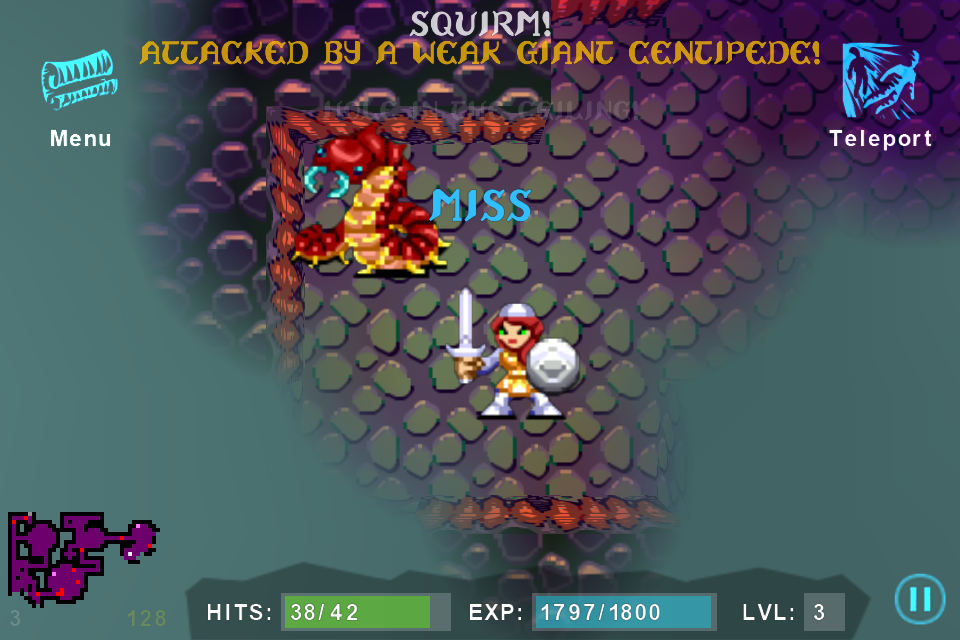
#oneaday Day 787: Shadow Hearts: A Scoreless Review

20120316-014112.jpg

Shadow Hearts for the PS2 is a game which seems to be almost universally adored by everyone who has played it. It's certainly a far cry from the reaction its PS1 predecessor Koudelka got, for sure, proving that yes, sometimes developers do learn from their mistakes.

Is it worth playing in 2012, though? That's one of the questions I set out to answer when I eschewed the latest and greatest in fancy-pants HD gaming and booted up Sacnoth's classic for the first time. I'd never played it before, so coming to it as a 2012 gamer would be my first experience — hopefully allowing me to determine whether or not it's still worth your time.

First impressions are striking, and not necessarily in a good way. We're in full-on old-school JRPG mode here, with polygonal characters wandering around on top of pixelated prerendered backdrops, occasionally stopping to perform a canned animation and generally not looking overly natural in their surroundings. Couple this with that much-maligned mainstay of Japanese roleplaying games, the random battle, and you have an experience which takes a little getting used to if you're accustomed to the ways in which the genre has grown, changed and adapted over the years.

Once you get your head into the mindset of how things work, though, all that culture shock quickly fades away. The characters may have somewhat wooden animations, but they're detailed 3D models with plenty of personality, and they provide the party you eventually assemble over the course of the game's 30 hours or so with a distinctive look. When combined with the good quality localisation job which has been done on the game's dialogue, the game's cast comes together as a loveable, memorable crew of misfits that is all the more notable for not relying on traditional JRPG archetypes.

The plot, too, is interesting and unconventional, blending real-world events from the early 20th Century with pure fantasy that occasionally drifts into Lovecraftian "it came from beyond the stars" territory, though with a slightly light-hearted edge on everything. It works well, and all the more so for the fact that it doesn't feel the need to necessarily spell things out for the player. You can tell that we're dealing with some sort of twisted alternate history here when we see how comfortable everyone is with the use of magic, for example — there are no exaggerated "Wow, you have amazing special powers!" scenes when new characters join the party, even when protagonist Yuri reveals the ace up his sleeve: his ability to transform into slobbering death monsters.

The characters' special abilities are what provides depth to the game's combat system. Characters tend not to be single-minded specialists, but often have a range of skills that unlock over the course of the game which can be applied to a variety of situations. Even leading lady Alice, who is set up pretty early on to be your stock "healer" character, has some entertaining tricks which she can perform — and she's not the only one with the ability to heal, either. Even some of Yuri's monster forms have the ability to heal, meaning the player can stick with a party arrangement that works for them — or that is simply made up of characters they find appealing. Given Yuri and Alice's importance to the overarching plot, however, most players will likely find themselves spending the majority of their time in the game with these two and one of the four other characters in the third slot.

Combat unfolds via a rather sedate turn-based system. There's no time bars here, just a simple behind-the-scenes initiative calculation determining who gets to go next. There are two twists on the traditional turn-based combat formula, however: sanity, and the Judgement Ring.

Sanity points gradually drain over the course of a fight, reflecting the mental strain battling horrific eldritch monsters has on the human psyche. Running out of sanity points causes the character to go Berserk, attacking enemy and ally indiscriminately accompanied by the word "Violently" curiously emblazoned in the air over their head. In a nice nod to characterisation through statistics, different characters have varying pools of sanity points according to their own mental faculties. Alice, for example, being a bit of a scaredy-cat girly-girl at times, has a very small pool of sanity points, while Yuri, who is wandering around with a variety of monsters living in his psyche, has a very large pool which he expends any time he turns into a monster — presumably a rather traumatic experience.

Meanwhile, the Judgement Ring is the mechanic which drives the whole game. Rather than simply hammering the Attack button to get through fights as quickly as possible, the Judgement Ring is a timing-based system that requires players to accurately tap the X button on their controller in time with a predefined pattern. Said pattern varies according to what the player is trying to do — using an item only requires one tap, for example, while the characters' later special abilities may require three or four carefully-timed taps in total. It's a simple means of making combat feel significantly more interactive than turn-based titles otherwise can, and it's also used outside of combat to resolve situations which would be handled by a dice-based "skill check" in a tabletop RPG — kicking down a door, negotiating for better prices in a shop, perfomring a task which requires endurance.

Whether or not you'll find Shadow Hearts to be a palatable play experience in 2012 will depend a lot on your patience. While the random encounter rate isn't overly high, you can expect exploration of the game's world to be frequently interrupted by battles with enemies — and, as is common for this breed of role-playing game, you'll see the same enemies and groups of enemies quite a lot over the course of a dungeon. Boss battles, meanwhile, are generally fairly lengthy experiences, partly to put a bit of pressure on the game's sanity system. Later conflicts can feel like they're dragging on a bit, particularly once you've managed to acquire some equipment for the party which allows them to shrug off things like status effects. The requirement to use the Judgement Ring with each ability use and attack helps keep things moving, but a few of the later bosses just go on a little bit too long to be comfortable or fun. The final boss is particularly prone to this, it has to be said, as it's something of a damage sponge. In a game where three-figure damage is considered a strong hit, taking down something with over 10,000 hit points is a task you'd better set aside plenty of time for.

Presentation has also moved on significantly since the game's original release back in 2001. Video sequences feature characters with that obvious sort of "rendered on the cheap" animation, and the voice acting is woefully inconsistent. Some English characters speak with an American accent, and others speak English at times and then yell something in Japanese in the middle of battle. The slightly rough edges do give the game a certain degree of charm, however, and the lengthy sequence where an old lady reads you a ghost story — complete with vocalised sound effects — is extremely memorable.

All in all, though, Shadow Hearts' charms considerably outweigh its idiosyncracies, and the game remains fun, entertaining and engrossing today. While it's not the most technically polished, high-budget JRPG — something which was apparent even back on its original release, especially when compared to Final Fantasy X, which came out the same year — it's certainly one of the most memorable. And, crucially, by clocking in at around 25-30 hours, beating the game is well within the reach of even people who like to go outside sometimes. In these days of everyone seemingly being increasingly busy, the importance of brevity shouldn't be underestimated.

So should you check it out in 2012 if you've never played it? Sure, but do be prepared for that initial culture shock as you adjust to the Way We Did Things over ten years ago. Times have changed, for sure.
#oneaday Day 783: Prepare for Moxibustion: Shadow Hearts First Impressions

20120311-235149.jpg

[I am not at all sorry for the above image.]

I recently acquired copies of Shadow Hearts and Shadow Hearts: Covenant for PlayStation 2. My good friend and podcasting buddy Mark has been extolling the virtues of this series (well, its first two entries anyway) for a considerable amount of time now, and given my current aversion to recently-released triple-A titles, I figured it was about time to give it a shot.

For those unfamiliar with this particular little gem, Shadow Hearts is a Japanese roleplaying game from 2001 developed by a company known as Sacnoth (later Nautilus) and published by Midway in Europe. It's the sequel to an unusual PlayStation 1 roleplaying game called Koudelka, which blended survival horror and tactical RPG elements to create a game that had a rather mixed reception upon its original release. Shadow Hearts, unlike its predecessor, is a much more traditional Japanese roleplaying game, with a great deal in common with the PS1-era Final Fantasy games. Players control a 3D character on a flat, prerendered backdrop and are thrown regularly into random battles against enemies which are otherwise invisible on the field.

Aside from these basic mechanical and technical similarities, however, Shadow Hearts is a very different beast to Square Enix's franchise, for a wide variety of reasons.

Mechanically, an innovative feature in the game was the "Judgement Ring" system, whereby any action which would be resolved in a tabletop roleplaying game by a throw of the dice is instead left up to the player's reflexes and sense of timing. The titular Ring appears on screen with markers placed on it to show where the player needs to press the button. An indicator sweeps round it, and the player must tap the button as the indicator passes through the various areas. There are variations on the theme, but this is used throughout the game whenever there is an element of chance — both in and out of combat. For example, the Judgement Ring is seen when attacking an enemy, attempting to cast a spell or use an item in combat (outside combat, magic and item use automatically succeeds, thankfully) or attempting to haggle for a better price in shops. It's a simple system that through its inclusion lends a much greater feeling of interactivity and involvement to a genre known for making the player sit back and tap the X button 300 times before getting to do anything. Its timing-based nature means that combat can't simply be resolved by strapping a rubber band to the X button and walking away — the player must learn the various characters' "rhythms" for their attacks and stay on their toes to tap the button appropriately.

It's not just in mechanics that Shadow Hearts differs somewhat from the norm, however. In a typical Japanese RPG, the party tends to be made up of a group of idealistic teenagers (with optional "old man" character who is actually simply in his late 20s), at least two of whom will be childhood friends; at least two of whom will fall in love with one another; at least one of whom will be a moody bastard who grows to understand human kindness and friendship by the end of the story; and at least one of whom will be a demure, shy girl while another will be a borderline-inappropriately sexy girl in a teeny-tiny skirt. This kind of ensemble works well, which is why we see it so often, particularly in popular franchises such as Final Fantasy.

Not so in Shadow Hearts. In Yuri, we have a moody protagonist, sure, but he's angsty because he can turn into monsters. Also he's half Russian, which explains why he hails from Japan but has a name which is commonly used to refer to lesbian-themed content in Japanese. (His name also means "lily" in Japanese, which might explain why he's so upset and surly. Although if we take "Yuri" to be the Russian half of his name, then that means "farmer", which is a bit more manly.) Then in Alice we have the shy, demure girl, but she's clad in what can only be described as an incredibly impractical outfit which precludes her from ever volunteering to bend over and pick anything up ever. She's also English. I've never met any English girls who dress like that. But then I wasn't alive in 1913, either.

Aside: not only does Shadow Hearts take place in the "real world" (albeit a real world with magic and demons and vampires and whatnot), it also takes place in recognisably "recent" (relatively) history, meaning we get a pleasing blend of low-tech fantasy-style stuff with the trenchcoats and Mauser pistols of the World War I-ish era.

But back to the cast. We also have a crotchety old Chinese oracle who calls people "son of a bitch" all the time and a friendly vampire called Keith (Keith?) who woke up from a 200 year slumber only to find himself bored stiff with nothing to do in his monster-infested castle. There may be more, but I haven't got that far yet. Already it's a memorable, bizarre cast, though the game nails the whole "suspension of disbelief" thing so well that it seems perfectly natural for this oddball group to be hanging out together while discussing the movements of the Japanese army.

Shadow Hearts is a slow burn that takes a while to get going. If you've been playing more recent Japanese roleplaying games that tend to be a bit pacier or have battle systems that veer a little closer to "action" (see: Final Fantasy XIII and its sequel, The Last Story and Xenoblade Chronicles to a certain extent) then there's a bit of an adjustment period to get back into random battles and completely turn-based combat. It's also a bit of a culture shock to go back to a game where the dialogue is pretty much all text — though this rekindles the once-common love for renaming your characters; a joy which the age of voice acting has rendered obsolete.

I'm guessing I'm about halfway through at the moment. Further thoughts to follow when I've beaten it.

#oneaday Day 606: While You Sleep, They'll Be Waiting . . .

I started up Wing Commander III tonight in celebration of its recent rerelease on Good Old Games and in protest against all the Gears of War 3 excitement that's slowly building up. (I hate Gears.) And by golly, I miss that series something rotten. (Wing Commander, not Gears of War.)

I remember first playing the original Wing Commander and being gobsmacked by its then-revolutionary cutscenes and effort in telling a story. In fact — and this was always a big taboo in the early days of PC gaming — Wing Commander's dedication to spinning a compelling, if cheesy, space opera yarn made me consistently enjoy it far more than the X-Wing series.

Wing Commander III was something special, though. One of the first games to boast a multi-million dollar budget. An early outing for Mark Hamill, now a mainstay of the games industry. Full-motion video in a glorious 256 colours coming out of its ears. And, bizarrely, a porn star cast as the ship's mechanic.

It's difficult to pin down exactly what it is that's so appealing about the Wing Commander series — III and IV in particular — but I have a feeling it's the good balance between plot and spacefaring action. Missions are short enough that you can get through a bunch in a single sitting, but they don't feel like "throwaway" efforts — there's always something to do, even if it's just a patrol. But it's the fact that you're rewarded for completing them with advances in the plot — or sometimes just getting to know the characters a bit better — that made the game fun for me. Despite the fact it's essentially Top Gun in space, with all the cheesiness that implies, Wing Commander's cast is memorable, even years later. I can still recall Malcolm McDowell's star turn as the deliciously sinister Admiral Tolwyn years later, and it's always nice to see John Rhys-Davies. Hamill, too, puts in a good performance — at the time, the game invited references to Star Wars thanks to Hamill in the leading role, but if Wing Commander III showed one thing, it's that Hamill had grown up, got better hair and was no longer Luke Skywalker.

I'd almost go as far to say that I have fonder memories of the Wing Commander series than I do of the Star Wars saga. I mean, sure, I respect Episodes IV, V and VI and the culture they created, but despite the username by which I typically go online, I'm in no real rush to watch them again — neither am I in any hurry to go pick up the Blu-Ray box set which released recently. Wing Commander III rereleased on Good Old Games, though, for $5.99? I was straight in there. (This may have something to do with the fact that the Star Wars Blu-Ray set costs nearly 70 quid, while Wing Commander III offers an equivalent, if not greater, amount of entertainment for less than a tenth of the price.)

Nostalgia, as they say, isn't what it used to be. But sometimes you revisit something from the past and find it's just as awesome as you remember. So far, Wing Commander III, in all its grainy-video glory, has fallen squarely into that category. While modern takes on the space sim genre (what few examples there are left) often offer pleasingly deep and freeform experiences, there really is something to be said for the structured, narrative-heavy approach that Wing Commander offered.

And if you've never tried the series for yourself? For $5.99, you can surely afford to check it out.

#oneaday Day 131: Thoughts on Star Raiders

1979's Star Raiders and its 1986 sequel are, to me, two of the most memorable games I've ever played. The original Star Raiders was notable for being a pretty convincing simulation of what it might like to be to fly a spaceship and defend a galaxy that absolutely, 100% wasn't ripped off from Battlestar Galactica, oh no, from the "Zylons". Sure, it had crude graphics and sound, but its interesting blend of spaceflight, combat and light strategic elements made it a compelling example of early gaming that is actually still perfectly playable today, unlike many other retro "classics". It also taught me what "red alert" meant long before I ever saw my first Star Trek episode.

Its sequel upped the ante with better graphics, a wider variety of foes to battle against and more things to do than just fly around and shoot Zylons in space — you got to orbit planets, take on motherships, bomb bases and all sorts of things.

Now, some 25 years after the last Star Raiders game made an appearance, we have a brand new one for both Xbox 360 and Windows (and, if Sony ever gets PSN up and running again, PS3.)

I will preface this by saying that if you are thinking about playing this game on a console, just don't, all right? If you never played Wing Commander III on PlayStation 1, you've never known the horror of having too many controls and not enough buttons on your joypad. Hint to developers: if you need to include a "shift" button in your joypad-based control scheme, you may wish to rethink it somewhat.

Try it on a PC with a proper Giger alien-penis joystick and some not-inconsiderable control redefining, though? Now that's more like it. What we have here is a relatively simplistic space game that, unlike many recent examples, remembers that space is three-dimensional, and that it is, in fact, possible to "loop the loop" in space, along with go up and down, turn left and right and roll around your axis.

A good start. Add a transforming ship to that mix and you have some interesting possibilities. Your all-new Star Raiders ship (called, inexplicably, "Jasper") can transform between "Attack" (constant forward movement, high top speed, poor turning, guns and missiles), "Assault" (mech-like move-and-strafe, lower top speed, excellent turning, guns and heavy laser beam) and "Turret" (rapid aiming, snail's pace movement, super-powerful heavy weapons) modes. When I first started playing, I wondered why you'd ever want to switch out of "Attack" mode, until I realised that I was spending an awfully long time chasing down Zylon fighters that were more manoeuvrable than me. So I switched to "Assault" mode and found that I could kill them rather more easily. And "Turret" mode came in handy for dealing with capital ships.

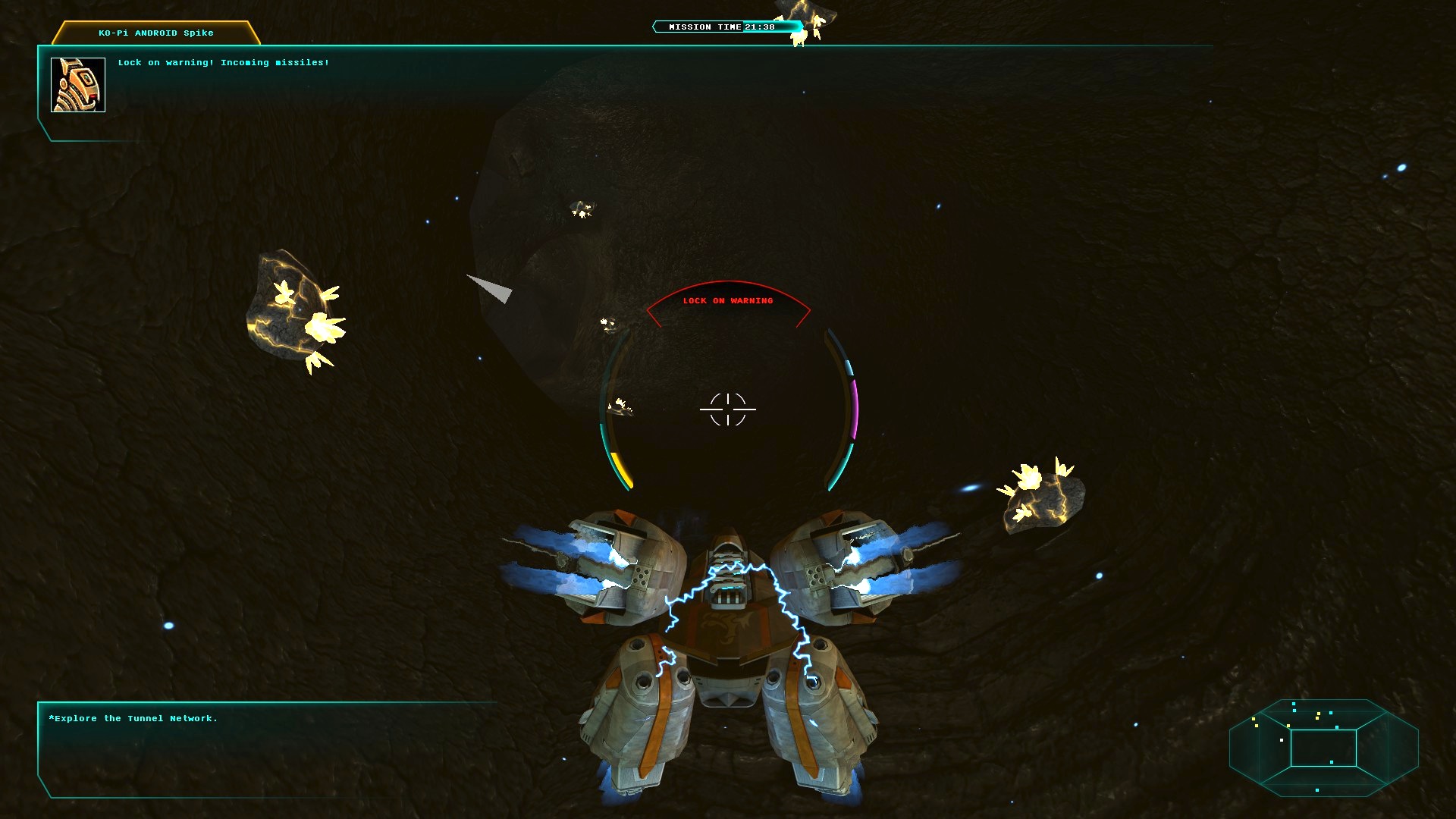
The first few missions were a bit samey, despite claiming to be "recon" and "combat" missions — they all seemed to involve "destroy [x] number of Zylon fighters", possibly against a time limit. But then the fourth "story" mission came along, which tasks you with finding a piece of a secret weapon that will help you deal with a Zylon secret weapon. Said piece of secret weapon is stashed somewhere in an asteroid. And this asteroid is pretty big. So big that when you're flying over its surface, you'd be forgiven for thinking you were conducting a planetside mission. Not only that, but part of the mission involves going inside the asteroid, at which point switching to Assault mode effectively turns the game into Descent, which is awesome. I'll ignore, for now, the fact that the game crashed on me at this point just as I was about to finish that mission.

I wasn't sure what to think of Star Raiders when I first started playing it. Then I looked at the clock and realised I'd been playing for nearly two hours. So something must be right somewhere. It's clearly not the original game in any shape or form — the "galactic map" interface in the game is a glorified mission select screen rather than the strategic overview of the original — but what it does offer is a good, fun, if simplistic space combat game with some nice ideas and a horrendously poor control scheme on console.

At £6.99, though, you can probably afford to take a chance on it, though, right?

Oh, if you're interested, then…

Old:

New (previously-mentioned Descent bit):
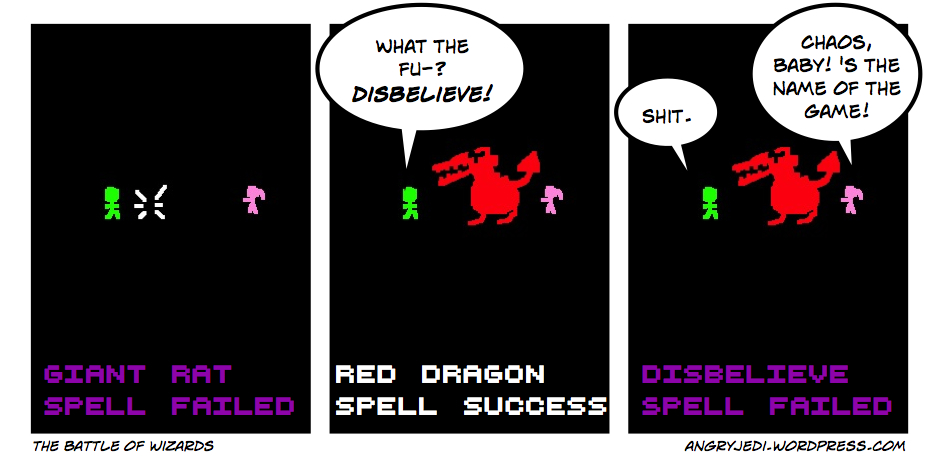
#oneaday, Day 111: Chaos, The Battle of Wizards

It's a sad but true fact that returning to the games of your youth usually ends in disappointment as you realise that gaming has moved on a lot, and those games never got a re-release on Xbox Live Arcade or the like for a very good reason — they're not very good.
But there's a few exceptions. Specifically, anything made by Julian Gollop is still just as fresh as it was back then.

How do I know this? Thanks to the Elite ZX Spectrum Collection app for iPhone. This app features a decent Spectrum emulator and a selection of games, most of which can be bought via in-app purchase in packs of six. One such pack is a Julian Gollop pack, which contains five fantastic strategy games and one utterly awful bouncy-ball atrocity, the less said about which the better. At least — hopefully — after that, Gollop figured out what he was good at and what he wasn't.

The games included in the pack are Chaos, Lords of Chaos, Rebelstar and its sequel and Laser Squad. I can't remember what the bouncy one is called but it involved catching balloons and wasn't fun at all.

The strategy games, on the other hand, are another matter. Chaos is the simplest of the bunch, with Teletext-quality graphics and feeble beep-and-fart type sound effects, but it's an immensely competitive game that supports up to eight players. It works well as a "pass the phone" game, too. And casting a Gooey Blob that gets out of hand never gets old.

The remaining games are all fundamentally very similar, featuring the same basic gameplay mechanics and gradually-improving graphics. In fact, if you've played the X-COM games, you've played these games too. That's no bad thing, though, because X-COM is awesome. Featuring turn-based multiplayer action, they're, in many ways, virtual boardgames that don't demand any throwing of dice or getting out a billion pieces or avoiding bumping the table or spilling curry on them or anything like that. And the Spectrum controls, while a little clunky, manage to work pretty effectively on the iPhone app. It helps that the keys are labelled, rather than my first experience with Chaos on a PC based emulator, where my friend Sam and I spent a good half an hour or so attempting to work out by trial and error what keys did what.

So if you're jonesing for more X-COM and don't object to playing on a touchscreen, then grab the Elite ZX Spectrum Collection and the Julian Gollop pack. I can guarantee that you won't be disappointed, and you'll be surprised that retro gaming can still be fun, deep and rewarding rather than vaguely upsetting.

Day 459

#oneaday, Day 44: The Late Review - Final Fantasy XII

Since I'm currently going through my backlog of games and beating them one at a time, it seems only fitting that I should write a sort of "review" of each one as I come to their (hopefully inevitable) conclusion. So tonight it's the turn of Final Fantasy XII, one of several "black sheep" of the series thanks to its complete defiance of established series conventions and adoption of a quasi-Western RPG style of gameplay. I will try and avoid as many spoilers in this post as possible.
I will preface this by saying, as always, that I am a total Final Fantasy fanboy. I don't care if they're clichéd, I don't care if big tentacley angel monsters as final bosses are overdone, it's what I expect from a JRPG, and it's what I inevitably get from the Final Fantasy series in particular. Overwrought melodrama, gratuitous and unnecessary love stories and the inevitable destruction of the world that only a plucky band of teenagers (and one guy in his twenties who inevitably gets referred to as "old man" throughout) can prevent? Sign me up. I love it.

So it was something of a surprise that Final Fantasy XII eschews most of these things. The melodrama is kept to a minimum, any romantic subplots are handled with the subtlest of nudges and winks rather than faintly embarrassing scenes accompanied by someone singing and the small ensemble cast is likeable, realistic and "human", typically ridiculous Final Fantasy costumes aside. (Penelo must be really sweaty by the end of the game.)

In fact, for once in a Final Fantasy game, the plot almost takes a back seat to the gameplay. There are large tracts of the game where you're given a lot of freedom—something happens, the party comes to the conclusion that what they really need to do next is travel to something that is inevitably on the complete opposite side of the game world to where they are right now and then it's up to the player how to proceed. They could go straight there using the various means of fast travel. They could walk straight there. Or they could wander off and go and do some of the many, many sidequests, most of which are available throughout the game rather than the usual Final Fantasy trick of saving them all until just before the world really needs to be saved right now please. Granted, you still have the somewhat silly opportunity to go and do all these things while the final confrontation patiently waits for you right in the middle of the map, but you just know that people would bitch and moan if you didn't have the opportunity to do this. It's also worth noting that the amount of time between the "point of no return" and the ending of the game is actually pretty short, so it's not as if you have to go off and do all the sidequests then spend 6 hours battling through the final dungeon. This is a refreshing change.

By far the most refreshing thing about the game is the battle system, though. I waxed lyrical about this back on Day 5, but it's worth mentioning again. The combat system, combining the best bits of a quasi-real-time MMO-style combat system and the "active pause" style of a BioWare RPG whilst keeping it optimised for a console, works astoundingly well, especially once you get the hang of using Gambits. By automating common actions such as curing and buffing, you're not making the game unnecessarily easy, you're making your play more efficient. Are you really getting any more from a game where you're manually selecting to cast "Haste" on your attackers every few turns?

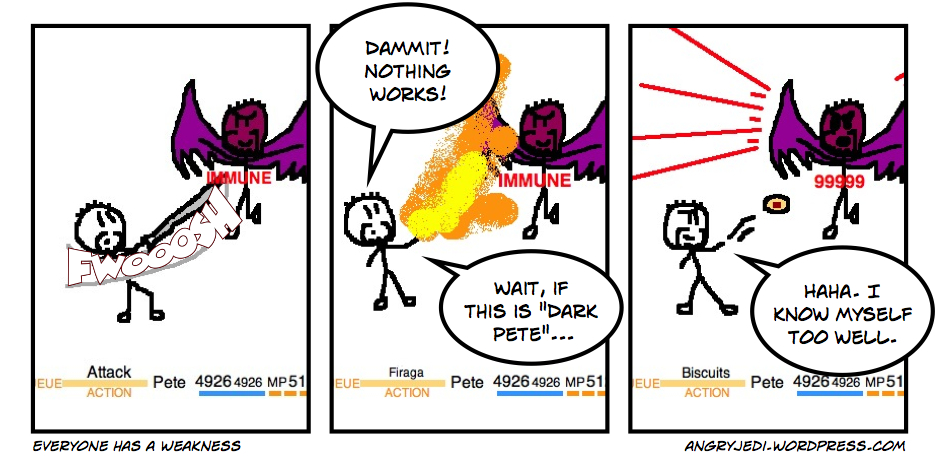
I described the Gambit system as being akin to the "huddle" you have when playing an MMO with a well-organised group. The best way to use it appears to be to give everyone clearly defined roles. For me, this means one tanking attacker, one who solely focused on healing HP and status effects and a third who focused on buffing the tanking attacker with Protect, Shell, Regen and Haste. All of them got stuck in hitting things with sticks and hammers when they didn't have anything else to do, but this setup worked extremely well and saw me through most of the game. Any mishaps could be quickly dealt with by popping up the menu and dealing with them manually. And in boss battles where circumstances suddenly shifted, such as them suddenly becoming immune to physical attacks? Well, that was just a case of popping open the main menu and adjusting the attacking Gambits to use Magicks instead.

It's a great-looking game for a PS2 game, too. Sure, there's rough edges when playing on an HDTV, but it's clear to see this is a well-crafted, well-designed world with distinctive-looking characters. The animations in cutscenes are excellent, too, with some high-quality facial animations doing a great deal to help forget the laughing scene in Final Fantasy X. One tiny bugbear with the graphics is that all the FMV sequences are in 4:3 while the game itself happily runs in 16:9 but this is a minor issue, as the vast majority of story sequences are rendered in-engine.

The sound is probably the weakest bit of the game. The voices are heavily, heavily compressed, though the acting itself is generally very good. The music is unmemorable, however, which is quite unusual for a Final Fantasy game. It has character, and sounds like Final Fantasy Tactics (which is understandable, given their common setting) but there's nothing anywhere near as iconic as One Winged Angel on display here, which is a shame. There's also a couple of areas that repeat music from earlier in the game, too, which seems a little lazy, given that the vast majority of areas have unique music. It's hardly a deal-breaker, though.

Final Fantasy XII is often described as the FF for people who don't like FF. And it's absolutely true—the crushing linearity of earlier entries in the series is nowhere to be seen (although the main plot is firmly on rails, you're free to wander off and do your own thing at any time right up until the finale) and there's very little need to "grind" by running around in circles waiting for random battles to happen. In fact, it's possible to "grind" without noticing simply by travelling from one place to another—the numerous long-distance journeys that the plot tasks you with seem to set you up to take advantage of this fact.

At the same time, these elements may put some people off. Some people enjoy the tight focus that a strictly linear plot gives, and indeed in FFXII it's very easy to lose track of what happened in the story when your last cutscene was eight hours ago. The plot picks up pace towards the end, though, and you find yourself wanting to press forward and see things through to their conclusion. How quickly you choose to do so is entirely up to you—so if you're a fan of a tight plot, you could probably romp through fairly quickly. If you're a completionist, though, there's plenty to keep you occupied here. I beat the game after 98 hours with barely half of the sidequests completed. Then there's secret weapons to find, a boss with 35 million HP to take down, secret Summons, optional areas to explore and doubtless many other things besides.

So in summary then, I was very, very impressed with the whole game. As a Final Fantasy fanboy, I enjoyed the fact that it still felt like a Final Fantasy game whilst playing very differently to the more "traditional" entries in the series. And as a fan of good games? Well, this is very much a Good Game.

The only thing that makes me a little sad is how few people will probably be inclined to play it these days. With the lack of backward-compatibility on new PS3s, playing it will either involve tracking down a PS2 or using an emulator. It's wholly worth it, though, as it is without doubt one of the best RPGs I've had the pleasure to play for a long time, and certainly one of the finest entries in the Final Fantasy series. A pity we probably won't see its like from Squeenix again.

#oneaday, Day 35: In Praise of Last Gen

An oft-had discussion in gaming is what constitutes the "golden age" of gaming, or indeed if there has even been one.
For some, it's the age of the arcade, when games were designed for pure fun and nothing else—besides emptying your pocket of quarters/local equivalents, of course. For others, it's the home consoles of the NES era; others still, the 16-bit wonderment of the SNES and Genesis/Mega Drive. For yet others… You get where this is going, I'm sure.

For me, the golden age will forever be the PS2 era. I didn't always think this was going to be the case; I remember playing PS2 games for the first time and thinking they were graphically impressive, but somehow lacking the "magic" of my favourite PS1-era games, particularly when it came to JRPGs. It took time, but the PS2 gradually proved itself as a force to be reckoned with, with a gigantic library of excellent titles (and an even bigger library of fucking awful ones) and the kind of backing from the public that Microsoft and Nintendo could only have dreamed of in those days. Funny how things change.

The thing is, being unemployed and skint as I am at the moment, I'm finally getting around to attempting to beat some of the PS2 titles that have sat, under-loved, on my shelf for years now. Final Fantasy XII is my current project: I'm now over 60 hours into it and still loving every minute. It's struck me while playing FFXII that it seems to be a much more infrequent occurrence that a current-gen (360, PS3 or Wii) game will grab me in quite the same way as numerous titles from the PS2 era did… and indeed still are.

I wonder how much of this is down to graphics. Naughty Dog aren't far from the truth with their jokey "next-gen filter" option in Uncharted; an increasing number of games in the current generation are looking increasingly interchangeable, with "gritty", "realistic" graphics often winning out over vibrant colours. There are exceptions, of course, and I discussed a number of these the other day.

I don't think it's just visual character, though; I think the way games are designed and consumed has changed considerably since the PS2 days, too. Look at the number of people who Achievement-whore these days. More often than not, this takes place not through a desire to see everything the game has to offer, but instead to line up their shiny virtual trophies on their virtual shelf and brag to their friends. The social side of gaming is cool, sure, but what happened to gaming just purely for the sake of fun?

There's no reason for these people to want to 100% Final Fantasy XII, for example. There's no public way of recognising your achievement besides actually telling people. But I think that's kind of a good thing, personally—if you want to be a hardcore insane idiot and complete every insanely difficult hunt, clear out every unnecessarily difficult area just for the satisfaction of knowing you have, that's great. But there's no feeling of "obligation" to do so—the person who storms straight through FFXII's main quest without exploring the side content is getting their money's worth just as much as the hardcore insane idiot.

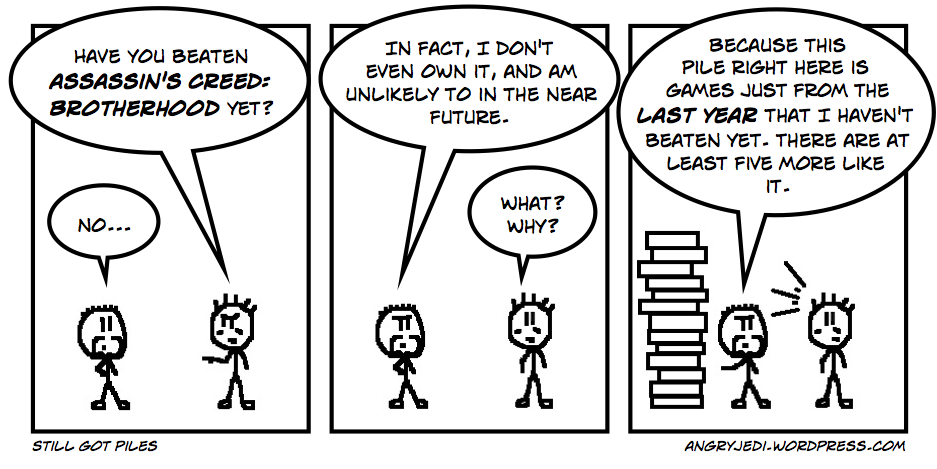
But in games with Achievements these days, many people feel that they haven't got their money's worth unless they 1000G/Platinum Trophy the game. And in many cases, some of those Achievements and Trophies are enormously tedious collectathons (Assassin's Creed), forced replays of lengthy games (Mass Effect, Dragon Age) or encouragement to completely remove any "meaning" and sense of consequence from moral choices in games (any game that has separate Achievements for completing quests/levels in multiple different ways, thereby encouraging saving before "important" bits, then reloading and replaying just to get said Achievements).

Screw that; I'm just as guilty as the next man or woman of Achievement-whoring at times. But spending such a protracted period of time in the company of a last-gen game without all that bollocks to think about is giving me pause for thought. Are things really moving in the right direction?

It makes me a little sad to think that there's a generation of gamers now who have no idea what gaming life pre-Achievements was like—and with Sony's ditching of PS2 support on the PS3 and Microsoft's woeful "backward compatibility" (I use the term loosely) on the Xbox 360, it's becoming more and more unlikely that newer gamers will have the opportunity to explore that side of gaming—and then even if they do, they'll probably be put off by "ugly" SD graphics. Look at how much snobbery people have towards the Wii's graphics now.

Do I have rose-tinted specs when it comes to looking at last-gen gaming? Perhaps. But I'm more than happy to live in the past, if so.

#oneaday, Day 294: Filthy Rogue

The roguelike genre is one I only discovered relatively recently. In fact, I was a relative latecomer to the whole RPG genre, only getting to grips with it for the first time with Final Fantasy VII. As such, for a good few years, I felt that RPGs were all about strong stories, interesting (and sometimes clichéd) characters, a buildup to an epic final conflict and some of the best music you'll ever hear.

As such, when I played an RPG that wasn't so strong on the story and focused more on loot-whoring or level-grinding, I found myself losing interest quickly. It was long after its release that I finally beat Diablo II and, to this date, I've never beaten it on anything other than the normal difficulty level.

That changed when I came across Angband, though. Angband looks like the sort of game you used to play on Teletext. Sure, there are graphical tilesets you can customise it with. But at its heart, it's a text-based game with about a bajillion keyboard commands.

But you know what? The kind of emergent narrative that came out of several intense Angband sessions rivalled any pre-scripted tales that Squeenix have ever come out with. Largely because it was so unpredictable, and that any screw-ups were inevitably your fault for failing to prepare adequately, rather than the fault of the game mechanics itself.

Take the time my oil lamp ran out on the fifth level of the dungeon. This meant, in gameplay terms, that I couldn't "see" new passageways ahead of me—namely, they weren't revealed on the map—unless I banged into a wall, which then helpfully revealed said wall on the map for me. My first reaction in this instant was, of course, to panic. Death in Angband doesn't mean restoring a saved game. Oh no. Death in Angband means your save game getting deleted and you having to start all over again. This adds an enormous amount of pressure on you, the player, to get it right. And it also makes you kick yourself when you realise that you didn't bring enough oil to fuel your lamp.

So off I went, slowly "feeling" my way along the walls of the corridors in an attempt to find the stairs up… for five floors. This sounds like an impossible task. But after a fairly lengthy period of methodical, careful searching (and a few terrifying combats in the pitch darkness) I finally managed to emerge victorious to town level, stock up on oil and provisions and jump back into the dungeon with renewed fervour.

Of course, I promptly got twatted by an Ogre, making all that work utterly meaningless. But it didn't matter—it was a fun experience unlike anything I'd experienced in a game before. And I've struggled to repeat it with any game since then.

Not through lack of trying, though. There are some great roguelikes out there, many of which are a lot more accessible than Angband. I have three favourites I'd like to share with you right now, one of which is, of all things, a board game. The other two are iPhone games.

Sword of Fargoal is actually a remake of an old Commodore 64-era title which didn't look like the picture above. No, it looked like this:
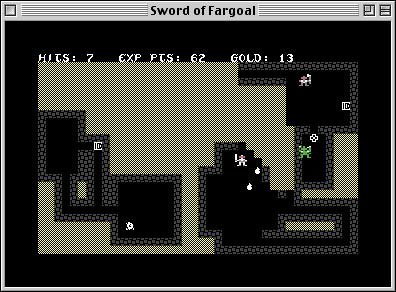
The best thing about Sword of Fargoal is its simplicity coupled with a surprising amount of hidden depth. While Angband is rather intimidating to get started with, with pretty much every key on the keyboard (shifted and non-shifted) mapped to something, Fargoal simply requires that you get to grips with moving and using a context-sensitive button in the top-right corner. And keeping an eye on the text display at the top of the screen for hints and cues, too. Combat is a case of running into an enemy—the player and monster will then take turns bashing each other until one or the other falls over or one runs away. Gold is collected to sacrifice at altars throughout the dungeon for experience point bonuses. And the rest is left to the player to discover. The more you play, the more you start to notice little graphical details and cues tipping you off to the location of traps or treasure.
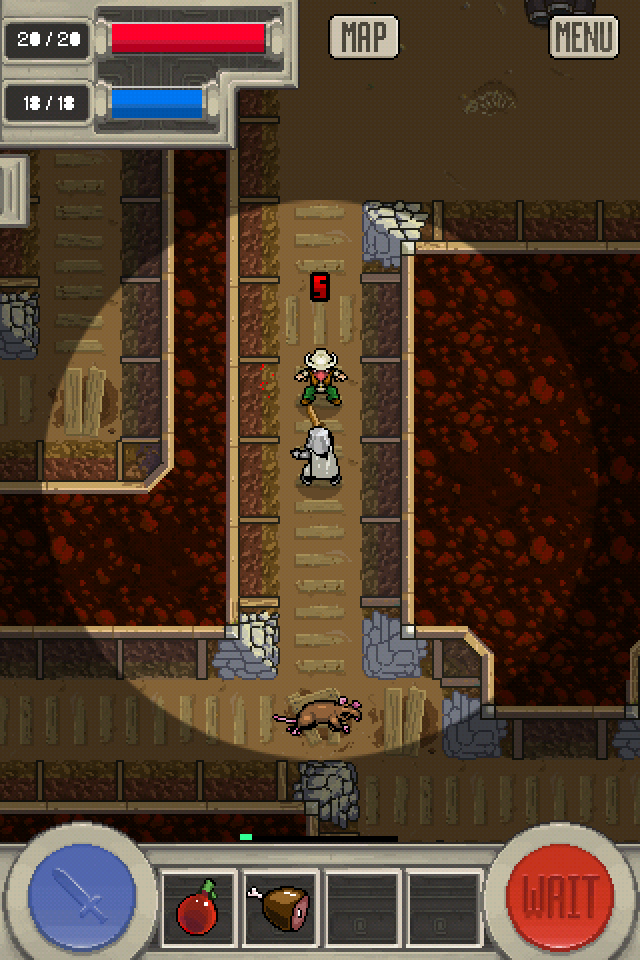
And it's challenging, too. There are 15 levels to explore, all of which are sprawling monstrosities with several areas. And when you make it to the bottom to recover the titular blade, you then have to escape again. I haven't even made it to the bottom yet. It's a lengthy, challenging quest. And despite the fact that death is permanent, it's addictive and easy to return to.

Then we have 100 Rogues, which takes a slightly different approach to that of Sword of Fargoal. While Fargoal's quest is lengthy, 100 Rogues can potentially be beaten in one sitting. Key word here being "potentially". 100 Rogues is particularly brutal, fond of surrounding the player and battering them to a pulp. Fortunately, the player also has a Diablo-style skill tree at their disposal, including a number of attacks that can beat back several enemies at the same time.
It's very difficult, though, and the descriptions of the game on the App Store don't even try and hide the fact that you will die. A lot. In fact, there's even a Game Center Achievement for having sent the titular 100 rogues to their eventual demise.

I only picked this up recently, but it's immensely appealing due to its 16-bit graphics and soundtrack. It looks and plays like a Genesis/Mega Drive game, in a good way. It's a bit buggy in places but the author appears to be committed to regular updates.

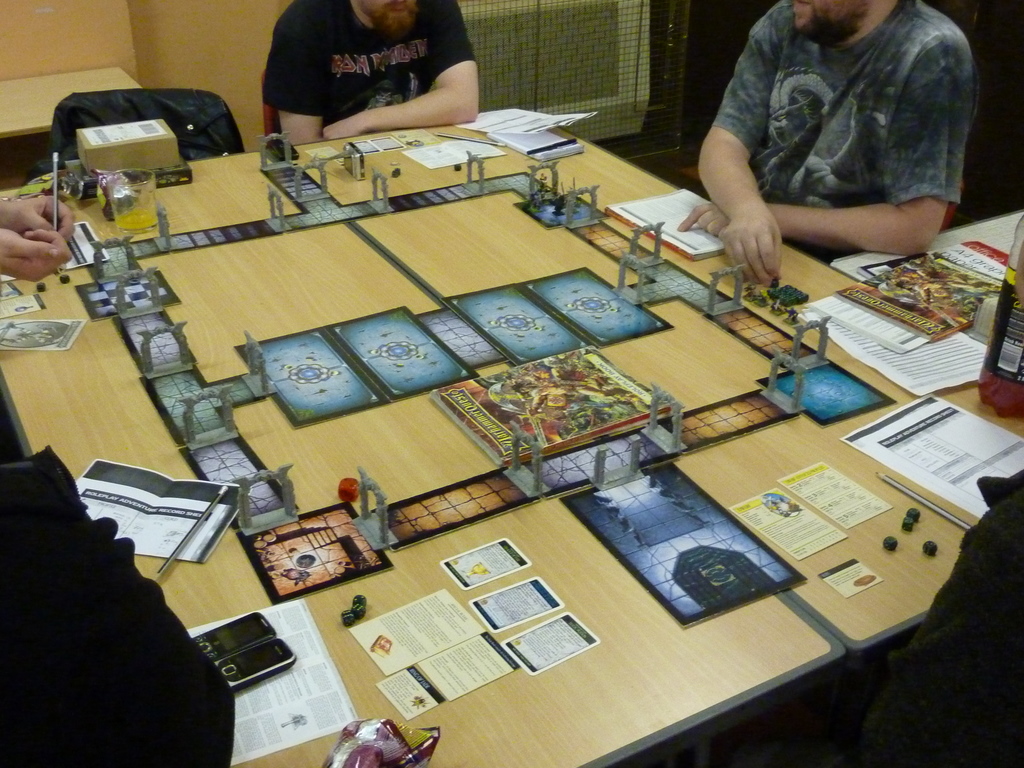
Finally, one of my favourite roguelikes of all time is Warhammer Quest, a game that involves you having people you actually don't mind being in the same room with. Featuring all the genre staples—a randomly generated dungeon, permadeath, brutal difficulty, vast amounts of phat lewt—it's very much the board game equivalent of Rogue et al. Even better, everyone gets to join in on the fun—there's no need for a Game Master player (unless you really want to use one) as the rules cater fully for monster "behaviour".

Couple that with the game's immense customisability (it's a word) thanks to its use of Games Workshop Citadel Miniatures line of figures and you have a game with limitless potential. And hundreds—hundreds—of tiny pieces of card and plastic.

So there you go. A whistlestop tour of the roguelike genre. And I didn't even mention Moria or NetHack once.

#oneaday, Day 219: I Like 'Em Chunky

I've been playing Scott Pilgrim vs. The World: The Game recently. Besides being an excellently fun game that hearkens back to the golden days of the brawler, it also has some of the most adorable graphics you'll ever see. By deliberately rendering things in low-res pixel art, it somehow manages to have approximately three thousand times more charm than the shiny brownness that is Gears of War. Granted, Gears isn't a cartoony game, so it's probably not an apt comparison. But even 3D-rendered "cartoony" or light-hearted games pale in comparison to some good old-fashioned pixel art.

It's been a curious transition for art styles over the last few years. As 3D technology got better and better, the pressure was on developers to produce something that looked more and more real. The expression "if graphics don't get any better than this, I'll be happy" was trotted out with every new console generation. People spent hours looking down at the floor in Halo marvelling at how realistic the grass texture was. (Just me? All right then.) Putting things in higher and higher resolution was seen as the gold standard; something for everyone to strive for. Getting something running at 60 frames per second in 1080p? The Holy Grail.

Somewhere along the way during this process, pixel art spent some time being undesirable. I remember emulating Final Fantasy VI on my PC back when I first discovered emulation, and finding the huge pixels made incredibly clear on the PC monitor to be very offputting. I felt like I couldn't see the detail. This wasn't taking into account the fact that by the very nature of pixel art, some detail has to be omitted.

Today, though, I find myself playing PS1 sprite-art based games on my PS3 with all the filters turned off so that I can see those sharp edges. And Scott Pilgrim handles this in the same way. All the artwork is rendered in a deliciously unfiltered manner, which means you can see the "stepping" on diagonal lines, the black outlines around the character sprites and the necessary omission of detail. No-one has a nose, for example.

But you know what? It's beautiful. It's gorgeous. And I'd take a hundred games drawn in this way over another Unreal Engine 3 game. Perhaps it's just oversaturation or "next-gen fatigue" and I'd eventually get sick of pixel art again. But certainly right now, I find it to be an incredibly attractive art style that I'm really glad to see a resurgence of. And my favourite use of HD graphics is, ironically, to render low-resolution pixel art in all its sharp-edged glory.

So you can keep your next-gen sweaty-faced protagonists. (Except Nathan Drake and Elena. They may live.) Give me a good old-fashioned big-eyed protagonist with giant fists and no nose any day of the week. KPOW!

#oneaday, Day 209: Coming Soon

Tomorrow night, The Squadron of Shame are back in action after something of a hiatus.

For those of you unfamiliar with our unique brand of discussion and podcastery, let me explain what it's all about, and when the new podcast hits, you'll be able to come and join the fun.

The Squadron of Shame started as a result of a feature on 1up Yours dubbed "The Pile of Shame". The term has since spread around the Internet somewhat, and it refers to all of the things that you've bought and never got around to reading, listening to or playing. In the case of the original 1up feature, it referred to that pile of games you have on your shelf that are begging to be played, but somehow inevitably get left behind whenever the latest triple-A hotness makes an appearance. The first game they took on was the excellent Psychonauts.

As it happened, the feature was somewhat short-lived on the 1up podcast. But a number of community members ran with the concept on the companion forums for the 1up "radio" output. We formed a club page on 1up which is still there, though largely inactive these days. We'd pick a game which was supposed to be good (or at least interesting), play it through as a group and discuss it all together. Some fascinating discussions resulted, and it also allowed many people to expose themselves to a variety of games which they might not have done otherwise. Games like Star Control II, Freespace 2, Call of Cthulhu: Dark Corners of the Earth and Psi-Ops.

As time moved on, the group wanted more. The merging of all the 1up boards into one mangled mess meant that the reasoned debate of the old threads was much more difficult. Topics would get derailed and it was clear that a new approach was needed.

Thus began the SquadCast, the Squadron of Shame's official podcast. Starting with independent rabbinical adventure game The Shivah, select members of the group banded together to do what they did best: play through a game together, then put their heads together and have a discussion about it. Ably hosted by the fine Mr Chris Whittington and edited/produced in a sort-of OKish manner by my good self, the show is now 29 episodes strong and has covered subjects as diverse as the Commodore 64, Russian FPS-adventure depress 'em up Pathologic and charming indie puzzler Machinarium.

Following circumstances beyond their control (mostly beyond my control, I admit) there's been something of a gap since our last episode. So we've thought that now is the time to take a break, consider how to make the show better and come back stronger than ever with some brand new output in a whole new format.

So, tomorrow we're recording. And next week we'll be proudly presenting The Squadron of Shame SquadCast, Season Two. Taking some of the advice we got from Jeff Green, Shawn Elliott, Ken Levine and some others who I've forgotten speaking on the Podcasting for PR panel at PAX East, we've made some changes.

The show's going to be bi-weekly. This means that rather than have variable gaps as everyone clamours to complete a "mission" before we talk about it, some regularity will allow us to build up a more, well, regular listenership.

Next up, it's going to have a static cast of host Chris Whittington, Mark Whiting, Jeff Parsons and myself with occasional guest spots available where appropriate. Jeff is in the process of composing us a brand new theme tune, too, so it's going to be a complete sonic reboot.

Most importantly, though, each episode is no longer going to be focused on a specific game. Instead, the focus will be on particular "topics", with occasional traditional "mission" podcasts interspersed as appropriate. This means that people will hopefully be more inclined to tune in regularly and hear what we have to say, rather than skipping episodes about games they have no interest in. As part of this, the official Squawkbox of the Squad will be playing a more prominent role, with community questions and discussions a regular occurrence. If you already have a WordPress account, you can head right over and start chatting with us. If not, it's simple to sign up. Everyone who's interested in discussing video games and who isn't afraid of the odd (all right, frequent) wall of text is very welcome to pay us a visit.

Besides the changes, it'll be our same wordy, intellectual, chin-stroking discussion about video games, representing one of the most unique podcasts on the Internet. We'd love it if you could join us for our relaunch. Visit the Squawkbox, follow us on Twitter, become a Fan… sorry, Like us on Facebook and find our past episodes and those of our sister podcast The Exploding Barrel Podcast here.

2010 is going to be a great year for the Squad. We hope you'll come along for the ride.