1657: Bloodlines

For a bit of a change this evening, I decided to fire up a game I've been meaning to play through and beat for a long time: Vampire: The Masquerade – Bloodlines. And, despite its now somewhat dated-looking visuals and inconsistent-quality audio, I've really enjoyed what I've played so far.

Bloodlines, as it shall be known hereafter, is an interesting game. Based on the White Wolf pen-and-paper role-playing game Vampire: The Masquerade, itself part of White Wolf's larger World of Darkness setting, it's an excellent take on the role-playing genre and a fantastic adaptation of its source material. The reason why it's so fondly regarded — even with its flaws and bugs necessitating the creation of a community-made patch well after its developers had abandoned it — is because it does things a little differently from other games of a similar type.

Vampire: The Masquerade was a fairly unconventional beast (no pun intended) in its pen-and-paper incarnation, too. Eschewing dungeon-crawling and loot whoring in favour of in-depth role-playing based on a shockingly well-realised world and society — World of Darkness features one of the most richly detailed explanations of vampiric culture since… well, ever, really — Vampire: The Masquerade was a game that rewarded those who sought interesting, unconventional and creative solutions to problems. There was combat, sure, but it was always rather heavily implied that getting into a true fight was something of a last resort for members of vampire society. Rather, you'd make use of your wits, your intelligence, your social skills and your charisma — with a bit of help from your supernatural vampiric abilities — and, more often than not, be able to get through situations without ever drawing your weapon.

Bloodlines is rather similar. It does cater to those players who enjoy the idea of swinging a tyre iron around and caving people's skulls in — although the combat is, it must be said, rather rudimentary compared to more modern real-time RPGs like The Witcher and Dark Souls — or even those who enjoy first-person shooting. But, for me, far more rewarding is the opportunity to get through most situations by making use of your vampiric powers, which vary according to what kind of character you create at the start of the game.

Much of Vampire: The Masquerade is based on the interactions between various clans of vampires, and each of these clans has its own specialisms. Some have magical abilities; others are strong fighters; others still are true "creatures of the night", able to disappear into thin air right before their enemies' eyes. The character I'm playing this time around is a Malkavian; their defining characteristic is the fact that they're, well, insane — but they can use this fact to their advantage by channeling their mental energy outwards to do things like inflict terror on others or make enemies have hallucinations. In conversation, Malkavians tend to speak in riddles, and, pleasingly, the dialogue options you have available to you when playing as a Malkavian are all borderline gibberish — though the longer you play, the more these riddles will start to make sense to you. Oh, and Malkavians also hear voices while they're wandering around. And occasionally stop to have a conversation with a roadsign. You get to "roleplay" all of this — something I haven't seen since the early Infinity Engine games, which featured differing dialogue depending on things like your Intelligence score.

Perhaps the most interesting thing about Bloodlines is that it uses all these traditional RPG mechanics without putting the player in the usual "god mode" perspective, watching the action unfold from above. No; instead, taking heavy cues from its contemporaries such as Deus Ex and the like, Bloodlines has plenty of "immersive sim" elements about itself, too: hub-based areas to explore, with buildings you can go into and investigate even if the game's quests haven't directed you to yet; objects you can pick up and manipulate; computers you can fiddle with by actually typing things into them; and a sense that, in a rather simplistic manner, the world will respond to the way you behave in it.

While we have plenty of open-world, non-linear RPGs today, nothing that's emerged recently has quite the same feel about it as Bloodlines. I've played it through once for about 20 hours or so — though to my shame, I never beat it — and I'm now very interested to take it for another spin with my adorably mental protagonist. If you haven't yet sampled its bloody charms — and can look past the visuals of a pre-Half-Life 2 Source Engine game — then I strongly recommend you give it a look.

1655: Tease Me, Tease Me, Tease Me... Actually, Don't

I'm not entirely sure how I got onto EA's mailing list, having not played any of their games for a substantial period of time, but I do know all it took to get me to immediately unsubscribe: this email.

Screen Shot 2014-08-01 at 00.09.31

Said email came from BioWare, a company whose games I used to happily purchase "day one" when they came up, but whom since being absorbed by EA a few years back have become increasingly disappointing — to such a degree that now, when they send me a "teaser" email like this, I don't find it exciting, I instead find it bothersome.

This isn't exclusively directed at BioWare, of course. I have very little time for teasers anyway these days, and their use in the increasingly sprawling marketing campaigns for big-budget games is getting to a stage where they simply dissuade me from wanting to check the game out rather than intriguing me.

I started feeling this way while I was working in the games press. Teasers are infuriating to receive as a news writer, because more often than not there's absolutely nothing to write about. As a general rule, I avoided writing about them altogether unless there was enough intriguing material therein to spin a story out into at least 300 words. In most cases, there wasn't, and inevitably there were plenty of other more interesting things I could write about on any given day, so I was inclined to write about those instead. I can't help feeling that this is the precise opposite of what whoever came up with the teaser campaign may have had in mind when they lovingly constructed it.

Now I no longer work in the games press, teasers are even more irritating. They clutter up news sites who are less discerning about what they cover than I am — the above email has likely been spun into at least one "BioWare is Working on Something" story somewhere on the Internet by now — and, when I have neglected to unsubscribe from a company's newsletters and promotional emails like I had apparently done with EA, they clutter up my inbox, and believe me, that doesn't need any help filling up with crap.

What I find somewhat hilarious is when mobile and social game developers decide to do teasers for their upcoming games. As much money as these types of game inevitably make at the hands of stupid people, I simply can't take them seriously; nor can I believe that anyone could possibly get excited about the prospect of a new mobile game from notorious free-to-play conmen like, again, EA, King or numerous others.

I long for the days gone by, when protracted marketing campaigns simply didn't seem to happen. You got previews in magazines, sure, but these actually told you something about the game. Like, you know, its title — something which the BioWare email conspicuously fails to mention. (I don't know if the video gives any more information because I didn't watch it. Instead of watching it, I unsubscribed from EA's mailing list. Good job, there.) Or details about what kind of game it is. Or a bit about the story. Or anything.

That anything is how you get me interested in a new game — not waffling around the point with vague, pointless emails that tell me nothing. Show me something interesting — show me a reason to care, otherwise, spoiler, I won't give a shit.

1654: Pay Attention, Bon-- Err, Remington

I felt like trying something new today, so after toying with the idea of downloading legendary military sandbox Arma III (and eventually resisting — its £35.99 price point is a little too high for me to consider taking a risk on it at the moment) I wandered over to GOG.com and took a look at a game that has caught my interest several times over the years: Sid Meier's Covert Action.

I remember first seeing adverts for Covert Action back in multi-format games magazine Advanced Computer Entertainment (aka ACE) way back around 1990, when the game first came out. I recall being intrigued by the prospect of what looked like a fairly convincing "spy game" — something that hadn't really been done at the time, and certainly not in the way that Covert Action chooses to do things.

Covert Action is, unlike other espionage-themed games on the market, very much a "spy simulator". Straddling a line somewhere between a surprisingly huge number of different genres, Covert Action casts you in the role of superspy Max (or Maxine) Remington as he (or she) attempts to foil the devious plots of various bands of criminals around the world. These plots range from simple thefts all the way up to the construction of doomsday devices, but the execution remains the same: gather evidence, infiltrate facilities, intercept communications and eventually — hopefully — bring the perpetrators to justice. Or, if you're as incompetent as me, arrest a few of them and allow the remaining criminals to happily get away with what they were planning.

Covert Action is split into a number of different components. The "main" part of the game, if you can call it that, involves moving from location to location both within cities and around the world, and choosing the best course of action. Actions always take varying amounts of time, so if you spend too long dilly-dallying around, you'll find the criminals get one, two, three steps ahead of you before you know it. This is a game about preventing a crime before it happens rather than solving a crime that has already happened, and as such you have to go about things a little differently to how you might do in other games; you have to anticipate what your opponents' moves might be, then react accordingly, ideally to catch them in the act and be able to arrest them in such a manner that causes the remainder of their plot to fall to pieces.

Choosing to perform various actions in the game's locations triggers minigames. Choose to wiretap a building's phones, for example, and you'll be confronted with a challenging PipeMania-esque puzzle where you must reroute power away from both the phones and the alarm systems of the building. Choose to decrypt an intercepted communication from one of the perps and you'll actually have to crack the code using your own brainpower. Opt to tail a suspect and see if they lead you anywhere interesting, and you'll find yourself playing an oddly strategic driving game in which you order two cars around in an attempt to follow the suspect without arousing their suspicions. And choose to break in to a facility and you'll have to actually infiltrate it yourself.

It's this latter part of the game that tends to form the meat of most investigations — and it's also an aspect that Meier himself was somewhat dissatisfied with, feeling that the game's minigames weren't tied together in a coherent enough manner. Break-ins are not the only option for gathering information, but they're by far the most efficient and as such you'll spend quite a lot of time doing them.

They take the form of an interesting pre-Metal Gear stealth action game in which you control Max as s/he explores a randomly generated building, opening filing cabinets and drawers and photographing all the files s/he can. You'll also have to deploy bugs in various items of furniture in order to raise your ability to perform remote surveillance on the building, and recover incriminating evidence from safes if you want to "turn" your opponents over to your side rather than simply arresting them. Some interesting, rudimentary AI sees guards patrolling the building and looking out for unusual things — containers you neglected to close, for example. You can also trick them somewhat by knocking one of them out and then disguising yourself in their uniforms — in a nice touch, your disguise will only continue to work if you don't allow them to look at your front or side for any length of time, leading to some comic situations as Max stares at a wall, hoping that the guard who just opened the door behind him/her doesn't decide to come in and check the room more thoroughly.

All the while you're investigating, the criminals are working on their plot in the background, and if you're not quick or careful enough, they will succeed. Regardless of whether you "win" or "lose" a case, however, the game continues, and you're evaluated on your performance, with a certain number of points being available for each mission according to who you managed to arrest, what key items you managed to confiscate and whether you actually managed to foil the plot at all.

It's a difficult, challenging, ambitious and somewhat flawed game, but it's a magnificent example of the creativity of game developers in the early '90s — particularly MicroProse, who were well-known for this sort of game around that time. It's also a game absolutely crying out for a remake — with today's technology, it's more than possible for someone to do the game's grand vision even more justice than the hardware and software of 1990 would allow.

That said, Covert Action still stands up remarkably well even today, despite its dodgy AdLib sound effects and horrid 16-colour EGA graphics. If you're looking for something a little bit different to entertain you for a while, I'd urge you to check it out.

1652: A Grand Day Out

We took our visitors up to Oxford today, for several reasons — to have a look at some genuinely Old Stuff, to play a couple of Zero Escape-style "room escape" games, and to visit Oxford's answer to Toronto's board game cafe Snakes and Lattes, Thirsty Meeples.

It was a great day out, though the amount of walking reminded me that I don't do nearly enough just walking around these days.

The early part of the day consisted of the aforementioned "room escape" games courtesy of Ex(c)iting Game, a modest operation that offers two different interactive experiences in which you're given an hour to solve a particular task. In the first room, we were challenged to break into a computer to recover a piece of information about someone who was going to be assassinated; in the second, we were tasked with locating a USB stick containing sensitive information before it was auctioned off.

In both cases, the games were fairly low-rent, consisting of straightforward and simple props with a few fun gadgets. The two games were markedly distinct from one another, too; the Stop the Assassin game was much more gadget-heavy, seeing us cracking a safe, using a blacklight and eventually cracking the code that led us to the computer password; conversely, second game The Auction was much more focused on deducing the answers to various riddles in order to solve combination locks and get them open.

Both games also featured a number of red herrings that had little to do with the games themselves, and both were reasonably challenging, taking our group of four a decent amount of time to crack in both cases. We completed the first game with just six minutes to spare; the second game we solved a little more quickly, with around twenty minutes left on the clock.

The setup, although simple, was effective. The staffer — whom I felt rather sorry for, since she clearly spent an awful lot of time twiddling her thumbs between appointments — observed our efforts to solve each room via webcam, and subsequently offered real-time hints through the monitor that otherwise displayed our time limit. Rather than these hints being predefined, she was able to highlight particular things in the room or type messages to us to ensure we could normally be nudged back onto the right track. In the case of both games, we would have probably found the answers ourselves eventually, but the hints were timed nicely so it didn't feel like our intelligence was being insulted.

All in all, the game experience was fun. It would be neat to see the idea implemented with a somewhat bigger budget — perhaps some more special effects, more high-quality props and a little more effort to make the games more strongly thematic — but for today, it made an enjoyable and memorable day out.

We then took a bus into the city centre of Oxford, where we had a wander around a couple of the colleges, which was a fairly humbling experience when I think back on the places I stayed and studied when I was at university in Southampton. The dining hall in one of the colleges in particular was a real Hogwarts-style affair that impressed me and Andie almost as much as it did our visitors.

Following some wandering around — and a break for a drink in an incredibly old pub — we made it to Thirsty Meeples, where we had coffee, snacks and some gaming. We played the cooperative game Robinson Crusoe, which I've been curious to try for a while, and Boss Monster, which I've likewise heard of previously and have been keen to give a shot.

Robinson Crusoe is a very cool and strongly thematic cooperative game, though for those who enjoy the more Euro end of the spectrum, there's plenty of worker placement and resource management involving shifting little wooden discs and cubes around the place. There's also a number of different scenarios that I can see would likely change the way you play significantly — it'd be a game you could get a decent amount of replay value out of, due to the randomised elements. It was initially a little difficult to grasp, but after a turn or two all becomes clear and highly enjoyable — likely a game I'll try and score a copy of for myself in the near future.

Boss Monster, meanwhile, is a short and simple card game in which you play a 16-bit era video game boss and have to build a dungeon to fend off the never-ending hordes of incoming heroes. It's a simple, easy-to-understand game that I think will be a lot of fun with various groups — I ended up picking up a copy of it along with Avalon before we left.

We also gave Concept a go, which is, along the lines of Dixit, more of a fun group activity than a "game" per se. Like Dixit, it involves a certain amount of creativity — meaning Andie wasn't a huge fan of it, but she soldiered on regardless — but handles things very differently. Rather than attempting to describe pictures on cards, Concept challenges you to get, well, concepts across by placing markers on various icons. It's kind of Charades-ish, only you don't do any actions — you place markers to describe the main concept of the word, phrase, title, whatever it is, and its "subconcepts". You can then use smaller markers to elaborate on these a bit, but the only thing you can say during this whole process — which is surprisingly frustrating if your tablemates just won't grasp something that seems obvious to you — is "yes" if they get something along the right lines.

So all in all, then, we had a great day. I'm pretty tired now, though, so I have a feeling I'll sleep rather well this evening!

1650: Ascension

You may recall a while back I talked a little about an indie game called Towerfalla game that was originally intended to be the poster child for the ill-conceived Android microconsole the Ouya, but which subsequently came to other platforms including PS4 and PC. When I originally talked about it, I'd only tried the Versus mode — the mode the game was originally built around — but today Mark and I gave the cooperative two-player Quest mode a shot.

It's a hell of a lot of fun, maintaining much of the chaos of the competitive multiplayer mode while presenting its own challenges as you and a partner work together to fend off increasingly difficult waves of enemies.

As Mark pointed out while we were playing, the closest comparison is probably Bubble Bobble, but with Towerfall being a modern game, it does all manner of things that the technology of Bubble Bobble's era simply wouldn't have been able to manage. Things like lighting and distortion effects on the screen; slow-motion sections; complex enemy waves; physics effects; and all manner of other things.

The genius of Towerfall — and presumably the reason it's so well regarded as a top-tier indie title — is because it doesn't try to do too much. It's a series of single-screen arenas — a la Bubble Bobble — in which all you have to do is defeat all the enemies in a series of waves in order to proceed. But it's the design of these waves — and the enemies themselves — that makes the game so good.

Each individual enemy's behaviour is relatively simple, and it's straightforward to figure out how to deal with most of them without any prompting from the game whatsoever — this is a game that is well and truly of the old school, eschewing unnecessarily long and tedious tutorial sequences and instead throwing the player(s) straight into the action at the earliest possible opportunity. You learn through discovery rather than through being told — and in doing so, you can feel yourself getting better and better each time you play. And you'll need to — because this game is hard.

Yes, the pixel-art aesthetic isn't the only old-school thing about Towerfall; it also has the difficulty level of an old-school arcade machine. The first couple of levels are deceptively straightforward, then the difficulty starts to ramp up pretty quickly, culminating in some extremely challenging battles later in the game. Never do things become overly complicated, though; you're always dealing with the same types of enemies, with the same attack patterns, just in varying combinations. And it's the good design and pacing of each of these levels that makes the game so enjoyable and satisfying to play.

Well, that and the ability to fire an arrow at particularly troublesome enemies and pin them to the wall with it. Who hasn't wanted to do that to an army of slimes and grim reapers?

1649: UUUUURGH

Been showing off the Wii U today, and as part of this process I decided to pick up a game I've been meaning to give a shot for a while — Ubisoft's ZombiU. So far it seems to be an interesting game, for sure, albeit not one without a few glaring problems, not least of which is a game-breaking bug relatively early in to the whole experience.

For those who have never encountered this Wii U exclusive, the best means of describing it is probably to use that tired old analogy: saying it's "the Dark Souls of [x]", where [x], in this case, is survival horror.

For once, though, that statement isn't altogether inaccurate, since so far as I can make out from what I've played so far, ZombiU simply is Dark Souls, albeit presented from a first-person perspective and set in modern-day London rather than From Software's dark fantasy classic. It has all the trappings of Dark Souls' basic gameplay — combat that's rather more methodical and careful than your typical action game, in which it's easy to become overwhelmed if you try and face off against too many enemies at once; online connectivity allowing you to write messages on the walls for other players to find; and the fact that death is an inconvenience that you can overcome to a certain extent if you can only get back to the point you died — and, in this case, defeat your former self, who has, naturally, become a zombie in the intervening period. (That is, unless you're playing the rather brutal Survival mode, in which you only have a single life in which to get as far as you can.)

It's an intriguing game, and an effective example of how the Wii U's unique features can be used to enhance a game experience. While the majority of the action unfolds on the TV screen, things like looting bodies and searching containers is done on the GamePad screen, leaving you vulnerable to attack while you do so — just as you would be if you stopped to rifle through your own bag. Furthermore, you can use the GamePad as a means of scanning the area and marking points of interest, which subsequently show up on your main screen and map as markers.

It's also a decent example of survival horror done well. By keeping the TV screen clutter to a minimum — there's very little in the way of HUD, and you have to look down at the GamePad to check your ammo — it provides a nicely immersive experience, and allows for wonderful, authentic "horror" moments such as pointing your gun at an incoming zombie, pulling the trigger and hearing that awful sound: click. There are some nice touches with the various characters you play as, too, such as certain characters obviously being terrified of the situation in which they find themselves, while others appear to take it in their stride.

I'm not 100% sure on whether it's quite my sort of game just yet, but I'm certainly willing to give it a go, and even if I end up not wanting to beat it I only paid £12.99 for it as a preowned copy, so I don't mind too much. There's also an intriguing-sounding multiplayer mode that I'd like to give a try.

So, game-breaking bugs aside — don't die while escaping from the supermarket in the early stages of the game! — it appears to be a solid experience, and one of the more interesting Wii U exclusives available.

1645: Animus

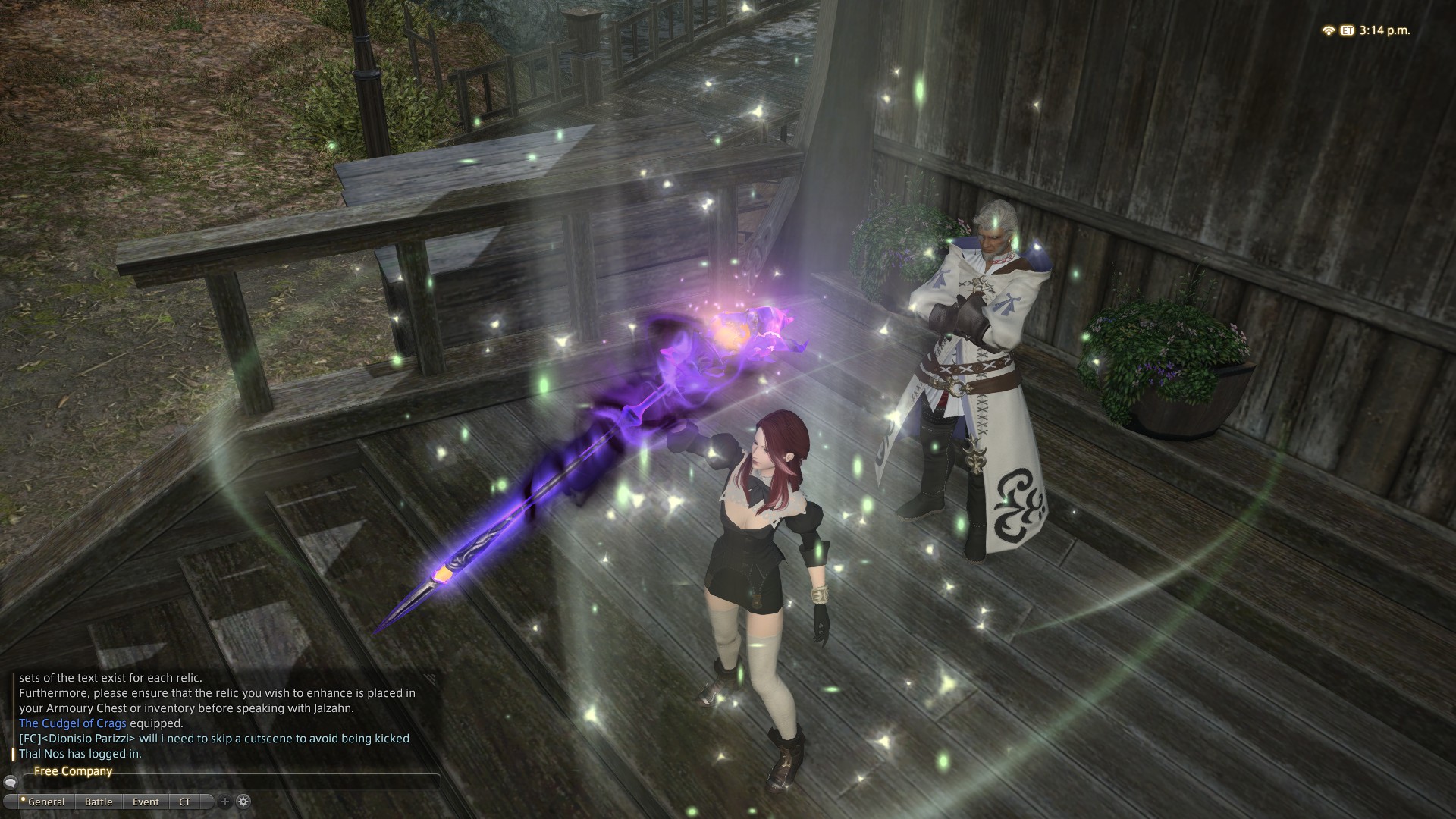
17754480252836380672_screenshots_2014-07-22_00001A long road finally came to an end today — no, nothing important, it was just a lengthy quest in Final Fantasy XIV. Specifically, it was the quest to upgrade my weapon's "Atma" incarnation into its more powerful "Animus" form, which means it's now just one step away from being its (currently) ultimate "Novus" incarnation.

The quest to acquire and upgrade your "relic" weapon in Final Fantasy XIV is a pain in the arse, extremely time-consuming and, at times, very frustrating, but it's also one of the most rewarding things to do at endgame. It gives your character a continual sense of gradual progression — particularly during the Atma-Animus phase that I've just completed — and it gives you a series of long-term goals to aim for, which is important to keep things interesting.

I really like it, in other words, partly for the fact that it's everything what is effectively a "construct your own lightsaber" quest should be. Star Wars MMO The Old Republic featured a "construct your own lightsaber" quest that was not particularly big or epic, and the lightsaber you ended up constructing would often be replaced by something better along the line anyway. Final Fantasy XIV's Relic questline, meanwhile, turns this process into a long journey, with each milestone proving to be a satisfying improvement in your weapon.

The process begins with a sidequest that sees you tracking down a once-legendary smith who now spends his days at the bottom of a bottle in the depths of the Black Shroud forest. Eventually, you track down a legendary weapon appropriate for your class, but it's in a sorry state and can't be used. Newly inspired — though he'd never admit that — the smith challenges you to find a suitable "host weapon" and infuse it with materia to act as a base for the reconstructed relic. You then need to challenge several of the toughest bosses in the realm — at least they used to be, anyway — in order to get various materials that Gerolt the smith requires to reconstruct the relic. Eventually, you're left with a weapon that you've worked hard for — but it doesn't end there.

After infusing your weapon with additional power through a strange concoction known as Thavnairian Mist, you can then begin scouring the realm for Atma crystals. These elusive little things have a very low drop rate from FATEs, the public quests that pop up around the realm, and you need to collect twelve of them: one each from a variety of different areas. This is the part that proves most frustrating for a lot of people — there's not really any way that you can make the search for Atma crystals any easier other than just doing a lot of these FATEs, but from a game design perspective it's actually quite clever: it keeps even the low-level FATEs relevant for even level-cap players, meaning that low-level players who might want to use FATEs to gain experience points will usually have at least a few people to help out, since most FATEs are designed around the assumption that multiple players will show up and participate.

Once you've gathered twelve Atmas, you upgrade your weapon into its Atma form. Initially, this offers no improvement whatsoever over its previous Zenith form, but by purchasing and then completing the various trials in a set of books chronicling the exploits of the Zodiac Braves (the ones from Final Fantasy Tactics? Who knows?) you gradually upgrade your Atma weapon, a tiny bit at a time, until it's considerably more powerful than it once was. When you've completed all the books, your Atma weapon becomes an Animus, and it's then that the road to Novus begins — the road down which I'll soon be starting.

Upgrading your Animus to Novus is a similarly time-consuming process, but rather than simply grinding through tasks again, you instead make use of the game's "materia" system to infuse a magical scroll with various stats you would like to apply to your finished weapon. In total, you have to apply 75 points of stats to the weapon, but how you distribute those is up to you — with the only restriction being the hard cap on certain stats. This means that, unlike any other weapon in the game, you can customise your Novus to be the weapon you want it to be. If you want to emphasise Accuracy — essential if you plan on venturing into the challenging endgame raids The Binding Coil of Bahamut and The Second Coil of Bahamut — then you can. If you'd rather emphasise Determination, a stat that improves your damage output, you can. If you'd rather make your spells cast just that little bit faster, you can do that too. In most cases, the combination of stat caps and the requirement to apply 75 points to the weapon means that you'll end up doing a combination of things, but it's still possible to specialise to a considerable degree.

I haven't really considered what I'm going to do with my Novus yet, but work starts on it when I next start playing. In the meantime, I have my shiny, glowy new Animus to enjoy; it helps me kill things even faster than I already could as a Black Mage. I'm looking forward to trying it out soon.

1643: Twintania Down for the Count

It's taken a lot of effort — including the effort to gather groups of people together for a common purpose — but this evening… morning… whatever it is now, I finally cleared Turn 5 of The Binding Coil of Bahamut in Final Fantasy XIV.

For those unfamiliar, The Binding Coil of Bahamut is a five-part dungeon for level-cap players. It was originally designed to be the absolute hardest challenge in the game, but has since been superseded by new content added in the three big patches there have been since launch. It's also been "nerfed" considerably, with players going in now being the recipients of the "Echo" buff — a 20% increase to maximum hit points, damage dealt and healing received. The thinking behind this gradual easing of its difficulty is so that, in theory, everyone will eventually be able to make it through — and that they might want to do so, because it offers some intriguing story content along the way.

Even with the 20% Echo buff, however, Turn 5, the fifth and final part of the dungeon, is still a stiff challenge. It's theoretically simple, consisting of nothing more than a boss fight between a party of eight people and a rather pissed-off dragon called Twintania, but it's a very demanding confrontation, requiring detailed knowledge of the mechanics, what to expect from the fight at every stage and fast reactions. As such, it's still a significant achievement to make it all the way through.

It's taken a good few hours — and several different parties — over the course of the evening to get through, but we eventually made it by the skin of our teeth. Not before we had an agonising defeat with Twintania's HP down to just 1%, of course, but we eventually made it nonetheless.

Turn 5 in particular is a good example of how high-level content in MMOs differs from more accessible challenges such as dungeons with lower player counts and open-world content. It demands either solid communication — which is why many players choose to make use of voice chat rather than the game's text-based chat — or extensive knowledge of what to expect from the fight. Or, preferably, both, because even with an experienced group, sometimes people's attention wanders, causing mistakes that can easily snowball out of control. Not only that, though, but as cheesy as it sounds, the amount of teamwork required for a successful clear is the sort of thing that really helps to build bonds between friends.

It's the kind of challenge that I don't think would be for everyone. Turn 5 in particular presents such a daunting challenge to many players that I wouldn't be at all surprised if there were plenty of dedicated endgame players who never cleared it. Which is a bit of a shame, as it's a spectacular, genuinely thrilling fight — and the perfect antidote to those people who feel that other content in the game is a little on the easy side. (It definitely is if you overgear yourself, which is quite easy to do these days.) Not only that, but my God, did it feel good when we eventually beat it. There may have been an audible "Yes!" from everyone participating when that HP bar finally dropped to 0.

Anyway. Battling that fearsome foe has led me to the doorstep of 4am, and so I'm going to go and get a few hours of sleep now. Well-earned, I'd say.

1641: Return of the Hype Train

Congratulations, Bungie; your upcoming game Destiny is the latest in a long line of high-profile, big-budget games that I'm sick of hearing about long before they're generally available to the public.

This phenomenon, which I tend to think of as "reverse hype", is a common issue with modern gaming. High-profile, big-budget games have every step of their development chronicled both internally and by the press, and this, for me, leaves me feeling saturated with information about them by the time they finally hit store shelves. (And, in the rare instances where I have tried out a triple-A game in recent memory, they have usually ended up being rather disappointing compared to what was promised.)

Destiny has been particularly bad today, though, because its "beta" launched today on PlayStation platforms, and as such social media has been filled with two things: people with "spare" codes and people begging for codes.

Let's not kid ourselves: this isn't a true beta in the development sense. It's a limited-access demo positioned as you getting the opportunity to preview an unfinished version of the game shortly before its official release. The fact that anyone who preordered the game gets not one but three "beta" codes is not generosity on Bungie's part — it's a convenient bit of free marketing. And, of course, it's working.

I'll add at this juncture that if you're playing and enjoying Destiny, great. I hope you like it, and I hope that, as an MMO, it provides enough interesting content to keep things interesting after launch. It is, however, just the latest in a long line of games that utterly dominates coverage and conversation, making attempts to talk or find out about anything else an exercise in frustration while the hype train continues clattering its way noisily along the tracks.

I'm pretty sure I'm not the only person who gets frustrated with this seeming inability for both press and public to acknowledge the existence of more than one thing at once. And now, having left behind the games press as my profession, it's doubly frustrating because I'm not really in a position to do anything about it.

Thank heavens for groups like the Squadron of Shame, is all I can say. A haven of calm amid all the noise!

1640: Not Quite Dead Yet

There was a horrible moment earlier where it looked like 1up.com had disappeared off the face of the planet.

For the uninitiated, 1up.com was a video games website that was originally born as a spinoff of Ziff Davis' multiformat magazine Electronic Gaming Monthly. It was one of the first community-driven video games sites, with as much of a focus on its community-generated content as on the professionally produced material from the site's full-time team (which, at one point, included my own brother).

For me, 1up was a site that had some good, talented writers and regularly put out interesting features, but it was that community that kept me coming back for more. It was one of my first encounters with the concept of "blogging", too — I wrote semi-regularly on the subject of what I'd been playing and it provoked some interesting conversations with others in the comments. This was in the days before social media dominated everything — and even the days before "don't read the comments" became a piece of accepted, common sense, popular wisdom.

The highlight, for me, though, was the forums. Specifically, the 1up Radio forums, which were the birthplace of the Squadron of Shame. Threads in this forum tended to follow the subjects of the 1up podcasts — 1up was also something of a pioneer in the then-fledgling podcast format — but often spun off in interesting and unexpected directions. One such example was the abortive attempt by the 1up Yours podcasters to tackle their "pile of shame" — games they'd owned for ages but had never gotten around to playing. The original intention of the segment on the show was for the hosts to play some of the same game that they had on their Pile, then discuss it the next week. Unfortunately, it didn't really take off as part of the show, but fortunately for the format — "gaming book club" seemed like a good idea — the community decided to take the idea and run with it.

The first couple of threads we did this for were simply branded "The Boardmembers' Pile of Shame" and explored games like System Shock 2 and Freespace 2. After a while, it became clear that it was the same group of people participating each time, and so the Squadron of Shame Club was born using 1up.com's Club feature — itself an interesting take on social media that I haven't quite seen the likes of since; in many ways, it pioneered microblogging long before Twitter became popular, though there was no character limitation, simply an ongoing, reverse-chronological order feed of conversation that we've tried several times to recreate with varying amounts of success.

1up has been dying for some time, though. The beginning of the end of that site for the Squadron of Shame was when the forums were merged into "Games", "Not Games" and something else that escapes me right now. Various disparate communities were pushed together; tempers flares; cultures clashed. An attempt at a Squad thread in these new digs was quickly derailed by some asshole with the attention span of a gnat yelling about "massive fucking walls of text" when, in fact, that had been our bread and butter for a long time by that point.

The Squad has kind of floated around the Internet ever since, eventually settling on our most recent digs, that will hopefully be "home" for some time to come. 1up, meanwhile, continued to tick along for a while before eventually being swallowed up by IGN and pretty much left to rot. The site was still there, though, with all its archives visible for all to see whenever they wanted.

Which is why so many people were surprised and upset today when going to 1up.com's front page simply gave what appeared to be an empty directory. Thankfully, at the time of writing, the front page at least appears to have come back, and if you can remember the not-very-friendly link, you can even get to the Squadron of Shame's original home.

How much longer will it be there, though? This is a sad and unfortunate aspect of the digital age — things that are the source of great memories are becoming increasingly impermanent. One day 1up.com will simply cease to be, and those memories will be nothing but that — memories. We've already lost a lot of things, such as our original mission threads on the old forums — it'd be a real shame to lose what's left of our community in its original form, though thankfully most of the Old Guard have followed each other around as digital nomads ever since.

So 1up.com may not be dead just yet, then, but today was a potent reminder that nothing lasts forever.