1678: Old Man of the Forest

Been a little while since a Final Fantasy XIV post, so here's one for your delectation: I was fortunate enough to be around for our Free Company's first clear of the Extreme difficulty version of the Ramuh boss fight this evening. I'm thrilled about this; I've never been present for a first kill before, and it's an enormously satisfying moment, knowing that 1) you've been part of the culmination of a group of people's efforts, and 2) your own skills and abilities are up to the task of taking on some of the game's most challenging content.

I'm glad. One issue with MMO endgame play is that after a while, you're so well-geared that a lot of the challenges you'd normally take on become quite easy, and progressing becomes a matter of doing things almost by rote: you know that in this dungeon, you can afford to pull this many enemies before having to stop and fight them; than in this boss fight you need to stand here at this moment in order to make sure you don't die. I don't mind this aspect of play at all, as it happens — I actually rather like the heavily "choreographed" nature of many of the endgame encounters, as it's really quite an awesome sight to see eight people moving as one to dodge incoming attacks and position themselves appropriately to deal as much damage as possible as quickly as possible. But the fact remains: a lot of stuff is quite easy.

Which is why I was keen to challenge myself with the Extreme difficulty boss fights — particularly those against Good King Moggle Mog XII, Leviathan and Ramuh, all of which I was yet to clear. I gave myself a double challenge for the first two by tanking them as a Paladin rather than going as my main class Black Mage; it was a lot of fun, and helped me gain some confidence in what goes on when you're tanking an eight-player encounter. For Ramuh, however, everyone needed to be on top of their game, and as such I was back in my lovely dark blue yukata — my current Black Mage outfit — to take on the old, somewhat electrifying presence of Ramuh.

I'd held off taking on the Extreme primal fights because the initial three against Garuda, Titan and Ifrit were all very difficult — unsurprising, given the Extreme moniker, of course, but I found them rather stressful rather than just challenging. Moogle, Leviathan and Ramuh were all a different matter, however; these were just plain fun fights in which yes, you needed to know and understand all the mechanics well in order to succeed, but they were enjoyable in that everyone had something interesting and useful to do; no-one was stuck just standing around flinging damage or "tanking and spanking".

It was also a great opportunity for bonding with the Free Company members. It's always nice to have the opportunity to do things together with other people, and as we've all been progressing at slightly different paces and discovering the things that we each enjoy doing, it can sometimes feel like those occasions are rare. Tonight was a great example of people pulling together for a common goal, though; we'd decided that we were going to beat Ramuh, and by gosh we sure did at that.

Now it is after 4:30 in the morning and I should probably get some sleep. I anticipate dreams filled with an old, bearded, lightning-flinging man.
1677: Twin Sticks

I love a good twin-stick shooter, though I must confess I wasn't really aware of it as a sub-genre of the shoot 'em up until Geometry Wars on the Xbox 360. (Fun fact: that game, more than any of the other early titles on that console, was the reason I picked up my own 360. Fast forward a generation and I find myself unable to justify a PS4 for Resogun — a game which is, admittedly, jolly good. Hmm.) I guess I was sort of aware of it with Smash TV on the Super NES — and what I thought was an extremely peculiar control scheme when I played it — but I never played the original Robotron or anything.

Since Geometry Wars, though, I've been a big fan of the twin-stick shooter, and it occupies a similar tier of affection in my brain to Japanese "bullet hell" shooters.

It was Geometry Wars 2 that truly cemented my love of this shmup sub-genre — and it was partly a result of the growing world of online console gaming. These days, we take online leaderboards and multiplayer functionality for granted — hell, it's in most mobile phone games — but in the earlier days of the 360, online functionality was still new and exciting. And Geometry Wars 2, although it handled it incredibly simply, worked brilliantly.

All Geometry Wars 2 offered in terms of online functionality was a separate leaderboard for each of its game modes, with the display of your friends' scores prioritised. While you were playing, the upper-right corner of the screen displayed the next friend's score that you needed to beat to move up a spot on the leaderboard, and it was surprising how enormously distracting this could be — to such a degree that some people even advocated putting masking tape over the corner of your TV so you weren't tempted to look while playing.

It worked brilliantly, though, and all the more so for the fact that, when Geometry Wars 2 came out, absolutely everyone was playing it. Herein, however, lies something of a mixed blessing: while the games industry has grown into a multi-billion dollar behemoth since that time, the sheer number of games around at any given moment these days means that it's become gradually less and less likely that we'll ever have a communal, shared, international experience like that ever again. Games like Geometry Wars 2 are now considered by some to be too simple for computers and consoles, instead finding a "better" home on mobile. (I'd question whether or not it's actually "better", however, since mobile phone control schemes for this sort of game still suck immense quantities of balls.)

That, thankfully, doesn't mean there aren't still devs making these games, however. In fact, two of my current favourite non-narrative games are relatively recent twin-stick shooters: Assault Android Cactus on PC (coming soon to various other platforms) and Super Stardust Delta on Vita.

Assault Android Cactus is the work of small Australian independent developer Witch Beam. I was completely unaware of the game prior to the Eurogamer Expo last year but a chance encounter with a preview build a few days prior caused me to frantically schedule an appointment with the developer's representative, who had flown over especially for the show. Their enthusiasm for their game was infectious — and it was clear they'd done their homework, citing classic Japanese shmups as their inspiration for the game, which despite being a twin-stick shooter very much had its own identity. Today, the game is still in Early Access on Steam awaiting its finishing touches, but it's already one of the finest shooters I've ever had the good fortune to play. I can't wait to take it on the go with the Vita.

Super Stardust Delta, meanwhile, is a twin-stick shooter from Finnish developer Housemarque and, I didn't realise, a distant offshoot of a series that originally began back on the Amiga. Combining elements of Asteroids, Geometry Wars and Ikaruga, Super Stardust Delta is, once again, proof that you can take a simple base mechanic — twin-stick shooting — and make it into something unique and enjoyable. It's also one of the most beautiful-looking games on the Vita, so if you want something for Sony's underappreciated handheld with which to impress people, it's a fine choice.

Anyway, the beauty of a good twin-stick shooter is that a single play session is only short. So I think I'm going to go sit in bed and play Super Stardust Delta for a bit before sleep. That sounds like a good way to close out my last week of freedom before work starts next week!

1674: Raiding the Stars

I think I've found a suitable successor to classic Atari space sim Star Raiders. And that successor is Artemis, the starship bridge simulator. It was the second time I've played it tonight, and it confirmed what I had suspected on reflection since the last time I played: that Artemis is a spiritual successor to Star Raiders.

There's a chance that if you're reading this, you don't know what either Star Raiders or Artemis are, so a brief lesson: Star Raiders was the original space sim, featuring a surprisingly detailed simulation of what it might be like to fly around the galaxy defeating enemies and protecting starbases from being overrun. Artemis, meanwhile, is a space sim exploring what it might be like to fly around the galaxy defeating enemies and protecting starbases from being overrun. You can probably see why I'm drawing comparisons here.

There's a twist, though. While Star Raiders was a single-player affair, Artemis is a multiplayer experience that requires a rather elaborate setup. Specifically, you need a computer to act as the simulation's server and the ship's main viewscreen, then several other devices — one per player — act as the bridge's various consoles. From here, the players have to work together — and communicate — to fly the ship as one and defeat the enemies in the area.

It's a highly flexible system, too; the default game mode is pure Star Raiders as you do your best to protect the sector's starbases from attack, but support for hand-crafted missions and even RPG-style affairs with a human "game master" overseeing proceedings and triggering events and attacks as they see fit give the game a considerable amount of longevity.

The only issue is that which I've already mentioned: the fact you need multiple computers, phones and/or tablets to play together. This has become less of an issue since the affordable mobile version, but you'll still need to actually get four or five people together to play the damn thing, unless you're very good at multitasking!

It's an effort worth making though; it's a co-op experience altogether unlike anything else, and if you have the slightest interest in space sims — including Star Raiders — then you won't be disappointed.

1672: It's Time to Take "Simulator" Back

On a whim, I downloaded a game called F-117A Nighthawk: Stealth Fighter 2.0 from retro gaming specialists Good Old Games the other day. This was the sequel to a game I used to play a whole bunch on the Atari ST, our main family computer back in the late '80s to early '90s — F-19 Stealth Fighter.

F-19 and F-117A are both the brainchild of Sid Meier, the legendary game designer who is most well-known for the Civilization series these days. Back in the '80s and '90s, though, Meier and his compatriots at MicroProse — a company which he co-founded — were specialists in the field of simulations of various kinds. And not just flight sims, either; notable early MicroProse titles included submarine simulator Silent Service and air traffic control simulation Kennedy Approach as well as the detailed but accessible jet fighter sims like F-15 Strike Eagle that the company was most well-known for.

That "accessible" part was an important part of the appeal of MicroProse games — even as a young child, I was able to pick up a joystick and happily fly a virtual F-15 or the non-existent F-19 (and its real-world counterpart the F-117A) without crashing, for the most part. (Landing was — and still is — troublesome, but it was ever thus.) And yet the games were packed with detail and options that allowed you to make the experience more realistic if you so desired — systems that could get damaged or fail in flight, more complex flight models, less forgiving physics models for landing and all manner of other goodies. In other words, they were games that both my young self and my confirmed propellerhead father could get something out of — although the latter often noted that SubLogic's (and subsequently Microsoft's) Flight Simulator series was considerably more "true to life" in numerous ways.

Booting up F-117A Nighthawk: Stealth Fighter 2.0 (which is a fancier version of F-19 Stealth Fighter rather than a completely new game in its own right) made me realise that a full-on, proper simulation like this is something of a rarity these days. Oh, sure, we still get the odd authentic simulator like Euro Truck Simulator and Farming Simulator, but for the most part, simulators aren't what they used to be.

And I mean that literally: the definition (or usage, at least) of the words "simulator" and "simulation" have changed over time, and branched off in a couple of directions: first they were co-opted by social game developers to describe isometric-perspective clickfest non-games like FarmVille and CityVille and, more recently, they've been adopted in a humorous sense by games like Surgeon Simulator and Goat Simulator — games that are making a joke out of the fact that they bear little to no resemblance to reality whatsoever. (A joke that some might argue has gone a little bit too far now, but that's not really what I want to get too hung up on right now.)

An honest-to-goodness flight simulator, though? A rare sighting — along with their closely related cousins, the space flight simulator. (In the latter case, we're usually into the realms of pure science fantasy, but good space flight sims treat their subject matter with as much respect as those games that are firmly based in the real world. See: X-Wing, Tie Fighter, FreeSpace.) And that's a bit sad, really, because surely with the power of modern systems we could do some absolutely kick-ass flight sims these days.

Flight sims were, during the '90s and early '00s, showcase titles for powerful computers. Fast processors were needed to crunch the numbers for increasingly realistic flight models, and the dawn of the 3D accelerator video card age brought us texture-mapped visuals that were forever pursuing the "photo-realistic" ideal. No-one ever quite managed it, but there were more than a few games that got pretty close — and even when they didn't, there were plenty of games that managed to suspend one's disbelief enough through atmosphere and a feeling of authenticity to make you feel like you were really sitting in the cockpit heading off on a deadly mission into enemy territory.

F-117A is a prime example of this. Its visuals consisting entirely of flat-shaded polygonal graphics with occasional dots appearing on land and sea to give a (surprisingly convincing) feeling of speed and altitude, the game nonetheless remains somewhat terrifying thanks to its stealth mechanics. You need to fly under radars and make sure you don't do anything that will attract attention — no firing off weapons unless you've reached your target; no hitting the afterburners to get where you're going a bit quicker. The little gauge in the cockpit that reflected your visibility to enemy radar — a nod to accessibility rather than something I for a moment believe is present in a real F-117A cockpit — became something you'd glance furtively at before returning your attention to the occasional radar "blips" you'd see on the cockpit's multi-function displays. You'd lower the nose and drop altitude still further, terrifying a few Libyan farmers as you flew past a few hundred feet above their heads. Then, when your target was in range, you'd lock on, open the bay doors, release your payload and then get the hell out of there before pursuers arrived on the scene.

I miss that sort of experience. I know I can still have it with F-117A, but it would be awesome to see what that game would look like had it been made today. I wonder if we'll ever see a resurgence of this kind of game? It's not beyond the realm of possibility; after all, traditional PC roleplaying games, point-and-click adventures and all manner of other genres have made successful comebacks in recent years — I think flight sims are long overdue their time in the sun.

1670: At Your Side

[Edit, 16/08: Apologies for those who missed this yesterday — it seems I composed an entry and then didn't publish it properly. I present it now, better late than never. As if you care.]

So I finally finished Sweet Fuse this evening and I'm very happy I did.

For those disinclined to look back over my previous entries about this game, here's the quick version: it's a visual novel for PSP (Vita-compatible) in which you play Saki Inafune, niece of Mega Man designer Keiji Inafune, as she gets trapped in a theme park at the behest of a terrorist dressed as a pig. Along the way, she encounters a selection of fine-looking gentlemen and, over the course of seven days, gets to know at least one of them very well indeed.

Sweet Fuse has an utterly ridiculous premise, but ultimately it's little more than a gimmick or hook to draw you in to the game proper: the story itself plays itself admirably and consistently straight throughout, not being afraid to tone down the light-hearted humour in favour of some pathos or outright tragedy at times. Saki herself is at times a little ill-defined as a character, but such is the nature of the visual novel protagonist, whether they're male or female: they have to be flexible enough to make the various routes through the narrative plausible, and also non-specific enough to make them identifiable with for a wide proportion of the audience.

The nice thing about Sweet Fuse's story is that you don't get the whole truth in a single playthrough. In fact, depending on which of the game's cast members you choose to pursue, you might not get the truth at all. Follow the path for Towa Wakasa, young boy band idol, and you'll have an enjoyably romantic little tale in which you find out a bit about Wakasa himself — and how Saki feels about him — but you'll learn almost nothing about the motivations behind Hogstein's hijack of the park and the deadly game he makes the cast play. (You do, however, get a tiny teaser which is easily missed if you're not paying attention.) Conversely, play through the route for Subaru Shidou, detective originally intended to be in charge of the park's security on its opening day, and you'll get tantalisingly close to the complete truth without revealing absolutely everything. It's not until you play the route for the "secret" character, which only opens up from a second playthrough onwards, that you get a full, final and complete explanation of what has truly been going on.

And, without spoiling it here, I was surprised at the nature of the truth. As previously noted, the expectation for Sweet Fuse, given its premise and setup, is for the story to be rather light-hearted in nature — and indeed, there's a lot of self-consciously ridiculous stuff that goes on. But ultimately there's a serious core to what has been going on — and it doesn't feel out of place, despite the fact that the villain you're pursuing throughout the narrative is almost constantly dressed as a cigar-smoking pig with a disco ball around his neck.

Ultimately, your response to Sweet Fuse will depend on how much you care for the rather "hands-off" nature of most visual novels: despite the premise of the game being somewhat akin to the Zero Escape series, there are no real "puzzles" to solve as such; the most you have to do throughout the game is pick the right choice when one comes up, or occasionally pick out the most important word or phrase from a monologue in order to proceed. In other words, the game is extremely light on "gameplay" and this may disappoint a few people — particularly given that the theme park that forms the game's setting is supposed to be based on video games — but it works and, on reflection, is probably a sensible choice; breaking up the game with, well, "gameplay", would break its flow and run the risk of you not being able to proceed due to, to put it politely, a deficit in your own skills. By handling it this way, anyone can see the story through to its conclusion, and thanks to convenient quicksave, fast-forward and rewind functions, going back to see other possible outcomes to various scenarios is quick and painless, too. I played through two whole routes in a single day today, albeit fast-forwarding through the first three "common route" chapters and just making the appropriate choices where necessary. That still left four unique chapters per character, though.

I'm glad I played through Sweet Fuse, as it ended up being really, surprisingly good. I was immediately intrigued by the premise — and I love seeing the face of people when I explain it to them — but what I found was actually rather different from what I expected, in a very positive way.

If you have a Vita or a PSP and are hungry for an interesting story-based game to while away some time with, you could do far worse than a copy of Sweet Fuse, then. Highly recommended.

1669: Lord of All the Land... Well, City

Haven't added to my board game collection for a while, so I treated myself to a copy of Dungeons & Dragons board game Lords of Waterdeep and its expansion Scoundrels of Skullport.

For those unfamiliar, Lords of Waterdeep eschews the dungeon-crawling of the other Dungeons & Dragons games available at present in favour of a competitive strategy game where players challenge one another to score as many points as possible through completing quests.

At heart, Lords of Waterdeep is a worker-placement game somewhat akin to Uwe Rosenberg's well-respected Agricola. Each round, each player has a number of actions to take (here represented by "agents" that you place in buildings around a map of the city of Waterdeep) that allow you to do various things: collect resources (here in the form of money and adventurers of various classes), pick up quests for later completion, build new buildings to add new action spaces to the board, or play "Intrigue" cards to either benefit yourself or directly screw over your opponents.

It's this latter aspect in particular that means I like Lords of Waterdeep quite a bit more than Agricola — there's a lot more direct player interaction thanks to the "attack" cards that usually allow you to directly impact another player's collection of money and/or adventurers, but even without direct conflict I find the game tends to put people on a much more even playing field than Agricola's enormous decks of cards tend to.

For those less familiar with Agricola, the full version of the game gives you a hand of "Occupation" and "Minor Improvement" cards at the start of the game; our gaming group likes to distribute these through draft, a process which gives an immediate advantage to those who have played the game more and learned the decks more thoroughly. Lords of Waterdeep eschews this system in favour of a combination of things: the constructible buildings, which provide a benefit to their "owner" any time another player takes them, and the quest cards you're completing throughout the course of the game. Most of the time, these simply award victory points to help determine a winner, but a number of them are dubbed "Plot Quests" and provide ongoing benefits over the course of the game. In other words, you very much "earn" these benefits through play rather than being dealt or drafted them at the start of the game and then simply having to find the perfect moment to play them, and when they become available — all available quests are public knowledge — everyone has a fair crack at them.

Lords of Waterdeep also isn't as stressful as Agricola in that there's no race to feed your family (or equivalent) every few turns; in other words, the game is more about earning victory points rather than attempting to avoid losing them. That is, until you add the Skullport module from the Scoundrels of Skullport expansion, which provides various new action spaces and quests that net you "corruption", which is worth a variable amount of negative points at the end of the game according to how much corruption is in circulation around the table.

There's still an element of scarcity and a scramble for resources, however, particularly if you indulge in the Undermountain module of the Scoundrels of Skullport expansion, which, besides adding a few new action spaces, focuses on high-value quests that require a huge amount of resources to complete successfully. You need to quickly prioritise which quests are worth working on and which are not — taking into account the fact that your secret character card provides you with a bonus at the end of the game according to the types of quest you completed — and hope, pray that your opponents don't hit you with a Mandatory Quest card: a quest that you have to complete before any others, which is typically very low-value and low-requirement, designed simply to get in your way and waste a turn or two.

I haven't yet had the chance to try the Scoundrels of Skullport expansion, but I'm looking forward to breaking it out in the near future. We had a game of the base game a short while ago and enjoyed it, and it inspired me to pick up my own copy. I'm looking forward to playing again.

Oh, and if you're curious, there's a good version available for iOS.

1668: Gentleman Friends

Longtime readers may recall that some time ago I extolled the virtues of a (Vita-compatible) PSP game called Sweet Fuse — a game that I've recently returned to in order to clean up some endings I missed.

This peculiar game is a visual novel-cum-dating sim in which you take on the role of Saki Inafune, niece of legendary game designer Keiji Inafune (of Mega Man and Mighty No. 9 fame), as she gets caught up in a plot led by a terrorist dressed as a pig to take over the video game-inspired theme park Inafune-san designed. Along the way Saki (and you) will encounter several gentleman friends, each of whom has their own unique narrative path that branches off in the latter half of the game after a shared beginning.

Sweet Fuse is what's known as an otome game, meaning it's primarily aimed at a heterosexual female audience — or at least depicts heterosexual romances from the perspective of a female protagonist. Such games are relatively widespread in their native Japan, but it's quite rare to get them localised for the Western market, which still seems to assume for the most part that the majority of gamers out there are testosterone-filled heterosexual men. As such, Sweet Fuse immediately sets itself apart from other games of its type — and this is without taking its unusual premise into account.

Speaking as a heterosexual gentleman who has played his fair share of bishoujo games (visual novels and dating sims aimed at a heterosexual male audience) I initially wasn't quite sure what to make of Sweet Fuse. In this type of game you're often encouraged to put yourself in the shoes of the protagonist to such a degree that they rarely appear on-screen and, when they speak, their dialogue is unvoiced. This is, in theory, to allow the player to project themselves onto the protagonist and imagine it's themselves embroiled in the situations depicted throughout — be they fantastic, romantic, erotic, strange or just plain messed up. It's an effective device that tends to work well. But, I found myself questioning before I started playing the game for the first time, will this still work if the protagonist is a different gender to me?

The question of whether male players can "identify" with female protagonists is often mocked among the more social justice-happy members of the games press, but in the dating sim and visual novel space, where you're encouraged to inhabit the role of the lead character a lot more intimately than in other types of interactive entertainment, it's an important consideration. Part of the way these games work on an emotional level is down to your own personal opinions and tastes — who do you find attractive or desirable, physically, sexually, emotionally and in terms of their personality? If you're outside the target audience of a work, inhabiting the headspace of a protagonist that pointedly is not you, and considering potential partners that are contrary to your own usual sexual preferences, can that really "work"?

Well, of course it can; most of us have read books, seen films, watched TV series where we've rooted for characters to get together, even if they don't match our own characteristics or preferences — and for female fans of games, they have to do this a lot of the time anyway. All this is, I've found, abundantly true with Sweet Fuse. As a heterosexual dude, it's liberating to play the role of Saki and consider the virtues and vices of these different men as I choose which of the narrative paths to pursue. And, it turns out, it's not all that difficult to put yourself in Saki's shoes and contemplate which one is most attractive or desirable. (Urabe. Without a doubt.)

Like any good visual novel, Sweet Fuse's various narrative paths are all unique, but all feed into a single interpretation of what is going on. Pursuing a single character and then putting the game down gives you a satisfying ending to the story, sure, but in some cases doesn't reveal any of the truth behind the bizarre situation that forms the basis for the game. Others provide teases of information; others still are clearly the "main" routes that provide the most information. All are worth exploring — and it's for this reason that I've picked up Sweet Fuse again after quite some time not playing it.

With, I think, two routes left to go (plus possibly a refresher on the others I've previously completed) I still haven't got to the bottom of the mystery surrounding Count Hogstein and his apparent vendetta against the main cast. I'm very much looking forward to discovering the truth — the paths I've played to date have been by turns heartwarming, touching, intriguing and thrilling; now, it's time to see Saki's saga through to its conclusion, and wonder if we'll ever see a game quite like Sweet Fuse in the West again.

1664: The Myths of Modern PC Gaming

I witnessed a surprisingly civil online discussion earlier on about that rather tired old topic, console vs. PC gaming, but despite the civility it seems that a lot of people on the "pro-console" side of the fence still hold more than a few misconceptions about what PC gaming is all about.

Let's take a moment to address some of these points.

PCs require maintenance.

While this was once true, with Windows 95, 98 and XP seemingly all having some sort of built-in failsafe that caused them to slow down to barely usable levels after about a year or so, necessitating a full reinstall, Windows 7 and beyond, in my experience, run perfectly happily without complaint and without requiring anything special to be done in order to keep things running efficiently. If updates to drivers or other software are required, the respective pieces of software will generally notify you — or, in many cases, simply update themselves in the background without you ever knowing. All you, the user, really need to do is ensure you have some sort of security software installed to protect yourself against viruses and the like.

PC games are riddled with compatibility problems.

Another issue from the past that is, in 99% of cases, no longer relevant. If you're trying to run an older game, then perhaps you may run into some issues — though in most cases, a quick Google will reveal what you need to do to get it running on a modern machine, and the solution is often simple — but if you buy something new (and by "new" I mean "released within the last five years") all you generally need to do is put in the disc or click the "install" button in Steam, then start playing as soon as it's ready. Easy.

PC games require adjusting settings.

The limit of most setting adjustments I do these days is as follows:

1) Ensure game is running at 1920×1080 resolution if it doesn't default to that (and most do).
2) Adjust detail level if framerate is unsatisfactory and game doesn't auto-suggest best settings (and most do).

I think everyone can manage that.

[Console X] does [Y]!

PCs do literally anything you want them to. Consoles have access to selected digital media sources, sure, but on PC you can access anything available on the Web, not just those services with apps that have been specifically designed for the system. Not only that, but thanks to services like UnblockUs it's a snap to access digital content that is normally region-locked to other territories. (UnblockUs will work with consoles, but it requires far more tinkering with the settings than the PC version does — on PC you simply download a small executable file, run it and then turn it on and off from the Windows System Tray as needed.)

Oh, but Kinect…

Shut up.

[Console X] has [exclusive game]!

This is the only mildly compelling argument in favour of consoles, but in reality, choosing a digital entertainment system is far more than just choosing the exclusives. (And there's nothing wrong with having several systems on hand for just this reason.) PC versions of games are, in most cases, the definitive versions, with the best graphics, most customisable settings, mod support (official or unofficial) and the greatest flexibility with regard to control schemes. Even a shoddy console port on PC (I'm looking at you, Binary Domain) is technically superior and more impressive than its console counterpart — and for those who care about such things, PC games will typically all run in true 1080p without breaking a sweat.

As for those exclusives, well, PC as a platform, having been around for a lot longer than anything else on the market, has a gigantic library of games, far bigger and more diverse than any one console will ever be able to offer. If you claim there isn't a PC game out there that interests you, you aren't looking hard enough. Plus thanks to services like GOG.com, old games are still just as relevant as the latest and greatest — something which simply isn't true on the latest consoles due to the lack of backward compatibility.

You want specifics? If you think that Destiny is a compelling reason for consoles being "better" than PC, ponder this for a moment: Destiny is a blend of two game genres — first-person shooter and massively multiplayer online RPG — that have been the PC's bread and butter for years now. While Destiny itself may not be coming to PC — although, to be honest, I'll be very surprised if it doesn't eventually — there are plenty of alternatives and equivalents.

I prefer gaming from my couch.

So game from your couch. Most modern PC video cards have at least one HDMI out socket, allowing you to connect your computer to your TV just like a console. The HDMI port also carries audio, too, so you don't have to faff around with separate audio cables and speakers like you once did either. Couple that with the fact that Xbox 360 controllers are natively supported by Windows (both wired and wireless — though you will need an adapter to use the wireless ones) and wireless keyboards and mice are more affordable than they've ever been, and there's absolutely no reason you can't have a great PC gaming experience from your couch. Make use of Steam's Big Picture Mode to manage your game library and the experience is all but indistinguishable from using a console.


Note: Nothing in this post is intended to say that consoles are in some way "bad" or "inferior" to PC — I still play games on PC, console and handheld devices. There's a certain joy in being able to insert a disc and just start playing — though with the rise of mandatory installs, this is rapidly becoming a thing of the past, even on console — and there are, admittedly, a number of interesting console-exclusive titles that, in some cases, may never make the jump to PC.

The original discussion stemmed from someone's question about whether they should spend a chunk of money on a PlayStation 4 or a new phone, and PC was touted as a third option — one I'd firmly stand behind. Speaking as a former member of the games press, at present I can't in good conscience recommend the PlayStation 4 to anyone simply on the grounds that there aren't enough interesting games available for it that you can't get anywhere else… yet. This will doubtless change in the future — there's a lot of great-looking stuff coming next year — but speaking right now, in August 2014, a PC is a much more sound investment for both video games and home entertainment purposes.

1661: Dead Dancing

Fancied a bit of a change today, so I decided to grab a copy of a game I've been keeping one eye on for a while now: indie title Crypt of the NecroDancer, which hit Steam Early Access recently.

Several hours later, I realised that I'd been playing Crypt of the NecroDancer for a very long time, and I was starting to do everything — not just in-game actions — in time with the beat in my head.

Rewind a moment, for those unfamiliar with Crypt of the NecroDancer: what the hell is this curiously-named game? Well, it's yet another example of one of the current "indie darling" genres: the roguelike. But this game's a bit different from the many, many other procedurally generated hack-and-slash RPGs out there, in that it's actually more of a rhythm action game than anything else.

Yes, you read that correctly: a rhythm action game. Crypt of the NecroDancer eschews the complexity of more stat-heavy roguelikes and RPGs in favour of an extremely simple system that only requires you to use four buttons on the keyboard: the directional arrows. Everything you do involves pressing one or two of these keys in time with the music — even using items. It takes a little getting used to, but the reason for this lightweight control system becomes obvious almost immediately: this is a game about sticking to the beat, watching for patterns and learning to exploit them, not about min-maxing your gear and gaining experience. It has a distinctly arcadey feel to it thanks to mechanics like score multipliers and powerups, and it's structured in such a way that play sessions are quick and brutally difficult, particularly once you get out of the first of the four "zones" that make up the game in its current Early Access form.

Speaking of Early Access, this is one of the most "complete" Early Access titles I've played to date, consisting of four zones with four levels each (three standard, one boss), each of which has their own music, composed by Danny Baranowsky, of Super Meat Boy and Desktop Dungeons fame. The music is absolutely fantastic, covering a variety of different electronic dance music styles and tempi, and gives each level a unique feel that you'll come to know and love (or hate) very well as you try again and again to make a little progress.

Progress in the game is somewhat akin to that other well-regarded lightweight roguelike of the moment: Rogue Legacy. Through playing the game normally, you'll acquire diamonds, which can be used to purchase permanent upgrades for the dungeon and your character, ranging from extra health to new items that show up in chests. The twist is that diamonds "expire" after you enter the dungeon again, so in order to unlock something expensive you'll need to collect all the diamonds you need in a single run — something that becomes "easier" (in that you'll start picking up more than one diamond at once) as you get into the harder zones.

The whole game is utterly charming, with some lovely pixel art — though a V-sync option would be nice to prevent the occasional bit of screen tearing that is apparent — and some well-designed, distinctive monsters, each of whom have their own attack patterns you'll have to learn how to tackle while staying on the beat. The use of a female protagonist feels a bit like she's there for the sake of it just so people can point at the game and use it as an awesome example of a game that uses a female protagonist by default — but this isn't a problem as such, more a pointed response to the growing focus on social issues that much of the games business has right now, for better or worse. Only idiots will actually complain about it, and besides, the finished version will have numerous unlockable characters, anyway, a la Spelunky, so I can only assume that those who do have violent objections to playing as a woman for any length of time will be catered to in this way.

Long story short, Crypt of the NecroDancer is looking (and sounding) absolutely fantastic so far, and I can't wait to see the finished version. There's every possibility that this could be one of the next big things in the indie space, and I would absolutely love to see it on other platforms — its quick-fire gameplay would make it an ideal fit for Vita in particular. Let's hope it sees enough success to make that happen.

1660: Stop Wasting Cool Licenses on Monopoly

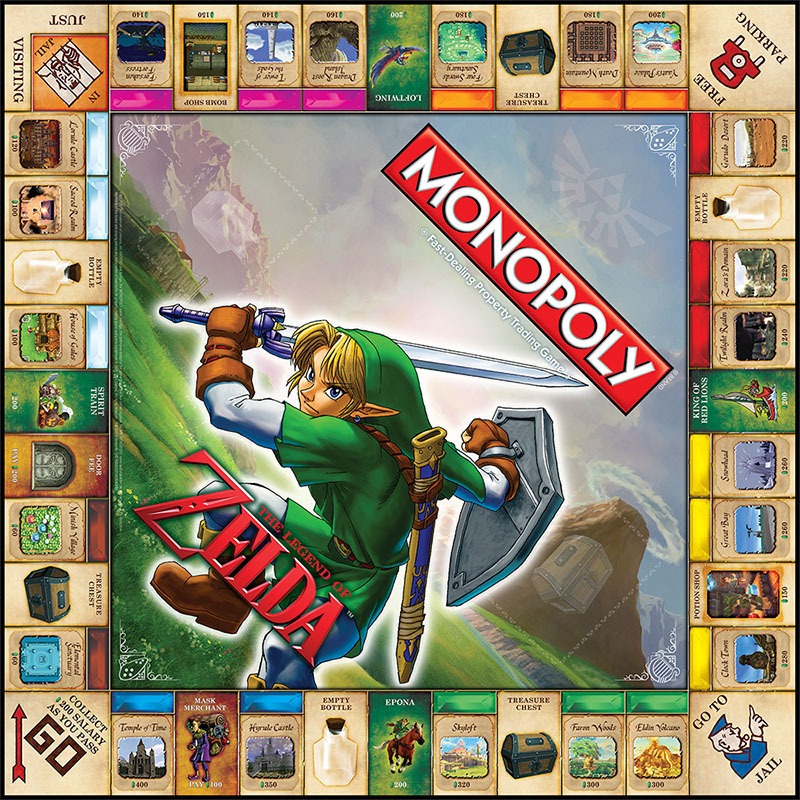
Hey! Listen! There's a Legend of Zelda board game coming! Awesome! Take a look!

zelda-board-monopoly…Oh. Monopoly. Again. Great.

Yes, indeed: the latest in a long-line of quick-and-easy cash grab Monopoly sets is one based on Nintendo's Legend of Zelda series, a franchise that has been running almost since the dawn of gaming, and one which has consistently provided gamers with some of the most enchanting interactive adventures of all time, blending childlike wonderment with epic heroic fantasy.

The Legend of Zelda, meanwhile, has not been particularly known over the years for its protagonist Link's desire to build up a sizeable portfolio of property, nor has Hyrule society ever been particularly dependent on capitalism. Link, more often than not, does good deeds out of a sense of altruism, or occasionally for the promise of "something good" (inevitably in bold print) — said "something good" is rarely financial reward, with questgivers instead tending to give him something of much more practical use.

I'm a bit annoyed about this. I'm not a particularly huge Zelda fan myself, but this is, without a doubt, a colossal waste of an awesome license. Monopoly is a terrible board game to shoehorn the Zelda license into. It's a terrible game in its own right, too, but I'm aware some people still like it, so I'm not going to push that angle too far — besides, my own personal dislike of Monopoly isn't why I'm frustrated to see Zelda squandered like this.

No, instead I find myself wishing for a more appropriate use of the license. It doesn't have to be an original board game in its own right — though that would be cool: spectacular Polish RPG series The Witcher is soon to get its own cool-looking original board game, so it's not without precedent either — but surely, surely there are better ways that Zelda could be adapted for tabletop play?

Here's just a few suggestions:

  • The Legend of Zelda: Carcassonne — Standard Carcassonne, except the tiles are all made up of actual tilesets from past Zelda games — A Link to the Past's 16-bit top-down graphics would be ideal for this. Meeples could be replaced by the different, distinctive races of creatures you come across in a typical Zelda game — one player could have a set of Gorons, while another could have Zoras, another still could have the Kokiri, and so on.
  • The Legend of Zelda: Catan — Much like Carcassonne, the bare minimum you need to do to make a convincing Zelda Catan set would be to redo the tile artwork in an authentically Zelda-esque fashion. You could incorporate some of the new rules and tweaks from things like Star Trek Catan — variable player powers is neat, for example — and Catan's numerous expansions for different scenarios.
  • The Legend of Zelda: Talisman — Talisman is, while flawed as a game, a decent depiction of an epic quest to achieve something. Reskinning this would be a more appropriate use of the license than Monopoly.
  • D&D Adventures: The Legend of Zelda — The dungeon-crawling co-op adventure games carrying the D&D brand are ripe for adaptation with Zelda artwork, enemies and items. You could even do a "Four Swords" thing, with each player having a differently coloured Link to control.
  • Arkham/Eldritch Horror: The Legend of Zelda — Okay, stretching things a bit here in terms of theme, but the mechanics of Arkham and Eldritch Horror are ripe for adaptation into a Zelda-style epic quest. There's exploration, treasures, character progression, battles, boss fights… everything a good Zelda game would need.

And this is just off the top of my head. All of the above would need very little adaptation in order to create a more convincing tabletop Zelda experience than Monopoly ever will. Come, on, Zelda Monopoly even still has "salaries", "Go To Jail" and "Free Parking", the latter of which in particular is completely incongruous with the setting.

So, this is pissing in the wind, I know, but please, please, license holders: when considering whether or not to license your awesome property for tabletop adaptation, please look a little further than Monopoly. It may be one of the most well-known games in the world, but there are hundreds, thousands of other, far better board and card games out there, most of which would be much better-suited for adaptations of this kind.