Bio. SHOCK!

Topical, huh? Yes, I finally completed Bioshock, a game that has been sitting on my own personal pile of shame since release day. It's a game I have steadfastly refused to trade in because it's a game I knew I "should" finish before I even considered it. Other games I know I'll never get around to, so often they're trade fodder, unless they're the sort of thing that's likely to become difficult to find in the future in which case I'll hang on to them – because ironically, the rarer stuff fetched much lower trade-in values anyway.

But I digress already. Bioshock, then.

THERE WILL BE MASSIVE SPOILARZ IN THIS POST. IF YOU HAVEN'T FINISHED BIOSHOCK AND INTEND TO, TURN BACK NOW.

It's not an understatement to say that I was looking forward to Bioshock a great deal as a result of a Squadron of Shame mission on System Shock 2 – this was in our pre-podcast days so don't go looking for a SquadCast on it… yet. I absolutely adored System Shock 2 and its prequel, which I also played all the way through thanks to the magic of DOS emulation. They were two games absolutely dribbling with atmosphere, and they featured one of the greatest villains of all time – SHODAN. SHODAN was a magnificent villain because she was creepy without overdoing it, she was omniscient and she had a level of power that was never entirely clear to you. It was important not to underestimate her, because she could very often put you into a difficult situation and then mock you from the shadows. The fact that she was incorporeal also helped a lot with the creepiness factor – until the very end of the first game, there was very little you could do to hurt her directly.

Bioshock necessarily took a different tack thanks to its retro-themed 1950s setting rather than the futuristic environments of the System Shock games. An omniscient computer perhaps wouldn't fit in with the setting, so instead we have two people watching your every move through the security systems in the underwater city of Rapture – Andrew Ryan and "Atlas". Ryan is set up to be "the bad guy" of the piece, with his constant taunts echoing SHODAN somewhat. Indeed, your whole experience with Ryan is similar to your relationship with SHODAN in the Shock games. He sits in the shadows far away from you, affecting the things that are happening around you. And these are drastic effects he has, too – in one memorable sequence, he kills the forest created in the underwater city, threatening to deprive you of oxygen. The area is flooded with gas and the trees wither and die around you. It's a powerful moment that pushes home the necessity for you to go forward with your mission to destroy Ryan.

Atlas, on the other hand, is where the "big twist" happens. Atlas is set up from the start of the game to be "the good guy" – your voice in the darkness guiding you onward. Yet paying close attention to the things he says, it is clear that he has his own motivations for you to move forward. When you arrive in Rapture following a plane crash, you have no idea what you're doing there, and it's not until Atlas asks "would you kindly…" rescue his family, deal with various problems and finally stove Ryan's head in with a golf club that you have any clue as to your purpose in that place.

Of course, it's all been premeditated. Atlas is Fontaine, Ryan's rival in the underworld of Rapture, and he knows how you work. The trigger phrase of "would you kindly" turns out to be something programmed into your brain to make you do things. You're under the control of anyone who uses that phrase. Ryan demonstrates this to you with fatal consequences when he hands you the aforementioned golf club and says "would you kindly… kill", and you oblige. It's a powerful moment and a nice way of handling the relatively linear nature of the game – the fact that you've been surreptitiously manipulated throughout the whole thing was a great justification for what you've had to do up until that point.

Following Ryan's death, there's some great sequences where Fontaine taunts you with another trigger phrase that gradually causes your health to seep away… and then when you find the antidote, it only half-works, causing violent hallucinations and random, indiscriminate use of Plasmids. Eventually you manage to pull yourself together thanks to another dose of the antidote that you find, and it's on to the final confrontation.

This is where Bioshock, for me, started to sadly tail off a bit, and a lot of people feel the same way. The sequence where you have to make yourself into a Big Daddy is quite neat, but the gameplay mechanic used here – an escort mission! Ugh! – is rather irritating, unless you enjoy the sight of little girls being shot to pieces with little you can do about it. The feeling of being a Big Daddy is quite fun though – your footstep sound changes to the big clumpy boots that they wear, your grunts of pain when you get hit have the low groaning of a Big Daddy, and your vision is distorted through the diving helmet that you wear.

Finally, of course, there's the notorious battle against Fontaine. This is, without a doubt, the most ridiculous part of the game, and one which there was really no need for. During your Little Sister escorting, you hear Fontaine suddenly "discovering" gene splicing so that by the time you get to him he looks like something out of Fantastic Four. Oh, and he's naked. You then have a protracted boss battle with him that pretty much involves you hurling every piece of ammo you've got left at him then running up to him and pressing the "Action" button, then repeating this three more times.

Now, as previous posts have shown, I'm a big fan of final confrontations, particularly if the music involved is suitably stirring. But this battle felt so entirely incongruous with the rest of the game. I would have preferred something more along the lines of Uncharted's final battle (which I won't spoil here, but those of you who have played it will know what I mean) which is a masterful piece of gameplay that is entirely appropriate for the setting. It's still essentially a "boss battle" of sorts but there's nothing stupid about it. There's no giant monster, for one thing. (OMG SPOILARZ.) Why couldn't we just have had a plain old shootout with Fontaine as a human, or fisticuffs atop a submarine or something like that?

Sadly, Bioshock's ending falls into the same trap that many other games have done in the past – great game, fell apart at the end. Indigo Prophecy, aka Fahrenheit, is perhaps the most notorious example of this, but it's by no means the only one. Many games are rushed in their final stages by pushy publishers keen to get the game out of the door. It's sad really, because commonly-accepted wisdom has it that the things we take away most from (for want of a better word) "artistic" experiences are beginnings and endings. A lot of games have great beginnings, but shoddy endings. I'd rather that they made the beginning and the ending first and then sorted out the stuff in the middle afterwards. If there's a lull in the middle, that's nothing unusual. A lot of books, films, pieces of music, whole albums… many of them lull in the middle but pull themselves together for an explosive (not necessarily literally) finale.

Of course, with games there's the argument that if you suffer through a lull in the middle you'll never get to the end of the game. The ideal situation would be, of course, if developers were free to work on their games until they were completely, totally 100% done and dusted to the writers' and designers' complete satisfaction. Sadly, in the high-pressure world of commercial video games, this doesn't always happen, which is why many commercial publishers could, I think, learn a lot from indie developers making smaller games. Take something like Flower on PSN. It's short, sure, but it's a wonderfully "complete" experience that takes you on a journey from beginning to end. Some people weren't fans of the end of Flower, sure, but at least it didn't feel like it was rushed through – it felt like it was a conscious artistic decision by the team.

One day, maybe we'll get the perfect game – one that doesn't need patching, one whose ending doesn't suck and remains a consistently excellent game all the way through. Bioshock gets so close, so very close… but falls apart at the end. It's a shame – but that's not to say that you shouldn't play it. I'm really glad I finally played it through as it's a pretty incredible experience. It still looks great, the atmosphere is second to none and the overall story has been thought through well. It's just that in a rush to tell that whole story, that boss fight had to get shoehorned in.

So, Bioshock? Good. Very good, in fact.
Retro or "Inspired By"?

turtles-in-time-reshelled-screenshot-now-only-10-dollars

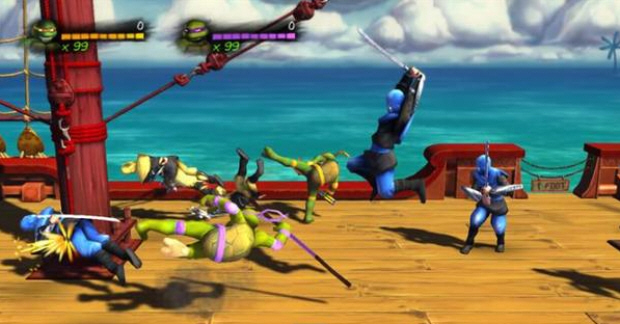
Tolkoto's recent Exploding Barrel rant about reviewers' reactions to the recent Turtles in Time remake on Xbox Live got me thinking. What is it that gets people so excited about some "retro" games and not others? I agree with him, in fact – reviewers' reactions to Turtles in Time was somewhat harsh, particularly considering it's only 800 space dollars. Criticising the gameplay of the original by measuring it against modern yardsticks clearly isn't acceptable… or is it? It's difficult to say. After all, this may be some gamers' first encounter with an early-90s brawler (although XBLA has hosted the previous Turtles arcade game along with the magnificent Streets of Rage 2 and the diabolical Double Dragon) – what gives? And how come Castle Crashers – fundamentally the same game in many respects – gets smothered in adoration?

A common criticism of the brawler genre is that it's "too simple". But let's take a look at another genre in the form of the PSN's recent brick-breaker Shatter, which has garnered almost universal praise since its release a couple of weeks ago. Shatter is, let's not kid around here, Arkanoid. Okay, you have a "suck" button. And a "blow" button. (Stop sniggering at the back.) But fundamentally, it's still Arkanoid. You're a bat-shaped spaceship hitting a ball into bricks that are floating in space with some flimsy justification laughably called a "plot" buried somewhere in the Help menus. There are powerups, including one where you can just shoot down the bricks. Pretty much the sole point of the game is to achieve as high a score as possible – and high scores are something the game does well. It's a simple game. Everyone loved it for this fact.

So in terms of gameplay, Shatter adds little to the Arkanoid formula save a few fancy bits of physics, some HD art and a kickass soundtrack that I love and Feenwager hates. So why is this game awesome and Turtles in Time a bit steaming turd to reviewers? God knows.

The important thing is, of course, what the player thinks of all this. Those who enjoy the brawler genre or have fond memories of playing Turtles in Time on the SNES will have an absolute blast with the new XBLA remake. Similarly, those who enjoy bouncing things around and smashing walls will love Shatter. But are people more predisposed to like Shatter as it was designed from the ground-up to be a new game rather than a "re-imagining" of Arkanoid? Arkanoid LIVE on the 360 released to mixed reviews and has, it seems, been mostly forgotten already. Shatter, on the other hand, gives me the impression that people will perhaps be more inclined to give it a go, particularly given its very generous price point ($7.99 in the US store, £4.79 over here) as a result of the few things it does a little bit differently.

This pattern follows us around a great deal. LittleBigPlanet for PS3 is a 2D platformer, and unashamedly so. Yet plonk someone down in front of that, then down in front of, say, Rolo to the Rescue and see which they prefer. Actually, that's perhaps not strictly accurate. Plonk someone down in front of an HD version of Rolo to the Rescue sold for $10 on XBLA or PSN and ask them which they prefer. Would the answer still be LBP? Judging by what has happened with Turtles in Time here, it may well be, though many players, particularly those who have played and loved both, may feel a bit differently.

This has been yet another rant without any real point but do feel free to comment if you have any feelings. I'm planning a new music post very soon – those take a bit more preparation though. 🙂

Af Wubbas Do (Or: Evil in the world of The Sims)

So I bought The Sims 3. So I like The Sims, and have done since the first one. So I usually buy most, if not all of the expansion packs. What of it? Huh?

If I sound defensive, it is of course because The Sims is seen by many as one of the banes of the hardcore gamer. I've found it fascinating over the years, though. Ever since first playing Sim City, then being able to fly around a Sim City 2000 save game in Sim Copter, I wondered for the longest time how cool it would be to get right down to the "personal" level… and the original iteration of The Sims delivered bigtime. It became a social event, too – I was living in halls at university at the time, so inevitably I made all of the people in our flat as best I could. Everyone came by regularly to see what was going on and laugh at who had pissed themselves or passed out from exhaustion that day (hey, managing six people is tricky!) and it is a source of many fond memories.

Fast forward to today, and we have The Sims 3. Some things haven't changed much (the basic gameplay still involves bossing your Sims around and making sure they don't shit themselves, though this has been played down a little in favour of "Moodlets" – mood "buffs" and "debuffs" – this time around), and others have changed a great deal. The biggest change is the much-vaunted "open world" design of the game. In practice, this means that Sims can walk out of their front door, walk down the street and go and visit someone else. The difference this makes is enormous – no longer are you confined to your own house or specific "community lots" – now you can actually explore the world, and there's a bunch of gameplay elements to reflect that. You can go fishing, collect things, find "treasure" – in many ways, the design of the game is getting closer and closer to something along the lines of an MMORPG.

Anyway, this time around, as usual, I made myself and my wife and am playing them "straight" – that is, attempting to be as successful as possible and maintain the family bloodline. As such, as Sim Pete and Sim Jane enter their twilight years, their two kids are growing up nicely and developing into fine young men. I just hope they don't die before the kids reach adulthood, which is, of course, a possibility!

Having read some articles online, the Prima official guide (which is a good, fun read if you're interested in the game and its mechanics) and, most notably, this touching and heartbreaking blog about two homeless Sims, I was intrigued to try out a completely different kind of Sim, using some of the more… shall we say "unpleasant" Traits on offer at character creation. Here were the results:

This is Lars. As you can probably see, he's a miserable git. Maybe people laugh at his Sephiroth hair and overuse of man-makeup. Whatever the reasons, he's become a bitter and twisted individual. He's Grumpy pretty much all the time, which makes it difficult to keep him happy. He's also Evil, which means he delights in the misfortune of others.

Naturally, he has an evil-looking house surrounding by a grungy-looking moat/swamp combo. He deliberately designed it to annoy his neighbours, who have a very pleasant-looking house.

Lars wanders over to pay his new neighbours a visit and is confronted with Roxy, a young woman whom he takes an immediate dislike to due to her looking "a bit hippie".

The conversation turns sour quickly. Roxy recoils in horror as Lars starts yelling at her for no other reason than he felt like it. He insults her appearance and her house. (Most of this was without any intervention from me.)

Lars decides enough is enough and spontaneously decides to attempt to punch out Roxy. He fails once. Humiliated, he tries again and is victorious. Both sims are left feeling faintly ashamed, but Lars is pleased that he's caused some misery.

Dusting himself off, Lars turns to Roxy's roommate, who has been watching in horror at the sideshow unfolding in front of her. Lars is sweetness and politeness, though, and uneasily (and some may say foolishly) she allows him into her house. Roxy is not happy.

"What a nice house," thinks Lars, his Kleptomaniac Trait itching. He restrains himself for the moment, as people are watching and he's already made a… memorable first impression.

In an attempt to ingratiate himself with his hostess (and perhaps build up some misplaced trust which could come in handy later…) Lars decides to tell the one about the broccoli, the tomato, the carrot and the pepper. Roxy's housemate isn't sure what to make of Lars' aimless ramblings. But then there's a clattering thump behind them.

Roxy has passed out on the floor. Evidently the exertions of meeting Lars for the first time were too much for her. Lars, Roxy's housemate and Madame Dungarees all have their own thoughts on Roxy at this point.

At this point, the household gets another visitor. Lars doesn't even bother to find out her name before he starts spreading gossip about how unlucky Roxy is. "She sure was unlucky to meet me today," he cackles.

The visitor is unimpressed. Lars sneers, knowing that the poison has been dripped. Roxy blushes as she listens to him carry on.

Lars starts on Roxy again, who looks close to tears. Roxy's housemate, getting rather fed up of this, starts thinking about going to bed and just leaving them to it.

Roxy decides to stand up to Lars and squares up to him. Her housemate stares into space behind the quarreling pair.

Finally, as Lars goes to give Roxy a good slap around the kisser, Roxy's housemate finally decides enough is enough and politely asks Lars to leave on account of his "misbehaviour".

He graciously leaves, bidding his hostess farewell. Then he tips their trashcan over…

…and steals one of their porch lights, not because he needs one, but because he can.

Tired and hungry, Lars heads home to contemplate the evil he has committed that day. Preparing himself a piece of toast, he suddenly realises that his house doesn't have any chairs in it, so, unprompted by me, he decides to settle down on the toilet to enjoy his toast.

I was laughing hard by this point. This was such a different experience to anything else I'd done in The Sims before. Sure, you could play an evil God and kill them off by rebuilding their houses in ways that, shall we say, weren't to their advantage, but the "negative" social interactions were always seemingly discouraged. By playing an Evil Sim, you're actively encouraged to be mean and nasty to as many people as you can. The Sim's Wishes reflect that, showing their heartfelt desires to go out and steal candy from a baby, or slap a special someone.

The expressiveness on the faces of the Sims has developed a lot over the years. Check out the faces that Roxy pulls as Lars is mean to her. I also found it pretty funny that Lars did a lot of the unpleasant things to Roxy completely of his own volition thanks to the "free will" option. He obviously felt an uncontrollable urge to make his presence known to his new neighbours, so I just kind of went along with it. It was fun, in an ever-so-slightly wrong way.

Give it a try. Playing an unconventional, flawed character presents some interesting challenges that you'd never come across if you were playing relatively "straight-laced".

TWANG! Waggle! Kick! Punch! It's all in the mind!

Those of you following me on Twitter may be familiar with my Jedi Health Kick blog. Perhaps you're reading it already, in which case you'll know I recently picked up a copy of EA Sports Active in my latest attempt to hammer and chisel my woeful body into a shape vaguely resembling human. It's good stuff, and for anyone doubting the value of Wii Fit as an exercise programme, you can rest assured that EA Sports Active gives you much more of a battering than Wii Fit ever did thanks to the fact it actually takes you through set programmes (although, of course, you can create your own also) rather than leaving you to your own devices and relying on your own self-discipline which – let's face it – your lack of is probably the reason you came to titles like Wii Fit in the first place!

The thing I like about it is how "videogamey" it makes the whole experience. Being a supergeek as I am, I like anything that rewards achievement in a noticeable way. I'm a sucker for slidey bars, percentage markers and trophies. Ironic, really, that I never got into sports, since sports are also filled with slidey bars, percentage markers and trophies. Anyway, the fact is that EASA is full of these things. You get trophies not only for successfully completing workouts, but for smaller things like doing a certain number of laps around the virtual track across all your workouts, doing a certain number of squats, burning a certain number of calories and the like. These are all goals that you would probably set yourself if you were one of those people who are "into fitness" and can motivate themselves, but for the gamers (or the lazy) amongst us, it helps to have something to remind us that even smaller achievements are worth celebrating.

Anyway, to cut to the tenuous link: there's been a lot of discussion surrounding motion control and full-body control recently, particularly after E3. Some seem to think that it's "the way that games are going", with the idea of us standing up to play games and running the risk of hurricane-kicking our TV a very real possibility. Others are very much a fan of the traditional controller, believing that it is something fundamentally "gamey". I'm inclined to fall into this latter camp, but the motion control thing has some obvious health benefits which are clearly demonstrated by titles like EASA.

The question is, of course, do you want something that is primarily an entertainment device to provide health benefits all the time? Look at other media. TV and books offer health benefits sometimes – you can watch a yoga DVD or read a lifestyle book – but for however many of these there are, there are an equal if not greater number of "junk" items to enjoy – pure, unadulterated enjoyment with no pretense of "doing it for your own good". In this sense, while motion controls are cool and groovy, I'd like to hope that the controller isn't dead just yet.

A key part of the experience is tactile feedback. While motion controls allow you to feel your own body moving, when it comes to actually touching or hitting something, you don't feel anything. This is also a problem with touchscreen controls – a joypad on a touchscreen will never match a real joypad until a technology is developed where you can "feel" it. I also question how some genres would work with motion controls – take an FPS, for example. How do you look up? If you REALLY look up, then you can't see the TV any more, so unless Halo Natal comes with some sort of 360-degree "vision ball" that you have to stand inside to play (which would be awesome, incidentally) then you're resorting to flailing your arms around in some arbitrary gesture or pointing something at the top of the screen.

I think there's work to do – and I just hope that people aren't going to embrace these new technologies too completely. I very much like them and think they're going to be a lot of interesting fun to play with – plus I think all of them provide plenty of scope for further titles like EASA and Wii Fit to improve gamer lifestyle, which can only be a good thing – but let's hope the controller isn't dead just yet, hmm?

Microsoft at E3

Just finished watching the Microsoft E3 presentation. As most people could have predicted even before seeing what was on offer, reception was somewhat mixed.

Predictably, everyone creamed themselves over the Modern Warfare 2 trailer and gameplay footage which I, ever the rebel, remain relatively indifferent about, though it is remarkably pretty. Halo fanboys spooged copiously over ODST and the "secret" Halo title, Reach. This I am completely indifferent about. When Bungie said they had a "top secret" project to announce, I was hoping they were going to show a new Myth game or something like that… but no. Bungie make Halo and nothing else now, it seems. Fair play, it's made them an awful lot of money but seriously guys, something new once in a while really wouldn't go amiss.

Other notable mentions went to Crackdown 2, sequel to the underrated open-world funfest from a while back – and for my money, one of the best implementations of co-op (or perhaps it should be more accurately called "concurrent play", since you can both happily charge off in opposite directions if you want to) I've ever seen.

Then there was Splinter Cell: Conviction, which does look like it's trying some revolutionary new tricks with presentation. Rather than having mission objectives and cutscenes taking players out of the action, many things appear "projected" on the walls, be these instructions or even flashback cutscenes. It was a really interesting approach, and the game looks to be supremely cinematic because of it. It's certainly enough to get me interested in Splinter Cell again, a series I haven't touched for quite some time.

Then there was Alan Wake, a game which many were worrying had fallen into the abyss of vaporware. But no – we saw it, including some gameplay footage. It looks to be something of a cross between Max Payne and Silent Hill, with, like Splinter Cell, some interesting presentational features. Wake's narration of the action hearkens back to Max Payne's overblown drawl from his games, and the use of light and dark is reminiscent of some scenes in the Silent Hill series. It certainly looks incredible, too, and could well be the thing that makes 360 owners feel a bit better about not having Heavy Rain to play.

Kojima also snuck onto stage and dropped the fact that a new MGS game starring Raiden would be hitting 360, and Square showed off some FFXIII footage. Both will likely be great, but there was nothing there we hadn't expected.

The main part of the keynote revolved around the Project Natal technology, which allows real-time motion capture and voice recognition, allowing players to interact with games without needing a controller. It was made very clear at the outset of the presentation that this was primarily intended to be a means by which non-gamers could be attracted to interactive entertainment – but of course, this hasn't stopped hardcore gamers bitching and moaning as they always do.

We saw a number of demos, including some questionable real-time avatar motion capture and animation and a fun-looking tech demo called Ricochet (essentially body-controlled Breakout). We also saw how Natal will allow users to interact with the Dashboard in a distinctly Minority Report manner by swishing their hands around and, much to the disgust of Atheistium over at viera.nu, allow their avatars to try on girly clothes while having a video chat. (To be fair, this was pretty cringeworthy, but I don't see it being a huge part of most gamers' lives.)

It was Peter Molyneux's work with Natal that provoked the most interest and curiosity, however. Presenting a virtual human called Milo, he demonstrated the capabilities of Natal along with software by showing someone interacting with Milo by speaking naturally and using realistic gestures to interact with the virtual world. At one point, Milo invites the player to look into the water and a real reflection of the player appears on-screen, with the ripples in the water responding to their "touch". It was a pretty incredible sight, and a glimpse of what the future might hold, especially for games like Oblivion. (Thanks to Ajguy for suggesting this.) Imagine being able to hold a naturalistic conversation with an NPC rather than tediously clicking through a list of topics.

As I mentioned earlier, reception has been mixed. Natal is undoubtedly amazing technology (assuming it works) but the self-professes "hardcore gamers" of the world are already up in arms about "dumbing down". But the fact is, just like the Wii is not a system for these people, Natal and its features are not designed for this audience. What Natal will allow Microsoft to do is broaden their audience from the core of gamers to families and other non-gamers. With the introduction of other services on the Dashboard such as last.fm, instant-on 1080p movies (I remain cynical about this, given the general crapness of my connection) and live TV from Sky, the aim is very much to turn the Xbox from a simple games system to an all-purpose multimedia box that sits under the television as the centrepiece of your digital life.

I don't think that's such a bad thing. No-one suggested once that hardcore gamers would be left out in the cold – quite the contrary, in fact, with the announcement of big titles like Modern Warfare 2, Crackdown 2, Left 4 Dead 2 (yayz!) and numerous others. What Natal will do is simply open up the field of interactive entertainment to more people. If all they want to do is prance around like a pillock in front of their TV, then let them. But there's always the possibility that they'll get interested enough in the hobby to join the growing number of gamers out there and enjoy this rapidly-changing medium.

I think that's quite a pleasant image of the future, in fact. Let's see what happens.

What is Your Alternate Reality?

I've been banging on about ancient 8-bit RPG Alternate Reality since the last SquadCast now and am finding the process of revisiting it with an adult's mind (i.e. one that understands what an RPG is) equal parts addictive and frustrating. The reason for this is that Alternate Reality itself is an incredibly ambitious game with very grand designs… yet its difficulty level at the outset is absolutely maddening… and yet (again) this difficulty level makes it incredibly addictive. You start think that if you could just get a little further… or if you hadn't tried to punch that knight in the face while not wearing any armour… things would be better.

At this point, let's pause for a typical playthrough from beginning to inevitable early death. Strap yourself in, we're going to another world.

It's a typical day in the city. Perhaps I'm on the way to work, or on my way to meet a friend. But disaster is waiting just around the corner, because…

Holy shit! Aliens! AAAAHHH!!

And now they're abducting people! Interestingly, I'm not the only one abducted… it looks like the ship picks up three others. (I'm not sure if these other three people are ever mentioned… or perhaps it's a reference to the fact you have four "save slots" on your character disk)

Uh-oh… we're leaving. But where are we going…?

Ah, yes, space. Of course. They are aliens, after all. Wait a minute, I know how we can lift our spirits…

A little sing-song! Maybe this won't be so bad…

As the song ends, two sets of big scary doors slam shut and I'm locked in a green room where I am invited to "become a new person".

When the doors slide open again, I'm in front of a gate with a force field over it. Numbers rotate over the gate. As soon as I step through the force field, the numbers freeze in place, defining who I am to be in this new world.

There's a flash of… lightning? Static? Something, and then…

Apparently I am "joined", and ready to enter an alternate reality.

(In the subsequent loading break, you have to swap disks twice unless you have more than one drive. You thought you had it rough with JRPGs.)

And here I am at the Floating Gate, ready to begin my adventure. You'll notice my statistics are distinctly average. From left to right, we have Stamina, Charisma/Charm, Strength, Intelligence, Wisdom and Skill/Dexterity. These have a potential initial maximum of 21, so Stamina, Charisma and Skill are pretty good, but Strength, Intelligence and Wisdom are pretty feeble. Fortunately, Skill is probably one of the most helpful stats early in the game, as it allows you sufficient mobility to avoid attacks from early enemies.

So, first job? Find a weapon. You begin your adventure in the city of Xebec's Demise with only the money given to you by the strange portal at the beginning, no equipment and only some basic clothing. Fortunately, your starting area is the City Square, with the Floating Gate in the middle and shops all around. So, let's take a look.

A smithy, huh? This sounds promising. I know he's in at the moment, too, because I can hear him hammering away inside. (And yes, you actually can. This is just one of the cool "environmental effects" that you hear throughout your travels). So, let's pay him a visit.

(Single-drive users can expect a disk swap at this point.)

The Best Armorers, huh? Sounds expensive. However, as the smith seems quite happy to stand there singing while I browse his wares, I take my time and consider my options carefully.

7,424 coppers? I was right, this place is expensive. In fact, there's nothing I can even nearly afford in here. I tell him to forget it rather than risk offending him by making him a paltry offer (which might make the smith reluctant to deal with you in the future, when you could potentially afford his wares – one of the many things that AR keeps track of in the background). I step back onto the windy streets, still distinctly lacking in equipment. Time to explore.

As I leave the Best Armorers, it starts raining, which makes it difficult to see where I'm going and slows me down. Thunder crashes and lightning flashes. But at least I haven't run into any ne'er-do-wells as yet.

Spoke too soon. A wandering zombie notices me but doesn't have time to act. I don't fancy taking it on in my current state, so I run for it. Fortunately, I managed to get away before it was able to do anything unpleasant to me.

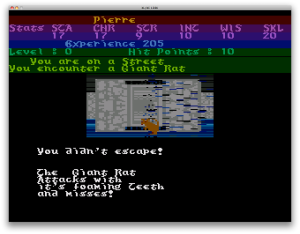
A little further down the road, I surprised a rabid-looking Giant Rat. I elect to leave it alone as I don't fancy adding a disease to the list of my woes. It's still early days in this strange place.

After a little exploring (and a Hobbit surprising me, then running away without saying a word) I hear the sound of a smithy again… but there's no doors in this building. Curious. I press against a wall and find myself slipping straight through it. A secret door!

Sure enough, it's another smithy. Occums Weaponsmiths, to be precise. It's cheaper… but still way out of my price range. Curses.

Outside, it's still raining, and worse, I run into a Goblin. Desperate, I try and sweet-talk it into stepping down and maybe giving me some of its treasure and equipment. The conversation doesn't go well, with the Goblin responding to my polite request by trying to stab me. This place is just like Southampton. Maybe I haven't gone anywhere at all.

I respond in kind to the Goblin by punching it in the face. It's a feeble attack, but at least it connects, which is more than can be said for the Goblin's attacks. With my high Skill, I nimbly avoid and parry all of his blows and manage to knock the foe to the ground without sustaining any injuries myself. Unfortunately, the Goblin doesn't seem to be carrying anything of value. I do, however, gain a total of 59 experience points from the whole encounter.

Night falls, and it's still raining. I surprise a Fighter in the street, but he looks tough so I decide to avoid him while he's still surprised. I begin to think it might be an idea to try and find somewhere to spend the night. It's clear the City is an inhospitable place, but I imagine this becomes even more apparent in the night-time.

In search of an inn, I get mugged by a Skeleton. What a bastard. Fortunately, I manage to get away before he can attack properly. But how much did he steal…?

I check my pockets. Fortunately, I don't seem to have lost anything irreplaceable, and I still have a few copper coins to my name. Enough to spend the night somewhere, hopefully.

I encounter a Dwarf a little further down the road. I'm not sure if he's friendly or unfriendly, so I decide to turn on the Charm and see what he has to say about that. Bizarrely, he dies. I think this is AR's way of telling me that this was a successful encounter, not that my tongue was so silver he simply collapsed and died in wonderment at my words. Possibly. Whatever actually happened (and I guess we'll never know), I now have 205 experience points. Not yet enough to reach level 1 (You have to earn level 1! The indignity!) but a step closer, nonetheless.

A Troll shows its face next. It looks scary, so I try and disengage from it and escape. I do so, but not before it steals some of my water and food. This isn't going well.

picture-33For a worrying moment, despite working with a map (an absolute necessity, as this was, of course, the days long before automapping) I think I'm lost, and I haven't bought a compass yet. Fortunately, I get my bearings shortly afterwards and manage to stumble my way to the doorway of Mom's Bar, where the giant rat I ran away from earlier (possibly) is waiting for me. The rat tries to steal some more of my food and water then tries to bite me, but I dodge it and duck into the bar to get out of the rain.
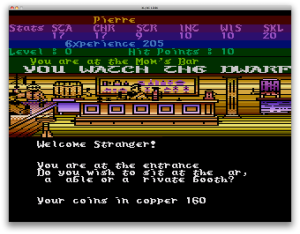
picture-35The bartender informs me that the band are on a break, but invites me to watch a dwarf dancing. Since I'm hungry and thirsty, I decide to take him up on his offer and sit at the bar watching the dwarf and listening to his quirky music.
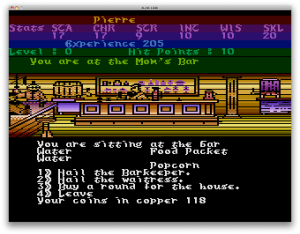
picture-36I order some water and a food packet to take with me. This only costs me a few coppers, fortunately, and should give me enough sustenance to get through the night… I hope. I step back out of the door. I wonder if it's stopped raining yet…
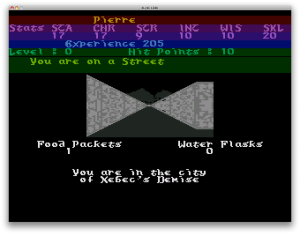
picture-37It has. But it's still dark and I need a place to sleep. I stumble through the city streets some more, pausing only for another giant rat (the same one again?) to steal the food packet I just bought.
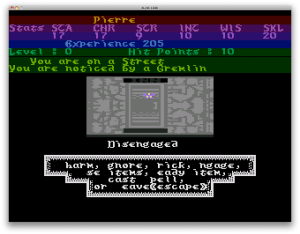
picture-38Eventually I come across a welcome sight – a door marked "Inn". Unfortunately, as I reach for the handle, I'm attacked by a Gremlin. I ask it very politely if it wouldn't mind awfully stepping aside if it would be so kind, and it dies at my words, finally giving me enough experience to reach level 1. Not only that…
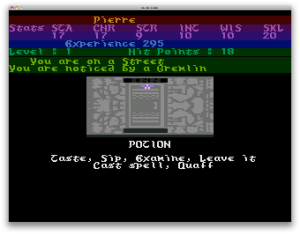
picture-411TREASURE! The Gremlin drops a potion. I can't work out what it is, but it tastes dry and is red in colour. I decide not to quaff it right now just in case it is deadly poison, which is entirely possible in this harsh world. The Gremlin also drops a shield, which looks "mundane", apparently. I pick it up and wield it on my off-hand, not caring that I look ridiculous wielding a shield but not a sword. Cutting a rain-drenched yet distinctly self-satisfied figure, I barge into the Green Boar Inn.
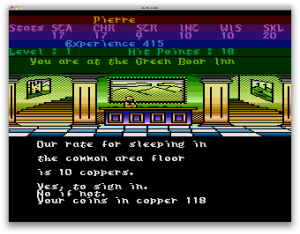
picture-481I elect to spend the night on the common room floor as despite having my first taste of acquiring treasure, I'm not exactly flush with cash. I hand over 10 coppers and spend the night on the floor, asking to be woken at 9am the next day.
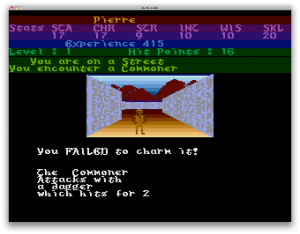
(Aside: This is, I think, the longest I've ever survived. It figures that the one time I decide to show you a "typical playthrough" and make reference to "inevitable early death" I'm here for ages.)

picture-51I step outside the door and give a charming greeting to a passing commoner. The commoner is obviously in a bad mood and promptly stabs me in the stomach. I try and apologise, but he stabs me again, so I run away, bleeding a bit. I'm also now very hungry and very thirsty. Time to pay that tavern another visit.
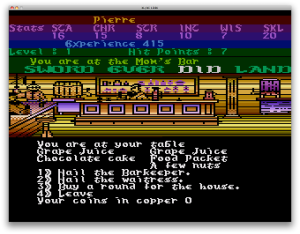
picture-52Seriously hungry and thirsty now, and my stats now starting to drop from thirst, I impulsively spent my remaining coins on food and drink – some grape juice, a couple of food packets and some chocolate cake. When I leave a few hours later, I'm still thirsty but I'm not hungry any more. Plus I enjoyed the band's song.
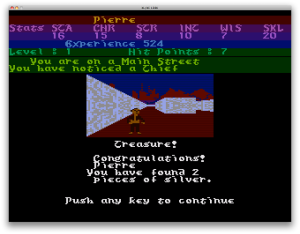
picture-531Back on the street, the sun is setting (Already? I must have been in that tavern longer than I thought) and I encounter a Thief. I charm him successfully and take his two pieces of silver that he was carrying – this equates to twenty copper pieces. It paid for the chocolate cake if nothing else.
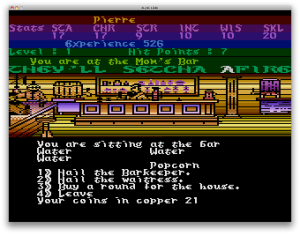
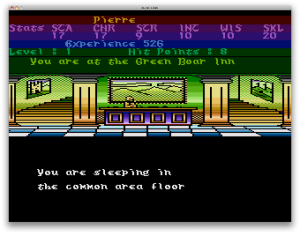
Incidentally, reading the official guidebooks and cluebooks for The City indicate that successfully Charming someone is indeed killing them – you pretend to be their friend then stab them in the back. So to the Dwarf I met earlier… uhh… sorry! This is something you have to be careful of in your time in the City. Encounters fall into three categories – Good, Neutral and Evil. You can safely do whatever you like to Evil creatures. Attacking a Neutral creature (and these include most of the humanoid ne'er-do-wells such as thieves and fighters) first before they do anything to you is considered an evil act… and tricking or charming a Good creature is a very evil act. As you might expect, dropping your reputation in this way is a sure-fire way to get the whole city pissed at you.

In a case of art mirroring life, I find myself "very thirsty" again, much as I am feeling now, sitting here writing this with a sore throat. Keen to prevent my already feeble statistics (in-game) from dropping any further, I head back to Mom's Bar to rehydrate myself.

picture-54

I order three glasses of water and sit at the table for a while, sipping them. It'll be time to sleep again soon, which should help me recover the injuries I sustained with my ill-advised encounter with the Commoner earlier. The band sings an entertaining if unnerving song about not going into bad parts of town at night for fear of being set on fire.

I stagger out of the tavern and head back towards the inn. Perhaps tomorrow will be a more productive day.

picture-55I wake up and, once again, I'm hungry and thirsty. Time for breakfast at Mom's Bar.
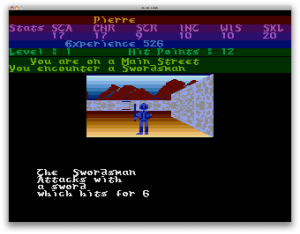
picture-56Unfortunately, I get jumped by a Swordsman outside the inn. The swordsman steals all my coppers then cuts me up with his sword. Fortunately, he proves easy to Charm. I hold my hands up in truce until he comes over, then I snap his neck. Unfortunately, he seems to have eaten my coins, so I'm now penniless, hungry and thirsty.
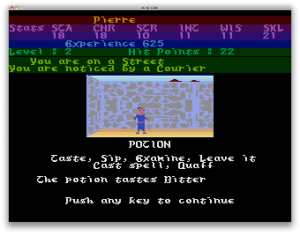
picture-58I'm not proud of what I do next. I use my not-inconsiderable skills of persuasion to "convince" a passing Courier to part with what he was carrying. Unfortunately, he was the walking equivalent of a white van with a "NO TOOLS ARE KEPT IN THIS VAN OVERNIGHT" sign posted on the back, as he is carrying nothing but a bitter-tasting potion which disappears in a puff of smoke when I attempt to quaff it.
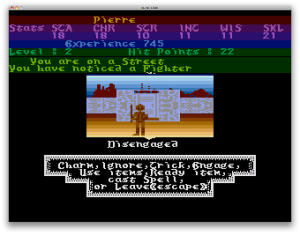
I do hit level 2, though, so it's not all bad news.

picture-59I'm reaching desperation point now. I come across a Fighter and attempt to sweet-talk him out of some coins. This fails and I get hit again. I manage to run away before too much injury is done to me, but things are starting to go downhill.
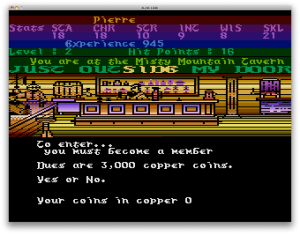
picture-60Saved! I find another tavern – this one called the Misty Mountain. But they want three thousand copper coins before they'll let me in. Given that I don't have any copper coins whatsoever, I am quickly ejected from the premises.
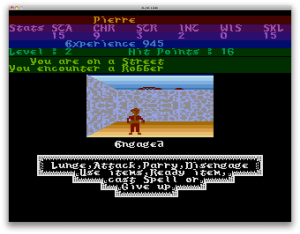
I begin to feel that my demise might be on its way. Death is peering over my shoulder. I slink back onto the street, dejected, weary and very thirsty. I manage to dredge up a food packet from my pocket to satiate my hunger for the moment, but there's no water anywhere to be seen.

picture-61Unable to help myself, I stumble into the path of a robber and attempt to beat him back, but I fail. He takes my last remaining possessions and runs away. By now I'm parched and starving, and I can feel myself weakening moment by moment. I must cut a pitiful sight.
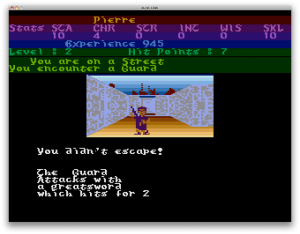
picture-64I collapse somewhere around the city's walls and am confronted by a guard. My attempts to mug the populace out of desperation have not gone unnoticed, it seems, as he attacks me without warning. By now, I am grateful for the attention. I put up some meager resistance but secretly, within, am hoping for the sweet release of death as this existence has become too difficult.
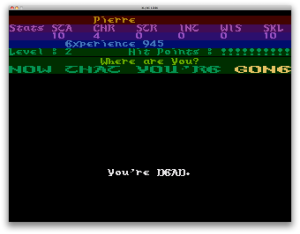
I am slain by his greatsword and crumple to the ground, never to be heard from again.

picture-65Alas, I am dead.

So there you go – in slightly longer format than I anticipated, but never mind.

Alternate Reality: The City is one of those games that is infinitely better when you treat it much as I did above – as a "playground" where you make your own story. This is largely because the game has no aim as such – partly due to its design, and also partly due to the fact that the whole series was never finished – a crying shame, as the whole series had a huge amount of potential.

For the unfamiliar, the series was originally planned to be split into several interconnected volumes – The City (and the Dungeon beneath its streets), The Wilderness, The Palace, The Arena, Revelation and Destiny. Only The Dungeon ever made it out onto shop shelves – as a separate game rather than part of the original City package. The Dungeon had much more structure and actually had an "end" too – or more specifically, a point that clearly led onto the final two chapters, Revelation and Destiny.

Revelation and Destiny were the interesting-sounding ones. Towards the end of The Dungeon, the player character was supposed to acquire a keycard, which could be used to enter the Revelation area where everything suddenly became a bit more futuristic. The player would find themselves walking the corridors of an alien spacecraft, looking out through windows into a dramatic spacescape, while Destiny would allow the player to finally discover the truth – that abducted humans had been placed into a form of suspended animation within "cocoons", each living out their own parallel life in the city of Xebec's Demise and its surroundings.

Hold on a minute, you might think. This all sounds a little bit familiar. A bit Matrix-y if you will. And you'd be right.

Philip Price, author of the series, claims he once met a pair of movie directors who wanted to discuss Alternate Reality. It's never been verified whether or not this was the Wachowski brothers, but there are certainly plenty of similarities between the two series, and it makes a nice story for geek folklore nonetheless. It's a crying shame that Price never got to realise his ambition, however, as the whole thing would have been a magnificent achievement had it come to fruition.

As it is, The City and The Dungeon stand as two extremely interesting (not to mention playable and addictive) curios – role-playing games that were many, many years ahead of their time that arguably could finally have their original intentions fulfilled nowadays. It would certainly be interesting to see Bethesda working on a re-imagining of the series. But I guess we'll never know.

Some great info and links on Alternate Reality can be found here and here. Check it out. Oh, and here's that glorious intro sequence in full – a five-minute long intro on a 48k machine isn't bad going, is it?

POKEY my SID

Forget Sega vs Nintendo, it's time for the battle of the old sound chips.

As I commented on the recently-released 8-Bit Computer Retrospectacular Squadcast (which I really do recommend you go and listen to – it's our best yet), I was an Atari boy growing up, largely because that's the system we had at home – there was none of this "own every system" malarkey that goes on now, partly because the systems were a lot more expensive in relative terms than today's consoles, and partly because pretty much the same stuff came out on all of them anyway.

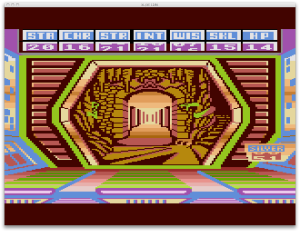
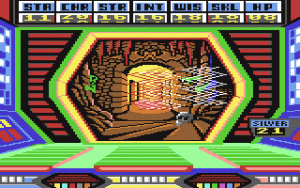
The bitterest battles that we Atari people fought were against the might of the Commodore 64, a machine of roughly equivalent power and capabilities to the Atari 8-bit series of computers. Both had very similar specifications, so it was common for owners of the two systems to try and outdo each other whenever possible. This constant effort of oneupmanship often took the form of trying to outdo each others' graphics as seen here in this equivalent screenshot from Alternate Reality: The Dungeon on Atari (first) and Commodore (second).

Alternate Reality: The Dungeon (Atari)
Alternate Reality: The Dungeon (C64)

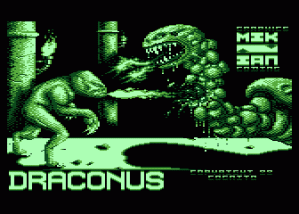
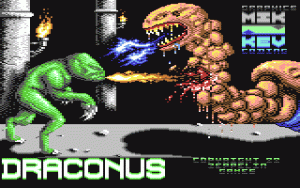
Atari fans were quick to point out that clever programmers were able to get 256 colours on screen at any one time while the Commodore often seemed to have a more limited colour palette. But then Commodore would strike back with something like this shot, the title screen from Draconus (again, Atari first, C64 second):

Draconus (Atari)
Draconus (Atari)
Draconus (C64)
Draconus (C64)

Facepalm. "Hey, where's all your colours now, Mr Atari?"

Graphics were all very well and good, but some of the bitterest battles were fought on the aural front, with both systems having a great sound chip far ahead of anything else at the time – Atari being armed with POKEY, Commodore with SID.

Okay, I may be exaggerating when I say "bitter battles" but it's clear that there was some rivalry here. Some compositions sound clearly better on Atari while others are clearly superior on the C64. And it's the SID chip's sound which has endured in today's chiptunes. There's still POKEY players and archives out there, sure, but nothing on the scale of, say, the High Voltage SID collection, an exhaustive library of pretty much every piece of SID chip music, both retro and contemporary, you would ever want.

So, let's take a look at a few examples. That is why you've read this far, right? To hear some funky old chiptunes? All right. Here we go.

Zybex – Adam Gilmore

Atari version:

C64 version:

Two versions of a cool song that you'll be familiar with if you've read my past entries on game music. Adam Gilmore worked on a lot of music tracks for both the Atari and the C64 (including the theme for Draconus, pictured above) and was clearly very familiar with how to get the best out of both of them. It's difficult to say which one is the best out of these two – or even if there is a "best" one. The Atari version, to me, has a cleaner sound, while the C64 version has some more interesting synth effects.

Warhawk – Rob Hubbard

Atari version:

C64 version:

Rob Hubbard was one of the undisputed masters of the 8-bit sound chips, with games featuring his music frequently marketed due to that fact – even if said music only appeared on the title screen, as was the case with most games, including Warhawk here. In many cases, the demands that pushing the sound chip hard enough to produce complex music put on the processor meant that having in-game music was often impractical.

I've gotta hand it to the C64's SID chip here, the Warhawk theme sounds hugely better on it – partly because it seems that Hubbard actually wrote a more complex piece of music for it. Listen through, though, and you'll hear the kind of effects that you'd expect to hear on a standalone synth – vibrato, tremolo, chorus, echo – it's impressive stuff.

M.U.L.E – Roy Glover

Atari version:

C64 version:

A much older and simpler piece of music than the kinds of things Rob Hubbard dreamt up, the M.U.L.E. theme is still a catchy little piece. For my money, I prefer the POKEY version of this one as the sound envelopes that are used, particularly on the melody line, just give the whole thing a bit more "fullness" than the C64 version which sounds a bit "dry".

Action Biker – Rob Hubbard

Atari version:

C64 version:

Oh dear. It's clear where Mr Hubbard's loyalties lie now, isn't it? The pathetic, short loop used in the Atari version of Action Biker becomes an actual piece of music on the C64. Thanks. Thanks a lot.

Digital music

Bonanza Digi (Atari):

Digi Freaks Digi (C64):

What many people didn't realise (even now, in some cases, and definitely not in the early days) was that both of these sound chips were more than capable of reproducing and sequencing sampled sounds, leading to much more realistic-sounding pieces. Of course, the sound quality is nothing to write home about, but there's something gloriously 80s about the sound of "noisetracker" pieces such as these – a phenomenon which continued with the 16-bit machines, particularly with the C64's 16-bit successor, the Amiga, whose sound chip was so far ahead of Atari's equivalent effort for the ST (which in many cases sounded inferior to POKEY) it was ridiculous.

So there you have it. A few selected examples from the Atari and C64's sound chip back catalogues. Back in the day, I was genetically predisposed to hate everything Commodore but on reflection, there are many examples of its superiority in music production. There's certainly got to be a reason that the sound of the SID chip has endured as long as it has and remains popular to this day, while POKEY remains relatively obscure. I'll always have a soft spot for those Atari sounds, though.

If you're interested in making chiptunes, this plug-in for VST- and AU-based DAWs provides a good way to get started for low-cost, while fans of the old NES sound should check this (free!) one out.

Sonikku za Hejjihoggu

I know I said I was going to talk about Persona 4 and City of Heroes, but indulge me for a moment if you would. I'm going to talk about Sonic again, since I've been playing the Mega Drive/Genesis Ultimate Collection thing some more. Specifically, I've been playing a lot of Sonic 1.

Replaying Sonic 1 a number of years after I last "seriously" played it (in my case, when it first came out on the Mega Drive) was an eye-opening experience. Firstly, you forget how difficult old platform games are when compared to the hand-holding that modern games offer. Secondly, you forget quite how many swear words are actually in your vocabulary.

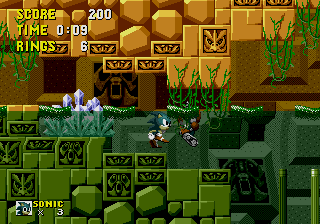
Sonic

I have a confession to make here – Sonic used to scare me a bit when I was a kid. Not "jump out of your skin" scared a la Resident Evil, but "edge of the seat, worried, frantic" kind of scared. I could never really pin down why this was when I was a kid – I just knew that, although I enjoyed playing it, it freaked me out a bit too.

Now, I have one word to say why: traps. Or more specifically, spikes. One thing I don't remember having seen in many games I've played recently on next-gen consoles is a good old-fashioned pit of spikes. Or a big heavy thing with spikes on it that drops on your head. Or a wall that suddenly shoots out spikes and impales you on them.

Sonic is full of spikes. And their simple presence makes the whole experience of running, jumping and collecting things that much more tense, because you know that they're one of the things that can lead to premature death, even if you have shields and rings in place. Plus, when you think about it, impaling something on spikes, or dropping spikes on it, is a pretty unpleasant way to die, isn't it?

Thinking about it, an awful lot of these old games featured incredibly unpleasant ways to meet one's demise, usually involving spikes, being crushed, falling down a big pit or, in extreme circumstances, a combination of all of these things. Sonic isn't by any means the only one to feature painful-looking death-makers. Mario also had plenty of spikes and crushy things to contend with, as indeed did pretty much any 2D platform hero of the time. And even though these games aren't gory at all, having a spike penetrating a place that is not supposed to be penetrated by sharp things looks painful!

Enough about my spike phobia (and Jane's, incidentally – she actually can't watch me play Sonic for fear of the spikes) – I had another point. Sonic's design understands player psychology perfectly. Each level is crafted to play with your expectations and make you want to slap yourself in the face when you fuck up the same bit for the fifth time.

A particular case I have in mind occurs in the Labyrinth Zone, which is full of spikes and long underwater stretches where you can drown, along with swinging ball-and-chain things and bottomless pits. It's one of the least "friendly-looking" zones in Sonic, and (for me at least) one of the more challenging ones. The bit I'm thinking of sees you tempted by an invincibility powerup… only to clonk you on the head with a big spiky ball and chain if you mistime your approach – i.e. if you charge straight in without pausing to see if it's safe! Later in the same level, there's another invincibility powerup closely followed by a nasty bottomless pit. Naturally, when you grab the invincibility powerup, you feel invincible, so you take rather less care than you would normally, leaving you highly likely to go barging straight into the pit. It's frustrating and results in some colourful language but the key thing is, each time you mess up, you know it's your fault for falling into the psychological traps left by the level designers.

Labyrinth ZoneComing at this from a modern, more experienced and world-weary perspective, it's been a real pleasure to re-experience the whole game and understand a little better what they were doing when they put them together. Good level design makes the difference between a game that is "cheap" and a game that is "challenging". When I first started replaying Sonic, I was all for screaming "cheap!" at it – but now, having put a bit of time in, I know what they're doing. I still make mistakes, but I know they're my fault now, not the game's.
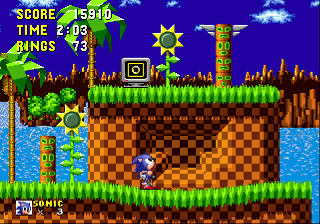
This is in direct contrast to the recent Sonic games, where deaths are just as (if not more) likely to be caused by poor game mechanics than by player error or design psychology. It's been sad to see Sonic lose his way over the years, but it does make me feel a little bit better to go back to the Mega Drive originals and find that they really are timeless.

Old Shit

Hey all! Thanks for stopping by. I realise it's been a while since my last post, but these things happen. Sometimes real life takes over with a veritable shitstorm of stupid things happening, and this was one of those times. This is not the place, nor is it the time to talk about these things, but suffice to say that blogging hasn't been at the forefront of my mind just recently.

Still, I plan to change that now and get back into the habit, and what better way to get back into things than with a good old-fashioned retro games post? You're absolutely right, there is no better way!

Okay. So my old Xbox 360 semi-died on me recently, with the DVD drive pretty much giving up the ghost and on several occasions failing to register that there was even a disc in the drive. This, of course, is a problem for a fundamentally DVD-based system – and also, the Xbox was acting as our primary DVD player in the house, too, thanks to its fancy-pants upscaling shenanigans.

So eventually after a bit of umming and ahhing we (yes, we) decided to purchase a new one. I picked up the new Premium, or Pro, or whatever they're calling it now, with the 60GB hard drive, which will be nice. That 20GB drive on the old one filled up surprisingly quickly. However, I do wish Microsoft had had the decency to include a transfer cable in the box. You can get one for free by sending off a form to them (through the post… no online request option, how quaint… and inconvenient) but mine hasn't arrived yet, so I'm using my new 360 with my old hard drive at present. FAIL.

The point, though.

Game were doing a couple of bundles with the 60GB model. One was with Call of Duty 4, a game which I know is fabulously good and marvellous and the best thing ever but I really have very little interest in whatsoever. What did interest me, however, was the Sega Mega Drive Ultimate Collection (or Sega Genesis Fuckfest as Tolkoto of the Exploding Barrel Podcast memorably dubbed it), which was the other game on offer. The irony of the fact I spent nearly £200 on a console only to get a bunch of Mega Drive games with it was not lost on me. You know what else plays Mega Drive games and costs approximately a tenth of an Xbox 360? A Mega Drive!

That's not entirely fair, of course, because the 360 version of the Mega Drive collection comes with a veritable plethora of 16-bit entertainment including all the expected things (Sonic 1, 2, 3, Sonic and Knuckles followed by various Sonic spinoffs as the blue spiny dude's credibility slowly began to wane, like a slow descent into alcoholism and drug abuse) plus some things that I personally am very glad to see in there but many others likely won't give a damn about (Phantasy Star 1, 2, 3, 4 and Shining Force, Shining Force II and Shining in the Darkness) and some other things besides. Purchasing (let alone locating) all these Mega Drive games would take time and money, whereas there's apparently over 40 titles to play with in this collection. I say "apparently" as they seem remarkably reluctant to list all the titles in too many places. Perhaps this means there's some pleasant surprises tucked away somewhere.

Sonic the Hedgehog
Sonic the Hedgehog

What struck me having played a few of these is that many of these games are still fundamentally excellent games. Sonic in particular still plays very well, although it's easy to forget with the rose-tinted spectacles quite how frustrating it was at times. It's also interesting to play a properly optimised version of these games finally. I've spent my whole life thinking that one of Sonic 2's great new features was the fact it ran at approximately twice the speed of the original Sonic. Not true. The PAL version of Sonic 2 ran at roughly twice the speed of the original PAL version of Sonic. In fact, this collection has taught me that Sonic 1 is actually quite fast and the original PAL port was one of the shoddiest 60-50Hz hack jobs of all time.

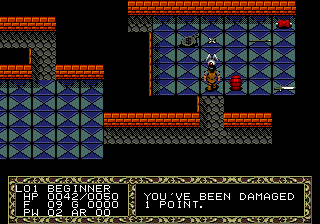
There's also some pleasant curios on the collection, too. I never knew the Mega Drive played host to a Roguelike, for example, but it did, in the form of Fatal Labyrinth (which is one of those examples of Japanese titling where two random, vaguely related words are thrown together) – an absolutely shameless remake of Rogue with 16-bit sprite graphics and smooth scrolling. It doesn't have much in the way of depth (as the original Rogue didn't – it wasn't until later titles like Moria and Angband that they became the behemoths they are today) but it includes a lot of the elements that make Rogue fun – the fact you don't know what anything does until you take a risk and use it being the main one. Chug back a potion and you might suddenly be stronger. Conversely, you might suddenly go blind. It's as brutal as Rogue and, despite its simplicity, it's actually fun and addictive.

Fatal Labyrinth
Fatal Labyrinth

There's a whole batch of unlockable extras too, with the usual video interviews that you get with this kind of package, but also a selection of Master System and arcade titles too. All in all, it's a great package that I will certainly enjoy delving into on a regular basis. Plenty of interesting Achievements to go for too – they're not just of the "Complete Sonic" variety, there's a little bit of creativity there, too. The Achievements are also used to unlock the additional content, too, so that actually gives you some incentive to go for them, too.

Anyway. More soon. I have plenty of things I want to talk about over the next few days, not least of which include Persona 4 along with City of Heroes and its new expansion, the Mission Architect.

See you soon.

Listen To Whatever The Hell You Want

I'm many things, but one thing I've never been is cool. There are many reasons for this – crap hair, being overweight, dandruff, a tendency to blush furiously when talking to people, a voice I hate listening to (which, inexplicably, seems to have gained a cult following thanks to the SquadCast) and, of course, relentless self-deprecation.

This lack of coolness was particularly apparent during my teenage years. These days I like to think I have my own identity – nerd chic or whatever stupid post-modern label you want to apply to it – and I'm quite happy with this. During adolescence, though, it's easy to be jealous of "the cool kids" and for many nerds such as myself, the way to get in on some of that action was to get into the same music that they liked. At least then you'd have something to talk about, and you'd feel justified sitting in on them in the Music department at lunchtime, trying their best not to crucify their favourite song and, inevitably, failing.

I didn't quite manage this perfectly, however. Kids were into Blur and Oasis when I was at school, so the first album I ever bought for myself was Oasis' Definitely Maybe. Fine. A good choice. Unfortunately, I chose the day before (What's The Story) Morning Glory? came out to purchase it, so was thus branded an idiot.

Over time, I got a little better, picking up some other albums that other people considered to be "classics" for various reasons, and more than a few stinkers as well – all of which I have, and intend to hold onto with no shame as a reminder of my past. I never really strayed that far out of the cultural comfort zone of local commercial radio and what I read in magazines, though.

As time went on, I got older and I apparently at some point signed that non-negotiable contract that means once you're over the age of 25 you must immediately start hating all contemporary popular music. (To be fair, contemporary popular music is shit.) As such, I kind of stopped paying that much attention to a lot of music for a while, instead sticking to things that I'd liked for years, or more "niche" interests such as countless remixes, reorchestrations and even a spectacular metal reinterpretation of the Final Fantasy soundtracks. During my training as a teacher, my buddy Owen introduced me to 80s and early 90s metal, which I enjoyed greatly but didn't explore in any depth. In the meantime, the charts slowly filled up with 50 Cent and crap like the track in the link posted above, and television began search after search for "the next big star", with Popstars, Pop Idol, The X-Factor, Britain's Got Talent and all manner of other "talent" shows which proved again and again that the mainstream popular music industry at large wasn't interested in talent, just someone who "looked right" and was "marketable".

Fast forward a few years – to now, in fact. I picked up Guitar Hero World Tour and Rock Band 2 the other week, and between them those two games have reignited an interest in exploring music. Not middle-of-the-road chart music because that's still shit. (I know I posted that already. But it is shit.) No, I'm talking music where the artists actually play their instruments and in many cases compose their own songs too.

It may sound trite to quote Guitar Hero and Rock Band as influences on exploring music, but it's true in my case. Speaking as an actual musician (albeit not a guitarist, vocalist or particularly gifted singer), I can say that both games encourage analytical listening of the music you're playing, even if the note charts for you to play on your plastic instruments are sometimes a little questionable (but that's a discussion for another day). As such, it quickly becomes apparent which ones are the genuinely-well composed tracks and which ones are masking their compositional deficiencies behind lots of noise. For the most part, there's a clear divide between "classic rock" of the 70s and 80s and more recent tracks, with many earlier tracks displaying much more in the way of virtuosity (and stamina), particularly on the part of the guitarists and drummers – but there are some notable exceptions, two of which I thought I'd mention particularly, as the individual tracks in Rock Band actually convinced me to explore these artists further and purchase more of their music.

First up is Coheed and Cambria, which I know RocGaude is a fan of. Coheed and Cambria are prog-rock taken to the extreme, with spectacularly lengthy album titles (the one I purchased is called Good Apollo I'm Burning Star IV Volume One: From Fear Through The Eyes Of Madness) and even a companion series of graphic novels to flesh out the story of the characters in the songs. But there's something about the songs, particularly Welcome Home, the track from Rock Band, that "got" me. Now that I've mentioned this, Coheed and Cambria fans amongst my circle of friends have started coming out of the closet too. I'd never heard of them prior to a couple of weeks ago – now it seems that appreciation for their work is more widespread than I thought.

Next up is Dream Theater, their track Panic Attack representing one of the most difficult tracks in Rock Band 2, thanks to some tricky riffs and the fact that it jumps around from 5/4 to triplet rhythms at irregular intervals, meaning that everyone in the band has to keep on their toes. This piece was so unashamedly dramatic that it immediately appealed to me, with the concept of the piece also holding a degree of personal resonance for me. As a result, I decided to check out the album it was from, Octavarium. I wasn't disappointed – from the opening track through a hugely diverse range of styles paying homage to U2 and Muse among other things, and finishing with a twenty-minute long finale, I really enjoyed the album. It's the first album I actually decided to sit and listen to – as in, headphones on, lights off, concentrate on the music and nothing else – for a very long time. Not working with music on, not blogging, not browsing the Internet, not having the music on in the background – just focusing on the music exclusively. And I had a great experience with the album.

My point? Yes, there is one, however flimsy it might be. I have no idea if it's cool to like Coheed and Cambria, or Dream Theater, but I am happy to stand up and be counted as someone who likes them both. I'm sure I will discover more great new music as time goes on, from Rock Band, from the live gigs I've been to recently and via services like last.fm.

In short, anywhere but from BBC Radio 1.

And that song is shit.