#oneaday, Day 135: Blurred Socialization

"Social games" are crap. There, I've said it. Now everyone else can breathe a sigh of relief that the elephant in the room has been well and truly pointed out.

But why are they crap? Well, the main reason is that they just aren't very fun to either play as games or use as a means of socialising. I've tried out Mafia Wars and We Rule in particular. And neither of them are very fun.

Both of them involve a lot of clicking and waiting. Click on a button to complete a task. Wait for something to happen… in real time. While you wait, why not spam your friends to "help" you by clicking on the same button that you did? You'll both get XP! Yay XP! Of course your level means little more than how long you have bothered to waste your time playing what is basically an Access database, but that's beside the point.

The social angle is flawed too. There's no interaction. You can request "help" from other players but there's no means of actually playing together concurrently. In some games you can't even send messages to each other.

Then came Blur. Blur single-handedly shows the correct way to develop a good social game: by building a good game first, then a social network around it. Too many other titles do this the other way round, and that's what causes them to be the shallow, meaningless garbage that they are.

Blur is different, though. Even without the social features it would be a great racer featuring the "why hasn't anyone done this before?" combination of realistic racing and Mario Kart-style powerups. But add in the ability to taunt friends publicly via Facebook and Twitter, not to mention the incredibly solid "Friend Challenge" system, and you've got a winning experience on your hands.

Playing Blur is actually remarkably akin to logging into something like Facebook. Starting the game greets you with a "Previously on Blur" feature showing you the next milestones you might reach, a bit like Facebook's News Feed shows you recent happenings. Then you might want to check your messages, so you look at the Friend Challenges screen. You see that three of your friends have challenged you to beat their times, so you while away a short while beating them senseless… or not. Then you take on some of the single-player, and achieve something you know none of your friends have, so you post it to Facebook. Then… the list goes on. All the while you're having a good time playing a great game AND sharing the experience with friends.

So, social game developers? Please stop being satisfied with the derivative shit you're coming out with. The shit you are deriving your new shit from wasn't very good in the first place. So actually hire someone who has played a video game before to design your game, then build the social features around it.

Rant over. I'm off to play Blur.

#oneaday, Day 134: Busy Days

Hello everyone! Apologies for the late hour. It's been a genuinely busy day today, despite it being a Bank Holiday (or Memorial Day if you want to be all American about it).
My day started with waking up several times, snoozing my alarm and then waking up again. The last snooze inexplicably went on a lot longer than the other ones so I had a minor panic when I woke up the last time, because I actually needed to get up today.

Why? I hear you ask. Well, today was my first performance in public for ages. What? I hear you ask. For those of you who don't know, I've been playing the piano for quite a long time now. Since the age of five, in fact. Which makes it… a long time that I've been playing. I haven't performed in public for quite a while, though, and my friend Sam assures me that he'd never heard me play in public before. I'm convinced otherwise, but he's very insistent on this matter. I know he certainly didn't see the last piano performance I did at university, which was a duet performance with one of the strangest people I've ever had the curious fortune to encounter in my life that was followed with one of the most memorable and terrifyingly inappropriate pub conversations I've ever experienced. Those who know who I'm talking about also know what the conversation was about. Those who don't… well, I feel it would be improper for me to discuss it here. Unless you really want to know, in which case leave me a comment and I'll tell you there.

So today was my first performance in public for ages. We've established that.

What did you play? I hear you ask. Demanding, aren't we? Perhaps you should stop asking so many questions and let me get on with my story because it's entirely possible I might have been about to tell you what I played. In fact, I'm half-tempted to just not tell you now.

Except that would make this blog entry run rather short and not allow me to include the lovely media that I'm about to. So I'll tell you.

A few years back, I discovered the Final Fantasy Piano Collections and managed to acquire most of them. Some of them I have the actual books of. The older ones I managed to track down some scans from the Internet. More recently, I managed to locate some piano scores for the music from Persona 3 and Persona 4. These respective series have some of my favourite music of all time, so I figured a public performance would be a good opportunity to spread the love and let other people know what they're all about. So that's what I did.

The event itself was part of Southampton's "Keys to the City" event, celebrating local arts and the piano in particular. Today's performance took place in the city's art gallery, tucked away on one side of the Civic Centre near the library. I got the impression not many people know about it. But there's a lovely Steinway piano there which has clearly been crying out to be used for some time, so my friend and ex-colleague Stephen McCleery of Retrograde Recordings helped to organise an event to give it a bit of attention.

Here's three of the pieces I performed. I'll be recording the others over the next few days, so there's a few posts ready to go if I'm short of inspiration!

If you're reading this on an iPhone, don't get pissy about the Flash audio players not working. I've been good enough to supply direct links to the files. Just click on the title. I'm good to you people. Not every blog would do that, you know.

Anyway… enjoy. More to come over the next few days.

Main Theme from Persona 4

Prologue from Final Fantasy

Velvet Room from Persona 3

#oneaday, Day 125: 3D Red Split Dot Dead Second Game Redemption Velocity Heroes

No, this isn't another blog post about search terms that will find my blog, though it's entirely possible that the phrase above can now be used to locate me. This is going to be a short post waxing enthusiastic about some of the awesome new releases us gamers have seen recently. And it's not even all of the ones that are available.

Through some judicious trading-in and knowing where to go to get some decent deals, I managed to score copies of 3D Dot Game Heroes, Red Dead Redemption and Split/Second. And you know what? They're all awesome. Here's why:

3D Dot Game Heroes

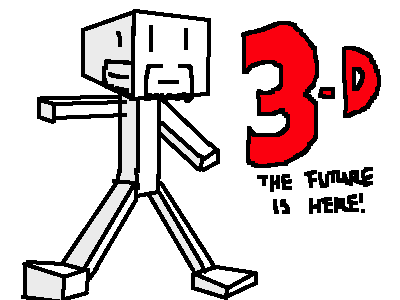
Well you try drawing a fucking 3D stickman, then, smart-arse.This one is incredibly simple to discuss. If you liked The Legend of Zelda: A Link To The Past then you will like this, because it's the same game. Well, actually, that's not quite fair as there are a few extra bits and pieces that the old Zelda games didn't do, such as the ability to customise how your sword upgrades and so forth. But overworld, dungeons, bombs, hookshot, boomerang, bow and arrow, empty bottles and all manner of other distinctly familiar things are present and correct.
The twist is, of course, it's in 3D. Sort of. It still plays like the 2.5D game that LttP was, it's just rendered in a gloriously different "3D pixel" look, where characters are still familiarly 8-bit in appearance and animation, but have some depth to their appearance. There's also a gorgeous tilt-shift effect on the camera as your character moves from the foreground to the background, too, which gives you the impression you're looking down onto a tiny, tiny world made of blocks.

One of the most entertaining things about the game is the character editor. You can build your own character one block at a time and animate them to be your avatar in the game. It's great fun, and enormously satisfying to see your creation wandering around the game world wielding a sword which is about five times their size.

It's a tough game, as the older Zelda titles tended to be, but never overly unfair, at least not in the part I've played thus far. There's plenty to see and do and, in good Zelda tradition, there's a ton of completely optional sidequests too.

Split/Second

Actual in-game footage.

Or Split/Second: Velocity to give it its full name, complete with unnecessary subtitle. How many people have wandered into a shop, seen that and asked if they have "the original Split/Second in stock"? Some people really are that stupid.

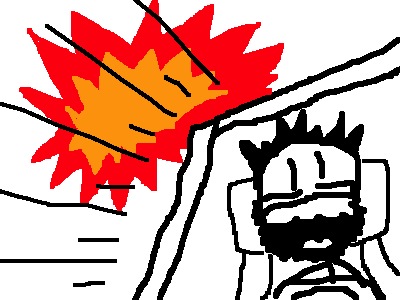
Anyway. If you've played the demo you probably know what to expect. Race cars, blow things up. What the demo doesn't quite prepare you for is how utterly involving and terrifying the full game is. The whole thing is tied together with a beautifully-produced "TV show" aesthetic that uses graphic design, special effects and music straight out of an American version of a TV show such as Ramsay's Kitchen Nightmares or the like. Only instead of dealing with an ailing restaurant, there are cars and big explosions. And the explosions are big. Many levels see you gripping on to the controller for dear life as, for example, a cruise liner in drydock comes sliding down towards you as you pray desperately you make it through to the other side.

Then there's the non-race game modes. "Air Strike" sees you attempting to survive as long as possible while a helicopter gunship fires missiles at you, for example. It's an enormous amount of very silly fun, and is a game that features one of the most consistent and stylistically-appropriate aesthetics that I've ever seen in a game. So hats off to Disney's Black Rock Studios for that.

Red Dead Redemption

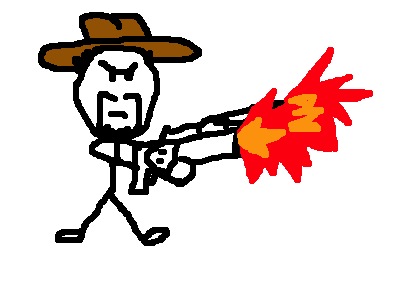
Ah'm a cowboy. Not the Brokeback Mountain kind.

Aka "that cowboy game" or Grand Theft Horse-o. Red Dead Redemption is a spectacular achievement, with an enormous world to explore and ride around, tons of things to do besides the "story missions" and a real sense that you're part of the twilight years of the Old West. The game is plain fun to play, whether it's in single-player or the peculiar multiplayer mode, and there is enough stuff there to keep you busy for a very long time. Hopefully, though, this won't mean that it falls into the trap Grand Theft Auto has traditionally fallen into, meaning that no-one will ever finish it. That would be a shame, as the writing and voice acting are very good and deserve to be seen.

The one thing I will say about this one, though, is that it's one of those games that almost feels too big. Once you get to the stage where you can ride off freely, a couple of hours into the game, you're confronted with this massive open world and your brain's first reaction is to go "Which way? MAAAAAAAHHH" before dribbling out through your ears. Fortunately though, whichever way you ride off in you'll find something to do, whether it's one of the "challenges" that require you to hunt down particular pieces of wildlife, a "Stranger" who gives you a sidequest that you can complete at your leisure, a random in-world event such as bandits attacking a stagecoach or, indeed, the game's story missions.

EDIT: Also, you can punch a horse in the face. How could I have forgotten to mention that?

EDIT: Also, this.

So these three are certainly plenty to keep me busy for a while. And there's still a growing pile of shame to get through as well. Ye Gods, what have I done?

#oneaday, Day 124: Evergreen Entertainment

Throughout most people's lives, there are certain things that give them comfort. Certain things that they know they can always turn to. Certain things that are evergreen and never seem to lose their appeal, regardless of how long they've been in your life. It's nice to have things like this, because it reminds you that however chaotic life in general might seem, there will always be a few constants out there that will keep you happy.
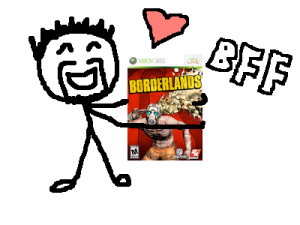
I have a few of these things. One of these, as you may have deduced by now, is Borderlands. One of last year's sleeper hits, Borderlands was a winning combination of first-person shooter and Diablo-esque loot whoring action RPG. A whole bunch of people bought it on its release, which is good. But how many of those people 1) finished it and 2) are still playing it now?

I enjoy Borderlands because it's entertainment you can "dip" into. It doesn't have a particularly demanding story. Some might say the story is something of an afterthought. But that's not important. In fact, that's what makes it so "dip-friendly", if that's even a term. Because you never feel like you've lost the plot (literally) and there's always something in the mission log to go and do, it can be months between play sessions and you can still have a good time with it regardless. I still haven't finished the game with a single character, but I do enjoy going back to it time and time again, whether it's solo, with a split-screen partner or with some companions on Xbox LIVE. In fact, I've played it far too little online, as it's great fun in multiplayer. But for me at least, it's evergreen entertainment. I can happily go back to it. If you still have a copy, hit me up. I have a level 31 Siren just waiting to show you a good time.

The same is true for Geometry Wars 2. Although the Squadron of Shame's battle for high score supremacy is long over, with me claiming the top spot in everything except the Waves and Pacifism modes, it's still a game I come back to time and time again, because it's low-maintenance entertainment. And it has a kicking soundtrack. Bizarre even released an awesome megamix MP3 of it that you can pick up here.

Besides games, my other choices are TV shows, because they're short enough to sit down and watch with dinner without feeling like you're committing several hours of time to, and because they're comfortably familiar. In particular, I've lost count of the number of times that I've watched Black Books and Spaced. Spaced in particular, for me, represents possibly the very best of British television. It's clever, it's funny, it's well-written and above all, it's evergreen. It's still just as relevant today as it is now, though watching it as a slightly older person changes my perspective on it somewhat. Black Books, on the other hand, represents the other extreme of what British comedy does well – the bizarre and the uncanny. Black Books makes absolutely no sense and thus, going by past experience, it utterly confuses Americans. Admittedly I base this assumption on the fact that my brother found it really funny and my sister-in-law didn't get it at all, so it may be a somewhat hasty conclusion. But if you want to switch your brain off and enjoy some purely comic situations, there's few things that will beat it.

As you can probably imagine, in recent weeks I've been turning quite a lot to some of these pieces of evergreen entertainment to bring me some comfort. Of course, some of them have memories attached to them. But many of the memories attached to them are even older than those ones that are painful. They've been the constant presence in my life, and that brings me comfort.

What are some of your evergreens?

#oneaday, Day 103: Synchronise... Watches!

Anyone who's got friends in other countries, something which has become more and more likely with the rise of online social networking, will know how difficult it is to do things together sometimes. Different time zones, the fact that you're not "just around the corner" from one another – all manner of factors conspire to ensure that arranging a friendly game of Modern Warfare or Fat Princess, let alone anything more adventurous, is tricky business.

So what's the solution? Well, how about if you don't actually have to be online at the same time as each other to play together? It's obviously not quite the same as actually being able to talk smack live to each other, but it's a start. And it's a gaming trend which is growing.

Many iPhone and iPad owners have been enjoying Words with Friends, a Scrabble clone with a different board layout to avoid difficult copyright negotiations. Words with Friends gets this idea of asynchronous multiplayer just right. Play a move and a pop-up push notification is sent to your opponent that it's their turn. They can play their turn whenever is convenient to them. Then the notification is sent back to you. There's also a chat window in game, where messages can be left for the other player. If you want to both stay logged in and play in real-time, there's nothing stopping you doing that. But if, like most people, time is of the essence and you don't have a spare hour for a friendly game, you can spread your game over the course of several days, weeks, months as necessary.

Obviously this works great for turn-based games, but what about genres which are traditionally real-time? Take racing games, for example.

Well, here's a clever solution. The rather literally-titled Async Racing allows players to compete against each other without being logged in at the same time. The way it does this is by recording players' laps around the game's tracks and then using these recorded laps as opponents when someone decides to enter a race. Mario Kart Wii did something similar some time back with its Mario Kart Channel functionality, and it proved rather successful for a while, at least among my friends and I.

Then there's Geometry Wars 2, perhaps the best – and simplest – example of asynchronous multiplayer fun. By posting one of your friends' scores in the upper-right corner of your screen at all times during gameplay, you're always competing against someone else. Assuming you actually have some friends, of course.

While asynchronous multiplayer is never going to completely take the place of simultaneous play complete with all the trash-talking that entails, it's certainly an attractive alternative for those who are either short on time or friends in the same time zone. It'll be interesting to see how – or indeed if – it will translate to other genres.

One possibility is for it to use the behavioural analysis that Halo: Reach is supposedly going to pioneer for its matchmaking. Imagine being able to party up with an AI team in something like World of Warcraft made up of your friends' personalities, or have a game of Call of Duty against bots based on behavioural analysis of your buddies. Sure, it's not a patch on actually being there with your friends, but we've established that isn't always an option for some people.

Games are more fun with friends, whether they can be there with you or not. New opportunities to "play" with people you wouldn't normally get to should be embraced. Asynchronous play is going to be a big part of the future of gaming, and it'll be interesting to see who gets it right first.

#oneaday, Day 102: Many Happy Returns

As you get older, some things become less and less sacred.

You realise the Tooth Fairy isn't real when you catch one of your parents sneaking in to collect the tooth and drop off 20p. (It was the 80s. Kids in the class I used to teach get a quid now. Inflation at work!)

You realise Santa isn't real. (I don't remember how this happened.)

You realise the Easter Bunny isn't real.

You start to care less about "big" annual events like Christmas and Easter. Especially given that the shops start selling crap for each of them earlier and earlier each year.

In short, things start to matter less. But for me, one thing which will always be absolutely sacrosanct is one's birthday. Your birthday is a day when you should be immune to all harm, be it physical or mental. Of course, in reality it's a day just like any other, but to me, something always feels special about my birthday, and I always respect this feeling towards other people too. I feel particularly sorry for people who have bad things happen to them on their birthdays. I'd feel sorry for them anyway, but to me, having something terrible happen on your birthday just seems like kicking someone when they're down.

I'm also firmly in favour of people not having to work on their birthdays. Like a personal Bank Holiday, if you will. It's your day, it should be yours to do with as you please.

But unfortunately, the world doesn't quite work like that. Other people don't care that you're a year older. In fact, most people don't even know that you're a year older, as one of the things that ceases to happen as you get older is the wearing of badges to helpfully inform those around you that "I AM 6". And so when something doesn't go your way on your birthday it feels like an enormous injustice has taken place.

Fortunately, that hasn't happened today. It's been a pretty quiet one for me. I wrote a few articles, drank some coffee, ate some cake and then went to see some friends and try out new board game Mystery Express, a Murder on the Orient Express-style deduction game. We didn't get time to finish the whole game before some people had to leave and head bedwards (the perils of having a regular day job) but we got a good grasp of the rules and it seems like an interesting game. I'm looking forward to giving it a proper try sometime when we have a bit more time to spare.

So, I'm 29. So far it doesn't feel that different. I wonder if next year will feel different. 30 feels like it should be some sort of milestone, but at the moment I feel rather like I'm drifting and haven't found my true path yet. Well, as it stands, I have 364 days left to get that sorted. That's doable, right?

#oneaday, Day 97: Ding! Growing Up

I reached level 80 in World of Warcraft today. This is the first time in any MMORPG that I've reached the level cap, and the character with whom I achieved it is the one I started playing on the day the game was released. My friend Tim also reached the milestone in the early hours of this morning, having originally started at the same time as me.

For those who have never got into an MMORPG, talk of reaching the level cap being "just the beginning" of the experience sounds like absolute nonsense. After all, reaching the level cap in a single-player RPG just means that you don't need to grind any more and can zip through the rest of the story with ease. But reaching 80 in Warcraft, or 50 in City of Heroes, or the rather more casual-player friendly 20 in Guild Wars, is simply a sign of maturity.

In fact, the whole "levelling up as metaphor for life" idea is, on reflection, quite a potent one. Bear with me on this one.

You're born. You come into the world knowing nothing about it. Everything is new to you. You spend your time exploring, finding out how to do things. Some things you find out for yourself, others you are taught. You're weak and feeble. You often need help doing things. You make friends. You quickly learn the people to avoid. And all the time, you are learning, growing stronger.

As time goes on, you eventually reach a stage where you have outgrown your home. It doesn't offer you any challenges any more, so you move on. You say a fond farewell to the familiar surroundings of your home and spread your wings, and during this time you continue to learn new things. Your challenges become greater, and you sometimes still need help, but at other times you can do things for yourself. On the occasions where you return home, everything suddenly feels much smaller. Things which once offered you a huge amount of challenge are now mere trifles to be knocked aside as you pass through.

Time passes. You continue to learn and grow. You move further and further away from your home until you eventually reach a stage where you feel like the world is your oyster. There are still some challenges which seem insurmountable, even with help, but you are feeling more independent. You still feel that you have a lot to learn, and you run into people who have more experience than you regularly, but you know that you are much more capable of finding things out for yourself.

Eventually, after what feels like an extremely long journey, you reach maturity. You are independent. You can go anywhere, you can do anything. You could co-operate with others for a common good. Or you could pursue your own personal goals. You could take possession of bigger and better things to help you become stronger, but there's nothing more for you to learn. But there are still challenges to overcome. Challenges of your own deciding.

In Warcraft, reaching 80 is reaching maturity. You can go anywhere and do anything. There are no new skills or spells to learn, no way of working to become stronger. It's all up to you and your possessions to prove your worth. And at this point, being an "adult", other people start to look up to you. The people who are still at the beginning of their journey look at you, seemingly at the end of yours, and believe that you are someone who knows what they are doing. But you might not. Just because you've negotiated the perils of childhood, puberty, adolescence and young adulthood doesn't mean that you know everything. You might not want to be a leader. You might still want someone to tell you what to do, even though you're theoretically strong enough to make it on your own.

I often find that online games tend to reflect social values quite nicely. Past experiences with Second Life, in particular, have been interesting, but the same thing happens in Warcraft. I'm nearly thirty years old, but in my daily life I still don't feel like a "leader". I'd feel weird if I was placed in charge of a group of people, and it's the same when I join a party in Warcraft. I don't have the experience of leadership, though I do have other skills. So I wouldn't want to be the one bossing a party or a raid around, but I'm happy to follow orders and give my own ideas. It's the same in reality – I'm happy to follow someone else's instructions and suggestions, and occasionally chip in myself, but were I to be in charge of a group of people? I'm not sure how I'd handle that.

I guess my past work in teaching is technically a "leadership" role, so I have done it in the past. And I'm completely comfortable showing people how to do things, or explaining things to them. I think the thing which I find most difficult is being decisive on behalf of other people. I fear looking stupid in front of others, or deciding something that turns out not to be of mutual benefit to everyone. So I defer to others. Now, admittedly, in real life you're unlikely to suffer a "wipe" as a result of a bad decision you made. But there are other ways that things can go wrong. Feelings can be hurt. You can find yourself in a situation you're not sure how to get out of. Worse, you can feel you've trapped other people in a situation you don't know how to get out of.

Decisiveness is clearly an art to learn, whether you're a level 80 mage or a level 0 everyman. And there's no class trainer to help you with that one!

#oneaday, Day 90: Ebert in the Lions' Den

Art is the process or product of deliberately arranging elements in a way to affect the senses or emotions. It encompasses a diverse range of human activities, creations, and modes of expression.

Wikipedia

Roger Ebert gently and gracefully lowered his gazelle-scented testicles into the lions' den that is the world of video games a couple of days ago. It's pretty fair to say that he got a reaction. But was it the one he was after?
His contention was that "Video games can never be art". A strong opening hypothesis. One which has been debated amongst gamers many a time too, with little agreement on the subject. Some feel that yes, games can be art, others feel that no, games can not be art – yet. There are very few people I know who are interested in the world of games – whether or not they think there is currently any evidence of artistic creativity in the medium right now – who would stand up and proudly announce that their chosen form of entertainment will never be art. As Ebert points out in his own article, Rick Wakeman once reminded us that "never is a long, long time".

So how is Ebert, a respected film critic, so sure on this subject? Well, of course, he's played some games to back this up, right?

Given the substance of the article, I'm not entirely convinced. He certainly talks about a few games – specifically Waco Resurrection (which I'd never heard of), Braid and Flower. I can't comment on Waco, having never heard of this game until today, but Braid and Flower are both games that I have played and enjoyed, and I take exception to the manner in which Ebert responds to them – or doesn't, as the case may be.

When discussing Braid, he mentions the game's unique selling point – the time rewind mechanic. He even cites the justification for it – the thematic concept of "what if you could go back and fix your own mistakes?" He then spectacularly misses the point by comparing it to cheating in chess… or rather, "negating the discipline" of chess. I agree that taking back moves in chess is counter-productive in developing your own skills, but Braid is a game that is designed around that whole concept. Rather than being a sore loser's way out, the time rewind mechanic in Braid is a key part of the experience. More to the point, it's not used purely as a way of avoiding death, as he seems to believe. Instead, use of time and your past self is key to solving the puzzles in Braid, making apt and clever use of the main theme of the story in a practical sense.

It's his comments on Flower that got me, though. It's immediately apparent that he hasn't even played the game at all from this:

We come to Example 3, "Flower".  A run-down city apartment has a single flower on the sill, which leads the player into a natural landscape. The game is "about trying to find a balance between elements of urban and the natural." Nothing she shows from this game seemed of more than decorative interest on the level of a greeting card. Is the game scored? She doesn't say. Do you win if you're the first to find the balance between the urban and the natural? Can you control the flower? Does the game know what the ideal balance is?

"Can you control the flower?" Seriously? I would have thought that a respected critic would bother to actually experience the things he is commenting on before judging them. Flower is one of the most unique experiences there is on a games console – love it or hate it – and it eschews most traditional game mechanics in favour of being a piece of experiential entertainment. The experience you have playing Flower is entirely what you make of it. If you want to play it as a "game" and try to beat the levels as quickly as possible, you can. But most people who have spent any time floating on the wind and listening to that game's gorgeous soundtrack will agree that there is definitely a sense of narrative to the whole thing. But unlike most games, this sense of narrative is entirely personal to the person playing it. I played it feeling enormously melancholy, feeling an inexplicable sense that someone or something had died. Nothing on the screen suggested that, but that's what I felt while playing, to an almost overwhelming degree. Others have taken the rather more simplistic – but just as valid – interpretation that "flowers hate steel".

The problem with Ebert's comments is that they smack of condescension and arrogance. Ebert is a respected expert in his own field – justifiably so, I might add – and he clearly knows it. Therefore he seems to feel that this gives him the right to judge something which he very obviously knows very little about and has very little interest in pursuing further thanks to his own preconceptions.

Are games art? I don't have an answer for you, but Justin McElroy's excellent response to Ebert's piece raises a very good point – the medium of "games" has evolved so much in such a short space of time that to call the diverse experiences we have with our computers and consoles today simply "games" is a complete misnomer. We interact with these pieces of electronic entertainment for a variety of reasons. Sometimes it's escapist fantasy. Sometimes it's role-playing. Sometimes it's wish-fulfilment. Sometimes it's a social activity. Sometimes it's competition. Sometimes it's to feel an emotional response.

There are as many reasons to "play" as there are "games", so to damn the entire medium with a blanket statement – "games will never be art" – is misguided and short-sighted. They may not be art now in the eyes of some people, but that is not to say that they will not be in the future. If you take Wiki's rather broad definition of "art", listed at the top of this post, games (or whatever you want to call them) are already there.

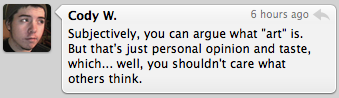
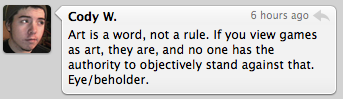
I will leave you with two tweets from Cody "NintendoTheory" Winn, whom I think sums up the problem with debating this whole question pretty succinctly in the space of 280 characters:

#oneaday, Day 89: No, It's Like "Poke-A-Nose"

I played poker for the first time tonight. Specifically, the Texas Hold 'Em variant that became inexplicably popular a few years back and has shown no signs of going away ever since. I never quite understood why it suddenly shot to prominence, given that it's surely a game that's been around for a long time. Anyway, at the time I first noticed a growing national obsession with the game, I put it down to just a fad and never bothered to get involved or learn how to play.

After tonight, I'm wishing I'd started playing sooner! That game is fun. We weren't playing for big money – a £5 buy-in got us 8,000 chips, and the last man standing would get everyone else's fivers. But the money didn't matter. It was the game itself that mattered. I found it pretty amazing how a simple game largely dependent on luck (or card-counting) can have such moments of drama and enormous satisfaction in it. Obliterating opponents with a hand that is just better enough than theirs to screw them over completely is enormously satisfying. Perhaps not for our gracious host, who was one of the first out, quickly relegated to a "kiss of death" advisory role.

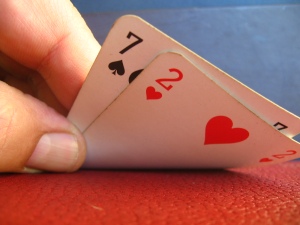
I came second in our game. Considering I'd never played before, I thought this was pretty good going. I managed to bluff my way through to some storming victories on a few hands, but was ultimately defeated in the last few hands by a straight vs my two (high) pairs.

I'm not sure if I was just getting lucky, or if I was actually "playing the game" correctly. But there were a number of occasions where the choices I made paid off bigtime for me, in some instances even allowing me to knock another player out. I'd be curious to try again to see if it was just beginners' luck. I know it certainly wasn't the others going easy on me. Although perhaps the fact that none of us were particularly experienced helped me out somewhat!

The best thing, though, was to find a game that I was actually good at. I like stuff like Agricola and Power Grid, but as I wrote a short while back, I am generally pretty terrible at them due to something of a deficiency in the strategic parts of my brain. I don't know what it is. But apparently, it seems, I have a decent poker face. I'm not sure how to take this news. Is it such a good thing to be a good liar?

Well, in the case of a game like poker… of course it is!

You look great in that shirt, by the way.

#oneaday, Day 84: Eternally Questing

Giant Bomb recently launched a quest system on their site. It rewards participants with experience points, badges and a sense of "yay" for exploring the site, looking at different pages and taking part in various activities. Some of the quests are as simple as setting up your profile. Others are more complex "puzzly" ones that require one to solve some cryptic clues about games and game culture. It's a lot of fun, and it actually convinced me to sign up to the site and make greater use of it.

This echoes the thoughts of social game designers at GDC a while back, including Brian Reynolds from Zynga. The idea of getting Achievements for things you do in "reality". It sounded stupid, but given the amount of fun I, and numerous others, have had with Giant Bomb's metagame, it may not be so dumb after all.

It's not the first time it's been tried, either. A very long time ago I posted about a site called PMOG, or the Passively Multiplayer Online Game. This game, actually a Firefox addon that sits atop your normal browser interface and re-christened The Nethernet a while back, allows players to earn experience points, achievements and items for exploring the web. More than that, though, other players can leave stuff on web pages for others to discover. These could be malicious (bombs, which make your browser shake about a bit and cause you to lose some points) or helpful (crates with money in them). They could also be mysterious portals, which lead to random places on the web, the destinations of which are only known to the portal's creator. It was an interesting concept let down only by the fact that it only worked in Firefox. Since Chrome came to Mac, I haven't touched Firefox since, the Mac version not being the greatest piece of coding there ever was.

Then there's Shuffletime, now sadly defunct – although the developers claim to be working on the "Next Big Thing". Shuffletime was a great idea – it was a collectible card game where the cards were websites. And you only got to collect the card if you correctly answered a question about the site it was showing you against a strict time limit. It was a fantastically addictive game, and a fine way to get people looking around the web at things they wouldn't normally. I'm sorry to see it go, but I'm sure something interesting will come out of it.

Like them or loathe them, Achievements and Trophies are here to say. And it's entirely possible that their influence will spread out of the world of core gaming and into the collective awareness of the web at large. Let's face it, it's always nice to get some encouragement isn't it?

Now, how many Gamerscore is hitting 100 One A Day posts worth?