#oneaday Day 506: Tactical Sunday

Final Fantasy Tactics is a game I absolutely love and respect greatly, but I have to be in the right mood to play it. Today I was very much in the mood to play it, so play it I did. I got to a point that proved to be a sticking point for me when I first played it on PlayStation — Golgollada Gallows, also known as Golgorand Execution Site in the original — and, indeed, it proved to be a bit of a sticking point for me this time around, also.

However! This time around, I was armed with the knowledge of how I beat it last time around, which was to spend several hours doing random battles to level up my core units to such a point that they could survive the challenge of Golgollada Gallows — notorious as one of the toughest fights in the relatively early game — and progress without too much trouble.

Y'see, the difficulty I had with this first time around is that Final Fantasy Tactics sort of positions itself as a game where you move from story beat to story beat without any interruptions. Because it's not a conventional RPG in which you directly control the protagonist as he wanders around towns and dungeons, it's easy to see the random engagements you can run into on the node-based world map as annoying inconveniences preventing you from seeing the next bit of story.

But they are there for a reason — and, indeed, The Ivalice Chronicles version of the game makes it even easier for you to take advantage of them by making them not random at all. Sure, sometimes as you move from node to node you'll get the distinctive "swoosh" that indicates a battle is incoming, but unlike the PlayStation original, you can choose not to engage if you don't want to. This prevents you from encountering a minor softlock if, for example, you're trying to get to a town to stock up on healing items or refresh your units' equipment.

However, it also goes the other way. If you pass through a non-story node and you don't have an encounter there, you can choose to "search for enemies" and manually trigger a battle. This means if you actually want to spend some time levelling your units or earning them some new abilities — which the game doesn't tell you to do, but which is very much a good idea — you can do that much more easily than in the PlayStation version. If you want to, you can just stand on one battlefield, do a fight, then immediately trigger another one — no running back and forth between nodes in the hope of getting the "swoosh", because you can trigger it at will, and you can ignore it if it's inconvenient.

While I'm not normally a fan of being able to turn off encounters in a regular RPG — it feels very much like cheating, plus it does you out of some progression that you probably need — in a game like Final Fantasy Tactics, where battles take 5-10 minutes or more rather than a few seconds, this was an important and very welcome tweak to the formula.

Anyway, upshot of all this is that I beat Golgollada Gallows on my second attempt rather than taking the many, many, many attempts I did back in the day. I was still relatively new to console RPGs when I first picked up Final Fantasy Tactics, after all, and it hadn't occurred to me to grind because I wasn't super-familiar with the concept. Once I spent that time levelling my units properly, though, everything fell into place, and the rest of the game was much more straightforward. As, indeed, I suspect it will be this time around, too.

Final Fantasy Tactics: The Ivalice Chronicles is a wonderful remake of an already wonderful game. I have greatly enjoyed my time playing today, and, having got over that notorious difficulty spike, I suspect the remainder of the game (except maybe "that" Wiegraf fight) will be even more enjoyable.

So your lesson for the day, then, if you're new to Final Fantasy Tactics, is don't be afraid to grind. Embrace it. Love it. You will come to appreciate it when all your units are suddenly orders of magnitude more effective with just four or five additional levels under their belts!


Want to read my thoughts on various video games, visual novels and other popular culture things? Stop by MoeGamer.net, my site for all things fun where I am generally a lot more cheerful. And if you fancy watching some vids on classic games, drop by my YouTube channel.

If you want this nonsense in your inbox every day, please feel free to subscribe via email. Your email address won't be used for anything else.

#oneaday Day 502: Another reminder that traditional games journalism is all but dead

It emerged today that the entire Features team of the gaming website TheGamer has been laid off, after owner Valnet decided that it likes money more than having actual employees who are capable of writing.

I'll admit that I was never a particular fan of TheGamer for a variety of reasons, but regardless of my own personal feelings about the site, this sucks. It's the latest instance of something that has continued to suck for a while now, with even big names of the games journalism industry — if such a thing even exists any more — suffering widespread layoffs, cutbacks and significant worsening of what they offer for their audiences. Enshittification, if you will. And yes, even longstanding behemoths like IGN and Eurogamer have been subject to this. According to VideoGamesChronicle and PressEngine, more than 1,200 journalists have left the business entirely in just the last two years — and that's not taking freelancers into account. (That puts the figure nearer 4,000.)

Honestly, seeing this happen to TheGamer isn't a surprise, though. This is just what the site's owner, Valnet, does. They buy up sites that were once successful, rip out everything that made them distinctive and unique — i.e. the people who worked hard on establishing the site's identity — then proceed to replace everything with slop. I would not be surprised at all if in short order we start seeing casino advertorials and AI-generated garbage on what remains of TheGamer.

Valnet and their big rival, Gamurs, are a scourge on what was once a thriving sector. They both take this model: they buy "verticals" (ugh) that they want to add to their portfolio, and then think that just because they now own, say, Polygon, that they have unlocked an infinite money glitch. But they have not — for a variety of reasons, not which is the model on which ad-supported commercial games journalism has been forced to operate for years now.

This article by Luke Plunkett of Aftermath sums it up nicely: these sites had been stuck in operating in the same way as 2000s-era Kotaku, which is to post as much as possible, as often as possible, and it didn't matter too much if nothing of any real substance was being said. It was all about the content.

I've been through this, too. During my time on both GamePro and USgamer, I was specifically hired to be someone who operated on a different time zone to the rest of the staff, with my responsibility being to ensure that there were things ready to read on the site by the time North America woke up. These typically end up being "news" posts, which, in the churn of having to produce so much content every day, often end up being little more than you could learn from just following a company's social media account or signing up to their mailing list.

"Guide content", that odious practice where every single site has to have 5,000 articles explaining every minutiae of every hot new game (and often badly, to boot), is also at play here, with the entire Internet gradually being flooded by "what is today's Wordle solution?" posts, individual articles explaining each and every shrine in The Legend of Zelda (often badly) and inconclusive, vapid answers to questions no-one was really asking with any great seriousness. It's all about the pursuit of endless, relentless content, and it doesn't matter if it's any good or not, it just has to be fresh, constantly updated and now.

And it sucks! It's not doing anyone any good! It's not making the writers on these sites look good, it doesn't make the games they're covering look good, it doesn't make the site look good, and it doesn't inform the readership of anything worthwhile. It just means those readers have something new to scroll through every time they refresh the page while they're staring, glassy-eyed, at their phone for the 14th consecutive hour that day.

It sucks that it has to be this way, too, because the presence of a specialist press is important. The idea that we might, one day, be completely without a games press altogether is absolutely baffling, but with every round of layoffs like the one we've seen today, we get closer to that dystopia.

Reader-supported sites such as Aftermath, 404 Media (not games, but relevant) and Giant Bomb are doing great work, but it remains to be seen how sustainable that model is — particularly as so many of the bloody things are starting to pop up that it is no longer possible or affordable for anyone to be "widely read" when it comes to good-quality games coverage. That's not necessarily a bad thing, given that back in the '80s and '90s we tended to be loyal to individual magazines rather than reading all of them, but it's a big shift in how the Internet has traditionally worked.

I don't even know what to think any more. It's bleak out there. And I wonder if it's ever going to get better again. I just want to have some fun websites to read again, by people who know their craft and are passionate about it. We used to have that — why can't we have that again? Why can't we have 1up.com again?

Those are rhetorical questions.


Want to read my thoughts on various video games, visual novels and other popular culture things? Stop by MoeGamer.net, my site for all things fun where I am generally a lot more cheerful. And if you fancy watching some vids on classic games, drop by my YouTube channel.

If you want this nonsense in your inbox every day, please feel free to subscribe via email. Your email address won't be used for anything else.
#oneaday Day 499: A productive day of video-making

The MiSTer Multisystem 2 has been everything I hoped it would be: an all-in-one retro gaming device that I can very easily use to both enjoy classic games on a CRT television, with all the benefits that offers, and be able to capture footage from said games to make videos about them. The dual outputs on the Analogue model of the Multisystem 2 means I can do both at the same time, and it's a real delight. So I made a grand total of five (count 'em!) videos today, and I feel like this is going to help me broaden my whole remit on my YouTube channel considerably.

I've built a small following with Atari-focused stuff, and I by no means intend to leave that behind completely. But there's so much fascinating retro stuff out there that I'd love to explore on video that it just seems daft not to… do that.

My aim for the channel has always been simply, to quote my own description, "make you feel like you're sitting down with an old friend to enjoy some great (and occasionally not-so-great!) games." The Atari focus just sort of happened with my own personal interest in the platforms, but it was never intended to be an Atari-exclusive thing, otherwise I would have branded the whole channel that way. Indeed, I'm having a lot of fun exploring weird and wonderful console titles right now — and some of my most successful, popular videos have been in that area.

I think the easiest way to put it is that my YouTube channel reflects how I like to enjoy games when I'm not on camera — I'm fascinated to explore the overlooked and underappreciated titles from both today and yesterday, and there's nothing I like more than being able to share my experiences with people, and those people find a new favourite as a result. As such, with a few exceptions — I'm almost certainly going to do some Ridge Racer at some point — you probably won't see "big name" or "triple-A" stuff on my channel, but you will see some lesser-known stuff that I either enjoyed a lot back in the day and think not enough people know about, or things that I've discovered more recently.

They draw minimal numbers, but I'm also pleased to be back into doing some long, episodic playthroughs. I'm really enjoying revisiting The Granstream Saga right now, and doing video series like this is a good reason to finally settle down and play some older RPGs that, for one reason or another, I have never gotten around to. I have a very long list of stuff that I'd like to play, and ideally I'd love to play them on the channel!

One thing at a time, though. The Granstream Saga is ongoing, but if I remember rightly that isn't super long overall. And then I guess I will have to spin a wheel or something to pick what comes next!

Anyway, if you're not subscribed and want to join me exploring some fun games, head on over to the channel and hit the subscribe button, maybe check out a few videos. It'll be like the good old days when we went over to each other's houses to play games together. Remember that? It's feeling like an increasingly dim and distant memory, but gosh, I miss it. That channel is the nearest thing I've got right now, so I hope at least a few of you derive the same value from it that I do.


Want to read my thoughts on various video games, visual novels and other popular culture things? Stop by MoeGamer.net, my site for all things fun where I am generally a lot more cheerful. And if you fancy watching some vids on classic games, drop by my YouTube channel.

If you want this nonsense in your inbox every day, please feel free to subscribe via email. Your email address won't be used for anything else.
#oneaday Day 498: Forgetful... again

Ooh, I forgot to write something yesterday, again. To be honest, yesterday just sort of went by in a haze. I don't feel like I really "achieved" anything. We went food shopping, which was something, but aside from that, not a lot happened. I didn't even really feel like I had much time to spend doing things I enjoy — before I knew it, the day was just over.

I did play the demo for the upcoming Nighthawks on Steam, though. I'll likely write something more substantial about this soon, but my first impressions on this short-but-sweet demo were very encouraging.

For the unfamiliar, Nighthawks is an adventure game/visual novel/RPG type thing published by adventure game maestros Wadjet Eye Games and developed by The Curiosity Engine. It's a vampire-themed game that obviously takes some heavy cues from Vampire: The Masquerade without actually using the World of Darkness license. Which is good, because it sounds as if the long-awaited Vampire: The Masquerade – Bloodlines 2 has turned out to be… not so good. As if anyone is surprised at that after its cursed development cycle.

Nighthawks, though — that gets the whole World of Darkness vibe, with a few interesting twists. For starters, in the world of Nighthawks, humanity is aware of the existence of vampires, so no need for the "Masquerade". That said, making use of your vampiric powers somewhere that you can be noticed is still frowned upon, so you still have to be a bit careful.

The game starts with you creating a character by establishing some elements of your background: where you came from, who your sire was, what your specialisms are. From there, you're thrown into the plot proper, where you arrive in town in search of a former contact who has absconded with something precious to you. As a pretty new vampire, you have no money to your name, no contacts and no reputation, so it's up to you to establish all these things — and I believe the full game ends up with you owning the eponymous nightclub and having to run it.

I really like what I've seen so far, and I'm going to try playing the demo again with a different character archetype to see what — if anything — changes. It looks as if it's going to be one of those games where you can very much "role-play" your character and have a markedly different experience depending on your choices, both during character creation and once the game proper is underway.

The demo is still up at the time of writing as part of Steam Next Fest, so be sure to download it and give it a go if it sounds like your sort of thing. In the absence of a good Vampire: The Masquerade game (though I must confess I never played those visual novels from a while back) it's looking like it has the potential to be a very good substitute.


Want to read my thoughts on various video games, visual novels and other popular culture things? Stop by MoeGamer.net, my site for all things fun where I am generally a lot more cheerful. And if you fancy watching some vids on classic games, drop by my YouTube channel.

If you want this nonsense in your inbox every day, please feel free to subscribe via email. Your email address won't be used for anything else.

#oneaday Day 494: Goddamn gacha

Recently, Square Enix announced that it was doing a new Dissidia Final Fantasy game. For a brief, blissful moment, I was hoping that we might actually have a proper new Dissidia, and not whatever that last thing on PS4 was, but no. Of course it's a fucking free-to-play gacha game. Of course it is.

I'm so sick of gacha games. I'm sick of them exploiting people, I'm sick of them being poorly designed games, I'm sick of them being the only peep we hear from once-beloved franchises, and I'm even sick of them leaning hard into the "sex sells" angle. And I say that as a card-carrying lover of anime tiddies.

The new Dissidia game supposedly has Final Fantasy characters brought to real-world Tokyo and has full Japanese voice acting. Great! Why isn't it a proper game? Because I'm sorry, another thing I'm sick of is people who scold you for "looking down" on gacha games "because they're successful".

Gacha games are shite. They're marginally less shite today than they once were, but they're still shite.

I'll give you a bit of context. Following the surprise and sudden closure of GamePro, I found myself working on a business-facing publication that looked at mobile and social games. Free-to-play games — both on mobile and, at the time, Facebook — were really starting to take off around that point, so I was paid a frankly impressive salary to suffer through playing them every day.

One that I remember specifically being encouraged to look at was Rage of Bahamut by Cygames. This, I was told, was part of a new trend for what was, at the time, known as "card battling" games. Great, I thought. I like Magic and Ascension and Dominion — this'll be a great fit for mobile.

Except Rage of Bahamut had about as much gameplay as a '90s webpage — and had an interface to match. Progressing through the game's plot literally involved nothing more than clicking the "Advance" button multiple times, watching your "Energy" bar decline with each step and your "Experience" bar increase concurrently. Occasionally you'd be thrown into "battle", during which the numerical values of the cards in your hand were added up and compared to your opponent's, and whoever had the bigger number won. There was absolutely no interactivity whatsoever — the sole "strategy" for the game, if you can call it that, was making those numbers as big as possible. And, of course, the most efficient way to do that was to pay money, which would guarantee you "rare" (higher value) cards.

Zoom forward a few years and you have games that are at least attempting to hide this formula somewhat, but they're all still, at their core, nothing but "make bigger number than opponents" games. Two of the most popular examples, Cygames' Granblue Fantasy and Aniplex's Fate/Grand Order, dress it up with fancy turn-based battles that look like they're from proper RPGs, but ultimately both are about just making sure you have valuable enough cards to overpower everything in your path.

The frustrating thing is that these games often have quite good, interesting stories to them, but the gameplay is so unimaginably tedious that I have absolutely no desire to play them whatsoever — and even if that wasn't the case, the utterly exploitative monetisation would do the trick for me.

Most of the gacha games in my experience provide various different "packs" of the premium currency required to draw new cards, characters or whatever, but pretty much every one has required that you spend at least twenty quid in order to get a worthwhile draw. The alternative is grinding, grinding, grinding through the tedious, shitty gameplay in the hopes of being given a scrap of premium currency to draw some rare cards once in a blue moon. Twenty quid can buy you multiple good games that you can just enjoy at your leisure from thereon!

And many of these games are flagrantly, transparently attempting to use quasi-erotic artwork as a means of extracting money from their player base. Azur Lane is one of the worst in this regard, with more recent competition from Nikke: Goddess of Victory, a game with more jiggling arses than I think I've ever seen, even in Senran Kagura. They'll offer a "limited banner" of some exceedingly attractive character in a skimpy outfit, and players will gullibly throw money at the game in the hopes of getting a PNG or a Live2D image of their waifu, and the cycle will repeat over, and over, and over again.

These games have no soul. These games have no value. And I wish they would go away. But after over 10 years of suffering their presence, it doesn't seem like they're going anywhere any time soon, with a significant number of companies now seemingly reliant on the obscene income they draw in (and the minimal expenses they almost certainly cost to run).

Mobile gaming is dead to me. And, apparently, so is Dissidia. At least I still have the two PSP games to enjoy.


Want to read my thoughts on various video games, visual novels and other popular culture things? Stop by MoeGamer.net, my site for all things fun where I am generally a lot more cheerful. And if you fancy watching some vids on classic games, drop by my YouTube channel.

If you want this nonsense in your inbox every day, please feel free to subscribe via email. Your email address won't be used for anything else.
#oneaday Day 493: The breakneck pace of Final Fantasy IV

As one of several games I have on the go right now — for a bit of variety, like — I decided to start up Final Fantasy IV Pixel Remaster. I've played Final Fantasy IV I think twice before — and one of those was on PlayStation, so your sympathies are gratefully received, though that version at least isn't quite as bad as PS1 Final Fantasy VI — and remembered it being quite short, though I had forgotten quite how fast it moves.

I'm two hours in and already — apologies in advance if any of this is a spoiler, but the game came out in 1991 — the main character has committed a war crime, adopted an orphan child that he was directly responsible for orphaning, become separated from his best friend (who inevitably turns traitor), rescued his loved one from a deadly bout of Desert Fever by retrieving a valuable gem from a slobbering Antlion, rescued a prince from the ruins of his devastated castle and his broken heart, and attempted (mostly unsuccessfully) to fend off an assault on another kingdom.

It moves so fast. I had forgotten how fast. I have played so many modern (relatively speaking) games that feature epic-length story sequences between the core "gameplay" sections that it almost feels rushed. I mean, hell, after two hours in a Persona game from 3 onwards, you're barely through the initial character introductions and you almost certainly haven't set foot in a dungeon yet.

This is both a strength and a weakness of Final Fantasy IV, looking at it with a 2025 pair of eyes. It's a strength because it means that there's never particularly long to wait before you're doing stuff again — exploring the world, clearing dungeons, fighting monsters, levelling up, buying new equipment — and that is quite a refreshing change from today's narrative-centric games that, while undoubtedly considerably more ambitious in their storytelling, sometimes do feel like they're getting a little bogged down. Not only that, but Final Fantasy IV is done and dusted in less than 20 hours, which makes it a veritable light novel by RPG standards.

However, it's also a weakness, because there are some sequences that were clearly intended to be quite significant narrative moments, but the way the game just whizzes through them makes them feel almost laughable.

I'll give you an example. Rydia, the girl that the protagonist, Cecil, rescues from a war crime he inadvertently committed at the behest of his king, is a Summoner in Final Fantasy Job terms. This means that not only can she summon big things to deal heavy damage, but she can also cast both white and black magic spells. When you first get her, she's an inexperienced kid at level 1, so she barely knows any spells, but a bit of levelling in the field will net her a few initial, useful spells. Except you'll notice one black magic spell is prominently missing: Fire.

Think about it for a moment and it's obvious why: because she lost her entire village, including her mother, in a fiery explosion, she is, of course, going to be hesitant to call upon the power of fire. This little bit of characterisation is initially delivered without the game drawing any attention to it whatsoever, but you can notice it early from a simple browse of the menu. Very cool. Ambitious for the time, even!

What is less cool is when the party finds their path up a mountain blocked by a big chunk of ice, and the other members, eventually getting Rydia to admit that she "hates fire", pretty much tell her to stop snivelling and get over it because they jolly well have a quest to accomplish. It's almost certainly not intended to come across that way — the other members are all "yay, you did it, I always believed in you" after she does successfully cast her first Fire spell, presumably with tears streaming down her face and the knowledge that this is probably going to need years of therapy to truly deal with — but with at least a couple of decades' worth of games that handle sensitive topics rather more delicately behind us, it does feel rather… blunt.

But, again, you have to remember that this was 1991, just a year after the SNES had come on the market, and Final Fantasy IV was on a cartridge that contained less than a megabyte of data in total. In fact, during development, the script had to be cut considerably to fit on its cartridge; lengthy exposition was something that developers simply couldn't afford to do back in these days, because every byte mattered, and text can potentially take up a lot of space if there's enough of it. As such, it's not altogether surprising that some sequences feel like they move a tad fast by modern standards — short of shipping on a larger capacity cartridge, which was presumably a decision that needed to be made relatively early in development, there were very real constraints on what Final Fantasy IV would be able to do.

Of course, Final Fantasy IV has been expanded on quite a bit in later remakes such as the polygonal 3DS version, the Game Boy Advance version and the PSP version; each of these had their own additions to the basic Final Fantasy IV formula.

But the Pixel Remaster; that's based on Final Fantasy IV as it originally existed, graphics and music aside, and thus you have the plot that speeds off over the horizon as you just think you're getting caught up on proceedings.

All this is no shade on Final Fantasy IV, of course; it's a game I like very much (though it's far from my favourite Final Fantasy) — I just found it interesting to revisit this after so many years and be reminded that at one time, RPGs moved a lot more quickly than they do now!


Want to read my thoughts on various video games, visual novels and other popular culture things? Stop by MoeGamer.net, my site for all things fun where I am generally a lot more cheerful. And if you fancy watching some vids on classic games, drop by my YouTube channel.

If you want this nonsense in your inbox every day, please feel free to subscribe via email. Your email address won't be used for anything else.
#oneaday Day 491: Some first impressions from Death end re;Quest Code Z

I am a big fan of Compile Heart's Death end re;Quest series. For the unfamiliar, it's a series of three (to date… with it looking like there's more on the way) narrative-centric console RPGs with strong horror themes, and involvement from some maestros of the genre like Makoto "Corpse Party" Kedouin on scenario duties and Kei "Mary Skelter" Nanameda on the art.

What I've found very interesting about Death end re;Quest to date is that all the games in the series have been very different from one another. Mechanically, the first two were quite similar, but tonally and thematically they were very different. The first game primarily involved an "if you die in the game you die for real" kind of MMO-gone-mad situation, while the second was based around horrible goings-on in a tiny European town that doesn't appear on any maps. As Compile Heart games, both of them also involved more than a touch of yuri to them — particularly in the case of the second one.

Death end re;Quest Code Z, meanwhile, changes up both the narrative setting and the game's core mechanical conceits. Narratively, I'm not far enough into the game to know exactly what the situation is, but it involves characters from both of the previous two games, many of whom didn't interact with one another directly in their original games — and, moreover, some characters who were very much dead in previous games, such as the father of the second game's protagonist, Mai — are alive in this one. I can't comment on that further as yet, but I'm interested to know more.

The most obvious difference between Death end re;Quest Code Z and its predecessors is that it's now a Mystery Dungeon-like. For those not familiar with such things, this is a Japanese take on the roguelike genre that typically (though not always) favours cutesy visuals; grid-based, turn-based movement and combat; a heavy degree of resource management; limited inventory space; and, of course, a series of increasingly deep, procedurally generated dungeons in which to hack, slash, explore, level up and loot.

Death end re;Quest Code Z mostly plays things relatively straight in this regard, with the exception of one thing: rather than an "energy" or "hunger" bar, the protagonist, Sayaka, has a sanity rating. This gradually declines as you explore, with various "milestones" on the gauge corresponding to her field of view contracting, the background audio becoming more distorted (or completely replaced) and, in the case of extremely low sanity, interface elements like the minimap being unusable and the likelihood of her harming herself going up considerably.

This is very much in keeping with the horror tone the series has always had, but it also means that the game has quite a "survival horror" feel to it as well. Since you're juggling your health, sanity and available items as you progress through each dungeon, you have to make some tough and interesting choices as you play — particularly if you're playing on the "Expert" mode (which I actually recommend in this case), where Sayaka's level is reset every time she leaves a dungeon, and she suffers notable losses in terms of inventory items and weapon power-ups if she's actually killed.

The other interesting thing relates to the series' titular "Death Ends". In prior games, Death Ends came about if you made bad choices during the storytelling sequences, and usually resulted in the protagonist and/or members of the core cast suffering a horrifying, gory death, described in excruciating detail. Towards the end of the first game — mild spoilers, I guess — one of the characters becomes aware of you, the player, and starts addressing you as "God of Death" in recognition of the number of times you have led the cast to a sticky end, and Death end re;Quest Code Z builds on this further by having the main protagonist, Sayaka, constantly aware of and communicating with you — even putting her trust in you.

There's some interesting conflict here, because Sayaka trusts you to lead her through the challenges ahead of her, and you need to successfully do so in order to progress through the story. But! And this is a big but: if you let her die, you can make her stronger. Because every time you see a unique Death End in Death end re;Quest Code Z, Sayaka gets a skill point that you can invest in passive boosts to her basic abilities and resistances, and even complete immunity to certain status effects. The more she dies, the stronger she gets and, presumably in theory, the easier the game gets.

But that places you, as her "Partner" (she very pointedly keeps referring to you as such) in a difficult position. Because in keeping with series tradition, every time Sayaka carks it, there's a lengthy narration of exactly how she dies, often delivered in something of a mocking tone. This is coupled with a gory (and often somewhat sexualised) event image depicting her dying yet again. Thus you are faced with a quandary: do you kill Sayaka a bunch in order to power her up? Do you deliberately lead her to her death multiple times in succession to score some easy skill points at the outset of the game? Or do you actually try and take care of her somewhat, knowing that in doing so you are leaving her as a somewhat sub-optimal character?

Death end re;Quest Code Z forces the player to interrogate their relationship with the death of their on-screen avatar — particularly one that is supposedly aware of them. Sayaka never remembers any of her deaths, but you know you caused them, and there's a helpful checklist of all 104 possible ways to die and the skill tree itself to remind you quite how many times you've seen her devoured, eviscerated, beaten to a bloody pulp, disintegrated, decapitated and any number of other nasty words you might care to mention. Undoubtedly the most "efficient" way to play is to repeatedly let Sayaka die in the first dungeon, but doing so is tedious — and thinking that should give you pause. You are repeatedly murdering someone, and it's boring. Are you that desensitised to violence that you can bring yourself to do that?

Some of you will be absolutely fine with it, I'm sure, and I'm not judging you for it. But after a few initial deaths in that first dungeon, I really started to hesitate and think "hang on a minute, this doesn't feel right at all". And I can't remember the last time a game made me feel quite like that about the protagonist, through my actions, being killed off.

This has made me determined to see how far it's possible to progress without killing Sayaka repeatedly. I've reached a point where I don't give a toss about PlayStation trophies any more, so I don't have the "pressure" from the two that related to getting all the Death Ends and unlocking all the skills weighing on me — and thus it really is up to my own feelings of morality about whether I want to buff up Sayaka by murdering her over and over again, or if I genuinely want to see her succeed, taking her shortcomings into account.

Thus far this is turning out to be one of Compile Heart's most interesting games. I'd expect nothing less from a series whose other two entries were also thoroughly fascinating. I'm intrigued to play more — and it certainly is the season for a bit of horror.


Want to read my thoughts on various video games, visual novels and other popular culture things? Stop by MoeGamer.net, my site for all things fun where I am generally a lot more cheerful. And if you fancy watching some vids on classic games, drop by my YouTube channel.

If you want this nonsense in your inbox every day, please feel free to subscribe via email. Your email address won't be used for anything else.
#oneaday Day 490: Normalise roasting shitty customers

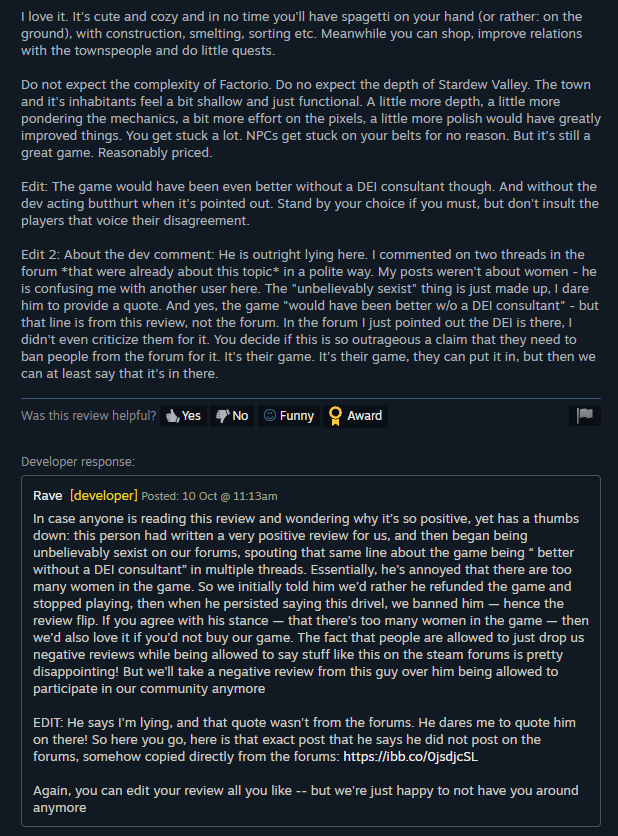
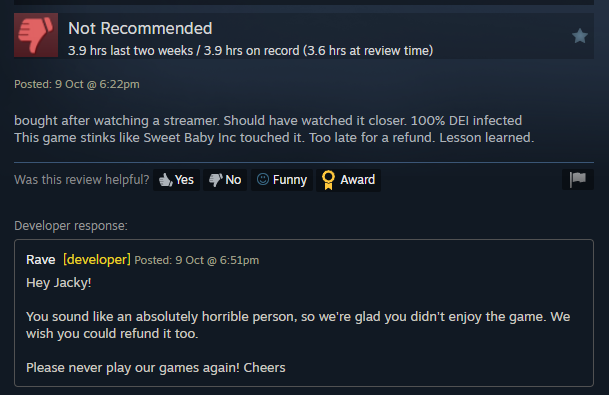
Earlier today, the publisher of the new automation-centric indie game Little Rocket Lab — by all accounts a thoroughly nice-looking, charming game that seems to have mostly gone down well — shared a few Steam posts, noting that they had completely lost patience with the idiots who cry "DEI" any time a woman or non-white character is included in a video game, and had just taken to responding to them in as blunt and unforgiving a manner as possible.

Here's the prime example:

And this one's pretty good, too:

Now, of course, this had A Certain Type of Gamer up in arms about the developer being "hostile" or "butthurt" to players, and to that I say… good. He has every right to be hostile when some little shit comes in and starts shooting their mouth off about something completely, utterly stupid. He has every right to want to curate his community and filter out toxic individuals — even in the case of a single-player game like this. He has every right to say that he's happy certain types of person are not going to play the game because they can't handle the presence of women and people who otherwise look a bit different from them.

I wish this attitude was a bit more normalised. Because it of course sucks to be on the receiving end of rudeness, but if you act like a twat then you should expect to be called on it, likely in anger, and that's a bit different from someone coming up to you and, completely unprovoked, telling you that they hope you die. Unfortunately, the culture of making everything as PR-friendly as possible these days means that even if you're receiving a torrent of abuse from some blowhard on the Internet, you're supposed to just quietly endure it, accept it, thank them for their feedback and move on with your day.

Well, honestly, it's not that easy. I, regrettably, have considerable experience from multiple positions I have worked over the years with people being complete shits to what they believe is a faceless social media account, and it sucks absolute donkey dick. Sometimes it's just weird, such as the one guy who harassed me when I was on GamePro because he thought debit cards were a conspiracy by George Bush to control society. But sometimes — often, even, I'd say — it's downright scary.

Under most circumstances, you're not allowed to respond in kind, you're not allowed to express any sort of frustration and you're absolutely not allowed to make the dickhead in question feel like they are the one who has done anything wrong.

I know why this is the case, of course. It's because the second a company steps out of perceived "line", particularly when it comes to something that has A Community around it, a million and one YouTube videos will appear with "[Brand Name] said WHAT??!!" and, in turn, further harassment will be sent the way of whatever poor sap is having to man the social media mines that day — and said poor employee of the company in question will probably find themselves facing if not disciplinary action, then certainly an awkward conversation with Management the next day.

It shouldn't have to be that way, though. In an age where you can't even walk into a coffee shop or doctor's office without prominent notices about how abuse and harassment of staff members will not be tolerated, why are we still sort of okay with it online? Why do we put up with this garbage treatment from "customers" who, in many cases, are not our target audience in the first place? Why can't we say that these people are not welcome in our community and shouldn't buy our products?

I, unfortunately, don't really have an answer to that. But I have plenty of respect for "Rave" (aka Mike Rose from publisher No More Robots) above, not only for responding the way he did, but also for sharing the crap that anyone involved in the production of games — or games journalism, for that matter — probably finds depressingly familiar at this point in time. We're long overdue a good, long talk about this, and how we can make things better. I'm just concerned it might be far too late to do anything about it.


Want to read my thoughts on various video games, visual novels and other popular culture things? Stop by MoeGamer.net, my site for all things fun where I am generally a lot more cheerful. And if you fancy watching some vids on classic games, drop by my YouTube channel.

If you want this nonsense in your inbox every day, please feel free to subscribe via email. Your email address won't be used for anything else.
#oneaday Day 489: You've got Fun Factor

I've written about this before, but I write a lot of shit on this blog, so you may not have seen it, particularly since I last wrote about it in March of this year, when you may not have even been reading this blog. (The viewing figures would seem to suggest that quite a few more people are reading this blog now than there were in March. Although the other day I had approximately 900 bot visits from China, so I may take those figures with a pinch of salt or ten.)

Anyway, what I would like to talk about is the Fun Factor podcast, hosted by the experienced writers and video game enthusiasts, Ty Schalter and Aidan Moher. "Oh great," you might say. "Another video games podcast. Like we need any more of those!"

To that, dear reader, I say fie and pfaugh and other such expectorations! Fun Factor is different. Fun Factor isn't just a bunch of dudes sitting around talking about what they'd played that week, maybe coupled with the gaming news headlines they'd picked off their favourite website. Fun Factor is, as you might have determined from the name, about something which is very close to my heart and soul: magazines.

Each episode of Fun Factor takes a close look at an individual video game magazine. The present "season" is focusing specifically on the "Generation Gap", which covers the years between 1995 and 1997. This was a time when gaming underwent a quantum shift as we moved from 16-bit pixel mastery into the brave new frontier of (texture-mapped, Gouraud-shaded) polygonal 3D thanks to platforms like the Nintendo 64, PlayStation and Sega Saturn.

It was an exciting time, and the press of the period reflected that — for many, this was a real golden age for games magazines, as the Internet was early enough in its mainstream adoption (i.e. a lot of us were still on dial-up, particularly outside the US) that it hadn't yet taken the place of traditional publishing.

Rather than attempting to summarise the entire magazine, an episode of Fun Factor instead primarily focuses on a single piece in that magazine: a "review of a review", as it were. Along the way, Aidan and Ty both take a bit of time to flip through the magazine as a whole and contextualise what they're about to do a deep-dive into, including commentary on what was going on in games at that time, what they were both up to in their own personal lives (and experience with gaming) — and even a look at some of the weird and wonderful adverts that cropped up in print.

What I particularly enjoy about Fun Factor is that it has a breezy, friendly tone that one iTunes reviewer quite correctly described as "being like reading old magazines with friends". It's unmistakably modern, as Ty and Aidan are not above pointing out how these magazines often demonstrate how social attitudes and conventions have changed over the years, but, crucially, this never becomes in any way overbearing or preachy. There is plenty to criticise and lessons to be learned in these old mags — but also plenty to celebrate, too, and the show always finds an excellent balance between reflecting on how we've grown (or not, in some cases!) and what a wonderful time it was to be interested in video games.

Both Aidan and Ty cite classic games magazines as being formative in their own decisions to get into professional writing, so it's all done out of love for the medium. I've seen all too many online discussions of '90s magazines and ads in particular descend into nothing but laughing at the terrible taste and attitudes we all had, but Fun Factor has never, to date, across 13 episodes at the time of writing, found anything completely irredeemable in the publications they've looked at.

Even in instances where both Ty and Aidan have disliked the review that was published — such as Edge's truly strange Final Fantasy VI review — there have been positives to pull out. And some of the best examples of reviews from that period have, so far, ended up coming from the most unexpected places — like, say, sports games.

I adore old magazines and have a small collection of them that I treasure — mostly from well before the era that Aidan and Ty are presently covering on Fun Factor — but I don't have many people that I feel I can talk and enthuse about them with, or who understand why they hold such meaning for me. One of the reasons I value Fun Factor so much is that it helps me feel like there are other people out there who get it, who understand why magazines, at one time, held such importance for us as video game enthusiasts — and why many of us miss those days greatly.

If you're after something new to listen to and the above sounds like fun, you can find more information about the Fun Factor podcast on their official website, funfactorpod.com. You can also subscribe to the podcast's channel on YouTube, and I'd encourage you to check out the video versions of the podcast, since each episode displays scans of the pages that Ty and Aidan are talking about, allowing you to "read along" with them to a certain extent.

Thanks for the entertainment, fellas, and I look forward to hearing more from you. Plus if you ever need to hear stories about old Atari magazines, Year 10 work experience on PC Zone or freelancing for the Official Nintendo Magazine here in the UK, you know where I am!


Want to read my thoughts on various video games, visual novels and other popular culture things? Stop by MoeGamer.net, my site for all things fun where I am generally a lot more cheerful. And if you fancy watching some vids on classic games, drop by my YouTube channel.

If you want this nonsense in your inbox every day, please feel free to subscribe via email. Your email address won't be used for anything else.

#oneaday Day 488: Home ports deserve remembering too

I feel like I've talked about this before, but whatever. I feel like talking about it today, so talk about it I will.

In this age of being able to easily emulate the original arcade versions of games, I feel like one thing gets easily lost from the "preservation" aspect of retro rereleases on today's systems: home ports that are notably different from simple attempts to recreate the original arcade games.

I was reminded of this when watching the YouTuber Classic Gaming Quarterly playing Gauntlet for NES earlier. I legitimately had no idea that Gauntlet for NES is not, in fact, a straight port of the arcade game and is, instead, a completely different game. I did know that Gauntlet IV for the Mega Drive also pulls this stunt, but I did not know that this extended back to the NES version. And for my money, pretty much all the home ports of Gauntlet are much more fun than the quarter-munching arcade version — particularly if you're playing on emulation and thus have infinite credits and therefore infinite health.

There are others, too. The Mega Drive port of Toaplan's Slap Fight features an entirely new game mode. The NES versions of the Double Dragon games are completely different to their arcade counterparts. And I'm sure there are countless others — to say nothing of the "home-exclusive sequels" we saw to numerous arcade games, often put together by western developers who didn't quite get what made the Japanese originals so good. (That said, I will happily go to bat for OutRun 2019.)

A few publishers are cottoning on to the fact that there is value in preserving multiple versions of classic games, including both the arcade originals and popular home ports, but it's by no means the norm. The reasons are likely due to licensing complications — in many cases, while the rights to the original arcade game remain with the original creators (or a company that has succeeded the original creators and/or bought the rights), home ports were developed by different teams, meaning that the rights would, I assume (IANAL), be split between the original creators of the arcade game and whoever made the port. This is not a problem when those are one and the same — like the Double Dragon games, for example — but there are plenty of situations where the home versions of a game were made by a completely different company, or even an individual at times.

The takeaway I have from all this is something that I've thought for a while: in many cases, I actually prefer playing the home conversions of games to the original arcade versions, even when the arcade version is obviously technologically superior. There are several reasons for this: firstly, those home conversions are often a good example of what their host platforms are (and are not) capable of. Secondly, since home ports are not obliged to keep people feeding coins into a machine, they are often balanced much better than their arcade counterparts. And this, in turn, makes them considerably more enjoyable to play.

Because there absolutely are arcade games out there that take "quarter-munching" way too far. I adore the beat 'em up genre, for example, but I'd much rather play Streets of Rage 2 than the arcade version of Final Fight, simply because Streets of Rage 2 is balanced much more fairly — and the beat 'em up genre appears particularly prone to this issue. The same is true for any sort of competitive game with a "1P vs COM" mode, be it a fighting game or a puzzle game. In their arcade incarnations, these tend to become absolutely impossible after just one or two levels, whereas in their home incarnations, they tend to save their biggest bullshit for their final challenges. Still annoying at times, yes — particularly in puzzle games, where final bosses tend to have superhuman capabilities as well as, more often than not, ways to "cheat" — but a little less galling than only being able to get through two or three stages before having to wipe your score and "Continue?"

Thankfully, while official licensors are seemingly hesitant to let those often flawed ports back out into the wild when one can just emulate the arcade version on a veritable toaster of a machine these days, one can make use of alternative means to enjoy them through software emulation or FPGA solutions. And I would encourage everyone to do so, because while everyone will inevitably have a preference as to which version of something is "best", it's worth exploring those versions rather than simply assuming the most technologically advanced version is automatically the most enjoyable.

Now, I think I might give Gauntlet on the NES a bit of a go for myself!


Want to read my thoughts on various video games, visual novels and other popular culture things? Stop by MoeGamer.net, my site for all things fun where I am generally a lot more cheerful. And if you fancy watching some vids on classic games, drop by my YouTube channel.

If you want this nonsense in your inbox every day, please feel free to subscribe via email. Your email address won't be used for anything else.