Nostalgia and rose-tinted spectacles are rife in all walks of life, but there are few places where it happens more so than in the video games industry. This is perhaps due to the fact that it's such a fast-moving industry that you can be in your twenties and still feel nostalgic for "the good old days" and how much better they supposedly were.
Nine times out of ten, of course, nostalgia is proven wrong when you actually go back and play the things you were so nostalgic about. Things move on for a reason.
But I'm firmly of the opinion that the previous console generation is always going to be looked back on as a "golden age" that is going to be very difficult to top, however good the games might be, and however beautiful the HD graphics of today's games might be.
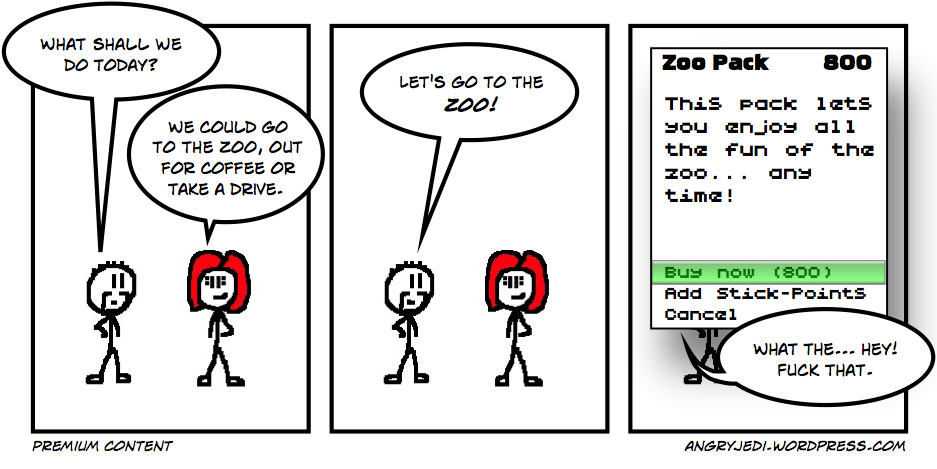
The reason for this, to me, that games from then were finished. Now we have the blight that is DLC. Now, the arguments in favour of downloadable add-ons for games are many—extra content adds life to a game and keeps it relevant long after release. It gives developers the opportunity to show that they're still "supporting" a product. And it allows for other, smaller developers to use an existing base as the means for some creative risk-taking—see Bioshock 2's "Minerva's Den" as an example.
But at its worst, DLC is a cynical money-making exercise designed to get people to pay for their games twice—once to buy the thing in the first place and once again to purchase all the "premium content" that should have been included with the game. Premium content, let's not forget, that very often is actually on the game disc and is simply "unlocked" by purchasing an access code.
This isn't the only negative side to DLC, either. Narrative games suffer considerably from this whole "oh, let's add a bit here, add a bit there" structure. There was a time when you would start playing a game, go through its story, beat it and be satisfied. Now, it seems, there always has to be "a little bit more". There always has to be an "exclusive epilogue chapter", or some "side missions" or "the shock return of a beloved character!"
Rather than seeing this as a good opportunity to get more of the games I love, I see this as reason to not pick up a copy of a hotly-anticipated game on its original release, because it's almost inevitable that there will be some "extra bits" sold separately down the road, and that these will be bundled into a "Game of the Year Edition" or similar even further down the road.
This is what was supposed to happen with the PS3 version of Mass Effect 2. I was quite keen to wait for this rather than picking up any of the DLC for the Xbox version, so that I could play the "definitive version". Sure enough, the PS3 version was announced as having "all" the DLC included with it. Nice. Except now they've announced some more, because Mass Effect 2 is big business and people will keep funnelling money into it.
ARGH. What this means in practice is that when you buy a game these days you're essentially purchasing an unfinished product. With the speed at which some of this DLC magically appears, it's clear it's been worked on alongside the "main" game and so it would have been very easy for it to simply be included in the price of admission. And with some publishers like EA already withholding content from those who have purchased a game pre-owned, the whole situation just strikes me as more than a little objectionable. Games are too expensive anyway, and to start charging even more for them is just… well, wrong.
Unfortunately, there are too many people out there invested in the DLC debacle to mean we can ever go back. Are you happy with that?
The UK game development community has a long and colourful history. Some of the most well-known and successful titles from gaming's history come from UK-based developers, and it's in part due to the active "bedroom programmer" community of the 1980s that gaming is in the healthy position it is in today. In short, although the big bucks may come from American developers and hugely successful properties like Call of Duty, the humble UK played a pivotal role in bringing us to where we are today.
And that's why it's always sad to see a UK-based developer fold under the pressure. But something's different this time. The demise of Bizarre Creations seems to be affecting a lot of people on a much more personal level than many other similar announcements. I've been trying, with little success, to figure out why this is all day.
Perhaps it's quite simply the fact that they have made some astonishingly good games in their time. Sure, they've made a few that are arguably duffers, too, but those games, personally speaking, just showed me that they were willing to try their hand at something different, even if they ended up being not that good at it. And Boom Boom Rocket was awesome, I don't care what anyone else says.
Bizarre Creations was always about two things, though: racing and shooting neon shapes in space. These were their raisons d'être, if that's the correct plural, which it probably isn't.
The Dreamcast's Metropolis Street Racer was an absolutely gobsmacking title upon its initial release. We'd seen racers with pretensions of "photo-realism" before—the PS1 Gran Turismo titles along with Namco's Ridge Racer Type 4 and Reflections' Driver had come pretty close in all their non-anti-aliased glory, but Metropolis Street Racer went one further. The sheer accuracy of both the car modelling and the streets through which you raced was astonishing. The fact you were racing through recognisable locales—and the fact that the system's clock was used to make sure you were racing at whatever time it was right now—gave a pretty-much unprecedented sense of involvement in the races. Couple this with the fact that it wasn't just another racer—it was an extreme sports game that happened to involve cars—and you have a winner on your hands. The ability to customise the in-game messages to hurl obscenities at you whenever you crashed was just the icing on an already delicious cake.
And that's not even mentioning the soundtrack, extracts of which you may have noticed peppering this post. Completely composed from scratch rather than licensed, MSR's soundtrack perfectly captured a snapshot of how the year 2000 sounded in terms of popular music.
Project Gotham Racing was a similarly spectacular title showcasing the power of Microsoft's new Xbox system. When I first saw the game, I didn't immediately make the connection between it and MSR, but after a little bit of racing around I suddenly felt a sense of familiarity. It hit me hard—this was the next generation of the game I'd wasted countless hours on on SEGA's doomed little wonderbox. Its sequel spawned my favourite use of Xbox LIVE—Friends leaderboards. I was never that bothered about online racing as I'm not anywhere near as good as some of the freaks out there, but being able to compare times and scores directly against friends without having to do anything special? That was a watershed moment for me.
Which, of course, brings us to Geometry Wars, formerly a hidden minigame that sat in the garage of your Project Gotham cars. The original Geometry Wars is, without a shadow of exaggeration, the reason I bought an Xbox 360. An early-adopter friend showed me a few games—Oblivion, The Outfit and Geometry Wars, as I recall—and while the first two impressed me a little with all their HD glory, it was the orgasmic explosion of colour and sound that was Geometry Wars that convinced me I needed one of these machines. Thus began a long campaign of battling against each other for high-score supremacy, punctuated by regular MMS messages back and forth each time we beat each other.
The sequel took this to a whole other level. There were some days when I wouldn't play a "full" retail game at all, instead blasting away at Geometry Wars 2 for hours at a time in a desperate attempt to beat my friends' scores on the various game modes. It became hugely, ridiculously competitive until I pretty much accidentally attained several scores that neither I nor my friends have been able to replicate since. Thus ended that particular battle.
And then most recently we had "powered-up racer" Blur. Blur came out of nowhere, thanks to Activision's questionable marketing. But what a game it was. Taking the good bits of Call of Duty's multiplayer and inserting them seamlessly into a game that wasn't brown and wasn't about soldiers going pewpewpew was a genius move, and the fact it's one of the few games out there you can still play in four-player split screen alone means it's worthy of mention.
So this is why I'm sad that Bizarre Creations have closed their doors for the last time today. Some of my fondest gaming memories stem from Bizarre's games. I sincerely hope that the team manage to find their way to pastures greener, and that they can once again get back to doing what they do so well.
Also, Microsoft, you are idiots for not picking them up to revive the PGR series.
So, if you'll turn to your song sheet, we can sing today's hymn, from the Metropolis Street Racer soundtrack, the lyrics of which are oddly poignant (if cheesy) today. Sing along. I'll know if you don't. SING, DAMMIT.
I wake up and it's another day
Time to wish all my tears away
Every day and it's the same old story
No more dreams, just reality
I should find a place I've never been before
Gotta see a place I've never seen before
Gotta go somewhere that I can still believe
You are there
Don't know what to do
Don't know where to go
How can I find you
Who's to know?
I gotta know where you are
No matter how near or far
I'll never get over you.
In my mind I know it's just a game
But it helps to keep away the pain
People tell me that it's all too easy
I don't listen, how could they know?
So I'll keep on running down this lonely road
'Cause I can't help thinking it's the only road
Gotta stay right here so I can still believe
You are near?
Don't know what to do
Don't know where to go
How can I find you
Who's to know?
I gotta know where you are
No matter how near or far
I'll never get over you.
I cannot believe that you are gone
How can I carry on?
It's so long ago that you were mine
Remember the first time?
In my soul I know that you'll remain
In my heart I love you just the same
All the time I think about the day
You'll return and say that you will stay
But I got to live my life without you now
Gotta get along but I don't know how
If I close my eyes then I can still believe
You are here
Don't know what to do
Don't know where to go
How can I find you
Who's to know?
I gotta know where you are
No matter how near or far
I'll never get over you.
Don't know what to do
Don't know where to go
How can I find you
Who's to know?
I gotta know where you are
No matter how near or far
I'll never get over you.
Farewell, Bizarre Creations. Thanks for the good times. May your work live on.
It's fair to say that, as a general rule, Facebook games are pretty, well, shit. For the most part, they're cynical, money-grabbing exercises designed only for bored soccer moms and office drones to while away the hours performing virtual meaningless tasks instead of real-life meaningless tasks. What's worse is the fact that the real-life meaningless tasks are still there once you've clicked on every single field in FarmVille 300 times.
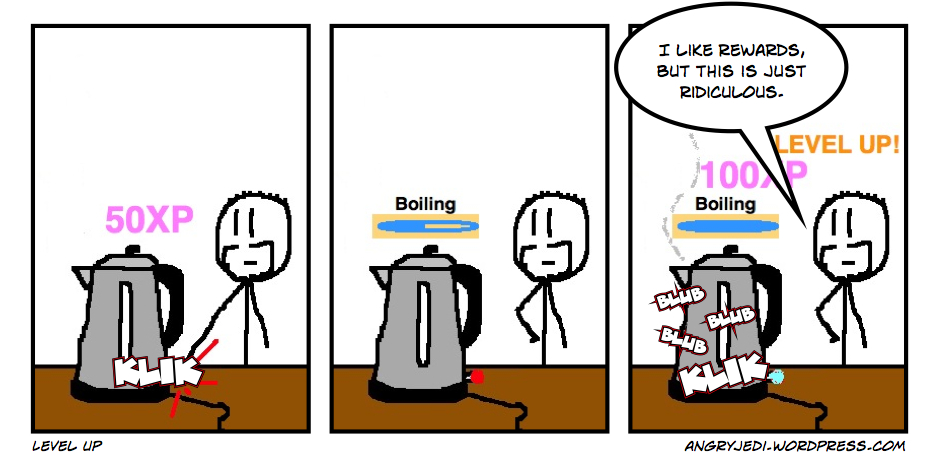
Fortunately, it doesn't have to be this way. There are a few developers out there who are starting to produce games which have some actual substance to them, even if almost every single one of them insists on including an utterly meaningless, pointless experience point/levelling system. Memo to Facebook game developers: you don't "need" that to be competitive. Make a game that's addictive and fun and people will come back of their own volition. You don't need some arbitrary, meaningless, substanceless "reward" to keep people dangling on your Fish-Hook of +5 Monetization. So stop it.
Anyway. Here's 5 Facebook games that aren't shit.
Bejeweled Blitz
The grand-daddy of Facebook Games that Aren't Shit is surely PopCap's minute-long masterpiece. Featuring the match-three gameplay of Bejeweled condensed into a frantic, hectic minute of scoring points that is, to be honest, more luck-based than anything else, Blitz is great fun and enormously competitive thanks to the weekly-resetting friend leaderboards. Even better, the mobile versions also work with the Facebook scoreboards, allowing you to challenge friends on the go. Go play!
Zuma Blitz
See above, only you're playing Zuma instead. You're still matching groups of three or more colours together, only this time you're trying not to let them drop down a big hole. Frantic and arguably more skill-based than Bejeweled, this is another good choice for daytime timewasting. Go play!
Asteroids Online
This game combines the structure of obnoxious gameplay-free experiences like Mafia Wars and actually adds some gameplay to it. Offering a wide variety of missions and some surprisingly impressive (for a web game, anyway) polygonal graphics, this is a good, challenging choice for anyone who grew up with the old Atari classics. Go play!
Where in the World is Carmen Sandiego?
A fun, educational detective game particularly suitable for younger players. You can use it as a means of testing your geographical knowledge and deductive reasoning, or you can cheat (a bit) and using Google/Wikipedia to help you work things out. Either way, it's a lot of fun, even if it does have a completely pointless levelling system that I really, genuinely can't see any reason for whatsoever. Go play!
Robot Unicorn Attack
One of the quintessential two-button platformers out there, Robot Unicorn Attack is always a pleasure to play, largely because of its soundtrack. Now it's approximately seven thousand times as competitive thanks to Bejeweled-style friend leaderboards. Pity the iPhone version doesn't sync with these, however. Go play!
Dishonorable Mention: Scrabble
Fuck Facebook Scrabble. Why? Facebook should be the perfect platform for asynchronous wordplay. Well, two reasons: firstly, dumb copyright issues meaning that there are separate Facebook apps for the US/Canada and the rest of the world, meaning that if you have any friends in North America and you yourself are not in North America, you can't play them. And secondly, the non-American version features some of the most obnoxious, annoying, obtrusive pre-game advertising I've ever had the misfortune to see. Stick to Words with Friends on your smartphone. It's now available for Android, you know.
Honorable Mention: Word Scramble
Basically Boggle, this is a genuinely fun and competitive word game that would be much better if it actually told you when it was your turn. There's also a decent iPhone version of the game which sadly doesn't appear to sync with the Facebook version. Go play!
Since I'm currently going through my backlog of games and beating them one at a time, it seems only fitting that I should write a sort of "review" of each one as I come to their (hopefully inevitable) conclusion. So tonight it's the turn of Final Fantasy XII, one of several "black sheep" of the series thanks to its complete defiance of established series conventions and adoption of a quasi-Western RPG style of gameplay. I will try and avoid as many spoilers in this post as possible.
I will preface this by saying, as always, that I am a total Final Fantasy fanboy. I don't care if they're clichéd, I don't care if big tentacley angel monsters as final bosses are overdone, it's what I expect from a JRPG, and it's what I inevitably get from the Final Fantasy series in particular. Overwrought melodrama, gratuitous and unnecessary love stories and the inevitable destruction of the world that only a plucky band of teenagers (and one guy in his twenties who inevitably gets referred to as "old man" throughout) can prevent? Sign me up. I love it.
So it was something of a surprise that Final Fantasy XII eschews most of these things. The melodrama is kept to a minimum, any romantic subplots are handled with the subtlest of nudges and winks rather than faintly embarrassing scenes accompanied by someone singing and the small ensemble cast is likeable, realistic and "human", typically ridiculous Final Fantasy costumes aside. (Penelo must be really sweaty by the end of the game.)
In fact, for once in a Final Fantasy game, the plot almost takes a back seat to the gameplay. There are large tracts of the game where you're given a lot of freedom—something happens, the party comes to the conclusion that what they really need to do next is travel to something that is inevitably on the complete opposite side of the game world to where they are right now and then it's up to the player how to proceed. They could go straight there using the various means of fast travel. They could walk straight there. Or they could wander off and go and do some of the many, many sidequests, most of which are available throughout the game rather than the usual Final Fantasy trick of saving them all until just before the world really needs to be saved right now please. Granted, you still have the somewhat silly opportunity to go and do all these things while the final confrontation patiently waits for you right in the middle of the map, but you just know that people would bitch and moan if you didn't have the opportunity to do this. It's also worth noting that the amount of time between the "point of no return" and the ending of the game is actually pretty short, so it's not as if you have to go off and do all the sidequests then spend 6 hours battling through the final dungeon. This is a refreshing change.
By far the most refreshing thing about the game is the battle system, though. I waxed lyrical about this back on Day 5, but it's worth mentioning again. The combat system, combining the best bits of a quasi-real-time MMO-style combat system and the "active pause" style of a BioWare RPG whilst keeping it optimised for a console, works astoundingly well, especially once you get the hang of using Gambits. By automating common actions such as curing and buffing, you're not making the game unnecessarily easy, you're making your play more efficient. Are you really getting any more from a game where you're manually selecting to cast "Haste" on your attackers every few turns?
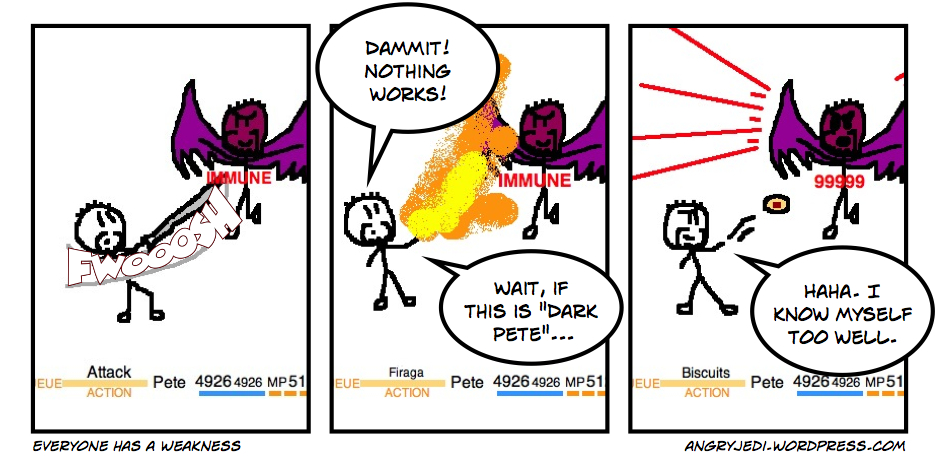
I described the Gambit system as being akin to the "huddle" you have when playing an MMO with a well-organised group. The best way to use it appears to be to give everyone clearly defined roles. For me, this means one tanking attacker, one who solely focused on healing HP and status effects and a third who focused on buffing the tanking attacker with Protect, Shell, Regen and Haste. All of them got stuck in hitting things with sticks and hammers when they didn't have anything else to do, but this setup worked extremely well and saw me through most of the game. Any mishaps could be quickly dealt with by popping up the menu and dealing with them manually. And in boss battles where circumstances suddenly shifted, such as them suddenly becoming immune to physical attacks? Well, that was just a case of popping open the main menu and adjusting the attacking Gambits to use Magicks instead.
It's a great-looking game for a PS2 game, too. Sure, there's rough edges when playing on an HDTV, but it's clear to see this is a well-crafted, well-designed world with distinctive-looking characters. The animations in cutscenes are excellent, too, with some high-quality facial animations doing a great deal to help forget the laughing scene in Final Fantasy X. One tiny bugbear with the graphics is that all the FMV sequences are in 4:3 while the game itself happily runs in 16:9 but this is a minor issue, as the vast majority of story sequences are rendered in-engine.
The sound is probably the weakest bit of the game. The voices are heavily, heavily compressed, though the acting itself is generally very good. The music is unmemorable, however, which is quite unusual for a Final Fantasy game. It has character, and sounds like Final Fantasy Tactics (which is understandable, given their common setting) but there's nothing anywhere near as iconic as One Winged Angel on display here, which is a shame. There's also a couple of areas that repeat music from earlier in the game, too, which seems a little lazy, given that the vast majority of areas have unique music. It's hardly a deal-breaker, though.
Final Fantasy XII is often described as the FF for people who don't like FF. And it's absolutely true—the crushing linearity of earlier entries in the series is nowhere to be seen (although the main plot is firmly on rails, you're free to wander off and do your own thing at any time right up until the finale) and there's very little need to "grind" by running around in circles waiting for random battles to happen. In fact, it's possible to "grind" without noticing simply by travelling from one place to another—the numerous long-distance journeys that the plot tasks you with seem to set you up to take advantage of this fact.
At the same time, these elements may put some people off. Some people enjoy the tight focus that a strictly linear plot gives, and indeed in FFXII it's very easy to lose track of what happened in the story when your last cutscene was eight hours ago. The plot picks up pace towards the end, though, and you find yourself wanting to press forward and see things through to their conclusion. How quickly you choose to do so is entirely up to you—so if you're a fan of a tight plot, you could probably romp through fairly quickly. If you're a completionist, though, there's plenty to keep you occupied here. I beat the game after 98 hours with barely half of the sidequests completed. Then there's secret weapons to find, a boss with 35 million HP to take down, secret Summons, optional areas to explore and doubtless many other things besides.
So in summary then, I was very, very impressed with the whole game. As a Final Fantasy fanboy, I enjoyed the fact that it still felt like a Final Fantasy game whilst playing very differently to the more "traditional" entries in the series. And as a fan of good games? Well, this is very much a Good Game.
The only thing that makes me a little sad is how few people will probably be inclined to play it these days. With the lack of backward-compatibility on new PS3s, playing it will either involve tracking down a PS2 or using an emulator. It's wholly worth it, though, as it is without doubt one of the best RPGs I've had the pleasure to play for a long time, and certainly one of the finest entries in the Final Fantasy series. A pity we probably won't see its like from Squeenix again.
Little Johnny wants to buy a copy of acclaimed and excessively popular (some might say cultish) Lovecraftian multiplayer FPS Call of Cthuty: Black Arts and heads down to his local GAME. There, he attempts to procure a copy of said game—which has a big shiny red BBFC "18" certificate on it—with the pocket money he's saved up. Little Johnny is eleven years old and doesn't have any ID, fake or otherwise. The cashier at GAME refuses to serve him. Little Johnny goes home and cries, and Xbox LIVE is safe from another squeaky-voiced pipsqueak for another day.
Well done, GAME, correct response.
Little Johnny returns to GAME with his mother, who doesn't know much about video games. He has convinced her that he "needs" this game in order to fit in with all the cool kids, who are all playing it for 37 hours a day, some of whom have already Ascended and are going around the levelling system again, only this time with brand new Elder Powers to choose from. His mother picks up the game, barely gives it a second glance, asks the cashier for it with Little Johnny standing right there, and the cashier doesn't question this at all. Little Johnny's mother hands him his shiny new game, he shouts "FUCK YEAH!" and runs out of the shop giggling.
No, GAME. Bad GAME. Incorrect response.
Bigger Johnny (no relation) wants to buy a copy of acclaimed and excessively popular (some might say cultish) Lovecraftian multiplayer FPS Call of Cthuty: Black Arts and heads down to his local GAME. There, he attempts to procure a copy of said game—which has a big shiny red BBFC 18 certificate on it—with his credit card. He is 19, after all. He gives the "If you're lucky enough to look under 21…" sign on the counter a brief glance but decides that the bum-fluff he's managed to grow on his chin will ensure he won't have to worry about ID—which is good, because he's forgotten to bring it. He is incorrect in his assumption, as the cashier asks him for ID and he is unable to provide it. He leaves the shop empty-handed, but with his bank account forty quid better off than it would have been.
Well done, GAME, correct response.
Bigger Johnny's mum just happens to be Mary "Queen of Shops" Porta, supposed shopping "guru" who is on the tellybox frequently whingeing at shop-owners about how rubbish they are. She is outraged at the way GAME have treated her darling son and tells him all sorts of things about how he should have demanded to see the manager, then promptly gets on the phone, shouts at them, gets hung up on and then demands to speak to the CEO of the entire company. In public. On Twitter. CEO promptly deflects her with his PR human shield… and the matter is still ongoing at the time of writing.
This latter part actually happened today, albeit with a 15-rated game and a 17-year old son who attempted to use his 16+ Oyster Card as valid ID for GAME staff to check his age. They refused—and good on them, frankly, for upholding a law which is all too often flouted by retailers more concerned with making a quick buck than actually ensuring inappropriate content doesn't get into the hands of kids. Mary Queen of Shops, however, was furious, though it's not entirely clear what grounds she has to complain. Here are some of her tweets on the subject:
STILL holding on after 8mins to spk to a human at GAME Ox st where they refused to sell my 17 yr son a 15 + game. Now they've cut me off.
You'll notice her casual dismissal of the ratings system as "we are not talking drink". Apparently some retail laws really are worth more than others to our Mary. She is also heavily focused on the ID issue, though implies that there was some non-specific "rotten attitude" from the store in question. When asked about this by one Twitter user, however, her only response was this:
No mention of what the "more to it than that" was. She hasn't said anything since, at the time of writing.
Now, I've talked about this topic a number of times. Censorship is a bad thing; but the refusal to sell age-restricted products to minors is not censorship. It's ensuring that people have access to age-appropriate material—a law which would mostly work were it not for the stupid loophole most retailers use to avoid difficult conversations where they'll happily sell the game to a parent even if it is very, very obviously on behalf of a child who is standing right there.
I don't for a second believe Fox News' nonsense that games cause rape, violence and AIDS. But I do believe that "mature" content should be kept out of the hands of minors until they're old enough to deal with it appropriately and not run around shouting "Fuck! Fuck! Fuck! Fuck!" in the middle of the street. (Which they genuinely used to do in sunny Southampton.) Foot-stamping and attitude from people like Mary here doesn't achieve anything except devalue the law every time it's circumvented. If her son wanted to buy the game—which he was quite entitled to do if he had one of the forms of ID that everywhere else in the world accepts and not an Oyster card which no-one has ever* accepted as valid ID—then he should have gone prepared. And when he got turned away, his initial reaction should not be to speak to the manager as Mary seems to think it should be. It should be to shrug, accept the fact that he done messed up, like, go home, get his ID and then try again.
But no; the customer is always right, after all. Even when they're clearly wrong. You have my sympathies, retail types. I remember all too well what it was like.
It's been a funny few weeks for the games industry, what with spats between high-profile journalists such as Leigh Alexander and Jim Sterling; the whole Penny Arcade "dickwolves debacle"; and, yesterday, Fox News making the astonishing claim that Bulletstorm directly encourages rape.
This sort of thing is oddly symptomatic of the modern industry, though. We take technology for granted so much these days that new, exciting things are met not with the excitement that they deserve, but with cynicism, caution and, at times, outright hostility. This is arguably wise, given that technology generally isn't cheap, particularly for early adopters. But sometimes I miss the days of wide-eyed wonderment at a new gizmo that does something no-one else has ever done before.
Case in point: Sony and Nintendo's upcoming handhelds, the NGP and 3DS, respectively. Both are pretty impressive pieces of kit—the 3DS for offering glasses-free 3D glasses (which may or may not prove difficult to appreciate for those who actually wear glasses) and the NGP for being a veritable behemoth of pocket-sized power. Both will make a significant dent in your cashflow should you choose to adopt them, but both are incredibly exciting pieces of technology.
So then, why do the industry press feel the need to publish articles like this? This is perhaps a bad example, because PocketGamer did, in fact, also publish a counter-article about why you will buy an NGP. But this is by no means an isolated incident; game sites are filled with list articles like this offering you "reasons to sell your Wii", "reasons not to buy an [x]", "reasons why the [y] is rubbish" (I'm paraphrasing, obviously). It's a curious offshoot of fanboyism that some game sites seem to be voluntarily perpetuating—presumably because it encourages "discussion". Discussion means hits. Hits mean ad revenue. That's what it's all about for many of these sites these days, after all.
Sometimes I think there's a market for a site that treats things with the kind of wild-eyed enthusiasm that we as kids and teens in the 90s used to show for every new and exciting thing. Remember when Starfox/Starwing came out and it looked like games we'd been playing on home computers for years but everyone still loved it because it hadn't been done on a console before? Remember when the Atari Lynx had hardware sprite scaling? Remember when you were gobsmacked about how many layers of parallax scrolling Shadow of the Beast on the Amiga had? Yeah. That. I want that back.
Perhaps it's symptomatic of the fact that technology advances have slowed somewhat since those days. An oft-quoted line with every new generation of gaming technology is "it's difficult to imagine how graphics could possibly get any better than this", or "[x developer] claims they're using 100% of the [y console]'s power". But then someone does something cool. It might not be as huge a leap as that between, say, the SNES and the PS1. But it's still an improvement, and something that I, personally, feel is still worth getting excited about.
For so-called "enthusiast press", sometimes we're not very enthusiastic.
"Is Bulletstorm the worst video game in the world?"
That's the question Fox News asked earlier with an article that was hyperbolic and scaremongering, even by their questionable standards. According to Fox's "experts", including Carol Lieberman, a psychologist and book author, "the increase in rapes can be attributed in large part to the playing out of [sexual] scenes in video games".
Whoa there. Hold on a minute. The playing out of sexual scenes in video games (which, I might add, are typically incredibly tame and rather immature in the way they are handled) is a "large" contributing factor to the increase in rapes?
This is scaremongering against games taken to a whole other level. Unbelievable stuff. And, of course, complete and utter nonsense. If we follow through Lieberman's arguments to a natural (and exaggerated) conclusion, here's how the life of an average gamer would generally go:
09:00 – Wake up wearing same clothes you've been wearing for the last six months because game characters never change their outfits. Skip breakfast because game characters never eat. Skip going to toilet for same reason.
09:05 – Leave house. Run down road because game characters never walk except in cutscenes.
09:06 – See passer-by, assume they're enemy. Kill them for XP and loot and/or rape them if they're female.
09:07 – Repeat process ad nauseam until reaching work.
09:30 – Reach work, still running. Enter work building. Start lurking around corners.
09:35 – Shoot out security camera in case it sees you, despite the fact you actually work here.
09:40 – Run around office using cubicles as cover, shooting anyone you happen to catch a glimpse of in the head.
10:00 – Called into boss's office.
10:05 – Defeat boss by filling him full of lead.
10:10 – Rape him for good measure.
10:15 – Loot his body, because bosses always carry the phattest lewt.
11:00 – Take elevator up to next level. Repeat process.
12:00 – Police arrive. Shootout ensues.
12:10 – Die. Fail to respawn because you don't get to do that in real life.
Now, granted, there are some absolute fuckwits in the world to whom that probably sounds like a great way to live out the last few hours of their lives. But, as is frequently pointed out by rational people every time such a tragedy happens, if someone is going to go on a killing and/or raping rampage, it's probably not games that caused it in the first place. To assume that the average person doesn't have the appropriate filters in their brain to differentiate between the darkly comic, over-the-top, ridiculously exaggerated violence in Bulletstorm—a game intended for (immature) adults, let's not forget—and how horrifying it would be to witness real-life violence or rape? That's just insulting to, well, everyone.
The article does raise one valid point about control and "censorship", though. Parents still aren't taking responsibility for the entertainment their kids are interacting with. Personally, I strongly believe that there should be tighter controls on how games are sold. I'm not talking about censorship, I'm talking about stricter enforcement of age ratings—and a change in the ridiculous policies that most retailers adopt that allow parents to buy age-inappropriate games for their children. If the parent is by themself, then sure, there's not much that can be done. But as it stands right now, if a parent is obviously buying a game for the kid they have with them, most retailers won't do a damn thing about it.
The above will probably have made clear that I don't believe that there's a direct causal link between violence and sexual content in the media and the way people behave. But I do believe that children shouldn't be exposed to such content from such an early age these days—more so they can hold on to the increasingly-irrelevant concept of "youth" more than anything else.
Sadly, though, it's pretty clear that it's too late. To backtrack now and enforce tighter controls would be difficult, if not impossible to do. So we're just going to have to live with the consequences. Which, according to Fox News, is a society full of joypad-wielding rapists.
I shall leave you with two interesting thoughts to mull over:
You'd think before blaming video games for the rise in rape cases, you would check to see if there actually has been a rise in rape cases.
An oft-had discussion in gaming is what constitutes the "golden age" of gaming, or indeed if there has even been one.
For some, it's the age of the arcade, when games were designed for pure fun and nothing else—besides emptying your pocket of quarters/local equivalents, of course. For others, it's the home consoles of the NES era; others still, the 16-bit wonderment of the SNES and Genesis/Mega Drive. For yet others… You get where this is going, I'm sure.
For me, the golden age will forever be the PS2 era. I didn't always think this was going to be the case; I remember playing PS2 games for the first time and thinking they were graphically impressive, but somehow lacking the "magic" of my favourite PS1-era games, particularly when it came to JRPGs. It took time, but the PS2 gradually proved itself as a force to be reckoned with, with a gigantic library of excellent titles (and an even bigger library of fucking awful ones) and the kind of backing from the public that Microsoft and Nintendo could only have dreamed of in those days. Funny how things change.
The thing is, being unemployed and skint as I am at the moment, I'm finally getting around to attempting to beat some of the PS2 titles that have sat, under-loved, on my shelf for years now. Final Fantasy XII is my current project: I'm now over 60 hours into it and still loving every minute. It's struck me while playing FFXII that it seems to be a much more infrequent occurrence that a current-gen (360, PS3 or Wii) game will grab me in quite the same way as numerous titles from the PS2 era did… and indeed still are.
I wonder how much of this is down to graphics. Naughty Dog aren't far from the truth with their jokey "next-gen filter" option in Uncharted; an increasing number of games in the current generation are looking increasingly interchangeable, with "gritty", "realistic" graphics often winning out over vibrant colours. There are exceptions, of course, and I discussed a number of these the other day.
I don't think it's just visual character, though; I think the way games are designed and consumed has changed considerably since the PS2 days, too. Look at the number of people who Achievement-whore these days. More often than not, this takes place not through a desire to see everything the game has to offer, but instead to line up their shiny virtual trophies on their virtual shelf and brag to their friends. The social side of gaming is cool, sure, but what happened to gaming just purely for the sake of fun?
There's no reason for these people to want to 100% Final Fantasy XII, for example. There's no public way of recognising your achievement besides actually telling people. But I think that's kind of a good thing, personally—if you want to be a hardcore insane idiot and complete every insanely difficult hunt, clear out every unnecessarily difficult area just for the satisfaction of knowing you have, that's great. But there's no feeling of "obligation" to do so—the person who storms straight through FFXII's main quest without exploring the side content is getting their money's worth just as much as the hardcore insane idiot.
But in games with Achievements these days, many people feel that they haven't got their money's worth unless they 1000G/Platinum Trophy the game. And in many cases, some of those Achievements and Trophies are enormously tedious collectathons (Assassin's Creed), forced replays of lengthy games (Mass Effect, Dragon Age) or encouragement to completely remove any "meaning" and sense of consequence from moral choices in games (any game that has separate Achievements for completing quests/levels in multiple different ways, thereby encouraging saving before "important" bits, then reloading and replaying just to get said Achievements).
Screw that; I'm just as guilty as the next man or woman of Achievement-whoring at times. But spending such a protracted period of time in the company of a last-gen game without all that bollocks to think about is giving me pause for thought. Are things really moving in the right direction?
It makes me a little sad to think that there's a generation of gamers now who have no idea what gaming life pre-Achievements was like—and with Sony's ditching of PS2 support on the PS3 and Microsoft's woeful "backward compatibility" (I use the term loosely) on the Xbox 360, it's becoming more and more unlikely that newer gamers will have the opportunity to explore that side of gaming—and then even if they do, they'll probably be put off by "ugly" SD graphics. Look at how much snobbery people have towards the Wii's graphics now.
Do I have rose-tinted specs when it comes to looking at last-gen gaming? Perhaps. But I'm more than happy to live in the past, if so.
Earlier today, this animated image from Insomniac Games' Resistance 3 did the rounds. Impressive. But also rubbish.
Ooh, controversial.
But seriously, look at it again. What is the one thing that sticks in your mind after watching that short clip? You probably answered either "post-apocalyptic", "monster" or "brown".
The trouble with things like this is that they completely lose their impact after a time. I'm sure Resistance 3 is technically very proficient, particularly if that clip was rendered using the game engine, which I'm guessing it was. But the fact it looks like Gears of War meets Fallout meets any other post-apocalyptic brown "destroyed beauty" sort of environment completely kills any interest for me—there's just too much of it around. And not just in the sci-fi genre; I haven't played Modern Warfare 2 for months (I traded it in after I got bored and decided I had no interest in the rest of the Call of Duty series after it) but my one enduring memory of that game, too, is that there was a lot of brown around.
This is nothing new, of course. I vividly remember getting all excited over the original Quake, the first high-profile "true 3D" first-person shooter. My brother, obviously already sick of it having been exposed to it every day on PC Zone, referred to it as "oh, the brown game". And yes, Quake was overwhelmingly brown, though there were a few blue bits in it too. This was just the beginning, though.
Yes, post-apocalyptic environments probably are going to be grey, brown and miserable. Although one thing that Halo: Reach shows is that it is possible for armageddon to be happening and it still be a vibrant place filled with colour. In the case of that game, it's arguable that the impact of the destruction is all the more profound because of the splashes of bright colours that are everywhere.
Or alternatively, developers, how about fewer games involving things that have collapsed or are in the process of collapsing? Fewer games where there's nothing but rock and stone? More games in organic, natural environments that aren't dead. More games that aren't afraid to take a few risks and be a bit more stylised rather than "gritty" and "realistic". Some of my favourite games of all time are the Timesplitters series, proving once and for all that I don't hate FPS games, I am just very tired of them all being identikit and boring. Timesplitters was colourful, distinctive and humorous but still managed to be atmospheric. And the news that CryTek are considering resurrecting the series fills me with an enormous amount of joy… and hope that they don't fuck it up.
Perhaps this is why I like JRPGs at a time when more and more people seem to be getting switched off by them. They may be their own particular kind of generic, but at least they offer some colour as part of their aesthetic.
The other night, I posted a question on Formspring. I thought I sent it to just a couple of friends but apparently somehow shared it with the entire Internet, as a lot of people, some of whom I hadn't come across on Formspring before, appeared to be very enthusiastic to answer it. I was somewhat surprised at the amount of depth people were putting into their answers, because it was, after all, a somewhat flippant question that I wasn't expecting people to take seriously at all. How wrong I was.
This was the question:
Out of The X-Factor/American Idol and equivalents; Jersey Shore; the music of Girls Aloud; the Call of Duty series; and cakefarts (don't look it up, it's exactly what it sounds like), which has had the most beneficial impact on society, however small?
My thinking behind it was this: here is a list of arbitrarily-chosen things that are all either irritating, disgusting, amusing or awesome depending on your outlook. Is there one that people see as significantly "better" than the others?
Turns out not, actually. Everyone had some good points to make.
Cakefarts by far. Yes, I am familiar. And yes I've gotten a lot of friends with it.
It's probably important to choose who you're going to show Cakefarts to carefully, because after all, it is exactly what it sounds like. But it's the sort of thing you can show to people and they certainly won't forget it in a hurry. (If you're not familiar, seriously, don't look it up, especially if you're at work; the clue's in the name) If you are acquaintances with people who don't "get" the Internet, you'll be an Instant Legend.
@Cidergirli agreed with AJ, but for different reasons:
I'm going to have to go with cakefarts, purely because it's the only one which appears to be open and honest about its use of cake. Also: cake.
@MJPilon had a thoughtful take on the issue and came out in favour of American Idol/X-Factor:
The answer I have off the top of my head is American Idol and equivalents because despite all the craziness that has sprung up around these shows, at their heart, these shows demonstrate that people should not give up on their dreams and that if they work for it, they can achieve what they desire. Anything which can still evoke these feelings and notions in people are beneficial for society.
He was concerned immediately after that he may have missed the point of the question, but I think that's a decent answer; though personally I feel that "ambition" shouldn't require a TV show to inspire people to reach for the stars.
@C64Glen came out in favour of Girls Aloud, though not for the reasons you might expect. Or possibly the reasons you might expect, given his username. I wasn't familiar with the factoid he shared, though. TIL.
Girls Aloud easily, some of the tracks and production on the 'Out of Control' album is great. Some of it by former C64 musician Matt Gray. E.g. Untouchable (instrumental)
@Shinogu showed where his priorities lie with his response:
Jersey Shore? They were the only people of that selection at the LittleBigPlanet 2 World Record event.
@Cilllah, ably aided by @Culley25, got straight to the point of the matter:
All of them prove one very important fact – mental illness makes money.
Fair point. @Bungiesgirl then came up with an image that you will either find delicious or nightmarish depending on your opinion of two of the things mentioned in the original question:
Surely it is a combination of Girls Aloud and Cakefarts?! Girls aloud because they have a hot(ish) redhead, cakefarts just for the LOL! preferably these two things should be brought together into one super site of Girls Cakefarts Aloud.
I like the redhead in Girls Aloud. Nicola. She has a name. Nicola. I like Nicola. I understand she's not the most popular option. That's just fine by me.
Sorry, where was I? Oh, right. @minifig came up with some fair points in favour of Girls Aloud and Call of Duty, with a disclaimer:
Call of Duty probably wins it, since the development of the game has at least pushed a few technological boundaries a little way, and probably just enough to outweigh the huge timesink it is for the people that play it. However, I think Girls Aloud probably come second since:
1. They have a couple of songs that aren't too offensive and
2. The amount of masturbation they've induced may well have had an impact to reduce the fertility of large numbers of men, thereby reducing the world's already excessively large population.
Not that I like either CoD or Girls Aloud.
It was around this point that the answers started to gradually increase in length, depth and intensity of feeling. Here's @docbadwrench:
Thankfully, I only know what a few of those things are. However, I think I get the general point.
Based upon the available data, I would have to conclude that Call of Duty has the most beneficial (though incredibly small) impact upon society. It encourages aiming, which is highly important if you use a gun.
In fact, if all fans of the aforementioned list could improve their aim, then they might kill one another; this could be another net gain for society. Perhaps, if we could plant subliminal messages into Call of Duty games encouraging people to buy guns. Then, extending the message further, perhaps their American Idol viewing parties would include handguns, just lying around on the table, in case there's a conflict about whether the latest off-key primadonna is the bestest of them all.
Definitely Call of Duty.
"allpointsnorth", whom I'm not sure I know on Twitter (apologies if I do) had this to say:
I suppose the knee jerk and natural response is that none of those programmes have any beneficial impact, but that would be a touch lazy and, not really fair.
Like most things it depends upon how you measure it. If we take beneficial to mean that more people enjoyed it so it must be more beneficial then I suppose I'd have to say Call of duty? 55 million sold worldwide. I guess Call of Duty would also fall into the 'brought economic rewards to many' view of beneficial too, though I'm sure that Jersey Shore brings in the cash too as will Girls Aloud.
However, I'm not really a big fan of measuring society against some sort of scale. I don't think it really works like that. To break society down in such binary ways is tempting as it allows us to explain and comprehend the world around us so much more simply. However, society isn't simple and what benefits one, no doubt, harms another. Even if that harm falls into a socially acceptable form of harm that we ignore.
Of the things here I'd say that Girls Aloud benefited me most as I've enjoyed a selection of their poptastic hits and the videos to go with them more than Jersey Shore, Call of Duty or Cakefarts – none of which I have seen. So, clearly, the music of Girls Aloud is the winner here and has done the most to benefit society at large.
Interesting point. What is "beneficial" to society? Is it something that brings economic rewards? Something that benefits art and culture? Something that makes people happy?
@planetf1 had a simple but accurate answer to my question:
I'd go for xfactor/idol simple as it's given a lot of people pleasure, helped many with a career/breaking into the music industry, has stimulated discussion & allowed many people to share a common experience.
Discussion there certainly is; like it or hate it, during any high-profile "reality" show on TV, Twitter will be abuzz with discussion about the show in question, whether it's in-depth debates about which floppy-haired twat is the "best" or people ranting and raving how much they don't care about whatever programme it is.
Two more, then we're done. @MituK had this wonderfully analytical, scientific approach to share on the subject:
Ooh, interesting. Well, let's assume that 'beneficial impact' can go into negatives, and assess each accordingly.
I know that there is a difference between X-Factor-type-shows and Jersey Shore, but both seem to elevate fame for it's own sake; even where hard work and talent are not what is being rewarded. This has led to a whole generation(s) of kids valuing fame for it's own sake, rather than as a consequence of hard work. Definitely negative impact. We'll give this a -5 rating for 'beneficial impact'
Similarly, the music of girls aloud – this has created tunes I can happily bop along to when in the mood, but it's also meant Cheryl Cole, who most little girls (according to a recent survey) would like to grow up to be, so this creates the same problem as described in the first paragraph. We'll give this an arbitrary rating of -0.5, weighing up those two things…
The CoD series – hmm, perhaps there has been no negative impact other than the already-existing self-perpetuating desire for studios to churn out yet more of these types of games. HOWEVER, it's existence has no doubt also inspired some of the many smart people interested in game design to want to create more interesting video game experiences (think indie scene). So, perhaps in a way this has had beneficial impact of +2 (of course I'm being idealistic here).
Cakefarts get a 'beneficial impact' rating of 0, because that is precisely how long I want to think about cakefarts.
So, on that scale, CoD wins, I guess!
And finally, @jennfrank shares a convincing argument in favour of Jersey Shore:
I've had more conversations about Jersey Shore than I've ever had about Idol or Talent or Call of Duty, and while these are all legitimate cultural milestones, OH MY GOD, don't get me started on all the million reasons Jersey Shore is my heart and soul.
I love these earnest people earnestly, without a wrinkle of irony–I do!–and I love their passion for life and their perfectly foreign codes of morality and chivalry and fashion. But it's this amazing anthropological study that no other show dares attempt, which is edgy in its way, and the cast, in turn, are these amazing actors who improvise their warts, these utterly authentic famewhores who relish in their own faults and even explain them all out, looking directly into the camera in partial states of drunkenness and undress.
Watching the show, for me, reproduces much the same crackle I felt as a tween watching early Real World, but instead of feeling a voyeur's envious thrill at the specter of adults away from home for the first time, I instead know the envious thrill of watching kids away from home for the first time. So it's the same, and it's not the same.
Also, these folks are classy: Snooki is a NYT bestselling author, and Jenni "JWOWW" Farley is a spectacularly talented painter.
So there you have it. Points in favour of all of them, and proof positive that easily-derided cultural phenomena sometimes carry more significance than you might think personally.
 Nostalgia and rose-tinted spectacles are rife in all walks of life, but there are few places where it happens more so than in the video games industry. This is perhaps due to the fact that it's such a fast-moving industry that you can be in your twenties and still feel nostalgic for "the good old days" and how much better they supposedly were.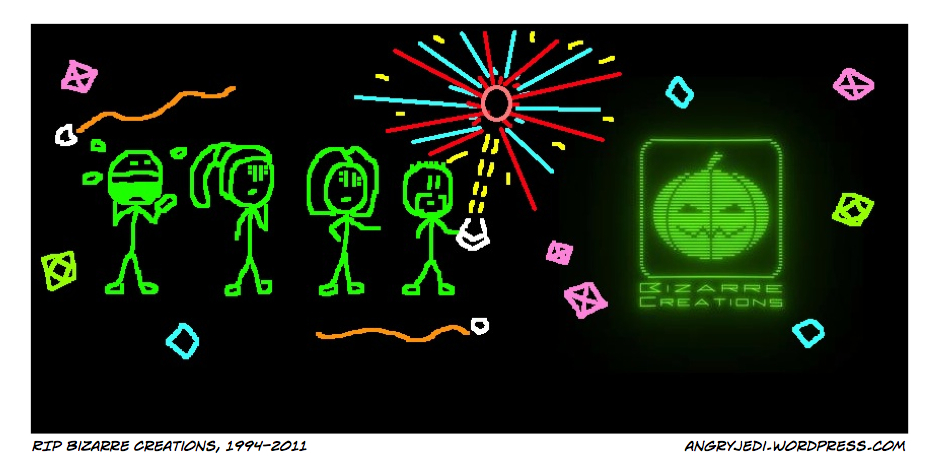
 It's fair to say that, as a general rule, Facebook games are pretty, well, shit. For the most part, they're cynical, money-grabbing exercises designed only for bored soccer moms and office drones to while away the hours performing virtual meaningless tasks instead of real-life meaningless tasks. What's worse is the fact that the real-life meaningless tasks are still there once you've clicked on every single field in FarmVille 300 times.
 Since I'm currently going through my backlog of games and beating them one at a time, it seems only fitting that I should write a sort of "review" of each one as I come to their (hopefully inevitable) conclusion. So tonight it's the turn of Final Fantasy XII, one of several "black sheep" of the series thanks to its complete defiance of established series conventions and adoption of a quasi-Western RPG style of gameplay. I will try and avoid as many spoilers in this post as possible.
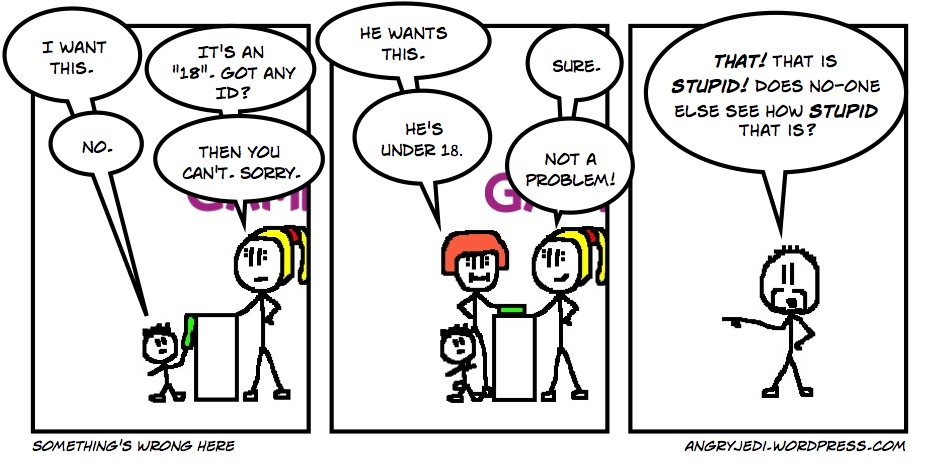 Little Johnny wants to buy a copy of acclaimed and excessively popular (some might say cultish) Lovecraftian multiplayer FPS Call of Cthuty: Black Arts and heads down to his local GAME. There, he attempts to procure a copy of said game—which has a big shiny red BBFC "18" certificate on it—with the pocket money he's saved up. Little Johnny is eleven years old and doesn't have any ID, fake or otherwise. The cashier at GAME refuses to serve him. Little Johnny goes home and cries, and Xbox LIVE is safe from another squeaky-voiced pipsqueak for another day.
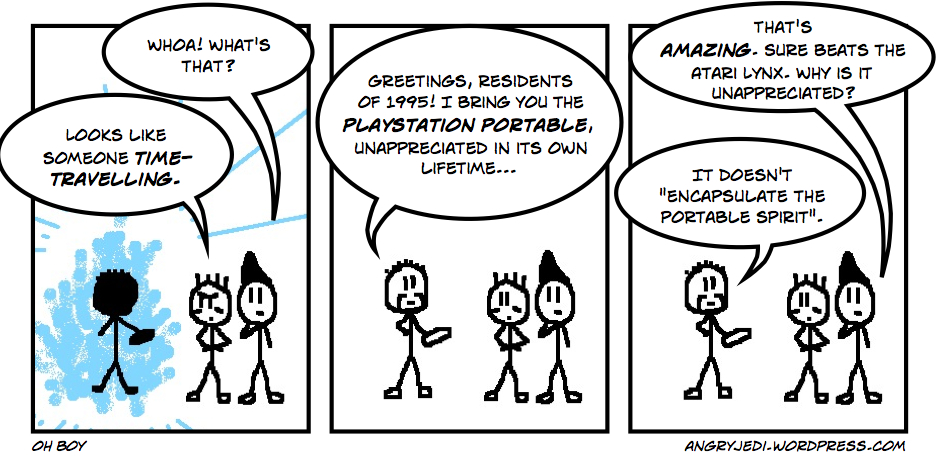 It's been a funny few weeks for the games industry, what with spats between high-profile journalists such as Leigh Alexander and Jim Sterling; the whole Penny Arcade "dickwolves debacle"; and, yesterday, Fox News making the astonishing claim that Bulletstorm directly encourages rape.
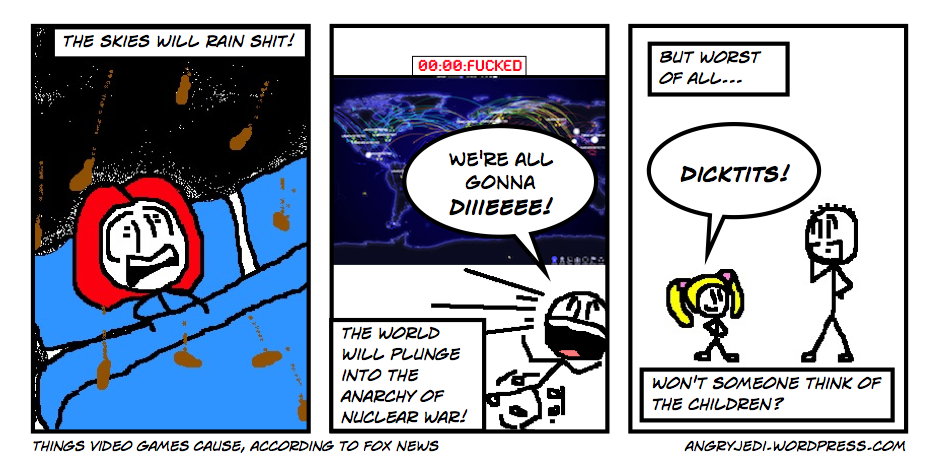 "Is Bulletstorm the worst video game in the world?"
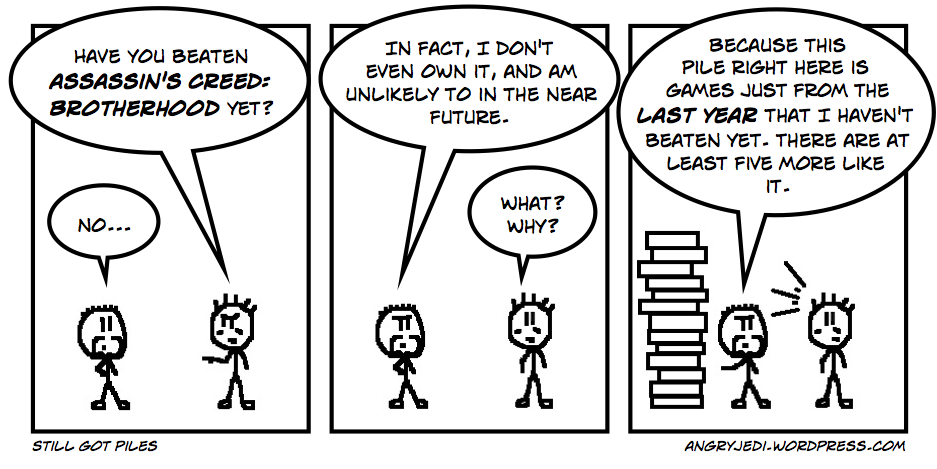 An oft-had discussion in gaming is what constitutes the "golden age" of gaming, or indeed if there has even been one.
 Earlier today,
  The other night, I posted a question on Formspring. I thought I sent it to just a couple of friends but apparently somehow shared it with the entire Internet, as a lot of people, some of whom I hadn't come across on Formspring before, appeared to be very enthusiastic to answer it. I was somewhat surprised at the amount of depth people were putting into their answers, because it was, after all, a somewhat flippant question that I wasn't expecting people to take seriously at all. How wrong I was.