#oneaday Day 747: I've Already Done A Post Called "Fun With Portals" So Use Your Imagination

20120204-234514.jpg

Can you imagine how awesome it would be if portals were real? Portals as in the portals from Portal, not portals as in Web portals. I know those exist.

Let's consider a few real-world applications of said portals.

For starters, assuming the technology could be modified to create more than two portals, a worldwide transportation network — perhaps attached to some large chain of fast food restaurants or coffee shops — could easily be set up. Imagine how much easier it would be to get around and visit friends if you could simply step through a portal in your local Starbucks and come out in a different Starbucks somewhere else. (Pedants may suggest a portal in your own home might be more useful, but that is obviously then open to abuse. Public portals are the way forward in this instance.)

Second of all, the creation of a real-life Resident Evil-style Item Box, where the inordinately huge number of possessions that you dumped inside are inexplicably available any time you open an identical-looking box somewhere else. This would make getting furniture home from Ikea considerably easier. Perhaps they could even sell the boxes in question, allowing users to then drop any future furniture purchases in the public box in store and have it immediately pop out at the other end. (Those who live with others may wish to warn their housemates if they are going to do this, however, for seeing a fully-formed bookcase suddenly bursting out of the floor may be somewhat terrifying for those with weak constitutions.)

Thirdly, those finding the development of an exercise routine troublesome due to lack of space can make themselves an infinite running track in even the smallest of apartments simply by placing two portals opposite one another. Obviously ensure the floor space between the two portals is clear and you have understanding neighbours if you do not live on the ground floor, but you can then run to your heart's content without ever having to go outside and worry about the general public laugh at your pathetic speed and wobbling man-boobs. (Assuming you're a gentleman, of course.)

Fourthly, the Walk of Shame after a particularly rambunctious night on the town can easily be dealt with by simply popping one portal on your bedroom wall before you leave, and then, when the night/sex is over, simply pop the other portal on a wall near the situation you would no longer like to be physically present in. (Do then remember to either close the portals or put the second portal somewhere else so that the person/situation you are attempting to escape from is unable to follow you into your bedroom.

Fifthly, stairs could become a thing of the past. You know when something you really need/want is at the opposite end of your house and your own laziness precludes you from climbing the stairs to go and get it? Simply ensure you leave a portal upstairs at all times, and then fire the other one immediately in front of you. Wander through and voila — no unnecessarily tiring stair-climbing to worry about. (If you are performing this operation primarily to get food, be aware that you will probably get fat if you're not even getting the exercise that climbing your stairs provides.)

It should, by now, be abundantly clear that real-life portal technology would be useful, practical and not at all intrusive. FOR SCIENCE.

#oneaday Day 746: I Love You, Emi

20120204-020606.jpg

This post regards the notorious amateur-developed visual novel Katawa Shoujo. If you are intending to play this game and proceed down the "Emi" path and would like to avoid spoilers, I recommend you skip this post. I've even put the spoilery discussion below the break. Aren't I nice?

If you're still reading this, it's highly likely you already know what Katawa Shoujo is but just in case you aren't, it's a visual novel developed by 4 Leaf Studios, made up of members of the much- (and usually justifiably-) maligned 4chan community along with other itinerant creative types from around the Internet. It was developed following extended discussion over a sketch by Japanese doujinshi artist Raita, and is the very definition of a "labour of love", having come from discussions on 4chan all the way to a full-fledged, professional-quality game between the years of 2007 and 2012. It's been described by some as "eroge" or an erotic game, but I feel this does it an injustice; there are sexual scenes in the game, yes, but the point of the game is not to get to these scenes — rather, they are part of the plot, and not necessarily a "victory" for the player. They are also not terribly frequent compared to the rest of the game, which focuses on interpersonal interactions and psychological issues.

If you want to check out Katawa Shoujo for yourself, take a peek at the official website.

Continue reading "#oneaday Day 746: I Love You, Emi"

#oneaday Day 745: Miss Catherine O'Gyny

20120203-033504.jpg

I've been rather disappointed by the attitudes I've seen over the last couple of days, from people who, though in many cases I've not had the opportunity to speak to directly, I would consider to be my peers — those working in the game journalism business, and specifically those from the UK.

What I'm referring to here isn't a blanket problem with all UK game journalists or the industry at large, but it is a relatively widespread one, and one which I don't particularly want to get into direct finger-pointing about. I do, however, feel that it is worth mentioning.

Context: Last night there was a launch party for the impending UK release of Atlus' excellent Catherine. If you're not familiar with Catherine, it's a bold, daring game that doesn't shy away from adult themes, and explores the concepts of relationships, commitment, infidelity and the power of sex through well-written dialogue, well-realised characters and some very striking, surreal imagery. Despite its subject matter, it never oversteps the boundary into tastelessness, and the vast majority of the game's sexuality is implied rather than made explicit.

So of course it would be an excellent idea to launch the game in a strip club. Of course that would be a sensible idea, particularly given that there is no strip club (or indeed any strippers) in the game, which handles sexuality in an understated, tasteful manner which respects the player's maturity.

Some people on Twitter quite rightly spoke out and said that they felt this venue for the game's launch was totally inappropriate. Some brought out facts and figures to back up their arguments. But surely even without facts and figures, anyone with half a brain could see that hosting a launch event for a game in a strip club is just a terrible, terrible idea.

Apparently not. The people who raised objections to the venue were told by some attendees that they were taking things too seriously, that they were trying to unfairly tar people with the "sexist" brush, that it wasn't really anything to worry about. Arguments got heated in many instances. I kept well away from the whole thing and observed — usually the best choice in this sort of situation.

The issue that really bugged me, though, was that for many of those who were at the event — I wasn't, I hasten to add — it seemed a simple matter to dismiss the inherent misogyny in hosting an event at such a venue. The objectors were accused of "overreacting".

Fact is, the video games industry has always been male dominated and, despite the number of prominent women who are now involved, is still a male-dominated industry. Hosting events like this is not going to make women (and, indeed, some men) feel welcome to the industry, and from the outside it just looks sleazy — both for the industry at large, and for Catherine, too, which, as a genuinely thought-provoking, mature game for adults, it does not deserve. None of that is an overreaction. The industry needs to be more inclusive.

All this isn't the first time the reaction of many UK media types has bugged me, however. Late last year, industry trade publication MCV held the Games Media Awards ceremony, during which people from across the industry were to be celebrated for their achievements. It should be a prestigious, high-profile ceremony — and to some extent, it is. However, all trace of credibility for the event was lost for me when I clapped eyes on its Twitter feed, which was encouraging attendees to get as drunk as possible and show up naked, and continually promised "industry boobs" — a supposedly hilarious joke whereby if the account got enough followers, they'd show a picture that actually turned out to be the flabby chest of one of the gentlemen had reviewed the UFC Personal Trainer product for Kinect. IT'S CLEVER BECAUSE IT'S NOT ACTUALLY SEXIST BUT LOOKS LIKE IT IS, DO YOU SEE?

I have always been of the attitude that an awards ceremony should be a professional affair — dinner suits, shiny shoes, that sort of thing. That doesn't mean that you can't have a bit of fun with it, but the babbling of the GMAs' Twitter account really seemed to cross the line with its crass humour, so I happened to mention it one day on Twitter, noting how the behaviour of whoever was running the account had actually put me off wanting to find out more about the ceremony.

I was promptly retweeted and mocked for, again, "taking it too seriously".

In my experience, "you're taking it too seriously", "I didn't mean it" or "I was just having a laugh" are some of the weakest defences that there are. They show complete disregard for the other person's feelings and put across the notion that it's all right to do or say anything you want, so long as it's "a joke" or not meant to be "taken seriously". The other person should just lighten up, stop being such a stick-in-the-mud, take the pole out of their arse.

The Games Media Awards got their comeuppance when sponsors Grainger Games ended up acting like a bunch of dicks, however. The hypocrisy of some, who had previously been advocating the crass humour of the Twitter account, now lambasting Grainger Games for its inappropriate behaviour in person was almost amusing.

In the case of the Catherine event, I feel very disappointed in the way many UK journos have behaved. While I'm sure the event offered a great networking opportunity, the fact that it appears no-one saw fit to object to the venue and instead were more than happy to hoover up the free drinks is a bit sad. It's highly likely that there were some people there — male and female — who would have felt very uncomfortable in that situation, but felt like they would be unable to mention it for fear of ruining the networking opportunity, or the relationship they might have with public relations representative. The fact that those who weren't there who did object to the venue were promptly called out and, in some cases, ridiculed, is really sad, and the flimsy justifications and excuses offered by those who were in attendance are what I find particularly disappointing.

In order to fight the perception of the games industry as an all-boys' club in which only twentysomething men can participate, events like this need to stop happening. There's no good reason the launch couldn't have taken place at any old bar — but I have a horrible, sleazy, sneaking suspicion that the strip club venue was chosen precisely because it has provoked the discussion it has. You know the saying… "any publicity is good publicity", right? Would people be as aware of Catherine if all this hadn't happened?

In short, I just think that the industry is better than this. And if this is the direction that members of the industry think it is appropriate to go in, then I'm more than happy that my current career sits on the sidelines and concentrates more on the analytical, business side of matters rather than flashy, over the top, exclusive events like this.

#oneaday Day 744: Being a Sidebar to That Interminable Games and Art Discussion, Regarding Visual Novels

20120202-010015.jpg

Games are art, games aren't art, games can never be art. Who gives a toss? Actually, judging by the amount of discussion this topic has been generating over the years, quite a few people. For me and my friends, it was Final Fantasy VII that first made us even consider it. Nowadays, of course, Final Fantasy VII and the JRPG genre in general is regarded as something of a cliche, but that's not what I'm going to get into here.

Instead, inspired by finally getting around to downloading, installing and starting Katawa Shoujo, I wanted to say a few words about the visual novel genre of interactive entertainment, and its tangential relevance to the "games as art" issue.

For the uninitiated (and those too lazy to click on the link above), Katawa Shoujo, which apparently literally translates to Cripple Girls, is a visual novel-cum-dating sim developed by members of notorious Internet cesspit 4Chan. It casts the players in the role of a teenage boy struggling to come to terms with his own condition — arrhythmia. As part of his rehabilitation and treatment, he's transferred to a special school that specifically caters to students with disabilities, and from here he comes to know a variety of strange and wonderful characters, most of whom each have some sort of disability. After the first act, the game then proceeds down one of several paths depending on which girl in the cast the player decides our protagonist is going to pursue.

I shan't talk any more about Katawa Shoujo specifically at this time, as I'm still partway through my first playthrough and don't want to draw any conclusions just yet. But what playing it is reminding me is that visual novels are one of my favourite styles of games — and yet, ironically, they're barely games at all by the traditional definition.

I know I said I wouldn't talk any more about Katawa Shoujo yet, but in Katawa Shoujo so far, I have pressed the "continue" button a whole lot and made approximately four choices in about two and a half hours of gameplay. I do not feel short-changed by this, as the stuff for which I am pressing "continue" is interesting, compelling and utterly addictive in exactly the same way that a good book is.

The situation is pretty much the same with titles like the Ace Attorney series, arguably my favourite series of all time. The vast majority of your time in these games is spent pressing a large "continue" button, with the occasional choice of where to go next, what to examine and, in the series' iconic courtroom scenes, using what you have discovered at the appropriate time to prove your case. In these games, there's one set solution and no deviating from it — but again, I don't feel short-changed at all.

Why? Well, the technical limitations of the genre mean that you find yourself filling in the blanks with your imagination a lot more than you might if the game were fully-voiced, fully-animated and provided complete freedom of interactivity. Instead, you're presented with static backdrops; character stills overlaid with maybe three or four different frames of animation to represent different emotions; and text. Lots of text.

The latter part is what puts a lot of people off visual novel titles — the "it's too much reading" argument — but it's from all the text that these titles gain all their power. Typically involving the player getting inside the head of the protagonist and playing things from a first-person narrative perspective, the use of text throughout allows for a far more in-depth exploration of the character than we get in even the lengthiest of RPG. We know what the protagonist is feeling; how he reacts to events; what his attitudes towards the other characters are; and any conflicts he might be feeling. It's a curiously intimate relationship that the player of a visual novel has with the character they're ostensibly "controlling", but this intimacy is oddly often amplified by how infrequently you get to make choices or speak for the protagonist. The choices you make, in many cases, are extremely important, and in some cases can cause the entire plot to veer off in a completely different direction. Their relative infrequence makes them powerful moments to mull over.

But what of the relevance to the "games and art" debate? Well, visual novels present an interesting medium for a variety of artists to express themselves. A novel is typically the work of one person — the writer, perhaps with an illustrator in tow depending on what type of book it is. A painting is the work of a visual artist. A piece of music is the work of a composer. But a visual novel requires all of these things — art, music, sound, writing and in some cases, animation and acting — making it a distinctively collaborative, cross-disciplinary medium. Alongside this, it's one of the most accessible forms of game there is — if you can read, you can play, understand and enjoy a visual novel even if you've never, ever picked up a controller before — meaning it has an inherently larger potential audience than the relatively specialised "gamey games" markets. It distinguishes itself from movies, animation and TV shows by providing a middle ground between the "show, don't tell" of moving pictures and the pure imaginative effort required when reading a novel.

In short, it allows for stories to be told in a way that is unique to its own medium. These stories, while often following similar patterns and very often involving big-eyed anime girls, are no less valid and worthy of study, interpretation and criticism than those presented in more "traditional" media. In fact, if anything, the fact that the visual novel is a relatively new and emergent art form merits more attention than it actually gets.

And sure, while many visual novels descend into Japanese absurdity, titles like Katawa Shoujo; Digital: A Love Story; Don't Take It Personally, Babe, It Just Ain't Your Story; and numerous others all push the boundaries of what it's possible to make interesting interactive entertainment from, along with taking on subject matter I can't recall ever being dealt with (tastefully, anyway) in other types of game.

Consider how simple early movies were and how sophisticated they are now in comparison. Given visual novels' relative infancy compared to other media, imagine what the possibilities might hold in the future. Will we ever see a title like this regarded as "interactive literature" or equivalent?

Who knows. All I know right now is this: if your primary motivation for playing interactive entertainment is to be told a story that draws you into its world and characters, you'd do well to check out titles like those that I've mentioned above.

#oneaday Day 738: Diversifying

20120126-220014.jpg

In a recent blog post, one Ben Goldacre described Spotify's auto-sharing behaviour as "creepy" and called for greater transparency in opt-out procedures. While I don't disagree that users should have the option of whether or not to share what it is that they're doing, I do disagree with the good Doctor's assertion that showing off your tastes to others is somehow "creepy" or "wrong".

The reason I don't find it either of those things is because of discovery. Spotify is built in such a manner that it's easy to check out an artist or album you're unfamiliar with in a risk-free environment. You don't drop any money on the album directly, so if you wind up hating it, you haven't lost out. And if you end up loving it, you can whack it in a playlist or star it for future reference.

Combine this ease of trying things outside of your usual comfort zone with social features and you get a powerful tool to expand your own tastes. Because music is an ever-present part of society these days — silence, it seems, is frowned upon by most people, particularly those of more tender years — conversations about what artists are awesome are less common than they once were in the age of buying CDs (and, heaven forbid, cassettes). Music is just there for many people — a disposable thing that people may well have a strong connection to but perhaps don't always think to actually discuss,

What Spotify's sharing feature does is allow you to see what friends have been listening to and, if it takes your fancy, jump right in there and have a listen yourself. I've discovered more than a few new favourites this way, and I'm certain other people will have been curious about some of my tastes too. I don't have any objection to people seeing what I've been listening to and I'm certainly not ashamed of it. The same is true for Netflix, newly launched in the UK and nicely integrated with Facebook to allow you to share what you're watching. On the whole, I'm much more inclined to pay attention to new releases if my friends are enjoying them rather than if they're simply "critically acclaimed". See: The Squadron of Shame

Goldacre suggests that people will make judgements based on what you have been listening to, and your playlists which, if you weren't already aware, are made public by default. And perhaps people will — but the attitude I have always taken with personal taste is that it is just that: personal. If you're the sort of person who ridicules someone else just because of what music they listen to, how they dress, or their appearance… I probably don't really want to know you. Everyone is free to make their own choices with regard to what entertains them (unless, you know, if you're into something fucked up and illegal) and so people should not feel ashamed or embarrassed to share what it is that they have been enjoying.

In fairness, it's entirely possible that there is the scope for cyber-bullying among schoolkids based on what they might have been listening to with Spotify, or the content of their playlists. But there's the scope for cyber-bullying based on their photos, their status updates, all the other stuff that's on Facebook, too. This isn't excusing it. However, it does mean that Spotify itself isn't some sort of creepy bully-magnet. As with all forms of social media and teens interacting with others on the Web, it's important for parents to be involved and aware of what their offspring are up to. If it looks like causing a problem, they should be familiar with the options that are there to protect people — and Spotify has those options if, for whatever reason, sharing things does become a problem. But someone's listening habits are public by default — and why shouldn't they be? There's nothing to be ashamed of there.

Perhaps I have a naïve view of social media and sharing information on the Web. But I just don't see how sharing your entertainment consumption is particularly harmful. Sharing deeply personal information, yes. But the fact that you listened to the Lazy Town soundtrack today? For me, that's the start of an interesting conversation, not something creepy.

#oneaday Day 737: Attack of the Clones

20120125-220706.jpg

So it seems that Zynga, lords of the social gaming space, are cloning Nimblebit's Tiny Tower. This isn't the first time Zynga has ripped off someone else's game and removed all trace of personality from its visuals, and it certainly won't be the last. The different this time is that people are actually taking notice, because Tiny Tower, for all its faults — and it has many, that not even its glorious retro pixel art aesthetic can counter — was extremely popular, made Nimblebit a fair amount of money and was even chosen by Apple as its iPhone game of the year.

Zynga's new game is called Dream Heights and one of the guys from Nimblebit conveniently compared it to his game here. As you can see, it has pretty much all the gameplay of Tiny Tower with none of the visual appeal.

Now, in the mainstream games market, this sort of thing is generally frowned upon quite a bit. For all of the complaining that the big shooter franchises all look very similar, they at least try to differentiate themselves with how they play, the modes they offer and the like. Battlefield 3 offers a very different experience to Call of Duty. I don't care for either of them, but I can appreciate that each appeals to a different subsection of the audience,

In mobile and social gaming, however, developers and publishers seem to have no such scruples. In my current position writing game reviews for Inside Social Games and Inside Mobile Apps, I regularly see games that are almost identical to each other. Most of them follow the FarmVille model to one degree or another — you click on things, there's a countdown timer before you can click on them again to get a reward, there's a list of insultingly simple "quests" on the left side of the screen, you get experience points every time you exhale and, generally speaking, the game is designed to be a series of not very well disguised Skinner boxes.

Other popular genres include the growing hidden object genre, where you're sent into a cluttered room/street/train carriage and tasked with locating lists of completely arbitrary items, with scenes tied together by an often flimsy excuse for a plot. Just in the last couple of weeks, Zynga released Hidden Chronicles on Facebook, only to be followed this week by the almost identical World Mysteries from Brazilian developer Vostu. See, it's not just Zynga doing it — it goes both ways, too.

Fans of Spry Fox's fun puzzle game Triple Town on Facebook and Google+ may also want to check out Yeti Town on iOS by the obnoxiously-named 6waves Lolapps. This game has drawn criticism for ripping off Triple Town completely and releasing on iOS before Spry Fox were ready to release their own iOS version of their game. You may argue that Spry Fox should have been quicker off the mark in getting their iOS version to market, but it's hard to believe that 6waves Lolapps came up with an identical concept (not almost-identical, identical) completely independently of Triple Town.

Independent developer Vlambeer ran into this issue last year when, like Spry Fox, they were beaten to the punch on an iOS game. Gamenauts' Ninja Fishing hit the App Store shortly before Vlambeer was ready to release its own title Ridiculous Fishing, itself a reimagining-cum-sequel of its earlier Web-based title Radical Fishing. I'm very pleased to see that Vlambeer will be speaking publicly about this debacle at GDC this year.

Where does it end, though? Games are a creative art form and for all these clones to hit the market is to do the medium a disservice. You don't get books hitting store shelves where an author has simply done a Find and Replace on all the characters' names from someone else's work, nor do you get movies which are simply shot-by-shot reconstructions of another movie. We get remakes, sure, but at least those are usually reimagined for a contemporary audience — and they're being honest about their source material rather than attempting to pass themselves off as a completely new product.

This practice needs to stop. Unfortunately, cloning, it seems, is already an established part of mobile and social game development. In the long term it will only hurt everyone's business.

So devs? Be bold. Come up with an original idea. Don't call your game "innovative" if it's the same as something someone released last week, and the week before, and the week before. Try something new. Break out of established conventions. The most memorable games in the mainstream are the ones which tried something new. The moment we see a successful social game break out of the market's conventions is the same moment we'll see people willing to be a bit less cynical and a bit more enthusiastic to see what this burgeoning industry has to offer.

#oneaday Day 734: Pay Attention

20120123-000024.jpg

Since getting an iPad a few short days ago it's become more clear to me than ever that if you are ignoring the iOS platform on the grounds that it's "just mobile games", then you are Doing It Very Wrong.

Let's face some home truths first of all, however. Traditional control schemes suck on touchscreens. The lack of tactile feedback is the main thing — you can't feel those buttons under your fingers, so it's all too easy to drift away from them, particularly if they're of the breed that are fixed in place. Alongside that, your thumbs blocking part of the play area isn't a great look, particularly on the small screen of the iPhone and iPod touch.

That is the main issue with iOS gaming, but also a blessing in disguise.

The fact that traditional control schemes sucking is such a well-established fact by now means that iOS developers are forced into making some important decisions when creating their games. Do they remain steadfast and shoehorn in a virtual joypad control method? Do they support external controllers such as the iCade and make the assumption that anyone serious about playing that kind of game on iOS will already own one? Or do they throw conventional thinking about what makes a good portable game out of the window?

It's the latter option that leads to the most interesting experiences, and it tends to lead in one of two directions. The first direction leads to the explosion in new styles of gameplay we've had since gaming really started to take off on the platform. Granted, some of these existed in the form of independent and Flash games prior to iOS' emergence, but Apple's platforms have very much brought them to the masses. Physics-based puzzlers. Line-drawing games. Match-3 puzzlers. "One-touch" games. All of these provide simple mechanics that are surprisingly versatile. In the case of the line-drawing genre, for example, go play Flight Control, DrawRace 2 and Heroes vs Monsters and tell me that isn't an incredibly versatile control scheme.

The second direction is in the resurgence of genres which have lain all but dormant everywhere except the independent PC game development community for many years. Turn based strategy titles. Board game adaptations. First person flick-scrolling dungeon crawlers. Deep, hardcore roleplaying games. Roguelikes. All have made something of a comeback on iOS, and it's no coincidence that these games provide some of the most satisfying experiences on the platform. It's also these titles which provide the strongest, most compelling evidence that yes, you do get "proper" games on iOS, and there's no reason to believe that you're getting a "lesser" experience than what you would get from a console, except perhaps from some diminished graphical quality — and even then, that gap is rapidly closing.

iOS does also bring with it its share of controversial topics. The monetization of games in particular. It's not unusual these days for games to have the option to purchase in-game currency or even skip out parts of the game altogether. I'm not a big fan of this practice, but if done correctly, it can actually have several benefits for both consumer and developer alike.

Firstly, it allows the game itself to be released at a far cheaper price point than you'd ever see it on 3DS or Vita. I bought a racing game today for 69p. It has impressive graphics, fun gameplay and is certainly on a par with the PSP version of Burnout in terms of depth. 69p. You can't even buy a cup of coffee for that anywhere, yet here I am paying it for a game that would have been at least thirty quid a few years back. And how can it afford to do that? Because of the few people out there who value their time more than their money and would rather unlock content in the game quickly through dropping a few pounds on it rather than playing through it normally — which, I hasten to add, is very much still an option.

The downside to above is that it has affected the perceived value of these games. If you paid 69p for a game — or even got it for free in some cases — are you more or less likely to play it through to completion? I'm guessing "less", because if you're anything like me, that feeling of "I just spent forty quid on this, I'd better bloody play it" just isn't there. This factor is actually mitigated somewhat by the titles that are considered "expensive" on the platform — look at Square Enix's £10 RPGs, for example, or £5 titles like Infinity Blade and Galaxy On Fire. £5-10 is considered "expensive" for an iOS title so people are more likely to think before they buy, and by extension take a bit more time to play through these less "disposable" titles.

I think by far the greatest thing about the platform, however, is how there's something to appeal to pretty much everyone. In my circles of family and friends, there are kids and grandparents who like playing Angry Birds; hardcore strategy gamers who like deep, complex mechanics; commuters who appreciate having something quick and low-maintenance to play on said commute; hardcore gamers who crave the depth of a console or PC title in a format they can carry around with them; people who don't have time to immerse themselves in the sprawling experiences that are today's interactive entertainment titles but appreciate the opportunity to play a quick game of Words, Scramble or Hero Academy with friends. All of them are catered to, and there's a bunch of crossover between the groups too. That's amazingly awesome, and it's probably done more to help the image of gaming in the mainstream audience than any other technological innovation we've had over the years.

So in summary, then, if you arestill of the belief that iOS as a platform isn't important to the games industry and games culture at large, I say again: you are Doing It Wrong.

#oneaday Day 733: The Greatest iOS Game You've Never Played

20120121-201751.jpg

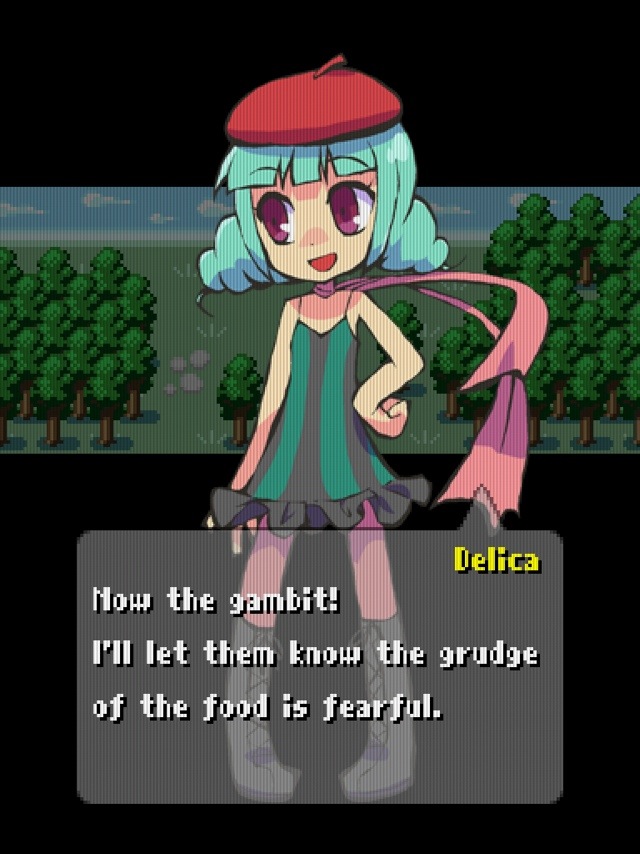
Oh boy do I have a treat for you iOS owners out there. A free game that is brilliant, doesn't try to con you out of any money and doesn't have a single ad in it anywhere. Not only that, but it also features the most spectacular Engrish you will ever see, as evidenced by the screenshot which accompanies this post.

The game in question is HungryMaster by xionchannel. I found it completely by chance while browsing titles related to Square Enix's catalogue on iPad, and downloaded it out of sheer curiosity. I was expecting it to be a five minute novelty, to be deleted immediately afterward.

What I instead found was a wonderfully silly, addictive little game whose use of touch controls puts big-name developers to shame.

The premise is simple and insane. Delica is hungry and walking in the woods one day when she comes across a talking white cat called Saten [sic]. Saten offers to give Delica magical powers for some reason I feel is somewhat lost in translation. Said magical powers allow Delica to defeat monsters by turning them into food, which kills two birds with one stone.

In gameplay terms, the player controls Delica by touching on the screen anywhere, and she follows. In order to use her new-found magical girl powers, the player must draw a line starting from her and running through enemies. The player can lock on to as many enemies as they can draw a line through while a brief timer is running, then they explode and turn into food when the player releases their finger. Delica can then collect the food by running over it. Collecting more food in rapid succession gives a combo bonus, and the main objective of most levels is to collect enough food to deliver to houses scattered around the map. There are occasional boss fights, too, where twenty pieces of food can inexplicably be used to set off a bomb.

It's as gloriously ridiculous as it sounds, but the gameplay is very solid thanks to the excellent touch controls. The whole thing is presented on the iPad or iPhone screen in portraitwise orientation, features 80s-style pixel art and scanlines. It's like holding a forgotten 80s arcade machine in your hand — the sort you only ever found at that one arcade at that one seaside resort, but would always insist on going to whenever possible because that hidden gem of a game was just so good.

I'm very happy that I've found such a hidden gem on iOS. Check it out for yourself here.

#oneaday Day 732: Last Night on Earth

So I'm back in the UK after a long, turbulent and ache-inducing flight. A necessary evil when dealing with international travel, of course, so I'm not going to complain too much.

Andie and I both fell asleep for a bit in the early afternoon once we got back. I know they say that's a bad idea but we were both exhausted to the point of mild delirium. I awoke a short while later relatively refreshed but still zombie-like, had a shower and prepared to head off to my good friend Sam's abode for some board gaming goodness. His wife is away, so he wanted to take advantage of the situation with a "boys' night". Our definition of "boys' night" doesn't involve drinking and going out on the pull; it involves playing board games until 3AM.

And that's what we did. We got in some good time with a number of new titles, including Last Night on Earth and 7 Wonders.

The latter was a pleasant surprise. Many building and resource management games are very time-consuming and complex, but this one is very straightforward. The relatively simple mechanics belie a wealth of strategies, and the card-based nature of the game means that there's a pleasing element of randomness.

Last Night On Earth is at the other end of the spectrum — "Ameritrash" to 7 Wonders' "Eurogame", if you will. (For the uninitiated, "Ameritrash" refers to board games with strong thematic content but simple mechanics that are light on the head-scratching strategy, while "Eurogames" are the opposite, focusing more on mechanics and strategy, often presenting their thematic content in a somewhat abstract way. Both are fine uses of your time, despite the disparaging implications of the word "Ameritrash", but many gamers typically gravitate towards one kind of game or the other as the situation demands.)

As it happened, Last Night on Earth is a good game for the end of the night. Its mechanics are simple and straightforward, but it encourages you to imagine the movie scenes of the virtual zombie horror that you are playing out on the board in front of you. Instead of simply collecting cards and following movement rules, you're imagining, say, Jenny the farmer's daughter fleeing for her life through the cornfields as she is pursued by a relentless horde of zombies; Sheriff Anderson boldly protecting his son from harm by blowing a zombie's head off with a shotgun at point blank range; Jake the "drifter" stumbling around in the darkness, barging shambling zombies out of the way. (Kudos to the game for covering all the zombie movie tropes along the way, too, including a card which implies two opposite-sex player figures inhabiting the same space will want to shag each other, causing them to miss their respective turns.)

Now it's 3.27AM and I should sleep. There's more gaming to be done tomorrow. And then more sleep. Lots more sleep.

Oh, also, I'm now officially into my third year of daily blogging. Go me!

#oneaday Day 727: Together Apart

You know what it's like. You want to play with friends but they all live on the other side of the world to you, so you can never find a convenient time to play together, and as such, you never get the chance to take each other on.

Not so if you happen to have a smartphone or tablet. There's a bunch of asynchronous multiplayer games out there for you to play, meaning that you can take it in turns to play together when it's convenient for each of you. While it's not quite the same as playing live, it's the next best thing.

But what are these games? Well, focusing on iOS, here's a few:

…With Friends

Whatever you may think of Zynga the company, it publishes some of the most popular multiplayer titles in the iOS library: Chess, Words, Hanging and Scramble With Friends.

Of these four games, Scramble is my favourite because it's quick and easy to play, and impossible to cheat at. Words is far too open to abuse (there are tons of "cheat" apps on the App Store), Hanging is a bit boring and, well, I suck at Chess.

The fact that, at the time of writing, I am unbeaten at Scramble certainly helps!

Disc Drivin'

If you've ever flicked a coin around a makeshift course or played that racing game where you flick wooden discs around a racetrack, Disc Drivin' is for you. Offering a bunch of courses, some powerups and the ability to play with up to three friends, this is a fun one for a while, though lacks depth.

Carcassonne

Carcassonne is a brilliant entry-level board game, and its iOS version, while relatively expensive, is an excellent port. Offering not only a great port of the base game but also a fun solitaire puzzle mode, this is a personal favourite.

Ascension: Wrath of the Godslayer

A great card game, as discussed the other night. Ascension lends itself well to the asynchronous format because players compete with one another for points, but turns are pretty self-contained. What little direct interaction there is between players is easily resolved at the start of the next player's turn. The only thing this one is missing is a chat facility — you just play.

Starbase Orion

I admit I haven't spent a huge amount of time with this yet, but it's probably the deepest game on this list. Playing out like Master of Orion (or sort of Civ in space, if you like), this is a lengthy, complex game that strategy buffs will have a blast with in either single or multiplayer.

Hero Academy

The newest title on this list, Hero Academy from Orcs Must Die! developer Robot Entertainment is a turn-based combat strategy game that combines elements of DOTA, tower defense, Final Fantasy Tactics and, err, Scrabble. (Yes, really.) Providing players with a "rack" of units and abilities to use each turn, then allowing five actions per turn, this is a simple to understand but tough to master game with a lot of potential for awesome development in the future — new teams, maps and other possibilities are all in the works.

So there we go. If you have an iOS device and you're looking for some multiplayer action you can fit around your life rather than having to set aside hours at a time, the above are a great place to start.

Do you have any recommendations to add? Let me know in the comments!